1. Introduction
Graph labeling refers to the process of assigning integers to vertices, edges, or both, according to specific rules or constraints. A comprehensive and regularly updated survey on graph labeling was compiled by Gallian [
1] in 2024. The concept of vertex magic total labeling was introduced by MacDougall et al. [
2] in 2002. The terminology of edge magic total labeling was further developed by Wallis et al. [
3].
Applications of vertex and edge magic total labelings have been studied in both theory and practice. The combinatorial aspects of edge magic total labeling in specific families of graphs, such as cycles and wheels, have been examined by Baker and Sawada [
4], providing a theoretical foundation for structured network labeling schemes. In communication networks, Marr and Wallis [
5] explored edge magic total labeling for applications such as unique channel assignment and address computation, which can reduce signal collisions and eliminate the need for lookup tables. Masthan and Sharief [
6] used reverse vertex magic total labeling to solve a real-world resource allocation problem, assigning computers across departments while balancing shared and individual use. Algorithms for constructing vertex and edge magic total labelings in complete graphs were later developed by Manas et al. [
7], suggesting their use in fault-tolerant systems through structured labeling.
Although vertex magic total labeling has been widely studied, restricting the labeling to the even case leads to a more restrictive and structured problem. In even vertex magic total labeling, the vertex labels must be even integers, which introduces parity constraints on both the labels and the graph structure. As a result, not all graphs admitting vertex magic total labeling satisfy this condition. Studying the even case therefore provides a finer classification of graphs and helps reveal structural properties that do not appear in the general setting.
The concept of even vertex magic total labeling was introduced by Nagaraj et al. [
8] in 2017. In this labeling, the vertices are assigned even integers
. The authors explored several fundamental properties of even vertex magic total labelings and demonstrated that certain graphs admit such labelings. Additionally, they identified some graphs that do not possess an even vertex magic total labeling.
Recently, in 2025, Kumar et al. [
9] studied the even vertex in-magic total labeling of digraphs. They investigated several fundamental properties of this labeling and, based on these properties, established both existence and non-existence results for even vertex in-magic total labelings within various families of digraphs.
Moreover, in 2018, Nagaraj et al. [
10] introduced a new concept called the odd vertex magic total labeling of a graph, defined as follows: a vertex magic total labeling
f is called an odd vertex magic total labeling if the labels assigned to the vertices form the set
. They studied some basic properties of this labeling and identified certain classes of graphs that admit odd vertex magic total labeling. They also demonstrated that other classes of graphs do not admit such labeling. Subsequently, in 2018, Nagaraj et al. [
11] contributed by presenting an odd vertex magic total labeling for some classes of two-regular graphs.
We recall the definition of a wheel graph. For an integer , the wheel is obtained by joining a single vertex, called the hub, to every vertex of a cycle . The edges connecting the hub to the vertices of the cycle are referred to as spokes. The vertices lying on the cycle are called rim vertices, and the edges of the cycle are called rim edges.
MacDougall et al. [
12] investigated vertex magic total labelings of wheels and related graphs. Subsequently, further studies on vertex magic total labelings of certain wheel-related graphs were conducted in [
13]. In addition, vertex magic total labelings have been investigated for several classical graph classes, including cycles, paths, complete graphs, bipartite graphs, trees, and wheels; see [
14].
In this study, our focus is on even vertex magic total labelings of wheel-related graphs. Throughout this paper, all considered graphs are assumed to be finite, simple, and undirected. Let
G denote a graph of order
n and size
m. According to the definition in [
2], a
vertex magic total labeling of a graph
G is an injective function
such that the sum of the label of each vertex
u and the labels of all edges incident with
u is a constant. That is,
for every vertex
, where
denotes the set of neighbors of
u. The constant
k is called the
magic constant of the labeling
f. Following Nagaraj et al. [
8], a vertex magic total labeling is said to be
even if its vertex labels are a set of even integers
. Graphs that admit such a labeling are referred to as
even vertex magics. It is also necessary that
for any graph with this property.
Studies such as those in [
15,
16,
17] observed that there exist graphs of equal order and size that admit even vertex magic total labelings. The results in [
8] demonstrated that wheels do not possess even vertex magic total labelings. However, certain wheel-related graphs, including some fan graphs and all sun graphs, do admit such labelings.
The interest and challenge in investigating wheel-related graphs whose size exceeds their order and that also admit even vertex magic total labelings was explored by Saduakdee and Khemmani [
18] in 2023 through the study of certain wheel-related graphs, defined as follows: for integers
and
, the
t-fold wheel is obtained from the wheel
by replacing its hub with
t distinct hub vertices. Each of these hubs is adjacent to every rim vertex, while no edges exist between the hubs themselves. The resulting graph
has
vertices and
edges, so its size is greater than its order. In their study, they determined the necessary and sufficient condition for such labeling, with a focus on
n and
t.
Although vertex magic total labeling has been widely studied, restricting the labeling to the even case imposes additional parity constraints on both vertex labels and the underlying graph structure. As a result, not all graphs admitting vertex magic total labelings satisfy this stronger condition. Studying the even case therefore provides a finer classification of graphs and reveals structural properties that do not appear in the general setting, particularly for highly symmetric graphs such as wheel-related graphs.Among these graphs, the plus wheel arises naturally as an extension of the classical wheel graph by adding vertices while preserving much of its symmetry. This modification introduces new parity-related structural features that affect the existence of even vertex magic total labelings. Moreover, this class of graphs has not been previously studied in this context. Motivated by these observations, we investigate even vertex magic total labelings of plus wheels and other wheel-related graphs, and we establish necessary and sufficient conditions for their existence.
The following results from [
8,
18] will be used throughout this paper.
Theorem 1 ([
8]).
Let G be a nontrivial graph with n vertices and m edges. If G admits an even vertex magic total labeling, then its magic constant k is given by Theorem 2 ([
18]).
Let n be an odd integer with and let be an integer. Then the t-fold wheel has an even vertex magic total labeling if and only if . Theorem 3 ([
18]).
Let n be an even integer with and let be an integer. Then the t-fold wheel admits an even vertex magic total labeling if and only if . 2. Even Vertex Magic Total Labelings of Wheel-Related Graphs of Order
In this section, we explore the even vertex magic total labelings of various wheel-related graphs of odd order, specifically those with order of the form . First, let us introduce the families of graphs related to the wheel that exhibit this particular order.
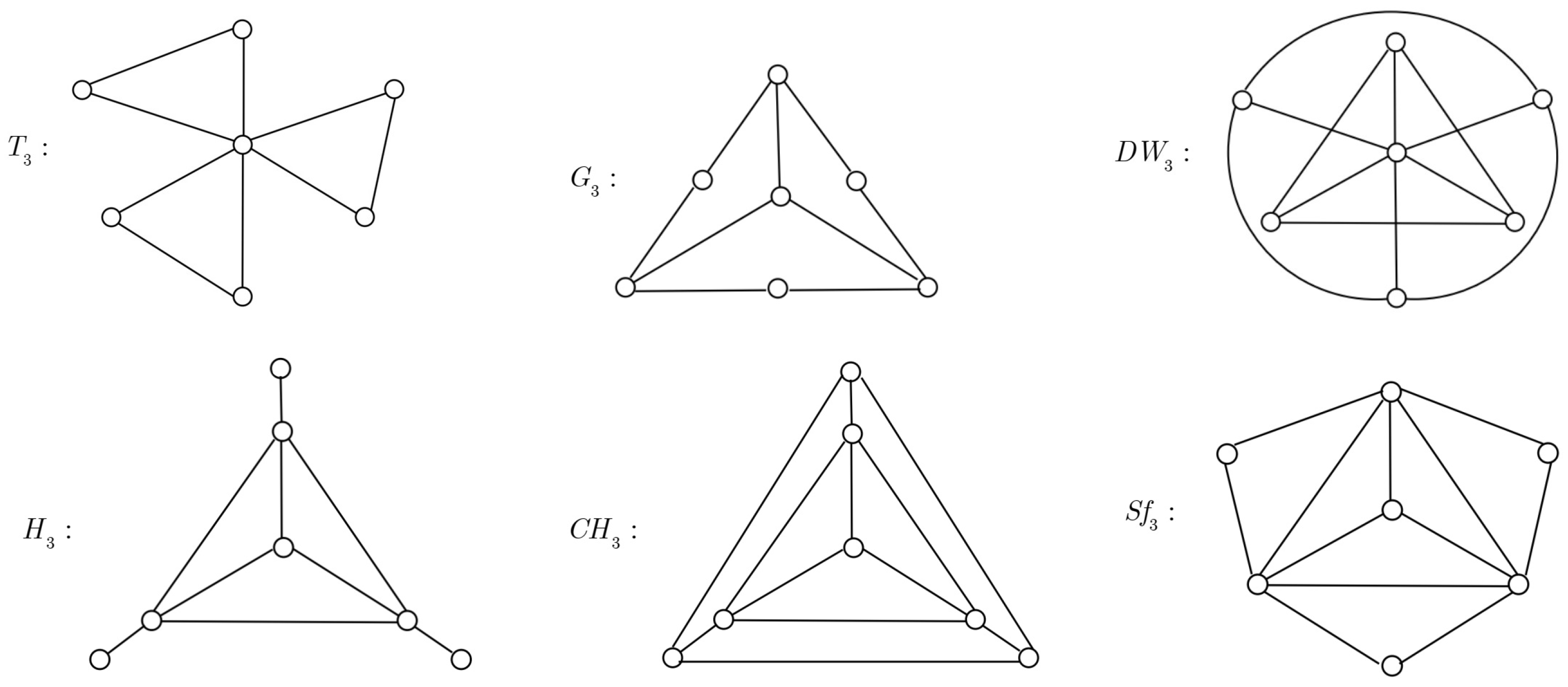
The friendship graph , , is a graph of order and size , obtained from a wheel by deleting alternate rim edges. Another way of obtaining a friendship graph is a collection of n triangles sharing exactly one common vertex.
A gear graph , , is a graph of order and size , constructed from a wheel by inserting an additional vertex between each pair of adjacent rim vertices. This results in a graph where each original rim edge is subdivided once, forming a cycle of vertices connected to the hub.
A double wheel , , is a graph of order and size , composed of two cycles of order n, where the vertices of the two cycles are all incident to a common hub.
A helm , , is a graph of order and size , obtained from a wheel by attaching a pendant edge to each rim vertex.
A closed helm , , is a graph of order and size , derived from a helm by joining pendant vertices in sequence to form the cycle .
A sunflower , , is a graph of order and size , constructed from the gear graph by joining the rim vertices that are adjacent to the hub, in sequence to form an additional cycle .
Some wheel-related graphs of order 7, corresponding to
, are illustrated in
Figure 1.
We begin exploring a useful lemma for wheel-related graphs of order as follows.
Lemma 1. For every integer , is not divisible by .
Proof. Suppose, to the contrary, that is divisible by . We first observe that is not divisible by , or otherwise for some positive integer q, leading to a contradiction for .
Additionally, since , and divides , it follows that divides 3, which is impossible for . Therefore, cannot be divisible by . □
From Lemma 1, we obtain the following theorem.
Theorem 4. For every integer , a graph of order and size is not an even vertex magic.
Proof. Suppose, to the contrary, that there exists an integer such that a graph G of order and size is an even vertex magic with magic constant k. By Theorem 1, we have
By Lemma 1, is not divisible by . That is, k is not an integer, which is a contradiction. Therefore, a graph G of order and size is not an even vertex magic for every integer . □
By Theorem 4, the following corollaries present classes of wheel-related graphs that are not even vertex magics.
Corollary 1. For every integer , the friendship graph is not an even vertex magic.
Corollary 2. For every integer , neither the gear graph nor the helm admits an even vertex magic total labeling.
In addition to the above results for graphs of order and size , we now consider wheel-related graphs of the same order but with a larger size, specifically those of order and size , as discussed below.
Theorem 5. For every integer , a graph of order and size is not an even vertex magic.
Proof. Suppose, to the contrary, that there exists an integer such that a graph G of order and size is an even vertex magic with magic constant k. Theorem 1 implies that
Since is greater than 2 and does not divide 2, it follows that k is not an integer, which is a contradiction. Therefore, a graph G of order and size is not an even vertex magic for every integer . □
Since the closed helm , the double wheel , and the sunflower all have order and size for every integer , Theorem 5 implies the following result.
Corollary 3. For every integer , the closed helm , double wheel , and sunflower are not even vertex magics.
3. Even Vertex Magic Total Labelings of Wheel-Related Graphs of Order
From the previous section, we establish the result that several wheel-related graphs of order are not even vertex magics. In this section, we aim to explore other wheels that are even vertex magics. Accordingly, we define a new wheel-related graph of order as follows.
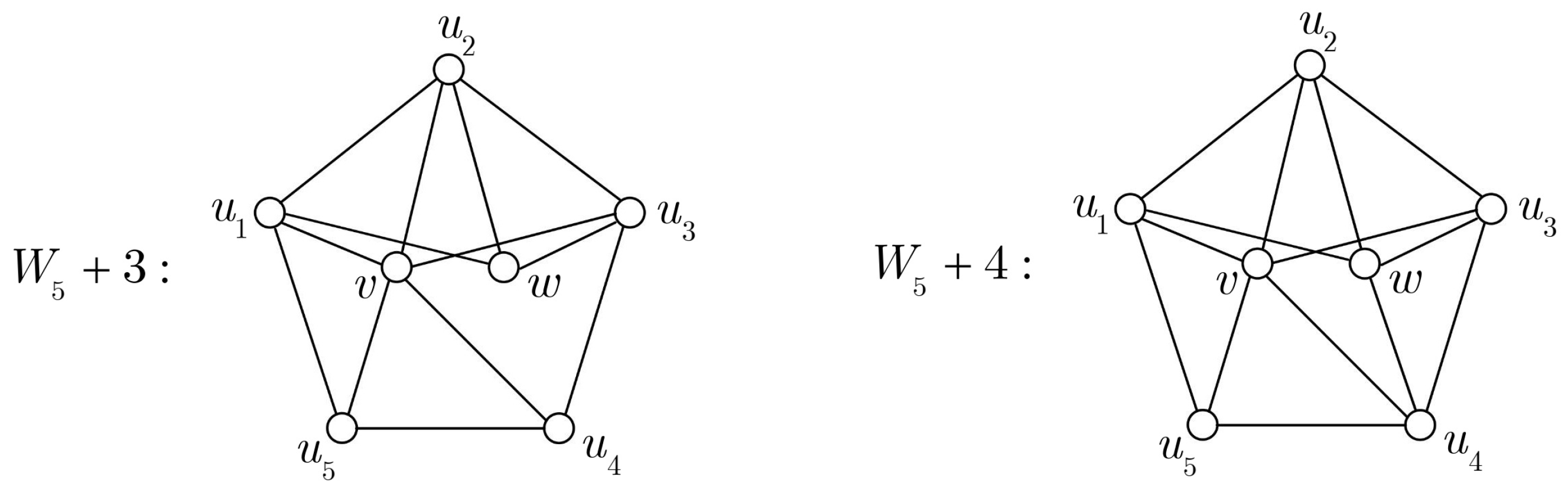
A plus wheel , where and , is a wheel-related graph obtained from a wheel by adding a new vertex w that is adjacent to r consecutive rim vertices.
We now introduce some additional notation for the plus wheel
where
and
. Let
be the vertex set, where
v is the hub of the wheel and
w is the additional new vertex, and the edge set is defined as
In order to clearly illustrate the newly defined graph, we hereby present an example of the plus wheel
for
and
in
Figure 2.
The plus wheel has order and size . Furthermore, it can be observed that the plus wheel is isomorphic to the 2-fold wheel . Based on the order and size of the plus wheel, its magic constant can be derived by Theorem 1 as presented in the following proposition.
Proposition 1. Let n and r be integers with and . If the plus wheel admits an even vertex magic total labeling, then its associated magic constant k is given by Proof. Suppose that the plus wheel
is an even vertex magic with magic constant
k. Observe that the plus wheel
has order
and size
. By Proposition 1, the magic constant is given by
Simplifying the above expression, we obtain
□
By Proposition 1, we have the following result.
Proposition 2. Let and be integers. If the plus wheel admits an even vertex magic total labeling, then .
Proof. Suppose that the plus wheel
has an even vertex magic total labeling with magic constant
k. Proposition 1 then implies that
First, suppose that . Then Since k must be an integer and , it follows that , and the magic constant is . However, in this case, , so the maximum possible value of is , which is less than k, leading to a contradiction.
Since , the denominator does not divide 2. Consequently, the value of k is not an integer, contradicting the fact that the magic constant must be an integer.
Therefore, in both cases, a contradiction arises. It follows that . □
Building on Proposition 2, we now investigate a necessary condition for the plus wheel
to be an even vertex magic. To aid in the proof, the following notation is provided: for any even vertex magic total labeling
f of an even vertex magic
G, define
for each vertex
u of
G.
Theorem 6. For every integer , if the plus wheel is an even vertex magic, then .
Proof. Let be an integer. Suppose that the plus wheel admits an even vertex magic total labeling with magic constant k. For a contradiction, suppose that . According to Proposition 1, the magic constant is given by We consider two cases.
Case 1. n is odd.
Observe that k is even and the degree of the hub v in is odd. Consequently, the minimum possible even value of is
Since , it follows that , which implies that the minimum even value of exceeds the magic constant k. This is a contradiction.
Case 2. n is even.
Consider that the minimum possible value of is . Since , . Hence, the minimum of exceeds the magic constant k, which is a contradiction.
Hence, in both cases, we establish that , completing the proof. □
Based on the necessary condition established in Theorem 6, we now construct an even vertex magic total labeling for the plus wheel when n is an odd integer satisfying .
Theorem 7. For every odd integer , the plus wheel is an even vertex magic.
Proof. Let
n be an odd integer with
. Define a labeling
as follows:
The remaining edge labels are specified in
Table 1.
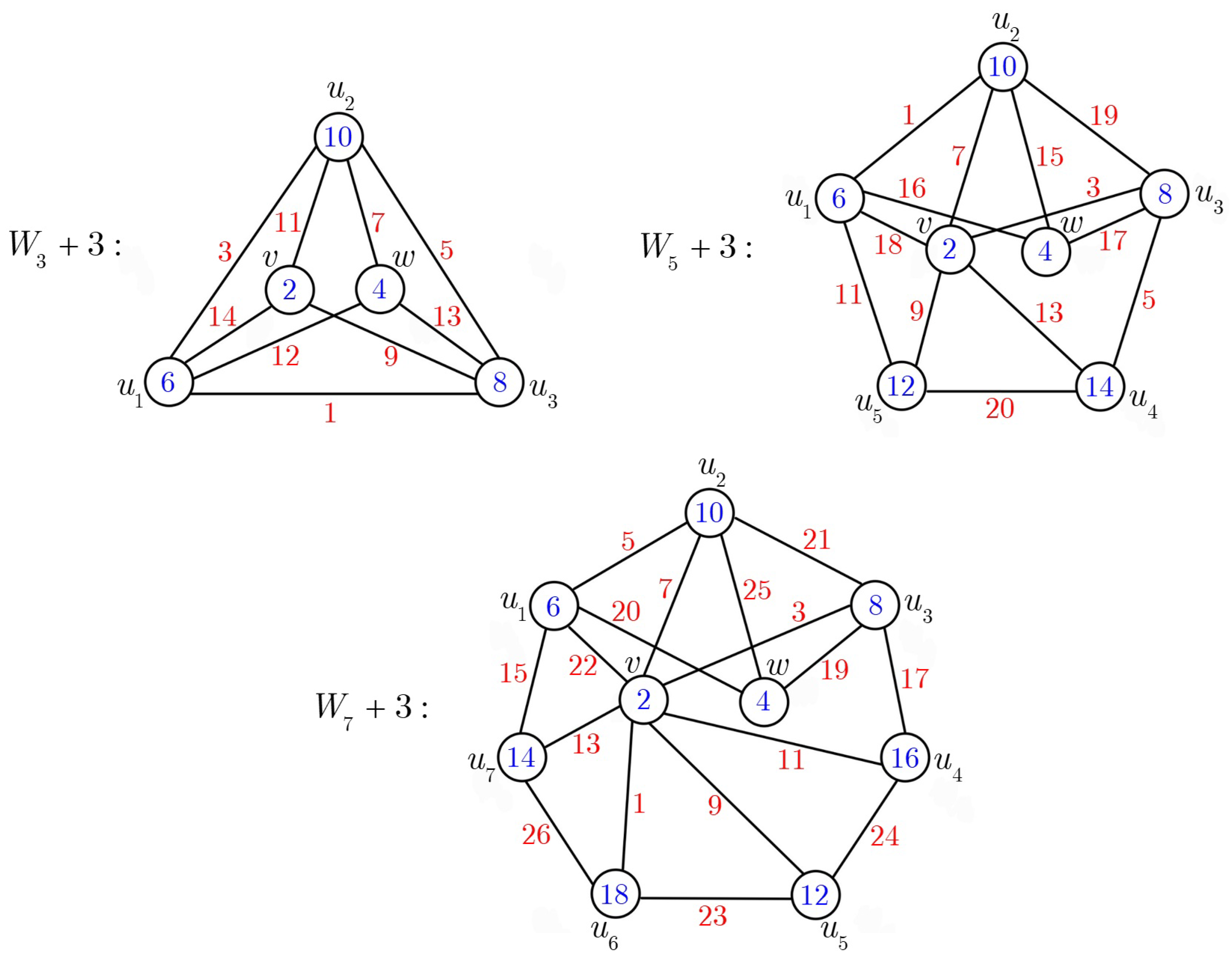
Then, for each , and 7, we have and 68, respectively, for each vertex u of . Consequently, the labeling f is an even vertex magic total labeling of with magic constant and 68, respectively. Therefore, is an even vertex magic. □
As defined in Theorem 7, the even vertex magic total labelings of the plus wheels
,
, and
with magic constants
, and 68, respectively, are presented in
Figure 3.
The following construction presents an even vertex magic total labeling of the plus wheel for even integers n with .
Theorem 8. The plus wheel is an even vertex magic for all even integers n satisfying .
Proof. For an even integer
n with
, a labeling
is defined by
and for
, labels of the remaining edges are shown in
Table 2.
For each , and 8, we have , 60, and 76, respectively, for every vertex u of . Consequently, the labeling f yields an even vertex magic total labeling of with magic constant and 76, respectively. Hence, has an even vertex magic total labeling. □
We recall the following necessary notation:
for each even vertex magic total labeling
f of an even vertex magic
and
.
Next, we present a lemma giving a necessary condition for the plus wheel to be an even vertex magic.
Lemma 2. The plus wheel is not an even vertex magic.
Proof. For a contradiction, suppose that
has an even vertex magic total labeling with magic constant
k. By Proposition 1, it implies that
. Let
f be an even vertex magic total labeling of
such that
and for each vertex
u of
,
First, consider the hub
v. Since
and
, it follows that
, and
Next, we claim that must consist only of odd integers; suppose, to the contrary, that this is not the case. Since some of these edges are labeled with even integers, the minimum possible even value of is , which is a contradiction. Hence, all four of these edge labels must be odd integers.
We now claim that , for some . In order to see this, suppose otherwise, that . Since , it must be that and = . As a consequence, the minimum possible even value of is , and again a contradiction is produced. Therefore, , for some .
Next, we show that cannot consist of all even integers. Suppose, to the contrary, that . Then there exists rim vertex for some , for which is the sum of three even integers and one odd integer, resulting in being odd, and then contradicting . Therefore, at least one of these four rim edge labels must be odd. Consequently, the remaining must contain at least one even integer.
Finally, we claim that contains all five even integers. Suppose, to the contrary, that at least one is not. Then there is a rim vertex for some such that is the sum of two even and three odd integers, resulting in being odd, a contradiction to . Hence, as claimed, all five of these rim edges must be labeled with even integers.
Unfortunately, there are only four even integers, namely , which are insufficient to label these five rim edges. This is a contradiction.
Therefore, our initial assumption is false, and so is not an even vertex magic. □
Next, we investigate a necessary condition for to admit an even vertex magic total labeling.
Theorem 9. For every integer , if the plus wheel is an even vertex magic, then .
Proof. Let be an integer. Suppose that admits an even vertex magic total labeling with magic constant k, and suppose to the contrary that . If , then by Lemma 2, is not an even vertex magic, producing a contradiction. Now suppose . By Proposition 1, the magic constant . We consider two cases.
Case 1. n is odd.
Since k is even and the degree of the hub v is odd, it follows that the minimum possible even value of is . For , we have , implying that the minimum possible even value of exceeds the magic constant k, which would produce a contradiction.
Case 2. n is even.
Again, by Proposition 1, . Since k is even and is even, the minimum possible value of is . For , it can be deduced that . Hence, the minimum of exceeds the magic constant k, which gives a contradiction.
Therefore, in both cases, we conclude that , as desired. □
Given the condition provided in Theorem 9, we proceed to construct an even vertex magic total labeling of the plus wheel for each odd integer n with .
Theorem 10. The plus wheel admits an even vertex magic total labeling for .
Proof. Let
n be an odd integer, where
. We construct a labeling
as follows:
>and for
, labels of the remaining edges are shown in
Table 3.
For and 7, equals 58 and 74, respectively, for each vertex u of . Consequently, the labeling f yields an even vertex magic total labeling of the plus wheel with magic constant and , respectively. Therefore, admits an even vertex magic total labeling. □
Next, we present an even vertex magic total labeling for the plus wheel when n is an even integer satisfying .
Theorem 11. For every even integer , the plus wheel is an even vertex magic.
Proof. Let
n be an even integer satisfying
. Define a labeling
as follows.
and for
, labels of the remaining edges are shown in
Table 4.
Then, for , and 8, equals and 82, respectively, for each vertex u of . Hence, the labeling f constitutes an even vertex magic total labeling of with corresponding magic constant and 82, respectively. Consequently, admits an even vertex magic total labeling. □
Combining Theorems 6–8 and Theorems 9–11, we obtain a complete characterization of when the plus wheel admits an even vertex magic total labeling for , as stated in the following theorems.
Theorem 12. For every integer , the plus wheel is an even vertex magic if and only if .
Proof. Let be an integer. Suppose that the plus wheel is an even vertex magic. By Theorem 6, we obtain . Since , it follows that . Conversely, suppose that . Then, by Theorems 7 and 8, the plus wheel is an even vertex magic. □
Theorem 13. For every integer , the plus wheel is an even vertex magic if and only if .
Proof. Let be an integer. Suppose that the plus wheel is an even vertex magic. By Theorem 9, we have . Together with the condition , this yields . Conversely, let . Then, by Theorems 10 and 11, the plus wheel is an even vertex magic. □
Alternatively, for integers , we characterize precisely when the plus wheel admits an even vertex magic total labeling.
Theorem 14. For every integer , the plus wheel is an even vertex magic if and only if .
Proof. For an integer r with , suppose that has an even vertex magic total labeling. By Proposition 2, this implies that . Conversely, suppose . By Theorem 7, is an even vertex magic. □
Theorem 15. For every integer and , the plus wheel is an even vertex magic if and only if .
Proof. Let
n and
r be integers with
and
. Suppose that
admits an even vertex magic total labeling with magic constant
k. According to Proposition 2, this implies that
. Suppose, to the contrary, that
. Then, by Proposition 1, we have
For each integer and , it follows that is not an integer, contradicting the fact that k is an integer. Similarly, when and , it follows that is not an integer, which is again a contradiction. Furthermore, if , then is isomorphic to the 2-fold wheel , which by Theorem 3 is not an even vertex magic. This again leads to a contradiction. Hence, r is either 3 or 4.
Conversely, if or , then by Theorems 7, 8, 10 and 11, the plus wheel is an even vertex magic. □