1. Introduction
Timely elimination of emergency modes in power network operation provides durability of its elements. Based on the analysis of current and voltage values, relay protection and automation systems (RP and AS) are used to solve this problem. Current data are obtained primarily by using closed-loop electromagnetic current transformers (CTs) [
1]. CT core, as operating experience shows, can become saturated during the transient process caused by fault [
2]. As a result, the error of a measured current increases sharply and affects RP and AS efficiency negatively. This necessitates the development of a set of procedures to eliminate the impact of CT core saturation on the correct operation of the RP and AS algorithms.
Today, one way to solve the problem is to introduce an air gap into the CT core [
3,
4]. This reduces the magnetic permeability of the core, which supports normal operation of the CT under transient processes of emergency mode. Replacing a large number of existing CTs with a closed magnetic core can result in significant time and financial costs. Consequently, solving the problem in this way may be ineffective in terms of its implementation. The second method to solve the saturation problem is to increase the requirements for the selection of CT. Generally, with the development of energy facilities, the power flow through network elements begins to increase, and this leads to an increase in fault currents. As a result, the magnetic cores of previously selected CTs may become saturated. The third way to solve the problem of restoration of the saturated CT distorted current is based on deterministic mathematical methods [
5]. As a result, the calculated current is more accurate and closer to the reference one. A characteristic feature of this way is the difficulty of adapting deterministic methods to real conditions. The next way is to restore the distorted current waveform by using methods based on artificial neutron networks (ANNs) [
6,
7,
8]. In this case, the problem of CT current restoration is reduced to regression tasks, and the measured current values are used as input features of ANNs. After training, the output of the network provides calculated current values close to the reference ones. One of the features of this way is the necessity of the data preprocessing stage. It can lead to additional time delay. Another feature is the use of a large number of neurons with complex mathematical functions in them. This leads to an additional computational burden on the algorithms of RP and AS.
One possible way to solve saturation problems is to use machine learning (ML) methods which are based on a set of decision rules consisting of conditional operators. One of the advantages of this class of ML methods is that there is no need to use mathematical functions. The trained algorithm processes data based on a set of conditional operators without using complex mathematical functions. As a result, data processing time can be reduced to a level acceptable for the operation of RP and AS algorithms.
The contributions of this work are as follows. A comparative analysis of methods for restoration of the CT measured current is carried out and their advantages and disadvantages are shown. A method for dividing current data into clusters depending on the depth of the CT core saturation and the shape of the distorted current curve is proposed based on the ML algorithms. Then, the current restoration problem is reduced to regression tasks and a current restoration method is proposed.
Section 2 of the paper provides analysis of both deterministic and ML methods for current restoration.
Section 3 describes a methodology for generating a data sample and clustering the distorted shape of current curves with their subsequent restoration.
Section 4 presents experiments, selection of hyperparameters of ML methods, and evaluation of their performance.
Section 5 describes the discussion and limitation of the proposed methodology. The conclusion of this paper provides the findings of the study and plans for future research.
2. Evaluation of the Current State of the Problem
In Reference [
9], to solve the problem of current restoration, a method based on a fault current model is proposed. In this model, amplitude
Im and phase
φ are unknown parameters of AC component, and initial value
I0 and decay rate
γ are unknown parameters of the DC component, as follows:
where
and
are calculated and measured current, respectively.
Based on the Taylor series and the transformation of trigonometric functions, the model is reduced to a form in which its unknown quantities are expressed in linear form. Afterwards, unknown values of the above-mentioned parameters are calculated using the measured current values corresponding to unsaturated section. Then, the distorted section of the measured current is replaced by a calculated current close to the ideal one.
One of the advantages of this method is that it is independent from CT parameters and helps to find unknown parameters of the fault current model relatively fast. Another advantage of this method is the “smoothing” white noise of the measured current. The feature of this method is its high sensitivity to random components with a distribution different from normal and to harmonic, interharmonic, and subharmonic components in the measured current. The method also assumes that when fault current occurs, the homogeneity of the emergency mode is maintained until it is eliminated. These features limit its practical development. However, the method has found theoretical development in [
10,
11].
A method for restoring the CT current using its parameters is proposed in [
12]. The method simulates the magnetization curve of the CT without considering the hysteresis loop. After that, when the CT’s core saturation occurs, the secondary current values are calculated based on this curve. This can be represented as follows:
where
and
—measured current and residual induction at the moment of the CT saturation occurrence, respectively;
,
and
—resistive load, inductive load, and CT magnetizing current, respectively.
The advantage of this method is robustness to the presence of random and harmonic components in the measured current. Another advantage of the method is independence from data homogeneity in the transition process of emergency modes. However, the use of the method assumes that the trajectory change in magnetic induction
λ in the magnetization curve contains no hysteresis loop. This affects method accuracy negatively. Also, the method is strongly tied to the CT parameters, and in case of a small deviation, the phenomenon of ill-conditioning may occur. The main disadvantage of the method is its high sensitivity to residual induction at the moment of CT saturation occurrence. Despite the existing disadvantages, the method has found wide theoretical development in [
13,
14,
15].
In Reference [
16], a new method is presented that resulted from the combination of [
9,
12]. It was designed to eliminate the shortcomings of the previously considered methods. Based on method [
9] under CT core saturation, the initial region of the distorted section of the measured current is predicted. After that, using this predicted value, the estimation of the residual induction
corresponding to the moment of the CT saturation occurrence is performed. Then, on the basis of the method [
12], the remaining part of the distorted section of the measured current is reconstructed using the already known
. Thus, the sensitivity of the method [
9] to the homogeneity of the transient process and random components as well as the sensitivity of the method [
12] to residual induction
are reduced to a minimum.
The advantage of the combined method is the increase in its robustness to the homogeneity of the fault mode and residual
. However, a small deviation in predicting the initial region of the distorted section of the measured current can lead to poor conditioning. Despite this, the method was developed in [
17,
18]. A more detailed analysis and numerical evaluation of methods [
9,
10,
11,
12,
13,
14,
15,
16,
17,
18] is given in [
5].
To restore the current, a method based on artificial neural network model with a feedforward architecture (FNN) is proposed in [
19]. The model consists of an input layer, two hidden and an output layer. The input layer contains 32 nodes, which corresponds to a full period of the measured current at a frequency of 50 Hz. The first and second hidden layers contain 15 and 8 neurons, respectively. The number of neurons in the output layer corresponds to the number of nodes in the input layer. In all neurons of all layers, a modified sigmoid function is used as the activation function. The input of the model accepts distorted measured current values corresponding to one period, and the output returns clarified calculated current values.
The solution of the problem of restoration of the CT secondary current and compensation of its error using FNN methods has found theoretical development [
20,
21,
22,
23]. Some of the earliest methods of CT current restoration using FNN are proposed in the works [
24,
25,
26,
27].
The advantage of the FNN-based method is its high adaptability to all CT saturation scenarios and harmonic components in the measured current. The necessity to use additional data preprocessing methods before supplying them to the model input is one of its disadvantages. This leads to additional delay. Another disadvantage of this method is the use of complex mathematical functions in the trained model. The final disadvantage of this method is the inability of the model to consider time characteristics of the fault current transient process.
To eliminate the negative impact of CT core saturation on the correct operation of RP and AS algorithms, a method is proposed in [
28]. The essence of the method is the use of a deep neural network (DNN) model based on a denoising autoencoder (DEA). The problem of eliminating the negative impact on CT saturation is reduced to classification tasks. The use of the DEA-based DNN model is intended to reduce the influence of noise on the measured current values and identify the most informative input features. The model used consists of 4 autoencoders. The first and second layers use 15 and 12 neurons, respectively. And in the third and fourth layers, 9 and 5 neurons are used, respectively. The model receives measured current values at the input and produces a signal at the output that determines the saturation of the CT.
The advantage of the method proposed in [
28] is its high adaptability to various forms of distortion and robustness to noise in measurements. The disadvantage of this method is the failed combination of the data preprocessing method and the Leaky ReLu activation function in neurons. After preprocessing, the data are distributed in the range between [−1, 1]. The Leaky ReLu activation function strongly cuts off negative values of the measured current. As a result, there is a loss of informative features for the values of the reverse half-period of the measured current. The necessity of the data preprocessing stage is another disadvantage of this method. This leads to unnecessary delays in the RP and AS algorithms. As a result, this method returns a signal about CT core saturation, after which it is necessary to block the operation of the RP and AS algorithms.
To restore distorted CT current, a method using a DEA-based DNN model was proposed in [
29]. The problem of current restoration is reduced to regression tasks. The proposed DNN model contains 3 DEA layers, each of which uses 60, 57, and 55 neurons, respectively. The activation function used in the encoder layer is Leaky ReLu, and the activation function used in the decoder layer is linear. The advantage of this method is its robustness to noise in measured values and adaptability to various forms of current distortion. The disadvantage of this method is the lack of possibility to restore the current of the reverse half-period. This is caused by the failed use of activation functions with the range of values narrowed to the I and II quadrants of the coordinate system. As a result, the function suppresses negative current values. Another disadvantage of the method is the large number of neurons in the hidden layers. This leads to additional time delay in RP and AS algorithms.
Table 1 provides a comparative analysis of the methods considered. To indicate the purpose of these methods, the following abbreviations are used in the table: 1—restoration of the CT current; 2—detection of the CT core saturation.
As the analysis shows, despite the research topic elaboration level, from a practical point of view the problem of the negative impact of CT saturation remains unresolved. Considering the properties of the above-mentioned methods, a ML algorithm current restoration technique is proposed, which divides distorted measured currents into groups depending on their distortion form and the depth of the CT core saturation. Then, for each of these groups the most appropriate model for current restoration is determined. A detailed description of the methodology is given below.
3. CT Current Restoration Methodology
It is known that training ML models requires previously accumulated data samples describing the behavior of the object under study. The collection of current data samples was carried out on the basis of the mathematical model of CT described in [
30]. Data generation was carried out by varying both the CT parameters, including residual induction, the magnitude and nature of the secondary load, and the fault current angle and magnitude. As a result, a sample with different fault current modes and CT saturation depths was formed. The generated sample size was 5400 pairs of measured and reference currents.
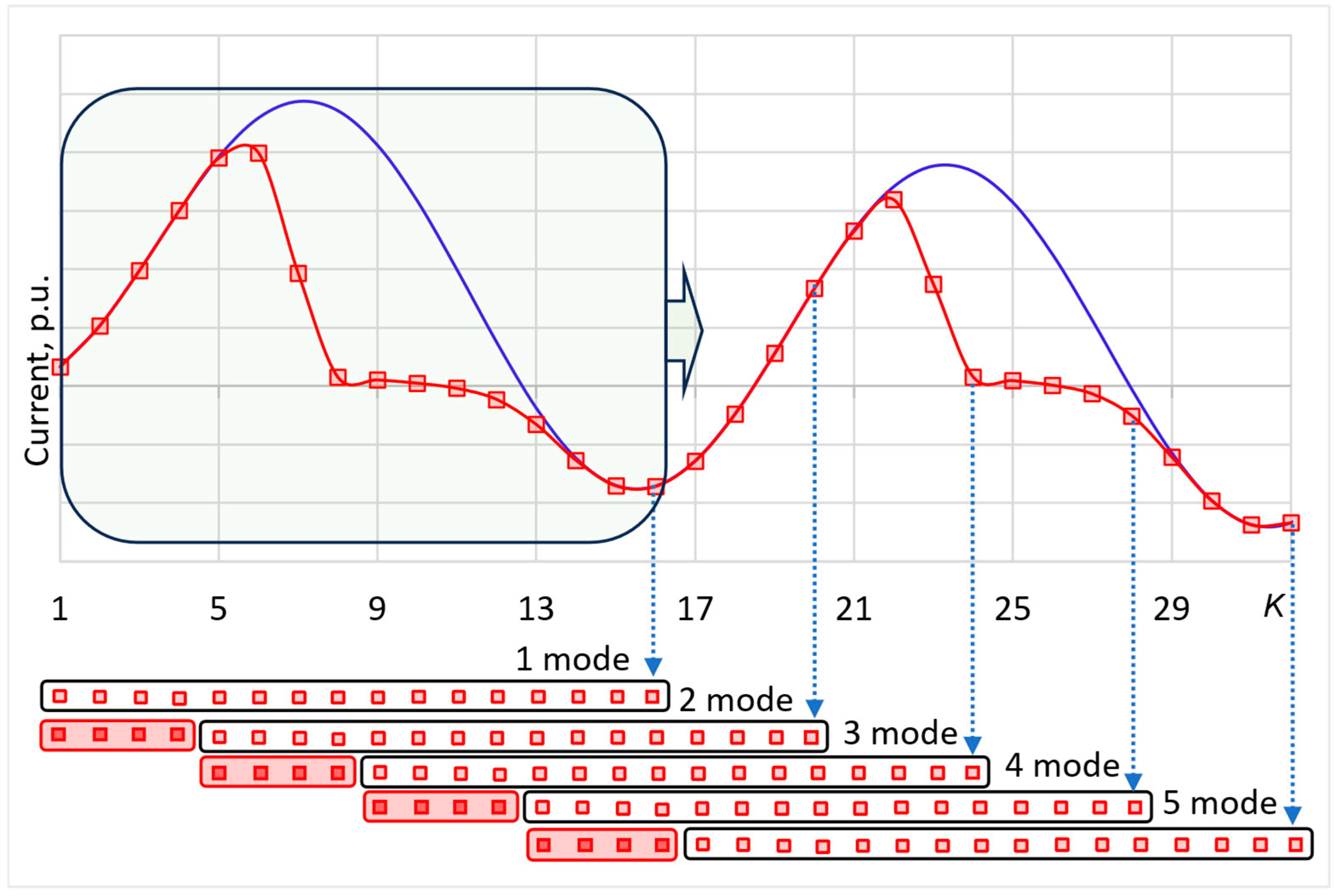
Each of the current modes’ duration in the obtained sample was three periods with a frequency of 50 Hz. It is important to note that the location of the fault current occurrence moment with regard to the data window affects the accuracy of the ML models. For this purpose, 16 scenarios were generated from one fault mode using a window function with a width of 1 cycle and a sliding step of 5 ms. For clarification,
Figure 1 shows an example of window function over the fault current. As a result, 5 scenarios are formed for one case of fault consisting of 2 cycles.
Thus, the duration of each pair of measured and reference currents was 1 period with a frequency of 50 Hz. The total volume of the resulting sample was 86,400 fault modes.
It has been established that the following factors contribute to CT core saturation: residual induction; the angle of the fault current occurrence; the magnitude and nature of the secondary load of the CT secondary winding. Each of the listed factors affects the depth of saturation in a different way. As a result, for each of the saturation cases in the previously formed samples, the distorted shape of the secondary current curve may differ greatly. This may result in reduced efficiency of the ML models during current restoration. To eliminate the negative impact of this phenomenon, it is proposed to divide the initial data sample into clusters. As a result, currents that are similar in curve shape are grouped in each cluster. Considering the distribution density of the descriptive statistics of each measured current data in the initial sample, K-means is the most suitable clustering algorithm [
31]. The essence of this algorithm is to determine the smallest distance between each of the sample points to randomly selected reference points, called centroids, as follows:
where
xi and
n—
ith point and number of points in the data sample;
μj—
jth centroid;
C—number of clusters.
Thus, the relation of each point to a cluster is determined. As a result, currents are grouped according to the identity of distortions. This allows one to reduce the degree of data dispersion relative to their average of distribution, which has a positive effect on the accuracy of current restoration methods based on ML algorithms.
After clustering, it is necessary to restore the distorted measured current values, considering RP and AS algorithm performance requirements. For this purpose, it is proposed to develop a model for the CT current restoration by using ML algorithms that operate based on a set of logical rules without high computational load. The following algorithms are used to construct such models: Decision Tree (DTree) [
32], Random Forest (RForest) [
33], and eXtreme Gradient Boosting (XGBoost 3.0.2) [
34]. The Support Vector Machine for Regression Problems (SVR) method is also used for comparative analysis [
35].
The DTree algorithm partitions the original set into disjoint subsets. In the case of current restoration, the initial set is the values of the distorted measured and reference currents of the CT, as follows:
where
X—original set;
xi and
yi—measured and reference current values in
ith subset, respectively;
l—quantity of all subsets.
To assess the quality of the original set division in (4), the split criterion:
and information gain are used:
where
—measure of information content when dividing a set with R objects;
y and
—reference and average current values, respectively;
—original set;
and
—right and left subsets after division of the
, respectively;
j and
tm—feature and threshold value for dividing a set, respectively.
It should be noted that with each division of the original set in the DTree algorithm, leaves, containing an information measure, information gain and the number of objects, are formed. The last leaves are called terminal leaves. In the context of CT current restoration, they contain current value close to the reference ones. Formulas (5) and (6) are used only in the process of training the algorithm. After training, the algorithm forms a set of conditional operators and saves feature index of the original sample.
The RForest algorithm is a class of ensemble methods in ML. It is based on a set of DTree algorithms that operate independently from each other. The output of the RForest algorithm is an averaged result of the DTree operation as follows:
where
result of
ith DTree.
Thus, each calculated value of the CT current obtained at the output of the RForest algorithm is the result of averaging the forecasts at the output of a number of DTree algorithms.
The XGBoost algorithm is a class of ensemble ML models that contains a set of weak patterns. Unlike RForest, in this algorithm the models are assembled into a sequential chain. In this chain, each subsequent model learns from the errors of the previous one. The algorithm’s training task is formulated as follows:
where
L,
a and
c—loss function, weighting coefficient, and
ith algorithm.
The next ML algorithm for solving the current restoration problem is the SVR method. The essence of the method is to search for the optimal hyperplane, and this is reduced to optimization tasks as follows:
where—
and
—slack variables;
K—regularization parameter;
d—bias;
—band width;
w—model parameters vector.
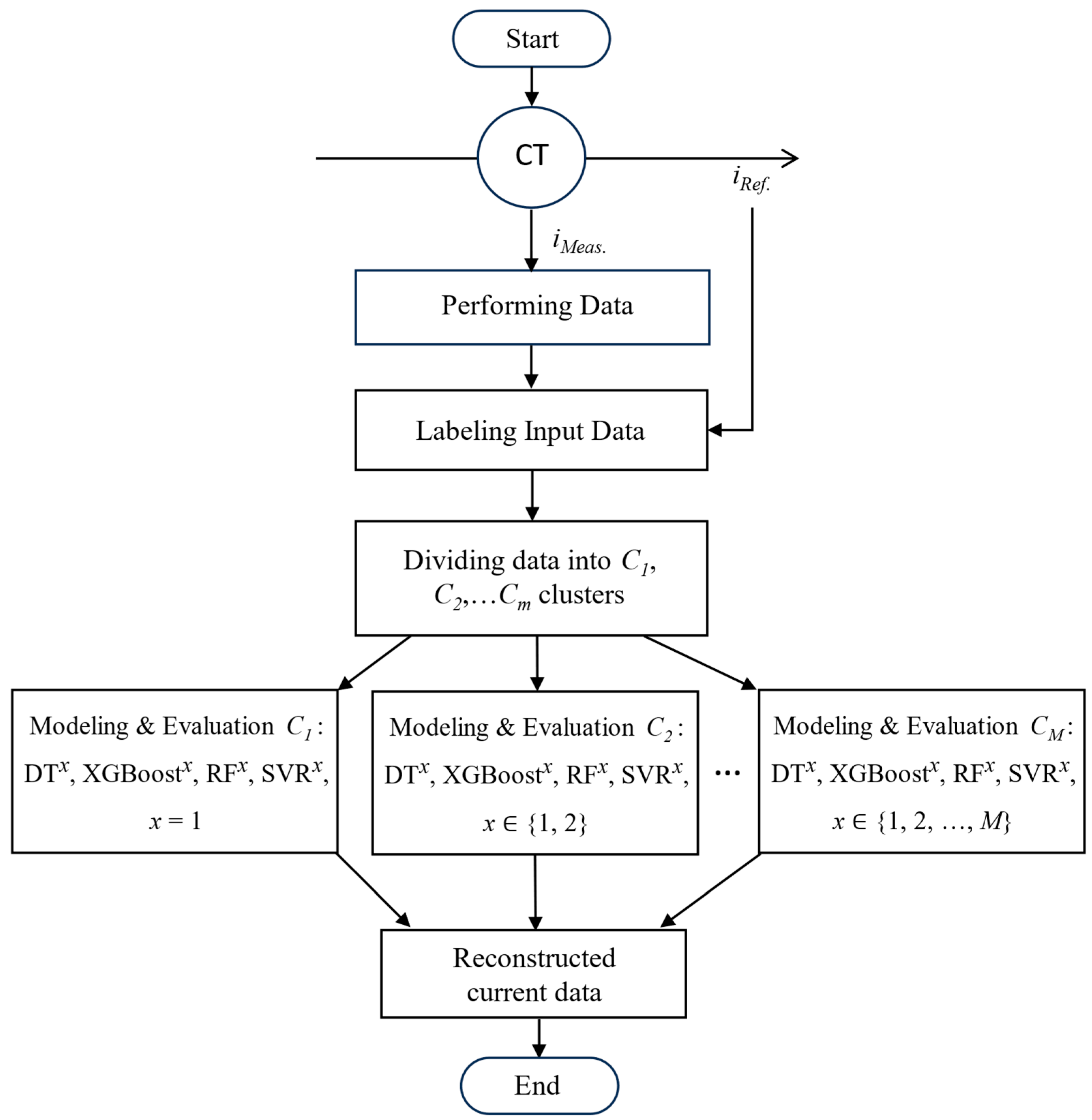
Thus, based on the listed the ML algorithms the problem of current restoration, under CT core saturation conditions, is solved. The structural diagram of the proposed method is presented in
Figure 2. As shown in the figure, at the first stage, pairs of current data samples (measured and reference) are formed based on the mathematical model of the CT. On the next stage, obtained samples are divided into clusters depending on the depth of CT saturation and the distorted shape of the current curves. Finally, for each obtained current data cluster the most suitable ML algorithm for CT current restoration is determined. From
Figure 2 it can be seen that the number of clusters
M is not initially known. The optimal
M is determined by combining operations of the clustering algorithm and models for current restoration. To do this,
M should vary as follows. When
M = 1, models for CT current restoration are trained. Then, the performance quality of each trained model is determined using the total error of the CT as follows:
where
I and
Iµ—the RMS values of the primary and magnetizing currents of the CT reduced to the secondary side, respectively;
i1 and
i2—instantaneous values of the reference and measured currents;
—CT transformation ratio;
N—signal sampling frequency, samples/cycle.
Thus, when
M = 1, the error of each DTree, RForest, XGBoost, and SVR regression model is calculated. On the next step, the original sample is divided into 2 clusters,
M = 2. For each of these clusters, their own current restoration models are developed based on DTree, RForest, XGBoost, and SVR. The total number of models is 8. Therefore, after applying Formula (10), 8 errors are obtained—4 for each cluster. Then, the intercluster error of similar models is averaged as follows:
where
M—number of clusters;
k—type of model within a cluster,
;
—intercluster mean error of identical models.
4. Case Study
One of the most important components in ML algorithms is their hyperparameters. The correct choice of parameter values directly affects the efficiency of algorithm work.
Table 2 shows the default values of these hyperparameters in the Python 3.13.5 libraries Sklearn and Xgboost. Another important component is the data sample size. The total data sample volume contained 86,400 fault modes with different CT saturation depths and distorted shapes of the measured current curves. Before, the clustering procedure samples were divided into training and testing parts in a ratio of 80:20%.
To determine the optimal clusters of current data,
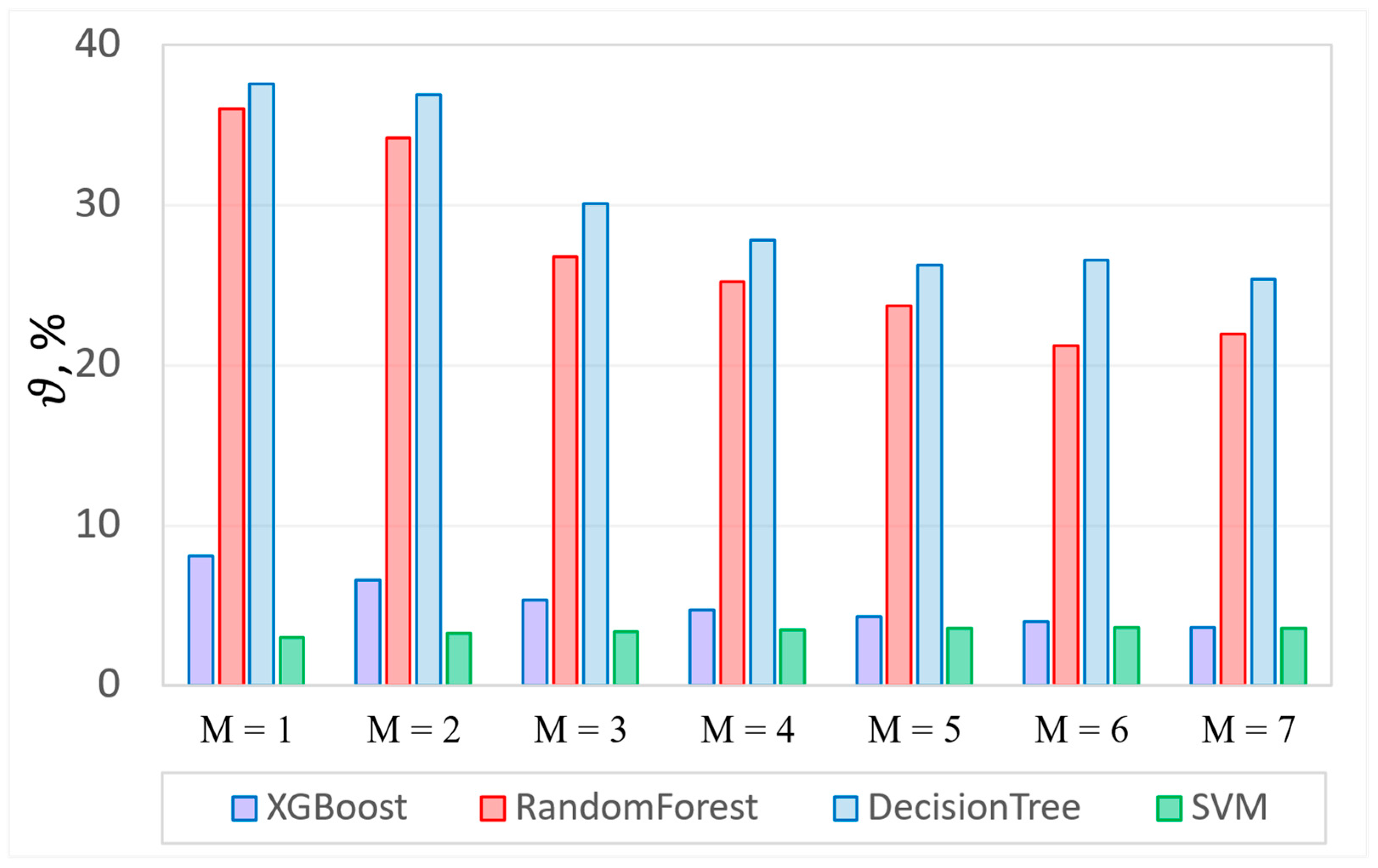
M was varied in the range from 1 to 7. For each of the clusters, a current restoration model was developed, and its error was calculated in accordance with Formulas (10) and (11). The result of this procedure is shown in
Figure 3. This figure shows that the current restoration model based on the SVR algorithm is the most effective in terms of accuracy. The accuracy of its operation remains virtually unchanged regardless of the number of clusters. For other models, increasing the number of clusters leads to an increase in their accuracy. However, the number of clusters
M > 4 does not provide a significant increase in accuracy. Therefore,
M = 4 is accepted.
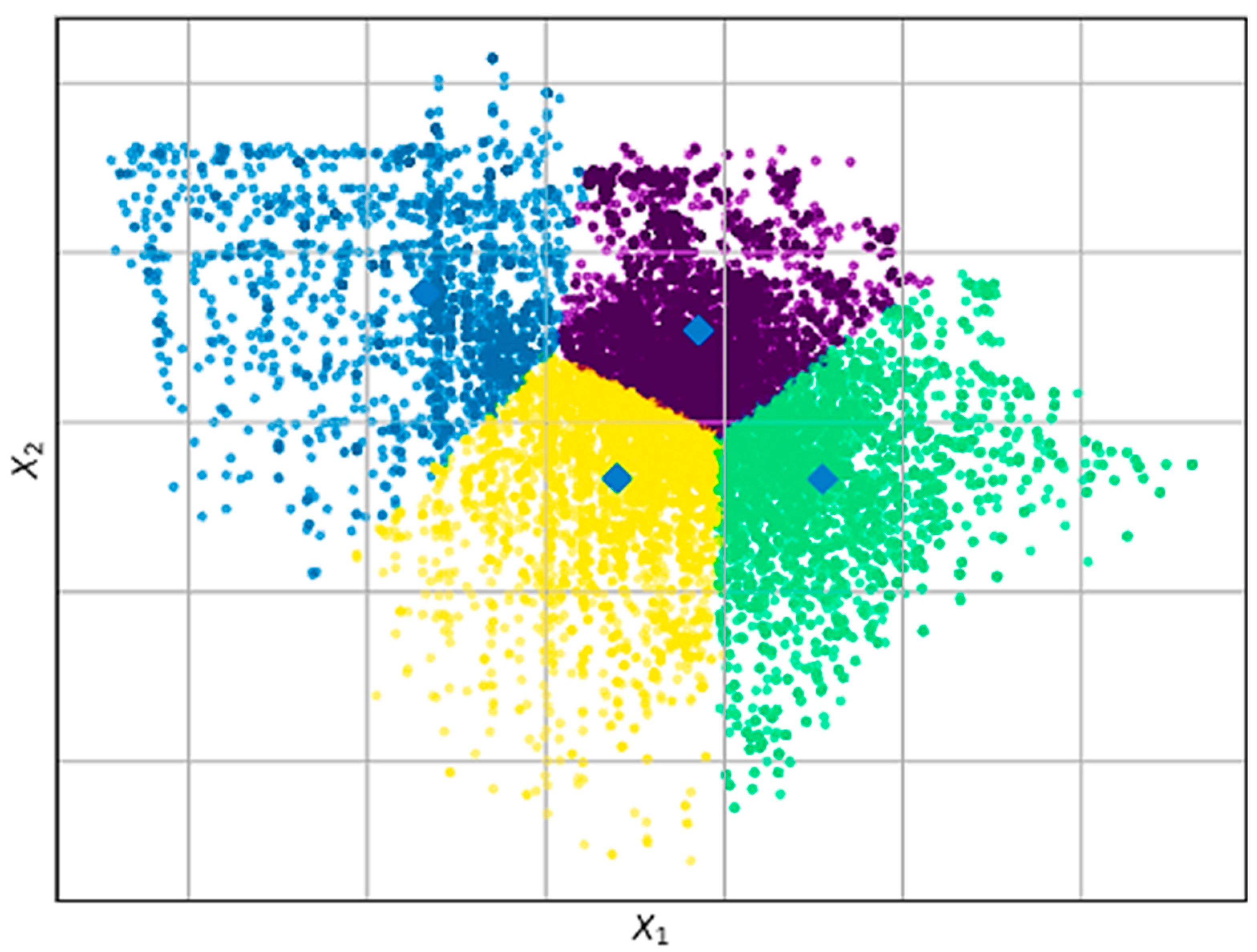
The result of clustering for
M = 4 is shown in
Figure 4. This figure presents the minimum and maximum current values along the
O-y axis and
O-x axis, respectively. In
Figure 4, the center of each cluster is marked with a diamond.
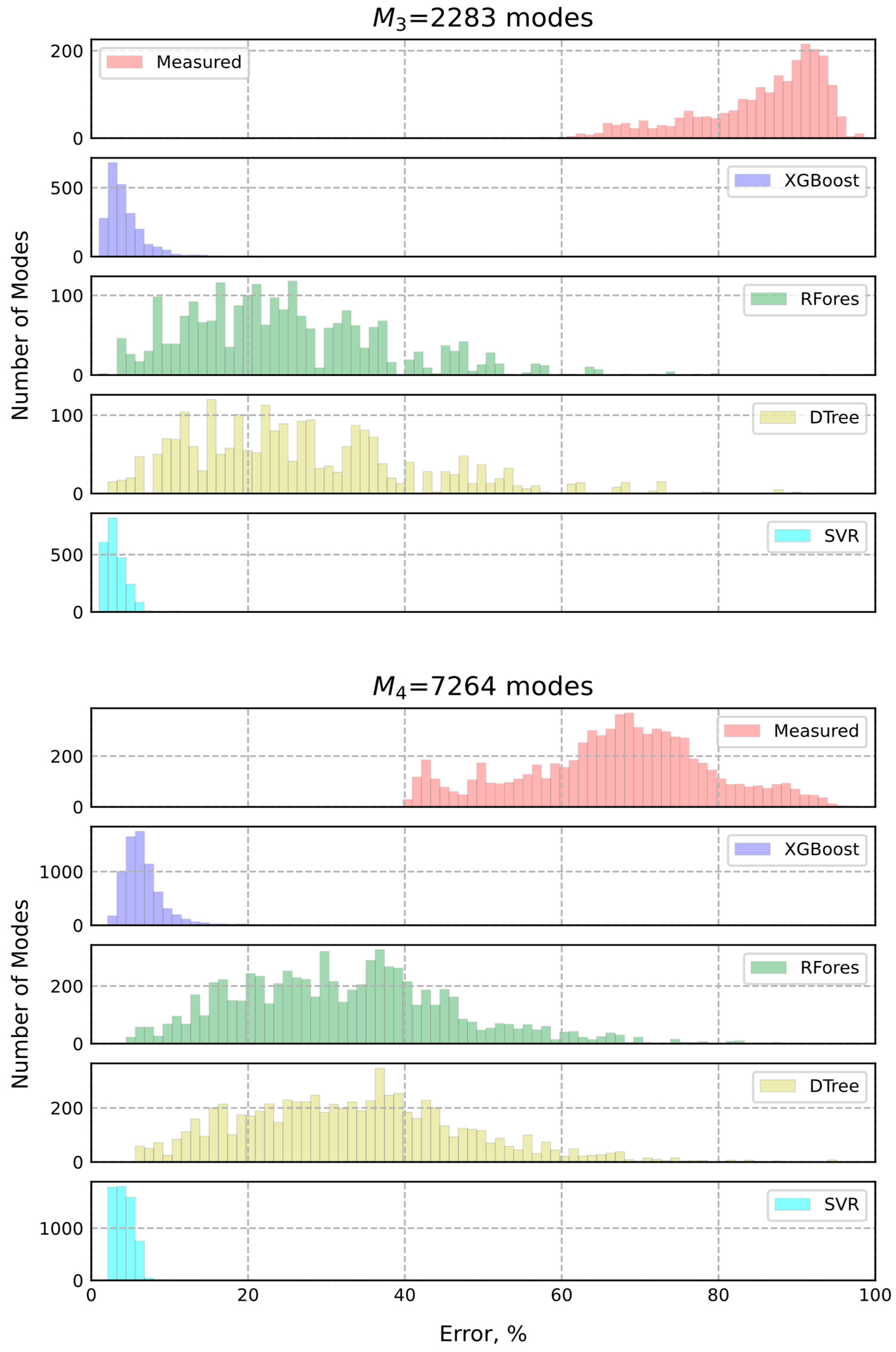
Since the error distribution at the CT output for clusters 1, 2, and 4 current data is approximately the same, the graphical representation of the first two is not provided. The first graph in
Figure 5 shows the error distribution after current restoration procedure using models based on DTree, RForest, XGBoost, and SVR algorithms for cluster 3. The total number of fault modes is
M3 = 2283. The
O-x axis shows the error calculated using Formula (10), and the
O-y axis shows the number of fault modes. As can be seen from the red bars in
Figure 5, the error at the CT output varies in the range from 60 to 95%. This corresponds to deep CT core saturation. Despite this, as shown by the purple bars, the error was significantly reduced by the XGBoost algorithm. The average error value at the output of this algorithm is 4%. The average error at the output of models based on the RForest (dark green bars) and DTree (light green bars) algorithms is 25 and 27%, respectively. It should be noted that the error distribution at the output of these models has a large spread and reaches up to 80%. This negatively affects the efficiency of RP and AS algorithms. As for the SVR-based model, its average error value is 3%.
The second graph in
Figure 5 shows the distribution of errors in measured and restored currents for cluster 4. The total number of fault modes is
M4 = 7264. Unlike the previous graph, the error variance at the CT output has a large spread and the expected mean is approximately 70%. This may correspond to the average degree of the CT core saturation. Despite this, it was possible to reduce the average error value at the output of the XGBoost-based current restoration model to 7%. For models based on RForest and DTree, these numbers are 32 and 29%, respectively. The output of these models has the same error trend as in the previous cluster. The model based on the SVR algorithm reduces the initial error with an average value of 4%. Unlike XGBoost, the variance of the error distribution of the SVR-based model is greatly reduced. This increases the robustness of the model with respect to various forms of saturation.
From
Figure 5 it can be seen that the SVR-based current restoration model is dominant in terms of accuracy. It is followed by a model based on XGBoost. After that comes the RForest and DTree models. Despite the presence of a series of parallel trees in RForest, this model failed to reduce the initial error at the CT output below 15–20%. This demonstrates the inability of the model to solve the current restoration problem under CT core saturation conditions. As for the XGBoost and SVR based models, they show high performance.
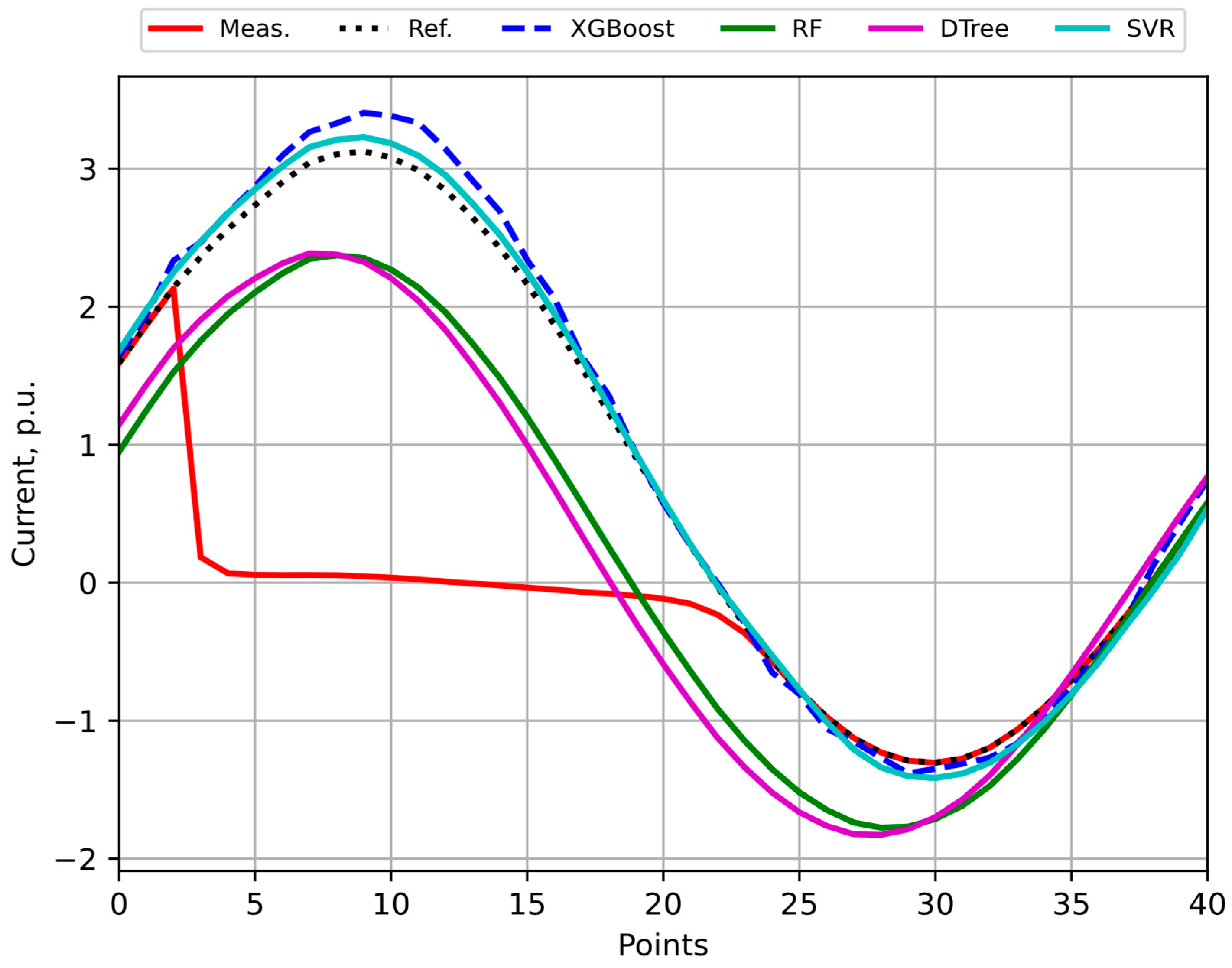
For information purposes,
Figure 6 shows the reference, measured, and restored current values for one of the test modes of cluster 4. From this figure can be seen that under deep saturation, the current restoration models based on RForest and DTree are not able to recover the current either in amplitude or in phase. Moreover, these models distort the non-saturated areas of the measured current. As a result, the phase error increases. As for the XGBoost- and SVR-based models, they restore current maintaining both phase and amplitude.
Since the elimination of emergency modes by RP and AS algorithms must occur within a few ms, the response time of current restoration models is one of the important indicators. For this purpose,
Table 3 shows the performance and error of the models for all 4 clusters. From the table it can be seen that changing the number of clusters affects both the model’s error and its time efficiency. For example, to restore data from cluster 1 with a volume of
M1 = 4047 fault modes, the XGBoot error was 5%, and its performance for restoring one saturation mode was 0.0074 ms. In the case of cluster 4 with a volume of
M4 = 7264 fault modes, these model indicators were 7% and 0.0064 ms, respectively.
The SVR-based current restoration model, despite its dominance in accuracy, is significantly inferior to other models in terms of time efficiency. Its time delay for restoring the current of one mode from cluster 1 is 2.8 ms. This adds additional delay to RP and AS algorithms. This delay is caused by a complex mathematical function and the operation of the algorithm itself.
Among all the models considered in terms of performance, the current recovery model based on the DTree algorithm became dominant. Its maximum time delay did not exceed 0.00008 ms. However, it is inferior to all other models in terms of current restoration error. Its average error for all clusters ranges from 27 to 32%. This is unacceptable for the correct functioning of RP and AS algorithms. For the RForest algorithm, this number ranges from 24 to 32%.
Thus, among considered models, XGBoost is the most suitable for solving the current restoration problem. For all four clusters, its average time delay for restoring a single mode is 0.0067 ms. This is acceptable delay for RP and AS algorithms operations. As for its average error, for all clusters it is 4%. This has a positive effect on the correct functioning of RP and AS algorithms.
5. Discussion and Limitations
In the proposed method, the SVR-based model proved to be the most effective in terms of accuracy, while the DTree-based model performed best in terms of time efficiency. However, when considering these characteristics simultaneously, both the first and second current restoration models are inferior to the XGBoost-based model. Despite the presence of several parallel trees, the RForest-based model is also inferior to XGBoost in accuracy. As the study results showed, RForest may restore current signals with large spikes. This negatively impacts RForest’s accuracy and functioning of RP and AS algorithms.
The limitations of the methodology proposed in this study include the following. The proposed method for current restoration requires the accumulation of historical data equal to one current period after the fault occurrence in the device buffer. This will lead to additional delays in the RP and AS algorithms. When a fault occurs, the current data may contain random, harmonic, and interharmonic components [
36,
37,
38]. This may impact the accuracy of both the clustering method and the current data restoration models. Also, under fault occurrence the network frequency may drift from the nominal value [
39,
40]. This may also impact both the accuracy and the time delay of the method.
To consider the above-mentioned, the future research plan is to test the models in the presence of noise, harmonic, interharmonic, and subharmonic components in the measured current values. Testing current restoration models considering network frequency variations in the range of +/− 5 Hz is identified as a future research direction as well. It is also planned to solve the problem of the CT secondary current restoration under core saturation conditions, presenting it in the form of binary and multi-class classification tasks. Next, it is planned to determine the moment when the CT core saturation occurs. Then, it is planned to apply regression algorithms to the distorted current values to restore the current.
6. Conclusions
Concerning the topic of CT magnetic core saturation, an analysis of compensation methods for the restoration of the distorted measured current curve shape was carried out. The level of elaboration of the topic has been determined. It is shown that both deterministic methods and methods based on artificial neural networks and deep learning are used to restore the current. The limitations of applicability of these methods are shown in the context of their practical application. It was found that deterministic methods are sensitive to CT parameters and measured current values, while methods based on artificial neural networks and deep learning, despite their high adaptability, are computationally complex.
A current restoration methodology has been proposed. Within this methodology, the problem of CT core saturation is reduced to clustering and regression tasks. The clustering task involves grouping the measured current data depending on their distortion form. As part of the regression task, the measured current values are replaced with calculated ones close to the reference value. The proposed methodology considers the features of other methods related to computational complexity, sensitivity to the shape of the saturated current curve, and adaptability, since this is important for the purposes of RP and AS algorithms.
The results of the experiments have proved that for the considered sample size of distorted current data, the optimal number of clusters is four. It was found that among the current restoration models considered, the model based on the SVR algorithm is the most effective in terms of accuracy. On average, its error for cluster 3 is 1.3 times lower than XGBoost. For cluster 4, this model was on average 1.75 times more efficient than XGBoost. It was found out that, from the point of view of time efficiency, the SVR model provides an additional time delay during CT current restoration. The SVR model requires about 2.4 ms on average to restore the current of one saturation mode. The average time delay of the XGBoost algorithm for one saturation mode is 0.0067 ms. In terms of current recovery accuracy, the DTree and RForest-based models showed unacceptable performance. Considering the time delay and accuracy, the XGBoost-based model is the most suitable tool to overcome the saturation of the CT core.



 ,
,