Article

Two-Dimensional Steady-State Thermal Analytical Model of Dual-PM Consequent-Pole Magnetically Geared Machine Based on Harmonic Modeling


1
Department of Electrical Engineering, Chungnam National University, Daejeon 34134, Republic of Korea
2
Department of Electrical Engineering, Changwon National University, Changwon 51140, Republic of Korea
3
Korea Research Institute of Ships and Ocean Engineering, Daejeon 34103, Republic of Korea
*
Author to whom correspondence should be addressed.
Mathematics 2026, 14(3), 460; https://doi.org/10.3390/math14030460
Submission received: 24 December 2025 / Revised: 19 January 2026 / Accepted: 26 January 2026 / Published: 28 January 2026
(This article belongs to the Special Issue Mathematical Applications in Electrical Engineering, 2nd Edition)

Abstract

This paper presents a mathematical approach for analyzing the thermal behavior of a dual-permanent-magnet consequent-pole magnetically geared machine. The analytical method, referred to as harmonic modeling, employs a complex Fourier series and the Cauchy product to obtain solutions to the partial differential equations governing the temperature distribution in electrical machines. Unlike lumped-parameter thermal networks that provide only average quantities, the proposed approach enables the prediction of spatial temperature distributions. The machine is further investigated under various operating conditions, including different convection coefficients and loss levels. An 11-pole, 18-slot prototype was evaluated by comparison with finite element method (FEM) simulations. The results demonstrate that the proposed method agreed well with the FEM results, with errors below 10%, while requiring less than 2 s per calculation compared with approximately 20 s for FEM simulations.

1. Introduction

In recent years, dual-permanent-magnet (PM) consequent-pole magnetically geared machines (MGMs), which incorporate PMs on both the stator and rotor, have attracted increasing interest for high-torque, low-speed, direct-drive applications [1,2,3]. As power density increases, the thermal constraints become more significant owing to the elevated loss densities, making an accurate thermal analysis essential during the design stage. Current thermal analysis methods include analytical approaches—such as lumped-parameter thermal networks (LPTNs)—and numerical techniques such as the finite element method (FEM) and computational fluid dynamics (CFD).
The LPTN method simplifies heat sources and thermal resistances into lumped parameters and models them through one or two dominant heat-transfer paths, enabling fast computation [4]. For example, paper [5] proposed an LPTN model for a modular spoke-type PM motor in which heat-transfer coefficients are theoretically determined and end-cap effects are incorporated. In [6], a three-dimensional (3D) LPTN model for a flux-switching PM double-rotor machine accelerated the estimation of the winding thermal resistance by simplifying the slot geometry, although at the expense of accuracy. Generally, the reliability of an LPTN highly depends on how well the main heat-transfer paths are modeled and how accurately thermal parameters (e.g., resistances and heat sources) are estimated [7,8,9]. The construction of an accurate thermal network is complex and often relies on designer experience [10]. A particular challenge occurs in modeling the thermal behavior of stator slots, where active windings reside and heat spreads multidirectionally from the slot center—which the LPTN struggles to accurately represent. Mathematical approaches for evaluating temperature distribution in windings have been explored [11,12,13]. In these studies, the LPTN solved the temperature prediction for machine components, excluding the stator winding. Instead, Poisson’s heat transfer equation for the stator slot region was solved using the boundary conditions of the stator teeth and yoke temperatures calculated from the LPTN.
In contrast, the FEM can manage complex geometries and generate detailed temperature distributions for different machine structures. For instance, papers [14,15] analyzed the thermal behavior of magnetically suspended and flux-switching machines by incorporating loss characteristics. A reduced-order model based on thermal eigenmode orthogonality was proposed in [16] to shorten the computation time. However, the FEM primarily captures conduction in solid regions and cannot fully model interactions at solid–coolant boundaries. Therefore, convection and radiation must be approximated using empirical boundary conditions. CFD can overcome this problem by directly computing the heat-transfer coefficients around fluid–solid interfaces—such as air gaps or water-cooling channels [17,18]. Nevertheless, both the FEM and CFD are computationally expensive, require substantial hardware resources, and depend heavily on manual meshing, particularly for CFD models.
In the thermal analysis of electrical machines, only a limited number of studies have explored analytical heat-transfer methods based on the direct solution of thermal partial differential equations (PDEs). This paper builds on scientific developments in electromagnetic field modeling—specifically the subdomain method (SM) and harmonic modeling (HM). The SM solves PDEs using Fourier series expansions and has been applied to surface-mounted PMs, interior-mounted PMs, and magnetic gears as reported in [19,20,21]. Extending this concept, paper [22] derived the thermal distributions of surface-mounted, inset, and spoke-type PM machines. However, for more complex topologies or machines with many stator slots, the SM becomes increasingly bulky and computationally demanding. HM, which employs a complex Fourier series and the Cauchy product, has been developed to predict electromagnetic characteristics in a wide range of machines, including surface, inset, and axial-flux PM machines [23,24,25,26]. In thermal analysis, HM has been successfully applied to surface PM machines [27], linear PM machines [28], and systems that incorporate water-cooling structures [29].
Because the HM concept predicts the temperature distribution more accurately than the LPTN in a significantly shorter time than the SM and FEM, this paper develops the HM for a dual-PM consequent-pole MGM. Section 2 introduces the MGM principle. Section 3 presents the application of PDEs to a dual-PM consequent-pole MGM. Section 4 presents the FEM simulation results validating the proposed HM method, and Section 5 introduces a coupled thermal-electrical process considering the influence of temperature on copper loss.

2. Dual-PM Consequent-Pole MGM

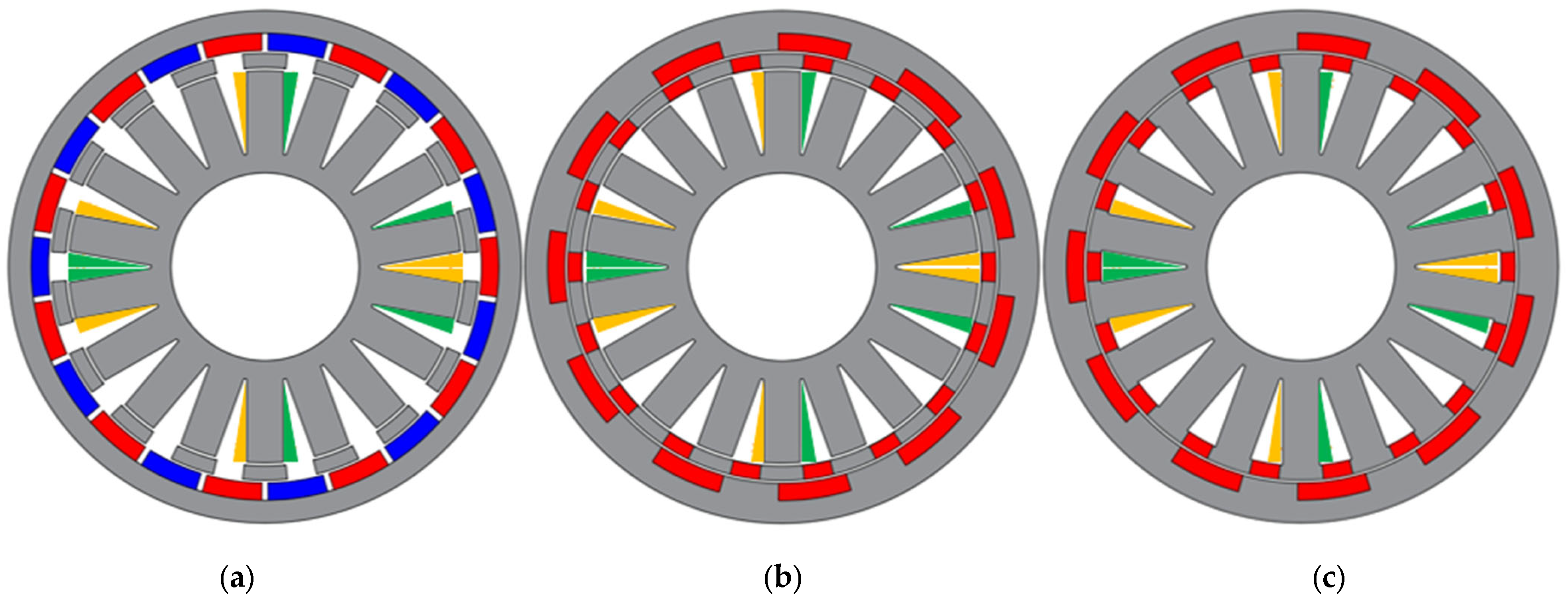
The magnetic gear shown in Figure 1a is composed of three parts: an inner rotor with Z p i pole pairs of the PM; an outer rotor with Z p o pole pairs of the PM; and a modulator with N m poles. The transmission of flux between the inner and outer rotors and vice versa requires a minimum of three pole numbers, as follows [20]:
Z p i + Z p o = N m
As depicted in Figure 1a, a conventional MGM replaces the rotating inner rotor with an inner stator equipped with a three-phase winding that produces a rotating electromagnetic field. The concept of the conventional MGM has been investigated in several studies [21,30,31]. Specifically, when the outer rotor has Z p i = 11 pole pairs and the modulation layer contains N m = 18 poles, the stator winding is arranged to form Z p o = 7 pole pairs. The phase-A winding layout is illustrated in Figure 1, where the green and orange colors indicate the “OUT” and “IN” current directions, respectively. The phase-B and phase-C windings are obtained by spatially shifting the phase-A winding by 120° in the clockwise and counterclockwise directions, respectively.
Starting from the conventional MGM configuration shown in Figure 1a, a modified structure was introduced in [32,33], as shown in Figure 1b. In this topology, the PMs on both the rotor and modulation segments are magnetized radially outward, and each magnet, together with its neighboring iron tooth or modulation segment, constitutes a magnetic pole pair. However, the presence of two air gaps in this structure results in increased manufacturing complexity. To overcome this limitation, a suitable selection of the rotor and stator pole numbers enables the stator and modulation layers to be merged into a single structure, thereby achieving a single-air-gap configuration, as illustrated in Figure 1c. The parameters of the dual-PM consequent-pole MGM are listed in Table 1.
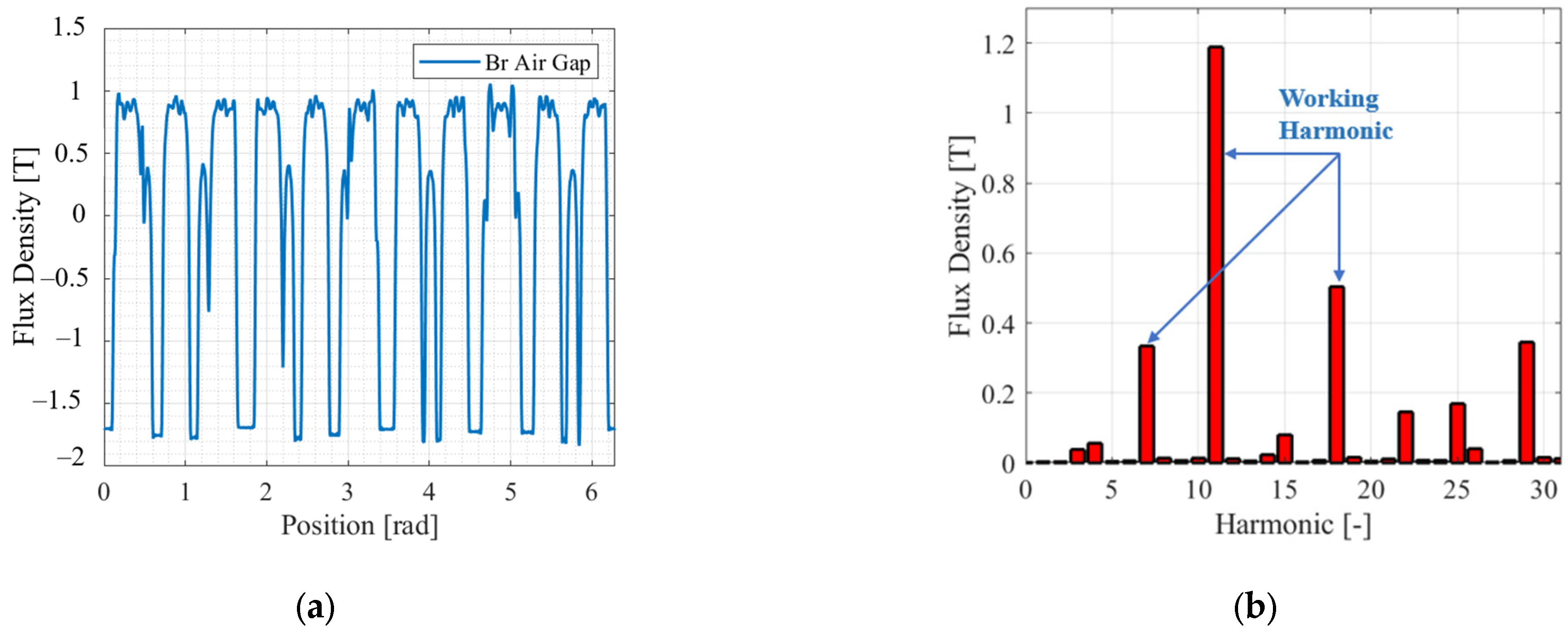
Figure 2 illustrates the air-gap flux density distribution and fast Fourier transform (FFT) analysis. It can be observed that the dominant 7th-, 11th-, and 18th-order harmonics correspond to the rotor and stator pole combinations discussed previously.
Unlike conventional PM synchronous machines, which operate with only a single dominant working harmonic, the dual-PM consequent-pole MGM exhibits three working harmonics in the air gap. This results in core losses in both the rotor and stator, as well as significant magnet losses. These losses must be accurately evaluated prior to the thermal analysis.

3. Harmonic Modeling Framework for Thermal Behavior

The HM approach employs complex Fourier series and the Cauchy product to obtain solutions to the PDEs governing the temperature distribution in electrical machines. In this method, thermal PDEs are formulated for each region and subsequently solved by applying boundary conditions at the interfaces between adjacent media. By introducing a new general solution form of the PDEs, HM reduces the required number of regions, which decreases the computational matrix size and improves the computation time compared with the well-known SM.

3.1. Assumptions

Initially, the following assumptions were made:
  • The model is formulated in a two-dimensional (2D) polar coordinate system;
  • The radiation is typically much less significant than convection; therefore, it is neglected;
  • A thin air layer may exist at the core–magnet interface because of manufacturing imperfections; however, its influence is difficult to quantify, and the interfaces between regions are therefore assumed to be perfect;
  • Detailed information on the spatial non-uniformity of heat sources or losses is generally unavailable; thus, the losses are assumed to be uniform and constant to obtain the solution of otherwise complex engineering problems;
  • Similarly to the heat source, the materials are assumed to have constant thermal conductivity.
The thermal conductivities, ambient temperatures, convection, and loss are given in Table 2.
Notably, three materials, including conductor, insulation, and air, are present in the stator slot. Assuming a constant thermal conductivity within the stator slot, the equivalent thermal conductivity λ e q is defined based on the thermal conductivities of these three materials and their respective volume ratios V w i n s a = 0.4 / 0.02 / 0.58 within the stator slot.
λ e q = 1 V w λ w + V i n s λ i n s + V a λ a = 1 0.4 400 + 0.02 0.03 + 0.58 0.026 = 0.0435   W / m / K
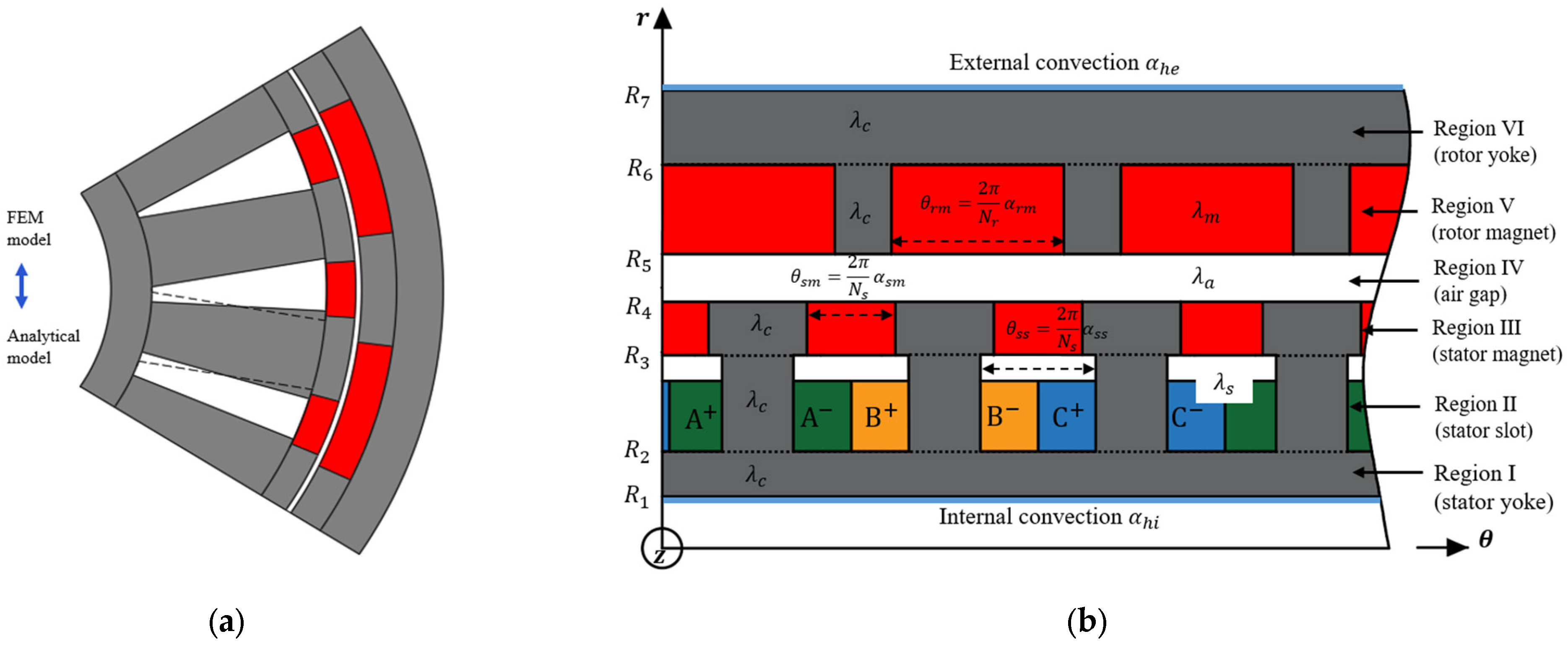
In the actual model, the stator teeth have parallel shapes. However, for analytical modeling, they are represented using radial and tangential dimensions. Consequently, the original parallel tooth geometry is converted and simplified into stator tooth ratios, as shown in Figure 3.

3.2. Loss and Thermal Conductivity Distribution

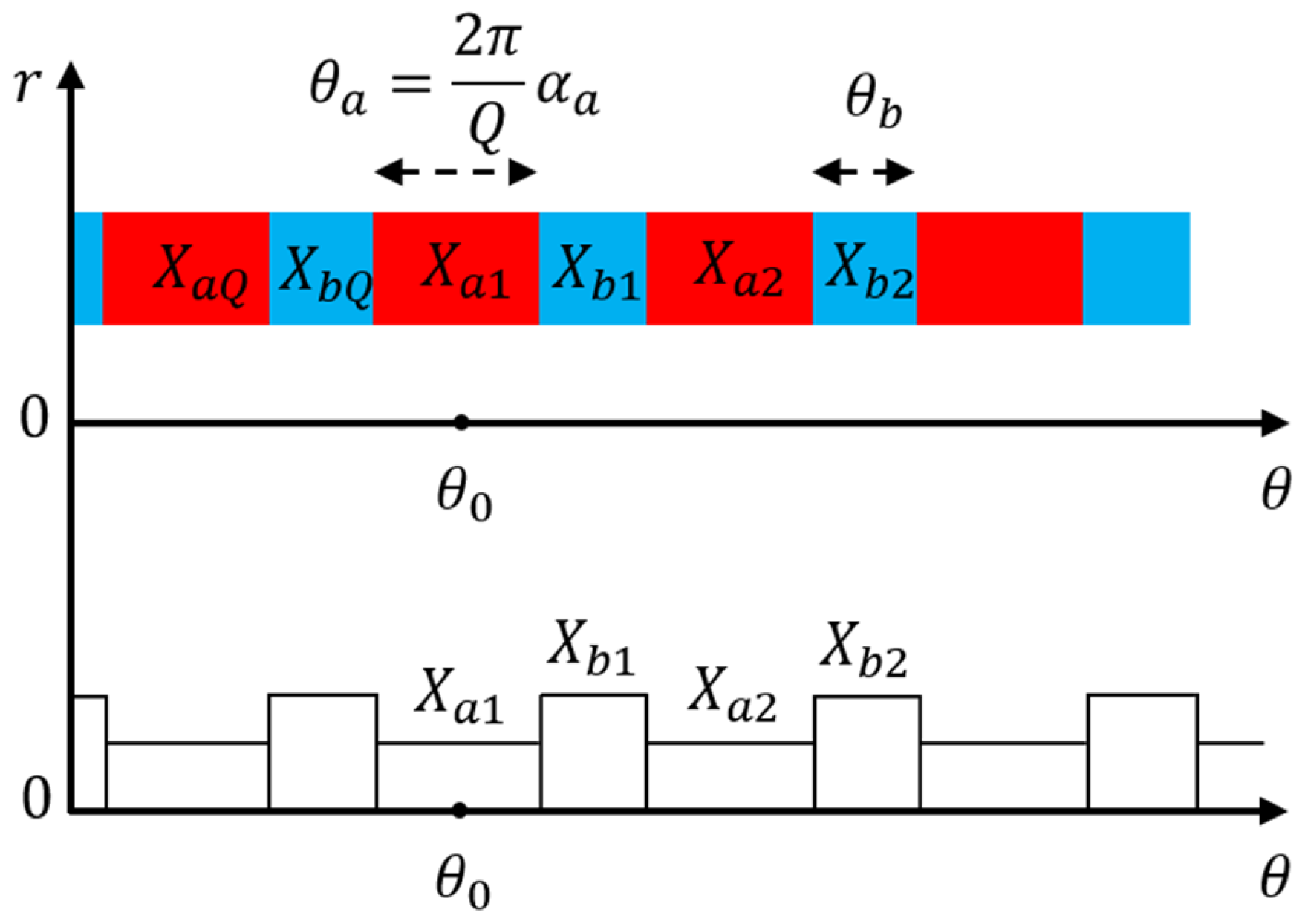
In a given region divided into Q area pairs, each pair consists of two tangentially adjacent sub-areas:
Sub-area a: Amplitude X a , tangential width θ a ;
Sub-area b: Amplitude X b , tangential width θ b .
The corresponding waveform of the signal X is illustrated in Figure 4.
The quantity can be expressed as complex Fourier series expansions:
X = R n = N n = N X n e j n θ
in which the nth X n is given by
X n = 1 2 π i = 1 Q X a i θ a + X b i θ b n = 0 X n = i = 1 Q e j n 2 π i Q + θ 0   2 π j n X a i e j n θ b 2 1 e j n θ a + 2 j X b i sin n θ b 2 n 0
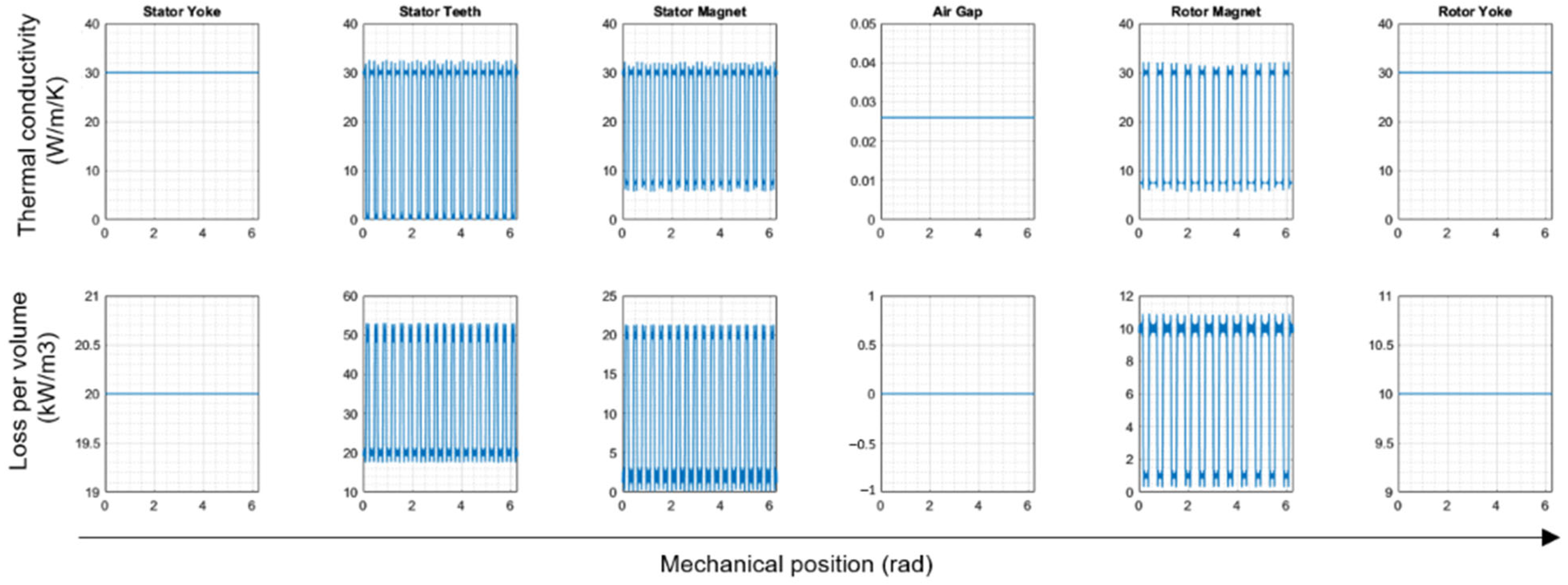
In the HM-based thermal analysis, the loss density and thermal conductivity listed in Table 2 are represented by applying the complex Fourier series formulation given in Equation (4) to the regions shown in Figure 3b. Figure 5 shows the calculated distributions of the loss density and thermal conductivity.
The HM framework is implemented based on matrix quantities. Therefore, Equation (3) is rewritten as a matrix form:
X = R X N T E ;   X θ = R j X N T N t E
where X N = X n X 0 X n T ; N t = d i a g N N and E = e j n θ 1 e j n θ T .
The thermal conductivity matrix λ is performed as a convolution matrix, as follows:
λ c r = λ 0 λ N λ 2 N λ 0 λ N λ 0 λ N λ 0 λ 2 N λ N λ 0 2 N + 1   b y   2 N 1 λ c θ = λ 0 r e c λ N r e c λ 2 N r e c λ 0 r e c λ N r e c λ 0 r e c λ N r e c λ 0 r e c λ 2 N r e c λ N r e c λ 0 r e c 2 N + 1   b y   2 N 1
The quantity λ n r e c is the inverse coefficient of the nth harmonic. It means replacing λ a i and λ b i in Equation (4) by 1 / λ a i and 1 / λ b i .

3.3. Governing Partial Differential Equations (PDEs)

Letting V = λ c θ N t λ c r 1 N t , the temperature distribution is calculated by solving the following PDE [27]:
2 T = 2 T r 2 + 1 r T r V 2 r 2 T = λ c r 1 P
By conducting a 2D analysis in polar coordinates, the PDE’s general solution for the kth region (regions I to VI with respect to the radii R 1 to R 6 ) depicted in Figure 3b can be formulated as follows:
T k = W k r R k + 1 L k a k + W k R k r L k b k + r 2 F k
where the diagonal eigenvalues and the eigenvector matrix of V k are W k , L k = e i g V k ; the particular solution is r 2 F k = r 2 V k 2 4 I 1 λ c r k 1 P k ; and the vectors a k and b k are the column vectors of the constant’s unknown coefficient. Notably, the vectors T k ; a k ; b k ; P k have the same dimensions as the vector X N in Equation (5).
The radial heat flux density is calculated from the temperature form as follows:
q r k = λ c r k T k r = 1 r λ c r k W k L k r R k + 1 L k a k W k L k R k r L k b k + 2 r 2 F k

3.4. Boundary Conditions (BCs)

When considering heat transfers inside the machine by conduction, the BCs between two adjacent media (regions II to VI with respect to the radii R 2 to R 6 ) are given as follows:
T k 1 r = R k = T k r = R k and   q r k 1 r = R k = q r k r = R k
In the inside and outside media where the heat is transferred by convection (radiation is ignored), the BCs can be mathematically written as follows:
q r I r = R 1 = α h i T a m b T I r = R 1
q r V I r = R 7 = α h e T I r = R 7 T a m b
At r = R 1 , (11a) gives:
1 R 1 λ c r I W I L I R 1 R 2 L I a I 1 R 1 λ c r I W I L I b I + 2 R 1 λ c r I F I = α h i T a m b + α h i W I R 1 R 2 L I a I + α h i W I b I + α h i R 1 2 F I α h i W I R 1 R 2 L I 1 R 1 λ c r I W I L I R 1 R 2 L I a I + α h i W I + 1 R 1 λ c r I W I L I b I = α h i T a m b α h i R 1 2 F I + 2 R 1 λ c r I F I X 0101 a I + X 0102 b I = B 1
At r = R 2 , (10) gives:
W I a I + W I R 1 R 2 L I b I + R 2 2 F I = W I I R 2 R 3 L I I a I I + W I I b I I + R 2 2 F I I W I a I + W I R 1 R 2 L I b I W I I R 2 R 3 L I I a I I W I I b I I = R 2 2 F I + R 2 2 F I I X 0201 a I + X 0202 b I + X 0203 a I I + X 0204 b I I = B 2
λ c r I W I L I a I W I L I R 1 R 2 L I b I + 2 R 2 2 F I = λ c r I I W I I L I I R 2 R 3 L I I a I I W I I L I I b I I + 2 R 2 2 F I I λ c r I W I L I a I + λ c r I W I L I R 1 R 2 L I b I + λ c r I I W I I L I I R 2 R 3 L I I a I I λ c r I I W I I L I I b I I = 2 R 2 2 λ c r I F I 2 R 2 2 λ c r I I F I I X 0301 a I + X 0302 b I + X 0303 a I I + X 0304 b I I = B 3
At r = R 3 , (10) gives:
W I I a I I + W I I R 2 R 3 L I I b I I W I I I R 3 R 4 L I I I a I I I W I I I b I I I = R 3 2 F I I + R 3 2 F I I I X 0403 a I I + X 0404 b I I + X 0405 a I I I + X 0406 b I I I = B 4
λ c r I I W I I L I I a I I + λ c r I I W I I L I I R 2 R 3 L I I b I I + λ c r I I I W I I I L I I I R 3 R 4 L I I I a I I I λ c r I I I W I I I L I I I b I I I = 2 R 3 2 λ c r I I F I I 2 R 3 2 λ c r I I I F I I I X 0503 a I I + X 0504 b I I + X 0505 a I I I + X 0506 b I I I = B 5
At r = R 4 , (10) gives:
W I I I a I I I + W I I I R 3 R 4 L I I I b I I I W I V R 4 R 5 L I V a I V W I V b I V = R 3 2 F I I I + R 3 2 F I V X 0605 a I I I + X 0606 b I I I + X 0607 a I V + X 0608 b I V = B 6
λ c r I I I W I I I L I I I a I I I + λ c r I I I W I I I L I I I R 3 R 4 L I I I b I I I + λ c r I V W I V L I V R 4 R 5 L I V a I V λ c r I V W I V L I V b I V = 2 R 4 2 λ c r I I I F I I I 2 R 4 2 λ c r I V F I V X 0705 a I I I + X 0706 b I I I + X 0707 a I V + X 0708 b I V = B 7
At r = R 5 , (10) gives:
W I V a I V + W I V R 4 R 5 L I V b I V W V R 5 R 6 L V a V W V b V = R 5 2 F I V + R 5 2 F V X 0807 a I V + X 0808 b I V + X 0809 a V + X 0810 b V = B 8
λ c r I V W I V L I V a I V + λ c r I V W I V L I V R 4 R 5 L I V b I V + λ c r V W V L V R 5 R 6 L V a V λ c r V W V L V b V = 2 R 5 2 λ c r I V F I V 2 R 5 2 λ c r V F V X 0907 a I V + X 0908 b I V + X 0909 a V + X 0910 b V = B 9
At r = R 6 , (10) gives:
W V a V + W V R 5 R 6 L V b V W V I R 6 R 7 L V I a V I W V I b V I = R 6 2 F V + R 6 2 F V I X 1009 a V + X 1010 b V + X 1011 a V I + X 1012 b V I = B 10
λ c r V W V L V a V + λ c r V W V L V R 5 R 6 L V b V + λ c r V I W V I L V I R 6 R 7 L V I a V I λ c r V I W V I L V I b V I = 2 R 6 2 λ c r V F V 2 R 6 2 λ c r V I F V I X 1109 a V + X 1110 b V + X 1111 a V I + X 1112 b V I = B 11
At r = R 7 , (11b) gives:
α h e W V I + 1 R 7 λ c r V I W V I L V I a V I + α h e W V I R 6 R 7 L V I 1 R 7 λ c r V I W V I L V I R 6 R 7 L V I b V I = α h e T a m b α h e R 7 2 F V I 2 R 7 λ c r V I F V I X 1211 a V I + X 1212 b V I = B 12
By collecting the BCs from Equations (12)–(23), the following total matrix equation is obtained:
X 0101 X 0102 0 0 0 0 0 0 0 0 0 0 X 0201 X 0202 X 0203 X 0204 0 0 0 0 0 0 0 0 X 0301 X 0302 X 0303 X 0304 0 0 0 0 0 0 0 0 0 0 X 0403 X 0404 X 0405 X 0406 0 0 0 0 0 0 0 0 X 0503 X 0504 X 0505 X 0506 0 0 0 0 0 0 0 0 0 0 X 0605 X 0606 X 0607 X 0608 0 0 0 0 0 0 0 0 X 0705 X 0706 X 0707 X 0708 0 0 0 0 0 0 0 0 0 0 X 0807 X 0808 X 0809 X 0810 0 0 0 0 0 0 0 0 X 0907 X 0908 X 0909 X 0910 0 0 0 0 0 0 0 0 0 0 X 1009 X 1010 X 1011 X 1012 0 0 0 0 0 0 0 0 X 1109 X 1110 X 1011 X 1112 0 0 0 0 0 0 0 0 0 0 X 1211 X 1212 a I b I a I I b I I a I I I b I I I a I V b I V a V b V a V I b V I = B 1 B 2 B 3 B 4 B 5 B 6 B 7 B 8 B 9 B 10 B 11 B 12
With the harmonic order as N, the total number of unknown coefficients in Equation (24) is ( 2 N + 1 ) × 2 × 6 r e g i o n s .

4. FEM Simulation Comparison

To ensure a consistent performance benchmark, we performed both the HM and FEM simulations on the same computing platform, featuring a 12th Gen Intel Core i9-12900KF processor operating at 3.19 GHz.
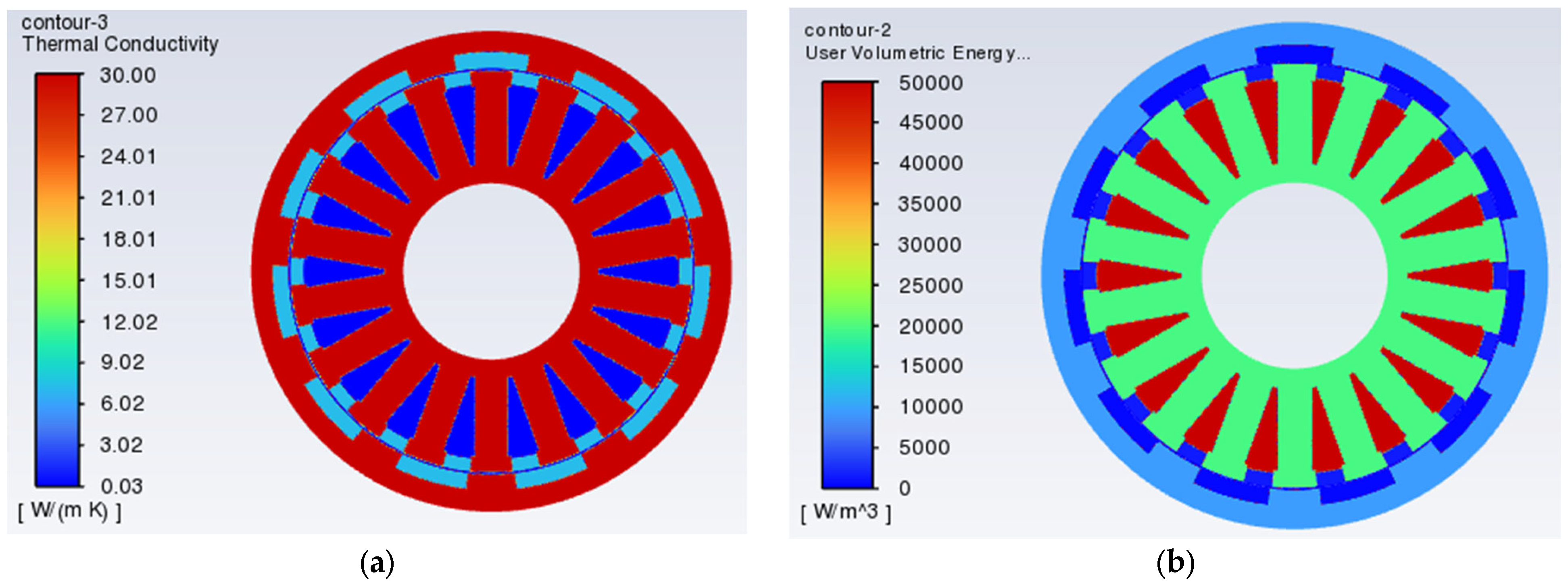
Figure 6 shows the distribution of thermal conductivity and volumetric loss density. In the stator slot, although the thermal conductivity of the conductor is as high as 400 W / m / K , air and insulation occupy approximately 60% of the slot volume. Consequently, the equivalent thermal conductivity is significantly reduced to 0.0435 W / m / K , which is close to that of air (0.026 W / m / K ). The dominant heat source originates from the stator slot region owing to the winding loss. The second major contributor to the temperature increases is core loss in the rotor and stator. As shown in Figure 2b, three dominant working harmonics exist in the air gap, leading to significant loss contributions in the rotor core and the rotor-stator magnets.
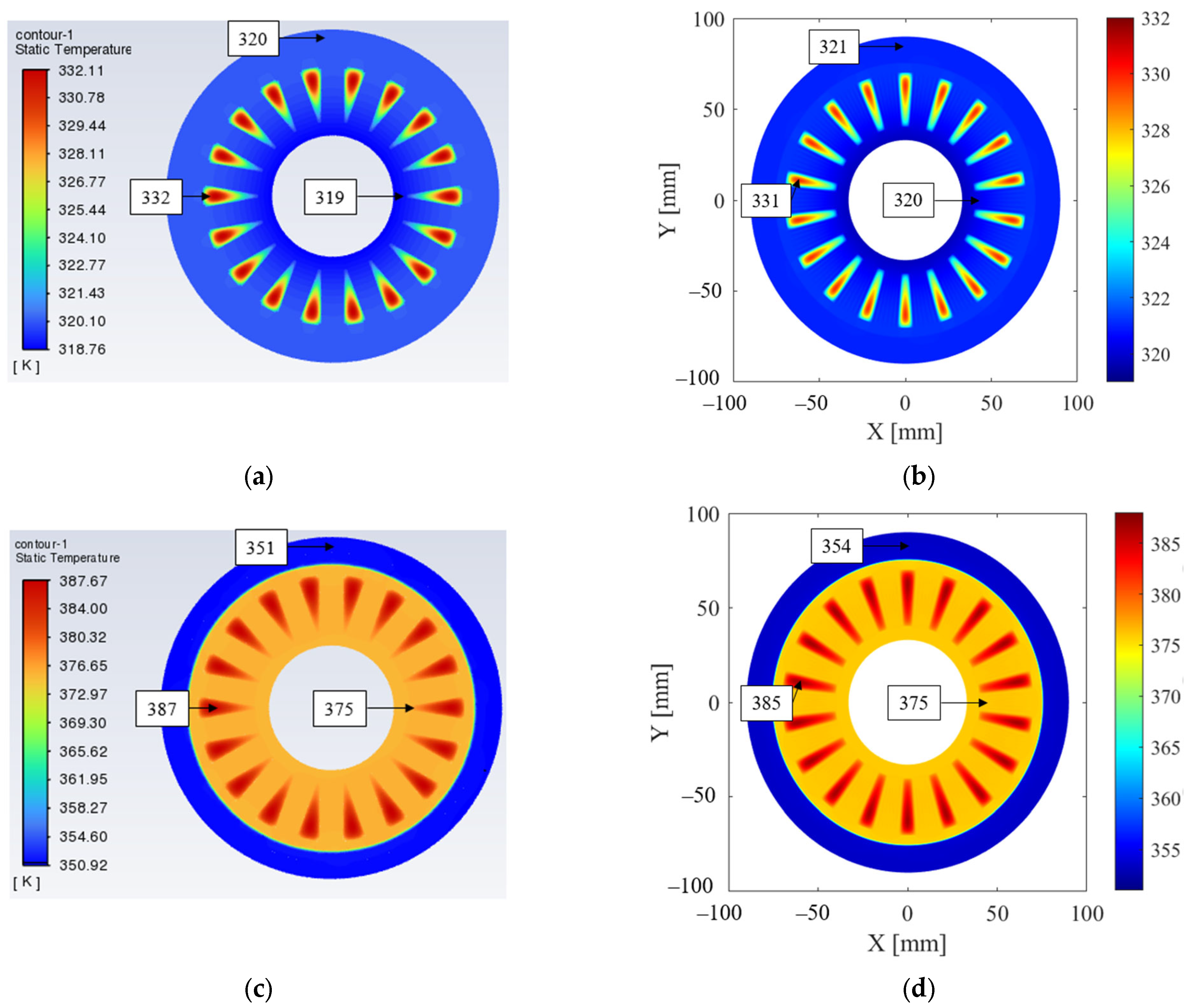
The temperature distributions within the machine obtained using the developed HM method and FEM are shown in Figure 7. Most of the heat is concentrated in the stator slots, which is reasonable because the dominant losses occur in this region. In contrast, the temperature within the rotor core and rotor PMs, as well as within the stator core and stator PMs, is approximately uniform in each region. Notably, the analytical results agree well with those obtained using the FEM.
In Figure 7a,b, a high convection coefficient inside the stator, equal to 100 W / m 2 / K , is applied to represent forced-air cooling through the stator axle; therefore, heat is primarily transferred along this path. On the rotor yoke side, the convection coefficient outside the stator is set to an extremely low value, indicating natural convection. The temperature rises observed in the stator slot, stator yoke, and rotor yoke are 32 °C, 19 °C, and 20 °C in the FEM results, and 31 °C, 20 °C, and 21 °C in the HM results, respectively.
In Figure 7c,d, both the internal and external convection coefficients are relatively low, equal to 10 W / m 2 / K , which results in significantly higher temperatures. The temperature rises in the stator slot, stator yoke, and rotor yoke reach 87 °C, 75 °C, and 51 °C in the FEM results, and 85 °C, 75 °C, and 54 °C in the HM results, respectively. When converted to absolute temperature, the stator magnet temperature reaches approximately 102 °C, which may cause partial demagnetization and consequently lead to a reduction in generator output power. Therefore, thermal analysis is crucial to preventing magnet damage during machine operation.
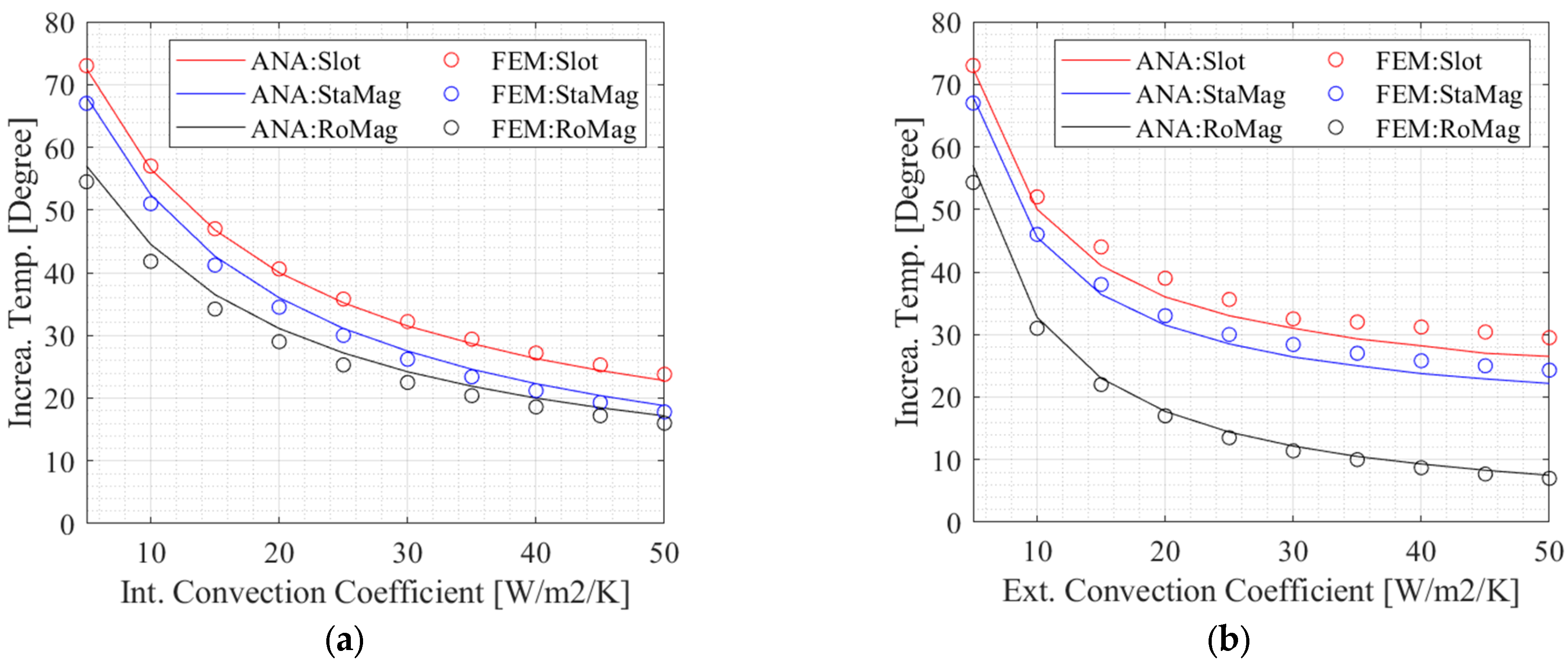
As shown in Figure 8, a parametric study was conducted by varying the internal and external convection coefficients under different conditions, where the total losses are set to half the values listed in Table 2. Generally, the temperature is the highest in the stator slot (red line) and decreases gradually toward the stator magnet (blue line) and rotor magnet (black line), because most of the heat sources are concentrated in the inner stator slot. Under the convection condition of α h i   α h e = 50   5   W / m 2 / K , the temperatures in the stator slot, stator magnet, and rotor magnet are 22.8 °C, 18.8 °C, and 17.2 °C, respectively. Under the condition of α h i   α h e = 5   50   W / m 2 / K , the corresponding temperatures are 26.5 °C, 22.2 °C, and 7.5 °C, respectively. These results indicate that applying cooling inside the stator is more effective than cooling at the outer rotor surface, because the peak temperature in the stator slot is lower when higher internal convection is applied. Furthermore, the HM results are in good agreement with the FEM simulations, with errors of less than 10%. This level of agreement can be attributed to the conversion of the original parallel-tooth geometry into an analytically equivalent radial-tooth representation, as illustrated in Figure 3a.
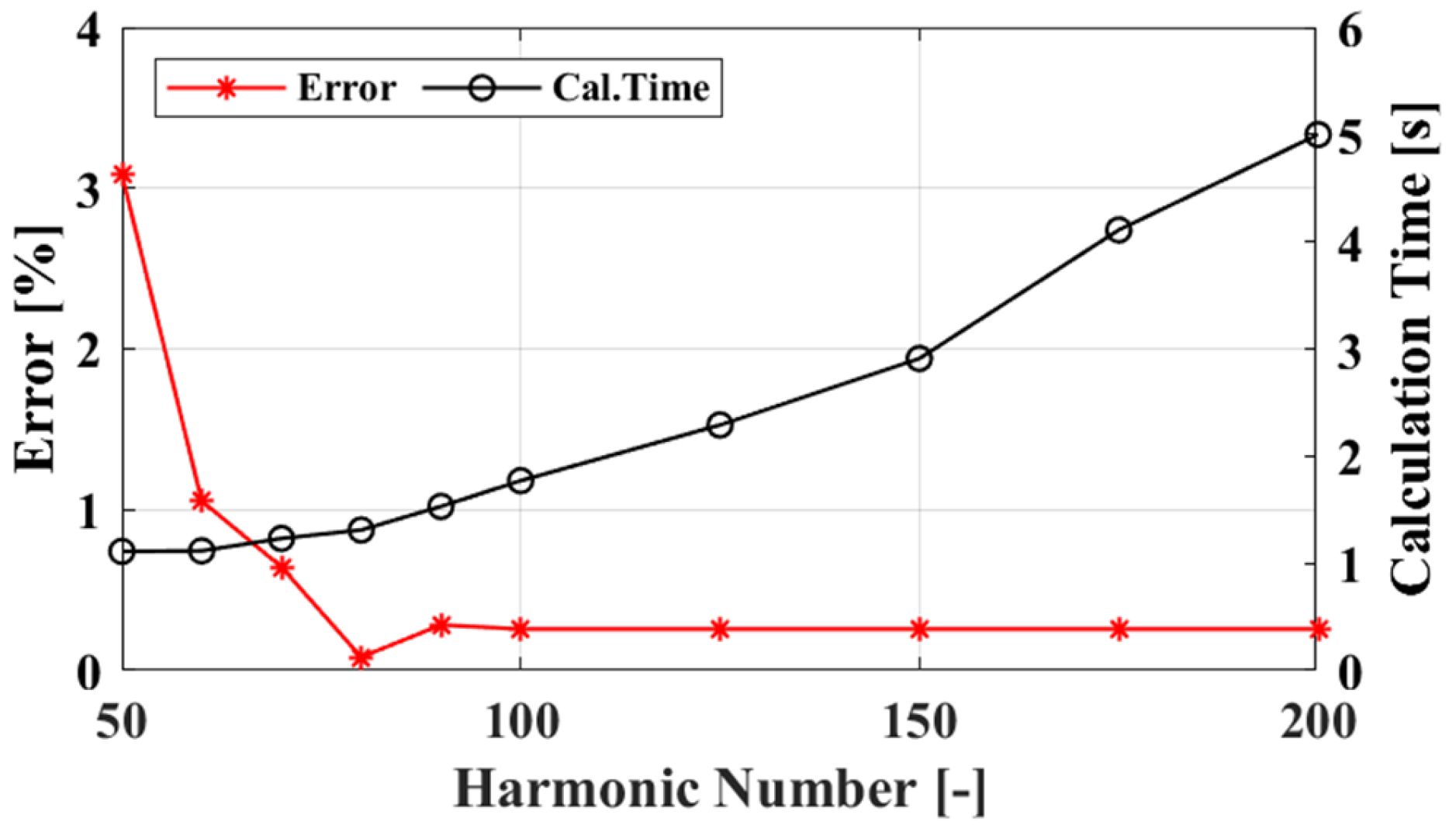
The calculation time of the proposed HM can be shortened by reducing the number of spatial harmonics (n). However, reducing n also leads to a decrease in the calculation accuracy. To evaluate the influence of n on the calculation accuracy of the temperature solution, Figure 9 compares the errors between the analytical and FEM results for various values of n.
The error begins to converge near n = 100. At n = 100, HM computes the temperature in 1.77 s, whereas the FEM simulation analyzes it in 20 s.

5. Analysis Considering Copper Loss Affected by Temperature

The increasing resistance of copper at different temperatures can be calculated as
R R r e f = 1 + 0.00393 T w 20
where T w is the stator slot temperature (°C).
At the initial temperature of 300 K (27 °C), the winding loss density increases as follows:
k T = 1 + 0.00393 T w 20 1.02751
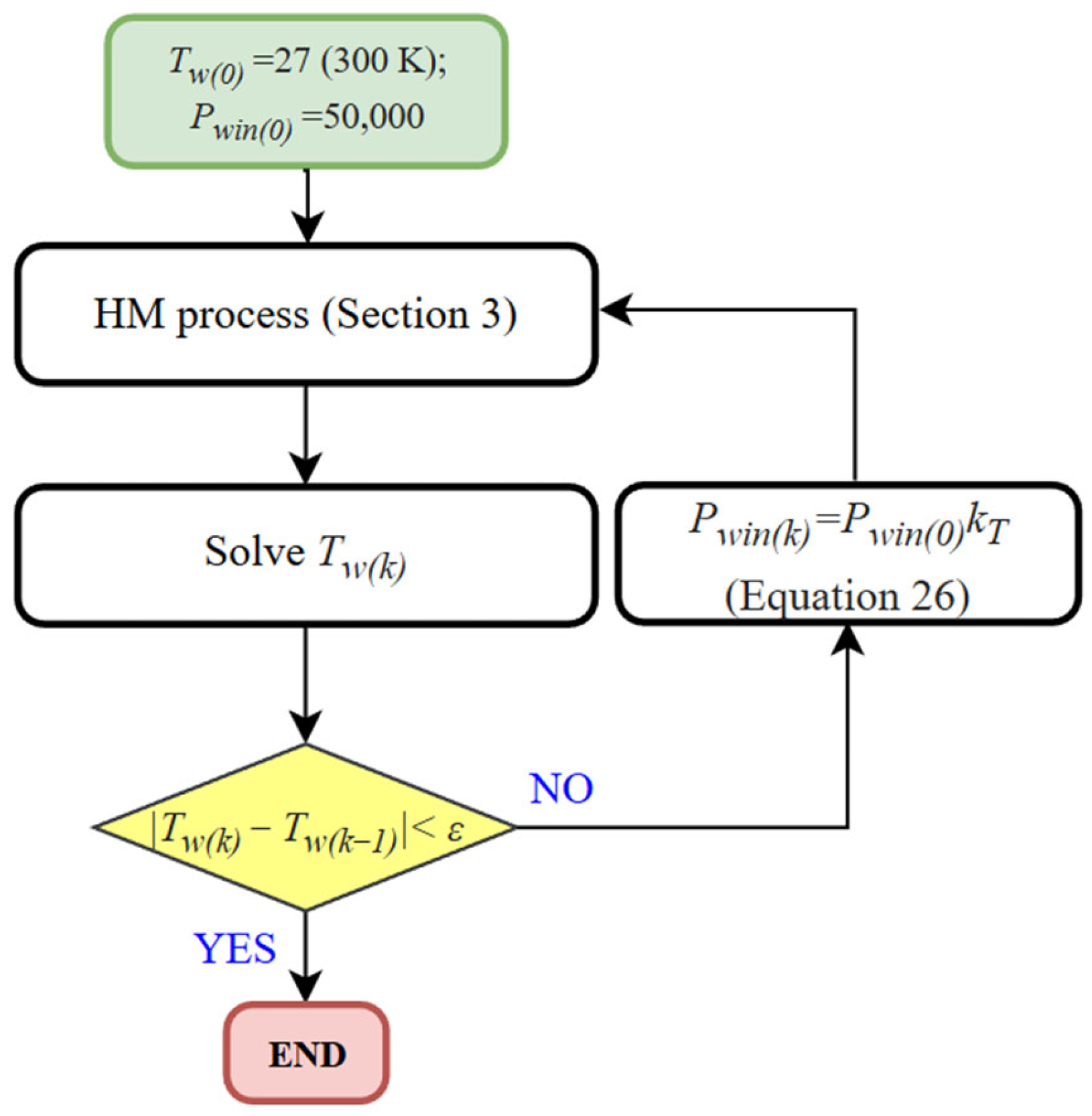
As the winding resistance increases with temperature, the copper loss correspondingly increases, leading to an increase in the winding loss density, as listed in Table 2. This effect results in higher temperatures in the stator slot regions. Therefore, an iterative loop is required to achieve the convergence of this coupled thermal-electrical process, as illustrated in Figure 10.
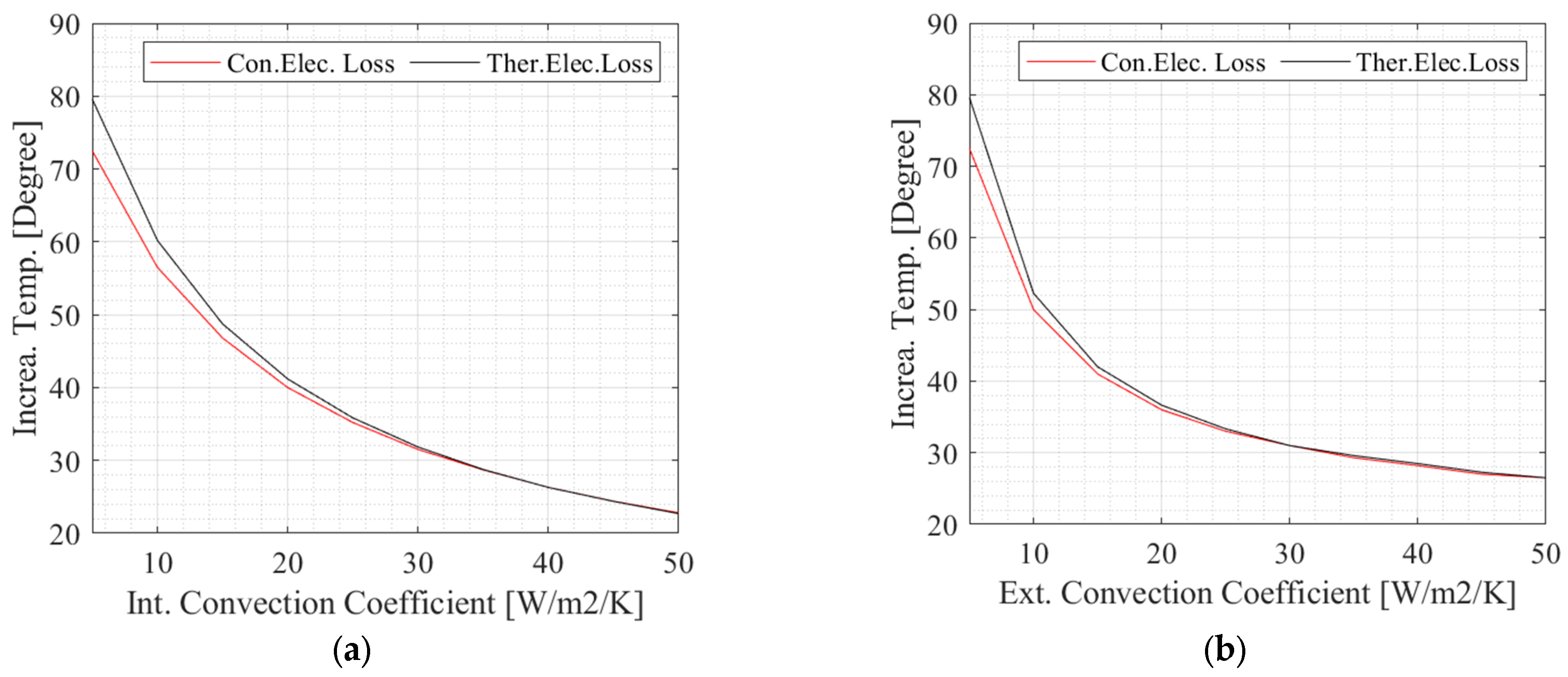
Under loss conditions similar to those in Figure 8, Figure 11 compares the temperature increase in the winding obtained using the coupled thermal-electrical process (black line) with that obtained assuming a constant copper loss (red line). The increase in copper loss at elevated temperatures leads to higher temperatures in the stator winding.

6. Conclusions

The proposed mathematical method is an efficient approach for determining the rising temperature in a dual-PM consequent-pole MGM. In this paper, a 2D analytical approach is presented to evaluate the steady-state temperature distribution. Six distinct regions are defined, and Laplace’s and Poisson’s equations are solved analytically using complex Fourier series representations. The boundary conditions within the machine are derived from the continuity of the temperature and radial heat-flux density at the material interfaces. Subsequently, heat transfer due to convection at the machine boundaries is incorporated. The proposed model is validated against an FEM simulation under various operating conditions, demonstrating good accuracy (errors below 10%), while saving more than 10 times the computation time compared to the FEM simulation.
Based on the methodology and findings of this study, the following future research avenues are suggested:
Consider the non-linear characteristics of thermal conductivity and radiation phenomena;
Consider the ending effects for 3D analysis;
Develop an HM-solving transient analysis;
Verify the HM prediction experimentally using a prototype.

Author Contributions

Conceptualization, M.-D.N.; methodology, M.-D.N.; validation, M.-D.N.; writing—original draft preparation, M.-D.N.; writing—review and editing, D.-T.H., K.-H.S., K.-H.K., J.-Y.P. and J.-Y.C.; supervision, K.-H.S. and J.-Y.C. All authors have read and agreed to the published version of the manuscript.

Funding

This research was supported by the Korea Institute of Marine Science and Technology Promotion (KIMST) funded by the Ministry of Oceans and Fisheries (00254688).

Data Availability Statement

The original contributions presented in this study are included in the article. Further inquiries can be directed to the corresponding author.

Conflicts of Interest

The authors declare no conflicts of interest.

References

  1. Chen, H.; Li, D.; Meng, Y.; Zhang, Y.; Qu, R. Investigation of a Novel Dual-Side PM Vernier Machine With Two-Slot-Pitch Coils. IEEE Trans. Transp. Electrif. 2025, 11, 2108–2119. [Google Scholar] [CrossRef]
  2. Niu, S.; Sheng, T.; Zhao, X.; Zhang, X. Operation Principle and Torque Component Quantification of Short-Pitched Flux-Bidirectional-Modulation Machine. IEEE Access 2019, 7, 136676–136685. [Google Scholar] [CrossRef]
  3. Jiang, J.; Niu, S.; Li, Z.; Dai, L.; Wu, W.; Chan, W.L. Design of a Novel Dual-PM Vernier Machine for High-Torque Direct-Drive Application. IEEE Trans. Transp. Electrif. 2025, 11, 6107–6118. [Google Scholar] [CrossRef]
  4. Dong, J.; Huang, Y.; Jin, L.; Lin, H. Comparative study of surface-mounted and interior permanent-magnet motors for high-speed applications. IEEE Trans. Appl. Supercond. 2016, 26, 5200304. [Google Scholar] [CrossRef]
  5. Qi, J.; Hua, W.; Zhang, H. Thermal analysis of modular-spoketype permanent-magnet machines based on thermal network and FEA method. IEEE Trans. Magn. 2019, 55, 8104105. [Google Scholar] [CrossRef]
  6. Mo, L.; Zhang, T.; Lu, Q. Thermal analysis of a flux-switching permanent-magnet double-rotor machine with a 3-D thermal network model. IEEE Trans. Appl. Supercond. 2019, 29, 0600905. [Google Scholar] [CrossRef]
  7. Phuc, P.N.; Bozalakov, D.; Vansompel, H.; Stockman, K.; Crevecoeur, G. Rotor temperature virtual sensing for induction machines using a lumped-parameter thermal network and dual Kalman filtering. IEEE Trans. Energy Convers. 2021, 36, 1688–1699. [Google Scholar] [CrossRef]
  8. Zhu, S.; Cheng, M.; Cai, X. Direct coupling method for coupled field-circuit thermal model of electrical machines. IEEE Trans. Energy Convers. 2018, 33, 473–482. [Google Scholar] [CrossRef]
  9. Cai, X.; Cheng, M.; Zhu, S.; Zhang, J. Thermal modeling of flux-switching permanent-magnet machines considering anisotropic conductivity and thermal contact resistance. IEEE Trans. Ind. Electron. 2016, 63, 3355–3365. [Google Scholar] [CrossRef]
  10. Zhang, H.; Giangrande, P.; Sala, G.; Xu, Z.; Hua, W.; Madonna, V.; Gerada, D.; Gerada, C. Thermal model approach to multisector threephase electrical machines. IEEE Trans. Ind. Electron. 2021, 68, 2919–2930. [Google Scholar] [CrossRef]
  11. Nguyen, M.-D.; Choi, J.-Y. Thermal analysis and experimental verification of permanent magnet synchronous motor by combining lumped-parameter thermal networks with analytical method. AIP Adv. 2023, 13, 025140. [Google Scholar] [CrossRef]
  12. Chen, Q.; Fan, Y.; Chen, J.; Lei, Y.; Yang, C. A New Analytical Thermal Model of Distributed Winding Wheel Machine for Electric Vehicles. IEEE Trans. Veh. Technol. 2022, 71, 12691–12700. [Google Scholar] [CrossRef]
  13. Zhao, W.; Cao, D.; Ji, J.; Huang, L.; Liu, T. A Generalized Mesh-Based Thermal Network Model for SPM Machines Combining Coupled Winding Solution. IEEE Trans. Ind. Electron. 2021, 68, 116–127. [Google Scholar] [CrossRef]
  14. Han, B.; Liu, X.; Huang, Z.; Zhang, X.; Zhou, Y. Loss calculation, thermal analysis, and measurement of magnetically suspended PM machine. IEEE Trans. Ind. Electron. 2018, 65, 4514–4523. [Google Scholar] [CrossRef]
  15. Cheng, M.; Wang, J.; Zhu, S.; Wang, W. Loss calculation and thermal analysis for nine-phase flux switching permanent magnet machine. IEEE Trans. Energy Convers. 2018, 33, 2133–2142. [Google Scholar] [CrossRef]
  16. Zhou, K.; Pries, J.; Hofmann, H. Computationally efficient 3-D finite-element-based dynamic thermal models of electric machines. IEEE Trans. Transport. Electrific. 2015, 1, 138–149. [Google Scholar] [CrossRef]
  17. Nategh, S.; Huang, Z.; Krings, A.; Wallmark, O.; Leksell, M. Thermal modeling of directly cooled electric machines using lumped parameter and limited CFD analysis. IEEE Trans. Energy Convers. 2013, 28, 979–990. [Google Scholar] [CrossRef]
  18. Dong, J.; Huang, Y.; Jin, L.; Lin, H.; Yang, H. Thermal optimization of a high-speed permanent magnet motor. IEEE Trans. Magn. 2014, 50, 749–752. [Google Scholar] [CrossRef]
  19. Lubin, T.; Mezani, S.; Rezzoug, A. 2-D exact analytical model for surface-mounted permanent-magnet motors with semi-closed slots. IEEE Trans. Magn. 2011, 47, 479–492. [Google Scholar] [CrossRef]
  20. Dubas, F.; Boughrara, K. New scientific contribution on the 2-D subdomain technique in polar coordinates: Taking into account of iron parts. Math. Comput. Appl. 2017, 22, 42. [Google Scholar] [CrossRef]
  21. Nguyen, M.-D.; Jung, W.-S.; Hoang, D.-T.; Kim, Y.-J.; Shin, K.-H.; Choi, J.-Y. Fast Analysis and Optimization of a Magnetic Gear Based on Subdomain Modeling. Mathematics 2024, 12, 2922. [Google Scholar] [CrossRef]
  22. Boughrara, K.; Dubas, F.; Ibtiouen, R. 2-D Exact Analytical Method for Steady-State Heat Transfer Prediction in Rotating Electrical Machines. IEEE Trans. Magn. 2018, 54, 8104519. [Google Scholar] [CrossRef]
  23. Hoang, D.-T. Irreversible Demagnetization Prediction Due to Overload and High-Temperature Conditions in PMSM Based on Nonlinear Analytical Model. IEEE Trans. Energy Convers. 2025, 40, 2256–2267. [Google Scholar] [CrossRef]
  24. Du, Y.; Huang, Y.; Guo, B.; Peng, F.; Yao, Y.; Dong, J. Magnetic field prediction of U-shaped interior permanent magnet motor considering magnetic bridge saturation. IEEE Trans. Magn. 2023, 60, 8200304. [Google Scholar] [CrossRef]
  25. Nguyen, M.-D.; Yang, J.-W.; Hoang, D.-T.; Shin, K.-H.; Choi, J.-Y. Electromagnetic Analysis of YASA Axial Flux Motor Using Harmonic Modeling Considering Non-Linear Core Permeability. IEEE Trans. Magn. 2025, 61, 8203412. [Google Scholar] [CrossRef]
  26. Du, Y.; Huang, Y.; Guo, B.; Peng, F.; Dong, J. Semianalytical model of multiphase Halbach array axial flux permanent-magnet motor considering magnetic saturation. IEEE Trans. Transport. Electrific. 2023, 9, 2891–2901. [Google Scholar] [CrossRef]
  27. Djelloul Khedda, Z.; Boughrara, K.; Dubas, F.; Guo, B.; Ailam, E.H. Two-dimensional steady-state thermal analytical model of permanent-magnet synchronous machines operating in generator mode. COMPEL 2022, 41, 125–154. [Google Scholar] [CrossRef]
  28. Djelloul Khedda, Z.; Boughrara, K.; Dubas, F.; Guo, B.; Ailam, E.H. Two-dimensional steady-state thermal analytical model of permanent magnet linear motor in Cartesian coordinates. COMPEL 2025, 44, 109–126. [Google Scholar] [CrossRef]
  29. Du, Y.; Peng, F.; Guo, B.; Djelloul-Khedda, Z.; Huang, Y. Two-Dimensional Semi-Analytical Steady-State Thermal Model of Permanent Magnet Machines With Water-Cooled Structure. IEEE Trans. Transp. Electrif. 2024, 10, 9226–9235. [Google Scholar] [CrossRef]
  30. Jing, L.; Tang, W.; Wang, T.; Ben, T.; Qu, R. Performance Analysis of Magnetically Geared Permanent Magnet Brushless Motor for Hybrid Electric Vehicles. IEEE Trans. Transp. Electrif. 2022, 8, 2874–2883. [Google Scholar] [CrossRef]
  31. Jing, L.; Wang, T.; Tang, W.; Liu, W.; Qu, R. Characteristic Analysis of the Magnetic Variable Speed Diesel–Electric Hybrid Motor With Auxiliary Teeth for Ship Propulsion. IEEE/ASME Trans. Mechatron. 2024, 29, 668–678. [Google Scholar] [CrossRef]
  32. Wang, Q.; Niu, S.; Yang, S. Design Optimization and Comparative Study of Novel Magnetic-Geared Permanent Magnet Machines. IEEE Trans. Magn. 2017, 53, 8104204. [Google Scholar] [CrossRef]
  33. Wang, Y.; Niu, S.; Fu, W. Sensitivity Analysis and Optimal Design of a Dual Mechanical Port Bidirectional Flux-Modulated Machine. IEEE Trans. Ind. Electron. 2018, 65, 211–220. [Google Scholar] [CrossRef]
Figure 1. (a) Conventional, (b) consequent-pole, and (c) dual-PM consequent-pole MGM.
Mathematics 14 00460 g001
Figure 2. (a) Air gap flux density distribution and (b) corresponding FFT analysis of dual-PM consequent-pole MGM.
Mathematics 14 00460 g002
Figure 3. (a) FEM–analytical method conversion and (b) simplified analytical model.
Mathematics 14 00460 g003
Figure 4. Illustration of Fourier series.
Mathematics 14 00460 g004
Figure 5. Thermal conductivity and heat source distribution calculated by Equation (4).
Mathematics 14 00460 g005
Figure 6. (a) Thermal conductivity and (b) loss per volume distribution in FEM simulation.
Mathematics 14 00460 g006
Figure 7. Temperature maps (in kelvin) of (a) FEM and (b) HM at [αhi αhe] = [100 5] W/m2/K and (c) FEM and (d) HM at [αhi αhe] = [10 10] W/m2/K.
Mathematics 14 00460 g007
Figure 8. Variations in rising temperature in different parts of machine with varying (a) internal and (b) external convection coefficients.
Mathematics 14 00460 g008
Figure 9. Error compared to FEM and time calculation of HM by varying harmonic number.
Mathematics 14 00460 g009
Figure 10. Flowchart of coupled thermal-electrical process.
Mathematics 14 00460 g010
Figure 11. Comparison of temperature increase in stator winding assuming constant copper loss and temperature-dependent copper loss with varying (a) internal and (b) external convection coefficients.
Mathematics 14 00460 g011
Table 1. Dual-PM consequent-pole MGM parameters.
QuantitySymbolUnitValue
Inner stator radius R 1 mm33
Inner stator slot radius R 2 mm40
Outer stator slot radius R 3 mm70
Outer stator radius R 4 mm75
Inner rotor radius R 5 mm76
Outer rotor magnet radius R 6 mm82
Outer rotor radius R 7 mm90
Stack length L s t k mm50
Rotor slot number N r -11
Stator slot number N s -18
Stator slot pitch ratio α s s N s / 2 π 0.375
Stator magnet pitch ratio α s m N s / 2 π 0.4
Rotor magnet pitch ratio α r m N r / 2 π 0.6
Table 2. Thermal model parameters and losses.
QuantitySymbolUnitValue
Winding thermal conductivity λ w W / m / K 400
Insulation thermal conductivity λ i n s W / m / K 0.03
Air thermal conductivity λ a W / m / K 0.026
Core thermal conductivity λ c W / m / K 30
Magnet thermal conductivity λ m W / m / K 7.5
Internal thermal convection coefficient α h i W / m 2 / K 100/10
External thermal convection coefficient α h e W / m 2 / K 5/10
Rotor core loss density P r c W / m 3 10,000
Rotor magnet loss density P r m W / m 3 1000
Stator core loss density P s c W / m 3 20,000
Stator magnet loss density P s m W / m 3 2000
Winding loss density P w i n W / m 3 50,000
Ambient temperature T a m b K300
Disclaimer/Publisher’s Note: The statements, opinions and data contained in all publications are solely those of the individual author(s) and contributor(s) and not of MDPI and/or the editor(s). MDPI and/or the editor(s) disclaim responsibility for any injury to people or property resulting from any ideas, methods, instructions or products referred to in the content.