2. Materials and Methods
The development of the digital risk twin and its iceberg-based geometric representation require a clear conceptual and mathematical grounding. This section formalizes the position of the DRT within the broader digital twin ecosystem, defines its role as a specialized risk-focused subsystem, and introduces the parametric principles that underpin the proposed iceberg model. By establishing these foundations, we create a rigorous framework through which multidimensional sensor data, operational context, and inferred risk indicators can be transformed into an interpretable three-dimensional structure that supports monitoring and decision-making in complex engineering systems.
2.1. Digital Risk Twin as a Core Component of the Digital Twin
In modern engineering practice, DT has become a foundational concept for representing, simulating, and optimizing the lifecycle of complex systems. A DT can be viewed as a dynamic digital counterpart of a physical asset, continuously synchronized with operational data to mirror its state, performance, and behavior in real time. Formally, the physical system at time
can be described as a tuple
where
denotes internal system state vector,
represents control input vector,
is the vector of measurable sensor outputs, and
represents the vector of contextual or operational variables. The dimensions
represent fixed structural characteristics of the monitored system.
The corresponding digital twin
attempts to replicate these components through a combination of physical models, sensor-driven data assimilation, and simulation-based prediction:
While such full-system twins are invaluable for design, control, and optimization, their implementation can be computationally intensive and often exceeds the practical requirements of real-time health and risk monitoring. For these tasks, a more compact, specialized representation is both sufficient and preferable. This motivates the introduction of the DRT as a focused subsystem within the broader DT ecosystem dedicated solely to risk perception, prediction, and visualization.
The DRT
can be defined as a mapping from sensor and contextual data to a structured risk state vector:
where
are real-time sensor measurements,
represents contextual variables (e.g., usage intensity, ambient conditions),
denotes the risk inference model parameters (e.g., learned thresholds, regression coefficients),
is the risk modeling function (e.g., a statistical, AI-based, or rule-based estimator).
The function denotes the internal risk inference mechanism of the DRT. The term encapsulates the set of model parameters that define the behavior of . These parameters may include learned model coefficients obtained from machine-learning training, decision rules and threshold values derived from domain expertise, or statistical descriptors such as estimated distributions, clustering prototypes, and principal components. In AI-based implementations, typically denotes the set of model parameters produced during training on historical sensor and operational data. In rule-based implementations, may include manually defined health boundaries, expert-defined thresholds, or fuzzy membership functions. In this way, represents the internal knowledge of the DRT and supports the transformation of raw inputs into actionable real-time risk indicators . The accuracy, generalizability, and interpretability of the DRT depend on how is selected, calibrated, and validated.
The output
represents the normalized risk profile across
monitored parameters or subsystems. Each
quantifies the degree of deviation from nominal operation, where higher values correspond to higher risk or degradation probability.
Each risk component can be interpreted as:
A normalized failure probability;
A proximity-to-threshold index;
An anomaly magnitude score, depending on the modeling choice.
In this study, each component is treated as a normalized risk indicator that quantifies the severity of deviation of the -th monitored component from its nominal regime at time . Although may originate from different inference mechanisms (e.g., probabilistic estimation, threshold-based scoring, or anomaly detection), these quantities are not assumed to be mathematically equivalent in their raw form. To ensure rigor and reproducibility, the framework requires that the output of any inference mechanism is converted into a common bounded risk scale with consistent semantics: corresponds to nominal operation, while larger values indicate increased risk or degradation severity for component .
Accordingly, the indicator is interpreted as one of the following risk indicator types, depending on the chosen inference model: (i) a probabilistic risk estimate (failure likelihood), (ii) a proximity-to-boundary score derived from predefined operational limits, or (iii) a normalized anomaly severity score derived from statistical or machine-learning detectors. The specific type used in an application should be declared together with its inference method and calibration approach. This explicit distinction prevents ambiguity in interpretation and ensures that different risk indicators remain comparable once mapped to the unified normalized scale used for geometric embedding in the iceberg digital risk twin.
Importantly, unlike the full DT which attempts to simulate system dynamics:
the DRT does not attempt to reconstruct or simulate all
. Instead, it focuses on monitoring trends in
that correlate with emerging faults or deviations from healthy operation.
In contrast to a full digital twin that seeks to simulate the entire system dynamics
, the DRT focuses on monitoring risk evolution:
where
captures the trend or acceleration of risk associated with component
. This differential form enables early identification of emerging anomalies and supports predictive intervention.
Importantly, the DRT is not an isolated construct but a specialized layer within the DT architecture:
To clarify the functional role of the DRT within the broader digital twin ecosystem,
Table 1 provides a structured comparison of its respective capabilities. While both constructs operate on synchronized data streams from the physical system, they differ substantially in scope, computational complexity, and operational intent. The full DT is designed to replicate and simulate system behavior across its entire lifecycle, integrating physics-based models, control logic, and data-driven prediction. In contrast, the DRT constitutes a focused, lightweight analytical layer dedicated to health assessment, degradation tracking, and early risk detection.
This comparison highlights how the DRT complements, rather than replaces, the full digital twin. By abstracting high-dimensional system observations into compact risk indicators and interpretable geometric representations, the DRT enables faster update cycles, improved explainability, and more efficient real-time monitoring. The table therefore emphasizes the rationale for embedding the DRT as a modular subsystem within DT architectures, particularly in safety-critical and resource-constrained operational environments.
To further substantiate the architectural role of the DRT,
Table 2 summarizes the key benefits of embedding the DRT as a dedicated subsystem within a broader DT framework. Rather than functioning as an independent or parallel model, the DRT operates as an internal analytical layer that continuously distills high-dimensional sensor and contextual data into compact, interpretable risk representations.
This embedded configuration enables a clear separation of responsibilities: the full DT retains responsibility for system-level simulation, optimization, and lifecycle management, while the DRT focuses on real-time risk perception, degradation monitoring, and early anomaly detection. The table highlights how this division improves computational efficiency, enhances explainability, and supports faster update cycles, while simultaneously strengthening the DT’s decision-making layer through structured, visualization-ready risk information. As such, the DRT acts as a cognitive and diagnostic intermediary that augments the DT’s operational intelligence without increasing model complexity.
In this integrated structure, the DT provides the contextual data, operational envelope, and feedback mechanisms, while the DRT delivers real-time risk indicators and visualization-ready summaries. The bidirectional exchange between the two allows for adaptive model updates and closed-loop decision-making.
2.2. Iceberg Model as a Risk Representation Metaphor
To enable intuitive interpretation of the Digital Risk Twin’s outputs and capture the asymmetry between observed and latent system risks, we propose the iceberg model as a geometric and metaphorical representation of multivariate risk states. This model extends the traditional “iceberg” metaphor used in safety science—where only a small part of a system’s failure profile is observable—into a formal, parametric, and dynamic structure that visualizes both visible and hidden degradation over time.
In the classical iceberg metaphor, the tip of the iceberg corresponds to observable events or failures (e.g., alarms, fault codes), while the submerged body corresponds to hidden faults, parameter drifts, early-stage anomalies, or precursors to failure. In the context of a Digital Risk Twin, we can reinterpret this metaphor in terms of:
Observed indicators. values close to 1 → high risk, visible symptoms.
Latent degradation. values > 0 but < threshold → submerged but growing risk.
Healthy conditions. → flat/no elevation in iceberg profile.
This motivates a 3D geometric structure, constructed from individual parameter contributions to system risk.
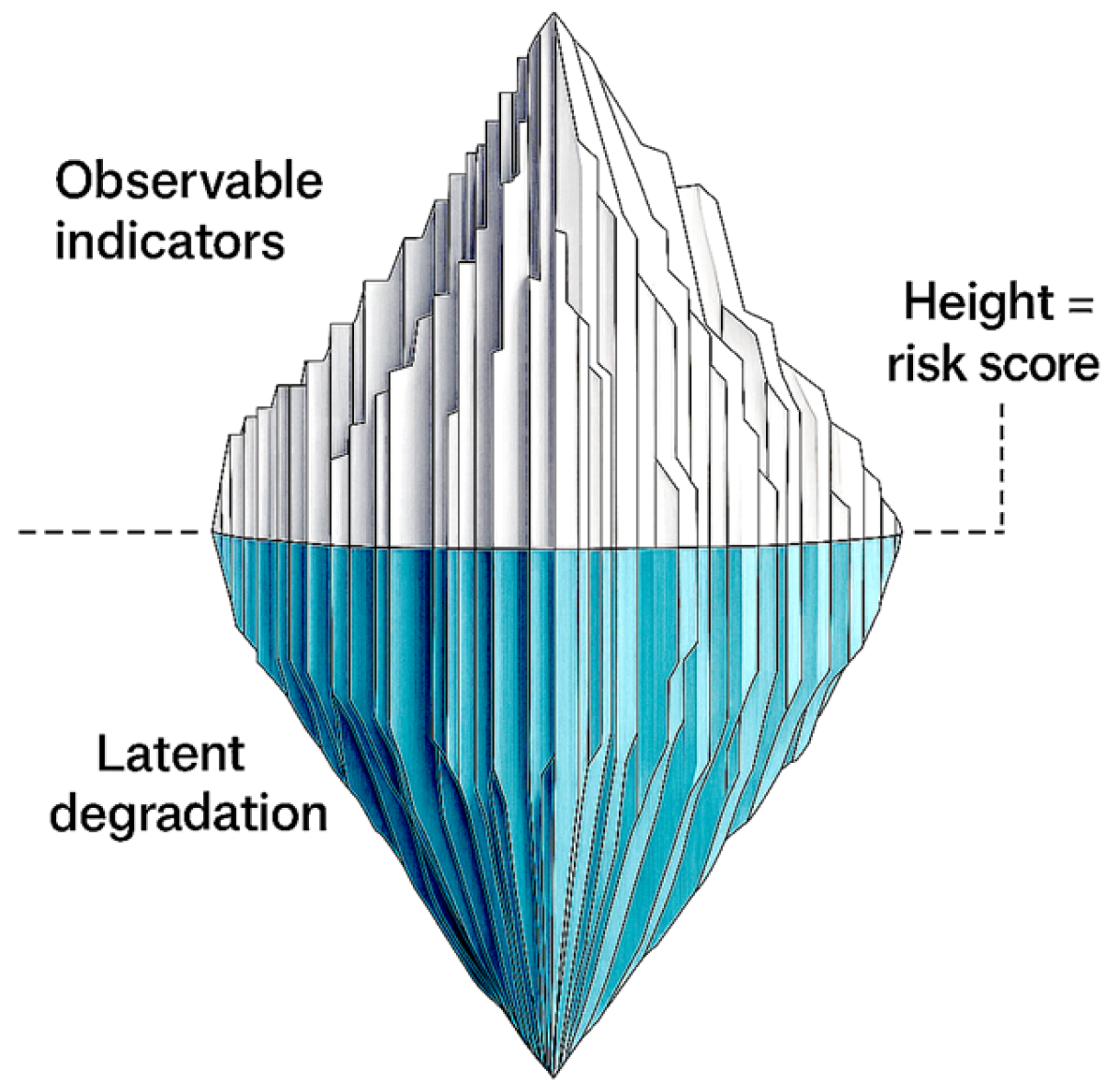
This conceptual distinction is illustrated in
Figure 1, which depicts the iceberg geometry used in the proposed digital risk twin. Each vertical plate corresponds to a risk component, with elevation reflecting its normalized risk score. The upper region above the waterline represents the subset of risks that are observable or actionable, while the larger submerged region captures latent degradation that accumulates before manifesting through measurable symptoms. This visual asymmetry highlights the necessity of monitoring both visible and hidden components of system health, forming the foundation for the parametric model developed in the subsequent subsections.
The baseline iceberg representation models each risk component as a separate vertical sheet, which provides an intentionally interpretable decomposition of multivariate risk into visible and latent parts. This construction does not imply that risk drivers are physically independent; rather, it reflects a factorized geometric visualization used as a first-order approximation for explaining dominant contributors. In many complex engineering systems, risk components may exhibit coupling, including correlated degradation, shared causal mechanisms, common-mode failures, and cascading propagation across subsystems.
To address this, the framework is compatible with an interaction-aware extension in which risk coupling is represented by an additional dependency layer that modulates the inferred risk values before geometric embedding. Cross-component influence can be incorporated through a coupling model (e.g., learned correlation structure, causal graph, Bayesian network, or dynamic influence weights), allowing one component’s growth to amplify, dampen, or delay the evolution of others. In this extended setting, the iceberg geometry remains interpretable, while cascading behavior is reflected by coordinated changes in multiple sheets and by the emergence of dominant coupled clusters rather than isolated risk spikes.
This coupling-aware extension preserves the transparent risk decomposition as the main advantage of the proposed model while enabling the representation to capture failure propagation patterns that are typical for safety-critical systems. A full formalization and empirical evaluation of interaction structures can be identified as a natural direction for future work, particularly for domains with strongly coupled failure modes.
Let the DRT at time
produce a multivariate risk vector:
Each element represents the normalized estimated risk level associated with a specific system component, sensor channel, or failure mode.
We define the iceberg surface at time
as the union of a set of vertical plates (or “sheets”), where each sheet corresponds to one risk component:
Each vertical sheet
is defined as:
where
is the position of the -th plate in the 2D base plane (e.g., circular or grid layout).
is the height function, mapping the risk score to vertical elevation, is a scaling function (linear or nonlinear), e.g., with scaling constant , to emphasize low-amplitude signals or exponential , with .
Thus, the entire 3D iceberg can be viewed as a piecewise-vertical risk extrusion surface, where the vertical dimension encodes risk intensity.
To further enrich the visual and analytical expressiveness of the model, additional attributes can be encoded:
where
is the source parameter.
Color coding: use functional domain (e.g., structural, hydraulic) or risk severity category (green/yellow/red zones).
Temporal animation: observe shape evolution over time , highlighting dynamic risk trends.
The iceberg representation offers multiple advantages as a DRT visualization layer:
It enables fast visual scanning of which parameters dominate system risk at time .
The visible tip (elevated components) corresponds to actionable issues.
The growing base of the submerged region signals cumulative risk before threshold breach.
Changes in shape, asymmetry, or volume over time can be used to forecast criticality or maintenance needs.
This structure supports explainable AI in health monitoring systems, bridging abstract model outputs with actionable insights for human operators.
Recall that each risk component
is derived from a nonlinear mapping of system observations:
Thus, the 3D iceberg can be considered a visual embedding of the output space of the risk model , constrained by the parameter set .
The iceberg model transforms the numerical output of a DRT into a spatially structured, temporally dynamic surface, with strong metaphorical and mathematical grounding. It provides an intuitive yet formal bridge between raw sensor analytics and human-centered risk visualization, enabling decision-makers to see the hidden layers of system health.
2.3. Parametric Geometric Representation of the Iceberg
To transform the multivariate outputs of the DRT into an interpretable and dynamic visual structure, we define a parametric geometric representation of the iceberg model in 3D space. This representation enables the visualization of both instantaneous and evolving risk states, offering a spatial encoding of the risk vector produced by the DRT.
The full iceberg body is thus a non-uniform vertical extrusion of the risk vector over a discrete spatial layout.
The temporal evolution of risk can be tracked by computing over a sequence . The changing geometry of the iceberg reflects:
Growing peaks → increasing risk magnitude.
Asymmetry → localized concentration of degradation.
Emerging submerged mass → accumulation of latent risk not yet at actionable thresholds.
Define the temporal derivative of risk height:
to monitor acceleration of degradation or stabilization trends per parameter.
The volume under the waterline (submerged region) represents early-stage degradation, while the visible region corresponds to risk levels exceeding predefined thresholds .
To enhance the expressiveness of the iceberg visualization, we introduce optional encodings:
where
is the local standard deviation of source signal
, and
is a scaling factor.
Color encodes subsystem group, domain (e.g., electrical, hydraulic), or severity classification.
Opacity
reflects confidence score from the risk inference model:
The base coordinates
can be defined via a layout function:
Examples include:
This allows the iceberg to be structured in a manner that supports visual modularity, separating different domains of the system (e.g., propulsion, avionics, hydraulics) into zones.
The iceberg model serves as a spatial visualization of the risk function:
where
is the geometric mapping function that converts abstract risk vectors into a tangible 3D surface with visual semantics.
This structure makes the risk state of complex systems auditable, explainable and trend-sensitive, providing a direct bridge between mathematical inference and intuitive visual diagnostics.
2.4. Integration of the Iceberg Model Within the Digital Risk Twin Pipeline
The iceberg model is not an isolated visualization component but is structurally integrated into the DRT pipeline as its terminal stage of representation and interpretation. It serves as a dynamic, geometry-based interface between data-driven risk estimation and human-centered decision support.
In this section, we formalize how the iceberg geometry is constructed from raw data through sequential processing layers within the DRT architecture.
The system under observation generates two primary streams of input:
Sensor measurements:
Contextual/environmental variables:
These form the observable state:
- 2.
Inference Layer. Risk Modeling Function
A risk modeling function
, parameterized by
, maps the observed state to a risk vector:
Each component quantifies the real-time degradation level or anomaly score for a subsystem or operational mode. Models for may include statistical estimators (e.g., moving average, residual error), AI/ML models (e.g., LSTM, autoencoders), and knowledge-based models (e.g., expert rules, threshold functions).
The risk function is assumed to be a well-posed mapping from admissible observations (including contextual variables) to a bounded and normalized risk representation, ensuring comparability across heterogeneous data sources. To guarantee robustness, is required to satisfy a regularity (stability) property, meaning that small perturbations in the input due to sensor noise or minor context variations do not lead to disproportionate changes in the inferred risk. Identifiability is assumed at the level of the selected observation set, i.e., the major risk drivers correspond to distinguishable patterns in the data, enabling meaningful decomposition of risk contributions. When is instantiated as a learned model, it is further assumed to be statistically consistent under a stable data-generating process, such that risk estimates converge toward a stable mapping as additional observations become available.
- 3.
Geometric Mapping Layer. Iceberg Projection
The vector
is then mapped to a 3D parametric surface using the iceberg generation function:
with each sheet:
This projection defines the vertical profile of the iceberg, where the height of each segment encodes the magnitude of the corresponding risk score.
Optional extensions like uncertainty thickness , color, and transparency can also be derived at this stage from secondary model outputs and .
- 4.
Visualization Layer: Rendering and Interaction
The final surface is rendered in a 3D interactive space, allowing:
Inspection of local risk peaks;
Filtering by domain or threshold;
Time-based animation to assess risk dynamics.
Define an alert threshold for actionable risk levels. The visual model is segmented into:
Visible tip—regions where , i.e., actionable anomalies.
Submerged mass—regions where , i.e., latent or early-stage degradation.
Flat base—regions where , i.e., normal behavior.
The full DRT + iceberg pipeline can be represented as a composite mapping:
where
This composition allows real-time generation of visually expressive and mathematically grounded risk surfaces from live telemetry streams.
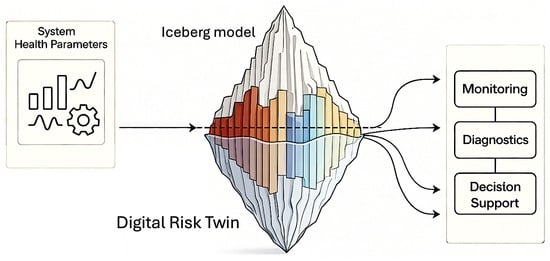
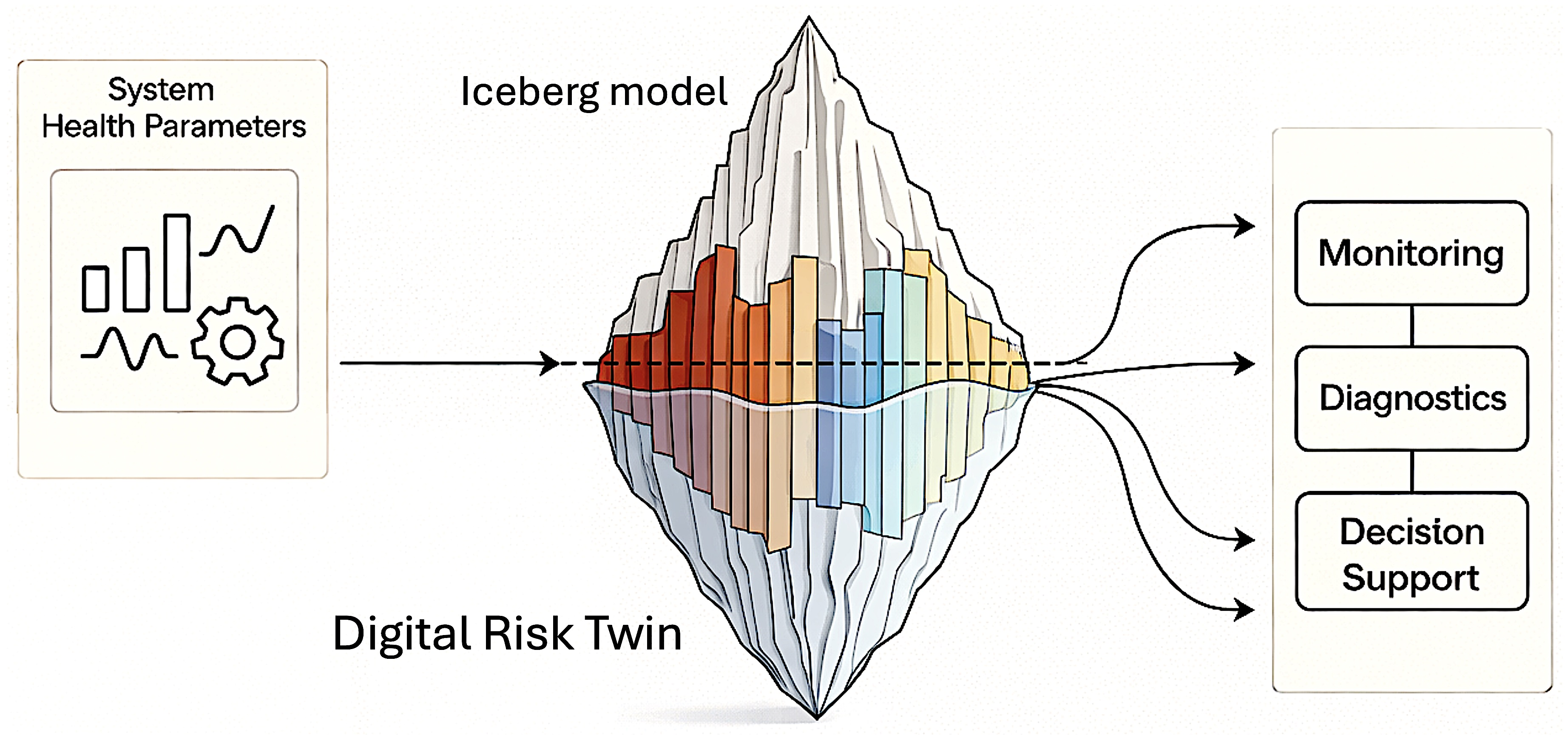
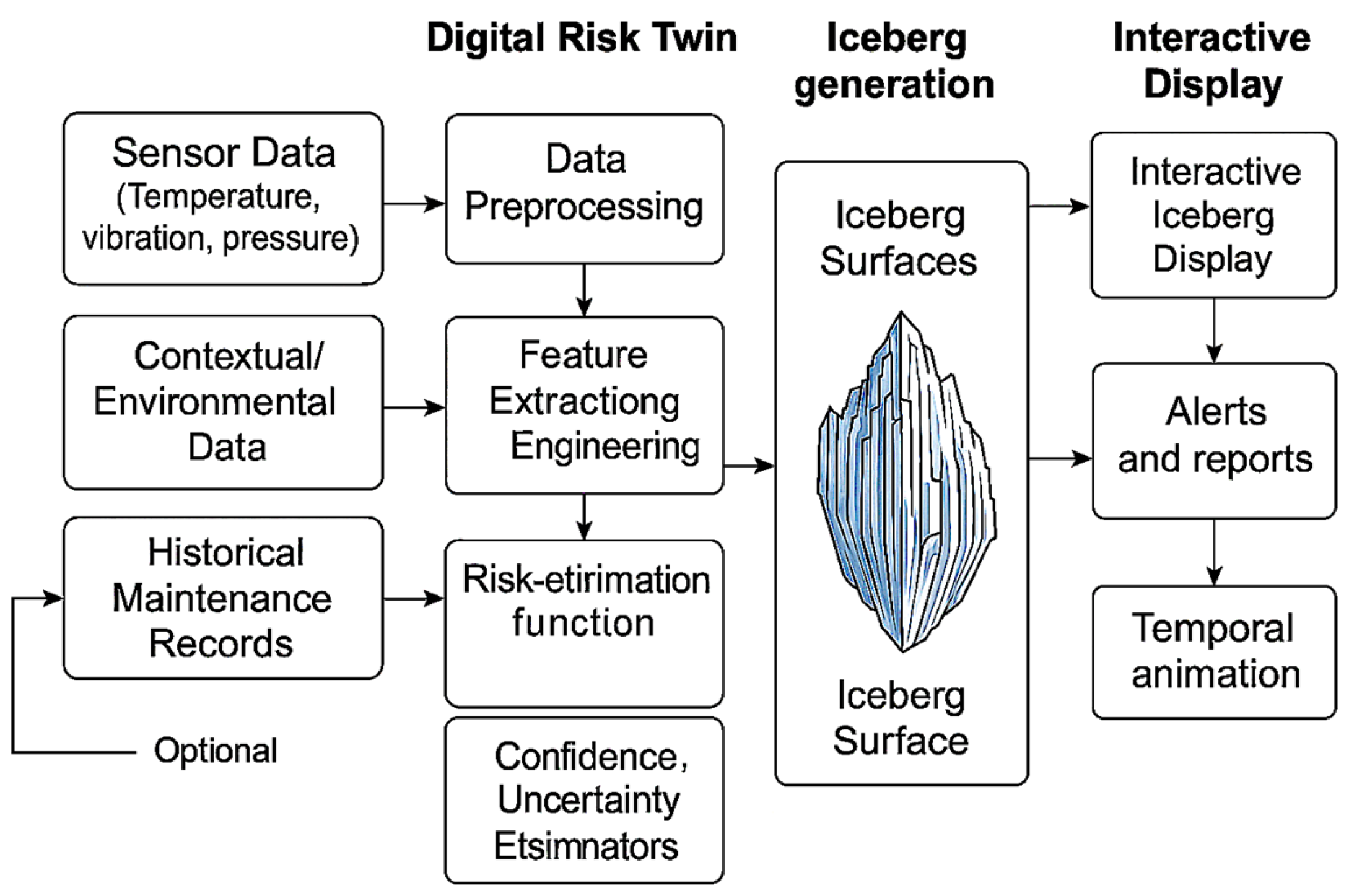
Figure 2 illustrates the complete data processing pipeline of the proposed DRT, from raw sensor acquisition to the generation of the iceberg-based risk visualization and interactive display.
Sensor data (e.g., temperature, vibration, pressure), contextual and environmental variables, and optionally maintenance records are first ingested and passed through the data preprocessing layer. Feature extraction and engineering transform these raw inputs into structured representations suitable for risk inference. The core of the DRT is the risk-estimation function , which produces the normalized risk vector and, when available, associated confidence or uncertainty estimates.
These outputs feed into the iceberg generation module, where individual risk components are mapped to vertical geometric surfaces forming the iceberg structure. The resulting 3D iceberg surface is then delivered to the interactive display environment, which includes a real-time visualization interface, automated alerting and report generation, and temporal animation tools for tracking the evolution of system risk. Together, these components enable a transparent, explainable, and dynamic representation of risk within complex engineering systems.
Embedding the iceberg within the DRT pipeline provides the following key benefits:
Interpretability at which each visual component has a direct, formal correspondence to a risk parameter.
Traceability at which users can link geometry to data stream .
Modularity at which iceberg construction is decoupled from inference logic, allowing independent improvements in modeling and visualization .
Alert integration at which color bands or threshold overlays can encode early-warning zones.
This completes the formal integration of the iceberg model into the DRT computational pipeline.
2.5. Risk Interpretation and Decision Support Through Iceberg Model Visualization
The integration of the iceberg model within the DRT architecture culminates in a structured, intuitive, and mathematically coherent approach to risk interpretation and operational decision-making. Unlike abstract numerical vectors or threshold-based alerts, the 3D iceberg surface provides a visually and spatially encoded snapshot of the system’s health state. This section formalizes how actionable insights are derived from the geometry and dynamics of the iceberg model.
The visual representation
, constructed as:
is interpreted as a risk elevation map, where
Tall vertical extrusions correspond to high-risk subsystems (e.g., abnormal sensor values);
Wide or thick surfaces indicate high uncertainty or high variance;
Symmetry/asymmetry in the iceberg shape reveals distribution of degradation across subsystems;
Color zones highlight domain-specific anomalies (e.g., electrical vs. mechanical).
Define an alert threshold for actionable risk levels. The visual model is segmented into:
Visible tip—regions where , i.e., actionable anomalies.
Submerged mass—regions where , i.e., latent or early-stage degradation.
Flat base—regions where , i.e., normal behavior.
This semantic zoning enables color-coding, filtering, and prioritization of risk zones in the iceberg structure.
By monitoring the time evolution of the iceberg geometry , the system can detect:
Emerging peaks: increasing parameter trending toward failure;
Stabilized surfaces: resolved or non-progressing condition;
Growing base mass: systemic risk accumulation not yet crossing alert threshold.
Define a risk growth velocity for each parameter:
and use this to forecast which submerged segments may soon become visible and require intervention.
To assist with operator dashboards and automated maintenance recommendations, the following aggregate metrics may be computed from the iceberg geometry:
where
is the base area or thickness of each plate
.
Critical subsystem identification:
These metrics may be updated in real-time and displayed alongside the visual iceberg for quantitative monitoring.
The combined interpretability and formal grounding of the iceberg model support several risk-driven decision support scenarios:
Preventive maintenance triggering: If , generate maintenance ticket.
Risk forecasting: If exceeds predefined slope threshold → predictive alert.
Fleet-wide risk comparison: Use , , or iceberg shape similarity for benchmarking.
Operational adjustments: Inform safe mission replanning based on current risk geometry.
Crucially, the iceberg model enhances the explainability of the DRT’s outputs:
Each visual segment maps to a specific parameter and risk function.
Changes in geometry correspond to concrete data shifts.
Operators can visually trace alarms to their underlying source components, improving trust in the model’s outputs.
The iceberg model is more than a visual metaphor; it is a quantitative, decomposable, and dynamic representation of multivariate system risk. When embedded within the DRT pipeline, it enables structured visualization of abstract risk states, time-resolved monitoring of degradation processes and transparent decision-making in high-stakes environments.
2.6. Mathematical Model of the Parametric Iceberg
This section defines the mathematical framework that underpins the transformation of multidimensional risk estimates into a structured, parameterized 3D geometry of the iceberg model. This model enables interpretable, real-time visualization of system health, capturing both visible failures and latent risks through geometric features.
We present the complete mapping from system data streams to the parametric geometry , detailing each function and structural element involved. The full structure is a discrete geometric approximation of the risk state surface.
Additional semantic information may be encoded into the iceberg’s visual properties:
- (a)
Thickness (uncertainty)
Let the visual thickness
reflect uncertainty:
where
is the standard deviation or confidence interval of the inferred risk
.
- (b)
Opacity or transparency
Opacity
can be defined as:
where
is the model’s internal confidence in the risk estimate
.
Assign a color based on subsystem domain, component category, or severity level, for example, blue (structural components), orange (hydraulic subsystems), red (high-risk peaks).
This enables visualization with different textures or overlays (e.g., transparency or waterline indicator) to represent interpretability zones.
To monitor risk dynamics, define the risk velocity for each parameter:
And the total iceberg volume as an integral or discrete sum:
where
is the base area of sheet
, e.g., constant if using uniform sheets.
The total transformation from data to geometry can be written compactly as:
where
is the risk inference function,
is the geometric extrusion and styling function,
is the 3D risk surface available for visualization and interpretation.
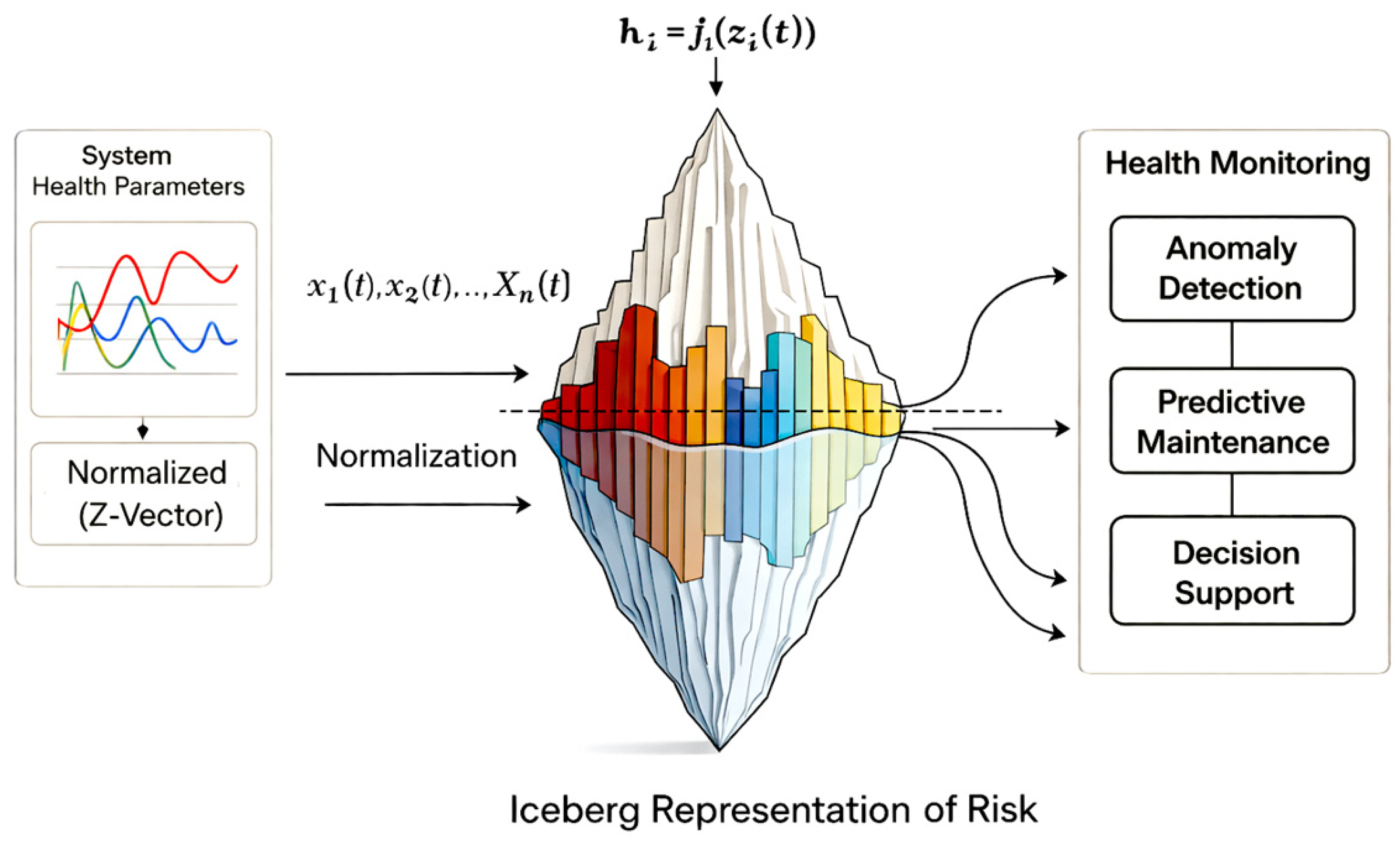
Figure 3 illustrates the transformation of multidimensional system health parameters into an iceberg-based digital risk twin representation. Time-series measurements
are first normalized to form a bounded risk vector
. Each risk component
is mapped to a geometric height
, generating a set of vertical elements that collectively form the iceberg structure. The portion of the iceberg above the waterline represents observable and actionable risk, while the submerged region captures latent degradation. The resulting geometric representation supports downstream health monitoring tasks such as anomaly detection, predictive maintenance, and decision support.
This parametric model enables not only visualization but also computation, monitoring, and integration of system health risk into decision support environments.
2.7. Mathematical Novelty and Core Mathematical Contribution
While the individual operators employed in the proposed construction, such as normalization, vertical extrusion, and linear/logarithmic scaling, are standard, the mathematical novelty of this work lies not in introducing new primitive transformations, but in defining a risk-to-geometry formalization as a structured mathematical object that enables quantitative analysis on the geometric representation itself. In particular, an explicit compositional mapping is introduced
where
denotes the risk inference operator and
is a geometry-generation operator producing a piecewise-defined 3D surface (“iceberg”)
. This yields a well-defined geometric state space for the digital risk twin, in which the system health is not only expressed as a numerical vector but also as a parametric geometric entity suitable for further mathematical operations.
From this operator-based formalization, the iceberg DRT becomes a computable risk manifold surrogate (piecewise-vertical surface) equipped with geometry-derived functionals. Specifically, the model enables the introduction of geometric risk metrics (e.g., total risk volume, visible risk ratio, dominant sheet identification) as quantitative functionals of
, such as:
These quantities are not inherited automatically from standard visualization practices; rather, they arise from treating the visualization as a mathematically defined geometric representation. Furthermore, by defining the temporal evolution
the framework supports the analysis of risk dynamics at the geometric level, where risk growth, concentration, and the emergence of actionable anomalies correspond to measurable changes in the surface structure.
Therefore, the novelty is the introduction of a domain-agnostic, modular, and analyzable mapping from multivariate risk states to a geometric representation with explicit semantics (visible vs. latent risk via a waterline threshold), enabling both interpretable visualization and quantitative risk monitoring through geometry-based descriptors.
3. Results
3.1. Simulation-Based Demonstration of the Iceberg Digital Risk Twin
To demonstrate the behavior, interpretability, and dynamic properties of the proposed iceberg-based DRT independently of any specific application domain, a simulation-based demonstration scenario is first considered. This abstract setting allows controlled exploration of how multidimensional risk indicators are transformed into the parametric iceberg geometry and how the resulting structure evolves over time in response to changing system conditions.
The objective of this demonstration is not to model a particular physical system in detail, but rather to validate the internal consistency of the proposed risk-to-geometry mapping, illustrate the effects of risk growth and asymmetry, and highlight the semantic separation between latent and visible risk regions defined by the waterline threshold. By using synthetically generated data with known degradation patterns, the behavior of the DRT can be analyzed in a transparent and reproducible manner, providing a reference baseline for subsequent application to a real engineering subsystem.
The simulation-based demonstration relies on a synthetic multivariate dataset representing a notional monitored system with risk components. At each discrete time step , the input consists of a vector of simulated sensor observations and optional contextual variables , generated according to predefined degradation patterns with additive noise. These inputs are used exclusively to evaluate the behavior of the DRT and its geometric projection, rather than to emulate a specific physical process.
To validate the model, we consider a notional technical system with:
observable components (e.g., sensors or functional units).
Each generating a time-series of values .
Environmental inputs , such as ambient temperature, operational load, and humidity.
The simulation period spans time steps.
Each parameter evolves according to a controlled degradation profile:
where
is baseline value,
is degradation amplitude,
is frequency (component-dependent),
is phase shift,
is additive Gaussian noise
.
For this case study, the inference function
is implemented using a z-score anomaly detector:
where
and
are computed from a training window
. The result is normalized using:
where
is the upper anomaly bound.
This produces a bounded risk vector at each time step.
Each
is mapped to a height:
The spatial layout follows a radial configuration:
Each sheet is rendered as a vertical rectangular panel at , with:
Constant thickness .
Color intensity proportional to .
Opacity set to full for , and semi-transparent otherwise.
The 3D surface is regenerated at each time step to reflect current risk dynamics.
To illustrate the interpretability and operational utility of the proposed iceberg-based DRT, some visualizations derived from the simulated case study.
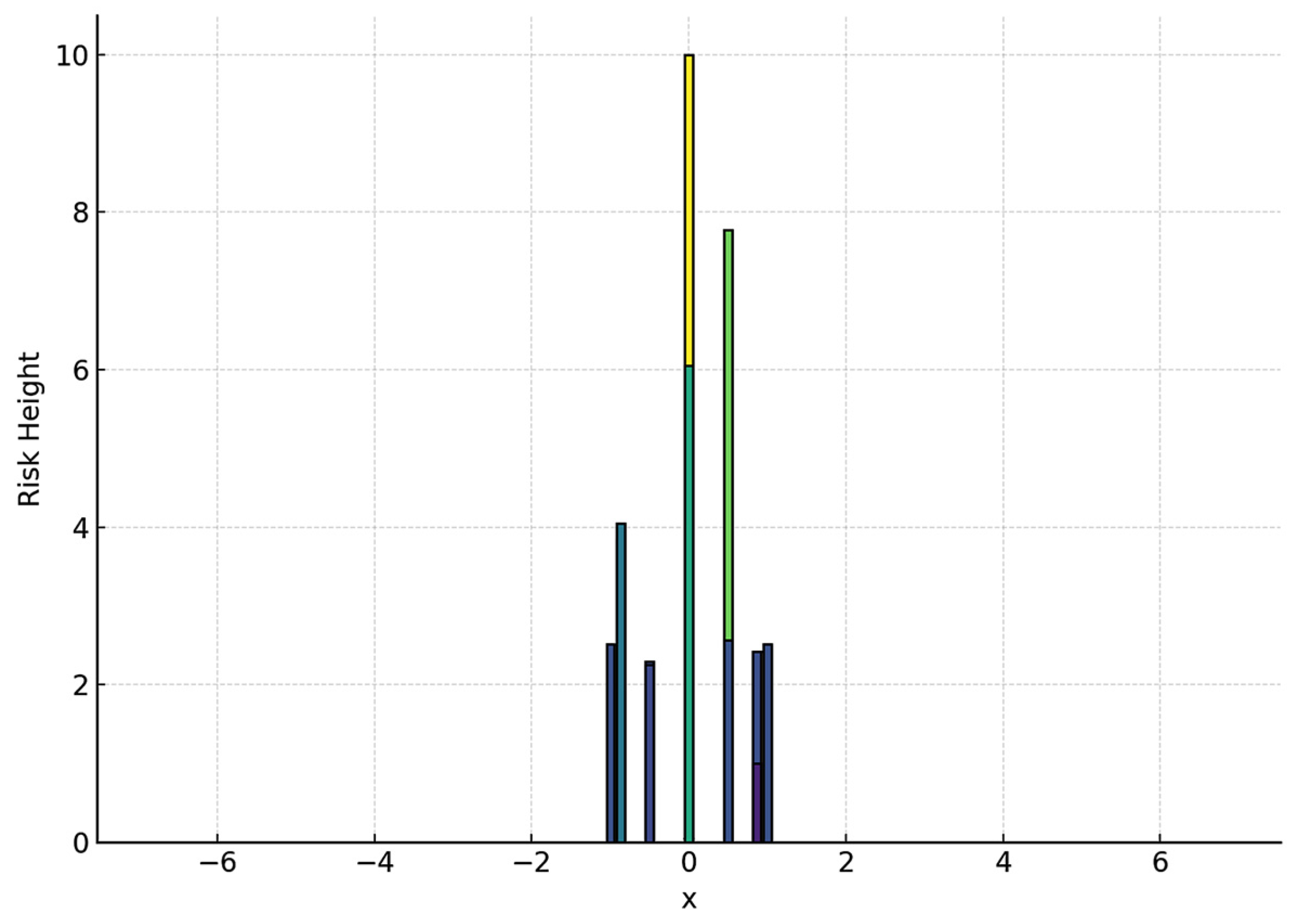
Figure 4 displays a snapshot of the 3D iceberg geometry
at time step
. Each vertical sheet represents an individual risk component, positioned using a radial layout and extruded vertically based on its associated risk score
. The color intensity of each panel correlates with risk magnitude. This visualization highlights two significantly elevated components, whose peaks are visually dominant and easily distinguishable from the broader risk landscape. The radial configuration provides symmetry and spatial clarity for comparison across components. Two components (
and
) exhibit pronounced peaks above the threshold
, indicating actionable risks.
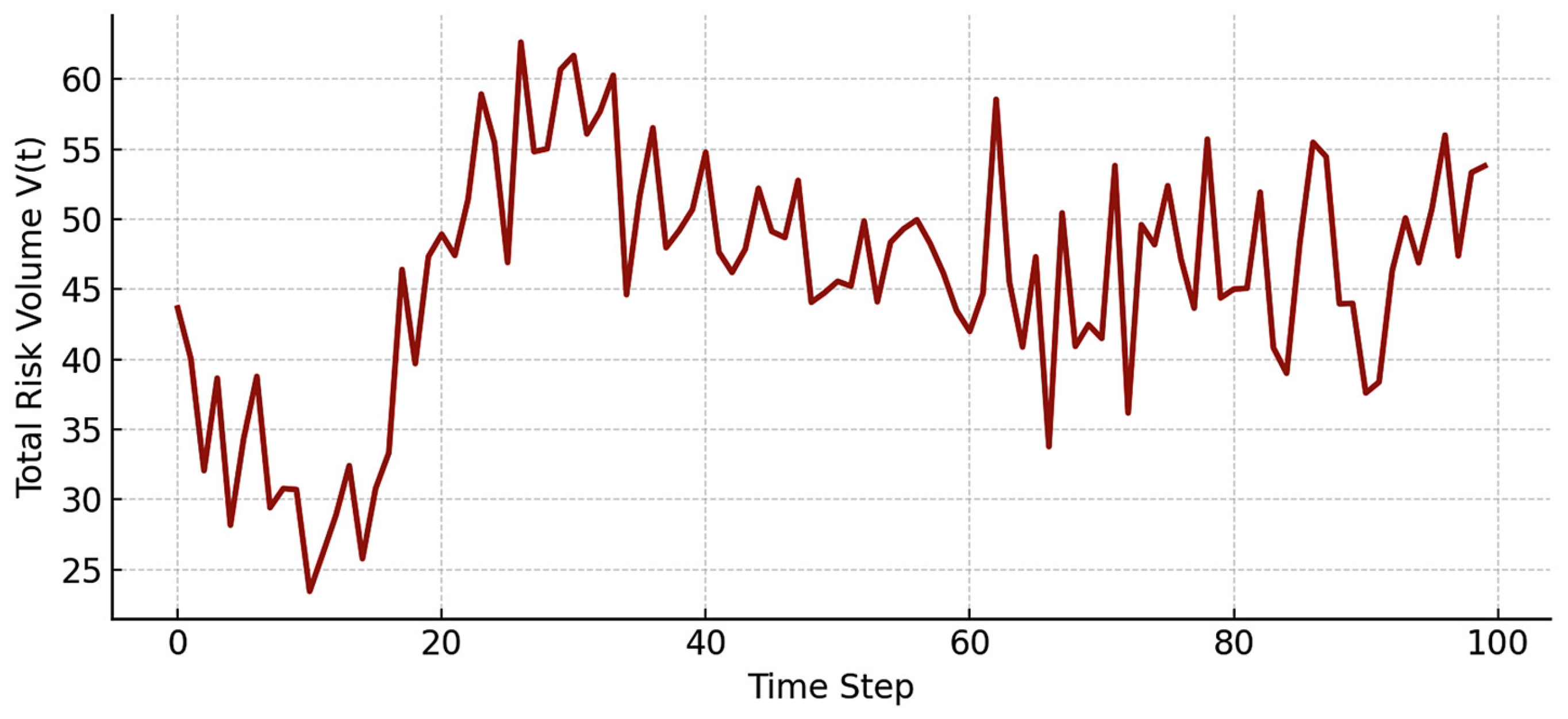
Figure 5 illustrates the evolution of total iceberg volume:
It shows increasing system degradation over the 100-step simulation window. This scalar metric aggregates all individual risk heights and serves as a proxy for overall system health. A clear upward trend is visible, indicating growing systemic risk. In practice, such a curve could trigger thresholds for predictive maintenance or resource reallocation.
To support more intuitive decision-making,
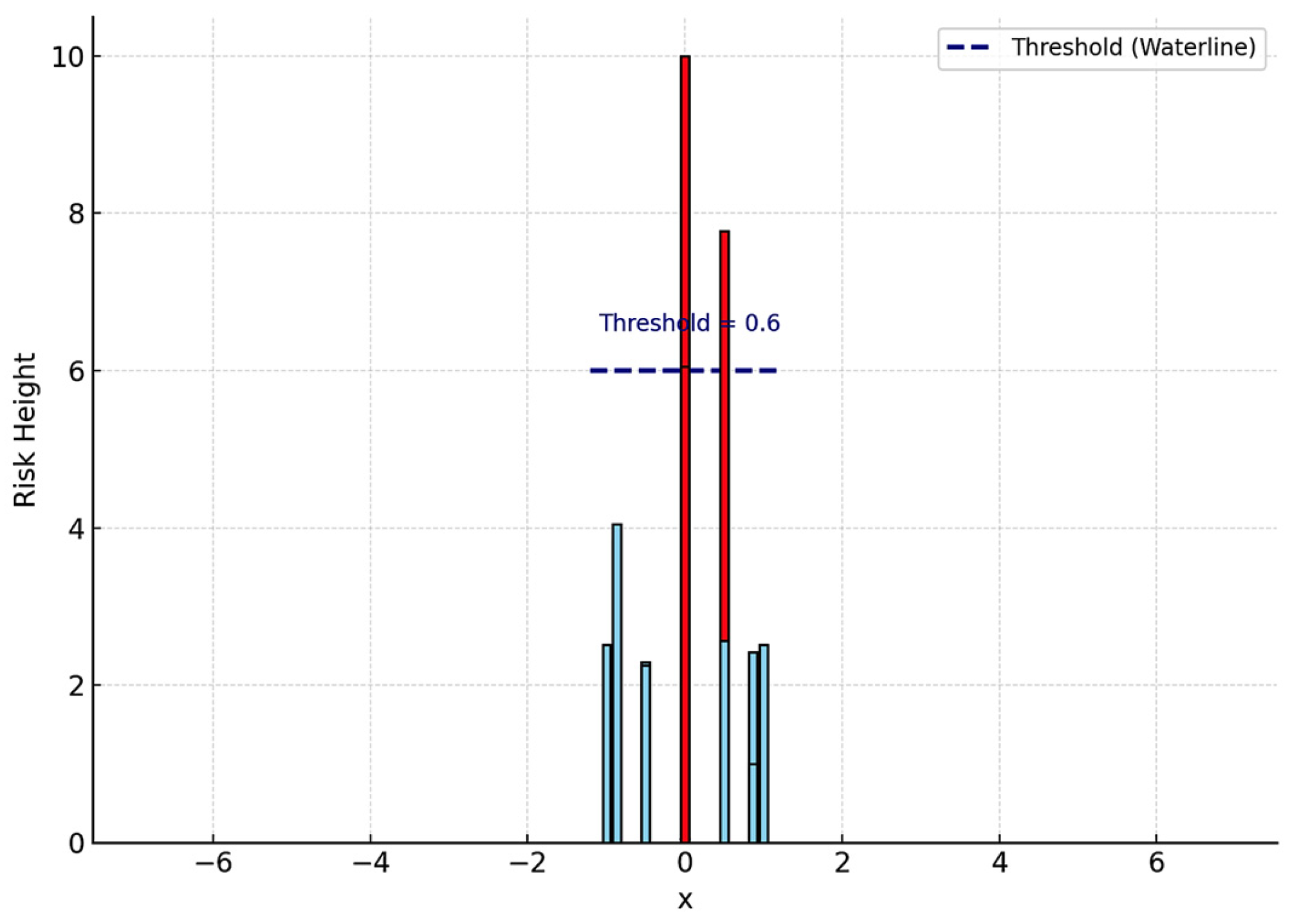
Figure 6 incorporates a visual waterline threshold (set at
) superimposed on the iceberg geometry. Panels exceeding this threshold are rendered in red and flagged as visible risks requiring attention, while those below are depicted in blue, denoting latent or background risks. This metaphor reinforces the classic iceberg principle: only a fraction of total risk is immediately visible, while a substantial portion may remain submerged until further degradation occurs. The use of a dynamic waterline enhances operator interpretability and supports risk segmentation.
While
Figure 4 presents the baseline geometric snapshot of the risk iceberg,
Figure 6 introduces a semantic interpretation layer by explicitly applying a waterline threshold that separates latent and actionable risk components.
Together, these figures demonstrate how the parametric iceberg model bridges quantitative risk assessment with spatial-temporal intuition. Such visualization:
Aids in identifying trends, clusters, or anomalies;
Provides immediate visual cues for operational prioritization;
Supports explainability of AI-derived risk scores through geometric form.
These benefits make the approach particularly suitable for safety-critical or high-complexity systems where interpretability is essential.
3.2. Application Case Study: Aircraft Fuel System Monitoring
Following the generic demonstration scenario, the proposed DRT framework is applied to a concrete engineering system to assess its practical relevance and diagnostic value. In this subsection, the iceberg-based risk representation is used for health monitoring of an aircraft fuel system, a safety-critical subsystem characterized by heterogeneous sensors, interacting components, and latent degradation processes.
The simulation study and the aircraft fuel-system case study are intentionally based on synthetically generated signals, as the primary goal of this manuscript is to validate the risk-to-geometry mapping mechanism and to demonstrate how multivariate risk estimates can be transformed into an interpretable iceberg-type DRT representation. Synthetic data enables controlled variation in degradation trends, injected anomalies, and visibility thresholds, allowing the behavior of the geometric representation to be examined under known ground-truth scenarios.
At the same time, it is acknowledged that realistic industrial monitoring data typically exhibit non-Gaussian noise, missing values, sensor drift, non-stationary operating regimes, and complex fault modes, which may affect the stability and calibration of risk inference. The proposed framework is designed to be detector-agnostic: the use of a simple -score method is adopted only as a minimal baseline to illustrate the pipeline end-to-end, and it is not a limitation of the iceberg representation itself. In practical deployments, the risk inference stage can be replaced by more robust approaches such as adaptive thresholding, change-point detection, probabilistic health indicators, physics-informed residual models, or machine-learning-based anomaly and fault classifiers that explicitly handle time-varying conditions.
Therefore, the empirical results in this paper should be interpreted as a proof-of-concept validation of the representational and analytical capability of the iceberg digital disk twin under controlled conditions, rather than a full benchmark of anomaly detection performance. A comprehensive evaluation using real-world datasets with realistic noise characteristics and diverse fault modes is identified as an important next step, including comparative assessment of different risk inference models under non-stationarity and operational variability.
The purpose of this application case study is to illustrate how the same risk inference and geometric mapping pipeline introduced in previous section can be instantiated using system-specific parameters and diagnostic indicators, without modifying the underlying model structure. By mapping fuel-system health parameters onto the iceberg geometry, the DRT enables intuitive visualization of dominant risk contributors, separation of emergent and submerged degradation, and subsystem-level interpretation of evolving health states under realistic monitoring conditions.
In the aircraft fuel system case study, the DRT is instantiated using system-specific health indicators derived from representative fuel-system sensors and diagnostic metrics. At each time step , the input comprises a vector of monitored parameters , including pressure, temperature, flow, vibration, and leakage-related indicators, together with contextual operational variables reflecting system usage conditions. These inputs are mapped to a fixed set of risk components corresponding to fuel-system subsystems and failure modes.
Ten representative health parameters were selected to reflect the operational and structural state of the fuel system: fuel pump pressure, temperature sensor output, filter clogging index, fuel flow rate, tank pressure, valve operation time, fuel leak detection score, pump vibration amplitude, outlet temperature, and return line pressure. These parameters represent both physical sensor data and diagnostic indicators commonly found in modern aircraft monitoring platforms.
Synthetic time-series data for each parameter were generated over a simulation horizon of time steps. The evolution of each parameter was modeled using sinusoidal degradation signals with random phase and frequency components, and Gaussian noise was added to reflect operational variability. A z-score anomaly detection approach was employed to infer the relative risk of each component at each time step, using the first 20 samples as a baseline reference window. The resulting risk vector was then mapped to geometric heights , forming the vertical sheet components of the iceberg structure .
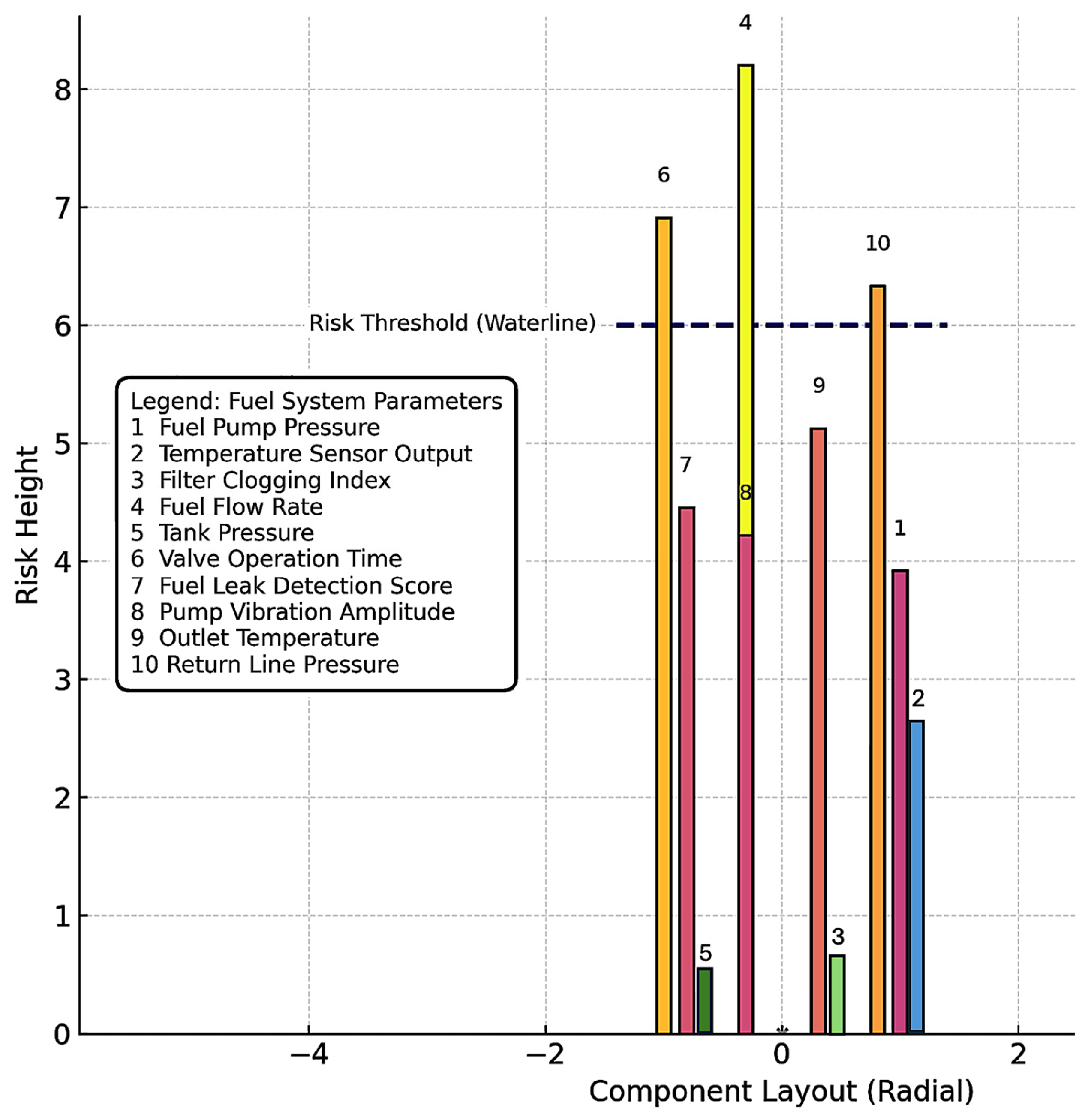
Figure 7 presents a snapshot of the iceberg risk geometry at
. Each vertical panel corresponds to one of the ten monitored components and is spatially arranged in a radial configuration. The height of each panel reflects the current risk level, and the panels are colored using a colormap scaled to the relative magnitude of risk. A horizontal threshold line (the “waterline”) is drawn at height
, corresponding to a normalized risk value of
. Components with risk levels above the waterline are visually flagged in warmer colors (e.g., red and orange), while submerged components remain cooler in tone and less prominent.
The snapshot reveals an asymmetric risk distribution, with three components, filter clogging (component 4), fuel leak detection (component 6) and return line pressure (component 10), which exceed the waterline threshold. These components can be interpreted as actionable or near critical, suggesting emerging failure modes or anomalous operating conditions. Other components such as fuel flow rate and pump vibration show moderate risk elevations, remaining below the threshold but indicating trends worth tracking. The asymmetry of the iceberg geometry suggests non-uniform degradation and potentially localized interdependencies within the subsystem.
From a diagnostic perspective, the iceberg visualization enables intuitive interpretation of multidimensional health data. The height and visibility of each component serve as proxies for urgency and system-criticality. The visual segmentation into submerged and emergent risk zones facilitates triaging and prioritization. Additionally, the observed skewness and angular clustering of elevated components may provide early cues about the spatial or functional concentration of risk, aiding root-cause analysis.
This case study demonstrates how the parametric iceberg model can encapsulate complex risk profiles in a visually interpretable format, offering both real-time insight and trend-based forecasting. It validates the DRT framework as a lightweight yet powerful alternative to full digital twins for the purpose of health monitoring and predictive maintenance.
3.3. Integration into Health Monitoring Ecosystems
The proposed parametric iceberg-based DRT offers a modular and computationally efficient approach to integrating interpretable health state representation into modern health monitoring systems. While not intended to replace full-featured digital twins, the DRT serves as a focused surrogate, optimized for real-time risk assessment and decision support. In this section, we explore how this model can be embedded within AI-enhanced aircraft health monitoring systems (AHMS), coupled with diagnostic and prescriptive frameworks, and extended to other safety-critical domains.
In the context of AI-driven AHMS, the DRT plays a bridging role between raw data ingestion and actionable insight generation. It encapsulates multi-sensor, multi-source data into a dynamic, interpretable structure, the iceberg, whose geometry encodes risk magnitude, distribution, and temporal evolution. This intermediary representation serves both as an input layer to downstream AI services and as a human-readable diagnostic interface for maintenance personnel.
Notably, the DRT model is compatible with federated learning architectures, as discussed in the original reference article [
1]. Because the iceberg structure is derived from anonymized, aggregated risk vectors, rather than raw sensor logs, it is well-suited for privacy-preserving model sharing across aircraft fleets or maintenance hubs. Each local instance can compute its risk geometry independently and contribute to a global model of component failure modes without exposing proprietary or sensitive data. This architecture supports collaborative learning while respecting operational data boundaries, thereby aligning with evolving data governance standards in the aviation industry.
The dynamic evolution of the iceberg geometry over time provides a fertile ground for integrating fault diagnosis and prescriptive analytics. For example:
Diagnostic models can monitor the growth rate, asymmetry, or clustering patterns of risk panels to classify failure modes (e.g., mechanical degradation vs. sensor drift).
Prescriptive models can associate iceberg features with recommended maintenance actions, using AI classifiers trained on historical intervention records linked to geometric risk profiles.
Beyond visual alerts, the quantitative nature of the iceberg structure, its height distribution, volume, and spatial skewness, can be encoded as feature vectors for machine learning pipelines. These can feed into reinforcement learning agents, predictive models, or knowledge graphs for intelligent decision-making. The result is a closed-loop system in which the DRT supports not just monitoring, but also adaptive response and policy generation.
While developed in the context of aircraft systems, the concept of a lightweight risk twin based on iceberg geometry is broadly applicable. Many other domains exhibit, such as multi-sensor monitoring, latent versus visible failure patterns, the need for explainable AI interfaces and others.
Examples include:
Power grids with monitoring load imbalances, transformer wear, and frequency fluctuations across distributed networks.
Rail systems with visualizing axle temperature, brake pad wear, or vibration anomalies in rolling stock.
Manufacturing with detecting process drift, machine fatigue, or quality deviations in production lines.
In each case, the DRT can serve as a visual, intuitive abstraction of system health, embedded in existing monitoring dashboards or AI agents. The parametric structure supports fast rendering, minimal compute overhead, and intuitive segmentation of operational risk zones.
The iceberg-based DRT is not merely a visualization metaphor, but a formal, scalable component that can augment existing digital ecosystems with interpretable, modular, and AI-compatible health representations. It offers a pragmatic path forward for integrating human-centric risk awareness into complex cyber-physical systems.
4. Discussion
4.1. Conceptual Insights and System-Level Interpretation
The iceberg-based DRT introduced in this study provides a structured and interpretable representation of risk evolution in complex engineering systems. By mapping normalized risk indicators onto a parametric three-dimensional geometry, the model enables simultaneous quantitative assessment and visual insight into system behavior. This dual representation is particularly valuable in engineering domains where operators must interpret large volumes of heterogeneous data under time and safety constraints.
The DRT framework demonstrates strong modularity and scalability, as each monitored parameter is represented by an independent geometric sheet. This structure allows the model to adapt to systems ranging from small subsystems to large-scale, multi-component installations. The distinction between visible and submerged regions of the iceberg further supports semantic interpretation, enabling identification of emerging risks that have not yet crossed operational thresholds.
A key contribution of the proposed framework is its compatibility with AI-augmented health monitoring ecosystems. By transforming raw measurements into structured risk vectors and subsequently into geometric forms, the DRT serves as an interpretable intermediary layer that facilitates integration with anomaly detection algorithms, predictive maintenance models, and decision-support tools. The formal mathematical structure underlying the model ensures that both human operators and automated systems can utilize the same representations, thereby enhancing consistency and explainability.
The case study results illustrate how the iceberg geometry captures salient risk patterns, including asymmetry, clustering, and dominant component behavior. These geometric features provide actionable information that may be obscured in conventional time-series analysis, demonstrating the utility of the DRT as a system-level diagnostic aid. Collectively, these insights underscore the potential of the iceberg-based representation to serve as a foundational component within modern digital health monitoring architectures for engineering systems.
4.2. Challenges, Limitations, and Future Directions
While the proposed iceberg-based DRT offers a promising framework for representing and monitoring risk in complex engineering systems, several challenges and limitations must be acknowledged. These relate both to the underlying mathematical modeling assumptions and to practical considerations associated with deployment in real-world operational environments.
A first challenge concerns the simplifying assumptions used in the construction of the risk vector and its subsequent geometric mapping. The current formulation relies on normalized, scalar risk values derived from statistical deviations, which may not fully capture nonlinear interactions, contextual dependencies, or causal chains that influence system health. In practice, risk evolution may be governed by multi-scale phenomena—material fatigue, fluid dynamics, control logic transitions, that require more sophisticated models than the linearized mappings employed in this work. Future research should investigate hybrid approaches that integrate probabilistic graphical models, Bayesian inference, and physics-informed components to better represent uncertainty and dynamic behavior.
A second limitation arises from the geometric abstraction inherent in the iceberg model. While the parametric representation of vertical sheets provides interpretability and visual clarity, it does not reflect the topological or physical structure of the underlying engineering system. The spatial layout function is intentionally generic, yet more domain-specific layouts could improve the diagnostic value for classes of systems. Future extensions may explore hierarchical or multi-layer iceberg structures, enabling the representation of subsystems, component groups, or interconnected processes within the same geometric framework.
A further challenge relates to data availability and validation. The case study presented in this paper relies on synthetically generated data, which, while illustrative, does not capture the full complexity, noise characteristics, and failure patterns present in real aircraft or industrial monitoring logs. Deployment of the DRT in operational settings will require extensive calibration using historical maintenance archives, flight data monitoring records, or condition-based maintenance systems. Validation across varying aircraft types, fleets, or industrial installations will be essential to assess generalizability, robustness, and user acceptance.
The integration of the DRT into broader prognostic and prescriptive ecosystems opens several avenues for future development. The risk geometry and its derived features, such as volume, skewness, and rate of growth, can be incorporated into reinforcement learning, decision-theoretic models, or knowledge graph-based reasoning engines to support proactive maintenance strategies. Further exploration of federated learning architectures may enable fleet-wide sharing of anonymized geometric risk signatures, enhancing predictive accuracy without compromising data privacy. These directions position the DRT not merely as a visualization tool but as a potential core component of adaptive, self-updating digital ecosystems for engineering asset management.
In summary, while the present study establishes a strong foundation for the iceberg-based DRT, addressing these challenges will be essential for realizing its full potential. Advancements in statistical modeling, geometric representation, data validation, and AI integration constitute key pathways for future research and deployment in real-world engineering systems.