Article

Finite Element Analysis for the Stationary Navier–Stokes Equations with Mixed Boundary Conditions

1
Teaching Department of Basic Courses, Xi’an Vocational and Technical College, Xi’an 710077, China
2
School of Mathematics and Statistics, Xi’an Jiaotong University, Xi’an 710049, China
*
Author to whom correspondence should be addressed.
Mathematics 2026, 14(2), 333; https://doi.org/10.3390/math14020333
Submission received: 21 October 2025 / Revised: 13 January 2026 / Accepted: 16 January 2026 / Published: 19 January 2026
(This article belongs to the Special Issue Advances in Numerical Analysis of Partial Differential Equations)

Abstract

This paper studies the stationary incompressible Navier-Stokes equations with mixed boundary conditions using a velocity-pressure finite element formulation. We first establish a variational framework and prove existence of solutions under suitable regularity assumptions, followed by a Galerkin discretization with error estimates. Three iterative algorithms (the Stokes, Newton, and Oseen schemes) are then analyzed, with stability conditions and error bounds derived for each. Numerical experiments confirm the theoretical results: all methods achieve second-order convergence for velocity and pressure. Among the three schemes, the Newton iteration is the most efficient in terms of computational time, while the Oseen iteration exhibits the strongest robustness with respect to decreasing viscosity coefficients.

1. Introduction

The Navier–Stokes (N–S) equations are the fundamental system describing fluid motion, with important applications in both physical phenomena and engineering practice. Typical examples include atmospheric circulation, oceanic flows, bearing lubrication, and internal flows in turbo-machinery. In real-world settings, fluid models such as the bifurcated channel flow arise frequently, with broad applications in mechanical engineering, hydraulic engineering, and biotechnology [1].
The N–S equations are highly nonlinear and notoriously difficult to solve; in most cases analytic solutions are unavailable, so numerical methods are required [2]. The main approaches include the finite difference method (FDM), the finite element method (FEM), and the finite volume method (FVM). The FDM [3] replaces the continuous domain by a mesh of discrete nodes, approximating derivatives by difference quotients and reducing the partial differential equations (PDEs) to algebraic systems, which is simple and accurate but cumbersome for irregular geometries. The FEM [4,5] partitions the domain into finite elements, assumes local approximations, and assembles them into a weak global formulation, yielding high accuracy and flexibility for complex geometries. The FVM [6] can be regarded as an intermediate approach, using nodal values like FDM but interpolation functions only for computing control-volume integrals as in FEM; it is efficient and suitable for complex domains, though generally less accurate than FEM. Meshless approaches, such as the generalized finite difference method (GFDM), have also been developed as effective alternatives for the numerical simulation of scientific and engineering problems; see, for example, [7].
In modeling the N–S equations, boundary conditions play an essential role. Typical boundary conditions include Dirichlet, Neumann, or mixed types. In particular, the Navier–Stokes equations with mixed boundary conditions [8] provide an effective framework for simulating bifurcated channel flows, which are of significant practical interest. Therefore, in this paper, we focus on the Navier–Stokes equations with mixed boundary conditions of the following form:
ν Δ u + ( u · ) u + P = f , in Ω , div  u = 0 , in Ω , u = 0 , on Γ , u · n = 0 , on Γ Γ m , ( curl  u ) × n = 0 , on Γ m ,
where Ω is a bounded domain with Lipschitz continuous boundary Ω . We decompose Ω into two disjoint parts Γ and Γ m , and impose different boundary conditions on each part. Here, n denotes the unit outward normal vector, ν > 0 is the viscosity coefficient, u is the velocity, P is the pressure, f is the prescribed body force, div  u represents the divergence of u , and curl  u denotes the vorticity. The unknowns of the problem are u and P.
To discretize the Navier–Stokes equations with mixed boundary conditions [9], a new formulation has been proposed [10,11,12], in which, in addition to velocity and pressure, the vorticity w = curl  u is introduced as a third unknown, leading to the so-called vorticity–velocity–pressure formulation. In order to take advantage of the well-established results of standard finite element theory [13], Bernardi et al. [14] instead adopted the velocity–pressure formulation, involving only two unknowns: the velocity and the pressure.
As is well known, the nonlinear convective term ( u · ) u renders the Navier–Stokes system highly challenging to solve, which calls for efficient iterative algorithms. A variety of iterative methods have been developed in the literature (see, e.g., [15,16,17,18,19,20,21,22,23,24]). More recently, He and collaborators proposed the Euler time–space iterative finite element method for stationary incompressible flows at high Reynolds numbers, and carried out a detailed theoretical analysis of its stability and convergence properties [25,26,27,28]. In addition to these classical works, further progress has been made in recent years. For instance, Zhang et al. [29] established stability and convergence conditions for Stokes and Newton iterations applied to the Navier–Stokes equations. These studies demonstrate the continued relevance of developing robust iterative solvers and stability analyses for complex boundary value problems.
In this paper, we further investigate the solution of the Navier–Stokes equations based on the velocity–pressure formulation. We focus on spatial iterative algorithms, including the Stokes iteration, the Newton iteration, and the Oseen iteration, and study their convergence properties together with corresponding numerical solutions.
In Section 2, we present the variational formulation of the Navier–Stokes equations, introduce the notion of weak solutions, prove their existence and uniqueness, and derive error estimates between the exact and finite element solutions. Section 3 introduces three classical spatial iteration schemes¡a the Stokes, Newton, and Oseen iterations¡a for the Navier-Stokes equations with mixed boundary conditions. For each scheme, stability conditions are established and rigorously analyzed, and error estimates are derived under the assumptions on stability, mesh size h, and iteration index m. Section 4 reports numerical experiments that confirm the theoretical convergence rates and further assess the stability and efficiency of the three schemes under different viscosity coefficients.

2. Navier–Stokes Equations with Mixed Boundary Conditions

In this paper, we focus on the two-dimensional case, which allows a curl-based variational formulation with mixed boundary conditions and avoids several technical complications inherent to three-dimensional flows. In this section, we discuss the uniqueness of the solution to this variational problem under suitable regularity assumptions on the domain. Finally, we propose a finite element discretization based on the Galerkin method and establish the corresponding error estimates.
In the two-dimensional case, we embed the velocity field by ( u 1 , u 2 ) ( u 1 , u 2 , 0 ) , so that curl  u = ( 0 , 0 , ω ) and the cross product × is well defined. All boundary terms in the integration by parts vanish because v · n = 0 on Ω , v × n = 0 on Γ , and ( curl  u ) × n = 0 on Γ m . This embedding is a technical device that permits the use of vector identities involving cross products and is specific to the two-dimensional setting.
For problem (1), we derive its variational formulation. We first recall the following vector identities:
Δ u = curl ( curl  u ) ( div  u ) ,
and
( u · ) u = ( curl  u ) × u + 1 2 ( u · u ) ,
where
curl ( curl  u ) = ( curl  u ) y , ( curl  u ) x
is understood as a vector operator.
Using these relations, we define
p : = P + 1 2 | u | 2
and problem (1) is equivalently rewritten as
ν curl ( curl  u ) ν ( div  u ) + ( curl  u ) × u + p = f , in Ω , div  u = 0 , in Ω , u × n = 0 , on Γ , u · n = 0 , on Γ Γ m , ( curl  u ) × n = 0 , on Γ m ,
Next, we introduce the following functional spaces [8,30,31]. The divergence space is defined by
H ( div , Ω ) = v L 2 ( Ω ) 2 ; div  v L 2 ( Ω ) ,
and its kernel subspace is given by
H 0 ( div , Ω ) = v H ( div , Ω ) ; v · n = 0 on Ω .
Similarly, the curl space is defined as
H ( curl , Ω ) = v L 2 ( Ω ) 2 ; curl  v L 2 ( Ω ) ,
with the constrained subspace
H * ( curl , Ω ) = v H ( curl , Ω ) ; v × n = 0 on Γ .
Based on these definitions, we set
X ( Ω ) = H 0 ( div , Ω ) H * ( curl , Ω ) ,
equipped with the norm
v X ( Ω ) = div  v L 2 ( Ω ) 2 + curl  v L 2 ( Ω ) 2 1 / 2 .
Since the chosen domain Ω is simply connected, this quantity indeed defines a norm [32].
We assume that f X ( Ω ) (the dual space of X ( Ω ) ) and define
L 0 2 ( Ω ) = q L 2 ( Ω ) ; Ω q d x = 0 .
Then by [5,33,34,35], the variational formulation of problem (2) is to find ( u , p ) X ( Ω ) × L 0 2 ( Ω ) such that
a ( u , v ) d ( v , p ) + b ( u , u , v ) = ( f , v ) , v X ( Ω ) , d ( u , q ) = 0 , q L 0 2 ( Ω ) ,
which can equivalently be written as finding ( u , p ) X ( Ω ) × L 0 2 ( Ω ) such that for all v X ( Ω ) and q L 0 2 ( Ω ) ,
a ( u , v ) d ( v , p ) + d ( u , q ) + b ( u , u , v ) = ( f , v ) .
Here the bilinear and trilinear forms are defined by
a ( u , v ) = ν Ω curl  u curl  v + div  u div  v d x , d ( v , q ) = Ω ( div  v ) q d x , b ( u , u , v ) = Ω curl  u × u · v d x ,
where ( · , · ) denotes the duality pairing. The bilinear form a ( u , v ) is continuous, coercive, and symmetric. Boundary terms vanish because v · n = 0 on Ω , v × n = 0 on Γ , and ( × u ) × n = 0 on Γ m .
Definition 1
(Weak solution). A pair ( u , p ) X ( Ω ) × L 0 2 ( Ω ) is called a weak solution of problem (1) if it satisfies the variational formulation (3).
Remark 1
(On extensions to higher-dimensional cases). The analysis developed in this paper is restricted to the two-dimensional Navier–Stokes equations with mixed boundary conditions. Throughout the paper, the variational formulation as well as the subsequent theoretical results, including the uniqueness analysis and the error estimates for the Galerkin discretization, are established under this two-dimensional setting.
The restriction to two dimensions is primarily motivated by the fact that, in this case, the curl operator reduces to a scalar quantity and the nonlinear convection term admits a particularly convenient decomposition. These features allow a natural curl–div-based variational formulation in the space H ( div , Ω ) H ( curl , Ω ) and lead to a transparent treatment of the mixed boundary conditions, which is essential for both the later stability analysis and error estimates.
From a broader perspective, part of the proposed approach can be extended beyond the two-dimensional setting. In three dimensions, the curl operator remains well defined as a vector-valued operator, and the vorticity–velocity interaction term ( × u ) × u preserves a structure similar to that exploited in the present work. This suggests that an analogous curl–div variational formulation could be constructed in appropriate subspaces of H ( div , Ω ) H ( curl , Ω ) . However, such an extension would require a more delicate functional framework, stronger regularity assumptions on the domain and the data, and sharper estimates to control the nonlinear term. These additional difficulties would affect not only the formulation of the problem, but also the uniqueness analysis and the derivation of error estimates for the associated discrete schemes.
In contrast, for general N-dimensional settings with N > 3 , the notion of the curl operator is no longer directly available, and the curl–div structure underlying the present formulation does not carry over in a straightforward manner. As a consequence, the variational framework and the analysis developed in this paper are intrinsically tied to lower-dimensional settings. Addressing higher-dimensional cases would require a substantially different analytical approach and is therefore beyond the scope of the present work.

2.1. Existence and Uniqueness of the Continuous Problem

In this paper, we assume that X ( Ω ) is compactly embedded into L 4 ( Ω ) 2 [32,36], that is,
X ( Ω ) L 4 ( Ω ) 2 , u L 4 ( Ω ) 2 c 0 u X ( Ω ) , u X ( Ω ) .
When the domain Ω has a C 1 , 1 boundary or is convex, it follows that X ( Ω ) H 1 ( Ω ) 2 , and consequently X ( Ω ) L 6 ( Ω ) 2 L 4 ( Ω ) 2 . Here, the embedding constant c 0 depends only on the geometric properties of the domain Ω (such as its shape and boundary regularity), and is independent of the viscosity coefficient ν , the forcing term f, and the discretization parameter h. We emphasize that c 0 is associated with the continuous embedding inequality induced by the compact embedding X ( Ω ) L 4 ( Ω ) 2 , whereas the compactness itself is only required in the existence analysis to ensure strong convergence in L 4 ( Ω ) 2 .
In the subsequent analysis, the constant c 0 is mainly used to establish the continuity of the nonlinear term and to derive sufficient (but generally non-sharp) conditions for existence, uniqueness, and stability of the proposed iterative schemes. From a practical point of view, c 0 does not need to be evaluated explicitly in numerical computations. Instead, convergence and stability are assessed by computable quantities, such as the norm of successive iterates u h m u h m 1 X ( Ω ) , as employed in Section 3.
Theorem 1.
Assume that X ( Ω ) is compactly embedded into L 4 ( Ω ) 2 . Then the trilinear form b ( · , · , · ) is continuous on X ( Ω ) × X ( Ω ) × X ( Ω ) . Moreover, for any f X ( Ω ) , the variational problem (3) admits a solution ( u , p ) satisfying the a priori estimates
u X ( Ω ) 1 ν f X ( Ω ) ,
p L 2 ( Ω ) c f X ( Ω ) 1 + f X ( Ω ) .
In addition, if the smallness condition
c 0 2 ν 2 f X ( Ω ) < 1 ,
holds true, where c 0 is the embedding constant of X ( Ω ) L 4 ( Ω ) 2 , then problem (3) admits a unique solution ( u , p ) .
Proof. 
The conclusion (5) and (6) follows by [5,14]. It is also well known that problem (3) admits at least one solution [4]. We now show that under the condition c 0 2 ν 2 f X ( Ω ) < 1 , this solution is unique.
Let ( u 1 , p 1 ) and ( u 2 , p 2 ) be two solutions of (3). Subtracting the two equations and setting w = u 1 u 2 , r = p 1 p 2 , we obtain
a ( w , v ) d ( v , r ) + b ( u 1 , u 1 , v ) b ( u 2 , u 2 , v )   = 0 , v X ( Ω ) ,
d ( w , q )   = 0 , q L 0 2 ( Ω ) .
Choosing v = w , q = r in (7) and (8), we have
a ( w , w ) + b ( w , u 1 , w ) + b ( u 2 , w , w ) = 0 .
Since the trilinear form b ( · , · , · ) is skew-symmetric in the last two arguments, we have b ( u 2 , w , w ) = 0 , and hence
a ( w , w ) + b ( w , u 1 , w ) = 0 .
By coercivity of a ( · , · ) , we have
a ( w , w ) = ν Ω | curl  w | 2 + | div  w | 2 d x ν w X ( Ω ) 2 .
On the other hand, applying Hölder’s inequality and the embedding X ( Ω ) L 4 ( Ω ) 2 , we get
| b ( w , u 1 , w ) |     curl  w L 2 ( Ω ) u 1 L 4 ( Ω ) 2 w L 4 ( Ω ) 2     c 0 2 u 1 X ( Ω ) w X ( Ω ) 2 .
Thus from (9),
ν w X ( Ω ) 2   c 0 2 u 1 X ( Ω ) w X ( Ω ) 2 .
Using the a priori bound (5),
u 1 X ( Ω ) 1 ν f X ( Ω ) ,
we obtain
ν w X ( Ω ) 2 c 0 2 ν f X ( Ω ) w X ( Ω ) 2 .
If c 0 2 ν 2 f X ( Ω ) < 1 , the only possibility is w X ( Ω ) = 0 , i.e., u 1 = u 2 .
Finally, since w = 0 , Equation (7) reduces to d ( v , r ) = 0 for all v X ( Ω ) . By the continuous inf-sup condition, we infer r = 0 , i.e., p 1 = p 2 and uniqueness is proved. □

2.2. Error Estimates

We assume that Ω is a polygonal domain, and consider a regular triangulation T h ( Ω ) of Ω into triangles, satisfying the following conditions: (1) for any h, the closure Ω ¯ is the union of all elements in T h ( Ω ) ; (2) the intersection of any two distinct elements of T h ( Ω ) (if nonempty) is either a vertex or an entire edge; (3) h K h < σ , where h K denotes the diameter of any element K T h ( Ω ) , h = max { h K } , and σ is a constant independent of h.
We define P k ( K ) as the space of polynomials of degree at most k restricted to each element K T h ( Ω ) . For each h, we introduce the finite element spaces X h ( Ω ) X ( Ω ) and M h ( Ω ) L 0 2 ( Ω ) . The corresponding discrete inf-sup condition [5,14,34] reads
sup v h X h ( Ω ) d ( v h , q h ) v h X ( Ω ) β * q h L 2 ( Ω ) , q h M h ( Ω ) ,
where β * > 0 is a constant depending only on the domain Ω .
As an illustration, we next present an example of an admissible finite element pair, the Taylor–Hood element [13]:
X h ( Ω ) = v h X ( Ω ) ; K T h ( Ω ) , v h | K P 2 ( K ) 2 , M h ( Ω ) = q h L 0 2 ( Ω ) H 1 ( Ω ) ; K T h ( Ω ) , q h | K P 1 ( K ) .
For the Taylor–Hood element with k = 2 , the following approximation properties hold:
inf v h X h ( Ω ) v v h X ( Ω ) c h s 1 v H s ( Ω ) 2 , inf q h M h ( Ω ) q q h L 2 ( Ω ) c h s 1 q H s 1 ( Ω ) ,
for integers k 1 , with v X ( Ω ) H s ( Ω ) 2 , q L 0 2 ( Ω ) H s 1 ( Ω ) , and 1 s k + 1 .
Applying the Galerkin method, the discrete problem corresponding to (3) reads: find ( u h , p h ) X h ( Ω ) × M h ( Ω ) such that
a ( u h , v h ) + b ( u h , u h , v h ) d ( v h , p h ) = ( f , v h ) , v h X h ( Ω ) , d ( u h , q h ) = 0 , q h M h ( Ω ) ,
which is equivalently written as
a ( u h , v h ) d ( v h , p h ) + d ( u h , q h ) + b ( u h , u h , v h ) = ( f , v h ) ,
for all v h X h ( Ω ) and q h M h ( Ω ) .
Assuming that X ( Ω ) is compactly embedded into L 4 ( Ω ) 2 , the forms a ( · , · ) , d ( · , · ) , and b ( · , · , · ) are continuous on X h ( Ω ) × X h ( Ω ) , X h ( Ω ) × M h ( Ω ) , and X h ( Ω ) × X h ( Ω ) × X h ( Ω ) , respectively, and
a ( v h , v h ) ν v h X ( Ω ) 2 , v h X h ( Ω ) .
Furthermore, the trilinear form b ( · , · , · ) satisfies the skew-symmetry property
b ( w h , v h , v h ) = 0 , w h , v h X h ( Ω ) ,
We now derive an a priori estimate for the solution of problem (11).
Theorem 2
([5,14,34]). For any f X ( Ω ) , the solution ( u h , p h ) of problem (11) satisfies the estimates
u h X ( Ω ) 1 ν f X ( Ω ) ,
p h L 2 ( Ω ) c f X ( Ω ) 1 + f X ( Ω ) .
The most important result of this section is the following error estimate for the finite element approximation.
Theorem 3
([5,14,37,38,39]). Let ( u , p ) be the unique solution of problem (3), and ( u h , p h ) the unique solution of problem (11). Then the following error bound holds for some c * :
u u h X ( Ω ) + p p h L 2 ( Ω ) c * h s 1 u H s ( Ω ) 2 + p H s 1 ( Ω ) ,
where s = min { s , k + 1 } and 3 2 < s k + 1 .
For Taylor-Hood elements ( k = 2 ) and smooth solutions u H 3 ( Ω ) , p H 2 , one obtains the optimal order O ( h 2 ) for both velocity and pressure.

3. Finite Element Algorithms for the Navier–Stokes Equations

In this section, we introduce three classical spatial iterative algorithms—the Stokes iteration, the Newton iteration, and the Oseen iteration. We apply these methods to the Navier–Stokes equations with mixed boundary conditions, analyze the stability of each method, and establish the corresponding error estimates.

3.1. Stokes Iteration

We define the sequence { ( u h n , p h n ) } n 1 X h ( Ω ) × M h ( Ω ) , with the iterative scheme given by
a ( u h n , v h ) d ( v h , p h n ) + d ( u h n , q h ) + b ( u h n 1 , u h n 1 , v h ) = ( f , v h ) ,
for all ( v h , q h ) X h ( Ω ) × M h ( Ω ) .
The initial value ( u h 0 , p h 0 ) is chosen as the solution of the discrete Stokes problem:
a ( u h 0 , v h ) d ( v h , p h 0 ) + d ( u h 0 , q h ) = ( f , v h ) ,
for all ( v h , q h ) X h ( Ω ) × M h ( Ω ) .

3.1.1. Stability Analysis of Stokes Iteration

We now consider the stability of the Stokes iteration.
Lemma 1.
Assume that X ( Ω ) is compactly embedded into L 4 ( Ω ) 2 and that the stability condition
4 c 0 2 ν 2 f X ( Ω ) < 1
is satisfied, where c 0 denotes the embedding constant. Then the solution ( u h m , p h m ) of the iteration scheme (16) satisfies
u h m X ( Ω ) 2 ν f X ( Ω ) ,
for all m 0 .
Proof. 
For m = 0 , taking v h = u h 0 and q h = p h 0 in (17) yields
a ( u h 0 , u h 0 ) = ( f , u h 0 ) .
Using (13), we obtain
ν u h 0 X ( Ω ) 2 f X ( Ω ) u h 0 X ( Ω ) ,
which implies
u h 0 X ( Ω ) 1 ν f X ( Ω ) 2 ν f X ( Ω ) ,
and hence (19) holds for m = 0 .
For m 0 , assuming that (19) holds for m = J , we aim at proving it holds for m = J + 1 . Taking ( v h , q h ) = ( u h J + 1 , p h J + 1 ) in (16) with n = J + 1 , we obtain
a ( u h J + 1 , u h J + 1 ) d ( u h J + 1 , p h J + 1 ) + d ( u h J + 1 , p h J + 1 ) + b ( u h J , u h J , u h J + 1 ) = ( f , u h J + 1 ) .
By Hölder’s inequality,
| b ( w , u , v ) | curl  w L 2 ( Ω ) u L 4 ( Ω ) 2 v L 4 ( Ω ) 2 .
Hence,
ν u h J + 1 X ( Ω ) 2 curl  u h J L 2 ( Ω ) u h J L 4 ( Ω ) 2 u h J + 1 L 4 ( Ω ) 2 + f X ( Ω ) u h J + 1 X ( Ω ) .
Since X ( Ω ) L 4 ( Ω ) 2 , it follows that
ν u h J + 1 X ( Ω ) 2     c 0 2 u h J X ( Ω ) 2 u h J + 1 X ( Ω ) + f X ( Ω ) u h J + 1 X ( Ω ) .
Using (18) together with the induction hypothesis, we deduce
ν u h J + 1 X ( Ω )   c 0 2 u h J X ( Ω ) 2 + f X ( Ω )   4 c 0 2 ν 2 f X ( Ω ) 2 + f X ( Ω )   2 f X ( Ω ) ,
which proves (19) for m = J + 1 . Thus the Lemma is established by induction. □

3.1.2. Error Estimates of Stokes Iteration

In this subsection we derive error bounds for the iterative errors
( e n , η n ) : = ( u h u h n , p h p h n ) , n 1 ,
i.e., the distance between the discrete (Galerkin) solution ( u h , p h ) of (12) and the n-th Stokes iteration ( u h n , p h n ) from (16). Subtracting (16) from (12) gives the error equation
a ( e n , v h ) d ( v h , η n ) + d ( e n , q h ) + b ( e n 1 , u h , v h ) + b ( u h n 1 , e n 1 , v h ) = 0 ,
for all ( v h , q h ) X h ( Ω ) × M h ( Ω ) , where ( e n , η n ) X h ( Ω ) × M h ( Ω ) .
Lemma 2.
Under the assumptions of Lemma 1 (in particular X ( Ω ) L 4 ( Ω ) 2 and 4 c 0 2 ν 2 f X ( Ω ) < 1 ), the Stokes iteration errors satisfy
e m X ( Ω ) ν 1 3 c 0 2 ν 2 f X ( Ω ) m f X ( Ω ) ,
η m L 2 ( Ω ) c 3 c 0 2 ν 2 f X ( Ω ) m f X ( Ω ) ,
for all m 1 , where c > 0 depends only on Ω (e.g., on the inf-sup constant β * ).
Proof. 
Taking v h = e n and q h = η n in (22) yields
a ( e n , e n ) + b ( e n 1 , u h , e n ) + b ( u h n 1 , e n 1 , e n ) = 0 .
Using coercivity (13), the Hölder bound for b ( · , · , · ) (20), and the compact embedding X ( Ω ) L 4 ( Ω ) 2 (with embedding constant c 0 ), we obtain
ν e n X ( Ω ) 2 curl  e n 1 L 2 u h L 4 e n L 4 + curl  u h n 1 L 2 e n 1 L 4 e n L 4 c 0 2 e n 1 X ( Ω ) u h X ( Ω ) e n X ( Ω ) + c 0 2 u h n 1 X ( Ω ) e n 1 X ( Ω ) e n X ( Ω ) .
Cancelling one factor e n X ( Ω ) and using the bounds
u h X ( Ω ) ν 1 f X ( Ω ) ( by ( 14 ) ) , u h n 1 X ( Ω ) 2 ν f X ( Ω ) ( by Lemma 1 ) ,
we get the linear recurrence
e n X ( Ω ) 3 c 0 2 ν 2 f X ( Ω ) e n 1 X ( Ω ) .
For n = 0 , subtracting (17) from (12) gives
a ( e 0 , v h ) d ( v h , η 0 ) + d ( e 0 , q h ) + b ( u h , u h , v h ) = 0 .
Choosing v h = e 0 , q h = η 0 and arguing as above yields
e 0 X ( Ω ) c 0 2 ν u h X ( Ω ) 2 c 0 2 ν 3 f X ( Ω ) 2 < 1 4 ν f X ( Ω ) ,
where the last inequality uses the smallness condition (18). Combining (26) and (27) proves (23).
To bound the pressure error, take v h = e n and q h = 0 in (22):
d ( e n , η n ) = a ( e n , e n ) + b ( e n 1 , u h , e n ) + b ( u h n 1 , e n 1 , e n ) .
Using the discrete inf-sup condition (10), coercivity (13), the bound (20), and the estimates for u h X ( Ω ) and u h n 1 X ( Ω ) ,
β * e n X ( Ω ) η n L 2   ν e n X ( Ω ) 2   +   c 0 2 e n 1 X ( Ω ) u h X ( Ω ) e n X ( Ω ) +   c 0 2 u h n 1 X ( Ω ) e n 1 X ( Ω ) e n X ( Ω )   c ν e n X ( Ω ) + c c 0 2 ν f X ( Ω ) e n 1 X ( Ω ) ,
whence
η n L 2 ( Ω ) c ν e n X ( Ω ) + c ν 3 c 0 2 ν 2 f X ( Ω ) e n 1 X ( Ω ) .
Using the recurrence (26) together with (27) gives (). □
In the foregoing error bounds, the factor c 0 2 ν 2 f X ( Ω ) is difficult to evaluate in practice. We therefore re-express the estimates in terms of the computable increment u h m u h m 1 .
Theorem 4.
Under the assumptions of Lemma 2, the Stokes iterative solution { ( e m , η m ) } m 1 satisfies
lim m u h m u h m 1 X ( Ω ) = 0 ,
e m X ( Ω ) u h m u h m 1 X ( Ω ) ,
η m L 2 ( Ω ) c ν u h m u h m 1 X ( Ω ) ,
for all m 1 , where c > 0 depends only on Ω (e.g., through the inf-sup constant β * ).
Proof. 
By the triangle inequality,
u h m u h m 1 X ( Ω )   =   ( u h u h m ) ( u h u h m 1 ) X ( Ω )     e m e m 1 X ( Ω )     e m X ( Ω ) +   e m 1 X ( Ω ) .
Using Lemma 2, the right-hand side tends to 0 as m , which proves (28).
Next, take v h = e m and q h = η m in the error Equation (22) with n = m to obtain
a ( e m , e m ) + b ( e m , u h , e m ) + b ( e m 1 e m , u h , e m ) + b ( u h m 1 , e m 1 e m , e m ) = 0 .
Using coercivity (13), the Hölder bound (20), the embedding X ( Ω ) L 4 ( Ω ) 2 with constant c 0 , and the bounds u h X ( Ω ) ν 1 f X ( Ω ) (by (14)) and u h m 1 X ( Ω ) 2 ν 1 f X ( Ω ) (by Lemma 1), we get
ν e m X ( Ω ) 2 c 0 2 e m X ( Ω ) 2 u h X ( Ω ) +   c 0 2 e m 1 e m X ( Ω ) u h X ( Ω ) e m X ( Ω ) +   c 0 2 u h m 1 X ( Ω ) e m 1 e m X ( Ω ) e m X ( Ω ) .
Rearranging and using the smallness condition from Lemma 1 yields
ν c 0 2 ν f X ( Ω ) e m X ( Ω ) 3 c 0 2 ν f X ( Ω ) e m 1 e m X ( Ω ) ,
and hence
e m X ( Ω ) e m 1 e m X ( Ω ) u h m u h m 1 X ( Ω ) ,
which proves (29).
Finally, set v h = e m and q h = 0 in (22) (with n = m ) to write
d ( e m , η m ) = a ( e m , e m ) + b ( e m , u h , e m ) + b ( e m 1 e m , u h , e m ) + b ( u h m 1 , e m 1 e m , e m ) .
Applying the discrete inf-sup condition (10) together with (13), (20), (14), Lemma 1, and (29), we obtain
η m L 2 ( Ω ) c ν e m X ( Ω ) +   c ν u h m u h m 1 X ( Ω ) c ν u h m u h m 1 X ( Ω ) ,
which completes the proof of (30). □
From Theorems 3 and 4, we immediately obtain the following error bounds for the Stokes iteration scheme (16). Let ( u , p ) be the unique solution of problem (3), and ( u h m , p h m ) the m-th Stokes iteration. Then
u u h m X ( Ω ) c * h s 1 u H s ( Ω ) 2 + p H s 1 ( Ω ) + u h m u h m 1 X ( Ω ) , p p h m L 2 ( Ω ) c * h s 1 u H s ( Ω ) 2 + p H s 1 ( Ω ) + c ν u h m u h m 1 X ( Ω ) ,
hold for some c * > 0 which depends on ν and Ω , c > 0 depends only on Ω and s = min { s , k + 1 } with 3 2 < s k + 1 .

3.2. Newton Iteration

We define the sequence { ( u h n , p h n ) } n 1 X h ( Ω ) × M h ( Ω ) by the iterative scheme
a ( u h n , v h ) d ( v h , p h n ) + d ( u h n , q h ) + b ( u h n , u h n 1 , v h ) + b ( u h n 1 , u h n , v h ) = b ( u h n 1 , u h n 1 , v h ) + ( f , v h ) ,
for all ( v h , q h ) X h ( Ω ) × M h ( Ω ) . The initial value ( u h 0 , p h 0 ) is taken as the solution of the discrete Stokes problem
a ( u h 0 , v h ) d ( v h , p h 0 ) + d ( u h 0 , q h ) = ( f , v h ) ,
for all ( v h , q h ) X h ( Ω ) × M h ( Ω ) .

3.2.1. Stability Analysis of Newton Iteration

Let ( e n , η n ) : = ( u h u h n , p h p h n ) . Subtracting (31) from (12) yields the error equation for the Newton iteration:
a ( e n , v h ) d ( v h , η n ) + d ( e n , q h ) + b ( e n , u h n 1 , v h ) + b ( u h n 1 , e n , v h ) = b ( e n 1 , e n 1 , v h ) ,
for all ( v h , q h ) X h ( Ω ) × M h ( Ω ) , with ( e n , η n ) X h ( Ω ) × M h ( Ω ) .
Lemma 3.
Assume X ( Ω ) L 4 ( Ω ) 2 with embedding constant c 0 , and suppose the stability condition [28]
3 c 0 2 ν 2 f X ( Ω ) < 1
holds. Then the Newton iteration ( u h m , p h m ) and the errors ( e m , η m ) satisfy
u h m X ( Ω ) 4 3 ν f X ( Ω ) ,
e m X ( Ω ) ν 1 9 c 0 2 5 ν 2 f X ( Ω ) 2 m 1 f X ( Ω ) ,
η m L 2 ( Ω ) c 9 c 0 2 5 ν 2 f X ( Ω ) 2 m 1 f X ( Ω ) ,
for all m 0 , where c > 0 depends only on Ω.
Proof. 
When m = 0 , from (32), taking v h = u h 0 , q h = p h 0 , we obtain
a ( u h 0 , u h 0 ) = ( f , u h 0 ) .
From (13), it follows that
ν u h 0 X ( Ω ) 2 f X ( Ω ) u h 0 X ( Ω ) .
That is,
u h 0 X ( Ω ) 1 ν f X ( Ω ) 4 3 ν f X ( Ω ) .
Hence, (35) holds.
When m 0 , suppose that for m = n 1 relations (35)–(37) hold. We now prove that for m = n , they also hold.
From (33), taking v h = e n , q h = η n , we get
a ( e n , e n ) + b ( e n , u h n 1 , e n ) = b ( e n 1 , e n 1 , e n ) .
By (13), (20), and the embedding X ( Ω ) L 4 ( Ω ) 2 , it follows that
a ( e n , e n ) + b ( e n , u h n 1 , e n )   curl e n 1 L 2 ( Ω ) e n 1 L 4 ( Ω ) 2 e n L 4 ( Ω ) 2   c 0 2 e n 1 X ( Ω ) 2 e n X ( Ω ) ,
and
a ( e n , e n ) + b ( e n , u h n 1 , e n )   ν e n X ( Ω ) 2 c 0 2 e n X ( Ω ) 2 u h n 1 X ( Ω )   ν c 0 2 u h n 1 X ( Ω ) e n X ( Ω ) 2 .
Moreover, ν c 0 2 u n 1 X ν 4 3 c 0 2 ν f X 5 9 ν . Thus, from (39) and (40) and the induction hypothesis, we deduce
e n X ( Ω ) 9 c 0 2 5 ν e n 1 X ( Ω ) 2 9 c 0 2 5 ν ν 1 9 c 0 2 5 ν 2 f X ( Ω ) 2 ( n 1 ) 1 f X ( Ω ) 2 ν 1 9 c 0 2 5 ν 2 f X ( Ω ) 2 n 1 f X ( Ω ) .
Thus, (36) holds.
Next, we prove (37). For (33), taking v h = e n , q h = 0 , and using (10), (41), and the induction hypothesis, we obtain
η n L 2 ( Ω ) c ν e n X ( Ω ) + c c 0 2 e n X ( Ω ) u h n 1 X ( Ω ) + c c 0 2 e n 1 X ( Ω ) 2 c ν e n X ( Ω ) + c c 0 2 e n 1 X ( Ω ) 2 c ν e n X ( Ω ) + c c 0 2 ν 1 9 c 0 2 5 ν 2 f X ( Ω ) 2 ( n 1 ) 1 f X ( Ω ) 2 c 9 c 0 2 5 ν 2 f X ( Ω ) 2 n 1 f X ( Ω ) .
Here c > 0 depends only on Ω . Thus, (37) holds.
Finally, the cases n = 1 and n 2 are treated analogously, leading to
u h m X ( Ω ) 4 3 ν f X ( Ω ) m 0 ,
which completes the induction and the proof. □

3.2.2. Error Estimates of Newton Iteration

In this section, we establish the X-norm error u h n u and the L 2 -error p h n p for n 1 . In the above error estimates, the error factor c 0 2 ν 2 f X ( Ω ) is difficult to compute. Therefore, we consider expressing the error in terms of the difference u h m u h m 1 .
Theorem 5.
Under the assumptions of Lemma 3, the Newton iteration e m , η m ( m 1 ) satisfy
lim m u h m u h m 1 X ( Ω ) = 0 ,
e m X ( Ω ) c ν 1 u h m u h m 1 X ( Ω ) 2 ,
η m L 2 ( Ω ) c u h m u h m 1 X ( Ω ) 2 ,
where c > 0 depends only on Ω.
Proof. 
By the triangle inequality, we have
u h m u h m 1 X ( Ω )   ( u h u h m ) ( u h u h m 1 ) X ( Ω )     e m e m 1 X ( Ω )     e m X ( Ω ) + e m 1 X ( Ω ) .
From Lemma 3, it follows that as m , u h m u h m 1 X ( Ω ) 0 .
From (33), we obtain
a ( e m , e m ) + b ( e m , u h , e m ) = b ( u h m u h m 1 , u h m u h m 1 , e m ) .
By (13), (14), (20), the embedding X ( Ω ) L 4 ( Ω ) 2 , and Lemma 3, we have
a ( e m , e m ) + b ( e m , u h , e m ) ν e m X ( Ω ) 2 c 0 2 e m X ( Ω ) 2 u h X ( Ω ) ν c 0 2 u h X ( Ω ) e m X ( Ω ) 2 ν c 0 2 ν f X ( Ω ) e m X ( Ω ) 2 2 3 ν e m X ( Ω ) 2 .
Combining (46) and (47), we get
ν e m X ( Ω ) 3 2 c 0 2 u h m u h m 1 X ( Ω ) 2 c u h m u h m 1 X ( Ω ) 2 ,
which proves (44).
Next, setting v h = e m , q h = 0 in (33) with n = m , we obtain
d ( e m , η m ) = a ( e m , e m ) + b ( e m , u h , e m ) + b ( u h m u h m 1 , u h m u h m 1 , e m ) .
Using (10), (13), (14), (20), Lemma 3, and the embedding X ( Ω ) L 4 ( Ω ) 2 , we have
β * e m X ( Ω ) η m L 2 ( Ω ) ν e m X ( Ω ) 2 + c 0 2 e m X ( Ω ) 2 u h X ( Ω )   + c 0 2 u h m u h m 1 X ( Ω ) 2 e m X ( Ω ) .
Hence
η m L 2 ( Ω )   c ν e m X ( Ω ) + c c 0 2 ν f X ( Ω ) e m X ( Ω ) + c c 0 2 u h m u h m 1 X ( Ω ) 2   c u h m u h m 1 X ( Ω ) 2 ,
which proves (45). □
We now present the error estimates for the Newton iteration scheme. Let ( u , p ) be the unique solution of problem (3), and u h m , p h m the Newton iteration defined by (31). By Theorems 3 and 5, the following error estimates hold:
u u h m X ( Ω )   c * h s 1 u H s ( Ω ) 2 + p H s 1 ( Ω ) + c ν 1 u h m u h m 1 X ( Ω ) 2 , p p h m L 2 ( Ω )   c * h s 1 u H s ( Ω ) 2 + p H s 1 ( Ω ) + c u h m u h m 1 X ( Ω ) 2 ,
where c * > 0 depends on ν and Ω , c > 0 depends only on Ω , and s = min { s , k + 1 } with 3 2 < s k + 1 .

3.3. Oseen Iteration

We define ( u h n , p h n ) X h ( Ω ) × M h ( Ω ) for n = 1 , 2 , 3 , , with the iterative scheme
a ( u h n , v h ) d ( v h , p h n ) + d ( u h n , q h ) + b ( u h n 1 , u h n , v h ) = ( f , v h ) ,
where the initial value ( u h 0 , p h 0 ) is taken as the solution of the discrete Stokes problem:
a ( u h 0 , v h ) d ( v h , p h 0 ) + d ( u h 0 , q h ) = ( f , v h ) ,
for any ( v h , q h ) X h ( Ω ) × M h ( Ω ) .

3.3.1. Stability Analysis of Oseen Iteration

We now consider the stability of the Oseen iteration algorithm [27].
Lemma 4.
Assume that X ( Ω ) is compactly embedded into L 4 ( Ω ) 2 , and that the following stability condition holds:
4 c 0 2 f X ( Ω ) ν 2 < 1 .
Then the solution ( u h m , p h m ) of the algorithm satisfies
u h m X ( Ω ) 1 ν f X ( Ω ) ,
for all m 0 .
Proof. 
When m = 0 , from (49), taking v h = u h 0 , q h = p h 0 yields
a ( u h 0 , u h 0 ) = ( f , u h 0 ) .
From (13), we obtain
ν u h 0 X ( Ω ) 2 f X ( Ω ) u h 0 X ( Ω ) .
That is,
u h 0 X ( Ω ) 1 ν f X ( Ω ) .
Hence, (51) holds for m = 0 .
When m 0 , suppose (51) holds for m = J . We prove it also holds for m = J + 1 . Taking ( v h , q h ) = ( u h J + 1 , p h J + 1 ) X h ( Ω ) × M h ( Ω ) in (48) with n = J + 1 , we obtain
a ( u h J + 1 , u h J + 1 ) d ( u h J + 1 , p h J + 1 ) + d ( u h J + 1 , p h J + 1 ) + b ( u h J , u h J + 1 , u h J + 1 ) = ( f , u h J + 1 ) .
Since b ( w , v , v ) = 0 by skew-symmetry in the last two arguments, the Oseen term vanishes in (52). Thus, by (13) and (52), it follows that
ν u h J + 1 X ( Ω ) 2 f X ( Ω ) u h J + 1 X ( Ω ) ,
that is,
ν u h J + 1 X ( Ω ) f X ( Ω ) .
Thus, (51) also holds for m = J + 1 . By induction, the result follows for all m 0 . □

3.3.2. Error Estimates of Oseen Iteration

In this section, we also establish the X-error u h n u and the L 2 -error p h n p for n 1 . Let ( e n , η n ) = ( u h u h n , p h p h n ) . Subtracting (48) from (12), we obtain the error equation of the Oseen iteration:
a ( e n , v h ) d ( v h , η n ) + d ( e n , q h ) + b ( e n 1 , u h , v h ) + b ( u h n 1 , e n , v h ) = 0 ,
for all ( v h , q h ) X h ( Ω ) × M h ( Ω ) , with ( e n , η n ) X h ( Ω ) × M h ( Ω ) .
Similar to Theorems 4 and 5, we have the following estimation of the iteration error. The proof is omitted for brevity.
Theorem 6.
Under the assumptions of Lemma 4, the Oseen iteration ( e m , η m ) ( m 1 ) satisfy
lim m u h m u h m 1 X ( Ω ) = 0 ,
e m X ( Ω ) u h m u h m 1 X ( Ω ) ,
η m L 2 ( Ω ) c ν u h m u h m 1 X ( Ω ) ,
where c > 0 depends only on Ω.
Finally, we present the error estimates for the Oseen iteration scheme. Let ( u , p ) be the unique solution of problem (3), and ( u h m , p h m ) the Oseen iteration defined by (48). By Theorems 3 and 6, the following error estimates hold:
u u h m X ( Ω )   c * h s 1 u H s ( Ω ) 2 + p H s 1 ( Ω ) + u h m u h m 1 X ( Ω ) , p p h m L 2 ( Ω )   c * h s 1 u H s ( Ω ) 2 + p H s 1 ( Ω ) + c ν u h m u h m 1 X ( Ω ) ,
where c * > 0 depends on ν and Ω , c > 0 depends only on Ω , and s = min { s , k + 1 } with 3 2 < s k + 1 .

4. Numerical Experiments

In this section, we present several numerical examples to validate the theoretical results. First, we provide a numerical example with a known exact solution to verify the convergence rates of velocity and pressure with respect to the mesh size h for the three iterative methods, followed by a comparison among them. Second, we examine the influence of the viscosity coefficient ν on the three iterative methods, thereby validating the strength of their stability conditions. All numerical examples in this study are implemented using the software FreeFem++ v4.1. [40].

4.1. A Numerical Example with an Exact Solution

In this section, we solve the Navier-Stokes equations with mixed boundary conditions using the three iterative methods described above. The numerical experiments are carried out on a regular domain. This choice is made deliberately in order to provide a clear and unbiased verification of the theoretical stability and convergence results, without additional effects caused by geometric complexity or mesh distortion. The computational domain is taken as Ω = ( 0 , 1 ) × ( 0 , 1 ) . For the finite element approximation of velocity and pressure, we adopt Taylor-Hood elements on a regular triangular mesh. We prescribe the following exact solution:
u 1 ( x , y ) = sin ( π x ) cos ( π y ) ,
u 2 ( x , y ) = cos ( π x ) sin ( π y ) ,
p ( x , y ) = 10 ( 2 x 1 ) ( 2 y 1 ) .
By p = P + 1 2 u · u , we have
P ( x , y ) = 1 2 cos 2 ( π x ) sin 2 ( π y ) + sin 2 ( π x ) cos 2 ( π y ) + ( 20 x 10 ) ( 2 y 1 ) .
Substituting the exact solution (57)–(60) into
ν Δ u + ( u · ) u + P = f ,
we obtain the explicit expression of the right-hand side:
f ( x , y ) = 2 π 2 ν sin ( π x ) cos ( π y ) π sin ( π x ) sin ( π y ) cos 2 ( π x ) cos 2 ( π y ) + 20 ( 2 y 1 ) 2 π 2 ν cos ( π x ) sin ( π y ) π sin ( π x ) sin ( π y ) cos 2 ( π y ) cos 2 ( π x ) + 20 ( 2 x 1 ) .
For all numerical experiments, the initial approximation for the iterative schemes is chosen as the solution of the corresponding Stokes problem with the same right-hand side and boundary conditions. This choice provides a divergence-free initial velocity field that is consistent with the variational formulation. The same initial approximation is used for all three iterative methods in order to allow a fair comparison of their convergence behavior. We set the stopping criterion as Exp = 10 6 for the difference of two successive iterations, and the viscosity coefficient as ν = 0.05 . We report the mesh size, CPU time, relative X-norm error for velocity, relative L 2 -norm error for pressure, convergence order of velocity with respect to mesh size h (u-X order), and convergence order of pressure with respect to mesh size h (p- L 2 order). The detailed results are shown in Table 1, Table 2 and Table 3. Notice that the error analysis in Section 2 and Section 3 decomposes the total error into the spatial discretization error and the iterative error. In the numerical experiments, we control the iterative error by imposing the stopping criterion
u h m u h m 1 X ( Ω )     10 6 .
According to Theorems 4–6, the iterative errors can be bounded in terms of the computable increment u h m u h m 1 X ( Ω ) (and similarly for the pressure). Therefore, once (61) is satisfied, the iterative error becomes negligible compared with the spatial discretization error. As a result, the convergence rates reported in Table 1, Table 2 and Table 3 mainly reflect the spatial accuracy of the finite element approximation.
From these tables, we observe that as the mesh size decreases ( 1 / 10 to 1 / 80 ), all three iterative methods achieve the same numerical accuracy, with a second-order convergence rate in the X-norm for velocity and also a second-order convergence rate in the L 2 -norm for pressure. This agrees with the theoretical error estimates.
Moreover, it is evident that, for the same mesh size, the Newton iteration requires the least computational time, and the time saving increases for finer meshes, owing to its quadratic convergence with respect to the iteration step m. We also observe that the Stokes iteration is faster than the Oseen iteration.
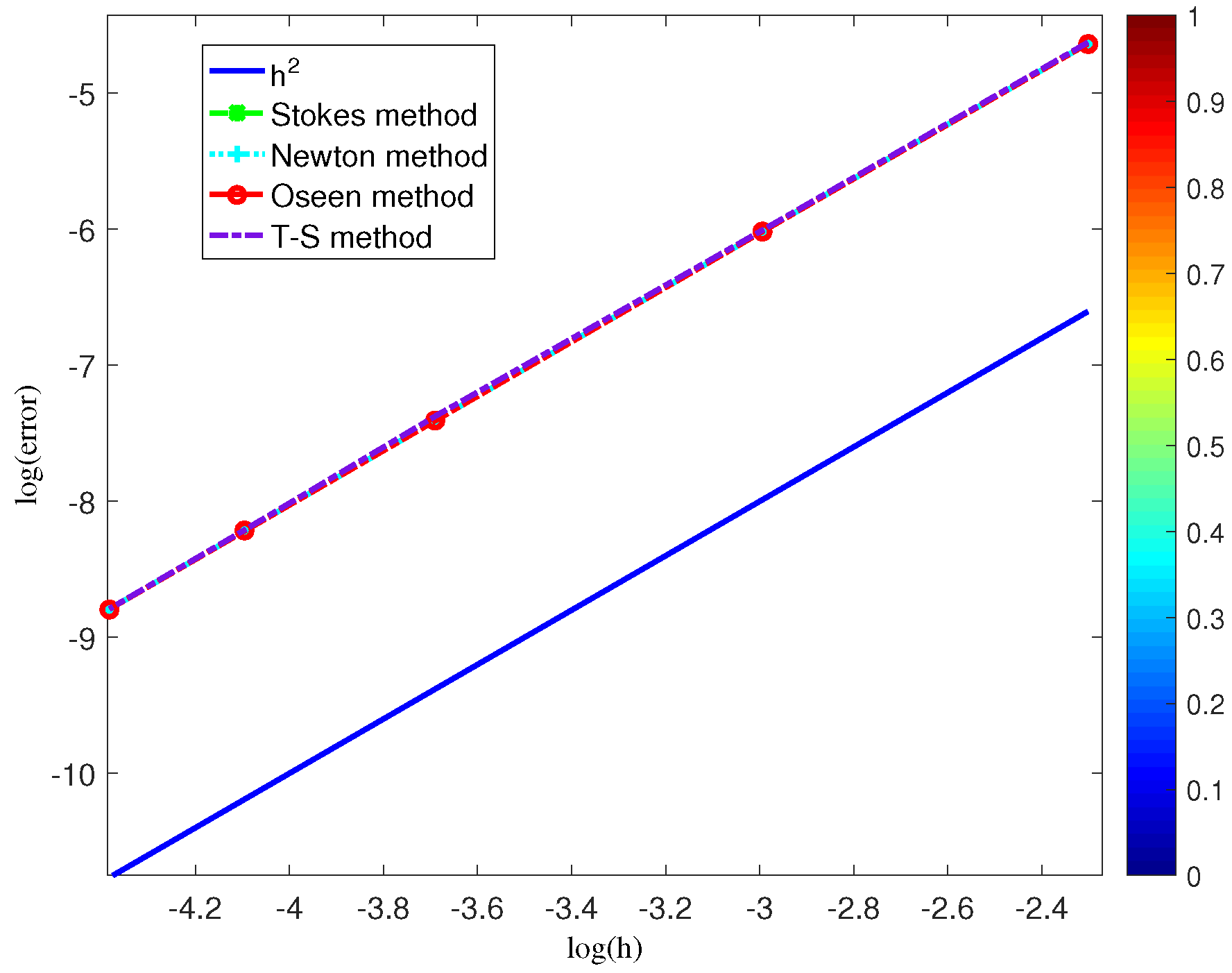
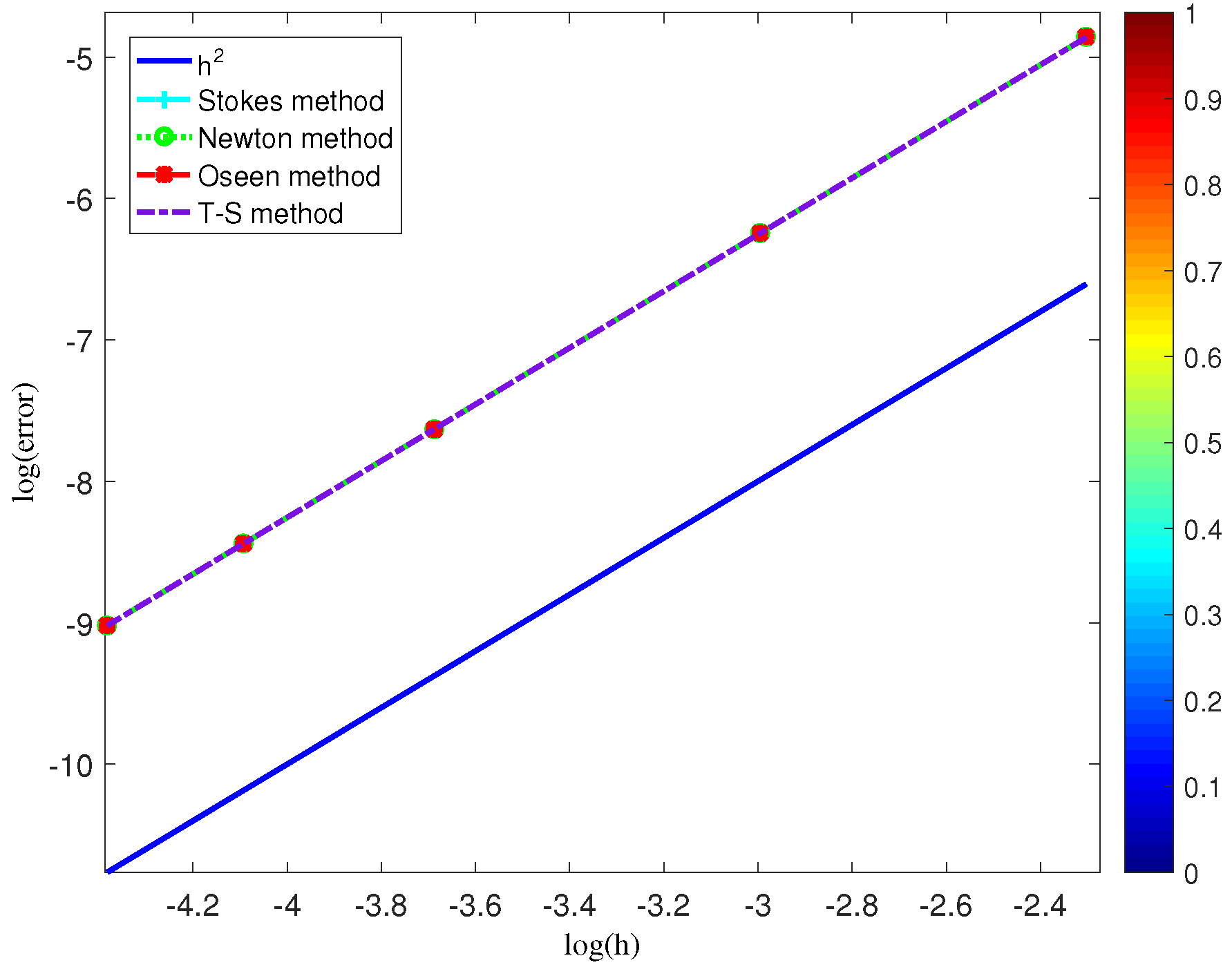
To better visualize the convergence rates of velocity and pressure, Figure 1 and Figure 2 are presented. From Figure 1 and Figure 2, we see that both curves are essentially parallel, confirming that the convergence rate is of order two in the X-norm for velocity and also of order two in the L 2 -norm for pressure.

4.2. Model Computation

We further investigate the influence of the viscosity coefficient ν on the three iterative algorithms. Consider the problem on the domain Ω = ( 0 , 1 ) × ( 0 , 1 ) , with the upper boundary denoted by Γ m = { 0 , 1 } × { 1 } . Here we take the right-hand side f = 0 and impose the boundary condition u = g on Γ , where g is defined as follows:
g 1 ( 0 , y ) = 0 , 0 y 1 2 , ( 2 y 1 ) 2 , 1 2 y 1 , g 1 ( 1 , y ) = 0 , 0 y 1 2 , ( 2 y 1 ) 2 , 1 2 y 1 , g 1 ( x , 0 ) = 0 , 0 x 1 , g 2 = 0 , on Γ .
From the boundary condition we obtain u · n = 0 on Γ m , which implies u 2 = 0 on Γ m .
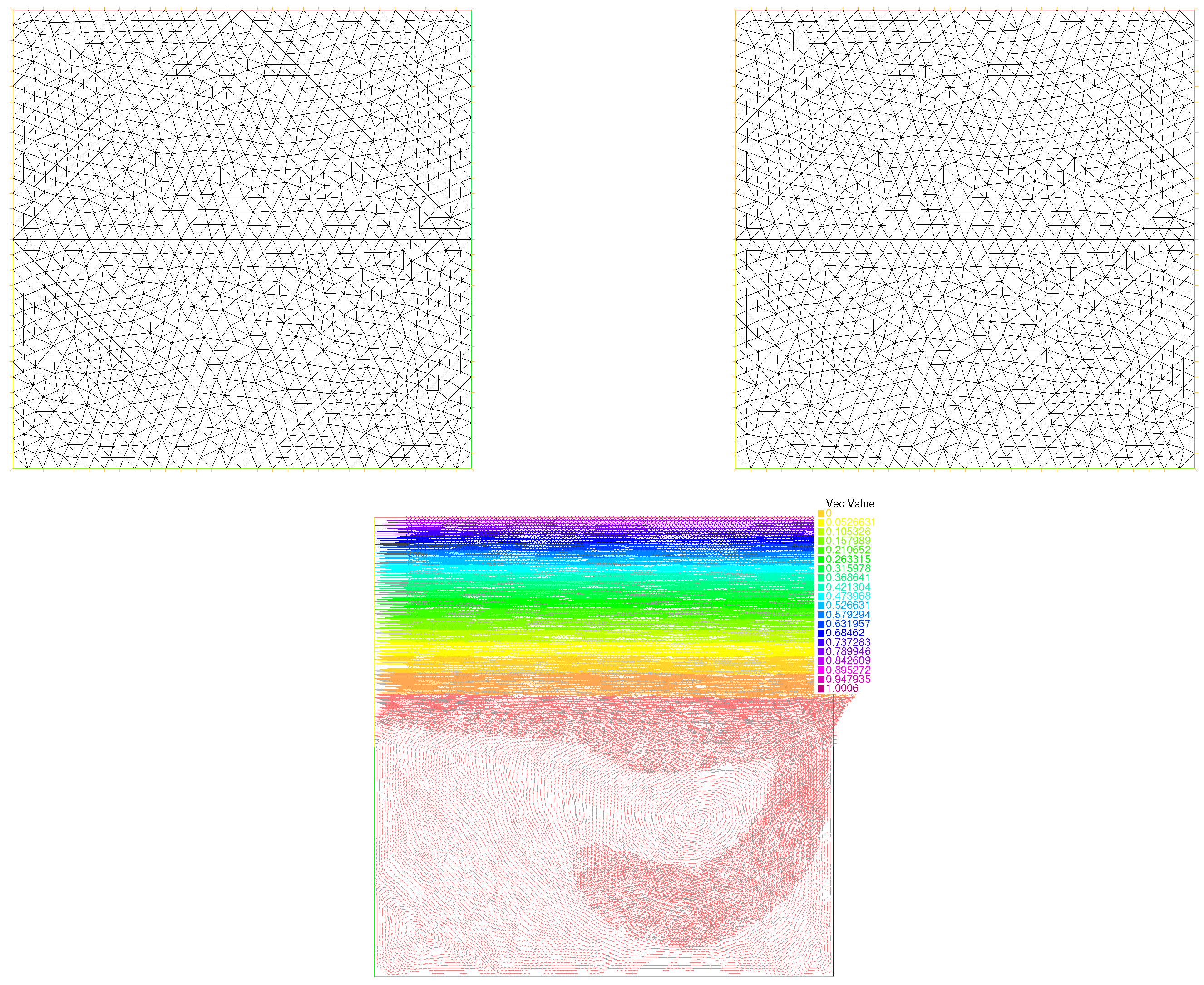
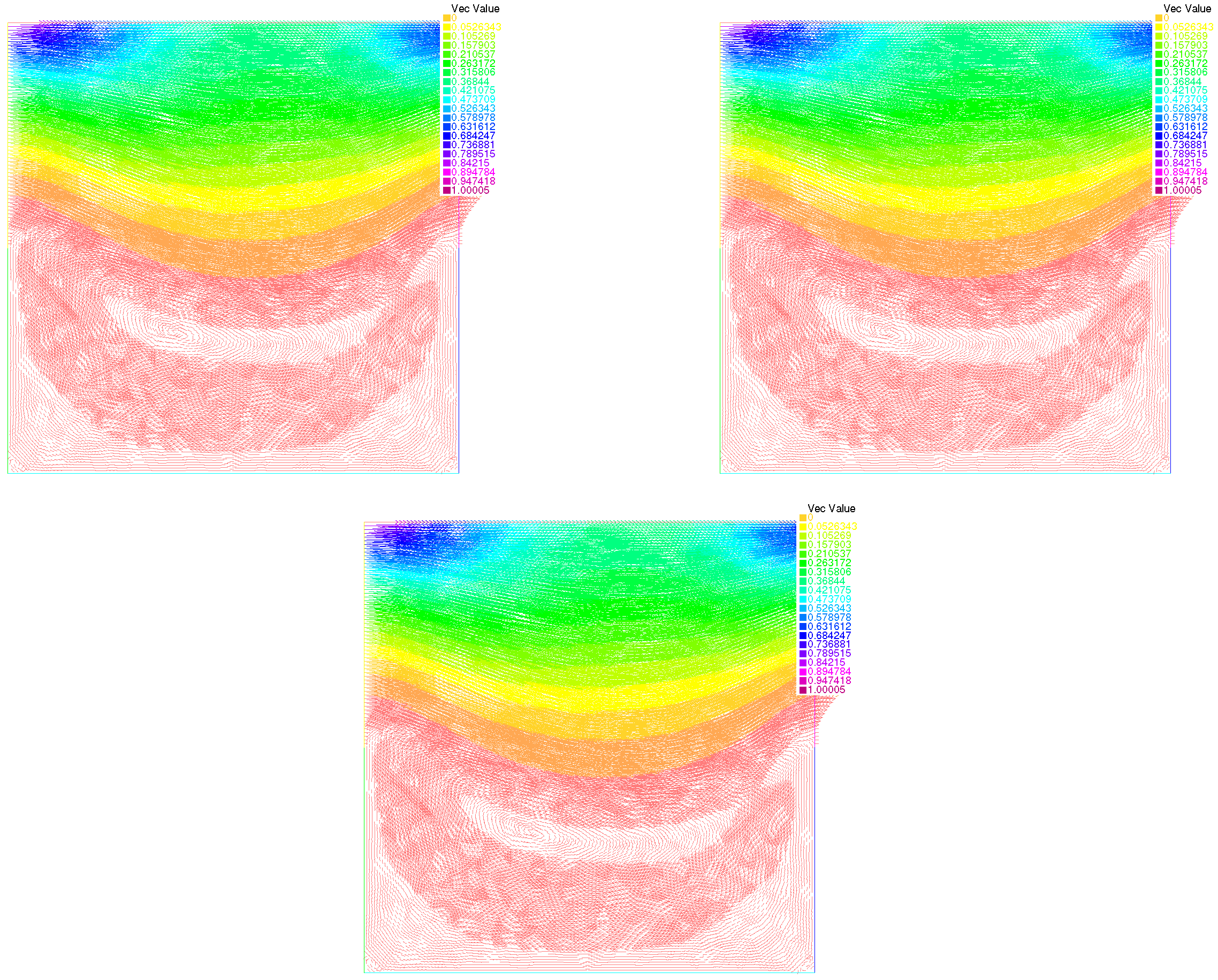
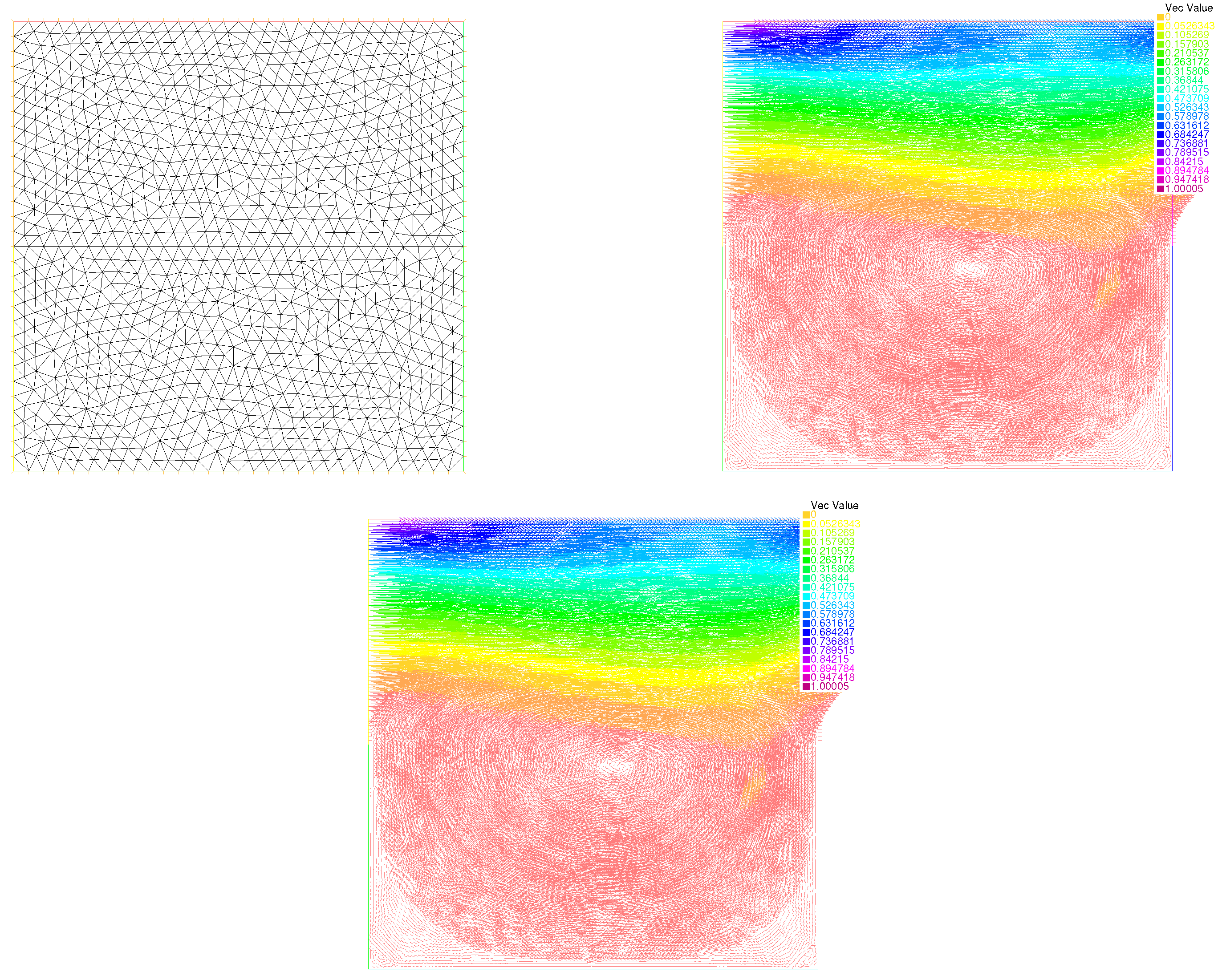
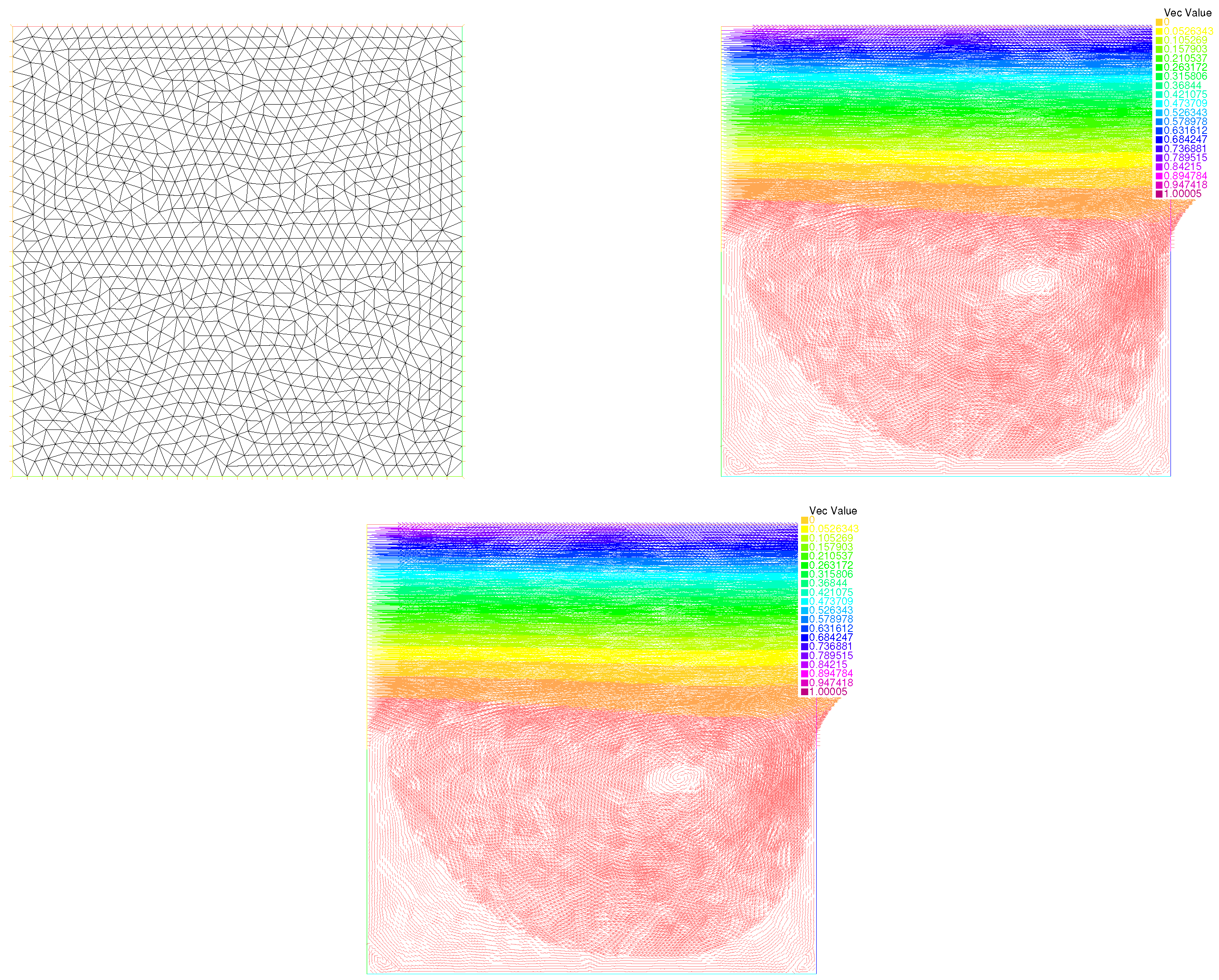
We fix h = 1 / 40 and vary the viscosity coefficient ν from 0.1 down to 1.0 × 10 5 , and we compute the corresponding velocity fields and pressure contour plots using the three iterative algorithms. Figure 3, Figure 4, Figure 5 and Figure 6 show the cases ν = 0.1 , ν = 0.01 , ν = 10 3 and ν = 10 4 ; all three iterative algorithms fail to converge within 3600s for the case ν = 10 5 . In each figure, the top-left panel corresponds to the Stokes iteration, the top-right to the Newton iteration, and the bottom to the Oseen iteration. When the iteration does not converge, the velocity and pressure plots are replaced by mesh grids.
From Figure 3, Figure 4, Figure 5 and Figure 6, we observe that as ν decreases, some algorithms become unstable and fail to produce numerical solutions for the Navier-Stokes equations with the given mixed boundary conditions. Specifically: when ν = 0.1 , all three algorithms converge successfully; when ν = 0.01 and ν = 10 3 , the Newton and Oseen iterations converge, while the Stokes iteration fails; when ν = 10 4 , only the Oseen iteration converges, while the Stokes and Newton iterations fails; when ν = 10 5 , none of the three algorithms converge. These results indicate that the Newton and Oseen iterations are less sensitive to ν compared to the Stokes algorithm.

4.3. Discussions

Combining the results in Table 1, Table 2 and Table 3 with the model computations in Figure 3, Figure 4, Figure 5 and Figure 6, we summarize the performance of the Stokes, Newton, and Oseen iterative algorithms from the viewpoints of accuracy, computational efficiency, and robustness.
For a moderate viscosity coefficient (e.g., ν = 0.05 ) and the same stopping criterion Exp = 10 6 , all three methods produce solutions with essentially identical accuracy. In particular, second-order convergence rates are observed in the X-norm for velocity and in the L 2 -norm for pressure. This indicates that, once the iterative increment u h m u h m 1 X ( Ω ) is sufficiently small, the total error is dominated by the spatial discretization error, in agreement with the error decomposition and theoretical estimates established in Section 2 and Section 3.
From the perspective of computational efficiency at ν = 0.05 , the Newton iteration consistently requires the least CPU time for all mesh sizes, and its advantage becomes more pronounced as the mesh is refined. This behavior reflects its fast (quadratic) convergence with respect to the iteration index. The Stokes iteration is generally faster than the Oseen iteration in this case, although the Oseen scheme involves a simpler linearization of the nonlinear term. The slower convergence of the Oseen iteration results in a higher overall computational cost.
As the viscosity coefficient decreases, the relative robustness of the three schemes changes significantly. As observed in Figure 3, Figure 4, Figure 5 and Figure 6, the Stokes iteration is the most sensitive to ν : it already fails to converge for ν = 10 2 and ν = 10 3 , whereas the Newton and Oseen iterations remain convergent in these regimes. When the viscosity is further reduced to ν = 10 4 , the Newton iteration also loses convergence, while the Oseen iteration continues to produce a numerical solution. Finally, for ν = 10 5 , none of the three iterative schemes converges within the prescribed time limit.
This behavior indicates that, as ν becomes small, problem (1) increasingly exhibits a convection-dominated or small-parameter character. In such regimes, the numerical solution of the steady Navier–Stokes equations is well known to be challenging, and classical Galerkin-based iterative methods may suffer from reduced robustness; see, for example, [28]. The Stokes, Newton, and Oseen iterations considered in this work are primarily designed for moderate-viscosity regimes and are analyzed under stability conditions that explicitly depend on ν . In particular, the stability conditions derived in Lemmas 1-4 involve factors of the form c 0 2 ν 2 f X ( Ω ) , which become increasingly restrictive as ν decreases. The observed loss of convergence for the Stokes and Newton iterations at ν = 10 4 , as well as for all three schemes at ν = 10 5 , is therefore consistent with the theoretical analysis and reflects the intrinsic limitations of standard finite element discretizations without stabilization in the small-viscosity setting.
The comparatively better performance of the Oseen iteration for ν = 10 4 suggests that linearizations incorporating a frozen convection field can provide enhanced robustness in convection-dominated regimes. Nevertheless, for sufficiently small viscosity, even the Oseen iteration fails to converge without additional stabilization. Effective treatment of such problems typically requires stabilized finite element methods or alternative numerical strategies specifically designed for convection-dominated flows. A detailed investigation of these approaches is beyond the scope of the present work.

5. Conclusions

This work studied the Navier-Stokes equations with mixed boundary conditions, focusing on the Stokes, Newton, and Oseen iteration schemes. The equations were reformulated to convert mixed into natural boundary conditions, a variational framework was established, and existence and uniqueness of solutions were proved. Finite element error estimates were derived, and stability conditions with corresponding error bounds were obtained for each scheme, including a detailed treatment of challenging error terms. The numerical results show that, under the same spatial discretization and stopping criterion, the Newton iteration is the most efficient in terms of computational time, while the Oseen iteration is more robust with respect to decreasing viscosity coefficients.
Future work includes addressing three-dimensional problems with mixed boundary conditions, designing time-space iteration schemes for low-viscosity regimes, and applying the approach to physically relevant fluid models. In addition to problems with known analytical solutions, it is also of interest to apply the proposed finite element framework and iterative schemes to more realistic flow problems posed on irregular domains, where analytical solutions are generally unavailable. In such cases, highly resolved numerical solutions obtained on refined meshes may serve as reference solutions for further validation. This will be investigated in future work.


Author Contributions

Methodology, Y.C. and Q.L.; software, Y.C. and J.L.; validation, Y.C., Q.L. and J.L.; writing—original draft preparation, Y.C.; writing—review and editing, Y.C., Q.L. and J.L.; funding acquisition, Q.L. and J.L. All authors have read and agreed to the published version of the manuscript.

Funding

This research was funded by National Natural Science Foundation of China (No. 12371324 and 11901449) and Fundamental Research Funds for the Central Universities (No. xzy012024071).

Data Availability Statement

The original contributions presented in this study are included in the article. Further inquiries can be directed to the corresponding author.

Acknowledgments

The authors would like to thank the editors and three anonymous reviewers for their insightful comments and constructive suggestions, which help us improve the paper significantly in both contents and style.

Conflicts of Interest

The authors declare no conflicts of interest.

References

  1. Conca, C.; Parés, C.; Pironneau, O.; Thiriet, M. Navier–Stokes equations with imposed pressure and velocity fluxes. Int. J. Numer. Methods Fluids 1995, 20, 267–287. [Google Scholar] [CrossRef]
  2. Chorin, A.J. Numerical solution of the Navier–Stokes equations. Math. Comput. 1968, 22, 745–762. [Google Scholar] [CrossRef]
  3. Anderson, J.D. Computational Fluid Dynamics: The Basics with Application; Tsinghua University Press: Beijing, China, 2002. [Google Scholar]
  4. Temam, R. Navier–Stokes Equations: Theory and Numerical Analysis; North-Holland Publishing Company: New York, NY, USA, 1979. [Google Scholar]
  5. Girault, V.; Raviart, P.A. Finite Element Method for Navier–Stokes Equations: Theory and Algorithms; Springer: Berlin/Heidelberg, Germany, 1986. [Google Scholar]
  6. Tao, W. Numerical Heat Transfer; Xi’an Jiaotong University Press: Xi’an, China, 2001. [Google Scholar]
  7. Qu, W.; Gu, Y.; Fan, C.M. A stable numerical framework for long-time dynamic crack analysis. Int. J. Solids Struct. 2024, 293, 112768. [Google Scholar] [CrossRef]
  8. Chen, G.; Zhou, J. Boundary Element Methods with Applications to Nonlinear Problems, 2nd ed.; World Scientific: Paris, France, 2010. [Google Scholar]
  9. Amara, M.; Capatina-Papaghiuc, D.; Trujillo, D. Stabilized finite element method for the Navier–Stokes equations with physical boundary conditions. Math. Comput. 2007, 76, 1195–1217. [Google Scholar] [CrossRef]
  10. Dubois, F. Vorticity–velocity–pressure formulation for the Stokes problem. Math. Methods Appl. Sci. 2002, 25, 1091–1119. [Google Scholar] [CrossRef]
  11. Dubois, F.; Salaün, M.; Salmon, S. Vorticity–velocity–pressure and stream function–vorticity formulations for the Stokes problem. J. Math. Pures Appl. 2003, 82, 1395–1451. [Google Scholar] [CrossRef]
  12. Amara, M.; Papaghiuc, D.C.; Chacón-Vera, E.; Trujillo, D. Vorticity–velocity–pressure formulation for the Stokes problem. Math. Comput. 2003, 73, 1673–1697. [Google Scholar] [CrossRef]
  13. Ciarlet, P.G. The Finite Element Method for Elliptic Problems; North-Holland: Amsterdam, The Netherlands, 1978. [Google Scholar]
  14. Bernardi, C.; Hecht, F.; Verfürth, R. A finite element discretization of the three-dimensional Navier–Stokes equations with mixed boundary conditions. ESAIM M2AN 2009, 43, 1185–1201. [Google Scholar] [CrossRef]
  15. He, Y.; Wang, A.W.; Mei, L.Q. Stabilized finite element methods for the stationary Navier–Stokes equations. J. Eng. Math. 2005, 51, 367–380. [Google Scholar] [CrossRef]
  16. He, Y.; Li, K.T. Two-level stabilized finite element methods for the steady Navier–Stokes equations. Computing 2005, 74, 337–351. [Google Scholar] [CrossRef]
  17. He, Y.; Wang, A.W.; Chen, Z.X.; Li, K.T. An optimal nonlinear Galerkin method with mixed finite elements for the steady Navier–Stokes equations. Numer. Methods Partial. Differ. Equ. 2003, 19, 762–775. [Google Scholar] [CrossRef]
  18. He, Y.; Li, J. A Stabilized Finite Element Method Based on Local Polynomial Pressure Projection for the Stationary Navier–Stokes Equations. Appl. Numer. Math. 2008, 58, 1503–1514. [Google Scholar] [CrossRef]
  19. Li, K.T.; He, Y. Taylor expansion algorithm for the branching solution of the Navier–Stokes equations. Int. J. Numer. Anal. Model. 2005, 2, 459–478. [Google Scholar]
  20. Li, K.T.; Hou, Y.R. An AIM and one-step Newton method for the Navier–Stokes equations. Comput. Methods Appl. Mech. Eng. 2001, 190, 6141–6155. [Google Scholar] [CrossRef]
  21. Zhou, X.L.; He, Y. Using divergence free wavelets for the numerical solution of the 2-D stationary Navier–Stokes equations. Appl. Math. Comput. 2005, 163, 593–607. [Google Scholar] [CrossRef]
  22. Liu, Q.; Hou, Y.; Wang, Z.; Zhao, J. Two-level consistent splitting methods based on three corrections for the time-dependent Navier-Stokes equations. Int. J. Numer. Methods Fluids 2016, 80, 429–450. [Google Scholar] [CrossRef]
  23. Feng, X.; Lu, X.; He, Y. Difference finite element method for the 3D steady Stokes equations. Appl. Numer. Math. 2022, 173, 418–433. [Google Scholar] [CrossRef]
  24. Shang, Y. A Parallel Finite Element Discretization Scheme for the Natural Convection Equations. J. Sci. Comput. 2024, 100, 56. [Google Scholar] [CrossRef]
  25. He, Y.; Li, J. Numerical comparisons of time-space iterative method and spatial iterative methods for the stationary Navier–Stokes equations. J. Comput. Phys. 2012, 231, 6790–6800. [Google Scholar] [CrossRef]
  26. He, Y. Euler implicit/explicit iterative scheme for the stationary Navier–Stokes equations. Numer. Math. 2013, 123, 67–96. [Google Scholar] [CrossRef]
  27. Temam, R. Navier–Stokes Equations, Theory and Numerical Analysis, 3rd ed.; North-Holland: Amsterdam, The Netherlands, 1984. [Google Scholar]
  28. He, Y. Stability and convergence of iterative methods related to viscosities for the 2D/3D steady Navier-Stokes equations. J. Math. Anal. Appl. 2015, 423, 1129–1149. [Google Scholar] [CrossRef]
  29. Zhang, S.; He, Y.; Lin, T. New conditions of stability and convergence of Stokes and Newton iterations for Navier–Stokes equations. J. Comput. Appl. Math. 2015, 290, 515–530. [Google Scholar] [CrossRef]
  30. Costabel, M. A remark on the regularity of solutions of Maxwell’s equations on Lipschitz domain. Math. Methods Appl. Sci. 1990, 12, 365–368. [Google Scholar] [CrossRef]
  31. Costabel, M.; Dauge, M. Computation of resonance frequencies for Maxwell equations in non smooth domains. In Topics in Computational Wave Propagation; Springer: Berlin/Heidelberg, Germany, 2004; pp. 125–161. [Google Scholar]
  32. Amrouche, C.; Bernardi, C.; Dauge, M.; Girault, V. Vector potentials in three-dimensional nonsmooth domains. Math. Methods Appl. Sci. 1998, 21, 823–864. [Google Scholar] [CrossRef]
  33. Adams, R.A. Sobolev Spaces; Academic Press: New York, NY, USA, 1975. [Google Scholar]
  34. Marion, M.; Temam, R. Navier–Stokes Equations: Theory and Approximation; Handbook of Numerical Analysis; North-Holland: Amsterdam, The Netherlands, 1998. [Google Scholar]
  35. He, Y. Convergence of three iterative methods based on the finite element discretization for the stationary Navier–Stokes equations. Comput. Methods Appl. Mech. Eng. 2009, 198, 1351–1359. [Google Scholar] [CrossRef]
  36. Friedrichs, K. Differential forms on Riemannian manifolds. Commun. Pure Appl. Math. 1955, 8, 551–590. [Google Scholar] [CrossRef]
  37. Brezzi, F.; Rappaz, J.; Raviart, P. Finite-dimensional approximation of nonlinear problems. I. Branches of nonsingular solutions. Numer. Math. 1980, 36, 1–25. [Google Scholar] [CrossRef]
  38. Pousin, J.; Rappaz, J. Consistency, stability, a priori and a posteriori errors for Petrov-Galerkin methods applied to nonlinear problems. Numer. Math. 1994, 69, 213–231. [Google Scholar] [CrossRef]
  39. Orlt, M.; Sändig, A.M. Regularity of viscous Navier–Stokes flows in nonsmooth domains. In Boundary Value Problems and Integral Equations in Nonsmooth Domain; Dekker: New York, NY, USA, 1995; pp. 185–201. [Google Scholar]
  40. Hecht, F.; Le Hyaric, A.; Ohtsuka, K.; Pironneau, O. FreeFEM, v4.1 ed.; Université Pierre et Marie Curie: Paris, France, 2019. [Google Scholar]
Figure 1. Convergence order analysis for velocity.
Mathematics 14 00333 g001
Figure 2. Convergence order analysis for pressure.
Mathematics 14 00333 g002
Figure 3. Velocity vector fields and pressure contours for ν = 0.1 , h = 1 / 40 (the top-left panel corresponds to the Stokes iteration, the top-right to the Newton iteration, and the bottom to the Oseen iteration).
Mathematics 14 00333 g003
Figure 4. Velocity vector fields and pressure contours for ν = 0.01 , h = 1 / 40 (the top-left panel corresponds to the Stokes iteration, the top-right to the Newton iteration, and the bottom to the Oseen iteration).
Mathematics 14 00333 g004
Figure 5. Velocity vector fields and pressure contours for ν = 10 3 , h = 1 / 40 (the top-left panel corresponds to the Stokes iteration, the top-right to the Newton iteration, and the bottom to the Oseen iteration).
Mathematics 14 00333 g005
Figure 6. Velocity vector fields and pressure contours for ν = 10 4 , h = 1 / 40 (the top-left panel corresponds to the Stokes iteration, the top-right to the Newton iteration, and the bottom to the Oseen iteration).
Mathematics 14 00333 g006
Table 1. Stokes iteration algorithm ( Exp = 10 6 , ν = 0.05 ).
1 / h Time (s) u u h m X u X p p h m 0 p 0 u-X Orderp- L 2 Order
101.9850.0096980.007746
204.8910.0024310.0019361.99622.0000
408.5000.0006080.0004841.99912.0000
6015.5310.0002700.0002151.99971.9999
8028.6400.0001520.0001211.99991.9993
Table 2. Newton iteration algorithm ( Exp = 10 6 , ν = 0.05 ).
1 / h Time (s) u u h m X u X p p h m 0 p 0 u-X Orderp- L 2 Order
100.4530.0096980.007746
201.7820.0024310.0019361.99622.0000
407.5470.0006080.0004841.99912.0000
6011.4840.0002700.0002151.99971.9999
8021.5000.0001520.0001211.99991.9993
Table 3. Oseen iteration algorithm ( Exp = 10 6 , ν = 0.05 ).
1 / h Time (s) u u h m X u X p p h m 0 p 0 u-X Orderp- L 2 Order
102.3750.0096980.007746
206.3130.0024310.0019361.99622.0000
409.0160.0006080.0004841.99912.0000
6016.1250.0002700.0002151.99971.9999
8030.5630.0001520.0001211.99991.9993
Disclaimer/Publisher’s Note: The statements, opinions and data contained in all publications are solely those of the individual author(s) and contributor(s) and not of MDPI and/or the editor(s). MDPI and/or the editor(s) disclaim responsibility for any injury to people or property resulting from any ideas, methods, instructions or products referred to in the content.