

Article

Eigenvalues of the Operator Describing Magnetohydrodynamic Problems in Outer Parts of Galaxies

by
Evgeny Mikhailov
1,2,* and
Tatiana Khasaeva
1,3
1
Faculty of Physics, M.V. Lomonosov Moscow State University, 119991 Moscow, Russia
2
P.N. Lebedev Physical Institute, 119991 Moscow, Russia
3
Institute of Earthquake Prediction Theory and Mathematical Geophysics, 117997 Moscow, Russia
*
Author to whom correspondence should be addressed.
Mathematics 2026, 14(2), 308; https://doi.org/10.3390/math14020308
Submission received: 11 November 2025 / Revised: 24 December 2025 / Accepted: 14 January 2026 / Published: 15 January 2026

Abstract

The magnetic field generation studies in astronomy lead to a number of interesting problems in mathematical physics. In the dynamo theory, the problem is reduced to a system of parabolic equations for the field components. Assuming that the field grows exponentially, we obtain an eigenvalue problem for the corresponding elliptic operator. The possibility of the field generation and behaviour of the system is characterized by the spectra of the operator. If all eigenvalues lie in the left half of the complex plane, the perturbations will decay. On the other hand, if some of the eigenvalues have positive real parts, the large-scale structures of the field can be generated. From the astrophysical point of view, galactic magnetic fields are very important to study. One of the main problems is connected with the peripheral regions, where the properties of the medium complicate the operator structure. We can use the perturbation theory to find the eigenvalues. However, the problem can be solved analytically by considering some specific approximations. We can find the spectra using numerical approaches in the case of the conditions that are close to the real ones. In this paper, we solve eigenvalue problems for different operators which are connected with magnetohydrodynamic processes in outer parts of galaxies.

1. Introduction

Magnetohydrodynamic problems play a significant role in different applications, from the most fundamental laws of the Universe [1,2,3] to technical problems of flows in liquid metals [4,5,6]. They are often connected with quite interesting problems of mathematical physics, which describe processes in objects of different shapes and complicated motions of the fluids [7,8]. For example, the structure of the magnetic field motions in conducting fluids leads to quite complicated spectral decompositions [9,10]. The evolution of the frozen-in magnetic field in convective cells is connected with collapse problems and takes an important place in nonlinear dynamics [11,12]. Studies of magnetic field evolution in astrophysics are usually connected with the dynamo mechanism and have a great importance for theoretical and mathematical physics, too [13,14,15].
There are various approaches for the field generation in cosmic objects based on different properties of the ionized medium [16,17,18]. It is necessary to divide the process to different time and spatial scales. The normal size of turbulent cells in magnetohydrodynamics is defined by the small-scale dynamo which is connected with the properties of the fluid motions [19,20]. Though this phenomenon is not the main subject of the paper, it is necessary to mention that the small-scale dynamo is described by statistical laws which can give typical average values of the field and its dispersion. However, from the astrophysical point of view, the large-scale field is much more important. It can be obtained by averaging the field on scales of order of turbulent length [13,18,21,22]. The evolution of such fields is described by the large-scale dynamo mechanism, which is based on two main effects. Firstly, the turbulent motions have non-zero helicity, which leads to a complex “rotation” of the lines of the frozen-in field (such a process is called alpha-effect). Along with that, the astrophysical objects have a large-scale rotation with changing angular velocity (differential rotation). This leads to a kind of “stretching” of the magnetic field [21,23]. Of course, there are different mechanisms of the field generation, such as Biermann battery [16,24], magnetorotational instability [25] and others, which naturally act jointly with the dynamo. However, the regular dynamo can be supposed to make the greatest contribution to the large-scale field generation.
Mathematically, the dynamo process can be described by averaging the equations of magnetohydrodynamics. If we consider helical turbulent motions (this means that the velocity should have non-zero projection on its curl), we will obtain a three-dimensional equation for the mean field evolution [13]. It can be understood as a system of three scalar parabolic equations. One of the most important questions is connected with the possibility of the field generation: small perturbations connected with different mechanisms should grow with time [26]. If we consider that the field changes with time according to some exponential law, we will face an eigenvalue problem for the corresponding linear operator (if we take modest values of the magnetic field). The evolution of the field in the original system of equations will be connected with the properties of the spectra. If it lies fully in the left part of the complex plane, all perturbations will decay. If some of the values are in the right half, we can obtain a growing magnetic field. When the magnetic field enlarges, nonlinear effects appear, and the field growth will become slower than exponential. Finally, it will pass to some stationary distribution. This is connected with the transition of energy between turbulence and the magnetic field, which leads to the saturation of growth [21,27,28]. Although such effects are very important, as for studying the possibility of an increase in small seed fields, it is necessary to describe a linear model. Also, it has a specific mathematical interest connected with the spectral theory of differential operators.
The eigenvalue problem for the magnetic field is quite complicated. It seems that it cannot be solved for most of the three-dimensional cases. So, the two-dimensional approximations which take into account the symmetry of the field will be quite useful. First of all, we should mention the Parker dynamo [29,30] for the spherical case. It is very useful for the Sun and other stars. Further approaches are connected with a number of thin disc models [31,32,33], which have been developed for galaxies [22] and accretion discs [34]. Their applicability is based on the fact that the typical half-thickness of the disc is more than one order smaller than its radii [35,36]. It is necessary to note that there are also models that take into account finite thickness [37], which could be important for different processes connected, for example, with vertical flows. However, for a basic description of the magnetic fields, it is often reasonable to use thin disc models. Taking into account the specifics of such plane objects, one can describe the problem in cylindrical coordinates. Moreover, sometimes, axisymmetric models are accurate enough to be considered and the problem will be even more simplified.
Such problems firstly occurred for the galaxies. Nowadays, it is strongly proved that a large number of galaxies have regular magnetic fields of 1–3 microgauss [21]. First, observational studies were connected with the research of cosmic rays and their distribution on the celestial sphere. Also, measurements of spectra of synchrotron emission gave an opportunity to estimate magnetic fields. At the moment, most of the studies of galaxies are conducted using Faraday rotation measurements for radio waves [38]. As for the Milky Way, pioneer studies were connected with the measurements for the polarized waves from a few dozen objects, and nowadays, there are more than 103 pulsars, the radiation of which is successfully used to describe magnetic field structures in our galaxy. The extragalactic sources of radio waves are used as well [39].
There is also a wide range of mathematical studies of the magnetic field evolution in galaxies. They are filled with interstellar medium, which contains neutral hydrogen and 5–20% of an ionized component that provides a frozen-in field and the applicability of basic approximations of magnetohydrodynamics. The field generation is supported by a dynamo mechanism, which is connected with a specific structure of small-scale flows of the interstellar medium (alpha-effect) and the non-uniform angular large-scale velocity of the object (differential rotation). Such processes lead to the exponential increase in the magnetic field, but the dissipation processes limit the field growth. If the dissipation is quite high, the field may start to decay. These processes can be understood using both theoretical approaches and observational studies [18,21].
We can obtain an eigenvalue problem for the field evolution in the main part of the galaxy (for distances from the centre that are smaller than 6–8 kpc). In the axisymmetric case, the exact solution can be found for the simplest structure of the motions. The eigenfunctions are based on Bessel cylindrical functions, and the eigenvalues are connected with its zeros. It has been shown that for a wide range of parameters they are real; furthermore, some of them are positive. This leads to a quite transparent condition for the field growth, which can be connected with some of the observed parameters. As for the non-axisymmetric case, we can solve the problem approximately and obtain an interesting result [40]. For example, spectral approaches show that the azimuthal structures are suppressed by axisymmetric magnetic fields in the linear case. If we study the field nonlinear saturation, the equipartition field is proportional to the square root from density of the medium [21], so we can conclude that the field can be larger in regions of larger density, especially in the spiral arms. But, at the linear stage, non-axisymmetric features are not very important.
Another problem which is necessary for applications is connected with the field generation in the outer parts of the galaxy. Such fields should occur according to various astrophysical reasons, and there are different approaches to describe it. Partly, the field can grow due to magnetorotational instability (that is also closely connected with some eigenvalue problems), but it is not the only mechanism responsible for that. However, numerical studies have shown that the field can grow at distances of up to 15–20 kpc from the rotation axis [41]. The field can grow even if simple estimates for dynamo numbers and other basic characteristics show that the field growth is impossible, and the dissipative processes are so strong that the field should decay.
It seems interesting to study such processes theoretically, based on the methods of perturbation theory [42]. However, there are sufficient complications. First of all, motions of the medium in the outer parts of the galaxy are much weaker, and their intensity strongly depends on the distance from the centre. Some of the problems can be connected with the changing thickness of the galactic disc. Thus, finding the exact meanings of the eigenvalues seems to be impossible. We can calculate them approximately using the fact that linear operators are self-adjoint. This allows us to use the perturbation theory which has been developed for the operators in quantum mechanics and other fields of the operator theory [42]. A numerical solution of such problems also seems to be challenging. Another difficulty will comprise the consideration of the disc expansion, which in reality is especially significant closer to the periphery of the galaxy [41].
To obtain the needed system of parabolic equations, we will need to use some approximations. As soon as spiral galaxies can be considered as flat discs, here we will use the thin disc model, which has been previously mentioned in the text. To solve the system using the perturbation theory methods, we will consider linear modes above all. The eigenvalues obtained are firmly connected with the field growth rate, while the eigenfunctions show the spatial distribution of the field structure.
The paper is organized in the following way. Firstly, we describe our model and formulate basic equations that are used to study the field. Then we pass to the main part, where we find the eigenvalues of corresponding differential operators using perturbation theory. Then, we verify our results using numerical solutions and obtain computational eigenvalues for the case when analytical studies are too complicated. Also, we discuss the possibility of the non-axisymmetric field’s generation. In the end, we give a short summary and conclusion for our research.

2. Basic Equations

Magnetic fields in galaxies can be described by mean field dynamo vector equation [13]:
B t = × V × B + × ( α B ) + η Δ B ,
where B is the magnetic field vector, V = r Ω e ϕ is the mean velocity (usually it is connected with large-scale rotation, Ω is the angular velocity), α is the alpha-effect coefficient (based on non-zero mean helicity of the small-scale motions) and η characterizes the dissipation.
This equation is quite difficult to be solved exactly, which leads to using a number of simplifications. In most galaxies, the field grows mainly near the equatorial plane, and the typical scaleheight of the galactic disk has the order of 0.5 kpc. The radius of the “main” part of the galaxy is usually close to 10–15 kpc. Based on the mentioned approaches, we consider the galactic field in the thin disc approximation and reduce the problem to a two-dimensional one. If we assume standard models for the alpha-effect and magnetic fields, we can obtain a system of equations in the axisymmetric case [32,33]:
B r t = Ω r l 2 h 2 r B ϕ η π 2 B r 4 h 2 r + η 2 B r r 2 + B r r r B r r 2 ;
B ϕ t = r d Ω d r B r η π 2 B ϕ 4 h 2 r + η 2 B ϕ r 2 + B ϕ r r B ϕ r 2 ;
where h r is the half-thickness of the disc and l is the linear scale of turbulent motions.
To simplify the process of the field solution, it is convenient to use the following replacement [40]:
y = B r r d Ω d r B ϕ l Ω r h 2 r
z = B r r d Ω d r + B ϕ l Ω r h 2 r
Note that the field components can be easily expressed using the following equations:
B r = y + z 2 r d Ω d r
B ϕ = y z 2 l h 2 r Ω r
If we assume that parameters change slowly ( Ω d Ω / d r > > B d B / d r , h d h / d r > > B d B / d r ), after a series of algebraic transformations, we can obtain two separate equations:
y t = y A 1 r A 2 r + η 2 y r 2 + y r r y r 2
z t = z A 1 r + A 2 r + η 2 z r 2 + z r r z r 2
where we have introduced A 1 r = l h 2 r r Ω r d Ω d r and A 2 r = η π 2 4 h 2 ( r ) for brevity.
For both equations, we can suppose exponential growth:
y ( r , t ) = y 0 r exp μ t ;
z ( r , t ) = z 0 r exp λ t .
Omitting the “zero” index, we shall obtain the eigenvalue problem for y :
μ y = H ^ + U ^ y ;
y | r = 0 = y | r = r max = 0 ;
and for z :
λ z = H ^ + V ^ z ;
z | r = 0 = z | r = r max = 0 .
Here, we have introduced the following operators:
H ^ = d 2 d r 2 + 1 r d d r + 1 r 2 ;
U ^ = A 1 r A 2 r ;
V ^ = A 1 r A 2 r ;
Here, r max is the typical value of the outer radius of the peripherical parts of the galaxy. Operators are defined in Hilbert spaces of twice continuously differentiable functions (for 0 < r < r max ) with scalar product defined as y 1 ( r ) y 2 ( r ) = 0 r max y 1 ( r ) y 2 ( r ) r d r .
It is necessary to notice that this problem is strongly connected with the generation of the magnetic field. Approximately, the field B = B r B ϕ will grow according to the law:
B r , t 1 2 i = 1 C i y i ( r ) r d Ω d r y i r l h 2 r Ω r exp μ i t + 1 2 j = 1 D j z j ( r ) r d Ω d r z j r l h 2 r Ω r exp λ j t .
where C i and D j are the coefficients depending on the initial conditions. We can see that μ i and λ j will be close to the eigenvalues of the original operator which can be associated with right part of (1). So, the possibility of generation of the magnetic field is described by the spectra in (12) and (14). Taking into account that corresponding operators are self-adjoint, it can be seen that the eigenvalues will be real. The possibility of the generation of the field can be reduced to the question whether any of μ i and λ j is positive.
Problems (12)–(13) and (14)–(15) cannot be solved exactly. One of the most important approaches is based on the perturbation theory which is used in quantum mechanics and other branches of theoretical physics.

3. Non-Perturbed Eigenvalues

The convenience of the eigenvalue problems for y and z is connected with the similar part H . We can use it as the non-perturbed operator and construct a basic approximation which will be perturbed by operators U ^ and V ^ , correspondingly. The non-perturbed problem for both cases will be the same. So, we shall describe a basic approximation using y 0 ( r ) :
μ 0 y 0 = H ^ y 0 ;
y 0 | r = 0 = y 0 | r = r max = 0 .
In this case, we will obtain the following equation:
r 2 d 2 y 0 d r 2 + r d y 0 d r μ 0 r 2 η y 0 r y 0 r = 0 .
Let us insert another replacement x = r μ 0 η to reduce the problem to a more simple Bessel equation:
x 2 d 2 y 0 d x 2 + x d y 0 d x + y 0 r x 2 1 = 0 .
The solution of this equation is a first-order Bessel function:
y 0 x = N J 1 r μ 0 η
Values for μ can be approximately found using asymptotic formulae for the Bessel function for the large (significantly distant from zero) argument:
J 1 ξ = 2 π ξ cos ξ 3 π 4 + O ξ 3 / 2
It can be used to approximate the search for roots and, as a result, the eigenvalues of the operator. Thus, for the corresponding eigenvalues, we will obtain the following:
μ i 0 η r max 2 π 4 + π i 2
As for the eigenfunctions we shall have the following:
y i 0 x J 1 r r max π 4 + π i
As it was previously said, the unperturbed eigenvalues and eigenfunctions for problems (14) and (15) will be the following:
λ j 0 η r max 2 π 4 + π j 2
z j 0 x J 1 r r max π 4 + π j

4. Perturbed Eigenvalues

The remaining parts of the equations will be considered as perturbations. In order to calculate the perturbations in the first approximation, we will use the equations [42]
δ λ n ( 1 ) = ( z n , V ^ z n ) ;
δ μ n ( 1 ) = ( y n , U ^ y n ) ;
The possibility of using this approach is based on comparing the norms of operators H ^ ,   V ^ and U ^ . Formulas (30) and (31) can work only if V ^ and U ^ are smaller than H ^ . In functional analysis, it can be shown that H ^ = sup y H ^ y y , where functions y are integrable with squares for 0 < r < , and the norm of the function is defined as y = 0 r max y 2 ( r ) r d r . Using examples of y = Q r 1 r r max sin n r r max (where Q and n are arbitrary), we can show that H ^ y y ~ n 2 and can be made as large as possible, so H ^ = . As for V ^ , we can estimate V ^ y = 0 r max A 1 r A 2 r 2 y 2 r r d r max A 1 r + A 2 r y . So V ^ = sup y V ^ y y max A 1 r + A 2 r , which is smaller than infinite H ^ . The same conclusion can be made for U ^ max A 1 r A 2 r . The accuracy of the approximations will be proportional to V ^ 2 and U ^ 2 , correspondingly.
Thus, the eventual form of the integrals to be solved will be the following:
δ λ n ( 1 ) = 0 r max J 1 2 r r max π 4 + π n A 1 ( r ) A 2 ( r ) r d r 0 r max J 1 2 r r max π 4 + π n r d r = I 1 I 2 ;
δ μ n ( 1 ) = 0 r max J 1 2 r r max π 4 + π n A 1 ( r ) A 2 ( r ) r d r 0 r max J 1 2 r r max π 4 + π n r d r = I 3 I 2 ;
Firstly, we will find the corresponding values of the integrals separately using general considerations:
I 2 = 1 2 r 2 J 1 2 ( 4 π n + π ) r 4 r max J 0 ( 4 π n + π ) r 4 r max J 2 ( 4 π n + π ) r 4 r max ;
To calculate other integrals, we will need to reorganize the coefficients. We see that, for 0 r r 0 , the coefficients will be the following:
A 1 ( r ) = l h r r Ω r d Ω d r = Ω 0 l r r 0 h 1 + r 2 r 0 2 Ω 0 l h r 0 r r 3 r 0 2 + r 5 r 0 4 ;
Moreover, we will consider A 2 r = A 2 = c o n s t .
On the other hand, for r 0 r r max
A 1 ( r ) = l h r r Ω r d Ω d r = Ω 0 l r r 0 h 1 + r 2 r 0 2 = Ω 0 l r 0 h 1 r 1 r 0 2 r 2 + 1 Ω 0 l r 0 h 1 r r 0 2 r 3 + r 0 4 r 5 ;
The integrals will be calculated separately as well. Thus, in the case of 0 r r 0
I 4 = 0 r 0 J 1 2 r r max π 4 + π n r d r = r max π 4 + π n 1 2 r 2 r max 2 π 4 + π n 2 J 1 2 r r max π 4 + π n J 0 r r max π 4 + π n J 2 r r max π 4 + π n   0   r 0
0 r 0 J 1 2 r r max π 4 + π n r 3 d r = r max π 4 + π n 1 6 r r max π 4 + π n 4 J 0 2 r r max π 4 + π n 2 3 r r max π 4 + π n 3 J 0 r r max π 4 + π n J 1 r r max π 4 + π n + + 1 6 r 2 r max 2 π 4 + π n 2 + 4 r r max π 4 + π n 2 J 1 2 r r max π 4 + π n   0   r 0 = I 5
0 r 0 J 1 2 r r max π 4 + π n r 5 d r r max π 4 + π n r r max π 4 + π n 6 J 0 r r max π 4 + π n 2 J 1 r r max π 4 + π n J 1 r r max π 4 + π n = I 6
On the other hand, when for r 0 r r max :
0 r 0 J 1 2 r r max π 4 + π n 1 r d r = r max π 4 + π n J 0 2 r r max π 4 + π n 2 J 1 2 r r max π 4 + π n 2 1 2 = I 7
We will note that the values of the remaining two integrals 0 r 0 J 1 2 r r max π 4 + π n 1 r 3 d r = I 8 and 0 r 0 J 1 2 r r max π 4 + π n 1 r 5 d r = I 9 will be negligible in comparison with the other four values. Finally, we obtain the equation for the integrals:
I 1 = Ω 0 l h r 0 I 4 + I 5 + I 6 Ω 0 l r 0 h I 7 A 2 0 r max J 1 2 r r max π 4 + π n d r
I 3 = Ω 0 l h r 0 I 4 + I 5 + I 6 + Ω 0 l r 0 h I 7 A 2 0 r max J 1 2 r r max π 4 + π n d r
Thus, the first-order perturbations of the eigenvalues will be calculated with the help of the following equation:
δ λ i ( 1 ) = Ω 0 l h r 0 I 4 + I 5 + I 6 Ω 0 l r 0 h I 7 A 2 0 r max J 1 2 r r max π 4 + π i d r 1 2 r 2 J 1 2 ( 4 π i + π ) r 4 r max J 0 ( 4 π i + π ) r 4 r max J 2 ( 4 π i + π ) r 4 r max
δ μ j ( 1 ) = Ω 0 l h r 0 I 4 + I 5 + I 6 + Ω 0 l r 0 h I 7 A 2 0 r max J 1 2 r r max π 4 + π j d r 1 2 r 2 J 1 2 ( 4 π j + π ) r 4 r max J 0 ( 4 π j + π ) r 4 r max J 2 ( 4 π j + π ) r 4 r max
Finally, the eigenvalues will be found by summarizing the non-perturbed eigenvalues and their first-order perturbations:
λ i = λ i 0 + δ λ i ( 1 ) μ j = μ j 0 + δ μ j ( 1 )
We find the approximate calculation of eigenvalues using approximations for the eigenfunctions. After that, we will need to verify them numerically. It can be performed by a computational solution of the eigenvalue problem for the finite-difference analogue of the original operator. In such numerical eigenvalue problems, the inverse power method is widely used. Its essence is to repeatedly act on the operator ( L ^ μ ˜ I ) 1 with approximate eigenvalues μ ˜ . Here
L ^ = A 1 r A 2 r + d 2 d r 2 + 1 r d d r + 1 r 2
We compare the analytical and numerical results in Table 1. The data in the column “Analytical result” have been found for the perturbation method using Formulas (43) and (44). In the column “Numerical calculation of the integral”, the results were obtained in the framework of perturbation theory using Formulas (30) and (33), where the integrals were found numerically without any approximations taken in (34) and (44). In the column “Numerical calculations”, the eigenvalues were found using the inverse power method, where no perturbation approaches were used.
The integrals were calculated using a trapezoidal numerical method. For numerical calculations, we used the realizing inverse power method. It leads us to a system of linear algebraic equations. They were solved using the sweep method. All these approaches were performed using our own codes written in C++ language (using compiler GCC 13.2.1).
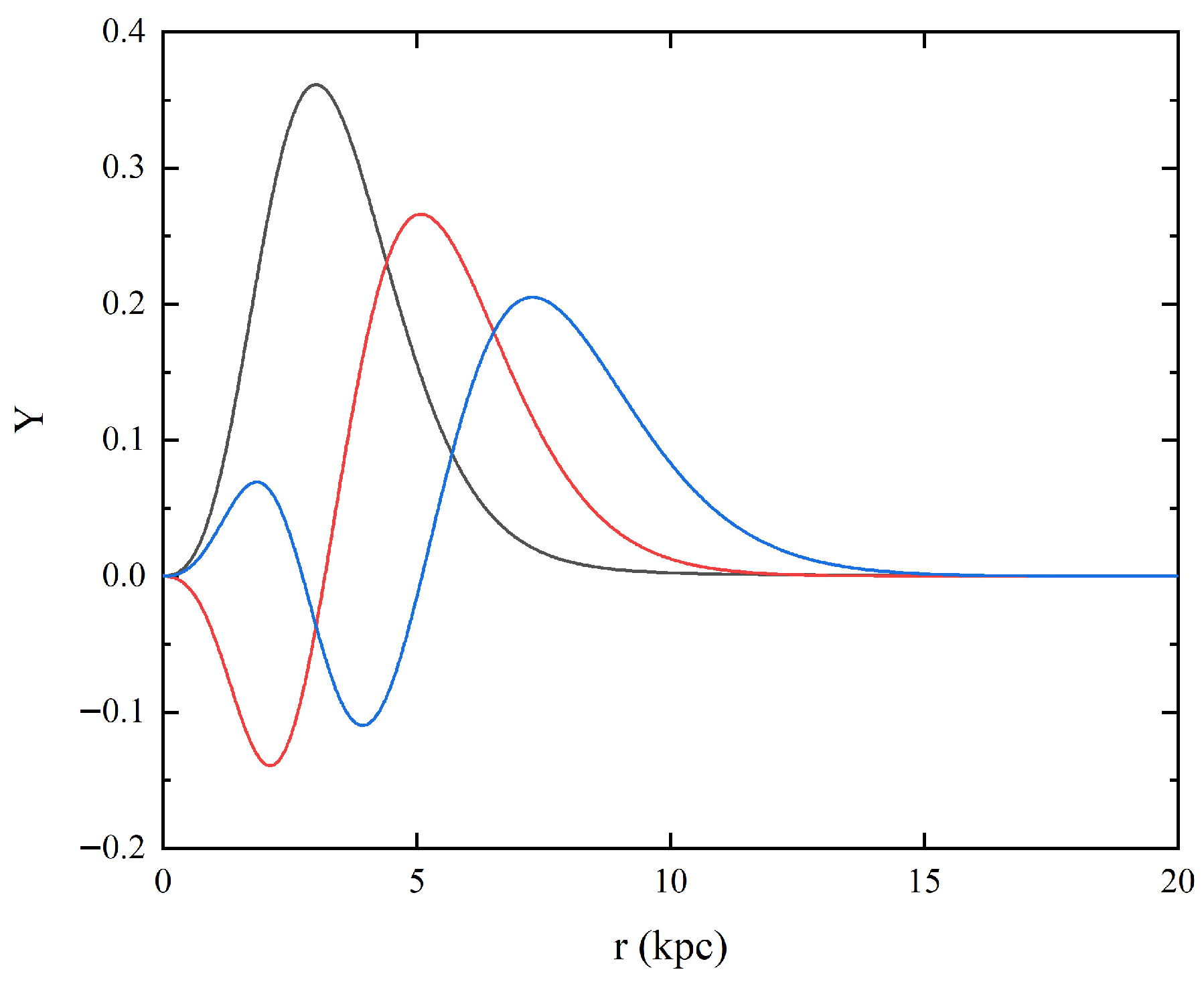
The eigenfunctions obtained numerically are shown in Figure 1.
It is quite interesting to compare the results given by different approaches. First of all, it is useful to estimate typical mistakes. As for the methods based on the perturbation method (both for purely analytical results and numerically calculated integrals) we should find the next approximation which can be a subject of separate research. However, to make some order estimates, we can take the oldest term in the second order for the first eigenvalue: σ p e r t = 1 λ 1 λ 2 0 r max A 1 r A 2 r y 1 r y 2 r r d r 2 0 r max y 1 2 r r d r 0 r max y 2 2 r r d r ~ 0.01 . It should be taken into account that there is more than one term and also some extra mistake can be connected with approximate calculations of integrals. So, we could guarantee that at least σ p e r t < 10 1 . For the direct solution of the eigenvalue problem, the accuracy of the solution for the corresponding algebraic problem is connected only with machine precision: the number of iterations can be made as large as important. So, the mistake can be connected only with the approximation of the finite difference scheme. Both for the first and second derivative, we take the schemes with a second order of approximation. For this case, the mistake will be σ n u m ~ Δ r 2 . Taking into account that this is a very rough estimate, we can say that σ n u m < 10 5 . It can be seen that the results in Table 1 are nearly the same within the error limits.

5. Results for Changing h(r)

The observations have shown that the half-thickness of the galactic disc slightly changes in the outer regions of the galactic disc [41]. Thus, we should also take this fact into account using the following simple linear case: h = h 0 + ξ r . In this section, we will represent both numerical and partly analytical calculations, connected with the perturbation theory as well. Here, the corresponding coefficients will be the following:
A 1 ( r ) = l h r r Ω r d Ω d r = Ω 0 l r r 0 h 0 + ξ r 1 + r 2 r 0 2
A 2 ( r ) = η π 2 4 h 2 ( r ) = η π 2 4 h 0 + ξ r 2
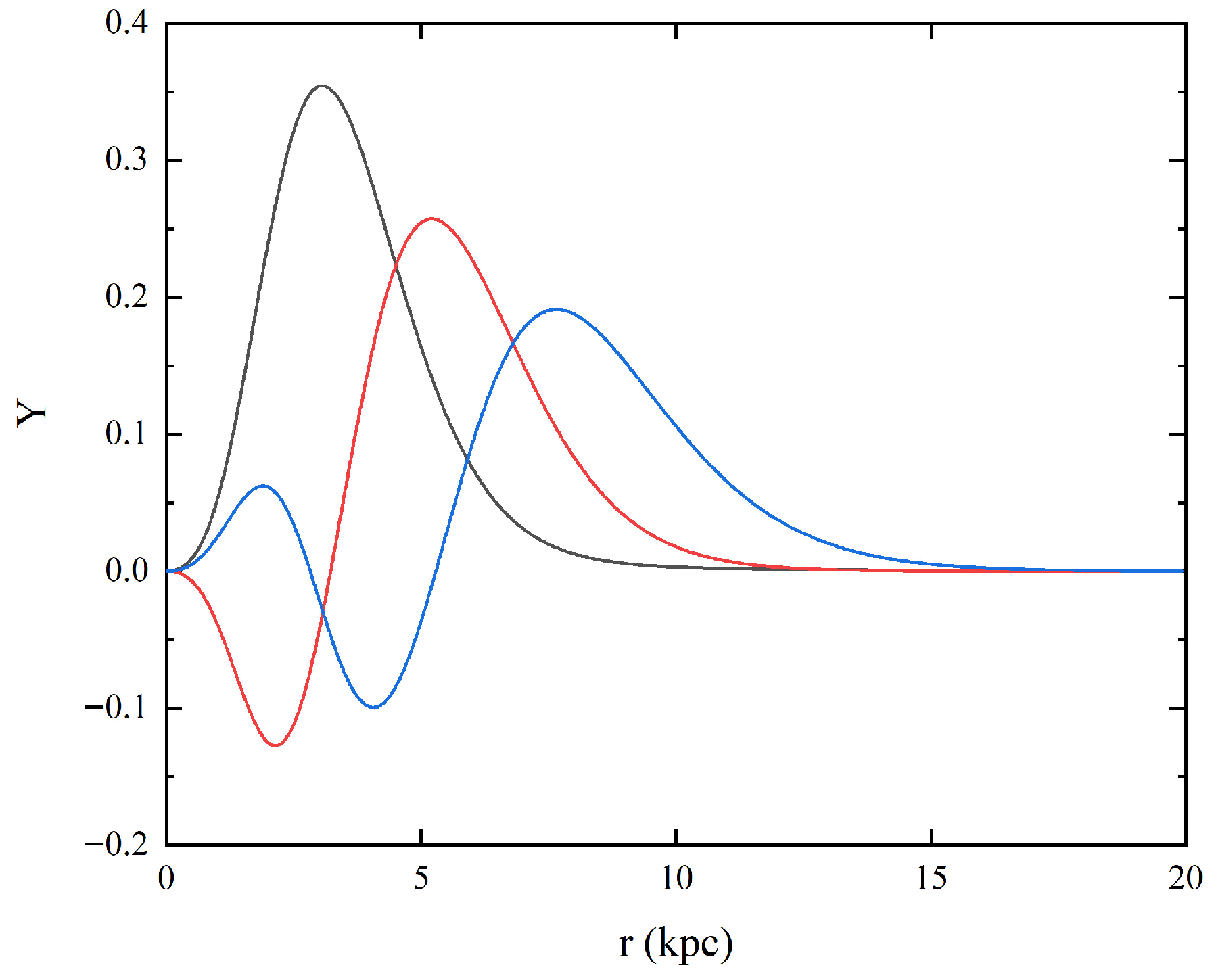
In this case, the integration process seems to be significantly more complicated. Thus, we will calculate the integrals numerically. In the previous section, the similar estimations seemed to be accurate enough to represent the results of the perturbation theory method. The results are shown in Table 2. Here, the meaning of each column is the same as in Table 1. As for the typical mistakes, we also can take that σpert < 10−1 for the numerical calculation of the integrals and σnum < 10−5 for purely numerical calculations. We also show the eigenfunctions obtained numerically in this case in Figure 2.
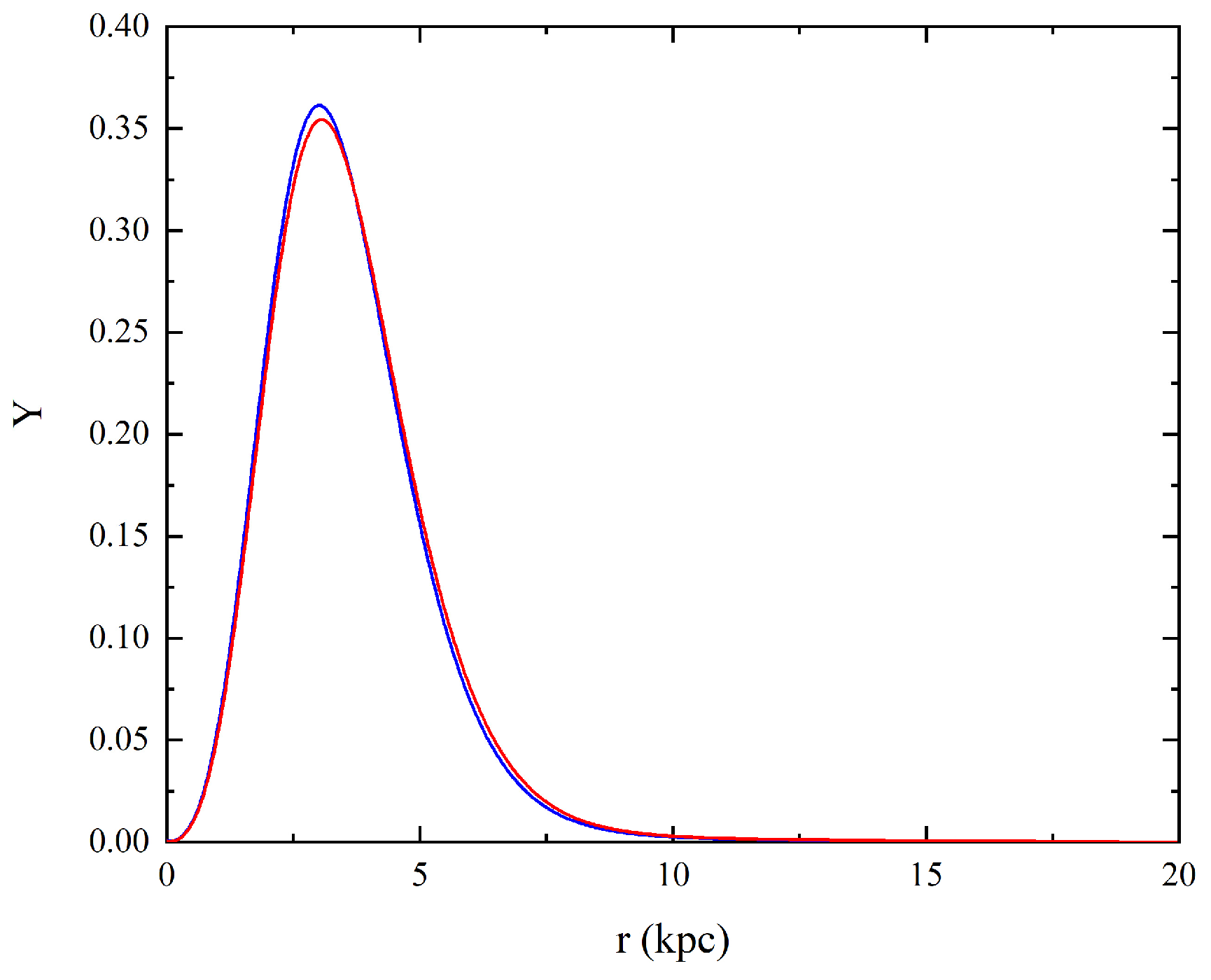
The first eigenfunctions for both modifications of the problem are presented on Figure 3. It is easy to notice that the eigenfunctions in both cases are similar. So, we can be assured that the approximation with h = const is accurate as well.

6. Non-Axisymmetric Magnetic Field Structures

All previous results have been obtained in the framework of axisymmetric models for the field evolution. However, more accurate approaches take into account that the field can have more complicated azimuthal structures [43,44]. There are observational arguments in favour of the fact that the field in the internal parts is connected with spiral arms [45,46,47]. So, it would be useful to consider the model which includes the possibility of the generation of non-axisymmetric structures.
Based on the assumptions of the thin disc model for such a case, we should solve the following system of equations [40]:
B r t = Ω l 2 h 2 B ϕ η π 2 B r 4 h 2 Ω B r ϕ + η 2 B r r 2 + 1 r B r r B r r 2 + 1 r 2 2 B r ϕ 2 2 r 2 B ϕ ϕ
B ϕ t = r d Ω d r B r η π 2 B ϕ 4 h 2 Ω B ϕ ϕ + η 2 B ϕ r 2 + 1 r B ϕ r B ϕ r 2 + 1 r 2 2 B ϕ ϕ 2 + 2 r 2 B r ϕ
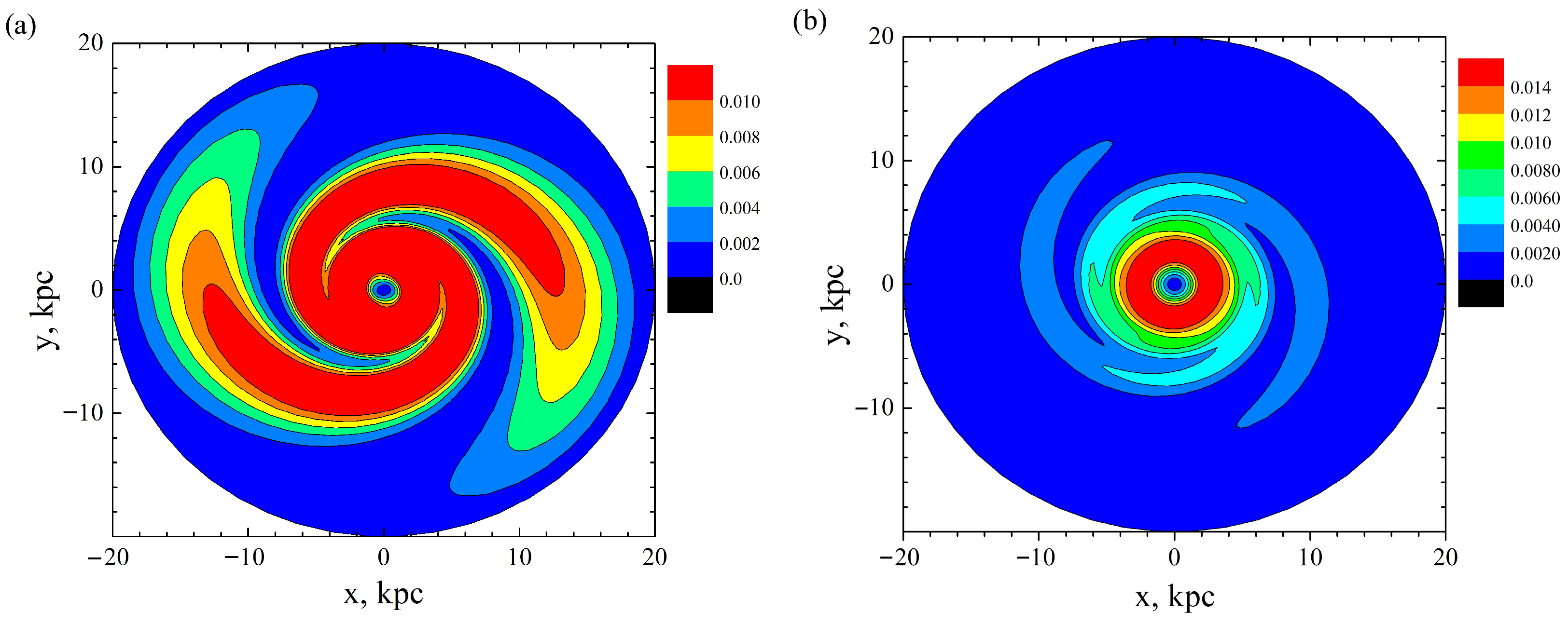
Although this model is linear, the spectral analysis for the corresponding operator is much more difficult than in the previous case. So, it is possible only to study the numerical solution of the evolutionary problem, which also takes quite large computational resources. The evolution of the specific initial non-axisymmetric field is shown on Figure 4. It can be seen that in the outer parts (especially for r > 15   kpc ) azimuthal non-uniformities are smoothened for a quite small time. So, the axisymmetric models can be used at least for the evolution of small fields (when their values are much smaller than the equipartition level). Also, there are some observational examples of galaxies such as NGC 6946 [48] and M 83 [49], where the field is not connected with the material arms, which gives us an opportunity to apply our axisymmetric model and to believe that it can be useful for some cases.
Of course, if we are speaking about larger fields at the next stage of the field evolution, the nonlinear effects in most objects will take part in the evolution, and saturated regimes can strongly depend on the density: the equipartition field is proportional to ρ 1 / 2 . So, the field can reach larger values in the parts where the density has higher values (the typical example which is well-known for internal parts is connected with spiral arms and fields there).

7. Conclusions

We have studied spectra of differential operators describing the generation of magnetic fields in outer parts of galaxies using a simple large-scale dynamo model, taking into account basic processes. Certainly, there are different effects, such as magnetic buoyancy [28,43] and others, which could be important too. However, our simple model gives us an opportunity to describe spectra of the corresponding differential operators and to estimate the eigenvalues characterizing possible field growth. To find the eigenvalues, it was necessary to take the perturbation theory. For the simplest case (constant half-thickness of the disc), it is possible to find the corresponding integrals analytically. However, if we use operators with boundary conditions that describe more closely real galactic objects, the integrals in perturbation theory should be calculated numerically. Also, even for the case when we could find analytical approximation, it was necessary to verify the results numerically, and we have shown that perturbation theory methods and a direct numerical solution of the eigenvalue problem give similar results.
As for astrophysical applications, we have shown that the field really can be generated in the outer parts of the galaxy, but it is smaller. This is connected with the structure of the eigenfunctions and their fast decreasing near the outer boundary of the object. However, such fields can be quite significant to be observed and to influence the turbulent motions in the interstellar gas. Despite some restrictions, some modern studies give an opportunity to hope that the fields can be detected at distances of 15–20 kpc, although they are one order smaller than in the main part of galaxy [50]. So, our results can be used in astrophysics to study the magnetic fields and their influence on different processes.

Author Contributions

Conceptualization, E.M.; methodology, E.M.; investigation, T.K.; analytical approximations, T.K.; numerical results, T.K.; writing—original draft preparation, E.M. and T.K.; writing—review and editing, E.M. and T.K. All authors have read and agreed to the published version of the manuscript.

Funding

The research of T.K. in analytical approximation was funded by the Theoretical Physics and Mathematics Advancement Foundation “BASIS”, project number #22-2-2-55-1.

Data Availability Statement

The original contributions presented in this study are included in the article. Further inquiries can be directed to the corresponding author.

Conflicts of Interest

The authors declare no conflicts of interest.

References

  1. Brandenburg, A.; Subramanian, K. Astrophysical magnetic fields and nonlinear dynamo theory. Phys. Rep. 2005, 417, 1–209. [Google Scholar] [CrossRef]
  2. Liska, M.; Tchekhovskoy, A.; Quataert, E. Large-scale poloidal magnetic field dynamo leads to powerful jets in GRMHD simulations of black hole accretion with toroidal field. Mon. Not. R. Astron. Soc. 2020, 494, 3656–3662. [Google Scholar] [CrossRef]
  3. Hu, Y.; Lazarian, A.; Beck, R.; Xu, S. Role of Magnetic Fields in Fueling Seyfert Nuclei. Astrophys. J. 2022, 941, 92. [Google Scholar] [CrossRef]
  4. Kharicha, A.; Karimi-Sibaki, E.; Wu, M.; Ludwig, A.; Bohacek, J. Review on Modeling and Simulation of Electroslag Remelting. Steel Res. Int. 2018, 89, 1700100. [Google Scholar] [CrossRef]
  5. Pavlovs, S.; Jakovics, A.; Chudnovsky, A. Melt azimuthal rotation in direct current electric arc furnace without external axial magnetic field. Int. J. Appl. Electromagn. Mech. 2024, 75, 145–157. [Google Scholar] [CrossRef]
  6. Krutyanskii, M.M.; Nekhamin, S.M.; Mitrofanov, M.V. Electromagnetic Mixing of the Liquid Metal in DC Arc Furnaces. Russ. Metall. Met. 2018, 2018, 1165–1171. [Google Scholar] [CrossRef]
  7. Hosking, R.J.; Dewar, R.L. Fundamental Fluid Mechanics and Magnetohydrodynamics; Springer: Singapore, 2016. [Google Scholar] [CrossRef]
  8. Xiros, N. Mathematical Magnetohydrodynamics; Springer: Cham, Switzerland, 2017. [Google Scholar] [CrossRef]
  9. Shatrov, V.; Gerbeth, G. Stability of the electrically induced flow between two hemispherical electrodes. Magnetohydrodynamics 2012, 48, 469–484. [Google Scholar] [CrossRef]
  10. Malyshev, K.Y.; Mikhailov, E.A.; Teplyakov, I.O. Rapidly Convergent Series for Solving the Electrovortex Flow Problem in a Hemispherical Vessel. Comput. Math. Math. Phys. 2022, 62, 1158–1170. [Google Scholar] [CrossRef]
  11. Kuznetsov, E.A.; Passot, T.; Sulem, P.L. Compressible dynamics of magnetic field lines for incompressible magnetohydrodynamic flows. Phys. Plasmas 2004, 11, 1410–1415. [Google Scholar] [CrossRef]
  12. Kuznetsov, E.A.; Mikhailov, E.A. Magnetic Filaments: Formation, Stability, and Feedback. Mathematics 2024, 12, 677. [Google Scholar] [CrossRef]
  13. Krause, F.; Rädler, K.-H. Mean-Field Magnetohydrodynamics and Dynamo Theory; Elsevier: Amsterdam, The Netherlands, 2016. [Google Scholar]
  14. Rüdiger, G.; Hollerbach, R. The Magnetic Universe: Geophysical and Astrophysical Dynamo Theory; Wiley-VCH: Weinheim, Germany, 2005. [Google Scholar]
  15. Charbonneau, P.; Sokoloff, D. Evolution of Solar and Stellar Dynamo Theory. Space Sci. Rev. 2023, 219, 35. [Google Scholar] [CrossRef]
  16. Biermann, L.; Schlüter, A. Cosmic Radiation and Cosmic Magnetic Fields. II. Origin of Cosmic Magnetic Fields. Phys. Rev. 1951, 82, 863–868. [Google Scholar] [CrossRef]
  17. Chandrasekhar, S. The Stability of Non-Dissipative Couette Flow in Hydromagnetics. Proc. Natl. Acad. Sci. USA 1960, 46, 253–257. [Google Scholar] [CrossRef]
  18. Beck, R.; Brandenburg, A.; Moss, D.; Shukurov, A.; Sokoloff, D. Galactic Magnetism: Recent Developments and Perspectives. Annu. Rev. Astron. Astrophys. 1996, 34, 155–206. [Google Scholar] [CrossRef]
  19. Schekochihin, A.A.; Boldyrev, S.A.; Kulsrud, R.M. Spectra and growth rates of fluctuating magnetic fields in the kinematic dynamo theory with large magnetic Prandtl numbers. Astrophys. J. 2002, 567, 828–852. [Google Scholar] [CrossRef]
  20. Schekochihin, A.A.; Cowley, S.C.; Taylor, S.F.; Maron, J.L.; McWilliams, J.C. Simulations of the small-scale turbulent dynamo. Astrophys. J. 2004, 612, 276–307. [Google Scholar] [CrossRef]
  21. Arshakian, T.G.; Beck, R.; Krause, M.; Sokoloff, D. Evolution of magnetic fields in galaxies and future observational tests with the Square Kilometre Array. Astron. Astrophys. 2009, 494, 21–32. [Google Scholar] [CrossRef]
  22. Chamandy, L.; Nazareth, R.G.; Santhosh, G. Galactic Magnetic Fields. I. Theoretical Model and Scaling Relations. Astrophys. J. 2024, 966, 78. [Google Scholar] [CrossRef]
  23. Zeldovich, Y.; Ruzmaikin, A.; Sokoloff, D. Magnetic fields in Astrophysics; Gordon and Breach: New York, NY, USA, 1983. [Google Scholar]
  24. Andreasyan, R.R. Mechanism of formation of a dipole magnetic field in the central regions of active galaxies. Astrophysics 1996, 39, 58–62. [Google Scholar] [CrossRef]
  25. Kitchatinov, L.L.; Rüdiger, G. Seed fields for galactic dynamos by the magnetorotational instability. Astron. Astrophys. 2004, 424, 565–570. [Google Scholar] [CrossRef]
  26. Moffat, H.K. Magnetic Field Generation in Electrically Conducting Fluids; University Press: Cambridge, UK, 1978. [Google Scholar]
  27. Chamandy, L.; Singh, N.K. Non-linear galactic dynamos and the magnetic Rädler effect. Mon. Not. R. Astron. Soc. 2018, 481, 1300–1319. [Google Scholar] [CrossRef]
  28. Qazi, Y.; Shukurov, A.; Tharakkal, D.; Gent, F.A.; Bendre, A.B. Non-linear magnetic buoyancy instability and galactic dynamos. Mon. Not. R. Astron. Soc. 2025, 540, 532–544. [Google Scholar] [CrossRef]
  29. Parker, E.N. Hydromagnetic dynamo models. Astrophys. J. 1955, 122, 293–314. [Google Scholar] [CrossRef]
  30. Tobias, S.M. Diffusivity quenching as a mechanism for Parker’s surface dynamo. Astrophys. J. 1996, 467, 870–880. [Google Scholar] [CrossRef]
  31. Subramanian, K.; Mestel, L. Galactic dynamos and density wave theory—II. An alternative treatment for strong non-axisymmetry. Mon. Not. R. Astron. Soc. 1993, 265, 649–654. [Google Scholar] [CrossRef]
  32. Moss, D. On the generation of bisymmetric magnetic field structures in spiral galaxies by tidal interactions. Mon. Not. R. Astron. Soc. 1995, 275, 191–194. [Google Scholar] [CrossRef]
  33. Phillips, A. A comparison of the asymptotic and no-z approximations for galactic dynamos. Geophys. Astrophys. Fluid Dyn. 2001, 94, 135–150. [Google Scholar] [CrossRef]
  34. Boneva, D.V.; Mikhailov, E.A.; Pashentseva, M.V.; Sokoloff, D.D. Magnetic fields in the accretion disks for various inner boundary conditions. Astron. Astrophys. 2021, 652, A38. [Google Scholar] [CrossRef]
  35. Sánchez-Salcedo, F.J.; Saha, K.; Narayan, C.A. The thickness of H i in galactic discs under MOdified Newtonian Dynamics: Theory and application to the Galaxy. Mon. Not. R. Astron. Soc. 2008, 385, 1585–1596. [Google Scholar] [CrossRef]
  36. Lian, J.; Li, L. The Thickness of Galaxy Disks from z = 5 to 0 Probed by JWST. Astrophys. J. Lett. 2024, 960, L10. [Google Scholar] [CrossRef]
  37. Gressel, O.; Elstner, D.; Ziegler, D.; Rüdiger, G. Direct simulations of a supernova-driven galactic dynamo. Astron. Astrophys. 2008, 486, L35–L38. [Google Scholar] [CrossRef]
  38. Andreasyan, R.R.; Mikhailov, E.A.; Andreasyan, H.R. Structure and Features of the Galactic Magnetic-Field Reversals Formation. Astron. Rep. 2020, 64, 189–198. [Google Scholar] [CrossRef]
  39. Oppermann, N.; Junklewitz, H.; Robbers, G.; Enßlin, T.A. Probing magnetic helicity with synchrotron radiation and Faraday rotation. Astron. Astrophys. 2011, 530, A89. [Google Scholar] [CrossRef]
  40. Mikhailov, E.A. Symmetry of the magnetic fields in galactic dynamo and the material arms. Magnetohydrodynamics 2020, 56, 403–414. [Google Scholar] [CrossRef]
  41. Mikhailov, E.; Kasparova, A.; Moss, D.; Beck, R.; Sokoloff, D.; Zasov, A. Magnetic fields near the peripheries of galactic discs. Astron. Astrophys. 2014, 568, A66. [Google Scholar] [CrossRef]
  42. Landau, L.D.; Lifshitz, E.M. Quantum Mechanics. Non-Relativistic Theory; Pergamon Press: London, UK, 1958. [Google Scholar]
  43. Steinwandel, U.P.; Beck, M.C.; Arth, A.; Dolag, K.; Moster, B.P.; Nielaba, P. Magnetic buoyancy in simulated galactic discs with a realistic circumgalactic medium. Mon. Not. R. Astron. Soc. 2019, 483, 1008–1028. [Google Scholar] [CrossRef]
  44. Prajapati, M.; Gulati, M. Galactic magnetic field and spiral arms against gas quenching due to Ram pressure. New Astron. 2025, 117, 102356. [Google Scholar] [CrossRef]
  45. Doi, Y.; Nakamura, K.; Kawabata, K.S.; Matsumura, M.; Akitaya, H.; Coudé, S.; Rodrigues, C.V.; Kwon, J.M.; Tamura, M.; Tahani, M.; et al. Tomographic Imaging of the Sagittarius Spiral Arm’s Magnetic Field Structure. Astrophys. J. 2024, 961, 13. [Google Scholar] [CrossRef]
  46. Fletcher, A.; Beck, R.; Shukurov, A.; Berkhuijsen, E.M.; Horellou, C. Magnetic fields and spiral arms in the galaxy M51. Mon. Not. R. Astron. Soc. 2011, 412, 2396–2416. [Google Scholar] [CrossRef]
  47. Han, J.L. Magnetic fields in our Milky Way Galaxy and nearby galaxies. Sol. Astrophys. Dynamos Magn. Act. Proc. Int. Astron. Union IAU Symp. 2012, 294, 213–224. [Google Scholar] [CrossRef]
  48. Frick, P.; Beck, R.; Shukurov, A.; Sokoloff, D.; Ehle, M.; Kamphuis, J. Magnetic and optical spiral arms in the galaxy NGC 6946. Mon. Not. R. Astron. Soc. 2000, 318, 925–937. [Google Scholar] [CrossRef]
  49. Frick, P.; Stepanov, R.; Beck, R.; Sokoloff, D.; Shukurov, A.; Ehle, M.; Lundgren, A. Magnetic and gaseous spiral arms in M83. Astron. Astrophys. 2016, 585, A21. [Google Scholar] [CrossRef]
  50. Hu, Y.; Lazarian, A. Mapping the Galactic magnetic field orientation and strength in three dimensions. Mon. Not. R. Astron. Soc. 2023, 524, 2379–2394. [Google Scholar] [CrossRef]
Figure 1. First (black), second (red) and third (blue) eigenfunction y(r) in case of h = const.
Mathematics 14 00308 g001
Figure 2. The first (black), second (red) and third (blue) eigenfunctions y(r) in case of h = h(r).
Mathematics 14 00308 g002
Figure 3. The first eigenfunction for constant h (blue) and h = h(r) (red).
Mathematics 14 00308 g003
Figure 4. The non-axisymmetric field (a) and its evolution after 700 Myr (b). Fields are measured in equipartition values.
Mathematics 14 00308 g004
Table 1. Analytical and numerical results with h = const.
Analytical ResultNumerical Calculation of the IntegralNumerical Calculations
μ12.5742.6572.663
μ22.5272.5332.535
μ32.4412.4522.451
λ1−3.849−3.856−3.860
λ2−3.975−3.981−3.99
λ3−4.053−4.062−4.071
Table 2. Analytical and numerical results with h = h(r).
Numerical Calculation of the IntegralNumerical Calculations
μ12.5332.539
μ22.4142.417
μ32.3352.341
λ1−3.710−3.713
λ2−3.841−3.845
λ3−3.924−3.927
Disclaimer/Publisher’s Note: The statements, opinions and data contained in all publications are solely those of the individual author(s) and contributor(s) and not of MDPI and/or the editor(s). MDPI and/or the editor(s) disclaim responsibility for any injury to people or property resulting from any ideas, methods, instructions or products referred to in the content.