1. Introduction
A developable surface is a surface whose tangent planes are the same along the principal lines of a ruled surface. In other words, a ruled surface
in Lorentz space
is defined as
where
is called the base curve and
is referred to as the director curve. The straight lines
are the rulings. If the Gaussian curvature of the ruled surface
is zero, then it is called a developable ruled surface, see, e.g., [
1]. The ruled surface
is developable if and only if the distribution parameter
In [
2,
3], the authors gave the necessary and sufficient conditions for a ruled surface to be developable in Minkowski space and showed that it is developable if and only if its base curve is a helix. In [
4], the mean curvature of the principal normal surface along Bertrand curves was examined. The geometric properties of minimal surfaces and their applications in civil engineering and architecture are discussed in [
5]. In [
6], the minimality conditions for ruled surfaces with a Legendre base curve were investigated. In [
7], constant-mean-curvature surfaces were obtained along a given space-like curve in three-dimensional Lorentz space. In [
8], sufficient conditions were presented for determining surfaces in three-dimensional Euclidean space that pass through an arbitrary curve and possess constant mean curvature along that curve. In [
9], constant-angle ruled surfaces in Euclidean three-space were studied, and it was shown that they are developable. In this paper, we investigate developable surfaces whose mean curvature is constant along the base curve. First, these surfaces are considered in Euclidean space and then in Lorentz space.
One of the important research areas in differential geometry and physics is Lorentz space, which provides a natural geometric framework for describing the interaction between space and time in the theory of special relativity [
10]. In Lorentz space, the relationship between time and space dimensions is based on the principle of the constancy of the speed of light predicted in special relativity. Thus, Lorentz spaces are used to model different physical processes in the theory of special relativity, see, e.g., [
11,
12,
13,
14,
15].
Various studies on ruled surfaces have also appeared in architectural applications, see, e.g., [
16]. An important property of developable surfaces is that the envelope of reflected rays also forms a developable surface. The same phenomenon occurs in the case of fractures. Moreover, reflections and refractions generate focal curves in planar settings [
16].
We consider the following developable ruled surface:
where
and
are differentiable functions, which was discussed in [
17]. They proved that ruled surface (1) is developable in three-dimensional Euclidean space when
is a small circle on the unit sphere
We give the condition for ruled surface (1) to have constant mean curvature along a time-like or space-like
curve in Lorentz space. The condition that a surface exhibits constant mean curvature along a curve implies uniform bending behavior in the direction of that curve. If
H remains constant along a given curve on a surface, the local geometric behavior of the surface does not change in that direction. This property plays an important role in architectural and structural design, particularly in the context of developable or discretely panelized surfaces. Structures designed with constant-mean-curvature zones often benefit from predictable stress distribution and fabrication efficiency [
18]. Therefore, this geometric constraint not only carries mathematical significance but also offers practical advantages in the fields of architectural geometry and computational design.
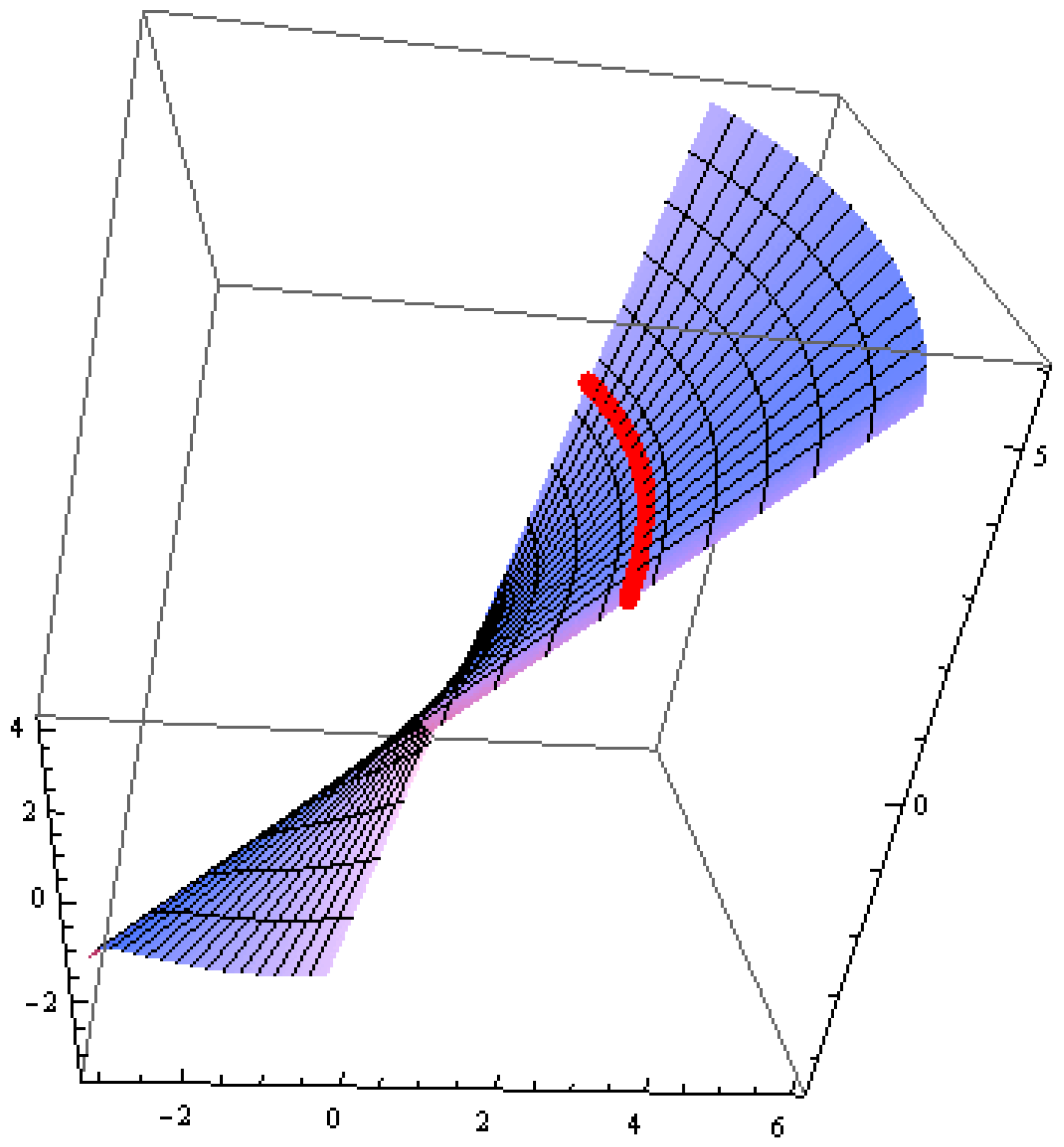
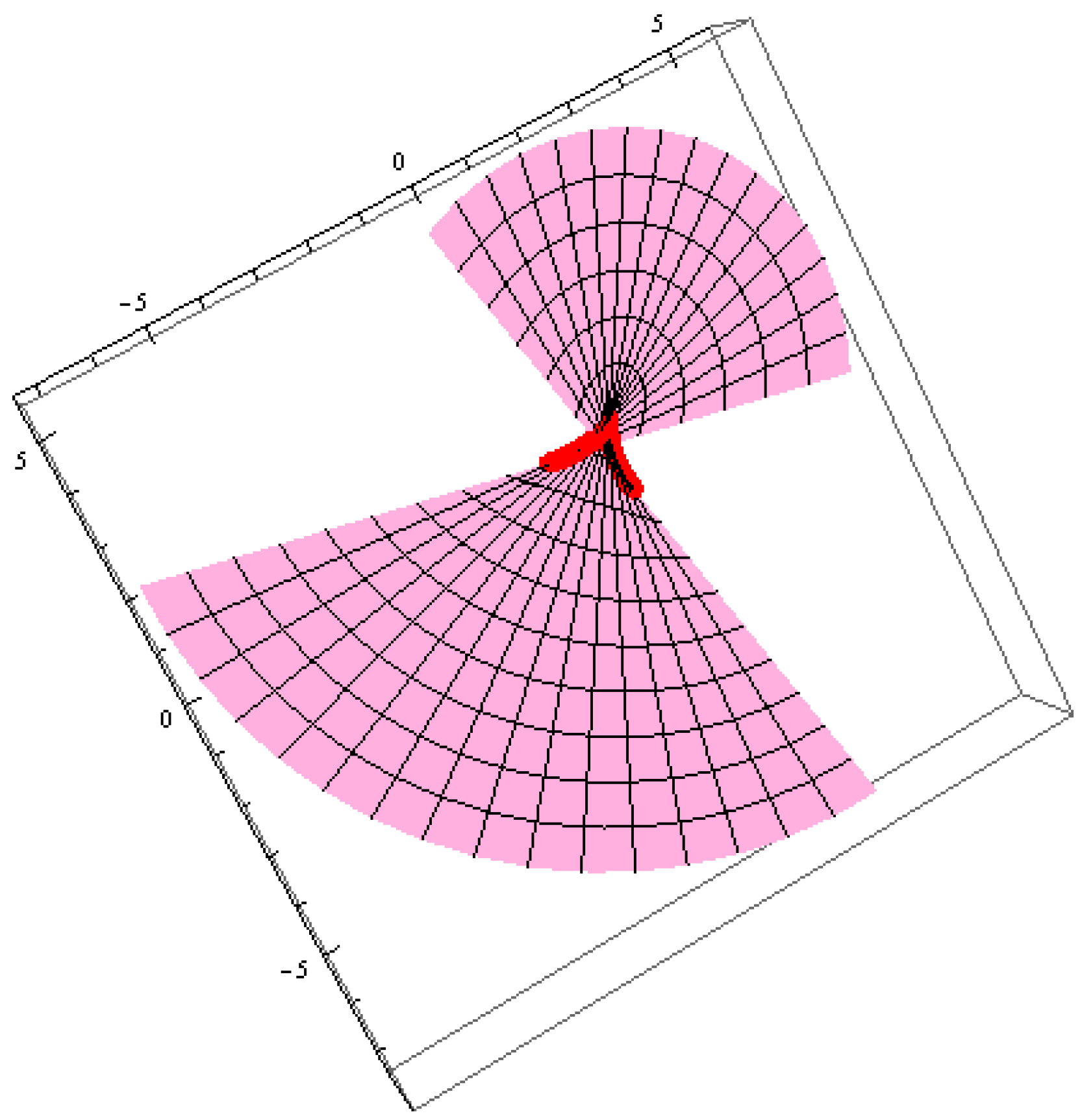
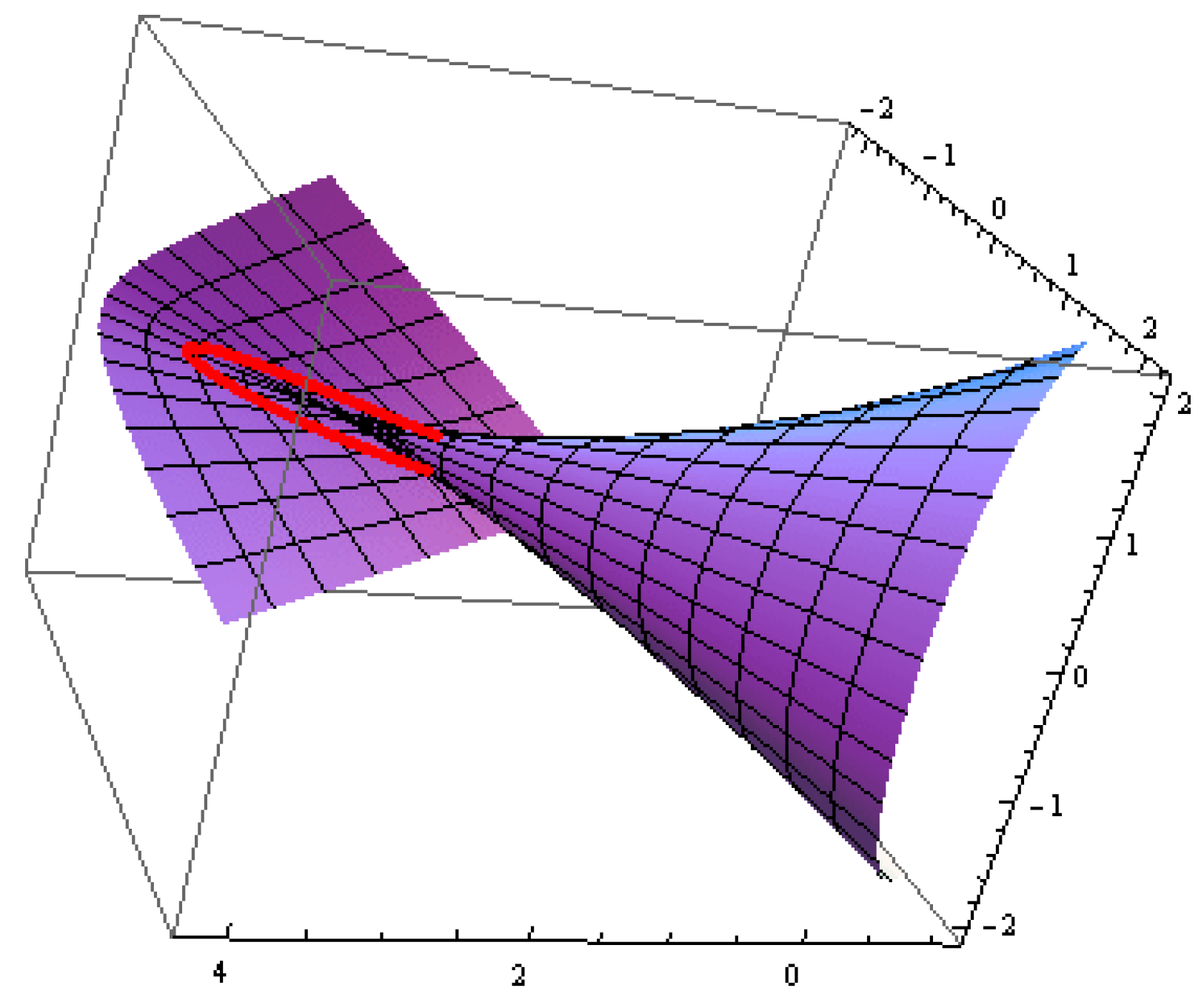
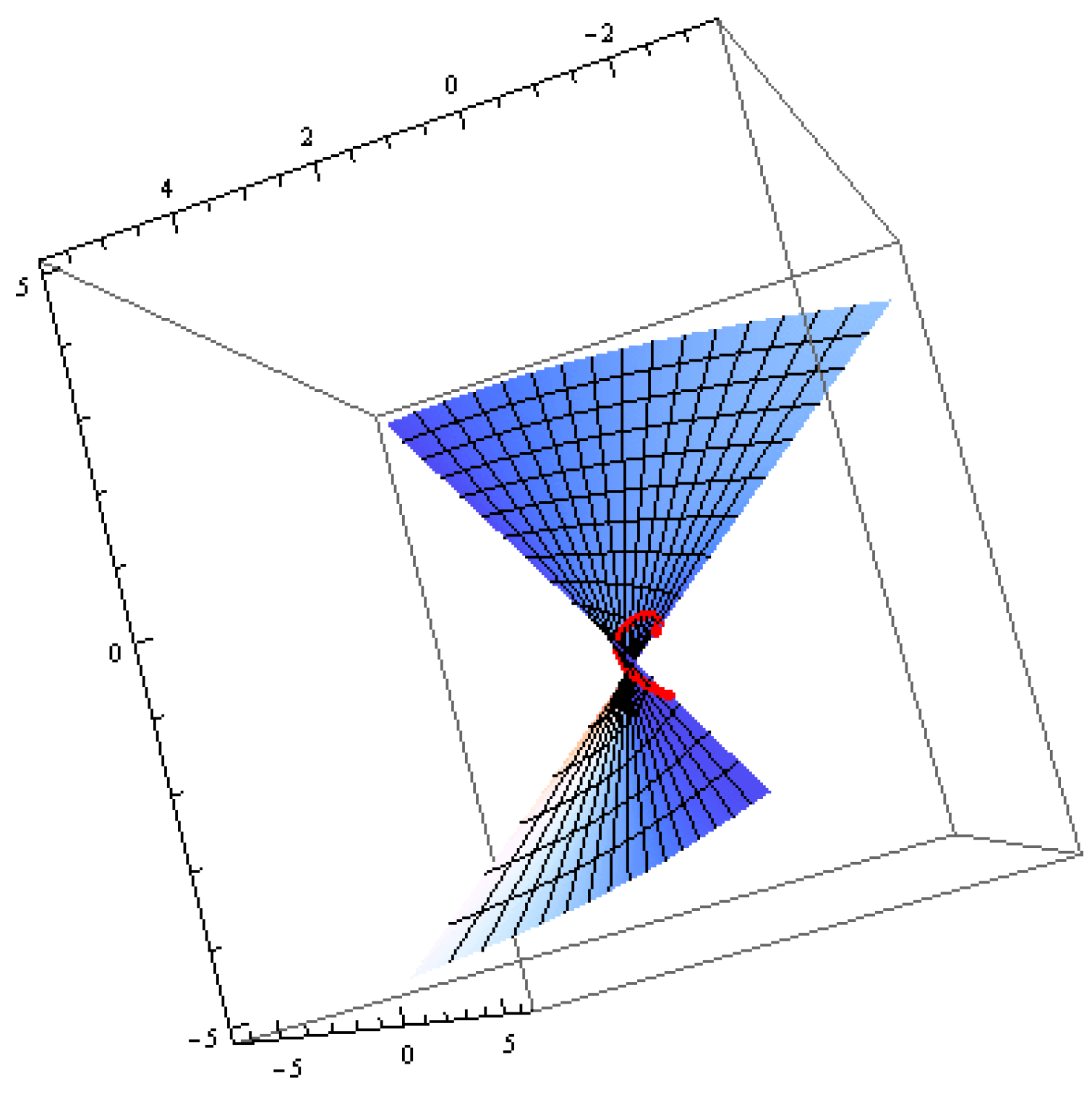
In this work, we calculate the mean curvature of the surface by using both time-like and space-like curves. When principal normal vector N is time-like, then tangent vector T and binormal vector B are space-like. If N is a space-like vector, then T and B are selected as time-like vectors. We focus on determination of surfaces that have constant mean curvature in Lorentz space. Additionally, we examine some special cases according to the based curves on the ruled surfaces. At the end of this study, some computational examples are given for Euclidean space and Lorentz space.
The rest of this study consists of six sections. Some basic definitions are presented in
Section 2. The mean curvature calculations for Euclidean space are given in
Section 3. Moreover, we focus on the mean curvature of developable surfaces constructed using indicatrix curves in Euclidean space. In
Section 4, the mean-curvature calculations for Lorentz space are presented. In addition, we deal with the mean curvature of developable surfaces constructed using indicatrix curves in Lorentz space. In
Section 5, special cases derived from the calculations in
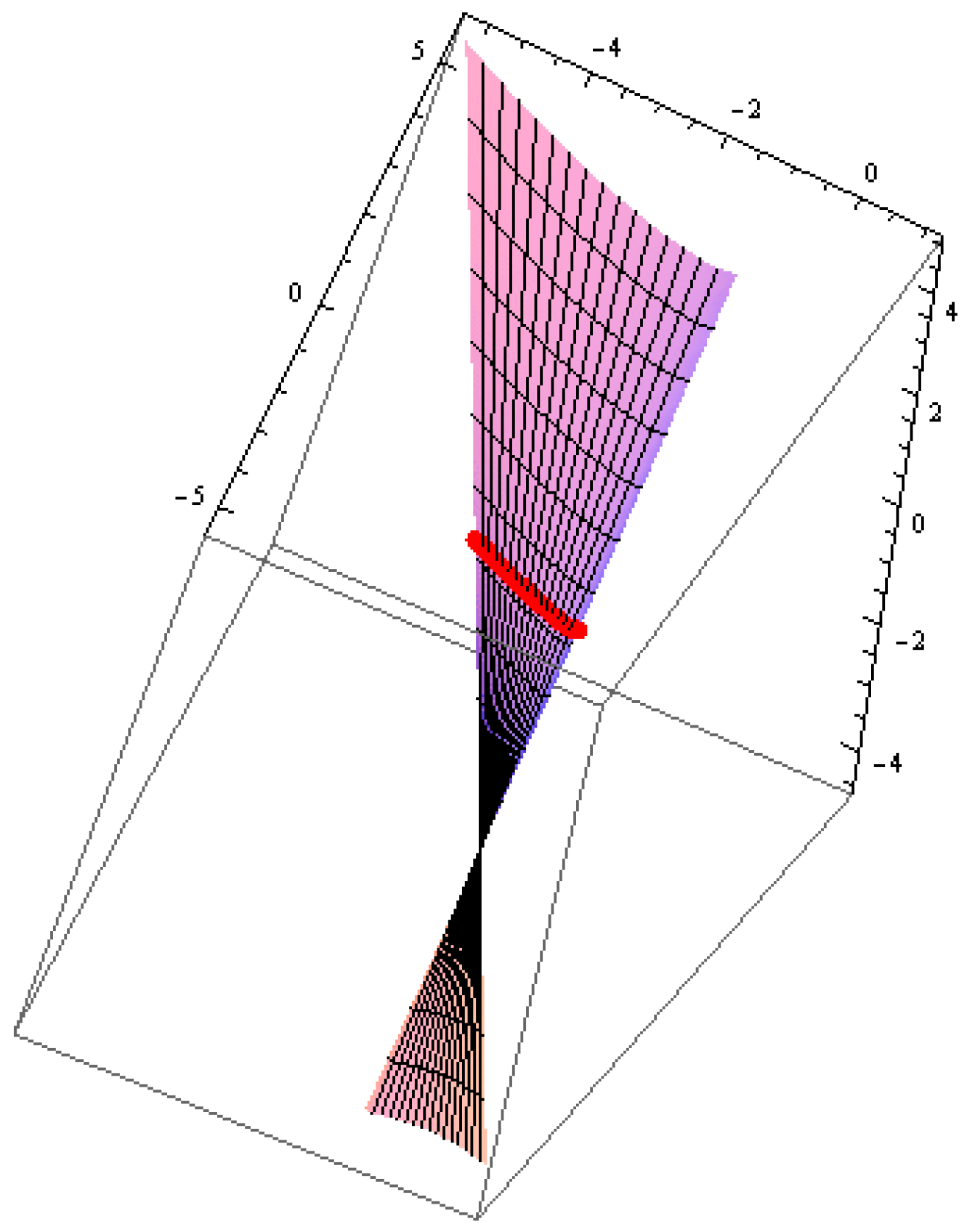
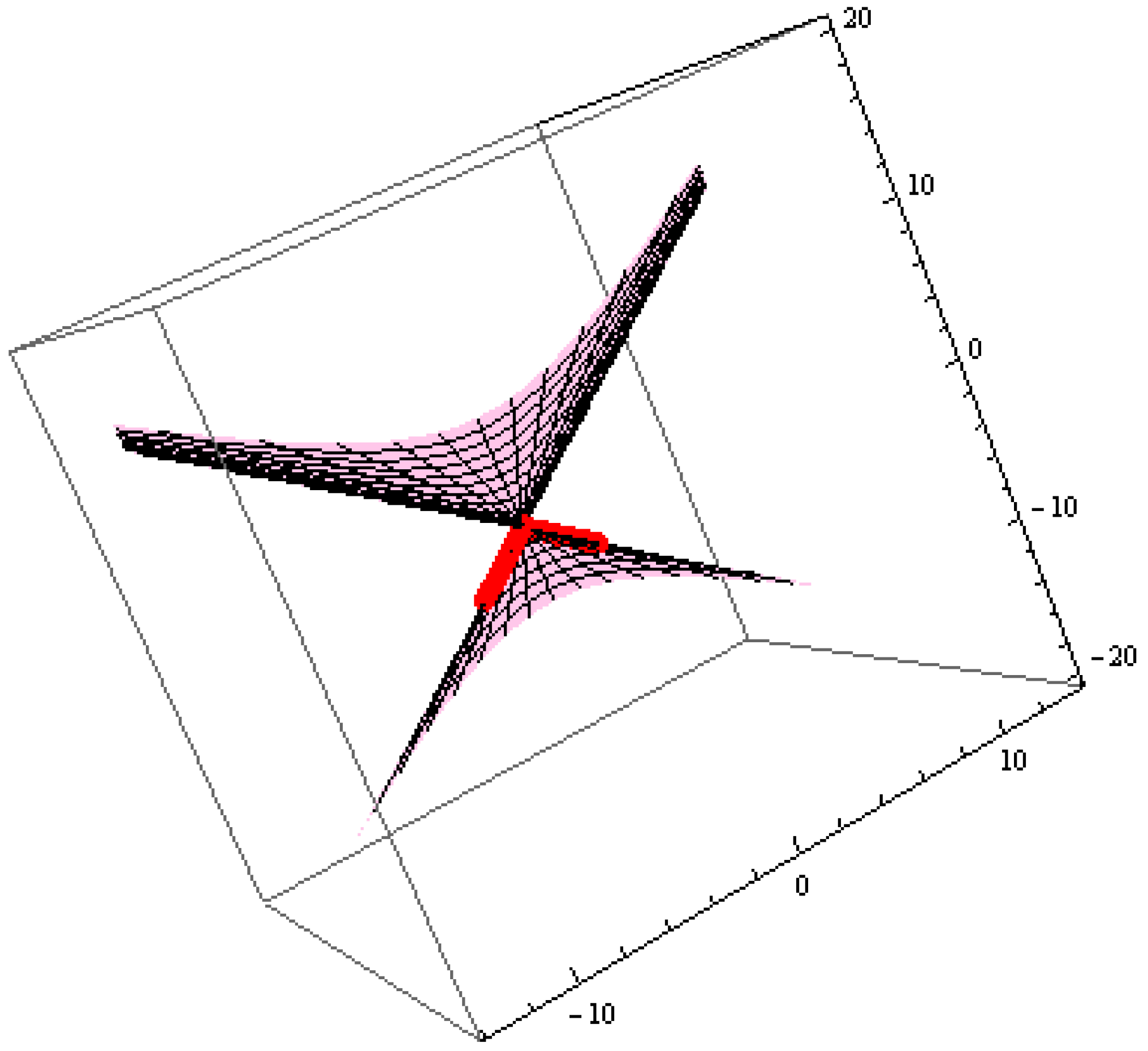
Section 4 are discussed. In the last section, computational examples are presented and some final remarks are given.
2. Preliminaries
In this section, we introduce some basic concepts in Euclidean space
and Lorentz space
that will be used throughout this work. For a detailed discussion on the related subjects, we refer to, e.g., [
1,
19,
20].
Let
be an arbitrary curve in
The curve
is said to be a unit speed if
for any
Assume that
is the moving frame of curve
, which satisfies the Frenet equations:
where
and
are the tangent, the principal normal and the binormal vector fields, and curvature and torsion of
, respectively.
The Lorentz space is the metric space
, where the metric
is given as
and is called Lorentzian metric. Moreover, the vector product of any vectors
and
in
is defined by
Let
be a ruled surface with associated normal vector
where
and
Also, expression of the first fundamental form is given below:
for the coefficients
And the second fundamental form is written as
for the coefficients
Therefore, the mean curvature
H and the Gauss curvature
K of the surface are defined as follows:
where we use the notation
.
Definition 1. Let be a Lorentz space, and let be a vector. Then:
- (i)
A vector x is said to be space-like if or
- (ii)
A vector x is said to be time-like if ;
- (iii)
A vector x is said to be light-like (null) if , see, e.g., [10].
If the curve is time-like or space-like, the Frenet formulas are defined as follows:
where
is the torsion function, and
is the curvature function. If
is a time-like Frenet curve in
for
,
, then Frenet formulas of
are given by:
For this trihedron, we write
The torsion of the curve
is defined as
, and the curvature is given by
Let
is a space-like Frenet curve in
If
is a space-like vector, then
is a time-like vector and
is a space-like vector for
. Thus, the following Frenet formulas of
are satisfied:
For this trihedron, we write
The torsion of the curve
is defined as
, and the curvature is given by
If
is a time-like vector, then
is a space-like vector and
is a time-like vector for
. Thus, the following Frenet formulas of
are satisfied:
For this trihedron, we have
The torsion of the curve
is defined as
, and the curvature is given by
Definition 2. In [21], the striction curve of the ruled surface is defined by 3. Calculation of Mean Curvature in Euclidean Space
In this section, we investigate the condition under which ruled surface (1) has a constant mean curvature along a general curve in Euclidean space.
Theorem 1. Let be a smooth spherical curve with its Darboux frameIf then the mean curvature of the ruled surface is constant along the curve . Moreover, if m and n are constant, the surface becomes a constant-angle surface, and, along the curve , the mean curvature H remains constant on this surface. Proof. By taking the derivatives of
with respect to
u and
s, we get
then the vector product can be written as
The coefficients of the first fundamental form can be calculated as follows:
Also, the normal vector N is equal to S. To obtain the coefficients of the second fundamental form, the derivatives of
with respect to
u and
s and the derivative of
with respect to
s are calculated as follows:
Therefore, the coefficients of the second fundamental form are obtained below:
Using (3)–(5) and (6)–(8) in (2), we have
The value of
is obtained from the equality
, where
c is a constant. Hence along the curve
the mean curvature
H is constant. □
As a special case for we obtain the following corollary:
Corollary 1. Let be a smooth curve. If , then the mean curvature H of the ruled surface is constant along the base curve . In this case, curve γ is a circle.
On the other hand, we investigate the condition under which ruled surface (1) has constant mean curvature along a striction curve. The striction curve of this surface is defined by
where
and
Then we have the following result:
Corollary 2. Let be a smooth curve. The mean curvature of the ruled surface remains constant foralong the striction curve In particular, if , then we obtain the following condition under which the surface has constant mean curvature along a striction curve: Mean Curvature for Developable Surfaces Constructed Using Indicatrix Curves
Let
be a smooth curve, and let
be the Frenet frame of
. In this section, for the developable surface
, we replace the directrix
by the indicatrix curves
of the curve
. The corresponding ruled surfaces are denoted by
and
. We then compute the mean curvature of these surfaces, defined by
Finally, we determine the conditions under which the mean curvature remains constant.
Theorem 2. The mean curvature of the ruled surface is constant along the curve if , where κ is the curvature, τ is the torsion, c is a constant, and g is a differentiable function.
Proof. By taking the derivatives of
with respect to
u and
s, we have
then the vector product can be written as
The coefficients of the first fundamental form can be calculated as follows:
Also, the normal vector
N is equal to
. To obtain the coefficients of the second fundamental form, the derivatives of
with respect to
u and
s and the derivative of
with respect to
s are calculated as follows:
Therefore, the coefficients of the second fundamental form are given below:
Using (9)–(11) and (12)–(14) in (2), we have
. From the equality
, we obtain
, where
c is a constant. Hence, along the curve
, the mean curvature
H of the ruled surface
is constant. If
is a circle, that is, the curve
is a helix, then the surface becomes a constant-angle surface. □
Corollary 3. As a special case for the mean curvature H of the ruled surface is constant along the base curve
Theorem 3. The mean curvature of the ruled surface is constant along the curve for
Proof. Following the same procedure as in the proof of Theorem 2, we compute the partial derivatives of
and, using the Frenet–Serret formulas, obtain
and hence
The coefficients of the first fundamental form are given by
while the unit normal vector field reduces to
. Furthermore, the coefficients of the second fundamental form satisfy
Consequently, the mean curvature takes the form
. Imposing the condition that
H is constant and equal to
, we obtain
. Therefore, the mean curvature of the ruled surface
is constant along the curve
If
is a circle, then the curve
is a helix, and the surface is a constant-angle surface. □
Corollary 4. For the mean curvature H of the ruled surface is constant along the base curve .
4. Mean Curvature for Developable Surfaces in Lorentz Space
In this section, we derive the conditions under which the mean curvature remains constant for the developable ruled surface in Lorentz space. For this aim, we consider two different cases.
Case 1. Let the vector
be time-like and the vector
be space-like with the Frenet frame. Thus, the condition for the mean curvature of the ruled surface
to be constant is the same as that obtained in
Section 3.
Case 2. Let the vector
be space-like and the vector
be time-like with the Darboux frame:
Then the mean curvature of the ruled surface
is constant along the curve
. If
, we see that
H is constant along the base curve
.
Mean Curvature for Developable Surfaces Constructed Using Indicatrix Curves in Lorentz Space
In this section, we calculate the mean curvature for the surfaces
and
, which are given in
Section 3 for Lorentz space.
First, we consider the following different cases for the developable ruled surface :
Case 1.
is a smooth space-like curve. If the principal normal vector
is time-like and the tangent vector
is space-like, then we have the following Frenet–Serret-type formula:
Then the mean curvature of the surface
is constant along the curve
In particular,
H is constant along the base curve
for
.
Case 2.
is a smooth time-like curve. If the principal normal vector
is space-like and the tangent vector
is time-like, then the condition for the mean curvature of the ruled surface
to be constant is the same as that obtained in
Section 3.
Next, we examine the following two cases for the developable ruled surface :
Case 1.
is a smooth space-like curve. If the principal normal vector
is time-like and the binormal vector
is space-like, then we have the following Frenet–Serret-type formula:
We find that along the curve
the mean curvature
H is constant.
Case 2. Let
be a smooth space-like curve. If the principal normal vector
is space-like and the binormal vector
is time-like, then we have the following Frenet–Serret-type formula:
The coefficients of the first fundamental form are calculated as
We also determine the coefficients of the second fundamental form
Hence along the curve
the mean curvature
H is constant.
In particular, if then H is constant along the base curve in the first case and along the base curve in the second case.
5. Special Cases
For the developable ruled surfaces, and assuming and may give rise to various distinct special cases:
Case 1. For the ruled surface
if the principal normal vector
is time-like and the tangent vector
is space-like, then the mean curvature of the ruled surface
is constant along the curve
. If
, the surface becomes a conical surface, and, along the curve
on the conical surface, the mean curvature remains constant.
Case 2. For the ruled surface , if the principal normal vector is space-like and the tangent vector is time-like, then the mean curvature of the ruled surface is constant along the curve . We also see that H is constant along the base curve for
Now, let us consider the ruled surface
Case 1. If the principal normal vector is time-like and the binormal vector is space-like, then we conclude that the mean curvature of the ruled surface remains constant along the curve .
Case 2. If the principal normal vector is space-like and the binormal vector is time-like, then we see that along the curve that the mean curvature H of the ruled surface is constant.
In both cases, when , H is constant along the base curve, which is given by in Case 1 and by in Case 2.