1. Introduction
In recent years, frequent uncertainties such as extreme weather, labor disputes, and maritime accidents have led to increased vessel delays and a notable decline in schedule reliability, consequently causing significant disruptions to port marine-side operations (Dai et al., 2023) [
1]. In a port featuring a one-way channel and multiple basins and berths, a strong spatiotemporal interdependence exists between the vessel sequencing and berth allocation. Changes in the estimated time of arrival can cause spatiotemporal mismatches between channel and berth resources, which may result in available berths remaining idle during certain periods while, in other periods, arriving vessels must queue due to a lack of available berths, and may even cause vessels that have completed operations to remain in port due to one-way channel traffic restrictions, thereby reducing navigation efficiency and increasing operating costs (Xiang et al., 2018; Zheng et al., 2024) [
2,
3]. Therefore, conducting research on the integrated rescheduling optimization of vessel sequencing and berth allocation, accounting for the impact of vessel delays, is of considerable practical importance.
In typical multi-basin container ports, there is a strong interdependence between channels and berths. Especially under the one-way channel alternating mechanism, the vessel sequencing not only determines channel utilization but also directly affects berth resource allocation and operational coordination. When delays occur in clusters, spatiotemporal mismatches of channel and berth resources can trigger a domino effect within the system. This chain reaction reduces the utilization rate of supporting resources such as tugboats, pilotage services, and shore cranes, potentially even leading to basin congestion and operational interruptions. Consequently, under the disruption of concentrated arrival delays, ports urgently require executable, cost-effective, and well-coordinated rescheduling strategies to reassign the vessel sequences and berth resources. These strategies must be adaptable to various delay scenarios while simultaneously adhering to safety constraints, maintaining navigation efficiency, and containing operational costs to cope with dynamic changes in practical operations.
Moreover, vessel delay events are highly uncertain. Owing to this uncertainty, the rescheduling optimization problem under vessel delays becomes more dynamic and complex. On one hand, vessel delays disrupt the originally planned sequence of arrivals and departures and the associated berth allocation, necessitating the determination of feasible sailing and berthing time windows under the alternating traffic rule of the one-way channel. On the other hand, berth resources are discretely distributed among different basins, which have varying navigational conditions and berth types. Consequently, during reassignment, vessels must simultaneously satisfy the constraints of channel accessibility, berth compatibility, and time windows for berthing and unberthing. Furthermore, operational linkages exist between mainline and feeder vessels, including transshipment and cargo handling coordination. Delays to feeder vessels may thus trigger a chain reaction, such as forcing mainline vessels to wait for cargo or resorting to cargo rolling, which can further amplify the systemic disruption.
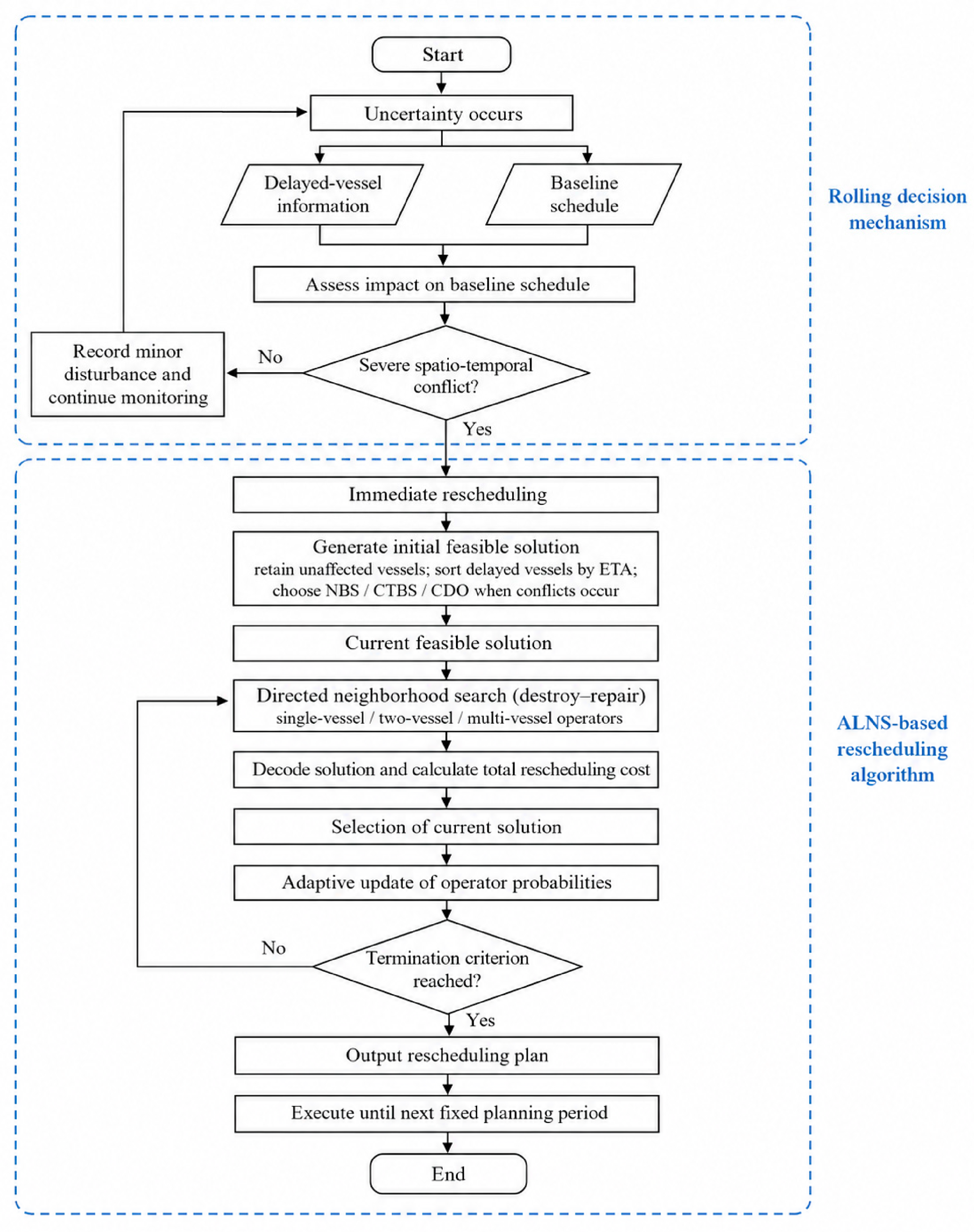
To address it, this paper develops an optimization framework for the integrated rescheduling of vessel sequencing and berth allocation under vessel delay scenarios. The framework operates as follows. Upon receiving delay information, it first assesses the feasibility of the initial schedule by detecting spatiotemporal conflicts in the channel and berth resources between the delayed vessel and other vessels in port or awaiting arrival. If the initial schedule is deemed infeasible, the rescheduling mechanism is triggered. This mechanism synthesizes strategies such as berth reassignment, normal berth shifting (NBS), cross-terminal berth shifting (CTBS), and cargo discharge-only (CDO) to generate a coordinated rescheduling plan. The objective is to minimize the weighted sum of various costs, including vessel demurrage cost, cost of occupying non-original berths, NBS and CTBS cost, cost of transporting containers via coastal feeder vessels, and storage cost of CDO containers in the yard. This proposed mechanism can flexibly select response strategies based on the delay characteristics of different vessel types. For scenarios involving mainline and feeder vessels, the priority is to ensure the operational continuity of loading and unloading for mainline vessels. For domestic trade vessels, berth resource conflicts are alleviated through CTBS or CDO, thereby achieving optimal overall system efficiency.
In summary, the main contributions of this paper are as follows.
- (i)
This paper focuses on the coupling relationship between the vessel sequencing and the berth allocation, and systematically characterizes their combined impact on scheduling decisions under the constraints of a one-way channel, berth availability, and mainline–feeder vessel coordination. By analyzing the spatiotemporal chain reactions caused by vessel delays, the paper reveals the complex interplay among constrained channel access, spatiotemporal berth mismatch, and delays in feeder–mainline transshipment. Furthermore, rescheduling strategies such as NBS, CTBS, and CDO are designed to mitigate disruptions.
- (ii)
To address the stochastic and disruptive nature of vessel delays, this paper proposes a rescheduling optimization method based on a rolling-horizon decision mechanism. Upon receiving delay information during operation, the model can automatically assess the feasibility of the original plan and trigger a rescheduling process if necessary. This process adheres to the one-way channel navigation rules and berth safety constraints to redetermine the vessel sequence and berth allocation plan. The optimization objective is to minimize the weighted sum of costs related to vessel demurrage, berth occupancy, vessel shifting (NBS, CTBS), coastal transshipment, and CDO.
- (iii)
Given the model’s large scale, complex constraints, and strongly coupled decisions, an improved Adaptive Large Neighborhood Search (ALNS) algorithm is designed. Tailored destruction and repair operators are developed to handle the vessel–berth matching, channel time-window conflicts, and operational coordination constraints, thereby enhancing the algorithm’s global search ability and local refinement in complex solution spaces. Numerical experiments based on a typical port demonstrate the superiority of the proposed algorithm over existing methods in terms of both computational efficiency and solution quality.
The structure of this paper is as follows.
Section 1 is the introduction.
Section 2 reviews the related literature.
Section 3 describes the problem.
Section 4 presents the mathematical model based on the problem formulation.
Section 5 details the ALNS algorithm for solving the model.
Section 6 evaluates the effectiveness of the proposed approach and the algorithm’s performance through numerical experiments. Finally,
Section 7 concludes the paper.
2. Literature Review
In recent years, berth allocation and vessel sequencing have attracted considerable attention from scholars. This section reviews the literature on berth allocation and vessel sequencing.
The berth allocation problem is a core challenge in optimizing port marine-side operations. It can be classified into discrete, continuous, and mixed models based on berth layout characteristics. Typically, discrete BAP is solved using exact algorithms, whereas continuous and mixed BAP often rely on heuristic and metaheuristic methods. In recent years, driven by the growing significance of uncertainties such as vessel arrival time deviations, fluctuations in operational durations, equipment failures, and unplanned vessel arrivals, the research paradigm has evolved from static planning toward dynamic frameworks that incorporate robustness and resilience. This evolution has given rise to three primary strategies: proactive, hybrid (integrated proactive–reactive), and reactive.
Proactive strategies enhance a plan’s ability to absorb common disruptions by embedding time or resource buffers into the baseline schedule. Specific measures include conservatively estimating operation durations, introducing idle-time buffers between consecutive vessel operations, or adopting a “dual-buffer” design that simultaneously accounts for uncertainties in both arrival and operation times. These methods are applicable to the BAP and are widely used in both continuous and discrete berth systems. In the context of continuous berths, representative studies employ robust optimization to handle the dual uncertainty in arrival and operation times (e.g., Zhen and Chang, 2012; Xu et al., 2012; Xiang et al., 2017) [
4,
5,
6] or incorporate operation time buffers into the BAP to improve coordination (Rodriguez-Molins et al., 2014) [
7]. Research on discrete berths includes comparisons between stochastic programming and robust optimization models (Zhen, 2015; Liu et al., 2017) [
8,
9], as well as approaches that first estimate parameters using machine learning before converting the problem into a deterministic optimization (Lv et al., 2024; Xiang and Liu, 2021) [
10,
11]. Furthermore, some studies focus solely on arrival time uncertainty, setting buffer times to suppress delay propagation (Wang et al., 2024) [
12]. Although this strategy enhances the robustness and feasibility of the schedule, its main limitation lies in potentially low resource utilization when the reserved buffers remain unused. Moreover, it may still rely on reactive adjustments when confronting large-scale delays or the insertion of non-scheduled vessels. This limitation has prompted the development of hybrid strategies.
Hybrid strategies adopt a multi-stage optimization framework that combines ex ante robust planning with in-process recovery to accommodate progressively revealed information (Du et al., 2010) [
13]. Typically, a baseline plan is generated in the first stage, and subsequent stages revise the plan using real-time information (Zhen et al., 2011; Iris and Lam, 2019) [
14,
15]. In continuous-berth systems, studies mainly consider joint uncertainty in arrival and service times (Zhen et al., 2011) [
14] or a single arrival deviation (Dai et al., 2023) [
1]. For discrete berths, multi-stage stochastic programming is commonly used (Zhen et al., 2024) [
16]. Solution approaches are dominated by heuristics (Zhen et al., 2011; Liu et al., 2020; Dai et al., 2023) [
1,
14,
17] and metaheuristics (Du et al., 2010; Iris and Lam, 2019) [
13,
15], with a few exact methods reported (Rodrigues and Agra, 2021; Zhen et al., 2024) [
16,
18]. Although hybrid strategies can mitigate resource waste, their effectiveness is highly sensitive to the design of the triggering mechanism; overly frequent or overly delayed triggers can degrade system performance, which in turn motivates the development of more responsive schemes.
Proactive strategies typically incorporate time or resource buffers into the baseline plan to absorb potential disruptions. However, these reserved buffers remain idle when disruptions do not occur and may still be insufficient under severe disturbances, making rescheduling necessary. Reactive strategies address such uncertainties dynamically through rolling-horizon or event-driven methods, enabling schedules to adapt to updated information and disruptions. Typically, these strategies first generate a plan with minimum operating cost and then make rapid adjustments in response to emerging disturbances (Xiang et al., 2018) [
2]. Research in this area has predominantly focused on continuous berth systems (Li et al., 2015) [
19], with some exploration of discrete berth systems (Xiang et al., 2018) [
2]. The disturbances considered include quay crane failures, unplanned vessel arrivals, and uncertainties in both vessel arrival and operation times (Liu et al., 2016; Al-Refaie and Abedalqader, 2022) [
20,
21].
For discrete berth allocation and rescheduling problems, existing solution approaches can generally be classified into exact methods and metaheuristic algorithms. Exact methods can provide optimal solutions for small instances, but their computational burden increases rapidly as the problem size and number of discrete decisions grow (Rodrigues and Agra, 2021; Zhen et al., 2024) [
16,
18]. Metaheuristic algorithms are therefore widely used for large maritime scheduling problems because of their flexibility and search efficiency. Representative approaches include genetic algorithms (Guo et al., 2022) [
22], simulated annealing (Kim and Moon, 2003) [
23], variable neighborhood search (Hansen et al., 2008) [
24], and adaptive large neighborhood search (Mauri et al., 2016; Martin-Iradi et al., 2024) [
25,
26]. Among these approaches, ALNS is particularly suitable for complex discrete scheduling problems because its adaptive destruction and repair mechanism enables efficient exploration of large solution spaces.
Port scheduling problems may also involve conflicting objectives related to operational efficiency, service quality, robustness, and environmental performance, which has encouraged the application of multiobjective metaheuristics. Early studies employed multiobjective genetic algorithms to obtain alternative berth schedules without aggregating all objectives into a single criterion (Golias et al., 2009; Hu, 2015) [
27,
28]. Under uncertainty, Xiang et al. (2017) [
6] developed a biobjective robust berth allocation model and an adaptive grey wolf optimizer to balance economic performance and customer satisfaction. More recently, multiobjective metaheuristics have evolved toward hybrid and adaptive frameworks. Xiao et al. (2025) [
29] combined NSGA-II with simulated annealing and neighborhood search for vessel scheduling in compound channels, while Ji et al. (2025) [
30] integrated decomposition with ALNS to solve a multiobjective berth allocation and vessel speed optimization problem. These developments demonstrate the increasing ability of multiobjective metaheuristics to address conflicting objectives and complex discrete decisions in port scheduling.
Beyond solution method design, determining when to trigger rescheduling remains another central challenge for reactive strategies. Existing studies have proposed mechanisms such as behavior perception models and triggers based on disturbance thresholds (Kim et al., 2021; Ji et al., 2022; Zheng et al., 2023) [
31,
32,
33]. More recently, Jia and Zheng (2026) [
34] developed a rolling decision mechanism for integrated vessel and tugboat rescheduling in one-way channel ports under adverse weather, considering channel closures, vessel delays, and additional shifting tasks. However, berth allocation was not incorporated into their rescheduling decisions. Therefore, effective triggering mechanisms that jointly consider vessel delays, one-way channel conflicts, vessel sequencing, and berth allocation remain insufficiently explored.
As the number of arriving vessels has increased, the navigation channel has become a critical constraint for many ports in improving the efficiency of vessel arrivals and departures, and the optimization of vessel sequencing has therefore become a focal topic of interest for many scholars. Early studies mostly focused on ports with one-way navigation channels. For example, Zhang et al. (2016) [
35] examined the effects of vessel sequencing, sailing direction and distance to the assigned berth in a one-way channel, whereas Liu et al. (2021) [
36] emphasized the impact of fuzzy vessel arrival and departure speeds. With the growing number of ports equipped with two-way channels and compound channels, some researchers have turned to the sequencing problem under these two channel configurations. Specifically, Wang et al. (2017), Meisel and Fagerholt (2019), and Hill et al. (2019) [
37,
38,
39] studied ports with two-way channels, while Tan et al. (2023) and Ursavas and Zhu (2016) [
40,
41] focused on ports with compound channels. In terms of optimization objectives, Wang et al. (2017), Meisel and Fagerholt (2019), Hill et al. (2019), and Ursavas and Zhu (2016) [
37,
38,
39,
41] constructed mathematical models aiming to minimize vessel service time, whereas Tan et al. (2023) [
40] developed a vessel traffic scheduling optimization model that minimizes both channel occupation time and total waiting time.
In summary, although existing studies on dynamic berth allocation and vessel sequencing optimization have achieved considerable results in uncertainty modeling and scheduling robustness, several critical gaps remain at the levels of system integration and rescheduling strategies.
- (i)
Limited System Integration and Modeling Scope: A predominant limitation of existing research is its narrow focus on single-basin or single-berth system models. Within these models, channel scheduling and berth allocation are often decoupled and modeled in isolation, thereby failing to capture their spatiotemporal coupling relationship within a unified optimization framework, particularly under the constraints of a one-way channel. When vessel delays occur, localized rescheduling adjustments can easily trigger system-wide congestion and resource decoupling. Furthermore, most models fail to adequately incorporate the interactive effects between domestic and international trade vessels, as well as the operational coordination between mainline and feeder vessels, thus overlooking the resource and operational synergies potential in multi-business-port structures.
- (ii)
Inadequate Multi-dimensional Rescheduling Strategies: Current research primarily concentrates on localized adjustments, such as modifying the vessel arrival and departure sequence or reassigning berths. There is a significant lack of a multi-dimensional decision-making mechanism capable of responding to complex delay scenarios, especially in multi-basin port environments. Critical strategies such as CTBS and CDO, which are essential for diverting operations and enhancing system resilience and overall efficiency when berth resources are constrained or vessels are delayed, have not yet been systematically integrated into a unified optimization framework.
3. Problem Description
During a fixed planning horizon, inbound vessels send their vessel information and operation information to the port in advance. After compiling the information of all inbound vessels within the planning horizon, the port formulates the inbound and outbound sequence plan for vessels and the berth allocation plan based on the one-way waterway rules and the availability of berths at each terminal. However, in the actual operation of the port, frequent uncertainties such as adverse weather often cause inbound vessels to arrive late. This may render the initial inbound and outbound sequence plan and berth allocation plan invalid. If the original plan is not adjusted timely, vessels may have to wait at the anchorage after arrival—either because there is no suitable berth or because they miss their original inbound time slot. Therefore, upon receiving the information about vessels’ delayed arrival, the port needs to timely adjust the initial inbound and outbound sequence plan and berth allocation plan. This adjustment is achieved through a combination of strategies, including reallocating berths, NBS, CTBS, and CDO, and it is based on the specific information of these delayed vessels and the information of other unoperated vessels. Considering that the delay scenarios vary significantly among different types of vessels, different response strategies should be adopted for specific scenarios.
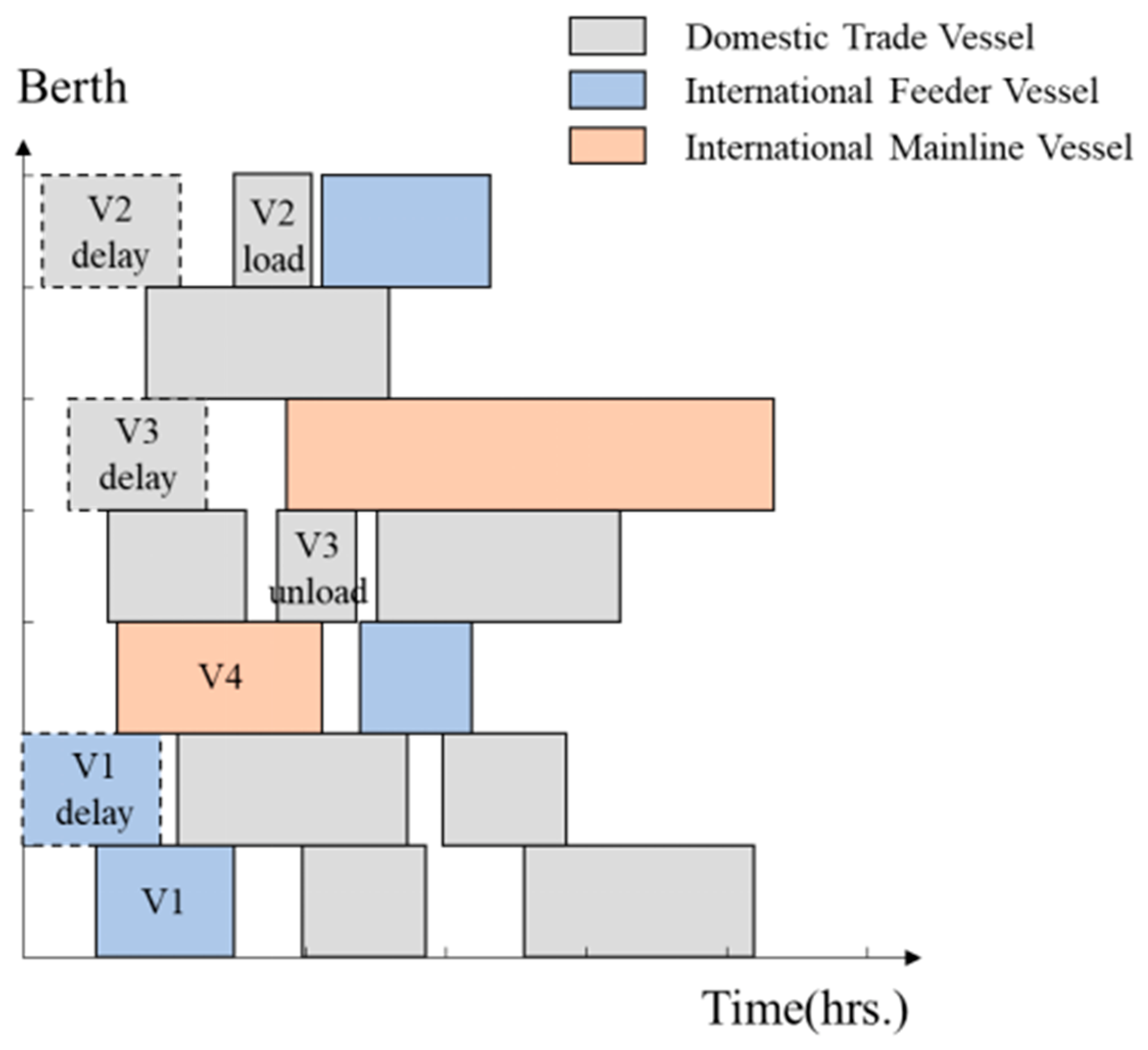
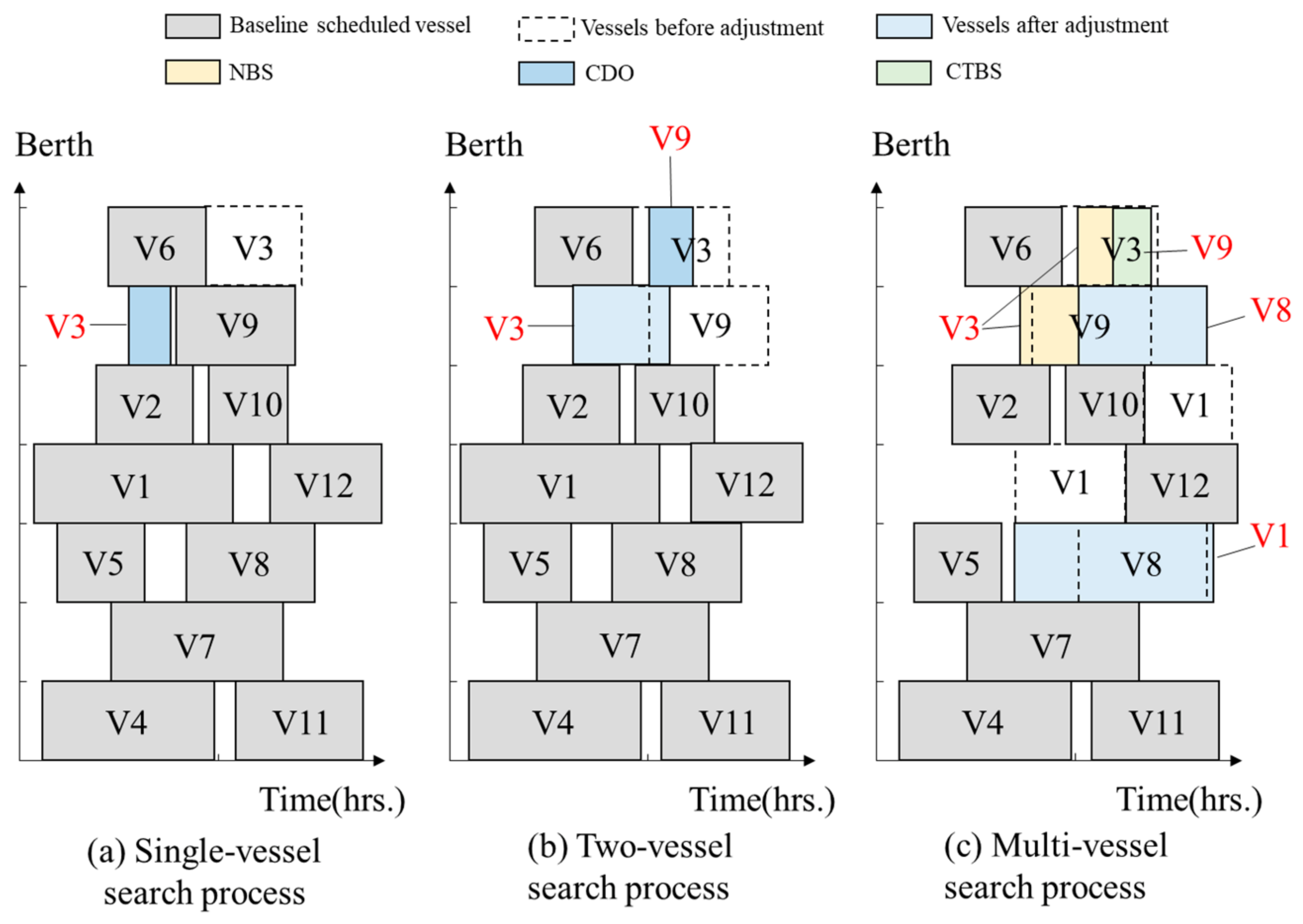
For delayed arrivals of international feeder vessels, it is known that the international mainline vessels with which they have a transshipment relationship arrive at the port on schedule, such as vessel V1 in
Figure 1. If the feeder vessel’s delay duration is short and there is an idle berth in the terminal, the feeder vessel V1 will be assigned to this idle berth to ensure that the mainline vessel V4 timely completes loading. If the delay duration is long, and the feeder vessel cannot finish unloading before the mainline vessel completes its unloading, coastal feeder vessels will be used to transport the unloaded containers to the next hub port. In this way, the transshipment operation between the mainline and feeder vessels is completed.
For delayed arrivals of domestic trade vessels, if the originally assigned berth is idle, the vessel will be arranged to enter the port during the nearest available time segment for loading and unloading operations. If the originally assigned berth is occupied by a scheduled vessel, the port will give priority to selecting other idle berths within the terminal for the delayed vessel’s loading and unloading operations. If there are no other idle berths available in the terminal at that time, two measures can be taken. As shown in
Figure 1, vessel V2 will first use an idle berth at the contracted terminal for unloading, and then conduct inter-terminal shifting back to the originally assigned berth for loading operations, which is an example of the CTBS. Alternatively, vessel V3 will depart directly without subsequent loading after completing its unloading, representing the CDO.
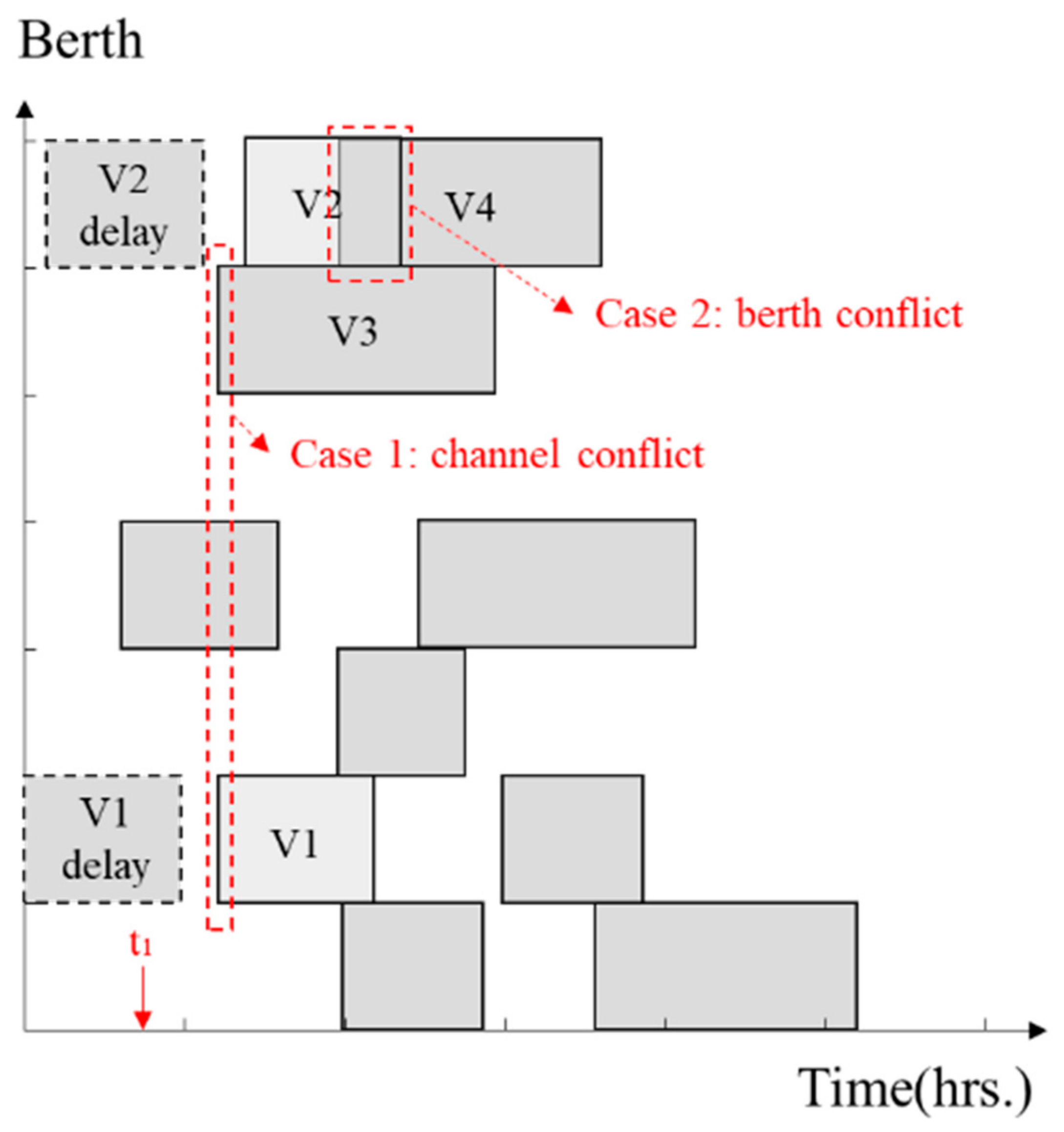
In the response mechanism proposed in this paper, if no delay events occur, operations proceed as per the initial plan. As shown in
Figure 2, if the port receives information about vessel delays at time t1, it immediately analyzes the impact of the delay event on the original vessel sequence and berth allocation plan. When a delayed vessel conflicts with other scheduled vessels from the original plan in two scenarios: waterway conflicts (e.g., delayed Vessel V1 and Vessel V3 in the initial plan have a waterway conflict during the second inbound time slot) or berth time–space overlaps (e.g., delayed Vessel V2 and Vessel V4 in the initial plan have a time overlap at the same berth), time t1 at this point becomes the rescheduling time, and a rescheduling plan is generated.
In summary, the problem considered in this paper can be described as follows. For a port with a one-way channel and discrete berths, an initial vessel sequence and berth allocation plan is prepared in advance for a fixed planning horizon based on the expected arrival information of all incoming vessels. If an uncertain event causes one or more of these vessels to be delayed, and the delay duration is known, the proposed response decision mechanism is immediately applied to determine whether the initial plan remains feasible. If the plan is still feasible, the original plan is executed. If the plan is not feasible, a new rescheduling plan is generated. The rescheduling model is subject to core constraints, including the alternation of inbound and outbound time segments in the one-way channel, the spatio-temporal constraints on berthing and unberthing operations, and the spatio-temporal constraints on transshipment between mainline and feeder vessels. The optimization objective is to minimize the total cost, defined as the sum of the vessel demurrage cost, cost of occupying non-original berths, NBS and CTBS cost, cost of transporting containers via coastal feeder vessels, and storage cost of CDO containers in the yard. Under these constraints and objectives, the model determines the optimal combination of multiple strategies, including berth reallocation, NBS, CTBS, and CDO, and outputs an integrated plan that specifies the vessel sequence, the berth allocation, and the strategy adopted for each vessel.
4. Mathematical Model
This section consists of three parts: model assumptions, notation explanation, and model formulation.
4.1. Model Assumptions
To clearly present the core ideas without losing generality, the following assumptions are made in this paper.
The scheduled arrival time, delay duration, and scheduled departure time of each vessel are known in advance.
Only unidirectional container transshipment from feeder vessels to mainline vessels is considered.
Information about the original operation plan of each vessel is known.
At the rescheduling time, decisions for vessel tasks that have already commenced remain fixed and cannot be revoked, whereas tasks that have not yet started can be re-optimized according to the current system state. Before solving the rescheduling model, decisions associated with tasks that have already commenced are fixed at their observed values and excluded from the re-optimization decision space.
International mainline vessels are required to complete all loading and unloading operations within the port and are therefore not allowed to adopt the CDO or CTBS rescheduling strategies.
4.2. Notations
- (1)
Sets
| Sets Symbols | Meaning |
| Set of vessels, where and denote the sets of domestic trade vessels, international feeder vessels, and international mainline vessels, respectively, with denotes the set of international feeder vessels associated with international mainline vessel |
| Set of berths, where denotes the set of berths satisfying the berthing requirements of vessel |
| Set of 30 min time periods, where and denote the sets of time periods during which inbound and outbound operations can be initiated, respectively |
| Set of vessel task types, where and and 4 represent inbound, unloading, loading, and outbound operations, respectively |
| Set of vessel berthing stages, where and |
- (2)
Parameters
| Parameters Symbol | Meaning |
| Latest departure time of vessel |
| Loading time of vessel |
| Unloading time of vessel |
| Minimum safety time interval for vessel inbound, outbound, and berthing operations |
| Transit time through the one-way channel |
| Sailing time of vessel between the berth and the inner anchorage |
| Binary indicator, equal to 1 if vessel is eligible to adopt the NBS at the rescheduling time, and 0 otherwise |
| Binary indicator, equal to 1 if vessel is eligible to adopt the CDO at the rescheduling time, and 0 otherwise. |
| Binary indicator, equal to 1 if vessel is eligible to adopt the CTBS at the rescheduling time, and 0 otherwise. |
| Actual arrival time of vessel |
| Berth shifting time required under the NBS strategy |
| Unit waiting time cost of vessel |
| Unit delay cost of vessel |
| Cost incurred when vessel adopts the NBS |
| Cost incurred when vessel adopts the CDO |
| Cost incurred when vessel adopts the CTBS |
- (3)
Decision Variables
| Decision Variable Symbol | Meaning |
| Start time of task type for vessel |
| Binary variable, equal to 1 if vessel starts task type in time period and 0 otherwise |
| Binary variable, equal to 1 if vessel performs inbound/outbound task before vessel and 0 otherwise |
| Binary variable, equal to 1 if vessel adopts the NBS strategy, and 0 otherwise |
| Binary variable, equal to 1 if vessel adopts the CDO strategy, and 0 otherwise |
| Binary variable, equal to 1 if vessel adopts the CTBS strategy, and 0 otherwise |
| Actual unloading time of vessel after rescheduling |
| Waiting time of vessel |
| Tardiness time of vessel |
| Actual loading time of vessel after rescheduling |
| Binary variable, equal to 1 if berth is assigned to vessel in its th berthing stage, and 0 otherwise |
| Start time of the th berthing stage of vessel |
| End time of the th berthing stage of vessel |
| Binary variable equal to 1 if the th berthing stage of vessel precedes the th berthing stage of vessel at berth and 0 otherwise |
4.3. Model Formulation
Based on the above assumptions and definitions, the mathematical model is formulated as follows.
Equation (1) presents the objective function, which minimizes the total rescheduling cost, including vessel waiting costs, tardiness costs, and the costs associated with the use of the three rescheduling strategies.
Constraints (2) and (3) ensure that vessel inbound and outbound operations can only be initiated within the corresponding allowable time periods. Constraint (4) determines the start times of vessel inbound, outbound, loading, and unloading operations. Constraint (5) imposes the minimum safety time interval between vessel inbound and outbound operations. Constraint (6) ensures that the sequences of vessel inbound and outbound operations do not conflict with each other.
Constraints (7) to (11) impose the temporal restrictions on vessel inbound, outbound, loading, and unloading operations. Constraint (7) ensures that a vessel can start its inbound operation only after arriving at the port, while vessel delays are taken into account in the rescheduling model. Constraint (8) stipulates that after starting its inbound operation, a vessel must first transit through the one-way channel and then sail from the inner anchorage to the berth before unloading can begin. Constraint (9) ensures that all vessels can start loading only after completing their unloading operations, while the adoption of the NBS, CDO and CTBS strategies is considered in the rescheduling model. Constraints (10) and (11) stipulate that a vessel can start its outbound operation only after completing its final berthing stage and sailing from the berth to the inner anchorage. Constraint (12) ensures that an international mainline vessel can start loading only after its associated international feeder vessels have completed their unloading operations, while the adoption of the CTBS strategy is considered in the rescheduling model. Constraint (13) defines the actual unloading time of vessel
, which depends only on whether the CTBS strategy is adopted. Constraint (14) defines the actual loading time of domestic trade vessels and international feeder vessels, which depends only on whether the CDO strategy is adopted. Constraint (15) defines the actual loading time of international mainline vessels. Constraints (16) to (18) specify the feasibility conditions for adopting the NBS, CDO, and CTBS strategies, respectively. Constraint (19) ensures that each vessel can adopt at most one rescheduling strategy.
Constraint (20) ensures that a vessel does not perform loading operations after adopting the CDO strategy. Constraint (21) ensures that a vessel does not perform unloading operations after adopting the CTBS strategy. Constraint (22) defines the tardiness time of vessel
. Constraint (23) defines the waiting time of vessel
. Constraint (24) ensures that each vessel with an uncompleted berthing stage must be assigned to a berth. Constraint (25) stipulates that a second berthing stage exists only when the vessel adopts the NBS strategy. Constraint (26) ensures that the same vessel can berth at the same berth at most once.
Constraints (27) to (30) determine the start time of the first berthing stage of vessel
. Constraints (27) and (28) stipulate that if the CTBS strategy is adopted, the first berthing stage of vessel
starts when its loading operation begins. Constraints (29) and (30) stipulate that if the CTBS strategy is not adopted, the first berthing stage of vessel
starts when its unloading operation begins. Constraints (31) to (34) determine the release time of the first berthing stage of vessel
. Constraints (31) and (32) determine the first berth release time of vessel
when neither the CDO nor the NBS strategy is adopted. Constraints (33) and (34) determine the first berth release time of vessel
when either the CDO or the NBS strategy is adopted. Constraints (35) to (38) stipulate that if vessel
adopts the NBS strategy, its second berthing stage starts at the beginning of the loading operation and ends upon completion of the loading operation. Constraint (39) ensures that a certain amount of time is required for the berth shifting operation.
Constraint (40) ensures that if two vessels occupy the same berth, a minimum safety time interval must be maintained between their berth occupancy periods. Constraints (41) to (44) define the relationship between variables
and
, ensuring that when two berthing stages are assigned to the same berth, their berthing sequence must be determined.
Constraints (45) and (46) define the domains of the decision variables.
In the rescheduling model, Big- values are used in several constraints, including Constraints (5), (9) to (12), and (27) to (40), to enforce logical relationships involving binary variables. To ensure the validity of these constraints while avoiding numerical instability caused by an excessively large value, is determined according to the maximum feasible values of the time-related variables involved in each group of constraints.
For the vessel sequencing constraint, i.e., Constraint (5), is required to relax the temporal precedence relationship when the corresponding sequencing variable is equal to 0. Considering the minimum safety interval , can be determined according to the maximum feasible vessel operation start time, i.e., .
For the temporal connection constraints, i.e., Constraints (9) to (12), is used to relax the corresponding precedence relationships when NBS, CTBS, or CDO changes the original operation sequence. Therefore, its value is determined according to the maximum feasible values of the time expressions involved in these constraints, i.e., .
For Constraints (27)–(39), the Big- method is used to establish the relationships between vessel operation times and the start and end times of different berthing stages under different rescheduling strategies. Accordingly, is determined based on the maximum feasible values of the relevant operation and berthing-stage times, including , , , , , .
Finally, for the berth-conflict constraint, i.e., Constraint (40), is required to deactivate the berth-separation relationship when two berthing stages are not simultaneously assigned to the same berth or when the corresponding precedence relationship does not hold. In this case, is determined according to the maximum feasible berth-release time together with the safety interval, i.e., .
In the computational experiments, a common value of is adopted as the maximum among the values determined above.
6. Numerical Experiments
The numerical experiments in this study are divided into five parts: (i) experimental cases description, (ii) experimental result analyses, (iii) scheme effectiveness validation, (iv) algorithm performance, and (v) sensitivity analysis.
6.1. Experimental Setup and Baseline Case Analysis
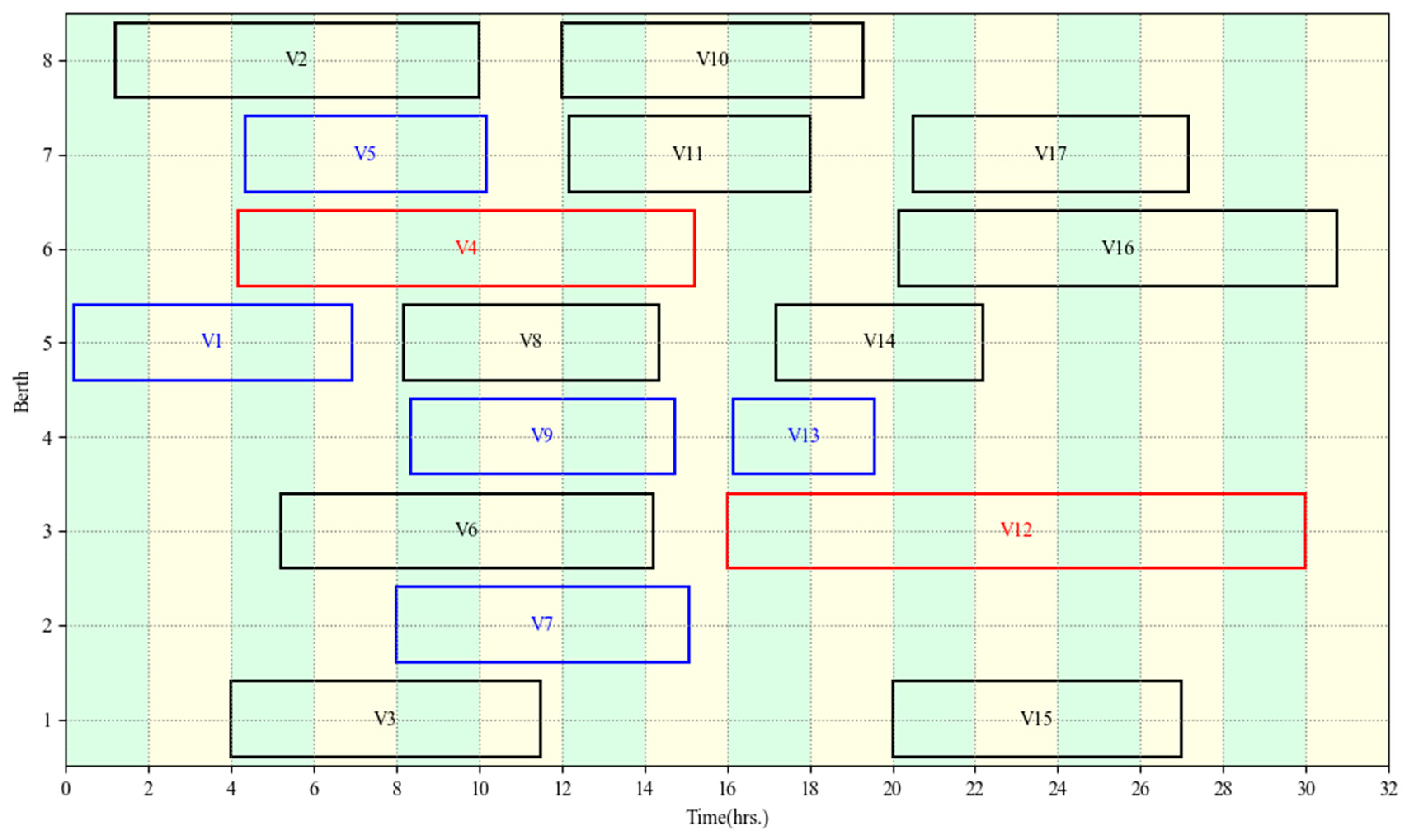
In a container port with a single one-way channel and two harbor basins, there are 8 discrete berths in total. Berths 1–4 belong to Harbor Basin 1, while Berths 5–8 are located in Harbor Basin 2. The vessel information includes international mainline vessels, international feeder vessels, and domestic trade vessels scheduled to arrive between 0 and 24 h, with a total of 17 vessels expected to operate. The basic information of these vessels is presented in
Table 2. According to the actual port operation conditions, both inbound and outbound channel time segments are set to 2 h, and the safe time interval between vessels navigating in the waterway is 1/6 h. Without considering uncertainty events, an initial vessel sequencing and berth allocation plan is developed with the objective of minimizing the total in-port time, as illustrated in
Figure 6.
Figure 6 illustrates the initial vessel sequencing and berth allocation plan. Each rectangle represents a vessel’s entry into the channel and berthing operation, and the text inside each rectangle indicates the vessel ID. Red rectangles denote international mainline vessels, blue rectangles represent international feeder vessels, and black rectangles indicate domestic trade vessels. The green background area corresponds to the inbound time segments, while the yellow background area represents the outbound time segments. The left edge of each rectangle must fall within the green area and the right edge within the yellow area, ensuring that each vessel enters during an inbound period and departs during an outbound period. In addition, rectangles must not overlap, maintaining the spatio-temporal independence of all vessels.
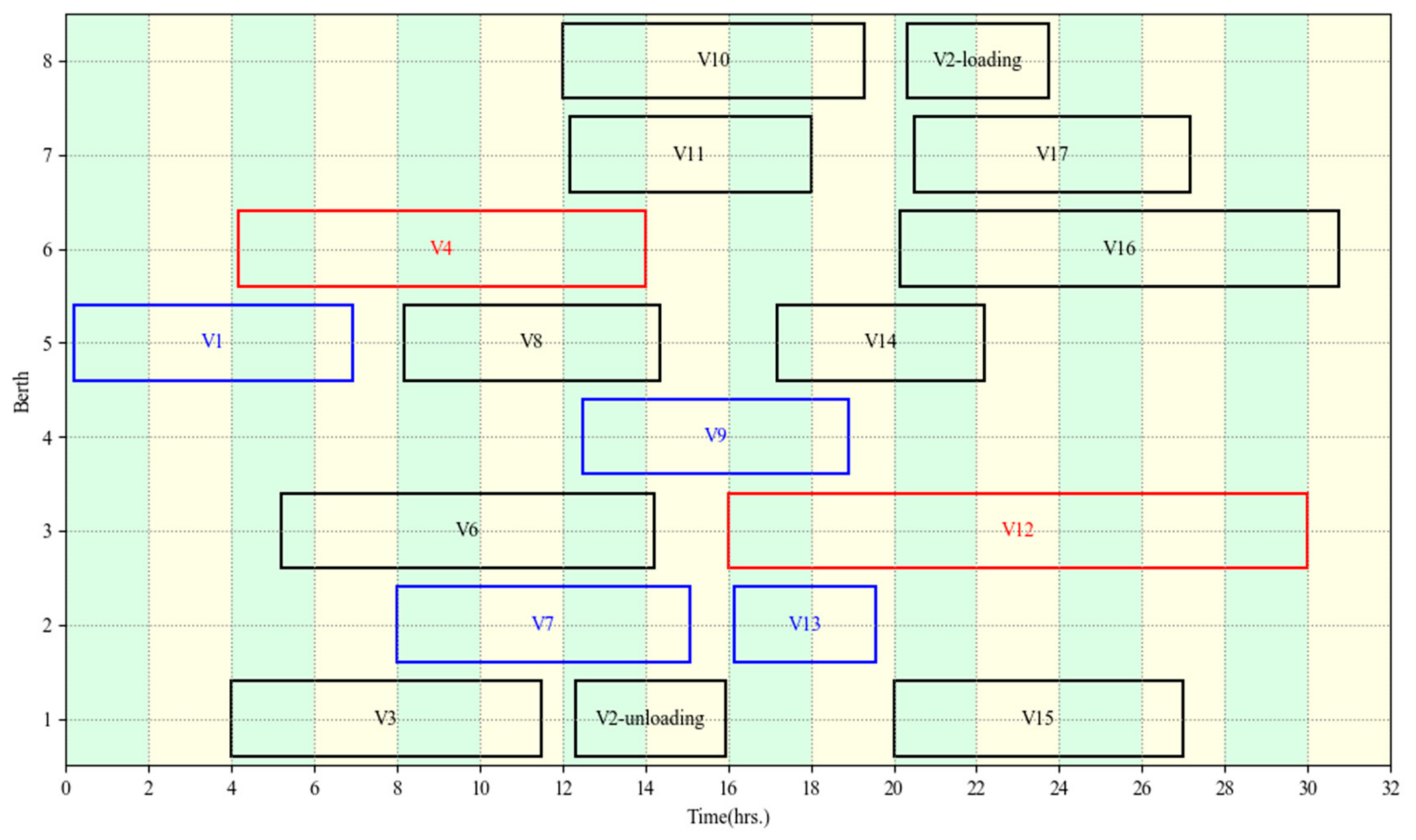
During the unloading and loading operations based on the initial vessel sequencing and berth allocation plan, a random rescheduling scenario was generated and solved using a computer processor (Intel(R) Core(TM) i5-7200 CPU @ 2.50 GHz with 16 GB of memory). The rescheduling plan was obtained using Python 3.9, which was compiled with the algorithm presented in this paper, and a visualization of the plan was generated. The initial population size of the algorithm was set to 20, with a maximum of 500 iterations. Each experiment was run 5 times, and the best result was selected as the experimental outcome. The randomly generated delay scenario is as follows. At 1:00 AM, the following delays were recorded: domestic trade Vessel 2 delayed by 6 h, international feeder Vessel 5 delayed by 12 h, and international feeder Vessel 9 delayed by 4 h.
Figure 7 presents the rescheduling plan generated by the proposed algorithm for the aforementioned delay scenario. As shown in
Figure 7, vessel 2 is delayed to 7.2 h for arrival. According to the initial plan, it would have a spatio-temporal conflict with Vessel 10 at Berth 8. Therefore, Vessel 2 is reassigned to Berth 1 for unloading between 12 h and 16 h, ensuring timely inbound and outbound operations within this period. Since its cargo has already been gathered at the port, the vessel must subsequently conduct NBS, shifting back to its originally assigned Berth 8 for loading. The delay of international feeder Vessel 5 affects its transshipment connection with international mainline Vessel 4, causing Vessel 4 to perform partial CDO operations and depart earlier at 14 h. Meanwhile, the delay of international feeder Vessel 9 results in a spatio-temporal conflict with international feeder Vessel 13, leading to a reassignment of Vessel 13 to Berth 2 in Harbor Basin 1.
6.2. Practical Scenario Analysis
The baseline case in
Section 6.1 demonstrates the rescheduling process and verifies the feasibility of the proposed method under a controlled delay scenario. To further examine its applicability under more realistic operating conditions, an additional practical case based on published port operational data is introduced in this section. Compared with the baseline case, this case provides a more practically grounded vessel arrival and disruption setting and is therefore used to evaluate whether the proposed rescheduling framework can effectively coordinate vessel sequencing, berth allocation, and alternative rescheduling strategies under more complex operational conditions.
The practical case is adapted from the operational case of Tianjin Wuzhou International Container Terminal reported by Zheng et al. (2026) [
42] and subsequently used in related rescheduling research. The original dataset contains operational information for 21 vessels over a one-week planning horizon and therefore provides a realistic basis for constructing the practical rescheduling scenario. Since the original case adopts a continuous berth layout and also involves disruption types beyond the scope of the present study, the operational information is transformed according to the problem setting developed in this paper. In particular, the continuous quay layout is converted into discrete berths, while vessel types, transshipment relationships, berth compatibility, handling characteristics, and one-way channel navigation requirements are incorporated according to the proposed model. The complete transformed case data used in the numerical experiments are publicly available in the corresponding GitHub repository.
For the transformed practical case, four discrete berths are considered. The vessel information includes vessel type, transshipment relationship, expected time of arrival, preferred berth, expected time of departure, handling demand, handling rate, and channel transit time. A total of 21 vessels are considered over the one-week planning horizon, including international mainline vessels, international feeder vessels, and domestic trade vessels. The basic information of these vessels is available in the public GitHub repository. Under the given operating conditions, both inbound and outbound channel time segments are set to 2 h, and the minimum safety interval between two vessels navigating in the one-way channel is set to 15 min.
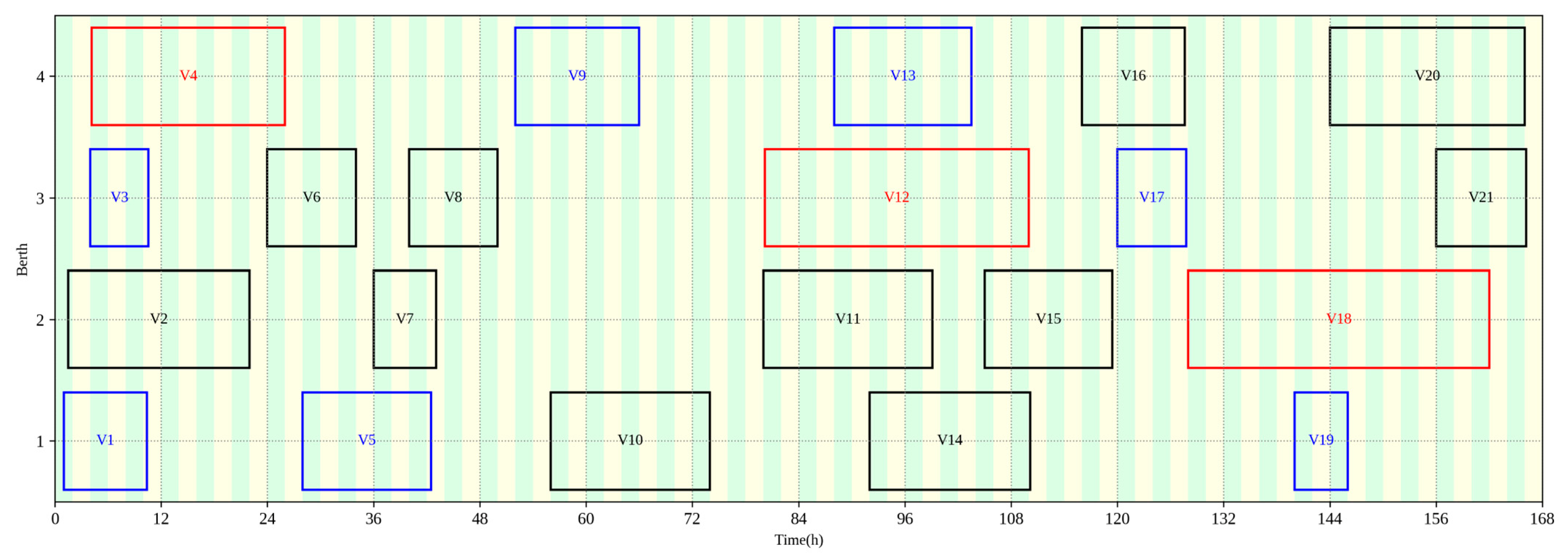
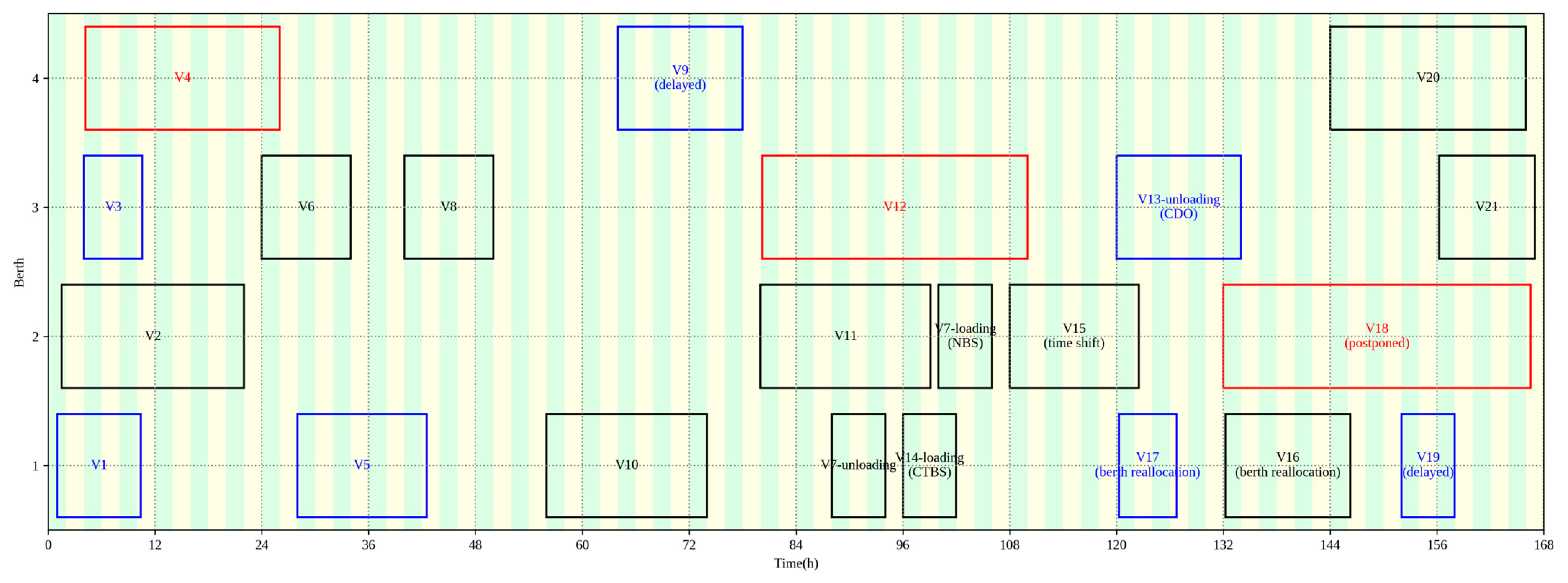
Without considering disruption events, an initial vessel sequencing and berth allocation plan is first generated for the practical case. The objective of this baseline plan is to coordinate vessel arrivals and berth occupation efficiently while satisfying the one-way channel navigation rules, berth compatibility requirements, and spatio-temporal non-overlap constraints. The resulting baseline schedule is illustrated in
Figure 8.
Figure 8 shows the initial vessel sequencing and berth allocation plan for the practical case. Each rectangle represents a vessel’s entry into the channel and berthing operation, and the text inside each rectangle indicates the vessel ID. Red rectangles denote international mainline vessels, blue rectangles represent international feeder vessels, and black rectangles indicate domestic trade vessels. The green background area corresponds to the inbound time segments, while the yellow background area represents the outbound time segments. The left edge of each rectangle falls within a green area and the right edge falls within a yellow area, indicating that each vessel enters the port during an inbound period and departs during an outbound period. Meanwhile, no two rectangles overlap in the same berth-time space, which verifies that the baseline plan satisfies the channel time-window constraints and maintains the spatio-temporal independence of berth occupancy.
To further evaluate the proposed rescheduling framework under more complex operating conditions, an amplified multi-vessel delay scenario is constructed based on the practical case. Multiple vessels are assumed to experience different degrees of arrival delay, thereby increasing the competition for channel and berth resources and allowing the coordinated effects of different rescheduling strategies to be examined.
At the rescheduling time
h, updated arrival information is received for five vessels. Domestic trade Vessel 7 is delayed by 40 h, and its ETA changes from 35 h to 75 h. International feeder Vessel 9 is delayed by 12 h, changing its ETA from 50 h to 62 h. International feeder Vessel 13 is delayed by 32 h, changing its ETA from 87 h to 119 h. Domestic trade Vessel 16 is delayed by 14 h, changing its ETA from 116 h to 130 h, while international feeder Vessel 19 is delayed by 12 h, changing its ETA from 139 h to 151 h. According to the rolling decision mechanism developed in this study, operations that have already started at
h remain fixed. Therefore, the ongoing operations of Vessels 5 and 6 are retained, whereas the unstarted vessel operations are released for reoptimization. Once the updated arrival information causes the baseline schedule to become infeasible, immediate rescheduling is triggered. The resulting rescheduling plan is shown in
Figure 9.
As shown in
Figure 9, the proposed method makes coordinated adjustments to both delayed and unaffected vessels. For delayed domestic trade Vessel 7, the NBS strategy is adopted: the vessel first performs unloading at Berth 1 and subsequently shifts to Berth 2 for loading. For delayed international feeder Vessel 13, the CDO strategy is adopted, and only its unloading operation is performed at Berth 3. Meanwhile, domestic trade Vessel 14 adopts the CTBS strategy and performs only its loading operation at Berth 1. In addition, Vessel 17 is reassigned to Berth 1 to release berth-time resources for delayed Vessel 13, while delayed Vessel 16 is also reassigned from its original berth to Berth 1 to avoid a subsequent berth conflict.
Other vessels are adjusted mainly through changes in operation times. Vessel 9 and Vessel 19 are rescheduled according to their updated arrival times, Vessel 15 is slightly postponed to coordinate with the loading stage of Vessel 7, and international mainline Vessel 18 is postponed because its transshipment connection is affected by the delay of Vessel 13. Vessel 21 is also slightly adjusted to maintain the feasibility of the channel and berth schedule. Overall, the results demonstrate that the proposed framework can simultaneously combine NBS, CDO, CTBS, berth reallocation, and operation-time adjustment to absorb multi-vessel delay impacts while maintaining feasible vessel sequencing and berth allocation.
6.3. Scheme Effectiveness Validation
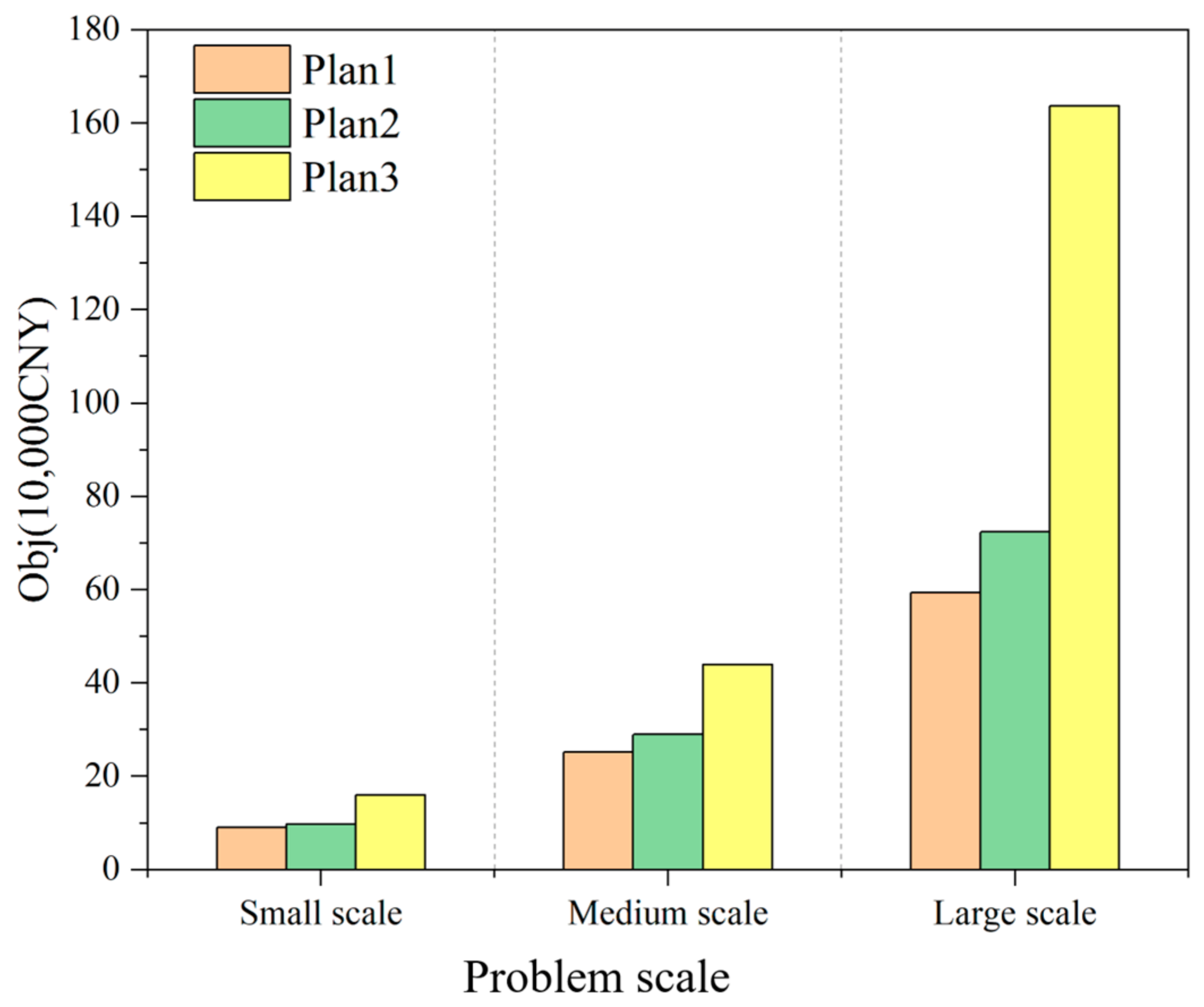
To verify the superiority of the proposed rescheduling plan (Plan 1), which integrates multiple strategies including berth reallocation, NBS, CTBS, and CDO, it is compared with two benchmark plans: Plan 2, which adopts only berth reallocation, and Plan 3, which follows the FCFS rule. Three groups of test cases with different scales, small, medium, and large, are designed, containing 10, 17, and 25 arriving vessels, respectively. In the small-scale case, two vessels are randomly selected to experience delays, in the medium-scale case, three delayed vessels are generated, and in the large-scale case, five delayed vessels are generated. Each group of test cases is run five times, and the average total rescheduling cost (i.e., the objective function value) is calculated. The comparison results are shown in
Figure 10.
As shown in
Figure 10, for test cases of the same scale, the proposed plan (Plan 1) yields the lowest total rescheduling cost, followed by Plan 2, which adopts only berth reallocation, while Plan 3 results in the highest cost. Moreover, the cost difference between Plan 1 and Plan 3 increases as the problem scale expands. These results indicate that the combination of multiple strategies in the proposed plan, including berth reallocation, NBS, CTBS, and CDO, achieves lower rescheduling costs than both Plan 2 and Plan 3, with the advantage becoming more pronounced as the problem scale increases.
6.4. Algorithm Performance
To comprehensively evaluate the performance of the proposed algorithm, the computational experiments are conducted from two perspectives. First, the proposed algorithm is compared with the Gurobi solver on relatively small-scale instances to verify the correctness of the mathematical model and evaluate its solution quality. Subsequently, larger-scale instances are constructed, and the proposed algorithm is compared with four representative heuristic algorithms in terms of solution quality and computational efficiency. To reduce the influence of randomness, repeated independent runs are conducted in the heuristic comparison, and the mean objective value and mean computation time are used for statistical evaluation.
6.4.1. Performance Comparison with Gurobi
To verify the correctness of the proposed mathematical model and evaluate the solution quality of the proposed algorithm, comparative experiments with Gurobi are first conducted on relatively small-scale instances. The maximum computation time of Gurobi is set to 7200 s. The same computational environment and instance data are used for both methods to ensure a fair comparison.
The experimental results are presented in
Table 3. For the smaller instances, the proposed algorithm obtains the same or very close objective function values compared with Gurobi while requiring substantially less computation time. As the number of vessels and delayed vessels increases, the computation time required by Gurobi grows rapidly. When the problem size further increases, Gurobi cannot obtain a solution within the 7200 s time limit, whereas the proposed algorithm can still generate feasible solutions within several minutes. These results indicate that the proposed algorithm maintains satisfactory solution quality while providing a substantial advantage in computational efficiency, especially as the problem size increases.
6.4.2. Performance Comparison with Classical Algorithms
To further evaluate the performance of the proposed algorithm, four representative metaheuristic algorithms are selected for comparison, including standard ALNS (Zheng et al., 2024), GA (Xu et al., 2025), TS (Cordeau et al., 2005), and SA (Xu et al., 2014) [
3,
43,
44,
45]. These algorithms are selected because they represent different search mechanisms that have been widely applied to berth allocation and related scheduling problems.
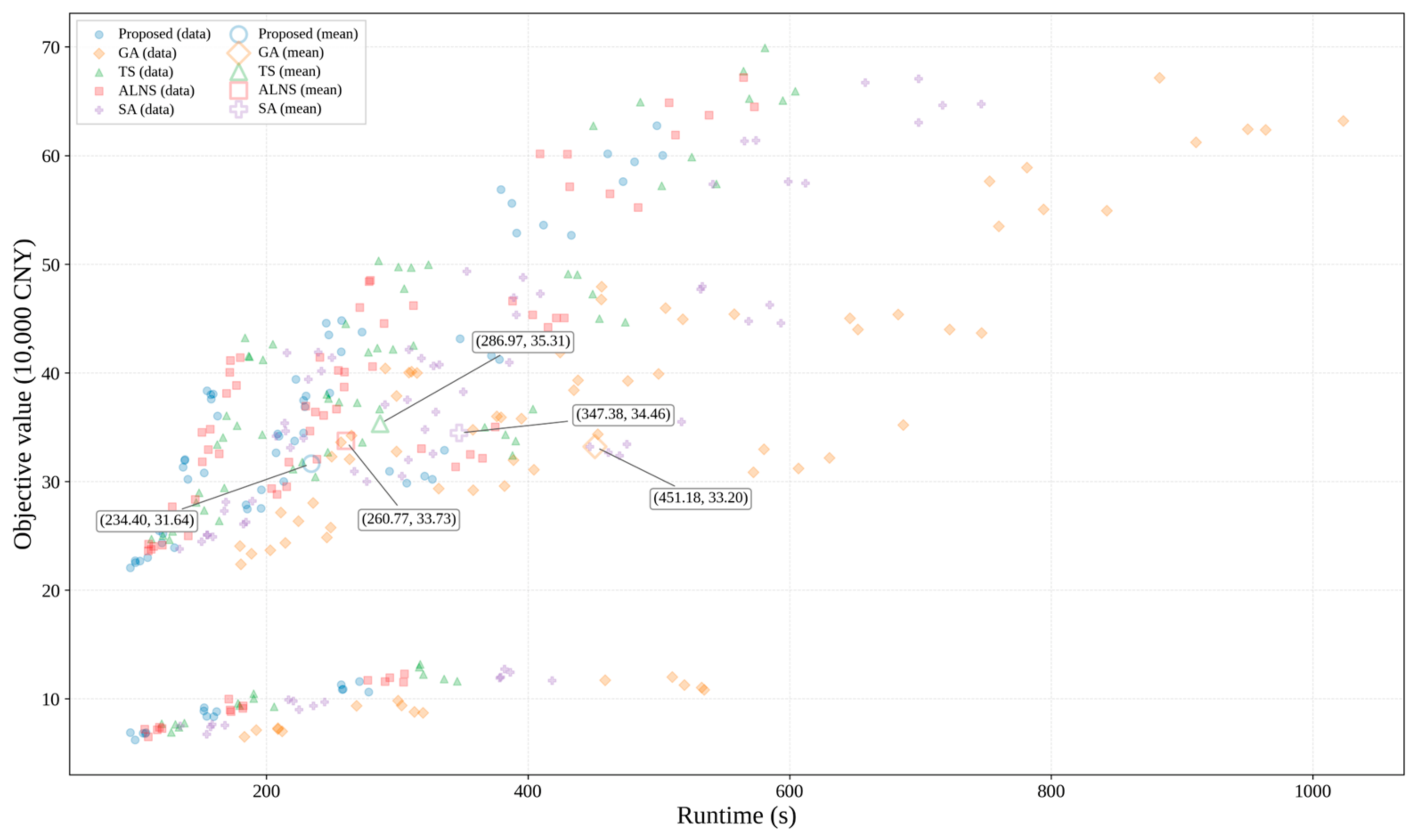
To reduce the influence of individual test instances, three groups of test cases are considered, containing 17, 22, and 25 arriving vessels, respectively. For each vessel scale, five disruption levels are considered, corresponding to 1–5 delayed vessels. For each combination of vessel scale and disruption level, five independent disruption instances are generated, resulting in a total of 75 test instances. Each instance is solved using the proposed algorithm, GA, TS, ALNS, and SA under the same computational environment and parameter settings. Since these metaheuristic algorithms involve stochastic search processes, each algorithm is independently executed 10 times for each instance, and the average objective function value and average computation time are recorded. The results for all instances and the overall mean performance of each algorithm are illustrated in
Figure 11.
As shown in
Figure 11, the proposed algorithm achieves the best overall performance among the five algorithms. Although several benchmark algorithms occasionally obtain slightly better results for individual instances, the proposed algorithm exhibits both lower mean objective values and shorter mean computation times across the 75 test instances. Among the benchmark algorithms, GA shows relatively better solution quality, while ALNS provides faster computation. Overall, the results demonstrate that the proposed algorithm performs favorably in both solution quality and computational efficiency and maintains stable performance under different vessel scales and delay levels.
6.5. Sensitivity Analysis
To analyze the impact of the number and duration of delayed vessels, as well as the proportion of international feeder vessels among the delayed ones, two groups of experiments were designed for sensitivity analysis.
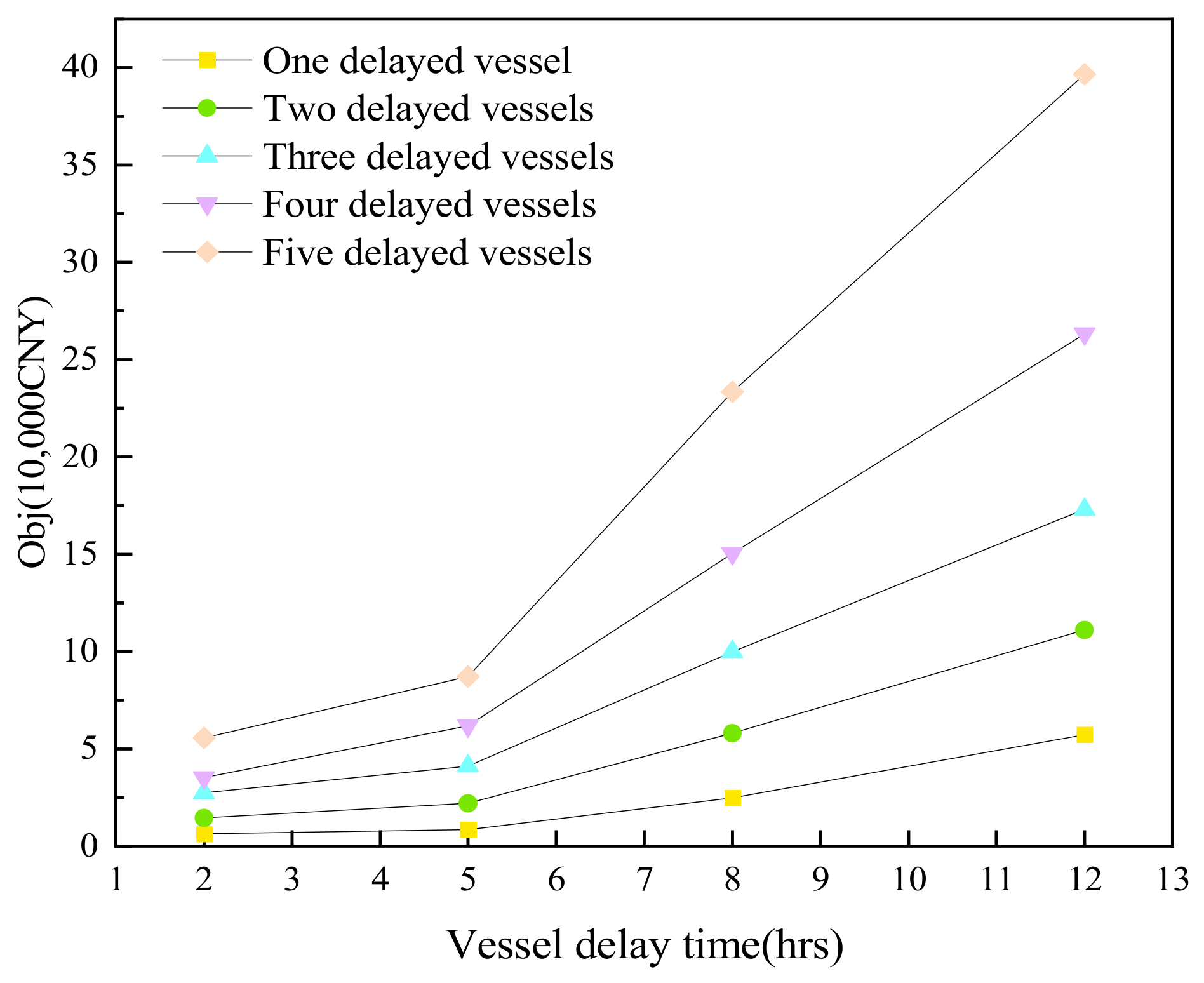
In Experiment 1, the parameters were set as follows: the total number of arriving vessels was 25, including 2 international mainline vessels, 8 international feeder vessels, and 15 domestic trade vessels. The number of delayed vessels (excluding international feeder vessels) was varied from 1 to 5, and the delay durations were set to 2 h, 5 h, 8 h, and 12 h. The total rescheduling cost was calculated for each combination, and the results are illustrated in
Figure 12.
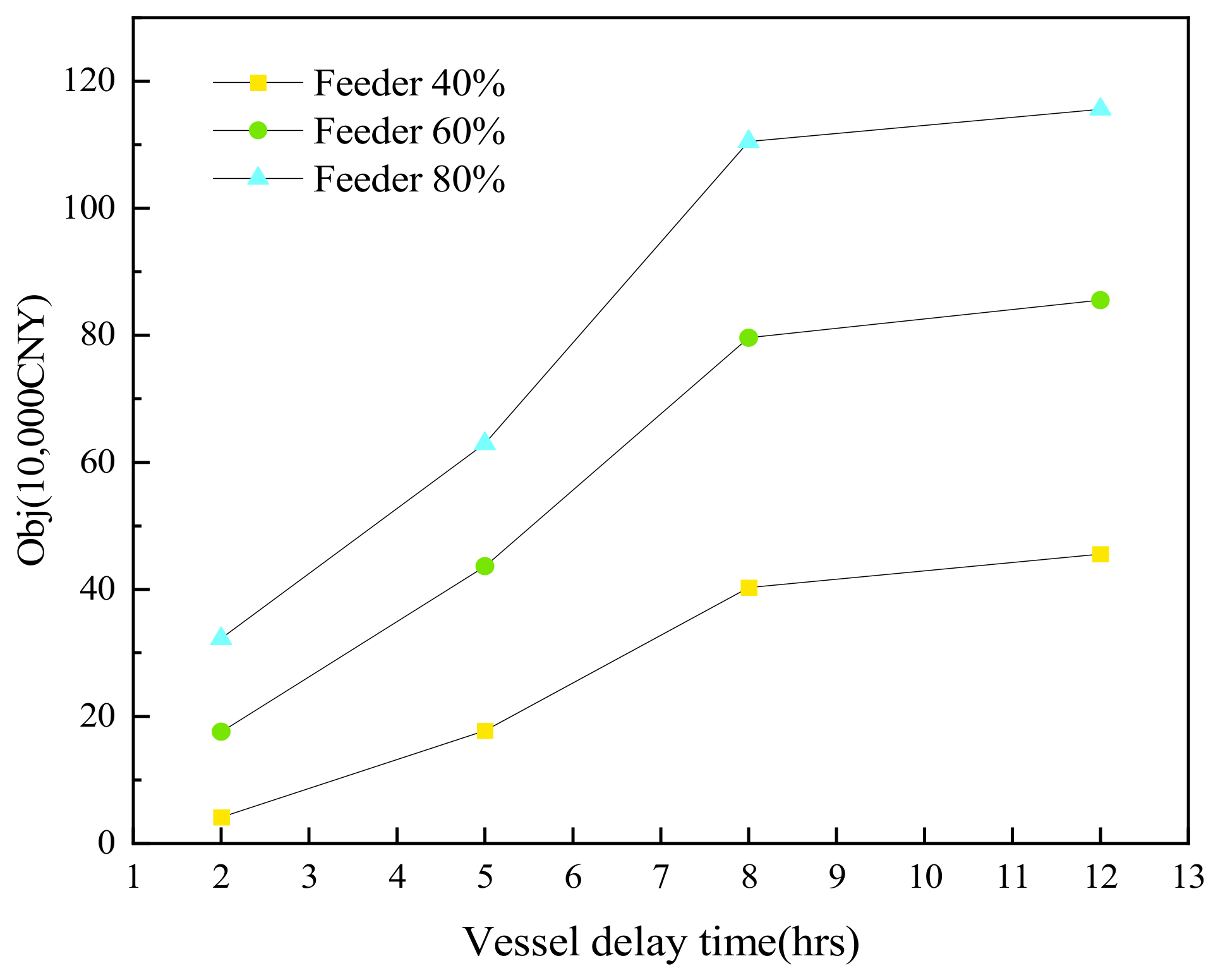
In Experiment 2, the total number of arriving vessels was kept the same as in Experiment 1. The number of delayed vessels was fixed at five, while the proportion of international feeder vessels among the delayed vessels was varied at 40%, 60%, and 80%. The delay durations were set to 2 h, 5 h, 8 h, and 12 h. The total rescheduling cost was calculated for each combination, and the results are presented in
Figure 13.
As shown in
Figure 12, when the delay duration is fixed, the total rescheduling cost increases proportionally with the number of delayed vessels. The cost increment becomes more significant as additional vessels are delayed, particularly when the number of delayed vessels exceeds three, where the objective function value rises sharply. When the number of delayed vessels is fixed, the rescheduling cost also shows a positive correlation with delay duration, and the impact on the objective function value becomes substantial once the delay duration exceeds 5 h. In summary, the number and duration of delayed vessels have a compounding effect on the total rescheduling cost, meaning that the more vessels are delayed and the longer the delay lasts, the higher the rescheduling cost will be.
As shown in
Figure 13, when the delay duration is fixed, a higher proportion of international feeder vessels among the delayed vessels results in a greater total rescheduling cost. When the proportion of delayed international feeder vessels is fixed, the objective function value increases rapidly once the delay duration exceeds 2 h. However, when the delay duration exceeds 8 h, the growth rate of the objective function value slows significantly. This indicates that when the delay duration of international feeder vessels reaches 8 h, it becomes impossible to complete the timely transshipment of cargoes to the corresponding international mainline vessels, and part of the CDO cost becomes relatively fixed. Therefore, when delays occur for international feeder vessels, prioritizing their operations can reduce waiting time and help them catch up with the departure schedule of related international mainline vessels, thereby lowering the overall CDO cost.
7. Conclusions
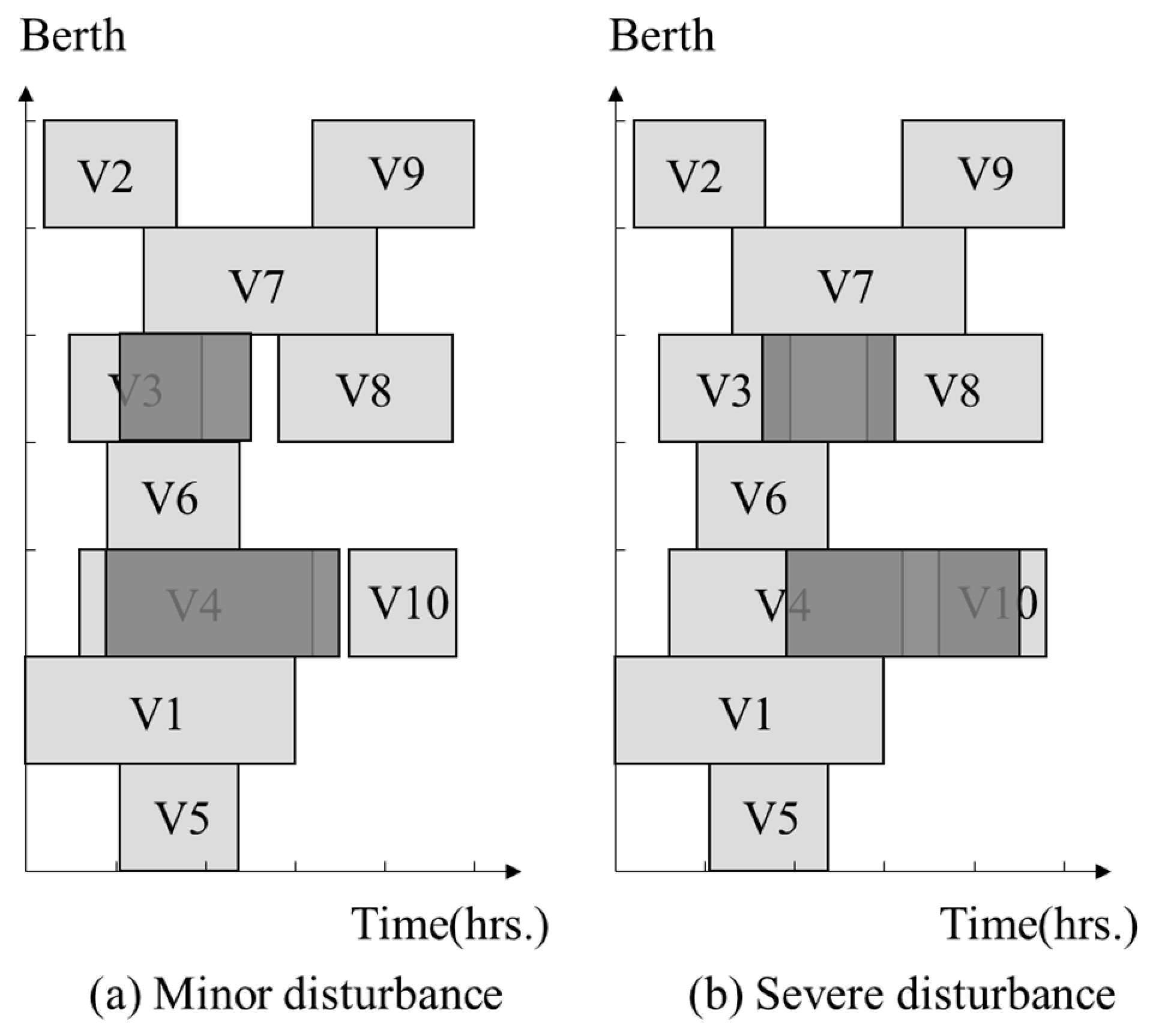
Given the increasing frequency of delayed vessel arrivals and their impact on seaside operations at container ports, this paper addresses the integrated rescheduling optimization of vessel sequencing and berth allocation under vessel delay impacts. A hybrid rolling decision mechanism is designed to adjust the rescheduling time point according to the severity of disruption. We also formulate a mathematical model that minimizes the total rescheduling cost. The model jointly optimizes vessel sequencing, berth allocation, and alternative rescheduling strategies, including NBS, CDO, and CTBS. Based on this model, we develop a tailored ALNS algorithm to generate a combined plan for vessel sequence and berth allocation after the rescheduling moment. The proposed framework can coordinately adjust both delayed and unaffected vessels according to the evolving berth and channel conditions. The results show that the proposed rescheduling scheme can effectively reduce port-side congestion and limit cost increases on the vessel side caused by delays. These findings provide a new decision-making approach for both port authorities and shipping lines in responding to vessel delay events.
The numerical experiments further demonstrate the effectiveness and practical applicability of the proposed framework. The practical-case analysis based on published port operational data shows that the proposed method can effectively coordinate different rescheduling strategies under multi-vessel delay disruptions while maintaining feasible vessel sequencing, channel navigation, and berth occupancy. The algorithm performance comparison also shows that the proposed algorithm performs favorably in both solution quality and computational efficiency compared with standard ALNS, GA, TS, and SA. In addition, the comparison with Gurobi confirms that the proposed algorithm can obtain high-quality solutions with substantially lower computational effort as the problem size increases. The sensitivity analysis shows that the number of delayed vessels, the delay duration, and the proportion of international feeder vessels among the delayed vessels all have a significant impact on the total rescheduling cost, and they introduce considerable challenges for port scheduling operations.
Therefore, to mitigate the impact of vessel delay events, ports and shipping lines should communicate in a timely manner and make full use of available berth and channel capacity to relieve congestion. In particular, timely information sharing and early identification of potential channel and berth conflicts can help reduce the propagation of vessel delays, while the coordinated use of berth reallocation and alternative rescheduling strategies can improve the utilization of limited port resources and reduce additional disruption costs.
This paper investigates the rescheduling of vessel sequence and berth allocation in a port with a one-way channel under vessel delay impacts. Future research may focus on the following direction, as vessel delays can make tugboat resources a critical factor affecting port operational efficiency, which can be incorporated into the optimization framework.