


Abstract
Nonlinear biological systems exhibit complex interactions, uncertain parameters, and strong treatment-dependent dynamics, making mathematical modeling and control essential for designing reliable therapeutic intervention strategies. This study proposes a multi-input adaptive smooth sliding mode control (AMIS-SMC) framework for regulating combined radiotherapy and chemotherapy in a nonlinear tumor–immune dynamical system described by ordinary differential equations. The proposed controller integrates a hyperbolic tangent smoothing mechanism with adaptive parameter-estimation laws to compensate for uncertainty in tumor and healthy-cell growth dynamics. In this way, the method explicitly links biological-system modeling, feedback control, treatment-dose management, and parameter adaptation within a single mathematically analyzable framework. Fundamental closed-loop properties are established analytically, including positivity and boundedness of all biological state variables, asymptotic convergence of the sliding surfaces, and explicit upper bounds on the administered radiation and chemotherapeutic drug dosages. Lyapunov-based stability analysis is used to guarantee boundedness of the closed-loop signals and convergence of the sliding manifold. Numerical simulations based on a brain-tumor case study demonstrate that the proposed AMIS-SMC algorithm achieves rapid tumor suppression while administering substantially lower treatment intensities than conventional and integral SMC approaches. Under nominal conditions, the proposed controller reduces cumulative radiation and chemotherapy dosages while maintaining effective tumor mitigation. Under mismatched parameter conditions, AMIS-SMC consistently drives the tumor-cell population toward the desired equilibrium across all tested scenarios, whereas conventional and integral SMC show limited adaptability. Statistical analysis using Mann–Whitney U and Fisher’s tests further indicates that AMIS-SMC provides an effective mathematical-control and treatment-management strategy for tumor suppression in a simplified nonlinear tumor–immune biological system under parameter uncertainty.
Keywords:
biological systems; mathematical modeling; tumor–immune model; adaptive sliding mode control; parameter identification; optimal control theory; treatment management; radiotherapy; chemotherapy; Lyapunov stability MSC:
37N25; 93C10; 93D15
1. Introduction
Recently, substantial research has been carried out to develop mathematical models that represent and predict tumor growth and proliferation dynamics, enabling the development of feedback control systems for disease management [1,2]. The most fundamental tumor models utilize a Gompertzian exponential growth function to describe tumor proliferation [3]. Similarly, a three-state system model representing tumor and healthy cells, along with the impact of a chemotherapeutic agent on them has also been proposed to understand the dynamics and proliferation of tumor mass under chemotherapy-based treatment [3,4,5]. This three-state model is further improved by utilizing the dynamics of immune cells, thus incorporating the natural response of the immune system against tumor proliferation [2,6,7,8]. The impact of radiation therapy on healthy, immune, and tumor cells has also been studied in a four-state system model [9].
Based on these proposed nonlinear tumor models, numerous control algorithms have been devised to mitigate and manage tumors [10,11,12]. Nonlinear control algorithms such as sliding mode control (SMC), super-twisting algorithm, synergetic, and state-feedback controller have been proposed in recent times to mitigate tumor cell population through controlling the chemotherapeutic drug dosage [7,12,13,14,15]. In a similar fashion, numerous variants of fuzzy logic-based controllers (FLBCs) have also been utilized, as fuzzy if–else statements designed on the basis of complex nonlinear tumor dynamics can robustly mitigate and manage this dreadful disease [6,7,11]. Similarly, optimization-based algorithms can effectively manage tumors while considering numerous realistic constraints simultaneously [4,16]. Moreover, optimization theory has also been applied to utilize multi-modal therapies concurrently to treat the menace of tumors [9,17]. Tumor management through drug and radiation regulation is a highly sensitive application of optimization and control, thus occurrence of transients in system states and control inputs is extremely undesirable [3,15]. Moreover, as tumors are inherently heterogeneous, with time, they tend to transform or develop resistance to applied treatment therapies [18]. Hence, control strategies devised for tumor management must consider such uncertainties and should adapt accordingly to limit and mitigate tumor cell population while improving patient outcomes.
This research study advances the closed-loop nonlinear smooth SMC algorithm proposed in Ref. [18] by incorporating adaptive control into a biological-system modeling and control framework. The proposed AMIS-SMC employs a five-state tumor–immune interaction model under the simultaneous influence of radiation and chemotherapeutic drug dosages as control inputs. Critical tumor-related and healthy-cell parameters may vary over time, producing tracking errors and steady-state deviations in the system response. Because these biological parameters are difficult to identify precisely during treatment, the proposed framework incorporates adaptive parameter-estimation laws within the SMC structure so that tumor mitigation can be maintained under parameter mismatch. Numerous nonlinear control strategies proposed in the recent literature are based only on chemotherapy and neglect the concurrent application of radiation for tumor mitigation. Moreover, several existing nonlinear control algorithms do not jointly establish positivity and boundedness of biological states, convergence of control surfaces, and analytical bounds on treatment dosages [4,7,8,12,15]. These gaps are addressed in this study by combining nonlinear tumor–immune modeling, adaptive feedback control, and treatment-intensity management in a single mathematical framework. The proposed algorithm also replaces the discontinuous switching component of conventional SMC with a hyperbolic-tangent smoothing function to reduce chattering and undesirable treatment transients. Therefore, the proposed method is positioned as a simulation-based mathematical-control strategy for optimizing multi-modal radiochemotherapy in an uncertain nonlinear biological system rather than as a clinically validated treatment protocol. The objective of this study is to develop and analyze an adaptive nonlinear control framework for a representative tumor–immune mathematical model. This study does not seek to establish clinical efficacy or recommend therapeutic protocols. Instead, it investigates the theoretical properties and performance of the proposed controller within a widely adopted mathematical modeling framework, thereby providing a foundation for future translational studies involving experimentally calibrated models.
- The biological model utilized in this study follows previously established tumor–immune dynamics available in the literature. Therefore, the contribution of this study does not lie in proposing a new biological model. Instead, the novelty resides in the control methodology developed around this model. Specifically, the contributions are:
- A multi-input AMIS-SMC framework is developed for a nonlinear tumor–immune biological system, integrating mathematical modeling, feedback control, and treatment-dose management under combined radiotherapy and chemotherapy.
- Adaptive parameter-estimation laws are embedded in the controller to compensate for uncertainty in tumor and healthy-cell growth dynamics, thereby addressing the parameter-identification challenge that commonly arises in heterogeneous biological systems.
- A hyperbolic-tangent smoothing mechanism is incorporated into the SMC structure to reduce chattering and treatment-dose transients while preserving robust tumor-suppression performance.
- Positivity, boundedness, and forward-invariance properties of the closed-loop biological state variables are established analytically.
- Lyapunov-based analysis proves asymptotic convergence of the sliding surfaces and supports convergence of tumor and healthy-cell populations toward their desired equilibria.
- Explicit upper bounds on radiotherapy and chemotherapy dosages are derived, providing a mathematical basis for treatment-intensity limitation within the proposed control framework.
- Simulation and statistical analyses demonstrate the adaptive capability of the proposed AMIS-SMC algorithm under matched and mismatched parameter conditions while maintaining lower cumulative treatment intensity than benchmark SMC approaches.
2. Materials
This study formulates an AMIS-SMC algorithm based on a nonlinear mathematical model of a tumor–immune biological system. The algorithm is designed to regulate radiation and chemotherapeutic drug dosages through feedback control so that tumor-cell proliferation is suppressed while healthy-cell dynamics are preserved as far as possible within the simplified model. The system parameters and variables that constitute the mathematical framework are described in this section. The section also clarifies the research objectives required for developing the proposed modeling, control, and treatment-management methodology.
2.1. Mathematical Framework
The nonlinear dynamical model utilized in this study to design the proposed control strategy is an ordinary differential equations (ODE)-based complex mathematical framework that encapsulates the intricate nonlinear interactions between system states and treatment dosages. The state variables employed by the considered mathematical system are as follows:
- T: characterizes the tumor-cell population.
- N: depicts the normal-cell population.
- I: depicts immune cells that attack tumor cells and thus represent the body’s natural immune response against tumor proliferation.
- R: indicates the accumulated radiation dosage in the body during radiotherapy.
- C: indicates the accumulated chemotherapeutic drug dosage in the body during chemotherapy.
The aim of the devised control strategy is to regulate two system control inputs for tumor management and eradication. These system control inputs are:
- : represents the administered radiation dosage to mitigate tumor cell population using the proposed AMIS-SMC.
- q: represents the administered chemotherapeutic drug dosage by utilizing the proposed AMIS-SMC feedback control framework to curb tumor progression.
2.2. System Parameters
The considered tumor–immune system model incorporates numerous system parameters, along with the above-mentioned state variables and control inputs. These parameters, variables, and inputs interact to simulate the dynamics of tumor, healthy, and immune cells under the impact of regulated radiation and chemotherapeutic drug inputs. These normalized system parameters (mentioned in Refs. [8,12,19]) are critical for simulation of disease response. These parameters are given below:
- Growth rates:
- : Tumor cell growth rate.
- : Healthy cell growth rate.
- : Immune cell recruitment rate.
- Elimination Rates:
- : Elimination rate of tumor cells by healthy cells.
- : Killing rate of tumor cells by immune cells.
- : Killing rate of healthy cells by tumor cells.
- : Killing rate of immune cells by tumor cells.
- Treatment impacts:
- : Proportion of tumor cells eradicated by chemotherapy.
- : Proportion of healthy cells destroyed by chemotherapy.
- : Proportion of immune cells eliminated by chemotherapy.
- : Proportion of healthy cells eliminated by radiation.
- Decay rates:
- Decay rates:
- : Chemo drug decay rate.
- : Radiation decay rate.
2.3. Objectives
The chief objectives of this study are as follows:
- Effective tumor eradication: robust application of multi-modal treatment strategy for tumor subjugation.
- Healthy cell proliferation: effective management of treatment dosages to enhance growth and proliferation of healthy cells naturally.
- Reduced toxic side effects: reduction in radiation and chemotherapy-related toxic side effects by effectively regulating the treatment dosages.
- Enhanced treatment efficacy: effective management of treatment-dose intensities by relying on the combined impact of radiochemotherapy while achieving intended therapeutic outcomes.
- Adaptation to tumor heterogeneity and parametric mismatch conditions: development of an adaptive control framework capable of accommodating variations in tumor and healthy cell growth dynamics, thereby ensuring consistent therapeutic performance across heterogeneous tumor conditions.
3. Methods
This section comprehensively explains the considered dynamical-system model, the proposed methodology, the derivation of the AMIS-SMC algorithm, and the simulation setup. The considered approach manages tumor growth and subjugates the tumor mass by regulating radiation and chemotherapeutic drug dosages simultaneously using feedback control.
3.1. Dynamical Nonlinear Model and System Parameters
As suggested by the Stupp protocol, the concurrent impact of radiation and chemotherapy is more effective and detrimental for tumor progression [20,21]. The tumor–immune dynamical model considered by this study is outlined in System (1). The model integrates the dynamics of both chemotherapy and radiation therapy along with their impact on tumor, healthy, and immune cells. The considered mathematical model is based on the system dynamics suggested in Refs. [2,6,8], integrating both radiation and chemotherapeutic drug dosages as the system’s control inputs.
The ODE-based mathematical model presented in System (1) utilizes normalized system parameters, proposed in Refs. [4,7,9,11,22]. The system of ODEs presented by System (1) is locally Lipschitz on . Hence, the system manifests a unique maximal solution for each nonnegative initial condition. The considered system represents a population-level depiction of tumor progression and treatment dynamics, contemplating the overall impacts of radiation and chemotherapy instead of their interaction on cellular or molecular levels. The system parameters utilized in System (1), along with their brief explanation and units of measurement, are provided in Table 1.
Table 1.
System parameters.
In the considered system model, presented in System (1), T, N, and I represent tumor, healthy, and immune cells, respectively. The state R represents radiation absorbed by the body over time throughout the procedure and is controlled by the administered radiation dosage . Similarly, the chemotherapeutic drug present within the system is represented by the state C, which is controlled by the chemotherapy dosage input q. In previous similar studies, these above-mentioned model parameters are assumed to be constant during the treatment duration [4,7,9,11,22]. However, in this study, the parameters and , representing the growth rate and carrying-capacity contribution of tumor cells, are considered to be estimated values, as tumors are heterogeneous and can exhibit varying parameter sets. Similarly, the parameters and , representing the intrinsic growth rate and carrying-capacity contribution of healthy cells, are also considered to be estimated values. Thus, in this study, it is assumed that these four parameters are not exactly known so that the proposed adaptive control framework may accommodate these unknown variations in the growth dynamics of tumor and healthy cells while effectively mitigating the tumor-cell population and achieving the intended therapeutic outcomes. Additionally, the model presented in System (1) should be regarded as a simplified and clinically motivated representation devised for feedback-control design, rather than as a biological disease-prognosis system.
The adaptive estimation is restricted to the intrinsic growth rates and carrying capacity-related parameters because these quantities determine the underlying logistic growth dynamics of the tumor and healthy cell populations and are expected to exhibit the greatest patient-to-patient variability. The remaining interaction and treatment-related parameters are assumed to remain constant over the treatment interval, consistent with the assumptions of the adopted biological model. This choice also limits the dimensionality of adaptive law, thereby reducing computational complexity and avoiding unnecessary parameter identifiability issues while maintaining satisfactory closed-loop performance.
The tumor–immune dynamics considered in this work are based on an established mathematical modeling framework that has been extensively employed in nonlinear tumor-control research. In particular, the logistic growth representation of tumor cells originates from classical studies in which logistic-type growth was shown to provide good agreement with clinical tumor-growth observations under the considered assumptions [23]. Subsequently, this growth law has been adopted and further developed in numerous tumor–immune interaction models, including those incorporating chemotherapy, radiotherapy, and optimal control strategies [9,24,25]. Therefore, the present study does not seek to introduce or clinically re-validate the biological model itself. Instead, it adopts this well-established mathematical framework as a benchmark for developing and analyzing the proposed AMIS-SMC algorithm. Similarly, the adopted model is also utilized to facilitate comparison with the existing nonlinear control approaches.
Although the underlying growth law has been motivated by clinical observations and has been widely adopted in the mathematical oncology literature, the objective of the present work is the development and theoretical analysis of a robust nonlinear control algorithm. Consequently, the simulation results presented in this study should be interpreted as mathematical validation of the proposed controller within an accepted tumor–immune modeling framework rather than as direct evidence of clinical efficacy. Experimental calibration against clinical or biological data is beyond the scope of the present study and constitutes an important direction of future research.
3.2. Basic Properties of System Model
The tumor–immune mathematical model given by System (1) exhibits two fundamental properties of positivity and boundedness. These properties are utilized in subsequent analysis provided in this study and, hence, are stated and proved below:
Assumption 1
(Regularity). Considering nonnegative model parameters, the right-hand side of the system of equations provided in System (1) is locally Lipschitz on . Hence, this implies that there must exist a unique maximal solution for any considered nonnegative initial conditions.
Lemma 1
(Positivity). Consider the nonlinear model provided in System (1) with state vector . Assume that the initial conditions satisfy
and the control inputs and are measurable and nonnegative for all .
If the system dynamics satisfy whenever , then the solution remains nonnegative for all , i.e.,
Proof.
Consider the system of equations provided in System (1) with nonnegative initial conditions, i.e.,
Assume that the control inputs and are measurable and nonnegative for all . To establish positivity, the behavior of each state variable on the boundary of the nonnegative orthant is examined. Consider any state such that at some time . By analyzing System (1), it can be observed that the corresponding dynamics (or state derivative) satisfies:
since all system parameters or interaction terms and inputs are nonnegative.
This implies that the vector field associated with the system either points inward or is tangent to the boundary of the nonnegative orthant. Therefore, none of the state trajectories can cross into the negative region. Thus, starting from nonnegative initial conditions, all state variables remain nonnegative for all , i.e.,
This concludes the proof of system positivity. □
Lemma 2
(Boundedness). Assume that the therapeutic control inputs, α and q, satisfy the following admissibility conditions:
where and denote finite upper bounds on the administered radiation and chemotherapy dosages, respectively. Then, for every nonnegative initial condition, all trajectories of the nonlinear tumor–immune system remain bounded in the positive orthant. In particular, there exist positive constants, i.e.,
for every t≥ 0.
Proof.
To establish boundedness of the biological system states, each subsystem can be examined separately. For the tumor-population dynamics:
Since all subtraction terms are nonnegative, it follows that:
The right-hand side of Equation (3) corresponds to a standard logistic-growth system, with its solution bounded above by the carrying capacity . Therefore, it follows that:
Applying the same argument to the healthy-cell dynamics yields:
which guarantees that:
Similarly, the immune-cell dynamics satisfy:
Because the recruitment term remains finite, while the remaining terms are dissipative, the immune cell population is also uniformly bounded. Thus, there exists a constant > 0, such that
For accumulated radiation dynamics, using the boundedness of control inputs, it can be written as:
By comparison arguments for first-order linear systems,
Likewise, for chemotherapeutic drug concentration,
Consequently, all system state variables remain confined within a compact positively invariant region of the state space. Therefore, the nonlinear tumor–immune dynamical system is uniformly bounded for all admissible therapeutic inputs. □
3.3. Proposed Control Methodology
Recently, a multi-input smooth sliding mode controller (MISSMC) has been proposed to mitigate tumor cell population effectively using combined radiochemotherapy [18]. This study advances the strategy devised for the design of MISSMC by incorporating adaptive control within its framework. Due to the varying nature of tumors, tumor-related critical system parameters can vary over time, which, from a control perspective, may introduce tracking as well as steady-state errors, thus necessitating the incorporation of adaptive control law against such critical system parameters. The considered mathematical dynamics of tumor cell population, provided in System (1), are mainly governed by tumor growth rate (denoted as ) and carrying capacity (denoted as ). In fact, the parameter and the ratio govern tumor progression in System (1). Similarly, the parameters and the ratio govern the growth dynamics of healthy cells. Thus, the adaptive control law proposed in this study is devised to negate the impact of variation in these four (, , , and ) system parameters to ensure effective tumor mitigation. The proposed Adaptive-MISSMC (AMIS-SMC) algorithm utilizes a nonlinear tumor–immune system dynamical model to suppress tumor proliferation using concurrent application of regulated radiation and chemotherapeutic drug dosages. The proposed adaptive feedback algorithm is exhibited in Figure 1. The devised control strategy regulates the treatment dosages to ensure their safe and effective administration for tumor mitigation. Integration of adaptive control within the framework of robust SMC-based strategy is particularly advantageous for sensitive biomedical application, as it ensures reliable performance under modeling uncertainties, varying system dynamics, and external disturbances.
Figure 1.
Tumor reduction using proposed closed-loop methodology.
Nonlinear control algorithms are intrinsically robust, and thus they tend to converge system response to desired equilibrium as swiftly as possible [7]. This rapid convergence leads to the occurrence of transient oscillations in system state dynamics, which is undesirable, specifically, in sensitive biomedical applications [15]. Similarly, a conventional sliding mode algorithm comprises a nonlinear switching function that inherently introduces chattering in control inputs and consequently in system dynamics. Thus, this study proposes incorporation of a hyperbolic-tangent-based smooth switching function that guarantees effective attenuation of chattering and transients. In addition to ensuring positivity and boundedness of system states, this study also presents analytical bounds on treatment dosages, which the other recent tumor management algorithms fail to establish [4,7,8,12,15]. Additionally, the multi-modal approach, utilized in this study, effectively facilitates co-reliance on both radiation and chemotherapy and thus limits excessive treatment-related toxicity by proficiently managing the treatment dosages. Hence, the proposed anti-tumor strategy offers a safe and reliable mechanism to manage tumor progression due to its adaptive, transient-reducing, and multi-modal approach.
3.4. Control Objectives
The main objective of this study is to devise an effective control algorithm that proficiently mitigates tumor cell population. However, to formulate a more practical approach, the proposed control strategy incorporates adaptive law so that any variation in tumor growth or proliferation parameters may be effectively dealt with. Thus, numerous control objectives considered by this study are the following:
- Effective tumor eradication: reduction of tumor cell population to very low levels ().
- Healthy cell proliferation: preservation of normal healthy cells by administering appropriate therapy dosages while avoiding excessive treatment-related toxicity.
- Decrease in treatment toxicity: reduction in total administered radiation and chemotherapeutic drug dosages by effective utilization of multi-modal approach.
- Suppression of transients: introduction of smooth switching control function to reduce chattering and other transient oscillations to ensure patient safety and comfort.
- Adaptation against tumor growth and proliferation: incorporation of adaptive control law within the framework of smooth SMC to negate the impact of system parameter variation and effectively mitigate tumor cell population.
3.5. Design of Multi-Input Adaptive Smooth SMC
The main aim of the proposed multi-modal anti-tumor strategy is to reduce tumor cell population while promoting growth and stabilization of healthy cell population. This goal is realized through efficient and simultaneous management of radiation and chemotherapeutic drug administration by employing the proposed AMIS-SMC algorithm. The devised strategy is based on the framework of conventional SMC, which utilizes the information of system states to compute treatment dosages so that the control objectives may be achieved. However, conventional SMC produces transients in control inputs, which are undesirable, especially in sensitive applications such as drug regulation. Thus, the proposed approach utilizes a hyperbolic tangent function-based smooth switching agent to reduce switching transients of SMC. Moreover, the robustness and effectiveness of conventional SMC is dependent on exact measurements of system states and the information of system state parameters. In case of parametric variation or model uncertainties, the performance of conventional SMC degrades, which motivated the design of an adaptive control strategy that has the robustness of SMC, smoothness of hyperbolic tangent function, and adaptive capabilities against parametric variations in critical system parameters. The proposed closed-loop feedback process that integrates all these three features within the framework of SMC is illustrated in Figure 2.
Figure 2.
Closed-loop control using adaptive multi-input smooth SMC.
Control Law Derivation and Main Stability Theorem
As the system considered in this study is multi-input (as mentioned in System (1), two distinct sliding surfaces are considered, which are given below:
where and represent the desired values for the states T and N. As the main goal of this study is to mitigate tumor cell population, is considered to be 0. Whereas, the maximum value for normalized healthy cells is considered to 1, thus the reference value for healthy cell population, i.e., , is 1. Similarly, , , , and are the positive definite design constants or weights of the respective sliding surface. Let:
where, , , , and are the actual values of the parameters: (which are assumed to be not exactly known in this study) , , , and , respectively. In other words, to simplify the adaptive-control derivation, the uncertain parameters , , , and are re-parameterized as , , , and .
Since and are constants, the time derivative of sliding surfaces and using Equations (1) and (12)–(17) becomes:
Let
where, , , , and are the errors between the estimated and actual values of the parameters , , , and , respectively. To analyze the stability of the system, consider the following Lyapunov functions:
where, , , , and are positive definite constants. Time derivative of and yields:
Consider:
Let
To ensure that the system trajectory reaches the considered sliding surfaces and remains confined within them at all times, consider:
Thus, the time derivative of the candidate Lyapunov functions will become negative definite, i.e.:
where , , , and are the positive-valued design constants. The parameters and determine the steepness of the hyperbolic-tangent function. The control law for radiation and chemotherapeutic drug administration can be computed by utilizing Equations (38) and (39):
Theorem 1
(Asymptotic Convergence of Sliding Surfaces under AMIS-SMC). Consider the tumor-growth system model, provided in System (1), together with the sliding surfaces, considered in Equations (12) and (13), the devised adaptive laws (Equations: (32)–(35)), and the formulated control laws, in Equations (42) and (43), where the controller design constants , , , , , , , > 0 (i.e., positive), then:
- All closed-loop signals (, , , , , ) remain bounded.
- The cumulative Lyapunov function given by:is positive definite and satisfies:.
- The sliding variables converge asymptotically to the origin:.
- Therefore, the sliding manifold is globally asymptotically stable.
Proof.
Consider the following positive definite and radially unbounded cumulative Lyapunov function:
The time derivative of the cumulative Lyapunov function , along the closed-loop trajectories, yields:
Since
this implies that:
Each term on the right-hand side of Equation (45) is nonnegative and vanishes only at the origin, i.e.,
Hence, the sliding manifold is globally asymptotically stable. Moreover, as:
Thus, using Equation (49), we obtain:
Likewise,
Therefore,
Hence, under Lemmas 1 and 2 (positivity and boundedness of system states), the adaptive controls and adaptation laws guarantee boundedness of . Consequently, all closed-loop signals and system states remain bounded. □
Remark 1
(Parameter Convergence). The Lyapunov analysis provided in Theorem 1 guarantees boundedness of the parameter estimation errors and asymptotic convergence of the sliding surfaces. However, convergence of the estimated parameters to their true values is not established because the persistence of excitation condition is not assumed in the present study. Consequently, the adaptive law should be interpreted as a mechanism for uncertainty compensation, rather than exact parameter identification. Once the sliding variables converge to zero, the adaption law naturally ceases updating the parameter estimates. If new modeling uncertainties or parameter variations arise during subsequent operation, the resulting tracking error reactivates the adaptive law, allowing the controller to continuously compensate for bounded uncertainties while preserving closed-loop stability.
Theorem 2
(Treatment Dosage Bounds). Assume that:
- The states T, N, I, R, C are positive and bounded.
- The parameter estimates , and are bounded.
- The controller gains .
Proof.
According to Lemmas 1 and 2, all states are positive and bounded, thus there exist constants , such that
Likewise, bounded parameter estimates imply:
Since , thus:
Similarly,
Also,
Moreover, as and from Equations (28) and (29) consist of bounded states and bounded parameters:
Hence, by utilizing Equations (42), (43), and (59)–(62), it can be deduced that:
and:
Consider and , then Equations (63) and (64) can be written as:
Thus, the administered radiation and chemotherapeutic dosages remain bounded. □
4. Simulation and Results
This section evaluates the performance and effectiveness of the proposed AMIS-SMC algorithm under the impact of model uncertainties while achieving the objective of mitigation of tumor cell population.
4.1. Simulation Setup
The following initial conditions of system states have been considered throughout this study: = . Thus, the initial value for tumor cell population is deliberately opted to be high, whereas the initial healthy cell population is kept low. Moreover, the initial values of radiation and chemotherapeutic drug concentration within the system are also set to zero. As mentioned in Section 3.1, this study assumes that the numerical values of parameters and , representing growth rate and carrying capacity of tumor cells, are not exactly known. Similarly, the parameters and , representing growth rate and carrying capacity of healthy cells, are also not known. Instead, this study assumes that the designed controller has the information of estimated values of these parameters only. The proposed algorithm adapts the control actions accordingly to accommodate these model uncertainties in tumor and healthy cell dynamics while ensuring tumor cell reduction. Thus, it is explicitly stated that the proposed AMIS-SMC algorithm has no information of any parameter mismatch throughout this simulation study. However, to substantiate the effectiveness of the proposed AMIS-SMC algorithm, two different sets of simulations have been performed. For the first set of experiments, the estimated and actual values of parameters , ’’, , and have been kept the same (as mentioned in Table 1) so that the simulations may result in a more realistic comparative analysis between the considered algorithms. However, for the next set of experiments, the numerical values of the above-mentioned parameters have been varied so that the adaptive capabilities of each considered algorithm can be scrutinized. It is important to note here that, for each performed experiment, the experimental and initial conditions for any considered algorithm have been kept exactly identical so that the achieved results may clarify the performance and comparison metrics for each algorithm. Furthermore, it should be noted that all simulations are performed using parameter values reported in the literature so that the performance of the proposed controller can be evaluated under standardized benchmark conditions commonly employed in tumor-control research. The simulations are intended to assess the mathematical behavior and robustness of the proposed controller and should not be interpreted as clinical treatment predictions.
4.2. Environment
The nonlinear system of equations provided in System (1) as well as the proposed AMIS-SMC algorithm have been simulated using MATLAB R2016a. Similarly, to establish the effectiveness of the proposed algorithm, its performance is analytically and statistically compared with conventional SMC and integral SMC algorithms. These comparisons have also been established based on simulations performed using MATLAB R2016a.
Controller Design Parameters
The design procedure of the proposed AMIS-SMC algorithm provided in Section 3.5 utilizes a number of controller design parameters. The numeric values of these constants shape and determine the transient as well as steady-state response of the overall closed-loop system. In this study, the controller design constants were selected using trial-and-error, with the primary objective of effective tumor reduction by adapting to model uncertainties while observing clinically motivated constraints on chemo drug and radiation dosages . The controller gains employed in this simulation study are provided in Table 2.
Table 2.
Model parameters and controller gain values used in simulations.
These selected gains have been tuned to suppress excessive transients while ensuring swift convergence to achieve effective tumor reduction. It is pertinent to differentiate between variation in transient characteristics of the system and its stability. Even though numerical tuning has been utilized to select a feasible gain set, the robustness and stability of the system arises from the inherent sliding mode framework of the proposed algorithm and its adaptive capabilities to negate the impacts of model uncertainties. Thus, the closed-loop system remains stable and ensures effective tumor suppression in the presence of bounded parameter variations and model uncertainties.
4.3. Performance Comparison Framework
The performance of the proposed AMIS-SMC algorithm is evaluated based on the following criteria:
- Reduction in overall administered dosages of radiation and chemotherapeutic drug during the course of combined therapy.
- Adaptation to model uncertainties, especially to the variations in growth rates and carrying capacities of tumor and healthy cell dynamics.
- Effective and swift convergence of healthy and tumor cell populations to their desired values.
Similarly, the controller performance is also evaluated qualitatively to highlight the following special features of the proposed controller:
- Transient-free administration of treatment dosages and smooth system response.
- Reduction in toxic side effects of treatment therapy through effective administration of control inputs.
- Successful mitigation of tumor cell population and convergence of treatment dosages to zero.
- Swiftness in decimation of tumor cell population.
4.4. Bench-Marking
Based on the framework provided in Section 4.3, this study establishes comprehensive comparative analysis between AMIS-SMC and recently proposed algorithms for tumor mitigation. These recently proposed algorithms include state-feedback, FLBC, supertwisting, nonlinear synergetic controller, twin delayed deep deterministic (TD3), etc.
4.5. Results: @ Estimated Parametric Values = Actual Parametric Values
Figure 3 depicts the dynamics of system states under the impact of the three considered control algorithms, i.e., the proposed AMIS-SMC, conventional SMC, and integral SMC. Figure 3a illustrates the dynamics of tumor cell population, whereas Figure 3b shows the curves of healthy cell population under the impact of AMIS-SMC, conventional SMC, and integral SMC. Similarly, the dynamics of radiation and chemotherapeutic drug over time have been displayed in Figure 3c and Figure 3d, respectively. As depicted in Figure 3a, all the controllers successfully and effectively reduced the tumor cell population, yet the proposed AMIS-SMC algorithm outperformed conventional and integral SMC. Under the impact of AMIS-SMC, the tumor cell dynamics reach the desired steady-state value in about ten days, whereas the conventional and integral SMC algorithms took around twenty days to converge tumor cell population to zero. A similar trend can be observed for healthy cell dynamics depicted in Figure 3b. Similarly, by observing the dynamics of states ‘R’ and ‘C’, depicted in Figure 3c,d, it can be analyzed that the proposed AMIS-SMC algorithm effectively converges the control dosages once the controller objectives have been achieved. However, the conventional and integral SMC failed to respond efficiently in comparison. In fact, as observed in Figure 3d, the conventional SMC algorithm introduced unwanted transients in system dynamics, even after converging the states ‘T’ and ‘N’ to their desired steady-state values.
Figure 3.
(a) Tumor, (b) healthy cell dynamics, (c) radiation over time, and (d) chemo drug concentration over time using conventional, integral SMC, and proposed AMIS-SMC.
Figure 4 depicts and compares the control inputs administered by each of the three considered algorithms. Figure 4a depicts the daily chemotherapeutic dosages (‘q’), whereas the administered radiation dosages (‘’) have been shown in Figure 4b. Again, the most important observation that can be made by analyzing Figure 4a,b is the inability of conventional and integral SMC algorithms to converge administered radiation and chemotherapeutic drug dosages to zero. Another important observation that can be made by analyzing both Figure 4a,b is the smooth administration of treatment dosages and their transient-free convergence to zero after fulfilling the control objectives. This effective management of input dosages naturally results in reduced treatment-related toxicity, as it can impact the outcome of combined therapy adversely. An algorithm that results in higher administered dosages will eventually lead to elevated levels of treatment-induced toxicity, and thus it poses a higher risk for the patient under consideration. Thus, even though all three algorithms, in the simulation environment, reduced the tumor cell population and resulted in proliferation of healthy cell population, the proposed AMIS-SMC achieved these results while utilizing much lesser dosages of radiation and chemotherapeutic drug.
Figure 4.
(a) Comparison of radiation and (b) chemotherapy control inputs for conventional, integral SMC, and the AMIS-SMC.
4.6. Results with Estimated Parametric Values ≠ Actual Parametric Values
Even though the proposed AMIS-SMC algorithm performed very well under consistent and matched parametric settings, convergence of system states to their desired respective values under mismatched conditions with parametric uncertainties is the actual challenge. As mentioned in Section 3.1, the main innovation of this study is to devise an adaptive strategy that can reduce tumor cell population, especially when the values of some critical system parameters are not correctly known. This research effort considers four such parameters so that the designed algorithm may accommodate and compensate the impact of model mismatch and converge the system to its desired steady-state conditions. According to Table 1 and Section 3.5, the exact values of these system parameters are (intrinsic growth rate of T); ; (intrinsic growth rate of N); and . However, to test the adaptive capability of each considered control algorithm, this section utilizes different sets of above-mentioned parameters. Figure 5 depicts the dynamics of states T and N for each of the considered control algorithms, including the proposed AMIS-SMC, under different estimated values of these parameters to reflect the scenario of parametric mismatch and model uncertainties. It is important to note that the mathematical model presented in System (1) is simulated by utilizing exactly the same parameter values presented in Table 1. However, the controllers do not have any information about the exact parametric values of , , , and . Instead, the controllers compute their respective control actions by utilizing the estimated values of these parameters (denoted in this study as , , , and ).
Figure 5.
Controller performance comparison under mismatched parametric conditions: (a) T and N at , , , ; (b) T and N at , , ; (c) T and N at , , , ; (d) T and N at , , , .
Figure 5a depicts the dynamics of states T and N under the impact of different control laws when the following estimated values of above-mentioned critical parameters were utilized: , , , and . Similarly, in Figure 5b, the dynamics of states T and N have been recorded when , , , and . The values of these estimated parameters utilized to record the dynamics in Figure 5c are , , , and , whereas, for Figure 5d, these values are , , , and . By analyzing these dynamics, it can be observed that the state responses attained by employing the proposed AMIS-SMC algorithm successfully converge to the desired steady-state values, even when there is a large mismatch between the actual and estimated system parameters. Moreover, apart from exceptional adaptive capabilities, the proposed AMIS-SMC algorithm maintained proficient system transient response, depicting smooth and transient-free dynamics of system states. On the contrary, conventional and integral SMC algorithms displayed robustness against model uncertainties only under certain specific circumstances that result in computation of large input dosages of the treatment therapies. In such scenarios, the toxic side impacts of treatment therapies can become a significant issue, undermining the advantages of utilizing feedback controllers for such sensitive applications. Thus, conventional and integral SMC can compensate for minor uncertainties or small mismatching of system parameter values. However, the proposed AMIS-SMC algorithm successfully manages all such parametric variations efficiently while fulfilling the control objectives.
To further validate the adaptive capabilities of the proposed AMIS-SMC algorithm, numerous observations have been recorded at different estimated parametric values: , , , and . The dynamics of states T and N obtained by employing the proposed AMIS-SMC algorithm for different random values of parameters , , , and have been depicted in Figure 6. A total of ten such results have been recorded and shown in Figure 6. The conditions or parametric values of , , , and , at which these simulations are performed, have been provided in Table 3. Similarly, another important control objective utilized in Section 3.5 revolves around converging the sliding surfaces to zero. Convergence of sliding surface, provided in Equation (12), to zero implies that not only the state T converges to zero, but it also ensures the convergence of state R to zero (after successful reduction in tumor cell population).
Figure 6.
Tumor and healthy-cell dynamics under varying values of , , , and . Curves for cases (g)–(i) are present; portions overlap because the corresponding responses are closely similar.
Similarly, the sliding surface utilized in Equation (13) also ensures the convergence of both states N and C to their respective steady-state values. Hence, Theorem 1, provided in Section 3.5, provides theoretical proof that ensures stability of the closed-loop system through the convergence of sliding surfaces to zero. This phenomenon is depicted in Figure 7, where different parametric values of estimated parameters , , , and (provided in Table 3) have been utilized to obtain the dynamics of the sliding surface. Thus, Figure 7 provides simulation-based evidence of the convergence of sliding surfaces to zero.
Figure 7.
Sliding surface convergence. Curves for cases (g)–(i) are present; portions overlap because the corresponding responses are closely similar.
4.7. Proposed Algorithm vs. Optimal Control
To further evaluate the effectiveness of the proposed AMIS-SMC algorithm, a nonlinear model predictive control (MPC) benchmark was implemented using the same tumor–immune model, identical sampling interval, treatment constraints, and initial conditions. The MPC optimization problem was formulated as a finite-horizon nonlinear optimal control problem and solved at each sampling instant using MATLAB’s built-in fmincon solver. A prediction horizon of was adopted with a sampling period of days. The optimization objective minimizes the tumor population while simultaneously penalizing deviations of the healthy population from its desired value and limiting the administered radiation and chemotherapy doses. The stage cost is defined as:
where and . The weighting coefficients were selected as , , , and .
Figure 8 compares the response of the proposed AMIS-SMC and the nonlinear MPC. Both controllers successfully suppress tumor growth during the initial treatment phase, demonstrating their capability to regulate the nonlinear tumor–immune dynamics. However, important differences can be observed in their long-term behavior. Although the nonlinear MPC rapidly reduces the tumor population, a small residual steady-state error can be observed, as illustrated in the enlarged view of Figure 8. While the residual tumor level is small, it indicates that the benchmark MPC does not explicitly enforce asymptotic convergence of the tumor state. From a biomedical perspective, even a small remaining tumor cell population may be clinically significant because surviving tumor cells can proliferate and contribute to disease recurrence, particularly in the presence of treatment-resistant or adaptive tumor phenotypes. In contrast, the proposed AMIS-SMC asymptotically drives the tumor population to the desired equilibrium without observable steady-state error.
Figure 8.
Proposed AMIS-SMC vs. nonlinear MPC.
The healthy cell dynamics further demonstrate the effectiveness of the proposed controller. Both approaches preserve healthy cell tissue during treatment; however, the AMIS-SMC algorithm maintains the healthy-cell population closer to the desired reference value throughout the steady-state period. Whereas the nonlinear MPC converges to a slightly lower equilibrium value. Consequently, the proposed controller achieves improved steady-state tracking performance while simultaneously suppressing tumor growth.
The treatment profiles also reveal fundamentally different control philosophies. The nonlinear MPC computes the treatment sequence by repeatedly solving a finite-horizon constrained optimization problem and therefore produces an aggressive initial treatment followed by optimization-based adjustments. Conversely, the proposed AMIS-SMC algorithm generates adaptive control actions directly from the nonlinear control law and the adaptive parameter update mechanism. As the system states converge to their desired reference, the sliding surface converges asymptotically to zero according to Lyapunov stability analysis provided in Theorem 1. Consequently, the control inputs gradually decrease toward zero as the treatment objective is achieved, thereby eliminating unnecessary therapeutic intervention during steady-state phase.
It should be emphasized that the theoretical properties of the two controllers differ substantially. The proposed AMIS-SMC is accompanied by a Lyapunov-based stability proof establishing asymptotic convergence of the sliding surfaces and the corresponding tracking errors, despite the presence of parametric uncertainties. In contrast, the benchmark nonlinear MPC relies on repeated numerical optimization over a finite prediction horizon and, in its present formulation, does not explicitly provide an asymptotic convergence guarantee. Moreover, the MPC requires solution of a nonlinear constrained optimization problem at every sampling instant, whereas the proposed controller computes the treatment inputs directly through explicit adaptive control laws. Therefore, the proposed adaptive smooth SMC achieves competitive therapeutic performance while offering theoretical stability guarantees and substantially lower online computational complexity.
4.8. Response to Treatment Interruption and Tumor Recurrence
To investigate the practicality of the proposed treatment strategy, a tumor regrowth test has been performed. To conduct this test, the therapy was suspended once the tumor burden reached a negligible level (). During the suspension period, tumor regrowth was intentionally allowed for ten days to emulate a clinical observation interval. Afterwards, the controller was allowed to automatically re-initiate the therapy, and observations have been recorded and presented in Figure 9. It can be seen that only a slight increase in tumor population was observed during the interruption period, while healthy cells remained close to their nominal value. Upon reactivation, the controller successfully suppressed the regrown tumor without requiring re-tuning of the controller parameters. These results demonstrate that the proposed framework can accommodate clinically motivated treatment interruptions while retaining its capability to respond adaptively to tumor recurrence.
Figure 9.
Tumor regrowth test.
4.9. Numerical Verification of Closed-Loop Convergence
The Lyapunov stability analysis provided in Theorem 1 guarantees the asymptotic convergence and boundedness of sliding surfaces. Figure 10 depicts this convergence of sliding surfaces when the simulation is performed by employing = 1.2, = 2.5, = 3, and = 1, respectively. According to Equation (12), the sliding surface can converge to zero if both the states T and R converges to zero. Thus, the convergence of sliding surface implies the successful convergence of tumor cell population to zero, along with the asymptotic convergence of state R and control input to zero. Similarly, the convergence of sliding surface (provided in Equation (13)) to zero implies the successful convergence of state N to the desired reference along with the convergence of state C to zero.
Figure 10.
Asymptotic convergence of sliding surfaces.
4.10. Numerical Behaviour of Parameter Estimates
As mentioned in Remark 1 (in Section 3.5), the proposed control law guarantees boundedness of the parameter-estimation errors. By analyzing Equations (12), (13), and (32)–(35), it can be observed that the dynamics of and depend directly on the sliding surface and the state T. Thus, as T approaches zero or the sliding surface converges to zero, the estimated parameters remain bounded. Similarly, the dynamics of and depend directly on the sliding surface and the state N, and both parameters remain bounded according to Theorem 1. Figure 11 depicts the boundedness of the estimated parameters when the initial estimates of , , , and were set to 1.2, 2.5, 3, and 1, respectively; the estimated parameters remain bounded throughout the simulation.
Figure 11.
Boundedness of estimated parameters.
4.11. Influence of Boundary-Layer Widths
The hyperbolic tangent function utilized in the derivation of the control law in Section 3.5 introduces boundary-layer parameters and , which govern the trade-off between control smoothness and switching aggressiveness. To investigate their influence, a sensitivity analysis has been performed by varying and while keeping all other controller parameters unchanged. The corresponding closed-loop state trajectories and control inputs are presented in Figure 12. The results demonstrate that increasing the boundary-layer widths produces only negligible changes in the tumor and healthy-cell responses, with the difference in residual tumor population remaining on the order of –. Meanwhile, slightly lower treatment intensities are observed for larger boundary-layer widths, indicating smoother control action. This behavior is primarily attributed to the adaptive sliding-mode structure together with the bounded treatment strategy established in Theorem 2, which ensures that the administered radiotherapy and chemotherapy remain within the prescribed normalized limits while preserving closed-loop stability. Consequently, the proposed controller exhibits low sensitivity to moderate variations in and while maintaining effective tumor suppression.
Figure 12.
Sensitivity analysis of boundary layer parameters.
4.12. Response Under Noisy Tumor-State Measurements
To evaluate the performance and robustness of the proposed algorithm against measurement uncertainty, additive Gaussian measurement noise was introduced into the state variable T, which is supplied to the controller, while the system dynamics remain unchanged and unaffected by this noise. Specifically, the measured tumor state was modeled as , where ∼ represents zero-mean Gaussian noise. Three noise levels corresponding to 5%, 10%, and 15% measurement uncertainty were investigated. It should be noted that the introduced noise affects only the controller inputs, thereby emulating inaccuracies in clinical measurements, whereas the plant model itself remains deterministic.
Figure 13 illustrates the closed-loop responses under different measurement noise levels. The proposed control algorithm maintains stable tumor suppression and healthy-cell recovery despite the presence of noisy measurements. Even under the highest investigated noise level (15%), the tumor is successfully driven toward the desired equilibrium with only minor deviations from the nominal response.
Figure 13.
Robustness against measurement noise.
4.13. Statistical Analysis
This section statistically evaluates and thus validates the effectiveness and performance of the proposed AMIS-SMC algorithm. For this statistical analysis to assess algorithm performances, numerous independent Mann–Whitney U tests have been performed. These tests evaluate reduction in overall dosages of administered radiation and chemotherapeutic drug. Similarly, three independent Mann–Whitney U tests have been performed to evaluate which of the considered control algorithms significantly reduces the therapy duration for tumor mitigation. Lastly, two Mann–Whitney U tests have been performed to assess the adaptive capability of each of the three considered control algorithms (in Section 4.6). The algorithm proposed in this study is devised to negate and compensate for parametric uncertainties, whereas, as depicted in Section 4.6, conventional and integral SMC are not robust enough to effectively compensate for each parametric variation and uncertainties. Thus, the statistical analysis presented in this section is performed to assess the performance of three considered algorithms (AMIS-SMC and conventional and integral SMC) under both matched and mismatched parameter scenarios. To conduct the first set of statistical evaluations, the experiment performed in Section 4.5 is conducted repeatedly by slightly modifying the initial conditions for the two system states, T and N, while keeping the estimated parametric values of , , , and equal to their actual considered values, i.e., no parametric mismatch. The observed results are hence recorded to perform the first set of statistical analysis. For these experiments, the recorded data are organized in the form of three distinct groups, where each group represents each of the three controllers. Each group contains thirty-one elements. Similarly, the next set of statistical evaluations are conducted to evaluate which of the three considered control algorithms successfully converges the tumor cell population to zero under mismatched parametric conditions. These statistical tests have been performed while keeping the initial conditions of system states constant. Whereas the estimated parametric values of , , , and have been modified slightly to test and record the system response under mismatched conditions. A total of sixty such experiments have been conducted for each of the three considered algorithms, and the statistical tests are then performed on the recorded data.
4.13.1. Test Results—Reduction in Overall Radiation ‘’ and Chemotherapy ‘q’ Dosages
In this section, the performance of proposed AMIS-SMC algorithm is validated for reducing the treatment dosages in comparison to those administered by conventional and integral SMC. A total of four Mann–Whitney U tests have been performed. The first two tests evaluate the radiation dosages , whereas the latter two tests assess the reduction in chemo dosages by the proposed AMIS-SMC algorithm in comparison to conventional and integral SMC. The first test compares the total radiation dosages administered throughout the therapy by the proposed AMIS-SMC and conventional SMC algorithm. Whereas the second test compares the total therapy radiation dosages administered by the AMIS-SMC and integral SMC algorithms. For the first test, a p-value of is observed, implying that the proposed AMIS-SMC algorithm resulted in statistically significant reduction in treatment dosage ‘’. The second test compares the performance of AMIS-SMC with integral SMC to assess reduction in overall radiation dosages administered throughout the therapy. A p-value of is observed for the second test, implying that the proposed AMIS-SMC reduced the administered radiation dosage in comparison to integral SMC. A detailed description of these two tests and the raw data are provided in Appendix A.
The third test evaluates the reduction in administration of chemotherapy dosage by the proposed AMIS-SMC algorithm in comparison to conventional SMC. On applying the Mann–Whitney U test, a p-value of has been observed. Similarly, for the fourth test, total chemotherapy dosages administered throughout the therapy have been observed for the proposed AMIS-SMC and integral SMC algorithms so that a statistical comparison is established. A p-value of has been observed for the fourth test. Thus, this implies that the proposed AMIS-SMC algorithm administered statistically significantly reduced chemotherapy dosages for the same objective of tumor mitigation. A detailed description of these two tests and the raw data are provided in Appendix A.
4.13.2. Test Results—Reduction in Treatment Duration
This section evaluates the performance of the proposed AMIS-SMC in comparison to other considered techniques on the basis of reduction in therapy time. A total of three Mann–Whitney U tests have been performed to establish this statistical comparison. The first Mann–Whitney U test statistically compares the therapy time (for tumor mitigation), taken by employing the proposed AMIS-SMC and conventional SMC. Whereas the second Mann–Whitney U test compares the tumor mitigation time taken by the proposed AMIS-SMC and integral SMC algorithms. A p-value of has been observed for the first test that compares the therapy time for AMIS-SMC with conventional SMC. Whereas a p-value of has been observed for the second test that compares the therapy time for AMIS-SMC with integral SMC. Thus, both these tests statistically validate the superiority of the proposed AMIS-SMC algorithm over conventional and integral SMC. Lastly, a third Mann–Whitney U test has also been performed that compares the time taken by the proposed AMIS-SMC algorithm for successful tumor mitigation with the time duration observed for different algorithms proposed in the recent literature. For this third experiment, a p-value of has been observed, which implies that the AMIS-SMC algorithm took significantly less time to mitigate tumor cell population in comparison to those considered algorithms proposed in the recent literature. A detailed description of these three tests along with the raw data are provided in Appendix B.
4.13.3. Test Results—Convergence of Tumor Cell Population Under Mismatched Parametric Conditions
To create the mismatched parametric conditions, the estimated values of four system parameters, , , , and , have been modified slightly to obtain sixty samples of data for each of the three considered algorithms. The generated data are collected and uploaded to a publicly available GitHub repository [26]. The initial conditions of the system remain constant throughout this experiment. The collected data contain total radiation and chemotherapeutic drug dosages for each of the three considered algorithms at different and unique sets of values for , , , and . If an algorithm is unable to converge the tumor cell population to zero, then the results for that particular set of parametric values are labeled as NC, which represents "state T did not converge to zero". The proposed AMIS-SMC algorithm converged the tumor cell population to zero for all sixty different sets of parameter values. Whereas the conventional SMC algorithm was able to achieve success in converging tumor cell population to zero twenty-eight times. Lastly, the integral SMC algorithm converged the tumor cell population thirty-two times. Thus, based on whether an algorithm is able to converge the system state T to zero or not, we can represent the data into binary, where 1 represents successful convergence and 0 depicts that the algorithm is unable to converge the system state T to zero. Fisher’s test was then performed on these collected data to compare the tumor eradication success rates of the proposed AMIS-SMC with conventional and integral SMC over these 60 Monte Carlo simulations. The proposed controller achieved a significantly higher success rate (p < 0.001). The estimated odds ratio was unbounded (OR = ∞), indicating complete separation between the two methods and demonstrating the superior adaptability of the proposed AMIS-SMC under parameter uncertainty. A p-value of has been observed for the first Fisher’s test that compares the proposed AMIS-SMC with conventional SMC. Similarly, for the second test that compares the proposed AMIS-SMC with integral SMC, a p-value of has been observed.
5. Discussion: Recently Proposed Algorithms vs. AMIS-SMC
According to the results presented and analyzed in Section 4, the proposed AMIS-SMC algorithm performed effectively, especially in the presence of mismatched parametric conditions and under model uncertainties. To further establish the efficacy of the proposed AMIS-SMC algorithm, a comprehensive comparative analysis is presented to assess the algorithm’s performance qualitatively and quantitatively relative to recently proposed control techniques.
5.1. Discussion: Qualitative Performance Comparison
The proposed AMIS-SMC algorithm is qualitatively compared with numerous recently proposed anti-tumor strategies. The criteria for this qualitative analysis include the capability of the considered control strategy to administer transient-free dosages, the employed therapy types, negative impacts of treatment therapy, convergence of treatment dosages to zero, settling time (mentioned as ST in Table 4), and the adaptive capability of the control techniques. A total of 14 different control strategies have been compared, and the comparison is presented in Table 4. It can be observed that most of the recently proposed control techniques did not consider the harmful and toxic side effects of anti-tumor therapies. Instead, almost every recently proposed algorithm is devised to mitigate tumor cell population as fast as possible, irrespective of the transients generated in control inputs or system states. By observing the transients in system dynamics, as well as the controller design procedure, the comparative analysis provided in Table 4 evaluates whether the considered anti-tumor strategy results in the smooth response to tumor proliferation or not.
Table 4.
Qualitative performance comparison with the proposed AMIS-SMC.
Similarly, the type(s) of therapy (or therapies) employed by a control strategy reflects its ability to integrate numerous treatment modalities simultaneously. As tumors are heterogeneous in nature and they can adapt to a single therapy type, utilizing and assimilating numerous treatment therapies can be very convenient, especially in practical and real-world scenarios. Based on the ability of the respective controller to manage and administer treatment dosages, its negative impact on health is assessed. If the controller keeps on pumping the treatment dosages even after the tumor cell population has been decimated, then its detrimental effects on health are marked as extremely high (mentioned as EH in Table 4). On the other hand, if the devised strategy considers administering transient free control inputs and effectively manages treatment dosages based on the tumor cell dynamics, then the harmful side effects on health caused by that particular controller are marked as very low or lowest. Similarly, ability of an algorithm to converge its treatment dosages to zero after reducing tumor cell population is explicitly mentioned in Table 4. Lastly, the therapy duration taken by any particular control strategy to reduce tumor cell population is notified as ST, which represents settling time (2% criterion).
Even though the finite-time FLBC, proposed in Ref. [11], effectively reduces tumor cell population, it administered a very high chemotherapy dosage. Moreover, the algorithm introduced large transients in system dynamics as well. Consequently, it manifested a swift anti-tumor response. Similarly, Refs. [2,9] proposed optimization-based approaches to mitigate tumor cell population. Yet, their respective cost functions only considered immediate decimation of tumor cell population, without realizing the health risks associated with this type of approach. Ref. [6] combines backstepping with an SMC-based FLBC algorithm to reduce tumor cell population, yet the study fails to mention the type of treatment therapy for which this type of algorithm can be effective. Ref. [7] proposes and compares the performances of the synergetic controller (mentioned as Ref. [7] a in Table 4), state-feedback algorithm (mentioned as Ref. [7] b in Table 4), and FLBC (mentioned as Ref. [7] c in Table 4). As the design procedure of these controllers did not consider the precautions against side effects of anti-tumor therapies, their results depict administration of high treatment dosages with transients. A similar such response was observed by analyzing the dynamics and design procedure of another variant of FLBC proposed in Ref. [4]. Ref. [27] employed the twin delayed deep deterministic (TD3) algorithm for tumor subjugation. Refs. [12,15] suggested the utilization of the nonlinear smooth super-twisting algorithm and smooth synergetic control strategy, respectively, for tumor mitigation. Similarly, Ref. [18] proposed smooth SMC (mentioned as Ref. [18] a in Table 4) and integral-smooth SMC (mentioned as Ref. [18] b in Table 4) for tumor cell population. These algorithms were designed to deliver transient-free treatment dosages effectively so that the algorithm converges control inputs to zero once tumor cell population is decimated. Moreover, the integral smooth SMC algorithm depicted limited adaptive capabilities against parametric mismatch. In actuality, the algorithm is designed to converge any steady-state errors that may arise in system states. So, strictly speaking, integral smooth SMC is not devised to perform effectively against model uncertainties. However, the proposed AMIS-SMC algorithm is purposely designed to handle conditions such as model uncertainties and parametric mismatch; thus, apart from depicting exceptional transient response, the proposed AMIS-SMC algorithm demonstrates exceptional adaptive capabilities in Section 4.
5.2. Discussion: Quantitative Performance Comparison
Table 5 presents a detailed quantitative performance comparison between the AMIS-SMC algorithm and anti-tumor strategies proposed in the recent literature. The core feature of the proposed AMIS-SMC algorithm is its adaptive capability against system parametric variations. Yet, the controller depicted remarkable transient response and significant qualitative features under both matched and mismatched parametric conditions. Table 5 provides details about the administered chemotherapy and radiation dosages , as well as the treatment duration employed by numerous algorithms for the effective reduction in tumor cell population.
Table 5.
Quantitative performance comparison with proposed AMIS-SMC.
In most cases, the algorithms devised for anti-tumor therapies decide their respective control action(s) based on the state T. Thus, they tend to reduce tumor cell population as fast as possible. Hence, as evident from the data presented in Table 5, these algorithms resulted in high dosages of control inputs.
Control strategies devised in Refs. [7,8,11,12,27] employed a chemotherapy-based approach, which not only resulted in high treatment dosages, but the utilization of a single-modality approach caused increased therapy duration. In a practical real-world scenario, this can cause severe discomfort and can have lasting consequences on patient health and safety. Whereas the control strategies devised in Refs. [15,18] and the proposed AMIS-SMC algorithm employ smoothing functions to not only limit the transients in control actions but to also eradicate tumor cell population effectively. Moreover, due to this effective multi-modal approach, the proposed AMIS-SMC algorithm is able to reduce tumor cell population swiftly without compromising its adaptive capabilities. In contrast, a control strategy such as integral SMC, as presented in Ref. [18], provides limited compensation against model uncertainties and parametric mismatch of system parameter values. Thus, the proposed AMIS-SMC algorithm outperforms recently devised control strategies both qualitatively and quantitatively, especially when tested under mismatched parametric conditions.
5.3. Discussion: Challenges and Limitations
This study addresses a key limitation identified in Ref. [18]: the difficulty of precisely measuring biological parameters that govern tumor growth, treatment sensitivity, resistance, and healthy-cell dynamics. Instead of assuming exact parameter knowledge, the proposed AMIS-SMC framework uses adaptive parameter-estimation laws to compensate for model mismatch while regulating radiotherapy and chemotherapy inputs. This is a useful mathematical advance because it connects parameter identification, nonlinear control, and treatment-intensity optimization within the same closed-loop biological-system model. Nevertheless, the present work remains a simulation-based study. The model is intentionally simplified, the parameters are normalized, and the controller is evaluated numerically rather than through experimental or clinical data. Therefore, the results should not be interpreted as evidence of clinical efficacy. The main limitations are summarized below:
- The ODE model in Section 3.1 does not represent molecular-scale tumor biology, spatial heterogeneity, pharmacokinetics/pharmacodynamics in full clinical detail, or patient-specific immune variability. Instead, the model represents population-level approximation of tumor progression, and the above-mentioned mechanisms are represented only indirectly through aggregate interaction terms.
- The proposed controller requires estimates of biological parameters and state variables. These parameter values have been adopted from previously published mathematical studies, rather than patient-specific measurements. As shown in Section 4, dosage requirements and treatment duration depend on these parametric estimates. Practical deployment would therefore require reliable parameter-identification and state-estimation methods, such as nonlinear observers or Kalman-filter variants, together with data from imaging, laboratory measurements, or treatment-response monitoring. Consequently, the reported results should be interpreted as validation of proposed control methodology within an accepted mathematical framework, rather than clinical validation.
- The simulations do not replace experimental validation, prospective clinical testing, or regulatory review. Any translational use would require biological validation, safety analysis, clinician oversight, and strict compliance with regulatory authorities such as the Food and Drug Administration (FDA) or the European Medicines Agency (EMA). Thus, future work will focus on validating the proposed controller using experimentally calibrated models, patient-derived datasets, and more detailed biological models incorporating pharmacokinetics and radio-biological mechanisms.
5.4. Discussion: Clinical Aspect
The control inputs considered in this study are normalized treatment variables. Consequently, the upper bounds established in Theorem 2 represent normalized fractions of clinically permissible maximum treatment levels rather than absolute physical doses. During practical implementation, these normalized quantities can be mapped to patient-specific treatment plans by multiplying the normalized control input by the maximum allowable radiotherapy fraction or chemotherapeutic dosage prescribed according to established clinical protocols. The normalization of treatment variables is commonly adopted in mathematical oncology to facilitate the development and analysis of control strategies independent of a particular clinical dosage regimen while maintaining compatibility with different treatment protocols through appropriate scaling. It should be noted, however, that this scaling determines only the relative treatment intensity. Direct translation into clinically prescribed doses (e.g., Gy for radiotherapy or for chemotherapy) would require additional patient-specific information, including radio-biological dose–response model, pharmacokinetics/pharmacodynamics modeling, fractionation schedules, and physician-imposed treatment constraints. These aspects are beyond the scope of the present study, whose primary objective is the development and theoretical analysis of a robust nonlinear control framework.
The proposed AMIS-SMC algorithm should be interpreted as a mathematical decision-support concept, not as an autonomous clinical treatment protocol. Its value lies in showing how adaptive feedback control could be used to explore radiotherapy and chemotherapy scheduling in a nonlinear tumor–immune model when parameter uncertainty is present. The framework may be useful for in silico studies of multi-modal intervention strategies, sensitivity analysis, and the design of future patient-specific control architectures. However, clinical relevance would require substantially richer biological modeling, validated parameter-identification procedures, safety-constrained optimization, and evaluation against experimental or clinical datasets. Thus, the proposed strategy is best viewed as a mathematically rigorous foundation for future biological-system control studies rather than a ready-to-use therapeutic method.
6. Conclusions
This study proposed an adaptive multi-input smooth sliding mode control (AMIS-SMC) framework for suppressing tumor proliferation using concurrent radiotherapy and chemotherapy in a nonlinear tumor–immune biological system. The proposed methodology was developed from an ODE-based model that incorporates interactions among tumor cells, healthy cells, immune response, accumulated radiation, and chemotherapeutic drug concentration. Unlike conventional sliding mode control-based approaches, the proposed controller integrates adaptive parameter-estimation laws to compensate for uncertainty in tumor and healthy-cell growth dynamics, thereby improving robustness against model mismatch and parameter variations. In the context of mathematical biology, this study combines biological-system modeling, feedback control, and treatment-intensity optimization within a single analytically tractable framework. Theoretical analysis established key closed-loop properties, including positivity and boundedness of all state variables, boundedness of treatment dosages, and asymptotic convergence of the sliding surfaces through Lyapunov stability theory. These analytical guarantees indicate that the closed-loop trajectories remain within admissible regions while achieving the desired control objectives in the considered model.
Simulation studies demonstrated that the proposed AMIS-SMC algorithm effectively reduced the tumor-cell population while preserving healthy-cell dynamics and maintaining smooth treatment administration. In comparison with conventional SMC and integral SMC, the proposed controller exhibited improved transient characteristics and lower cumulative treatment intensities. Under mismatched parametric conditions, the adaptive mechanism compensated for uncertainty in system parameters and consistently achieved convergence of the tumor-cell population toward the desired equilibrium. Statistical evaluations further confirmed the superiority of the proposed approach with respect to treatment-intensity reduction, therapy duration, and robustness under parameter uncertainty. Overall, the presented results indicate that the AMIS-SMC framework constitutes an effective nonlinear control and optimization strategy for tumor suppression in a simplified tumor–immune dynamical model. The findings should, however, be interpreted as mathematical and simulation-based evidence; further biological refinement, patient-specific parameter identification, and experimental or clinical validation are required before any translational use can be claimed.
7. Future Research Road Map
Future investigations may extend the nonlinear tumor–immune model considered in this study to incorporate more detailed biological mechanisms, including tumor heterogeneity, treatment resistance, angiogenesis, multi-scale immune response, and patient-specific treatment sensitivity. Such extensions would provide a more realistic representation of tumor progression and therapeutic intervention. In addition, systematic parameter-identification procedures should be developed to estimate patient- or cohort-specific model parameters from biological or clinical observations. State-estimation techniques, such as Kalman filtering or nonlinear observers, should also be employed to address uncertainties arising from incomplete or noisy measurements of physiological variables. Another promising research direction involves the development of hybrid control architectures that combine adaptive SMC with optimization-based techniques, reinforcement learning, or model predictive control to further improve treatment scheduling and dosage management under uncertainty. These extensions would strengthen the scalability and real-world applicability of the proposed modeling, control, and optimization framework for biological systems.
Author Contributions
Conceptualization, M.A., X.Y., S.M., and J.C.; Methodology, M.A., X.Y., S.M., and J.C.; Software, M.A. and X.Y.; Validation, M.A., X.Y., S.M., and J.C.; Formal analysis, M.A., X.Y., S.M., and J.C.; Investigation, M.A., X.Y., S.M., and J.C.; Resources, J.C.; Data curation, M.A.; Writing—original draft, M.A.; Writing—review and editing, X.Y., S.M., and J.C.; Visualization, M.A. and S.M.; Supervision, X.Y., S.M., and J.C.; Project administration, S.M. and J.C. All authors have read and agreed to the published version of the manuscript.
Funding
This work was supported by the National Research Foundation of Korea (NRF) grant funded by the Korea government (MSIT) (RS-2026-25468525).
Data Availability Statement
The original contributions presented in the study are included in the article and Appendix A. Further inquiries can be directed to the corresponding authors.
Conflicts of Interest
The authors declare no conflicts of interest.
Appendix A
Appendix A.1. Mann–Whitney U Test—Reduction in Radiation Dosages α
The first set of experiments establish a statistical comparison between proposed AMIS-SMC and conventional and integral SMC algorithms on the basis of overall administered dosage of radiation () that a respective controller delivered throughout the therapy. The observed results have been presented in the form of groups below. Each element of group1 represents the total dosage administered throughout the therapy by the AMIS-SMC algorithm at different and unique sets of initial conditions. The data presented in group2 represent the observed results of conventional SMC, whereas the entries of group3 correspond to the observed results attained using integral SMC. The entries of all these three groups at any particular instant (or entry) of the arrays correspond to an experiment conducted at exactly the same but unique sets of initial conditions. For instance, the first entry of group1, group2, and group3 correspond to the total radiation dosages administered by the respective algorithms at a unique and exactly same set of initial conditions for all the three considered control strategies. Thus, the following two tests have been performed to evaluate which of these algorithms consistently administered lower radiation dosages while ensuring effective tumor suppression. The first test compares the administered dosage by AMIS-SMC with conventional SMC. Whereas the second test compares AMIS-SMC with integral SMC.
- group1 = [5.4855, 5.479, 5.47, 5.466, 5.46, 5.454, 5.448, 5.44, 5.436, 5.43, 5.423, 5.416, 5.41, 5.4, 5.39, 5.39, 5.38, 5.377, 5.37, 5.382, 5.39, 5.38, 5.376, 5.37, 5.36, 5.36, 5.352, 5.344, 5.337, 5.33, 5.323] (: AMIS-SMC)
- group2 = [18.55, 18.56, 18.563, 18.568, 18.574, 18.58, 18.587, 18.59, 18.6, 18.61, 18.62, 18.634, 18.65, 18.66, 18.66, 18.67, 18.674, 18.7, 18.705, 18.715, 18.734, 18.753, 18.76, 18.773, 18.783, 18.781, 18.8, 18.795, 18.826, 18.83, 18.838] (: conventional SMC )
- group3 = [19.05, 19.132, 19.16, 19.2, 19.235, 19.25, 19.32, 19.32, 19.37, 19.384, 19.423, 19.45, 19.46, 19.477, 19.52, 19.52, 19.555, 19.575, 19.576, 19.586, 19.6, 18.623, 19.645, 19.664, 19.676, 19.693, 19.71, 19.723, 19.734, 19.75, 19.766] (: integral SMC )
Considered Null Hypothesis: There is no significant difference in the administered radiation dosages between the two considered groups.
- Results: The results of these two tests are as follows:
- Test results: AMIS-SMC vs. Conventional SMC:
- Hypothesis Test Result (h) = 1, implying that the null hypothesis is rejected.
- p-value = .
- zval = −6.7585: indicating a strong deviation from the above-mentioned hypothesis, validating that group1 (AMIS-SMC) administered statistically lower radiation dosages to reduce tumor cell population in comparison to group2 (conventional SMC).
- ranksum = 496: implying that the difference between the two groups is statistically significant.
Test results: AMIS-SMC vs. Integral SMC:
- Hypothesis Test Result (h) = 1, implying that the null hypothesis is rejected.
- p-value = .
- zval = −6.7584: indicating a strong deviation from the above-mentioned hypothesis, validating that group1 (AMIS-SMC) administered statistically lower radiation dosages to reduce tumor cell population in comparison to group3 (integral SMC).
- ranksum = 496: implying that the difference between the two groups is statistically significant.
Significance: The above-mentioned observations statistically signify that the strategy opted to obtain results presented in group1 (AMIS-SMC algorithm) and administer significantly lower radiation dosages in comparison to results presented in group2 (conventional SMC) and group3 (integral SMC).
Appendix A.2. Mann–Whitney U Test—Reduction in Chemotherapy Dosages q
The second set of experiments statistically compares the total chemotherapy dosages administered by AMIS-SMC with conventional SMC and integral SMC. The test settings are exactly similar to the first test. The entries of group1 correspond to the chemotherapy dosage values administered by AMIS-SMC. Whereas the elements of group2 and group3 correspond to the administered chemotherapy dosages by conventional SMC and integral SMC, respectively.
- group1 = [10.02, 10.03, 10.034, 10.04, 10.04, 10.047, 10.05, 10.06, 10.06, 10.06, 10.067, 10.07, 10.07, 10.07, 10.08, 10.08, 10.08, 10.087, 10.09, 10.147, 10.2, 10.2, 10.2, 10.2, 10.2, 10.2, 10.21, 10.21, 10.21, 10.21, 10.213] (q: AMIS-SMC)
- group2 = [12, 12, 12, 12, 11.96, 11.96, 11.96, 11.96, 11.96, 11.96, 11.96, 11.96, 11.92, 11.92, 11.92, 11.92, 11.92, 11.92, 11.92, 11.88, 11.88, 11.88, 11.88, 11.88, 11.88, 11.88, 11.84, 11.84, 11.84, 11.84, 11.84] (q: conventional SMC )
- group3 = [17.27, 17.27, 17.27, 17.27, 17.27, 17.27, 17.27, 17.27, 17.27, 17.27, 17.276, 17.275, 17.277, 17.277, 17.276, 17.277, 17.278, 17.28, 17.281, 17.28, 17.28, 17.28, 17.284, 17.282, 17.284, 17.284, 17.285, 17.287, 17.285, 17.288, 17.288] (q: integral SMC )
Considered Null Hypothesis: There is no significant difference in the administered chemotherapeutic drug dosages between the two considered groups.
- Results: The results of these two tests are as follows:
- Test results: AMIS-SMC vs. conventional SMC:
- Hypothesis Test Result (h) = 1, implying that the null hypothesis is rejected.
- p-value = .
- zval = −6.7786: indicating a strong deviation from the above-mentioned hypothesis, validating that group1 (AMIS-SMC) administered statistically lower dosages of chemotherapeutic drug to reduce tumor cell population in comparison to group2 (conventional SMC).
- ranksum = 496: implying that the difference between the two groups is statistically significant.
Test results: AMIS-SMC vs. integral SMC:
- Hypothesis Test Result (h) = 1, implying that the null hypothesis is rejected.
- p-value = .
- zval = −6.782: indicating a strong deviation from the above-mentioned hypothesis, validating that group1 (AMIS-SMC) administered statistically lower dosages of chemotherapeutic drug to reduce tumor cell population in comparison to group3 (integral SMC).
- ranksum = 496: implying that the difference between the two groups is statistically significant.
Significance: The above-mentioned observations statistically signify that the strategy opted to obtain results presented in group1 (AMIS-SMC algorithm) and administer significantly lower chemotherapy dosages in comparison to results presented in group2 (conventional SMC) and group3 (integral SMC).
Appendix B
Mann–Whitney U Test—Reduction in Therapy Duration
This test evaluates which of the considered algorithms took significantly less time to reduce tumor cell population. The results of this set of experiments have been recorded in the form of 3 groups. The first group corresponds to the values of radiation and chemotherapeutic drug dosages presented in group1 in Appendix A by the proposed AMIS-SMC algorithm. Thus, the results of group1 presented below are recorded under the same initial conditions at which the results of group1 (for and q) were recorded in Appendix A. Similarly, the results of treatment duration for conventional SMC and integral SMC have been recorded and presented in group2 and group3, and they correspond to the administered radiation and chemotherapy drug dosages delivered by the respective control algorithms (conventional SMC and integral SMC). Two tests are hence conducted to compare the treatment duration of AMIS-SMC with conventional SMC and AMIS-SMC with integral SMC. Lastly, a third test has also been conducted which statistically compares the results of group1 (AMIS-SMC) with the results of algorithms presented in the recent literature (group4).
- group1 = [11, 11, 11, 11, 11, 11, 11, 11, 11, 11, 11, 11, 11, 11, 11, 11, 11, 11, 11, 11, 11, 11, 11, 11, 11, 11, 11, 11, 11, 11, 11] (duration: AMIS-SMC)
- group2 = [18, 18, 18, 18, 18, 18, 18, 18, 18, 18, 18, 18, 18, 18, 18, 18, 18, 18, 18, 18, 18, 18, 17, 17, 17, 17, 17, 17, 17, 17, 17] (duration: conventional SMC)
- group3 = [17, 17, 17, 17, 17, 17, 17, 17, 16, 16, 16, 16, 16, 16, 16, 16, 16, 16, 16, 15, 15, 15, 15, 15, 15, 14, 14, 14, 14, 14, 13] (duration: integral SMC)
- group4 = [30, 50, 100, 200, 60, 68, 70, 100, 20, 30, 15, 22, 20, 25, 45, 45, 47, 3, 5, 6] (duration: other recently proposed algorithms)
Considered Null Hypothesis: There is no significant difference in the treatment duration between the two considered groups.
- Results: The results of these tests are as follows:
- Test results: AMIS-SMC vs. conventional SMC:
- Hypothesis Test Result (h) = 1, implying that the null hypothesis is rejected.
- p-value = .
- zval = −7.4288: indicating a strong deviation from the above-mentioned hypothesis, validating that group1 (AMIS-SMC) reduced tumor cell population in a shorter duration in comparison to group2 (conventional SMC).
- ranksum = 496: implying that the difference between the two groups is statistically significant.
Test results: AMIS-SMC vs. Integral SMC:
- Hypothesis Test Result (h) = 1, implying that the null hypothesis is rejected.
- p-value = .
- zval = −7.2615: indicating a strong deviation from the above-mentioned hypothesis, validating that group1 (AMIS-SMC) reduced tumor cell population in less time in comparison to group3 (integral SMC).
- ranksum = 496: implying that the difference between the two groups is statistically significant.
Test results: AMIS-SMC vs. algorithms proposed in the recent literature:
- Hypothesis Test Result (h) = 1, implying that the null hypothesis is rejected.
- p-value = .
- zval = −4.7434: indicating a strong deviation from the above-mentioned hypothesis, validating that group1 (AMIS-SMC) reduced tumor cell population in a shorter duration in comparison to group4 (algorithms proposed in the recent literature).
- ranksum = 589: implying that the difference between the two groups is statistically significant.
Significance: The above-mentioned observations statistically signify that the strategy opted to obtain results presented in group1 (AMIS-SMC algorithm) and administer treatment dosages more effectively, resulting in a shorter treatment duration in comparison to results presented in group2 (conventional SMC), group3 (integral SMC), and group4 (algorithms presented in the recent literature).
References
- Patmanidis, S.; Charalampidis, A.C.; Kordonis, I.; Mitsis, G.D.; Papavassilopoulos, G.P. Tumor growth modeling: Parameter estimation with Maximum Likelihood methods. Comput. Methods Programs Biomed. 2018, 160, 1–10. [Google Scholar] [CrossRef] [Scilit] [PubMed]
- Shindi, O.; Kanesan, J.; Kendall, G.; Ramanathan, A. The combined effect of optimal control and swarm intelligence on optimization of cancer chemotherapy. Comput. Methods Programs Biomed. 2020, 189, 105327. [Google Scholar] [CrossRef] [Scilit] [PubMed]
- Wu, X.; Hou, Y.; Zhang, K. Switched system optimal control approach for drug administration in cancer chemotherapy. Biomed. Signal Process. Control 2022, 75, 103575. [Google Scholar] [CrossRef] [Scilit]
- Ay, S.; Soylu, S. Optimal fuzzy P + D controller for cancer chemotherapy. Biomed. Signal Process. Control 2024, 96, 106634. [Google Scholar] [CrossRef] [Scilit]
- Arsalan, M.; Yu, X.; Sadiq, M.T. Development of novel reinforcement learning-based optimizer to impede tumor growth via radiochemotherapy. Sci. Rep. 2026. [Google Scholar] [CrossRef] [Scilit] [PubMed]
- Sarhaddi, M.; Yaghoobi, M. A new approach in cancer treatment regimen using adaptive fuzzy back-stepping sliding mode control and tumor-immunity fractional order model. Biocybern. Biomed. Eng. 2020, 40, 1654–1665. [Google Scholar] [CrossRef] [Scilit]
- Qaiser, H.; Ahmad, I.; Kashif, M. Fuzzy, synergetic and non-linear state feedback control of chemotherapy drug for a cancerous tumor. Biomed. Signal Process. Control 2020, 62, 102061. [Google Scholar] [CrossRef] [Scilit]
- Zubair, M.; Ahmad, I.; Islam, Y.; Islam, A. Lyapunov based nonlinear controllers for the chemotherapy of brain tumor. Biomed. Signal Process. Control 2021, 68, 102804. [Google Scholar] [CrossRef] [Scilit]
- Kumar, A.; Dubey, U.S.; Dubey, B. The impact of radio-chemotherapy on tumour cells interaction with optimal control and sensitivity analysis. Math. Biosci. 2024, 369, 109146. [Google Scholar] [CrossRef] [Scilit] [PubMed]
- Özgür Doruk, R. Angiogenic inhibition therapy, a sliding mode control adventure. Comput. Methods Programs Biomed. 2020, 190, 105358. [Google Scholar] [CrossRef] [Scilit] [PubMed]
- Dhanalakshmi, P.; Senpagam, S.; Mohanapriya, R. Finite-time fuzzy reliable controller design for fractional-order tumor system under chemotherapy. Fuzzy Sets Syst. 2022, 432, 168–181. [Google Scholar] [CrossRef] [Scilit]
- Rsetam, K.; Al-Rawi, M.; Cao, Z.; Alsadoon, A.; Wang, L. Model based smooth super-twisting control of cancer chemotherapy treatment. Comput. Biol. Med. 2024, 169, 107957. [Google Scholar] [CrossRef] [Scilit] [PubMed]
- Zubair, M.; Rana, I.A.; Islam, Y.; Khan, S.A. Variable Structure Based Control for the Chemotherapy of Brain Tumor. IEEE Access 2021, 9, 107333–107346. [Google Scholar] [CrossRef] [Scilit]
- Jiao, H.; Shen, Q.; Shi, Y.; Shi, P. Adaptive Tracking Control for Uncertain Cancer-Tumor-Immune Systems. IEEE/ACM Trans. Comput. Biol. Bioinform. 2021, 18, 2753–2758. [Google Scholar] [CrossRef] [Scilit] [PubMed]
- Arsalan, M.; Yu, X.; Sadiq, M.T.; Almogren, A. Simultaneous Multi-Treatment Strategy for Brain Tumor Reduction via Nonlinear Control. Brain Sci. 2025, 15, 207. [Google Scholar] [CrossRef] [Scilit] [PubMed]
- Mohite, U.L.; Patel, H.G. Optimization assisted Kalman filter for cancer chemotherapy dosage estimation. Artif. Intell. Med. 2021, 119, 102152. [Google Scholar] [CrossRef] [Scilit] [PubMed]
- Khalili, P.; Vatankhah, R. Optimal control design for drug delivery of immunotherapy in chemoimmunotherapy treatment. Comput. Methods Programs Biomed. 2023, 229, 107248. [Google Scholar] [CrossRef] [Scilit] [PubMed]
- Arsalan, M.; Muhammad, S.; Sadiq, M.T. Nonlinear Smooth Sliding Mode Control Framework for a Tumor-Immune Dynamical System Under Combined Radio-Chemotherapy. Mathematics 2026, 14, 521. [Google Scholar] [CrossRef] [Scilit]
- Chen, L.; Zhang, Y.W.; Zhang, S.C. Optimal Drug Dosage Control Strategy of Immune Systems Using Reinforcement Learning. IEEE Access 2023, 11, 1269–1279. [Google Scholar] [CrossRef] [Scilit]
- Gaiaschi, L.; Bottone, M.G.; Luca, F.D. Towards Effective Treatment of Glioblastoma: The Role of Combination Therapies and the Potential of Phytotherapy and Micotherapy. Curr. Issues Mol. Biol. 2024, 46, 14324–14350. [Google Scholar] [CrossRef] [Scilit] [PubMed]
- Stupp, R.; Mason, W.P.; Bent, M.J.V.D.; Weller, M.; Fisher, B.; Taphoorn, M.J.B.; Belanger, K.; Brandes, A.A.; Marosi, C.; Bogdahn, U.; et al. Radiotherapy plus Concomitant and Adjuvant Temozolomide for Glioblastoma. N. Engl. J. Med. 2005, 352, 987–996. [Google Scholar] [CrossRef] [Scilit] [PubMed]
- Arora, G.; Bairagi, N.; Chatterjee, S. A mathematical model to study low-dose metronomic scheduling for chemotherapy. Math. Biosci. 2024, 372, 109186. [Google Scholar] [CrossRef] [Scilit] [PubMed]
- Vaidya, V.G.; Alexandro, F.J. Evaluation of Some Mathematical Models for Tumor Growth. Int. J. Bio-Med. Comput. 1982, 13, 19–35. [Google Scholar] [CrossRef] [Scilit] [PubMed]
- Dingli, D.; Cascino, M.D.; Josic, K.; Russell, S.J.; Bajzer, Z. Mathematical modeling of cancer radiovirotherapy. Math. Biosci. 2006, 199, 55–78. [Google Scholar] [CrossRef] [Scilit] [PubMed]
- El-Gohary, A. Chaos and optimal control of equilibrium states of tumor system with drug. Chaos Solitons Fractals 2009, 41, 425–435. [Google Scholar] [CrossRef] [Scilit]
- Arsalan, M. Statistical Analysis Data: Tumor Mitigation Using AMIS-SMC Algorithm. 2026. Available online: https://github.com/Arsalan-017/Data_Mathematics_AMIS-SMC (accessed on 14 August 2026).
- Hoda, M.; Mostafa, N.; Fatemeh, J.; Meskin, N. Deep reinforcement learning-based control of chemo-drug dose in cancer treatment. Comput. Methods Programs Biomed. 2024, 243, 107884. [Google Scholar] [CrossRef] [Scilit] [PubMed]
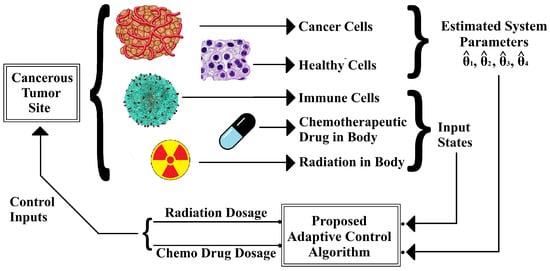
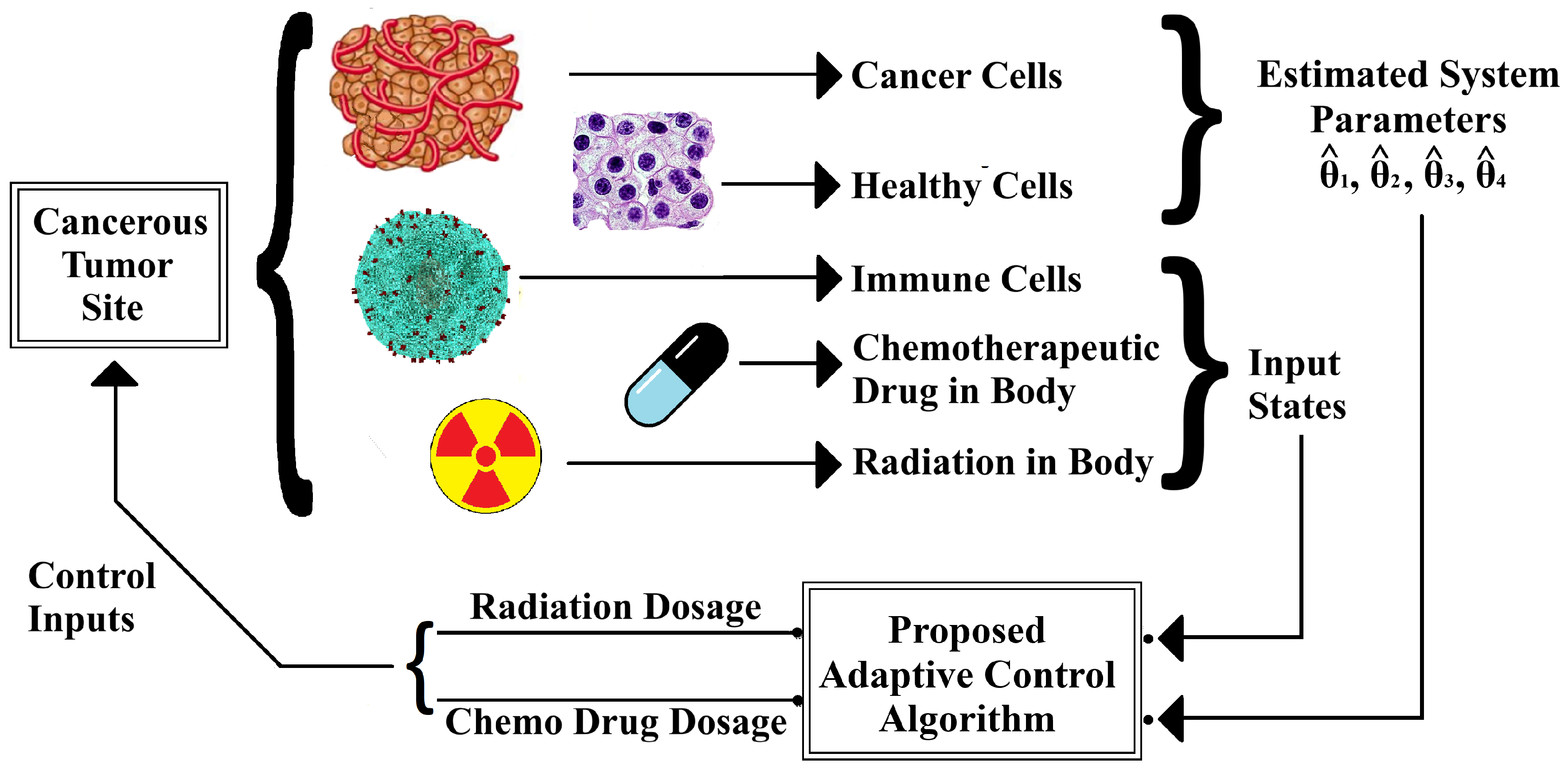


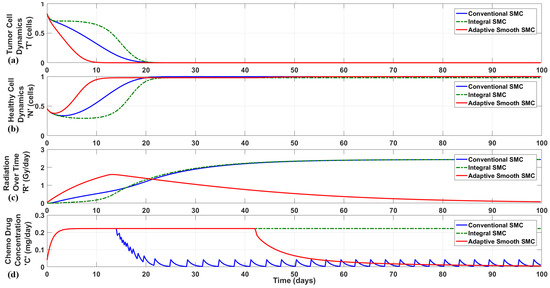
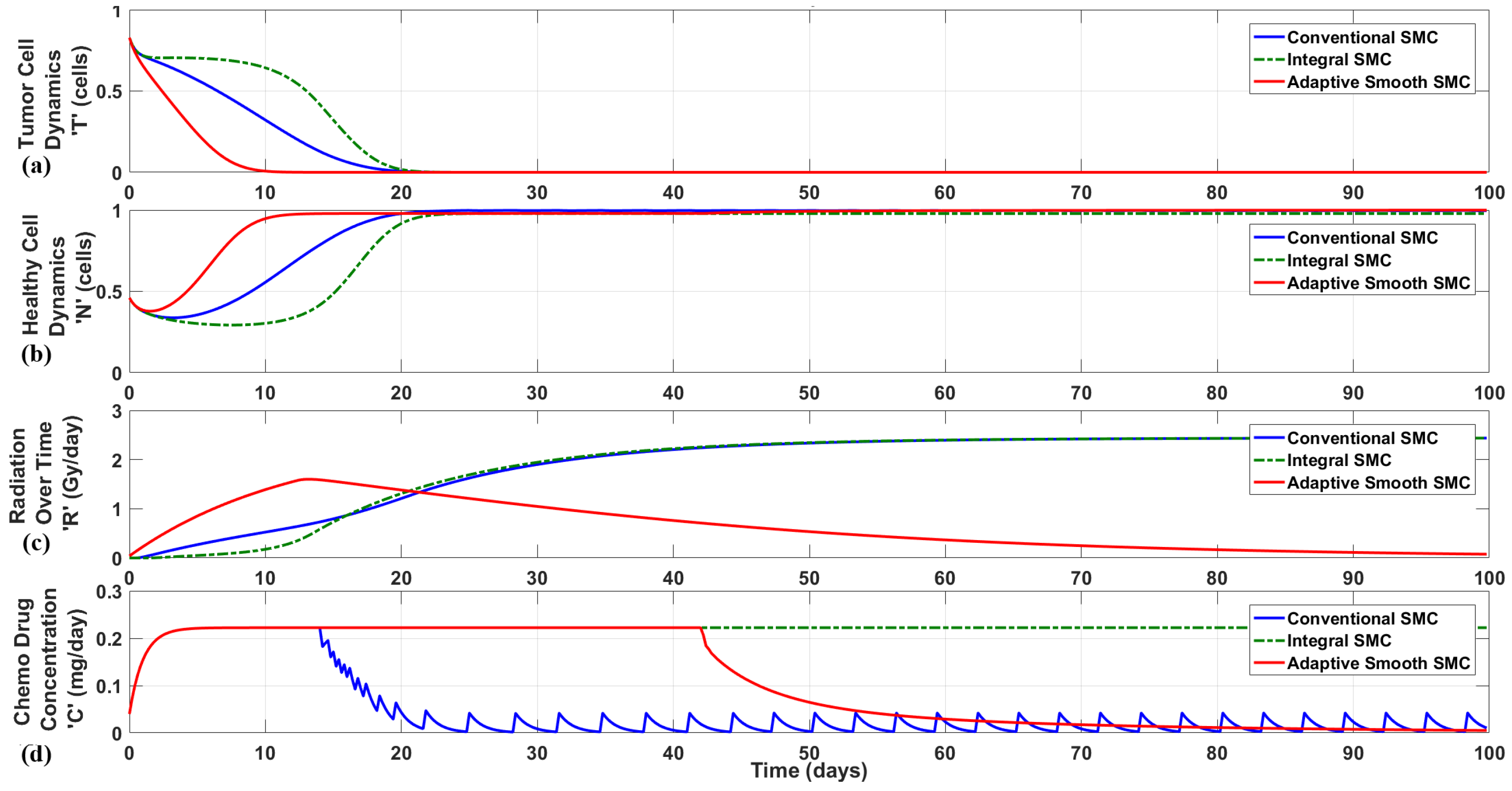
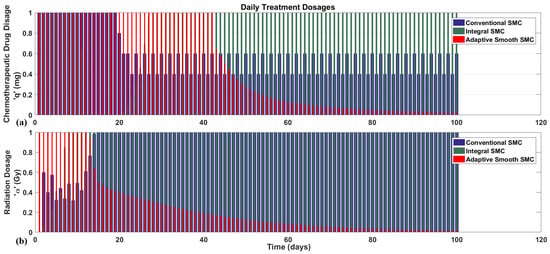
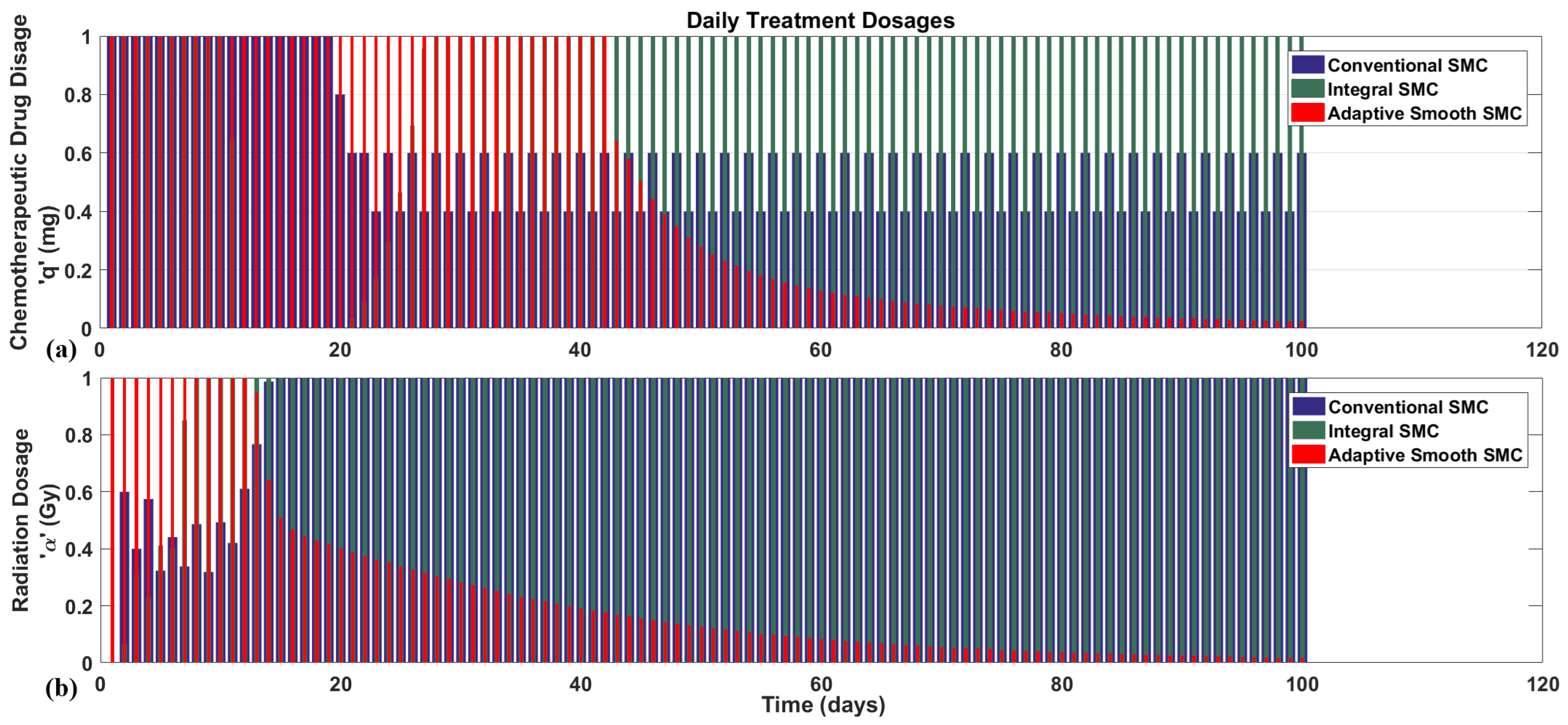
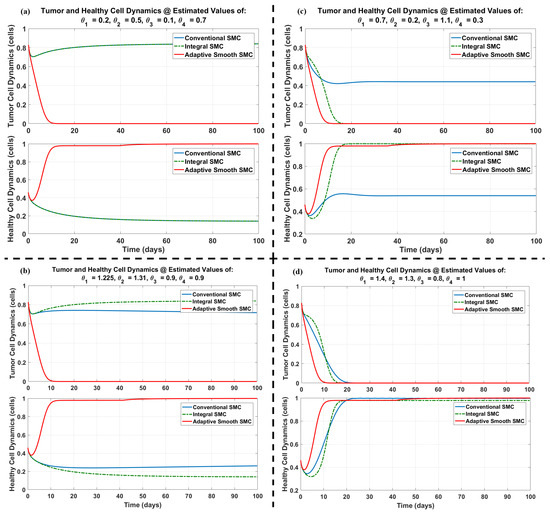
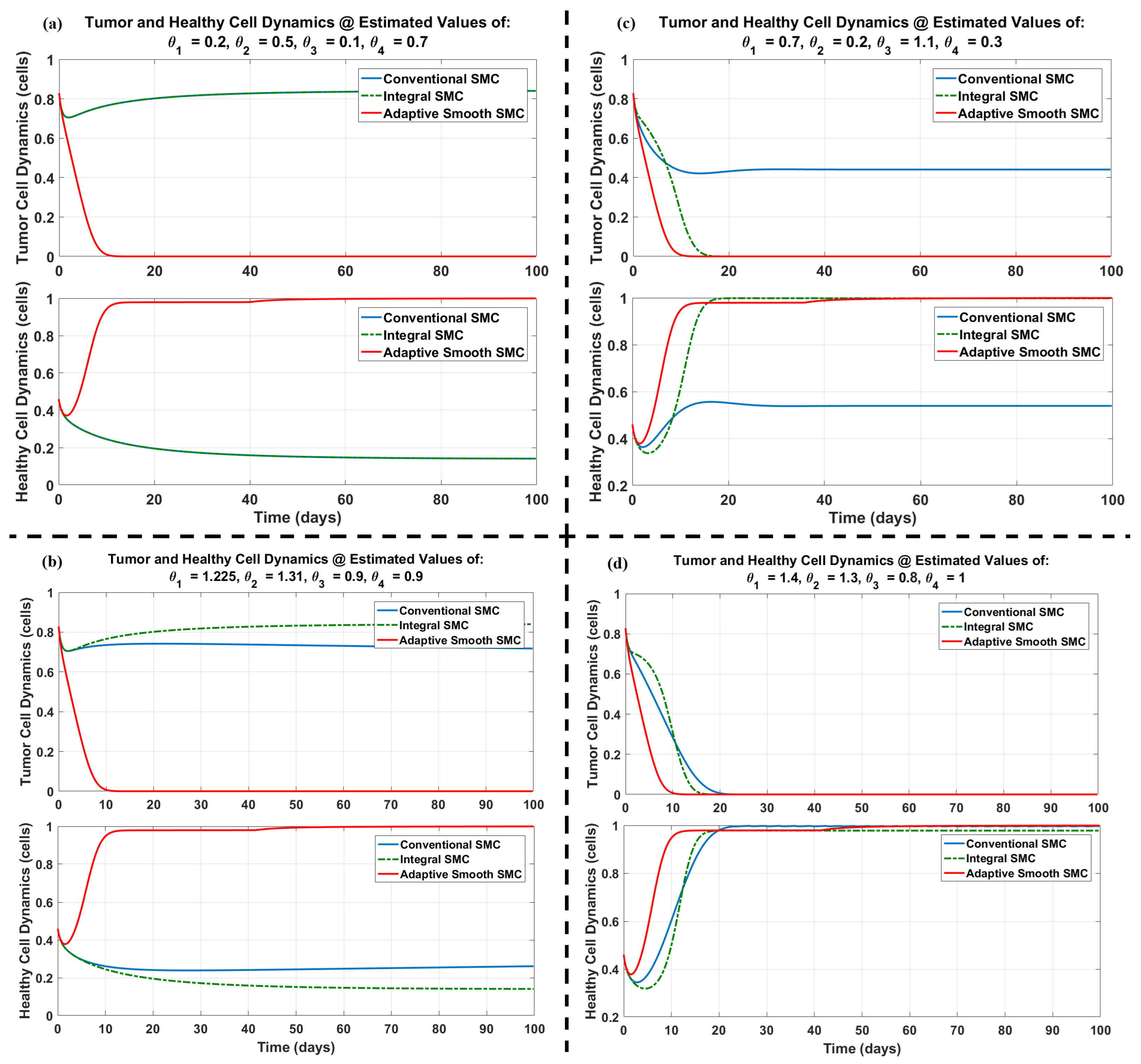
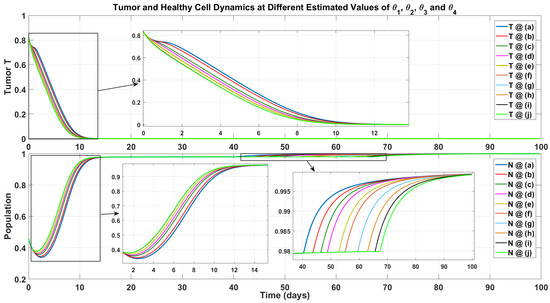
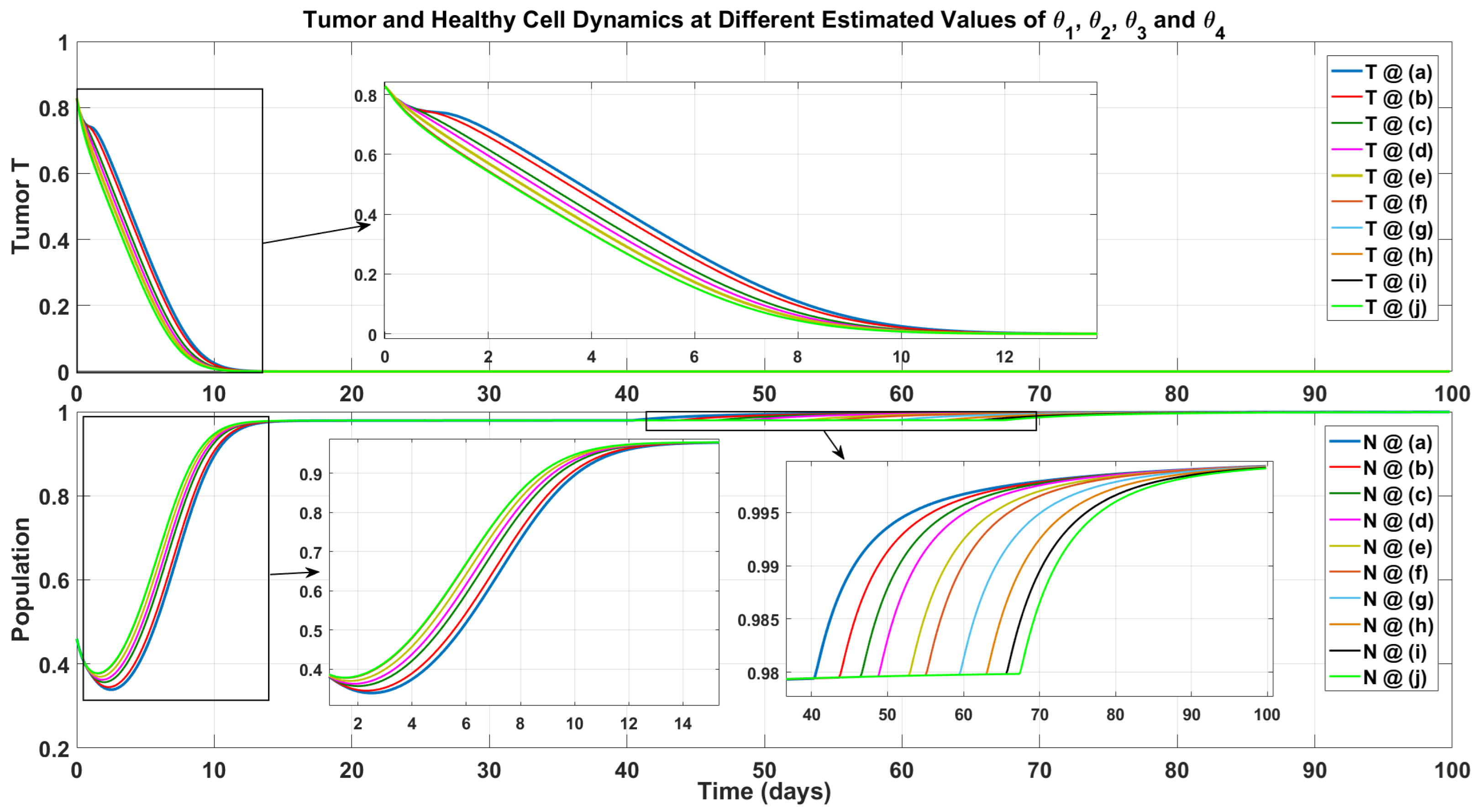
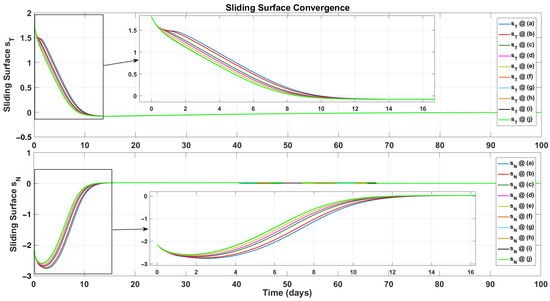
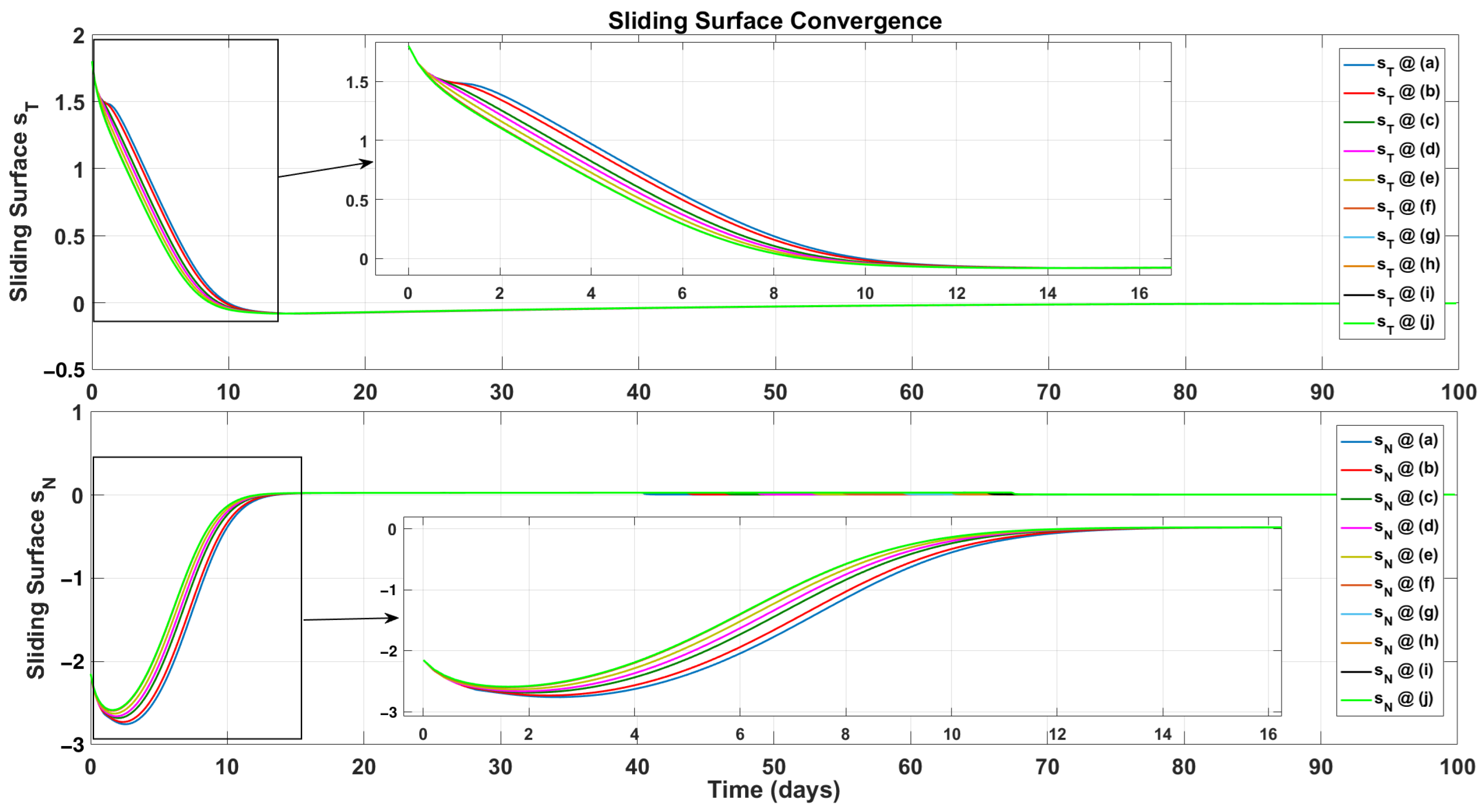
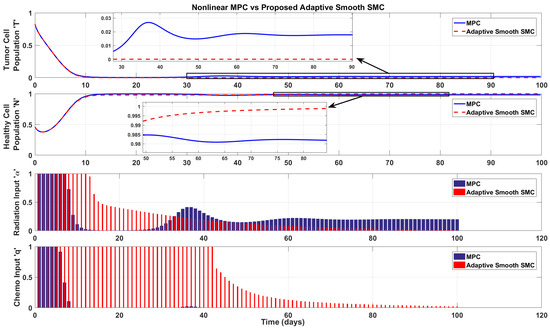
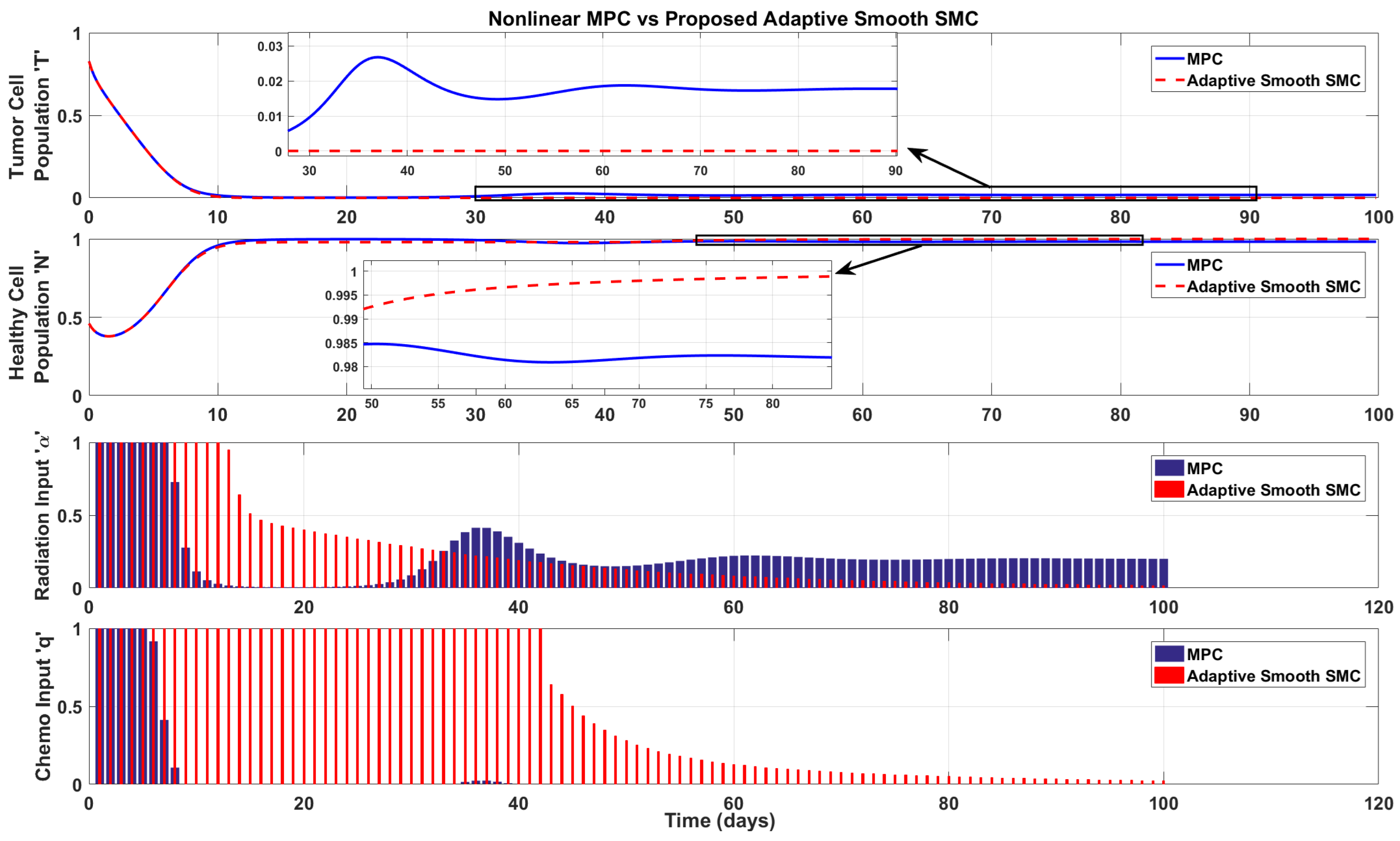
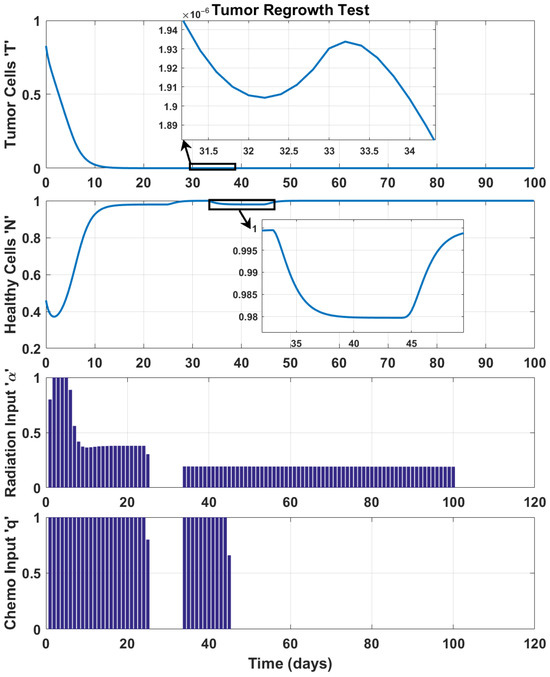
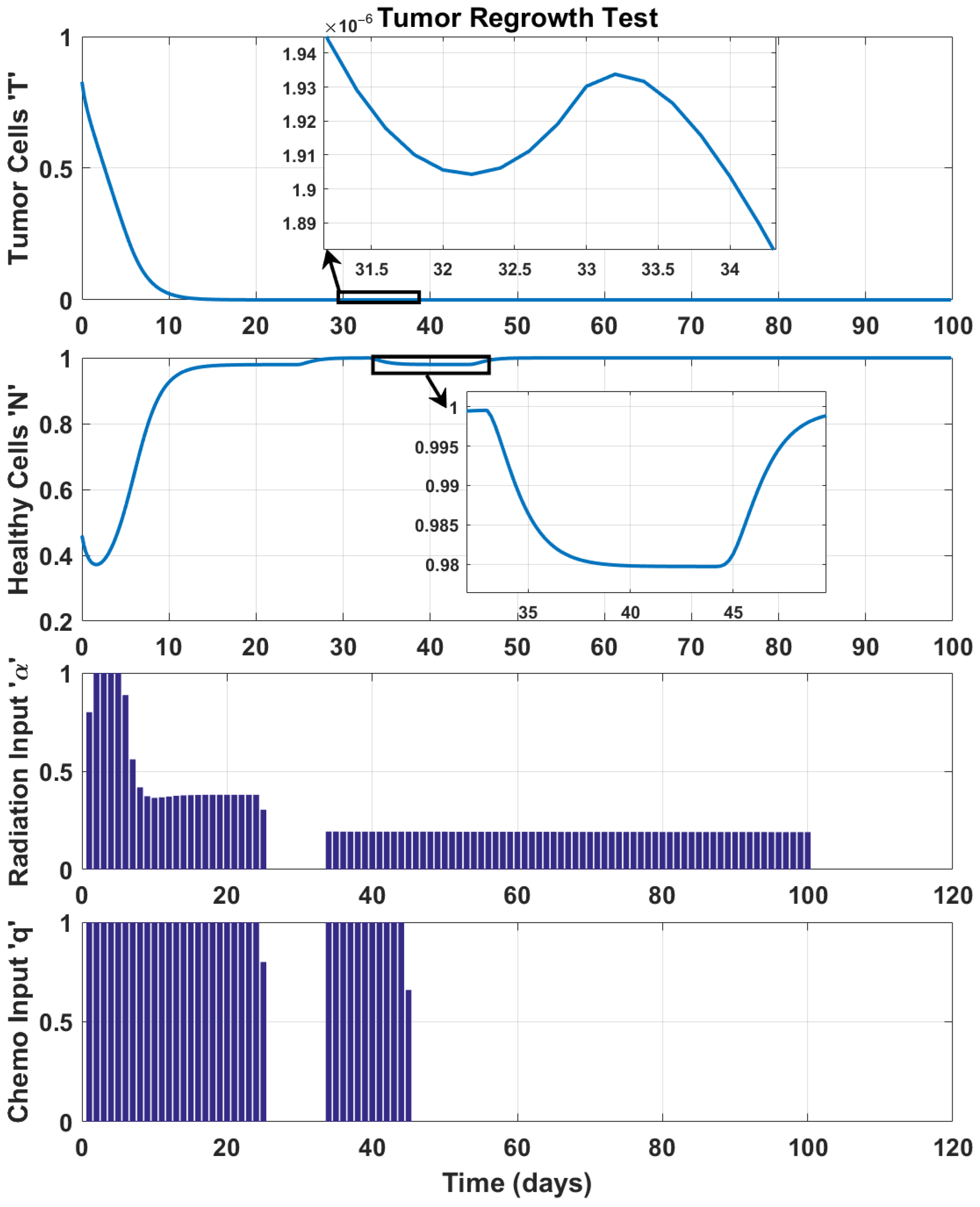
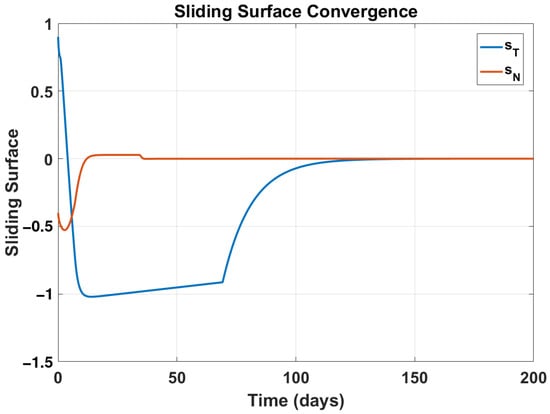
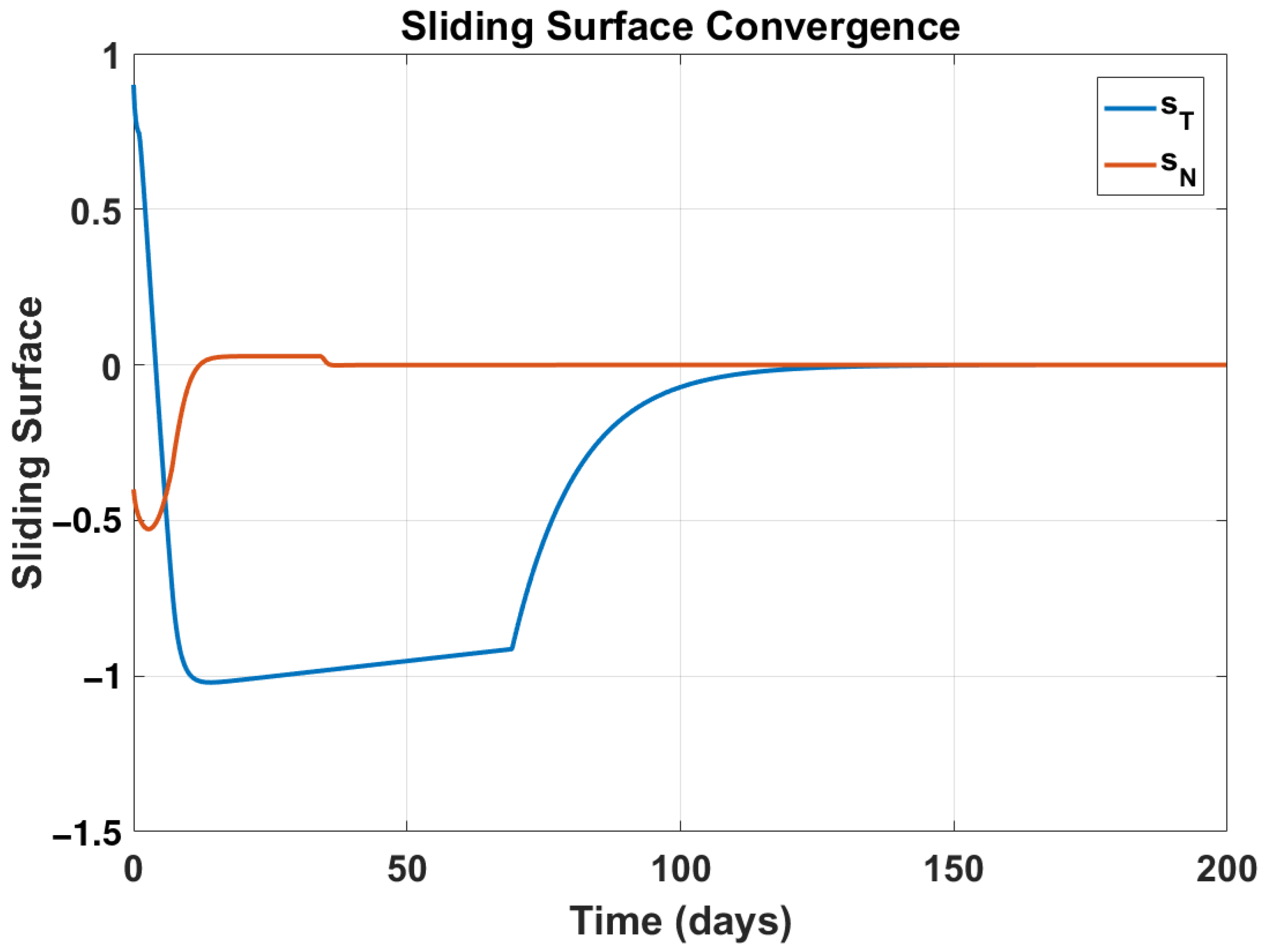
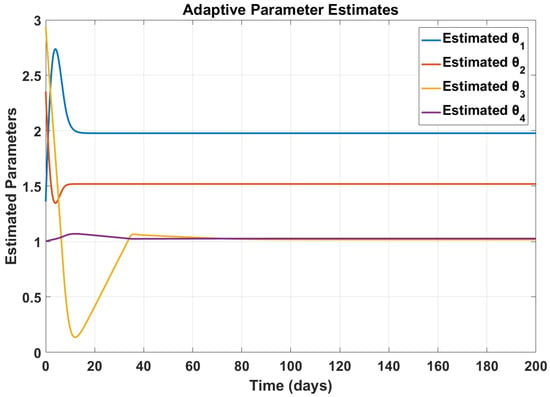
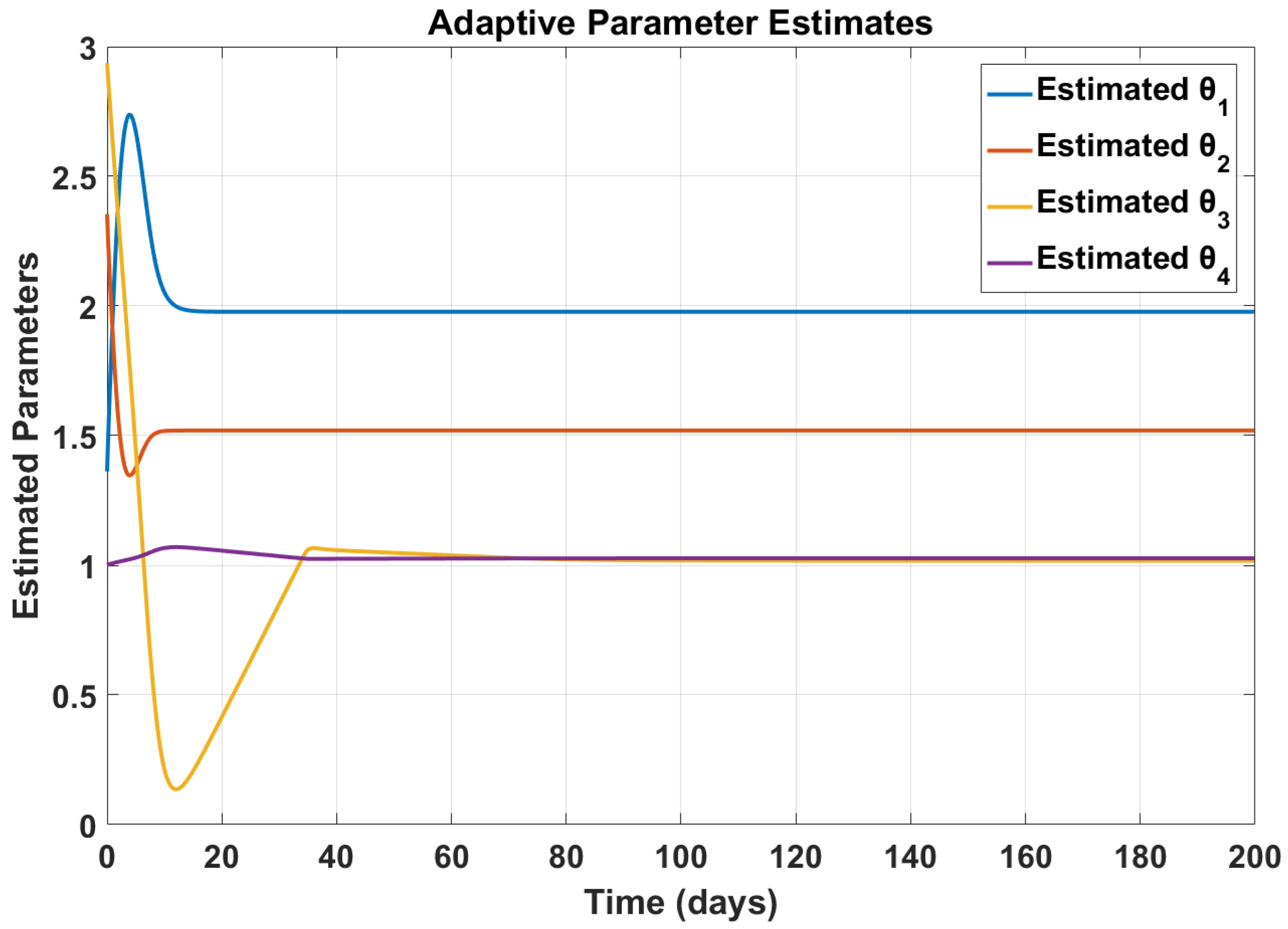
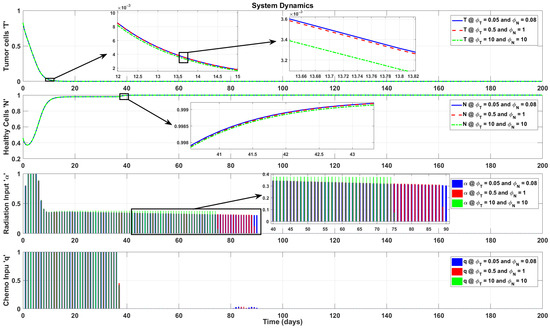
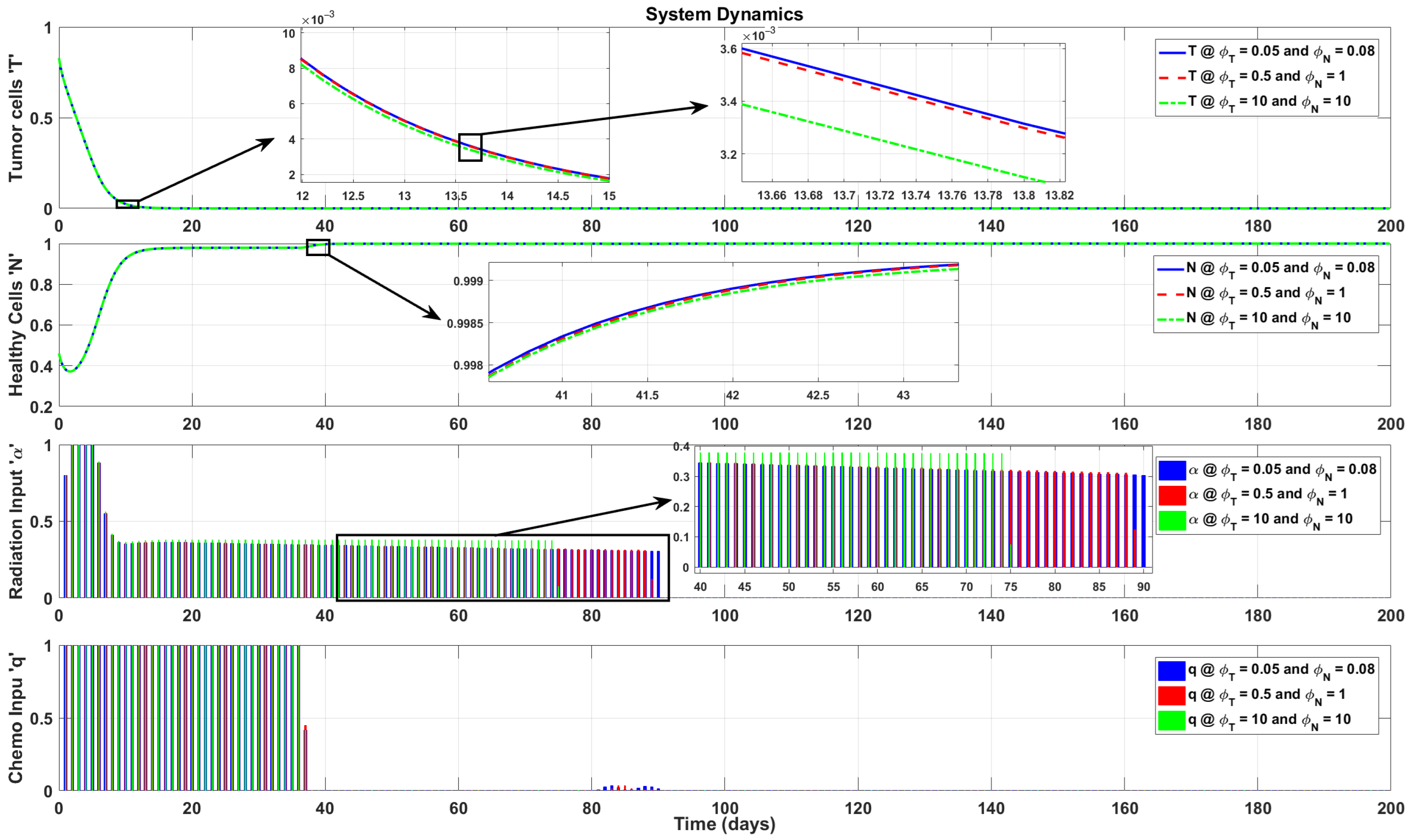
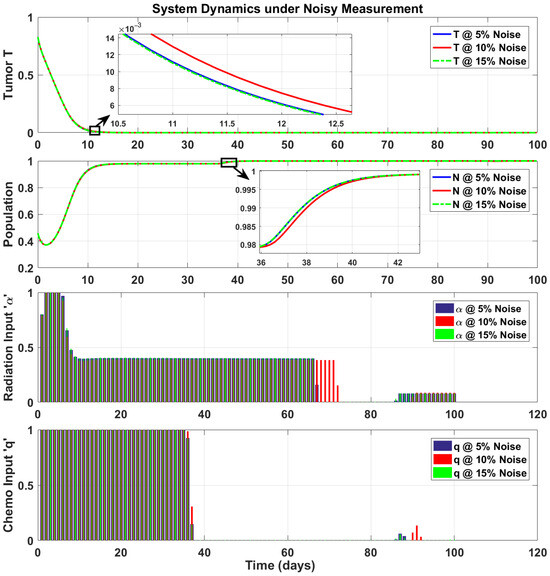
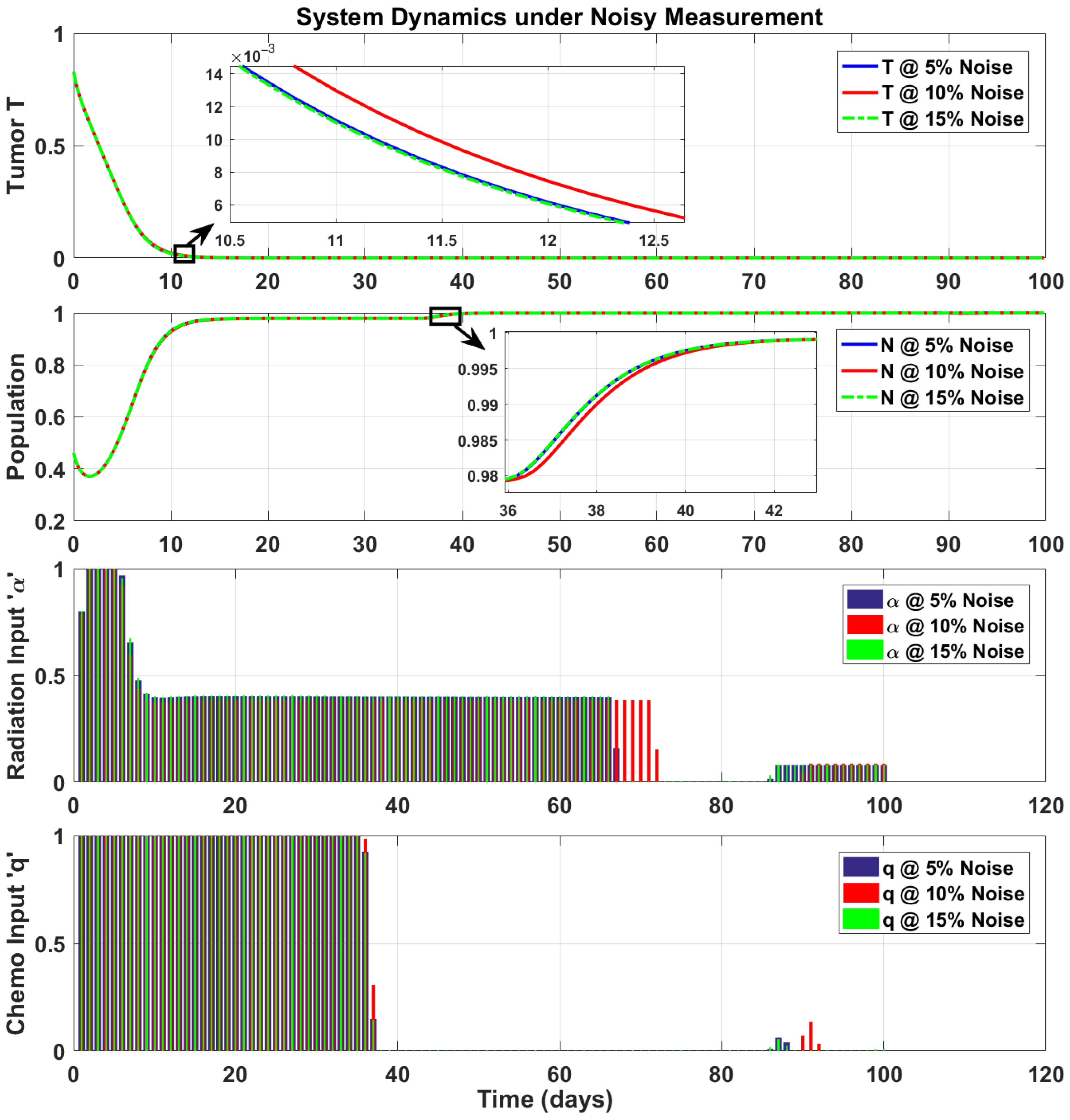

Disclaimer/Publisher’s Note: The statements, opinions and data contained in all publications are solely those of the individual author(s) and contributor(s) and not of MDPI and/or the editor(s). MDPI and/or the editor(s) disclaim responsibility for any injury to people or property resulting from any ideas, methods, instructions or products referred to in the content. |
© 2026 by the authors. Licensee MDPI, Basel, Switzerland. This article is an open access article distributed under the terms and conditions of the Creative Commons Attribution (CC BY) license.