3. Assembly Space Energy
A Dirichlet energy,
can be associated with any graph
provided with a map
(or
). It has recently been used to quantify the ruggedness of biological sequence–fitness landscapes [
4] and oversmoothing in graph neural networks [
5]. Here, we associate it with an unweighted assembly space (the cost of a concatenation of an assembly step is constant), applying the quadratic form to the pathway depths (
2).
Proposition 1 (Assembly Space Dirichlet Energy)
. The Dirichlet energy (
3)
of an assembly space Ω
can be expressed aswhere is the primary, and —the secondary energy. Proof. Each step vertex
s has
if we order its parent vertices
k,
l as
, so its two in-edges have increments
(the
primary edge) and
(the
secondary edge). Since,
, we can replace
in the summation (
3) with
and sum over both increments of each step vertex
s— that is, over
—which yields Equation (
4): the secondary energy charges each step vertex the square of its secondary (pathway depth) increment 1 +
, while the unit increments of the primary edges sum to the primary energy
. □
For example, all four distinct optimal assembly plans
of the minimum ASI strings of length 15 that can contain at most three symbols [
2] correspond to all four distinct shortest addition chains for 15, in which each new length is obtained by summing two previous lengths. All contain five different step strings and one additional concatenation of a basic symbol string, allowing for the introduction of a third symbol. Furthermore, all have
but split into two pairs having the same Dirichlet energies
and
. The four plans are grouped by energy (
) and independently by period
. The two groupings cross-cut: within each period class, the two members carry different energies, so neither period nor energy determines the other.
We have enumerated all optimal assembly plans for all 524,286 bitstrings of length up to 18. For example, the ASI([100110100001010111]) = 12 (the maximum ASI for a bitstring of length 18) can be achieved in 215,254 distinct optimal assembly plans, of which only 24 have optimal energy (). On the other hand, the minimum ASI([010101010101010101]) = 5 for the same length is achievable in 10 optimal plans, of which 4 have optimal energy ().
The closed-form expression of the Dirichlet energy (
4), which separates the assembly space size (
1) from the secondary energy, introduces two kinds of assembly plans.
Definition 6 (Minimal Energy Assembly Plan)
. A minimal energy assembly plan is the assembly plan having the minimum Dirichlet energy (
4)
(a minimal energy). Definition 7 (Energy Optimal Assembly Plan)
. An energy optimal assembly plan is the optimal assembly plan having the minimum Dirichlet energy (
4)
(an optimal energy). Proposition 2. For a unary string , all optimal plans have the same Dirichlet energy (
4)
. Proof. For , an assembly step at most doubles the largest available length, so a plan of p steps reaching doubles at every step and is unique; there throughout, and . For , there are optimal plans having , each with only one , the single non-doubling step sliding along the doubling ladder (e.g., for : , , ), all with . □
By Definition 7, the optimal energy of a string
is determined solely by the secondary energy
. As the ASI constraint is relaxed in Definition 6, a minimal energy assembly plan may have a suboptimal number of assembly steps, but attain a lower
for the string
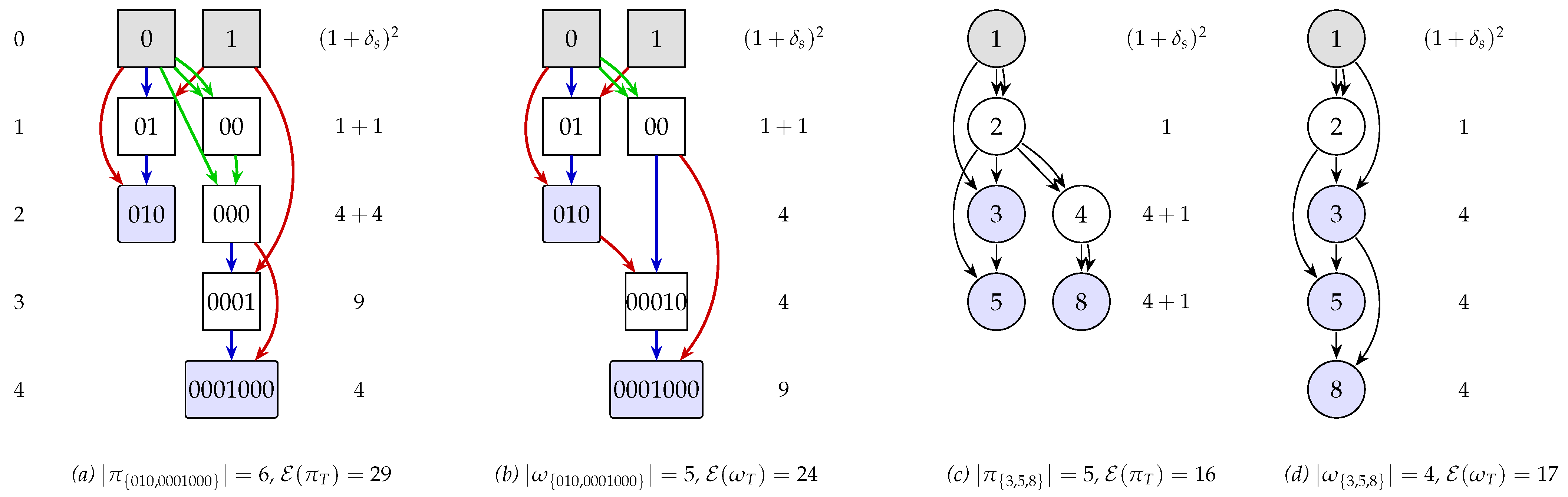
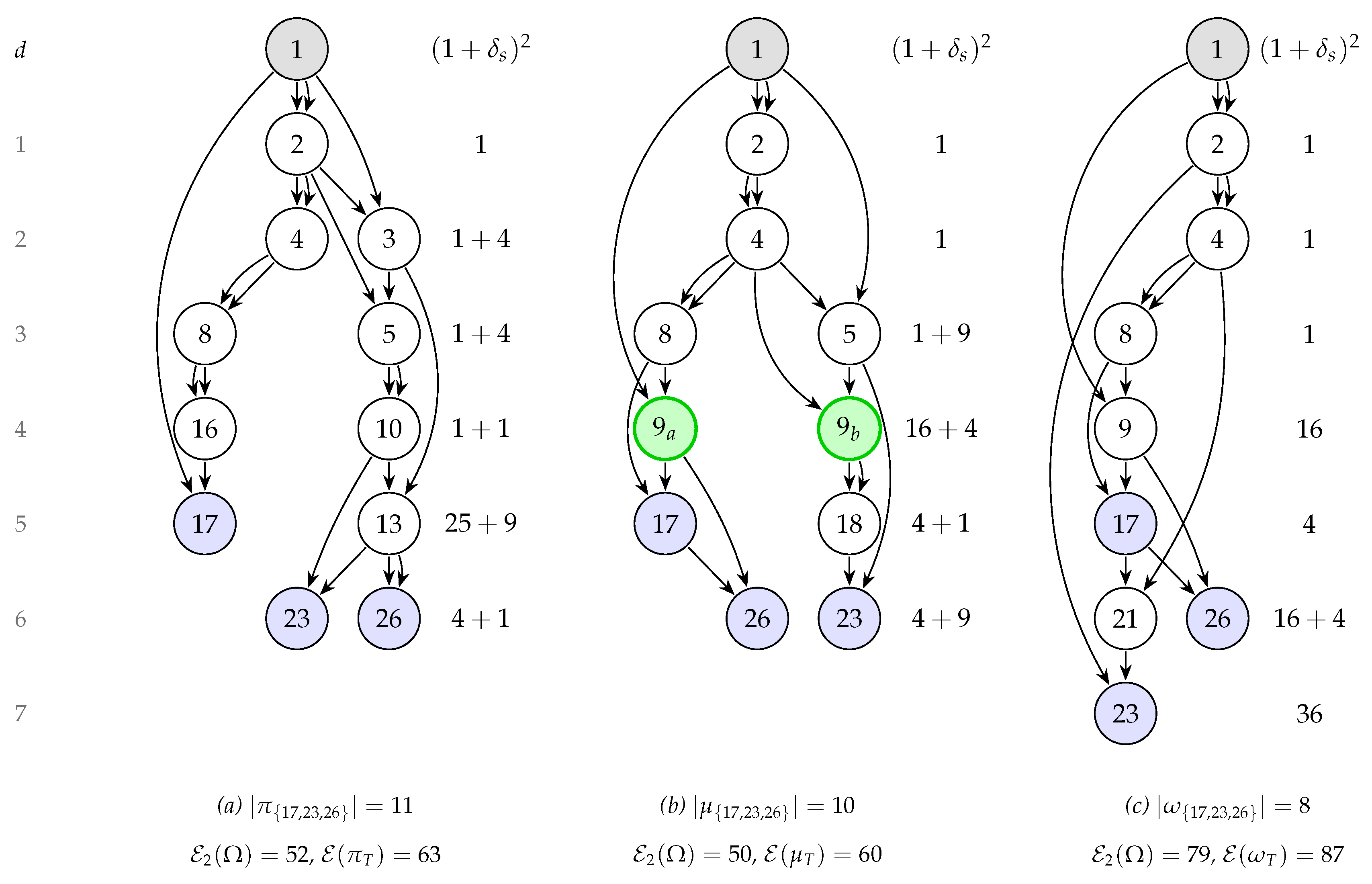
. In the unary case, the shortest such string is 13, as shown in
Figure 1a,b, where an additional assembly step over the ASI lowers the
by four, maintaining the same
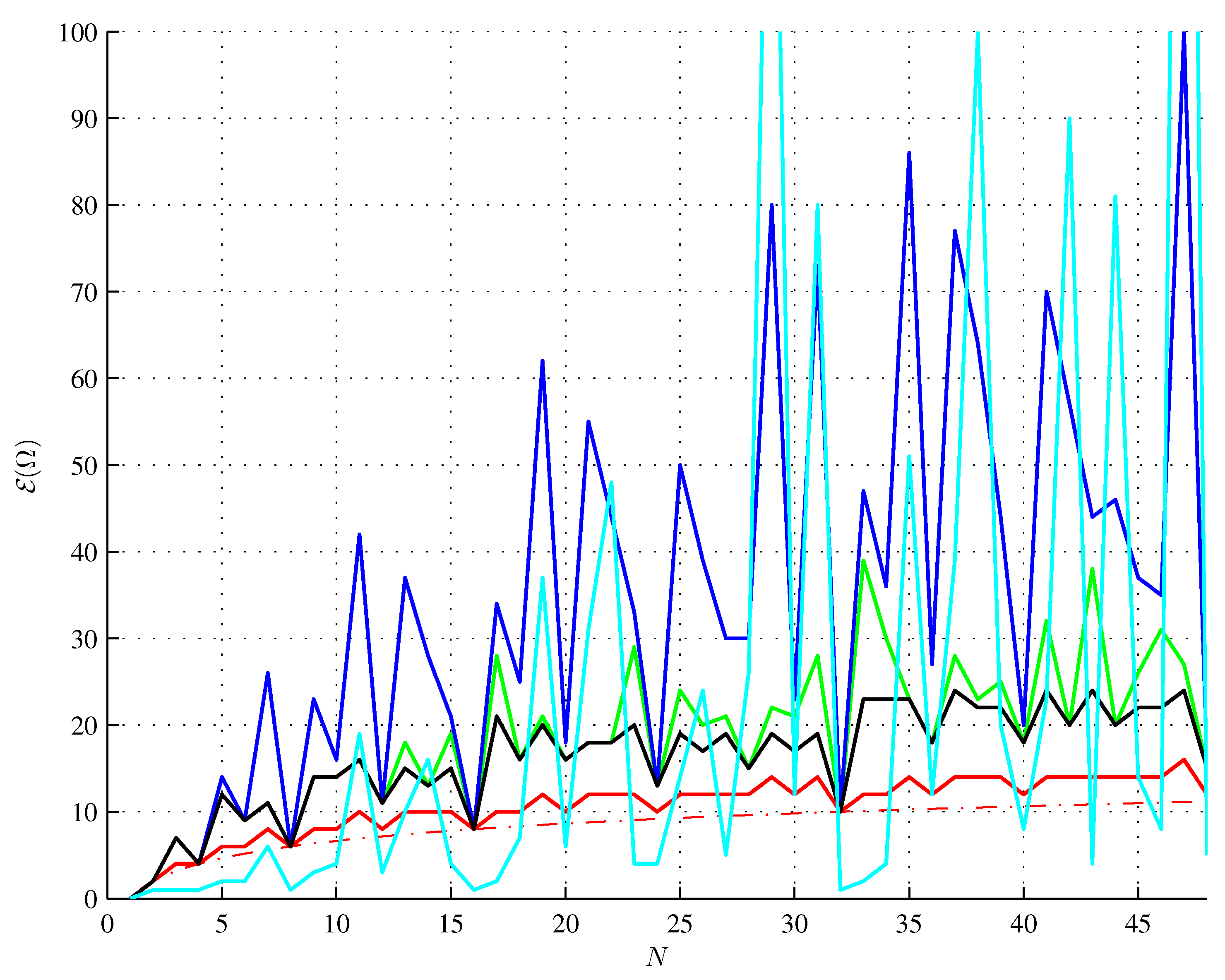
. The minimum energy for all plans and the range of energies for optimal plans of unary strings of length
are shown in
Figure 2. From Equations (
1) and (
4), it follows that
, wherein the bound is saturated by
any (not necessarily optimal) string of length
,
, providing that
, as
in this case. We have used this bound in an exhaustive search for minimal energy assembly plans
(cf.
Appendix A). Furthermore, the assembly depth
and the Dirichlet energy
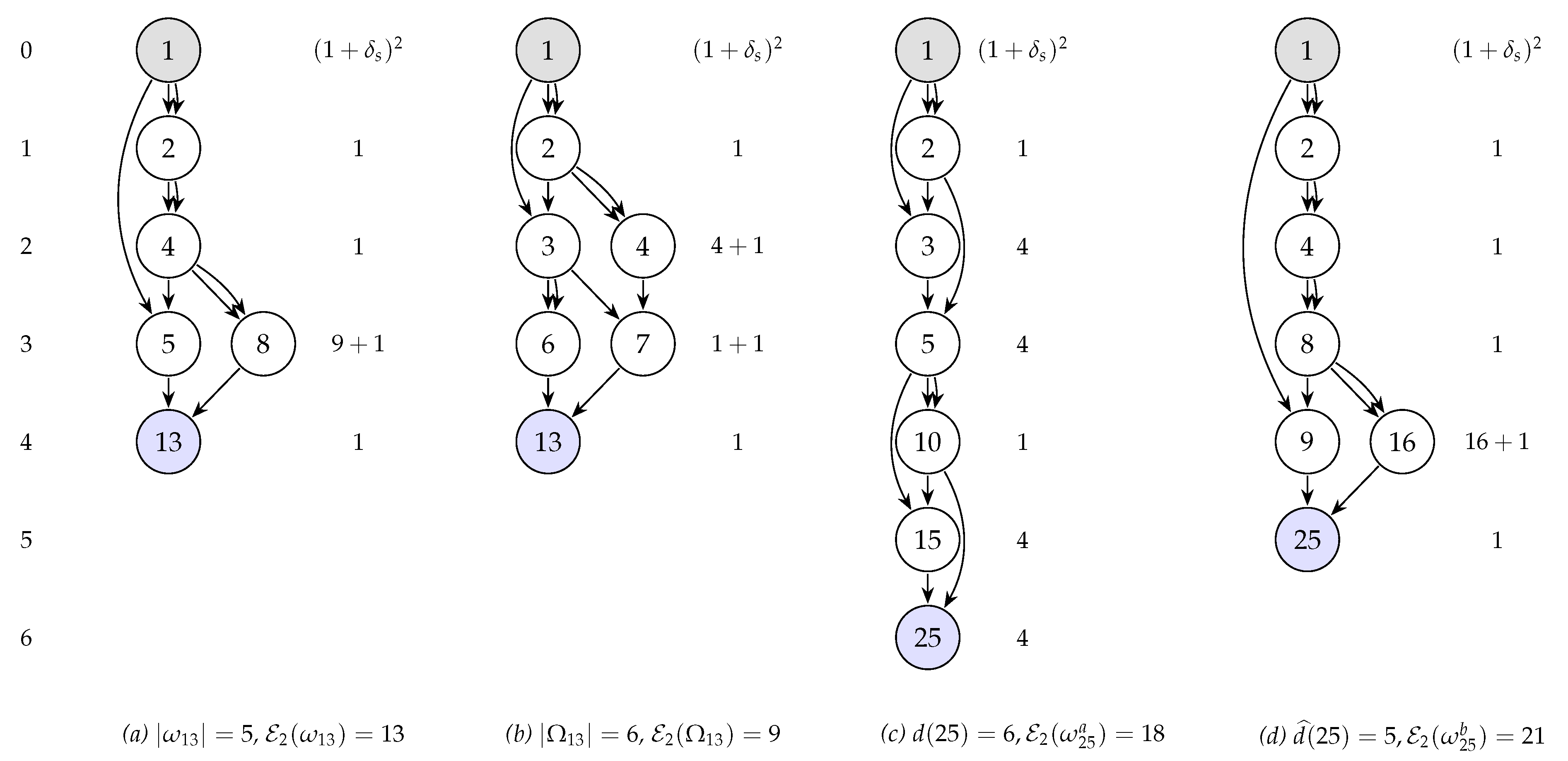
are independent parameters. The shortest unary string, at which the minimum-energy plan occurs at the pathway depth larger than the assembly depth, is 25, as shown in
Figure 1c,d. The energy optimal plan
has a pathway depth of six, while the energy of another optimal plan has larger energy
but attains the assembly depth of five (due to the large
reuse).
4. Joint Assembly Spaces
We shall now consider the co-assembly of strings within a single assembly space and, in particular, within one of minimum size. The joint assembly of several molecules was first considered for molecular graphs in [
6].
Definition 8 (Ensemble of Strings). An ensemble of strings is a set of at least two step strings. We shall call the strings of T target strings or targets.
The first candidate for such a space could be the union of the targets’ optimal assembly plans (the union of arbitrary shortest pathways of all observed polymers was used to approximate the assembly space of multiple coexisting polymers [
7]). We generalize it below to arbitrary plans, which are not necessarily optimal.
Definition 9 (Assembly Plans Union)
. The union of plans of strings of an ensemble T is the graph formed by the union of these plans Since the APU is a function of the plans, its size is not unique. To see that, consider
,
, and a valid choice of (optimal) assembly plans
so that
However, another valid choice of (optimal) assembly plans is
with
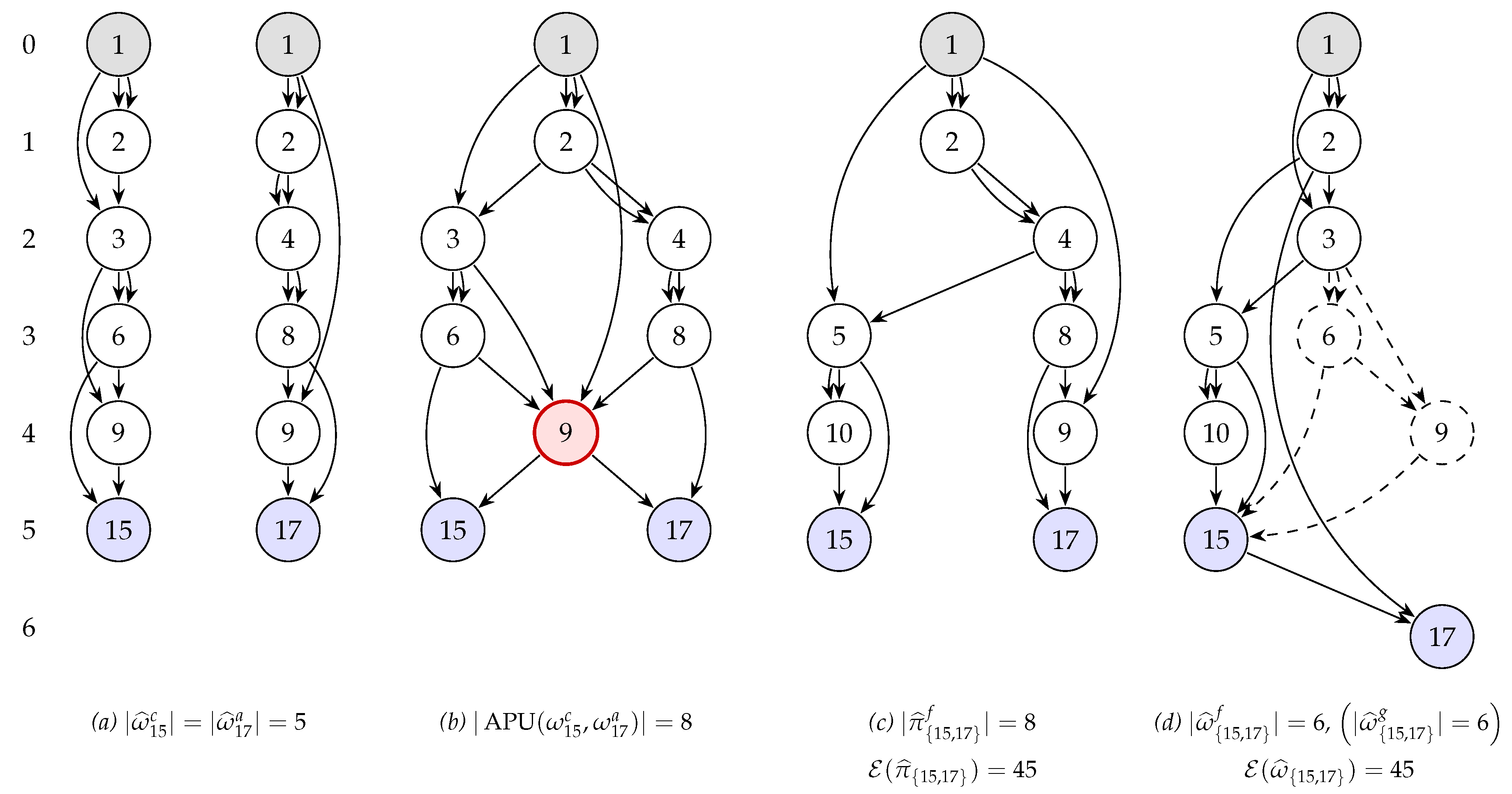
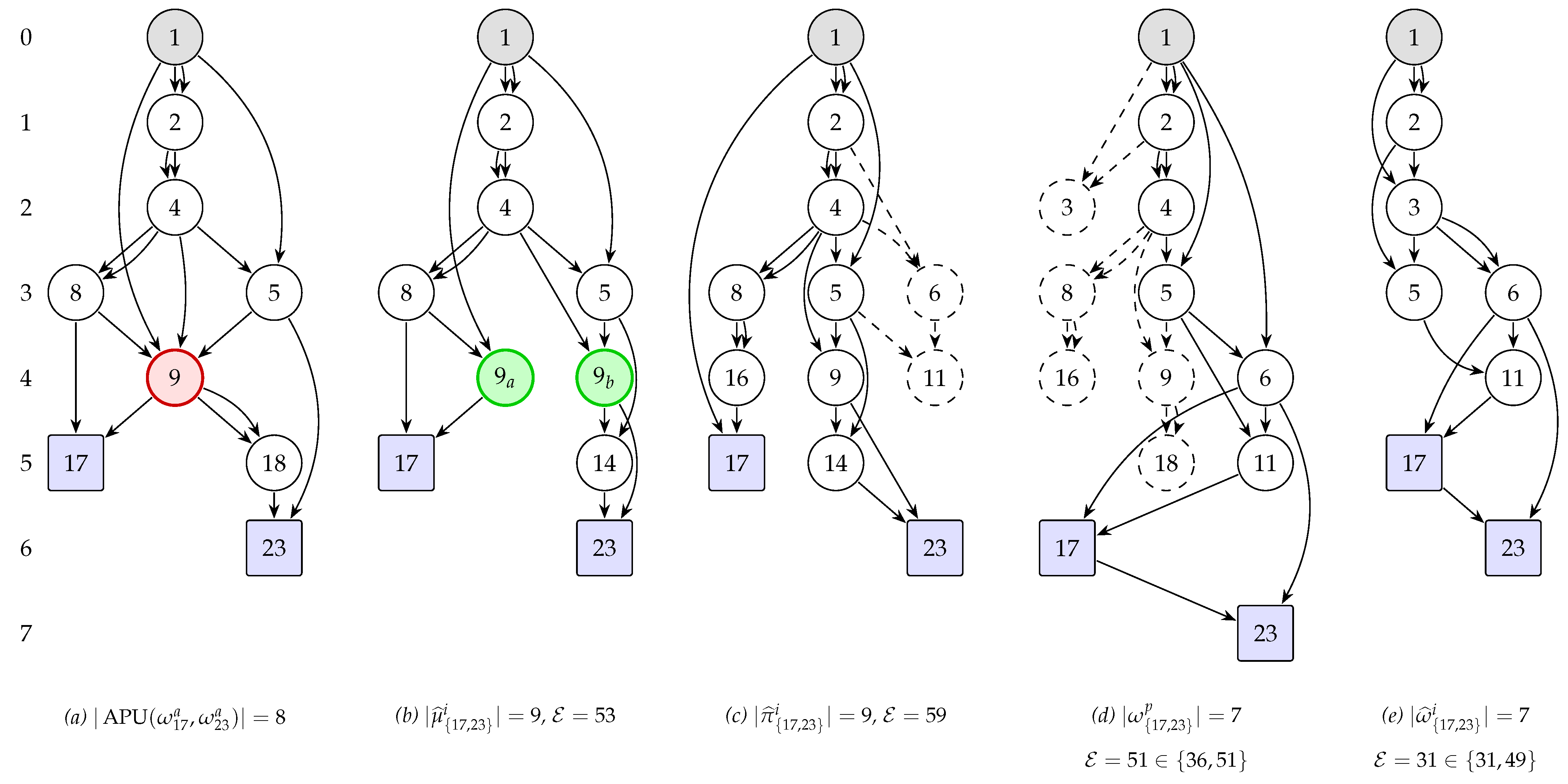
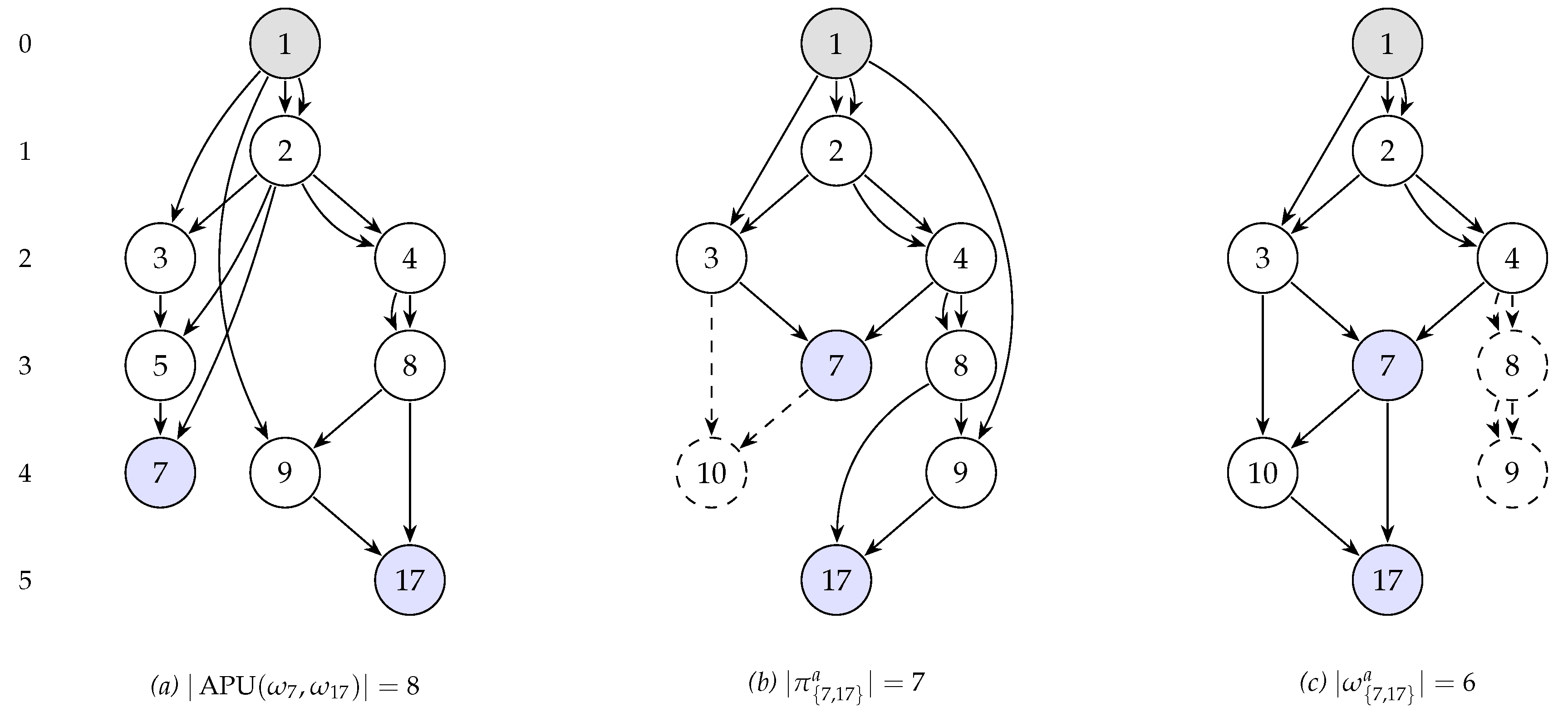
Furthermore, some unions of plans are not valid assembly spaces. In the APU shown in
Figure 3b, for example, the plans
and
clash at a step string 9 that they share, assembling it from different pairs of parent vertices (
vs.
). Uniting the two plans at a single step vertex would give it four signed in-edges, e.g.,
,
,
,
, breaking 2-in-regularity. This vertex would no longer qualify as a step vertex, and the edge-labeling map
could now pair any
left edge with any
right one, producing spurious combinations such as
or
that do not reproduce 9. Thus, without the 2-in-regularity requirement, each APU (
6) could be regarded as an admissible graph, even though its size would still depend on the selected plans and shared vertices could carry incompatible formation histories. Any well-defined single space that allows for co-assembly of strings must at least be an assembly space.
Definition 10 (Joint Assembly Space). A joint assembly space (or JAS) of an ensemble of strings T is an assembly space Ω that contains every and whose every final vertex (vertex without out-edges) belongs to T.
Definition 11 (Singly Optimal Joint Assembly Space)
. A singly optimal joint assembly space (or SOJAS) of an ensemble T is a joint assembly space of the minimum size among those formed as unions of individually optimal plans—one plan for each target —whose step strings are unique (i.e., pairwise distinct). The singly assembly index (SASI) of an ensemble of strings T is For a single target, the uniqueness of decompositions is automatic: a pathway of minimum size cannot have a vertex with two decompositions, as one could be deleted [
8]. Under the joint constraint of Definition 11, the deletion is no longer free, since the discarded decomposition may be the one realizing another target’s assembly index.
equals the number of unique step strings realized by the chosen optimal plans, minimized over choices whose union is an assembly space. Some choices are not: the union shown in
Figure 3b violates 2-in-regularity at the shared vertex 9, decomposed as
by the plan of 15 and as
by the plan of 17. Here, another pairing of the same size avoids the clash, but this is not always possible. The smallest unary pair whose clash cannot be avoided at the smallest union size is
, with
and
. The smallest size
is attained by two pairings, both taking
against
or
, shown in
Figure 4a. Both share
and both clash at 9, decomposed as
by the plan of 17 and as
by either plan of 23: sharing 4 forces
and
on 23, while 17 reaches 9 from
. The clash is therefore avoided not at 9 but by taking 17 off it, onto
, still individually optimal but sharing 16 with no plan of 23 (
Figure 4c), so the union needs a ninth vertex and
. Subsequent unary pairs
with this property for
are
,
and
.
However, clashes cannot always be avoided, and some ensembles T do not admit SOJAS.
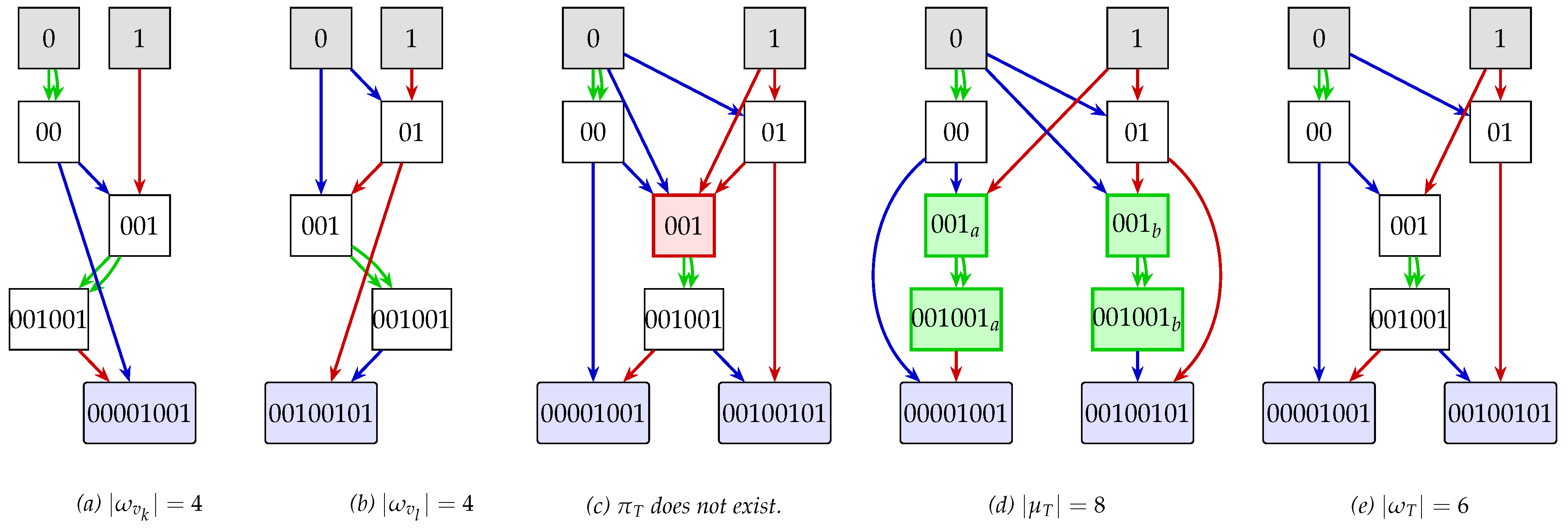
Proposition 3. For every alphabet Σ with , there exist ensembles that admit no SOJAS. An example is a binary pair .
Proof. Both targets have two optimal plans
with
. The 3-gram 001 must be present in all of these plans, but to maintain these ASIs, for the target
, it must be assembled as
(as 00 is required), while for the target
, as
(as 01 is required). Every pairing of an optimal plan of
with one of
therefore clashes at 001, and no SOJAS exists. For
, pick any two symbols in place of 0 and 1. □
Proposition 4. There exist unary ensembles of at least three targets admitting no SOJAS. The smallest maximal target of such an ensemble is 149
, attained by [9]. Proof. Within an SOJAS, every step string carries a single decomposition, so two individually optimal plans can be united only if they decompose identically every step string they share. The three targets have
,
,
and, up to the order of the concatenated parts, four optimal plans each. Enumerating them exhaustively gives three exclusive and exhaustive dichotomies,
A clash is then unavoidable: if 149 takes its left alternative, then 43 and 77 must take their right ones, but they clash on 5; if 149 takes its right alternative, then 43 must take the left one, which clashes on 9. Hence, no SOJAS exists. Conversely, we verified computationally (see Data Availability) that every ensemble all of whose targets are at most 148 admits an SOJAS, so 149 is the smallest maximal target for which non-existence occurs. Other triples with no SOJAS (based on ) are and . □
Conjecture 1. Every ensemble of two unary targets admits an SOJAS. We verified it for all unary pairs with .
Definition 1 allows distinct step vertices to carry the same step string (i.e.,
is permitted for
), reflecting the fact that AT conceptualizes objects as entities defined only by their possible formation histories [
7], and allowing us to introduce the following definition.
Definition 12 (Multiplicity Optimal Joint Assembly Space)
. A multiplicity optimal joint assembly space (or MOJAS) of an ensemble T is a joint assembly space of the minimum size among those formed as unions of individually optimal plans—one plan for each target —in which no two step vertices carry both the same step string and the same pair of parent vertices, the two vertices being identified regardless of the order recorded by ϕ. The multiplicity assembly index (MASI) of an ensemble of strings T is Unlike
, which identifies a repeated string with a single 2-in-regular vertex and must therefore reroute or add intermediates when two optimal plans build a shared string differently,
resolves such a clash by admitting the same string as two distinct step vertices provided that no two step vertices share a formation history, each assembled from a distinct pair of parent vertices. Furthermore, an MOJAS can be smaller than the SOJAS even when the latter exists, as shown in
Figure 5, and the following holds.
Proposition 5. An MOJAS exists for every ensemble.
Proof. Every string has at least one optimal plan, so at least one choice exists, and the choices are finitely many. It suffices that each of their unions, formed by identifying step vertices that carry the same step string and the same pair of parent vertices, be a JAS. Identification replaces two such vertices by a single one retaining one of their pairs of in-edges, rather than accumulating the in-edges of both. Every step vertex of the union therefore retains two in-edges, and vertices carrying the same step string from different parent vertices remain distinct, so no vertex acquires a second decomposition. Acyclicity holds, as the string length strictly increases along every edge; the source vertices are the basic symbols; every target is contained in the union; and a vertex with no out-edges is the final vertex of every chosen plan containing it, hence a target. A minimum-size such union exists, and it is an MOJAS. □
AT admits the plurality of identical objects as a property of the observed sample: an object of high assembly index found in many copies is improbable under chance, which is what the assembly equation exploits [
7]. Within a JAS of individually optimal targets, the same plurality arises structurally rather than observationally. For an ensemble admitting no SOJAS, the individual assembly indices are recoverable only by admitting one string at two or more step vertices. Multiplicity is therefore not an additional observable but a prerequisite for joint individual optimality—and, unlike copy number, a bounded one: a step string can be carried by at most
vertices, where
p is the number of its distinct assembly plans, as each of the
chosen plans has pairwise distinct step strings and so contributes at most one vertex per string. Definition 8 takes
T to be a set. Allowing it to be a multiset forces
m copies of a string
to carry
m distinct formation histories. Thus, such an ensemble admits an MOJAS if and only if every multiplicity is at most the number of optimal plans of its string, and a COJAS if and only if it is at most the number of all plans of its string; for the unary
, the latter holds and the former does not,
arising from
and
.
Conjecture 2. Every ensemble of two targets that admits an SOJAS satisfies . We verified it for all unary pairs with .
In an SOJAS, the sub-plan of every target
read off
is its optimal plan
: the uniqueness of step strings forces a single decomposition per step string, so tracing the in-edges upstream from
reproduces
. Every target is therefore assembled in
steps. In an MOJAS, the same holds for the copy of
contributed by its own plan. A structural counterpart of the copy number [
7] thus arises within the formalism of joint assembly spaces, as shown in
Figure 6c; a string 001 cannot be explored within an individually optimal SOJAS but can only be explored in copies allowed by an individually optimal MOJAS, shown in
Figure 6d. Yet, it can also be explored by relaxing the assembly index of one target (say
); the collectively optimal joint assembly space of
Figure 6e does so, at a cost of one step above
.
The collective notion has a counterpart for molecular graphs (Definition 3.4 in [
10]), in which the assembly index of a set of fragments is defined as the minimum size of an assembly pool that contains them. However, a pool records the fragments available rather than the decompositions realizing them, so the individually optimal variants of Definitions 11 and 12 cannot be formulated in that setting.
As with assembly plans, there can be multiple COJASs for
T. For example, the first and the last optimal plans (
5) are also the COJASs of an ensemble
, though the first one is more general (a ternary string 01201 cannot be produced using the last plan, for example).
Following Definitions 6 and 7, we introduce the following three definitions.
Definition 13 (Minimal Energy Joint Assembly Space)
. A minimal energy joint assembly space (or MEJAS) is the joint assembly space having the minimum Dirichlet energy (
4)
. Definition 14 (Singly Energy Optimal Joint Assembly Space)
. A singly energy optimal joint assembly space (or ESOJAS) is the singly optimal joint assembly space having the minimum Dirichlet energy (
4)
. Definition 15 (Multiplicity Energy Optimal Joint Assembly Space)
. A multiplicity energy optimal joint assembly space (or EMOJAS) is the multiplicity optimal joint assembly space having the minimum Dirichlet energy (
4)
. Definition 16 (Collectively Energy Optimal Joint Assembly Space)
. A collectively energy optimal joint assembly space (or ECOJAS) is the collectively optimal joint assembly space having the minimum Dirichlet energy (
4)
. By definition, the Dirichlet energies (
4) of an ESOJAS, EMOJAS, and ECOJAS are determined solely by the minimum secondary energies
,
, and
. If this constraint is relaxed, the MEJAS (Definition 13) may have a suboptimal number of assembly steps, but attain a lower Dirichlet energy
for the ensemble
T. As in the case of assembly plans, the energies (
4) of the optimal assembly spaces are unrelated to their assembly indices and depths, as can be seen in
Figure 5. An SOJAS restriction of one 2-in-regular vertex per string forces 17 onto the isolated branch
(
Figure 5a), which is also the energy-worse of the two optimal plans of 17 (
vs.
for
), so admitting a copy of 9 buys the MOJAS not only a smaller space but also a lower energy. Yet, lowering the space size by two vertices (COJAS of
Figure 5c) requires higher energy.
Theorem 1. For any finite ensemble T, where the last two inequalities apply whenever exists, and holds unconditionally. Proof. Since the size of an MOJAS
is the minimum over all feasible unions of the optimal assembly plans of the strings of
T (by Proposition 5, an MOJAS always exists), it cannot exceed the cost of the sum of their ASIs; therefore,
, which need not be a strict inequality, as the basic symbol(s) are not counted in the size of an assembly space (
1) (the exception is a unary case, where it is a strict inequality as the first assembled vertex 2 is always shared). An SOJAS, if it exists, is a joint assembly space in which all strings are unique; hence, one of the spaces over which
, having this condition relaxed, is minimized; therefore,
. Given
, process its step strings in order of increasing string length and, for each string carried by several vertices, retain one of them, redirecting to it the in-edges of every vertex assembled from a discarded copy; since the copies carry the same string, the string of each such vertex is preserved. Merging preserves acyclicity, as the string length strictly increases along every edge, so step vertices sharing a string are incomparable. Pruning iteratively every non-target vertex left without an out-edge, this canonicalization terminates in a single-decomposition joint assembly space of size at most
, and of size at most
whenever some string of
is carried by more than one vertex. As
is the minimum vertex count over that class,
. □
Corollary 1. The equality of MASI and CASI implies the equality of MASI and SASI.
Proof. Assume . If some string were carried by two step vertices of , the canonicalization in the proof of Theorem 1 would yield a joint assembly space of size at most , whence , a contradiction. Hence, the step strings of are pairwise distinct, so the minimum over the larger class is attained within the smaller one: exists and . □
The contrapositive reads , that is, , whence another corollary implies . Multiplicity can therefore reduce the singly optimal size only for ensembles in which the SOJAS and COJAS already differ by at least two vertices. The condition is necessary but not sufficient: has , yet .
It was observed for molecular graphs that the shortest assembly pathway building at least two targets together need not be the union of their individual shortest pathways, and can be shorter than the sum of their molecular assembly indices [
6]. However, in general, a relation similar to (
7) cannot be drawn for the APU (
6), as it is ill-defined: in the case shown in
Figure 4, its size is smaller than
, while for the case shown in
Figure 7, it is larger.
Table 1 lists all non-reducible ensembles of at most five unary strings of lengths
—those for which all inequalities (
7) are strict while no proper subensemble has this property—found by exhaustive enumeration over that range. Among all unary pairs
that we examined,
; the smallest ensembles with
have three targets. In the binary case, the inequalities (
7) are strict: for example, for an ensemble
with
.
Among all COJASs
, there can be more than one ECOJAS. For example, for the unary ensemble
,
is attainable with the spaces
and
, having the same energy
. Thus,
behaves the same as
(cf. plans (
5)).
Using breadth-first search, we exhaustively enumerated all SOJASs, MOJASs, and COJASs of the ensembles
of pairs of unary strings with
, i.e.,
target pairs. In 11 cases, shown in
Table 2, we found that
. Their full lists are available in the GitHub repository. The number of distinct SOJASs (
) was, in general, much smaller than the corresponding number of COJASs (
) for a given ensemble (except
and
). On the other hand, ECOJASs featured, in general, smaller energy than the corresponding ESOJASs (except
,
, and
and the equality for
).
A minimal example of an ensemble of three unary strings with
occurs for
, with
and
, as shown in
Figure 8c,d. In this case,
, while
. Subsequent such ensemble is
, with
and
.
Table 3 shows all ESOJASs
and ECOJASs
for the
optimal joint assembly spaces
and
listed in
Table 2. The ECOJAS attains
whenever the co-assembly saving is realizable through depth-balanced reuse—two intermediates of comparable depth, e.g.,
or
. It fails (
) for every collectively optimal
, when the saving forces reuse of a deep target through a shallow increment: the steps
(
,
,
), whose secondary edge alone carries the span exceeding the entire energy of
. Thus, the secondary energy does not merely track size; it distinguishes between the two mechanisms of co-assembly savings—balanced sharing and deep target reuse. These results allow us to state the following conjecture.
Conjecture 3. If an ensemble has a strict inequality , then there is only one ESOJAS .
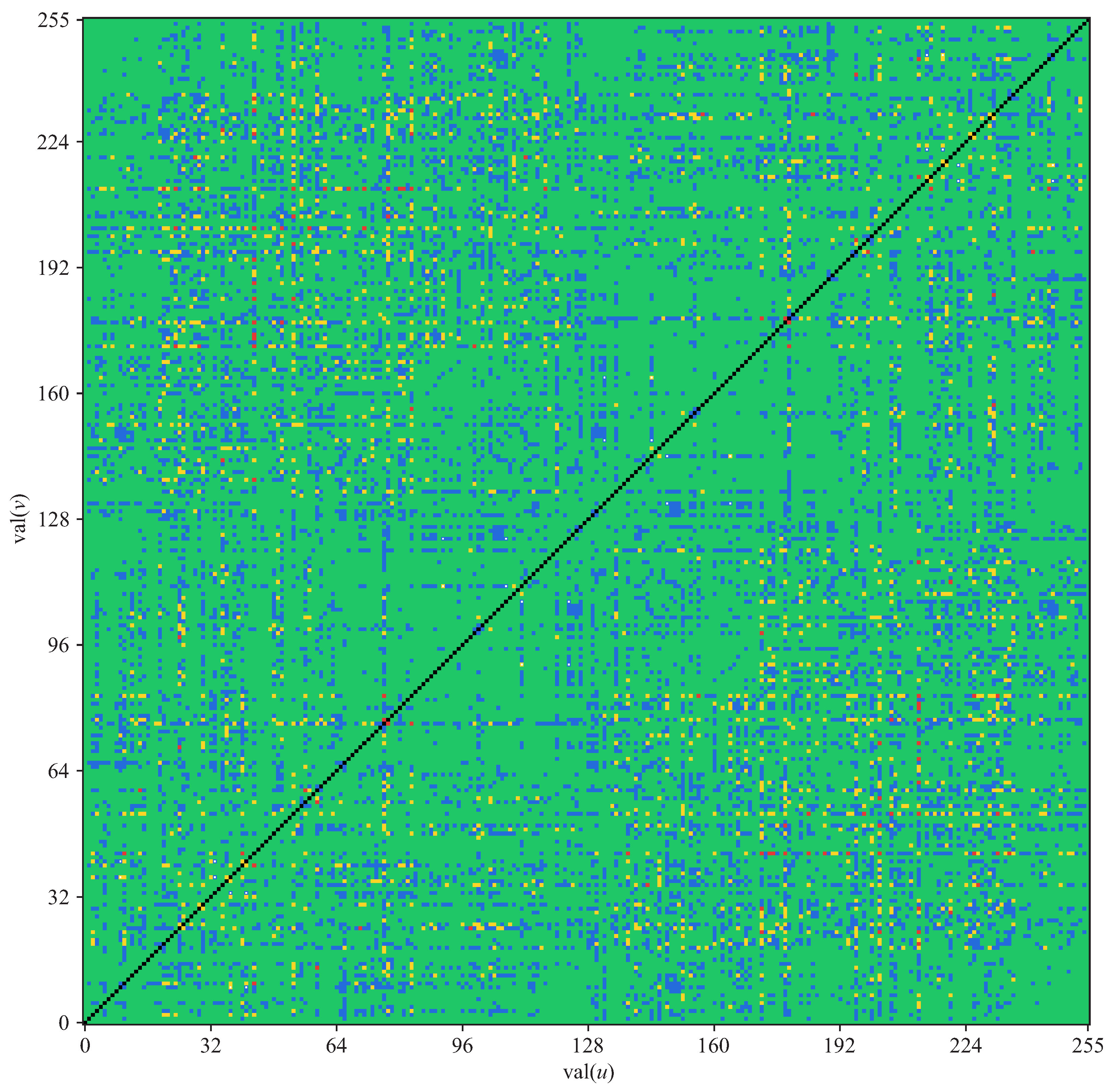
We have also examined
of all 32,640 pairs
of distinct bitstrings of length
. No SOJAS was present for 16 distinct pairs, including the pair
, shown in
Figure 6c. The results are shown in
Figure 9. For example, for the pair of bitstrings
, where
and
, as the optimal plans share no step strings, while
, as both targets can be co-assembled up to the 4th assembly step
.
Given the sets of all optimal plans
(or all plans
),
, the optimal assembly spaces are computable by finite enumeration. For
, one forms the unions of individually optimal plans, identifying step vertices that carry the same step string and the same pair of parent vertices, and selects a union of the minimum size; no union is excluded, as every such union is an assembly space. For
, one additionally excludes the unions violating the uniqueness of step strings (cf.
Figure 3b and
Figure 4a), provided any remain (cf.
Figure 6c). For
, one forms the unions of all plans
, excludes those which are not assembly spaces, and selects the minimum. Finding
,
, or
involves the additional step of selecting the minimum energy (
4). However, not knowing the plans renders the decision problems hard, as we show below.
Problem 1 (SASI, MASI, or CASI Decision Problem). Instance: A finite alphabet Σ, a finite ensemble of at least two strings, and an integer K.
Questions: “Is ?”, “Is ?”, or “Is ?”, where the answer to the first question is NO whenever does not exist.
Theorem 2. The SASI and MASI problems are NP-hard and lie in .
Proof. We reduce from the ASI problem of a string
v, which asks: “Is the
?” and is NP-complete [
11]. Given an ASI instance
with
, pick a symbol
and set
, a unary string over the disjoint alphabet
with
. Form the ensemble
over
. Because the two alphabets are disjoint,
and
share no vertex, so the only union of individually optimal plans is their disjoint union, which is automatically an assembly space; hence,
Therefore,
. The map
is computable in polynomial time, so the SASI problem is NP-hard.
The MASI problem is NP-hard by the same reduction: for the disjoint-alphabet ensemble , every union of individually optimal plans has unique step strings, whence .
For membership in , note first that every step string of a is a substring of , so a JAS of T formed as a union of plans of its targets carries at most step vertices, each a substring of some target; all objects quantified below are therefore of size polynomial in the instance. Guess such a JAS with , together with one step vertex carrying for each target . Tracing the in-edges upstream from the designated vertex yields a sub-plan of , of size . That is an assembly space, that its every final vertex is a target, that every target occurs, that , and—for SASI, that the step strings are pairwise distinct; for MASI, that no two step vertices carry both the same step string and the same pair of parent vertices—are decidable in polynomial time. Every vertex leads to a final vertex and hence to a target, so is the union of the designated sub-plans, and it is a union of individually optimal plans if and only if for every target. The bound is witnessed by the sub-plan itself; the matching bound asserts that no assembly plan of has fewer than steps, a universal quantification over objects of polynomial size with a polynomial-time matrix. Both problems therefore have the form with R decidable in polynomial time, and an instance admitting no (resp. no ) of size at most K simply has no witness y. □
Whether either problem belongs to np remains open. No general polynomially checkable lower-bound certificate for ASI is currently known; consequently, the natural JAS-based certificate described here does not establish membership in np. This contrasts with the CASI problem, for which an assembly space of size that reaches all targets is itself a complete certificate, placing it in NP.
Theorem 3. The CASI problem is NP-complete.
We provide two independent proofs of this theorem. In the first one, we use the addition-sequence problem as a reduction. Downey, Leong, and Sethi [
12] introduced the addition-sequence problem as a generalization of the addition chain problem and proved its NP-hardness by a reduction from the vertex cover problem, known to be NP-complete [
13]. The second proof of Theorem 3 is based on the proof of Theorem 2.
Problem 2 (Addition Sequence Decision Problem). Instance: Positive integers , and .
Question: “Starting from 1, can all integers be computed using at most K additions, with each new integer being the sum of two previously computed integers?”
Proof. Membership in NP is immediate. A certificate is a list of at most K additions , where s, t are previously available lengths. Each such addition represents the assembly step, . Verification checks, in polynomial time in the certificate size and input size, that every step is valid and that all targets appear.
For NP-hardness, we shall reduce from the addition sequence. Given an instance , construct the ensemble containing m strings of lengths composed of the same symbol 0. The bound remains K.
If the integers
can be computed from
using at most
K additions, then replace each integer
r in the addition sequence by the unary string
. Each addition
becomes the assembly step
giving a JAS for
T with at most
K step strings, so
.
Conversely, suppose T has a JAS with at most K step unary strings. Every step vertex has the form and is obtained by concatenating two preceding unary strings and ; hence, . Reading the space in topological order gives an addition sequence of at most K additions that contains all . Thus, the original addition-sequence instance is a yes-instance.
The reduction is clearly polynomial, and therefore the CASI problem is NP-hard. Together with membership in NP, the CASI problem is NP-complete. □
Proof. Membership in NP is immediate. A certificate is a list of at most K assembly steps, each specifying two previously available strings and their concatenation. Verification checks, in polynomial time in the certificate size and input size, that every step is valid, that the resulting directed graph is an assembly space, and that all targets in T appear among its vertices.
For NP-hardness, we reduce from the ASI decision problem. Given an instance
, choose a fresh symbol
, put
, and form the ensemble
over
; the second target is required by Definition 8, and
. Every step string of an assembly plan of
is a substring of
, whereas
is not, as
. Hence, every joint assembly space of
T consists of a plan of
together with the step vertex
, these being vertex-disjoint, and the minimum is attained by an optimal plan of
, whence
The transformation
is computable in polynomial time. Since the ASI decision problem is NP-complete, the CASI problem is NP-hard; together with membership in NP, it is NP-complete. □
The proofs above address two different input models. The first proof establishes the NP-completeness of the CASI problem of the length-encoded unary strings, where the reduction from the addition-sequence problem is polynomial in the encoded lengths. Thus, in the succinct unary-length model, the hardness does not require a rich alphabet or complex target patterns; it already appears for unary strings of minimum individual assembly complexity. The second proof, on the other hand, establishes the NP-completeness of the general explicit-string CASI problem, in which the targets are given as ordinary finite strings over an alphabet. Its NP-hardness follows by a direct reduction from the ASI decision problem using a fresh symbol b. Therefore, the addition-sequence reduction of the first proof should not be read as a polynomial reduction to the ordinary explicit unary-string problem, since explicitly writing may be exponentially longer than the binary representation of N. The unrestricted explicit-string NP-completeness is supplied by the second proof. These two results should therefore be interpreted as complementary. The first proof isolates the joint-structure hardness in a length-encoded unary setting, while the second proof proves NP-completeness for the standard explicit-string formulation of the CASI problem.
Neither proof by itself proves hardness for restricted families consisting only of maximum-ASI or near-maximum-ASI targets. The length-encoded unary instances used in the first proof are minimum-ASI unary strings, whereas the reduction in the second proof uses an arbitrary ASI instance augmented by the fresh target . Proving NP-hardness under near-maximum-ASI restrictions would require a separate reduction whose output instances always satisfy the imposed individual-complexity constraint. A separate and interesting question is whether NP-hardness persists under such restrictions to near-maximum-ASI targets. There are strong reasons to expect that in these cases, ensemble optimization remains difficult. Such strings are individually resistant to reuse within a single target, but an ensemble of such strings may still share external substructures, prefixes, suffixes, motifs, or assembly intermediates. Thus, the ensemble problem may remain jointly hard even when each target is individually hard or near-hard.
Conjecture 4 (Near-maximum ASI Ensemble Hardness). There exist polynomial padding or coding transformations that map unary target sets into ensembles of maximum and/or near-maximum ASI targets while preserving joint co-assembly savings up to an additive or affine correction. Under such transformations, the CASI problem restricted to ensembles of maximum and/or near-maximum ASI targets would be NP-hard.
A proof of Conjecture 4 would require gadgets that enforce high individual ASI and preserve the shared addition-sequence structure. The heat-map patterns and maximum-ASI constructions reported in formal string-assembly studies suggest a natural source of such gadgets: one may attempt to embed unary-length information into high-ASI wrappers whose internal assembly cost is forced, while the variable shared part encodes the original addition-sequence instance [
2].