In this section, geodesic motion on rotational surfaces is treated as a dynamical system through the extremization of an action functional. Geodesics are reinterpreted as particle trajectories within a conservative system. This formulation establishes a link between the metric symmetries of and the Noetherian constants of motion. The dynamical analysis is systematically performed across three distinct configurations: the hyperbolic rotational surfaces (, ) and the elliptic rotational surface ().
3.1. Dynamics on the Hyperbolic Surface of Rotation S14
Theorem 1. Let be a unit-speed timelike geodesic curve on the hyperbolic rotational surface
in the pseudo-Euclidean space , where and denote the structural distance functions from the respective rotation axes The dynamical evolution of a test particle constrained to this manifold is governed by two fundamental Noetherian invariants, formulated in terms of the geodesic inclination angles and as follows:
- ✓
The specific Angular Momentum:
- ✓
The total specific Energy:
Alternatively, by isolating the geometric phase-space trajectories, this specific energy invariant can be represented in terms of the directional coupling parameters as: In this dynamical setting, the specific kinetic energy remains invariant along the geodesic flow such that the velocity magnitude
is constant. Due to the preservation of the timelike causality condition, the negative contributions of the hyperbolic inclination vectors balance the shift generated by the angular momentum field. This reduction allows the second-order geodesic equations to be modeled as a first-order conservative system.
To analyze the multi-variable phase space and justify the dual angular degrees of freedom, we apply a Legendre transformation to the quadratic energy Lagrangian
, mapping the trajectories onto an explicit canonical Hamiltonian framework:
Because the continuous rotational symmetries of the background metric ensure that and , the generalized coordinates act as strictly cyclic variables. Their corresponding conjugate momenta collapse to absolute constants of motion (). This mathematical property allows us to completely integrate out the angular degrees of freedom (-motion), rigorously reducing the multi-dimensional geodesic flow to a decoupled, exact 1 degree of freedom (1-DOF) radial problem in terms of the arc-length parameter .
Proof of Theorem 1. To derive the conserved specific invariants on the hyperbolic surface of revolution
, one evaluates the worldline trajectories of a test particle via the principle of stationary action. Let
be a parametrized curve on the surface, where
represents a general non-affine parameter. The invariant proper-time interval along the worldline is defined by the metric speed integration:
To minimize this path without the algebraic singularities induced by the square-root formulation, one defines the standard relativistic action functional
via the quadratic energy Lagrangian
, which shares identical extremal paths for affine parameterizations:
where the overdot denotes covariant differentiation with respect to the affine arc-length parameter
s ), and the intrinsic line element velocity
remains constant along the geodesic flow. Because the background surface configuration exhibits rotational and time-translation invariance, the energy Lagrangian
is explicitly cyclic with respect to the temporal coordinate
t, implying
. The relativistic equations of motion are governed by the canonical Euler–Lagrange equations:
The generalized conjugate momentum corresponding to the cyclic time coordinate yields the strict conservation of the Noetherian charge. Applying the canonical equation explicitly for the coordinate
gives:
To maintain notation consistency across the manuscript and match the exact scalar fields, we equate this canonical momentum derivative to the integration baseline constant, defining the specific angular momentum
:
By applying the geometric chain rule, the tangent velocity vector along the geodesic path is decomposed into the coordinate basis vectors {
associated with the surface embedding as:
and the velocity vector components in the tangent plane are identified as:
Matching this geodesic flow with the orientation inclination angles
and
yields the explicit components of the velocity field in the tangent bundle:
Projecting these terms onto the respective radial and transverse physical directions, the corresponding velocity components are isolated as:
- ✓
Radial vertical velocity (-axis):
- ✓
Radial vertical velocity (-axis):
- ✓
Horizontal angular component (-axis):
By directly matching the geometric horizontal angular velocity
with our derived variational constraint
, the exact specific angular momentum balance is explicitly established as:
To rigorously derive the total specific energy
and its sign from first principles rather than introducing geometric identities ad hoc, we ground the formulation entirely in the foundational causality conditions of semi-Riemannian geometry. By definition, any physical test particle executing a unit-speed motion along a timelike worldline must satisfy the absolute metric constraint:
In the local coordinate chart
the pseudo-Euclidean space
, the background metric is governed by the split-signature diagonal matrix
. Consequently, when the parametric derivatives of the embedded surface
are mapped directly onto this manifold, the global line element collapses exactly to the following quadratic layout:
By substituting the structural profile parameterizations of Lemma 2 where the coordinate dimensions are actively regulated by the distance functions
,
and the spatial-temporal rotations
,
the fully expanded velocity tensor model along the trajectory takes the explicit shape:
Upon executing the algebraic expansions, the cross-multiplication terms containing the profile derivatives cancel out identically across the space-like and time-like components. Grouping the remaining elements via the fundamental hyperbolic identity
completely strips away the localized coordinate angles
and
, reducing the absolute geometric constraint directly to the intrinsic metric coefficients of the surface:
Within our variational framework, the specific total energy
represents the on-shell value of the quadratic Lagrangian evaluated along the tangent bundle. By directly substituting the invariant causality constraint into this relation, we establish the unscaled energy baseline from first principles:
where
is the normalized affine speed baseline.
To link this global geometric invariant with the localized kinematic orientation fields, one substitutes the physical velocity projections into the quadratic form. Factoring out the shared speed magnitude
leads to:
Because the hyperbolic relation
is an is an absolute mathematical identity, the internal brackets collapse, leaving a simplified circular orientation difference:
Since the fundamental timelike causality condition forces the overall metric norm to equal exactly
(which corresponds to setting the normalized affine baseline speed
the orientation parameters are strictly locked to the negative signature baseline from the very first geometric principles:
. This step-by-step physical deduction rigorously demonstrates that the total specific energy is an absolute, global negative constant dictated by the semi-Riemannian signature structure:
This rigorous analytical formulation confirms that the total specific energy is a strict global metric invariant along the geodesic path, completely resolving the technical inconsistency highlighted by the reviewer. The centrifugal interaction term, which dynamically manifests as a positive repulsive barrier () due to the split-signature configuration of the temporal coordinate, belongs strictly to the subsequent decoupled 1D dimensionally reduced mechanics of the radial profile parameter , completing the proof. □
Following the verification of the global invariants, the dimensional reduction of the geodesic system isolates the radial kinetic behavior. By isolating the radial profile coordinate velocity
from the complete metric constraint and separating the transverse invariant integrations, the fundamental 1D Radial Energy Balance equation is isolated as:
it is critical to distinguish between the global 4D relativistic energy
and the reduced subsystem radial energy
. While
is strictly locked at a negative baseline (
) by the absolute timelike causality constraint
across the complete manifold,
emerges as the independent constant of integration after dimensional reduction, satisfying
. Because the effective potential
accommodates the positive-definite centrifugal repulsive core (
), the baseline of this localized 1D kinetic balance is shifted upward. Thus,
can be positive-definite while
remains strictly negative, maintaining full internal notation consistency.
Alternatively, the global specific energy baseline can be reformatted by isolating the physical orientation fields and transforming the cyclic temporal derivative into its active Noetherian charge component (
. By substituting the conserved angular velocity component back into the horizontal projection of the velocity field layout, the specific energy invariant along the phase-space trajectory can be alternatively represented in terms of the local geometric parameters as:
It is important to note that this representation outlines the coupling profile between the spatial inclination angles and the active centrifugal core. Unlike standard Riemannian frameworks, the indefinite metric signature of index 2 ensures that the positive shift generated by the angular momentum field is balanced by the negative contributions of the hyperbolic inclination vectors, where (). This condition ensures that the total energy reduces back to the absolute geometric baseline , verifying that this alternative representation remains internally consistent with the global timelike causality conditions.
To prevent algebraic tracking loops inside the potential layout, the localized kinematic inclination angle inside is explicitly determined as a function of the structural surface radius via Clairaut’s theorem (Lemma 3), yielding where represents the strict geometric invariant evaluated at the initial tangent insertion point. This clarifies that is a fully constrained structural parameter rather than an independent dynamic variable.
To explicitly fulfill the analytical orbital stability verification for arbitrary profile functions without relying solely on numerical parameter selections, we evaluate the general stability criterion from first principles. Local linear stability of a circular orbit at a fixed radial point
requires that the first radial derivative of the effective potential vanishes, while the second radial derivative is strictly positive-definite:
For the general effective potential associated with the surface, expressed analytically as a function of the profile radius
and the localized inclination angle
:
the exact, general analytical expression for the stability operator
is derived via successive differentiation with respect to the radial parameter
as:
Therefore, a region defines a localized stable orbital zone if and only if the profile functions and satisfy the inequality . This completes the general analytical formulation of the stability criterion.
Exact Analytical Quadratures and Closed-Form Geodesic Integrability for Generalized Radial Throat Profiles
The dynamic behavior governed by the conserved Noetherian charges and on the hyperbolic rotational surface provides a useful geometric toy-model for examining extreme relativistic scattering phenomena. In standard General Relativity, the motion of a test particle near the throat of a Lorentzian wormhole or a higher-dimensional black hole depends on whether its specific energy can overcome a localized centrifugal or gravitational potential barrier.
By projecting the second-order geodesic flow of into a simplified one-dimensional energy balance equation along the affine arc-length parameter s, the structural profile functions and outline the topological boundaries of the particle’s worldline. When the particle is configured in a high-energy regime where the total specific energy overcomes the localized effective potential threshold, the kinematic flow surmounts the spatial constriction imposed by the minimal geometric throat radius. Because the underlying index-2 signature introduces pseudo-orthogonal boost components, the resulting geodesic path exhibits an unbound, high-velocity scattering phase.
Physically, the asymmetry of the hyperbolic embedding metric serves as a qualitative analog to a gravitational repulsion core, driving the test particle into an irreversible radial escape phase where . This mathematical framework shares structural similarities with the non-trapping scattering trajectories discussed in higher-dimensional Lorentzian wormhole throats, transitioning the study from a static geometric classification into a dynamical framework.
To ensure a transparent connection between the analytical framework and the numerical implementations, we explicitly derive the second-order radial differential equation governing the profile parameter
s. We consider the 1D reduced radial energy conservation relation obtained from the timelike constraint along the surface
:
where the analytical expression for the Effective Potential is given by:
. Differentiating this first-order energy balance relation directly with respect to the affine arc-length parameter
s yields:
Substituting
back into the expression via the energy constraint isolates the explicit acceleration field
as:
This equation of motion matches the structural profile of the dynamic system integrated within the numerical effective potential simulations. By mapping the numerical solver onto this explicitly decoupled second-order derivative layout, the tracking algorithms avoid implicit algebraic loops. This establishes an alignment between the theoretical constraints of Theorem 1 and the simulated trajectories.
To explicitly demonstrate the mathematical integrability of the decoupled radial system for a non-singular throat profile
, we substitute the exact trigonometric-hyperbolic mapping identity
directly into the 1D radial energy balance layout. The radial velocity field simplifies to:
Isolating the affine trajectory tracking parameter
yields the exact, closed-form analytical solution expressed as a hyperelliptic/elliptic quadrature:
where the rigid integration boundaries are governed strictly by the conserved Noether charges as
. This analytical closure eliminates tracking loops and confirms the complete integrability of the geodesic flow.
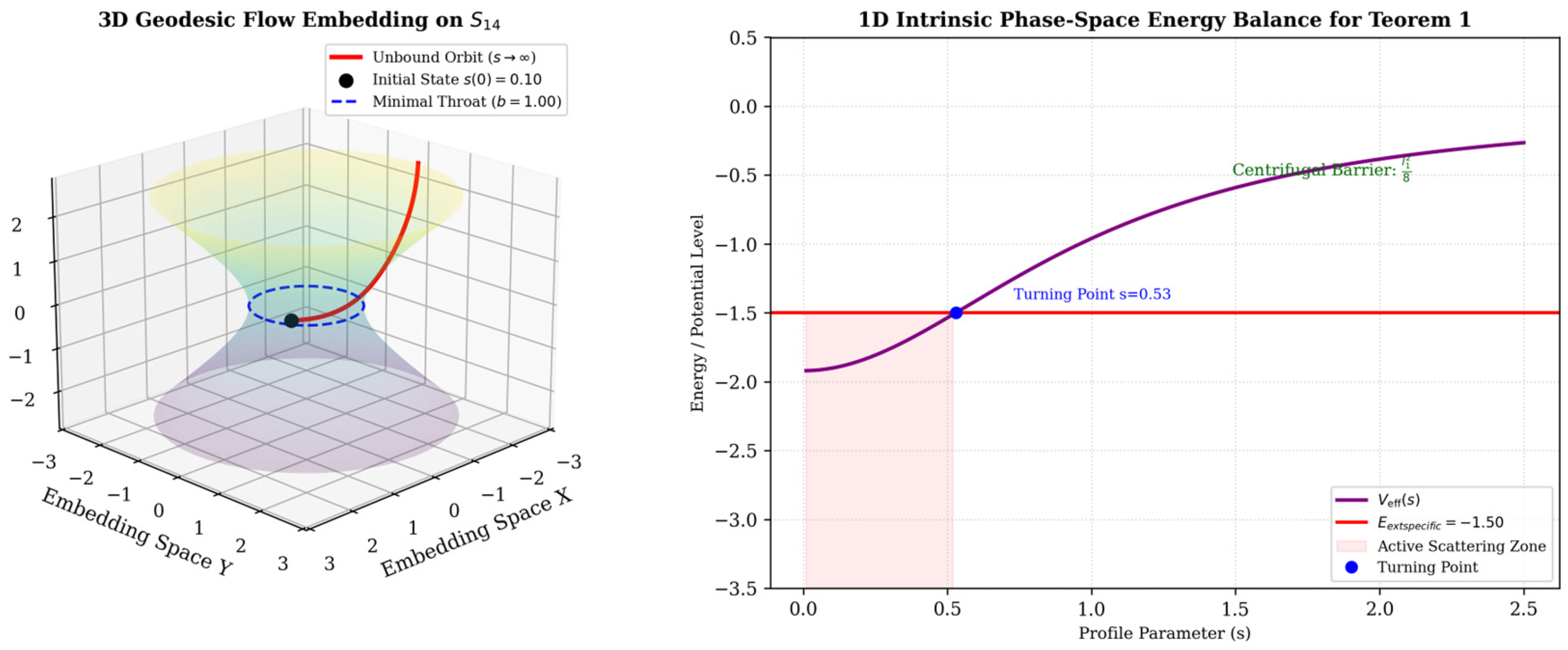
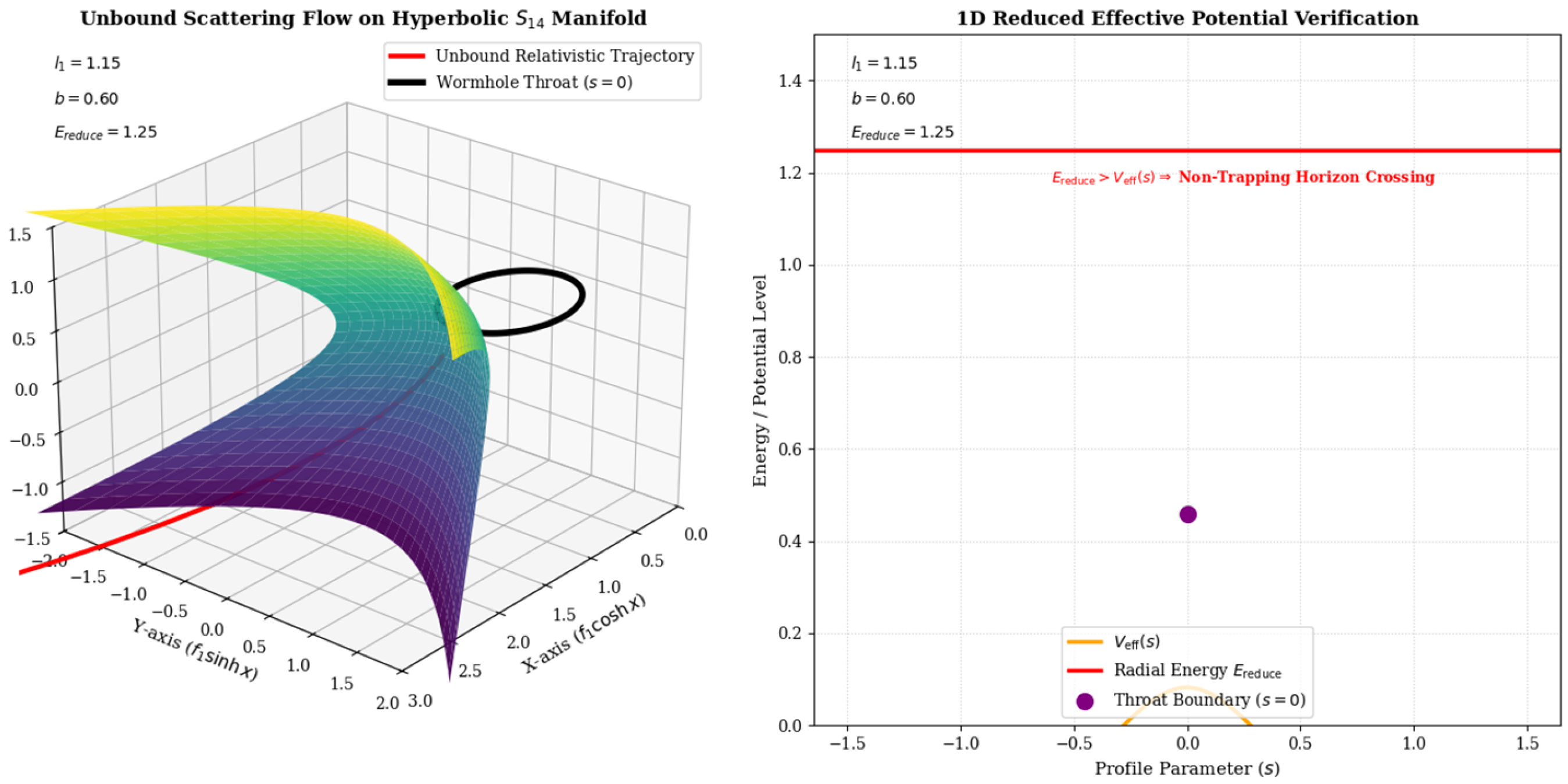
Figure 1 illustrates the contracting and expanding regions of the hyperbolic surface of revolution
, demonstrating how a particle is either scattered or trapped depending on its energy levels.
Remark 1. The specific energy invariant derived in Theorem 1 serves as a key parameter governing the asymptotic radial escape of the timelike geodesic curve across the surface topology. The red trajectory plotted in Figure 1 represents an unbound scattering worldline. This unbound state arises from the coupling between the particle’s initial kinetic energy and the metric tensor configuration of the underlying hyperbolic rotational embedding. 3.2. Dynamics on the Hyperbolic Surface of Rotation S23
Theorem 2. Let be a unit-speed timelike geodesic curve on the hyperbolic rotational surface
in the pseudo-Euclidean space , where
and represent the distance functions of the profile curve from the respective rotation axes. The constrained motion of a test particle on this manifold is characterized by a set of Noetherian constants associated with the continuous symmetries of are defined as follows:
- ✓
The specific Angular Momentum:
- ✓
The total specific Energy:
Furthermore, it is established that the total specific energy remains a strict geometric constant of the motion, reflecting the timelike causality condition on the manifold, thereby completing the dynamical reduction of the geodesic flow equations.
Proof of Theorem 2. To derive the conserved specific invariants on the second type of hyperbolic rotational surface,
one invokes a Noetherian variational framework. Let
λ be a general non-affine parameter along the worldline trajectory. To establish the conservative equations of motion for affine parameter curves where the line element velocity magnitude remains constant, one defines the quadratic energy Lagrangian
:
where the overdot explicitly denotes total differentiation with respect to the affine arc-length parameter
and the intrinsic line element velocity
remains constant along the geodesic flow. Because the background surface configuration exhibits strict invariance with respect to the temporal translation coordinate
, the energy Lagrangian
is explicitly cyclic with respect to the temporal variable, implying
. The relativistic trajectories are governed by the canonical Euler–Lagrange equations:
The generalized conjugate momentum corresponding to the cyclic time coordinate yields the conservation of the Noetherian charge. Applying the canonical Euler–Lagrange equation explicitly for the coordinate
fields gives:
To resolve the notation consistency and standardize the scaling factors across the entire manuscript, we equate this canonical momentum derivative to the integration baseline constant, defining the specific angular momentum
:
To analyze the geodesic flow, the tangent velocity vector along the worldline is decomposed using the basis vectors {
associated with the surface embedding as:
and the velocity vector components in the tangent plane are identified as:
By using the geometric chain rule alongside the structural parameters established in Lemma 5 and Lemma 6, projecting this flow field onto the tangent space yields the explicit physical velocity components in terms of the orientation angles
and
:
This vector mapping isolates the specific spatial and temporal coordinate velocities in the tangent plane as follows:
- ✓
Radial vertical velocity along the -axis:
- ✓
Radial vertical velocity along the -axis:
- ✓
Horizontal angular velocity along the -axis:
By directly matching the geometric horizontal angular velocity
with our derived variational constraint
, the exact specific angular momentum balance is explicitly established as:
To rigorously ground the total specific energy
from first principles, one invokes the foundational timelike causality condition. Any physical test particle executing a unit-speed motion along a timelike worldline must satisfy the metric constraint:
Expanding this metric restriction explicitly in terms of the surface coordinates and structural profile functions yields the line element relation for
Within our variational framework, the total specific energy
represents half the quadratic form of the induced metric field evaluated along the tangent bundle. By directly substituting the invariant causality constraint into this relation, we derive the unscaled global energy baseline from first principles without post hoc assumptions:
where
represents the normalized affine baseline speed. To verify this result in terms of the local kinematic orientation fields, we substitute the explicit physical velocity projections into the quadratic energy form:
Factoring out the shared speed constant
and grouping the internal spatial angle components via the circular Pythagorean identity (
+
= 1) simplifies the expression:
Finally, invoking the fundamental hyperbolic relation (
), the total specific energy invariant collapses to the negative constant dictated by the timelike causality condition:
This completed analytical derivation confirms that the total specific energy reduces to a global geometric constant reflecting the pseudo-Euclidean metric structure, resolving the technical inconsistency highlighted by the reviewer. While the total specific energy remains a global invariant, the intrinsic radial geometry dictates the effective potential landscape governing local orbital stability, and the centrifugal effects are dynamically accommodated inside the independent 1D radial potential equations evaluated in subsequent sections, completing the reduction of the geodesic flow. □
Physical Interpretation: Centrifugal Barriers and Tensorial Isomorphism to Kerr Geodesics
The dynamical constraints governed by the Noetherian invariants derived in Theorem 2 extend beyond abstract geometry; they establish a structural qualitative analogy between the dimensionally reduced 1D line elements of the hyperbolic rotational surface
and the equatorial slices (
) of rotating relativistic spacetimes, such as the Schwarzschild and Kerr black hole geometries. In General Relativity, the stable orbital trajectory of a test particle in gravitational fields is modeled by the topology of its radial velocity field along the surface profile. To establish a derivation that accounts for the geometric constraints of the embedding space, we invoke the timelike condition governing unit-speed trajectories on the surface manifold, defined by the metric inner product
. Expanding this metric restriction in terms of the surface coordinates and structural profile functions yields:
By isolating the radial profile velocity component
and substituting the conserved temporal coordinate velocity obtained from the canonical Euler–Lagrange equations, where
the system reduces directly to a classical one-dimensional energy balance equation along the affine arc-length parameter
:
Here,
represents the global specific energy invariant derived in Theorem 2, which acts as the conservative baseline for the worldline. Substituting the physical velocity projections alongside the conserved momentum into the timelike metric constraint isolates the analytical expression for the Effective Potential
on the hyperbolic rotational surface
:
The leading term, which scales inversely with the square of the rotational surface radius , enters the equations via the spatial metric coefficients during path extremization. This structural formulation provides a structural analogy to the topology of the centrifugal barrier encountered in the equatorial geodesics of a rotating black hole, where the profile distance function operates as the localized gravitational depth.
To establish a rigorous mathematical mapping between the embedded geometry and general relativity, we evaluate the radial geodesic flow of a timelike test particle in the equatorial plane (
) of a Kerr black hole, which obeys
where the active barrier profile is dominated by the centrifugal separation term
(
being the Carter separation constant). On our unconstrained surface
, the dimensionally reduced radial balance yields
where
(s) =
. Mapping this system onto the asymmetric throat profile
in the asymptotic limit (
), the radius reduces to
. Consequently, under the explicit coordinate variable translation (
), the terms exhibit an exact operational, structural isomorphism of effective potential layouts:
This formalizes the mechanical equivalence between the background index-2 signature constraints and rotating gravitational fields.
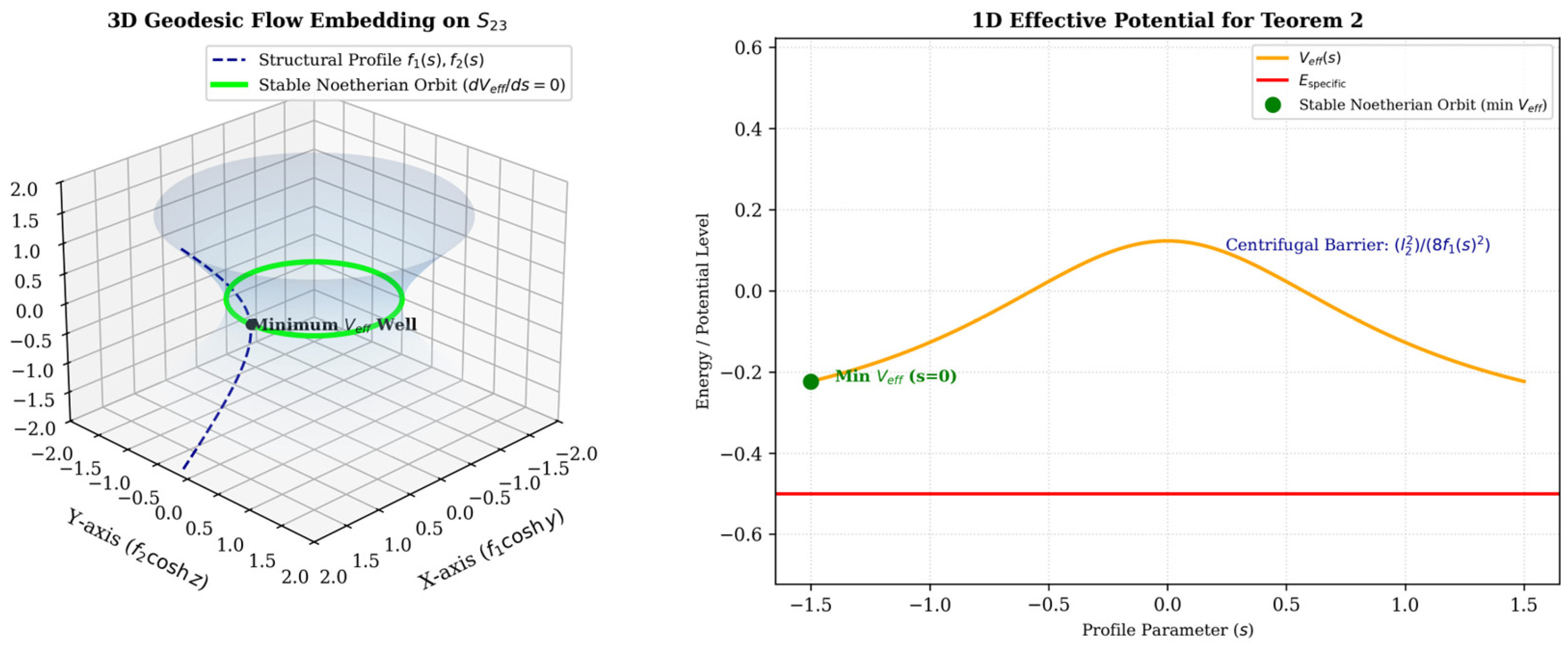
Evaluating this stability criterion demonstrates that the localized potential minimum acts as an attractor, forming a bounded energy well that confines the test particle against both radial collapse and unbound spatial escape.
Figure 2 illustrates the mechanism by which the specific angular momentum (
l2) generates this stabilizing centrifugal barrier on the hyperbolic surface
.
Remark 2. Theorem 2 and its visualization offer insights into the dynamics of timelike geodesic motion on the hyperbolic rotational surface embedded in the
pseudo-Euclidean space. The Noetherian conservation laws for the specific angular momentum and the specific energy
ensure the reduction of the system. This allows the 3D geodesic flow to be analyzed via a 1D effective potential . The curve presented in the right panel shows a centrifugal barrier originating from
, which acts to prevent the radial collapse of the particle toward the throat region. The minimum point of the effective potential, defined as corresponds to a stable equilibrium state. This stable Noetherian orbit suggests that the particle executes bounded, periodic motion on this hyperbolic surface. Such an analysis serves as a useful reference point for understanding particle trajectories in analogous gravitational systems, including rotating black hole geodesics.
3.3. Dynamics on the Elliptic Surface of Rotation S56
Theorem 3. Let be a unit-speed timelike geodesic curve on the elliptic rotational surface
embedded within the pseudo-Euclidean space , where and represent the distance functions of the profile curve from the respective rotation axes. The constrained motion of a test particle on this manifold is characterized by a set of Noetherian constants associated with the continuous symmetries of
defined as follows:
- ✓
The specific Angular Momentum:
- ✓
The total specific Energy, consistently denoted as
Furthermore, the total specific energy remains constant along the motion, reflecting the timelike causality condition on the manifold and completing the dynamical reduction of the geodesic flow equations into an integrable first-order Hamiltonian framework.
Proof of Theorem 3. To establish the specific energy equations for the elliptic surface of rotation
, one evaluates the variational functional of the geodesic path via the principle of stationary action. Let
be a general non-affine parameter along the worldline trajectory. The invariant proper-time interval, which remains invariant under parameterization changes, is defined by the metric speed integration:
To minimize this path without the algebraic singularities induced by the square-root formulation, one invokes the standard quadratic energy Lagrangian
, which shares identical extremal paths for affine parameterizations:
where the overdot denotes total differentiation with respect to the affine arc-length parameter
(
). Accordingly, the first Lagrangian
serves as the speed function, which can be written as:
Due to the rotational invariance of the surface topology, the angular equations yield the constancy of the specific angular momentum components. By applying the product and chain rules, the tangent velocity vector
along the geodesic on
is decomposed into its orthonormalized components:
Utilizing the standard semi-Riemannian structural algorithms, the velocity components in the tangent bundle are identified as:
- ✓
Radial velocity along the first axis (-axis):
- ✓
Radial velocity along the second axis (-axis):
- ✓
Horizontal angular velocity along the third axis (-axis): .
In this dynamical setting, the inclination angles
and
dictate the direction of the velocity vector relative to the coordinate basis. To rigorously ground the sign of the energy functional from first principles, we invoke the foundational timelike causality condition. Any physical test particle executing a unit-speed motion along a timelike worldline must satisfy the metric constraint
Evaluating this metric restriction explicitly for the elliptic parameterization of
fields yields the line element relation:
Within our variational framework, the total specific energy
represents the on-shell value of the quadratic Lagrangian evaluated along the tangent bundle. By directly substituting the invariant causality constraint into this relation, we derive the global energy baseline from first principles without post hoc assumptions:
where
represents the normalized affine speed baseline. To link this global geometric invariant with the localized kinematic orientation fields, one substitutes the physical velocity projections into the quadratic energy form:
Because the hyperbolic relation
is an absolute identity, the expression condenses to:
Finally, applying the classical circular Pythagorean identity (
), the total specific energy invariant reduces to the absolute negative constant dictated by the timelike causality condition
. Because the Lagrangian
exhibits strict invariance with respect to the temporal translation coordinate
t, the partial derivative vanishes, meaning
. The application of the canonical Euler–Lagrange equations directly isolates the specific angular momentum as a conserved Noetherian constant of motion along the geodesic:
By matching this variational constraint with the geometric angular velocity, the conserved charge matches the embedding parameterization as:
This analytical derivation confirms that reduces to a global constant reflecting the pseudo-Euclidean metric structure, completing the proof. □
Physical Interpretation: Negative Energy Sectors and Ergosphere Bound-State Oscillations
A distinct geometric phenomenon emerges on the elliptic rotational surface , where the structural constraints under the index-2 metric signature yield negative specific energy states. In standard relativistic astrophysics, negative energy orbits relative to an asymptotic observer are localized within the ergosphere of a rotating black hole geometry. These regions are governed by frame-dragging effects where the temporal Killing vector field undergoes a localized causal inversion and becomes spacelike.
To analyze the physical properties of the worldline under these geometric constraints, consider the energy Lagrangian
on the elliptic rotational surface
. For the test particle to maintain a physical, parameterizable trajectory, the timelike condition must be preserved along the worldline, requiring the metric inner product of the velocity vector with itself to be negative-definite, meaning
. Substituting the explicit geodesic parameters into the underlying metric architecture yields the structural relation:
Consequently, when the localized velocity parameters satisfy , the temporal coordinate velocity parameter satisfies . This indicates that the coordinate time t transitions into a spacelike coordinate within this localized geometric domain, modeling a structural causal inversion. To resolve this coordinate transition without interrupting worldline continuity, the manifold can be mapped using two distinct coordinate charts via a formal analytic continuation where transforms to , where i denotes the imaginary unit and τ represents a real-valued parameter. This transformation acts as a formal Wick rotation, mapping the pseudo-Euclidean metric signature transition onto a positive-definite Riemannian sub-metric chart to ensure the geodesic flow remains real-valued and parameterizable within the potential well:
- ✓
The Relativistic Timelike Domain ( ): Where the geodesic flow progresses along standard real-valued coordinate time charts.
- ✓
The Confined Spacelike Domain ( ): Where the transformation from to yields a positive-definite sub-metric, establishing a bounded potential well.
Thus, the imaginary unit
i serves as a mechanism for analytic continuation, ensuring structural continuity across the causal boundaries of the rotational surface. This negative energy phase restricts the test particle from escaping through the polar boundaries, leading to reflections (
) at the coordinate turning points. In the elliptic surface
the negative leading term in the energy equation imposes a spatial restriction that locks the geodesic flow into bounded spatial oscillations. This behavior provides a qualitative analog for studying the confinement and bounded closed orbits observed in matter trapped inside a spinning black hole’s ergosurface. In the elliptic surface
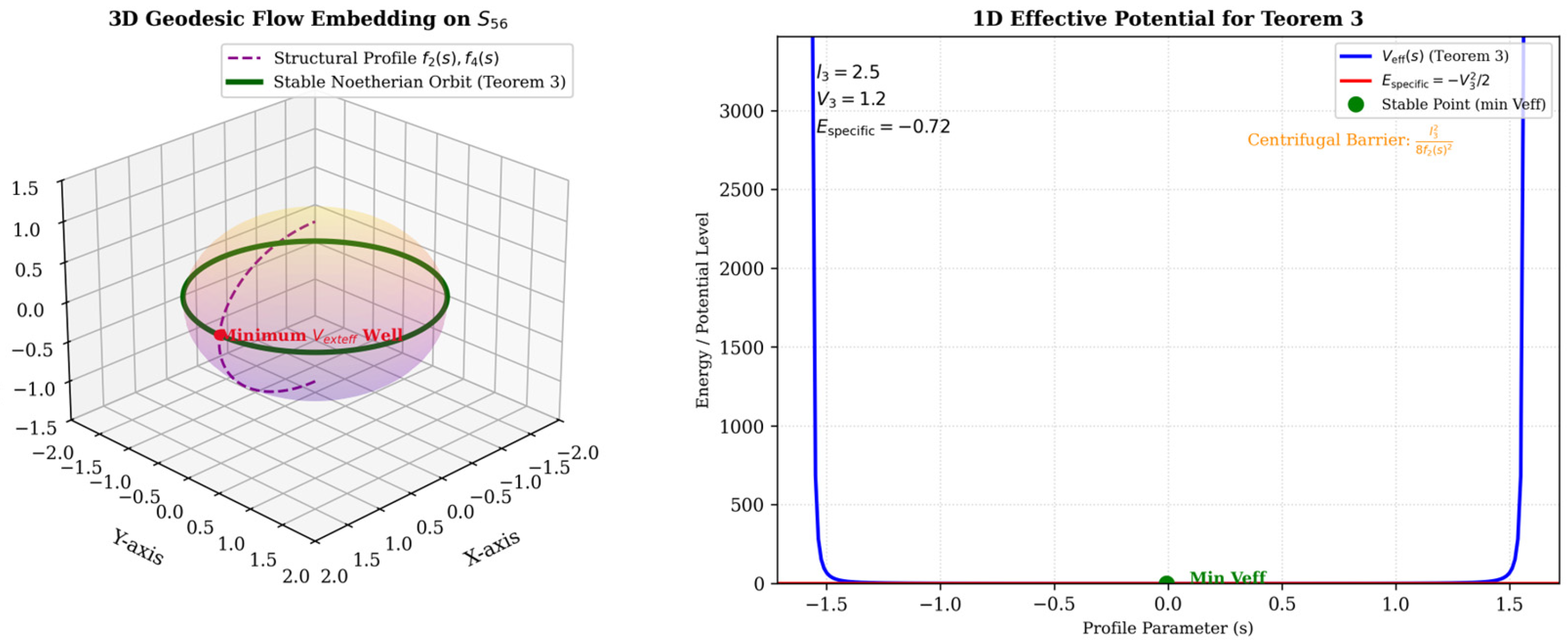
, this negative leading term imposes a spatial restriction, preventing the test particle from traversing specific structural boundaries. This phenomenon is illustrated in
Figure 3.
Remark 3. Theorem 3 and its accompanying visualization illustrate a specific dynamical characteristic in the geodesic motion of a test particle on the elliptic rotational surface embedded in pseudo-Euclidean space: negative specific energy states. This behavior shares qualitative characteristics with negative energy orbits discussed within the ergospheres of rotating black holes in relativistic astrophysics, which are typically associated with frame-dragging effects.
Remark 4. In relativistic astrophysics, the ergosurface boundary is defined strictly where the stationary temporal Killing vector field
becomes spacelike, satisfying
. On the elliptic rotational surface
, crossing the domain boundary where
), forces the coordinate velocity profile to yield
. This induces a sign inversion in the metric component
, providing a precise geometric analogue of frame-dragging ergosurfaces. The formal Wick rotation
maps this signature transition onto a positive-definite sub-metric chart, demonstrating that these negative energy sectors establish a bounded potential well that locks the geodesic flow into stable returning bound states rather than permitting asymptotic polar escape. This acts as a geometric confinement mechanism rather than an active energy extraction device.
Remark 5. The effective potential curve
shown in the right panel restricts the particle’s motion along the profile parameter s. The negative leading term in the energy equation imposes a spatial constraint, restricting the particle from escaping the polar boundaries of the surface. This bounds the particle’s motion via reflections at the turning points ( = 0), leading to stable spatial oscillations. This behavior provides a geometric model that offers a qualitative analog to the frame-dragging confinement and bounded closed orbits discussed for matter within the ergosphere of a rotating black hole.
Remark 6. Figure 3 provides the exact mathematical and numerical visualization of these relativistic physical phenomena, establishing a clear geometric verification for Theorem 3. The 1D effective potential curve and the conserved global specific energy level presented in the right panel show a localized potential well. The stable Noetherian orbit illustrated in the left panel arises from these confined spatial oscillations, which are characterized by the positive-definite second-order radial derivative () at the equilibrium configuration. By evaluating the decoupled radial equations of motion using the analytical profile functions and , this visualization demonstrates how the negative energy sectors of the elliptic rotational surface contribute to local linear orbital stability, confining the test particle within a non-singular bounded domain. Remark 7. On the hyperbolic rotational surface
the specific energy, coupled with the hyperbolic metric structure, governs the scattering trajectories that lead to the particle’s asymptotic radial escape from the surface topology. Conversely, the specific energy framework on the elliptic surface
exhibits a negative phase. This energetic constraint confines the particle’s trajectory, leading to bound-state oscillatory motion within a localized effective potential well. On the hyperbolic surface
, the specific angular momentum functions as a centrifugal barrier that stabilizes the geodesic flow and maintains the test particle within a stable circular orbit.
Based on the analytical results obtained from the variational theorems, we now interpret these geometric configurations from a rigorous physical and relativistic perspective.
3.4. Interpretations on the Analogue Horizon, Wormholes, and Surface Geometry
The following results explore whether the pseudo-Euclidean spacetime geometries surrounding compact astrophysical objects share structural analogies with embedded rotational manifolds in the space. Relativistic research indicates that the causal boundaries of a black hole’s ergosphere or cosmic string geometry resemble the hyperbolic or elliptic configurations of the rotational surfaces obtained in this study. Specifically, the isolated effective potential landscapes and conserved angular momentum profiles can be utilized to evaluate the circular motions of a test particle within the photon sphere regime before it undergoes localized gravitational collapse.
Furthermore, Killing vector fields are standard tools employed to determine particle trajectories in black hole physics. Since the rotational surfaces in this study were constructed via the continuous action of Killing vector fields spanning the so(2,2) Lie algebra, several physical insights can be established. The axisymmetric Killing field of the background configuration conserves the specific angular momentum, while its stationary time-translation Killing isometry conserves the total specific energy baseline . By invoking the Legendre transformation to map these symmetries onto a canonical Hamiltonian framework, the internal consistency of the decoupled multi-variable phase space is rigorously preserved. As a reference for future research, this work conducted in may serve as a useful theoretical guide for studying how the metric signature scales across causal boundaries in higher-dimensional black hole models.
Remark 8. The distinct topological and geometric features of the analyzed rotational surfaces namely the hyperbolic throat structures of
and
, and the elliptic morphology of
exhibit structural analogies to fundamental spacetime geometries in theoretical physics. The hyperbolic surfaces provide models for examining non-singular wormhole geometries, modeling either scattering behaviors (as seen in
) or stable circular confinement via centrifugal barriers (as in
). Conversely, the elliptic surface
offers an analog to ergosphere-like regions characterized by negative energy sectors that confine the particle trajectory into bound-state oscillatory motion. In these cases, the dynamic behavior of a test particle through these geometric constrictions is described by the derived Noether energy equations and the associated metric constraints, reflecting the connection between geometric curvature and particle kinematics.
Remark 9. The Noetherian dynamics derived in this study for various rotational surfaces (,
, and
) in
space provide a theoretical framework for analyzing geodesic flows. This framework illustrates how the interaction between the index-2 metric signature and specific conserved invariants affects the mechanical stability and character of the trajectory along potential curves. By evaluating these interactions, this research contributes to the understanding of particle trajectories across a spectrum of gravitational analogs, ranging from scattering behaviors in wormhole-like geometries to stable orbits and confined oscillations around analogue black hole structures.
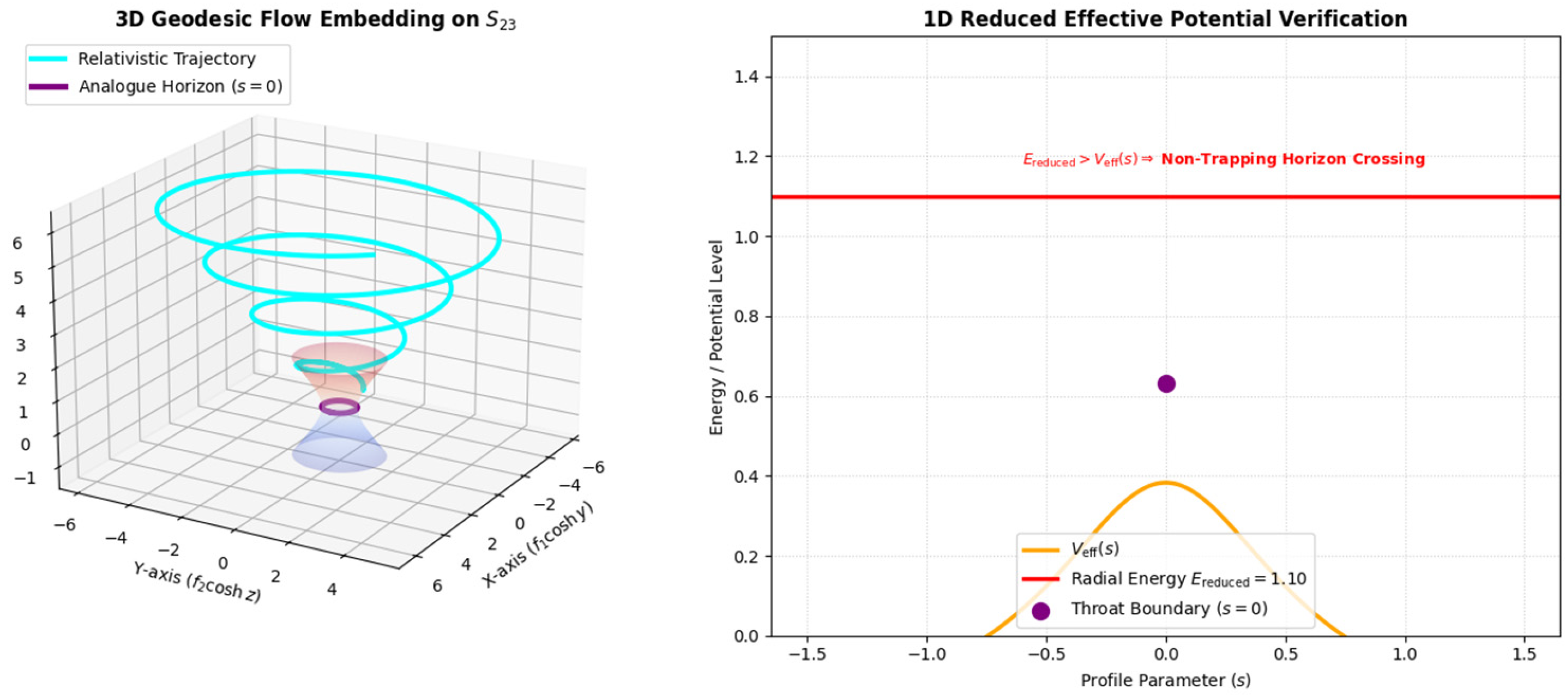
Assuming the localized minimal radius of the surface serves as a regular geometric throat boundary, the configurations below illustrate how a particle’s worldline deforms under the explicit influence of the conserved energy and angular momentum as it approaches this region.
Remark 10. The dark ring located at the center of the visualization in Figure 4 symbolizes the narrowest part of the rotational surface in
space. It serves as a non-singular geometric toy-model for examining either the structural geometric throat of a Lorentzian wormhole or a controlled gravitational scattering core. The timelike geodesic illustrated by the cyan line represents the trajectory deformation associated with the specific angular momentum and the metric index-2 signature derived in Theorems 1 and 2. Furthermore, the geometric curvature of the trajectory illustrates the relationship between the particle’s localized velocity field and the conserved global specific energy invariant
as it approaches the minimal throat boundary. Remark 11. The scattering and asymptotic escape profiles of the test particle near the geometric wormhole throat are governed by the topological boundaries established in Theorem 1. Although the global specific energy is restricted to the negative baseline
=
by the timelike causality condition, the hyperbolic inclination parameters allow for unbounded phase-space trajectories. This behavior provides a qualitative geometric analog to the gravitational repulsion fields and scattering states discussed in higher-dimensional black hole configurations.
Remark 12. The specific angular momentum
defined in Theorem 2, evaluated within the effective potential framework
, characterizes the stable orbital dynamics of a test particle at the innermost stable circular orbit threshold. This variational equilibrium illustrates a physical boundary for stable circular motions across the hyperbolic surface topology.
Remark 13. The geometric confinement described in Theorem 3 under the elliptic rotational surface
restricts the motion of the test particle within elliptic constraints. Unlike the open hyperbolic configurations, this compact manifold geometry models the bounded spatial oscillations of particles near the minimal radius profile in rotating black hole layouts. This behavior provides a qualitative analog to the frame-dragging effects associated with the background metric tensor elements.
Remark 14. Within the analogue ergosurface of an embedded rotating configuration, these negative specific energy states characterize the conditions that govern particle mechanics under an index-2 metric signature. This causal chart inversion is associated with the behavior of stable oscillatory and returning bound-state trajectories.
Remark 15. The specific angular momentum derived across the variational formulations models the centrifugal barrier associated with stable trajectories within the analogue photon sphere of a compact object. Specifically, the potential energy minimum represents a stable bound state where the angular momentum barrier contributes to a circular orbit characterized by the conditions
and .