1. Introduction
Dynamic scheduling and optimization systems in modern manufacturing, logistics, and service operations increasingly rely on domain knowledge to support real-time decision making under uncertainty [
1]. Much of this knowledge, however, resides in unstructured text sources. Examples include equipment maintenance logs, standard operating procedures, fault reports, and expert notes. Extracting structured, machine readable decision dimensions from such raw corpora without manual intervention remains a significant challenge [
2].
Knowledge graphs (KGs) have emerged as a powerful paradigm for organizing and representing structured domain knowledge, enabling applications in recommender systems, question answering, and decision support [
3,
4]. A typical KG consists of a schema layer, which defines concept classes and their hierarchical relations, and an instance layer, which populates entities and facts. In principle, a KG can serve as a structured knowledge base to enhance scheduling algorithms. For example, it can provide state abstractions for reinforcement learning or constraints for optimization models [
5]. However, constructing the schema layer of a KG for any complex domain traditionally requires extensive manual effort from domain experts. This paradigm, which relies on a schema defined by humans followed by model extraction, is not only labor intensive but also struggles to capture implicit, nested, or evolving knowledge dimensions. Consequently, it limits the scalability and adaptability of KGs in dynamic environments [
6,
7].
Recent advances in large language models (LLMs), such as GPT and BERT, have demonstrated remarkable capabilities in semantic understanding and text generation [
8]. In knowledge engineering, the convergence of LLMs and KGs has become a frontier research direction [
9,
10]. Nevertheless, most existing approaches still rely on manually predefined schema layers, using LLMs only for entity recognition and relation extraction. The schema itself remains defined by humans [
11]. This leaves the fundamental bottleneck untouched: how to automatically discover the conceptual dimensions that should form the backbone of a KG from raw unstructured text.
To address this gap, we propose a novel “data speaking for itself” paradigm for automatic discovery of semantic decision dimensions. Our method leverages the robust unsupervised clustering capabilities of LLMs through prompt engineering without a predefined schema. This enables the model to autonomously induce latent concept categories directly from unstructured text [
12]. Importantly, we do not claim to have solved industrial scheduling problems; instead, we validate our method on a domain widely recognized for its high complexity and nested knowledge structures: Traditional Chinese Medicine (TCM). TCM literature contains multi-dimensional, overlapping, and deeply nested descriptions of herbal functions, properties, and indications. This makes it an ideal benchmark for testing the generalizability of knowledge discovery methods. The complexity of TCM knowledge is comparable to that found in many technical domains, such as equipment fault diagnosis or process planning. Yet TCM data is publicly available and well documented, allowing reproducible experimentation. In addition to TCM, we further validate the method on a real-world aircraft assembly manual to demonstrate its transferability to scheduling related text.
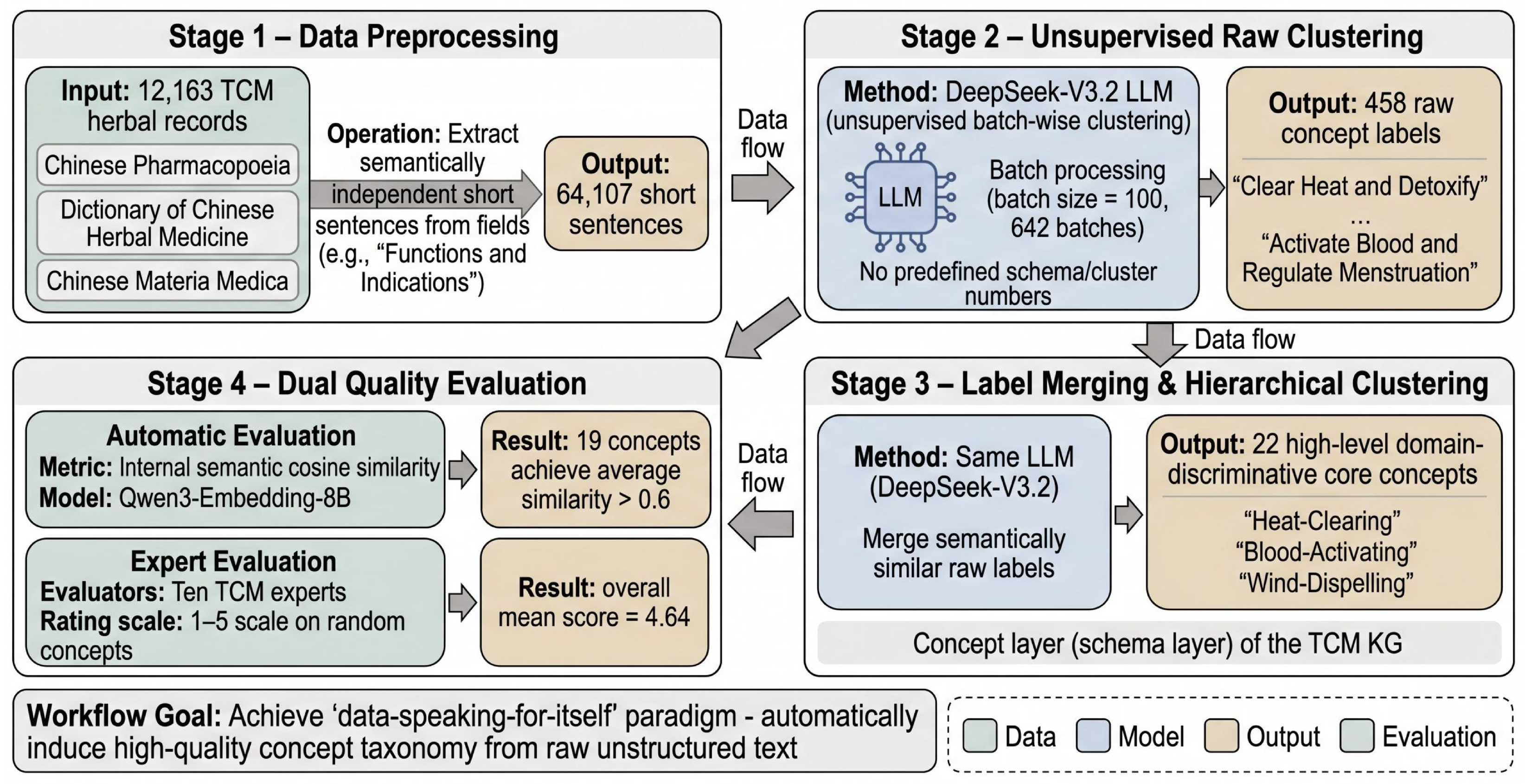
Specifically, we collect 12,163 TCM herb records from three authoritative sources (Chinese Pharmacopoeia, Dictionary of Chinese Herbal Medicine, and Chinese Materia Medica) and extract 64,107 independent short sentences from key fields. Using the DeepSeek-V3.2 model and processing the sentences in batches, we automatically generate 458 raw concept labels. These are then merged via a second stage LLM aggregation into 22 broad semantic categories. In the context of dynamic scheduling, these categories can be interpreted as potential decision dimensions or state abstractions. They could inform optimization and real-time decision making, for example, by providing a structured ontology for encoding system states or constraints.
For evaluation, we adopt a dual verification mechanism. First, we compute semantic cosine similarity among sentences within each concept using Qwen3-Embedding-8B, quantitatively assessing concept coherence: 19 out of 22 concepts achieve an average similarity above 60%. Second, we invite ten TCM domain experts to rate the reasonableness of randomly sampled concepts on a 1 to 5 scale, yielding an overall average score of 4.64. These results demonstrate that our method autonomously induces high quality, interpretable concept taxonomies from large-scale unstructured text.
The main contributions of this paper are threefold:
We propose a method driven by large language models and free of predefined schemas for automatic discovery of semantic decision dimensions from unstructured text. This breaks the traditional paradigm of a schema defined by humans followed by model extraction.
Using TCM, a highly nested and complex knowledge domain, as a challenging benchmark, we successfully induce 22 high quality core concepts from over 64,000 short sentences. This provides a reproducible case study for knowledge discovery in other complex domains.
We establish a dual evaluation framework combining quantitative semantic similarity measurement and qualitative expert assessment. It offers an operational methodology for assessing the quality of concept taxonomies generated by LLMs.
The remainder of this paper is organized as follows.
Section 2 reviews related work in knowledge graph construction, automatic concept learning, and LLM-KG integration.
Section 3 details the proposed LLM-based automatic concept discovery method.
Section 4 reports experimental setups and results, including a validation on aircraft assembly text.
Section 5 discusses limitations and future work, including potential applications in dynamic scheduling systems.
Section 6 concludes the paper.
3. Methodology
Figure 1 presents a high level overview of the proposed four stage pipeline for automatic concept layer construction. The following subsections describe each stage in detail.
3.1. Problem Formulation and Data Preprocessing
Let a knowledge graph (KG) be defined as , where is the set of concept classes (schema layer), the instances, and the relations. This paper focuses on automatically inducing from an unstructured text corpus .
We first embed each textual unit into a continuous vector space. Let
be the set of short sentences obtained from
(see below). A sentence embedding function
maps each
to a vector
. The semantic similarity between two sentences
and
is defined as the cosine similarity:
For the text embedding spaces used in this work, cosine similarities are always non-negative.
The goal of concept discovery is to partition
into
K disjoint clusters
such that
and to assign each cluster a natural language label
. This clustering problem can be formulated as an optimization objective: an ideal partition should maximize intra-cluster semantic similarity and minimize inter-cluster similarity:
where
is a balancing hyperparameter that controls the trade-off between intra-cluster compactness and inter-cluster separation.
This objective formalizes the intuition that semantically similar sentences should be grouped together while dissimilar sentences should be separated. However, we do not solve this optimization directly via gradient based methods. Instead, we leverage the LLM as an implicit optimizer: the LLM’s internal semantic representations, acquired during large-scale pre-training, allow it to approximate the above objective by directly generating coherent clusters from the input text. The LLM achieves this through its contextual understanding of language, without requiring explicit gradient computation, iterative parameter updates, or a pre-specified number of clusters K. The batch by batch strategy described in the following subsection further enables scalable approximation on large corpora.
The original dataset is with 12,163 herb records, where is the herb name and the text of the “functions and indications” field. We define a segmentation operator that splits t into independent short sentences based on punctuation and conjunctions (e.g., “;”, “,” followed by a verb). This yields the sentence set with 64,107. Each is stored with a unique identifier for traceability.
Optional auxiliary attributes (e.g., “properties and flavors”) are extracted and standardized for contextual reference but are not used in the clustering computation.
3.2. Unsupervised Short Sentence Clustering: Generating Raw Labels
We treat a large language model as a parameterized clustering function
. For any text set
,
outputs a partition
together with natural language labels
:
The complete prompt templates used for clustering and the subsequent aggregation stage are provided in
Appendix C. The number of clusters
K is not specified a priori; it emerges from the LLM’s internal similarity judgments.
Due to context window constraints, we process
in disjoint batches
with batch size
(except the last). Here
. For each batch
, we compute:
where
is the batch-specific number of clusters. Aggregating across all batches, the set of raw labels is
, where each
is the natural-language label generated for cluster
k in batch
b. This aggregation yields
distinct labels.
It is important to clarify what this number represents. The value 458 refers to the number of unique label strings after exact-string deduplication across all batches. This is not the total number of sentence-level clusters generated by the LLM. The actual number of clusters produced across all batches is approximately 1500, varying slightly by batch due to the LLM’s adaptive clustering behavior. The deduplication step is necessary because the same semantic concept may appear in multiple batches with slightly different phrasings (e.g., “clear heat and detoxify” vs. “clear heat and eliminate toxins”). These semantically similar but textually distinct labels are then merged in the subsequent aggregation stage to form the final 22 broad concepts. A summary of these statistics is as follows: from the original 64,107 short sentences, the LLM generated approximately 1500 sentence-level clusters across 642 batches. These were reduced to 458 unique label strings by exact matching, and finally to 22 broad concepts through semantic aggregation.
This batch by batch LLM clustering adapts its granularity to the local text distribution. It overcomes the limitation of traditional algorithms (e.g., k-means) that require a fixed k and often a precomputed similarity matrix.
3.3. Hierarchical Label Aggregation: Forming Core Concepts
The raw labels contain many synonyms and near-synonyms (e.g., “clear heat and detoxify” vs. “cool blood and detoxify”) and are too fine grained for a high level schema. We perform a second aggregation using an LLM as function .
For each raw label
, we select a representative set of short sentences
(typically one or two sentences whose embeddings are closest to the centroid of the cluster that produced
ℓ). The input to
is:
We instruct
to merge semantically similar raw labels into higher level concepts. Formally, the aggregation yields a partition of
:
where
is the final set of core concepts, and
are the raw labels assigned to concept
c. For each concept
c,
also produces a name (a natural language phrase) and selects representative short sentences
.
The number of final concepts is determined autonomously by the LLM based on semantic similarity; in our experiment . This set constitutes the schema layer (concept layer) of the knowledge graph.
3.4. Quality Evaluation of Concepts
We design both quantitative and qualitative metrics to assess the quality of the generated concepts.
3.4.1. Semantic Internal Cohesion
For each concept
, let
be its representative sentences (
). Using an independent embedding model
(Qwen3-Embedding-8B), we compute vectors
. The internal cohesion is defined as:
Since
, higher values indicate tighter semantic consistency. This measure can be interpreted as the average pairwise cosine similarity within the cluster. For readability, all cohesion scores in the subsequent evaluation are reported as percentages.
3.4.2. Expert Judgement
Semantic similarity alone does not guarantee domain relevance. We randomly sample concepts from and invite TCM experts to rate each concept on a Likert scale (1 = very unreasonable, 5 = very reasonable). The rating criteria include: (i) alignment between concept name and its example sentences, (ii) familiarity of the concept in TCM theory, and (iii) discriminability from other concepts.
For each sampled concept c, the average expert score is . The overall mean is .
This dual evaluation provides complementary evidence: measures machine perceived semantic compactness, while captures human perceived conceptual validity.
3.5. Algorithmic Summary
The complete procedure consists of the following steps, with key parameters summarized in
Table 1. To ensure reproducibility, we set the random seed to 42 for all stochastic operations, including sampling for example selection.
The input corpus is segmented into short sentences using punctuation based splitting. Each sentence is assigned a unique identifier, and a mapping from sentence ID to text is maintained for traceability.
The sentence set is divided into disjoint batches of size . For each batch , the LLM is invoked with a clustering prompt to generate semantic clusters. The response is parsed as JSON, and the cluster labels are collected. After processing all L batches, labels are deduplicated by exact string matching to produce the raw label set .
For each raw label in , two representative sentences are selected as examples. The LLM is then invoked with a merging prompt to group semantically similar labels into broad concepts. The response is parsed as JSON to obtain the final concept set .
The quality of the induced concepts is assessed via (1) semantic internal cohesion computed using Qwen3-Embedding-8B, and (2) expert judgment on a 1 to 5 Likert scale.
4. Experiments and Results
4.1. Dataset and Implementation
We collected 12,163 herb records from three authoritative sources: the Chinese Pharmacopoeia, the Dictionary of Chinese Herbal Medicine, and the Chinese Materia Medica. After sentence segmentation, we obtained 64,107 short sentences. The TCM domain is characterized by highly nested, multi-dimensional knowledge (e.g., overlapping indications, subtle distinctions between treatment principles, and context dependent interpretations). This makes it an ideal benchmark for evaluating knowledge discovery methods that could later be applied to other complex domains. Examples include industrial fault diagnosis or dynamic scheduling systems, where textual knowledge is similarly unstructured and nested.
For the first stage clustering, we used DeepSeek-V3.2 via API with temperature 0.3, max tokens 4000, and batch size 100 (642 batches). For the second stage label merging, we employed the same model with max tokens 32,000. For internal cohesion evaluation, the Qwen3-Embedding-8B model generated 4096-dimensional sentence embeddings. Ten TCM experts (five licensed practitioners and five herbal medicine researchers) participated in the rating task. The same methodology is then applied to an aircraft assembly manual (
Section 4.5) to evaluate transferability to scheduling related text.
4.2. Clustering Results: Induced Semantic Decision Dimensions
Table 2 lists the 22 broad concepts obtained after the two stage process. In the context of scheduling and optimization, these concepts can be interpreted as semantic decision dimensions or potential state abstractions that could help structure domain knowledge for intelligent algorithms. For each concept, we report its English name (translated from the original Chinese label), the number of raw labels subsumed, and a representative example sentence (English translation). The number of raw labels varies from 13 (“Traumatic Injury”) to 91 (“Liver Disease Treatment”), reflecting the frequency of related descriptions in the corpus. Concepts such as “Wind-Dispelling and Dampness-Removing” (46 labels) and “External Use for Skin” (56 labels) cover broad therapeutic categories.
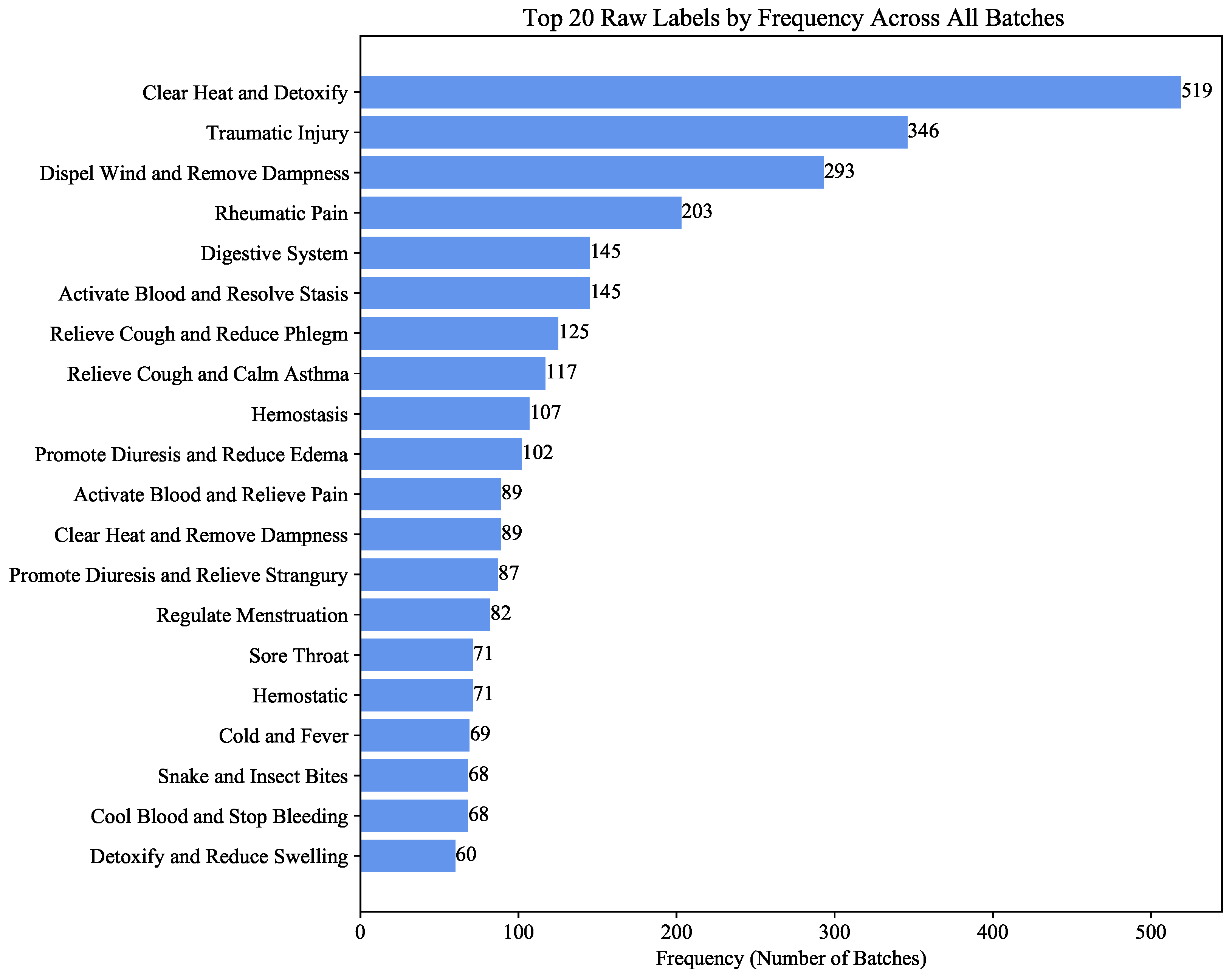
Figure 2 visualises the 20 most frequent raw labels produced by the first stage clustering across all 642 batches. Labels such as “Clear Heat and Detoxify”, “Clear Heat and Remove Dampness”, and “Cool Blood and Stop Bleeding” appear in many batches, indicating their high prevalence in the TCM corpus. The presence of these overlapping yet subtly distinct labels highlights the necessity of the second stage merging to aggregate them into broader decision dimensions.
4.3. Internal Consistency Evaluation
Table 3 presents the internal cohesion scores
for all 22 concepts, computed as the average cosine similarity among example sentence pairs. The scores range from 36.91% (“Other Miscellaneous Conditions”) to 81.51% (“Heat-Clearing and Detoxifying”). Notably, 19 out of 22 concepts achieve a score
, and 11 exceed 70%. These high scores confirm strong semantic compactness within most induced decision dimensions. This indicates that the LLM can discover well separated semantic groupings without any prior supervision.
Several observations can be made. Concepts that correspond to well defined TCM treatment principles, such as “Heat-Clearing and Detoxifying” (81.51%), “Warming Middle and Regulating Qi” (76.99%), and “Parasite-Expelling and Insect-Killing” (77.43%), exhibit the highest cohesion. This indicates that the LLM effectively captures established functional categories without human supervision. Concepts that are inherently broader or include heterogeneous symptoms, such as “Childhood Diseases” (59.25%), “External Use for Skin” (58.39%), and “Cold and Fever” (51.43%), score relatively lower but remain above 50%. This is acceptable given their natural diversity. The concept “Other Miscellaneous Conditions” has a very low score (36.91%). This is expected because it serves as a catch-all category for short sentences that could not be assigned to any specific concept. Its low cohesion reflects the diversity of the residual data rather than a methodological failure.
Compared to traditional clustering methods like k-means, which require manually choosing k and often produce clusters with mixed semantics, our LLM based approach yields categories that are statistically coherent and semantically meaningful. For example, the raw label “Heat-Clearing and Dampness-Drying” was correctly merged into the broader “Heat-Clearing and Detoxifying” concept instead of being left as a separate cluster. This demonstrates the benefit of the two stage aggregation. Such semantic grouping is analogous to what would be required when abstracting state spaces in dynamic scheduling: from low level event descriptions to high level operation modes.
4.4. Expert Evaluation
Ten TCM experts independently rated ten randomly sampled concepts on a 1 to 5 scale.
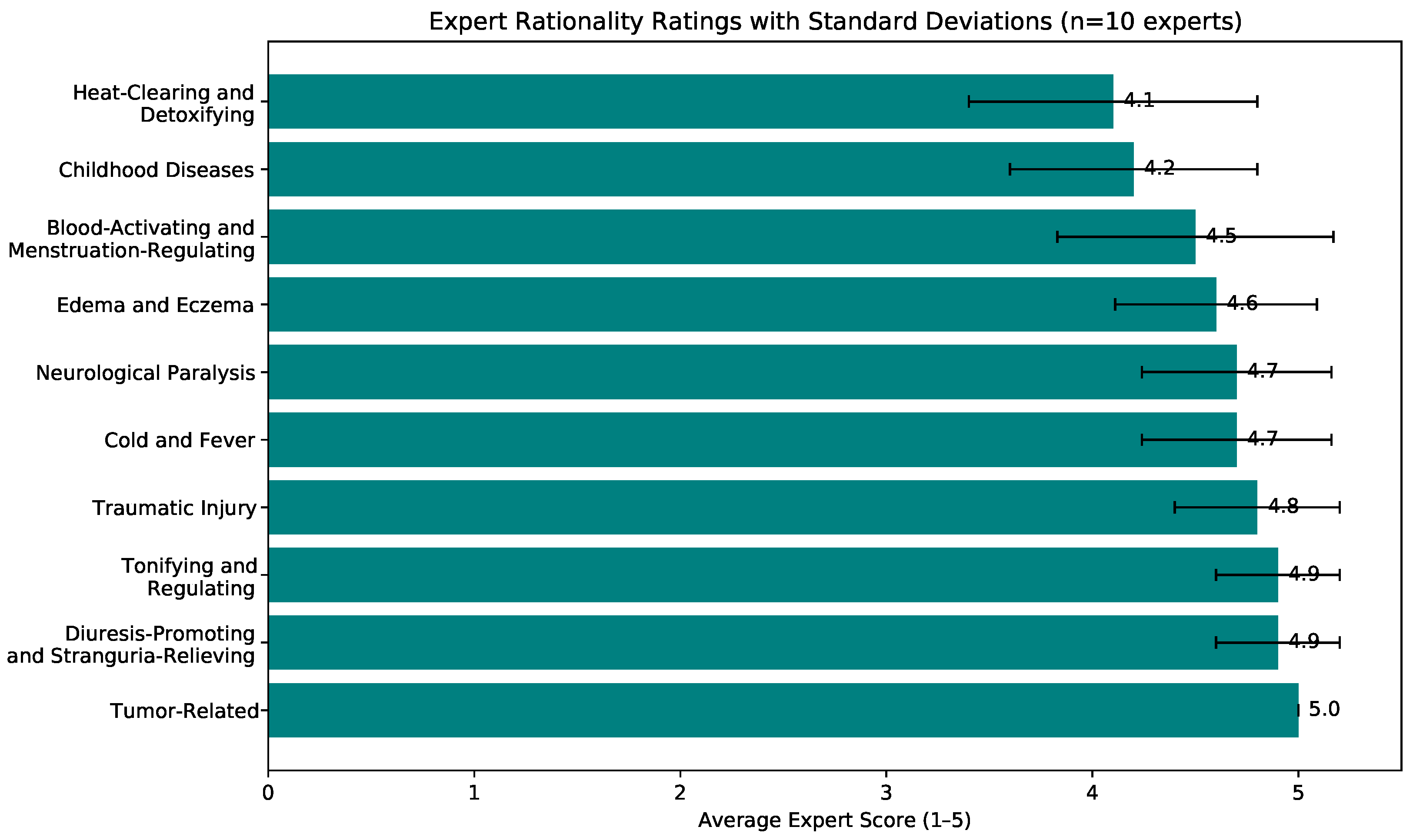
Table 4 summarises the average scores and standard deviations. The overall mean across the ten concepts is 4.64/5. Concepts such as “Tumor-Related” received a perfect score (5.0) with zero variance, indicating strong expert consensus. “Diuresis-Promoting and Stranguria-Relieving” and “Tonifying and Regulating” both averaged 4.9. Even the lowest-rated concept, “Heat-Clearing and Detoxifying” (4.1), was still considered reasonable by experts. They commented that its example sentences cover both infectious and non-infectious conditions, but it remains a valid broad category. The standard deviations range from 0.00 to 0.70, suggesting good inter-rater agreement overall.
To further quantify the reliability of the expert assessments, we analyzed the distribution of individual ratings. The overall mean score across all 100 ratings (10 experts × 10 concepts) was 4.58/5. Notably, 64% of all individual ratings were 5, 30% were 4, and only 6% were 3 or lower. Seven out of ten concepts had a rating range of 1 point or less, indicating strong expert consensus, and six concepts had standard deviations below 0.50. The concept “Tumor-Related” received a perfect score from all ten experts. These statistics confirm that the expert evaluations are reliable and consistent. The observed variability primarily reflects the inherent complexity of concepts that span multiple therapeutic categories rather than disagreement among experts.
Figure 3 visualises the average scores with error bars representing standard deviations. The high acceptance level confirms that the automatically generated concepts align well with domain experts’ knowledge. This further supports the validity of the method for extracting meaningful decision dimensions from unstructured text.
4.5. Validation on Aircraft Assembly Scheduling Text
To further demonstrate the generalizability of our method beyond TCM, we apply the same two stage LLM clustering pipeline to a corpus of aircraft assembly and commissioning documentation. The text is extracted from the
Aviation Manufacturing Engineering Manual: Aircraft Assembly [
25] (Chapters 9–11). It describes aircraft structural assembly, pipeline installation, control system adjustment, cable laying, system testing, and production planning. The ontology and knowledge extraction methods for this domain have been previously studied in [
10,
26]. After sentence segmentation, we obtain 13,025 short sentences.
Following the same procedure as in the TCM experiment, we use DeepSeek-V3.2 with batch size 100 to generate raw clusters. We then apply a second LLM merging step to produce 12 broad concepts. These concepts are listed in
Table 5. In the context of dynamic scheduling, they can be interpreted as potential decision categories or state abstractions for assembly line scheduling, resource allocation, and task sequencing.
4.5.1. Internal Cohesion Evaluation
We evaluate semantic cohesion using the same Qwen3-Embedding-8B model as in the TCM experiment. For each concept, we compute the average pairwise cosine similarity among all its associated short sentences (full set) and also among the four representative example sentences extracted during the merging stage. Because some concepts contain thousands of sentences, we randomly sample up to 200 sentences.
Table 6 reports the results. All cohesion values in the table are expressed as percentages for consistency with the TCM experiment, although the raw similarity scores lie in
.
The average full set cohesion of 46.6% is lower than the example based cohesion of 59.6%. This is expected because the full set includes more diverse and noisy expressions. Nevertheless, all values are substantially higher than the baseline of random pairs (10–25%), confirming that the discovered concepts capture meaningful semantic groupings. The highest cohesion is observed for “Assembly Production Plan and Network Diagram” (56.7%), while the lowest is for “Equipment and System Installation and Debugging” (39.4%). The latter reflects the inherent diversity of equipment installation tasks.
We acknowledge that classic clustering validity indices such as the Silhouette coefficient and Davies-Bouldin index are not well-suited for evaluating the proposed concepts. These indices assume well-separated, convex clusters with balanced sizes. Such conditions do not hold in the aircraft assembly domain, where concepts naturally overlap (e.g., “piping installation” and “equipment installation” share technical vocabulary) and concept sizes vary substantially (ranging from 50 to 2564 sentences). Under these conditions, such indices tend to produce artificially low scores even when intra-concept cohesion is strong.
4.5.2. Mapping to Reference Ontology
To assess the alignment of our automatically induced concepts with established domain knowledge, we map each concept to the aviation assembly ontology defined in [
26]. This ontology comprises five entity types: component, facility, operation, step, and tool. The mapping is presented in
Table 7. Most concepts correspond to one or two ontology types, and all five types are covered. The induced concepts are generally finer grained than the reference ontology. This demonstrates the capacity of our method to capture nuanced knowledge dimensions without manual predefinition.
This validation on a real world industrial document confirms that our LLM-driven unsupervised clustering method can be successfully transferred from TCM to a scheduling related domain. The automatically induced concepts are semantically coherent, interpretable, and align well with expert defined ontologies. This makes them suitable as decision categories or state abstractions for scheduling algorithms.
4.6. Comparison with Traditional Clustering Methods
To provide a quantitative reference, we compared our method with two established unsupervised approaches on the aircraft assembly corpus: (1) k-means clustering on sentence embeddings, and (2) Latent Dirichlet Allocation (LDA) topic modeling. Both are widely used for text clustering and topic discovery, making them suitable baselines for evaluating our LLM driven approach.
We randomly sampled 1000 sentences from the aircraft assembly corpus (
Section 4.5). For k-means, we used the same Qwen3-Embedding-8B embeddings as in our cohesion evaluation. The number of clusters was set to
to match the 12 concepts induced by our method. For LDA, we set the number of topics to 12 with default hyperparameters. We used a CountVectorizer with a maximum of 2000 features and removed English stop words. The random seed was fixed to 42 for reproducibility.
We used an independent large language model (DeepSeek-V3.2) as an evaluator to assess clustering quality. The evaluator rated each method on three dimensions, each scored from 1 to 5:
Coherence:whether sentences within each group are semantically related;
Clarity: whether each group has a focused, distinguishable theme;
Interpretability: how easily a meaningful label could be assigned to each group.
For k-means, the evaluator received the three sentences closest to each cluster centroid. For LDA, the top 10 keywords of each topic were provided. For our method, the evaluator was given the concept name and its representative example sentences.
Table 8 presents the results. Our method achieved the highest overall score (4.42), substantially outperforming k-means (3.42) and LDA (2.11). The largest gap appears in interpretability: our method scored 4.42, compared to 3.42 for k-means and 2.08 for LDA. This is expected. K-means produces only numeric cluster indices that require manual post hoc interpretation. LDA generates keyword lists that are often fragmented and domain agnostic. In contrast, our method directly produces natural language concept labels. Examples include “Assembly Production Plan and Network Diagram” and “Piping System Installation and Connection”. These labels are immediately usable for downstream applications.
These results confirm that traditional clustering methods can group sentences by surface level similarity. However, they fall short in producing semantically interpretable and usable concept structures. Our approach, driven by large language models, discovers coherent groupings and also generates human readable, domain relevant labels. It does so without requiring any predefined schema or manual annotation. This capability is especially valuable for knowledge graph construction and decision support in knowledge intensive domains.
5. Discussion
5.1. Effectiveness of the Proposed Method
Experimental results demonstrate that the proposed two stage LLM-based clustering method can automatically induce a domain relevant concept taxonomy from unstructured text. Compared to traditional approaches that require manually predefined entity types and relation sets, our method needs no annotated data or prior schema. This substantially reduces human effort for constructing the schema layer of a knowledge graph. Leveraging the rich semantic associations acquired during pre-training, the LLM effectively identifies synonyms, near-synonyms, and hypernym–hyponym relations. It thereby generates semantically compact and interpretable broad concepts. For example, concepts such as “Heat-Clearing and Detoxifying”, “Wind-Dispelling and Dampness-Removing”, and “Blood-Activating and Menstruation-Regulating” exhibit strong internal cohesion (all above 70%) and received high acceptance from domain experts (overall mean score 4.64/5). These results confirm that LLMs possess the capability to autonomously discover knowledge dimensions from raw texts. This offers a new technical pathway for data driven domain knowledge engineering.
Furthermore, the method is domain agnostic. While initially validated on TCM, a highly nested and complex knowledge domain, we have further demonstrated its applicability to an aircraft assembly manual. This is a real world scheduling related text corpus. On this corpus, the method induced 12 semantically coherent concepts with an average full set cohesion of 46.6%, substantially higher than the random baseline of 10–25%. The same unsupervised, schema free approach can thus be applied to other knowledge intensive fields, including dynamic scheduling and intelligent manufacturing. In such settings, textual knowledge (e.g., equipment fault logs, maintenance instructions, operational guidelines) could be automatically clustered into semantic decision dimensions. Examples include critical failure modes, preventive maintenance actions, or resource contention patterns. These could then serve as state abstractions for reinforcement learning agents or as structured inputs for optimization algorithms.
To further illustrate the practical connection to dynamic scheduling, we consider the aircraft assembly scenario as a concrete example. The 12 induced concepts from the assembly manual can be directly mapped to components of a scheduling model. For instance, the concept “Assembly Production Plan and Network Diagram” corresponds to the precedence constraints and task ordering in a project scheduling problem. The concept “Component Joining Process and Scheme” identifies operations that require specific resources (e.g., joining fixtures, specialized tooling), which can be mapped to resource allocation constraints. The concepts “Piping System Installation and Connection” and “Cable Laying and Electrical Connection” represent operations with sequential dependencies that affect the critical path in a scheduling network. Finally, the concept “System Function Test and Verification” corresponds to quality assurance checkpoints that must be completed before a job is considered finished. These mappings suggest a pathway for using the induced concepts as: (1) state space features in a reinforcement learning scheduler (e.g., encoding the current set of pending operations by their concept categories), or (2) constraint categories in a mixed-integer programming formulation (e.g., grouping operations with similar resource requirements). While a full integration with a scheduling optimizer is beyond the scope of this paper, the aircraft assembly validation demonstrates that the method can extract semantically coherent and domain-relevant decision dimensions from real-world scheduling-related text, providing a concrete foundation for such integration in future work.
5.2. Comparison with Existing Approaches
The comparative experiment presented in
Section 4.6 (
Table 8) confirms that our LLM-driven method substantially outperforms traditional unsupervised approaches—k-means and LDA—in terms of semantic coherence, topic clarity, and particularly interpretability. While k-means and LDA produce numeric indices or keyword lists that require substantial human post-processing, our method directly generates natural-language concept labels that are immediately usable for knowledge graph construction and downstream scheduling applications. This advantage stems from the LLM’s capacity to capture nuanced semantic relationships and produce domain-relevant categorical names without any predefined schema or manual annotation.
5.3. Limitations
Despite the satisfactory performance, several limitations should be acknowledged.
Flat concept hierarchy: The current method produces only a set of flat concept classes without defining semantic relations among them (e.g., subClassOf, attribute associations, instance relationships). For instance, in TCM theory, “Heat-Clearing and Detoxifying” and “Heat-Clearing and Dampness-Drying” may overlap. Yet our approach does not explicitly model such relations. Therefore, the output is better regarded as a preliminary schema; subsequent relation inference is needed to form a full ontology.
Sensitivity to rare concepts: Short sentence clustering relies on the LLM’s ability to judge semantic similarity. Pre-trained models are relatively weaker at representing low frequency terms (e.g., descriptions of obscure herbs). In our experiments, a small number of rare sentences may be mis-assigned to the “Other Miscellaneous Conditions” category or mixed with semantically unrelated concepts. This affects clustering granularity.
Low cohesion of the catch-all category: The internal cohesion score of “Other Miscellaneous Conditions” is only 36.91%, far lower than that of any other concept. This is primarily a design choice: gathering all unclassifiable sentences into a single residual category naturally leads to semantic dispersion. While this avoids forced misclassifications, it sacrifices utility. Future work could adopt a multi-level classification or introduce an “unassigned” marker.
5.4. Future Work
Based on the above limitations, we outline three directions for future research.
Incorporating multimodal and contextual information: Current clustering uses only the “functions and indications” field. TCM knowledge is embedded in multiple attributes such as “properties and flavors”, “meridian entry”, and “dosage and administration”. Future work can combine embedding fusion techniques to leverage these auxiliary features (e.g., sweet, bitter, pungent; lung meridian, spleen meridian) as additional signals to better discriminate semantic boundaries.
Defining inter-concept relations: Based on the current concept layer, we can further apply LLMs or graph neural networks to automatically discover hierarchical relations (e.g., subClassOf), attribute relations (e.g., associations between properties and functions), and instance relations. This would upgrade the flat concept set to a full ontology with reasoning capabilities.
Application to dynamic scheduling and intelligent systems: Building on our successful validation on the aircraft assembly manual, we plan to integrate the induced concepts into a scheduling optimization framework. Specifically, we will use the concept categories as state features in a deep reinforcement learning scheduler for a flexible job-shop scheduling problem. We will also evaluate the impact on scheduling performance (e.g., makespan reduction) compared to using raw text or manually defined categories. We will further extend the method to larger-scale scheduling-related text corpora, including machine breakdown logs, standard operating procedures, and shift reports, to validate its practical value for dynamic scheduling and intelligent manufacturing systems.
6. Conclusions
This paper proposed an automatic method for discovering semantic decision dimensions from unstructured text using large language models, with a case study on Traditional Chinese Medicine knowledge graphs. Without any pre-defined schema or manual annotation, the method performs two stage unsupervised clustering. First, it applies DeepSeek-V3.2 to process 64,107 short sentences in batches, generating 458 raw labels. Second, it re-employs the LLM to merge semantically similar labels into broad concepts. As a result, 22 high quality, domain discriminative core concepts are induced from unstructured text. For evaluation, a dual verification mechanism was adopted. Semantic internal cohesion computed using Qwen3-Embedding-8B shows that 19 concepts achieve a similarity of at least 60%, and 11 exceed 70%. Ten TCM experts gave an overall mean rationality score of 4.64 out of 5. To demonstrate transferability, we additionally applied the method to an aircraft assembly manual. This yielded 12 concepts with an average coherence of 46.6%, significantly exceeding the random baseline. Experimental results demonstrate that our method effectively breaks the limitation of a schema predefined by humans. It enables end-to-end automatic construction from raw corpus to a structured set of semantic concepts.
The significance of this work is twofold. First, it provides a low cost, scalable automatic paradigm for building the concept layer of knowledge graphs in complex, nested domains. This greatly reduces the need for manual intervention. Second, the method is domain agnostic and can be extended to other knowledge intensive tasks where mature ontologies are lacking or textual knowledge is highly unstructured. Our validation on the aircraft assembly manual provides a concrete example of this transferability: concepts such as Assembly Production Plan and Network Diagram and Component Joining Process and Scheme can be mapped to precedence constraints and resource allocation categories in scheduling models. More generally, in domains such as dynamic scheduling and intelligent manufacturing, equipment logs, maintenance records, and operational guidelines could be automatically clustered into decision dimensions (e.g., failure modes, maintenance actions, resource states) to support optimization algorithms or reinforcement learning agents.
Future work will focus on three directions. (1) Defining inter-concept relations (e.g., hierarchies, attribute associations) to upgrade the flat concept set into a full ontology with reasoning capabilities. (2) Incorporating multi source features (e.g., properties, flavors, meridian entries in TCM, or sensor metadata in industrial settings) to improve clustering accuracy. (3) Building on our validation on the aircraft assembly manual, we will apply the method to larger scale real-world scheduling text corpora. These include machine breakdown logs and standard operating procedures. The goal is to automatically derive state abstractions for dynamic scheduling systems and to evaluate the impact on scheduling performance through integration with existing optimization frameworks.