1. Introduction
Over the past few decades, considerable attention has been devoted to the study of reliability structures known as consecutive-type systems. These models have proven to be particularly useful in a wide range of applications, including information processing systems, communication networks, biological sequence analysis and pattern recognition. Their ability to capture dependencies among neighboring components makes them especially suitable for modeling systems where local interactions play a crucial role, such as DNA sequence analysis, signal processing and fault detection in networked environments.
In general, consecutive-type systems are natural extensions of the classical consecutive-
-out-of-
:
G and consecutive-
-out-of-
:
F models, which consist of
linearly or circularly ordered components. A consecutive-
-out-of-
:
G system operates if and only if there exists at least one sequence of
consecutive working components, while its dual counterpart fails if at least
consecutive components fail. These systems have been extensively studied in the literature (see, e.g., Refs. [
1,
2,
3,
4,
5]), along with various generalizations such as
-within-consecutive structures and other configurations that capture more complex operational requirements (see, e.g., Refs. [
6,
7,
8,
9,
10]).
Despite the extensive body of work on consecutive-type systems, relatively less attention has been given to models incorporating imperfect protection mechanisms, where certain components are subject to probabilistic improvement rather than deterministic enhancement. In many real-world applications, such as fault-tolerant computing, cybersecurity systems and biological processes, protective mechanisms (e.g., redundancy, filtering, or error-correction schemes) do not guarantee success but instead increase the likelihood of reliable operation in a stochastic manner. Motivated by such considerations, we introduce a consecutive--out-of-: G system equipped with imperfect protection blocks, where each protected component experiences an increase in its success probability with a pre-determined effectiveness level.
The main contribution of this work is threefold. First, we develop an exact recursive scheme for the computation of the system reliability, accommodating non-identical components and probabilistic protection effects. The proposed recurrence provides a computationally efficient and exact method for evaluating reliability without resorting to approximations. Additionally, we investigate the asymptotic behavior of the system reliability as the number of components increases, deriving explicit expressions that describe its limiting behavior.
To illustrate the theoretical outcomes, we present numerical results demonstrating the impact of protection effectiveness, coverage and system size on the overall reliability. A motivating application of the proposed model arises in DNA sequencing, where the accurate identification of consecutive gene segments is essential for reliable analysis. In this context, imperfect protection blocks may represent quality control or error-correction mechanisms that improve, but do not guarantee, the correct reading of sequences, making the study of consecutive success patterns particularly relevant. The remainder of the paper is organized as follows.
Section 2 introduces the proposed consecutive-
k-out-of-
n:
G model, while all necessary notations and preliminaries are discussed.
Section 3 is devoted to the main contribution of the present work, wherein the recursive scheme for computing the reliability of the system, as well as the asymptotic behaviour and the impact of the protection parameters on the asymptotic convergence rate of its reliability are also studied.
Section 4 provides numerical illustrations, while
Section 5 provides a suitable biological application. Finally,
Section 6 summarizes the main results and outlines directions for future research.
2. The Proposed Consecutive-k-out-of-n: G System
Let us next consider the case of a consecutive-k-out-of-n: G structure consisting of non-identical components. To improve the reliability of such a reliability model, protective measures may be applied to strengthen the system’s overall robustness. This might include adding redundancy, utilizing more reliable materials, implementing fault-tolerant designs or applying protective coatings and shielding to reduce the probability of components failures.
Motivated by this, we next study the reliability of consecutive-
k-out-of-
n:
G systems equipped with protection blocks. The so-called protection blocks, which have been recently studied by [
11,
12], help to reduce the failure probability of the components inside the block. Within the proposed framework, each block can protect exactly
k consecutive components. In simple words, each component outside the protection block has smaller reliability (say
) in comparison with the reliability of the corresponding ones inside the block, namely it holds true that
. Under the proposed block-level protection framework, components belonging to the same protection block may be marginally dependent through the common block-effectiveness state, while they are assumed to be conditionally independent given the vector of block-effectiveness states.
For illustration purposes, let us next consider the special case
, namely we focus on the consecutive-4-out-of-7:
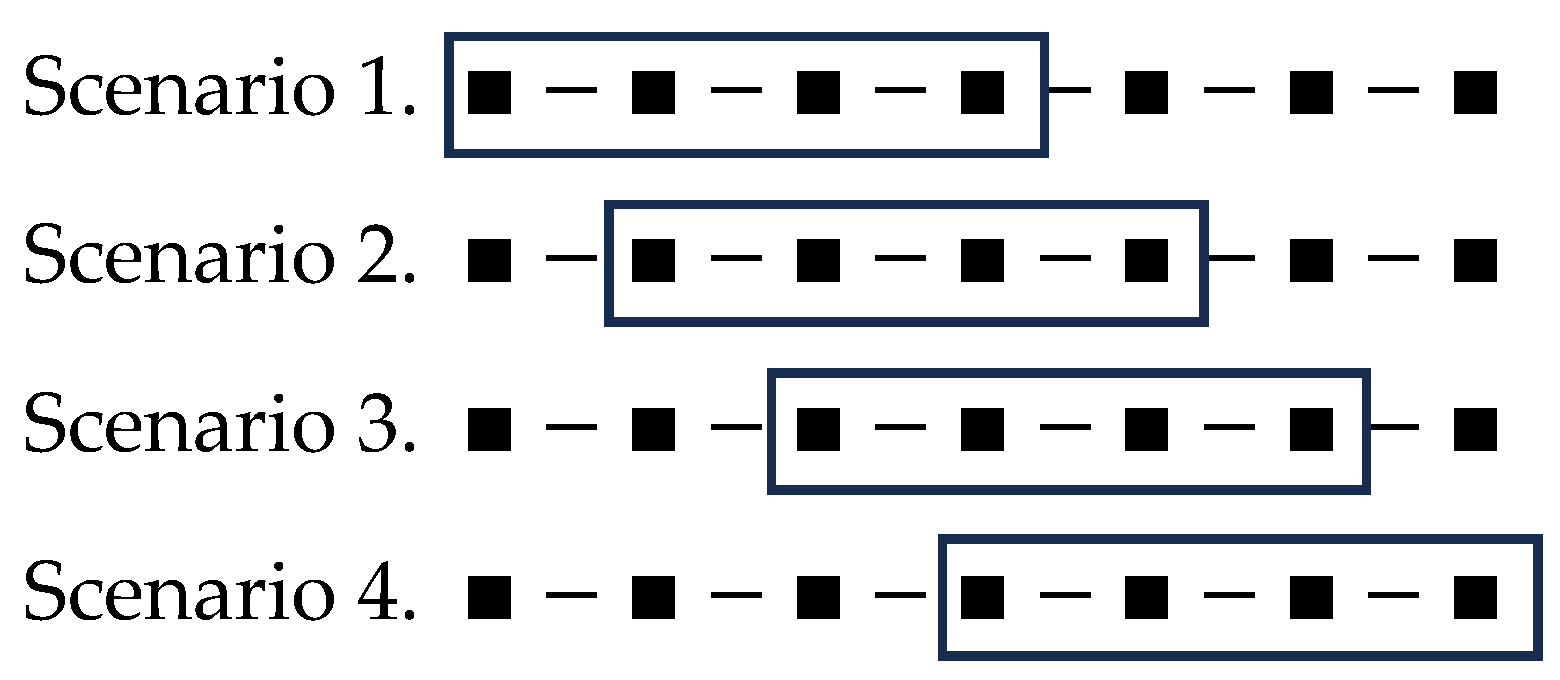
G system. According to the general outline, we may implement protection blocks for covering exactly 4 consecutive components each time (see
Figure 1). In simpler words, if we decide to apply such a measure by placing a single protection block, there are four different scenarios. According to Scenario 1, we cover the first four components by the aid of the protection block while the last three components remain outside the block.
On the other hand, Scenarios 2 and 3 call for the protection of successive components placed at positions 2–5 and 3–6, respectively, while under Scenario 4 the last four components within the structure are protected. Although arbitrary non-overlapping placements are allowed under the general model, the asymptotic analysis which shall be developed later on, focuses on the special case where protection blocks coincide with the disjoint reference partition.
It is of great importance to mention that protection blocks themselves are also subject to failure. It is evident that the failure of a protection block weakens the components’ reliabilities inside the non-working block and turns them from to .
Under the proposed consecutive-k-out-of-n: G structure, the protection block strengthens the robustness of the resulting scheme only with probability . That practically means that even if a protection block still operates, it succeeds in enhancing the formation of k consecutive working components only with probability . Within the proposed model (, hereafter), the reliability of a component inside an operational protection block increases (from to ) only with probability . In simpler words, parameter expresses the probability that a protection block is effective.
In technical terms, each protection block is associated with a Bernoulli effectiveness indicator. If the indicator equals one, the protection mechanism is effective and the reliabilities of all components belonging to that block are increased from to . Otherwise, the protection mechanism is ineffective and the corresponding component reliabilities remain equal to . Therefore, the protection mechanism is assigned jointly to the whole protection block and not independently to each component. As a result, components inside the same protection block share a common protection-effectiveness state. They may therefore be dependent marginally, although they become mutually independent after conditioning on the block-effectiveness vector.
In fact, this is the case in several real-life situations. For instance, in a firewall detection system, network packets pass through multiple security checkpoints. Each one of them has a probability of correctly identifying malicious activity. A run of k consecutive successful detections may be required to prevent an attack, while protection mechanisms such as redundant checks or advanced heuristics can increase the detection probability of specific modules. However, these protections are imperfect, e.g., they do not always prevent failures. Modeling the abovementioned structure as a consecutive-k-out-of-n: G system with imperfect protection blocks allows network administrators to quantify the probability that the firewall detection system will successfully detect a malicious sequence of packets.
It goes without saying that the proposed generalization leads to a heterogeneous consecutive-k-out-of-n: G system with block-induced dependence, since the effective protection mechanism induces both position-dependent component reliabilities and common protection-effectiveness states within protected blocks.
3. Main Results
In the present section we shall present the main contribution of the paper. More precisely, the reliability of the proposed consecutive-k-out-of-n: G structure is studied in some detail, while its asymptotic behavior is also under investigation.
Let us consider a consecutive-
-out-of-
:
G system consisting of
n components
, where
Suppose that
m non-overlapping protection blocks are deployed within the system. Each protection block covers exactly
k consecutive components. Let
denote the protection blocks. To model the imperfect effectiveness of the protection mechanism, we associate with each protection block
a Bernoulli random variable
, which is defined as
where
indicates that the corresponding protection block is effective and 0 otherwise. The random variables
are assumed to be mutually independent. We denote by
the vector describing the effectiveness states of all protection blocks. The component states are not assumed to be marginally independent. Instead, conditional on the realization of the block-effectiveness vector, they are assumed to be mutually independent.
Since protection blocks are non-overlapping, each protected component belongs to exactly one protection block. All components covered by the same protection block share a common protection-effectiveness state, while dependence between components is removed after conditioning on the vector .
On the other hand, for a component belonging to protection block
, the conditional reliability is given by
with
. It goes without saying that components that do not belong to any protection block retain the baseline success probability
.
Furthermore, conditional on the realization of the protection-effectiveness vector , the component states are assumed to be mutually independent. Consequently, for every fixed realization of , the system reduces to a heterogeneous consecutive-k-out-of-n: G system with deterministic component reliabilities .
Let denote the reliability of the proposed system, namely the probability that at least one run of k consecutive working components occurs among the n components.
Proposition 1 offers a probabilistic representation of imperfect protection by the aid of a mixture of traditional consecutive systems.
Proposition 1. Let us denote by
the reliability of a traditional consecutive--out-of-: G system with components having reliabilities .
The reliability of the system can be expressed as where is the conditional reliability of the given .
Proof. In order to implement the conditioning argument on protection effectiveness, we next apply the law of total probability with respect to
and the reliability of the
system can be expressed as:
where the sum runs over all configurations
. For a fixed realization
, the effectiveness status of every protection block is fixed. Therefore, each component has a deterministic success probability
. More precisely, if component
belongs to an effective protection block, then
, while if it belongs to an ineffective protection block or is not protected, then
.
Conditionally on
, the component states are assumed to be mutually independent. Therefore, the conditional system becomes a standard heterogeneous consecutive-
-out-of-
:
G system with component reliabilities
Substituting the last expression in Equation (4), we readily deduce that:
and the desired expression is readily deduced. □
It is worth mentioning that Proposition 1 shows that the reliability of the system is the expectation of the reliability of a standard consecutive-k-out-of-n: G system, averaged over all possible effectiveness configurations of the protection blocks.
The following result offers a recurrence for calculating the reliability of the proposed structure . The recursive scheme is developed with respect to the size of the underlying system, while the dependence induced by block-level protection is depicted therein.
Proposition 2. If expresses the conditional reliability of the system given , the reliability of the system satisfies the following recurrence relation: The above recurrence is accompanied by the boundary conventionand the initial conditionsand Proof. By the aid of the law of total probability, we may write:
For a specified realization
, the system becomes a structure with heterogeneous components with probabilities
. For
, applying the classical recurrence relation for consecutive-
-out-of-
:
G systems, we obtain
Here, denotes the conditional reliability of the subsystem consisting of the first components, under the induced restriction of the block-effectiveness vector to the protection blocks intersecting that subsystem. On the other hand, the factor ensures that the run of functioning components ending at position is preceded by a failed component, so that configurations already counted in are not counted again.
We next take expectation over the vector
and the following holds true:
Recalling that , the desired expression in Equation (6) is now straightforward.
It remains to clarify the boundary cases. If
, a run of
consecutive working components cannot occur among only
components. Therefore, for any realization of
,
This convention is necessary in the recurrence when , since the term then refers to a subsystem with fewer than components. In that case, the corresponding reliability is naturally equal to zero.
Moreover, when
, the system operates if and only if all
components function. Therefore, conditionally on
, its reliability is
and, by taking expectation over
, we deduce the following
Thus, the boundary convention and the initial conditions make the recurrence well defined for all . This completes the proof. □
It is worth noting that the product term and appeared in Equation (6) are generally dependent, since they may involve common block-effectiveness variables. Therefore, the expectation cannot be factorized in the general case.
Under the assumption that protection blocks are selected from the disjoint reference partition of the component sequence, the results provided by Proposition 3 offer an asymptotic characterization of the consecutive--out-of-: G systems equipped with imperfect protection blocks. More precisely, the number of protected reference blocks is assumed to have an asymptotic proportion among all reference blocks.
Proposition 3. Consider a system under the block-level protection model. Assume that the protection blocks are placed according to the disjoint reference partition of the component sequence into blocks of length . More precisely, let the sequence be partitioned into disjoint reference blocks, namely ., while the protected blocks are assumed to be selected only among these reference blocks. If corresponds to the number of protected blocks, we assume that If denotes the reliability of the system and , then
Proof. (i) By the assumed reference-block placement, the sequence is already partitioned into
disjoint blocks of length
. Note that at most
components remain outside this partition, and it is clear that ignoring them can only decrease the probability of detecting a successful run. Therefore, the resulting estimate provides an upper bound for the unreliability of the original system. For the
block
, we consider the event
while
corresponds to its complement. If at least one of the events
occurs, then the system operates, since a run of
consecutive working components has been formed inside one of the reference blocks. Therefore,
or equivalently
For an unprotected block, all components inside the block have baseline success probability
, namely the following holds true
On the other hand, for a protected reference block, the block is effective with probability
. If the block is effective, all components inside it have success probability
. If the block is ineffective, all components inside it retain the baseline success probability
. Therefore, in that case we deduce that
Since the reference blocks are disjointed and the block-effectiveness indicators are mutually independent, the events
are also mutually independent. Therefore,
and the desired result is readily obtained.
(ii) Taking logarithms in Equation (8), we easily observe that
or equivalently
Recalling that
, we obtain
and Equation (9) is straightforward.
(iii) Since , we observe that and . Therefore, we may conclude that and consequently . The latter conclusion results effortlessly in Equation (11). □
The next result examines the monotonic effect of the protection parameters on the upper exponential convergence rate obtained by Proposition 3.
Proposition 4. Consider a
system under the block-level protection model and under the disjoint reference-block placement assumption of Proposition 3. Letand Then,
- (i)
for every, the unreliability satisfies - (ii)
the upper exponential convergence rate is strictly increasing with respect to whenever and to each of the parameters for .
Proof. (i) By the aid of Proposition 3, we may write
Since
there exists
such that for all
and
the following holds true
Therefore, we deduce that
for all sufficiently large
and the desired result is straightforward.
(ii) Recalling the definition of
and
, it is readily obtained that
whenever
and
. Therefore, we have
Based on the latter inequality, we conclude that increasing increases the weight assigned to the larger quantity . That practically means that is strictly increasing with respect to whenever and .
Furthermore,
β is strictly increasing in
whenever
and it is strictly increasing in
whenever
. Since the function
is strictly increasing on
, it follows that the term
inherits the same monotonicity properties. Consequently, for
, the upper exponential convergence rate
is strictly increasing with respect to both
and
. This completes the proof. □
4. Numerical Results
In the present section, we provide numerical evidence about the effect of the design parameters of the consecutive-k-out-of-n: G systems equipped with imperfect protection blocks upon their reliability. It is of some practical interest to investigate the behavior of the resulting scheme in terms of its parameters.
The numerical results presented in this section are obtained by recursive evaluation of the system reliability using the recurrence relation established in Proposition 2 together with its corresponding initial and boundary conditions. All reliability values shown in the figures are unconditional reliabilities, obtained after averaging over the random block-effectiveness states.
Throughout this section, the protection blocks are assumed to be placed deterministically according to the same disjoint reference partition used in Proposition 3. More precisely, for a given value of the protection coverage parameter
, the corresponding number of protected blocks is taken as
where
denotes the total number of disjoint reference blocks. Therefore, the positions of the protected blocks are fixed, while the effectiveness of each protection block remains probabilistic through the Bernoulli parameter
.
Let us first focus on the design parameter
, which corresponds to the protection effectiveness, namely the probability that the protection block manages to strengthen the robustness of the resulting scheme.
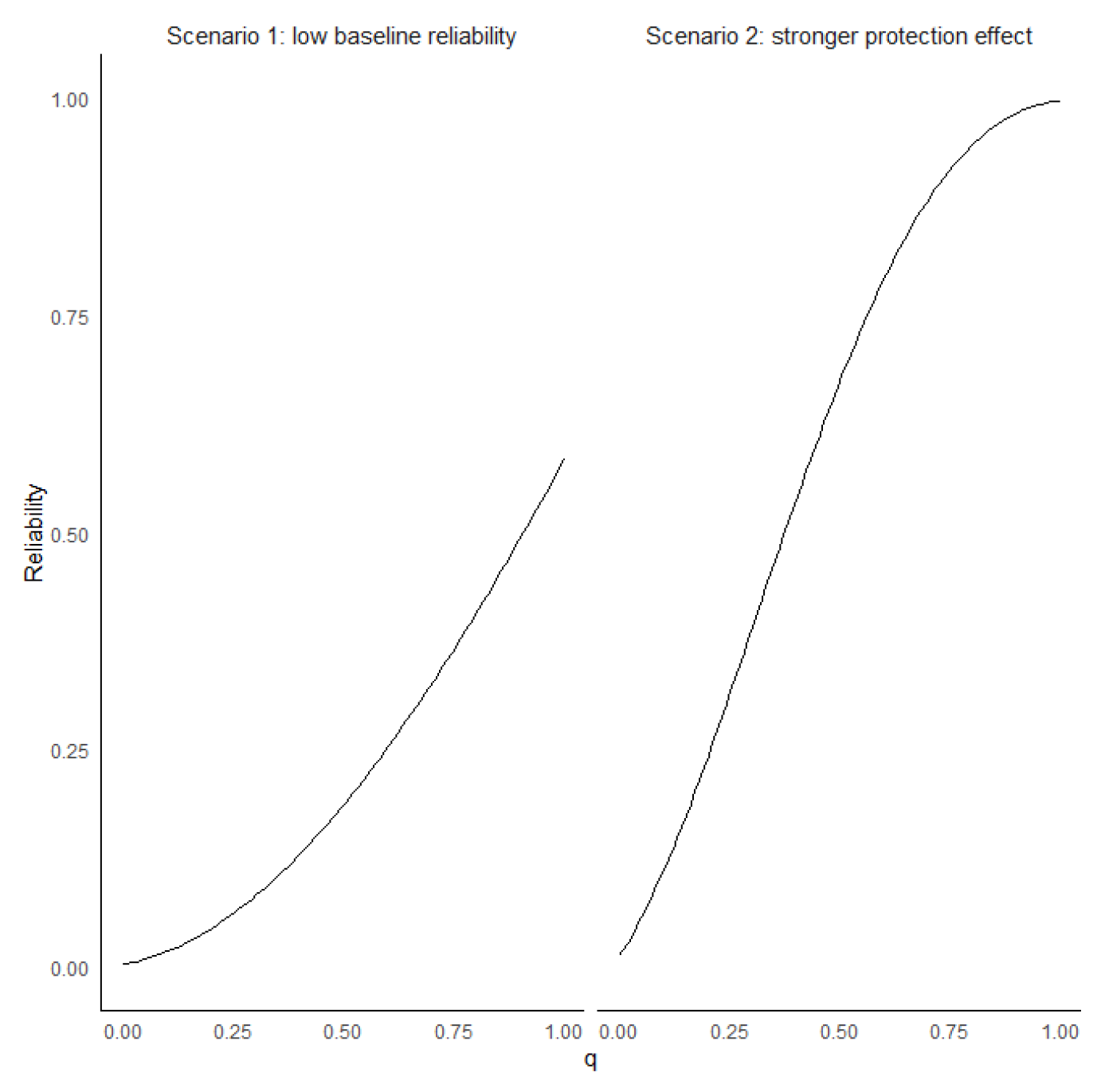
Figure 2 illustrates the monotonic increase in the system’s reliability with respect to the protection effectiveness
.
Figure 2 depicts the reliability of the proposed consecutive-
k-out-of-
n:
G systems as a function of the protection effectiveness probability
under two different design scenarios. The horizontal axis represents the probability that a deployed protection block is effective, whereas the vertical axis provides the corresponding system’s reliability. In both panels, the reliability increases monotonically with
, illustrating the beneficial impact of more effective protection mechanisms on the overall system performance.
The left panel (Scenario 1) corresponds to a difficult reliability setting with parameters , , , , . The relatively low baseline component reliability together with the requirement of a long run of eight consecutive working components makes system’s success unlikely when protection is ineffective. Consequently, the reliability starts very close to zero. As the protection effectiveness increases, the reliability improves steadily, although the increase remains moderate because the stringent run-length requirement continues to limit system performance. Thus, even highly effective protection cannot completely eliminate the difficulty associated with achieving a run of eight consecutive successful components.
The right panel (Scenario 2) represents a more favorable protection design characterized by , , , , . Compared with Scenario 1, the protected components achieve a substantially higher success probability and a larger fraction of the system is subject to protection. As a result, the reliability increases much more rapidly as grows. While the reliability is still relatively low for small values of , it rises sharply for moderate values of the effectiveness probability and eventually approaches values close to one when becomes large. This behavior demonstrates that the simultaneous combination of strong protection and broad protection coverage can significantly enhance the probability of observing a successful run of consecutive functioning components.
A comparison of the two panels highlights the crucial role played by the design parameters
. Although both scenarios share the same baseline component reliability (
), the stronger protection effect (
) instead of (
), the larger protection coverage (
) instead of (
) and the less demanding run-length requirement (
instead of
) collectively produce a substantially more reliable system. Therefore,
Figure 2 provides clear numerical evidence that both the effectiveness and the extent of the protection mechanism are key determinants of system reliability.
In addition, we provide some numerical results about the percentage of the components within the structure which are protected by a block (the protection coverage , hereafter).
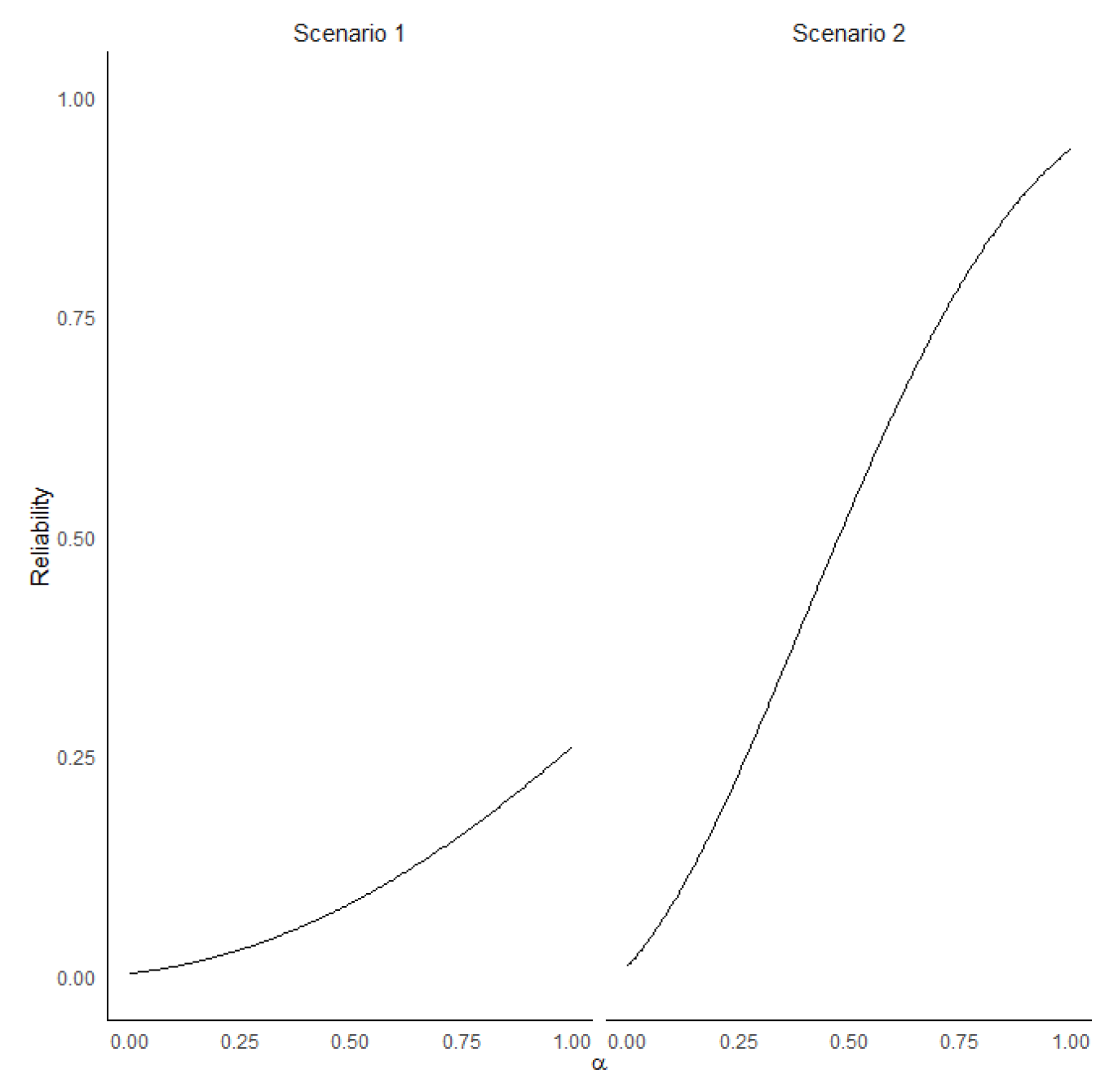
Figure 3 illustrates the effect of the protection coverage parameter
on the reliability of the proposed consecutive-
k-out-of-
n:
G systems under the two design scenarios considered previously. In Scenario 1 (
, , , , ), the increase in reliability is gradual, reflecting the challenging operating conditions imposed by the low baseline success probability and the stringent run-length requirement. In contrast, Scenario 2 (
,
,
,
,
) exhibits a much steeper increase. Overall, the figure demonstrates that extending protection to a larger portion of the system can lead to substantial reliability gains, particularly when the protection mechanism itself is highly effective.
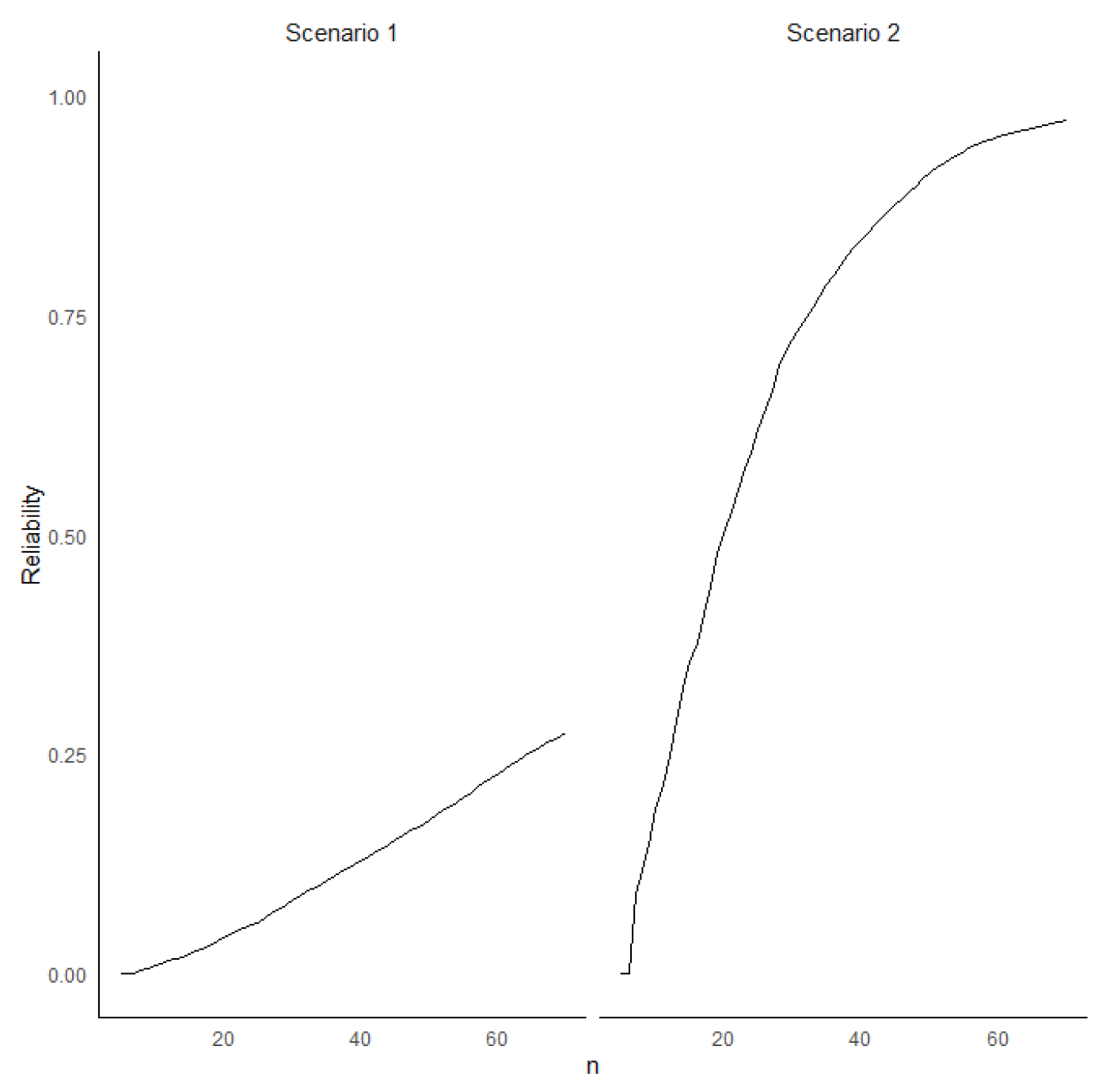
Similar arguments can be stated if we look at
Figure 4, where the reliability of the overall
system is viewed as a function of its size
n.
In both cases, the reliability is a non-decreasing function of , which is consistent with the theoretical properties of consecutive-k-out-of-n: G systems. The effect is particularly evident for moderate values of , where reliability grows rapidly before gradually approaching a plateau. This behavior indicates that, beyond a certain system size, additional components provide diminishing reliability gains. Moreover, the second scenario consistently achieves higher reliability levels than the first, demonstrating that favorable design characteristics not only improve reliability for a fixed system size but also allow the system to benefit more effectively from increases in . Overall, the figure highlights the positive influence of system expansion on reliability and confirms the monotone behavior predicted by the theoretical analysis.
5. A Practical Application
In this section, we provide some evidence for the applicability of the proposed reliability structure. We consider a DNA sequencing application where a sequence of genes must be read reliably. The goal is to determine the probability of observing at least one consecutive run of successfully read genes. Each gene has a baseline probability of success . To enhance reliability, a fraction of the genes are covered by imperfect protection blocks, which increases the success probability from to with an effectiveness . Protection is probabilistic, meaning that a protected gene only partially improves the chance of success rather than guaranteeing it.
Applying the recursion approach presented earlier (see Proposition 2), we next compute the system’s reliability for various values of the protection parameters and sequence length. First of all, we investigate how the effectiveness probability
affects the reliability of the overall structure. The corresponding results are summarized in
Table 1.
It is quite evident that even small increases in the value of the design parameter produce a significant enhancement of the reliability of the resulting scheme, showing that the system benefits greatly from higher per-unit protection.
We next consider the case where the value of parameter
changes under the assumption that the remaining parameters are pre-specified. The corresponding results are presented in
Table 2.
Based on
Table 2, it is readily observed that reliability of the resulting scheme improves monotonically with protection coverage. Therefore, the placement of protection blocks seems to be quite essential for achieving longer consecutive runs.
In addition, if we investigate how the size of the sequence affects the reliability of the resulting scheme, we may readily deduce that longer sequences provide more opportunities for successful runs.
For instance, as
Table 3 reveals, if the sequence length increases from 10 to 20 genes, then the corresponding reliability value is almost doubled.
6. Discussion
In the present paper, the consecutive-k-out-of-n: G systems equipped with imperfect protection blocks are introduced. For the proposed structures, a recursive relation for determining the overall reliability is built, while the asymptotic behavior of the resulting scheme is also studied.
To conclude, as a future potential, it is of some interest to investigate more complex consecutive-type structures, which have been already introduced in the literature and generalize the present work. In addition, an alternative future direction may include the determination of the optimal choice for the design parameters . More precisely, the optimal value of each one of them (or their vector) which maximizes the overall reliability of the resulting consecutive-type structure could definitely shed some light on the behavior of the underlying structure.
On the other hand, the present study focuses on protection blocks whose length coincides with the system parameter . This modelling choice is naturally aligned with the definition of consecutive--out-of-: G systems and facilitates the analytical development of the proposed framework. Nevertheless, practical applications may involve protection mechanisms acting on regions whose size differs from . Extending the present model to protection blocks of arbitrary length, possibly combined with heterogeneous or adaptive protection strategies, represents an interesting topic for future investigation. Such generalizations may reveal new reliability behaviours and provide further insight into the optimal allocation of protection resources in consecutive systems.