1. Introduction
Vehicular Internet of Things (V-IoT) networks are becoming a core communication layer for intelligent transportation systems, cooperative perception, traffic-aware mobility services, and safety-critical vehicle-to-everything (V2X) applications. In these networks, vehicles, roadside units (RSUs), sensors, and edge nodes exchange status updates, perception data, and control information under rapidly changing topologies and wireless channel conditions. Compared with static Internet of Things (IoT) deployments, V-IoT systems experience stronger mobility effects, burstier packet arrivals, intermittent connectivity, and tighter latency-reliability requirements. These characteristics make RSU-side packet admission and scheduling particularly difficult when multiple vehicles compete for limited communication and edge resources.
Reliable V-IoT scheduling must support different traffic classes with different service requirements. Safety or event-driven messages require low latency and high reliability, cooperative awareness messages (CAMs) provide periodic vehicle-state information, and cooperative perception messages (CPMs) carry sensor- or perception-derived information for shared environmental awareness. In dense or unstable traffic conditions, queue buildup, handoff pressure, wireless-link degradation, and RSU load imbalance can reduce packet delivery and degrade the freshness of CPM information. A throughput-driven scheduler may admit too many packets and increase failures, while an overly conservative scheduler may reduce failed transmissions by blocking useful information. Therefore, practical V-IoT scheduling requires a multiobjective admission policy that minimizes delay, communication energy consumption, admission-adjusted reliability loss, CPM delivery/freshness penalty, and RSU-load imbalance, while conditioning decisions on mobility, channel, and queue dynamics.
Several research directions have addressed parts of this problem. Age-aware and freshness-aware scheduling methods aim to reduce stale vehicular information [
1]. Vehicular edge computing and RSU-assisted resource allocation improve infrastructure-side coordination and offloading efficiency [
2,
3,
4]. Handoff-aware mechanisms reduce mobility-induced service disruption [
5]. Priority-aware and ultra-reliable low-latency communication (URLLC)-oriented V2X methods protect reliability-sensitive vehicular traffic [
6,
7,
8]. Cooperative perception studies further show that communication decisions should consider the usefulness and freshness of exchanged perception information [
9,
10,
11,
12]. Adaptive online learning methods, including Adaptive Learning-based Task Offloading (ALTO) and multi-armed bandit (MAB)-style policies, provide lightweight decision-making under uncertain edge conditions [
13]. These studies provide important foundations, but they usually emphasize one dominant objective, such as freshness, cooperation, handoff continuity, priority, or online adaptation.
The remaining challenge is to design an RSU-resident scheduler that treats these factors as coupled rather than independent. Mobility affects link reliability and handoff risk; admission decisions affect delay, blocking, and interruption; CPM usefulness depends on both perception value and successful, timely delivery; and RSU cooperation affects load balance and migration overhead. Optimizing one dimension in isolation can therefore lead to undesirable behavior under changing traffic density or vehicle load. This motivates a scheduling policy that combines mobility awareness, reliability-sensitive admission, CPM value awareness, and safety-feasible action selection within one decision process.
This paper proposes MoReSP, a Mobility- and Reliability-aware Scheduling Policy for RSU-assisted V-IoT networks. MoReSP observes queue, channel, traffic class, mobility, CPM value, and RSU load indicators and selects among deny, grant, preempt, coexist, and handoff actions. The policy combines mobility-regime inference, structured action scoring, safety projection, and episodic parameter adaptation. To avoid misleading conclusions from raw delivery metrics, the evaluation uses admission-adjusted indicators that penalize excessive blocking and interruption.
The main contributions of this paper are summarized as follows:
A mobility- and reliability-aware RSU-side scheduling framework is developed for heterogeneous V-IoT traffic, including safety messages, CAMs, and CPMs, under dynamic mobility and multi-RSU edge conditions.
A structured MoReSP decision policy is proposed by combining mobility-regime inference, interpretable action scoring, safety projection, and episodic parameter adaptation for five scheduling actions: deny, grant, preempt, coexist, and handoff.
An admission-adjusted multiobjective evaluation is introduced to quantify effective packet delivery, effective CPM delivery, delay, transmission energy, reliability loss, CPM freshness degradation, and RSU-load imbalance while explicitly penalizing excessive blocking and interruption.
A controlled simulation study is conducted under vehicle-load variation, Nagel–Schrec kenberg (NaSch) density variation, and RSU-capacity scaling against five literature-grounded baselines: Age of Correlated Information (AoCI)-Heuristic, RSU-Coop, Handoff-Aware, V2X-Priority, and ALTO-MAB.
Quantitative results show that MoReSP achieves the lowest admission-adjusted system cost across all evaluated scenarios. At nominal RSU capacity, MoReSP reduces system cost by 43.6% compared with the best baseline, while under high vehicle load, it reduces cost by 54.4% at arrival scale 2.0 and maintains effective packet and CPM delivery ratios of 0.849 and 0.828, respectively.
The remainder of this paper is organized as follows.
Section 2 reviews related work.
Section 3 presents the system model.
Section 4 formulates the scheduling problem.
Section 5 describes MoReSP.
Section 6 presents the simulation setup and evaluation methodology.
Section 7 discusses the results.
Section 8 concludes the paper.
2. Related Work and Motivation
Resource scheduling in V-IoT networks has been studied from several directions, including information freshness, vehicular edge computing, RSU cooperation, mobility-aware association, reliability-sensitive V2X resource allocation, cooperative perception, and adaptive online learning. These studies provide useful building blocks, but most of them optimize a single dominant objective or operate at a different abstraction level from RSU-resident packet scheduling. The following discussion critically reviews these directions and identifies the gap addressed by MoReSP.
Age of Information (AoI)-aware and freshness-aware scheduling are closely related to V-IoT, as safety and perception information lose value with delay. Chen et al. studied age-aware radio resource management for vehicular networks using proactive deep reinforcement learning, showing that scheduling decisions can reduce stale vehicular updates [
1]. Joint assignment and scheduling for Age of Correlated Information (AoCI) further showed that correlation among information sources affects scheduling performance [
14]. Application-oriented AoCI optimization and the Age of Incorrect Information (AoII) metric also indicate that information usefulness depends not only on update age but also on semantic relevance and correctness [
15,
16]. However, freshness-oriented optimization mainly captures timeliness and does not directly address the combined effects of packet blocking, interruption, RSU imbalance, and mobility-induced link degradation. This limitation is important for CPM traffic, where a scheduler must preserve freshness without sacrificing reliability-sensitive safety traffic or overloading RSU resources.
Vehicular edge computing studies have improved the use of infrastructure-side computation and communication resources. Survey work on vehicular edge computing highlights the role of edge nodes in reducing latency and supporting mobility-aware services [
2]. Collaborative task offloading has been used to improve resource sharing in vehicular multi-access edge networks [
17]. Digital-twin-enabled vehicular edge computing has also been studied for task offloading and resource allocation [
3], while adaptive digital twins and mobility-aware multiobjective offloading have been used to improve edge intelligence under dynamic vehicular conditions [
18,
19]. Meta-reinforcement learning has further been explored for fast task-offloading adaptation in edge computing [
20]. These approaches are valuable for computation-centric V2X services, but they usually abstract packet-level scheduling decisions and do not explicitly model mixed safety, CAM, and CPM traffic competing for RSU-side wireless access.
RSU cooperation and edge association have also been studied to improve connectivity and load distribution. Lin et al. proposed privacy-preserving joint edge association and power optimization for Internet-of-Vehicles systems through federated multi-agent reinforcement learning [
4]. Such approaches demonstrate that distributed infrastructure coordination can improve resource use in the presence of mobility. However, edge association and power optimization do not by themselves guarantee reliable packet admission, CPM freshness, or safety-feasible action selection. A cooperative RSU policy may balance load but still make unreliable scheduling decisions if channel quality, traffic class, and interruption risk are not jointly considered.
Mobility-aware handoff and edge selection address another important part of the V-IoT scheduling problem. Ren et al. studied handoff-aware distributed computing in high-altitude-platform-assisted vehicular networks and showed that service continuity is strongly affected by mobility and reassociation events [
5]. Tahir et al. further considered communication-aware consistent edge selection for mobile users and autonomous vehicles, incorporating access-point load and connectivity stability into edge-selection decisions [
21]. These studies confirm the importance of mobility continuity, but handoff-aware design alone is insufficient for multi-class V-IoT scheduling because it does not fully capture the interaction among traffic urgency, CPM value, packet admission, and reliability-aware action filtering.
Reliability-sensitive V2X resource allocation has been widely explored for safety-critical vehicular communication. Zhang et al. used deep reinforcement learning for cellular V2X mode selection and resource allocation, focusing on resource assignment under V2X communication requirements [
6]. Wu et al. addressed ultra-reliable low-latency communication (URLLC)-aware resource allocation for heterogeneous vehicular edge computing, emphasizing reliability and latency constraints [
7]. Event-triggered reinforcement learning has also been used for joint resource allocation in URLLC V2X communication [
8]. More recently, graph neural networks have been combined with deep reinforcement learning to capture topology and interference relations in V2X resource allocation [
22]. These works strengthen reliability-aware V2X control, but they are generally not designed as interpretable RSU-side schedulers that jointly account for CPM freshness, mobility regime, admission decisions, and post-decision safety projection.
Cooperative perception research provides another relevant perspective because CPM traffic carries perception information rather than ordinary status updates. When2com learns when agents should communicate to improve multi-agent perception efficiency [
9], while Where2comm reduces communication overhead by using spatial confidence maps for collaborative perception [
10]. Probabilistic V2X data fusion and cooperative bird’s-eye-view perception further show that communication-aware perception exchange can improve environmental understanding under limited bandwidth [
23,
24]. OPV2V provides an open benchmark for vehicle-to-vehicle cooperative perception, while V2X-Real and V2X-ReaLO extend this direction toward large-scale and realistic vehicle-to-everything perception settings [
12,
25,
26]. Interruption-aware cooperative perception further shows that V2X communication failures can directly affect autonomous-driving perception quality [
11]. These studies motivate CPM-aware scheduling, but they mainly focus on perception sharing, feature fusion, or dataset construction. They do not provide an RSU-side admission and scheduling policy that jointly considers safety/CAM/CPM coexistence, RSU load, mobility instability, and conservative reliability accounting.
Adaptive online learning methods provide lower-complexity decision alternatives for dynamic vehicular edge systems. Sun et al. proposed adaptive learning-based task offloading for vehicular edge computing, using online decision-making to handle uncertain service conditions [
13]. Such multi-armed-bandit-style methods are attractive because they require less modeling than full reinforcement learning. However, they generally do not represent the temporal coupling among queue evolution, mobility regime, CPM freshness, RSU load, and safety feasibility. This makes them useful as lightweight baselines but insufficient as complete scheduling solutions for dense and reliability-sensitive V-IoT scenarios.
Table 1 summarizes the positioning of representative studies relative to the proposed work. The comparison shows that prior studies usually emphasize one or two dimensions, such as freshness, offloading, handoff, reliability, cooperative perception, or online adaptation. In contrast, MoReSP is designed for RSU-side scheduling where traffic heterogeneity, mobility regime, reliability risk, CPM value, RSU load, and safety-feasible action correction must be considered together.
The above comparison identifies the central research gap: existing studies offer strong solutions for specific subproblems but do not provide a unified RSU-resident scheduling framework for heterogeneous V-IoT traffic under coupled mobility, reliability, CPM freshness, and RSU-load constraints. MoReSP addresses this gap by combining mobility-regime inference, structured action scoring, safety projection, and episodic adaptation into a single scheduling policy. This design allows the scheduler to select among deny, grant, preempt, coexist, and handoff actions while explicitly penalizing excessive blocking and interruption through admission-adjusted evaluation.
3. System Model
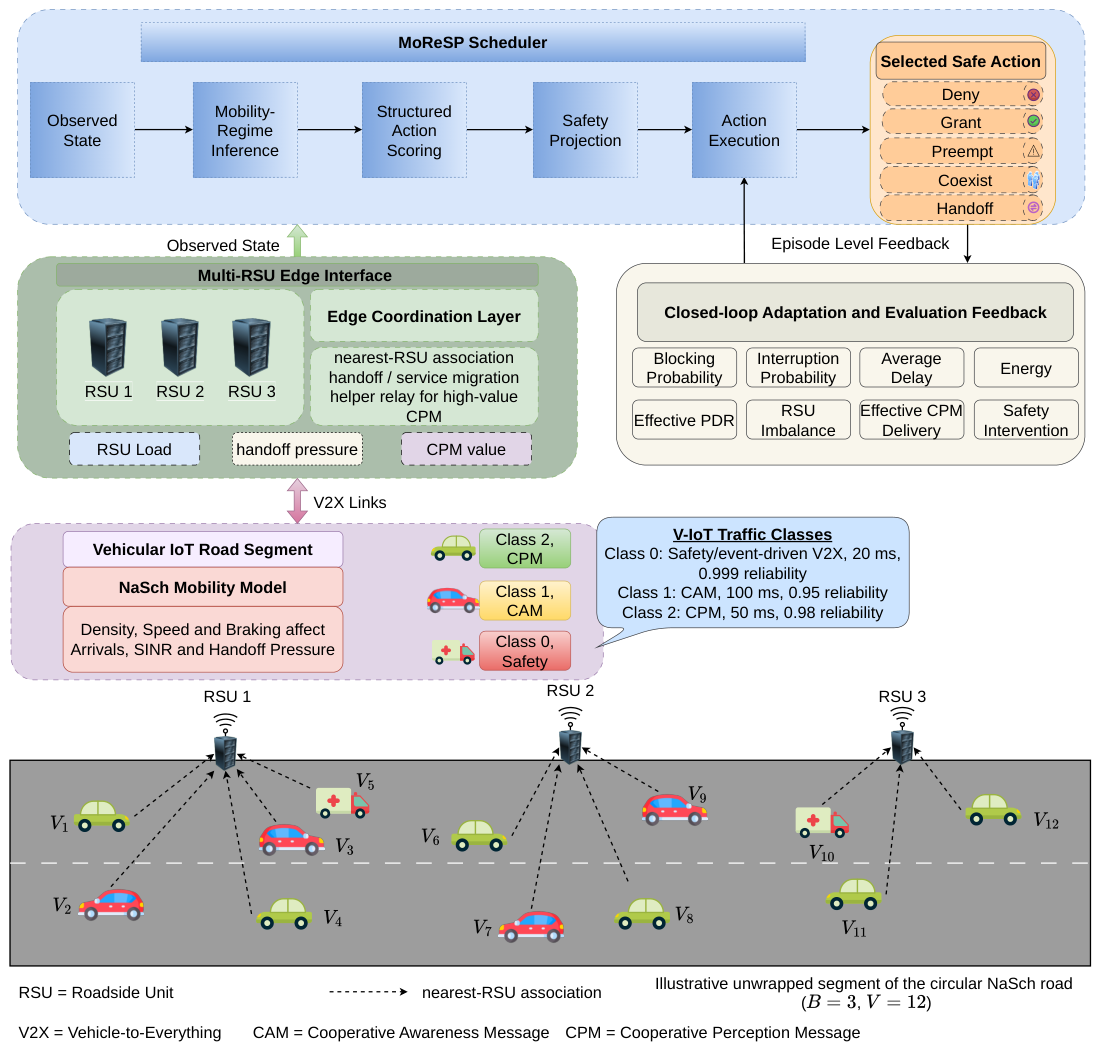
This section defines the RSU-assisted V-IoT system considered in this work. The network consists of a set of vehicles, RSUs, wireless V2X links, and an RSU-edge layer that supports packet scheduling, handoff, service migration, and cooperative perception delivery. Vehicles generate heterogeneous safety, CAM, and CPM traffic over slotted time.
Figure 1 illustrates the considered system model.
Let
denote the set of vehicles and
denote the set of RSUs. In the implemented setting,
. The system operates over discrete time slots indexed by
t, with slot duration
ms. Each vehicle is associated with one serving RSU at a given slot. If
denotes the position of vehicle
i and
denotes the position of RSU
b, the serving RSU is selected according to the nearest-RSU association:
where
is the road distance between vehicle
i and RSU
b. A service migration or handoff event may occur when the serving association changes or when the current link becomes unreliable.
The traffic model contains three service classes:
where class 0 denotes safety or event-driven V2X messages; class 1 denotes CAM traffic; and class 2 denotes CPM traffic. Each class
is characterized by its base sampling rate
, deadline
, reliability target
, and packet size
. The adopted service profile is
This profile captures the strict reliability requirement of safety traffic, the periodic status-update nature of CAMs, and the larger payload size of CPMs. For vehicle
i with traffic class
, packet arrivals follow a slot-level Bernoulli process. The arrival probability is
where
is the offered-load scaling factor;
is the device-specific load factor; and
is a class-dependent mobility multiplier. This multiplier increases the arrival rate of safety messages during unstable braking conditions and increases CPM demand under dense traffic. If
indicates a new packet arrival, the queue of vehicle
i evolves as
where
is the successfully served traffic in bits. The queue age increases while the queue remains nonempty, and a deadline violation is recorded when the queue age exceeds
. The exponential mapping in Equation (
6) ensures that
for all evaluated values of
. As
increases, more frequent arrivals increase
and queue age whenever the available service
is insufficient; the resulting active-queue pressure, oldest queue age, and average queue age are included in the scheduler observation and directly influence congestion- and urgency-aware action selection.
Vehicular mobility is modeled using the NaSch cellular traffic process on a circular road. The road contains
cells, each with length
m, giving
Let
,
, and
denote the velocity, position, and forward gap of traffic vehicle
j. The mobility update is
where
cells/slot. The extracted mobility indicators are traffic density
, normalized speed
, and braking rate
.
The V2X wireless channel operates at carrier frequency
GHz. It includes distance-dependent path loss, log-normal shadowing, fast fading, interference, and mobility-induced degradation. The noise floor is set to
dBm, while the shadowing and fast-fading standard deviations are 3 dB and 2 dB, respectively. Let
denote the transmit power of vehicle
i. The received signal level is
where
is the distance from vehicle
i to its serving RSU,
is the shadowing term,
is the fast-fading term, and
,
, and
denote density-, braking-, and speed-related channel degradation. The path loss is modeled as
where
is expressed in GHz and
is expressed in meters. In the implementation, the link distance is lower-bounded by
m to avoid singular path-loss values at very short distances. The instantaneous signal-to-interference-plus-noise ratio (SINR) in dB is
where
is a combined noise-plus-interference power in dBm. The slot service capacity is
where
W is the channel bandwidth and
is the spectral-efficiency cap.
The RSU-edge layer maintains load states for all RSUs. Let
denote the normalized association load of RSU
b, computed as the fraction of vehicles currently associated with that RSU. The average load and maximum load are
At each scheduling slot, the RSU-edge layer updates the serving-RSU association of each vehicle according to the nearest-RSU association rule and derives the normalized RSU-load state from the current associations. The resulting load indicators are incorporated into the scheduler state for RSU-load-aware action selection. When a handoff action is executed, the model includes the associated service-migration latency and energy overhead. The RSU-load state synchronization and refresh are abstracted within the ms RSU-edge control cycle before scheduling action selection.
For CPM traffic, a value-of-information proxy is used to represent perception usefulness. Let
denote the CPM value of vehicle
i. It is defined as
The normalized CPM value coefficients are set to
,
,
, and
. This allocation assigns greater importance to traffic density and braking activity, while retaining distance-based spatial novelty and reduced-speed effects in the CPM value estimate.
The distance-related novelty factor is defined as
where
denotes the shortest circular-road distance between vehicle
i and its serving RSU
. A larger value of
indicates greater vehicle–RSU separation and is used as a distance-based spatial-novelty proxy for CPM traffic. The coefficients
,
,
, and
are non-negative weights. For non-CPM packets,
.
At each slot, the scheduler selects one action from
The deny action rejects the current service opportunity; grant provides direct service; preempt prioritizes urgent traffic; coexist enables shared or cooperative service; and handoff triggers RSU reassociation or edge migration. Let
indicate whether the scheduled transmission succeeds. The served traffic is
The vehicle-side communication energy is calculated for successful service actions. For vehicle (
i), the slot-level service energy is
where
is the transmit power in dBm,
is the class-dependent circuit and processing-energy coefficient in J/bit, and
is the successfully served traffic in bits. For
,
. The adopted coefficients are
J/bit for safety, CAM, and CPM traffic, respectively.
where the handoff factor represents additional control and robust-allocation overhead. The episode-level vehicle-side communication energy is
The episode-level vehicle-side communication energy is used as the energy metric in the composite system-cost formulation.
The episode throughput over
T slots is
5. Proposed MoReSP Framework
MoReSP is a structured online scheduling policy for the RSU-side decision problem formulated in
Section 4. At each slot, the scheduler observes the current network state, derives pressure indicators, infers the mobility regime, assigns scores to the available actions in Equation (
18), and executes a safety-filtered decision. The design is intentionally interpretable: each decision is shaped by measurable queue, channel, mobility, CPM, and RSU-load indicators rather than by a purely black-box mapping.
Let the normalized observation at slot
t be
where
,
, and
denote active-queue pressure, oldest queue age, and average queue age, respectively. The terms
and
denote recent SINR and success-rate indicators,
is the traffic fraction of class
c, and
,
, and
are the density, normalized-speed, and braking indicators.
From
, MoReSP forms the feature vector
where
is urgency pressure,
is reliability risk,
is fairness pressure,
is congestion pressure,
is mobility instability,
is emergency pressure,
is CPM pressure,
is handoff pressure, and
is RSU-load pressure. The reliability-risk feature is computed as
The normalized coefficients are set to . Accordingly, recent delivery failure and interruption history receive the largest contributions, followed by braking activity, SINR degradation, traffic density, and recent blocking. where and denote recent-window interruption and blocking rates. The remaining pressure terms are computed using the same normalized design principle so that all components remain comparable within the scoring function.
The current traffic condition is assigned to one of four regimes:
The raw regime classifier
uses the mobility, queue, and reliability indicators, while a smoothing operator
suppresses rapid switching:
The regime variable changes the relative importance of reliability, mobility, congestion, and CPM delivery in the action-scoring process.
For each regime
, MoReSP maintains a parameter vector
where the
w-terms weight urgency, reliability, fairness, congestion, mobility, and action churn, while the
-terms represent action-specific bonuses or penalties. For each action
, the score is
where
is the action-specific pressure function;
is the regime-dependent bias; and
penalizes unnecessary action switching. The candidate action is selected as
The candidate action is then passed through a safety projection layer. Each action is assigned one of three feasibility states:
Let
and
denote the hard- and soft-feasible action sets. Define
For compactness, let
. The safety-projected action is
where
denotes the violation severity of action
a,
is the soft-acceptance threshold, and
returns the nearest accepted alternative. The safety layer uses success-rate, reliability-risk, congestion, mobility-instability, churn, and starvation thresholds. The soft-acceptance severity threshold is set to
.
After each episode, MoReSP updates the regime-specific parameters using blocking, interruption, fairness, utilization, and CPM-delivery statistics. Let
,
,
,
, and
denote the corresponding episode-level quantities. The regime-dependent adaptation step is
where
is the base step size, and
increases adaptation strength in dense-congested and unstable-braking regimes. The main parameter updates are
and
The fixed update coefficients are , , and . The base adaptation rate is , and the regime factors for sparse-stable, fast-flow, dense-congested, and unstable-braking conditions are , , , and , respectively. The remaining bonuses are adjusted according to the same episode-level feedback: excessive interruption reduces aggressive coexistence or preemption incentives, while insufficient CPM delivery increases coexistence and handoff incentives. The clipping bounds are and , while the target limits are and .
Algorithm 1 summarizes the MoReSP scheduling procedure.
| Algorithm 1 MoReSP Scheduling Procedure |
| Require: Environment , action set , regime set , initial parameters , safety thresholds, number of episodes E, slots per episode T |
| Ensure: Episode metrics and adapted regime-policy parameters |
- 1:
for do - 2:
Reset environment, regime inferencer, safety layer, and short-window statistics - 3:
for do - 4:
Observe and compute - 5:
Infer smoothed regime - 6:
Compute for all - 7:
Select - 8:
Apply safety projection to obtain - 9:
Execute - 10:
Update short-window reliability, intervention, fairness, and starvation statistics - 11:
end for - 12:
Finalize episode metrics - 13:
Adapt - 14:
end for
|
6. Simulation Setup and Evaluation Methodology
This section defines the experimental protocol used to evaluate MoReSP and the benchmark schemes. All simulations were conducted using a custom discrete-time V-IoT simulator implemented in Python 3.13. The simulator incorporates the multi-RSU edge environment, a NaSch-based mobility model, a stochastic packet-generation process, a V2X channel model, and packet-level scheduling operations described in
Section 3. All methods are tested under the same simulator, traffic model, channel model, action space, random seeds, and post-processing pipeline. The evaluation uses five independent seeds, 300 episodes per seed, and 150 slots per episode. The main simulation parameters are summarized in
Table 2.
MoReSP is compared with five benchmark schemes implemented under the same five-action scheduling space in Equation (
18). AoCI-Heuristic emphasizes age and CPM freshness pressure, RSU-Coop emphasizes RSU load balancing and cooperative service, Handoff-Aware emphasizes mobility continuity, V2X-Priority emphasizes safety and latency-critical traffic, and ALTO-MAB represents lightweight adaptive online action selection. Comparison fairness is ensured by evaluating all methods under a common simulator configuration, RSU topology, traffic and channel models, packet-generation process, action semantics, scenario settings, random-seed set, episode horizon, and metric-calculation pipeline. For each scenario–seed pair, every method is initialized independently under the same environmental configuration and evaluated over (300) episodes of (150) slots each. This common evaluation protocol enables a direct comparison of the alternative scheduling-policy designs under identical V-IoT operating conditions. These benchmarks are literature-inspired baseline families rather than exact numerical reproductions of individual prior studies.
The evaluation considers three main scenario sweeps and three diagnostic sweeps. The vehicle-load scenario varies the arrival-scale parameter as
The traffic-density scenario varies the NaSch density as
The RSU-capacity scenario varies the RSU capacity scale as
The diagnostic sweeps vary the RSU-to-RSU cooperation rate, CPM-load scale, and block-budget scale over . The main figures report vehicle-load, NaSch-density, and RSU-capacity results because these directly stress packet arrival pressure, mobility-density effects, and infrastructure availability.
Let
,
,
, and
denote the number of packet arrivals, blocked arrivals, preempted transmissions, and delivered packets, respectively. The blocking and interruption probabilities are
and
The raw packet delivery ratio (PDR) is
and the raw CPM delivery ratio,
, is computed using delivered and generated CPM packets.
To prevent blocked or interrupted traffic from being hidden by raw delivery statistics, the evaluation uses conservative admission-adjusted delivery indices. The service-admission factor is
The effective packet delivery and CPM delivery indices are
and
These indices are not conventional physical-layer PDRs; they are admission-adjusted service-reliability measures that penalize delivery failure, blocking, and interruption. The admission-adjusted reliability loss is
The main system-level metric is the admission-adjusted system cost. It combines normalized delay, normalized energy, reliability penalty, CPM freshness cost, and RSU-imbalance cost. The delay component is
where
is the average delay in milliseconds. The CPM freshness component is
The reliability component is
Let
denote the set of scenario–scheme–seed records in the reporting table. The normalized vehicle-side communication-energy component is
where
is the mean episode-level energy for record
z. If the denominator is zero,
is set to zero. The RSU-imbalance component
is normalized using the same min-max procedure. The final system cost is
The nominal weight vector is
, where the weights sum to one. These normalized design weights assign the greatest importance to admission-adjusted reliability and CPM freshness, while retaining delay, energy, and RSU-load balance as contributing system-level factors. Their influence is further examined through the weight-sensitivity analysis in
Section 7. The largest weights are assigned to reliability and CPM freshness because the target application is reliability-sensitive cooperative V-IoT scheduling rather than throughput-only access. All reported curves show the mean across five seeds. Error bars indicate two-sided 95% Student’s
t confidence intervals across five independent seeds. Cost-decomposition plots report the five weighted components of
, and all figures use a fixed scheme-color convention across scenarios.
7. Results and Discussion
This section evaluates MoReSP under RSU-capacity scaling, NaSch-density variation, and vehicle-load variation against AoCI-Heuristic, RSU-Coop, Handoff-Aware, V2X-Priority, and ALTO-MAB. Lower values are preferred for admission-adjusted system cost, reliability loss, and delay, whereas higher values are preferred for effective packet and CPM delivery. Unless otherwise stated, all numerical values are five-seed means corresponding to the plotted points and are reported to three decimal places.
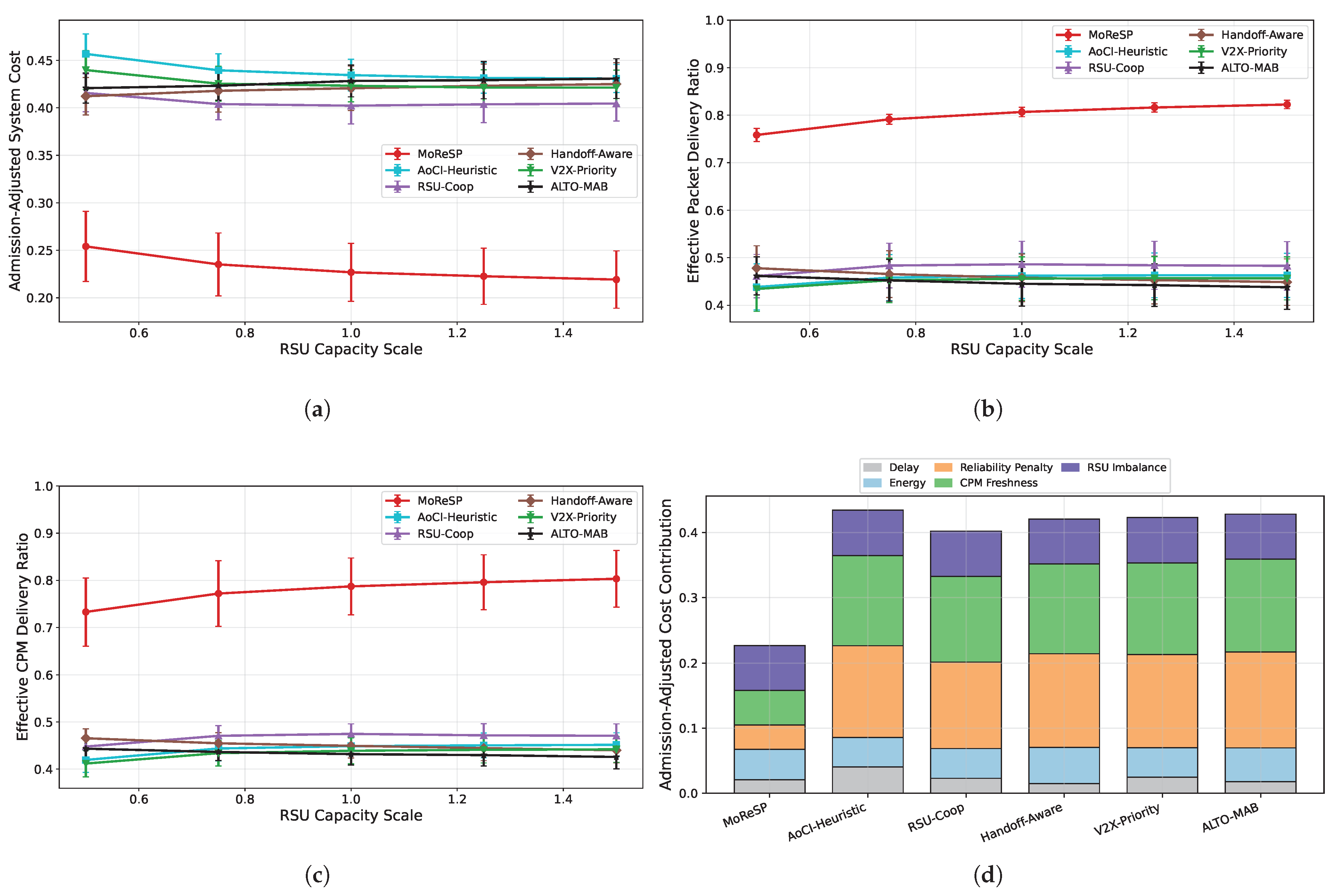
Figure 2 shows the effect of RSU-capacity scaling. MoReSP obtains the lowest admission-adjusted system cost throughout the sweep. At
, MoReSP records a cost of 0.254, compared with 0.412 for the best baseline, Handoff-Aware, corresponding to a 38.4% reduction. At nominal capacity,
, MoReSP reduces the cost to 0.227, compared with 0.402 for RSU-Coop, giving a 43.6% reduction. At
, MoReSP records 0.219, whereas RSU-Coop remains at 0.404, corresponding to a 45.8% reduction. These results show that MoReSP uses additional RSU capacity more effectively than the baselines.
At nominal RSU capacity, MoReSP also achieves a lower admission-adjusted reliability loss of 0.193, while RSU-Coop, AoCI-Heuristic, Handoff-Aware, V2X-Priority, and ALTO-MAB record 0.514, 0.538, 0.542, 0.544, and 0.555, respectively. The effective packet delivery ratio of MoReSP is 0.807, compared with 0.486 for RSU-Coop. Similarly, the effective CPM delivery ratio is 0.787 for MoReSP and 0.475 for RSU-Coop. The cost decomposition in
Figure 2d further shows that MoReSP reduces the total cost mainly through lower reliability and CPM penalties. Its total cost of 0.227 consists of delay cost 0.021, energy cost 0.047, reliability penalty 0.037, CPM freshness cost 0.053, and RSU-imbalance cost 0.069. In contrast, RSU-Coop has a total cost of 0.402, with reliability and CPM penalties of 0.133 and 0.131, respectively.
The reduction in these two components follows from the joint use of queue, channel, mobility, CPM, and RSU-load indicators in the decision process. When recent delivery success, SINR, density, braking activity, or short-window blocking and interruption rates indicate elevated service risk, MoReSP adjusts the action ranking using its reliability, congestion, and mobility pressures. The subsequent safety projection preserves only feasible actions under the prevailing operating condition, thereby reducing ineffective scheduling decisions that contribute to blocking and interruption. For CPM traffic, the CPM-pressure and value-of-information indicators maintain the importance of useful perception packets during action selection. Consequently, improved successful service and lower admission disruption jointly reduce reliability and CPM penalties.
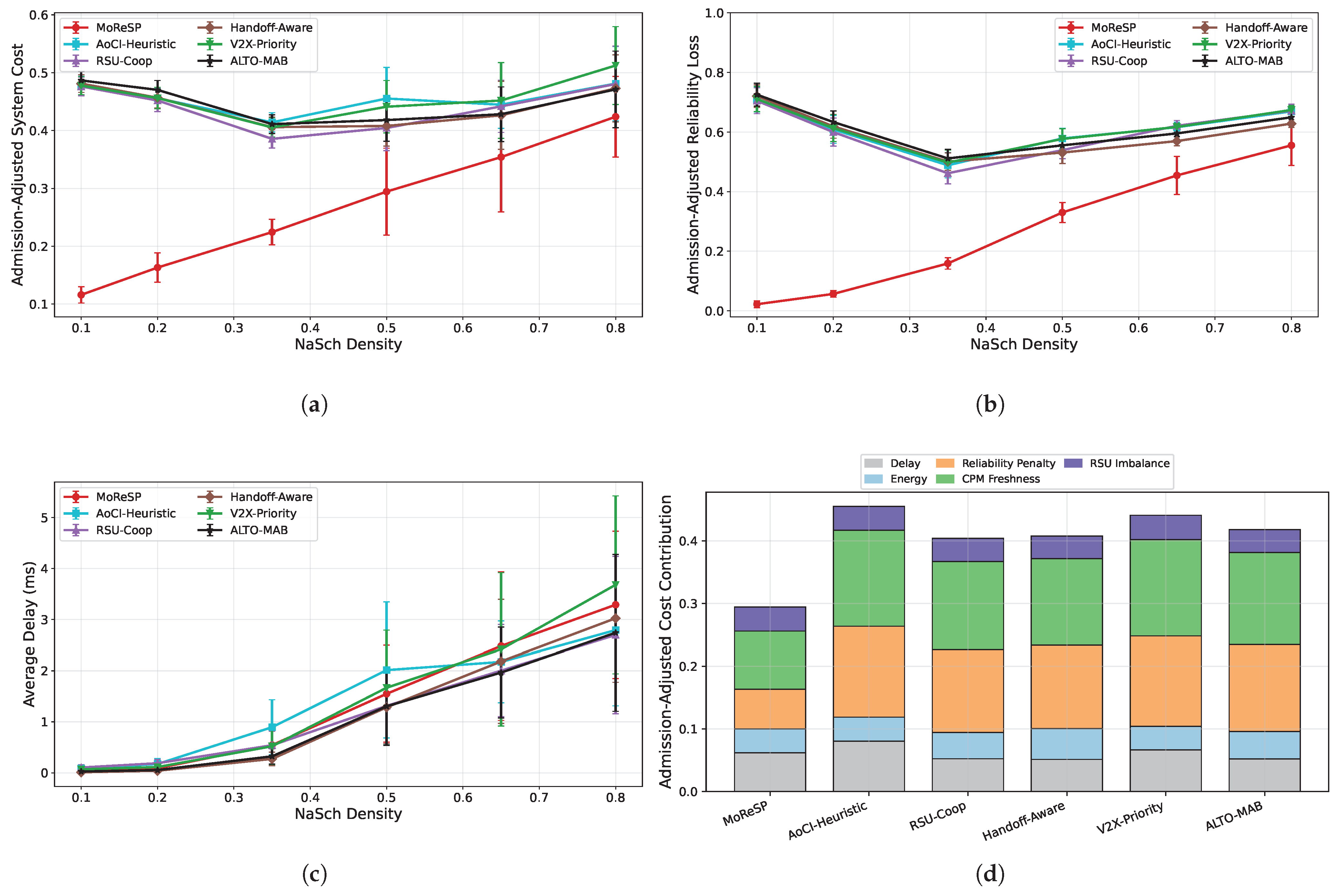
Figure 3 evaluates traffic-density variation. In
Figure 3a, MoReSP gives the lowest system cost at all density values. At
, MoReSP achieves 0.116, compared with 0.476 for RSU-Coop, giving a 75.6% reduction. At
, MoReSP records 0.295, compared with 0.404 for RSU-Coop, corresponding to a 27.0% reduction. At
, MoReSP records 0.424, while the best baseline, ALTO-MAB, records 0.471, giving a 10.0% reduction. The smaller margin at high density is expected because contention and mobility instability become dominant.
Figure 3b confirms that MoReSP preserves reliability more effectively as density increases. At
, its reliability loss is 0.022, compared with 0.705 for RSU-Coop. At
, MoReSP records 0.330, while Handoff-Aware and RSU-Coop record 0.531 and 0.539, respectively. At
, MoReSP records 0.555, compared with 0.628 for Handoff-Aware, giving an 11.6% reduction.
Figure 3c shows that MoReSP does not always minimize delay. At
, MoReSP delay is 3.291 ms, while RSU-Coop and ALTO-MAB record 2.699 ms and 2.742 ms, respectively. This indicates a deliberate reliability-delay trade-off: MoReSP accepts moderate delay growth to reduce the likelihood of failed or ineffective service decisions.
Figure 3d shows the cost breakdown at
and supports this interpretation. MoReSP records a total cost of 0.295, with delay cost 0.062, energy cost 0.038, reliability penalty 0.064, CPM freshness cost 0.093, and RSU-imbalance cost 0.038. RSU-Coop records 0.404, mainly due to higher reliability and CPM penalties of 0.132 and 0.141. Thus, the density-sweep advantage of MoReSP is mainly due to reliability and CPM preservation rather than delay minimization alone.
This trend is consistent with the mobility-regime mechanism. As traffic density increases and vehicle motion becomes less stable, the regime classifier changes the relative importance assigned to reliability, congestion, and mobility conditions in the action-scoring process. The safety projection further evaluates whether coexistence remains feasible under the observed reliability risk, recent success rate, mobility instability, and congestion pressure. Hence, MoReSP accepts moderate delay growth at high density when necessary to avoid unreliable service decisions, while preserving CPM delivery when the prevailing state supports coexistence or handoff scheduling.
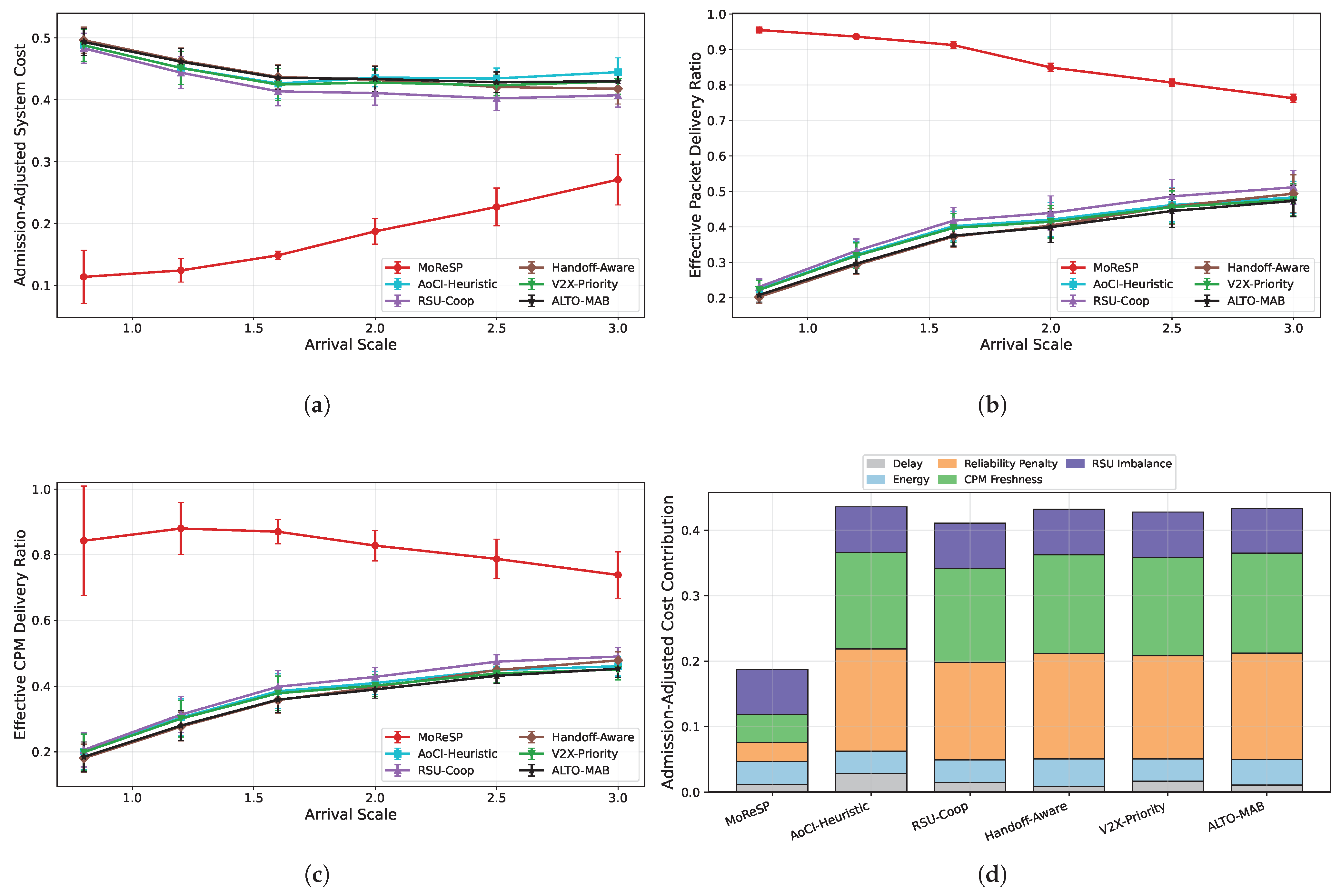
Figure 4 evaluates vehicle-load variation. In
Figure 4a, MoReSP remains the lowest-cost scheme across the full arrival-scale sweep. At
, MoReSP records 0.114, compared with 0.483 for RSU-Coop, giving a 76.4% reduction. At
, MoReSP records 0.187, compared with 0.411 for RSU-Coop, corresponding to a 54.4% reduction. At
, MoReSP records 0.271, while RSU-Coop records 0.407, giving a 33.5% reduction. The pronounced reduction at light load reflects the admission-adjusted composite metric, where MoReSP incurs lower blocking, interruption, and CPM-freshness penalties than RSU-Coop.
Figure 4b,c show that the lower system cost of MoReSP is accompanied by stronger effective delivery. At
, MoReSP achieves an effective packet delivery ratio of 0.849, compared with 0.440 for RSU-Coop. At the same load, MoReSP achieves an effective CPM delivery ratio of 0.828, compared with 0.428 for RSU-Coop. At
, MoReSP maintains effective packet and CPM delivery ratios of 0.763 and 0.738, while RSU-Coop records 0.512 and 0.490, respectively.
Figure 4d shows the cost-component decomposition at
. MoReSP has a total cost of 0.187, with delay cost 0.011, energy cost 0.036, reliability penalty 0.029, CPM freshness cost 0.043, and RSU-imbalance cost 0.068. RSU-Coop records a total cost of 0.411, mainly because its reliability and CPM penalties increase to 0.149 and 0.143. AoCI-Heuristic, Handoff-Aware, V2X-Priority, and ALTO-MAB record total costs of 0.436, 0.432, 0.428, and 0.434, respectively.
These values indicate that the high-load gain of MoReSP is primarily due to improved reliability and CPM delivery under admission pressure. Under increased arrival load, queue growth, and recent blocking or interruption events increase the urgency and reliability-risk pressures used by the policy. Episodic parameter adaptation then strengthens the emphasis on reliability and mobility protection, while a low CPM delivery ratio increases the preference for CPM-supporting coexistence and handoff decisions. This closed-loop adjustment improves the service-admission factor and the timely delivery of CPM traffic, which directly lowers the reliability and CPM components of the composite cost.
MoReSP achieves the lowest admission-adjusted system cost in all evaluated scenarios. Its largest gains appear under vehicle-load stress, where it reduces cost by 54.4% at and maintains nearly twice the effective packet and CPM delivery ratios of the strongest baseline. Under RSU-capacity scaling, it reduces cost by 43.6% at nominal capacity and 45.8% at the highest capacity point. Under NaSch-density variation, it remains the lowest-cost and lowest-reliability-loss scheme, although it incurs moderate delay growth at high density. These results show that reliable V-IoT scheduling requires coordinated admission control, mobility awareness, CPM preservation, reliability-risk management, and RSU-load balancing.
The results show that the observed cost reduction is produced by the coordinated use of reliability-risk estimation, mobility-regime inference, CPM-aware action scoring, safety-feasible scheduling, and episodic adaptation. These mechanisms jointly reduce blocking and interruption while preserving effective packet and CPM delivery under changing RSU capacity, traffic density, and vehicle-load conditions.
Sensitivity to Composite-Cost Weights
To assess the sensitivity of the results to the weighting coefficients in Equation (
58), the composite cost was recomputed from the same seed-level delay, energy, reliability, CPM, and RSU-imbalance components using alternative normalized weight profiles. The component definitions and normalization procedure were retained, while only the aggregation weights were changed. The analysis covers the (17) operating points in the three primary sweeps: vehicle-load variation, NaSch-density variation, and RSU-capacity scaling. In
Table 3,
,
,
,
, and
denote the weights of delay, energy, reliability, CPM, and RSU-imbalance components, respectively. The mean and minimum reductions are calculated relative to the lowest-cost baseline at each operating point.
As shown in
Table 3, MoReSP achieves the lowest mean composite cost at all (17) operating points under every tested weight profile. Its mean reduction relative to the best baseline ranges from (33.2%) under latency–energy emphasis to (51.6%) under reliability emphasis. The smallest observed reduction is (2.3%), obtained at
under the latency–energy profile. These results indicate that the main conclusion is robust to meaningful changes in the relative importance assigned to delay, energy, reliability, CPM delivery, and RSU-load balance.