4.1. Small Benchmark Example
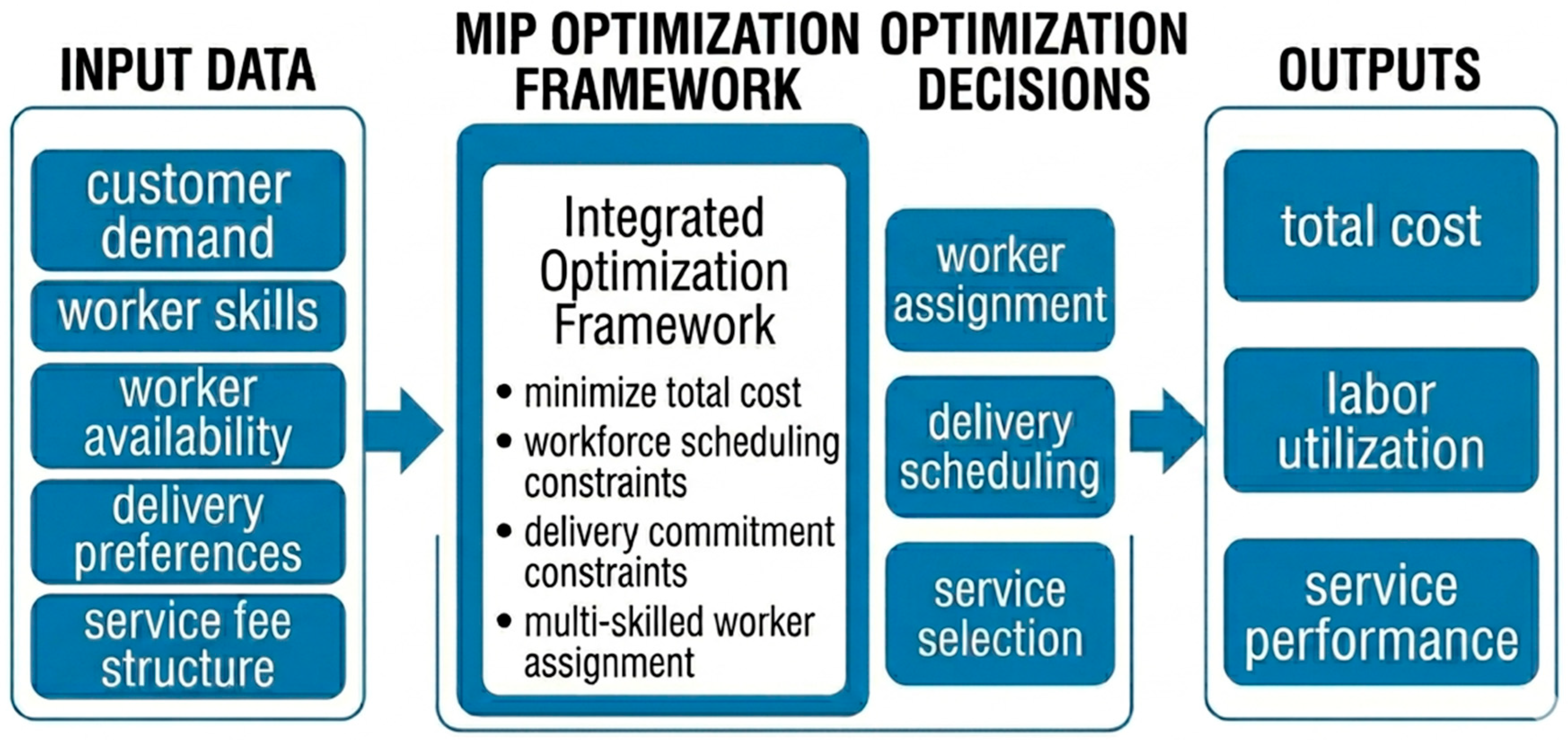
Before presenting an actual case study, we illustrate the main features of the model with a small example. For this purpose, consider a big-box retailer with three workers (one driver and two assistants) to serve six customers over a 3-day planning horizon. The sub-jobs and man-hour requirements of each sub-job for six customers, and price offered by the customers for the 3-day delivery window, are given in
Table 1. In
Table 1, the standard workload is measured in man-hours based on the lowest level of experiences. The price offered by the customer is based on the report of a recent empirical study. Each customer chooses one day as the preferred delivery date, and the 3PL service provider plans its services to meet these requests. In
Table 1, we combine the information on sub-jobs and workload of sub-jobs together. The workload values represent standard labor hours required for each sub-job based on manufacturer installation guidelines and historical completion records for entry-level workers. The prices offered by customers are used to infer their preferred service dates, with higher prices indicating stronger preferences for earlier service.
In
Table 2, the skills and experience level of skill for three workers as well as their availability for the 3 days are given. In the insourcing approach, workers have high levels of experience, and high availability per day because they are employees of the retailer. This sample represents the insourcing approach with a high level of experience. In the crowdsourcing approach, workers have varying availability each day, and they might work for several providers at the same time as independent contractors. In
Table 2, the data for Level of Experience gives the rating from 0 to 5 for each worker, and each sub-job as well as worker availability in hours over the 3-day period.
The fixed costs of hiring and training workers along with data about each worker’s past performance are given in
Table 3. The fixed costs are estimated by the worker’s experience, technical quality, and customer feedback. There are different ways to estimate the fixed costs based on historical data, and data analytics tools. For this, a five-level category is used to evaluate each criterion, and cost is assigned based on the level. Training here is minimal, and costs are in RMBs.
The time and cost to complete each sub-job by the worker each period is shown in
Table 4. The time to complete the job is calculated by the level of experience. The cost of a sub-job by qualified workers is calculated based on a salary survey. In China, the hourly rate for an entry-level delivery worker is between 16.5 and 21 RMB per hour, according to the Human Resources and Social Security Bureau, an official Chinese agency [
31].
Table 5 presents the optimal solution of delivery service in this small example. The values of decision variables in the objective function are reported in the table along with the value of objective function, which is −392, which means profit of 392. The model was solved in less than 0.0001 s using IBM ILOG CPLEX Optimization Studio 20.1 on a desktop PC with an 11th Gen Intel Core i9-11900H processor (2.50 GHz) and 32 GB of RAM.
The results provide several managerial insights. First, although three workers were available, the model determined that only two workers were required to complete all six customer deliveries, demonstrating the model’s ability to efficiently utilize labor resources while satisfying delivery commitments. Second, the solution illustrates how delivery timing and worker assignment decisions are jointly optimized to maximize profitability. Customers with different preferred delivery dates and service fees are assigned to workers and time periods in a coordinated manner, balancing workforce capacity and revenue opportunities.
Note that the model can also be used for scenario or what-if analysis. For example, suppose customers 3 and 5 both changed their delivery date to day 2. Re-solving the model quickly reveals that the new delivery schedule is in fact doable, but profits decline slightly from 392 to 364. Likewise, if all six customers prefer the same delivery date, the model quickly discloses that there is no feasible solution with the current workforce, and additional workers would have to be hired.
4.2. Real-World Case Study
In this section, we consider a large-scale delivery operation by a Chinese 3PL service provider for the largest online big-box retailer in China. Here, we give an overview of the problem, and the usefulness of the optimization model in planning and executing customer deliveries. Note that in
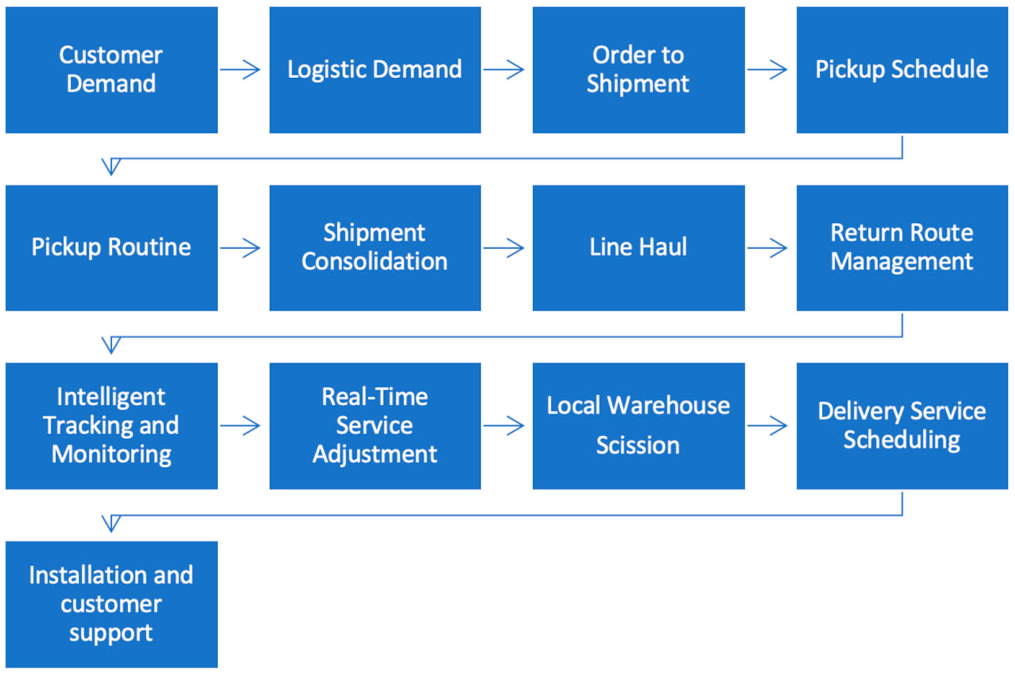
Appendix A we describe the complete order fulfillment process for a typical customer of a big-box retailer by a 3PL service provider.
The online big-box retailer considered several models of omni-channel fulfillment operations, choosing crowdsourcing to staff their delivery service. Unlike the insourcing approach, the online retailer’s planning horizon depends on the distance between manufacturing, and customer since they often use an intermodal transportation approach. The local 3PL service provider where the customer is located will manage the door-to-door delivery with worker and task assignments. The policy of the local 3PL here usually states that workers assigned to the customers are limited to a 10 min driving distance from those customers. We retrieved the data from a dedicated server via an ODBC connection. The primary attributes of the data include customer address and their preferred service time; shipment information such as item description, costs, and planned arrival time; and manufacturer-recommended man-hour requirements for installation. Worker information lists skills, their related skill levels, number of completed projects, customers’ ratings, training history, and third-party service provider information, noting the number of contractors, workers, and warehouse location. For training purposes, manufacturers provide a training video for installation and handling. They also provide man-hour requirements for various tasks. For the market opportunities at hand, sub-jobs are classified into eight categories including lamps, lanterns, curtains, drying racks, furniture category, flooring, wallpaper category, door, appliances, and locks.
The company plans deliveries 6 weeks in advance, solving the optimization model for each week to organize planning.
Table 6 details the weekly operational scale of the case by tracking total workload demands and crowdsourcing workers in formation over the 6-week planning horizon. The data shows a progressive demand surge, with total workload requirements escalating from a low of 1619 standard man-hours in week 2 to a peak of 3761 standard man-hours by week 6. Over this same period, individual customer order requirements remain consistently bound within a workload range of 1 to 8 h per order. To accommodate these shifting demands, the third-party logistics (3PL) provider dynamically scales its total available labor capacity from 1574 h in week 1 to a maximum of 4447 h in week 6, utilizing independent contractors who provide flexible daily shifts ranging between 4 and 8 h.
The results of the optimization runs are shown in
Table 7.
Table 7 reports the number of workers deployed, total cost and labor efficiency each week in the planning horizon. Operation logs show that worker availability ranged from 45 to 85 workers during weeks 1 to 6, and that over this time they were to service from 110 to 317 customers. Given these plans, the firm is on track to earn a profit in weeks 1, 3, 4, and 6, but to lose money in weeks 2 and 5. Note that
Table 7 also gives the size of the models solved where the six instances range in size from 10,439 to 45,630 variables, and from 1190 to 2529 constraints. The large number of variables is primarily driven by the combinatorial nature of workforce assignment and delivery scheduling decisions, while the constraints represent operational, capacity, scheduling, and logical consistency requirements. These dimensions illustrate the computational complexity of solving realistic large-scale home delivery scheduling problems. All six problems were solved within 1 h by CPLEX.
For evaluating the labor utilization efficiency, we use the ratio between the total adjusted workload demanded by the customer and the total occupied worker capacity .
These ratios are high, indicating limited flexibility in response to possible changes in customer demands and worker availability. For example, if the availability of workers declined by 5% in week 5, which has the highest ratio of customer/worker (317/75) and the highest ratio of deployed/available workers (74/75), then the solver cannot find a feasible solution, implying that the schedule is not workable. Workforce flexibility is key to the crowdsourcing business model when customer demand is uncertain.
Note that if the provider chose to switch to the service without fee model, rather than the service with fee model considered above, it could take control of delivery dates. This, in turn, would likely lead to changes in both the cost of deployed workers as well as labor utilization efficiency, with a resulting impact on profits. To test the impact of such a change here, we took the same data on workload demand, and worker availability used above, and allowed the possible delivery day to be relaxed to any day of the week. The results obtained by running the service without a fee model are shown in
Table 8. Note that by allowing delivery any day of the week, the size of the model grows substantially, resulting in much longer run times. The free-delivery setting introduces greater scheduling flexibility, which substantially increases the number of feasible delivery and workforce assignment combinations, resulting in significantly larger mixed-integer programming models. Of the six solutions shown in
Table 8, the shortest solution time was 4 h and the longest was 10 h. To evaluate labor utilization efficiency in this case, we use the ratio between the total adjusted workload demanded by the customer
and the total occupied worker capacity
.
The results show that labor utilization increased by an average of 12% and the number of workers was reduced by 16% on average, leading to a total labor cost reduction of 2.2%. However, considering the entire process (see
Appendix A) these changes, considering total revenue and production costs, actually led to lower profitability than was realized under the ‘with fee’ model.
Using the without fee model to test additional alternatives, we found that the worker’s availability can be reduced up to 50% and still allow feasible solutions. However, if the minimum worker capacity of any given day is less than the maximum total adjusted workload by a single customer, the problem is infeasible. The service-without-fee model showcases the trade-offs between the total cost of delivery and the value of schedule flexibility to commit to customer delivery dates.
The recent pandemic sheds some light on the trade-off of service without fees and with a fee. For example, for service without a fee, companies cannot meet the sudden jump in customer demand or disruption of logistics. Amazon must halt delivery service on some items due to its capacity bottleneck, and warehouse closings [
32]. For service with a fee, companies must plan a hiring spree of crowdsourcing workers in a short period to meet a surge of customer demand. Some 3PL delivery service companies, such as Instacart and Shipt, use flexible tipping as incentive to the crowdsourcing workers for fast delivery service.