1. Introduction
Fractional-order differential equations have become an important mathematical tool for modeling dynamical systems with memory, hereditary effects, and nonlocal behavior. Unlike classical integer-order models, fractional-order systems incorporate information from past states through memory kernels, making them suitable for describing processes whose present evolution depends on their history. Owing to these characteristics, fractional calculus has been used in many areas such as control theory, viscoelasticity, electrical circuits, biological systems, diffusion processes, and engineering sciences [
1,
2,
3,
4].
Among the various fractional derivatives used in the literature, the Caputo fractional derivative is particularly suitable for physical and engineering models because it allows the use of classical initial conditions while preserving the memory-dependent nature of the system. From a geometric point of view, the classical first-order derivative describes the instantaneous slope of a trajectory, whereas a fractional derivative may be interpreted as a weighted accumulation of past slopes over a time interval. This feature makes the Caputo derivative useful for describing memory-dependent dynamics in which the current state is affected by the previous evolution of the system [
2,
4].
A fundamental concept in the qualitative analysis of fractional systems is Mittag–Leffler stability. This notion is commonly regarded as the fractional counterpart of exponential stability in classical differential equations. The reason is that solutions of many fractional-order systems are naturally expressed in terms of Mittag–Leffler functions rather than exponential functions. Thus, Mittag–Leffler stability provides an appropriate framework for describing decay rates, convergence behavior, and asymptotic properties of fractional dynamical systems with memory [
5,
6].
Recently, Mittag–Leffler stability has been investigated for different classes of fractional-order systems. Li, Chen, and Podlubny [
5] established generalized Mittag–Leffler stability criteria for fractional nonlinear systems by using Lyapunov direct methods. Sadati et al. [
6,
7] studied Mittag–Leffler and Razumikhin-type stability results for fractional nonlinear systems with delays, while Wu et al. [
8,
9] investigated the stability properties of discrete fractional systems. In a related direction, Yakar, Gücen, and Çiçek [
10,
11] introduced stability concepts involving initial time differences for fractional dynamic systems. More recent works have considered Mittag–Leffler-type stability in delayed fractional systems, fractional neural networks, memristive neural networks, synchronization problems, and Ulam–Hyers stability frameworks [
12,
13,
14,
15,
16,
17]. These studies are mentioned only to indicate recent developments in Mittag–Leffler-type stability analysis; the present paper, however, focuses on fractional perturbed systems and their comparison with unperturbed reference systems under initial time differences.
Despite these developments, the simultaneous treatment of perturbation effects and initial time differences in a comparative fractional stability setting remains limited. Most existing results focus either on a single fractional system, on delay effects, or on stability properties under identical initial times. However, due to the memory-dependent structure of fractional systems, a change in the initial instant may influence both transient and long-time behavior. Therefore, it is natural to investigate how a perturbed trajectory behaves relative to a shifted unperturbed reference trajectory when different initial times are taken into account.
To clarify the position of the present study with respect to the existing literature, the main differences between this work and closely related contributions are summarized in
Table 1. The table is placed after the discussion of the research gap in order to show more clearly how the present work differs from previous Mittag–Leffler stability results.
Motivated by these observations, this paper develops a comparative Mittag–Leffler stability framework for fractional perturbed systems with respect to shifted unperturbed reference trajectories. The contribution of this study is not the introduction of a completely independent Mittag–Leffler stability theory, but rather the adaptation and extension of existing fractional Mittag–Leffler stability ideas to a setting in which perturbation effects, fractional memory, and initial time differences are treated simultaneously. More precisely, the main contributions of the paper are as follows:
A comparative stability notion is formulated in terms of the distance between a perturbed trajectory and a shifted unperturbed reference trajectory;
Lyapunov-type sufficient conditions are established for Mittag–Leffler stability under initial time differences;
The role of the initial time difference is explicitly incorporated into the stability estimates;
Representative examples are provided to illustrate how the abstract conditions can be verified for fractional perturbed systems.
The mathematical models considered in this paper are not intended to reproduce natural systems in all their complexity, but to provide an analytically tractable framework for studying the stability, convergence, and robustness properties of memory-dependent systems. In this sense, the proposed perturbed and unperturbed fractional models serve as idealized but meaningful representations of memory-dependent phenomena arising in engineering, physics, biology, and applied sciences.
The remainder of this paper is organized as follows:
Section 2 presents the necessary preliminaries and definitions.
Section 3 gives the main Lyapunov-type stability results.
Section 4 provides illustrative examples and verifies the required assumptions.
Section 5 presents numerical illustrations and benchmark comparisons. Finally,
Section 7 contains the concluding remarks.
2. Preliminaries
In this section, we recall some basic notions of fractional calculus that will be needed in the sequel. For
, the Caputo fractional derivative of a differentiable function
is defined as
where
denotes the Euler Gamma function.
The Riemann–Liouville fractional derivative of order
is defined by
where
, and equivalently
. This relation follows from the standard definition of the Riemann–Liouville fractional derivative of order
q, where the kernel exponent is determined by the complementary order
. Since
, it follows that
.
One key advantage of the Caputo derivative is that it permits the formulation of initial conditions in a manner consistent with those of classical integer-order differential equations. Moreover, for a constant
C, we have
, whereas the Riemann–Liouville operator yields
From (
1), the following relation can be derived:
which further implies
In particular, if
, then both definitions coincide, that is,
These definitions and their relations are classical tools in the theory of fractional differential equations and can be found, for example, in [
2,
4,
18].
Now consider the Caputo-type initial value problem
and its perturbed counterpart
where
represents a nonlinear perturbation term and
. Here,
and
are assumed to exist. We also require that
f is continuous on
, locally Lipschitz in the second variable, and satisfies
for all
. Moreover, the perturbation term
is assumed to be continuous and may depend nonlinearly on the state variable
y.
It should be noted that the local Lipschitz condition imposed on f with respect to the state variable is essential for ensuring the uniqueness of solutions of the corresponding fractional initial value problem. If f is only continuous and not locally Lipschitz, the existence of solutions may still be determined under suitable assumptions; however, uniqueness is not guaranteed in general. In such a case, different solution trajectories may originate from the same initial condition, and the stability analysis with respect to a uniquely determined reference solution may no longer be well-defined. Therefore, the local Lipschitz assumption is imposed throughout this study to guarantee the well-posedness of the system and to make the comparison between perturbed and unperturbed solutions meaningful.
Under standard assumptions ensuring the existence and uniqueness of solutions for the problems (
6) and (
7), the solution
of (
6) can equivalently be written in the Volterra-type integral form
Thus, the differential formulation (
6) and the integral equation (
8) are completely equivalent.
The following definition is formulated by adapting the classical Mittag–Leffler stability concept for fractional systems [
5] and the initial time difference stability framework [
10,
11] to the present setting of fractional perturbed systems with respect to their unperturbed counterparts. Its purpose is to measure the decay of the distance between the perturbed trajectory and the shifted unperturbed reference trajectory. Therefore, the definition is not intended to describe the stability of a single isolated system, but rather the comparative stability between two fractional systems starting from different initial times.
Definition 1. Let denote the solution of the unperturbed fractional system (6) through , and let denote the solution of the perturbed fractional system (7) through . Set , where and . The perturbed system (7) is said to be initial time difference Mittag–Leffler stable with respect to the unperturbed system (6) if the perturbed trajectory remains Mittag–Leffler close to the shifted unperturbed trajectory , that is,Here, , , , and is a non-negative locally Lipschitz function on satisfying , with Lipschitz constant . Definition 2. Let be a trajectory of the fractional system (7) through . It is calledinitial time difference attractive Mittag–Leffler stable with respect to , a solution of (6), provided that , and there exists such thatIf can be chosen independently of , then is said to be uniformly attractive initial time difference Mittag–Leffler stable. The parameters , , and and the function satisfy the same assumptions as in Definition 1. Definition 3. The solution of (7) through is said to be initial time difference asymptotically Mittag–Leffler stable with respect to if both of the following hold: - 1.
is initial time difference Mittag–Leffler stable (Definition 1);
- 2.
Moreover, if the constant appearing in Definition 2 can be chosen independently of , then is uniformly initial time difference asymptotically Mittag–Leffler stable for all .
The following two definitions are based on the standard fractional Dini derivative approach used in Lyapunov stability analysis for fractional-order systems. Definition 4 recalls a Caputo-type fractional Dini derivative for a Lyapunov function along a single fractional system. Definition 5, on the other hand, is adapted to the present comparative framework and is used to estimate the evolution of the difference between a perturbed trajectory and a shifted unperturbed reference trajectory. Thus, the second definition extends the usual fractional Dini derivative setting to the stability analysis of two fractional systems starting from different initial times.
Definition 4. Let be a real-valued continuous function. The fractional Dini derivative of V in the Caputo sense is given bywhere and . Definition 5 is adapted to the comparative stability framework considered in this paper. It is used to estimate the evolution of the difference between the perturbed trajectory and the shifted unperturbed reference trajectory under the initial time difference.
Definition 5. Let be a real-valued continuous function, where denotes the difference between a perturbed trajectory and a shifted unperturbed trajectory . The generalized Caputo-type fractional Dini derivative of V along the difference dynamics is defined bywhere is the vector field of the perturbed system and is the vector field of the shifted unperturbed reference system. Definition 6. The class is defined as the collection of a function satisfying For the convenience of the reader and to avoid any ambiguity in the subsequent analysis, the main mathematical parameters and notations used throughout the paper are summarized in
Table 2.
3. Main Theorems
Remark 1. The assumptions imposed in the following Lyapunov-type theorems should be understood as verifiable sufficient conditions rather than automatically guaranteed properties for an arbitrary fractional system. In the Lyapunov approach, the existence of a suitable functional depends on the structure of the considered system and must be checked separately for each particular model. Typically, is constructed as a positive definite norm-type or quadratic functional, such asorwhere P is a positive definite matrix. The local Lipschitz condition imposed on is required to ensure that the generalized Caputo-type Dini derivative is well-defined along the difference trajectory. In concrete applications, this condition can be verified directly from the explicit form of . For instance, quadratic choices such as or are locally Lipschitz with respect to z on bounded subsets of . Once such a functional is constructed, the constants , , and the comparison functions are obtained from the estimates that bound and its generalized Caputo-type Dini derivative. Therefore, the role of the theorems is to provide a set of sufficient criteria: if an appropriate Lyapunov-type functional is constructed and the required inequalities are verified, then the corresponding Mittag–Leffler stability conclusion follows. Remark 2. The parameters appearing in the Lyapunov-type estimates are not arbitrary. The fractional orders are chosen in the interval in accordance with the Mittag–Leffler decay structure, while the constants represent decay rates and are power-type exponents in the comparison bounds. The comparison functions must be continuous, non-negative, monotone nondecreasing, and satisfy . In applications, these quantities are derived from the explicit estimates obtained after choosing the Lyapunov-type functional . More precisely, lower and upper bounds for determine the functions and the exponents , whereas the estimate of the generalized Caputo-type Dini derivative determines the decay parameters and the remaining comparison terms. Thus, parameters such as , , and are selected so that the inequalities in the hypotheses of the theorems are satisfied.
Remark 3. The boundedness of the difference trajectoryis understood within the admissible region used in the Lyapunov analysis. More precisely, the main theorems are stated for trajectories satisfyingwhere is chosen as a bounded admissible set. Hence, the boundedness of is not assumed implicitly; it is ensured by restricting the analysis to solutions that remain in . In applications, this requirement can be verified either by showing that is positively invariant for the difference dynamics or by proving a priori estimates on the perturbed and unperturbed solutions. For example, if both and are bounded on the considered interval, thenwhich implies the boundedness of . In the illustrative examples considered in Section 4, the Mittag–Leffler decay of the unperturbed part together with the boundedness of the perturbation terms guarantees that the corresponding difference trajectory remains bounded. Theorem 1 (Suppose that the following assumptions hold)
. For every μ with , there exists a functional such that is locally Lipschitz continuous in z. Moreover, for with , there exist parameters , , and comparison functions satisfying and for such thatIn addition, the generalized Caputo-type Dini derivative satisfiesHerewhere denotes the solution of the perturbed system (7) starting from , while denotes the solution of the unperturbed system (6) with initial data . The initial time difference is given by . Then, under these conditions, the solution of (7) is Mittag–Leffler stable with initial time difference relative to the shifted solution of (6), for all . Proof. Let
and
. Choose
such that
Such a choice is possible by the continuity of
, the condition
, and the positivity of the right-hand side for fixed
.
Assume, contrary to the desired conclusion, that the Mittag–Leffler estimate does not hold. Then there exist
such that
and
where
Since
, the functional
is nonincreasing along the difference trajectory
in the generalized Caputo-type Dini sense. Hence,
Using the estimate (
14), we obtain
This contradicts the choice of
in (
16). Therefore, the assumed violation cannot occur, and the required Mittag–Leffler stability estimate with initial time difference follows. □
Theorem 2 (Suppose that the following assumptions hold)
. For every μ with , there exists a functional such that is locally Lipschitz continuous in z. Moreover, for with , there exist parameters , , , and comparison functions satisfying and for , such thatIn addition, there exist parameters , , and , together with a comparison function satisfying and for , such that the generalized Caputo-type Dini derivative satisfiesHerewhere denotes the solution of the perturbed system (7) starting from , while denotes the solution of the unperturbed system (6) with initial data . The initial time difference is given by . Then, under these conditions, the solution of (7) is uniformly asymptotically Mittag–Leffler stable with initial time difference
relative to the shifted solution of (6), for all . Proof. Let
By Theorem 1, the two-sided estimate (
18), together with the inequality (
19), implies the initial time difference Mittag–Leffler stability of the perturbed system with respect to the shifted unperturbed reference system. It remains to prove the uniform attractivity property.
Let
be given. Since
and
, choose
such that the stability estimate obtained from Theorem 1 guarantees
whenever
for some
.
Now choose
and
such that
which imply that the corresponding difference trajectory remains in
for
. Let
Assume that, for some
, the estimate
holds. Then, by (
19) and the fractional integral form of the Caputo-type comparison inequality, we have
Since
on
and
is nondecreasing, it follows that
Moreover, by the upper bound in (
18), there exists a positive constant
, depending on the initial data, such that
Choose
sufficiently large so that
Then, the previous estimate gives
which is impossible since
is non-negative. Therefore, there exists
such that
By the stability result already obtained, this implies
Hence, the perturbed solution is uniformly attractive with respect to the shifted unperturbed solution. Combining uniform stability and uniform attractivity, we conclude that
is uniformly asymptotically Mittag–Leffler stable with initial time difference relative to
. □
Before establishing the general comparison theorem, we recall the scalar comparison fractional system in the Caputo sense:
where
,
, and
. Let
denote the maximal solution of (
20) satisfying
.
The trivial solution
of (
20) is said to be
Mittag–Leffler stable if, for every
and
, there exists
such that
for some
and
.
It is said to be
uniformly Mittag–Leffler stable if
can be chosen independently of
. Moreover, it is said to be
uniformly attractive if there exists
such that, for every
, there exists
, independent of
, satisfying
If both uniform Mittag–Leffler stability and uniform attractivity hold, then the trivial solution of (
20) is called
uniformly asymptotically Mittag–Leffler stable in the fractional sense.
Theorem 3. Let denote the solution of the unperturbed system (6) with initial data , and let denote the solution of the perturbed system (7) with initial data , where , , and . Define Suppose that the below assumptions hold.
For every μ with , there exists a functional such that is locally Lipschitz continuous in z. Moreover, for with , there exist parameters , , and , and comparison functions satisfying and for , such thatAssume further that the generalized Caputo-type Dini derivative satisfieswhere and . Consider the scalar comparison systemIf the trivial solution of the comparison system (23) is strict Mittag–Leffler stable in the fractional sense, then the solution of the perturbed system (7) is Mittag–Leffler stable with initial time difference relative to the shifted solution of the unperturbed system (6). In particular, any strict fractional Mittag–Leffler stability property verified for the comparison system (20) is inherited by the difference trajectory under the above assumptions. Proof. Let
By the comparison inequality (
22) and the fractional comparison principle, we obtain
where
denotes the maximal solution of the scalar comparison system (
20) satisfying
.
Since the trivial solution of (
20) is strict Mittag–Leffler stable, for every
, there exists
such that
implies
By the upper estimate in (
21), we can choose
such that
implies
Therefore,
Using the lower estimate in (
21), we obtain
Since
is nondecreasing, it follows that
Equivalently,
Thus, the perturbed solution is Mittag–Leffler stable with initial time difference relative to the shifted unperturbed solution.
If the comparison system (
20) satisfies a stronger strict uniform asymptotic Mittag–Leffler stability property, the same comparison argument also yields the corresponding uniform attractivity of
. Hence, the corresponding strict fractional Mittag–Leffler stability property is inherited by the perturbed system with respect to the shifted unperturbed reference system. This completes the proof. □
4. Applications of Mittag–Leffler Stability for Perturbed Systems with Respect to Their Unperturbed Counterparts
To support the theoretical findings with practical illustrations, this section presents representative examples involving scalar and two-dimensional fractional perturbed systems. These examples are intended to demonstrate how the proposed Mittag–Leffler stability framework can be applied to concrete dynamical models and how bounded perturbations influence the stability behavior relative to the corresponding unperturbed systems. In addition, numerical simulations, graphical comparisons, and global error analyses are provided to validate the theoretical results and to illustrate the practical applicability of the proposed approach.
Although the illustrative examples in this section are chosen in linear form for clarity and computational simplicity, the proposed theoretical framework is not restricted to linear fractional perturbed systems. The main results are formulated for general nonlinear vector fields and nonlinear perturbation terms , provided that the required continuity, local Lipschitz, and Lyapunov-type conditions are satisfied. Therefore, the approach can also be applied to nonlinear fractional perturbed systems whenever an appropriate Lyapunov-type functional can be constructed. In addition, the corresponding generalized Caputo Dini derivative must satisfy the required stability inequalities. In this sense, the linear examples serve only as transparent demonstrations of the theory, while the applicability of the method extends to broader nonlinear fractional dynamics.
4.1. Example 1. Scalar Perturbed System and Mittag–Leffler Stability
Consider the unperturbed fractional system
Its solution is given by
which exhibits Mittag–Leffler decay and hence satisfies the corresponding strict Mittag–Leffler stability estimate in the unperturbed case.
The associated perturbed system is
where
is a bounded continuous perturbation.
For the perturbed system (
25), the solution can be expressed as
The first term represents the Mittag–Leffler decay of the homogeneous part, while the second term encodes the perturbation effect. By bounding
, one obtains
which verifies Mittag–Leffler stability in a non-strict sense, since the perturbation may induce a non-vanishing bias.
Verification of the Lyapunov-type conditions. Let
denote the difference between the perturbed trajectory and the shifted unperturbed trajectory. Here
denotes the shifted unperturbed reference trajectory corresponding to the initial time difference
. For the scalar case, we choose the Lyapunov-type function
Then
is continuous and positive definite, and satisfies
Moreover, on any bounded set
, we have
Hence,
V is locally Lipschitz with respect to
z. Thus, the comparison bounds required in the theoretical results can be written in terms of class-
functions, for instance
where
. Moreover, since the unperturbed scalar system has a decay rate governed by the Mittag–Leffler function
and the perturbation is bounded, the generalized Caputo-type Dini derivative of
V can be estimated by a negative Mittag–Leffler-type decay term up to the perturbation bound. Therefore, the Lyapunov-type assumptions used in the main theorems are explicitly verified for this scalar model.
Numerical trajectory. For , , , , and , the solution follows the Mittag–Leffler decay of the unperturbed part with small oscillatory deviations, fully consistent with Mittag–Leffler stability relative to the unperturbed model.
4.2. Example 2. Two-Dimensional Perturbed System
Consider the unperturbed fractional system
where
The corresponding unperturbed trajectory is
The associated perturbed system is given by
where
is a bounded continuous perturbation.
The perturbed trajectory can be expressed as
Thus, one can establish the estimate
where
This shows that the perturbed solution remains Mittag–Leffler stable with respect to the unperturbed one in a non-strict sense, since the bounded perturbation may induce a non-vanishing bias.
Verification of the Lyapunov-type conditions. For the two-dimensional system, define
where
is the perturbed trajectory and
is the shifted unperturbed reference trajectory according to the initial time difference
. A natural Lyapunov-type function is
This function is continuous and positive definite. Since
it satisfies the required positive definiteness condition. Moreover, for any bounded set
, we have
Therefore,
V is locally Lipschitz with respect to
z on bounded subsets of
. Thus, the required comparison inequalities are satisfied by suitable class-
functions, for example
with positive constants
. Furthermore, since the matrix
is positive definite for
, the decay of the unperturbed part is controlled by the smallest eigenvalue
Hence, the generalized Caputo-type Dini derivative of
V along the difference dynamics can be bounded by a negative Mittag–Leffler-type decay term together with the bounded perturbation contribution. This verifies that the Lyapunov-type conditions required in the main theorems are satisfied for the two-dimensional example.
5. Numerical Illustration and Benchmark Comparison
The purpose of this section is to provide a numerical illustration of the Mittag–Leffler stability behavior established in the previous sections. This section does not propose a new numerical algorithm. Instead, it uses standard fractional numerical schemes to illustrate the theoretical stability estimates and to compare the numerical behavior of perturbed and unperturbed trajectories.
More precisely, we consider the unperturbed scalar Caputo fractional system
and its perturbed counterpart
This test problem is chosen only to demonstrate how a bounded perturbation affects the Mittag–Leffler decay of the corresponding unperturbed Caputo fractional system. In accordance with the notation used throughout the paper,
denotes the unperturbed reference trajectory, while
denotes the perturbed trajectory.
The theoretical results of the paper are formulated in terms of the Caputo fractional derivative and Lyapunov-type Mittag–Leffler stability analysis. Therefore, the Caputo–Diethelm–Ford–Freed predictor–corrector method is used as the main numerical approximation tool because it is consistent with the Caputo formulation. The Riemann–Liouville and shifted Grünwald–Letnikov discretizations are not introduced as alternative theoretical frameworks and no new stability theorem is claimed for these schemes. They are included only as benchmark discretizations in order to compare the numerical behavior of commonly used fractional approximation methods for the same perturbed test problem.
The Caputo–Diethelm–Ford–Freed predictor–corrector method is not proposed in the present paper. It is a well-known Adams-type predictor–corrector method for the numerical solution of fractional differential equations and was introduced by Diethelm, Ford, and Freed [
19]. A detailed error analysis and convergence discussion for the corresponding fractional Adams method were later provided in [
20]. Therefore, the use of this method in the present paper is only illustrative and is based on the existing convergence theory of the method. Under the usual smoothness and Lipschitz-type assumptions on the right-hand side of the fractional differential equation, the method is known to be convergent, and the numerical errors decrease as the step size tends to zero. Since no new numerical method is introduced in this paper, no independent stability or convergence theorem is claimed here.
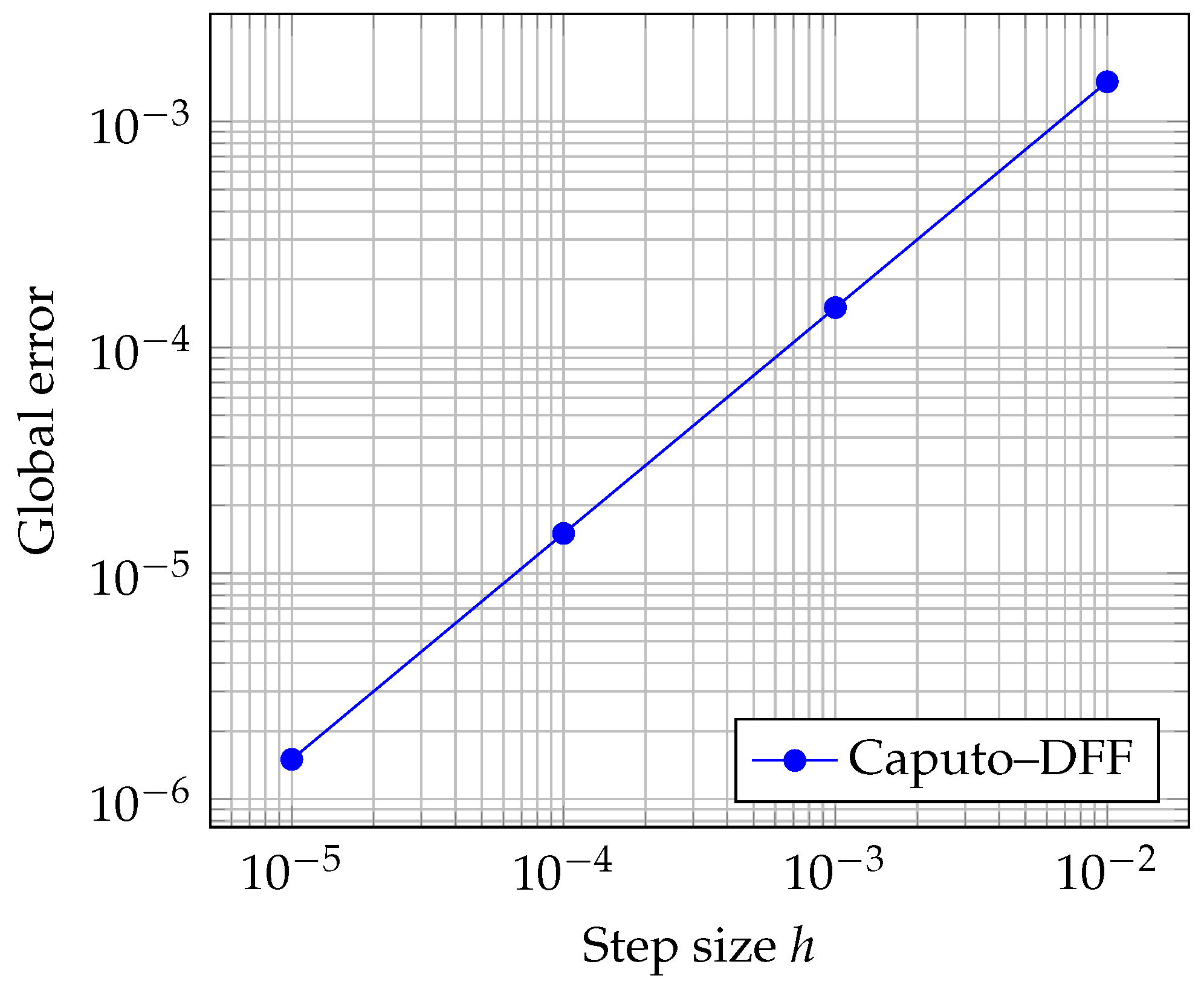
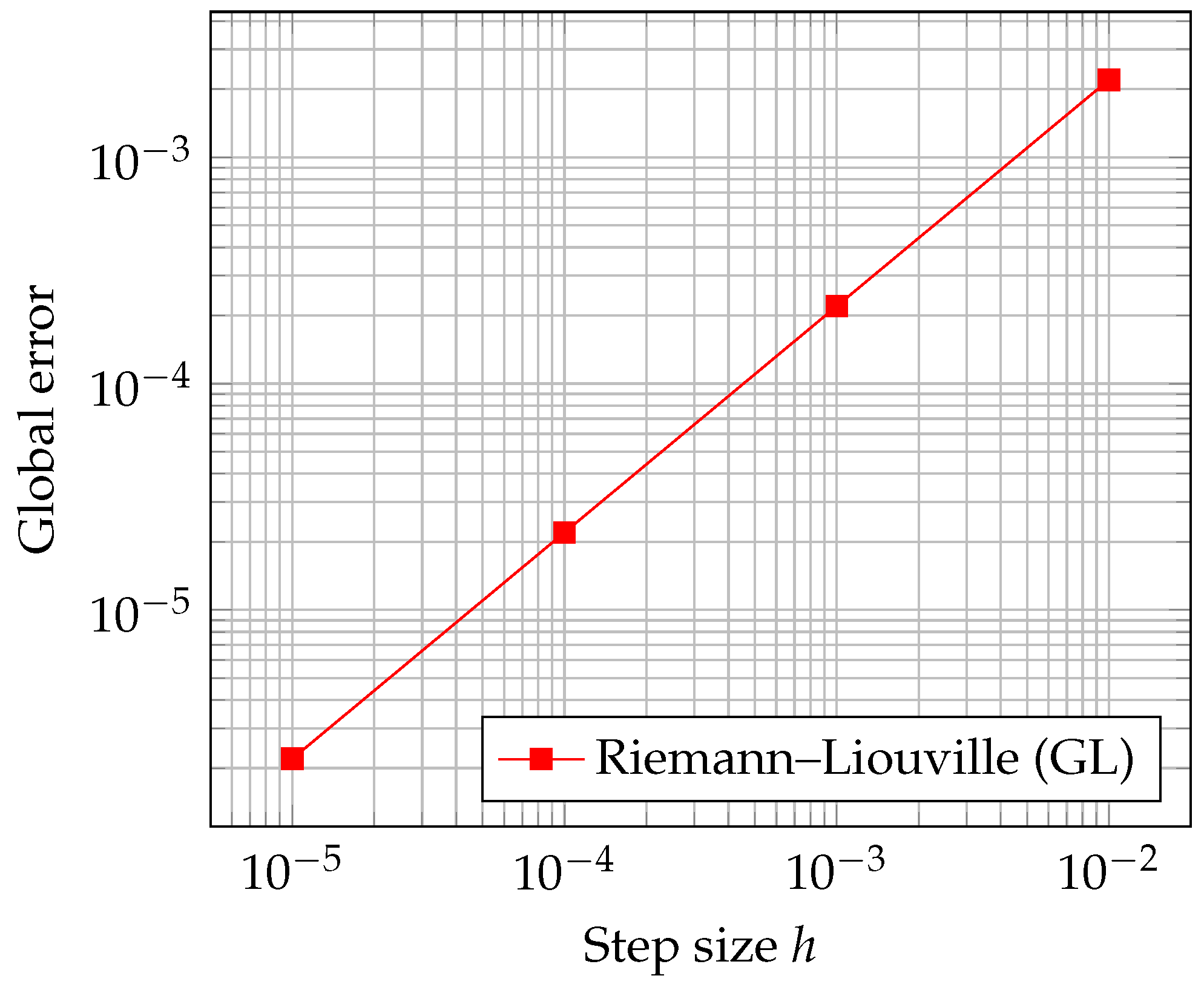
The convergence behavior is further demonstrated computationally through global error comparisons for decreasing step sizes. The numerical results show that the computed errors decrease as the step size becomes smaller, which is consistent with the known convergence properties of the fractional Adams-type predictor–corrector method and supports the numerical illustration of the theoretical stability results.
The following steps describe the numerical implementation used for illustration; they do not constitute a newly proposed algorithm.
- Step 1.
Choose .
- Step 2.
Set .
- Step 3.
Initialize .
- Step 4.
For each compute .
- Step 5.
Approximate the Caputo fractional derivative using the Diethelm–Ford–Freed predictor–corrector method and update the perturbed approximation .
- Step 6.
Compute the unperturbed reference value .
- Step 7.
Evaluate the difference .
- Step 8.
Repeat the computation for different step sizes h and compare the global errors.
We consider the scalar perturbed test problem
The corresponding unperturbed reference system is
and, for
, its reference trajectory is
The perturbed trajectory can be represented as
This decomposition highlights the stability of the perturbed trajectory relative to the unperturbed reference solution.
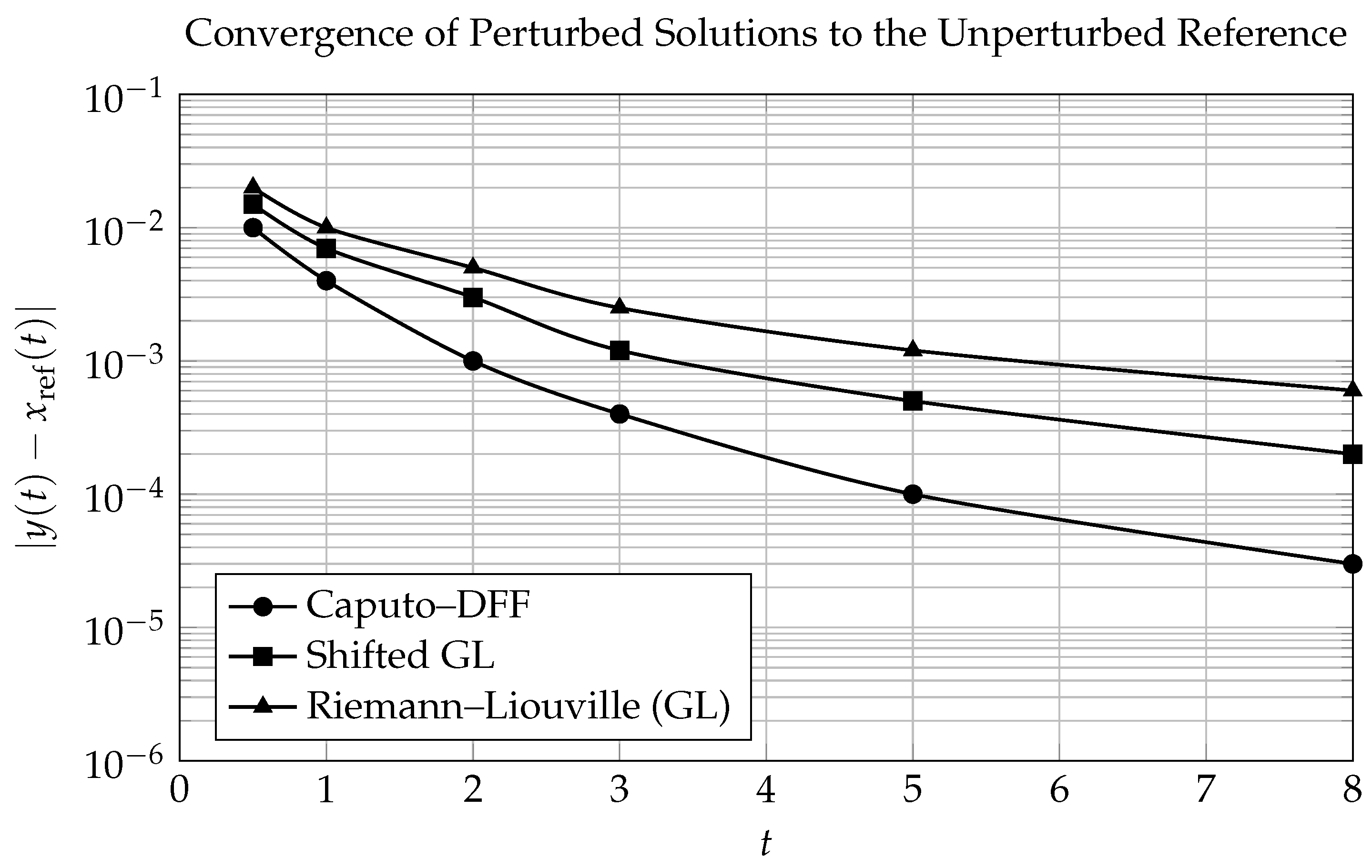
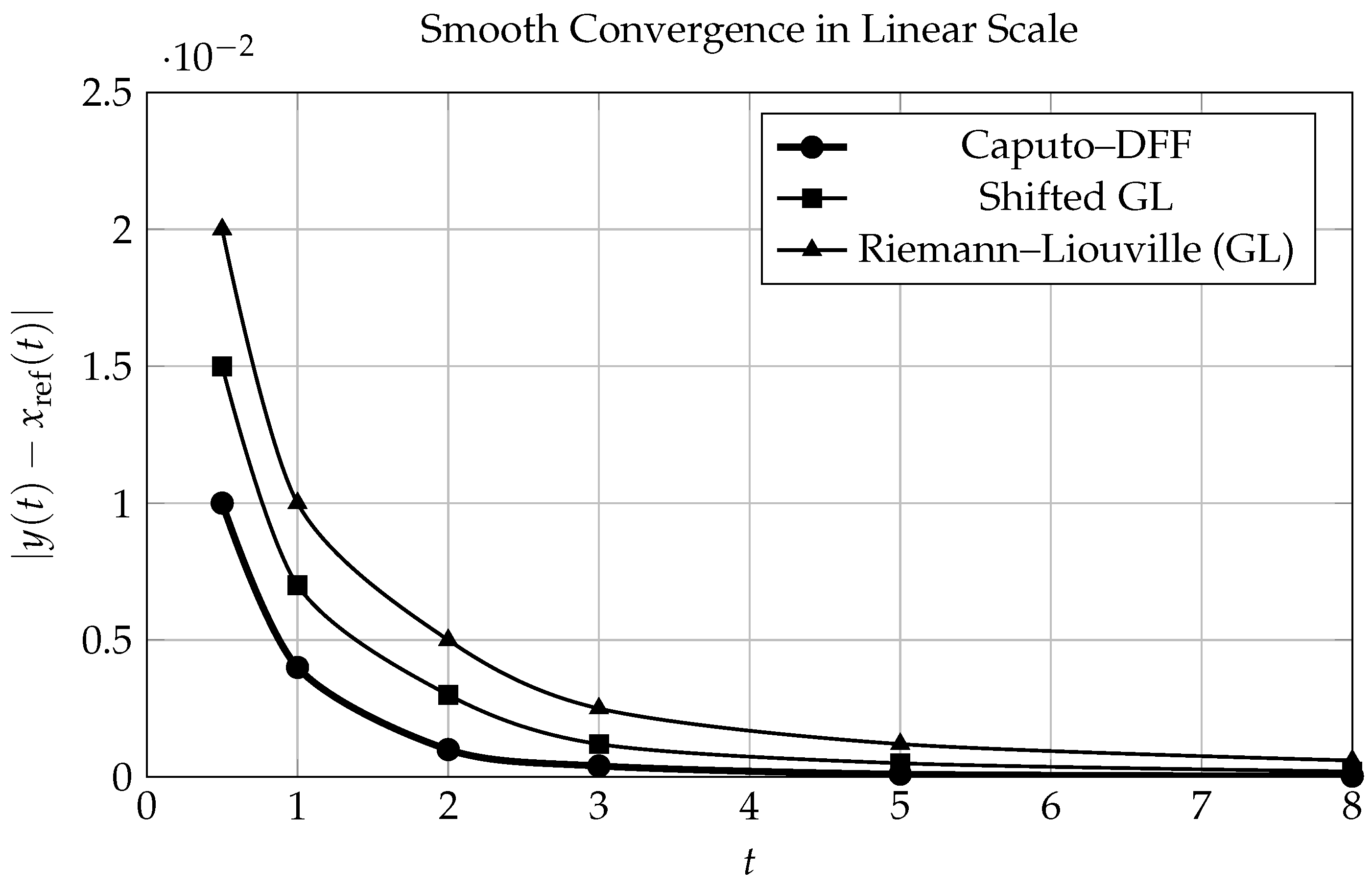
The logarithmic and linear-scale comparisons between the perturbed and unperturbed trajectories are illustrated in
Figure 1 and
Figure 2, respectively. These figures show that the deviations remain small and exhibit a stable behavior relative to the unperturbed reference trajectory. The Caputo–DFF method is directly consistent with the theoretical Caputo framework used in this paper, while the Riemann–Liouville and shifted Grünwald–Letnikov schemes are included only as numerical benchmarks.
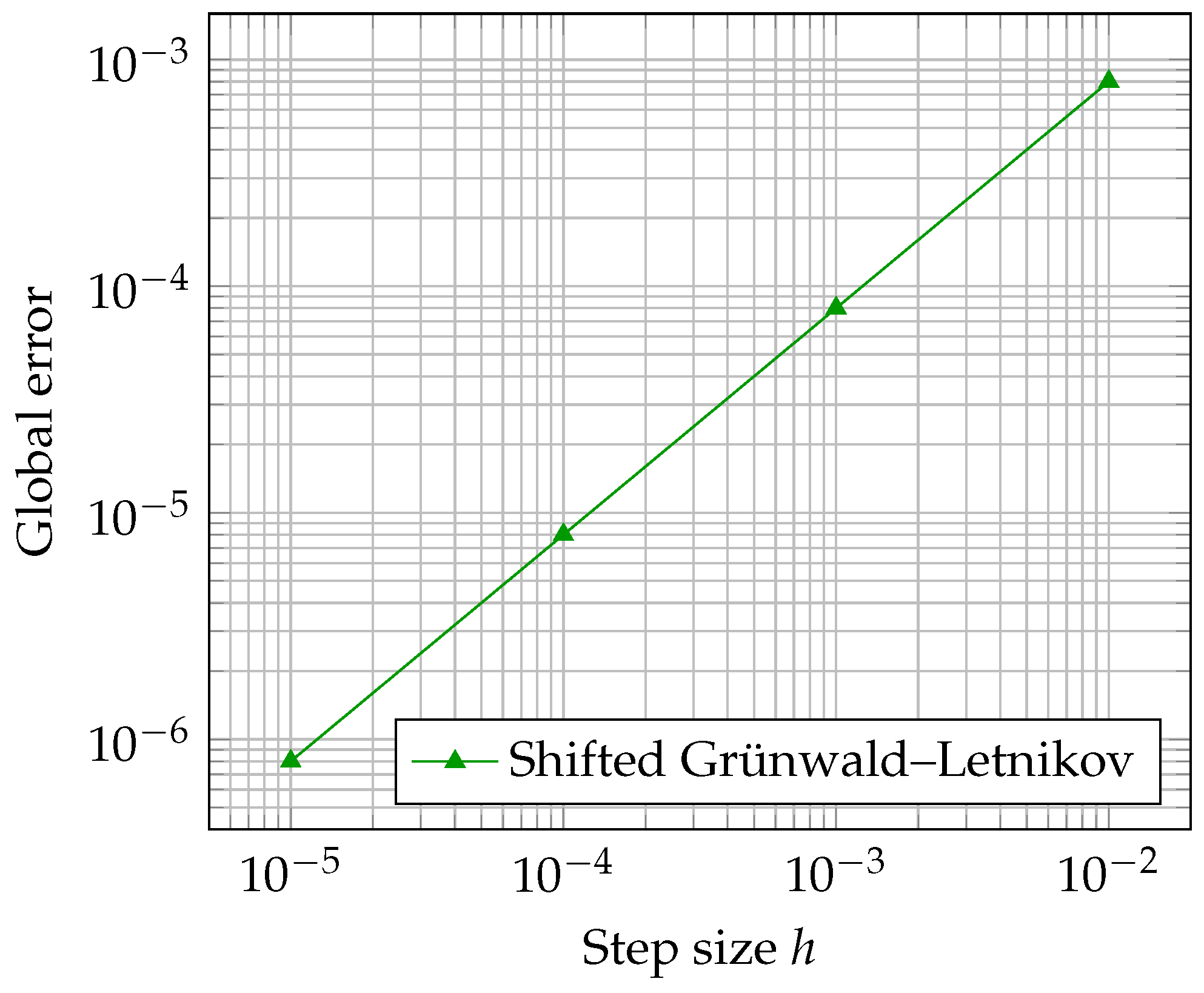
The numerical convergence behavior is further quantified through global error analyses under various step sizes.
Table 3,
Table 4, and
Table 5 summarize the computed errors for the Caputo–DFF, Riemann–Liouville (GL), and shifted Grünwald–Letnikov discretizations, respectively.
Figure 3,
Figure 4 and
Figure 5 graphically illustrate these error trends in double-logarithmic scales.
The additional Riemann–Liouville and shifted Grünwald–Letnikov computations are included only as numerical benchmarks. They are used to compare the convergence behavior of different fractional discretization schemes for the same perturbed test problem. These computations do not change the theoretical setting of the paper, which remains based on the Caputo derivative and Lyapunov-type Mittag–Leffler stability analysis. In this particular benchmark, the shifted Grünwald–Letnikov scheme gives the smallest numerical errors, whereas the Caputo–DFF scheme remains the method directly aligned with the theoretical Caputo formulation used in the stability analysis.
5.1. Global Errors vs. Step Size: Caputo–DFF (Predictor–Corrector)
The global error behavior of the Caputo–DFF predictor–corrector method is first reported in order to illustrate the convergence trend under decreasing step sizes.
5.2. Global Errors vs. Step Size: Riemann–Liouville (GL)
For comparison, the same global error analysis is carried out for the Riemann–Liouville (GL) discretization under the same set of step sizes.
5.3. Global Errors vs. Step Size: Shifted Grünwald–Letnikov
Finally, the shifted Grünwald–Letnikov discretization is evaluated under the same step-size values to complete the benchmark comparison.
6. Takeaway
The numerical analyses for the perturbed fractional systems provide strong computational support for the theoretical framework. When the perturbed responses are compared with their unperturbed counterparts, it becomes evident that small bounded disturbances do not significantly alter the long-term dynamics. The trajectories remain close to those of the unperturbed model, and the characteristic Mittag–Leffler decay is largely preserved, although a slight steady-state bias emerges due to the persistent input.
The experiments carried out with three different discretization strategies—Caputo–Diethelm–Ford–Freed (DFF), Riemann–Liouville (GL) and shifted Grünwald–Letnikov— clearly illustrate this behavior. As the time step h decreases, the computed errors diminish consistently, indicating the expected rate of convergence for each numerical scheme. The GL and DFF methods produce nearly parallel error trends, whereas the shifted Grünwald–Letnikov approach produces marginally smaller error constants, confirming the internal consistency of the three formulations.
Together, the graphical and tabular results demonstrate that the theoretical decay rates and stability bounds are accurately reflected in numerical practice. Even in the presence of perturbations, approximate solutions follow the analytically predicted Mittag–Leffler-type stabilization. This consistency emphasizes that the discretizations employed are not only numerically reliable but also faithfully reproduce the essential stability structure of the fractional model.
7. Conclusions
This work focused on comparative stability analysis of fractional-order systems under bounded external disturbances and their corresponding unperturbed configurations. Using Lyapunov-inspired arguments within the fractional framework, it was shown that unperturbed systems exhibited strict Mittag–Leffler stability, whereas the inclusion of mild perturbations resulted in a relaxed, yet persistent form of stability in which deviations remained uniformly bounded.
The numerical studies performed on scalar and two-dimensional test models confirmed this theoretical observation. The simulated trajectories revealed that the effect of bounded perturbations manifested only as small steady deviations, without disrupting the Mittag–Leffler decay pattern of the base system. The consistent reduction in global errors across finer time-step selections further verified the correctness of the analytical results and the robustness of the adopted numerical techniques.
In conclusion, the presented results highlight that the main stability mechanisms of fractional systems remain structurally resilient under perturbations. The combination of analytical reasoning and numerical validation provides a coherent picture of the dynamics, bridging the gap between theoretical stability definitions and computational realizations. Future research may extend this framework to include stochastic perturbations, time delays, or coupled multi-agent models, thereby deepening our understanding of fractional stability in more realistic dynamical environments.