1. Introduction
Wind tunnel testing platforms are indispensable infrastructure for high-speed aerodynamic research, with compressed air supply systems serving as the linchpin for generating high-pressure, stable, and continuous airflow in blowdown or energy-storage facilities [
1,
2,
3]. In these systems, high-pressure spherical air storage tanks function as both energy reservoirs and pressure buffers, rendering them mission-critical pressure-bearing components that govern the reliability and operational efficiency of experiments. Spherical tanks are preferred in the petroleum, chemical, and energy sectors due to their superior structural efficiency and uniform stress distribution [
4]. However, real-world engineering structures deviate from ideal, continuous shells. Geometric discontinuities—such as shell-to-support junctions, polar openings, and nozzle interfaces—induce complex redistributions of membrane and bending stresses, creating structural hotspots [
5]. Stress concentration in these regions often far exceeds the average membrane stress, posing significant risks of local damage and crack initiation. Consequently, accurate identification of these critical zones and assessment of their linearized stresses are imperative to ensure the structural integrity of high-pressure spherical tanks.
Finite element (FE) methods are widely used for stress analysis of critical regions in spherical storage tanks. High-fidelity three-dimensional FE models can capture detailed stress distributions at support connections, reinforced openings, and local attachments, thereby supporting code-based strength assessment [
6]. In pressure vessel design by analysis, however, raw FE stress fields are generally not used directly for structural evaluation. Instead, stresses are linearized along prescribed stress classification lines (SCLs) and decomposed into membrane, bending, and peak stress components [
7]. The linearized membrane-plus-bending stress intensity, P
L + P
b, characterizes the structural stress level at geometric discontinuities and is therefore an important metric for assessing local structural integrity. Nevertheless, the extracted membrane and bending stress components depend strongly on the placement of SCLs, local reinforcement geometry, and boundary constraints [
8]. For large spherical tanks with multiple discontinuities, deterministic FE analysis under a single load case is therefore insufficient to capture variations at critical locations and linearized stress responses resulting from changes in operating conditions and structural parameters.
In practical service, high-pressure spherical air storage tanks are subjected to a complex superposition of internal pressure, thermal loads, support constraints, manufacturing deviations, and environmental actions. For large-scale structures, external actions such as wind loads further compromise structural safety. Nevertheless, existing studies on spherical tanks predominantly employ deterministic finite element analysis, focusing primarily on local stress distributions, strength criteria, and code compliance under representative operating conditions. While these studies yield valuable insights for specific parameter sets, they fail to adequately quantify the statistical implications of operating-parameter fluctuations, material-property scatter, and fabrication tolerances on linearized stress assessment. As pressure-vessel safety assessment evolves from deterministic strength verification to reliability analysis and risk-informed decision-making, structural analysis methods that incorporate multiple sources of uncertainty have garnered increasing attention [
9]. Consequently, uncertainty quantification must be integrated into conventional FE-based workflows to characterize the statistical behavior, risk levels, and dominant factors contributing to linearized stresses in structural hotspots.
The Monte Carlo (MC) method is routinely employed for random response statistics and structural reliability analysis [
10]. However, its direct coupling with three-dimensional finite element (FE) models entails a prohibitive number of repeated evaluations, resulting in computational costs that make iterative assessments of complex structures impractical [
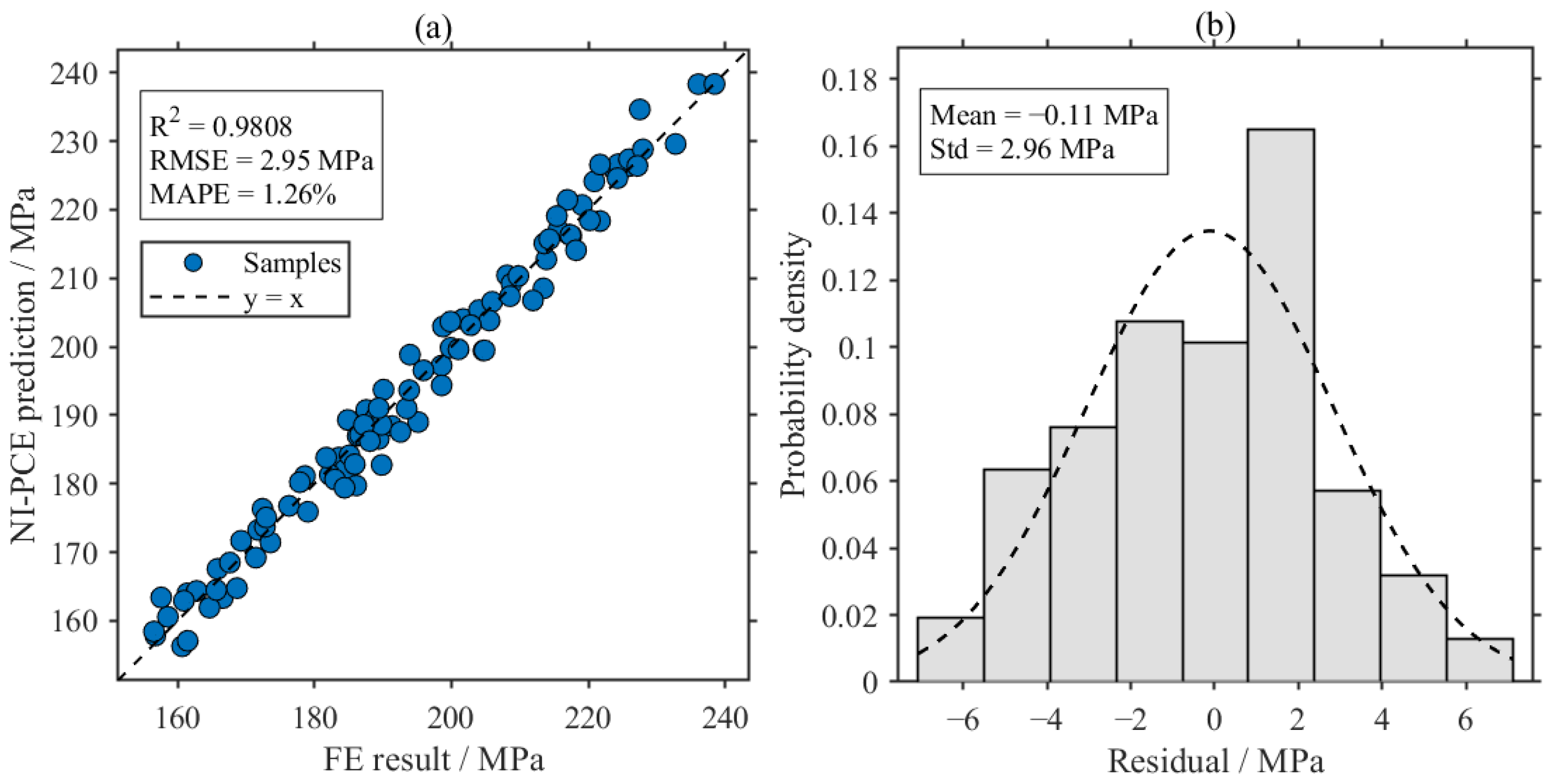
11]. To mitigate this burden, surrogate modeling techniques have been extensively adopted to replace computationally intensive FE models. Among these, Polynomial Chaos Expansion (PCE) constructs an approximation of the mapping between random inputs and structural responses using orthogonal polynomial bases, enabling efficient uncertainty propagation with a limited number of high-fidelity samples [
12]. In particular, Non-intrusive Polynomial Chaos Expansion (NI-PCE) builds the surrogate model exclusively from input–output samples without requiring modifications to the original FE solver. This feature renders it particularly compatible with commercial FE software for predicting the stochastic response of complex engineering structures [
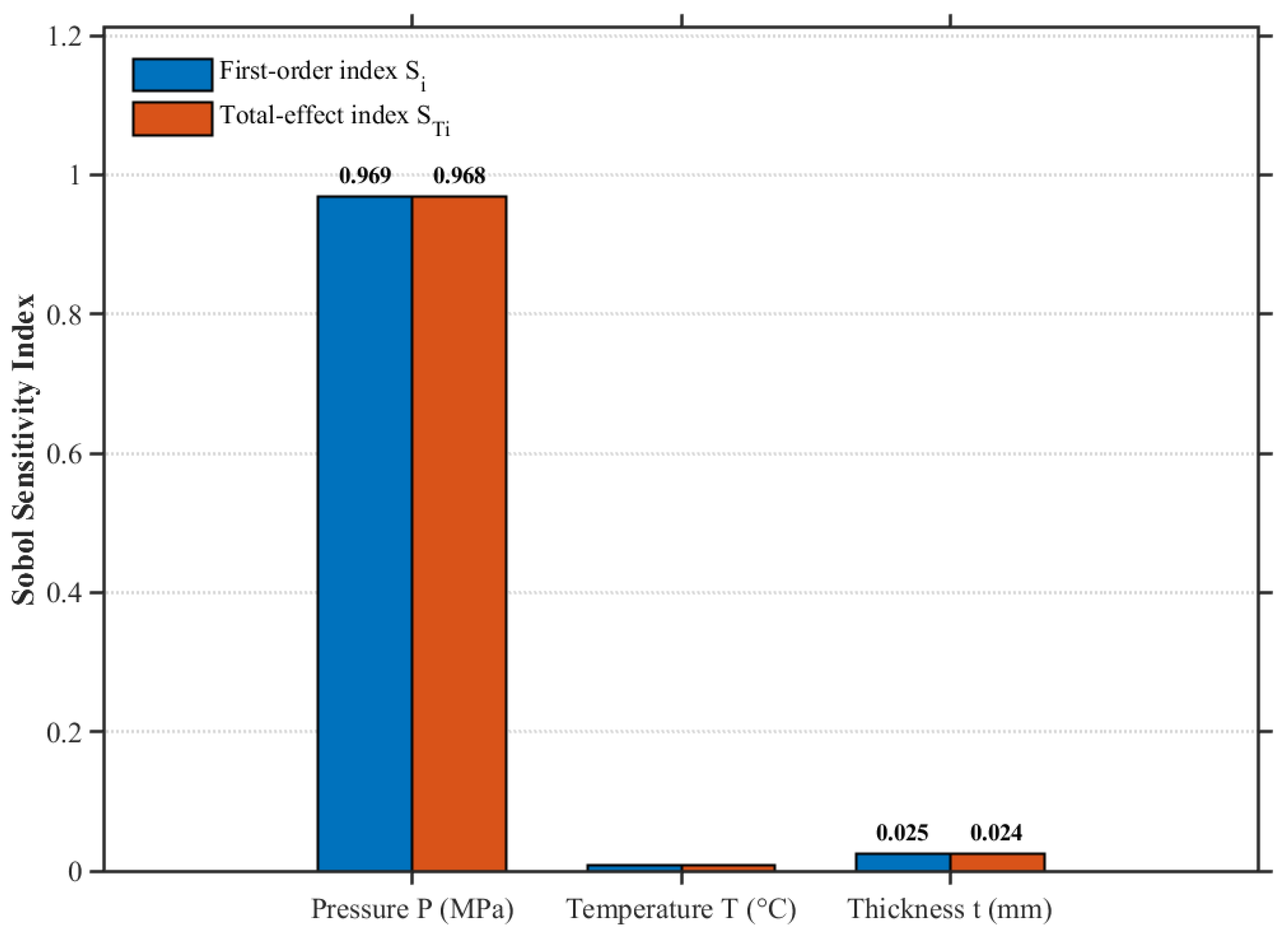
13]. Moreover, the PCE framework enables the analytical derivation of Sobol sensitivity indices from the expansion coefficients, thereby quantifying individual input contributions to the response variance [
14]. A key limitation of current UQ frameworks for spherical tanks is the implicit assumption that critical stress locations remain stationary across the parameter space. In practice, these controlling regions migrate under varying thermal and pressure loads. Conventional single-surrogate approaches overlook this drift, yielding ambiguous response definitions in which the output maps to disparate structural locations or stress states under different input conditions. This violates physical consistency, compromising both the interpretability and reliability of the UQ results.
Recent advances have underscored the significance of nonlinear structural responses and multiphysics coupling under complex service conditions. Liu et al. [
15] conducted a comprehensive review of the nonlinear dynamics of lightweight composite structures under thermo-electro-mechanical coupling, demonstrating that geometric nonlinearity, boundary effects, and multi-field interactions profoundly govern structural dynamics and failure modes. Addressing hydrogen energy infrastructure, Liu et al. [
16] established a transient multiphysics model for a PEM hydrogen storage system, elucidating how renewable-energy fluctuations propagate through electrochemical–thermal–fluid couplings to compromise system pressure and safety. Collectively, these studies highlight that reliance on single-field or static-load analyses is inadequate for the holistic assessment of high-pressure gas storage and transport systems. Consequently, multiphysics-informed modeling and Uncertainty Quantification (UQ) have gained increasing traction in related fields, including fiber-optic sensing, composite structures, and high-dimensional systems [
17,
18,
19,
20,
21,
22].
Addressing these limitations, this study focuses on a 3000 m3 high-pressure spherical air storage tank. First, the stationarity of critical stress locations is examined using finite-element-based stress linearization. Subsequently, for parameter regimes exhibiting stable hotspots, Non-intrusive Polynomial Chaos Expansion (NI-PCE) surrogates are constructed to perform uncertainty quantification and global sensitivity analysis of linearized stresses. A core innovation lies in integrating location-stability diagnostics directly into the UQ workflow to eliminate physically ambiguous response definitions that arise from hotspot migration. This strategy substantially enhances the physical consistency, reliability, and engineering interpretability of probabilistic assessments under complex loading conditions.
2. Finite Element Model and Linearized Stress Assessment Criteria for a Spherical Tank
2.1. Research Object and Structural Characteristics
The subject of this investigation is a 3000 m
3 high-pressure spherical air storage tank integrated into a wind-tunnel energy storage facility’s air-supply system. Key structural constituents include the spherical shell, support columns, polar openings, and local reinforcement details. The design and fabrication strictly adhere to the provisions of GB/T 12337-2014 Steel Spherical Tanks [
23], with the main design parameters detailed in
Table 1.
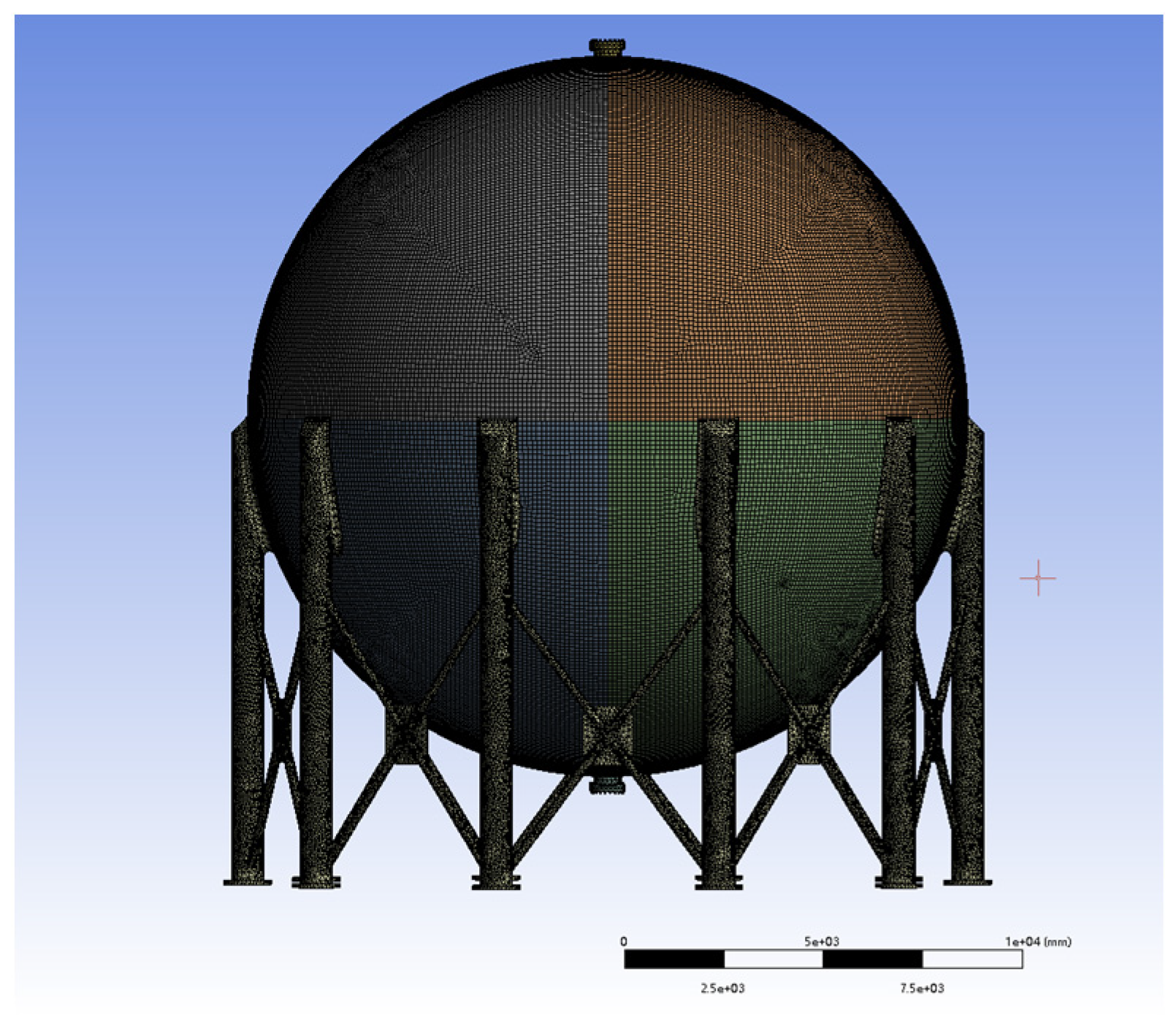
A three-dimensional solid finite element (FE) model of the tank was constructed to represent the full structural assembly, including the spherical shell, supporting columns, polar openings, and reinforcement structures (
Figure 1). The geometry was generated in SolidWorks 2024, exported in STEP format, and imported into the ANSYS Workbench 2020 R1 environment for meshing, load application, and static structural analysis. Adhering to design-by-analysis requirements, local geometric details (e.g., weld toes and reinforcement profiles) were intentionally omitted to focus on primary membrane and bending stresses (P
L + P
b) induced by structural discontinuities. Local mesh refinement was implemented in critical regions—specifically, shell–column junctions and polar openings—to capture stress gradients accurately. A unified protocol for modeling, meshing, and post-processing was maintained across all candidate locations to ensure comparability of results.
2.2. Material Properties, Boundary Conditions, and Loading
The spherical shell is constructed from Q370R steel plate and modeled herein as a linearly elastic solid. Material properties, summarized in
Table 2, were extracted from the equipment design documentation. In accordance with GB/T 150.2-2011 Pressure Vessels—Part 2: Materials [
24], the coefficient of linear thermal expansion is assigned a value of α = 1.2 × 10
−5 °C
−1, consistent with recommended values for carbon and low-alloy steels. Thermal strain calculations are referenced to a uniform ambient temperature of T
ref = 20 °C.
Boundary conditions include full constraints at the support column bases to replicate foundation fixation. Superimposed loads consist of internal pressure on the shell’s inner surface and gravity (g = 9.81 m/s
2). A uniform thermal regime is applied, with strains calculated via Equation (1):
Here, ϵth denotes the thermal strain, α is the coefficient of thermal expansion, T is the analysis temperature, and Tref is the reference temperature for thermal strain calculation.
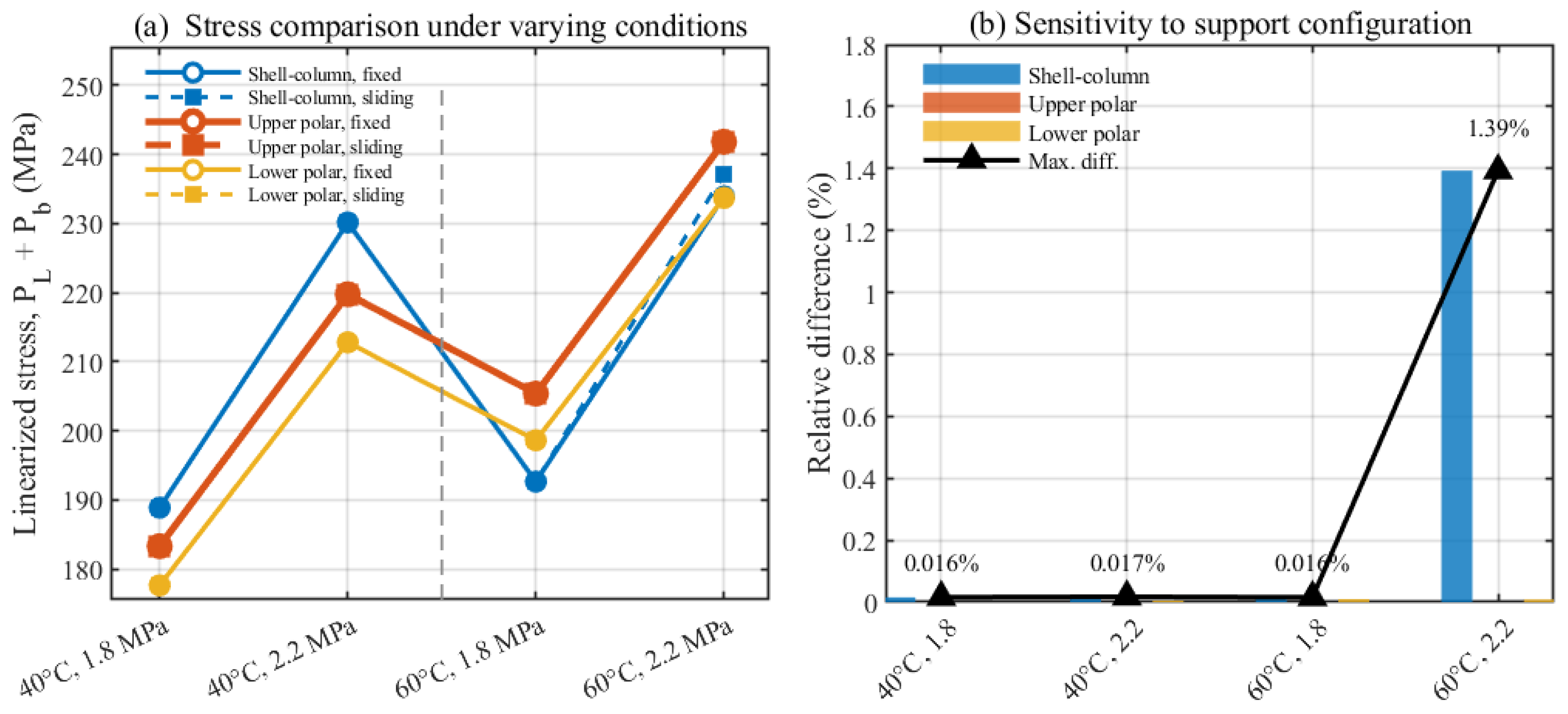
Under a uniform temperature rise, the spherical shell would ideally expand freely; however, the fixed constraints at the column bases restrict thermal expansion along the column axes. This kinematic restraint induces significant thermally induced bending stresses in the shell–column junction and adjacent regions. These stresses superimpose with the mechanical stresses caused by internal pressure and gravity, collectively governing the final stress state at the candidate locations.
2.3. Stress Linearization Method and Selection of Evaluation Metrics
In accordance with the pressure vessel design-by-analysis code, the stress tensors derived from the FE analysis are linearized along prescribed Stress Classification Lines (SCLs) and decomposed into membrane (P
L), bending (P
b), and nonlinear peak stress components. In this study, stress linearization was executed within the ANSYS Workbench 2020 R1 environment using its integrated path-integration tools. The procedure strictly conforms to the Design by Analysis for Pressure Vessels GB/T 4732-2024 [
25], wherein stress components are integrated through the wall thickness along the defined SCLs.
The membrane stress P
L along the wall thickness direction is expressed as:
The bending stress P
b is defined as:
where t is the shell thickness, σ(x) is the through-thickness stress distribution, and x is the local coordinate through the thickness.
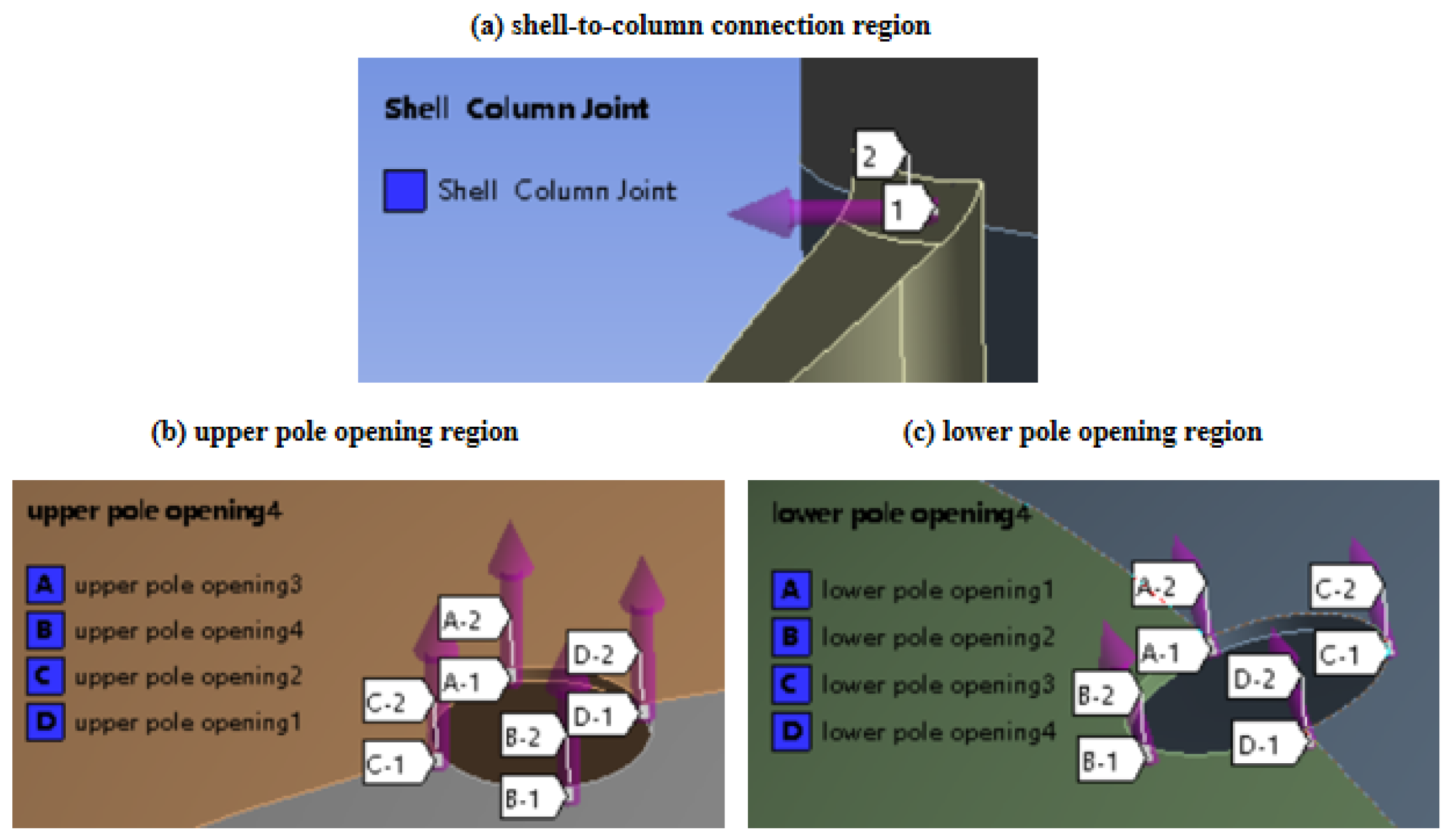
Owing to the complex geometry of the shell–column junction, the Stress Classification Line (SCL) was established as a through-thickness trajectory normal to the shell mid-surface, positioned centrally within the junction while excluding local geometric singularities such as weld toes. The SCL spans the entire wall thickness, extending from the inner to the outer surface. During post-processing, the finite-element stress tensor for each SCL was linearized to extract the membrane and bending stress tensors. Subsequently, the membrane stress intensity (PL), bending stress intensity (Pb), and their combined intensity (PL + Pb) were computed in strict accordance with the pressure vessel design-by-analysis code.
In this study, P
L + P
b was used as the primary strength-evaluation metric for candidate locations and as the response variable Y in the uncertainty propagation analysis. This parameter effectively characterizes the overall structural stress state under prescribed loading and is well-suited for cross-regional comparison and surrogate model development. As illustrated in
Figure 2, linearization paths were strategically distributed across critical regions, including the shell–column junction and the upper and lower polar openings. All paths were consistently aligned along the local thickness direction to extract stress distributions and derive the corresponding linearized stress results.
2.4. Credibility Verification of the Finite Element Model
2.4.1. Mesh Independence Verification
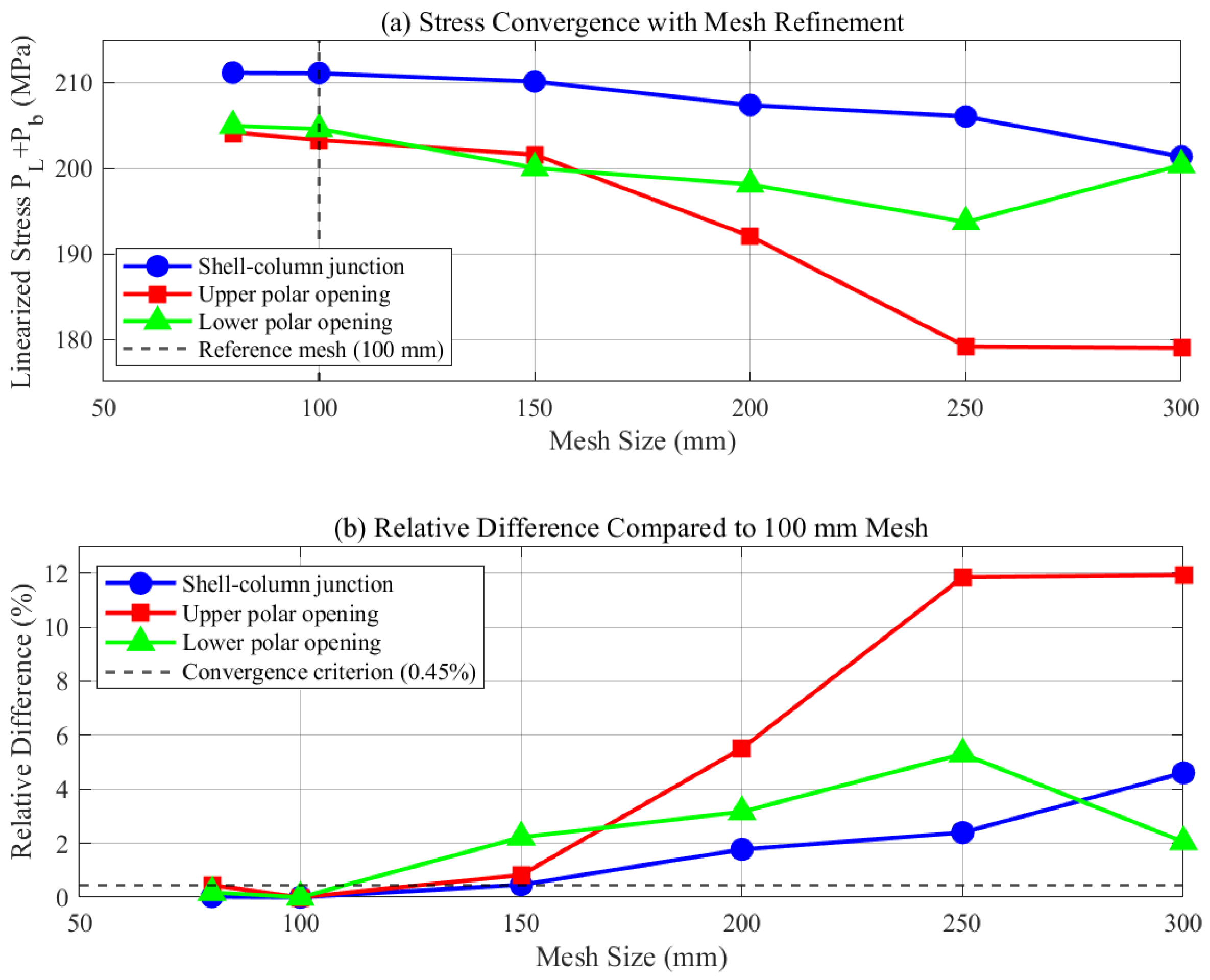
To ensure that the linearized stress results are insensitive to mesh discretization, a mesh convergence study was executed before the uncertainty propagation analysis. Six distinct mesh densities were established, and the membrane-plus-bending stress intensity (P
L + P
b) was extracted at three candidate critical locations: the shell–column junction, the upper polar opening, and the lower polar opening. Using the finest mesh scheme (100 mm) as the baseline, the maximum relative deviation for each coarser mesh was computed against this baseline, expressed as:
where Y
i,j is the stress intensity for the i-th mesh density at location j, and Y
100,j is the baseline value from the 100 mm mesh. Locations include the shell–column junction and the upper and lower polar openings.
As summarized in
Table 3, the P
L + P
b results at all three critical locations demonstrate a clear convergence trend with mesh refinement. Refining the mesh from 300 mm to 150 mm reduced the maximum relative deviation against the 100 mm baseline from 11.93% to 2.22%. Further refinement to 80 mm yielded a negligible deviation of only 0.45%; however, this came at the expense of a prohibitive increase in computational overhead, with node and element counts rising from 1.57 million to 1.99 million and from 0.51 million to 0.58 million, respectively. Consequently, further mesh refinement yields diminishing returns in stress accuracy while imposing a substantial computational penalty.
Figure 3 presents the mesh convergence profiles to substantiate the numerical stability visually. While
Figure 3a tracks the decay of linearized stress with mesh refinement,
Figure 3b benchmarks the results by computing the relative deviation from the 100 mm baseline.
Balancing accuracy against computational expense, the 100 mm mesh was selected as the baseline for subsequent FE calculations, stress linearization, and UQ analyses.
2.4.2. Benchmark Verification of Analytical Solutions for Membrane Stress
To evaluate the fidelity of the finite element model in capturing the global membrane stress response, a benchmark case with t = 46.5 mm, P = 2 MPa, and T = 20 °C is used to compare with the analytical solution. For a thin-walled spherical shell subjected to uniform internal pressure, the theoretical membrane stress is expressed as:
Here, σm represents the theoretical membrane stress for a spherical shell with internal pressure, mid-surface radius R, and wall thickness t. With Rset to 9000 mm, Equation (5) gives σm =193.55 MPa.
Numerically, the membrane stress was sampled at locations distant from geometric discontinuities (e.g., openings and attachments) and constraint boundaries to isolate the global response. The relative deviation is computed via:
where σ
m,FE is the numerical membrane stress extracted from the intact spherical shell (excluding discontinuities), σ
m,theory is the corresponding analytical baseline, and ε is the relative deviation. The comparative results are summarized in
Table 4.
Table 4 shows that the FE model yields a membrane stress of 202.31 MPa, which deviates by only 4.53% from the theoretical value (193.55 MPa). This, combined with the proven mesh convergence, validates the numerical stability of the model and its linearization routine. The model is thus confirmed as a reliable foundation for identifying candidate locations and conducting rigorous UQ analyses.
2.5. Candidate Locations and Identification of Control Locations
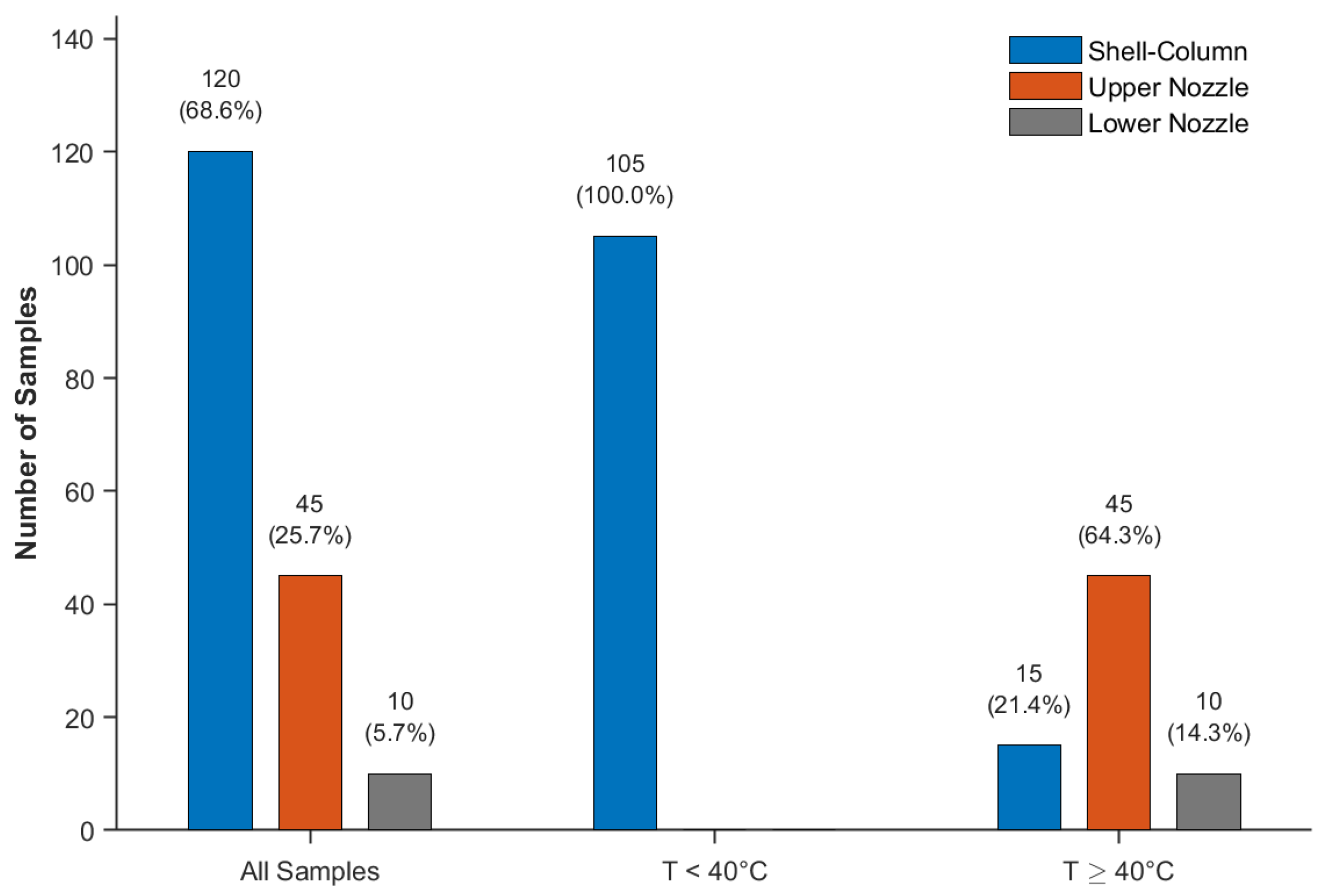
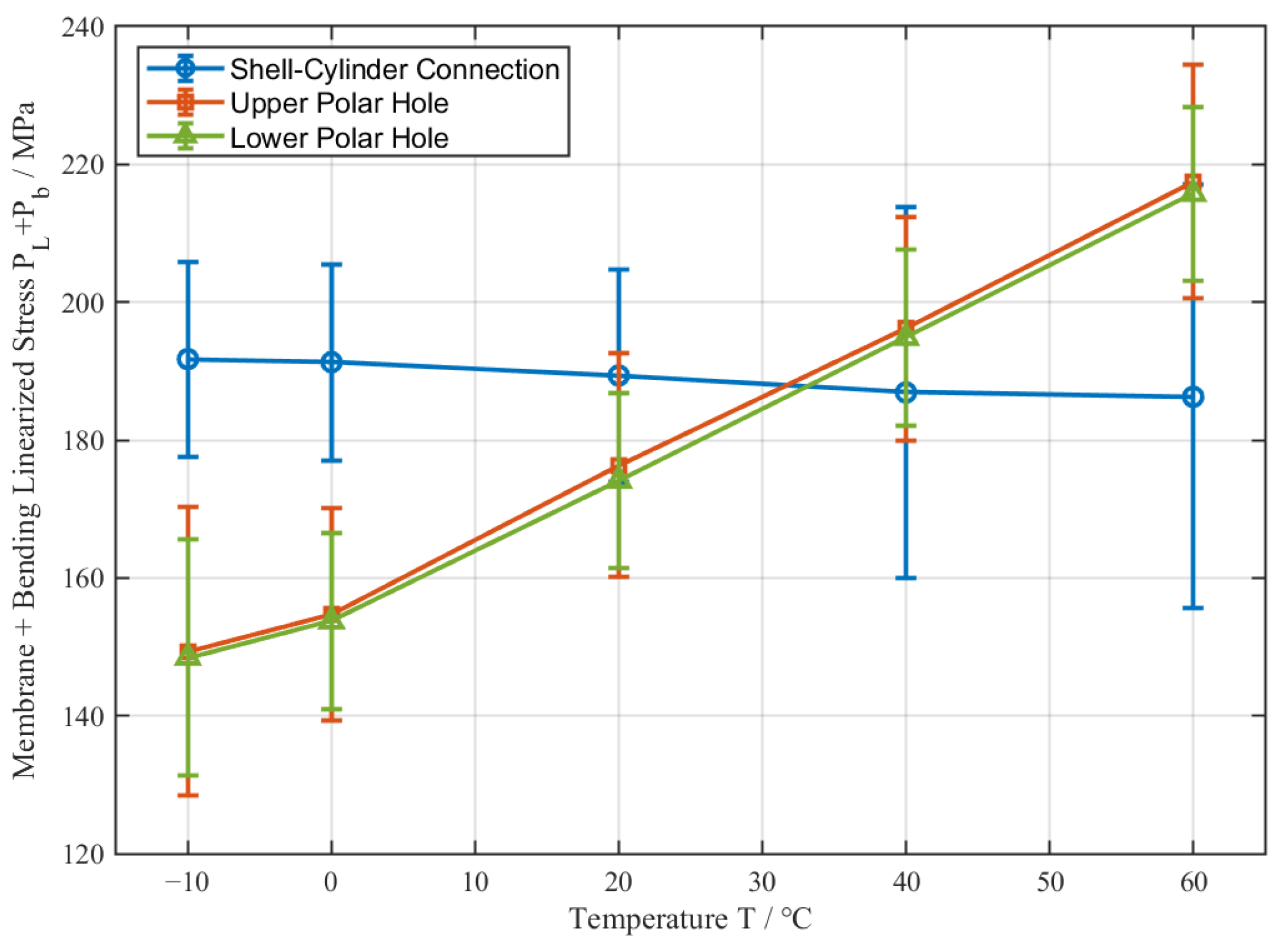
Candidate locations were defined at the shell–column junction and polar openings. Using 175 full-factorial design points, P
L + P
b values were derived for each site. As plotted in
Figure 4, the stresses exhibit clear temperature-dependent trends, facilitating the identification of critical zones under operational variability.
As illustrated in
Figure 4, the P
L + P
b stress at the shell–column junction exhibits a relatively mild temperature dependence. Within the T < 40 °C range, it persistently surpasses that of the polar openings, establishing the junction as the stable dominant control location under low-temperature conditions. Conversely, stresses at the polar openings show a pronounced increase as temperature rises, approaching or even exceeding the junction stress once T ≥ 40 °C. This signifies a transition of the critical control location at elevated temperatures. The phenomenon is attributed to thermally induced constraint stresses at the fixed column bases, compounded by localized stiffness discontinuities in the opening-reinforcement zones.
To formalize this observation, the control response Y
max is defined as the maximum P
L + P
b value among the three candidate locations. This metric constitutes the worst-case linearized stress level under the prevailing operating condition:
Here, T, P, and t represent the temperature, pressure, and thickness, respectively; Yshell-col, Yupper, and Ylower are the P
L + P
b values at the three candidate sites.
Table 5 statistically delineates the dominance of each location as the control point (Ymax) over varying temperature intervals.
As evidenced by
Table 5, the shell–column junction serves as the unequivocal control location across all 105 samples within the low-temperature regime (T < 40 °C), confirming its stability within the sampled parametric domain. Consequently, the uncertainty quantification and sensitivity analyses presented in Chapters 3 and 4 exclusively target this junction within said regime. This focused scope ensures that the response variable Y (i.e., P
L + P
b at the junction) maintains an unambiguous and physically consistent interpretation for surrogate modeling. The behavior in the high-temperature regime (T ≥ 40 °C), characterized by control-location migration, will be addressed separately.
2.6. Random Input Variables and Their Probability Distributions
To quantify the effects of operational fluctuations and manufacturing deviations, the internal pressure, uniform operating temperature, and shell thickness were selected as random input variables. The probability distributions adopted herein are engineering-oriented probabilistic models derived from equipment design parameters, the design temperature envelope, corrosion allowances, and specified parameter tolerances. It is important to note that these distributions are not fitted to long-term operational monitoring data but are conservatively estimated from design specifications to ensure robustness. The statistical characteristics of these inputs are summarized in
Table 6.
The shell thickness t refers to the effective load-bearing thickness, derived by deducting the corrosion allowance (1.5 mm) from the nominal thickness (48 mm). It is modeled as a uniform distribution bounded between [45.0, 48.0] mm, which corresponds to a standard deviation of approximately 0.866 mm.
Due to the lack of empirical thickness statistics, the effective wall thickness is modeled as a uniform distribution over the specified range, thereby avoiding extraneous prior assumptions. These probability distributions constitute the foundational input premises for constructing the NI-PCE surrogate model and performing uncertainty propagation analyses. Consequently, the results must be interpreted as conditional statistical responses contingent upon these input probabilistic models.
Discretized sampling levels were established as follows: internal pressure P at [1.8, 1.9, 2.0, 2.1, 2.2] MPa; temperature T at [−10, 0, 20, 40, 60] °C; and wall thickness t at [45.0, 45.5, 46.0, 46.5, 47.0, 47.5, 48.0] mm. This discrete set spans the principal parametric envelope of this study. It serves to calibrate the mapping relationship between the input variables and the linearized stress intensity at candidate evaluation locations.
5. Conclusions
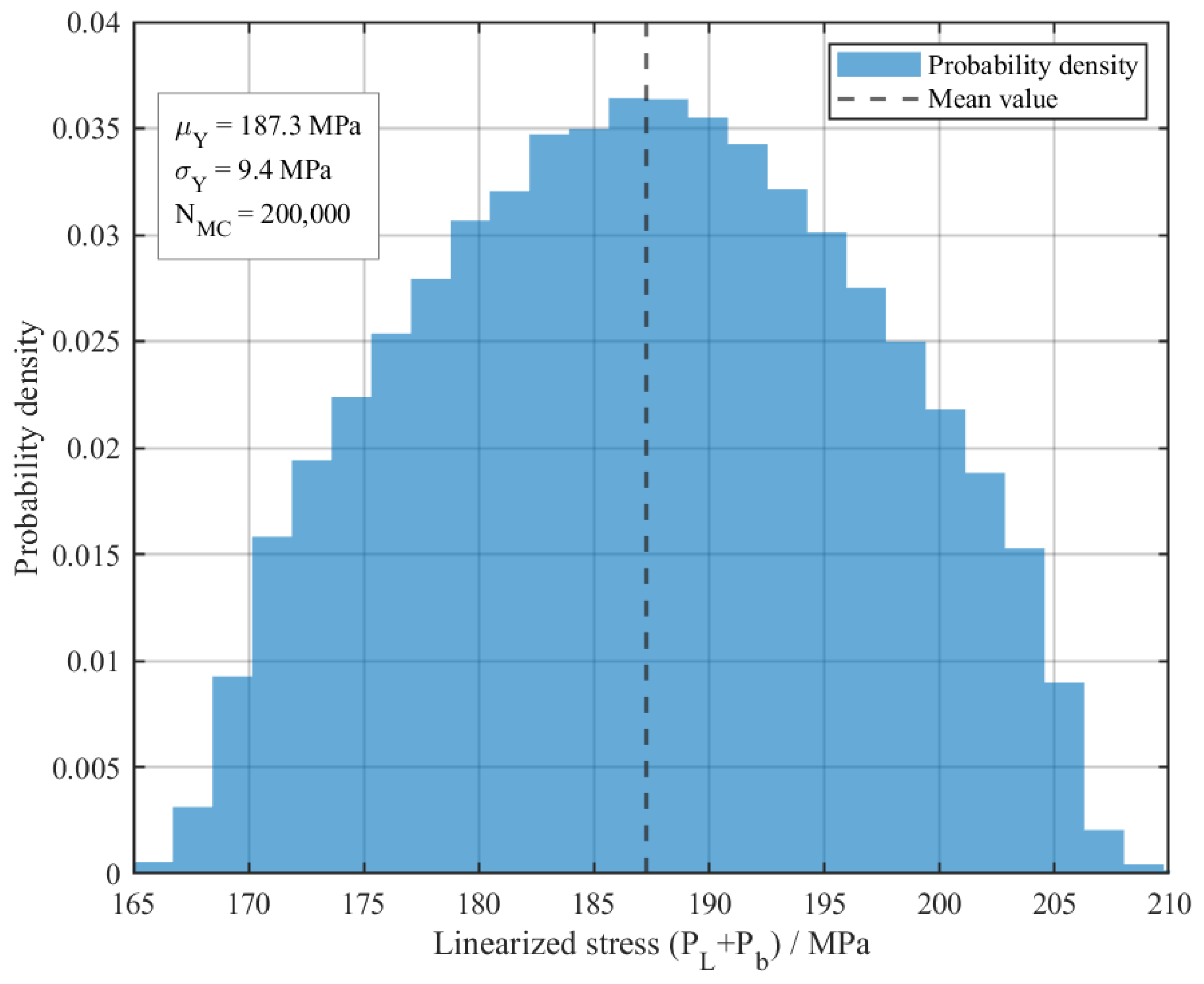
This study establishes a conditional uncertainty quantification (UQ) framework for high-pressure spherical air storage tanks in wind tunnel energy supply systems, integrating finite-element (FE) stress linearization with Non-Intrusive Polynomial Chaos Expansion (NI-PCE). The framework resolves the non-stationary migration of the critical control location induced by thermo-mechanical coupling, thereby circumventing the physical heterogeneity risks inherent in conventional global modeling approaches. FE sample analysis reveals a pronounced dependence of the membrane-plus-bending stress control location on the thermal regime: the shell–column junction remains the stable control point in the low-temperature regime, whereas the control location progressively shifts toward the nozzle region as temperature increases. This mechanism underscores that prior identification of operational sensitivity is a prerequisite for UQ, invalidating the assumption of a single, invariant control location across the full temperature domain. Leveraging this stability analysis, a high-fidelity NI-PCE surrogate model was constructed for the low-temperature regime, effectively replacing costly FE computations to enable efficient probabilistic propagation. UQ results indicate that stress responses remain within safety limits under the specified operational fluctuations. Global sensitivity analysis further identifies operating pressure as the dominant source of uncertainty, with shell thickness playing a secondary role. While temperature contributes marginally in the low-temperature regime, it is the pivotal physical parameter triggering the regime transition in structural behavior at elevated temperatures.
For industrial practice, specific monitoring priorities are dictated: the shell-column junction is the stable control point for low-temperature operations (T < 40 °C), while the upper polar opening becomes the primary hotspot in high-temperature scenarios (T ≥ 40 °C), accounting for 78.6% of control cases. Crucially, uncertainty assessments must integrate this location-migration mechanism to avoid underestimating extreme stresses (e.g., 246.66 MPa), thereby ensuring full-envelope operational safety.
Overall, this work establishes an “Identify–Partition–Quantify” analytical paradigm and refines the physical prerequisites for UQ. Although the migration of the control location precluded direct calculation of a full-domain failure probability, the proposed framework provides a rigorous probabilistic foundation for envelope-based reliability assessments that incorporate location-competition effects. This methodology is readily applicable to the safety evaluation of pressure equipment in the petrochemical and energy storage industries.