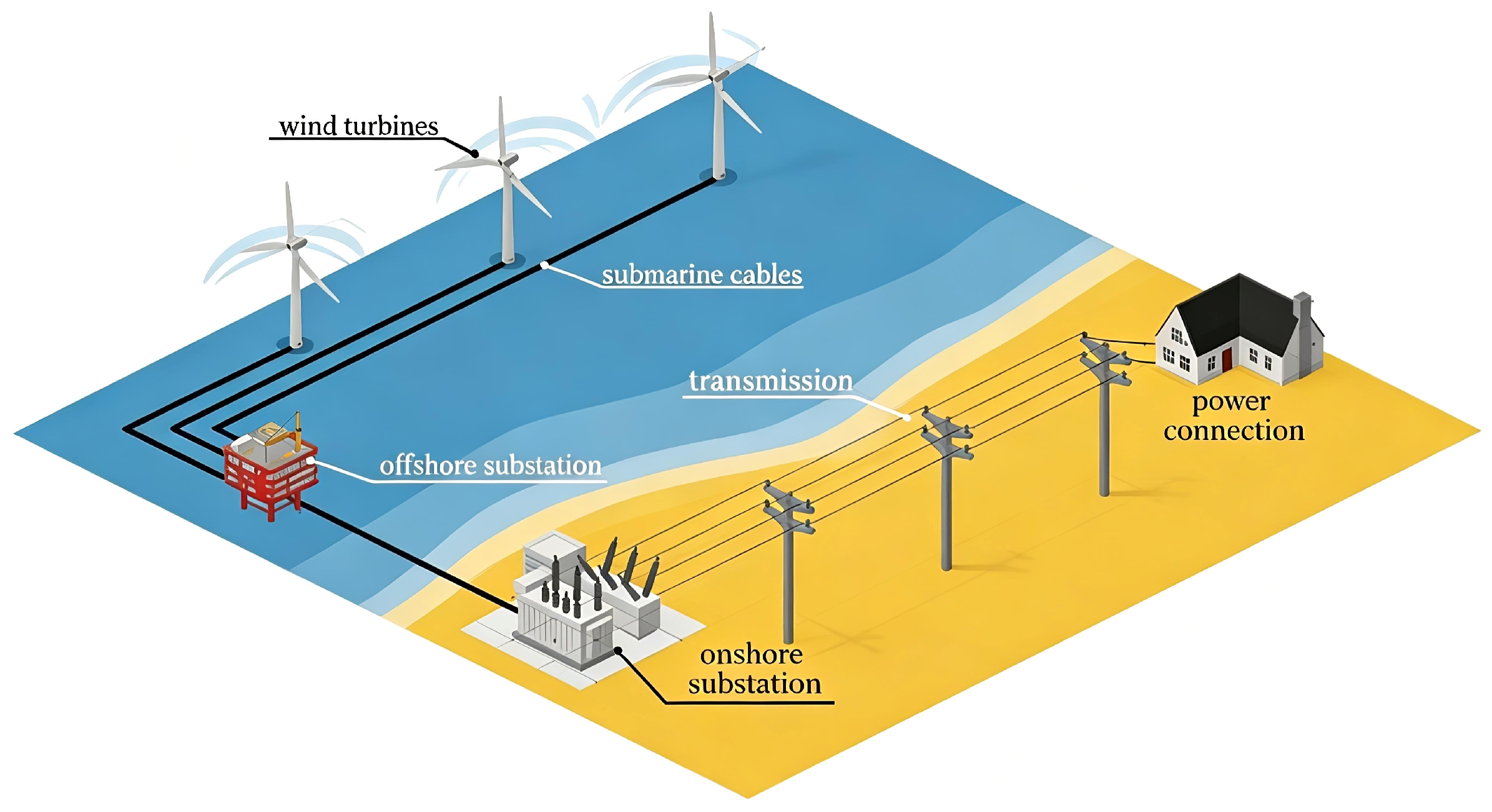
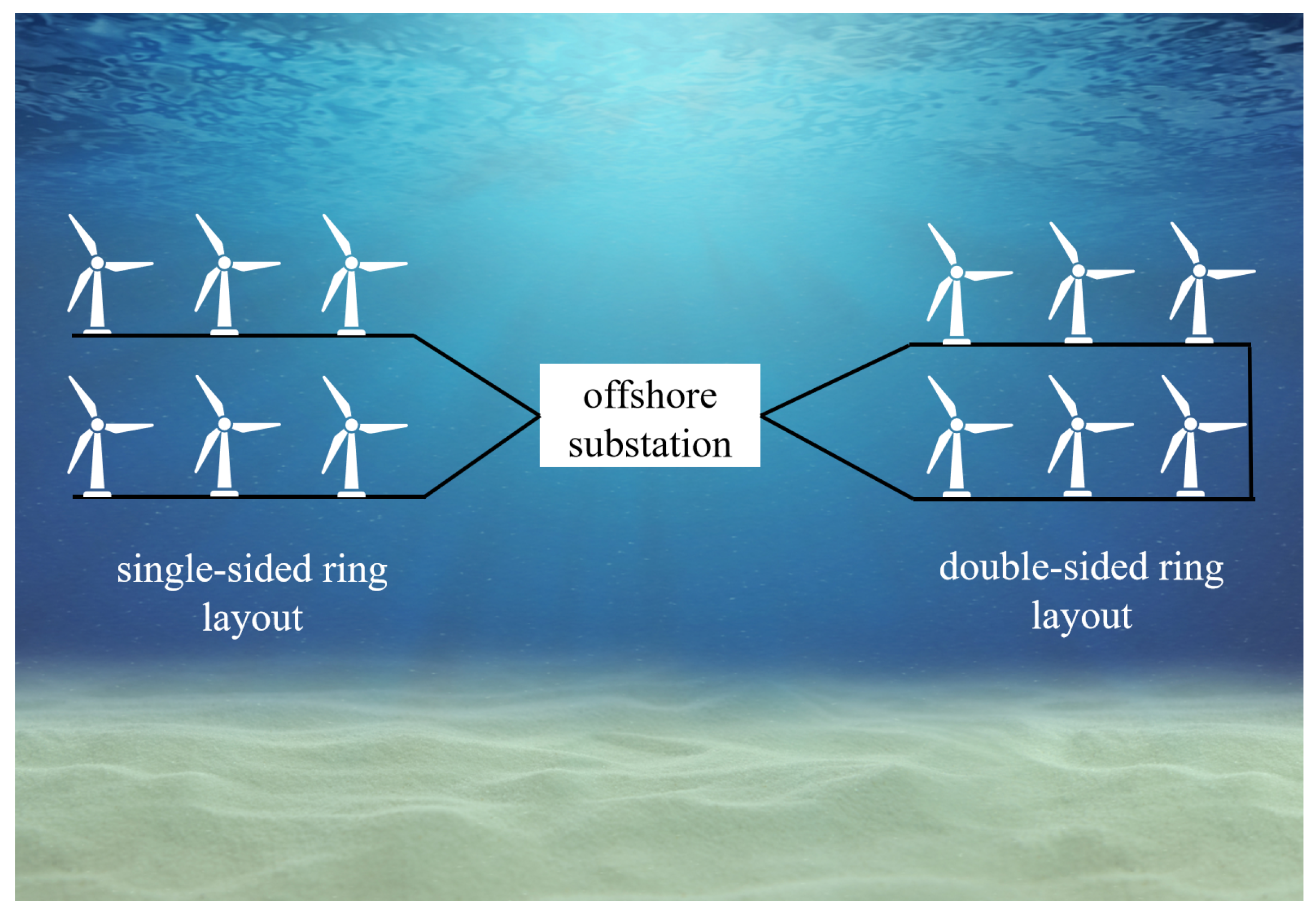
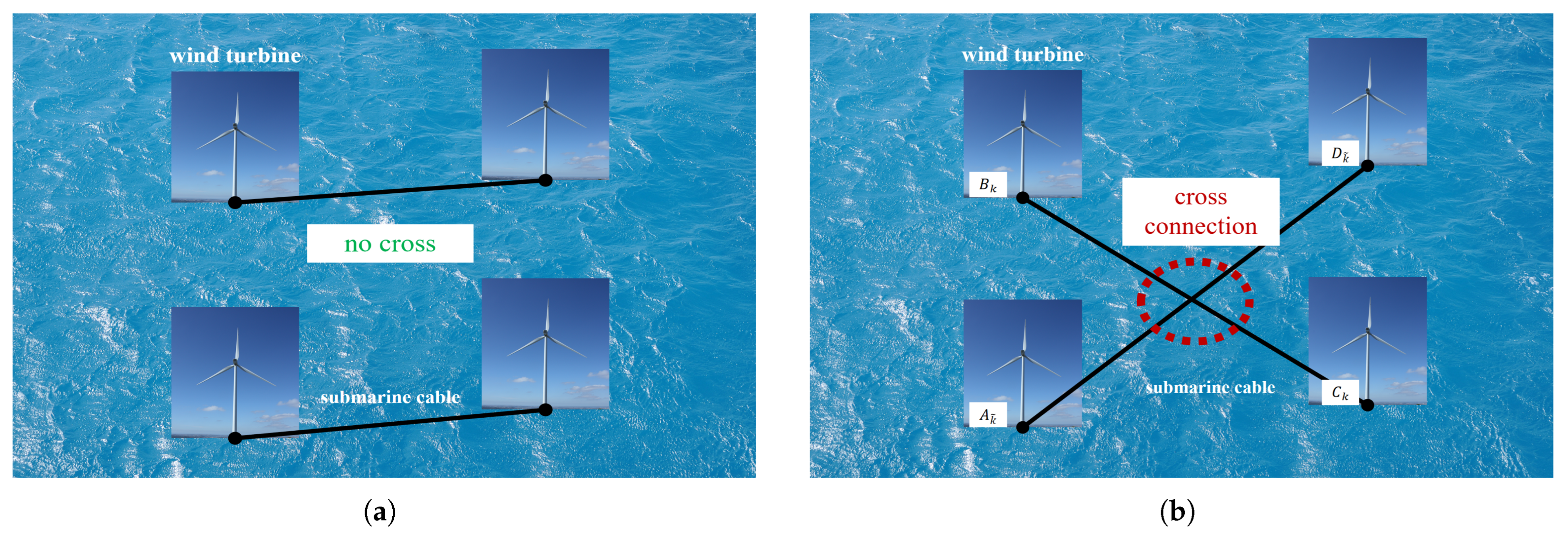
1. Introduction
As global demand for clean energy continues to increase, renewable wind energy resources have become a focal point for the international community. In recent years, the wind power industry has demonstrated a marked increase in growth and diversification of development modes. A thorough analysis of the installed capacity reveals that the global wind power industry is on track to reach 117 gigawatts (GW) in 2024, with cumulative installed capacity expected to exceed 1136 GW [
1]. These data underscore the robust development of the wind power industry and signify the widespread adoption of wind power technology on a global scale, with emerging markets as the primary drivers of industry growth. Concurrently, the wind power industry continues to exhibit promising growth prospects. Projections indicate that global wind power installed capacity will reach 139 GW by 2025, with a compound annual growth rate (CAGR) of 8.8% from 2025 to 2030 and an average annual installed capacity of 164 GW. In order to reach the COP28 target of tripling renewable energy installations by 2030, it is necessary to increase the annual installed wind power capacity to 320 GW [
2]. The development of the wind power industry has been strongly supported by a series of policies and plans, and also offers considerable potential for growth in emerging markets. Its development is not only related to the transformation of energy structure but is also a primary means to combat global climate change [
3,
4]. It is imperative that future research prioritize policy-driven emerging market development and technological breakthroughs. These factors will enable full realization of the potential of the wind power industry and provide the necessary support for the achievement of global renewable energy goals.
Offshore wind power projects exhibit considerable advantages over onshore wind power projects, including the abundance of wind resources, the conservation of land, and the annual number of power generation hours [
4,
5]. These factors suggest a promising future for offshore wind power projects and are regarded as the primary trend for the advancement of the wind power industry. The construction cost of the collection system constitutes a substantial proportion of the total cost of offshore wind farms (OWFs), ranging from 15 to 30% [
6]. In [
7], the authors carried out topological optimization of an offshore wind farm cable routing system based on an improved equilibrium optimization algorithm. They demonstrated that the investment cost of submarine cables is vital in an offshore wind farm, constituting a substantial proportion of the total investment. This cost component plays a pivotal role in the planning, investment, and operational reliability of wind farms. Consequently, it is imperative to optimize the collection system design to reduce expenses. Given the reduced impact of offshore wind farms on the geographic environment, the topology optimization of offshore wind power collection systems is essentially a two-dimensional path optimization problem, with the primary objective being economic efficiency. However, implementing conventional optimization algorithms to identify the optimal solution to the system topology within a constrained timeframe can be challenging. Given the expansion of offshore wind farms and the intricacy of the collection system topology, intelligent optimization algorithms play a pivotal role in enhancing the efficiency of power generation systems.
Presently, there has been a notable increase in the volume of research focusing on topology optimization of OWF collection lines [
6]. In [
8], the authors reviewed state-of-the-art optimization methodologies for offshore wind farm collection system topology and demonstrated that the existing models can be classified into deterministic and heuristic algorithms. Their review indicates that while existing models are effective at improving optimization efficiency, they may fall into local optimality when handling complex multimodal problems. In [
9], a genetic algorithm (GA) wa used to optimize the OWF collection system topology. A multi-stage optimization method was proposed to achieve synergistic dynamic optimization of both the off-shore substation (OSS) configuration and the cable topology in the OWF collection system. A genetic algorithm was initially used to select the number and location of OSSs, then capacity minimum spanning tree (CMST) was used to plan the paths of the array cables and iterative optimization was carried out for the three-phase coupling strategy. In [
10,
11], the available marine parcels were divided into smaller regions of suitable size and optimized sequentially by an improved GA, resulting in more efficient in calculation and significantly improved convergence speed. In [
12], the authors optimized the combined layout and cable setup of offshore wind farms based on mixed-integer programming, demonstrating that the layout and cable routing problem can be effectively decomposed into subproblems to reduce its complexity and allow for more efficient calculation. However, when handling large-scale wind farms with intricate collection system topologies, the computational burden increases significantly, meaning that achieving an optimal balance between solution quality and computational efficiency poses a significant challenge. Most of the above studies employed heuristic algorithms such as GAs; however, these require repeated adjustments to the parameters; in addition, the convergence speed is not ideal and the algorithm may fall into local optima. In [
13], a bi-level optimization framework was proposed for non-uniform offshore wind farm layout and cable routing using an enhanced particle swarm optimization algorithm, which effectively improved both solving speed and accuracy through adaptive parameter mechanisms and significantly improved economic efficiency while guaranteeing the feasibility of cable routing.
Application of the particle swarm optimization (PSO) algorithm has proven effective in topology optimization of OWF collection systems. The existing models in [
14] mainly focus on grid-connected voltage stability, with further innovation proposed for the optimal control of reactive power in offshore wind farms. This innovation introduces adaptive weighting coefficients to realize the dynamic adjustment of sub-objective weights with operating conditions while enhancing model adaptability. The uniform adaptive particle swarm algorithm (UAPSO) effectively improves the solving speed, significantly improves accuracy, effectively reduces network loss, and improves the reactive power margin while guaranteeing voltage stability. In [
15], the authors compared the results of different reactive power optimization methods under different wind power levels with minimum power loss as the objective function, which provides a reference for the economic operation of wind farms. In [
16], a clustering algorithm was used to perform clustering at any node of the traversal, which effectively reduced the problem complexity. Then, an ant colony optimization algorithm was used to perform path planning for each subset, leading to improved optimization efficiency. This algorithm carries out the optimization search via penalty function and parameter adjustment, but may fall into local optima.
In addition, graph theory algorithms play an important role in topology optimization of collection networks and onshore distribution networks [
17]. In [
18], a fast dimension reduction framework was developed for large-scale topology optimization of grid-layout offshore wind farm collector systems based on graph theory algorithms, demonstrating that graph theory algorithms can play an important role in topology optimization of collection networks by effectively reducing the problem complexity and considering cable non-crossing requirements in the design process. In [
19], the authors provided an in-depth optimization study for power harvesting systems with radial and toroidal structures. They applied the minimum spanning tree algorithm to the topology optimization task in conjunction with the traveling salesman problem of the system, and constructed an exhaustive cost model to evaluate the performance difference between these two structures. Conversely, Zuo et al. [
20] developed an economic cost model by integrating graph theory and a modified fuzzy C-mean clustering algorithm, thereby offering insights into the area-level optimization problem of the power collection system. In [
21], the authors employed a random bifurcation tree coding strategy to effectively address the limitations of the minimum spanning tree algorithm, then further optimized the variable integration problem for the location of the OSS, WT, and cable cross-sectional area. They also performed parallel optimization of the tree topology connection in the power generation system, with the objective of finding the most economically efficient optimization scheme. In [
22], the authors employed the unique stage strategy of the aquila optimizer (AO) to achieve a smooth transition between exploration and exploitation and to locate the global search region efficiently, then developed a hybrid particle swarm aquila optimizer (PSAO) algorithm based on PSO and AO to improve the search pattern and handle complex multimodal problems.
Despite the strides made in the field through the aforementioned studies, there remain significant challenges to be addressed. These include enhancing optimization speed, mitigating the tendency to fall into local optima, and augmenting topological flexibility in the context of large-scale wind farms. Conventional algorithms demonstrate limited efficacy in addressing complex constraints, and achieving an optimal balance between optimization and computational efficiency poses a significant challenge; consequently, it is imperative to develop more efficient, robust, and adaptable optimization methods. To this end, the present paper proposes a novel method based on an upper- and lower-layer optimization framework and introduces the sled dog optimizer (SDO), a bionic meta-heuristic algorithm [
23]. The proposed method reduces the solution complexity of large-scale systems by dividing the regions through polar coordinates and introducing a dynamic minimum spanning tree (DMST) in the upper layer. It also optimizes the collection system topology within each partition based on the SDO algorithm in the lower layer. This approach takes into account both the global economy and local feasibility. Concurrently, the parameters of the algorithm are straightforward and unambiguous, facilitating straightforward comprehension and modification.
Unlike classic meta-heuristic algorithms such as PSO and the grey wolf optimizer (GWO), which rely on fixed individual or hierarchical population update rules, the SDO is inspired by the collaborative foraging and pathfinding behavior of sled dog teams. It adopts a more flexible group iteration mechanism to maintain population diversity throughout the whole search process. PSO tends to lose population diversity in later stages and can easily become trapped in local optima, while the GWO follows a rigid hierarchical hunting strategy with limited adaptability to complex multi-constraint problems. In contrast, the inherent search logic of the SDO realizes a natural balance between global exploration and local exploitation, making it more suitable for topology optimization of large-scale offshore wind farm collection systems.
The coordination of exploration and development phases in the SDO has been demonstrated to yield optimal results in optimization tasks characterized by multiple constraints. In this study, we optimize the topology of a large-scale OWF collection system based on the SDO algorithm and evaluate its performance under specific constraints. The outcomes of the algorithmic analysis substantiate the rationality and efficacy of the proposed method.
Compared with existing studies, the main innovations of this paper include:
- (1)
A combination of polar division and the DMST is used to realize the partition optimization of large-scale OWF collection system, which effectively reduces the dimension of the problem and considers both the current-carrying capacity constraints and the cable non-crossing requirements in the design process.
- (2)
For the first time, the SDO algorithm is introduced into the topology design of an OWF collection system. This algorithm can quickly locate feasible solutions with lower life cycle cost through an efficient search mechanism and has a significant advantage over traditional heuristic algorithms in terms of both optimization speed and result quality. Unlike PSO and GWO with their rigid population updating strategies, SDO features a flexible bionic search mechanism and stronger ability to avoid local optima.
- (3)
A comprehensive upper-layer and lower-layer optimization framework is devised to enhancw scalability and solution efficiency in large-scale systems through synergistic design of partitioning and local topology optimization. This framework offers a novel approach for planning offshore wind collection systems in complex sea environments.
The rest of the paper is structured as follows: the second part constructs the mathematical model, detailing the composition of the collection system, the determination of the objective function, and the diversified constraints including the crossover constraints, voltage drop constraints, and current-carrying capacity constraints;
Section 2 provides an in-depth discussion of the principles and design process of the DMST algorithm, including the inspiration behind the SDO, the group intelligence modeling idea, the basic structure of the algorithm, and the key formula derivation and update rules;
Section 3 provides an overview, simulation, and in-depth analysis of the selected cases through case studies; finally,
Section 4 summarizes the main results and contributions of the whole research work.
3. Collection System Topology Optimization Method Based on SDO
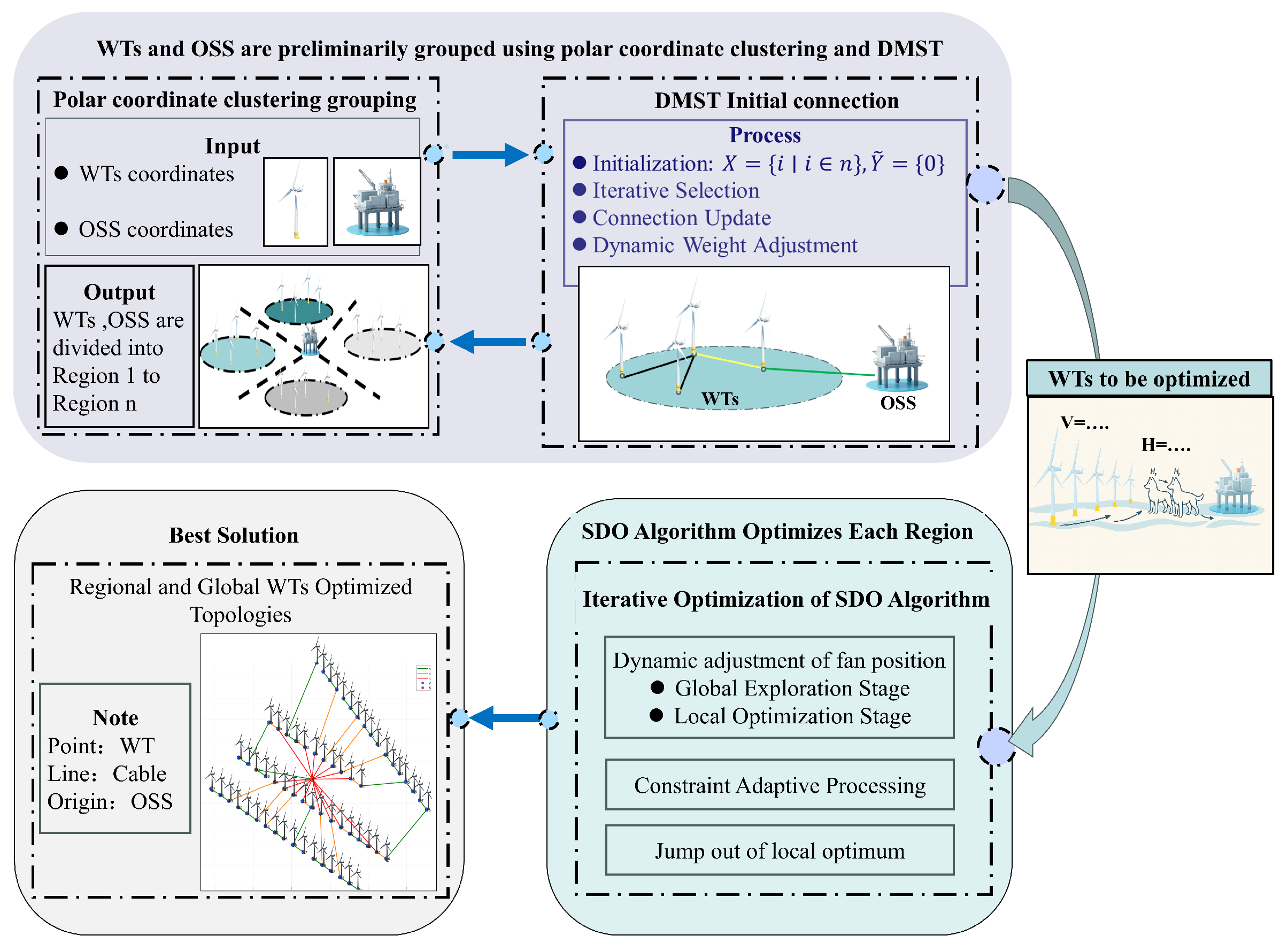
The proposed method is based on a hierarchical optimization principle that combines global partitioning with local topology refinement. First, wind turbines are partitioned into several spatially coherent regions according to their polar-coordinate distribution, which reduces problem complexity and improves structural regularity. Then, a feasible initial topology is constructed by the DMST. Finally, the SDO algorithm is employed to further optimize the connection structure within each region so as to obtain a lower-cost and more practical collector system topology.
3.1. Polar Coordinate Clustering-Based Regional Partitioning for Wind Farms
In the process of optimizing the collection system topology (CST) for OWFs, the wind farm zoning method based on polar coordinate clustering plays a crucial role, providing a solid foundation for the subsequent construction of an efficient collection system.
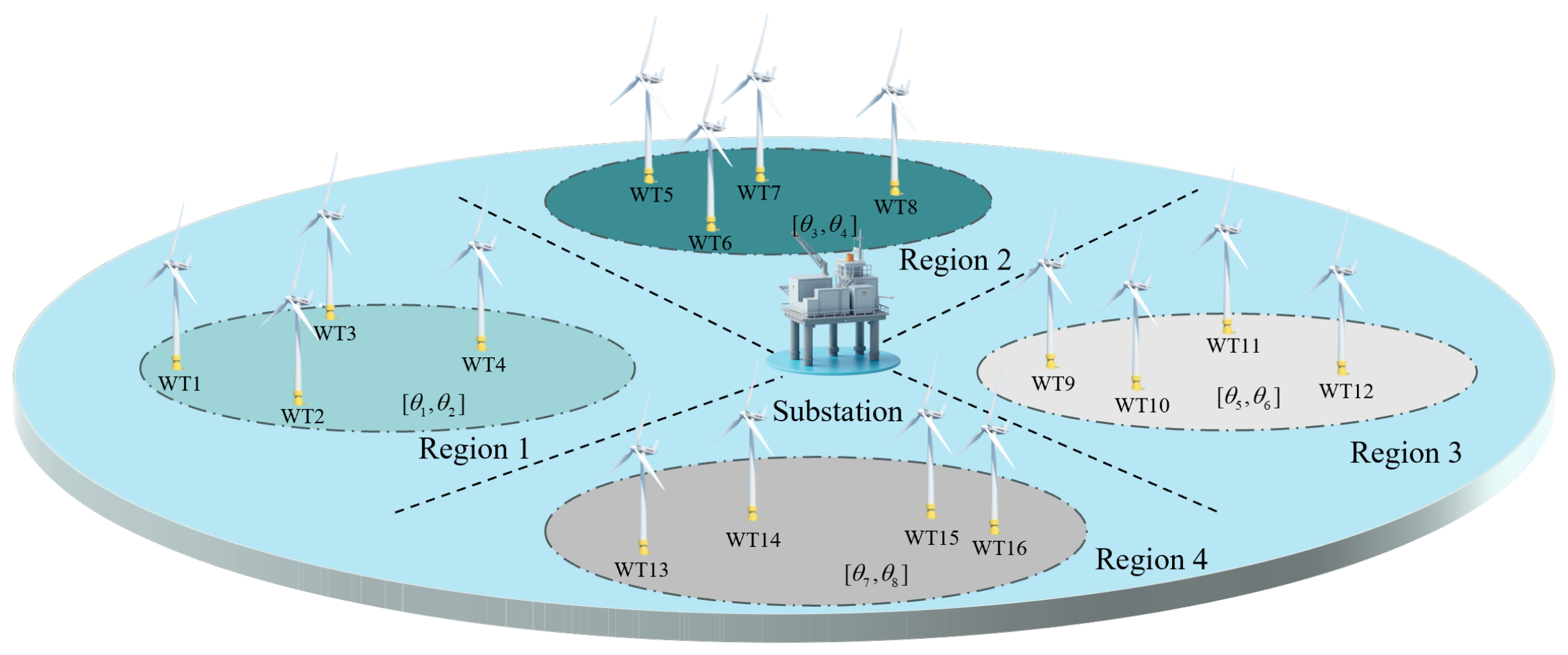
In this method, the substation is defined as the origin, and both the WTs and the substation are mapped into a polar coordinate system. Together with inter-turbine distance thresholds and other criteria, the distance and angular position of each WT relative to the origin are used to perform clustering operations. Those WTs that are spatially proximate, have similar angular positions, and satisfy specific rules are classified into the same cluster.
For example, if the distance threshold
and the angle range
are defined, two WTs are grouped together if their distance difference from the substation is less than
and their angular difference falls within the specified range. As shown in
Figure 4, the WTs can be clustered into Region 1, Region 2, Region 3, and Region 4, each meeting the distance and angle conditions.
3.2. Dynamic Minimum Spanning Tree
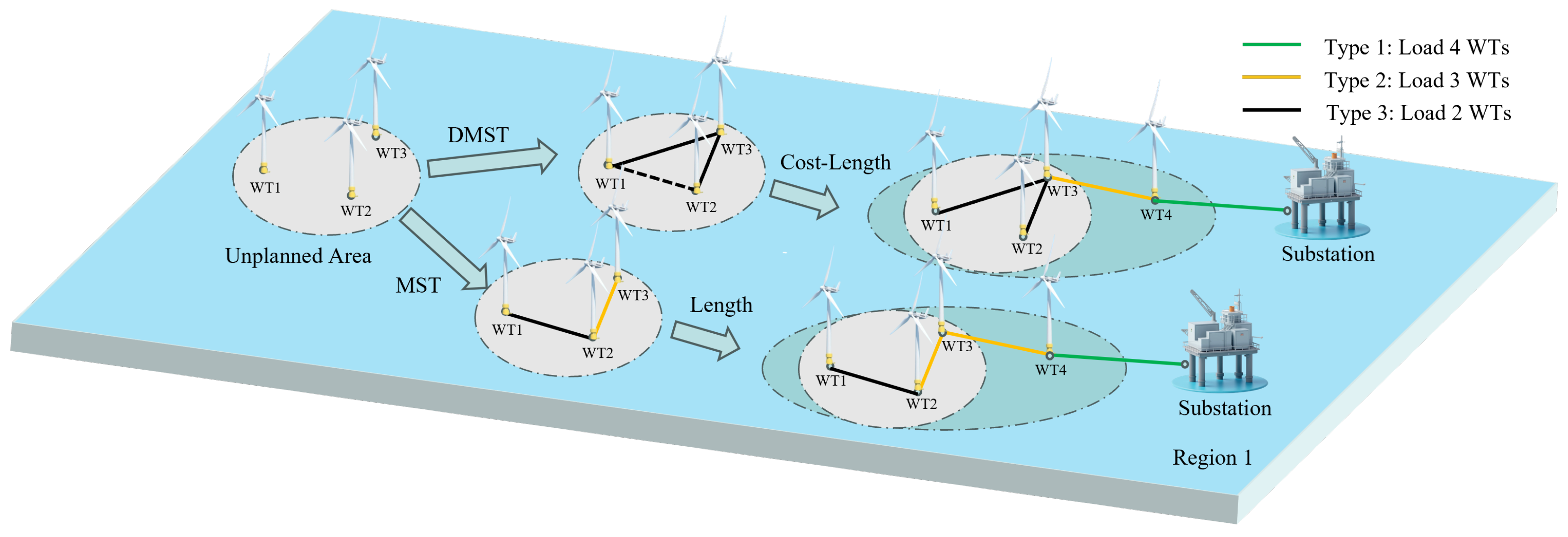
In CST optimization for OWFs, the minimum spanning tree (MST) and the DMST methods are employed to compare the respective pathways and applicable scenarios for transitioning from an unplanned area to a feasible connection scheme.
In the MST method, the topology design aims solely at minimizing the total laying length of submarine cables, while practical factors such as different cable types, current-carrying capacity, and construction constraints are ignored. Therefore, MST is suitable only for generating a rough single-objective scheme during the initial planning stage.
In contrast, the DMST starts from the same initial state but incorporates dynamic constraints such as cable types, cost coefficients, and WT loads into the topology generation process. As a result, it directly produces a connection structure that can be dynamically adjusted according to the number of WTs or changing engineering conditions.
Its core concept can be expressed as follows:
where
X denotes the set of wind turbines that have not yet been connected to the collector network and
Y denotes the set of nodes that have already been incorporated into the current spanning structure. At the beginning of the DMST process, all wind turbines belong to
X, while
Y contains only the offshore substation node. During each iteration, one wind turbine is selected from
X and connected to a node in
Y according to the minimum dynamic connection cost, after which the selected turbine is removed from
X and added to
Y. This iterative process continues until all wind turbines are connected.
In the DMST procedure, the dynamic cost weight of a candidate edge between an unconnected WT
and a connected node
is defined as
where
is the distance between nodes
i and
j,
denotes the cable type selected for the candidate branch, and
is the corresponding unit cable cost. Cable type
is dynamically determined according to the upstream load and current-carrying capacity requirement. Therefore, the candidate connection selected at each iteration can be expressed as
In each iteration, the optimal WT is selected from X and added to Y, while the cost weight is dynamically updated based on the cable type (Type 1, Type 2, or Type 3) and upstream load capacity. This process continues until , resulting in a globally cost-optimal CST structure.
As shown by the evolution results in
Figure 5, the DMST flexibly selects connection paths according to the current-carrying capacities of different cable types. Compared to the MST, which considers only distance, this approach better aligns with the practical operating conditions and economic requirements of submarine cable installation in OWFs.
3.3. Sled Dog Optimization Algorithm
3.3.1. Conceptual Inspiration of the SDO
The SDO algorithm draws inspiration from the working behavior of sled dogs. In the snowy regions of the Arctic, sled dogs are an essential means of transportation. A lead dog guides the team through complex terrain, while the other dogs cooperate and coordinate with each other. When encountering obstacles, the entire team adjusts its route collectively. If they lose their way, they explore alternative paths under the guidance of the lead dog. Moreover, the mechanisms for replacing injured dogs and training young dogs further inspire the design of the SDO algorithm.
3.3.2. Algorithm-Based Adjustment of WT Positions
In the SDO algorithm, sled dogs adjust their positions using different velocity update formulas depending on their roles and positions within the team. In the context of offshore WT layout, WT positions can be analogized to the positions of sled dogs, while factors such as interactions between WTs and wind direction can be regarded as analogous to historical best positions and global best positions. For WTs located in different positions, similar update formulas are applied to adjust their locations accordingly:
where
denotes the current position of the
ith wind turbine in the solution space and
(or
) denotes its position updating vector. The parameter
is the inertia weight, which decreases gradually with the iteration process to balance global exploration and local exploitation. The parameters
and
are learning coefficients that control the influence of historical experience and guiding information on the current individual. The variables
,
, and
are uniformly distributed random numbers in
introduced to enhance population diversity and reduce the risk of premature convergence.
In Equation (13), represents the historical best position of the ith wind turbine, while denotes a guiding reference position selected from elite solutions. Therefore, Equation (13) mainly describes the update behavior of individuals in the initial stage, where the search process emphasizes broad exploration under the joint guidance of personal memory and elite experience.
In Equation (14), and denote the neighboring positions of the current individual in the sled-dog formation, which are used to characterize local interaction and cooperative movement among adjacent individuals. The parameter ℓ is an influence coefficient, and represents a neighboring or reference individual randomly selected from the same group. Therefore, Equation (14) mainly reflects the intermediate-stage update mechanism, in which both neighborhood cooperation and stochastic guidance are incorporated to refine the search trajectory.
In Equation (15), the update rule is designed for the final-stage individuals, where the search process becomes more focused on exploitation around promising regions so as to enhance local refinement ability and accelerate convergence.
3.3.3. Application of the Algorithm to Escape Local Optima in WT Layout
In the process of offshore WT arrangement, the algorithm may fall into a local optimal layout scheme, resulting in suboptimal overall power generation efficiency. At this stage, the route adjustment behavior of sled dogs when they lose their way can be incorporated into the SDO algorithm to help escape local optima. The position update formula is expressed as follows:
where
is the previously defined reference position,
is a randomly generated position, and
C is a parameter that decreases nonlinearly with the number of iterations to control the step size of the random movement. In the early stage of the algorithm, a larger
C enables the WTs to carry out random exploration over a wider range, which is helpful for escaping local optima and discovering new layout possibilities. In the later stage, a smaller
C makes the exploration more concentrated near the currently promising solution, improving the local fine-tuning ability. Here,
and
are random numbers within the interval
and
is a random number that follows a standard normal distribution with a mean of 0 and variance of 1. In this way, when the layout scheme falls into a local optimum, the position of the WT can be randomly adjusted to a certain extent, thereby increasing the probability of finding a better layout scheme and improving the power generation efficiency and economic benefits of the entire OWF.
3.3.4. Optimization Framework
The proposed framework adopts a sequential bi-level optimization strategy rather than a co-evolutionary one. In the upper layer, polar-coordinate clustering is first performed to divide the wind farm into several fixed regions; the DMST is then used to construct an initial feasible topology for each region. After the regional boundaries are determined, the lower-layer SDO does not modify the partition results or reassign wind turbines among different regions. Instead, it only refines the cable connection structure within each fixed partition based on the DMST-generated initial topology. Therefore, the upper layer is mainly responsible for problem decomposition and feasible initialization, whereas the lower layer focuses on intra-region topology refinement and cost reduction under the established partition structure.
To further illustrate the interaction mechanism between the two layers, the complete optimization procedure of the proposed framework is summarized in Algorithm 1.
It should be emphasized that the partition boundaries remain fixed after the upper-layer clustering stage; the lower-layer SDO only optimizes the intra-region topology, without changing regional assignments. The specific workflow is shown in
Figure 6.
| Algorithm 1 Bi-level topology optimization procedure of the proposed SDO–DMST framework |
- 1:
Input: wind turbine coordinates, offshore substation coordinates, cable parameters, and engineering constraints. - 2:
Output: optimized collector system topology. - 3:
Determine the coordinates of wind turbines and the offshore substation. - 4:
Transform all wind turbine coordinates into the polar coordinate system. - 5:
Determine the wind turbine partition labels using polar-coordinate clustering. - 6:
Construct the initial feasible topology of each partition using the DMST method. - 7:
Initialize SDO parameters: population size N, maximum iterations T, inertia weight , learning factors and , and random search parameters. - 8:
Initialize the SDO population, where each individual encodes a feasible cable layout within the corresponding partition. - 9:
Calculate the total cost of each individual using the objective function and constraint evaluation. - 10:
Identify the global best solution. - 11:
for do - 12:
for each partition do - 13:
for each individual in the population do - 14:
Update the individual using the SDO search mechanism. - 15:
Decode the updated individual into a cable topology based on the current partition. - 16:
Calculate the fitness value of the decoded topology. - 17:
if the obtained solution is better than the current best solution then - 18:
Update the best solution. - 19:
end if - 20:
end for - 21:
end for - 22:
end for - 23:
Return the final optimized cable topology.
|
4. Case Study
In this section, the performance of the proposed optimization approach is rigorously assessed through a practical case involving an offshore wind farm layout consisting of 62 WTs. The scenario selected for the evaluation serves as a representative model aimed at verifying both the practicality and effectiveness of the proposed SDO combined with the DMST method.
To objectively evaluate the performance of different algorithms, the proposed SDO is benchmarked against several mainstream heuristic methods, including GA [
25], IA [
28], and PSO [
10]. In the revised comparative study, the recent artificial protozoa optimizer (APO) algorithm is further introduced as an additional benchmark. In the comparative experiments, all algorithms were configured with the same maximum number of iterations (
) and a unified population size setting to ensure a fair comparison in terms of convergence speed, computational efficiency, and solution quality. It should be noted that other algorithm-specific parameters were individually tuned according to the characteristics of each method and fixed throughout the repeated trials.
Additionally, to guarantee result comparability and eliminate hardware-induced variability, all simulation studies were performed using identical computational resources. Specifically, a high-performance computing system configured with an Intel Core i7-10875H processor (2.30 GHz base frequency, manufactured by ASUSTeK COMPUTER INC., Taipei, China) and equipped with 16 GB DDR4 RAM was consistently employed across all experimental trials.
4.1. Case Introduction
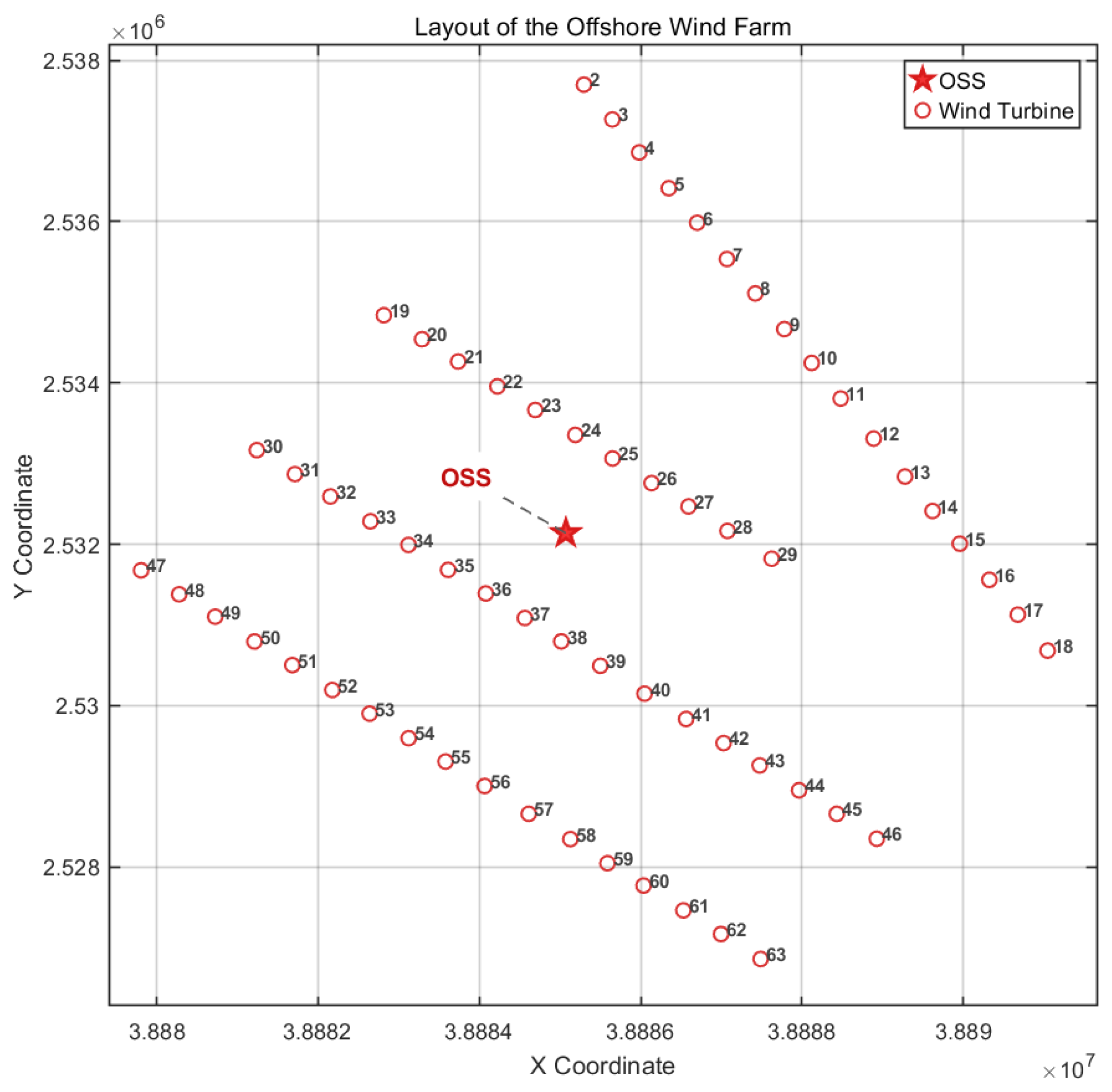
This case study investigates an offshore wind farm consisting of 62 WTs, each with a rated capacity of 8 MW, bringing the total installed capacity to 496 MW. As illustrated in
Figure 7, the turbines are deployed in a staggered configuration, creating several diagonal rows across the site.From an engineering perspective, a wind farm with 62 large-capacity WTs and a total installed capacity close to 500 MW can be regarded as a representative utility-scale offshore wind farm case rather than a small synthetic test system. This spatial arrangement resembles practical engineering layouts for offshore wind farm projects, and provides diverse options for cable routing and system optimization.
The scalability of the proposed framework is mainly supported by its hierarchical optimization structure. In the upper layer, the polar coordinate partitioning strategy divides the whole wind farm into several regional subareas to ensure that the subsequent topology optimization is not performed over all WTs in a single fully coupled search space. In the lower layer, SDO-based optimization is carried out within each partition, which reduces the effective search dimension of each local routing task and alleviates the computational burden associated with large-scale topology optimization. Therefore, when the number of WTs increases, the proposed method can extend the optimization process by increasing the number or size of partitions, instead of directly expanding one global high-dimensional combinatorial search problem. This hierarchical decomposition improves the scalability and computational tractability of the proposed SDO-DMST framework for larger offshore wind farm layouts.
The collection system utilizes three types of 35 kV submarine cables (Type 1, Type 2, and Type 3), each with different capacity, current rating, resistance, and price, as summarized in
Table 1. Cable selection is based on the power requirements and economic considerations of each connection.
Table 1 presents the key specifications of the three cable types utilized in the collection system. The cable price is expressed in
CNY/km. These parameters serve as essential inputs for the optimization model, which assigns cable types and determines routing schemes according to both technical requirements and cost-effectiveness.
4.2. Application of the Proposed Method
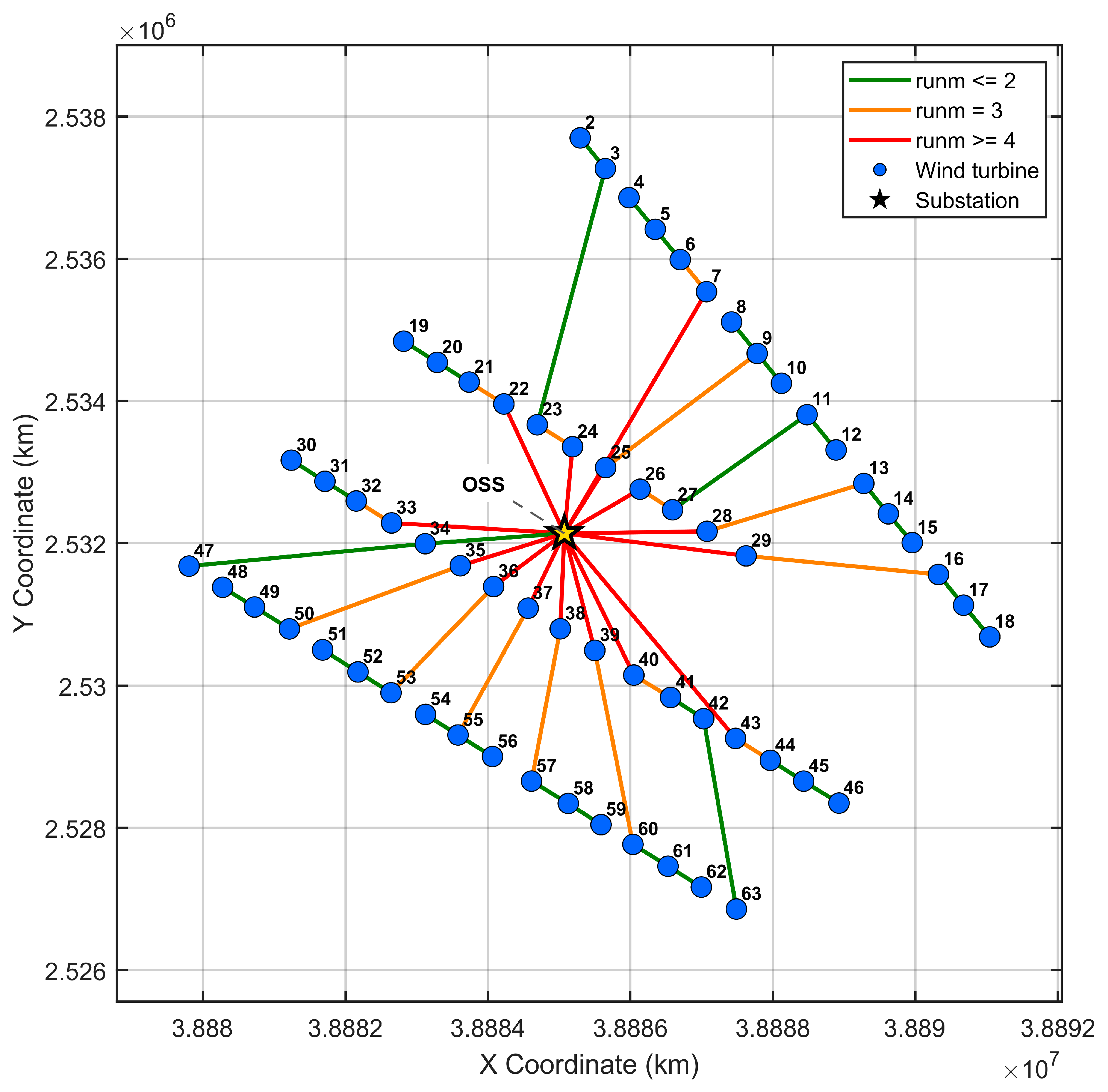
The optimized cable layout for the offshore wind farm generated using the SDO algorithm in combination with the DMST approach is illustrated in
Figure 8. The layout is designed to minimize total cable length and installation cost while ensuring technical feasibility and compliance with operational constraints such as current-carrying limits, voltage drop, and network reliability.
In the figure, the offshore substation is marked by a red pentagram at the center and serves as the collection point for all generated power. From this central hub, radial feeders extend outward to connect clusters of wind turbines. Each feeder typically connects four turbines, forming a pseudo-radial topology that balances power flow and enhances operational reliability. When the total number of turbines is not divisible by four, the final feeder accommodates the remaining units accordingly.
Three types of submarine cables with varying current-carrying capacities are employed in the system and are color-coded in the layout. Green lines indicate cables rated for a current capacity of at least two units, orange lines represent cables rated for three units or more, and red lines correspond to high-capacity cables rated for four units or more. This hierarchical classification reflects the power flow distribution within the network, with trunk cables located closer to the substation required to carry higher aggregated currents from multiple feeders.
Wind turbines are represented by red circles, each labeled with a unique identifier. The spatial arrangement of the turbines exhibits a rotationally symmetric structure around the substation, which helps to reduce intra-array cable distances and supports uniform power dispatch. This configuration also facilitates effective wake loss mitigation and offers practical advantages for system maintenance and future reconfiguration.
Overall, the proposed layout represents a technically robust and economically efficient design solution that satisfies the critical electrical, spatial, and operational constraints associated with offshore wind farm development.
4.3. Cost Comparison
To demonstrate the effectiveness of the proposed methodology in optimizing offshore wind farm collector system topologies, this study investigates a representative layout consisting of 62 WTs. A comparative analysis is conducted using five metaheuristic algorithms—GA, IA, PSO, APO, and SDO—each integrated with the DMST approach. This hybrid optimization framework is designed to evaluate the performance characteristics of different intelligent algorithms in turbine clustering and cable routing optimization.
It should be noted that the MST and DMST structures play different roles in this study. The MST mainly provides a distance-oriented preliminary connection scheme, whereas the DMST further incorporates cable type selection, current-carrying capacity, and cost-related engineering constraints. Therefore, the subsequent comparative results are all established on the unified DMST-based framework to ensure that the performance differences among the metaheuristic algorithms can be evaluated under the same practical conditions of topology construction.
Table 2 summarizes the main parameter settings of the heuristic optimization algorithms used in this study. While the population size and maximum number of iterations are uniformly set to 50 and 100 for all algorithms to ensure a fair comparison, some key parameters are fine-tuned according to the intrinsic characteristics of each algorithm. More specifically, the common control parameters, including population size and stopping criterion, are kept identical for all compared algorithms, whereas the algorithm-specific parameters are selected according to commonly adopted settings in the corresponding references and further adjusted through preliminary trials. Once determined, these parameter settings are fixed throughout all comparative experiments. For the newly added APO, the elite ratio is set to 0.2 and the stall refresh threshold is set to 6, while the same population size and stopping criterion are retained to preserve comparison fairness. Notably, the SDO algorithm adopts a leadership decay rate of 0.5 and an exploration coefficient of 1.0, which are specifically designed to enhance global search capability and adaptability in complex optimization scenarios.
Table 3 summarizes the minimum, average, and maximum values of total capital cost, convergence time, and computation time; specifically,
,
, and
denote the minimum, average, and maximum capital costs, respectively. In addition, the statistics of convergence time and computation time reported in
Table 3 provide a direct comparison of the running-time performance of the different algorithms.
Regarding solution quality, SDO achieves the lowest minimum total capital cost among all compared algorithms, with ¥/km. Compared with the other methods, the corresponding cost reduction ranges from approximately 0.92% to 1.91%, indicating that SDO has a stronger ability to search for high-quality solutions. This advantage is also reflected in the average results, where SDO obtains the lowest of ¥/km. The average cost is reduced by about 1.22% to 2.15% relative to the other algorithms, suggesting that SDO provides not only a better best-case solution but also more favorable overall optimization performance.
In addition to the cost statistics,
Table 3 reports the convergence and computation time indicators. On average, the convergence times are 23.50 s (IA), 45.62 s (PSO), 29.59 s (SDO), 42.86 s (GA), and 116.54 s (APO), while the corresponding computation times are 113.45 s (IA), 61.73 s (PSO), 61.26 s (SDO), 58.79 s (GA), and 209.47 s (APO). Overall, SDO offers a balanced performance profile, delivering the best
while keeping the computation time at a competitive level relative to the other metaheuristics considered in this study.
As demonstrated in
Table 3, metaheuristic-based iterative optimization methods significantly reduce capital expenditures compared to non-iterative deterministic approaches, albeit at higher computational cost. Among these, the SDO algorithm stands out by achieving the lowest capital cost while also exhibiting the fastest convergence and most efficient computation, underscoring its suitability for practical CST optimization problems as well as its potential applicability to larger-scale scenarios. The inclusion of APO further strengthens the running-time comparison and shows that the proposed SDO maintains superior overall performance in both solution quality and computational efficiency.
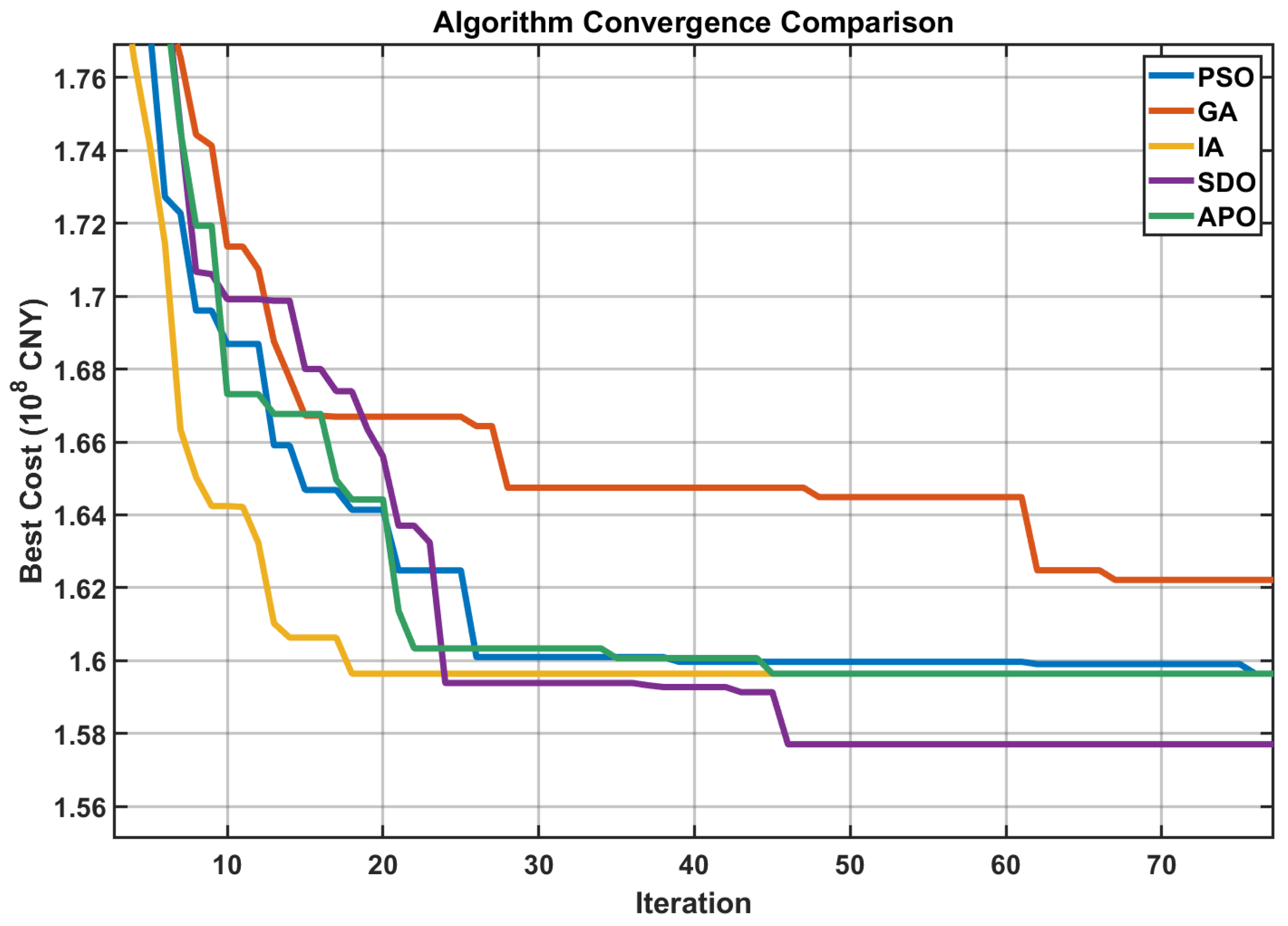
The convergence curves of the five algorithms are illustrated in
Figure 9. The convergence behavior of the five metaheuristic algorithms (PSO, GA, IA, SDO, and APO) in solving the wind farm cable layout optimization problem is clearly differentiated [
29]. Each curve represents the best cost (
CNY) obtained during the iterative optimization process.
Among the five algorithms, SDO demonstrates the best overall performance, converging to the lowest final cost level of approximately CNY
. IA, PSO, and APO converge to slightly higher and relatively close cost levels around CNY
–
, while GA shows a slower convergence process and remains at a higher final cost level of approximately CNY
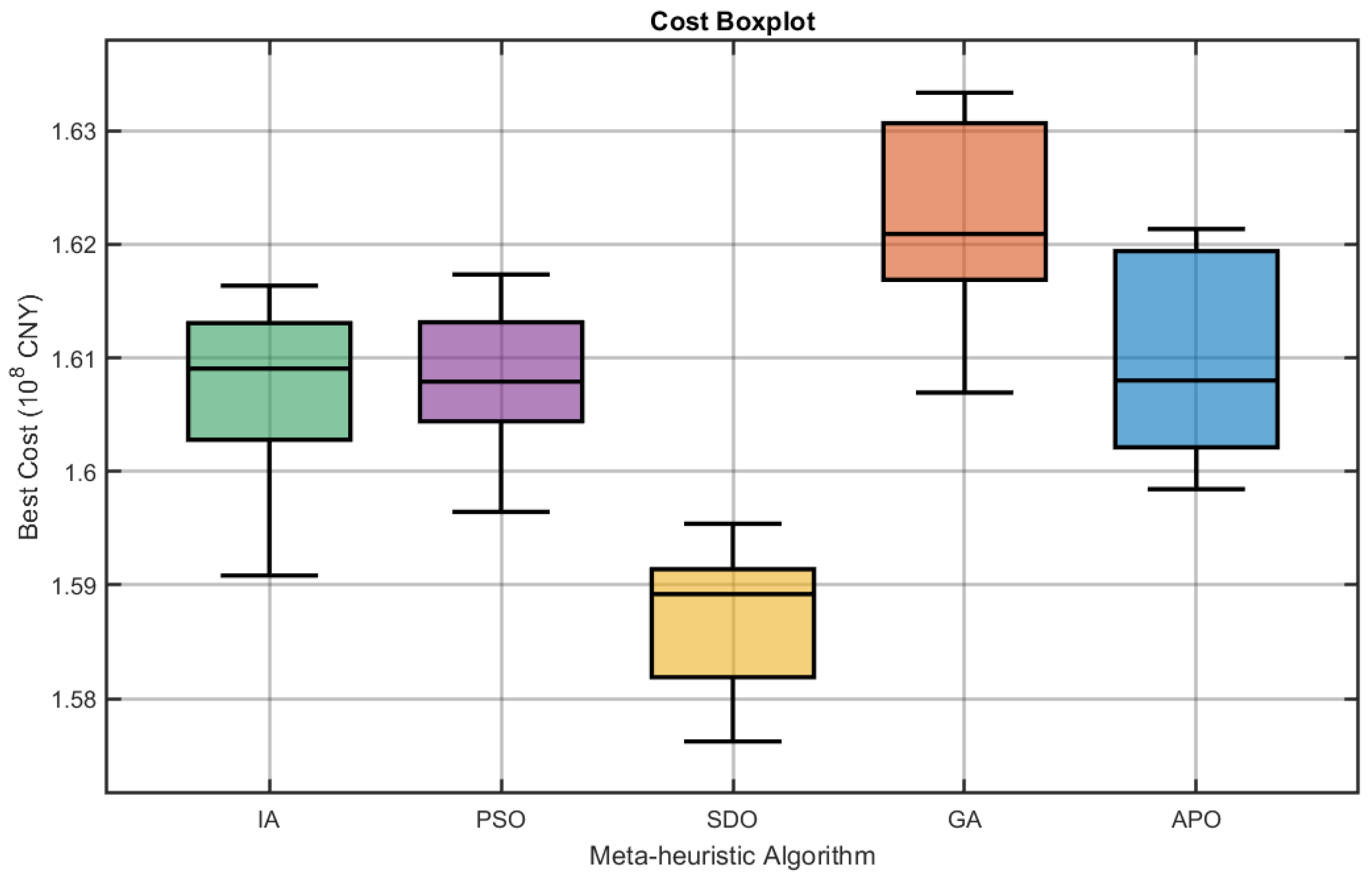
. These observations are consistent with the cost boxplot results in
Figure 10, where SDO exhibits the lowest cost distribution compared with the other benchmark algorithms.
In addition to the convergence trends,
Figure 10 further illustrates the distribution of the best costs obtained by the compared metaheuristic algorithms in repeated runs. It can be observed that SDO achieves the lowest median best cost and a relatively compact interquartile range, indicating better robustness and consistency in solution quality. By comparison, GA shows the highest cost distribution and relatively large variability across runs, while IA, PSO, and APO generally yield competitive but higher cost distributions than SDO. These results further confirm the advantage of SDO in terms of both solution quality and stability.
Overall, SDO demonstrates distinct advantages in both cost optimization and solution stability compared to traditional algorithms.
5. Conclusions
This study proposes a bi-level collaborative optimization framework based on the sled dog optimizer (SDO) for topology optimization of collection systems in large-scale offshore wind farms. In the upper layer, polar coordinate partitioning is integrated with the DMST strategy to satisfy current-carrying capacity constraints and cable crossing avoidance (CCA) requirements in a coordinated manner, thereby reducing the effective problem dimension. In the lower layer, the SDO is introduced to optimize intra-partition routing by leveraging the algorithm’s team collaboration and adaptive search behaviors to efficiently explore feasible solutions with low lifecycle cost.
A case study with 62 WTs is used to verify the effectiveness of the proposed framework. Compared with GA, IA, PSO, and APO, the SDO shows a notable advantage in terms of best-case solution quality and overall robustness. In particular, the SDO delivers the lowest minimum total capital cost, achieving approximately 0.92–1.91% lower than the benchmark algorithms. In terms of average performance, the SDO also obtains the lowest , with a reduction of about 1.22–2.15% compared with the other algorithms. Moreover, the convergence curve and boxplot results suggest that the SDO can reach high-quality solutions in a stable manner, offering a favorable tradeoff between optimization performance and computational effort. Under the current experimental settings, the SDO reduces the average computation time by about 46.0% compared with IA and by about 70.8% compared with APO, while remaining comparable to PSO and GA in computational efficiency.
Overall, the proposed SDO-DMST framework mitigates the limitations of conventional metaheuristics in large-scale scenarios, including slow convergence and becoming prematurely trapped in local optima, providing a practical solution pathway that balances economy and robustness for OWF collection system design in complex sea areas. It aligns with the ongoing trend toward large-capacity and far-offshore wind power deployment, offering engineering value for supporting the goals of clean energy transition and carbon neutrality. Future work will further extend the framework to multi-objective optimization and investigate its adaptability under more challenging marine conditions.