1. Introduction
With the increasing demand for electricity and growing environmental pressures, renewable energy sources were integrated into the grid through power electronics converters, which gradually became a defining feature of the new power system. The term “new power system” was formally established within the academic community to distinctly categorize modern grids, which were characterized by a high penetration of renewable energy and power electronic devices, from traditional synchronous-dominated systems [
1]. Meanwhile, the widespread use of high-penetration renewable energy and a large number of power electronic devices in the grid introduced new stability challenges to the new power system, including electromechanical-like low-frequency oscillations, wideband electromagnetic resonances, and new large-disturbance instability phenomena [
2,
3,
4]. Against this background, accurately identifying the dominant factors that caused system instability was of great importance for maintaining the stable operation of the new power system. Numerous studies investigated instability factors in conventional power systems. These traditional systems were typically dominated by power angle stability under highly inductive conditions. However, such conventional methods were difficult to apply directly to the new power system. With a high penetration of power electronics and low inertia, the new power system exhibited strong, multi-dimensional coupling among the power angle, voltage, and impedance angle. This coupling became particularly severe under low-voltage conditions. To fill this research gap, this paper proposes a dominant instability factor identification method for the new power system.
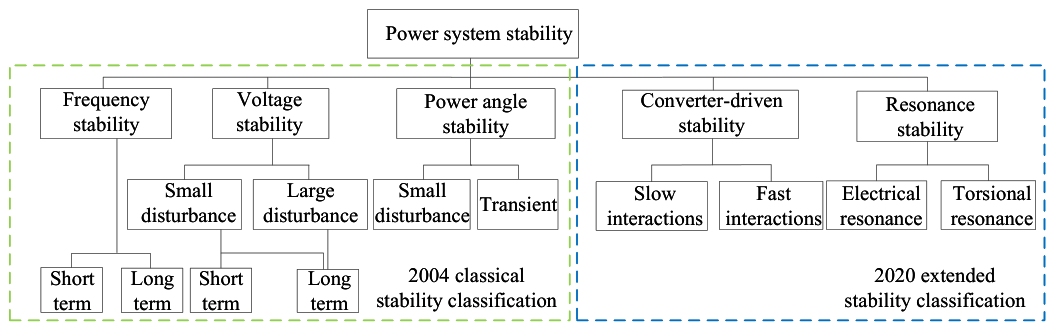
Addressing stability in conventional power systems dominated by synchronous generators, the IEEE and CIGRE formed the Joint Task Force on stability terminology and definitions in 2004. The Task Force released the report “Definition and Classification of Power System Stability” [
5], which established the classical definition and classification. A summary was provided in the left dashed box of
Figure 1. The classification included frequency stability, voltage stability, and power angle stability. Voltage stability and power angle stability were influenced by common factors such as power flow distribution and network impedance characteristics [
6,
7]. This interaction produced strong coupling in engineering practice and was a central coupled problem in conventional stability analysis. Frequency stability focuses on the active power imbalance between generation and load under severe disturbances. The dominant variable was system frequency. Typical controls included generator primary frequency control and under-frequency load shedding. The time scales covered a wide range [
8]. Due to the significant differences in dominant variables, control logic, and time scales between frequency stability and voltage stability, as well as power angle stability, frequency stability was often treated as a decoupled problem and was analyzed separately in engineering practice.
To address the stability classification problem of the new power system, IEEE and CIGRE released a new technical report in 2020 [
9], which extended the classical stability taxonomy to include converter-driven phenomena. Based on the stability classification given in the 2004 report, converter-driven stability and resonance stability were added, which extended the scope of power system stability and covered stability issues caused by power electronic equipment, as shown by the dashed box on the right side of
Figure 1. However, the extended classification had evident limitations. It no longer distinguished instability categories using system variables that indicated system instability, but instead relied on devices or causal mechanisms that triggered instability. As a result, the criteria were not aligned with the classical stability classification. Furthermore, it lacked directly observable and quantifiable stability indicators, which made it difficult to support monitoring and control in engineering practice.
Aware of the limitations of the above classification framework, reference [
10] started from the basic operating rule of active and reactive power balance and introduced the system impedance angle as an observable and quantifiable indicator for stability assessment [
11,
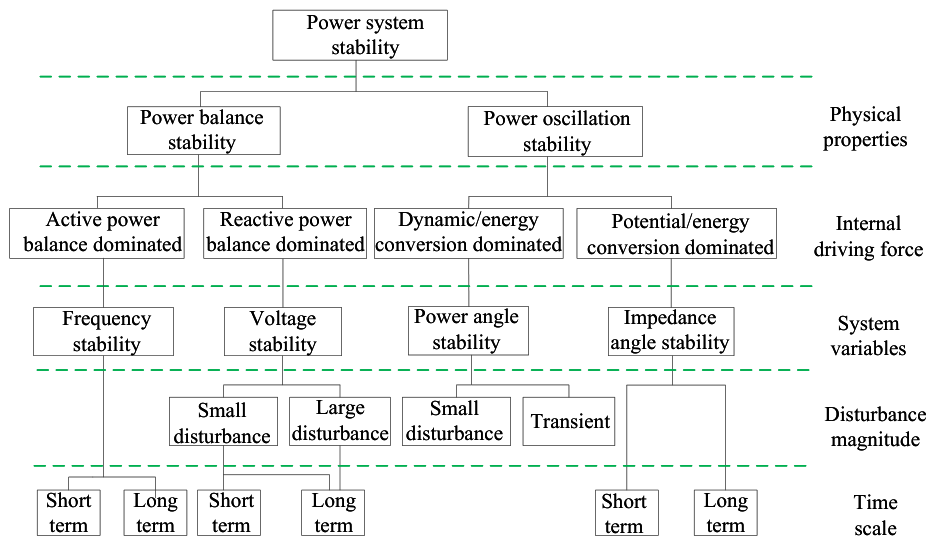
12]. The impedance angle stability was introduced to encompass the dynamic phenomena associated with the converter-driven stability and resonance stability proposed by IEEE/CIGRE in 2020. Accordingly, as an alternative and complementary control-oriented categorization rather than a direct replacement of the classical energy-based taxonomy, a stability categorization framework for the new power system was constructed, as shown in
Figure 2. The stability was divided into four categories, namely frequency stability, voltage stability, power angle stability and impedance angle stability. In conventional synchronous-generator systems, the impedance effectively represented passive and constant hardware. Thus, the impedance angle mainly acted as a static phase shift for the power angle in the power transfer equation, making the impedance angle a subset of angle stability. However, in inverter-dominated new power systems, the equivalent impedance was no longer a passive constant but a control-dependent equivalent quantity shaped by inner control loops and current limiters [
13]. Power angle stability was primarily driven by the active power synchronization mechanism operating at a low-frequency time scale. In contrast, impedance angle instability is more closely related to wideband control interactions between inverter inner loops and grid impedance. This distinction leads to different analytical boundaries. Specifically, power angle stability is related to the equilibrium point in the slow swing dynamics, whereas impedance angle stability is related to the wideband impedance matrix criteria. Recent studies on converter-driven stability have recognized converter-driven control interactions as an instability mode different from traditional synchronization loss [
14]. Therefore, impedance angle stability can be treated as a separate instability category rather than a simple reinterpretation of synchronization stability. This classification framework also indicated that the voltage, power angle, and impedance angle may interact during instability and should be analyzed as a coupled problem. Frequency stability, owing to the independence of the dominant mechanism and control time scale, was still handled separately.
Recent studies indicate a shift from passive monitoring to measurement-based decision support in power and electronic systems. Al Mhdawi et al. developed a micro software-defined control framework for smart grids to support distributed metering, power consumption prediction, and network traffic optimization [
15]. Nasser et al. combined frequency response features with a fuzzy logic classifier for fault detection and identification in analog electronic circuits [
16]. Hasan et al. used an artificial neural network for electricity consumption and residential bill prediction in demand-side energy management [
17]. These studies provide useful references for intelligent control, fault identification, and prediction in power and electronic systems. In the context of new power system stability, this paper further focuses on the identification of dominant power system instability factors under coupled variations in the voltage magnitude, power angle, and impedance angle.
To clarify the research status of dominant instability factor identification and highlight the research gap of “missing impedance angle coupling”, this section systematically reviews existing methods around two core themes: the coupling between the power angle and voltage, and the limitations of low-dimensional frameworks in new power systems. Existing methodologies are categorized into three mathematical architectures for in-depth analysis: traditional model-driven methods, conventional machine learning, and deep learning networks.
The first category comprises traditional model-driven methods, which focus on explicit physical mechanisms and the analytical formulation of criteria. Classical approaches, such as the transient energy function and the controlling unstable equilibrium point (CUEP) method [
18], provide a rigorous basis for distinguishing rotor angle stability from voltage stability. Using static stability sensitivities, reference [
19] derives a criterion from power flow relations to identify the dominant factor near operating equilibria and to enable fast decisions. However, coverage of strong transient nonlinearity under large disturbances and control interactions is limited, and the effects of field noise and measurement errors remain to be assessed. Furthermore, classic analytical models struggle to adapt to the control-driven nonlinearities of new power systems.
The second category involves conventional machine learning and data mining techniques, which have been explored to overcome the computational burden of explicit analytical models. According to reference [
20], a support vector regression (SVR) surrogate model approximates short-term stability using sensitivity-based features and supports dynamic reactive power planning. For online assessments, a decision tree-based approach is trained with early post-fault voltage and angle features to predict transient stability (TS) and short-term voltage stability (STVS) and report the dominant factor [
21]. The method depends heavily on manual feature engineering and stable thresholds, and the generalization and robustness under operating point drift require long-term validation. Agents are placed at key buses and collaborate using local measurements, such as relative frequency deviation [
22]. The boundary of the short-term voltage security region is learned using unsupervised u-shapelet clustering [
23]. These methods rely on offline dataset construction and fixed PMU placement, and their interpretability remains limited.
The third category encompasses deep learning and graph networks. As an advanced branch of data-driven methods, deep learning networks further enhance the nonlinear fitting capability by automatically extracting implicit spatiotemporal features. In reference [
24], a convolutional block attention module-based convolutional neural network (CBAM-CNN) is applied, wherein transient rotor angle stability (TRAS) and transient voltage stability (TVS) are assessed in a unified manner. A spatial–temporal intelligent assessment model (STIAM) is applied to phasor measurement unit (PMU) measurements to jointly assess TRAS and TVS [
25]. The subsystem that first loses stability is labeled as dominant, and results are mapped to a four-quadrant control guideline. However, dependence on system models persists, and controller parameter tuning and coordination are complex. The optimal amounts of generator tripping (GT) and load shedding (LS) are not provided. Network-wide voltage phasor time series are transformed into image-like inputs for a recurrent convolutional neural network (RCNN) [
26]. Graph-based models, such as Graph Attention Networks (GATs), represent the grid as a graph [
27]. More critically, the inherent “black-box” nature of these deep learning models makes explicitly decoupling specific physical driving forces extremely challenging.
Furthermore, to explicitly delineate the differences among existing instability identification approaches, the reviewed methodologies are systematically categorized and compared in
Table 1. The table contrasts traditional model-driven methods, conventional machine learning, and deep learning networks against the proposed APPT method based on four critical dimensions: data requirements, computational effort, performance and interpretability, and applicability to renewable-rich grids. By summarizing the advantages and limitations of different methods, this classification framework highlights the limitations of existing models in characterizing dynamic impedance variations and clarifies that the proposed APPT method provides a distinctive three-dimensional impedance angle coupling perspective for dominant instability factor identification.
In summary, existing studies have proposed several methods to identify the dominant instability factor under coupling between the power angle and voltage. However, in the new power system, existing studies have rarely addressed the identification of the dominant factor under coupling among the power angle, voltage, and impedance angle. Specifically, existing assessment approaches that rely on CUEP-based analytical criteria [
18] or advanced data-driven deep learning models [
24,
25,
26] primarily focus on monitoring single state variables or, at most, the two-dimensional coupling between the voltage and power angle [
20,
21]. Two-dimensional frameworks may face limitations in new power system scenarios because the impedance angle introduces an additional dynamic coupling dimension. The above limitation motivates the extension of dominant instability factor identification from voltage and power angle coupling to voltage, power angle, and impedance angle coupling.
From the perspective of impedance-based stability theory [
14], the impedance angle reflects the phase mismatch between voltage and current in the grid, and its dynamic variations may affect power transfer stability in a way that cannot be fully represented by traditional rotor power angle or voltage magnitude analysis alone. Particularly, the nonlinear amplification of impedance dynamics under low-voltage and high-power-electronic-penetration conditions is difficult to characterize using traditional one-dimensional or two-dimensional boundaries. Therefore, the impedance angle needs to be considered as an explicit instability-related variable in dominant factor identification for the new power system.
To address the aforementioned limitations, the proposed Apparent Power Phasor Trajectory (APPT) method integrates the dynamics of the voltage magnitude, power angle, and impedance angle into a unified apparent power sensitivity space. Different from existing coupling analysis approaches that mainly describe interaction relationships or coupled stability boundaries, the APPT method constructs comparable characteristic quantities for dominant factor identification. Compared with existing methods that mainly focus on one-dimensional or two-dimensional indicators, the APPT provides a trajectory-based representation for characterizing the coupling among the voltage magnitude, power angle, and impedance angle. Furthermore, compared to conventional modal analysis, which relies on local linearization and may be limited under strong transient nonlinearities, and black-box data-driven models, the APPT method provides physically interpretable characteristic quantities. Therefore, the proposed method focuses on identifying whether the voltage magnitude, power angle, or impedance angle is the dominant instability factor during power system instability.
Based on the above analysis, the main objectives achieved in this work are to establish an APPT sensitivity representation for the coupled effects of the sending-end voltage magnitude, receiving-end voltage magnitude, power angle, and impedance angle, and to construct a trajectory distance-based method for dominant instability factor identification. The main contributions are summarized as follows:
- (i)
A quantitative sensitivity expression of the Apparent Power Phasor Trajectory is constructed based on the sending-end voltage magnitude, power angle, receiving-end voltage magnitude, and impedance angle. On this basis, the sensitivity relationships of the power angle, receiving-end voltage magnitude, and impedance angle with respect to the sending-end voltage magnitude are derived. The derived relationships introduce the impedance angle as an explicit instability-related variable and provide an analytical basis for describing the staged transition among voltage-dominated, power angle-dominated, and impedance angle-dominated characteristics.
- (ii)
The trajectory distance is introduced as the dimensional basis of the identification method, and trajectory distance indicators of the power angle, receiving-end voltage magnitude, and impedance angle are constructed under a unified geometric measure. The constructed indicators provide comparable characteristic quantities for different physical variables. By quantitatively comparing the magnitudes of these indicators, the proposed method identifies the dominant instability factor during power system instability.
The remainder of this paper is organized as follows.
Section 2 describes the grid-forming inverter equivalent model and the adopted variables.
Section 3 derives the APPT sensitivity mechanism and constructs the trajectory distance-based identification method.
Section 4 presents the simulation verification.
Section 5 concludes this paper.
2. Description of Grid-Forming Inverter Equivalent Model
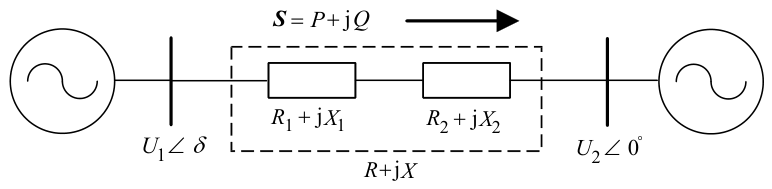
In new power systems, grid-forming inverters, grid-following inverters, and constant-power loads are widely present as typical power electronic devices. Among these devices, the grid-forming inverter provides frequency and voltage support and is equivalently regarded as the source side of the system [
28]. The macroscopic two-node equivalent model of the grid-forming inverter system is shown in
Figure 3.
In
Figure 3,
and
denote the sending-end voltage and the receiving-end voltage, respectively. The variable
represents the power angle. The voltage
represents the Thevenin equivalent voltage of the main power grid. The main power grid is represented by a remote synchronous-generator equivalent, which is used to describe the low-frequency power angle dynamics. The sending-end voltage
is established by grid-forming (GFM) inverter-based resources (IBRs) fed by renewable energy sources. The receiving-end load is represented by a composite load containing constant-power and induction-motor components, which is used to describe voltage-related instability characteristics.
The total impedance is , where and . Here, and denote the equivalent output resistance and reactance of the inverter, and and represent the line resistance and reactance, respectively. The equivalent impedance includes the physical filter impedance and the equivalent impedance shaped by the inverter control loops. As discussed in impedance angle-based stability studies, the equivalent impedance of grid-forming inverters may vary with the output current under converter-dominated operating conditions. In this paper, the current-dependent impedance effect is incorporated into the adopted equivalent model through . Under low-voltage conditions, the variation in may affect the overall impedance angle and contribute to impedance angle-related instability characteristics.
The variable S represents the apparent power phasor at the inverter terminal. In the adopted equivalent model, S contains the coupled information of three instability-related variables: the voltage magnitude, power angle, and impedance angle.
Based on the voltage phasors
and
, the voltage-difference term divided by the equivalent impedance denotes the branch current through
Z. According to the complex-power relationship between the port voltage and the conjugate branch current, the apparent power of the inverter is expressed as
In the equation,
P denotes the output active power and
Q denotes the output reactive power. Here, the apparent power phasor
S is defined as a complex-domain representation that reflects the coupled active and reactive power variations at the inverter terminal. This concept is different from the well-established power factor angle. Analytically, the conventional power factor angle mainly reflects the local proportional relationship between active power and reactive power at a single port (i.e.,
). The power factor angle describes the system behavior through a localized scalar metric and is not intended to characterize the coupled variations among the voltage magnitude, power angle, and impedance angle. In contrast, as derived in the equation above, the apparent power phasor
S contains the receiving-end voltage
, the power angle
, and the impedance angle
in a unified complex plane. This representation helps characterize the physical coupling interactions between the inverter and the main grid under the adopted equivalent model. Consequently, the apparent power phasor
S provides an analytical basis for visualizing and comparing the voltage-, power angle-, and impedance angle-related trajectory variations, thereby supporting the identification of the dominant instability factor.
where
is the total series resistance, and
is the total series reactance of the system. Using
,
, and
, and separating the real and imaginary parts of the above complex-power expression, the active power and reactive power are derived as:
Here, the formulation is based on the assumption that the receiving-end grid absorbs approximately constant apparent power during the considered transient process. Therefore, the relationship between the active power and the reactive power under grid disturbances is expressed as
In Equation (4),
is an arbitrary constant. The reactive power
Q at the inverter output is expressed by the droop controller equation
In the equation,
n denotes the reactive power droop coefficient, which is treated as a fixed coefficient in the adopted analytical model, and
denotes the inverter voltage at no load. The quantities
and
Q are operating variables in this droop relation. The equivalent output impedance
does not merely represent the passive filter hardware. The calculation of
combines the physical filter impedance with the equivalent impedance shaped by the inner voltage and current control loops of the grid-forming inverter [
13]. Under low-voltage conditions, current-limiting and inner-loop control effects may change the equivalent impedance according to the output current level. Therefore, the magnitude of
can exhibit current-dependent variations. Furthermore, the output current magnitude is coupled with the power angle
through the power flow constraints. The general nonlinear dependency of the impedance magnitude on the current and the power angle is defined as a continuous function
. To obtain a tractable local analytical representation,
is expanded around the initial operating point with respect to the power angle deviation. In this local representation,
denotes the initial operating point in the shifted coordinate, and the higher-order terms beyond the second order are neglected. Expanding the nonlinear function
via a second-order Taylor series around the initial operating point gives
In Equation (6),
represents the baseline impedance-magnitude component at the initial operating point for a given current magnitude, while the first- and second-order derivative terms describe the local linear and nonlinear variations caused by the power angle deviation. For compact modeling, the baseline term is represented by
, and the derivative terms are absorbed into two local sensitivity coefficients
and
. By defining the base impedance component as
and extracting the linear and quadratic partial derivatives as sensitivity coefficients, the unified analytical expression is derived as shown in Equation (7).
Here, the variable
I represents the current flowing through the inverter. The variables
and
are the linear and quadratic sensitivity coefficients, respectively. They are local coefficients used to characterize the first- and second-order effects of the power angle deviation on the equivalent impedance magnitude in the adopted approximation. Therefore, the system resistance
R and the system reactance
X are expressed by the equations
Here, the variables
and
are the distribution coefficients of the impedance
projected onto the resistance axis and the reactance axis, respectively. In the expressions, the coefficient
k is defined as shown in Equation (9).
Here, k is the baseline proportional coefficient adopted in the local impedance representation of Equation (7). In the adopted analytical model, provides the line-impedance baseline, while represents the droop relation-related contribution evaluated at the initial steady-state phase angle. Therefore, Equation (9) gives a compact coefficient definition for the local impedance-magnitude approximation. Here, denotes the initial steady-state phase angle of the system.
3. Criterion Mechanism Derivation
3.1. APPT Sensitivity Derivation and Mechanism Interpretation
For the equivalent model of the grid-forming inverter system, , , and are taken as state variables, while , , , , and are considered disturbance-related variables. When these disturbance-related variables undergo changes, the corresponding disturbance variations are denoted as , , , , and . Accordingly, the nonlinear relationships between , , and with respect to , , , , and can be formulated. These nonlinear relationships capture the first stage of disturbance propagation and define the sensitivity relationships of the voltage magnitude , power angle , and impedance angle .
The derivation follows the reduced two-node equivalent representation established in
Section 2. In this representation, the surrounding network is described through the sending-end voltage, receiving-end voltage, power angle, and equivalent impedance angle. The analysis is performed locally around the considered operating point, where the higher-order infinitesimal terms in the disturbance expansion are neglected, and the response is described by first-order sensitivity relations. The receiving-end side follows the approximate constant apparent power relation in Equation (4), and the equivalent impedance follows the local expression in Equation (7). These settings define the analytical scope of the proposed criterion.
When the system experiences a small disturbance, the disturbed system variables can be expressed as the sum of the steady-state values and the disturbance increment, where the disturbance increment contains higher-order infinitesimal quantities
. Here, the second core assumption of the derivation is introduced: since
is much smaller than the first-order terms, it is typically approximated as zero and neglected. Therefore, the system response can be treated using a linear first-order approximation, as shown in (12).
Based on this, the sensitivity expression of the Apparent Power Phasor Trajectory under small disturbance conditions is derived from the relationship between the voltage, current, and power state variables before and after the disturbance, as shown in (13).
In the equation,
,
,
, and
denote the incremental variations in the source voltage, receiving-end voltage, impedance angle, and power angle, respectively, under small disturbances. Based on the active and reactive power expressions in Equation (3), the local APPT sensitivity with respect to the source voltage is obtained by differentiating
P and
Q with respect to
at the considered operating point.
By combining the two scalar partial derivatives in Equation (14), the APPT sensitivity vector in the
P–
Q plane is written as
Thus, Equation (14) gives the scalar sensitivity components derived from Equation (3), and Equation (15) gives their vector representation. The mathematical relation in Equation (15) determines the local variation direction of the sensitivity trajectory, and its magnitude scales with
. As the operating point moves toward more coupled voltage-sag regions, the sensitivity trajectory may exhibit peaks, inflection points, and turning behaviors, indicating that the effects of the power angle and voltage on power transfer should be considered jointly. Therefore, the power angle relation in Equation (16) and the voltage–power relation in Equation (17) are organized into the state Jacobian matrix in Equation (18) [
29].
The determinant takes the compact explicit form given in Equation (19).
The state Jacobian determinant indicates the coupling condition between the power angle and the receiving-end voltage
. The determinant remains at a first-order approximation level. When the system enters the low-voltage region, the equivalent impedance may become current-dependent due to converter control and current-limiting effects. Consequently, the influence of the impedance parameters on the power transfer relationship becomes more evident. A local linear model with constant impedance may be insufficient to describe the pronounced variations in the trajectory. Therefore, the impedance parameters are incorporated as variables into the sensitivity derivation. The impedance-related sensitivity terms are characterized through the first-order partial derivatives in Equation (20).
The derivation results indicate an important phenomenon in the low-voltage region. The nonlinearities associated with the impedance parameters become important factors influencing the trajectory sensitivity. A traditional constant-impedance model may be insufficient to describe the nonlinear amplification associated with current-limiting effects. Therefore, a modeling approach based on dynamic equivalent impedance is introduced. This modeling approach provides a representation of the variation patterns of the sensitivity trajectory across the dimensions of power angle, voltage, and impedance parameters. Based on this representation, a chain relationship is derived by combining Equations (7) and (8).
Here,
is given by the current derivative, and the three terms can be combined and written as:
Substituting Equations (21) and (22) yields the input–output relationship of the impedance parameters.
Therefore, the total differential can be obtained as follows:
It should be clarified that the expressions in Equation (20) denote the analytical forms of the first-order partial derivatives, rather than a higher-order Taylor expansion. The higher-power terms, such as and , reflect the nonlinear dependence of the sensitivity terms on the equivalent impedance in the low-voltage region. Consequently, the total differential equation in Equation (24) uses these first-order partial derivatives to construct a local linear approximation. Specifically, in Equation (24), the first term denotes the power variation caused by the state variables. The second term, , denotes the direct power variation caused by the source-voltage disturbance. The third term denotes the power variation caused by the dynamic impedance variations.
By substituting (23) into (24), the quantified form of the apparent power sensitivity can be obtained.
In summary, Equation (25) indicates that, in practical operation, the sensitivity of the phasor trajectory is affected by the combined effects of three internal factors. The source-voltage magnitude determines the baseline direction, while the combined effect of the power angle and receiving-end voltage contributes to trajectory folding. In the low-voltage region, the influence of the impedance angle becomes more evident and contributes to nonlinear amplification.
To further analyze the underlying mechanism, the sensitivity characteristics of the power angle and the receiving-end voltage with respect to the source voltage are first examined. By calculating the inverse matrix of the state Jacobian in Equation (19), the disturbance of
is transmitted to the state variables. The exact analytical evaluation yields the sensitivity expressions for the power angle and the receiving-end voltage
, as shown in Equations (26) and (27).
The evaluation starts from the mathematical definition of the impedance angle in Equation (2). By applying the quotient rule and the chain rule, the derivative of the arctangent function is expanded. Combining the dynamic impedance relations in Equations (7) and (8), the impedance variations in Equation (23), and the state variable sensitivities in Equations (26) and (27), the complete sensitivity expression of the impedance angle is derived, as shown in Equation (28).
Although the coupled sensitivity relations in Equations (16)–(28) describe the interactions among the state variables under the adopted equivalent model, the cross-coupling terms make it difficult to directly interpret the regional contribution of each variable. To clarify the dominant tendencies associated with different voltage-sag regions, an asymptotic limit analysis is introduced. By evaluating the trajectory characteristics under different voltage-sag conditions, the coupled sensitivities are interpreted with respect to the following three representative physical boundaries:
Firstly, at the initial stage of voltage sags, the reactive power drop across the line reactance constitutes the primary physical boundary, which is analytically expressed as:
Secondly, as the terminal voltage decreases further, the active power synchronization constraint modulated by the line resistance is evaluated:
Finally, under severe voltage-sag conditions, current-limiting effects may become significant in the grid-forming inverter. To represent the resulting impedance-expansion tendency within the adopted equivalent model, a fractional-order relationship is introduced for the virtual impedance:
By mapping the APPT sensitivities onto these three asymptotic boundaries, the characteristic variations in the state variables can be described and visualized over different voltage-sag regions.
In summary, the combination of the coupled analytical model in Equations (16)–(28) and the asymptotic boundary analysis in Equations (29)–(31) provides an explanatory framework for interpreting the stability evolution of the system. According to the derived limits, in the high-voltage region, the trajectory is mainly constrained by the Q–V-related limit, leading to a voltage-related quasi-linear trend. As the voltage decreases to the medium-voltage region, the P– synchronization-related limit is approached, and the sensitivity trajectory begins to exhibit peaks and turning behaviors. In the deep-sag low-voltage region, the impedance-expansion effect can produce pronounced nonlinear amplification in the impedance angle-related sensitivity. This explains why the impedance angle component may become the dominant characteristic quantity in the low-voltage region. These three interacting mechanisms provide a theoretical basis for interpreting the regional characteristics of the APPT and its corresponding sensitivity trajectories.
3.2. Numerical Evaluation Under the 380 V Reference Condition
To examine the above theoretical analysis, numerical evaluations are conducted under specific grid operating conditions. The apparent power trajectory, the APPT sensitivity derivative, and the trajectory sensitivities of the power angle, receiving-end voltage, and impedance angle are compared. The numerical visualizations are used to illustrate the consistency between the derived regional mechanisms and the subsequent stability criterion.
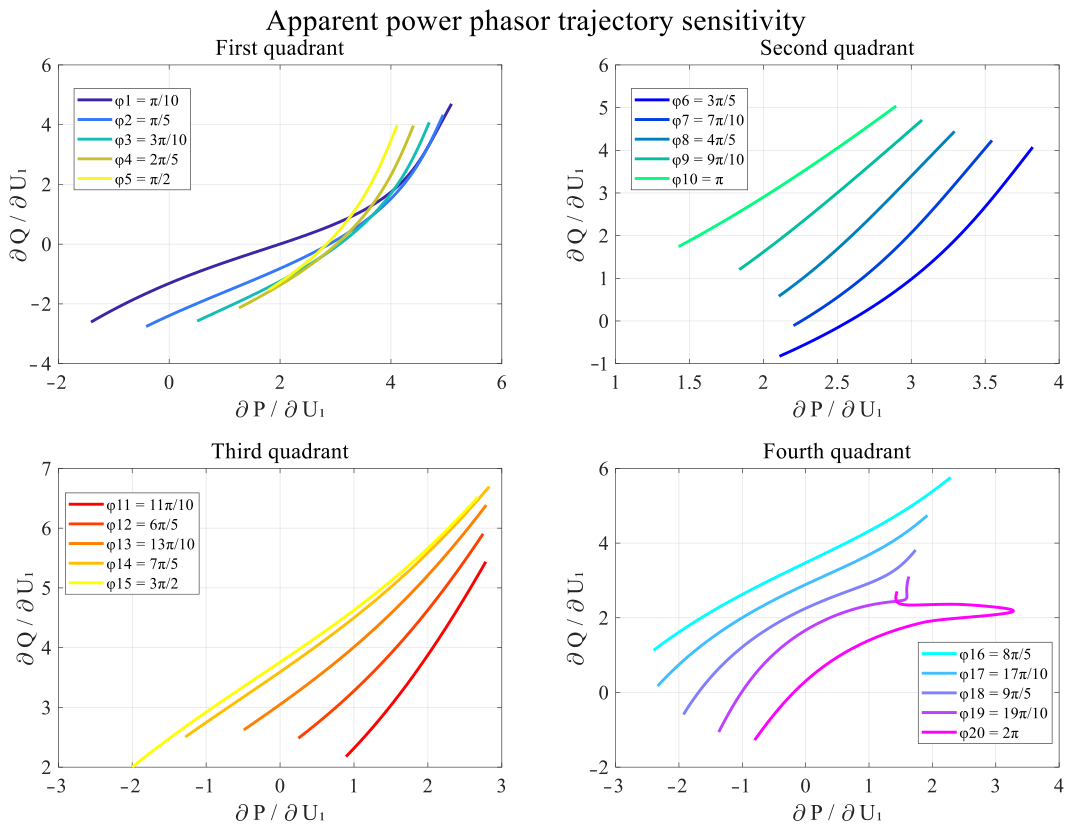
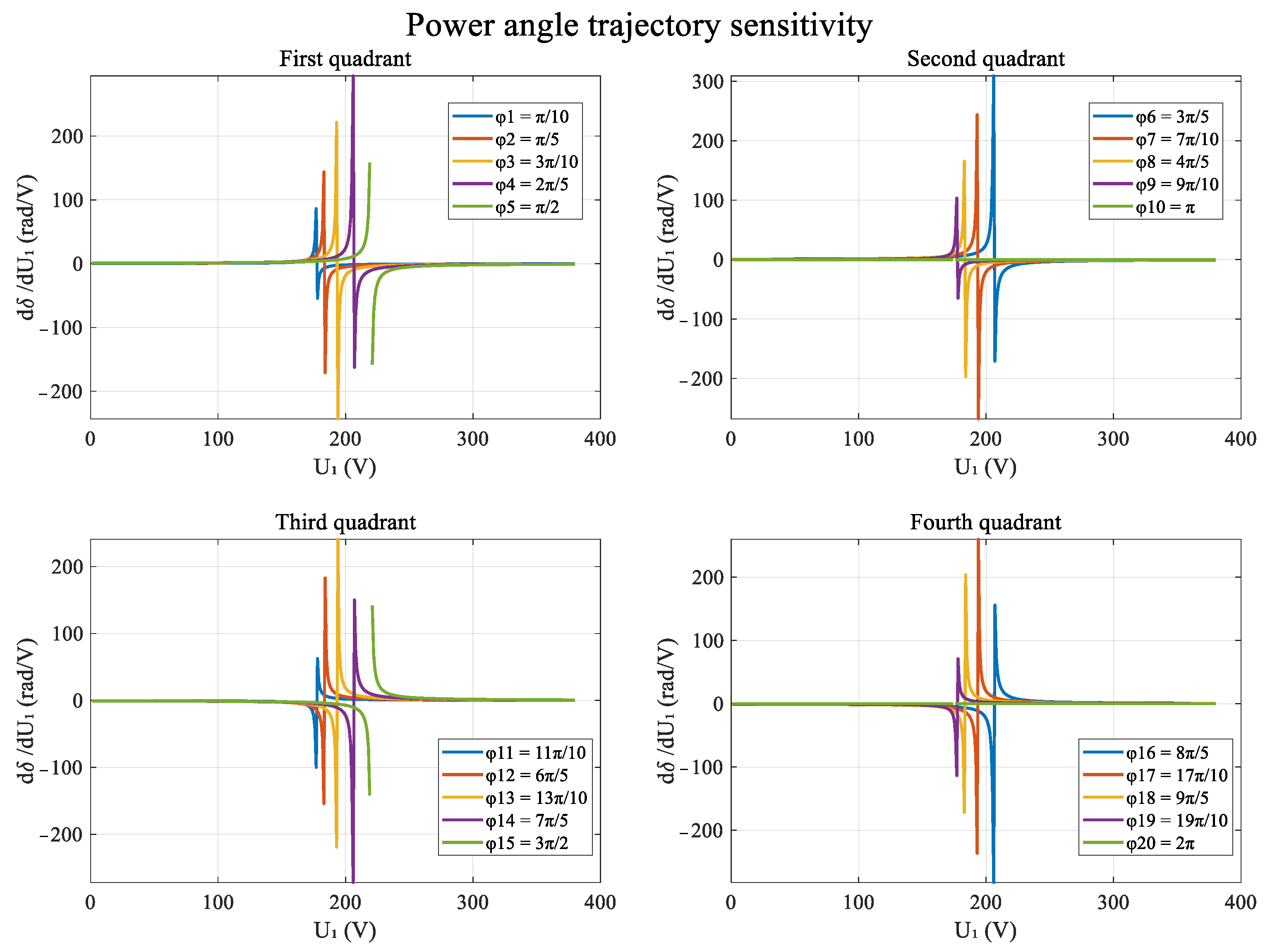
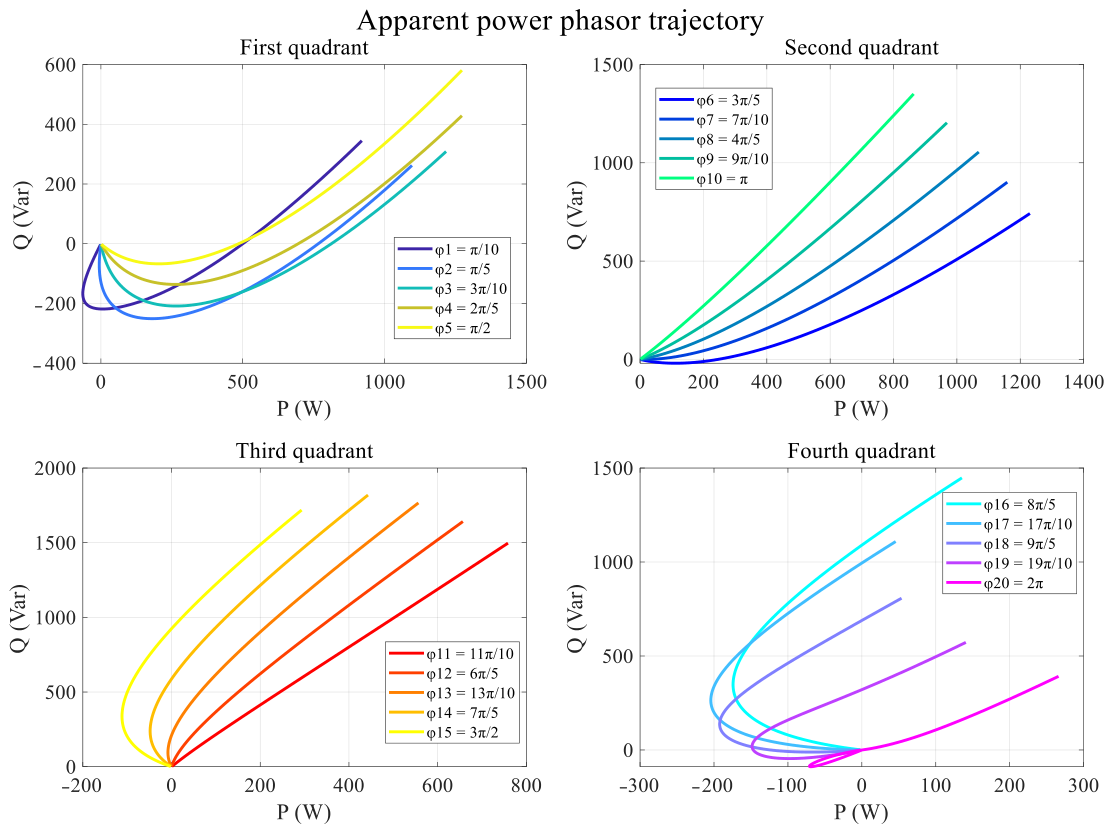
Taking the grid-forming inverter source voltage as the reference condition, the equivalent output impedance is configured as current-dependent according to the adopted equivalent impedance model. In the numerical evaluation, the line impedance is described by a series resistance and line inductance. The values and are adopted as nominal equivalent parameters to represent a high-impedance weak-grid equivalent condition in the reduced two-node model. This setting provides a stressed but fixed network condition for examining the APPT sensitivity trajectories during the voltage-sag sweep. In the Cartesian coordinate system, the voltage variation in the grid-forming inverter is analyzed by setting the phase angle of to values of , , …, , …, , . These are named in order of increasing phase angle as to . Based on the variation in the phase angle of in the Cartesian plane, the system is divided into four quadrants according to the quadrant distribution of the phase angles for comparison and analysis. The simulation models the grid condition where the voltage decreases gradually from to , extracting the changes in the grid’s stability-dominant characteristics.
Under the unified operating condition of the two-node model, the apparent power trajectory is first examined in the
Cartesian plane (
Figure 4). At the outer ends with high apparent power output, the distribution of power points remains nearly aligned with the base phasor, and the overall trajectory smoothly expands outward. The outward expansion is associated with sufficient voltage support of the system, where the influences of the power angle and impedance angle remain relatively weak. As the trajectory gradually converges toward the origin, the boundary begins to exhibit pronounced turning and folding characteristics. This trajectory folding indicates that the linear correspondence between terminal power and voltage becomes significantly weakened under deep voltage sags and suggests the need to further analyze the trajectory sensitivity to reveal the potential instability mechanism. The apparent power trajectory sensitivity in the
derivative plane is presented in
Figure 5. At the extended ends of the coordinate space, the sensitivity vectors exhibit a quasi-linear radial distribution. This quasi-linear distribution is consistent with the outward power expansion observed in
Figure 4. As the sensitivity curves evolve toward the highly coupled central region, the trajectories undergo pronounced distortion. The curves exhibit inward bending, hook-like intersections, and dense vortex-like clustering. This clustering behavior is consistent with the mathematical implication of Equation (19). According to the derivation, the state Jacobian determinant may approach zero during deep voltage sags. A near-zero Jacobian determinant weakens the uniqueness of the local response direction of the power flow. Strong cross-coupling among the system variables is reflected in the folding and abrupt variation in the sensitivity vectors.
The entangled geometric patterns make it difficult to directly distinguish the respective contributions of different state variables. To further clarify the regional characteristics associated with each variable, an asymptotic limit analysis is introduced. The subsequent analysis separately examines the trajectory sensitivities of the power angle, the receiving-end voltage, and the impedance angle.
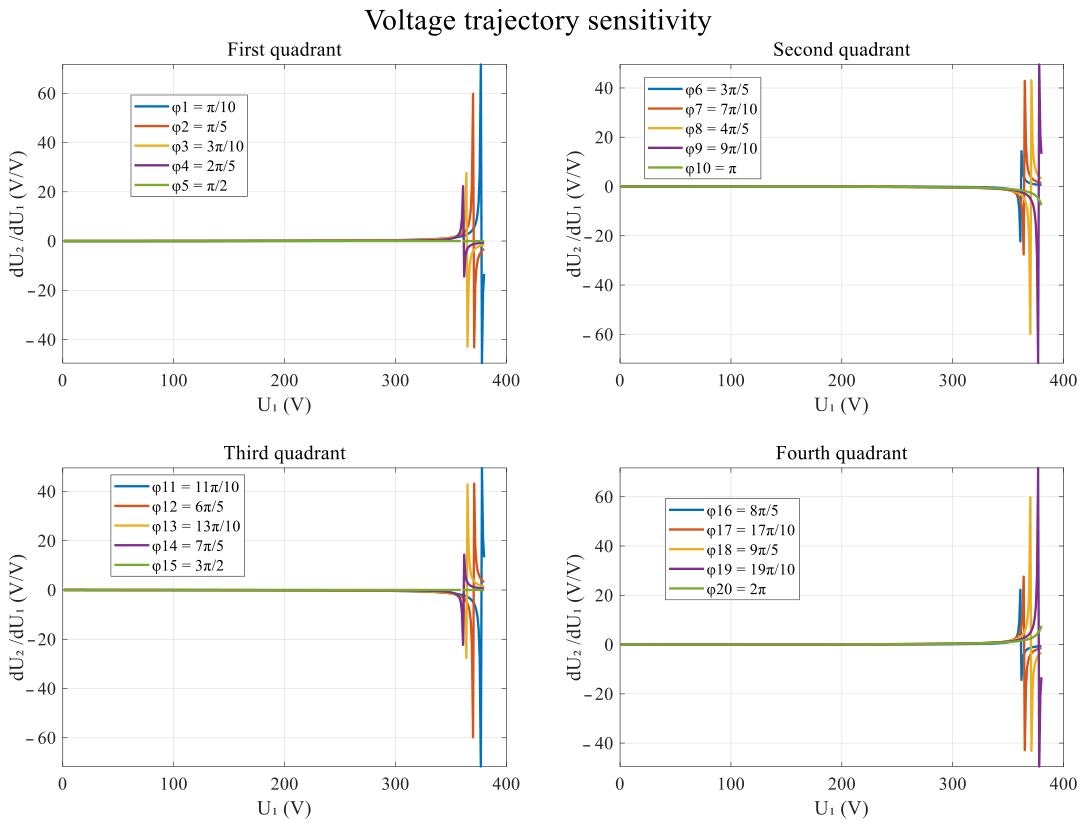
The receiving-end voltage trajectory sensitivity is presented in
Figure 6. The sensitivity curves exhibit pronounced fluctuations and spikes mainly within the
range. These high-voltage sensitivity peaks are associated with the
Q–
V-related limit discussed above. The power angle trajectory sensitivity is illustrated in
Figure 7. The sensitivity curves form localized spikes mainly within the
interval. The sensitivity amplification in this interval is consistent with the
P–
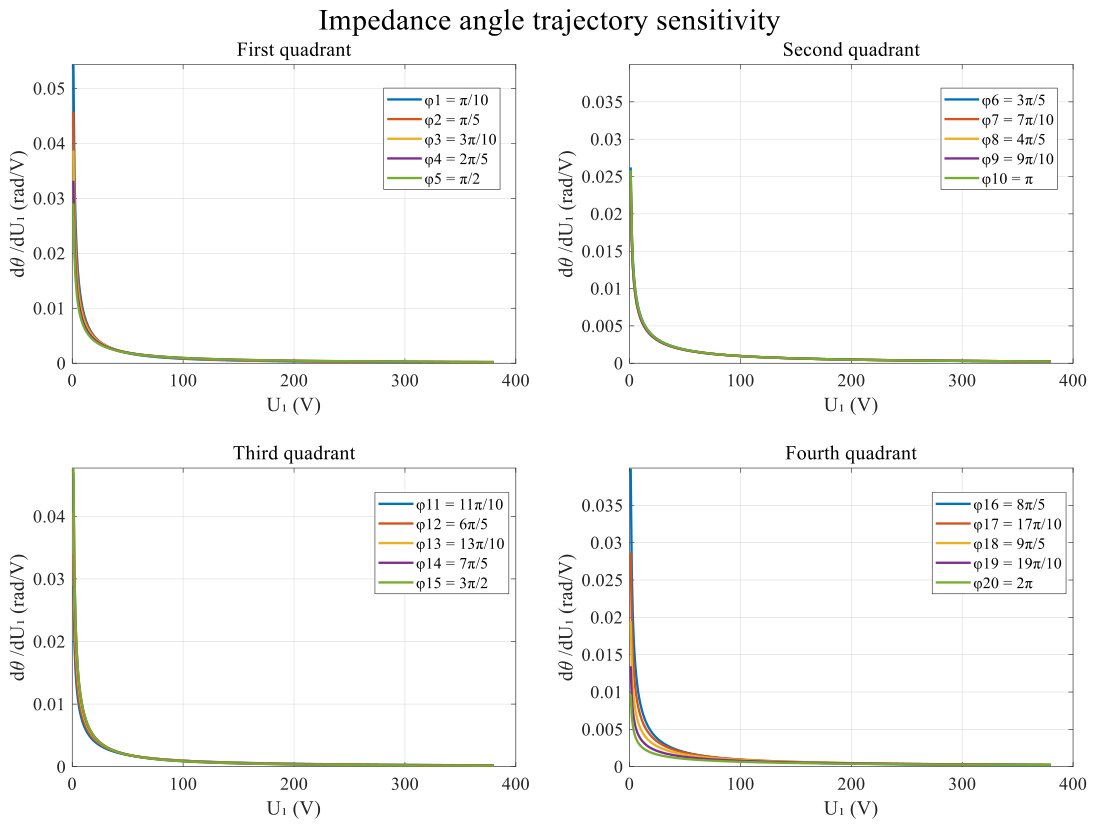
synchronization-related limit. The impedance angle trajectory sensitivity is displayed in
Figure 8. The sensitivity values increase sharply as
approaches the low-voltage region, especially below
. This low-voltage amplification is consistent with the impedance-expansion tendency described by the fractional-order relation. Overall, the distribution of sensitivity peaks over the voltage range indicates a staged transition among the prominent sensitivity components. The receiving-end voltage component is more evident in the high-voltage region, the power angle component becomes more pronounced in the intermediate-voltage region, and the impedance angle component is strongly reflected in the low-voltage region.
3.3. Proposed Dominant Instability Factor Identification Method
The above numerical observations indicate that the power angle, receiving-end voltage, and impedance angle exhibit distinct sensitivity characteristics across voltage regions, with clear differences in rates of change and inflection behavior. To provide a common comparative description of these three sensitivities, the trajectory distance is introduced in this subsection. Variations in the sensitivities of the power angle, receiving-end voltage, and impedance angle are mapped into a trajectory distance form, which is then used as the comparative parameter in the subsequent analysis.
Here,
,
, and
denote the trajectory distances of the power angle, the receiving-end voltage magnitude
, and the impedance angle, respectively, over a given variation segment in the trajectory sensitivity plane. For a variable
, a local trajectory segment is formed by two operating points,
and
, corresponding to the states before and after the variation in
. The trajectory distance is defined as the scalar length of this segment, so that the variations in different physical variables can be represented by a common geometric descriptor. The pairs
and
denote the terminal voltage
before and after the variation;
and
denote the power angle before and after,
and
denote the voltage magnitude
before and after, and
and
denote the impedance angle before and after. In the calculation of Equations (32)–(34), the voltage coordinates are expressed in per unit form based on a selected voltage base, while the angle-related variables
are expressed in radians. Thus, the obtained trajectory distances characterize normalized trajectory lengths rather than direct differences among heterogeneous physical quantities. This treatment provides a common numerical basis for comparing voltage- and angle-related trajectory variations under the adopted metric. The distances for the corresponding variation segments are computed using Equations (32)–(34), and the results are summarized in
Table 2.
The trajectory distances, namely the sensitivity-distance measures used in this study, differ markedly across operating conditions, and their evolution with step size follows distinct patterns. This indicates that parameter disturbances affect the power angle, receiving-end voltage, and impedance angle in different ways. On this basis, sensitivity characteristic indices are introduced, and the corresponding dominant factor criterion is established.
Similar to the synchronizing torque coefficient criterion and the practical static stability criterion in Ref. [
30], which determine operating conditions via proportional coefficients, the trajectory distance features extracted above are used as dominant factor identification parameters. Based on the trajectory distance definitions in Equations (32)–(34), the characteristic quantities
,
, and
are introduced. These characteristic quantities are obtained by normalizing the corresponding trajectory distance features with their total
p-norm magnitude. Consequently,
,
, and
serve as dimensionless relative contribution indices, where a larger value indicates a stronger trajectory response of the corresponding variable under the same variation segment. The characteristic quantities corresponding to the power angle, the receiving-end voltage
, and the impedance angle are calculated using the
p-order Minkowski norm [
31]. The detailed normalization expressions are provided in
Appendix A to keep the main text concise.
Here,
,
,
,
,
, and
represent the coordinates of the variables in the parameter sensitivity plane. The parameter
p represents the order of the Minkowski distance norm. In this study, a higher-order norm is selected with
to emphasize the component with the largest relative variation while reducing the influence of weaker components. This formulation behaves similarly to a smooth max-pooling operation and indicates that the characteristic quantity (
,
, or
) approaching one corresponds to the variable with the largest relative variation under the adopted metric. Furthermore, by comparing the magnitudes of the three characteristic quantities, the largest one is selected as the dominant factor, which allows the dominant instability factor at the operating point to be determined. The criterion is defined as follows:
When
reaches the maximum value, the operating condition is interpreted as a power angle-related dominant instability tendency under the adopted metric. When
reaches the maximum value, the operating condition is interpreted as a voltage-related dominant instability tendency. When
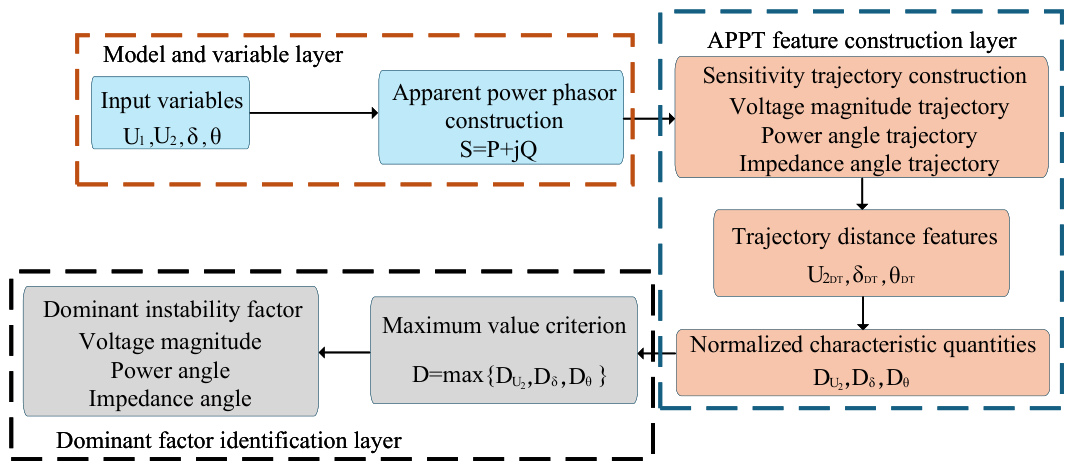
reaches the maximum value, the operating condition is interpreted as an impedance angle-related dominant instability tendency. To provide an overall view of the proposed criterion, the general framework of the APPT-based dominant instability factor identification method is illustrated in
Figure 9.
For clarity, the computational steps of the APPT-based dominant instability factor criterion are summarized in Algorithm 1.
| Algorithm 1 Computational steps of the APPT-based dominant instability factor criterion |
| Input: , , , and over the considered operating points.
|
| Output: Dominant instability factor.
|
| 1. Construct the Apparent Power Phasor Trajectory from the active and reactive power relations of the adopted equivalent model.
|
| 2. Obtain the sensitivity trajectories corresponding to the receiving-end voltage magnitude, power angle, and impedance angle.
|
| 3. Map the variations in the three sensitivity trajectories into the trajectory distance features , , and .
|
| 4. Normalize the trajectory distance features according to the adopted p-norm formulation to obtain the characteristic quantities , , and .
|
| 5. Compare , , and according to the maximum-value criterion. If is the largest, the voltage magnitude is regarded as the dominant instability factor; if is the largest, the power angle is regarded as the dominant instability factor; if is the largest, the impedance angle is regarded as the dominant instability factor.
|
| 6. Return the dominant instability factor.
|
The APPT criterion is mainly based on algebraic calculations of macroscopic terminal variables. Therefore, after the required trajectories are obtained, the dominant instability factor can be identified through trajectory distance construction, normalization, and maximum-value comparison with a relatively low computational burden.
The following section performs the simulation verification of the theoretical criterion.
4. Simulation Verification
The simulation section includes four cases with different verification roles. The two-node parameter-continuation studies examine the staged variation in APPT indicators along two source-voltage perturbation directions. The dynamic Kundur four-machine two-area case evaluates the tracking behavior of the proposed criterion under multi-stage disturbances and reports quantitative consistency and robustness results. The IEEE 39-bus system case examines the extension of the APPT logic through selected source-receiver observation channels in a meshed benchmark system. The Simulink-based case is used as supplementary waveform observation under a GFL inverter topology.
4.1. Two-Node Parameter-Continuation Studies
Two parameter-continuation studies are conducted on the two-node equivalent model to evaluate the APPT indicators along different source-voltage variation directions. The equivalent impedance magnitude of the grid-forming inverter follows (7). The line equivalent impedance is set as and . For each voltage step, the coupled nonlinear algebraic equations of the steady-state circuit and the state-dependent inverter impedance model are solved by a fixed-point iteration. The convergence tolerance is set to . The voltage sweep is stopped at to avoid numerical singularity near the zero-voltage limit. These cases are parameter-continuation numerical tests rather than physical fault simulations.
4.1.1. Real-Axis Source-Voltage Sweep
In the first sweep, the real component of
decreases from
to
, while the imaginary component remains fixed.
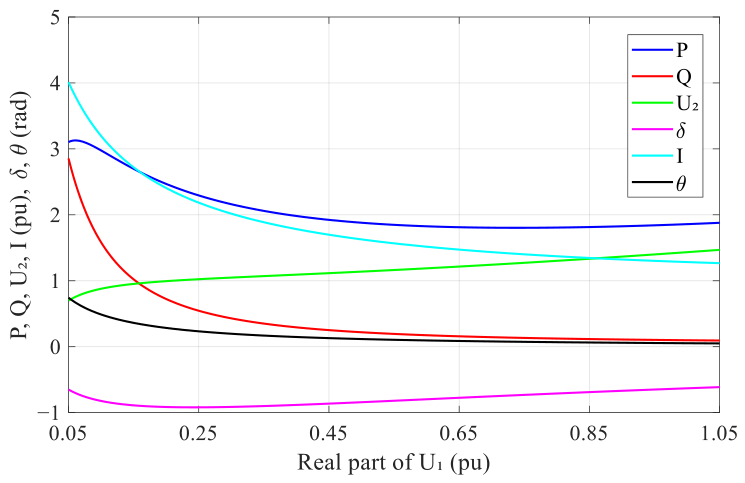
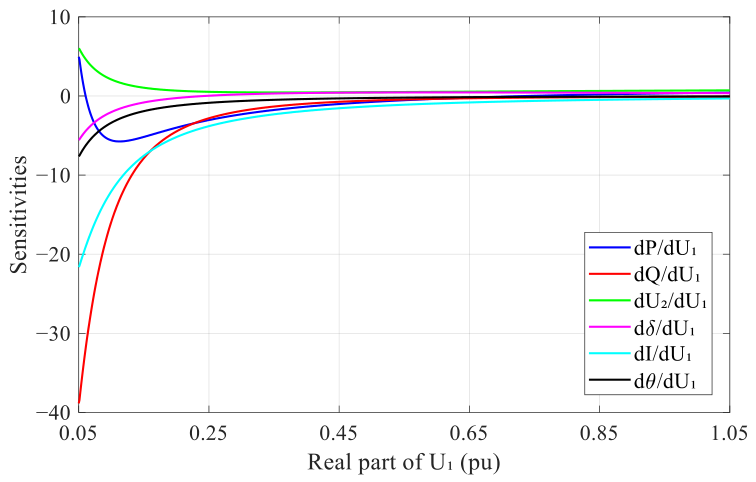
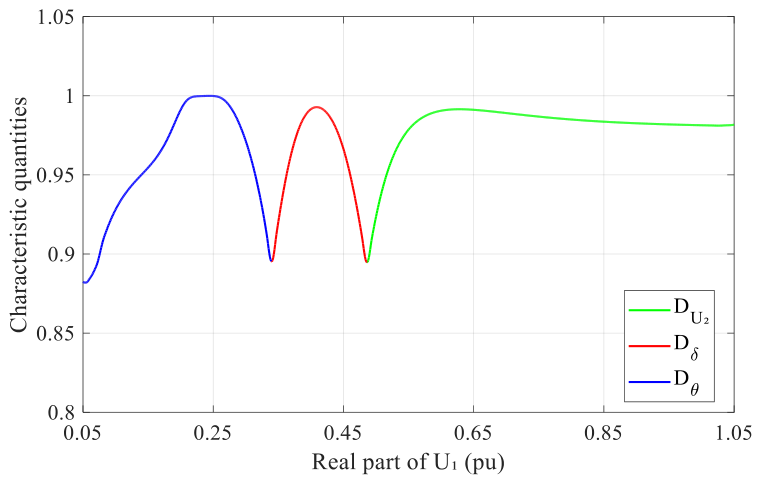
Figure 10,
Figure 11 and
Figure 12 show the operating variables, sensitivity curves, and dominant intervals, respectively.
In the high-voltage region,
changes slowly, and
P,
Q,
I, and
vary smoothly. The sensitivities in
Figure 11 remain small in this region. The voltage-related indicator
is therefore dominant in
Figure 12.
As the real component of
decreases further,
and active power attenuate more evidently, while the power angle increases. The magnitude of
also increases in
Figure 11. The dominant interval in
Figure 12 then shifts to the power angle-related indicator
.
Near the low-voltage end, the current and impedance angle increase rapidly, and
drops sharply. The impedance angle sensitivity becomes the dominant sensitivity component. Accordingly, the APPT result in
Figure 12 switches to
in the low-voltage region. The real-axis sweep therefore gives a staged dominant factor sequence from
to
and then to
.
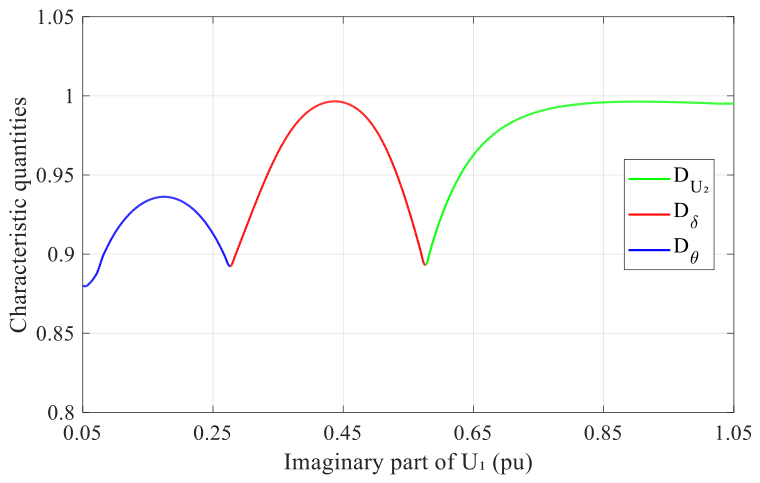
4.1.2. Imaginary-Axis Source-Voltage Sweep
In the second sweep, the real component of
is kept constant, while the imaginary component decreases from
to
. The same fixed-point iteration and convergence tolerance are used. This sweep provides a complementary test under another source-voltage variation direction.
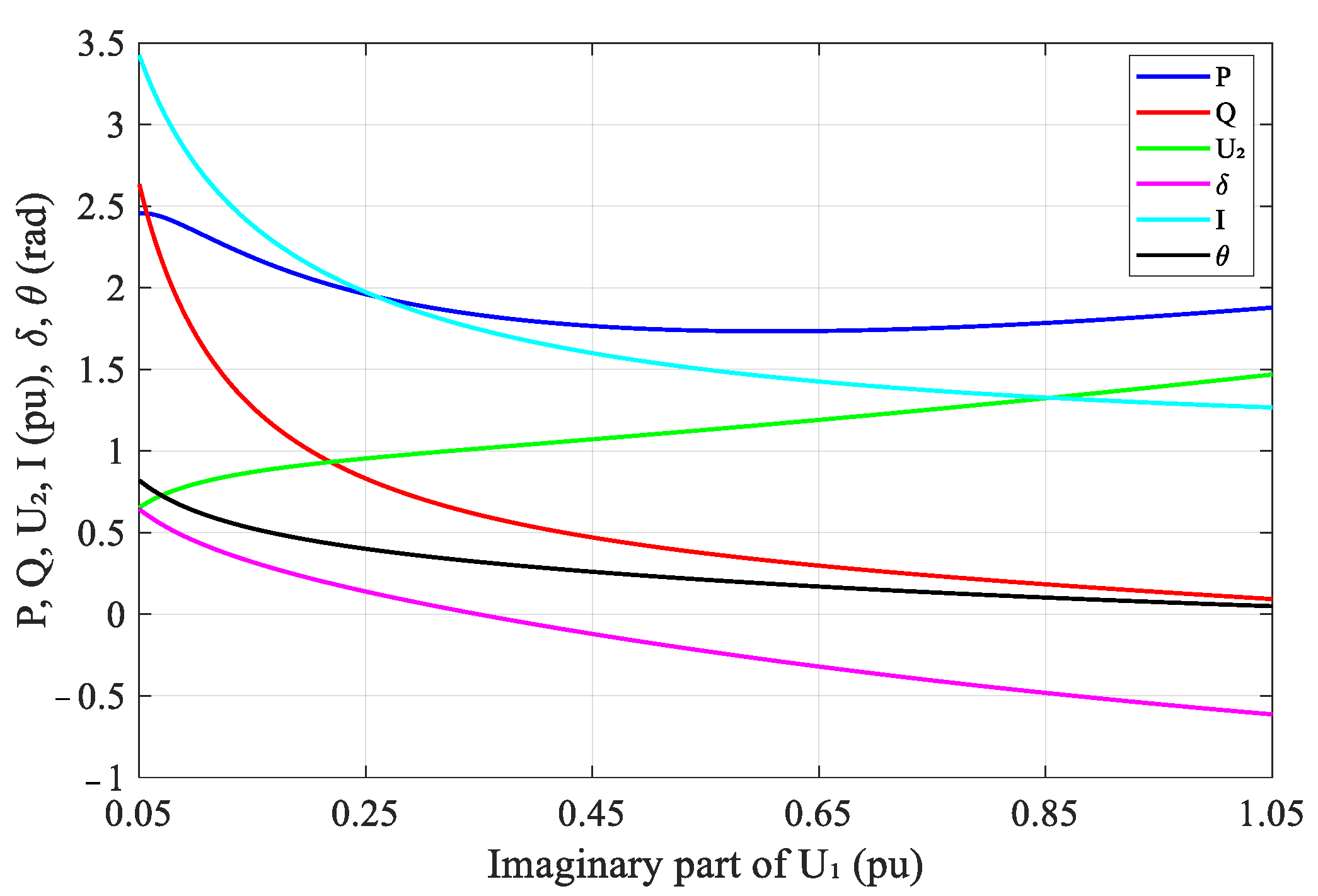
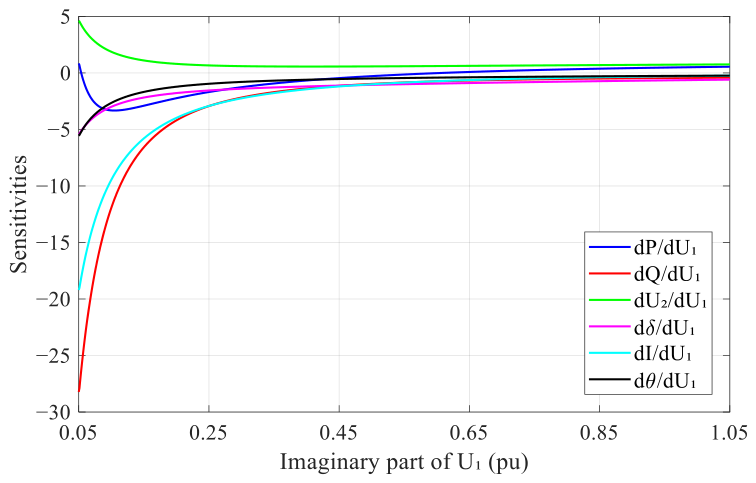
Figure 13,
Figure 14 and
Figure 15 show the corresponding operating variables, sensitivity curves, and dominant intervals.
In the high-voltage region,
,
P, and
Q vary smoothly. The current, power angle, and impedance angle also show no abrupt change. The sensitivities in
Figure 14 remain moderate, and the voltage-related indicator
is dominant in
Figure 15.
In the intermediate region, the power angle varies more rapidly. The power angle sensitivity increases in
Figure 14, and the dominant interval in
Figure 15 shifts to
.
As the imaginary component approaches the low-voltage limit, the current and impedance angle increase markedly, and
decreases significantly. The impedance angle-related response becomes dominant, and
Figure 15 shows a final transition to
. This result confirms that the staged transition among
,
, and
is not limited to the real-axis perturbation direction.
4.2. Dynamic Kundur Four-Machine Two-Area Case
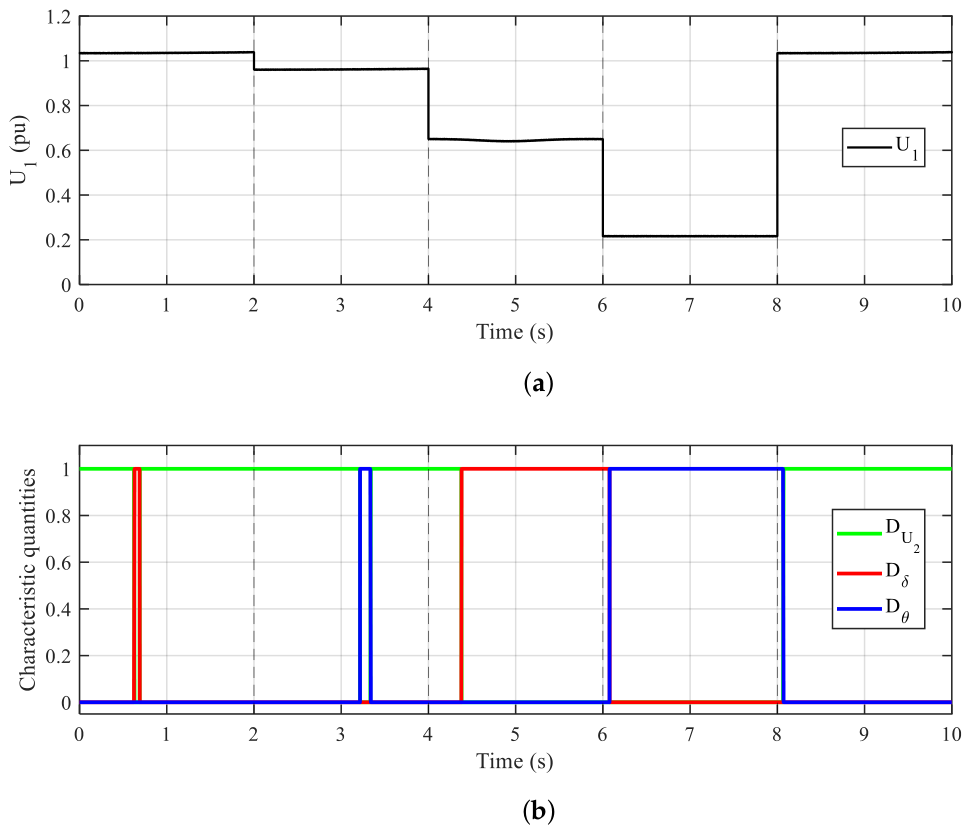
To further evaluate the proposed APPT method under a representative dynamic benchmark scenario, a 10 s multi-stage simulation is performed on a dynamic equivalent model of the Kundur four-machine two-area system. This case introduces sequential disturbance stages to examine the dynamic tracking behavior of the proposed identification criterion.
As shown in
Figure 16a, the sending-end voltage magnitude exhibits five distinct operating stages. The system first operates near
during 0–
. Then, the voltage decreases to approximately
during
–
after a shunt-admittance step. During
–
, a mechanical-power step-up with
is introduced under a low-inertia setting of
, and the voltage further decreases to approximately
. During
–
, the system enters an extreme low-voltage stage around
due to nonlinear current-limiting evolution with the phase-locked loop (PLL) state held constant in the numerical model. After
, the imposed disturbances are removed, and the system recovers toward the nominal voltage level.
In this numerical case, the APPT indicators are obtained from the simulated time-domain trajectories generated by the dynamic equivalent model. A one-sided post-processing routine is used, including low-pass smoothing, local polynomial differentiation, impulse suppression, deadzone processing, and debounce confirmation. The statistical intervals exclude the transition margins introduced by the above numerical processing. The selected intervals are
–
,
–
,
–
,
–
, and
–
. The corresponding APPT indicators are shown in
Figure 16b.
As summarized in
Table 3, the stage-wise consistency ratios for the initial
,
, and
stages are
,
, and
, respectively. The consistency ratio reaches
during both the extreme current-limiting stage around
and the disturbance-removal recovery stage. The overall consistency ratio is
under the adopted numerical post-processing procedure. These results indicate that the APPT indicators exhibit stable stage-dependent switching behavior during the multi-stage dynamic disturbance process.
Additional numerical robustness results are reported in
Table 4. The no-noise reference case gives an overall accuracy of
. Under the simulated measurement-noise case with
, the accuracy is
. When the selected model parameters are scaled by
, the accuracy remains
. Under a
synchronization mismatch, the overall accuracy decreases to
. These results indicate that the APPT identification result remains stable under mild noise and parameter perturbation, while synchronization mismatch has a more visible influence on the identification accuracy.
4.3. IEEE 39-Bus System Case
The IEEE 39-bus New England system is used as a multi-bus benchmark to examine the network-level applicability of the APPT identification logic. The preceding derivation is established from a two-node equivalent representation. In a meshed multi-bus network, this logic can be applied through selected source-receiver observation channels, where the surrounding network is reflected in the local voltage, power angle, and equivalent impedance angle trajectories.
The basic network data follow the standard MATPOWER case39 benchmark, including the branch parameters, transformer tap ratios, solved bus voltages, generator operating points, and load data. A simplified ZIP load model is adopted, where the constant-impedance, constant-current, and constant-power components account for 40%, 30%, and 30%, respectively.
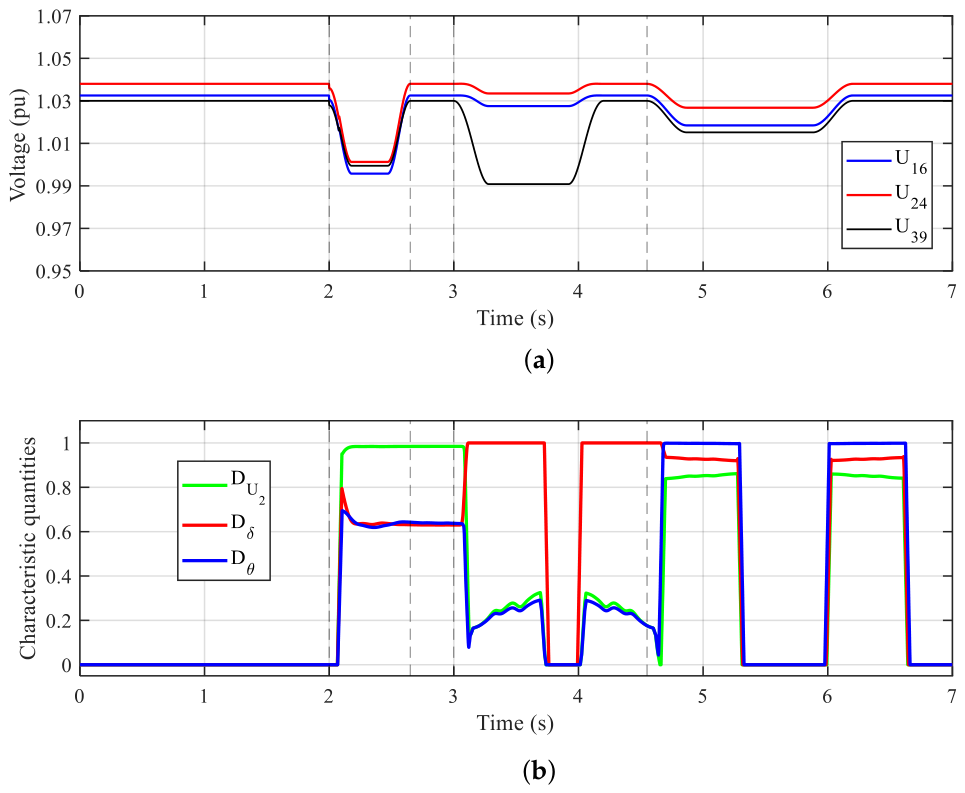
Four source-receiver observation channels are selected, namely Bus 39–Bus 16, Bus 31–Bus 16, Bus 39–Bus 24, and Bus 30–Bus 16. For each channel, the APPT characteristic quantities are calculated from the corresponding , , , and . These channels are used to examine whether the APPT characteristic quantities remain distinguishable and interpretable in a meshed multi-bus network. Since different electrical areas may respond differently to the imposed stresses, the system-level APPT characteristic quantities are obtained by taking the maximum continuous response among the selected channels. The network-level numerical stress sequence consists of three intervals. During –, a local voltage-related network stress is applied around the Bus 16 area. During –, a bounded phase-angle perturbation is introduced at the source side. During –, a local equivalent impedance variation is imposed around the Bus 16–Bus 24 area. These perturbations provide different network operating conditions for evaluating the APPT characteristic quantities in the IEEE 39-bus benchmark.
Figure 17a shows the representative voltage trajectories of Bus 16, Bus 24, and Bus 39. The voltage responses present clear stage-dependent variations under the imposed network stresses. The corresponding system-level APPT characteristic quantities are shown in
Figure 17b. The voltage-related indicator
is more prominent in the first interval, while the power angle-related indicator
increases during the phase-angle perturbation interval. In the third interval, the impedance angle-related indicator
becomes evident under the local equivalent impedance variation.
4.4. Supplementary Simulink-Based Waveform Observation
To complement the preceding APPT-based numerical evaluations, a supplementary time-domain waveform observation is conducted using a standard grid-following (GFL) inverter model in MATLAB/Simulink R2024a. This case provides waveform-level evidence under a practical inverter topology, while the APPT method is used to interpret the observed waveform deterioration from the perspectives of the voltage magnitude, power angle, and impedance angle. To avoid redundant presentation, voltage setpoints with similar waveform characteristics are summarized together, and only representative waveforms are retained for illustration.
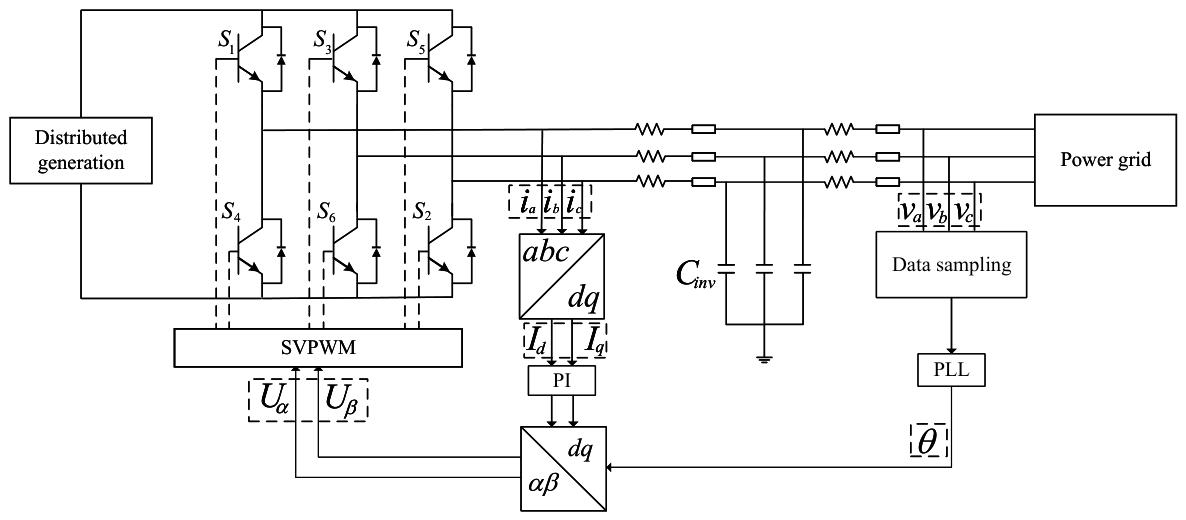
The simulation topology is shown in
Figure 18. The model consists of a distributed generation source, a three-phase voltage-source inverter, an LCL filter, a grid-side connection, and a standard GFL control structure with PLL synchronization and PWM modulation.
The line-to-line RMS voltage setting is treated as the equivalent grid input voltage, and seventeen voltage setpoints from to are tested. The controller parameters are kept unchanged in all cases. To observe the waveform evolution under severe voltage-stress conditions, the under-voltage tripping protection is not included. The point of common coupling (PCC) voltage is recorded for waveform-level analysis, with attention to envelope evolution, phase behavior, crest clipping, and interharmonic components.
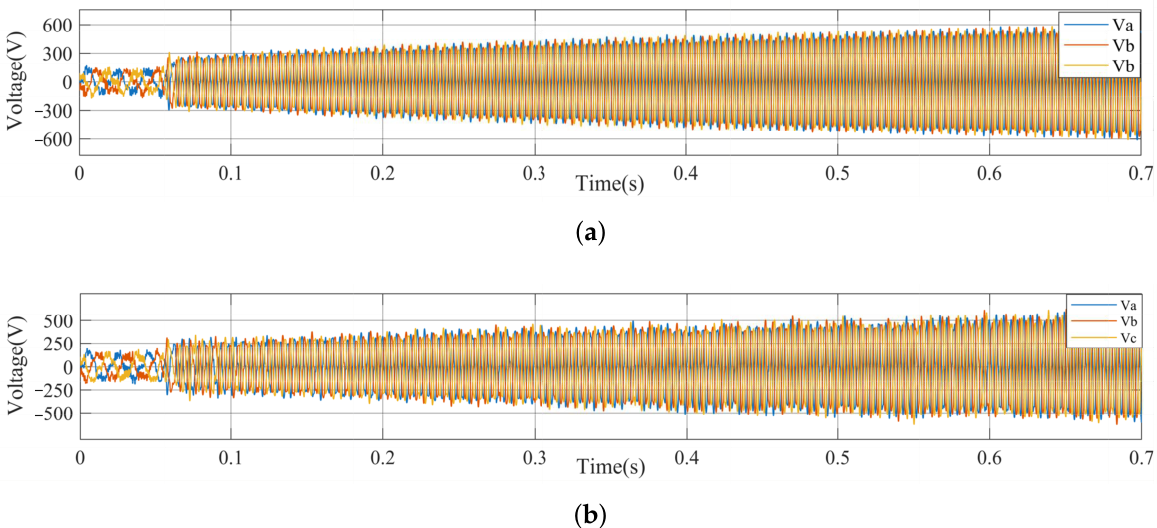
At , an initial transient appears at approximately –. After this interval, the voltage waveform develops sustained oscillatory distortion, with an expanding low-frequency envelope and increasing peak magnitude. Peak clipping and visible waveform distortion are also observed. During –, the oscillation still maintains a large amplitude without evident convergence. Consistent with these waveform features, the average three-phase PCC voltage total harmonic distortion (THD) calculated over the – observation window is , which further quantifies the severe waveform deterioration observed in this supplementary Simulink case.
In comparison, at , a milder initial transient also appears at approximately –. The envelope then expands more slowly, while the overall sinusoidal structure is partially retained. Compared with the case, the oscillation amplitude remains lower, and the waveform distortion is less severe. These waveform features indicate that the system is still affected by sustained oscillatory behavior, but does not clearly recover to a stable sinusoidal state within the observation window.
According to the APPT result illustrated in
Figure 19, the equivalent grid voltages of
and
are located in the deep low-voltage region associated with impedance angle-dominated instability. The waveform observations provide supplementary support for this impedance angle-dominated tendency. The
case exhibits more pronounced envelope growth and waveform distortion, suggesting higher instability severity than the
case.
Under
,
,
, and
operating conditions, the three-phase PCC voltages quickly become balanced sinusoidal waveforms after startup. The voltage amplitudes remain nearly constant, the phase sequence is stable, and no obvious envelope expansion or waveform distortion is observed. These features indicate that the system operates in a stable region under these voltage conditions. Since the four cases exhibit similar stable responses, only the
case is shown in
Figure 20 as a representative waveform.
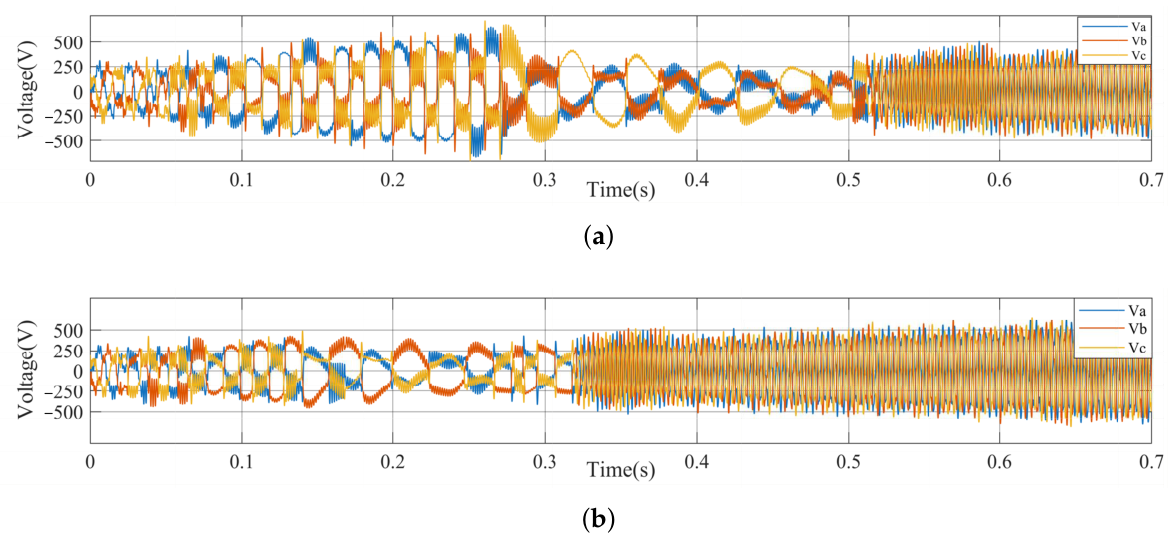
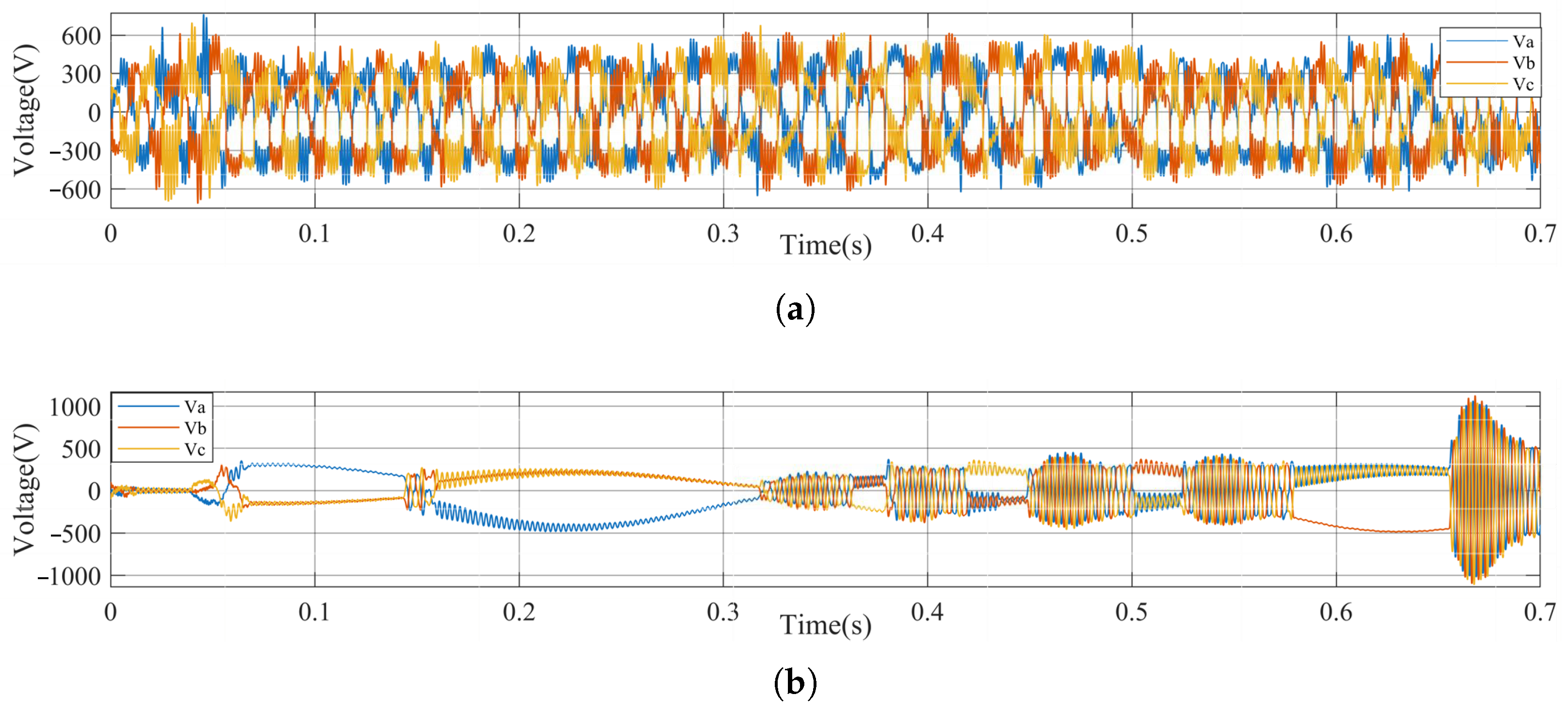
Under , phasors are established over approximately –, accompanied by evident phase drift and local phase jumps. During –, a low-frequency envelope develops, and the voltage amplitude exhibits periodic dilation and compression. From to , the phase distortion becomes more pronounced. Subsequently, over –, the waveform remains in a non-decaying oscillatory state, indicating weakened synchronization behavior under this operating condition.
As shown in
Figure 21, under
, a similar but weaker early-stage adjustment also occurs over approximately
–
, but its magnitude is smaller than that observed at
. During
–
, the three-phase sinusoidal structure is better preserved than in the
case. Thereafter, over
–
, the waveform gradually enters a continuous oscillatory response. Its overall amplitude remains lower than that of the
case, but no evident decay is observed toward the end of the simulation. The persistent phase drift, local phase jumps, and intermittent phase slips observed in these intervals indicate power angle-related oscillatory characteristics.
Accordingly, both the and cases correspond to power angle-dominated unstable conditions. The case enters instability earlier and exhibits more severe waveform distortion, whereas the case is relatively alleviated but still shows a non-convergent oscillatory response.
For the voltage setpoints from 280 to
, the PCC voltage waveforms exhibit similar stable characteristics. The three-phase voltages remain balanced, with nearly constant amplitudes and stable phase sequences throughout the observation window. No obvious envelope expansion, crest clipping, flat-top distortion, or sustained waveform distortion is observed. Since these waveforms show highly similar macroscopic features, only the representative waveform at the nominal
condition is plotted in
Figure 22 to avoid redundant presentation.
Under , during –, the three-phase voltages exhibit a persistent low-frequency envelope with alternating surges and dips. Zero-crossing jitter can be observed, while the overall amplitude remains within a moderate range. During –, the envelope expands gradually without clear convergence, and localized mild crest clipping appears. These waveform characteristics indicate a voltage-related oscillatory response with limited amplitude recovery under this operating condition.
Under , the waveform variation becomes more pronounced. Clustered wave packets appear during –. Between and , the packet spacing shortens, and the amplitude increases step by step. During –, the envelope expands more rapidly, accompanied by observable clipping and wave-group merging, and the waveform develops into a large-amplitude oscillatory response. Compared with the case, the instability at appears earlier, and the waveform distortion is more severe.
Accordingly, both the
and
cases correspond to voltage-related unstable conditions. The
case shows stronger envelope expansion and more severe waveform distortion than the
case (see
Figure 23).
4.5. Applicability Scope and Future Validation
Although the proposed APPT method has been evaluated under representative numerical and waveform-level conditions, further validation is still required before online deployment. The present derivation is based on a two-node equivalent model, and the multi-bus extension is implemented through selected source-receiver observation channels. Therefore, large-scale converter-dominated systems with dense inverter interactions, heterogeneous control strategies, weak grid connections, and stochastic renewable fluctuations remain to be further investigated.
For a future online implementation, reliable synchronized measurements and phasor estimation would be required, while the input signals may be affected by sensor noise, sampling asynchronism, communication delay, time-alignment errors, and online parameter estimation uncertainty in practical measurement environments. Therefore, further deployment studies should consider measurement filtering, time-alignment correction, abnormal data screening, and reliability assessment before the APPT indicators are introduced into online monitoring. With fixed filtering and differentiation windows, the computational load of the APPT is approximately for N samples and C selected observation channels.
The current Simulink case is used only as supplementary waveform observation, rather than a real-time implementation of the APPT method. Real-time validation remains outside the scope of the present work. Future studies may further examine the response time, latency, and robustness of the APPT under practical measurement conditions when suitable real-time simulation or measurement-based data are available.
This method will also be further extended to renewable-rich systems with multiple GFM and GFL converters, rapidly changing operating points, and multi-inverter interactions. In this extension, software-defined smart grid architectures can provide references for distributed measurement and local data processing [
15], while feature-based intelligent fault identification can support the design of interpretable diagnostic rules [
16]. These studies may support future APPT applications in real-time monitoring and engineering deployment.