Systematic Review

Advances in Hybrid Evolutionary–Fuzzy Systems for Optimization and Intelligent Decision-Making Under Uncertainty: A Systematic Review


by
Hugo Martínez Ángeles
,
Cesar Augusto Navarro Rubio
*,
José Gabriel Ríos Moreno
*,
José Luis Reyes Araiza
,
Roberto Valentín Carrillo-Serrano
,
Mariano Garduño Aparicio
,
Ivan Gonzalez-Garcia
and
Mario Trejo Perea
*
Facultad de Ingeniería, Universidad Autónoma de Querétaro, Santiago de Querétaro 76010, Mexico
*
Authors to whom correspondence should be addressed.
Mathematics 2026, 14(12), 2056; https://doi.org/10.3390/math14122056 (registering DOI)
Submission received: 15 May 2026 / Revised: 31 May 2026 / Accepted: 8 June 2026 / Published: 9 June 2026

Abstract

Hybrid Evolutionary–Fuzzy Systems (HEFS) have emerged as a powerful computational paradigm for addressing complex engineering optimization and intelligent decision-making problems under uncertainty. This study presents a systematic review, conducted following the PRISMA 2020 methodology, to analyze advancements in the integration of evolutionary algorithms, swarm intelligence, fuzzy logic, and Multi-Criteria Decision-Making (MCDM) techniques over the period 2020–2026. The analysis focuses on identifying key algorithmic mechanisms, hybridization strategies, performance metrics, and application domains. The results indicate that HEFSs significantly enhance optimization performance by balancing exploration and exploitation, improving robustness, and enabling adaptive and interpretable decision-making in uncertain and multi-objective environments. In particular, fuzzy systems contribute to effective uncertainty modeling and interpretability, while evolutionary and metaheuristic algorithms provide strong global search capabilities. Despite these advantages, important challenges remain, including high computational complexity, scalability limitations, and the trade-off between accuracy and interpretability. The review also identifies emerging research directions involving Explainable Artificial Intelligence (XAI), deep learning integration, digital twins, and big-data-enabled optimization. However, the reviewed evidence suggests that these technologies should currently be interpreted as promising but still evolving extensions, whose maturity and large-scale validation remain heterogeneous across application domains.

1. Introduction

In recent years, the increasing complexity of engineering systems and decision-making environments has driven the development of advanced computational approaches capable of addressing nonlinear, uncertain, and multi-objective problems [1,2,3]. Traditional optimization methods often struggle to efficiently handle high-dimensional search spaces, conflicting objectives, and incomplete or imprecise information, which are common in real-world applications such as energy systems, manufacturing processes, transportation networks, and healthcare decision support [4].
To overcome these limitations, hybrid intelligent systems have emerged as a powerful paradigm that integrates evolutionary algorithms, swarm intelligence, and fuzzy logic [5]. Evolutionary algorithms and metaheuristic techniques, such as Genetic Algorithms (GA) and Particle Swarm Optimization (PSO), provide strong global search capabilities and flexibility in exploring complex solution spaces [6]. However, these approaches may suffer from issues such as premature convergence, sensitivity to parameter tuning, and limited interpretability [7]. In contrast, fuzzy systems offer a robust framework for modeling uncertainty and incorporating human-like reasoning through linguistic variables and rule-based inference mechanisms, although they often rely on expert knowledge and may face scalability challenges [8].
From a theoretical perspective, evolutionary computation is grounded in population-based adaptive search processes inspired by natural selection, mutation, recombination, and collective intelligence mechanisms [9]. These approaches are particularly valued for their ability to balance exploration and exploitation in nonlinear, multimodal, and constrained optimization landscapes, making them suitable for complex engineering problems under uncertainty [10].
Fuzzy logic provides a complementary paradigm for representing vagueness, imprecision, and linguistic uncertainty through membership functions and rule-based inference systems [11]. Beyond uncertainty modeling, fuzzy methodologies contribute interpretability and human-readable decision structures, which are particularly relevant in decision-support and intelligent control applications [12].
The integration of these methodologies into Hybrid Evolutionary–Fuzzy Systems (HEFS) enables the combination of global optimization capabilities with adaptive and interpretable decision-making mechanisms [13]. These systems have demonstrated significant potential in addressing complex engineering problems by balancing exploration and exploitation, improving robustness, and enhancing adaptability under uncertainty [14]. Furthermore, the incorporation of MCDM techniques, such as the Analytic Hierarchy Process (AHP) and Technique for Order Preference by Similarity to Ideal Solution (TOPSIS), extends the applicability of HEFS to decision support scenarios where multiple conflicting criteria must be considered simultaneously [15].
From a decision-theoretic perspective, MCDM methodologies provide structured mechanisms for evaluating alternatives under multiple conflicting criteria [16]. Their integration within hybrid optimization frameworks enables the simultaneous consideration of performance, uncertainty, preference structures, and trade-offs across complex engineering decision environments [17].
Despite the growing body of literature on evolutionary algorithms, fuzzy systems, and hybrid intelligent approaches, existing studies often focus on isolated methodologies or specific application domains [18]. As a result, there is a lack of a unified and systematic perspective that integrates optimization performance, uncertainty modeling, interpretability, and emerging technological trends within a single analytical framework [19]. Additionally, challenges related to computational complexity, scalability, and the trade-off between accuracy and interpretability remain insufficiently addressed [20].
Therefore, this research seeks to address the following questions:
  • What recent advancements (2020–2026) have been achieved in HEFS, and how do these approaches improve optimization performance, robustness, and computational efficiency in complex engineering applications?
  • How can evolutionary algorithms, swarm intelligence, and fuzzy-based systems be systematically integrated and classified to establish a unified framework for hybrid intelligent systems?
  • To what extent do hybrid evolutionary–fuzzy approaches enhance the balance between exploration and exploitation, and how does this influence convergence behavior, solution quality, and computational cost under uncertainty?
  • What are the key limitations, research gaps, and emerging technological trends that will shape the future development of scalable, interpretable, and energy-efficient hybrid intelligent systems?
The objective of this study is to conduct a systematic review, following PRISMA 2020 methodology (Preferred Reporting Items for Systematic Reviews and Meta-Analyses) [21], to analyze the theoretical foundations, algorithmic mechanisms, performance characteristics, and application domains of HEFS. This review aims to provide a comprehensive framework that integrates optimization techniques, uncertainty modeling, and MCDM, thereby supporting the development of intelligent and scalable solutions for complex engineering problems.
The novelty of this review lies in its unified analytical framework rather than in the enumeration of isolated techniques. Whereas prior reviews typically address evolutionary optimization, fuzzy modeling, hybrid AI, or Multi-Criteria Decision-Making (MCDM) separately or through limited pairwise integrations, the present work introduces an explicit conceptual integration of four dimensions that are usually analyzed independently: optimization performance, uncertainty modeling, interpretability, and scalability. This integration is used to comparatively analyze Hybrid Evolutionary–Fuzzy Systems across methodologies, application domains, and emerging technological developments.
The scope of this review is intentionally centered on Hybrid Evolutionary–Fuzzy Systems (HEFS), understood as approaches that explicitly integrate evolutionary or metaheuristic optimization mechanisms with fuzzy-based uncertainty modeling, adaptive reasoning, or decision-support components. Technologies such as Explainable Artificial Intelligence (XAI), deep learning integration, digital twins, and big-data-enabled optimization are considered only insofar as they interact with, extend, or contextualize the ongoing evolution of HEFS research, rather than as independent review domains.
Likewise, this paper is organized as follows. Section 1, presents the theoretical background of evolutionary algorithms, fuzzy systems, and MCDM approaches. Section 2, describes the systematic review methodology, including the search strategy, selection criteria, and data extraction process. Section 3, presents the main findings, including the classification of methods, algorithmic mechanisms, performance comparisons, and application domains. Section 4, provides a comprehensive discussion of the results, highlighting key insights, limitations, and research implications. Finally, Section 5, summarizes the main conclusions of the study and outlines future research directions in HEFS.

2. Materials and Methods

2.1. Mathematical Formulation of HEFS

This subsection presents the fundamental mathematical formulations underlying HEFS, including evolutionary optimization, fuzzy inference mechanisms, and multi-objective decision-making frameworks. These formulations establish the theoretical foundation for modeling uncertainty, optimization processes, and intelligent decision-making in complex engineering systems.
It is important to note that these formulations are not intended for direct experimental implementation, but rather to provide a unified mathematical framework that supports the analytical discussion and comparative evaluation presented throughout this review.

2.1.1. Evolutionary Optimization Model

Evolutionary algorithms [22,23] aim to optimize an objective function defined as:
min x f ( x )
subject to:
g i ( x ) 0 , i = 1 , , m , h j ( x ) = 0 , j = 1 , , p , x Ω
where x represents the decision variables, Ω denotes the feasible search space, and  g i , h j correspond to inequality and equality constraints, respectively.
In multi-objective optimization problems [24], the objective is defined as:
min x F ( x ) = f 1 ( x ) , f 2 ( x ) , , f k ( x )
subject to the same constraints as in Equation (2).
Where f i denote the individual objective functions. The constraints defined in Equation (2) apply equally to both the single- and multi-objective formulations; explicit constraints are therefore not exclusive to the multi-objective case. This ensures that all candidate solutions remain within the feasible region delimited by Ω and the constraint functions g i and h j .

2.1.2. Fuzzy Inference System

A fuzzy system [25] is defined through membership functions:
μ A ( x ) : X [ 0 , 1 ]
where μ A ( x ) represents the degree of membership of element x in fuzzy set A.
A typical fuzzy rule [26] can be expressed as:
IF x 1 is A 1 AND x 2 is A 2 THEN y is B
The aggregated output [27] is computed using:
y = i = 1 N w i y i i = 1 N w i
where w i denotes the firing strength of the i-th fuzzy rule, y i is the representative (centroid) value associated with the consequent fuzzy set of the i-th rule, and N is the total number of rules in the fuzzy inference system.

2.1.3. Neuro-Fuzzy Learning (ANFIS)

In adaptive neuro-fuzzy systems [28], the output is modeled as:
y = i = 1 N w ¯ i f i ( x )
where w ¯ i are normalized firing strengths:
w ¯ i = w i j = 1 N w j

2.1.4. Multi-Criteria Decision-Making

In MCDM methods such as TOPSIS [26], the relative closeness to the ideal solution is defined as:
C i * = D i D i + + D i
where:
-
D i + is the distance to the ideal solution
-
D i is the distance to the negative-ideal solution

2.1.5. Performance Metrics

The Root Mean Square Error (RMSE) [29] is defined as:
R M S E = 1 n i = 1 n ( y i y ^ i ) 2
and the Mean Absolute Error (MAE) [30] as:
M A E = 1 n i = 1 n | y i y ^ i |
These metrics are commonly used to evaluate prediction accuracy in hybrid intelligent systems [31].

2.2. Methodological Design of the Systematic Review Using the PRISMA Protocol

The present study was conducted following the PRISMA 2020 methodology [21], a standardized framework widely used to enhance transparency, reproducibility, and methodological rigor in systematic reviews. This protocol provides a structured approach supported by a 27-item checklist and a flow diagram that clearly documents the stages of identification, screening, eligibility, and inclusion of the selected studies. Its implementation allowed the reduction of potential biases and ensured a reliable and consistent synthesis of the available scientific literature.
This review was conducted in accordance with PRISMA 2020 guidelines [21]. The review protocol was retrospectively registered in the Open Science Framework (OSF) (DOI: https://doi.org/10.17605/OSF.IO/UAM3Q) to enhance transparency and reproducibility. The completed PRISMA 2020 checklist is provided as Supplementary Materials to ensure full compliance with the reporting standards.
Likewise, the objective of this systematic review was to analyze the current state of research related to HEFS applied to engineering optimization and intelligent decision-making. In particular, the study aimed to identify the main methodologies employed, predominant application areas, recent research trends, and future development opportunities within this interdisciplinary field.
Prior to the search process, a structured methodological protocol was defined, including the formulation of research objectives, search strategy, inclusion and exclusion criteria, study selection procedures, and data extraction and analysis schemes. Establishing this protocol ensured consistency throughout the review process and enhanced the reproducibility of the obtained results.
The title/abstract screening stage and the full-text eligibility assessment were conducted by a single reviewer following the predefined inclusion and exclusion criteria and the PRISMA 2020 framework [21]. Consequently, no inter-rater agreement metric (e.g., Cohen’s kappa coefficient) was calculated.
The literature search was conducted using the Scopus database, selected due to its extensive coverage of peer-reviewed publications in engineering, computer science, mathematics, and decision sciences.
Nevertheless, restricting the search to a single database may have excluded potentially relevant studies indexed in complementary sources such as Web of Science, IEEE Xplore, or PubMed, particularly in specialized engineering or healthcare-related application domains.
The search strategy was developed using a combination of keywords related to the study topic and was applied to the title, abstract, and keyword fields. The search equation used was as follows:
TITLE-ABS-KEY (
 ("hybrid evolutionary fuzzy" OR "fuzzy evolutionary"
 OR "fuzzy genetic" OR "genetic fuzzy"
 OR "fuzzy optimization")
 AND ("optimization" OR "decision making")
)
AND PUBYEAR > 2019
AND PUBYEAR < 2027
AND (
 LIMIT-TO ( SUBJAREA,"COMP" )
 OR LIMIT-TO ( SUBJAREA,"ENGI" )
 OR LIMIT-TO ( SUBJAREA,"MATH" )
 OR LIMIT-TO ( SUBJAREA,"DECI" )
)
AND LIMIT-TO ( DOCTYPE,"ar" )
AND LIMIT-TO ( LANGUAGE,"English" )
Additional filters were applied to restrict the results to publications between 2020 and 2026, considering only studies classified within the subject areas of Computer Science (COMP), Engineering (ENGI), Mathematics (MATH), and Decision Sciences (DECI). Furthermore, only research articles written in English were included. After applying these criteria, the initial dataset comprised 667 records retrieved from the Scopus database.
To ensure the relevance and quality of the selected studies, explicit inclusion and exclusion criteria were defined. Studies were included if they focused on the development, implementation, evaluation, or application of hybrid approaches integrating evolutionary techniques and fuzzy logic in engineering optimization or intelligent decision-making contexts. Exclusion criteria comprised studies unrelated to the topic, publications outside the selected subject areas, non-research documents, articles in other languages, and studies lacking sufficient methodological clarity.
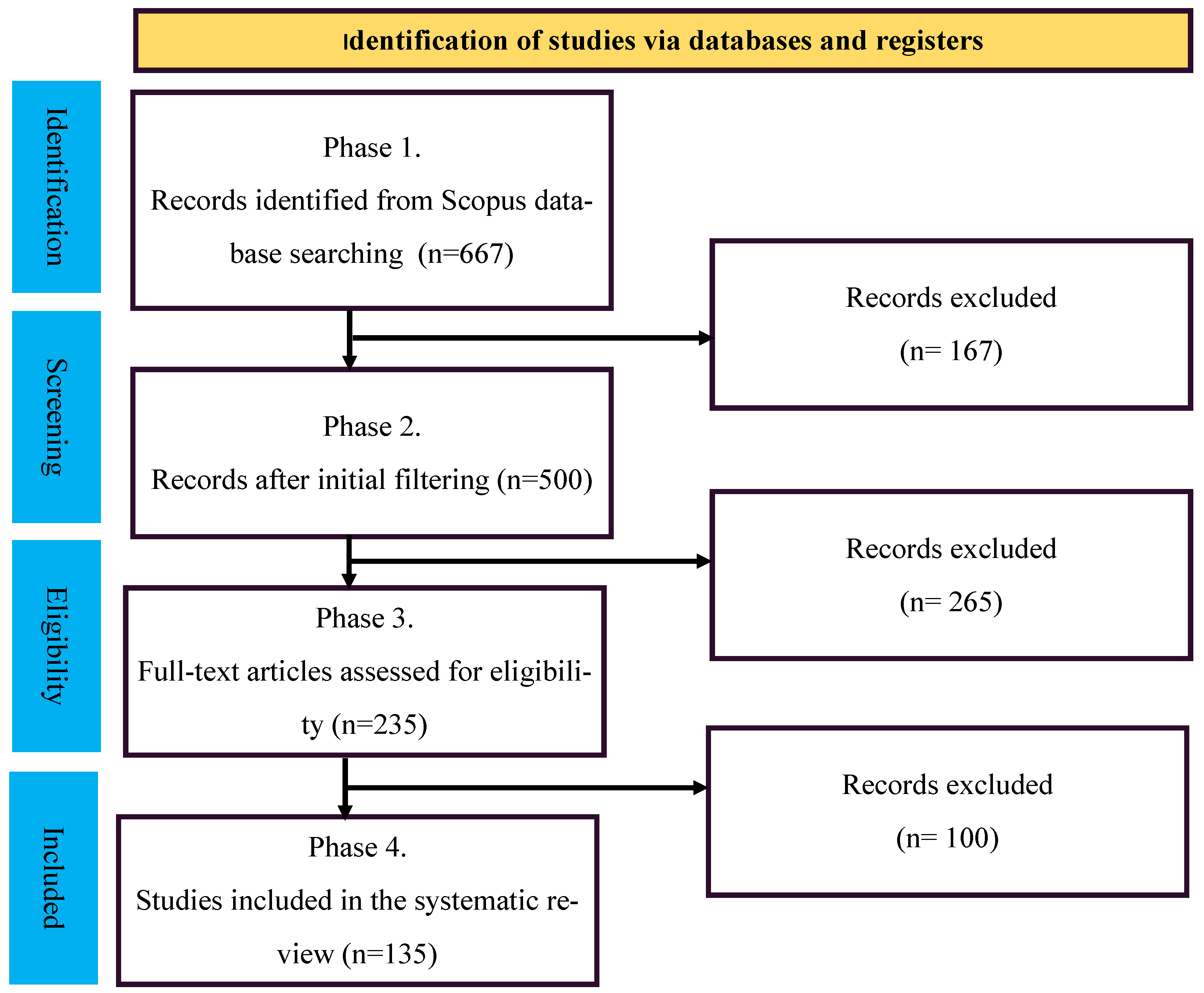
The study selection process followed the four stages established by the PRISMA framework: identification, screening, eligibility, and inclusion. During the identification phase, 667 records were obtained. After removing duplicates and applying basic filtering criteria, 167 records were excluded, resulting in 500 documents for the screening phase.
Duplicate control was performed during the identification stage through metadata verification within the Scopus export and screening workflow, including comparison of titles, authorship, publication year, DOI information, and source details. This procedure ensured that repeated records were identified and removed prior to thematic screening and eligibility assessment.
In the screening stage, titles and abstracts were reviewed to assess thematic relevance, leading to the exclusion of 265 records. Consequently, 235 articles were considered potentially relevant and advanced to the eligibility phase.
During the eligibility phase, full-text articles were thoroughly evaluated according to the established criteria. A total of 100 studies were excluded due to insufficient relevance, lack of methodological rigor, or weak alignment with hybrid evolutionary–fuzzy systems in optimization and decision-making contexts.
Finally, 135 studies were included in the systematic review. Data extraction was conducted systematically for each selected study. The variables analyzed included authorship, year of publication, application domain, type of problem addressed, evolutionary technique used, fuzzy approach employed, hybrid strategy implemented, optimization objectives, validation methods, main findings, and reported limitations. This structured approach enabled comparative analysis and facilitated the identification of methodological trends and research gaps.
Additionally, a qualitative assessment was performed to evaluate methodological robustness, applicability, clarity in hybrid model formulation, and relevance to engineering optimization and intelligent decision-making. Studies with ambiguous or insufficient information were excluded during the eligibility phase to ensure the overall quality of the review.
Overall, the application of the PRISMA methodology ensured a transparent, systematic, and reproducible process, providing a solid foundation for analyzing the evolution and impact of hybrid evolutionary–fuzzy systems in complex optimization and decision-support scenarios.

2.3. PRISMA Flow Diagram and Study Selection Process

The PRISMA flow diagram (Figure 1) visually summarizes the selection process of the scientific literature included in this systematic review. During the identification stage, a total of 667 records were retrieved from the Scopus database. After removing duplicates and applying initial filtering criteria, 167 records were excluded, resulting in 500 documents for the screening phase.
In the screening phase, titles, abstracts, and overall thematic relevance were evaluated, leading to the exclusion of 265 additional records. Consequently, 235 articles were considered potentially relevant and advanced to the eligibility stage, where a detailed full-text assessment was conducted.
During the eligibility phase, 100 studies were excluded for not meeting the predefined inclusion criteria, mainly due to insufficient methodological rigor, weak alignment with hybrid evolutionary–fuzzy systems, or limited relevance to optimization and intelligent decision-making contexts.
Finally, a total of 135 articles were included in the systematic review. From an analytical perspective, this distribution indicates that, although the field of Hybrid Evolutionary–Fuzzy Systems (HEFS) presents a considerable volume of scientific production, a significant proportion of the initially retrieved studies did not meet the required standards of thematic specificity and methodological quality. This highlights the heterogeneous nature of the literature in terms of approaches, application domains, and levels of methodological rigor.
In this context, the application of the PRISMA framework not only facilitated the systematic refinement of the retrieved records but also enabled a precise delimitation of a high-quality corpus of studies. This ensures a robust foundation for analyzing the role of HEFS in engineering optimization and intelligent decision-making under uncertainty.

2.4. Conceptual Dynamics and Thematic Structure of the Bibliometric Mapping

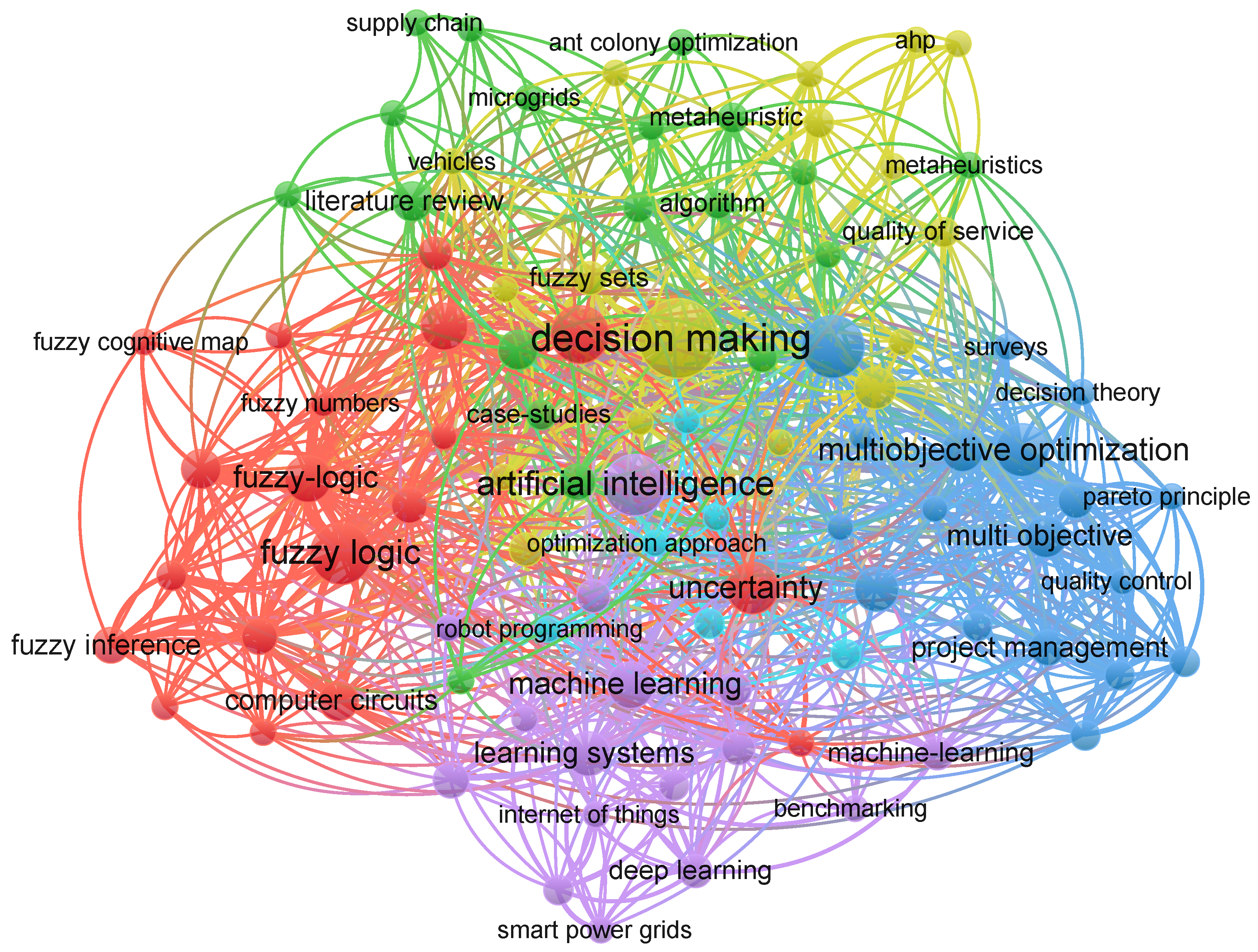
The analysis of the bibliometric network (Figure 2) reveals a highly interconnected and structured landscape that reflects the interdisciplinary nature of HEFS within the context of engineering optimization and intelligent decision-making. As observed in the visualization generated using VOSviewer software (version 1.6.20), the network exhibits a dense distribution of nodes and strong linkages among terms, indicating a high degree of conceptual integration across computational techniques, methodological approaches, and application domains.
At the core of the network, terms such as decision making, artificial intelligence, machine learning, fuzzy logic, and uncertainty emerge as dominant and highly connected nodes, acting as central articulators of the research field. The prominence of these concepts suggests that HEFSs are primarily developed to address complex decision-making problems characterized by uncertainty and high-dimensional data environments.
A clearly defined cluster is associated with fuzzy-based methodologies, including terms such as fuzzy sets, fuzzy inference, fuzzy numbers, and fuzzy cognitive map. This cluster highlights the critical role of fuzzy logic in modeling uncertainty and enabling interpretability in hybrid systems, particularly in decision support and knowledge-based applications.
Another prominent cluster is related to optimization techniques, where terms such as multiobjective optimization, metaheuristics, ant colony optimization, algorithm, and optimization approach are strongly interconnected. This indicates that evolutionary and swarm-based algorithms remain fundamental components in the design of HEFS, particularly for solving complex optimization problems where multiple objectives must be balanced simultaneously.
Additionally, a technological and application-oriented cluster is observed, incorporating terms such as internet of things, smart power grids, microgrids, supply chain, quality control, and project management. This reflects the wide applicability of HEFS across industrial, energy, and logistics systems, demonstrating their adaptability to real-world, large-scale problems.
A further cluster highlights the integration of advanced data-driven techniques, including deep learning, learning systems, classification, and forecasting. This suggests increasing exploratory interest in the convergence of HEFS with deep learning methodologies and large-scale data analysis. However, the reviewed literature still provides heterogeneous evidence regarding scalability, benchmarking practices, and generalizable performance gains in big-data environments.
Moreover, the presence of terms such as decision theory, benchmarking, quality of service, and case studies indicates a growing emphasis on evaluation frameworks, validation processes, and performance assessment, reinforcing the maturity of the field.
An important aspect revealed by the network is the absence of isolated clusters, as all thematic areas are interconnected through multiple pathways. This structural characteristic suggests that HEFS research is evolving toward a highly integrated and consolidated domain, where artificial intelligence, optimization techniques, fuzzy logic, and application-driven research are increasingly converging.
Overall, the bibliometric mapping of Figure 2 demonstrates that HEFSs constitute a mature yet dynamically evolving research field, characterized by strong interdisciplinary integration, continuous methodological innovation, and expanding applicability across diverse sectors. The increasing incorporation of advanced computational techniques and the focus on uncertainty management and decision support systems highlight the relevance of HEFS in addressing complex engineering challenges in modern environments.

3. Results

3.1. Classification of Evolutionary, Swarm Intelligence, and Hybrid Fuzzy Systems

Hybrid optimization approaches integrate evolutionary algorithms (EA), swarm intelligence (SI), and fuzzy systems to address complex engineering problems characterized by nonlinearity, uncertainty, and high dimensionality [32]. These methods leverage complementary strengths, combining global search capabilities with adaptive and interpretable decision-making mechanisms [33].
Table 1 presents a structured classification of the main optimization paradigms, including evolutionary algorithms, swarm intelligence techniques, and HEFS. The comparison highlights their fundamental principles, strengths, limitations, and representative application domains.
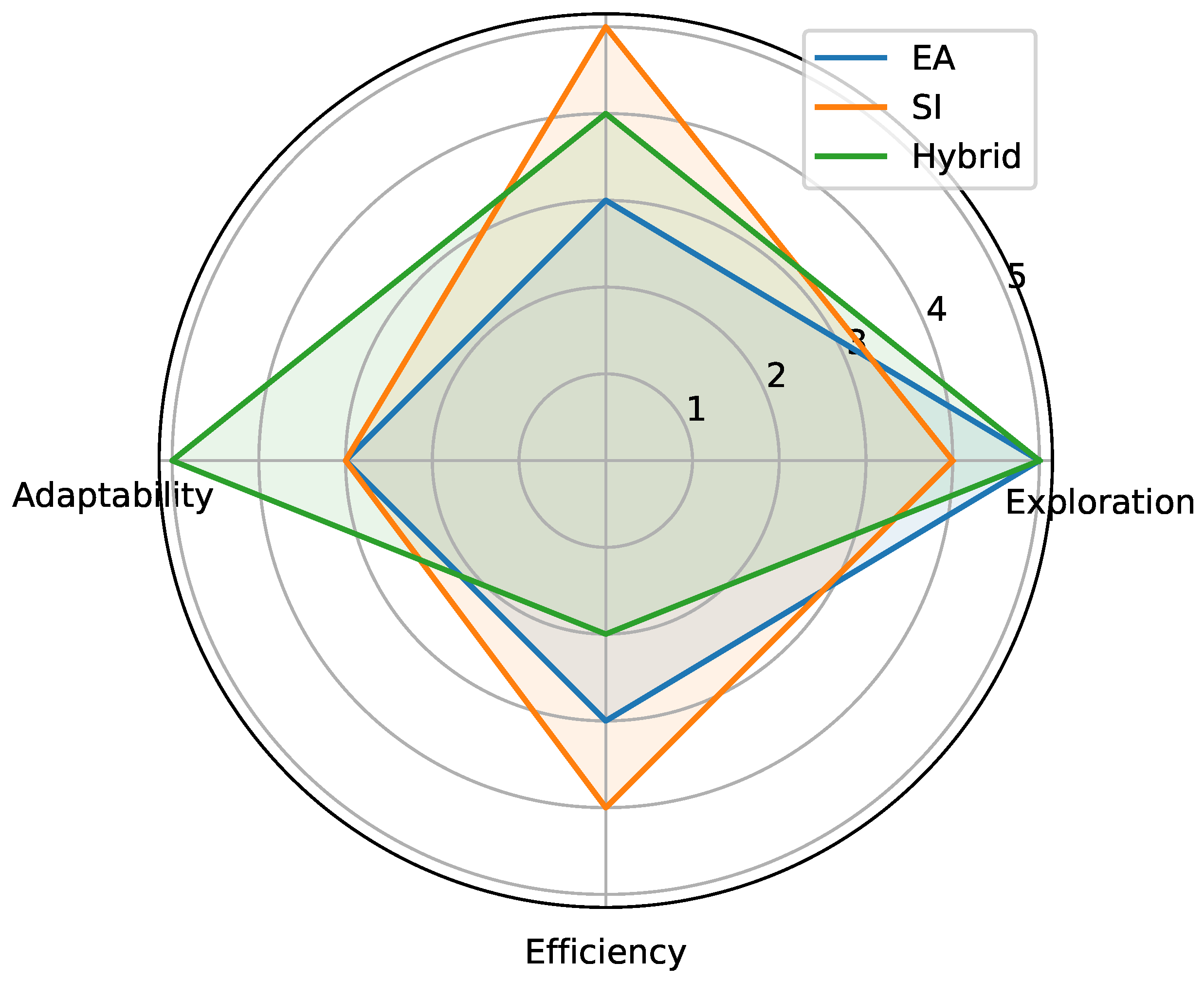
To facilitate a comprehensive comparison, Figure 3 illustrates the relative performance of evolutionary algorithms (EA), swarm intelligence (SI), and hybrid fuzzy systems across key optimization criteria, including exploration capability, convergence speed, adaptability, and computational efficiency.
It should be noted that the graphical representations presented in this review are qualitative and conceptual in nature, designed to illustrate comparative relationships and performance trends derived from synthesized literature findings rather than from pooled quantitative experimental data.
Likewise, the qualitative scales used in the figures (e.g., 1–5) are based on a comparative synthesis of the reviewed literature, where relative performance, impact, and importance were inferred from recurring patterns, reported findings, and convergent tendencies identified across multiple studies. A fully quantitative comparative aggregation was not feasible because the reviewed studies employ heterogeneous problem formulations, datasets, benchmark conditions, algorithmic configurations, and non-commensurable evaluation metrics across application domains. Consequently, these visualizations should be interpreted as structured analytical summaries intended to support conceptual comparison rather than as statistically normalized performance rankings.
Accordingly, the assignment of qualitative scores followed a structured interpretative procedure conducted by the reviewer. Numerical values on the 1–5 scales were not intended to represent exact quantitative measurements; instead, they reflected relative comparative positioning inferred from the reviewed literature. The scoring considered recurrent evidence regarding reported performance behavior, methodological robustness, interpretability, scalability, computational cost, adaptability, and application breadth across studies. Lower scores generally indicated comparatively limited capability or weaker evidence within a given criterion, whereas higher scores denoted stronger recurring support or broader comparative advantages reported in the literature. The mapping from literature findings to numerical values was therefore interpretative and comparative rather than algorithmically derived.
Figure 3 provides a conceptual overview of the main categories of optimization methods, highlighting the comparative strengths of evolutionary algorithms and swarm intelligence techniques. The visualization reveals that these approaches offer strong global exploration capabilities, making them particularly suitable for complex and high-dimensional optimization landscapes.
However, the Figure 3 also reflects inherent limitations, including premature convergence, sensitivity to parameter tuning, and scalability challenges when applied to large-scale or real-time problems.
HEFSs address these limitations by integrating fuzzy logic, which enhances interpretability and enables effective handling of uncertainty [40]. In particular, approaches such as GA–Fuzzy and PSO–Fuzzy demonstrate improved adaptability and decision-making performance in dynamic environments.
Despite these advantages, hybrid systems introduce additional computational complexity and require careful parameter tuning, which may limit their implementation in large-scale or real-time applications [48]. Overall, the results indicate that hybrid approaches represent a promising direction for intelligent optimization, although further research is needed to improve their efficiency, scalability, and practical deployment.

3.2. Algorithmic Characteristics and Optimization Mechanisms

Algorithmic mechanisms play a fundamental role in determining the efficiency, robustness, and applicability of HEFS and MCDM methods [51]. Key factors such as the exploration–exploitation balance, convergence speed, and population diversity are critical to avoiding local optima and improving solution quality [52].
Table 2 summarizes the key algorithmic characteristics characteristics and optimization mechanisms implemented in HEFS and MCDM approaches, along with their impact on performance.
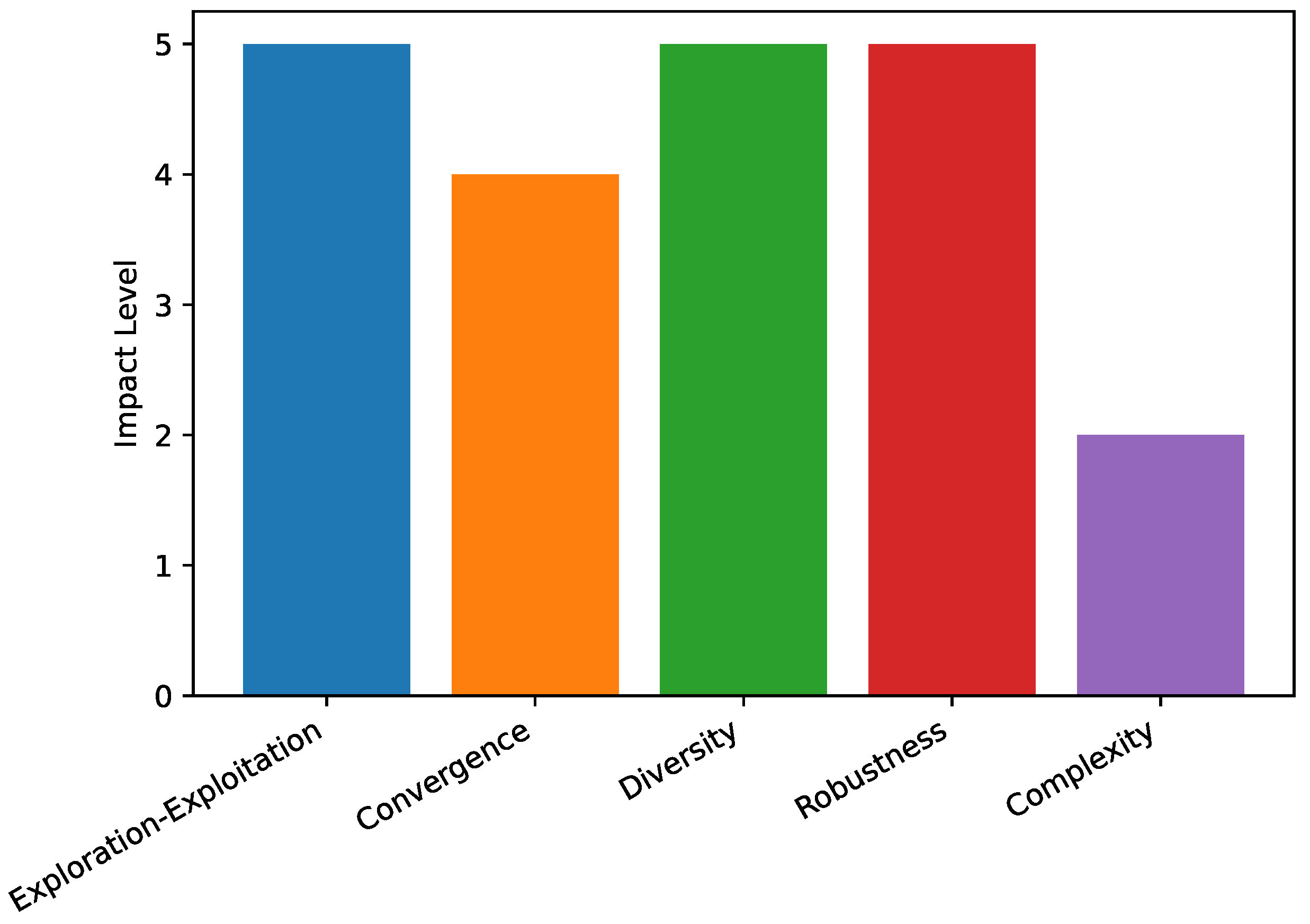
Figure 4 provides a conceptual comparison of the relative impact of main algorithmic mechanisms on the performance of HEFS and MCDM frameworks. The visualization emphasizes the critical role of factors such as the exploration–exploitation balance, convergence behavior, and population diversity in determining solution quality, robustness, and computational efficiency. These relationships highlight the importance of adaptive and hybrid strategies to achieve stable and high-quality optimization outcomes.
The results indicate that maintaining a proper balance between exploration and exploitation is essential for achieving robust and high-quality solutions. Mechanisms such as adaptive mutation, crossover strategies, and fuzzy rule adjustment significantly enhance the ability of algorithms to escape local optima and maintain population diversity.
Convergence acceleration techniques, including elitist selection and local learning, improve computational efficiency but may introduce risks of premature convergence if not properly controlled [55]. Similarly, diversity-preserving strategies play a crucial role in multi-objective optimization by ensuring adequate coverage of the Pareto front [57].
Hybrid metaheuristic approaches combined with fuzzy logic demonstrate improved robustness and adaptability in uncertain environments [55,56]. However, these advantages come at the cost of increased computational complexity, which may limit scalability in large-scale or real-time applications [59].
Overall, the integration of adaptive and fuzzy-based mechanisms enhances the flexibility and performance of optimization systems, highlighting the importance of dynamic parameter tuning in complex engineering problems [61].

3.3. Fuzzy Components in Hybrid Systems

Fuzzy components, including membership functions, rule-based systems, and inference mechanisms, play a crucial role in modeling uncertainty and subjectivity in real-world engineering problems [62]. Their integration with evolutionary and metaheuristic optimization techniques significantly enhances system accuracy, adaptability, and robustness [63].
Table 3 presents the main fuzzy system components, their implementations, advantages, and limitations within HEFS.
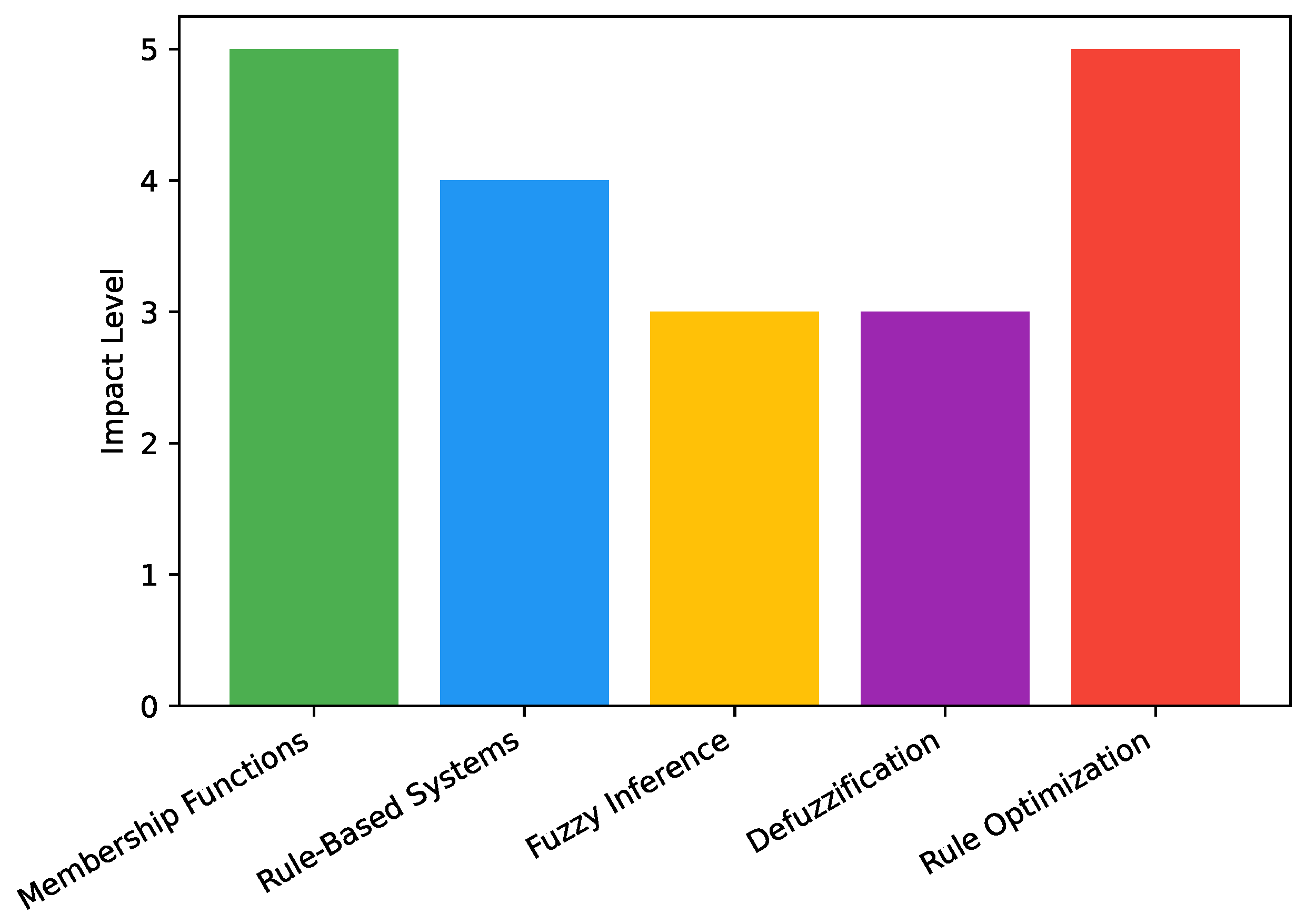
Figure 5 provides a comparative visualization of the relative contribution of key fuzzy components to the performance and adaptability of HEFS, emphasizing how membership functions, rule-based systems, inference mechanisms, and defuzzification strategies influence system accuracy, interpretability, and robustness. This highlights the importance of their proper design and optimization.
The results highlight that membership functions and rule optimization mechanisms are the most influential components in improving system performance, particularly in terms of adaptability and accuracy. The use of evolutionary algorithms for optimizing membership functions and rule bases enables automatic tuning, reducing reliance on expert knowledge and improving system generalization.
Rule-based systems remain a primary strength of fuzzy approaches due to their interpretability; however, the exponential growth of rules represents a major limitation for large-scale applications [64]. Similarly, fuzzy inference mechanisms provide transparency and flexibility but may become computationally inefficient as system complexity increases [68].
Defuzzification methods ensure interpretable outputs, which is essential for decision-making systems, although they may result in partial information loss [67]. Overall, the integration of fuzzy components with optimization techniques enhances system intelligence and adaptability, but scalability and computational cost remain critical challenges for practical deployment [69].

3.4. Comparative Performance: Convergence, Accuracy, and Computational Cost

The practical performance of optimization methods depends not only on the algorithmic structure but also on the application domain [70]. Key evaluation criteria include convergence speed, accuracy and robustness, computational cost, and the capability to handle multi-objective optimization problems [71].
Table 4 presents a comparative analysis of representative hybrid evolutionary–fuzzy and decision-making approaches, highlighting their performance characteristics across different criteria.
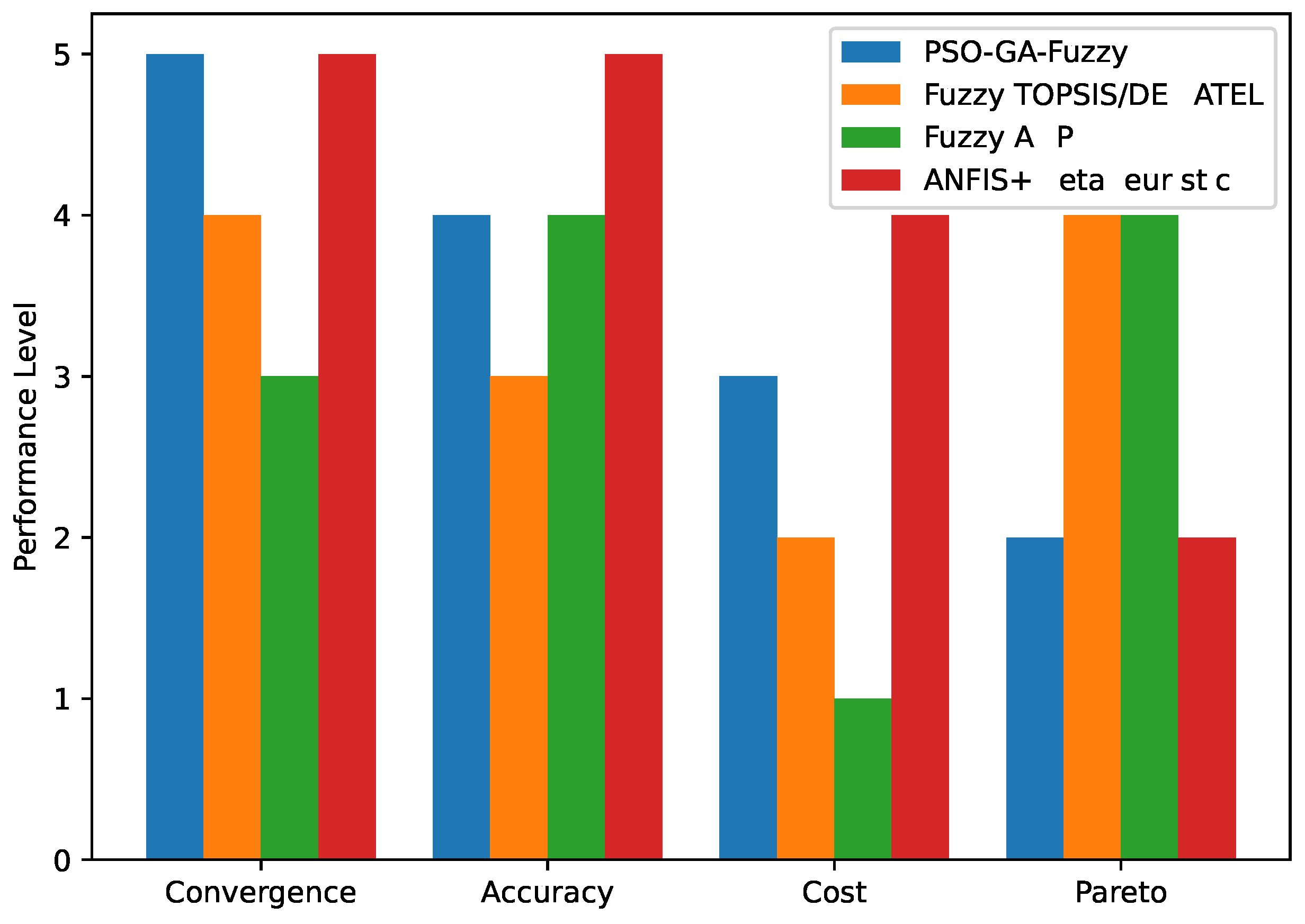
Figure 6 provides a comparative visualization of the performance of the analyzed hybrid methods across main evaluation criteria, emphasizing trade-offs between convergence speed, accuracy, robustness, and computational cost. This illustrates how different hybrid approaches balance these factors depending on the application context.
The results indicate that hybrid approaches achieve a strong balance between convergence speed and solution quality compared to traditional methods. PSO–GA–Fuzzy systems exhibit fast convergence and high accuracy, making them suitable for dynamic optimization problems [59].
Fuzzy TOPSIS/DEMATEL and Fuzzy AHP approaches demonstrate lower computational cost and strong multi-objective capabilities, making them particularly effective in decision-making scenarios involving multiple criteria and uncertainty [73].
ANFIS combined with metaheuristics achieves the highest level of accuracy due to its learning capabilities; however, this comes at the expense of increased computational cost, which may limit its applicability in real-time systems [56].
Overall, the selection of an appropriate method depends on the trade-off between accuracy, computational efficiency, and interpretability required by the specific application [75]. Hybrid methods clearly outperform classical approaches in terms of adaptability and robustness, although computational complexity remains a critical challenge [76].

3.5. Applications Across Engineering Domains

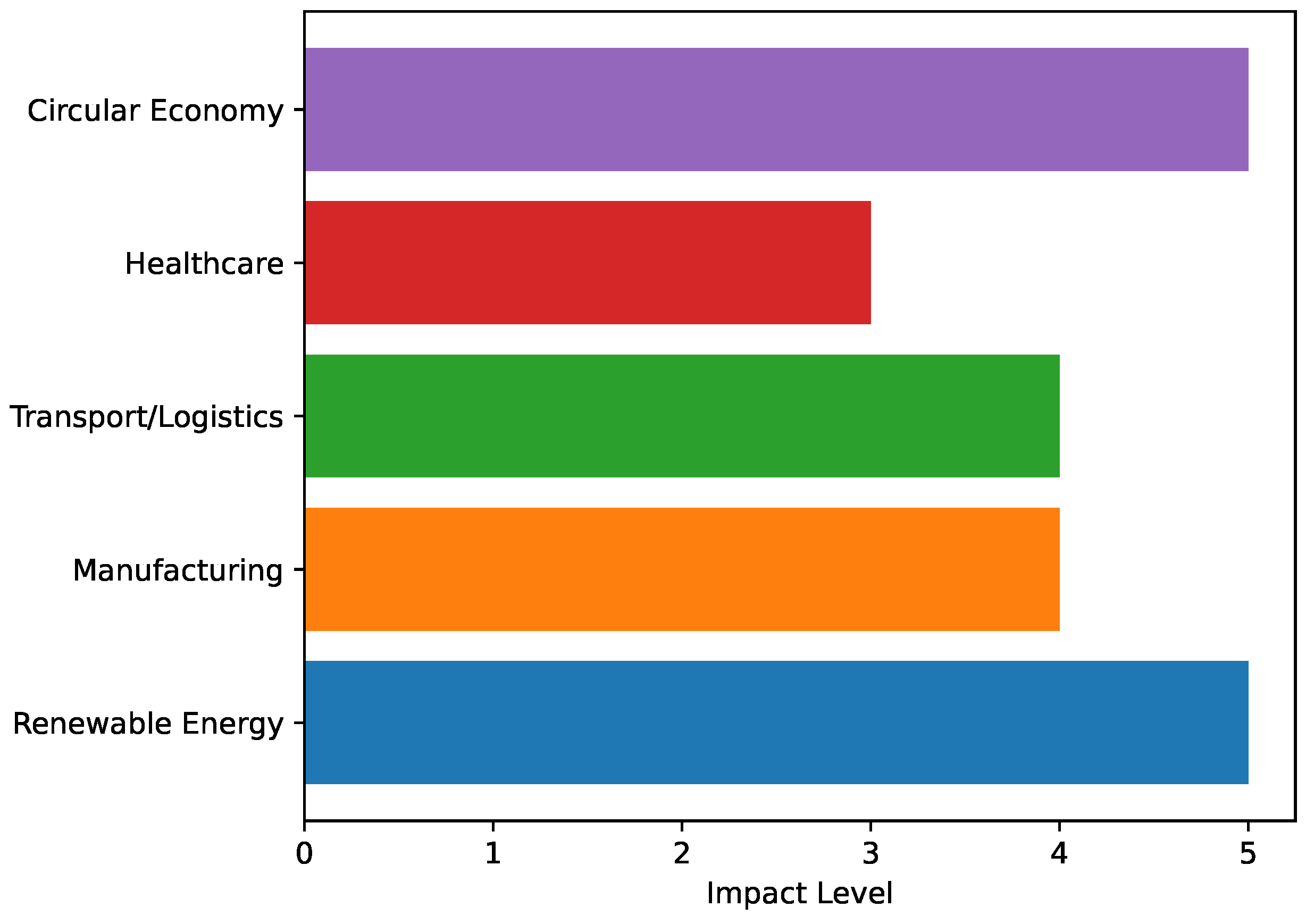
MCDM methods and HEFS have been widely applied across various engineering domains, including energy, manufacturing, transportation, healthcare, and circular economy systems [77]. These approaches are particularly effective in solving complex optimization and decision-making problems involving multiple criteria and high levels of uncertainty [78].
Table 5 summarizes representative applications, highlighting the applied methods, key benefits, and performance improvements achieved in different sectors.
Figure 7 provides a comparative visualization of the impact of hybrid fuzzy–MCDM methods across different engineering domains, emphasizing how these approaches enhance decision-making performance through the integration of multiple criteria and uncertainty management. This leads to improvements in efficiency, robustness, and optimization outcomes across sectors such as energy, manufacturing, transportation, and healthcare.
The results demonstrate that hybrid fuzzy–MCDM approaches significantly improve decision-making performance across multiple domains. In energy and manufacturing systems, these methods enable the prioritization of alternatives by simultaneously considering economic, environmental, and technical criteria, leading to improved efficiency and reduced emissions [79].
In transportation and healthcare applications, the integration of fuzzy logic enhances robustness under uncertainty and reduces human-related errors in decision-making processes. In particular, healthcare applications benefit from reduced diagnostic uncertainty and improved reliability of classification systems [82].
The circular economy domain highlights the capability of these methods to balance economic, environmental, and social factors, supporting sustainable decision-making frameworks [88]. Overall, hybrid fuzzy–MCDM approaches provide a powerful tool for addressing complex, multi-criteria problems in modern engineering systems, particularly under uncertain and dynamic conditions [42].

3.6. Decision-Making Techniques Under Uncertainty

Effective management of uncertainty is a fundamental requirement in modern engineering systems [89]. Different frameworks, including fuzzy, probabilistic, and hybrid approaches, have been developed to model both linguistic ambiguity and inherent randomness in real-world data [90].
Table 6 presents a comparison of the main decision-making techniques under uncertainty, highlighting the type of uncertainty addressed, advantages, and limitations of each approach.
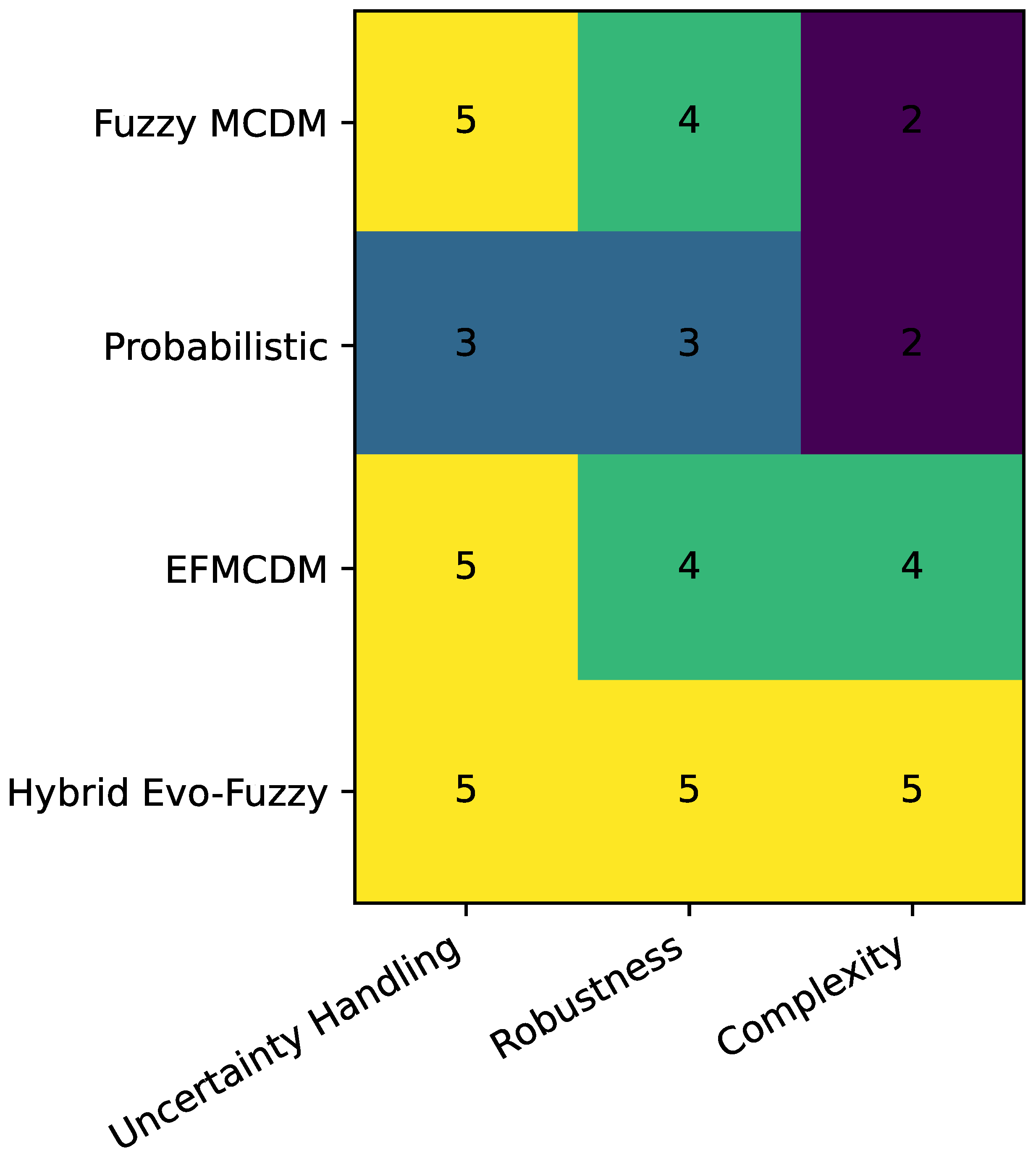
To provide deeper insight into the performance patterns of these approaches, Figure 8 presents a heatmap-based representation that enables a more intuitive comparison of the relative strengths and limitations of each method. The visualization highlights variations across main evaluation criteria, including uncertainty handling, robustness, and computational complexity, supporting a more comprehensive interpretation of their applicability in different decision-making scenarios.
The results indicate that fuzzy-based approaches are particularly effective when dealing with linguistic ambiguity and expert-driven decision-making scenarios [16]. These methods provide flexibility and interpretability but may still suffer from residual subjectivity [91].
In contrast, probabilistic approaches offer a strong mathematical foundation and are well-suited for problems with sufficient historical data [92]. However, their applicability is limited in scenarios where data is scarce or highly uncertain [57].
Evidential fuzzy methods extend traditional fuzzy frameworks by incorporating partial and uncertain information, thereby reducing subjectivity [87]. Nevertheless, their increased mathematical complexity can limit practical implementation [16].
HEFSs demonstrate superior robustness by integrating multiple uncertainty modeling strategies and optimization mechanisms [93]. These approaches are particularly effective in complex decision-making environments but come with increased computational cost [42].
Overall, the selection of an appropriate decision-making framework depends on the nature of uncertainty, data availability, and computational constraints, with hybrid approaches offering the most comprehensive solutions for complex engineering problems [94].

3.7. Computational and Environmental Indicators

Quantitative analysis plays a crucial role in evaluating the scalability, accuracy, and sustainability of intelligent systems applied to engineering optimization and decision-making [95]. These indicators provide objective criteria to assess both computational performance and environmental impact [96].
Table 7 summarizes the most relevant computational and environmental indicators, including their definitions and practical importance.
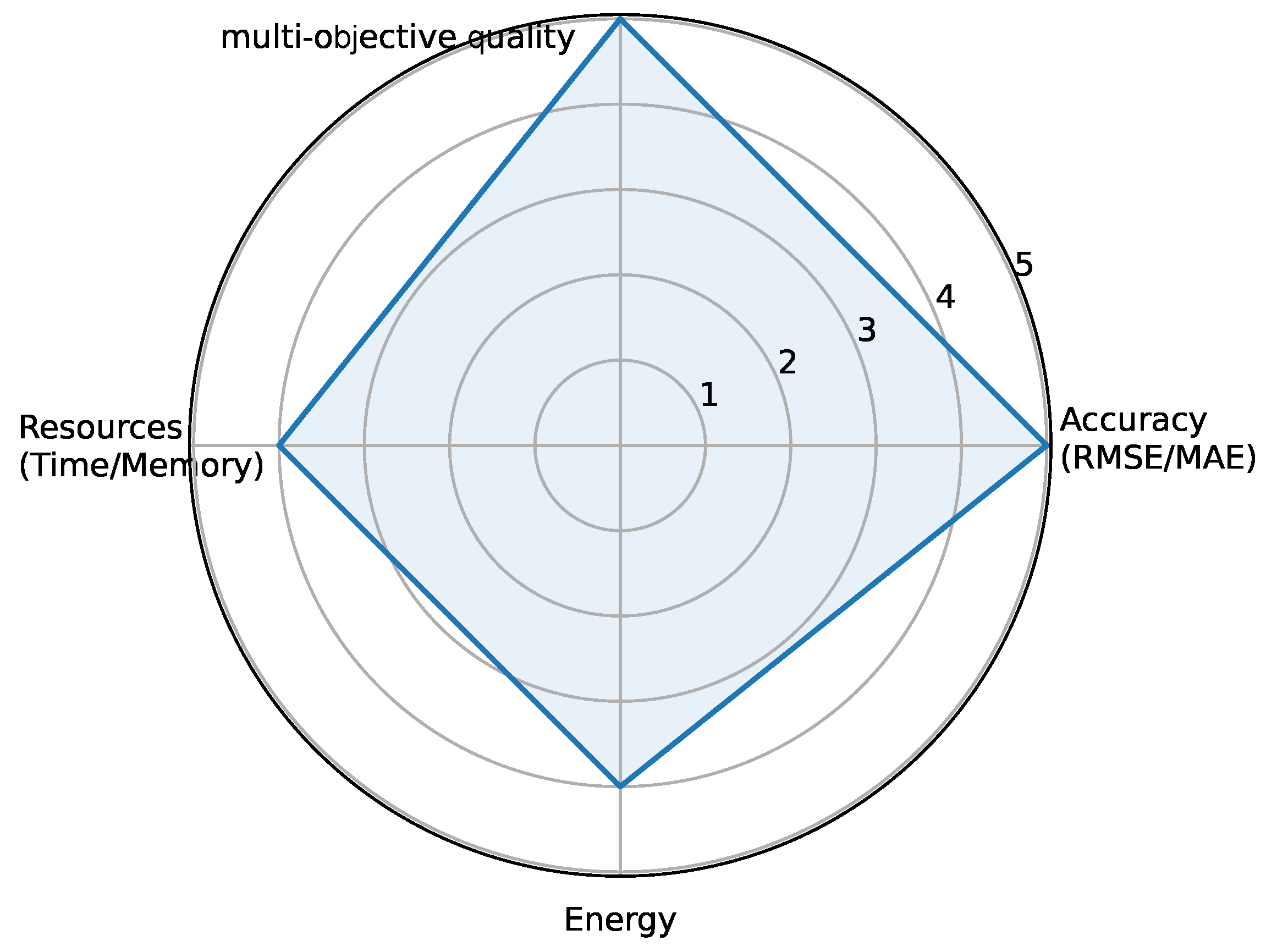
To provide a more comprehensive perspective on performance evaluation, Figure 9 presents a radar-based visualization of main performance indicators, highlighting the relative importance and trade-offs between accuracy, multi-objective solution quality, computational resource requirements, and energy consumption. This enables a holistic assessment of system efficiency and sustainability.
The results show that classical error metrics such as RMSE and MAE remain fundamental for evaluating predictive accuracy in optimization and decision-making systems [97]. These metrics provide direct and interpretable measures of model performance [79].
In multi-objective optimization, advanced indicators such as hypervolume (HV) and generational distance (GD/IGD) are essential for assessing both convergence and diversity of solutions [99]. These metrics enable a more comprehensive evaluation of Pareto-optimal fronts [100].
Computational resource indicators, including execution time and memory usage, are critical for determining the feasibility of real-world implementation, particularly in large-scale or real-time applications [101].
Additionally, computational energy consumption has emerged as a critical factor due to increasing concerns about environmental sustainability [102]. As optimization systems grow in complexity, their energy footprint becomes an important consideration, especially in large-scale and continuous deployment scenarios [103].
Overall, the integration of accuracy, multi-objective, computational, and environmental indicators provides a holistic framework for evaluating intelligent systems in modern engineering applications [104].

3.8. Hybridization Strategies in Evolutionary–Fuzzy Systems

Hybridization strategies play a crucial role in enhancing the performance of evolutionary–fuzzy systems by combining complementary optimization and learning mechanisms [39]. These strategies aim to improve convergence, robustness, adaptability, and solution quality in complex engineering problems [105].
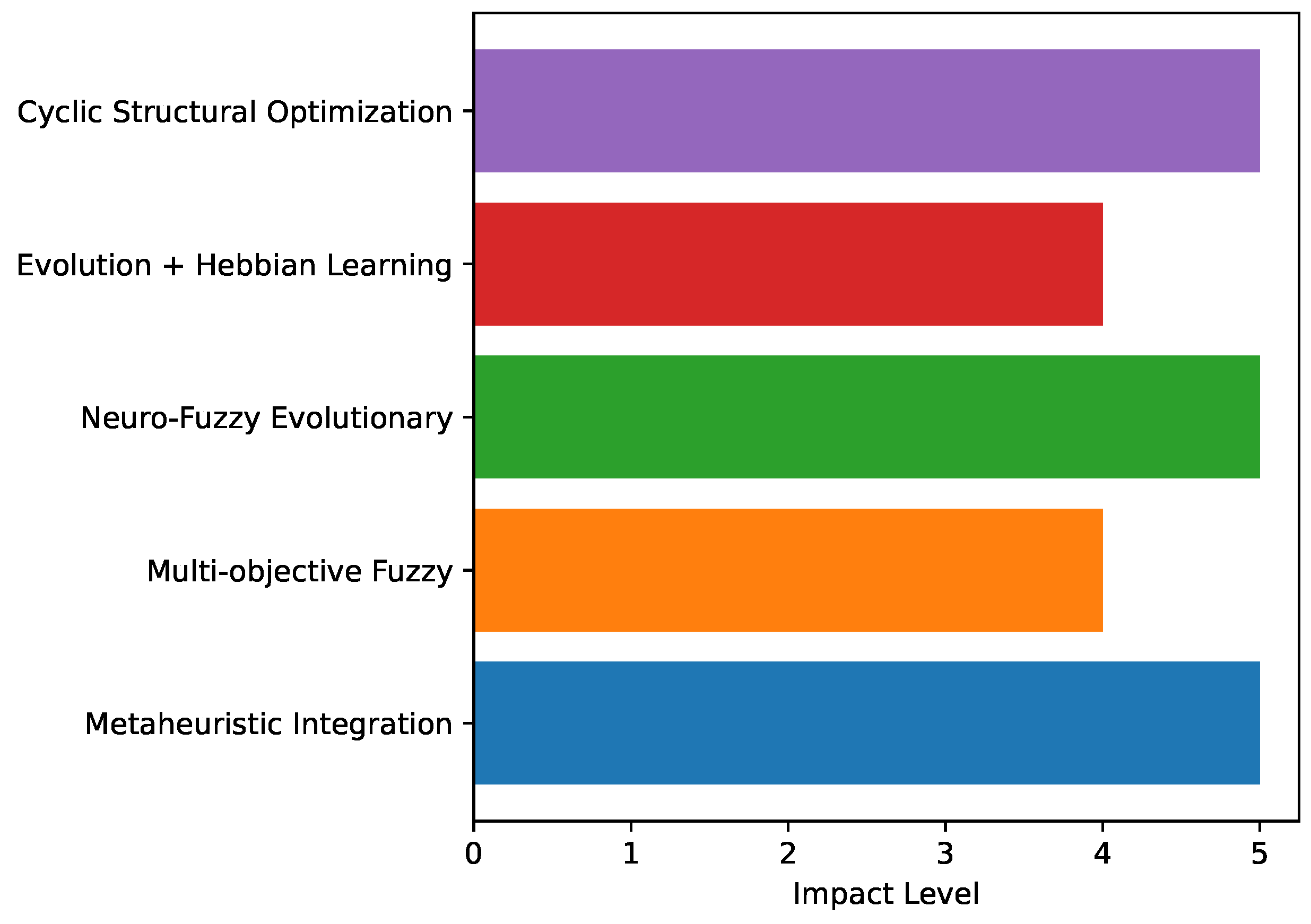
Table 8 summarizes the main hybridization approaches, including their descriptions, advantages, limitations, and representative applications.
Figure 10 provides a comparative visualization of the impact of different hybridization strategies on system performance, emphasizing how the integration of evolutionary algorithms, fuzzy systems, and metaheuristics influences convergence behavior, robustness, and adaptability. This highlights the benefits of hybrid approaches in addressing complex and uncertain optimization problems.
The results indicate that hybridization strategies significantly enhance the performance of evolutionary–fuzzy systems by leveraging complementary strengths of different computational paradigms. In particular, the integration of classical metaheuristics improves convergence behavior and helps avoid local optima [39].
Multi-objective fuzzy optimization provides a structured framework for balancing conflicting objectives such as accuracy and interpretability, although defining appropriate objective functions remains a challenge [49].
Neuro-fuzzy evolutionary systems stand out due to their ability to model complex nonlinear relationships and learn from data, making them highly suitable for predictive and adaptive applications. However, their implementation requires large datasets and careful parameter tuning [106].
Hybrid approaches combining evolutionary algorithms with Hebbian learning introduce both global and local adaptation mechanisms, although achieving stable convergence can be difficult [108].
Cyclic structural and parametric optimization strategies offer a dynamic balance between exploration and exploitation, improving adaptability in changing environments, but at the cost of increased computational complexity [109].
Overall, hybridization represents a prominent direction for advancing intelligent optimization systems, although future research should focus on reducing computational cost and improving scalability for real-world applications [110].

3.9. Common Metaheuristic Algorithms in Hybrid Systems

Metaheuristic algorithms play a central role in HEFS by providing efficient global search capabilities and enhancing solution quality in complex optimization problems [111]. These algorithms are often integrated with fuzzy logic and decision-making frameworks to improve convergence, robustness, and adaptability [112].
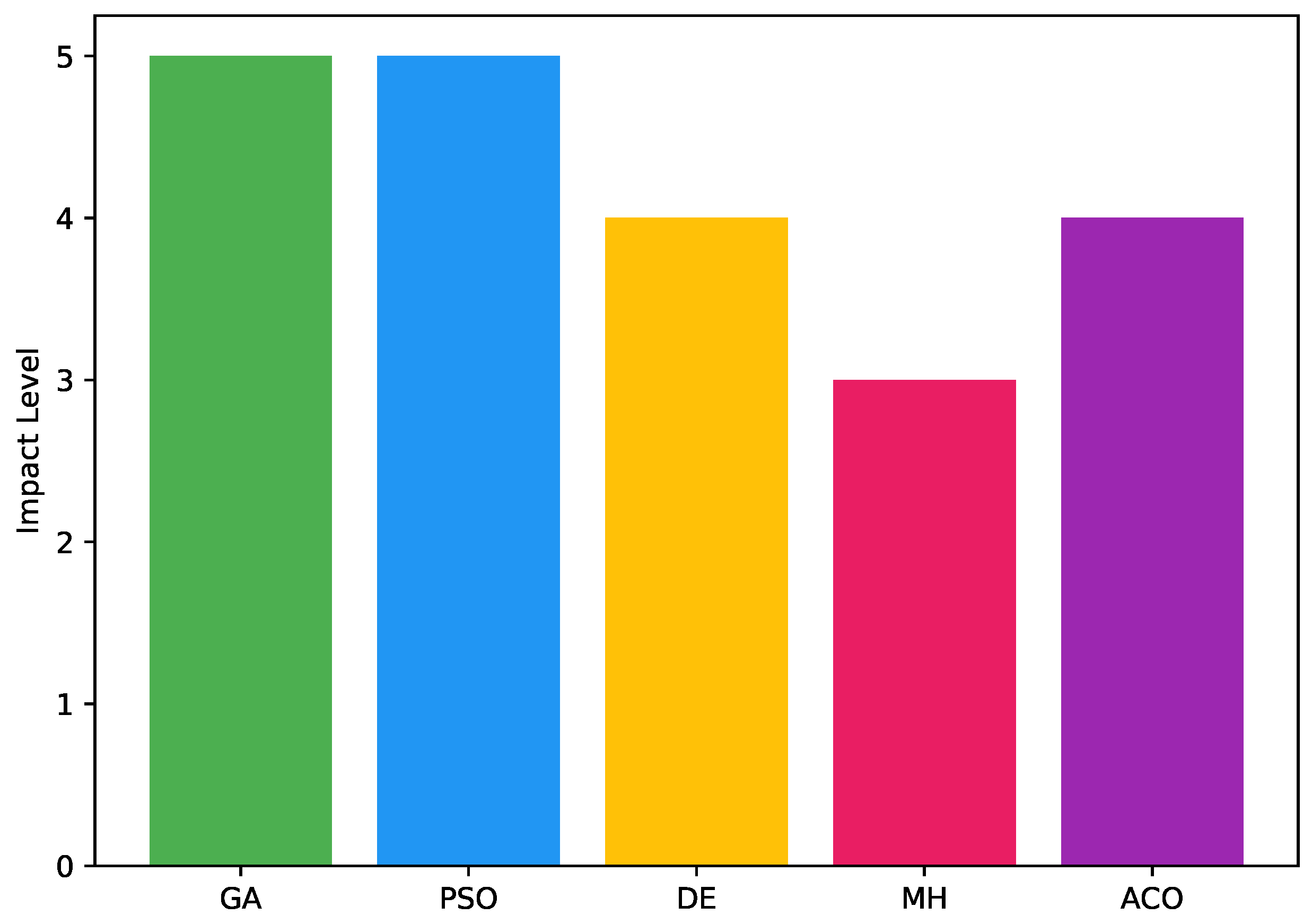
Table 9 summarizes the most commonly used metaheuristic algorithms in hybrid systems, highlighting their roles, characteristics, and typical applications.
Figure 11 provides a comparative visualization of the relative impact of different metaheuristic algorithms in hybrid systems, emphasizing how these algorithms contribute to optimization performance by influencing convergence behavior, solution quality, and computational efficiency. This highlights their complementary roles in enhancing hybrid intelligent systems.
The results show that Genetic Algorithms (GA) and PSO are among the most widely used metaheuristic techniques due to their strong global search capabilities and ease of integration with fuzzy systems [114]. GA is particularly effective for multi-objective optimization and rule design, while PSO is preferred for fast convergence and parameter tuning [115].
Differential Evolution (DE) provides a robust alternative with strong exploration capabilities, making it suitable for complex search spaces such as fuzzy cognitive map training [108]. Metropolis–Hastings (MH) contributes by improving population diversity during initialization, helping to avoid premature convergence [39].
Ant Colony Optimization (ACO) is especially effective in multi-objective and combinatorial optimization problems, including fuzzy rule optimization [49]. Overall, the integration of metaheuristic algorithms significantly enhances the performance of hybrid systems, although computational cost and parameter tuning remain important challenges [116].

3.10. Main Metrics for Evaluating HEFS

The evaluation of HEFS requires a comprehensive set of metrics that capture not only optimization performance but also system stability, diversity, and interpretability [117]. These metrics are essential for assessing the practical applicability of such systems in real-world engineering problems characterized by uncertainty and multiple objectives [118].
Table 10 summarizes the key metrics used to evaluate hybrid systems, including their definitions, practical importance, and typical applications.
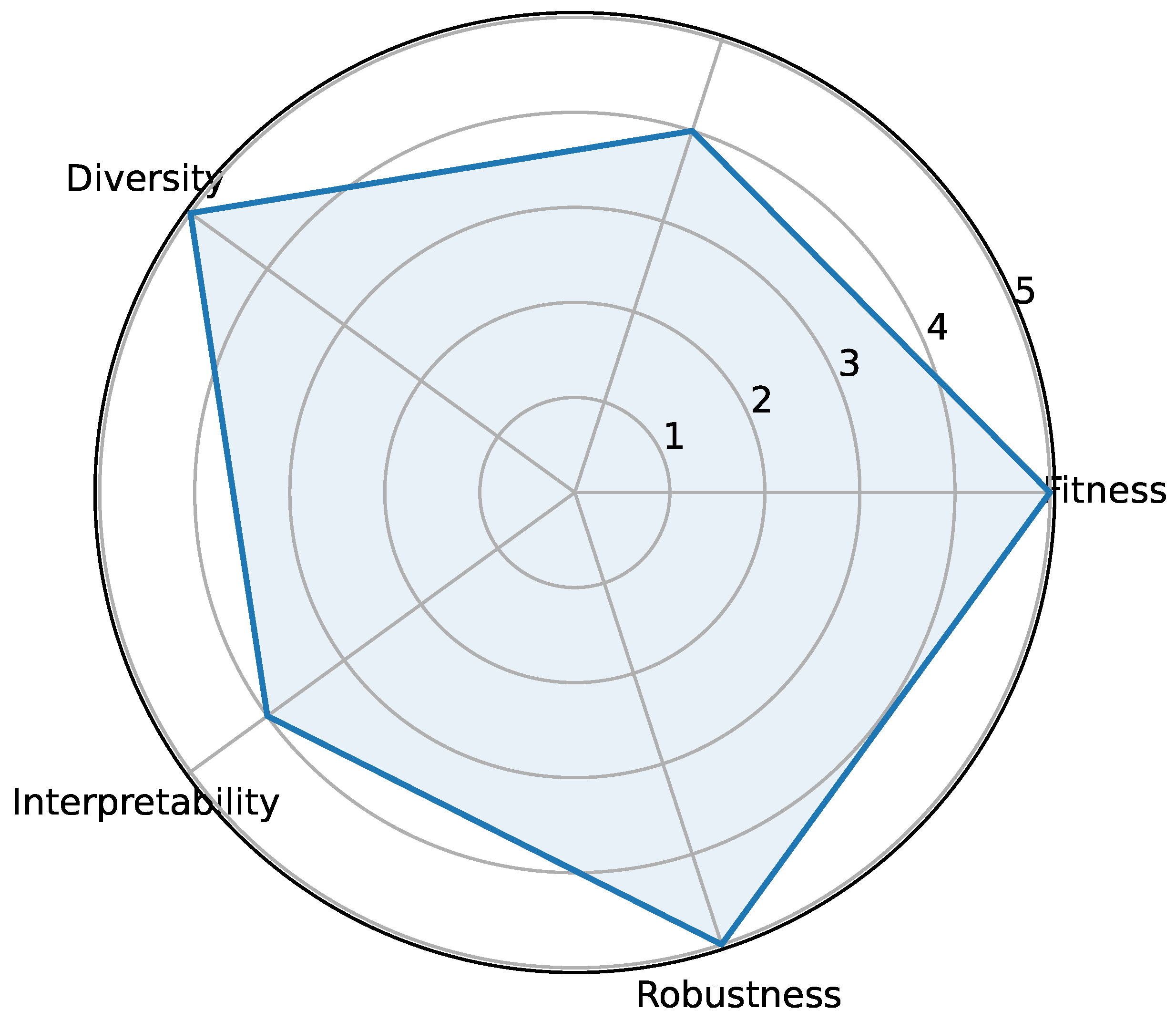
To provide a holistic view of system evaluation, Figure 12 presents a radar-based visualization of the main performance metrics, highlighting the relative importance and trade-offs among accuracy, convergence, robustness, and computational efficiency. This enables a comprehensive assessment of HEFS across multiple evaluation dimensions.
The results indicate that solution quality (fitness), diversity, and robustness are among the most critical metrics for evaluating hybrid systems, as they directly influence optimization performance and reliability [119]. Convergence plays a main role in determining computational efficiency, particularly in large-scale or real-time applications [69].
Population diversity is essential for avoiding premature convergence and ensuring adequate exploration of the search space, especially in multi-objective optimization problems [45]. Interpretability remains a fundamental requirement in fuzzy systems, particularly in decision-making contexts where transparency is necessary [63].
Robustness ensures consistent performance under uncertain or noisy conditions, making it a crucial metric for real-world applications [120]. Overall, the combination of these metrics provides a comprehensive framework for evaluating HEFS, balancing accuracy, efficiency, and interpretability [69].

4. Discussion

4.1. Bibliometric Interpretation of Research Trends

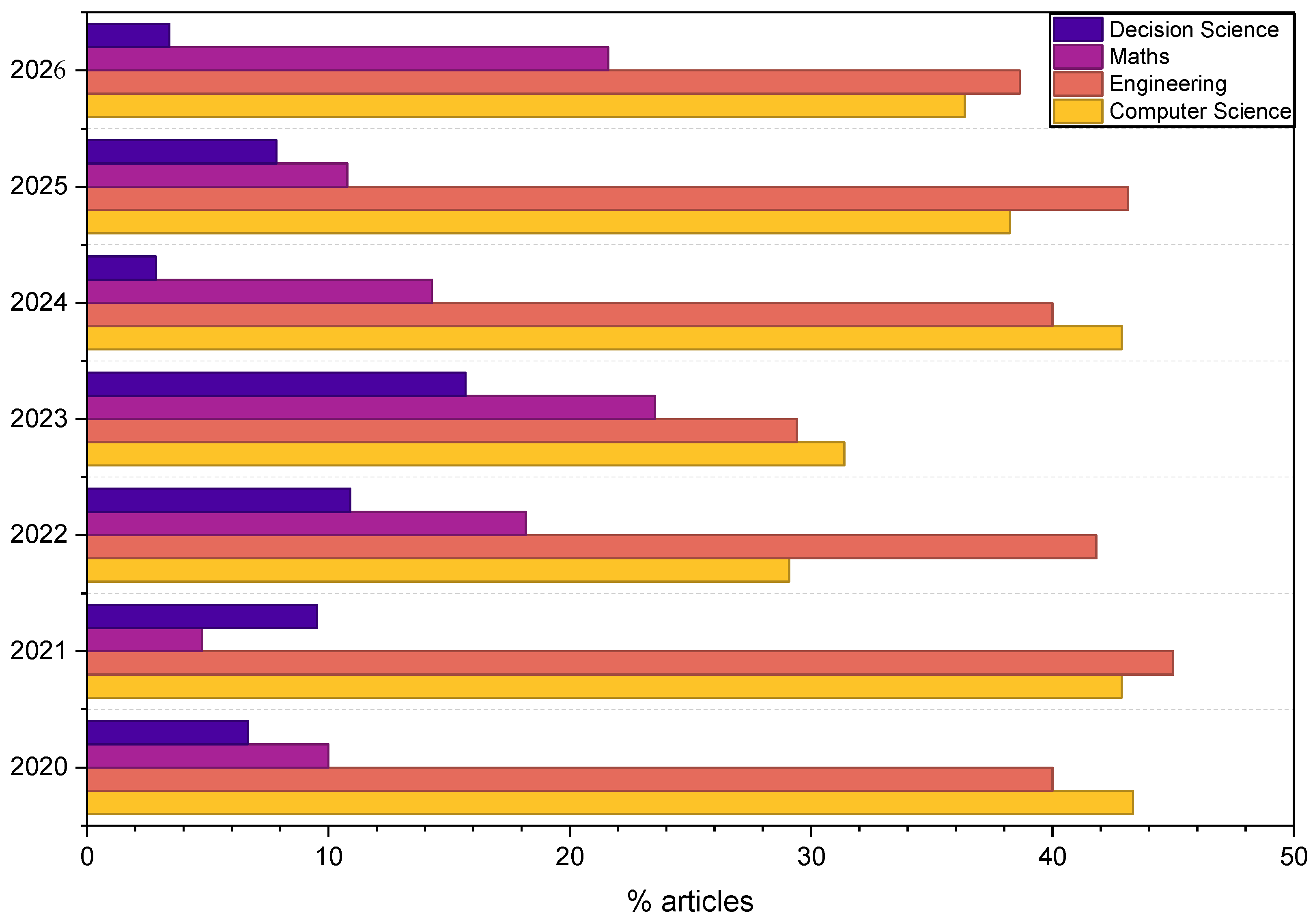
To complement the qualitative analysis with an evidence-based overview, the temporal and thematic distribution of the analyzed literature was examined through a bibliometric characterization of the final review corpus. The percentage distributions reported in this subsection were derived from the subject-area classification generated by the Scopus “Analyze search results” tool for the studies included in the 2020–2026 corpus. This descriptive analysis aims to identify publication evolution patterns, disciplinary composition, and thematic development within HEFS research.
As shown in Figure 13, Engineering and Computer Science are the dominant domains throughout the analyzed period, jointly accounting for the highest proportions of publications in every year, with individual shares in the approximate range of 30–45%. This behavior reflects the applied and computational nature of HEFS, whose development is primarily driven by the optimization of complex systems and the implementation of intelligent algorithms. Engineering, in particular, maintains a high and relatively stable participation, consistent with the sustained adoption of these approaches in real-world problems such as process control, resource optimization, and energy systems, while Computer Science reflects the central role of algorithms, artificial intelligence, and metaheuristic techniques.
The observed dominance of Engineering and Computer Science also suggests that HEFS research remains strongly application-driven and computationally oriented, whereas the more recent growth of Mathematics-related contributions may indicate an ongoing transition toward stronger theoretical formalization, analytical modeling, and methodological consolidation of the field.
Mathematics and Decision Sciences exhibit lower shares but a non-negligible and fluctuating presence across the period. Mathematics shows a comparatively higher relative contribution toward the most recent years, which is consistent with a growing interest in analytical foundations, formal models, and convergence analysis. Decision Sciences displays a more irregular behavior, with a relatively higher contribution around 2023, reflecting the role of multi-criteria evaluation and uncertainty modeling in specific application contexts rather than a monotonic trend.
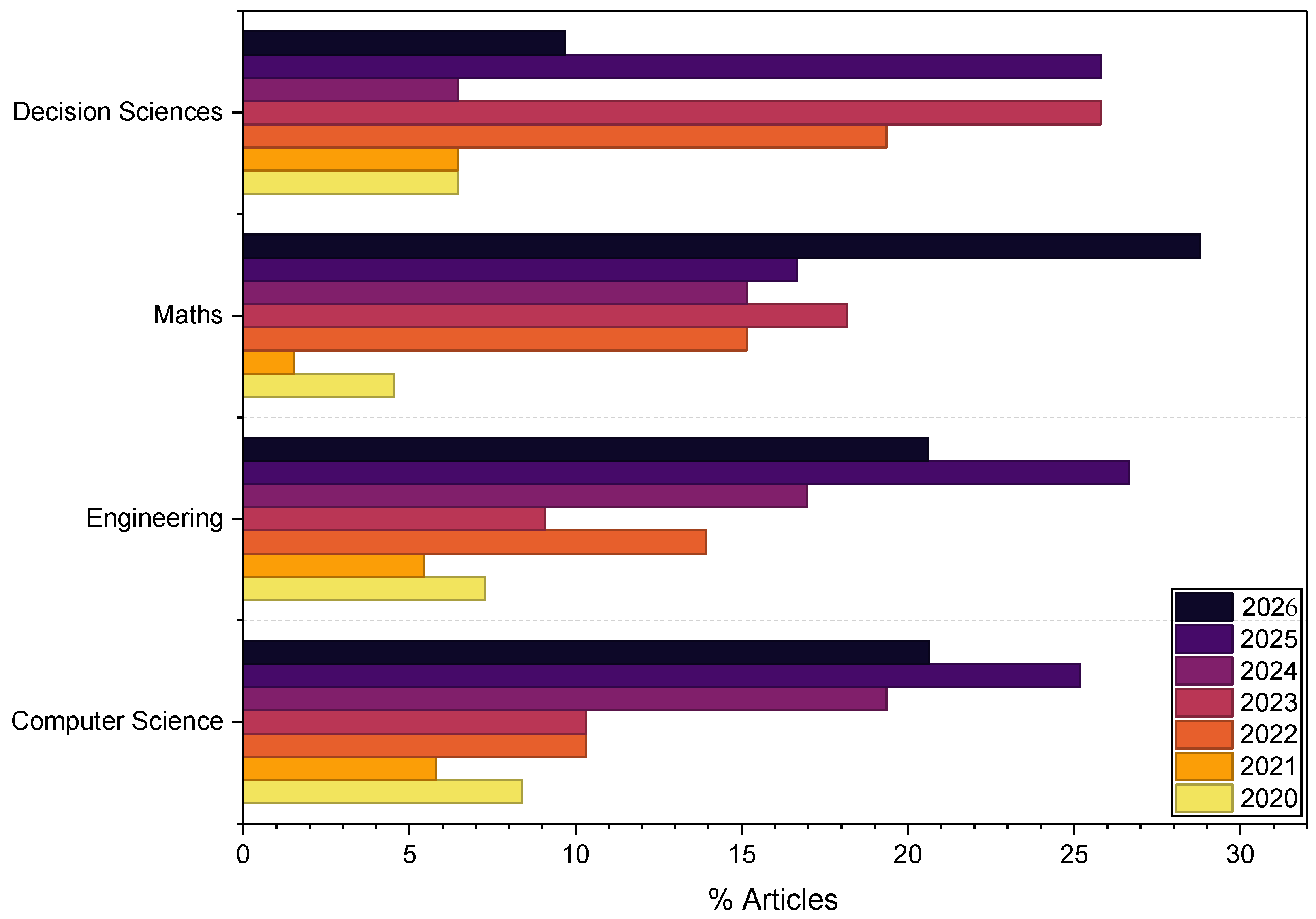
To provide a complementary perspective, Figure 14 presents, for each subject area, the distribution of its publications across the years of the analyzed window. This view indicates that the bulk of the output in all four areas is concentrated in the most recent years—particularly 2023, 2025, and 2026—which is consistent with the overall acceleration of scientific production in this field. The single early-access record corresponding to 2026 should be interpreted with caution, since that year was still in progress at the time of the search and its relative shares are therefore based on a very small number of documents.
Taken together, these distributions indicate that HEFS research, while still led by Engineering and Computer Science, increasingly incorporates contributions from Mathematics and Decision Sciences in recent years. This points to a gradual broadening of the field toward greater theoretical formalization and MCDM, supporting its characterization as an increasingly interdisciplinary domain.
Despite this growth and interdisciplinarity, the analyzed literature still exhibits important methodological heterogeneity regarding evaluation frameworks, benchmark selection, validation strategies, and comparative baselines. Such variability limits direct cross-study comparison and highlights the need for greater standardization, reproducibility, and harmonized reporting practices in future HEFS research.
It should be noted that a formal statistical meta-analysis based on pooled effect sizes was not feasible, since the primary studies involve heterogeneous optimization problems, non-commensurable objectives, and non-standardized evaluation metrics across distinct application classes. Accordingly, a structured descriptive, comparative, frequency-based, and bibliometric synthesis was adopted as the most methodologically appropriate analytical strategy for the available evidence base.
Although HEFSs demonstrate strong capabilities for uncertainty management and intelligent optimization, the reviewed literature also reveals several scenarios in which their performance may degrade. High-dimensional optimization problems frequently intensify computational burden, increase parameter sensitivity, and may reduce convergence efficiency. Likewise, sparse-data environments and noisy objective functions can limit the effectiveness of adaptive learning mechanisms, fuzzy-rule optimization, and model generalization.
Additional challenges emerge in online adaptation and real-time environments, where continuous updating requirements may introduce instability, latency, and scalability constraints. Furthermore, application contexts demanding strong interpretability—such as healthcare, transparent decision support, or safety-critical control systems—often expose persistent trade-offs between predictive performance, model complexity, and explainability. These observations suggest that HEFS effectiveness remains strongly dependent on problem structure, data quality, dimensionality, and operational requirements.
An additional methodological limitation of this review derives from the exclusive use of the Scopus database for literature retrieval. Although Scopus provides extensive multidisciplinary coverage consistent with the scope of HEFS research, relevant studies indexed in complementary repositories such as Web of Science, IEEE Xplore, or PubMed may not have been captured. Future reviews could therefore benefit from multi-database search strategies to further enhance comprehensiveness and reduce potential retrieval bias.

4.2. Emerging Trends and Technological Integration in HEFS

The rapid evolution of intelligent systems has led to the integration of hybrid evolutionary–fuzzy approaches with emerging technologies such as XAI, digital twins, deep learning, and big data analytics [121]. These developments aim to enhance adaptability, interpretability, scalability, and real-time decision-making capabilities in complex engineering environments [122].
Table 11 presents the main emerging areas and technological integrations, including their descriptions, challenges, applications, and supporting references.
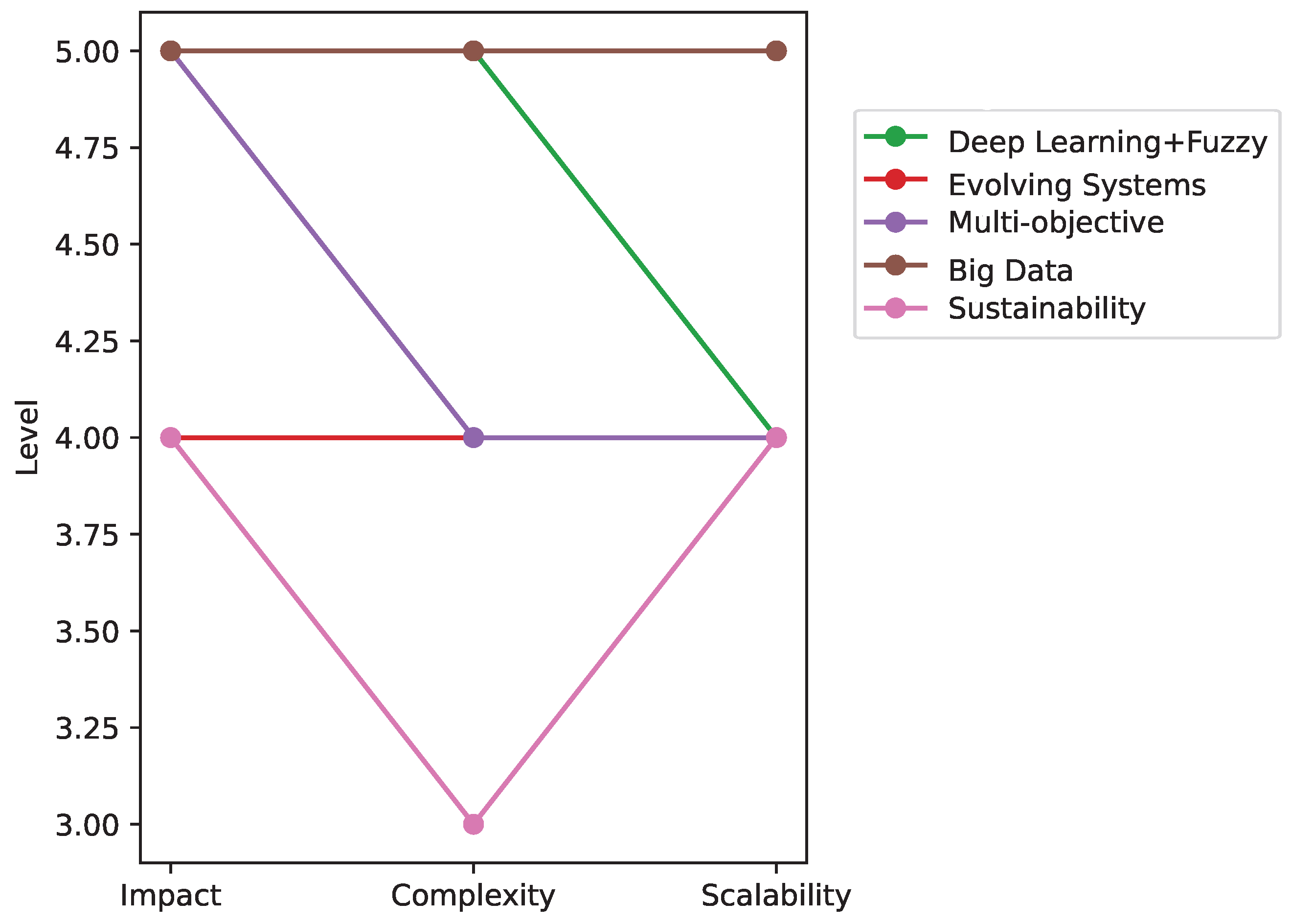
To provide a multidimensional analysis of these emerging technologies, Figure 15 presents a parallel coordinates visualization that captures the relationships between impact, complexity, and scalability across different technological trends, highlighting how these dimensions interact. This enables a comparative assessment of the trade-offs and potential of each emerging approach.
The results highlight a clear transition toward more intelligent, adaptive, and interpretable systems capable of operating in dynamic and data-intensive environments. The integration of XAI is particularly relevant for increasing trust in critical applications such as healthcare and finance, where transparency is essential [44].
Digital twins and deep learning integration may expand predictive and adaptive capabilities, potentially enabling real-time system monitoring and optimization. However, within the reviewed corpus this integration appears mostly in early-stage or proof-of-concept studies, and these approaches still introduce challenges related to computational scalability and data management [124].
Evolving and adaptive systems provide flexibility in non-stationary environments, although maintaining stability and avoiding overfitting remain significant challenges [124]. Multi-objective optimization continues to play a main role in balancing conflicting criteria such as accuracy, interpretability, and robustness [49].
The integration with big data technologies further enhances scalability and applicability across multiple domains, while computational sustainability emerges as a critical factor due to increasing energy demands of intelligent systems [5].
Overall, these trends indicate a shift toward more integrated, scalable, and sustainable intelligent systems, where hybrid evolutionary–fuzzy approaches play a central role in addressing uncertainty and complexity in modern engineering applications.
Likewise, these emerging technologies should therefore be interpreted as adjacent or future-facing extensions that may influence the evolution of HEFS, rather than as universally established components of Hybrid Evolutionary–Fuzzy Systems themselves.

4.3. Analytical Discussion and Research Implications

This review provides a comprehensive analysis of HEFS, metaheuristic optimization, and decision-making frameworks under uncertainty, highlighting their theoretical foundations, algorithmic mechanisms, practical applications, and emerging technological trends.
To synthesize the main findings of this study, Table 12 presents a consolidated overview of the main aspects, strengths, limitations, and future research challenges identified across the analyzed approaches.
The results presented across Table 1, Table 2, Table 3, Table 4, Table 5, Table 6, Table 7, Table 8, Table 9, Table 10 and Table 11, together with the synthesis in Table 12, reveal that hybrid approaches consistently outperform classical methods by combining global exploration capabilities with adaptive and interpretable decision-making mechanisms. In particular, the integration of evolutionary algorithms and swarm intelligence with fuzzy logic enables the effective handling of nonlinear, uncertain, and multi-objective engineering problems.
From an algorithmic perspective, the balance between exploration and exploitation (Table 2) emerges as a critical factor influencing optimization performance, as also summarized under the “Algorithmic mechanisms” aspect in Table 12. Adaptive strategies, such as dynamic mutation, crossover, and fuzzy rule adjustment, significantly improve robustness and help avoid premature convergence. However, these benefits often come at the cost of increased computational complexity.
The analysis of fuzzy system components (Table 3) aligns with the findings in Table 12, where fuzzy modeling is identified as a main strength due to its interpretability and uncertainty handling capabilities. Nevertheless, scalability remains a major limitation due to the exponential growth of rule bases.
In terms of performance evaluation (Table 4), hybrid methods such as PSO–GA–Fuzzy and ANFIS-based approaches demonstrate the trade-off between accuracy and computational cost, which is explicitly captured in the “Hybrid optimization methods” and “Performance evaluation” aspects of Table 12.
Application-oriented analysis (Table 5) confirms the versatility of hybrid systems across multiple domains. This observation supports the “Applications” category in Table 12, where adaptability and real-world impact are identified as key strengths.
The comparison of decision-making frameworks under uncertainty (Table 6) further reinforces the importance of hybrid models, as summarized in the “Decision-making under uncertainty” aspect, highlighting their ability to integrate ambiguity and probabilistic reasoning.
Furthermore, the evaluation metrics (Table 7 and Table 10) support the need for multi-dimensional assessment frameworks, which is reflected in Table 12 under the “Performance evaluation” category.
Hybridization strategies (Table 8) and metaheuristic algorithms (Table 9) correspond to the “Metaheuristics and hybridization” aspect, emphasizing their role in enhancing convergence and adaptability, while also introducing challenges related to parameter tuning and computational cost.
Finally, the analysis of emerging trends (Table 11) is directly connected to the “Emerging technologies” aspect in Table 12, highlighting the shift toward explainable, scalable, and data-driven systems.
Overall, the integration of these findings demonstrates that HEFS represent a promising and rapidly evolving field. As summarized in Table 12, future research should focus on improving computational efficiency, enhancing interpretability, and developing scalable architectures capable of operating in real-world, data-intensive environments.

4.4. Comparison with State-of-the-Art Reviews on HEFS

The comparative review presented in Table 13 highlights the distinct approach of this study compared to the existing literature on HEFS, metaheuristic optimization, and decision-making under uncertainty. While previous studies have primarily focused on individual methodologies such as evolutionary algorithms, fuzzy systems, or MCDM, this review provides a holistic perspective that integrates multiple dimensions, including optimization performance, uncertainty modeling, interpretability, and scalability in real-world applications.
Several important differences emerge when comparing this study to prior reviews. Early representative works in the field focused on evolutionary algorithms and optimization theory [128,129,130,131], emphasizing convergence and search efficiency. These foundational approaches established the basis for population-based optimization and swarm intelligence methods, which remain central to modern metaheuristics.
Subsequent research expanded toward fuzzy systems and neuro-fuzzy models [132,133,134,135], addressing uncertainty modeling, interpretability, and knowledge representation. These approaches enabled more flexible decision-making frameworks but often lacked strong optimization capabilities or required expert-defined rules.
More recent studies have shifted attention toward hybrid intelligent systems, explainable AI, and data-driven optimization frameworks [58,72,136,137,138]. In particular, recent reviews emphasize the integration of metaheuristics with fuzzy systems to improve robustness and adaptability under uncertainty. However, these works often remain fragmented across disciplines, typically focusing on optimization, fuzzy modeling, or decision-making independently rather than within a unified framework.
Furthermore, classical decision-making frameworks such as AHP and TOPSIS [139,140] and their fuzzy extensions [134] have been widely applied in engineering contexts, yet they are rarely integrated with evolutionary optimization in a systematic manner. However, none of these prior reviews have offered a comprehensive synthesis connecting optimization, fuzzy modeling, decision-making, and emerging technologies under a unified framework.
It should be noted that the reference ranges cited in the text (e.g., [128,129,130,131,132,133,134,135,136,137,138]) include representative and complementary studies, while Table 13 and Table 14 present a selected subset of the most relevant and representative review works for comparative analysis.
The comparative analysis summarized in Table 13 demonstrates a progressive evolution in the field, moving from isolated optimization techniques toward integrated hybrid intelligent systems. Early studies [128,130,131] concentrated on evolutionary algorithms and swarm intelligence, emphasizing convergence speed and solution quality. Although these approaches achieved strong global search capabilities, they lacked mechanisms to handle uncertainty and interpretability.
Subsequent investigations [135,136] introduced fuzzy systems and neuro-fuzzy models, highlighting their potential for modeling uncertainty and improving interpretability. These studies broadened the focus beyond optimization to include decision-making and knowledge representation. Nevertheless, challenges remained regarding scalability, computational cost, and dependency on expert-defined rules.
More recent comparative works [58,72,93,137,138] have revealed an increasing interest in hybrid approaches that combine evolutionary algorithms, fuzzy systems, and machine learning techniques. Such integrated strategies aim to balance optimization performance, uncertainty handling, and adaptability. Despite promising results, inconsistencies in evaluation frameworks and lack of standardization across studies still hinder direct comparisons and the formulation of unified performance criteria.
Table 13. Summary of reviewed works relating to evolutionary, fuzzy, and hybrid optimization systems.
WorkMain FocusMethodologyStrengthsLimitationsContribution of This Work
[129]Evolutionary algorithmsTheoretical and algorithmic reviewStrong optimization foundationsNo uncertainty modelingIntegrates with fuzzy and decision systems
[130]Multi-objective optimizationEvolutionary framework (NSGA-II)Pareto optimizationLimited interpretabilityCombines with fuzzy decision-making
[135]Genetic fuzzy systemsComprehensive reviewHybrid system designLimited large-scale applicationsExtends to multi-domain engineering
[136]Neuro-fuzzy systemsSystematic reviewStrong learning capabilityLimited metaheuristic integrationIntegrates with evolutionary optimization
[93]MCDM methodsComparative reviewEffective decision-making toolsLimited optimization integrationCombines MCDM with hybrid systems
[72]Hybrid AI and optimizationSystematic reviewBroad coverage of hybrid approachesLimited interpretability focusBridges fuzzy logic and metaheuristics
[58]Multi-objective evolutionary optimizationReview of optimization algorithmsAdvanced optimization techniquesLimited uncertainty modelingIntegrates fuzzy uncertainty frameworks
This workHEFS, MCDM, metaheuristics, uncertaintySystematic integrative reviewUnified framework; multi-dimensional analysisComputational complexityComprehensive integration of optimization, fuzzy logic, decision-making, and emerging technologies
In contrast, this work adopts a systems-oriented approach that bridges the gap between optimization, uncertainty modeling, and decision-making. By examining evolutionary algorithms, fuzzy systems, metaheuristic strategies, and emerging technologies such as explainable AI and digital twins, this study contributes to a more comprehensive understanding of intelligent hybrid systems. Furthermore, it reinforces the importance of integrating interpretability, scalability, and computational efficiency into a unified framework.
Likewise, Table 14 provides a structured comparison between this work and the most relevant state-of-the-art reviews on HEFS, highlighting the extent to which each study addresses evolutionary optimization, fuzzy modeling, hybridization, decision-making frameworks, and emerging technologies. This comparison allows identifying the main gaps in the literature and clarifies the comprehensive scope of the present review.
Table 14. Comparison of this work with state-of-the-art reviews on HEFS.
WorkEvolutionaryFuzzyHybridMCDMAI/MLScalabilityInterpretabilityPeriod
[129]X 1980–1996
[130]X 1990–2001
[135]XXX X1995–2008
[136] XX X X2005–2022
[93] X X X2010–2023
[72]XXX XX 2015–2024
[58]X X XX 2010–2023
This workXXXXXXX2020–2026
The comparative analysis of Table 14 reveals a clear evolution of research in hybrid intelligent systems, moving from isolated optimization approaches toward integrated frameworks combining evolutionary computation, fuzzy logic, and artificial intelligence. Studies such as [135,136] emphasize the importance of interpretability and uncertainty modeling, while more recent works [58,72,137,138] highlight the role of hybridization and machine learning in enhancing system performance.
However, important research gaps remain, including the lack of standardized evaluation frameworks, limited scalability in real-world applications, and insufficient integration of energy-efficient and sustainable computing approaches. Furthermore, the incorporation of explainable AI and real-time adaptive systems remains an open challenge.
By addressing these limitations, this review establishes a comprehensive multidisciplinary framework that integrates optimization, fuzzy modeling, decision-making, and emerging technologies. Consequently, it contributes a holistic perspective that bridges artificial intelligence, engineering optimization, and uncertainty modeling, marking a step forward toward the next generation of intelligent and scalable hybrid systems.

5. Conclusions

This study presented a systematic review of HEFS for engineering optimization and intelligent decision-making under uncertainty, covering recent developments from 2020 to 2026.
The findings indicate that hybrid approaches frequently outperform traditional methods by effectively combining the global search capabilities of evolutionary and metaheuristic algorithms with the uncertainty modeling and interpretability of fuzzy systems. This integration enables robust, adaptive, and high-quality solutions in complex, nonlinear, and multi-objective environments.
A key insight is that the balance between exploration and exploitation remains the most critical factor influencing optimization performance. Adaptive mechanisms, such as dynamic parameter tuning and fuzzy rule adjustment, significantly improve convergence behavior and solution diversity. However, these benefits come at the cost of increased computational complexity, highlighting a fundamental trade-off between performance and efficiency.
Furthermore, while fuzzy systems enhance interpretability and transparency, scalability limitations—particularly due to rule-base expansion—remain a major challenge for real-world deployment. Similarly, hybrid models introduce additional design complexity and require careful parameter tuning, which may hinder their practical implementation in large-scale or real-time systems.
The reviewed literature also indicates that HEFSs may face reduced effectiveness under specific conditions, including high-dimensional optimization spaces, sparse-data environments, noisy objective functions, and online adaptation requirements. Moreover, application domains demanding strong interpretability—such as healthcare, transparent decision support, or safety-critical systems—frequently expose trade-offs between predictive performance, model complexity, and explainability.
The review further identifies increasing research interest in technologies such as XAI, deep learning integration, digital twins, and big-data-enabled optimization. However, the available evidence suggests that these directions should currently be interpreted as promising but still evolving extensions rather than fully mature methodological paradigms, as their benchmarking, scalability assessment, and large-scale validation remain heterogeneous across application domains and are often supported by domain-specific case studies rather than standardized comparative evaluations.
Overall, HEFSs represent a mature yet dynamically evolving research field with significant potential for addressing uncertainty-driven engineering problems. Future research should prioritize the development of computationally efficient, scalable, and interpretable architectures, including adaptive rule-base reduction strategies, automated parameter tuning mechanisms, and hybrid frameworks capable of robust operation under high-dimensional, noisy, sparse-data, and real-time conditions.
Additional efforts should focus on establishing standardized benchmarking protocols, common evaluation metrics, and reproducible comparative datasets to strengthen cross-study comparability and practical deployment. From a methodological perspective, future systematic reviews may also benefit from multi-database search strategies integrating sources such as Web of Science, IEEE Xplore, and PubMed to broaden literature coverage and further reduce potential retrieval bias.

Supplementary Materials

The following supporting information can be downloaded at: https://www.mdpi.com/article/10.3390/math14122056/s1. The Supplementary Materials include the PRISMA checklist. Reference [21] is cited in the Supplementary Materials.

Author Contributions

Conceptualization, H.M.Á., C.A.N.R., and J.G.R.M.; methodology, H.M.Á., C.A.N.R., J.G.R.M., and M.T.P.; software, H.M.Á., R.V.C.-S., and I.G.-G.; validation, J.L.R.A., R.V.C.-S., I.G.-G., and M.G.A.; formal analysis, H.M.Á., J.L.R.A., and J.G.R.M.; investigation, H.M.Á., J.L.R.A., M.G.A., and M.T.P.; resources, M.G.A., I.G.-G., and M.T.P.; data curation, H.M.Á., R.V.C.-S., and J.L.R.A.; writing—original draft preparation, H.M.Á., J.L.R.A., and M.G.A.; writing—review and editing, C.A.N.R., J.G.R.M., M.T.P., and I.G.-G.; visualization, H.M.Á., R.V.C.-S., and M.G.A.; supervision, C.A.N.R., J.G.R.M., and M.T.P.; project administration, C.A.N.R. and M.T.P.; funding acquisition, J.G.R.M. and M.T.P. All authors have read and agreed to the published version of the manuscript.

Funding

The authors declare that no funding was associated with this research.

Data Availability Statement

The original contributions presented in this study are included in the article. Further inquiries can be directed to the corresponding authors.

Conflicts of Interest

The authors declare no conflicts of interest.

References

  1. Kumar, A.; Singh, P.; Kacher, Y. Neutrosophic hyperbolic programming strategy for uncertain multi-objective transportation problem. Appl. Soft Comput. 2023, 149, 110949. [Google Scholar] [CrossRef]
  2. Yu, Q.; Yang, C.; Dai, G.; Peng, L.; Li, J. A novel penalty function-based interval constrained multi-objective optimization algorithm for uncertain problems. Swarm Evol. Comput. 2024, 88, 101584. [Google Scholar] [CrossRef]
  3. Kumar, S.; Mahato, N.K.; Ghosh, D. Solution of Uncertain Multiobjective Optimization Problems by Using Nonlinear Conjugate Gradient Method. arXiv 2025, arXiv:2503.00311. [Google Scholar] [CrossRef]
  4. Guo, D.; Wang, X.; Gao, K.; Jin, Y.; Ding, J.; Chai, T. Evolutionary Optimization of High-Dimensional Multiobjective and Many-Objective Expensive Problems Assisted by a Dropout Neural Network. IEEE Trans. Syst. Man Cybern. Syst. 2022, 52, 2084–2097. [Google Scholar] [CrossRef]
  5. Myakala, P.K.; Jonnalagadda, A.K.; Naayini, P. Revolutionizing Big Data with AI-Driven Hybrid Soft Computing Techniques. Mach. Learn. Appl. Int. J. 2025, 12, 1–13. [Google Scholar] [CrossRef]
  6. Valdez, F.; Melin, P.; Castillo, O. Evolutionary method combining particle swarm optimization and genetic algorithms using fuzzy logic for decision making. In Proceedings of the 2009 IEEE International Conference on Fuzzy Systems, Jeju, Republic of Korea, 20–24 August 2009; pp. 2114–2119. [Google Scholar] [CrossRef]
  7. Urbańczyk, P.; Urbańczyk, A.; Król, M.; Rutkowski, L.; Kisiel-Dorohinicki, M. Sequential, Parallel and Consecutive Hybrid Evolutionary-Swarm Optimization Metaheuristics. arXiv 2025, arXiv:2508.00229. [Google Scholar] [CrossRef]
  8. Lughofer, E. Evolving multi-user fuzzy classifier systems integrating human uncertainty and expert knowledge. Inf. Sci. 2022, 596, 30–52. [Google Scholar] [CrossRef]
  9. Zhang, Y. Review of evolutionary computation. Proc. SPIE 2025, 13562, 1356232. [Google Scholar] [CrossRef]
  10. Al-Himyari, B.; Al-khafaji, H.; Hussain, N.F. Exploration-Exploitation Tradeoffs in Metaheuristics: A Review. Asian J. Appl. Sci. 2025, 12, 1–21. [Google Scholar] [CrossRef]
  11. Bhardwaj, N.; Sharma, P. An advanced uncertainty measure using fuzzy soft sets: Application to decision-making problems. Big Data Min. Anal. 2021, 4, 94–103. [Google Scholar] [CrossRef]
  12. Dumitrescu, C.; Ciotirnae, P.; Vizitiu, C. Fuzzy Logic for Intelligent Control System Using Soft Computing Applications. Sensors 2021, 21, 2617. [Google Scholar] [CrossRef] [PubMed]
  13. Afathi, M. Implementation of new hybrid evolutionary algorithm with fuzzy logic control approach for optimization problems. East.-Eur. J. Enterp. Technol. 2021, 6, 6–14. [Google Scholar] [CrossRef]
  14. Zangirolami, V.; Borrotti, M. Dealing with uncertainty: Balancing exploration and exploitation in deep recurrent reinforcement learning. Knowl.-Based Syst. 2023, 293, 111663. [Google Scholar] [CrossRef]
  15. Issa, U.; Saeed, F.; Miky, Y.H.; Alqurashi, M.; Osman, E. Hybrid AHP-Fuzzy TOPSIS Approach for Selecting Deep Excavation Support System. Buildings 2022, 12, 295. [Google Scholar] [CrossRef]
  16. Taherdoost, H.; Madanchian, M. Multi-Criteria Decision Making (MCDM) Methods and Concepts. Encyclopedia 2023, 3, 77–87. [Google Scholar] [CrossRef]
  17. Wang, X.; Ma, J.; Qin, Y. A Distributionally Robust Bi-Level Multi-Objective Decision Making Method Under Hybrid Uncertainty. IEEE Access 2025, 13, 155399–155410. [Google Scholar] [CrossRef]
  18. Škrjanc, I.; Iglesias, J.A.; Sanchis, A.; Leite, D.F.; Lughofer, E.; Gomide, F. Evolving fuzzy and neuro-fuzzy approaches in clustering, regression, identification, and classification: A Survey. Inf. Sci. 2019, 490, 344–368. [Google Scholar] [CrossRef]
  19. Acar, E.; Bayrak, G.; Jung, Y.; Lee, I.; Ramu, P.; Ravichandran, S.S. Modeling, analysis, and optimization under uncertainties: A review. Struct. Multidiscip. Optim. 2021, 64, 2909–2945. [Google Scholar] [CrossRef]
  20. Moussaoui, J.E.; Kmiti, M.; Gholami, K.E.; Maleh, Y. A Systematic Review on Hybrid AI Models Integrating Machine Learning and Federated Learning. J. Cybersecur. Priv. 2025, 5, 41. [Google Scholar] [CrossRef]
  21. Page, M.J.; McKenzie, J.E.; Bossuyt, P.M.; Boutron, I.; Hoffmann, T.C.; Mulrow, C.D.; Shamseer, L.; Tetzlaff, J.M.; Akl, E.A.; Brennan, S.E.; et al. The PRISMA 2020 statement: An updated guideline for reporting systematic reviews. BMJ 2021, 372, n71. [Google Scholar] [CrossRef]
  22. Wang, Y.; Li, J.P.; Xue, X.; Wang, B.-c. Utilizing the Correlation Between Constraints and Objective Function for Constrained Evolutionary Optimization. IEEE Trans. Evol. Comput. 2020, 24, 29–43. [Google Scholar] [CrossRef]
  23. Martínez Ángeles, H.; Navarro Rubio, C.A.; Ríos Moreno, J.G.; Carrillo-Serrano, R.V.; Obregón-Biosca, S.; Delfín-Prieto, S.M.; Trejo Perea, M. Performance Evaluation of the Plant Growth Optimization Algorithm for Constrained Nonlinear Optimization. Eng 2026, 7, 132. [Google Scholar] [CrossRef]
  24. Sharma, S.; Kumar, V. A Comprehensive Review on Multi-objective Optimization Techniques: Past, Present and Future. Arch. Comput. Methods Eng. 2022, 29, 5605–5633. [Google Scholar] [CrossRef]
  25. Gupta, S.; Biswas, P.K.; Aljafari, B.; Thanikanti, S.B.; Das, S.K. Modelling, simulation and performance comparison of different membership functions based fuzzy logic control for an active magnetic bearing system. J. Eng. 2023, 2023, e12229. [Google Scholar] [CrossRef]
  26. Magdalena, L. Fuzzy Rule-Based Systems. In Springer Handbook of Computational Intelligence; Springer Handbooks; Kacprzyk, J., Pedrycz, W., Eds.; Springer: Berlin/Heidelberg, Germany, 2015; pp. 203–218. [Google Scholar] [CrossRef]
  27. Senapati, T.; Chen, G.; Yager, R. Aczel–Alsina aggregation operators and their application to intuitionistic fuzzy multiple attribute decision making. Int. J. Intell. Syst. 2021, 37, 1529–1551. [Google Scholar] [CrossRef]
  28. Vesović, M.; Jovanovic, R.Z. Adaptive neuro fuzzy Inference systems in identification, modeling and control: The state-of-the-art. Tehnika 2022, 77, 439–446. [Google Scholar] [CrossRef]
  29. Hodson, T. Root-mean-square error (RMSE) or mean absolute error (MAE): When to use them or not. Geosci. Model Dev. 2022, 15, 5481–5487. [Google Scholar] [CrossRef]
  30. Qi, J.; Du, J.; Siniscalchi, S.M.; Ma, X.; Lee, C.H. On Mean Absolute Error for Deep Neural Network Based Vector-to-Vector Regression. IEEE Signal Process. Lett. 2020, 27, 1485–1489. [Google Scholar] [CrossRef]
  31. Fida, K.; Abbasi, U.; Adnan, M.; Iqbal, S.; Mohamed, S.E.G. A Comprehensive Survey on Load Forecasting Hybrid Models: Navigating the Futuristic Demand Response Patterns through Experts and Intelligent Systems. Results Eng. 2024, 23, 102773. [Google Scholar] [CrossRef]
  32. Qiao, J.; Wang, G.; Yang, Z.; Luo, X.; Chen, J.; Li, K.; Liu, P. A hybrid particle swarm optimization algorithm for solving engineering problem. Sci. Rep. 2024, 14, 8357, Correction in Sci. Rep. 2024, 14, 24888. https://doi.org/10.1038/s41598-024-75852-w. [Google Scholar] [CrossRef]
  33. Tang, W.; Cao, L.; Chen, Y.; Chen, B.; Yue, Y. Solving Engineering Optimization Problems Based on Multi-Strategy Particle Swarm Optimization Hybrid Dandelion Optimization Algorithm. Biomimetics 2024, 9, 298. [Google Scholar] [CrossRef]
  34. Fleming, P.; Purshouse, R. Evolutionary algorithms in control systems engineering: A survey. Control Eng. Pract. 2002, 10, 1223–1241. [Google Scholar] [CrossRef]
  35. Valdez, F.; Melin, P.; Castillo, O. An improved evolutionary method with fuzzy logic for combining Particle Swarm Optimization and Genetic Algorithms. Appl. Soft Comput. 2011, 11, 2625–2632. [Google Scholar] [CrossRef]
  36. Han, Z.; Zhang, X.; Zhang, H.; Zhao, J.; Wang, W. A hybrid granular-evolutionary computing method for cooperative scheduling optimization on integrated energy system in steel industry. Swarm Evol. Comput. 2022, 73, 101123. [Google Scholar] [CrossRef]
  37. Naderi, E.; Azizivahed, A.; Narimani, H.; Fathi, M.; Narimani, M. A comprehensive study of practical economic dispatch problems by a new hybrid evolutionary algorithm. Appl. Soft Comput. 2017, 61, 1186–1206. [Google Scholar] [CrossRef]
  38. Coelho, V.N.; Coelho, I.M.; Coelho, B.; Reis, A.J.R.; Enayatifar, R.; Souza, M.; Guimarães, F. A self-adaptive evolutionary fuzzy model for load forecasting problems on smart grid environment. Appl. Energy 2016, 169, 567–584. [Google Scholar] [CrossRef]
  39. Escobar-Cuevas, H.; Cuevas, E.; Gálvez, J.; Avila, K. A novel hybrid search strategy for evolutionary fuzzy optimization approach. Neural Comput. Appl. 2023, 36, 2633–2652. [Google Scholar] [CrossRef]
  40. Wang, H.; Chen, B.; Sun, H.; Li, A.; Zhou, C. AnFiS-MoH: Systematic exploration of hybrid ANFIS frameworks via metaheuristic optimization hybridization with evolutionary and swarm-based algorithms. Appl. Soft Comput. 2024, 167, 112334. [Google Scholar] [CrossRef]
  41. Bulygina, O.; Yartsev, D.D.; Prokimnov, N.N.; Vereikina, E.K. Directions of hybridization of swarm intelligence and fuzzy logic algorithms for solving optimization problems in socio-economic systems. J. Appl. Inform. 2024, 19, 65–87. [Google Scholar] [CrossRef]
  42. Qiao, N.; Xu, B. Fuzzy hybrid technology in manufacturing and management, used to optimize decision-making and operational efficiency. Int. J. Adv. Manuf. Technol. 2024. [Google Scholar] [CrossRef]
  43. Hoshino, Y.; Yoshimi, K.; Dang, T.L.; Rathnayake, N. Controlling Heterogeneous Multi-Agent Systems Under Uncertainty Using Fuzzy Inference and Evolutionary Search. Information 2025, 16, 732. [Google Scholar] [CrossRef]
  44. Fernández, A.; Herrera, F.; Cordón, O.; Jesús, M.J.; Marcelloni, F. Evolutionary Fuzzy Systems for Explainable Artificial Intelligence: Why, When, What for, and Where to? IEEE Comput. Intell. Mag. 2019, 14, 69–81. [Google Scholar] [CrossRef]
  45. Cao, B.; Dong, W.; Lv, Z.; Gu, Y.; Singh, S.; Kumar, P. Hybrid Microgrid Many-Objective Sizing Optimization with Fuzzy Decision. IEEE Trans. Fuzzy Syst. 2020, 28, 2702–2710. [Google Scholar] [CrossRef]
  46. Nguyen, P.H.D.; Fayek, A.R. Applications of fuzzy hybrid techniques in construction engineering and management research. Autom. Constr. 2022, 134, 104064. [Google Scholar] [CrossRef]
  47. Sharma, P.; Khan, J.S.A.; Radhika, K.; Thatipudi, J.G.; Sridevi, K.; Upadhyay, S. Evolutionary Intelligence: A Hybrid Neural Framework for Dynamic System Innovation. In Proceedings of the 2025 International Conference on Electronics and Renewable Systems (ICEARS), Tuticorin, India, 11–13 February 2025; pp. 1743–1749. [Google Scholar] [CrossRef]
  48. Akhtar, S.; Sujod, M.Z.B.; Rizvi, S.S.H. A Hybrid Soft Computing Framework for Electrical Energy Optimization. In Proceedings of the 2021 6th International Multi-Topic ICT Conference (IMTIC), Jamshoro & Karachi, Pakistan, 10–12 November 2021; pp. 1–5. [Google Scholar] [CrossRef]
  49. Zhao, T.; Chen, C.; Cao, H.; Dian, S.; Xie, X. Multiobjective Optimization Design of Interpretable Evolutionary Fuzzy Systems With Type Self-Organizing Learning of Fuzzy Sets. IEEE Trans. Fuzzy Syst. 2023, 31, 1638–1652. [Google Scholar] [CrossRef]
  50. Yang, X.; Zou, J.; Yang, S.; Zheng, J.; Liu, Y. A Fuzzy Decision Variables Framework for Large-Scale Multiobjective Optimization. IEEE Trans. Evol. Comput. 2023, 27, 445–459. [Google Scholar] [CrossRef]
  51. Purshouse, R.; Deb, K.; Mansor, M.M.; Mostaghim, S.; Wang, R. A review of hybrid evolutionary multiple criteria decision making methods. In Proceedings of the 2014 IEEE Congress on Evolutionary Computation (CEC), Beijing, China, 6–11 July 2014; pp. 1147–1154. [Google Scholar] [CrossRef]
  52. Chakraborty, S.; Sharma, S.; Saha, A.K.; Saha, A. A novel improved whale optimization algorithm to solve numerical optimization and real-world applications. Artif. Intell. Rev. 2022, 55, 4605–4716. [Google Scholar] [CrossRef]
  53. Gu, X.; Han, J.; Shen, Q.; Angelov, P. Autonomous learning for fuzzy systems: A review. Artif. Intell. Rev. 2022, 56, 7549–7595. [Google Scholar] [CrossRef]
  54. Talpur, N.; Abdulkadir, S.J.; Alhussian, H.; Hasan, M.H.; Aziz, N.; Bamhdi, A. Deep Neuro-Fuzzy System application trends, challenges, and future perspectives: A systematic survey. Artif. Intell. Rev. 2022, 56, 865–913. [Google Scholar] [CrossRef]
  55. Dziwiński, P.; Bartczuk, Ł. A New Hybrid Particle Swarm Optimization and Genetic Algorithm Method Controlled by Fuzzy Logic. IEEE Trans. Fuzzy Syst. 2020, 28, 1140–1154. [Google Scholar] [CrossRef]
  56. Pan, Y.; Li, Q.; Liang, H.; Lam, H. A Novel Mixed Control Approach for Fuzzy Systems via Membership Functions Online Learning Policy. IEEE Trans. Fuzzy Syst. 2022, 30, 3812–3822. [Google Scholar] [CrossRef]
  57. Cui, H.; Dong, S.; Hu, J.; Chen, M.; Hou, B.; Zhang, J.; Zhang, B.; Xian, J.; Chen, F. A hybrid MCDM model with Monte Carlo simulation to improve decision-making stability and reliability. Inf. Sci. 2023, 647, 119439. [Google Scholar] [CrossRef]
  58. Chen, Y.; Chan, W.H.; Su, E.L.M.; Diao, Q. Multi-objective optimization for smart cities: A systematic review of algorithms, challenges, and future directions. PeerJ Comput. Sci. 2025, 11, e3042. [Google Scholar] [CrossRef]
  59. Makhmudova, D.M.; Almufti, S.M. Hybrid Metaheuristic Frameworks for Multi-Objective Engineering Optimization Problems. Qubahan Techno J. 2024, 3, 1–14. [Google Scholar] [CrossRef]
  60. Korovushkin, V.; Boichenko, S.; Artyukhov, A.; Ćwik, K.; Wróblewska, D.; Jankowski, G. Modern Optimization Technologies in Hybrid Renewable Energy Systems: A Systematic Review of Research Gaps and Prospects for Decisions. Energies 2025, 18, 4727. [Google Scholar] [CrossRef]
  61. Zhou, X.; Ma, H.; Gu, J.G.; Chen, H.; Deng, W. Parameter adaptation-based ant colony optimization with dynamic hybrid mechanism. Eng. Appl. Artif. Intell. 2022, 114, 105139. [Google Scholar] [CrossRef]
  62. Lima, J.; Patiño-León, A.; Orellana, M.; Zambrano-Martinez, J.L. Evaluating the Impact of Membership Functions and Defuzzification Methods in a Fuzzy System: Case of Air Quality Levels. Appl. Sci. 2025, 15, 1934. [Google Scholar] [CrossRef]
  63. Nikolaeva, S.G. Modeling Fuzzy Systems for Decision-Making Under Uncertainty. Ekon. Upr. Probl. Resheniya 2025, 10, 11–17. [Google Scholar] [CrossRef]
  64. Afrasiabi, A.; Tavana, M.; Caprio, D.D. An extended hybrid fuzzy multi-criteria decision model for sustainable and resilient supplier selection. Environ. Sci. Pollut. Res. Int. 2022, 29, 37291–37314. [Google Scholar] [CrossRef]
  65. Lu, J.; Ma, G.; Zhang, G. Fuzzy Machine Learning: A Comprehensive Framework and Systematic Review. IEEE Trans. Fuzzy Syst. 2024, 32, 3861–3878. [Google Scholar] [CrossRef]
  66. Büyüközkan, G.; Uztürk, D.; Ilicak, Ö. Fermatean fuzzy sets and its extensions: A systematic literature review. Artif. Intell. Rev. 2024, 57, 138. [Google Scholar] [CrossRef]
  67. Tiruneh, G.G.; Fayek, A.; Sumati, V. Neuro-fuzzy systems in construction engineering and management research. Autom. Constr. 2020, 119, 103348. [Google Scholar] [CrossRef]
  68. Seoni, S.; Jahmunah, V.; Salvi, M.; Barua, P.; Molinari, F.; Acharya, U.R. Application of uncertainty quantification to artificial intelligence in healthcare: A review of last decade (2013-2023). Comput. Biol. Med. 2023, 165, 107441. [Google Scholar] [CrossRef]
  69. Czmil, A. Comparative Study of Fuzzy Rule-Based Classifiers for Medical Applications. Sensors 2023, 23, 992. [Google Scholar] [CrossRef]
  70. Simonetto, A.; Dall’Anese, E.; Paternain, S.; Leus, G.; Giannakis, G. Time-Varying Convex Optimization: Time-Structured Algorithms and Applications. Proc. IEEE 2020, 108, 2032–2048. [Google Scholar] [CrossRef]
  71. Koupaei, J.A.; Ebadi, M.J. A Chaotic Decomposition-Based Approach for Enhanced Multi-Objective Optimization. Mathematics 2025, 13, 817. [Google Scholar] [CrossRef]
  72. Azevedo, B.F.; Rocha, A.M.A.C.; Pereira, A.I. Hybrid approaches to optimization and machine learning methods: A systematic literature review. Mach. Learn. 2024, 113, 4055–4097. [Google Scholar] [CrossRef]
  73. Sousa, M.; Almeida, M.F.; Calili, R. Multiple Criteria Decision Making for the Achievement of the UN Sustainable Development Goals: A Systematic Literature Review and a Research Agenda. Sustainability 2021, 13, 4129. [Google Scholar] [CrossRef]
  74. Bellman, R.E.; Zadeh, L.A. Decision-Making in a Fuzzy Environment. Manag. Sci. 1970, 17, B-141–B-164. [Google Scholar] [CrossRef]
  75. Lumbreras, S.; Ciller, P. Interpretable Optimization: Why and How We Should Explain Optimization Models. Appl. Sci. 2025, 15, 5732. [Google Scholar] [CrossRef]
  76. Shaikh, M.S.; Lin, H.; Xie, S.; Dong, X.; Lin, Y.; Shiva, C.; Mbasso, W.F. An intelligent hybrid grey wolf-particle swarm optimizer for optimization in complex engineering design problem. Sci. Rep. 2025, 15, 18313. [Google Scholar] [CrossRef]
  77. Mardani, A.; Jusoh, A.; Zavadskas, E. Fuzzy multiple criteria decision-making techniques and applications—Two decades review from 1994 to 2014. Expert Syst. Appl. 2015, 42, 4126–4148. [Google Scholar] [CrossRef]
  78. Goldani, N.; Ishizaka, A. A hybrid fuzzy multi-criteria group decision-making method and its application to healthcare waste treatment technology selection. Ann. Oper. Res. 2024, 353, 171–196. [Google Scholar] [CrossRef]
  79. Ibrahim, O.; Bakare, M.S.; Amosa, T.I.; Otuoze, A.O.; Owonikoko, W.O.; Ali, E.M.; Adesina, L.M.; Ogunbiyi, O. Development of fuzzy logic-based demand-side energy management system for hybrid energy sources. Energy Convers. Manag. X 2023, 18, 100354. [Google Scholar] [CrossRef]
  80. Tahir, K.A. A Systematic Review and Evolutionary Analysis of the Optimization Techniques and Software Tools in Hybrid Microgrid Systems. Energies 2025, 18, 1770. [Google Scholar] [CrossRef]
  81. Kedir, N.; Nguyen, P.H.; Pérez, C.; Ponce, P.; Fayek, A. Systematic Literature Review on Fuzzy Hybrid Methods in Photovoltaic Solar Energy: Opportunities, Challenges, and Guidance for Implementation. Energies 2023, 16, 3795. [Google Scholar] [CrossRef]
  82. Paul, A.; Shukla, N.; Paul, S.; Trianni, A. Sustainable Supply Chain Management and Multi-Criteria Decision-Making Methods: A Systematic Review. Sustainability 2021, 13, 7104. [Google Scholar] [CrossRef]
  83. Jamwal, A.; Agrawal, R.; Sharma, M.; Kumar, P.V. Review on multi-criteria decision analysis in sustainable manufacturing decision making. Int. J. Sustain. Eng. 2020, 14, 202–225. [Google Scholar] [CrossRef]
  84. Elahi, M.; Afolaranmi, S.O.; Lastra, J.L.M.; García, J.A.P. A comprehensive literature review of the applications of AI techniques through the lifecycle of industrial equipment. Discov. Artif. Intell. 2023, 3, 43. [Google Scholar] [CrossRef]
  85. Yannis, G.; Kopsacheili, A.; Dragomanovits, A.; Petraki, V. State-of-the-art review on multi-criteria decision-making in the transport sector. J. Traffic Transp. Eng. (Engl. Ed.) 2020, 7, 413–431. [Google Scholar] [CrossRef]
  86. Mahdiraji, H.A.; Yaftiyan, F.; Abbasi-Kamardi, A.; Vrontis, D.; Gong, Y. Disentangling the resiliency of international transportation systems under uncertainty by a novel multi-layer spherical fuzzy decision-making framework: Evidence from an emerging economy. Transp. Res. Part A Policy Pract. 2024, 186, 104151. [Google Scholar] [CrossRef]
  87. Xiao, F. EFMCDM: Evidential Fuzzy Multicriteria Decision Making Based on Belief Entropy. IEEE Trans. Fuzzy Syst. 2020, 28, 1477–1491. [Google Scholar] [CrossRef]
  88. Balasbaneh, A.T.; Aldrovandi, S.; Sher, W. A Systematic Review of Implementing Multi-Criteria Decision-Making (MCDM) Approaches for the Circular Economy and Cost Assessment. Sustainability 2025, 17, 5007. [Google Scholar] [CrossRef]
  89. Wang, C.; Matthies, H. Random model with fuzzy distribution parameters for hybrid uncertainty propagation in engineering systems. Comput. Methods Appl. Mech. Eng. 2020, 359, 112673. [Google Scholar] [CrossRef]
  90. Wang, C.; Matthies, H. Epistemic uncertainty-based reliability analysis for engineering system with hybrid evidence and fuzzy variables. Comput. Methods Appl. Mech. Eng. 2019, 355, 438–455. [Google Scholar] [CrossRef]
  91. Dotoli, M.; Epicoco, N.; Falagario, M. Multi-Criteria Decision Making techniques for the management of public procurement tenders: A case study. Appl. Soft Comput. 2020, 88, 106064. [Google Scholar] [CrossRef]
  92. Avramova, T.; Peneva, T.; Ivanov, A. Overview of Existing Multi-Criteria Decision-Making (MCDM) Methods Used in Industrial Environments. Technologies 2025, 13, 444. [Google Scholar] [CrossRef]
  93. Sahoo, S.K.; Goswami, S. A Comprehensive Review of Multiple Criteria Decision-Making (MCDM) Methods: Advancements, Applications, and Future Directions. Decis. Mak. Adv. 2023, 1, 25–48. [Google Scholar] [CrossRef]
  94. Alaoui, Y.L.; Gallab, M.; Tkiouat, M.; Nardo, M.D. A hybrid-fuzzy-decision-making framework for digital technologies selection. Discov. Appl. Sci. 2024, 6, 522. [Google Scholar] [CrossRef]
  95. Vudugula, S.; Chebrolu, S.K. Quantum Ai-Driven Business Intelligence for Carbon-Neutral Supply Chains: Real-Time Predictive Analytics and Autonomous Decision-Making in Complex Enterprises. Am. J. Adv. Technol. Eng. Solut. 2025, 1, 319–347. [Google Scholar] [CrossRef]
  96. Kumar, S.; Machireddy, J.R.; Sankaran, T.; Sholapurapu, P.K. Integration of Machine Learning and Data Science for Optimized Decision-Making in Computer Applications and Engineering. J. Inf. Syst. Eng. Manag. 2025, 10, 748–759. [Google Scholar] [CrossRef]
  97. Chai, T.; Draxler, R. Root mean square error (RMSE) or mean absolute error (MAE)?—Arguments against avoiding RMSE in the literature. Geosci. Model Dev. 2014, 7, 1247–1250. [Google Scholar] [CrossRef]
  98. Dumre, P.; Bhattarai, S.; Shashikala, H.K. Optimizing Linear Regression Models: A Comparative Study of Error Metrics. In Proceedings of the 2024 4th International Conference on Technological Advancements in Computational Sciences (ICTACS), Tashkent, Uzbekistan, 13–15 November 2024; pp. 1856–1861. [Google Scholar] [CrossRef]
  99. Snášel, V.; Rizk-Allah, R.M.; Hassanien, A. Guided golden jackal optimization using elite-opposition strategy for efficient design of multi-objective engineering problems. Neural Comput. Appl. 2023, 35, 20771–20802. [Google Scholar] [CrossRef]
  100. Khodadadi, N.; Khodadadi, E.; Abdollahzadeh, B.; El-Kenawy, E.S.M.; Mardanpour, P.; Zhao, W.; Gharehchopogh, F.S.; Mirjalili, S. Multi-objective generalized normal distribution optimization: A novel algorithm for multi-objective problems. Clust. Comput. 2024, 27, 10589–10631. [Google Scholar] [CrossRef]
  101. Krisvarish, V.; Priyadarshini, T.; Saai, K.P.A.S.; Vijayakumar, V. Resource-Efficient Transformer Architecture: Optimizing Memory and Execution Time for Real-Time Applications. arXiv 2024, arXiv:2501.00042. [Google Scholar] [CrossRef]
  102. Dash, S. Green AI: Enhancing Sustainability and Energy Efficiency in AI-Integrated Enterprise Systems. IEEE Access 2025, 13, 21216–21228. [Google Scholar] [CrossRef]
  103. Kosuri, S.; Younas, A.; Chattopadhyay, D.; Sivakumar, K.; Mary, S.C.; Raj, I. Creating an Energy-Aware Cloud Platform to Optimize Carbon Footprint of Large-Scale Computational Environmental Models. In Proceedings of the 2025 IEEE 4th International Conference for Advancement in Technology (ICONAT), Goa, India, 19–21 September 2025; pp. 1–5. [Google Scholar] [CrossRef]
  104. Han, Z.; Han, W.; Song, X.; Lv, L.; Zhang, N.; Sui, J. A new multi-objective optimization model for an integrated energy system based on life-cycle composite technical, economic and environmental indices. Energy Convers. Manag. 2025, 327, 119532. [Google Scholar] [CrossRef]
  105. Dorantes, P.N.M.; Sanchez, P.H.I.; Cantú, J.M.V.; Garcia, E.L.; Mendez, G. Design and Optimization of Distribution Routes Using Evolutionary Strategy and Type-1 Singleton Neuro-Fuzzy Systems. IEEE Lat. Am. Trans. 2018, 16, 1499–1507. [Google Scholar] [CrossRef]
  106. Castellano, G.; Castiello, C.; Fanelli, A.; Jain, L. Evolutionary Neuro-Fuzzy Systems and Applications. In Evolutionary Design of Intelligent Systems in Modeling, Simulation and Control; Springer: Berlin/Heidelberg, Germany, 2007; pp. 11–45. [Google Scholar] [CrossRef]
  107. Moshaiov, A.; Salih, A. Multi-Objective Structure and Parameter Evolution of Neuro-Fuzzy Systems. In Proceedings of the 2021 IEEE Symposium Series on Computational Intelligence (SSCI), Orlando, FL, USA, 5–7 December 2021; pp. 1–7. [Google Scholar] [CrossRef]
  108. Papageorgiou, E.; Groumpos, P. A new hybrid method using evolutionary algorithms to train Fuzzy Cognitive Maps. Appl. Soft Comput. 2005, 5, 409–431. [Google Scholar] [CrossRef]
  109. Xu, S.; Wang, M.; Zhou, C.; Zhou, Y.; Wan, S.; Wang, B. Topology optimization for cyclic periodic structures with frequency objectives of nodal diameter modes. Eng. Optim. 2024, 56, 2522–2541. [Google Scholar] [CrossRef]
  110. Sugiarto. A Hybrid Optimization Algorithm for Large-Scale Combinatorial Problems in Cloud Computing Environments. ALCOM J. Algorithm Comput. 2025, 1, 1–12. [Google Scholar] [CrossRef]
  111. Moayedi, H.; Mehrabi, M.; Bui, D.; Pradhan, B.; Foong, L.K. Fuzzy-metaheuristic ensembles for spatial assessment of forest fire susceptibility. J. Environ. Manag. 2020, 260, 109867. [Google Scholar] [CrossRef]
  112. Keivanian, F.; Chiong, R. A novel hybrid fuzzy-metaheuristic approach for multimodal single and multi-objective optimization problems. Expert Syst. Appl. 2021, 195, 116199. [Google Scholar] [CrossRef]
  113. Fazzolari, M.; Alcalá, R.; Nojima, Y.; Ishibuchi, H.; Herrera, F. A Review of the Application of Multiobjective Evolutionary Fuzzy Systems: Current Status and Further Directions. IEEE Trans. Fuzzy Syst. 2013, 21, 45–65. [Google Scholar] [CrossRef]
  114. Cordón, O.; Herrera, F. Hybridizing genetic algorithms with sharing scheme and evolution strategies for designing approximate fuzzy rule-based systems. Fuzzy Sets Syst. 2001, 118, 235–255. [Google Scholar] [CrossRef]
  115. Alizamir, M.; Kisi, O.; Adnan, R.M.; Kuriqi, A. Modelling reference evapotranspiration by combining neuro-fuzzy and evolutionary strategies. Acta Geophys. 2020, 68, 1113–1126. [Google Scholar] [CrossRef]
  116. Kapen, P.T. Multi-objective optimization of a Wind/Photovoltaic/Battery hybrid system using a novel hybrid meta-heuristic algorithm. Energy Convers. Manag. 2025, 327, 119533. [Google Scholar] [CrossRef]
  117. Gacto, M.J.; Alcalá, R.; Herrera, F. Integration of an Index to Preserve the Semantic Interpretability in the Multiobjective Evolutionary Rule Selection and Tuning of Linguistic Fuzzy Systems. IEEE Trans. Fuzzy Syst. 2010, 18, 515–531. [Google Scholar] [CrossRef]
  118. Subburaj, B.; Amali, S.M.J. A fuzzy system based self-adaptive memetic algorithm using population diversity control for evolutionary multi-objective optimization. Sci. Rep. 2025, 15, 5735. [Google Scholar] [CrossRef] [PubMed]
  119. Tomar, M.K.S.; Shankar, U. Hybrid Type-2 Fuzzy NSGA-II Framework for Robust Optimization of Nonlinear Dynamical Systems Under Deep Uncertainty. Int. J. Multidiscip. Res. 2025, 7, 1–8. [Google Scholar] [CrossRef]
  120. Ucheniya, R.; Saraswat, A.; Siddiqui, S.A. Decision making under wind power generation and load demand uncertainties: A two-stage stochastic optimal reactive power dispatch problem. Int. J. Model. Simul. 2020, 42, 47–62. [Google Scholar] [CrossRef]
  121. Silva, S. Explainable Predictive Analytics for Smart Healthcare Using a Modular Hybrid Intelligence Framework. MATTER Int. J. Sci. Technol. 2025, 11, 25–36. [Google Scholar] [CrossRef]
  122. Mahmoud, H.A.; Ibrahim, I.M. Adaptive Hybrid Algorithms for Real-Time Decision-Making in Autonomous Systems. Asian J. Res. Comput. Sci. 2025, 18, 55–64. [Google Scholar] [CrossRef]
  123. Fernández, A.; López, V.; Jesús, M.J.; Herrera, F. Revisiting Evolutionary Fuzzy Systems: Taxonomy, applications, new trends and challenges. Knowl.-Based Syst. 2015, 80, 109–121. [Google Scholar] [CrossRef]
  124. Zhao, T.; Li, H. HWEFIS: A Hybrid Weighted Evolving Fuzzy Inference System for Nonstationary Data Streams. IEEE Trans. Artif. Intell. 2025, 6, 1679–1694. [Google Scholar] [CrossRef]
  125. de Campos Souza, P.V. Fuzzy neural networks and neuro-fuzzy networks: A review the main techniques and applications used in the literature. Appl. Soft Comput. 2020, 92, 106275. [Google Scholar] [CrossRef]
  126. Patale, S.; Sharma, A. Challenges and Future Trends in Fuzzy Logic: A Comprehensive Review. Int. J. Fuzzy Math. Arch. 2025, 24, 13–26. [Google Scholar] [CrossRef]
  127. Iliadis, L.; Maglogiannis, I. Editorial of the evolving and hybrid systems’ modelling special issue. Evol. Syst. 2020, 12, 1–2. [Google Scholar] [CrossRef]
  128. Goldberg, D.E. Genetic Algorithms in Search, Optimization, and Machine Learning; Addison-Wesley: Reading, MA, USA, 1989. [Google Scholar]
  129. Bäck, T. Evolutionary Algorithms in Theory and Practice: Evolution Strategies, Evolutionary Programming, Genetic Algorithms; Oxford University Press: New York, NY, USA, 1996. [Google Scholar] [CrossRef]
  130. Deb, K. Multi-objective Optimisation Using Evolutionary Algorithms: An Introduction. In Multi-Objective Evolutionary Optimisation for Product Design and Manufacturing; Wang, L., Ng, A., Deb, K., Eds.; Springer: London, UK, 2011. [Google Scholar] [CrossRef]
  131. Kennedy, J.; Eberhart, R. Particle swarm optimization. In Proceedings of the ICNN’95—International Conference on Neural Networks, Perth, WA, Australia, 27 November–1 December 1995; Volume 4, pp. 1942–1948. [Google Scholar] [CrossRef]
  132. Zadeh, L.A. Fuzzy sets. Inf. Control 1965, 8, 338–353. [Google Scholar] [CrossRef]
  133. Jang, J.S.R. ANFIS: Adaptive-network-based fuzzy inference system. IEEE Trans. Syst. Man Cybern. 1993, 23, 665–685. [Google Scholar] [CrossRef]
  134. Zimmermann, H.J. Fuzzy Set Theory—And Its Applications, 4th ed.; Springer: New York, NY, USA, 2001. [Google Scholar]
  135. Herrera, F. Genetic fuzzy systems: Taxonomy, current research trends and prospects. Evol. Intell. 2008, 1, 27–46. [Google Scholar] [CrossRef]
  136. Talpur, N.; Abdulkadir, S.J.; Alhussian, H.; Hasan, M.H.; Aziz, N.; Bamhdi, A. A comprehensive review of deep neuro-fuzzy system architectures and their optimization methods. Neural Comput. Appl. 2022, 34, 1837–1875. [Google Scholar] [CrossRef]
  137. Kaur, S.; Kumar, Y.; Koul, A.; Kamboj, S.K. A Systematic Review on Metaheuristic Optimization Techniques for Feature Selections in Disease Diagnosis: Open Issues and Challenges. Arch. Comput. Methods Eng. 2023, 30, 1863–1895. [Google Scholar] [CrossRef] [PubMed]
  138. Moloodpoor, M.; Mortazavi, A. A Comparative Review of Fuzzy Reinforced Search Algorithms: Methods and Applications. Arch. Comput. Methods Eng. 2025, 32, 3933–3977. [Google Scholar] [CrossRef]
  139. Saaty, T.L. The Analytic Hierarchy Process: Planning, Priority Setting, Resource Allocation; McGraw-Hill: New York, NY, USA, 1980. [Google Scholar]
  140. Hwang, C.L.; Yoon, K. Multiple Attribute Decision Making: Methods and Applications A State-of-the-Art Survey; Lecture Notes in Economics and Mathematical Systems; Springer: Berlin/Heidelberg, Germany, 1981; Volume 186. [Google Scholar]
Figure 1. PRISMA flow diagram illustrating the systematic literature selection process. The diagram summarizes the stages of identification, screening, eligibility, and inclusion, highlighting the progressive refinement of records and the application of inclusion and exclusion criteria to ensure methodological rigor and relevance of the selected studies.
Mathematics 14 02056 g001
Figure 2. Global bibliometric mapping of research trends in HEFS. The visualization represents the co-occurrence network of key terms extracted from the analyzed literature, where node size indicates term relevance and link strength reflects the degree of association. The identified clusters reveal the interdisciplinary nature of the field, integrating fuzzy systems, optimization techniques, machine learning, and decision-making under uncertainty.
Mathematics 14 02056 g002
Figure 3. Comparative performance of evolutionary algorithms (EA), swarm intelligence (SI), and hybrid fuzzy systems across key optimization criteria. The visualization presents a conceptual assessment derived from the systematic literature review, highlighting relative performance patterns and trade-offs among exploration, convergence, adaptability, and efficiency. The values shown represent qualitative trends rather than experimentally obtained data.
Mathematics 14 02056 g003
Figure 4. Impact of algorithmic mechanisms on the performance of HEFS. This conceptual visualization highlights the relative importance of fundamental optimization mechanisms, such as exploration–exploitation trade-offs, convergence dynamics, diversity preservation, robustness to local optima, and computational complexity. The impact levels represent qualitative interpretations derived from the systematic review rather than quantitative measurements.
Mathematics 14 02056 g004
Figure 5. Contribution of fuzzy components to performance in HEFS. This conceptual visualization illustrates the relative impact of fundamental fuzzy system components—membership functions, rule bases, inference mechanisms, defuzzification strategies, and rule optimization—on main performance dimensions. The impact levels reflect qualitative insights derived from the systematic review rather than quantitative evaluations.
Mathematics 14 02056 g005
Figure 6. Comparative performance of hybrid evolutionary–fuzzy methods across key evaluation criteria, including convergence speed, accuracy and robustness, computational cost, and multi-objective optimization capability. This visualization presents a conceptual synthesis of performance trade-offs among different hybrid approaches, where the depicted levels reflect qualitative interpretations derived from the systematic literature review.
Mathematics 14 02056 g006
Figure 7. Impact of hybrid fuzzy–MCDM methods across engineering domains. This conceptual visualization illustrates the relative effectiveness of these approaches in diverse application contexts, emphasizing their contribution to MCDM, uncertainty management, and system optimization. The impact levels represent qualitative assessments derived from the systematic review rather than quantitative performance metrics.
Mathematics 14 02056 g007
Figure 8. Heatmap representation of decision-making techniques under uncertainty across key performance criteria. The figure provides a conceptual and comparative overview of different frameworks, where rows correspond to decision-making approaches and columns represent evaluation criteria such as uncertainty handling, robustness, and computational complexity. The intensity scale indicates relative performance levels derived from qualitative analysis rather than quantitative measurements.
Mathematics 14 02056 g008
Figure 9. Radar profile of computational and environmental indicators for performance evaluation. This conceptual visualization highlights the multidimensional nature of system assessment, integrating accuracy metrics, multi-objective performance, computational resource usage, and energy efficiency. The shape of the radar profile reflects relative performance trends and trade-offs inferred from the systematic literature review rather than quantitative measurements.
Mathematics 14 02056 g009
Figure 10. Impact of hybridization strategies in evolutionary–fuzzy systems. This conceptual visualization illustrates the relative effectiveness of various hybridization mechanisms in enhancing optimization performance. The depicted impact levels are based on qualitative synthesis of the reviewed studies and reflect their influence on key aspects such as convergence dynamics, exploration–exploitation balance, system adaptability, and computational complexity.
Mathematics 14 02056 g010
Figure 11. Impact of metaheuristic algorithms in HEFS. This conceptual visualization illustrates the relative effectiveness of different metaheuristic approaches integrated within hybrid systems, emphasizing their role in enhancing global search capability, convergence dynamics, and robustness. The depicted impact levels are based on qualitative synthesis of the literature rather than quantitative evaluation.
Mathematics 14 02056 g011
Figure 12. Radar profile of main evaluation metrics for HEFS. This conceptual representation highlights the multidimensional nature of system evaluation, integrating optimization performance, diversity, interpretability, and robustness. The shape of the radar profile reflects relative performance patterns and trade-offs inferred from the systematic literature review rather than quantitative measurements.
Mathematics 14 02056 g012
Figure 13. Percentage distribution of publications by subject area for each year over the 2020–2026 period.
Mathematics 14 02056 g013
Figure 14. Distribution of publications by year within each subject area over the 2020–2026 period.
Mathematics 14 02056 g014
Figure 15. Parallel coordinates representation of emerging trends in HEFS across impact, complexity, and scalability. This conceptual visualization enables a multidimensional comparison of emerging technologies, where each axis represents a performance dimension and each line corresponds to a specific trend. The depicted patterns reflect qualitative relationships and trade-offs inferred from the systematic review rather than quantitative measurements.
Mathematics 14 02056 g015
Table 1. Classification and main characteristics of evolutionary, swarm intelligence, and hybrid fuzzy systems.
MethodBase PrincipleStrengthsMain LimitationsApplicationsRef.
Genetic Algorithms (GA)Natural selection and crossoverGlobal exploration; robustnessSlow convergence; parameter tuningEngineering design; control systems[13,34,35]
Differential Evolution (DE)Vector differencesSimplicity; efficiencyParameter sensitivityEnergy systems; manufacturing[36,37]
Evolution Strategies (ES)Adaptive mutationHigh adaptabilityComputational complexityEnergy forecasting[36,38]
Particle Swarm Optimization (PSO)Collective motionFast convergencePremature convergenceRobotics; energy optimization[35,37,39]
Ant Colony Optimization (ACO)Pheromone-based pathsStrong combinatorial searchHigh computational timeRouting; scheduling[40,41]
Artificial Bee Colony (ABC)Cooperative foragingPopulation diversityLimited scalabilityManufacturing optimization[41,42]
GA–Fuzzy SystemsGA + fuzzy logicAutomatic rule optimizationInterpretability vs accuracy trade-offAdaptive control[13,43,44]
PSO–Fuzzy ControlPSO + fuzzy inferenceDynamic parameter tuningInitialization sensitivityMicrogrids; autonomous vehicles[38,45,46]
Neuro-Fuzzy Evolutionary SystemsNeural networks + EA + fuzzyLearning capability + interpretabilityHigh complexityMedical diagnosis; prediction[40,47,48]
Adaptive Fuzzy Systems (Metaheuristic-based)Adaptive fuzzy + metaheuristicsReal-time adaptabilityHigh computational costSmart grids; forecasting[38,49,50]
Table 2. Algorithmic characteristics and optimization mechanisms in HEFS and MCDM systems.
Characteristic/MechanismImplementation in HEFS/MCDMPerformance ImpactRef.
Exploration–exploitation balanceAdaptive mutation/crossover; fuzzy rule adjustmentAvoids local optima; improves diversity[53,54,55,56]
Convergence speedElitist strategies; local learning mechanismsAccelerates search; risk of premature convergence[55,57]
Population diversityStochastic initialization; fuzzy-based operatorsImproves Pareto front coverage[56,57,58]
Robustness to local optimaHybrid metaheuristics; online fuzzy tuningIncreases solution stability[55,56,59]
Computational complexityIncremental hybridization strategiesMay significantly increase computational cost[57,60]
Table 3. Fuzzy components in HEFS.
Fuzzy ComponentTypes/ImplementationsAdvantagesLimitationsRef.
Membership functionsTriangular, trapezoidal, GaussianFlexible modeling capabilitySubjective manual selection[64,65,66]
Rule-based systemsMamdani, SugenoHigh interpretabilityExponential growth of rule base[53,56,64]
Fuzzy inferenceForward and backward chainingExpert-level transparencyComputational inefficiency for large systems[56,64,67,68]
DefuzzificationCentroid, mean, maximumInterpretable crisp outputsPartial loss of information[64,65,67]
Rule optimizationEvolutionary algorithms; metaheuristicsImproved accuracyHigh computational cost[13,53,56,67]
Table 4. Comparative performance of hybrid evolutionary–fuzzy and MCDM methods.
Algorithm/HybridConvergenceAccuracy/RobustnessComputational CostMulti-Objective/ParetoRef.
PSO–GA–FuzzyFastHighModeratePartial[38,54,55,59,72]
Fuzzy TOPSIS/DEMATELMedium–highGood stabilityLow–moderateYes[36,54,73]
Fuzzy AHPMediumHigh diversityLowYes[34,59,73,74]
ANFIS + MetaheuristicHighVery high accuracyHighPartial[37,56,59]
Table 5. Representative applications of MCDM and HEFS across engineering domains (↑ indicates an increase or improvement; ↓ indicates a decrease or reduction).
Domain/ProblemApplied MethodBenefitImproved MetricsRef.
Renewable energy/Smart gridsFuzzy logic + MCDM (AHP/TOPSIS)Cost and emission reductionRMSE↓, MAE↓[36,79,80,81]
Sustainable manufacturingFuzzy MCDM (AHP/TOPSIS/DEMATEL)Sustainable prioritizationEfficiency↑, utilization↑[64,82,83,84]
Transport and logisticsAHP/TOPSIS for route selectionOptimization under uncertaintyCost↓, time↓[82,85,86]
Healthcare/diagnosisFuzzy evolutionary soft setsReduction of subjectivityDiagnostic error↓[46,55,68,87]
Circular economyMCDM + environmental/economic criteriaBalance between cost and sustainabilityMulti-criteria evaluation[42,88]
Table 6. Comparative analysis of decision-making frameworks under uncertainty.
Technique/FrameworkType of Uncertainty AddressedAdvantagesLimitationsRef.
Fuzzy MCDM (AHP/TOPSIS/DEMATEL)Linguistic ambiguityModels expert judgment effectivelyResidual subjectivity[16,91]
Classical probabilistic methodsRandomnessStrong statistical foundationRequires large historical datasets[57,92]
Evidential Fuzzy MCDM (EFMCDM)Ambiguity + partial informationReduces human subjectivityHigh mathematical complexity[16,87]
HEFSMixed uncertaintyRobust Pareto-based solutionsHigh computational cost[42,93]
Table 7. Computational and environmental indicators for performance evaluation.
IndicatorDefinitionPractical ImportanceRef.
RMSE/MAERoot Mean Square Error/Mean Absolute ErrorDirect measurement of model accuracy[79,97,98]
Hypervolume (HV), GD/IGDPareto diversity and convergence metricsEvaluation of multi-objective solution quality[93,99,100]
Time/memoryRequired computational resourcesFeasibility of real-time implementation[82,101]
Computational energy consumptionEnergy used during optimization processesEnvironmental sustainability[88,102]
Table 8. Comparison of hybridization strategies in evolutionary–fuzzy systems.
Hybridization StrategyDescriptionAdvantagesMain LimitationsRef.
Integration with classical metaheuristicsCombines evolutionary algorithms with PSO, DE, and other metaheuristicsImproved convergence; avoids local optimaIncreased computational cost[38,39]
Multi-objective fuzzy optimizationUses multi-objective algorithms to balance accuracy and interpretabilityBalanced Pareto-optimal solutionsComplexity in objective definition[49,93]
Neuro-fuzzy evolutionary systemsCombines neural networks, fuzzy logic, and evolutionary algorithmsAdaptive learning; nonlinear modeling capabilityRequires large datasets; complex tuning[106,107]
Evolution + Hebbian learningIntegrates differential evolution with unsupervised learning for fuzzy cognitive mapsCombines global and local learningDifficult convergence stability[79,108]
Cyclic structural and parametric optimizationAlternates evolutionary parameter tuning with adaptive rule modificationBalance between exploration and exploitationHigh computational cost[69,109]
Table 9. Common metaheuristic algorithms in HEFS.
Metaheuristic AlgorithmRole in HybridizationCharacteristicsTypical ApplicationsRef.
Genetic Algorithm (GA)Global optimization; natural selectionPopulation-based search; crossover and mutation operatorsFuzzy rule design; multi-objective optimization[113,114]
Particle Swarm Optimization (PSO)Swarm-based searchFast convergence; simple implementationANFIS parameter tuning; continuous optimization[39,115]
Differential Evolution (DE)Differential evolution searchStrong exploration capabilityFuzzy cognitive maps (FCM) training[39,108]
Metropolis–Hastings (MH)Advanced probabilistic initializationImproves initial diversityODM-FOA enhancements; avoiding local optima[39]
Ant Colony Optimization (ACO)Ant-inspired optimizationEffective multi-objective handlingContinuous fuzzy rule optimization[49]
Table 10. Key evaluation metrics for HEFS and their practical importance.
MetricDefinition/PurposePractical ImportanceExample/UseRef.
Solution quality (Fitness)Objective value measuring overall system performanceGuides evolution toward optimal solutionsObjective function in single or multi-objective optimization[45,69,119]
ConvergenceSpeed and stability in reaching optimal solutionsReduces computational time and improves efficiencyComparison between hybrid evolutionary algorithms[69,119]
Population diversityVariation within the population of solutionsAvoids local optima and enhances explorationMeasured via distance metrics or Pareto diversity[45,119]
InterpretabilityEase of understanding fuzzy rulesCritical for transparent decision-making systemsDecision support systems[43,63]
RobustnessStability under noise and uncertaintyEnsures reliable real-world performanceTesting under noisy or uncertain conditions[69,120]
Table 11. Main technological integrations and emerging areas in HEFS.
Emerging Area/TechnologyDetailed DescriptionMain ChallengesApplications and ImpactRef.
Explainable AI (XAI)Hybrid systems for interpretable decision-making in complex environmentsTrade-off between accuracy and interpretabilityDecision support systems; healthcare; finance[44,49]
Digital twinsReal-time modeling of physical systems using adaptive hybrid modelsComputational scalability; data managementIndustry 4.0; predictive maintenance; environmental modeling[123,124]
Deep learning + fuzzyIntegration of deep neural networks with fuzzy logicLimited interpretability; large data requirementsPattern recognition; robotics; image processing[125,126]
Evolving and adaptive systemsOnline learning systems adapting to dynamic environmentsOverfitting; concept drift detectionStreaming data; cybersecurity; IoT[124,127]
Multi-objective optimizationSimultaneous optimization of conflicting objectivesObjective definition complexityFuzzy rule design; adaptive control[49,113]
Big data and AI integrationCombination of machine learning, fuzzy logic, and evolutionary algorithmsHigh dimensionality; real-time processingHealthcare; social networks; industrial analytics[5]
Computational sustainabilityEnergy-efficient architectures for intelligent systemsBalancing performance and energy consumptionEdge computing; embedded systems[126]
Table 12. Summary of main findings, strengths, limitations, and research challenges in HEFS.
AspectFindingsStrengthsLimitationsResearch Challenges
Algorithmic mechanismsExploration–exploitation balance is criticalImproved robustness and convergenceHigh computational complexityAdaptive and self-tuning strategies
Fuzzy system componentsMembership functions and rules enhance interpretabilityEffective uncertainty modelingRule explosion in large systemsScalable rule management
Hybrid optimization methodsSuperior performance vs classical methodsBalance between accuracy and adaptabilityParameter tuning complexityEfficient hybrid architectures
Performance evaluationMulti-metric evaluation is requiredHolistic system assessmentMetric selection complexityStandardized evaluation frameworks
Decision-making under uncertaintyHybrid models outperform single paradigmsRobust handling of ambiguity and randomnessIncreased computational costEfficient uncertainty modeling
ApplicationsWide applicability across engineering domainsHigh real-world impactDomain-specific customizationGeneralizable frameworks
Metaheuristics and hybridizationGA, PSO, DE enhance optimizationStrong global search capabilityParameter sensitivityAutomated tuning and scalability
Emerging technologiesIntegration with XAI, digital twins, AIImproved adaptability and explainabilityScalability and energy challengesReal-time and sustainable architectures
Disclaimer/Publisher’s Note: The statements, opinions and data contained in all publications are solely those of the individual author(s) and contributor(s) and not of MDPI and/or the editor(s). MDPI and/or the editor(s) disclaim responsibility for any injury to people or property resulting from any ideas, methods, instructions or products referred to in the content.