1. Introduction
Control problems in nonlinear dynamical systems have been extensively studied over the past several decades from the perspectives of optimal control theory, nonlinear control theory, and geometric control theory. In particular, since the development of Pontryagin’s Maximum Principle [
1], control problems have been predominantly formulated as the minimization of a cost functional, an approach that has played a central role across a broad spectrum of engineering and mathematical systems. Subsequent contributions by Kirk [
2], Sontag [
3], and Dayawansa [
4] further advanced stability analysis and control design for nonlinear systems, laying much of the groundwork for modern control theory.
Meanwhile, systems in which the structure of the control input varies with the state, or in which the activation of the input itself is determined dynamically, are commonly classified as switched or hybrid dynamical systems. A systematic theoretical framework for such systems was established by Liberzon [
5], and various analytical methods addressing stability and switching structures have been developed by Branicky [
6], Hespanha [
7], and Shorten [
8]. These approaches provide essential mathematical tools for characterizing state-dependent structural changes in control laws and the resulting complex behaviors of nonlinear systems.
Furthermore, from the perspective of geometric control theory, approaches that interpret control problems through the geometric structure of the system have also been developed. The works of Marquez [
9] and Bullo [
10] systematically characterize the structural properties and controllability of nonlinear systems. In addition, energy- and passivity-based control approaches offer a framework that simultaneously addresses energy flow and system stability and have been rigorously formalized by Van der Schaft [
11] and Liu [
12].
However, conventional optimal control and switching control theories are primarily concerned with the magnitude of the control input, often under the implicit assumption that the input contributes to system performance in a uniform direction. Despite significant theoretical advances, such approaches are inherently limited in that they do not explicitly account for the influence of input directionality on system performance.
In practical physical systems, the direction of the force or effect produced by the control input plays a crucial role in determining system performance. For instance, forces generated by the Magnus effect vary considerably depending on their alignment relative to the flow direction [
13], which constitutes a key factor governing propulsion performance in systems such as Flettner rotors [
14,
15,
16]. Moreover, such direction-dependent characteristics have a substantial impact on the energy efficiency and performance optimization of practical propulsion systems [
17,
18], indicating that the alignment of the input direction can be a critical determinant of control performance.
Recently, significant research efforts have been devoted to switched nonlinear systems, event-triggered control, and adaptive switching mechanisms under uncertain environments [
19,
20,
21]. In particular, event-triggered and self-triggered control strategies have attracted considerable attention due to their ability to reduce unnecessary control activation while preserving system stability and robustness [
19,
21].
Furthermore, reinforcement-learning-based and adaptive dynamic switching frameworks have been investigated for uncertain nonlinear systems with external disturbances, state constraints, and network-induced uncertainties [
20,
21]. These studies demonstrate the growing importance of switching structures that depend on state-dependent activation conditions and robustness-aware control mechanisms.
Unlike existing event-triggered or learning-based switching approaches that primarily focus on stability preservation and adaptive policy construction, the proposed framework derives the switching structure analytically from projection-induced geometric optimality conditions. Therefore, the present work establishes a complementary geometric interpretation of switching activation in direction-dependent nonlinear systems.
Nevertheless, approaches that quantitatively define the relationship between the direction of the vector induced by the control input and the system trajectory via an inner product, and subsequently employ it as an activation condition for the control input, remain relatively underexplored. In particular, although a control input may improve system performance under certain conditions while degrading it under others, a notable limitation persists in that such directional effects are not explicitly incorporated into the control structure.
This issue can be formulated as the following mathematical question: In nonlinear dynamical systems with direction-dependent inputs, under what conditions does a control input contribute positively to system performance, and how can an optimal control strategy be constructed accordingly?
In this study, the term “direction-dependent input” refers to a control input whose effectiveness depends not only on its magnitude but also on the directional alignment between the control-induced state variation and the preferred system evolution direction.
More specifically, the control-induced vector represents the instantaneous state variation generated by the input channel, while the preferred system direction denotes the desirable state evolution direction associated with cost reduction or system performance improvement.
Accordingly, the proposed framework evaluates the directional contribution of the control input through the projection relationship between these two vectors. The projection component quantifies the extent to which the control input contributes constructively to the desired system evolution. To mathematically quantify the directional contribution of the control-induced vector relative to the preferred system evolution direction, we introduce the projection component of the input-induced vector onto the normalized preferred direction. The corresponding projection component is defined as follows:
Here, denotes the vector generated by the control input, represents the unit vector in the system direction, and denotes the effective component along that direction. In contrast, the orthogonal component is not aligned with the system trajectory and may induce inefficiencies or deviations.
Such a vector decomposition transforms the control problem from a simple magnitude-based formulation into a geometric optimization problem based on the inner product. As a result, the activation of the control input is naturally determined by its projection component. In particular, the effectiveness of the control input can be characterized as follows:
This condition indicates that the control input contributes to the reduction in the cost functional only when its projection onto the system direction is positive, highlighting that the directionality of the input is a key factor in the control strategy.
From this perspective, the control problem can be formulated as the following minimization problem:
Here, represents the energy cost associated with the control input, while captures the loss arising from deviation in directional alignment. This cost structure defines a multi-objective optimization problem that simultaneously accounts for energy efficiency and geometric alignment.
The system considered in this study is modeled as a general nonlinear control system of the form:
Here, denotes the state variable, the control input, and an external disturbance. In particular, characterizes the direction-dependent influence of the control input on the system, giving rise to a nonlinear structure in which the effect of an identical input varies depending on the state.
Such a structure can be interpreted as a switching control system in which the activation of the control input is governed by the system state, and is closely related to established frameworks in hybrid dynamical systems and optimal control. However, unlike conventional approaches, the present study distinguishes itself by introducing a projection-based structure grounded in the directionality of the control input, rather than its magnitude, as the central element of the control formulation. This distinction is summarized in
Table 1.
The proposed framework should also be distinguished from existing optimization-driven and learning-based control methodologies. In model predictive control (MPC), switching actions are typically determined through repeated finite-horizon optimization procedures based on predictive system evolution. In reinforcement learning (RL) and adaptive dynamic programming (ADP), control policies are obtained through value-function approximation or policy learning processes.
In contrast, the proposed framework derives the switching structure analytically from a projection-induced optimality condition. The activation condition emerges explicitly from the directional alignment between the control-induced vector and the preferred system evolution direction, thereby establishing a direct geometric interpretation of switching optimality. To further clarify the differences between the proposed framework and existing control methodologies,
Table 2 summarizes their structural characteristics in terms of optimization mechanisms, switching behavior, directional geometry, and computational complexity.
The main contributions of this study are summarized as follows:
A novel projection-based optimal control framework for nonlinear systems with direction-dependent inputs is proposed.
A geometric optimality condition based on the projection component of the control-induced vector is analytically derived.
It is theoretically shown that the optimal activation structure naturally leads to a switching control mechanism induced by directional alignment conditions.
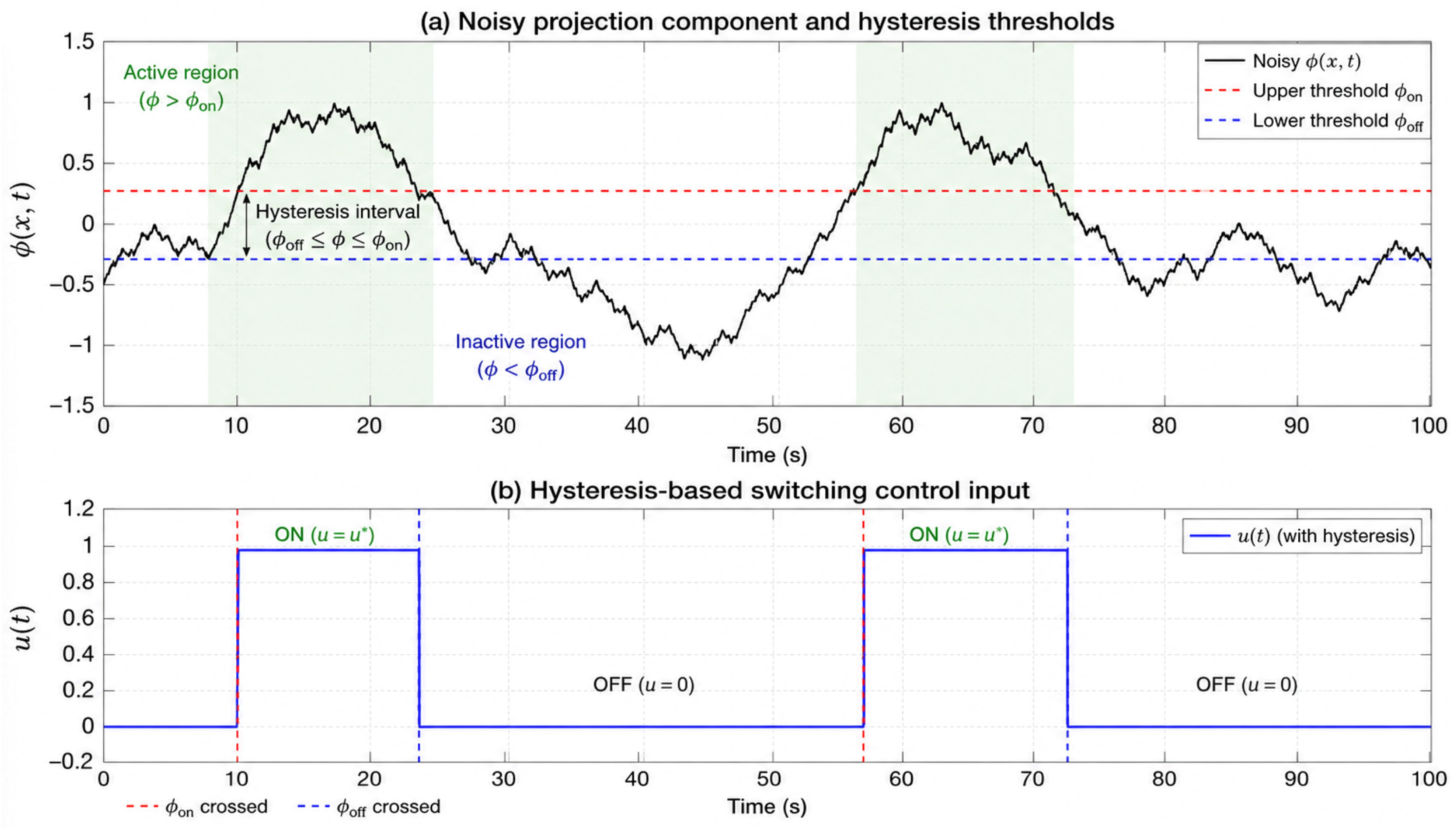
The practical robustness and switching feasibility of the proposed framework are verified through hysteresis-based switching analysis and noisy projection simulations.
Unlike classical optimal control approaches in which switching behavior is derived indirectly through Hamiltonian analysis, the proposed framework provides an explicit geometric characterization of switching optimality based on projection structure.
The remainder of this paper is organized as follows:
Section 2 presents the mathematical formulation of nonlinear systems with direction-dependent control inputs and reformulates the problem within an optimal control framework.
Section 3 derives the main theoretical results regarding the effectiveness of the control input based on the projection structure.
Section 4 provides numerical simulation results to validate the proposed theory.
Section 5 concludes the paper and discusses directions for future research.
The proposed framework additionally establishes a geometric perspective that complements existing event-triggered, adaptive, and switched nonlinear control methodologies.
2. Problem Formulation and Mathematical Structure of Projection-Based Optimal Control
2.1. System Model and Direction-Dependent Input Structure
In this study, we consider a nonlinear dynamical system with direction-dependent control inputs of the form
where
denotes the state vector,
is a scalar control input, and
represents an external disturbance. In the present formulation, the admissible control input is allowed to take continuous values within the interval. However, the derived projection-induced optimality condition reveals that the optimal activation structure naturally converges to a threshold-dependent switching behavior between inactive and active control regions. Therefore, the switching characteristic is not imposed a priori, but emerges analytically from the directional optimality condition. The restriction to nonnegative control inputs is adopted to represent systems in which the control action corresponds to unidirectional actuation or energy injection processes.
The functions and describe the intrinsic system dynamics and the influence of the control input, respectively.
To explicitly capture the directional effect of the control input, we introduce an input-induced vector representing the effect of the control input
. This vector is defined as
where
denotes the direction vector generated per unit input. Here, h(x,t) represents the directional structure and effectiveness of the control-induced action per unit input. Accordingly, the control input u(t) scales the magnitude of the induced effect, while h(x,t) determines how the induced action interacts with the system evolution direction. Therefore, even when identical control magnitudes are applied, their contributions to system performance may differ depending on the directional relationship between h(x,t) and the preferred system evolution direction. Next, we define a normalized vector representing the preferred system evolution direction. Let ψ(x(t), t) denote the preferred state evolution vector associated with performance improvement or cost reduction. The normalized preferred system direction is defined as the unit vector ê(t), where ê(t) = ∥η(x,t)∥η(x,t) and ∥ê(t)∥ = 1.
The normalization is introduced to isolate directional information independently from the vector magnitude. Based on this definition, the input-induced vector F(t) can be decomposed into components parallel and orthogonal to the preferred system direction as
To quantify the directional effectiveness of the control-induced action, the component of h(x,t) aligned with the preferred system evolution direction is evaluated using an inner-product-based projection structure, we introduce the scalar projection of
onto
, defined as
The scalar projection component ϕ(x(t), t) quantifies the directional contribution of the control-induced action relative to the preferred system evolution direction. Positive projection values indicate constructive directional alignment, whereas small or negative values correspond to inefficient or counterproductive control action.
The projection of
onto the system direction can then be expressed as
Therefore, ϕ(x(t), t) can be interpreted as a directional alignment gain that quantitatively characterizes the effectiveness of the control-induced action with respect to the desired system evolution direction.
2.2. Cost Functional and Optimal Control Problem
In this study, we consider a cost functional that simultaneously accounts for the energy consumption of the control input and the loss due to misalignment with the system direction. The cost functional is defined as
where
are weighting coefficients, and
denotes the energy cost associated with the control input. The first term represents the input usage cost, the second term captures the inefficiency arising from components orthogonal to the system direction, and the third term represents the reward for alignment with the system direction. The orthogonal component represents the portion of the control-induced vector that does not contribute to the preferred system evolution direction. Therefore, this component contributes to control effort without directly improving the optimization objective.
Substituting
, the cost functional can be rewritten as
where
denotes the magnitude of the component orthogonal to the system direction. The optimal control problem considered in this study is therefore formulated as
subject to
This cost structure represents a general class of optimization problems in which efficiency is determined by both energy expenditure and directional effectiveness.
Although the proposed analysis is developed using a specific convex instantaneous cost structure, the resulting projection-induced activation mechanism is not restricted to this particular formulation. Similar threshold-type switching structures can arise in broader classes of alignment-sensitive optimization problems in which the control benefit depends on directional projection and the control effort is associated with monotone activation costs.
2.3. Basic Assumptions
For the subsequent analysis, we impose the following assumptions.
Assumption 1. The functions , , , and are continuous and locally Lipschitz continuous in the relevant domain.
Assumption 2. The energy cost function is increasing and convex. In particular, it satisfies and is assumed to be differentiable.
Assumption 3. For a given state trajectory , the functions and are bounded and measurable.
Assumption 1 is a standard condition ensuring the existence and uniqueness of solutions to the state equation. Assumption 2 implies that the energy cost increases with the control input and that higher input levels incur progressively greater costs. Assumption 3 is required to guarantee the integrability of the cost functional and to ensure the well-definedness of the time-varying thresholds. Although Assumption 3 may appear restrictive in highly nonlinear or strongly uncertain environments, it is generally satisfied in many practical systems in which the preferred evolution direction varies smoothly over time.
The primary role of Assumption 3 is to guarantee the analytical consistency of the projection decomposition and the associated switching activation structure. In practical implementations, moderate deviations from the ideal directional estimation condition may arise due to sensor noise, disturbances, or modeling uncertainty.
To address this issue, additional robustness analysis under noisy projection estimation conditions is presented in
Section 4.5. The results demonstrate that the proposed switching framework preserves stable activation behavior under moderate uncertainty conditions.
2.4. Basic Properties of the Projection Structure
We first summarize a fundamental property of the vector decomposition.
Lemma 1. For any , the following identity holds: Proof. By definition,
is the component of
along the direction
, while
lies in the orthogonal complement. Therefore,
It follows from the Pythagorean theorem that
Lemma 1 shows that the total effect induced by the control input can be decomposed exactly into a component aligned with the system direction and an orthogonal component representing inefficiency. This result forms the basis for the subsequent analysis of the cost functional. □
2.5. Threshold-Based Switching Optimality
We now present the main result of this study.
It should be noted that the projection-induced optimality quantities are evaluated instantaneously with respect to the current system state x(t). Therefore, although the state trajectory evolves dynamically according to the applied control input u(t), the proposed optimality condition is interpreted locally in time based on the instantaneous directional relationship between the control-induced vector and the preferred system evolution direction.
Accordingly, the derived switching activation condition characterizes an instantaneous projection-induced optimality structure rather than a fully trajectory-dependent global optimal control formulation.
Theorem 1 (Threshold-Based Switching Optimality).
Suppose that Assumptions 1–3 hold. For each time , given the state , consider the instantaneous cost function If is strictly convex on the interval , then the unique pointwise optimal control satisfiesand In particular, the optimal control exhibits a switching structure determined by the thresholdsuch that the control input is activated only when .
Proof. Fix an arbitrary time t ∈ [0,T] and consider the instantaneous state x(t) as locally given for the pointwise optimization analysis. The instantaneous cost function is
By assumption, is strictly convex in and thus admits a unique global minimizer on . The optimal point is therefore characterized by the first-order condition.
The derivative of
with respect to
is given by
Evaluating at
, we obtain
□
Case 1: In this case,
and by convexity, the function
is non-decreasing at
. Hence, the minimum over
is attained at
Case 2: In this case,
so
initially decreases near
. Since
is strictly convex, its derivative is strictly increasing, and thus there exists a unique minimizer in
or at the boundary
. Therefore,
Combining both cases, the optimal control exhibits a switching structure determined by whether exceeds the threshold .
2.6. Interpretation and Implications
Theorem 1 provides the central mathematical result of this study. A key observation is that the activation of the optimal control input is not determined merely by whether the component along the system direction is positive, but rather by whether the directional gain is sufficiently large to overcome the marginal cost of input usage.
Intuitively, one might expect that the condition
is sufficient for the control input to be beneficial. However, optimality requires the stronger condition
which compares the directional alignment gain with the marginal energy cost. This highlights that the contribution of the present study goes beyond a qualitative interpretation of directionality. Instead, it establishes a rigorous switching condition based on the comparison between alignment gain and marginal cost.
Theorem 1 also has the following implications:
State-dependent activation of control input.
The optimal control is not a fixed input but takes the form of a switching law that depends on the state and time.
Directionality determines the control structure.
The magnitude of the input alone is insufficient; the degree of alignment between the input-induced vector and the system direction is the key factor governing optimality.
Constant input strategies are generally suboptimal.
Maintaining a constant input even in regions where the alignment gain is insufficient leads to increased cost, making state-independent control strategies structurally inefficient.
Theorem 2 (Integral Optimality under Pointwise Convex Cost Structure).
Suppose that Assumptions 1–3 hold. Let denote the pointwise optimal control given by Theorem 1. Then, for any admissible control , the following inequality holds: In particular, equality holds only when for almost every .
Proof. By Theorem 1, for each time t, the control
uniquely minimizes the instantaneous cost function
. That is,
for almost every
.
Integrating both sides over time yields
Moreover, by strict convexity, equality holds only when .
The optimal control problem considered in this study, unlike the traditional Hamiltonian-based approach, possesses a pointwise optimal control structure based on instantaneous cost minimization at each time. This approach is justified when the cost functional is separable in time, and the results of this study provide a structural interpretation for this class of optimal control problems. □
2.7. Suboptimality of Constant Input Strategies
The following direct result can be obtained from Theorem 1.
Corollary 1 (Strict Suboptimality of Constant Control).
If on a set of positive measureholds, then That is, for all , a control strategy maintaining a constant value cannot be optimal.
Proof. By assumption, on some interval
of positive measure,
holds. According to Theorem 1, the pointwise optimal input on this interval must be
Therefore, for any , applying yields a higher cost than the optimal input on the interval . Hence, the constant input strategy cannot minimize the total cost functional .
Corollary 1 clearly demonstrates why conventional fixed control strategies are structurally disadvantageous. This is not merely a simulation result but a mathematical conclusion derived from the structure of the cost functional itself. □
3. Geometric Interpretation and Projection-Based Control Structure
The optimal control conditions presented in
Section 2 demonstrate that the effectiveness of the control input is determined not by its magnitude alone but by directional alignment. In this section, these results are interpreted geometrically, and the general implications of the structure are analyzed. In particular, we clarify that the optimal control results in a switching structure that is activated only under specific conditions and extend this to structural properties in the state space.
3.1. Geometric Representation of the Direction Alignment Gain
The direction alignment gain defined in
Section 2,
is expressed as follows:
This can be interpreted as the inner product between the control input direction and the system progression direction and is converted into an angle-based expression as follows:
where
is the angle between the control input vector
and the progression direction vector
.
This expression shows that the effect of the control input is not simply determined by its magnitude but is fundamentally influenced by the degree of alignment between the two vectors, represented by . In particular, the sign and magnitude of this quantity are the key factors determining whether and to what extent the control input contributes to the system’s progression.
This relationship implies that the effect of the control input is determined not by its magnitude alone but by directional alignment. In particular, the angle between the input vector and the system progression direction serves as the key variable determining control performance.
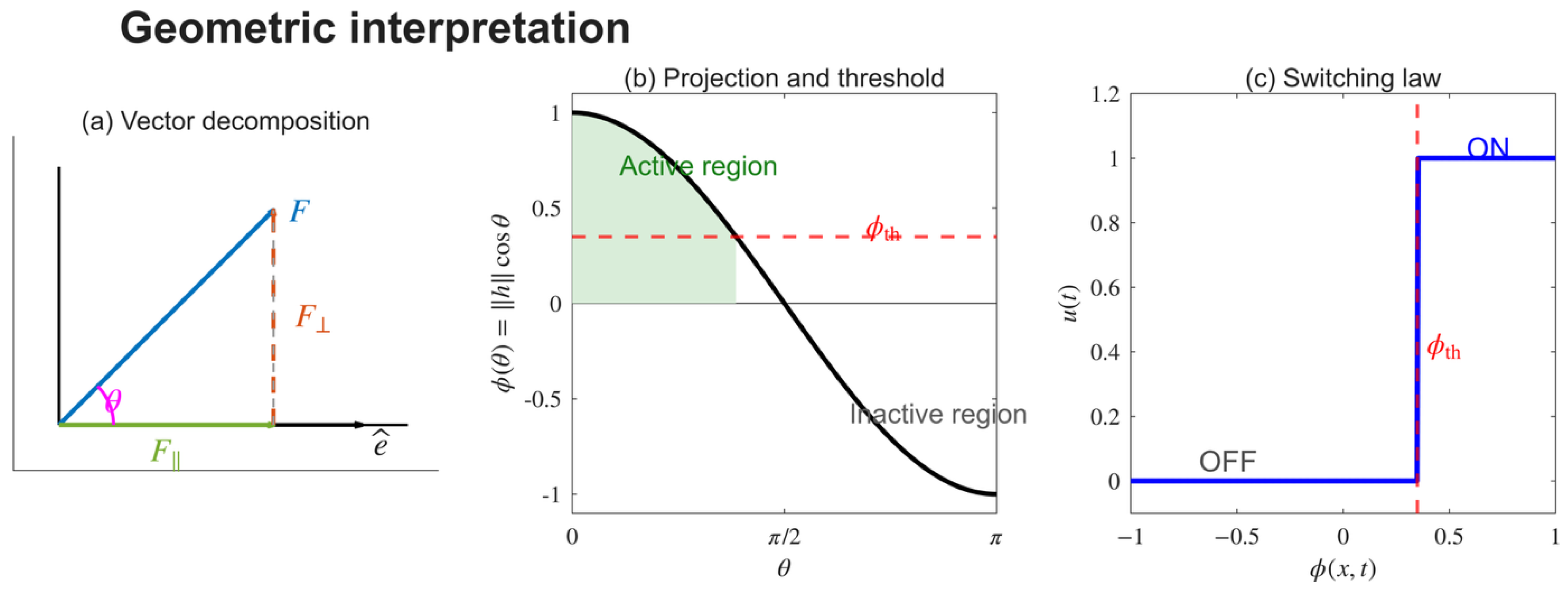
Figure 1 illustrates the geometric interpretation of the projection-based control structure proposed in this study.
Figure 1a shows that the input vector
is decomposed into the progression direction component
and the orthogonal component
, enabling the interpretation of the control input’s effect from a directional alignment perspective.
Figure 1b shows that as the alignment angle
varies, the projection value
changes, and the control input is effective only in intervals exceeding a specific threshold
. Furthermore,
Figure 1c demonstrates that this threshold condition causes the optimal control to take the form of a switching law rather than a continuous input. Therefore, in this study, the control problem can be interpreted not as a problem of continuously adjusting the input magnitude, but as a problem of selectively activating the input only in intervals where the directional alignment condition is satisfied.
3.2. Geometric Interpretation of the Threshold-Based Activation Condition
By Theorem 1 of
Section 2, the activation condition for the control input is given as follows:
The derived switching structure should be interpreted as a consequence of the balance between directional benefit and marginal control cost. When the projection-induced benefit exceeds the activation threshold, control activation becomes energetically favorable; otherwise, control deactivation minimizes unnecessary expenditure.
Re-expressing this in terms of angle,
is obtained. This means that the control input should be activated not merely when it has the same direction as the progression direction, but only when it satisfies a certain level of directional alignment.
From this, the following critical angle
can be defined.
Therefore, the control input is activated only when the following condition is satisfied.
This result implies that the effectiveness of the control input is determined not simply by whether the directions coincide, but by whether the degree of alignment exceeds a threshold. In particular, as it increases, the effect of the control input decreases progressively, and beyond a certain angle, it may rather degrade system performance.
Proposition 1 (Angle-Based Activation Condition)
. The necessary and sufficient condition for the control input to be activated is as follows:where 3.3. Switching Structure in the State Space
Since the activation condition of the control input depends on the state
, the state space can be divided into the following two regions:
where
denotes the active region where the control input is activated and
denotes the inactive region where the control input is deactivated.
These two regions are separated by the following boundary surface.
This boundary surface is a nonlinear surface depending on the state and time, and can be interpreted as a switching surface that determines whether the control input is activated.
Therefore, the optimal control input is expressed in the following switching form.
This result implies that the optimal control manifests not as a continuous input adjustment problem, but as a structural switching problem in which the input is selectively activated depending on the state.
3.4. Comparison with Conventional Control Structures
The conventional fixed control strategy is expressed as follows:
This strategy applies the same control input in all states and does not consider the directionality of the input or its state-dependent effectiveness.
In contrast, the control structure proposed in this study is as follows:
The fundamental differences between these two control strategies are summarized as follows:
The conventional control has a continuous control structure based on the magnitude of the input.
The proposed control has a state-dependent switching structure based on the directional alignment of the input.
In particular, the proposed structure operates the control input only in intervals where it is effective, thereby suppressing unnecessary input usage and improving overall system efficiency.
3.5. Generalizability and Theoretical Implications
The projection-based control structure derived in this study is not limited to a specific system but is applicable to various systems with direction-dependent inputs. In general, when the input acts on the system in vector form and its effect is determined by directional alignment, the structure presented in this study can be applied in the same manner.
In particular, these results have the following important theoretical implications.
First, the control problem can be reinterpreted not as a problem of adjusting the input magnitude, but as an alignment problem between the input vector and the system direction.
Second, it is shown that the optimal control does not generally take a continuous form, but may appear as a switching structure based on a threshold.
Third, conventional state-independent control strategies may be structurally suboptimal because they do not consider directional alignment.
In conclusion, the geometric interpretation presented in this section not only enables an intuitive understanding of the optimal control conditions derived in
Section 2, but also clearly demonstrates the generality and extensibility of the structure. This provides the theoretical basis for interpreting the numerical verification results presented in the next section.
Generalization Remark
The projection-based structure derived in this study was presented for scalar input systems, but can be generalized as follows:
Multiple direction projections
In this case as well, a threshold-based switching structure is induced for each input channel.
3.6. Robustness and Hysteresis-Based Switching
In practical implementations, switching activation laws based on a single threshold may induce excessive switching transitions near the activation boundary due to sensor noise, estimation uncertainty, or external disturbances. Such behavior may lead to chattering phenomena and undesirable switching oscillations.
To suppress this issue, a hysteresis-based switching mechanism with separate activation and deactivation thresholds is introduced. The hysteresis interval prevents rapid switching transitions near the threshold boundary and improves switching persistence characteristics.
In practical systems, the projection component may be affected by estimation errors, measurement noise, external disturbances, or unmodeled dynamics. Under such conditions, small perturbations near the activation threshold may induce undesired high-frequency switching behavior.
To improve robustness and suppress chattering phenomena near the switching boundary, a hysteresis-based switching structure is introduced. Specifically, two distinct thresholds are defined as follows:
Under this structure, the control input is activated only when
and deactivated only when
Accordingly, the switching law becomes
where
denotes the previous switching state.
The introduced hysteresis interval prevents repeated switching caused by small oscillations around the activation boundary and improves practical implementability. Furthermore, the hysteresis structure naturally generates an effective dwell-time behavior that suppresses excessively fast switching transitions. Because the control state is preserved within the hysteresis interval ϕoff ≤ ϕ(x,t) ≤ ϕon, repeated switching caused by small perturbations near the activation boundary is avoided, thereby ensuring a minimum practical switching persistence interval. Therefore, the proposed projection-based switching framework preserves the geometric optimality structure while improving robustness against uncertainties and noisy directional-alignment estimation.
4. Numerical Verification and Interpretation of Results
4.1. Verification Objectives and Setup
To verify the theoretical properties of the proposed projection-based optimal control framework, numerical simulations were conducted using a nonlinear direction-dependent dynamical system with projection-induced switching activation.
The considered system is represented by
where
denotes the system state,
is the control input, and
represents external disturbances and estimation uncertainties. The projection component
is computed from the directional alignment between the control-induced vector and the preferred system evolution direction.
The simulations were performed over a finite time horizon of
using a fixed-step numerical integration scheme. The initial state was selected as
To investigate practical robustness and switching feasibility, bounded noisy disturbances were additionally introduced into the projection estimation process. The disturbance term was modeled as a zero-mean Gaussian perturbation with bounded amplitude, representing sensor noise, external disturbances, and directional estimation uncertainty.
The activation threshold and hysteresis interval were selected to clearly illustrate the projection-induced switching behavior and robustness characteristics near the activation boundary.
The principal simulation parameters used throughout the numerical verification are summarized in
Table 3.
To quantitatively evaluate the effectiveness of the proposed framework, the simulations additionally compare cumulative cost reduction, switching behavior, and activation persistence characteristics under both fixed and projection-based switching conditions. The corresponding numerical results are presented in the following subsections.
The objective of the following simulations is to investigate how the projection-induced optimality conditions manifest in the temporal switching behavior and cumulative cost evolution. In particular, the purpose of this study is to confirm that the proposed control structure is not a mere empirical rule but an optimal control structure derived from the relationship between the direction alignment gain and the cost functional.
To this end, a nonlinear system with direction-dependent inputs is assumed, and a general situation in which the projection component varies temporally with the state is considered. In this study, a representative time-varying projection component is used to analyze the essential characteristics of the control structure without being dependent on a specific physical system.
The two control strategies for comparison are as follows:
Proposed (projection-based) control:
where
denotes the pointwise optimal input defined in
Section 2.
4.2. Temporal Variation in the Projection Component and Active Regions
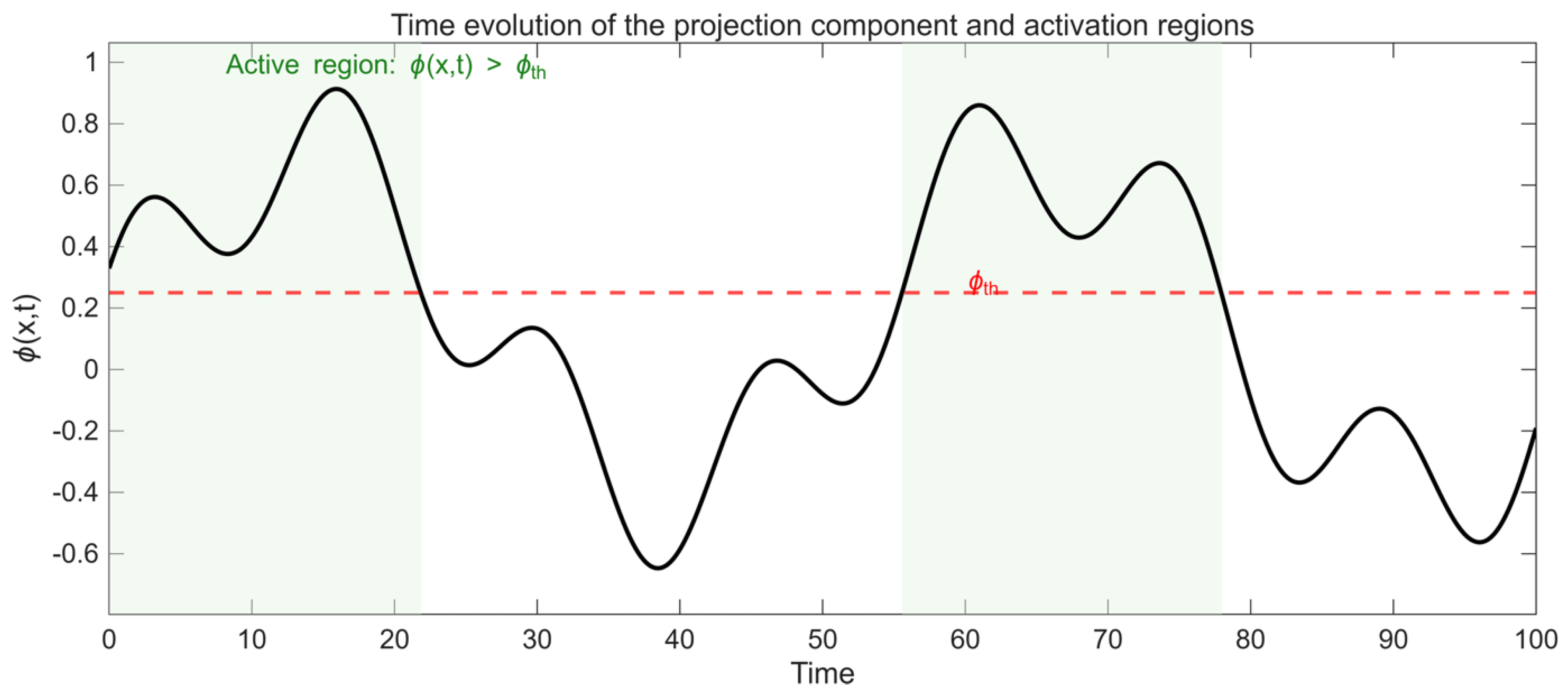
The key variable in the proposed control structure is the direction alignment gain . This value varies with time and serves as the criterion for determining whether the control input is activated.
Figure 2 shows the time evolution of the projection component
. The solid black line represents
, the red dashed line represents the threshold
, and the shaded regions indicate the active intervals where
.
As can be observed from the figure, alternates repeatedly between positive and negative regions over time without maintaining a constant value. In particular, the intervals where the threshold is exceeded correspond to only a portion of the total time interval, which means that the control input should not be applied at all times but rather be selectively activated.
These results are consistent with the threshold-based conditions derived in
Section 2, demonstrating that the effectiveness of the control input is determined not by the simple sign but by whether the threshold is exceeded.
4.3. Time Response of the Switching Control Input
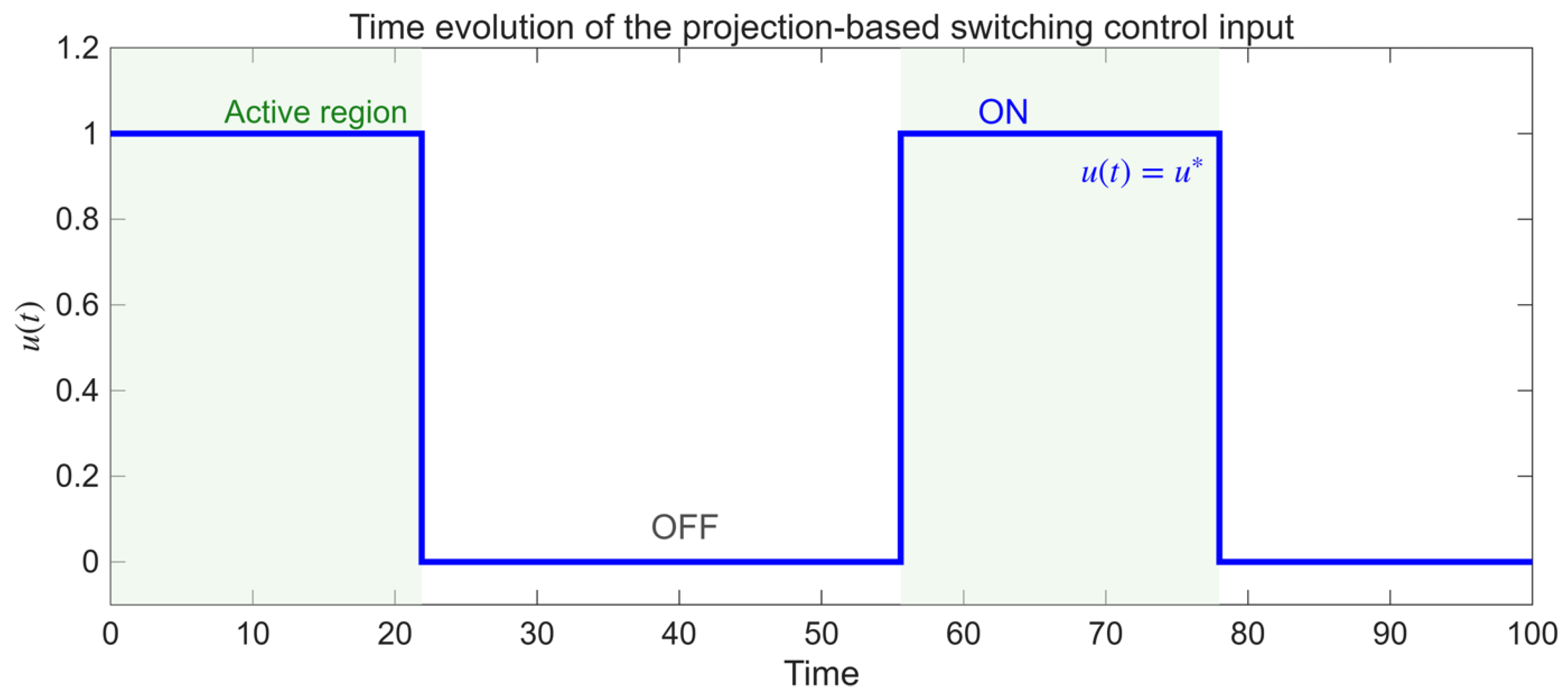
The control input generated based on the active intervals of the projection component is as follows.
Figure 3 shows the proposed control input
’s time response. The control input is activated only in the intervals satisfying
and is maintained at 0 in all other intervals.
In particular, comparing with
Figure 2, it can be confirmed that the intervals where the projection component exceeds the threshold exactly coincide with the intervals where the control input is actually activated. This indicates that the switching structure of the control input is not an artifact of the simulation but a direct consequence of the optimality condition derived in
Section 2.
That is, the proposed control is not a simple on/off control but an optimal control law determined by the direction alignment gain and the cost structure.
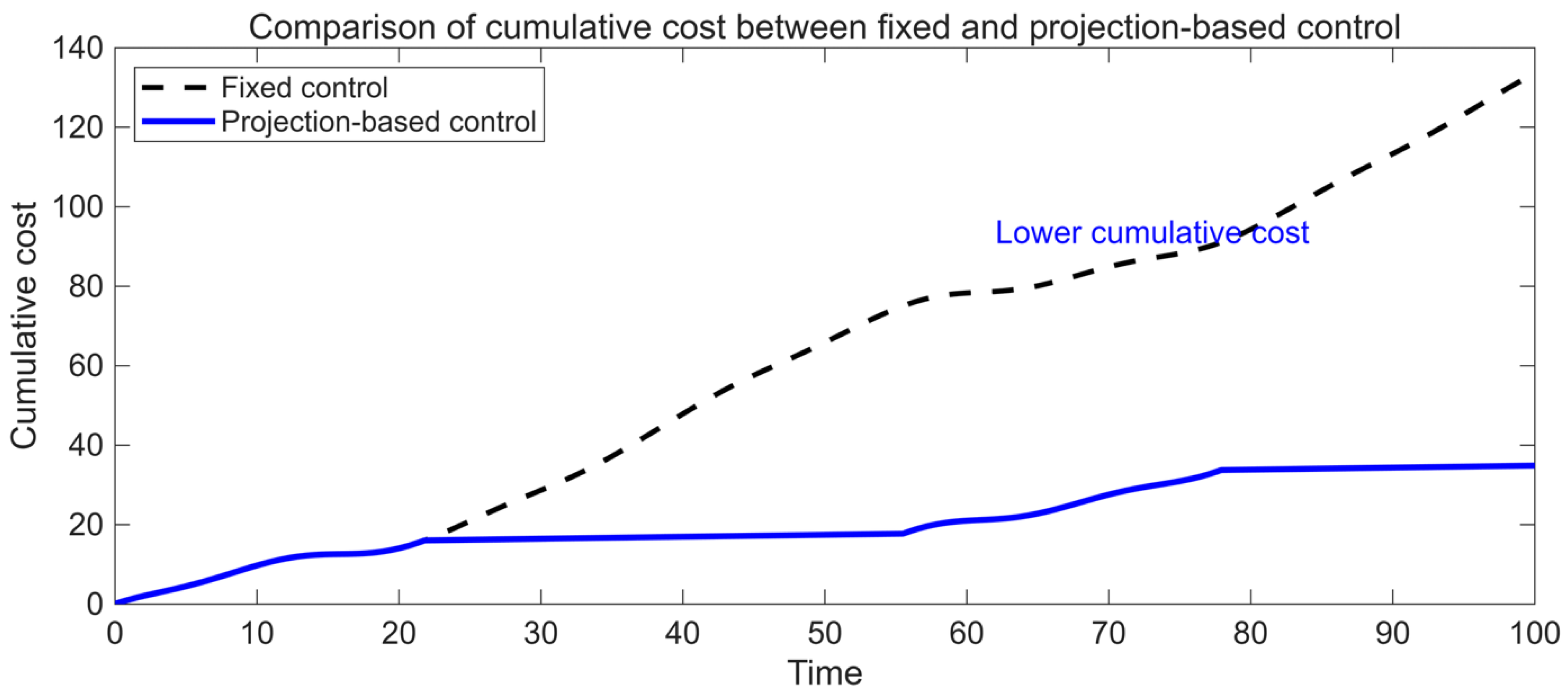
4.4. Comparison of Cumulative Costs
To quantitatively evaluate the performance of the proposed control structure, the cumulative costs of fixed control and projection-based control were compared. The cost functional is based on the form defined in
Section 2 and simultaneously considers the control input cost, the loss due to the orthogonal component, and the gain from directional alignment.
Figure 4 presents the comparison of cumulative costs between the two control strategies. Since fixed control maintains the input at all time intervals, costs continue to accumulate even in intervals where the projection component is below the threshold. In contrast, the proposed control activates the input only in intervals where the projection component is sufficiently large, thereby suppressing unnecessary input usage in inefficient intervals.
In particular, this cost reduction is not a simple effect of input reduction, but a structural consequence arising from the fact that the marginal cost of the input exceeds the direction alignment gain in intervals where the projection component is insufficient.
4.5. Robustness Analysis of the Hysteresis-Based Switching Structure Under Noisy Projection Estimation
To investigate the robustness of the proposed switching framework under practical uncertainties, additional simulations were conducted using noisy projection signals near the activation threshold. In practical applications, the projection component ϕ(x,t) may contain estimation errors caused by sensor noise, external disturbances, parameter uncertainties, or unmodeled dynamics. Under such conditions, repeated switching transitions may occur near the activation boundary when a single-threshold switching law is employed.
To address this issue, the proposed hysteresis-based switching structure introduced in
Section 3.6 was applied using two distinct activation thresholds, ϕ_on and ϕ_off.
Figure 5 illustrates the noisy projection signal together with the hysteresis thresholds and the resulting switching behavior. Without hysteresis compensation, small oscillations near the threshold may induce excessively frequent switching transitions. In contrast, the proposed hysteresis interval successfully suppresses chattering behavior and preserves stable activation/deactivation dynamics.
Furthermore, the hysteresis structure naturally generates an effective dwell-time behavior that improves practical feasibility while maintaining the projection-induced optimality structure.
These results demonstrate that the proposed hysteresis-based projection switching framework maintains stable activation behavior under moderate disturbances and noisy directional-alignment estimation conditions. In addition, the hysteresis interval implicitly generates a practical dwell-time effect that suppresses excessively fast switching transitions near the activation boundary.
4.6. Interpretation of Results and Generality
The numerical results of this section simultaneously support the optimality conditions derived in
Section 2 and the geometric interpretation presented in
Section 3.
Figure 2 shows that the projection component varies over time and the active region is limited,
Figure 3 shows that this structure manifests as the switching behavior of the actual control input, and finally
Figure 4 confirms that this selective control leads to an overall cost reduction.
In particular, these results are not limited to specific simulation conditions. The projection component in all systems where it varies temporally, the activation of the control input is determined by the threshold condition, and accordingly, a switching structure is naturally formed.
Therefore, the control strategy proposed in this study can be interpreted not as a simple empirical method, but as a result reflecting the general structure of optimal control in systems with direction-dependent inputs. This implies that the control problem can be redefined as a direction alignment-based selection problem rather than an input magnitude adjustment problem.
These numerical results are not merely a performance comparison, but directly demonstrate how the threshold-based optimality conditions derived in
Section 2 are realized in the time domain. In particular, it is confirmed that the switching structure of the control input is not externally designed but inevitably derived from the convex structure of the cost functional.
4.7. Discussion
The results presented in this study provide a geometric interpretation of optimal control in systems with direction-dependent inputs. Unlike conventional optimal control formulations, the proposed framework reveals that the effectiveness of the control input is inherently linked to its directional alignment with the system evolution.
A key observation is that the optimal control exhibits a switching structure that is not externally imposed but emerges naturally from the underlying optimality condition. This behavior is fundamentally different from classical magnitude-based control strategies, where the control input is continuously adjusted. In contrast, the proposed approach identifies regions in which the control input is either fully active or completely suppressed, depending on whether the projection component exceeds a critical threshold.
From a theoretical perspective, this result suggests that the control problem can be interpreted as a comparison between marginal benefit and marginal cost. When the projection-induced contribution is insufficient to compensate for the control cost, it becomes optimal to deactivate the control input. This interpretation provides a new insight into the structure of optimal control laws in nonlinear systems.
However, several limitations should be noted. First, the analysis assumes that the projection component can be evaluated accurately, which may not always be feasible in systems with incomplete state information. Second, the present formulation does not explicitly consider input constraints or saturation effects, which may influence the structure of the optimal control in practical applications.
Despite these limitations, the proposed framework has significant potential for extension. In particular, it can be generalized to systems with stochastic disturbances, time delays, or distributed dynamics. Moreover, the integration of the projection-based structure with adaptive or learning-based control strategies may enable real-time estimation of the activation threshold, further enhancing the applicability of the method.
Overall, the projection-based formulation provides a unified perspective that connects geometric structure, optimality conditions, and switching behavior, and may serve as a foundation for a broader class of control problems involving direction-dependent actuation.
This suggests that the projection-based switching structure is not specific to the considered formulation but represents a general characteristic of optimal control problems with direction-dependent actuation.
Unlike MPC and RL-based control architectures that require repeated optimization or iterative policy learning procedures, the proposed framework provides an explicit analytical switching condition derived directly from projection geometry and convex instantaneous optimality.
As a result, the proposed approach avoids the computational burden associated with prediction-horizon optimization and learning-based policy updates, while preserving a mathematically interpretable switching structure.
The proposed projection-based switching framework may also provide a useful theoretical perspective for future robustness-aware event-triggered and adaptive switching control systems. In particular, the geometric interpretation of directional alignment may potentially be integrated with learning-based or event-triggered activation mechanisms in uncertain nonlinear environments.
Although the proposed projection-based switching framework provides a mathematically interpretable activation mechanism, the resulting switching structure may introduce non-smooth and hybrid dynamical characteristics into the optimization problem. Consequently, the associated optimization landscape may become non-convex under certain directional activation conditions.
Therefore, the proposed framework should be interpreted as a geometric optimality formulation rather than a globally convex optimization methodology. Future research may investigate smooth approximation strategies, relaxed switching formulations, or hybrid optimization techniques to address such directional non-smoothness more systematically.
The proposed projection-based geometric framework may also be combined with differential flatness methodologies for nonlinear trajectory planning and optimal control design. In such a formulation, the flat outputs could potentially incorporate directional alignment conditions together with trajectory feasibility constraints.
This integration may provide an interesting extension in which projection-induced switching structures are embedded into flatness-based trajectory generation frameworks, thereby enabling direction-aware optimal trajectory design for nonlinear systems. However, such integration requires additional theoretical development and remains an important subject for future research.
Although the present study primarily considers a scalar input structure for clarity of theoretical derivation, the proposed projection-based framework may be extended to multi-input systems by defining directional projection metrics for each input channel or by constructing a composite projection operator in higher-dimensional input spaces.
In multi-input systems, coupled or interacting input channels may generate competing directional contributions. Therefore, the resulting switching structure may depend on both individual projection magnitudes and inter-channel geometric interactions.
4.8. Relation to Existing Control Frameworks and Limitations
The proposed framework is primarily intended as a theoretical and geometric optimality framework rather than a direct replacement for predictive or learning-based controllers.
In particular, MPC frameworks provide strong predictive capability for constrained systems, while RL/ADP approaches enable adaptive policy construction in uncertain environments. By contrast, the present work focuses on the analytical emergence of switching structures from projection-based optimality conditions.
Therefore, the main contribution of this study lies in establishing an explicit geometric interpretation of switching activation rather than developing a fully generalized predictive control architecture.
5. Conclusions
This study investigated an optimal control problem for nonlinear dynamical systems with direction-dependent control effects. Unlike conventional optimal control formulations that primarily focus on the magnitude of the control input, the proposed framework introduced a projection-based geometric formulation in which the directional alignment between the control-induced vector and the preferred system evolution direction plays a central role.
By decomposing the control-induced vector into parallel and orthogonal components, a geometric optimality condition was analytically derived using the projection component. Based on this condition, it was theoretically shown that the activation of the control input naturally leads to a threshold-dependent switching structure. Consequently, the obtained switching behavior was not introduced heuristically, but emerged directly from the directional optimality condition of the proposed framework.
The numerical investigations demonstrated that the proposed formulation achieves lower cumulative cost and reduced unnecessary control activation compared with fixed control strategies. Furthermore, the additional robustness analysis showed that the hysteresis-enhanced activation mechanism suppresses excessive switching transitions under noisy projection estimation conditions while preserving stable activation behavior near the switching boundary.
The obtained results suggest that projection-based geometric activation mechanisms may provide a useful mathematical perspective for nonlinear switched systems and direction-sensitive optimal control problems. In particular, the proposed framework may potentially be extended toward robustness-aware hybrid control systems, event-triggered activation mechanisms, and geometry-aware adaptive control methodologies.
Future research may investigate rigorous Lyapunov-based stability analysis, smooth approximations of the switching boundary, and broader applications to trajectory planning and nonlinear hybrid dynamical systems.