Article

Note on Derivatives of Bessel Function Ratios

Faculty of Mechanical Engineering and Mechatronics, West Pomeranian University of Technology in Szczecin, 70-310 Szczecin, Poland
Mathematics 2026, 14(11), 2011; https://doi.org/10.3390/math14112011
Submission received: 1 April 2026 / Revised: 31 May 2026 / Accepted: 2 June 2026 / Published: 5 June 2026
(This article belongs to the Section C: Mathematical Analysis)

Abstract

This paper introduces novel recurrence relations that enable the systematic calculation of derivatives for five fundamental Bessel function ratios: J p ± 1 ( z ) / J p ( z ) , I p ± 1 ( z ) / I p ( z ) , and J p ( z ) / J p ( z ) . The recursive structure reduces the calculation of this derivatives to algebraic operations, allowing for the explicit derivation of formulas up to the sixth order. These results are applied to generate new infinite series based exclusively on Bessel function zeros, extending the classical Rayleigh function framework. The methodology’s practical utility is demonstrated through application to an inverse Laplace transform problem arising in fluid mechanics, namely water hammer analysis. Additionally, we systematically extend and generalize Pedersen’s series, providing closed-form expressions for previously missing cases. The recursive framework established herein transforms what were once cumbersome ad hoc calculations into tractable algebraic procedures, opening new avenues for both theoretical exploration and engineering applications.

1. Introduction

As observed by Watson in his classic treatise [1], “there are various classes of problems, connected with the zeros of Bessel functions.” The classical Rayleigh functions [2] σ n ( p ) = k = 1 j k , p 2 n and their recursive determination by Meiman [3] and Kishore [4], with σ 1 ( p ) = 1 4 ( p + 1 ) and σ n ( p ) = 1 p + n k = 1 n 1 σ k ( p ) σ n k ( p ) , provide the foundation for our analysis. Similarly, Muldoon and Raza [5] extended Kishore’s results to sums of reciprocal powers of zeros of derivatives of Bessel functions: τ 1 ( p ) = k = 1 j k , p 2 = p + 2 4 p ( p + 1 ) and τ n ( p ) = k = 1 j k , p 2 n = σ n ( p ) + 2 p k = 1 n 1 σ k ( p ) τ n k ( p ) for n 2 .
The literature attests to a sustained interest in ratios (quotients) of Bessel functions and their properties. Amos [6] presents an efficient algorithm for computing modified Bessel ratios I p + 1 ( z ) / I p ( z ) , established sharp bounds, and monotonicity properties of this ratio. Nåsell [7] constructs double sequences of rational bounds for I p + 1 ( z ) / I p ( z ) with proven convergence. Ifantis and Siafarikas [8] derived inequalities for the ratios J p ( z ) / J p + 1 ( z ) and I p ( z ) / I p + 1 ( z ) for p > 1 , improving many earlier results. Landau [9] studies derivatives of the ratio J p ( z ) / J p + 1 ( z ) with respect to both order and argument, providing a complete description of the roots of α J p ( z ) + z J p ( z ) = 0 for all real p and α . Petropoulou [10] uses continued fractions to generate sequences of bounds for I p + 1 ( z ) / I p ( z ) while Ruiz-Antolín and Segura [11] introduce a novel method based on Riccati equation analysis to obtain bounds sharper than all previous known ones.
Issues related to these ratios are closely connected with series involving zeros of Bessel functions and the Bessel functions themselves—see Sneddon [12]. The electrostatic interpretation of Bessel zeros proposed by Muldoon [13], modeling their dynamics as a system of charged particles, provides valuable physical insight into these investigations. Baricz et al. [14] contribute an elementary proof of Calogero’s identity for zeros of Bessel functions, together with new identities applicable to Struve functions and modified Bessel functions of the second kind. Afanasiev [15] derives sum rules for Bessel function zeroes of integer and half-integer orders by comparing integral representations and applying perturbation theory to the Schrödinger equation. Pedersen [16] obtains sum rules for zeros and intersections of Bessel functions using quantum mechanical perturbation theory for Schrödinger and massless Dirac fermions in confined geometries. Urbanowicz [17] demonstrates that the use of Lommel polynomials simplifies series based on Bessel zeros, significantly extending Rayleigh theory with solutions useful for many previously unstudied problems in physics, mechanics, or mathematics. Langowski and Nowak [18] derive new identities involving zeros of the Bessel function and related functions. Fattah [19] extends Calogero’s identity to broad families of cross-order reciprocal series constructed from zeros of Bessel functions and their derivatives, obtaining explicit rational closed forms via Mittag–Leffler expansions. As explained by Segura [20], modified Bessel function ratios appear in a wide range of scientific and engineering applications and play an important role in fields such as finite elasticity, telecommunications, statistics, heat transfer, and information theory.
This paper is devoted to the continued study of Bessel function ratios, which play an important role in many engineering applications [21,22,23] and the theory of differential equations: [24]
J p + 1 ( z ) J p ( z ) , J p 1 ( z ) J p ( z ) , I p + 1 ( z ) I p ( z ) , I p 1 ( z ) I p ( z ) , and J p ( z ) J p ( z ) .
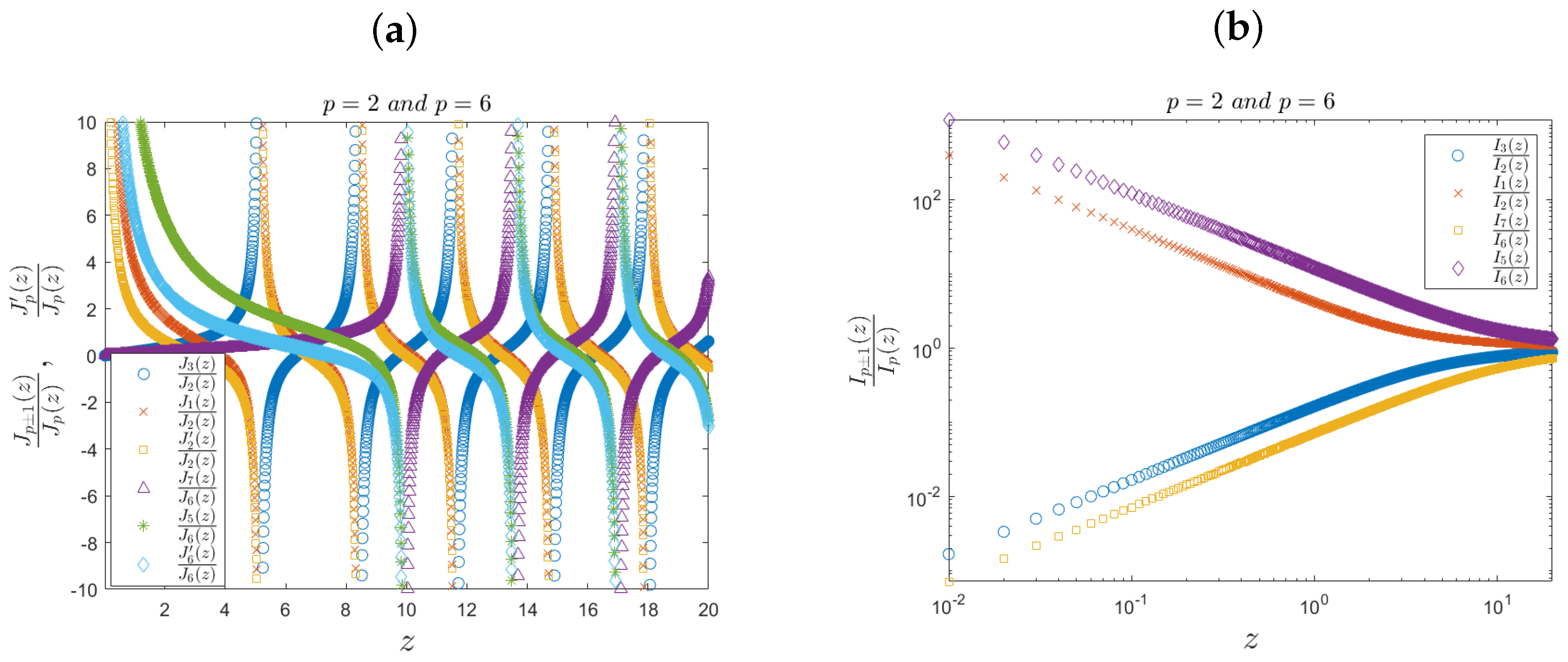
These ratios can be represented as series via the Mittag–Leffler expansion based on the poles of the denominator function [1,13,14] or by using the Weierstrass product representation followed by logarithmic differentiation [19]. Their behavior is illustrated in Figure A1 in Appendix A. The resulting derivatives of Equation (1), enable the formulation of important recurrence lemmas for powers of this ratio. The practical relevance of novel results is illustrated through examples from fluid mechanics (water hammer problem) and quantum mechanical perturbation theory for the Schrödinger equation and massless Dirac fermions. This work bridges pure analysis (including special function theory, Calogero identities [25,26,27], and sum rules) with engineering applications, continuing the rich tradition of Bessel function research initiated by Rayleigh and Watson and further developed by numerous contemporary authors.

2. Differential Recurrences for Powers of Bessel Ratios

The ordinary Bessel functions of the first kind can be defined as solutions of a differential equation, from generating functions, etc., while the most frequent definition is an infinite series representation (formula 9.1.10, p. 360 in [28]):
J p ( z ) = k = 0 ( 1 ) k 0.5 z p + 2 k k ! Γ ( p + k + 1 ) ,
where Γ ( z ) represents the gamma function and ! is the factorial.
The modified Bessel functions of the first kind and of order p are given by a similar series formula to Equation (2), except all of the coefficients in the series are positive numbers (formula 9.6.10, p. 375 in [28]):
I p ( z ) = k = 0 0.5 z p + 2 k k ! Γ ( p + k + 1 ) .
In Equations (2) and (3), p denotes the order of the Bessel function and z its argument. The series representations are valid for complex values of z and for p { 1 , 2 , 3 , } . Throughout this paper, whenever zeros j p , n are considered, we assume p > 1 , ensuring the existence of the standard sequence of positive real zeros 0 < j p , 1 < j p , 2 < .
The main objective of this paper is to derive explicit formulas for higher-order reciprocal series generated by Bessel function ratios. To achieve this, we first establish differential recurrence relations for powers of the fundamental ratios listed in (1). These recurrences constitute the principal technical tool used throughout the subsequent propositions and theorems, allowing repeated differentiation to be reduced to purely algebraic manipulations. The resulting identities are collected in the following lemma.
Lemma 1
(Differential recurrences for powers of Bessel ratios). Let k 1 . For every z 0 such that the denominators involved do not vanish, the following identities hold:
J p + 1 ( z ) J p ( z ) k = k J p + 1 ( z ) J p ( z ) k + 1 + J p + 1 ( z ) J p ( z ) k 1 2 p + 1 z J p + 1 ( z ) J p ( z ) k ,
J p 1 ( z ) J p ( z ) k = k J p 1 ( z ) J p ( z ) k + 1 J p 1 ( z ) J p ( z ) k 1 + 2 p 1 z J p 1 ( z ) J p ( z ) k ,
I p + 1 ( z ) I p ( z ) k = k I p + 1 ( z ) I p ( z ) k + 1 + I p + 1 ( z ) I p ( z ) k 1 2 p + 1 z I p + 1 ( z ) I p ( z ) k ,
I p 1 ( z ) I p ( z ) k = k I p 1 ( z ) I p ( z ) k + 1 I p 1 ( z ) I p ( z ) k 1 + 2 p 1 z I p 1 ( z ) I p ( z ) k .
Finally,
J p ( z ) J p ( z ) k = k p 2 z 2 1 J p ( z ) J p ( z ) k 1 1 z J p ( z ) J p ( z ) k J p ( z ) J p ( z ) k + 1 .
Proof. 
We recall the standard recurrence relations for Bessel functions (formulas 9.1.27, p. 361 in [28]):
J p + 1 ( z ) + J p 1 ( z ) = 2 p z J p ( z ) ,
and
J p ( z ) = 1 2 J p 1 ( z ) J p + 1 ( z ) .
For modified Bessel functions, we use (formulas 9.6.26, p. 376 in [28]):
I p 1 ( z ) I p + 1 ( z ) = 2 p z I p ( z ) ,
and
I p ( z ) = 1 2 I p 1 ( z ) + I p + 1 ( z ) .
These recurrence relations arise naturally when solving boundary-value problems possessing cylindrical symmetry, including wave propagation, heat conduction, acoustics, electromagnetic fields, and quantum mechanical eigenvalue problems.
We give the proof of the first identity. By differentiating the quotient J p + 1 ( z ) / J p ( z ) , one obtains
J p + 1 ( z ) J p ( z ) = J p + 1 ( z ) J p ( z ) J p + 1 ( z ) J p ( z ) J p 2 ( z ) .
Using (9) and (10), with the index shifted when necessary, this derivative can be rewritten as
J p + 1 ( z ) J p ( z ) = J p + 1 ( z ) J p ( z ) 2 2 p + 1 z J p + 1 ( z ) J p ( z ) + 1 .
Multiplying this identity by
k J p + 1 ( z ) J p ( z ) k 1
gives (4).
The proof of (5) is identical, starting from the quotient J p 1 ( z ) / J p ( z ) and using again (9) and (10). Similarly, the identities (6) and (7) follow by differentiating the quotients I p + 1 ( z ) / I p ( z ) and I p 1 ( z ) / I p ( z ) , respectively, and using the modified Bessel recurrences (11) and (12). This gives the corresponding Riccati-type identities, and multiplication by the appropriate factor k ( · ) k 1 yields the stated power recurrences.
For the last identity, we use the Bessel differential equation [1]
z 2 J p ( z ) + z J p ( z ) + ( z 2 p 2 ) J p ( z ) = 0 .
Dividing by z 2 J p ( z ) , we obtain
J p ( z ) J p ( z ) = 1 z J p ( z ) J p ( z ) 1 + p 2 z 2 .
Since
J p ( z ) J p ( z ) = J p ( z ) J p ( z ) J p ( z ) J p ( z ) 2
we get
J p ( z ) J p ( z ) = J p ( z ) J p ( z ) 2 1 z J p ( z ) J p ( z ) + p 2 z 2 1
Multiplying by
k J p ( z ) J p ( z ) k 1
gives (8). The proof is complete. □

3. Series Generated by Ratios of First Kind Ordinary Bessel Functions

3.1. Series Generated by the Ratio J p + 1 ( z ) / J p ( z )

In this subsection, we derive explicit representations for series involving the zeros of Bessel functions of the first kind. Such identities are important in spectral analysis and in problems where expansions over Bessel eigenvalues naturally arise. Related formulas have been studied in recent work by Urbanowicz [17], where similar summation structures were obtained in applied contexts. Building on these ideas, we present a systematic family of closed-form expressions for higher-order reciprocal powers of shifted Bessel zeros.
Proposition 1
(Explicit formulas for series associated with zeros of Bessel functions). Let z 0 , J p ( z ) 0 , and z j p , k . Then the following identities hold.
For l = 1 ,
k = 1 1 j p , k 2 z 2 = 1 2 z J p + 1 ( z ) J p ( z ) .
For l = 2 ,
k = 1 1 j p , k 2 z 2 2 = 1 4 z 2 J p + 1 ( z ) J p ( z ) 2 p + 1 2 z 3 J p + 1 ( z ) J p ( z ) + 1 4 z 2 .
For l = 3 ,
k = 1 1 j p , k 2 z 2 3 = 1 8 z 3 J p + 1 ( z ) J p ( z ) 3 3 ( p + 1 ) 8 z 4 J p + 1 ( z ) J p ( z ) 2 + z 2 + 2 ( p + 1 ) ( p + 2 ) 8 z 5 J p + 1 ( z ) J p ( z ) p + 2 8 z 4 .
For l = 4 ,
k = 1 1 j p , k 2 z 2 4 = 1 16 z 4 J p + 1 ( z ) J p ( z ) 4 p + 1 4 z 5 J p + 1 ( z ) J p ( z ) 3 + 2 z 2 + ( p + 1 ) ( 7 p + 11 ) 24 z 6 J p + 1 ( z ) J p ( z ) 2 z 2 ( 4 p + 5 ) + 2 ( p + 1 ) ( p + 2 ) ( p + 3 ) 24 z 7 J p + 1 ( z ) J p ( z ) + z 2 + 2 ( p + 2 ) ( p + 3 ) 48 z 6 .
For l = 5 ,
k = 1 1 j p , k 2 z 2 5 = 1 32 z 5 J p + 1 ( z ) J p ( z ) 5 5 ( p + 1 ) 32 z 6 J p + 1 ( z ) J p ( z ) 4 + 5 ( p + 1 ) ( 5 p + 7 ) + 5 z 2 96 z 7 J p + 1 ( z ) J p ( z ) 3 5 z 2 ( 6 p + 7 ) + 10 ( p + 1 ) ( p + 2 ) ( 3 p + 5 ) 192 z 8 J p + 1 ( z ) J p ( z ) 2 + 2 z 4 + z 2 ( p + 2 ) ( 11 p + 13 ) + 2 ( p + 1 ) ( p + 2 ) ( p + 3 ) ( p + 4 ) 96 z 9 J p + 1 ( z ) J p ( z ) ( 4 p + 7 ) z 2 + 2 ( p + 2 ) ( p + 3 ) ( p + 4 ) 192 z 8 .
For l = 6 ,
k = 1 1 j p , k 2 z 2 6 = 1 64 z 6 J p + 1 ( z ) J p ( z ) 6 3 ( p + 1 ) 32 z 7 J p + 1 ( z ) J p ( z ) 5 + 2 z 2 + ( p + 1 ) ( 13 p + 17 ) 64 z 8 J p + 1 ( z ) J p ( z ) 4 ( 8 p + 9 ) z 2 + 2 ( 3 p + 5 ) ( 2 p + 3 ) ( p + 1 ) 64 z 9 J p + 1 ( z ) J p ( z ) 3 + 1 960 z 10 17 z 4 + ( 146 p 2 + 405 p + 271 ) z 2 + ( p + 1 ) ( p + 2 ) ( 62 p 2 + 264 p + 274 ) J p + 1 ( z ) J p ( z ) 2 1 960 z 11 z 4 ( 34 p + 47 ) + 2 ( p + 2 ) ( p ( 26 p + 97 ) + 77 ) z 2 + 4 ( p + 1 ) ( p + 2 ) ( p + 3 ) ( p + 4 ) ( p + 5 ) J p + 1 ( z ) J p ( z ) + 1 960 z 10 2 z 4 + ( p ( 11 p + 47 ) + 47 ) z 2 + 2 ( p + 2 ) ( p + 3 ) ( p + 4 ) ( p + 5 ) .
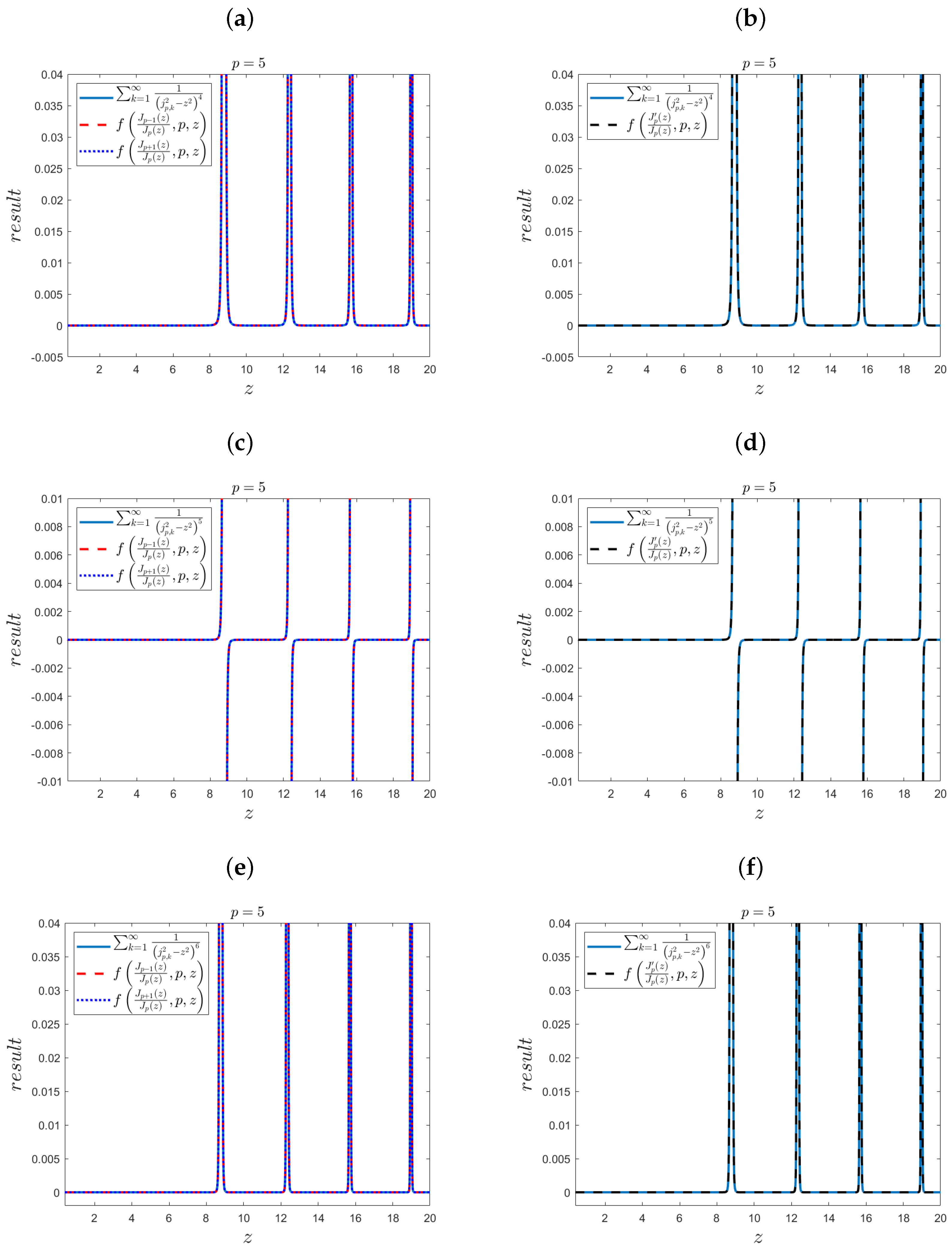
The correctness of the newly derived formulas presented above (for l = 4, 5, and 6) was verified through simulations, as confirmed by the obtained variability plots shown in Figure A2a,c,e in Appendix A.
Proof. 
The case l = 1 is precisely the Mittag–Leffler expansion associated with the zeros of J p ( z ) , namely Equation (19). This give the first identity. To obtain the case l = 2 , we differentiate the preceding formula with respect to z. Since
1 j p , k 2 z 2 = 2 z j p , k 2 z 2 2 ,
the left hand side becomes
2 z k = 1 1 j p , k 2 z 2 2 .
On the right hand side, differentiating gives
1 2 z 2 J p + 1 ( z ) J p ( z ) + 1 2 z J p + 1 ( z ) J p ( z ) .
Using Lemma 1, more precisely relation (4) with k = 1 , we obtain
J p + 1 ( z ) J p ( z ) = J p + 1 ( z ) J p ( z ) 2 + 1 2 p + 1 z J p + 1 ( z ) J p ( z ) .
Substituting this identity and simplifying, we get
2 z k = 1 1 j p , k 2 z 2 2 = 1 2 z J p + 1 ( z ) J p ( z ) 2 p + 1 z 2 J p + 1 ( z ) J p ( z ) + 1 2 z .
Dividing by 2 z yields Equation (20). This proves the formula for l = 2 .
For l = 3 , we differentiate the formula obtained for l = 2 . Using
1 j p , k 2 z 2 2 = 4 z j p , k 2 z 2 3 ,
we get
k = 1 1 j p , k 2 z 2 3 = 1 4 z d d z k = 1 1 j p , k 2 z 2 2 .
Applying relation (4) with k = 1 and k = 2 , and simplifying, gives Equation (21). This proves the formula for l = 3 .
For l = 4 , we proceed in the same way. Since
1 j p , k 2 z 2 3 = 6 z j p , k 2 z 2 4 ,
we have
k = 1 1 j p , k 2 z 2 4 = 1 6 z d d z k = 1 1 j p , k 2 z 2 3 .
Using relation (4) with k = 1 , 2 , 3 , and simplifying, we obtain Equation (22). This proves the formula for l = 4 .
For l = 5 , we differentiate the formula obtained for l = 4 . Since
1 j p , k 2 z 2 4 = 8 z j p , k 2 z 2 5 ,
we have
k = 1 1 j p , k 2 z 2 5 = 1 8 z d d z k = 1 1 j p , k 2 z 2 4 .
Using relation (4) with k = 1 , 2 , 3 , 4 and simplifying, we obtain Equation (23). This proves the formula for l = 5 .
Similar procedure is used to receive prove for l = 6 . Since
1 j p , k 2 z 2 5 = 10 z j p , k 2 z 2 6 ,
we have
k = 1 1 j p , k 2 z 2 6 = 1 10 z d d z k = 1 1 j p , k 2 z 2 5 .
Using relation (4) with k = 1 , 2 , 3 , 4 , 5 and simplifying, we obtain Equation (24). This proves the formula for l = 6 . □

3.2. Calogero-Type Identities Associated with Zeros of J p + 1 ( z )

Theorem 1
(Calogero-type identities associated with the zeros of J p + 1 ( z ) ). Let j p + 1 , n be the n-th positive zero of J p + 1 ( z ) . Then, for every integer l 1 , the following identities hold.
For l = 1 ,
k = 1 1 j p , k 2 j p + 1 , n 2 = 0 .
For l = 2 ,
k = 1 1 j p , k 2 j p + 1 , n 2 2 = 1 4 j p + 1 , n 2 .
For l = 3 ,
k = 1 1 j p , k 2 j p + 1 , n 2 3 = p + 2 8 j p + 1 , n 4 .
For l = 4 ,
k = 1 1 j p , k 2 j p + 1 , n 2 4 = j p + 1 , n 2 + 2 ( p + 2 ) ( p + 3 ) 48 j p + 1 , n 6 .
For l = 5 ,
k = 1 1 j p , k 2 j p + 1 , n 2 5 = ( 4 p + 7 ) j p + 1 , n 2 + 2 ( p + 2 ) ( p + 3 ) ( p + 4 ) 192 j p + 1 , n 8 .
For l = 6 ,
k = 1 1 j p , k 2 j p + 1 , n 2 6 = 2 j p + 1 , n 4 + p ( 11 p + 47 ) + 47 j p + 1 , n 2 + 2 ( p + 2 ) ( p + 3 ) ( p + 4 ) ( p + 5 ) 960 j p + 1 , n 10 .
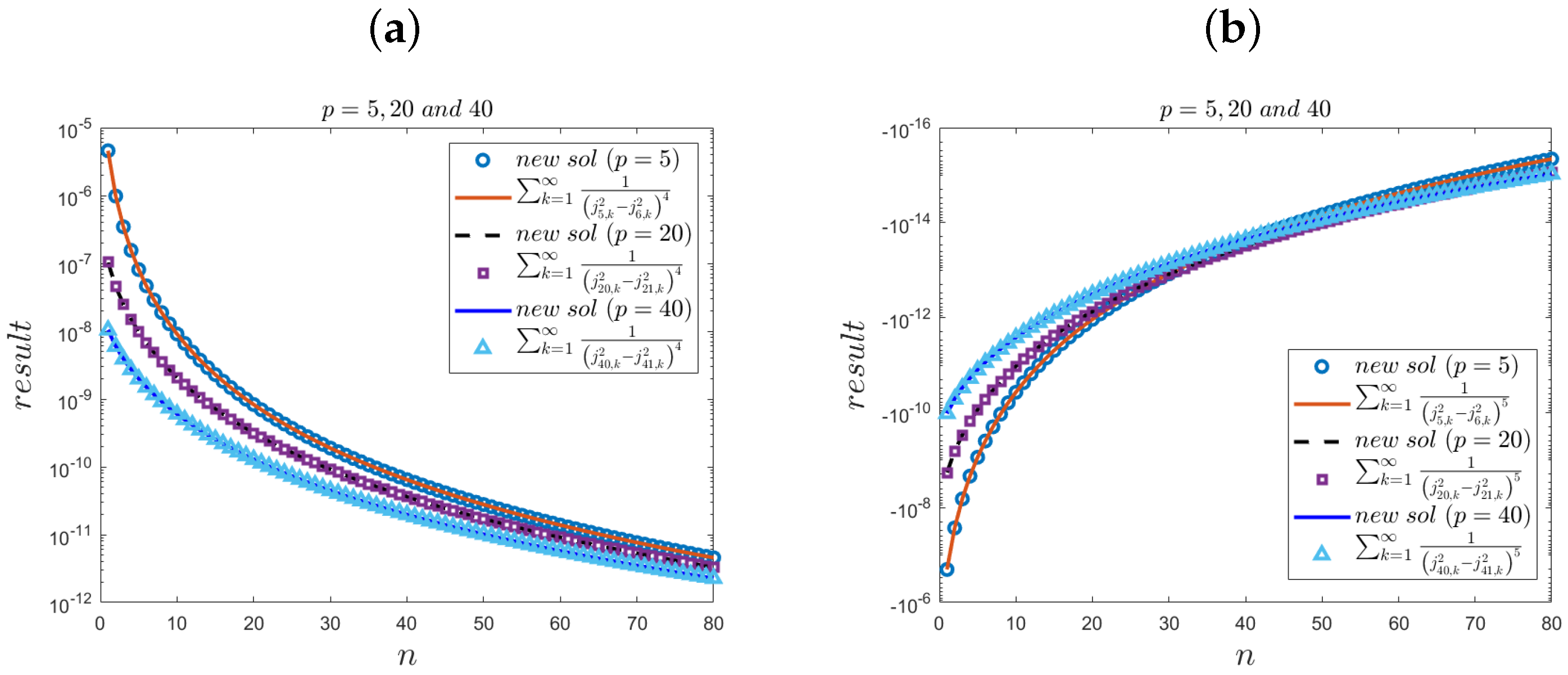
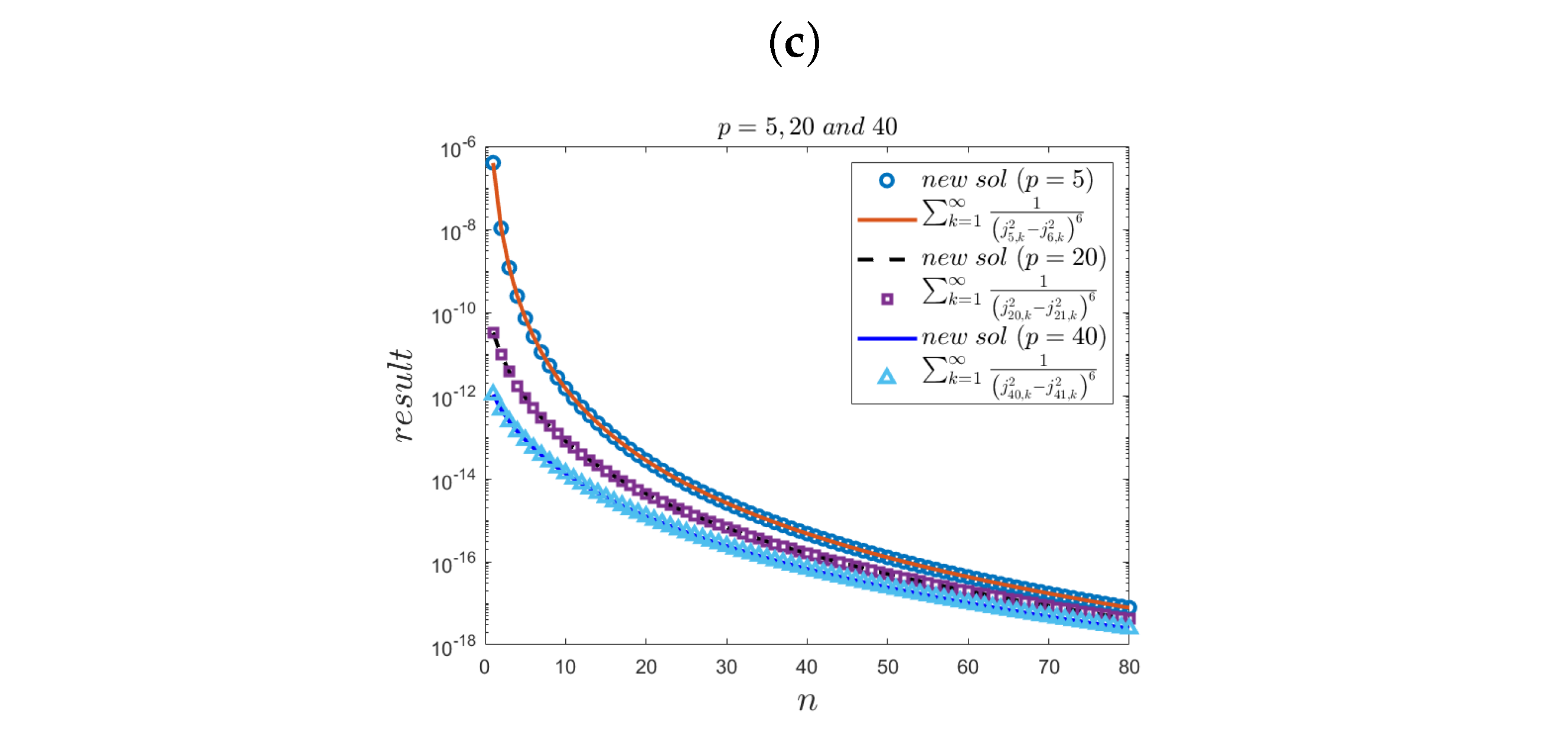
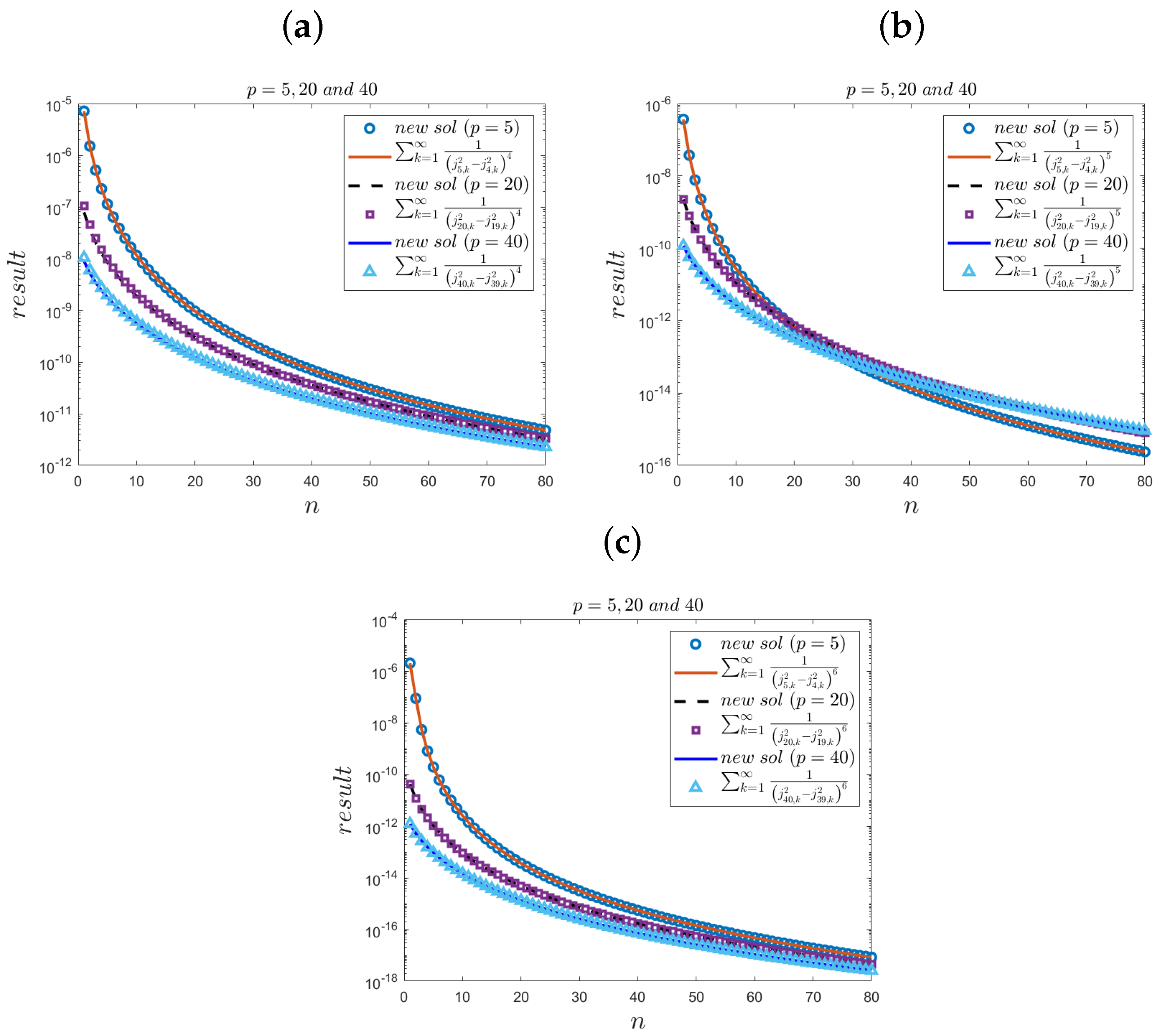
The identities for l = 1 , 2 , 3 are known in the literature [17], while the cases l = 4 , 5 , 6 provide higher-order extensions obtained via the differential recurrence method. Selected comparisons between series representations based on Bessel function zeros and the new corresponding non-series representations based solutions are shown in Figure A3 in Appendix A.
Proof. 
For l = 4 , we use Proposition 1, namely Equation (22) obtained for the ratio J p + 1 ( z ) / J p ( z ) . We now take z = j p + 1 , n . Since j p + 1 , n is a zero of J p + 1 ( z ) , one has J p + 1 ( j p + 1 , n ) = 0 . Moreover, by the interlacing and simplicity of the zeros, J p ( j p + 1 , n ) 0 . Hence
J p + 1 ( j p + 1 , n ) J p ( j p + 1 , n ) = 0 .
Therefore, all terms containing the ratio J p + 1 ( z ) / J p ( z ) vanish after the substitution. The only remaining term is the term not multiplied by the Bessel ratio, giving giving at z = j p + 1 , n
j p + 1 , n 2 + 2 ( p + 2 ) ( p + 3 ) 48 j p + 1 , n 6 .
which is Equation (41). This proves the identity for l = 4 .
For l = 5 , Proposition 1 gives Equation (23). Taking z = j p + 1 , n , the ratio J p + 1 ( z ) / J p ( z ) vanishes, since J p + 1 ( j p + 1 , n ) = 0 and J p ( j p + 1 , n ) 0 and Equation (42) is received. This proves the case l = 5 . By proceeding similarly, the proof for l = 6 can be obtained. □

3.3. Series Generated by the Ratio J p 1 ( z ) / J p ( z )

Pedersen observed [16] that additional series based identities involving Bessel zeros may be obtained through repeated differentiation of the quotient J p ( z ) / J p + 1 ( z ) . However, such calculations rapidly become cumbersome as the differentiation order increases. The following proposition establishes a recurrence framework that allows these derivatives to be generated systematically and forms the basis for the higher-order identities derived in this paper.
Proposition 2
(Explicit formulas for series associated with zeros of Bessel functions). Let z 0 , J p ( z ) 0 , and z j p , k . Then the following identities hold.
For l = 1 ,
k = 1 1 j p , k 2 z 2 = p z 2 1 2 z J p 1 ( z ) J p ( z ) .
For l = 2 ,
k = 1 1 ( j p , k 2 z 2 ) 2 = p z 4 + 1 4 z 2 J p 1 ( z ) J p ( z ) 2 p 1 2 z 3 J p 1 ( z ) J p ( z ) + 1 4 z 2 .
For l = 3 ,
k = 1 1 ( j p , k 2 z 2 ) 3 = p z 6 1 8 z 3 J p 1 ( z ) J p ( z ) 3 + 3 ( p 1 ) 8 z 4 J p 1 ( z ) J p ( z ) 2 z 2 + 2 ( p 1 ) ( p 2 ) 8 z 5 J p 1 ( z ) J p ( z ) + p 2 8 z 4 .
For l = 4 ,
k = 1 1 ( j p , k 2 z 2 ) 4 = p z 8 + 1 16 z 4 J p 1 ( z ) J p ( z ) 4 p 1 4 z 5 J p 1 ( z ) J p ( z ) 3 + 2 z 2 + ( p 1 ) ( 7 p 11 ) 24 z 6 J p 1 ( z ) J p ( z ) 2 z 2 ( 4 p 5 ) + 2 ( p 1 ) ( p 2 ) ( p 3 ) 24 z 7 J p 1 ( z ) J p ( z ) + z 2 + 2 ( p 2 ) ( p 3 ) 48 z 6 .
For l = 5 ,
k = 1 1 ( j p , k 2 z 2 ) 5 = p z 10 1 32 z 5 J p 1 ( z ) J p ( z ) 5 + 5 ( p 1 ) 32 z 6 J p 1 ( z ) J p ( z ) 4 5 ( p 1 ) ( 5 p 7 ) + 5 z 2 96 z 7 J p 1 ( z ) J p ( z ) 3 + 5 z 2 ( 6 p 7 ) + 10 ( p 1 ) ( p 2 ) ( 3 p 5 ) 192 z 8 J p 1 ( z ) J p ( z ) 2 2 z 4 + z 2 ( p 2 ) ( 11 p 13 ) + 2 ( p 1 ) ( p 2 ) ( p 3 ) ( p 4 ) 96 z 9 J p 1 ( z ) J p ( z ) + ( 4 p 7 ) z 2 + 2 ( p 2 ) ( p 3 ) ( p 4 ) 192 z 8 .
For l = 6 ,
k = 1 1 ( j p , k 2 z 2 ) 6 = p z 12 + 1 64 z 6 J p 1 ( z ) J p ( z ) 6 3 ( p 1 ) 32 z 7 J p 1 ( z ) J p ( z ) 5 + 2 z 2 + ( p 1 ) ( 13 p 17 ) 64 z 8 J p 1 ( z ) J p ( z ) 4 ( 8 p 9 ) z 2 + 2 ( 3 p 5 ) ( 2 p 3 ) ( p 1 ) 64 z 9 J p 1 ( z ) J p ( z ) 3 + 17 z 4 + ( 146 p 2 405 p + 271 ) z 2 + 2 ( p 1 ) ( p 2 ) ( p ( 31 p 132 ) + 137 ) 960 z 10 J p 1 ( z ) J p ( z ) 2 z 4 ( 34 p 47 ) + 2 ( p 2 ) ( p ( 26 p 97 ) + 77 ) z 2 + 4 ( p 1 ) ( p 2 ) ( p 3 ) ( p 4 ) ( p 5 ) 960 z 11 J p 1 ( z ) J p ( z ) + 2 z 4 + ( p ( 11 p 47 ) + 47 ) z 2 + 2 ( p 2 ) ( p 3 ) ( p 4 ) ( p 5 ) 960 z 10 .
The correctness of the newly derived formulas presented above (for l = 4, 5, and 6) was verified through simulations, as confirmed by the obtained variability plots shown in Figure A2a,c,e in Appendix A.
Proof. 
The case l = 1 is precisely the classical Mittag–Leffler expansion associated with the zeros of J p ( z ) , namely (46). This gives the first identity.
To obtain the case l = 2 , we differentiate the preceding formula with respect to z. Using (25) the left-hand side becomes (26). On the right-hand side, differentiating gives
2 p z 3 + 1 2 z 2 J p 1 ( z ) J p ( z ) 1 2 z J p 1 ( z ) J p ( z ) .
Using Lemma 1, more precisely relation (5) with k = 1 , we obtain
J p 1 ( z ) J p ( z ) = J p 1 ( z ) J p ( z ) 2 1 + 2 p 1 z J p 1 ( z ) J p ( z ) .
Substituting this identity and simplifying, we get
2 z k = 1 1 ( j p , k 2 z 2 ) 2 = 2 p z 3 + 1 2 z J p 1 ( z ) J p ( z ) 2 p 1 z 2 J p 1 ( z ) J p ( z ) + 1 2 z .
Dividing by 2 z gives (47), providing the formula for l = 2.
For l = 3 , we differentiate the formula obtained for l = 2 . Using (30) we get (31). Applying Relation (5) with k = 1 and k = 2 , and simplifying, gives (48). This proves the formula for l = 3 .
For l = 4 , we proceed in the same way. Since (32) we have (33) using next the Relation (5) with k = 1 , 2 , 3 , and simplifying, we obtain Equation (49). This proves the formula for l = 4 .
For l = 5 , we differentiate the formula obtained for l = 4 . Since (34) we have (35) next using the Relation (5) with k = 1 , 2 , 3 , 4 , and simplifying, we obtain Equation (50). This proves the formula for l = 5 . Similarly the formula Equation (51) for l = 6 can be proven. □

3.4. Calogero-Type Identities Associated with Zeros of J p 1 ( z )

Theorem 2
(Calogero type identities associated with the zeros of J p 1 ( z ) ). Let j p 1 , n be the n-th positive zero of J p 1 ( z ) . Then, for every integer l 1 , the following identities hold.
For l = 1 ,
k = 1 1 j p , k 2 j p 1 , n 2 = p j p 1 , n 2 .
For l = 2 ,
k = 1 1 j p , k 2 j p 1 , n 2 2 = p j p 1 , n 4 + 1 4 j p 1 , n 2
For l = 3 ,
k = 1 1 j p , k 2 j p 1 , n 2 3 = p j p 1 , n 6 + p 2 8 j p 1 , n 4
For l = 4 ,
k = 1 1 j p , k 2 j p 1 , n 2 4 = p j p 1 , n 8 + j p 1 , n 2 + 2 ( p 2 ) ( p 3 ) 48 j p 1 , n 6 .
For l = 5 ,
k = 1 1 j p , k 2 j p 1 , n 2 5 = p j p 1 , n 10 + j p 1 , n 2 ( 4 p 7 ) + 2 ( p 2 ) ( p 3 ) ( p 4 ) 192 j p 1 , n 8 .
For l = 6 ,
k = 1 1 j p , k 2 j p 1 , n 2 6 = 1 960 j p 1 , n 10 2 j p 1 , n 4 + p ( 11 p 47 ) + 47 j p 1 , n 2 + 2 ( p 2 ) ( p 3 ) ( p 4 ) ( p 5 ) p j p 1 , n 12 .
The identities for l = 1 , 2 , 3 are known in the literature [17], while the cases l = 4 , 5 , 6 provide higher order extensions obtained via the differential recurrence method. Selected comparisons between the series representations based on Bessel function zeros and the new corresponding non-series representations based on the Bessel function order p and the zero j p 1 , n are shown in Figure A4 in Appendix A.
Proof. 
For l = 4 , we use Proposition 2, namely the formula obtained for the ratio J p 1 ( z ) / J p ( z ) . Since j p 1 , n is a zero of J p 1 ( z ) , one has J p 1 ( j p 1 , n ) = 0 . Now if we take z = j p 1 , n , we get the solution (58). Proceeding similarly, we will obtain solutions for l = 5 and l = 6 . □

3.5. Series Generated by the Logarithmic Derivative J p ( z ) / J p ( z )

Closed-form formulas for reciprocal sums involving ordinary Bessel zeros and derivative zeros have been obtained previously by Fattah [19] and Langowski-Nowak [18] for low-order cases. The following proposition extends these results to higher-order reciprocal sums generated by the same spectral pair, providing explicit identities for increasing values of the exponent appearing in the denominator.
Proposition 3
(Identities generated by the logarithmic derivative J p ( z ) / J p ( z ) ). Let z 0 , J p ( z ) 0 , and z j p , k . Then the following identities hold.
For l = 1 ,
k = 1 1 j p , k 2 z 2 = p 2 z 2 1 2 z J p ( z ) J p ( z ) .
For l = 2 ,
k = 1 1 ( j p , k 2 z 2 ) 2 = 1 4 z 2 J p ( z ) J p ( z ) 2 + 1 2 z 3 J p ( z ) J p ( z ) + z 2 p ( p + 2 ) 4 z 4 .
For l = 3 ,
k = 1 1 ( j p , k 2 z 2 ) 3 = 1 8 z 3 J p ( z ) J p ( z ) 3 3 8 z 4 J p ( z ) J p ( z ) 2 z 2 p 2 + 4 8 z 5 J p ( z ) J p ( z ) 2 z 2 3 p 2 4 p 8 z 6 .
For l = 4 ,
k = 1 1 ( j p , k 2 z 2 ) 4 = 1 16 z 4 J p ( z ) J p ( z ) 4 + 1 4 z 5 J p ( z ) J p ( z ) 3 + 2 z 2 2 p 2 + 11 24 z 6 J p ( z ) J p ( z ) 2 + 5 z 2 6 p 2 + 12 24 z 7 J p ( z ) J p ( z ) + z 4 + p 4 + 12 z 2 2 p 2 z 2 22 p 2 24 p 48 z 8 .
For l = 5 ,
k = 1 1 ( j p , k 2 z 2 ) 5 = 1 32 z 5 J p ( z ) J p ( z ) 5 5 32 z 6 J p ( z ) J p ( z ) 4 5 z 2 5 p 2 + 35 96 z 7 J p ( z ) J p ( z ) 3 35 z 2 40 p 2 + 100 192 z 8 J p ( z ) J p ( z ) 2 2 z 4 + 2 p 4 + 26 z 2 4 p 2 z 2 35 p 2 + 48 96 z 9 J p ( z ) J p ( z ) 7 z 4 + 10 p 4 + 48 z 2 17 p 2 z 2 100 p 2 96 p 192 z 10 .
For l = 6 ,
k = 1 1 ( j p , k 2 z 2 ) 6 = 1 64 z 6 J p ( z ) J p ( z ) 6 + 3 32 z 7 J p ( z ) J p ( z ) 5 + 30 z 2 30 p 2 + 255 960 z 8 J p ( z ) J p ( z ) 4 + 135 z 2 150 p 2 + 450 960 z 9 J p ( z ) J p ( z ) 3 + 17 z 4 + ( 271 34 p 2 ) z 2 + 17 p 4 340 p 2 + 548 960 z 10 J p ( z ) J p ( z ) 2 + 47 z 4 + ( 308 107 p 2 ) z 2 + 60 p 4 450 p 2 + 480 960 z 11 J p ( z ) J p ( z ) + 1 960 z 12 2 z 6 + ( 47 6 p 2 ) z 4 + ( 6 p 4 129 p 2 + 240 ) z 2 2 p 6 + 85 p 4 548 p 2 480 p .
The correctness of the newly derived formulas presented above (for l = 4, 5, and 6) was verified through simulations, as confirmed by the obtained variability plots shown in Figure A2b,d,f in Appendix A.
Proof. 
For l = 1 , we start from the classical Mittag–Leffler expansion
k = 1 1 j p , k 2 z 2 = p z 2 1 2 z J p 1 ( z ) J p ( z ) .
Using the recurrence relation Equations (9) and (10)
J p 1 ( z ) J p ( z ) = J p ( z ) J p ( z ) + p z ,
we obtain Equation (61). For l = 2 , differentiating the above identity obtained for l = 1 and using (25), we obtain
k = 1 1 ( j p , k 2 z 2 ) 2 = 1 2 z d d z p 2 z 2 1 2 z J p ( z ) J p ( z ) .
Differentiating the right-hand side gives
d d z p 2 z 2 1 2 z J p ( z ) J p ( z ) = p z 3 + 1 2 z 2 J p ( z ) J p ( z ) 1 2 z J p ( z ) J p ( z ) .
Using the differential identity from Lemma 1 Equation (8) for k = 1
J p ( z ) J p ( z ) = J p ( z ) J p ( z ) 2 1 z J p ( z ) J p ( z ) + p 2 z 2 1 ,
we obtain solution for l = 2 Equation (62). The remaining identities are obtained by the same recursive argument. Indeed, for each l 2 , differentiating the identity of order l and dividing by 2 l z gives the identity of order l + 1 . At each step, the derivatives of the powers of J p ( z ) / J p ( z ) are reduced by Lemma 1, more precisely by elation (8). Applying this procedure successively for l = 2 , 3 , 4 , 5 , and simplifying the resulting rational coefficients, gives the stated formulas for l = 3 , 4 , 5 , 6 . □

3.6. Calogero-Type Identities Associated with Zeros of J p ( z )

Theorem 3
(Calogero-type identities for zeros of J p ). Let j p , n be a zero of J p , that is, J p ( j p , n ) = 0 . Then the following identities hold.
For l = 1 ,
k = 1 1 j p , k 2 j p , n 2 = p 2 j p , n 2 .
For l = 2 ,
k = 1 1 j p , k 2 j p , n 2 2 = j p , n 2 p ( p + 2 ) 4 j p , n 4 .
For l = 3 ,
k = 1 1 j p , k 2 j p , n 2 3 = 2 j p , n 2 3 p 2 4 p 8 j p , n 6 .
For l = 4 ,
k = 1 1 j p , k 2 j p , n 2 4 = j p , n 4 + ( 12 2 p 2 ) j p , n 2 + p 4 22 p 2 24 p 48 j p , n 8 .
For l = 5 ,
k = 1 1 j p , k 2 j p , n 2 5 = 7 j p , n 4 + ( 48 17 p 2 ) j p , n 2 + 10 p 4 100 p 2 96 p 192 j p , n 10 .
For l = 6 ,
k = 1 1 j p , k 2 j p , n 2 6 = 2 j p , n 6 + ( 47 6 p 2 ) j p , n 4 + ( 6 p 4 129 p 2 + 240 ) j p , n 2 2 p 6 + 85 p 4 548 p 2 480 p 960 j p , n 12 .
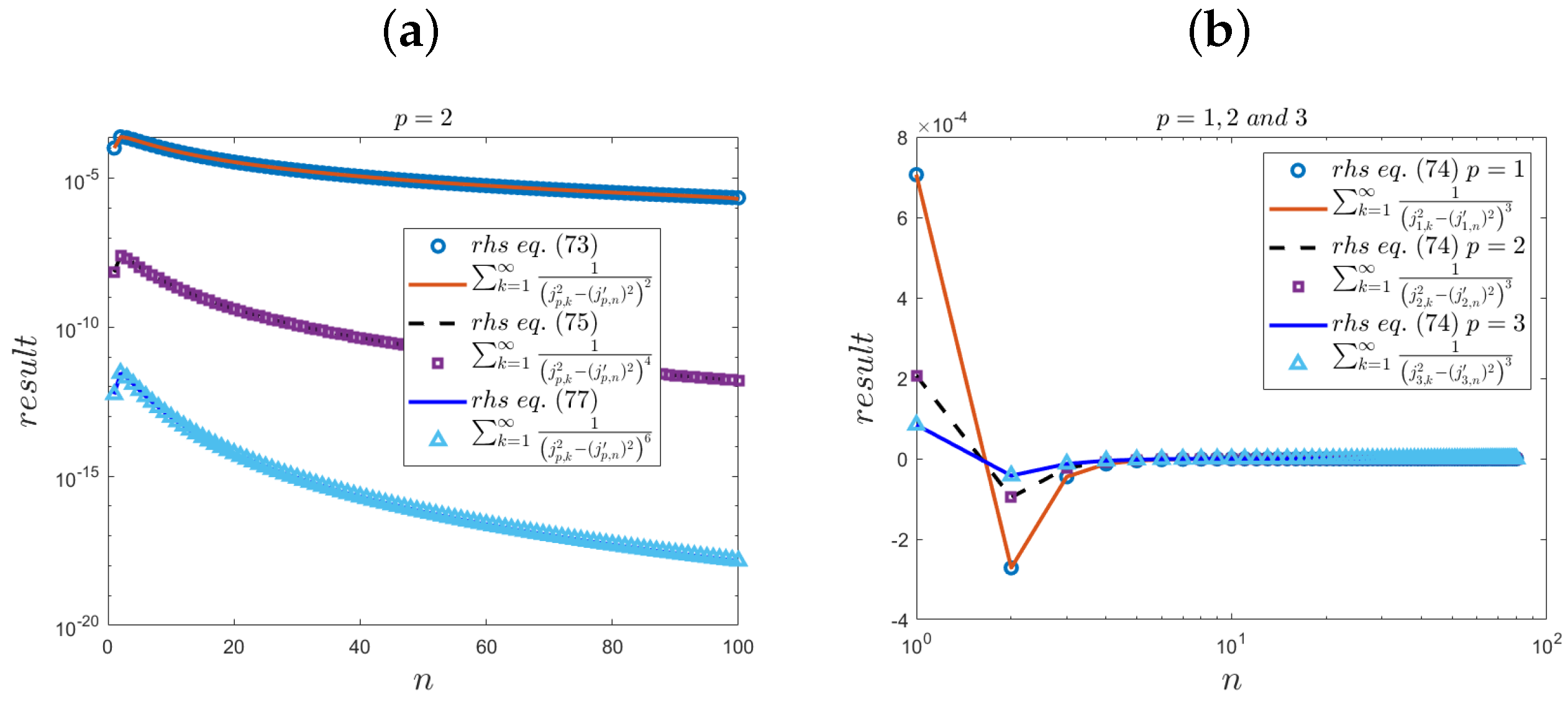
In derived solutions, only the first one (72) was known before and can be found in the recent Fattah paper [19]. Comparison of series solutions based solely on the Bessel zeros j p , k and Bessel functions derivatives zeros j p , n with the newly derived non-series solutions is presented in Appendix A (see Figure A5).
Proof. 
We evaluate the identities of Proposition 3 at z = j p , n . Since J p ( j p , n ) = 0 and J p ( j p , n ) 0 , one has
J p ( j p , n ) J p ( j p , n ) = 0 .
For l = 1 , Proposition 3 gives Equation (61). Putting z = j p , n , the second term vanishes, and therefore Equation (61) takes place. For l = 2 , the same proposition gives Equation (62). Again substituting z = j p , n , the first two terms vanish and Equation (73) takes place. The identities for l = 3 , 4 , 5 , 6 follow in exactly the same way: in each formula of Proposition 3, all terms containing a positive power of J p ( z ) / J p ( z ) vanish at z = j p , n , and the remaining constant term gives the stated closed form. This completes the proof. □

4. Series Generated by Modified Bessel Ratios

4.1. The Ratio I p + 1 ( z ) / I p ( z )

The preceding identities involved ordinary Bessel ratios and led, after suitable specialization at zeros, to Calogero-type formulas depending only on Bessel zeros. We now record the corresponding formulas for modified Bessel ratios. Their role is different: they generate series with denominators j p , k 2 + z 2 , which are natural in Laplace transform representations [22] and will be used in the next section.
Unlike the ordinary Bessel case, these identities do not reduce to closed expressions involving only the zeros j p , n , since the ratios I p ± 1 ( z ) / I p ( z ) do not vanish when z is a zero of J p ( z ) .
Proposition 4
(Series generated by modified Bessel ratios). Let p > 1 and z > 0 . Then
k = 1 1 j p , k 2 + z 2 = 1 2 z I p + 1 ( z ) I p ( z ) .
Moreover, the higher-order sums are given by the following identities.
For l = 2 ,
k = 1 1 j p , k 2 + z 2 2 = 1 4 z 2 I p + 1 ( z ) I p ( z ) 2 + p + 1 2 z 3 I p + 1 ( z ) I p ( z ) 1 4 z 2 .
For l = 3 ,
k = 1 1 j p , k 2 + z 2 3 = 1 8 z 3 I p + 1 ( z ) I p ( z ) 3 + 3 ( p + 1 ) 8 z 4 I p + 1 ( z ) I p ( z ) 2 z 2 2 ( p + 1 ) ( p + 2 ) 8 z 5 I p + 1 ( z ) I p ( z ) p + 2 8 z 4 .
For l = 4 ,
k = 1 1 j p , k 2 + z 2 4 = 1 16 z 4 I p + 1 ( z ) I p ( z ) 4 + p + 1 4 z 5 I p + 1 ( z ) I p ( z ) 3 2 z 2 ( p + 1 ) ( 7 p + 11 ) 24 z 6 I p + 1 ( z ) I p ( z ) 2 z 2 ( 4 p + 5 ) 2 ( p + 1 ) ( p + 2 ) ( p + 3 ) 24 z 7 I p + 1 ( z ) I p ( z ) + z 2 2 ( p + 2 ) ( p + 3 ) 48 z 6 .
For l = 5 ,
k = 1 1 j p , k 2 + z 2 5 = 1 32 z 5 I p + 1 ( z ) I p ( z ) 5 + 5 ( p + 1 ) 32 z 6 I p + 1 ( z ) I p ( z ) 4 5 z 2 5 ( p + 1 ) ( 5 p + 7 ) 96 z 7 I p + 1 ( z ) I p ( z ) 3 5 z 2 ( 6 p + 7 ) 10 ( p + 1 ) ( p + 2 ) ( 3 p + 5 ) 192 z 8 I p + 1 ( z ) I p ( z ) 2 + 2 z 4 z 2 ( p + 2 ) ( 11 p + 13 ) 2 ( p + 1 ) ( p + 2 ) ( p + 3 ) ( p + 4 ) 96 z 9 I p + 1 ( z ) I p ( z ) + ( 4 p + 7 ) z 2 2 ( p + 2 ) ( p + 3 ) ( p + 4 ) 192 z 8 .
For l = 6 ,
k = 1 1 j p , k 2 + z 2 6 = 1 64 z 6 I p + 1 ( z ) I p ( z ) 6 + 3 ( p + 1 ) 32 z 7 I p + 1 ( z ) I p ( z ) 5 2 z 2 ( p + 1 ) ( 13 p + 17 ) 64 z 8 I p + 1 ( z ) I p ( z ) 4 z 2 ( 8 p + 9 ) 2 ( p + 1 ) ( 2 p + 3 ) ( 3 p + 5 ) 64 z 9 I p + 1 ( z ) I p ( z ) 3 + 17 z 4 z 2 ( 146 p 2 + 405 p + 271 ) + ( p + 1 ) ( p + 2 ) ( 62 p 2 + 264 p + 274 ) 960 z 10 I p + 1 ( z ) I p ( z ) 2 + z 4 ( 34 p + 47 ) 2 ( p + 2 ) ( p ( 26 p + 97 ) + 77 ) z 2 + 4 ( p + 1 ) ( p + 2 ) ( p + 3 ) ( p + 4 ) ( p + 5 ) 960 z 11 I p + 1 ( z ) I p ( z ) 2 z 4 ( p ( 11 p + 47 ) + 47 ) z 2 + 2 ( p + 2 ) ( p + 3 ) ( p + 4 ) ( p + 5 ) 960 z 10 .
Proof. 
The case l = 1 is the classical Mittag–Leffler expansion for the modified Bessel ratio. For l = 2 , differentiating this identity gives
k = 1 1 j p , k 2 + z 2 2 = 1 2 z d d z 1 2 z I p + 1 ( z ) I p ( z ) .
Using Lemma 1, namely (6) with k = 1
I p + 1 ( z ) I p ( z ) = I p + 1 ( z ) I p ( z ) 2 + 1 2 p + 1 z I p + 1 ( z ) I p ( z ) ,
we obtain the asserted formula for l = 2 .
For l 2 , differentiating the identity of order l and using
1 j p , k 2 + z 2 l = 2 l z j p , k 2 + z 2 l + 1
gives the identity of order l + 1 after multiplication by 1 / ( 2 l z ) . At each step, the derivatives of the powers of I p + 1 ( z ) / I p ( z ) are reduced by Lemma 1 Equation (6). Applying this procedure successively yields the formulas for l = 3 , 4 , 5 , 6 . □

4.2. The Ratio I p 1 ( z ) / I p ( z )

Using the recurrence relation Equation (11) for modified Bessel functions,
1 2 z I p 1 ( z ) I p ( z ) p z 2 = 1 2 z I p + 1 ( z ) I p ( z ) ,
and the Mittag–Leffler expansion
1 2 z I p + 1 ( z ) I p ( z ) = k = 1 1 j p , k 2 + z 2 ,
we obtain
k = 1 1 j p , k 2 + z 2 = 1 2 z I p 1 ( z ) I p ( z ) p z 2 .
Proposition 5.
Series generated by the ratio I p 1 ( z ) I p ( z )
Let p > 1 and z > 0 . Then for l = 1 , , 6 , the following identities hold.
For l = 1 we have Equation (90).
For l = 2 ,
k = 1 1 j p , k 2 + z 2 2 = p z 4 + 1 4 z 2 I p 1 ( z ) I p ( z ) 2 p 1 2 z 3 I p 1 ( z ) I p ( z ) 1 4 z 2 .
For l = 3 ,
k = 1 1 j p , k 2 + z 2 3 = p z 6 + 1 8 z 3 I p 1 ( z ) I p ( z ) 3 3 ( p 1 ) 8 z 4 I p 1 ( z ) I p ( z ) 2 z 2 2 ( p 1 ) ( p 2 ) 8 z 5 I p 1 ( z ) I p ( z ) + p 2 8 z 4 .
For l = 4 ,
k = 1 1 j p , k 2 + z 2 4 = p z 8 + 1 16 z 4 I p 1 ( z ) I p ( z ) 4 p 1 4 z 5 I p 1 ( z ) I p ( z ) 3 2 z 2 ( p 1 ) ( 7 p 11 ) 24 z 6 I p 1 ( z ) I p ( z ) 2 + z 2 ( 4 p 5 ) 2 ( p 1 ) ( p 2 ) ( p 3 ) 24 z 7 I p 1 ( z ) I p ( z ) + z 2 2 ( p 2 ) ( p 3 ) 48 z 6 .
For l = 5 ,
k = 1 1 j p , k 2 + z 2 5 = p z 10 + 1 32 z 5 I p 1 ( z ) I p ( z ) 5 5 ( p 1 ) 32 z 6 I p 1 ( z ) I p ( z ) 4 5 z 2 5 ( p 1 ) ( 5 p 7 ) 96 z 7 I p 1 ( z ) I p ( z ) 3 + 5 z 2 ( 6 p 7 ) 10 ( p 1 ) ( p 2 ) ( 3 p 5 ) 192 z 8 I p 1 ( z ) I p ( z ) 2 + 2 z 4 z 2 ( p 2 ) ( 11 p 13 ) + 2 ( p 1 ) ( p 2 ) ( p 3 ) ( p 4 ) 96 z 9 I p 1 ( z ) I p ( z ) ( 4 p 7 ) z 2 2 ( p 2 ) ( p 3 ) ( p 4 ) 192 z 8 .
For l = 6 ,
k = 1 1 j p , k 2 + z 2 6 = p z 12 + 1 64 z 6 I p 1 ( z ) I p ( z ) 6 3 ( p 1 ) 32 z 7 I p 1 ( z ) I p ( z ) 5 2 z 2 ( p 1 ) ( 13 p 17 ) 64 z 8 I p 1 ( z ) I p ( z ) 4 + z 2 ( 8 p 9 ) 2 ( p 1 ) ( 2 p 3 ) ( 3 p 5 ) 64 z 9 I p 1 ( z ) I p ( z ) 3 + 17 z 4 z 2 ( 146 p 2 405 p + 271 ) + ( p 1 ) ( p 2 ) ( 62 p 2 264 p + 274 ) 960 z 10 I p 1 ( z ) I p ( z ) 2 z 4 ( 34 p 47 ) 2 ( p 2 ) ( p ( 26 p 97 ) + 77 ) z 2 + 4 ( p 1 ) ( p 2 ) ( p 3 ) ( p 4 ) ( p 5 ) 960 z 11 I p 1 ( z ) I p ( z ) 2 z 4 ( p ( 11 p 47 ) + 47 ) z 2 + 2 ( p 2 ) ( p 3 ) ( p 4 ) ( p 5 ) 960 z 10 .
Proof. 
The identity for l = 1 Equation (90) follows directly from the recurrence relation and the Mittag–Leffler expansion.
For l = 2 , differentiating Equation (90) and using
1 j p , k 2 + z 2 = 2 z j p , k 2 + z 2 2 ,
we obtain
k = 1 1 j p , k 2 + z 2 2 = 1 2 z d d z 1 2 z I p 1 ( z ) I p ( z ) p z 2 .
Using the differential recurrence Equation (7) satisfied by I p 1 ( z ) / I p ( z ) , one obtains the stated formula for l = 2 .
For l 2 , the identities are obtained recursively by differentiation (87) so that
k = 1 1 j p , k 2 + z 2 l + 1 = 1 2 l z d d z k = 1 1 j p , k 2 + z 2 l .
At each step, the derivatives of powers of I p 1 ( z ) / I p ( z ) are reduced using the differential recurrence relations for modified Bessel functions. Iterating this procedure yields the formulas for l = 3 , 4 , 5 , 6 . □

5. Application to Powers of Series Solutions

In this section, we illustrate how the differential recurrence formulas developed in the previous sections can be used to compute powers of series of the form
S p ( z ) : = k = 1 1 z 2 + j p , k 2 .
Such expressions arise naturally in applications, for instance in Laplace transform representations of physical models (see [22]).
The key tool is the identity
S p ( z ) = 1 2 z I p + 1 ( z ) I p ( z ) ,
together with the differential recurrence Equation (6) satisfied by the ratio I p + 1 ( z ) / I p ( z ) .
Proposition 6
(Square of the basic series). Let p > 1 and z > 0 . Then
k = 1 1 z 2 + j p , k 2 2 = 1 4 z 2 p + 1 z 2 k = 1 1 z 2 + j p , k 2 + k = 1 1 z 2 + j p , k 2 2 .
Proof. 
Starting from (100) we differentiate:
S p ( z ) = k = 1 2 z z 2 + j p , k 2 2 .
On the other hand,
S p ( z ) = d d z 1 2 z I p + 1 ( z ) I p ( z ) .
Using the differential identity (6) for k = 1
I p + 1 ( z ) I p ( z ) = 1 I p + 1 ( z ) I p ( z ) 2 2 p + 1 z I p + 1 ( z ) I p ( z ) ,
we obtain, after simplification,
1 2 z I p + 1 ( z ) I p ( z ) 2 = 1 4 z 2 p + 1 z 2 1 2 z I p + 1 ( z ) I p ( z ) 1 2 z S p ( z ) .
Substituting (102) gives the claimed identity. □
Remark 1
(Laplace variable formulation). Setting z 2 = s ^ , one obtains
k = 1 1 s ^ + j p , k 2 2 = 1 4 s ^ p + 1 s ^ k = 1 1 s ^ + j p , k 2 + k = 1 1 ( s ^ + j p , k 2 ) 2 .
For p = 0 , this coincides with the structure obtained in [22].
Using Equation (6) for k = 2 , one obtains the following identity for the cubic power of the series S p ( z ) .
Proposition 7
(Cubic identity for the basic series). Let p > 1 and z > 0 . Then
k = 1 1 z 2 + j p , k 2 3 = k = 1 1 ( z 2 + j p , k 2 ) 3 3 ( p + 1 ) 2 z 2 k = 1 1 ( z 2 + j p , k 2 ) 2 + ( p + 1 ) 2 z 4 + 1 4 z 2 p + 1 2 z 4 k = 1 1 z 2 + j p , k 2 + 1 2 ( p + 1 ) 8 z 4 .
Proof. 
Using Equation (6) for k = 2 ,
I p + 1 ( z ) I p ( z ) 3 = 2 p + 1 z I p + 1 ( z ) I p ( z ) 2 1 2 d d z I p + 1 ( z ) I p ( z ) 2 + I p + 1 ( z ) I p ( z ) .
Dividing by 8 z 3 and using Equation (100) gives
S p ( z ) 3 = p + 1 z 2 S p ( z ) 2 + 1 4 z 2 S p ( z ) 1 8 z d d z S p ( z ) 2 .
Differentiating Equation (101) and using Equation (102), we obtain
d d z S p ( z ) 2 = 1 2 z 3 + 2 ( p + 1 ) z 3 S p ( z ) + 2 ( p + 1 ) z k = 1 1 ( z 2 + j p , k 2 ) 2 4 z k = 1 1 ( z 2 + j p , k 2 ) 3 .
Substituting Equation (110) into Equation (109) and simplifying gives the claimed identity (107). □
Remark 2
(Laplace variable formulation). Setting z 2 = s ^ , one obtains
k = 1 1 s ^ + j p , k 2 3 = k = 1 1 ( s ^ + j p , k 2 ) 3 3 ( p + 1 ) 2 s ^ k = 1 1 ( s ^ + j p , k 2 ) 2 + ( p + 1 ) 2 s ^ 2 + 1 4 s ^ p + 1 2 s ^ 2 k = 1 1 s ^ + j p , k 2 + 1 2 ( p + 1 ) 8 s ^ 2 .
For p = 0 , Equation (111) reduces to
k = 1 1 s ^ + j 0 , k 2 3 = k = 1 1 ( s ^ + j 0 , k 2 ) 3 3 2 s ^ k = 1 1 ( s ^ + j 0 , k 2 ) 2 + s ^ + 2 4 s ^ 2 k = 1 1 s ^ + j 0 , k 2 1 8 s ^ 2 ,
which coincides with the structure obtained in [22].
Remark 3
(Higher powers). Higher powers
k = 1 1 z 2 + j p , k 2 n
can be obtained recursively using the same differentiation procedure. However, the algebraic complexity increases rapidly with n, and explicit closed forms become cumbersome beyond low orders.

6. On Pedersen Series Formulas

In this section, we revisit a family of series introduced by Pedersen [16], involving the zeros of Bessel functions in the form
k = 1 j p + 1 , k 2 j p + 1 , k 2 j p , n 2 l .
Pedersen obtained closed forms for certain odd values of l, in particular l = 3 , 5 , 7 . Our purpose here is to show that the same identities, together with the missing even cases l = 2 , 4 , 6 , follow systematically from the Calogero-type formulas derived in this paper from a simple algebraic reduction.
Theorem 4
(Pedersen-type identities and missing even cases). Let j p , n be the n-th positive zero of J p ( z ) . Then the following identities hold.
For l = 2 ,
k = 1 j p + 1 , k 2 j p + 1 , k 2 j p , n 2 2 = 1 4 .
For l = 3 ,
k = 1 j p + 1 , k 2 j p + 1 , k 2 j p , n 2 3 = p + 1 8 j p , n 2 .
For l = 4 ,
k = 1 j p + 1 , k 2 j p + 1 , k 2 j p , n 2 4 = j p , n 2 + 2 ( p 2 1 ) 48 j p , n 4 .
For l = 5 ,
k = 1 j p + 1 , k 2 j p + 1 , k 2 j p , n 2 5 = j p , n 2 ( 4 p + 1 ) + 2 ( p 2 1 ) ( p 2 ) 192 j p , n 6 .
For l = 6 ,
k = 1 j p + 1 , k 2 j p + 1 , k 2 j p , n 2 6 = 2 j p , n 4 + j p , n 2 ( 11 p 2 5 p 4 ) + 2 ( p 2 1 ) ( p 2 ) ( p 3 ) 960 j p , n 8 .
For l = 7 ,
k = 1 j p + 1 , k 2 j p + 1 , k 2 j p , n 2 7 = 4 ( p 4 ) ( p 3 ) ( p 2 ) ( p 2 1 ) + 2 ( 2 p + 1 ) ( 13 p 2 31 p + 16 ) j p , n 2 + ( 34 p 1 ) j p , n 4 11520 j p , n 10 .
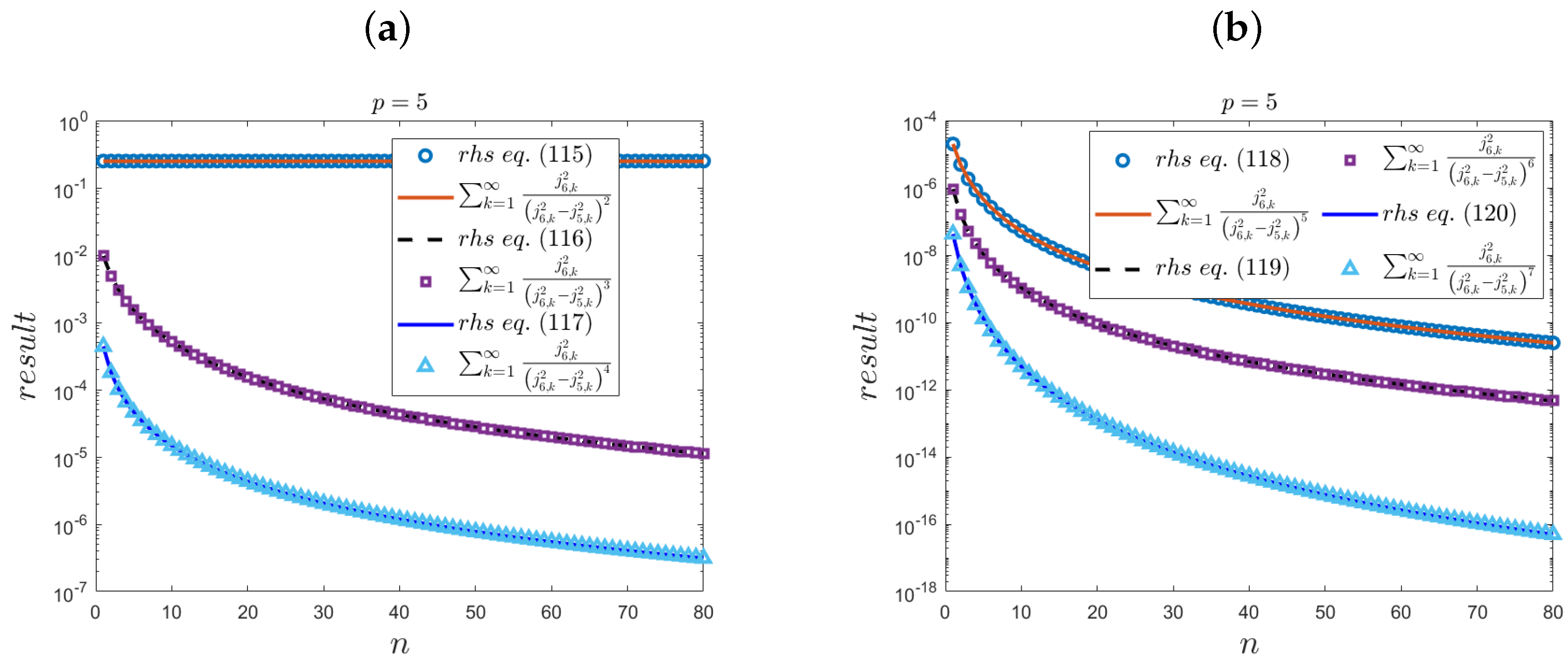
The identities for ( l = 3 , 5 and 7 ) agree with the formulas obtained by Pedersen, while the cases l = 2 , 4 , 6 provide the corresponding even-order completions. A comparison of the Pedersen infinite series with the proposed non-series solutions is presented in Figure A6 in Appendix A.
Proof. 
The basic identity is
a 2 a 2 z 2 l = z 2 a 2 z 2 l + 1 a 2 z 2 l 1 .
Taking a = j p + 1 , k and z = j p , n , and summing over k, gives
k = 1 j p + 1 , k 2 j p + 1 , k 2 j p , n 2 l = j p , n 2 k = 1 1 j p + 1 , k 2 j p , n 2 l + k = 1 1 j p + 1 , k 2 j p , n 2 l 1 .
This reduction shows that Pedersen’s series are determined by the Calogero-type sums without numerator.
The auxiliary sums without numerator are obtained from the Calogero-type identities established earlier (Theorem 2), after replacing p by p + 1 .
For l = 2 , Equation (122) gives
k = 1 j p + 1 , k 2 j p + 1 , k 2 j p , n 2 2 = j p , n 2 p + 1 j p , n 4 + 1 4 j p , n 2 + p + 1 j p , n 2 = 1 4 .
For l = 3 , the same reduction gives
k = 1 j p + 1 , k 2 j p + 1 , k 2 j p , n 2 3 = j p , n 2 p + 1 j p , n 6 + p 1 8 j p , n 4 + p + 1 j p , n 4 + 1 4 j p , n 2 = p + 1 8 j p , n 2 .
For l = 4 , one obtains
k = 1 j p + 1 , k 2 j p + 1 , k 2 j p , n 2 4 = j p , n 2 p + 1 j p , n 8 + j p , n 2 + 2 ( p 1 ) ( p 2 ) 48 j p , n 6 + p + 1 j p , n 6 + p 1 8 j p , n 4 = j p , n 2 + 2 ( p 2 1 ) 48 j p , n 4 .
The cases ( l = 5 , 6 and 7 ) follow by the same substitution, using the corresponding auxiliary identities of orders 5, 6 and 7. This yields respectively (118), (119) and (120). This completes the proof. □

7. Conclusions

Differential recurrences for powers of Bessel function ratios enabled successive derivatives to be organized systematically, leading to the construction of an expanding family of power-type solutions. The primary mathematical contributions of this work are threefold: (a) the first systematic derivation of derivatives up to sixth order for five fundamental Bessel function ratios, namely: J p ± 1 ( z ) / J p ( z ) , I p ± 1 ( z ) / I p ( z ) , and J p ( z ) / J p ( z ) ; (b) the derivation of several previously unknown Calogero-type infinite series formulas depending solely on zeros of Bessel functions by substituting the zeros of the numerator functions; (c) the extension of more complex series previously studied by Pedersen through the newly obtained formulas.
The proposed recursive formulas demonstrate considerable effectiveness, particularly in problems involving time-domain solutions obtained through the inverse Laplace transform of functions arising in analytical solutions of the water hammer problem in fluid mechanics. In addition to their analytical value, the recursive relations also provide computational advantages, since higher-order formulas are generated through algebraic recurrence relations rather than repeated direct differentiation. This reduces computational effort and simplifies the derivation of higher-order expressions. Combined with machine learning or mathematical AI techniques, the proposed approach may facilitate the derivation of higher-order power-type formulas without requiring repeated transitions between the frequency and time domains. The derived formulas and application examples suggest a broad potential for further applications of the proposed methodology
An open problem remains the derivation of recursive formulas for the newly obtained Calogero-type series, analogous to those developed by Meiman and Kishore for series based on zeros of ordinary Bessel functions, and by Muldoon and Reza for series involving zeros of derivatives of Bessel functions of the first kind.

Funding

This research received no external funding.

Data Availability Statement

The original contributions presented in this study are included in the article. Further inquiries can be directed to the corresponding author.

Acknowledgments

The author gratefully acknowledges Zakaria Fattah for insightful discussions, assistance in improving the structure and presentation of this paper, and helping formulate lemmas, theorems and proofs, and Armin Alavi for helping preparing the Latex version of the final draft.

Conflicts of Interest

The author declares no conflicts of interest.

Appendix A. Graphical Representation of Ratios of Bessel Functions and New Solutions

Figure A1. Variations of the ratios of (a) ordinary Bessel functions of the first kind; (b) modified Bessel functions of the first kind.
Mathematics 14 02011 g0a1
Figure A2. Comparison of selected series solutions and newly derived solutions based on Bessel function ratios: (a) Equations (22) and (49); (b) Equation (64); (c) Equations (23) and (50); (d) Equation (65); (e) Equations (24) and (51); (f) Equation (66).
Mathematics 14 02011 g0a2
Figure A3. Selected comparisons (tested p = 5, 20, 40) of series solutions based on Bessel function zeros with non-series solutions based on the Bessel function order p and the zero j p + 1 , n : (a) l = 4 —Equation (41); (b) l = 5 —Equation (42); (c) l = 6 —Equation (43).
Mathematics 14 02011 g0a3aMathematics 14 02011 g0a3b
Figure A4. Selected comparisons (tested p = 5, 20, 40) of series solutions based on Besselfunction zeros with non-series solutions based on the Bessel function order p and the zero j p 1 , n : (a) l = 4 —Equation (58); (b) l = 5 —Equation (59); (c) l = 6 —Equation (60).
Mathematics 14 02011 g0a4
Figure A5. Comparison of series solutions based solely on the Bessel zeros j p , n and their derivatives j p , n with newly derived non-series solutions: (a) cases for l = 2 , 4 and 6 corresponding to Equations (73), (75) and (77), respectively, for p = 2 ; (b) case for l = 3 with p = 1 , 2 , and 3 corresponding to Equation (74).
Mathematics 14 02011 g0a5
Figure A6. Comparison of the Pedersen infinite series with the proposed non-series solutions: (a) cases for l = 2 , 3 , 4 ; (b) cases for l = 5 , 6 , 7 .
Mathematics 14 02011 g0a6

References

  1. Watson, G.N. A Treatise on the Theory of Bessel Functions, 2nd ed. reprint; Cambridge University Press: Cambridge, UK, 1952. [Google Scholar]
  2. Rayleigh, L. Note on the numerical calculation of the roots of fluctuating functions. Proc. Lond. Math. Soc. 1873, 1–5, 119–124. [Google Scholar] [CrossRef]
  3. Meiman, N.N. On recurrence formulas for power sums of zeros of Bessel functions. Dokl. Akad. Nauk SSSR 1956, 108, 190–193. [Google Scholar]
  4. Kishore, N. The Rayleigh function. Proc. Am. Math. Soc. 1963, 14, 527–533. [Google Scholar] [CrossRef][Green Version]
  5. Muldoon, M.E.; Raza, A. Convolution formulae for functions of Rayleigh type. J. Phys. A Math. Gen. 1998, 31, 9327–9330. [Google Scholar] [CrossRef]
  6. Amos, E. Computation of modified Bessel functions and their ratios. Math. Comp. 1974, 28, 239–251. [Google Scholar] [CrossRef]
  7. Nåsell, I. Rational bounds for ratios of modified Bessel functions. SIAM J. Math. Anal. 1978, 9, 1–11. [Google Scholar] [CrossRef]
  8. Ifantis, E.K.; Siafarikas, P.D. Inequalities involving Bessel and modified Bessel functions. J. Math. Anal. Appl. 1990, 147, 214–227. [Google Scholar] [CrossRef]
  9. Landau, L.J. Ratios of Bessel functions and roots of αJv(x) + x J v (x) = 0. J. Math. Anal. Appl. 1999, 240, 174–204. [Google Scholar] [CrossRef][Green Version]
  10. Petropoulou, E. Bounds for ratios of modified Bessel functions. Integral Transform. Spec. Funct. 2000, 9, 293–298. [Google Scholar] [CrossRef]
  11. Ruiz-Antolín, D.; Segura, J. A new type of sharp bounds for ratios of modified Bessel functions. J. Math. Anal. Appl. 2016, 443, 1232–1246. [Google Scholar] [CrossRef]
  12. Sneddon, I.N. On some infinite series involving the zeros of Bessel functions of the first kind. Proc. Glasg. Math. Assoc. 1960, 4, 144–156. [Google Scholar] [CrossRef]
  13. Muldoon, M.E. Electrostatics and zeros of Bessel functions. J. Comput. Appl. Math. 1995, 65, 299–308. [Google Scholar] [CrossRef]
  14. Baricz, A.; Maširević, D.J.; Pogány, T.K.; Szász, R. On an identity for zeros of Bessel functions. J. Math. Anal. Appl. 2015, 422, 27–36. [Google Scholar] [CrossRef]
  15. Afanasiev, G.N. Closed expressions for some useful integrals involving Legendre functions and sum rules for zeroes of Bessel functions. J. Comput. Phys. 1989, 85, 245–252. [Google Scholar] [CrossRef]
  16. Pedersen, T.G. Sum rules for zeros and intersections of Bessel functions from quantum mechanical perturbation theory. Phys. Lett. A 2018, 382, 1837–1841. [Google Scholar] [CrossRef]
  17. Urbanowicz, K. Infinite series based on Bessel zeros. Appl. Sci. 2023, 13, 12932. [Google Scholar] [CrossRef]
  18. Langowski, B.; Nowak, A. On new identities involving zeros of Bessel functions. J. Math. Anal. Appl. 2025, 542, 128828. [Google Scholar] [CrossRef]
  19. Fattah, Z. On some generalized Calogero series. Integral Transform. Spec. Funct. 2026, 1–16. [Google Scholar] [CrossRef]
  20. Segura, J. Monotonicity Properties for Ratios and Products of Modified Bessel Functions and Sharp Trigonometric Bounds. Results Math. 2021, 76, 221. [Google Scholar] [CrossRef]
  21. Giusti, A.; Mainardi, F. On infinite series concerning zeros of Bessel functions of the first kind. Eur. Phys. J. Plus 2016, 131, 206. [Google Scholar] [CrossRef]
  22. Urbanowicz, K.; Bergant, A.; Grzejda, R.; Stosiak, M. About inverse Laplace transform of a dynamic viscosity function. Materials 2022, 15, 4364. [Google Scholar] [CrossRef]
  23. Grebenkov, D.S. A physicist’s guide to explicit summation formulas involving zeros of Bessel functions and related spectral sums. Rev. Math. Phys. 2021, 33, 2130002. [Google Scholar] [CrossRef]
  24. Simmons, G.F. Differential Equations with Applications and Historical Notes, 3rd ed.; Taylor & Francis Ltd.: Abingdon, UK, 2023. [Google Scholar]
  25. Calogero, F. On the zeros of Bessel functions. Lett. Al Nuovo C. 1977, 20, 254–256. [Google Scholar] [CrossRef]
  26. Calogero, F. On the zeros of Bessel functions—II. Lett. Al Nuovo C. 1977, 20, 476–478. [Google Scholar] [CrossRef]
  27. Ahmed, S.; Calogero, F. On the zeros of Bessel functions—IV. Lett. Al Nuovo C. 1978, 21, 531–534. [Google Scholar] [CrossRef]
  28. Abramowitz, M.; Stegun, I.A. Handbook of Mathematical Functions: With Formulas, Graphs, and Mathematical Tables, 9th ed.; Dover: New York, NY, USA, 1972. [Google Scholar]
Disclaimer/Publisher’s Note: The statements, opinions and data contained in all publications are solely those of the individual author(s) and contributor(s) and not of MDPI and/or the editor(s). MDPI and/or the editor(s) disclaim responsibility for any injury to people or property resulting from any ideas, methods, instructions or products referred to in the content.