Gromov–Wasserstein Meets Combinatorial Optimization: A Scalable Solver for the Capacitated Quadratic Assignment Problem



Abstract
1. Introduction
2. Related Work and Background
2.1. Assignment Problems: From AP to CQAP
2.2. Solution Methods for QAP and CQAP
2.3. Research Gap
3. From Assignment to Optimal Transport
3.1. From Monge’s Problem to the Assignment Problem
- represents the i-th location point in the source distribution;
- represents the j-th location point in the target distribution;
- and are the amounts of mass at each source and target point;
- and are Dirac delta measures at and , respectively.
3.2. Beyond Monge: Kantorovich Relaxation
3.3. Optimal Transport and CQAP
4. Gromov–Wasserstein (GW) Distance
4.1. Wasserstein Distances as Transport Costs
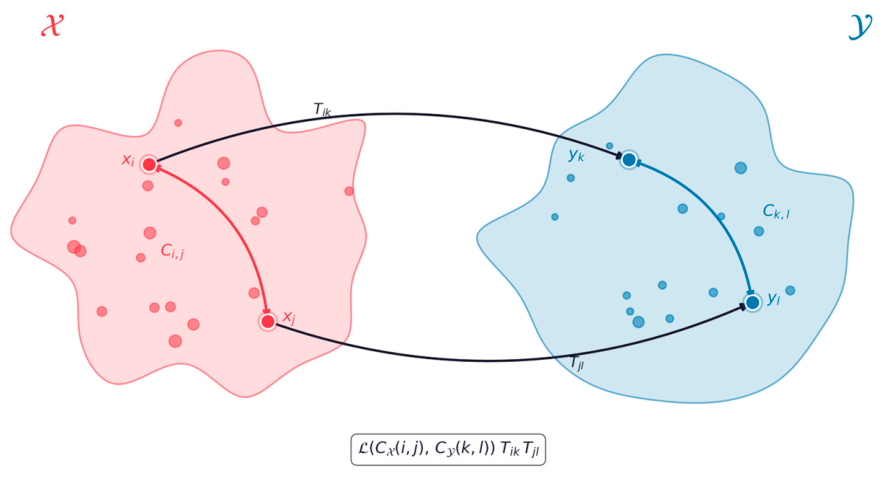
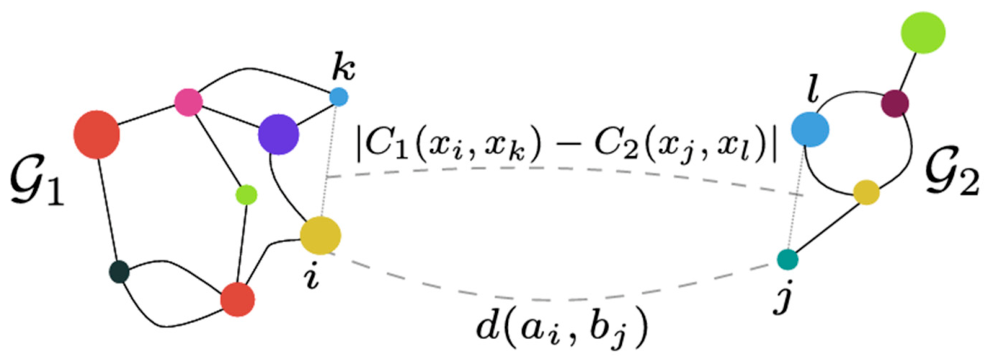
4.2. Gromov Wasserstein
4.3. Gromov Wasserstein Extensions
4.3.1. Entropic Gromov Wasserstein
- Gradient computation of the GW objective via tensor contractions, which has a computational cost of ;
- Sinkhorn updates to solve the resulting entropic OT subproblem have a per-iteration cost of .
4.3.2. Fused Gromov Wasserstein
- : pure feature-based comparison (Wasserstein);
- : pure structure-based comparison (Gromov–Wasserstein);
- : fused distance accounting for both aspects.
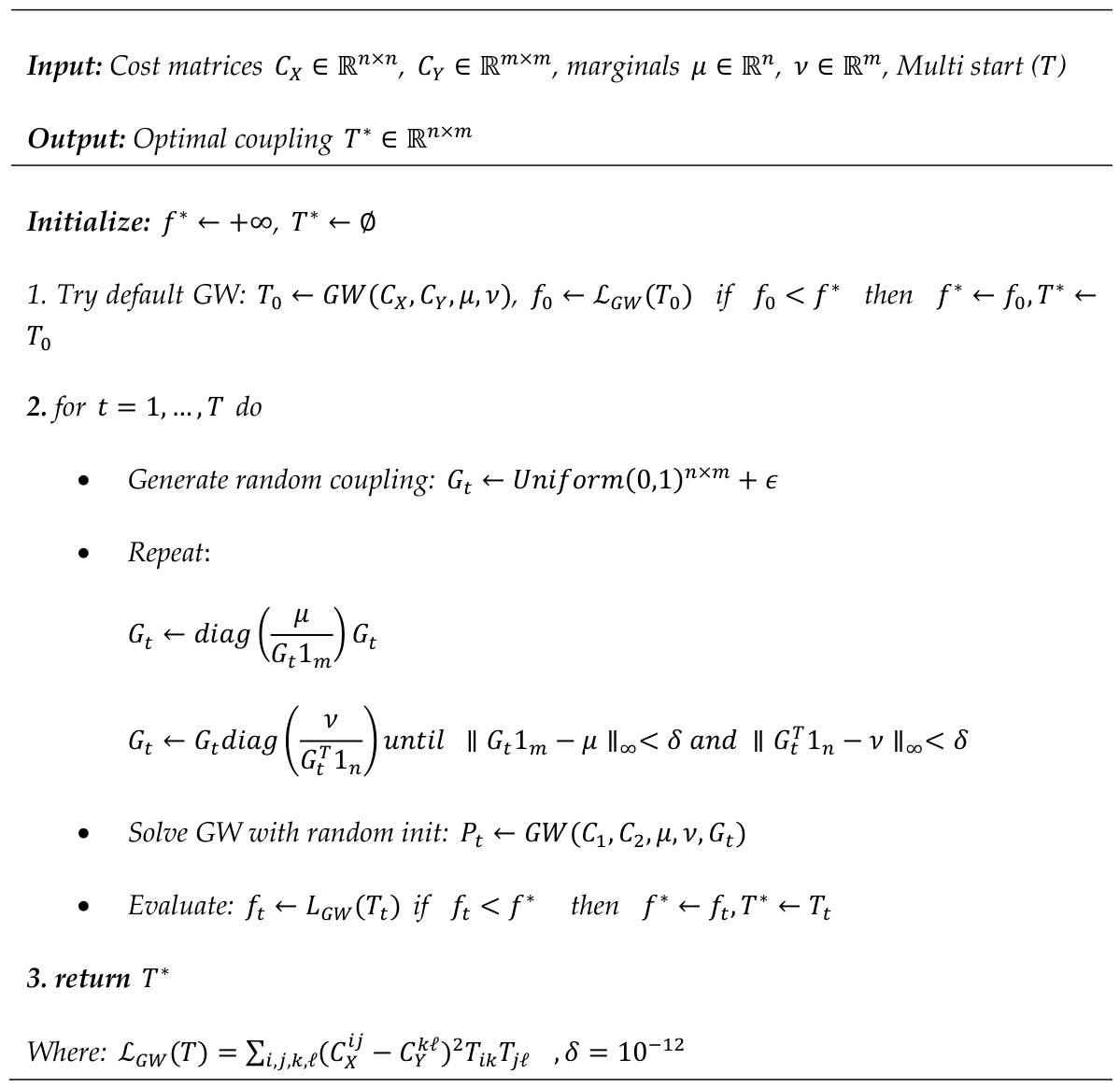
4.3.3. Multiple Initialization Strategy for Gromov–Wasserstein Optimization
5. Computational Results
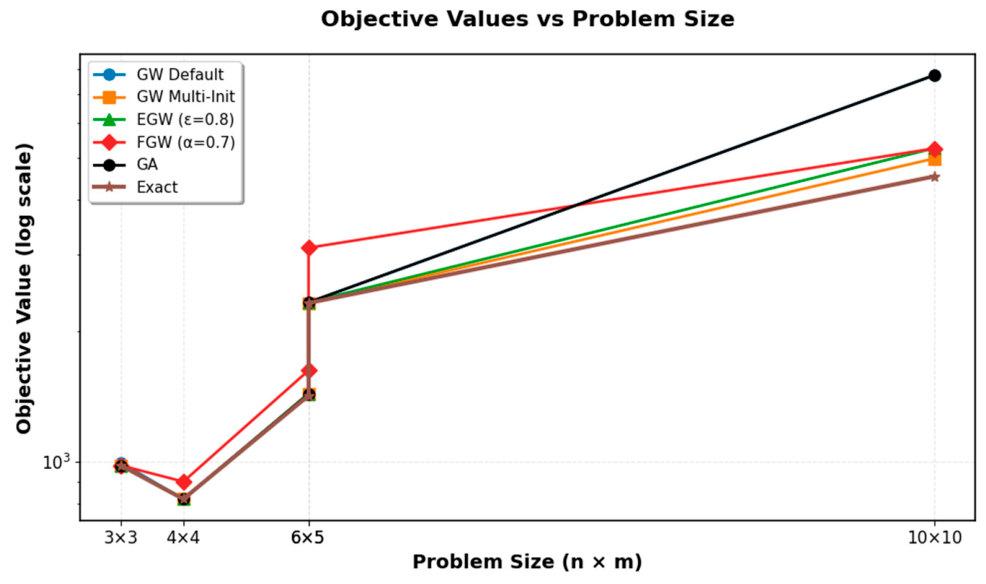
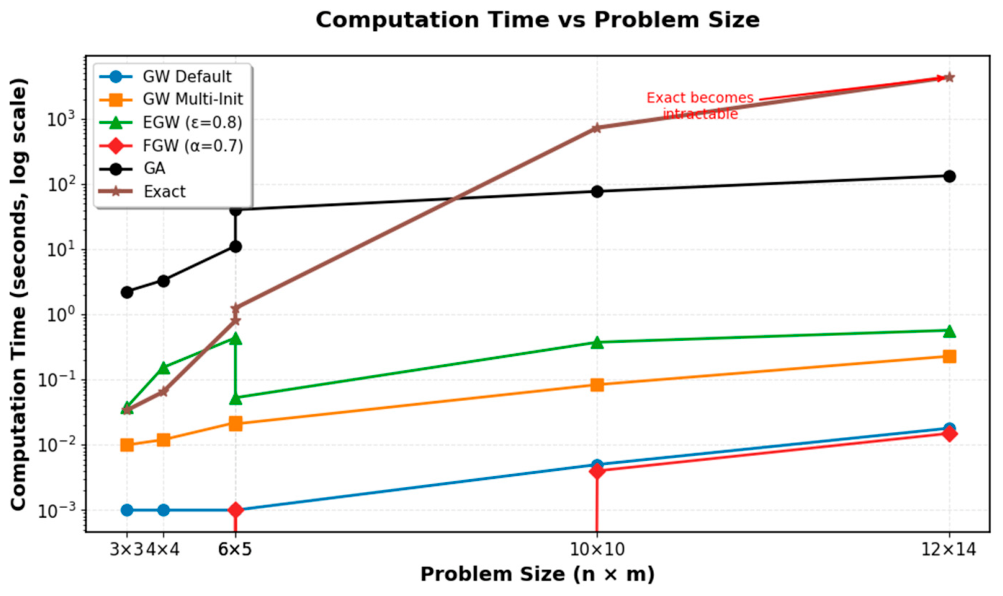
5.1. Synthetic CQAP Instances
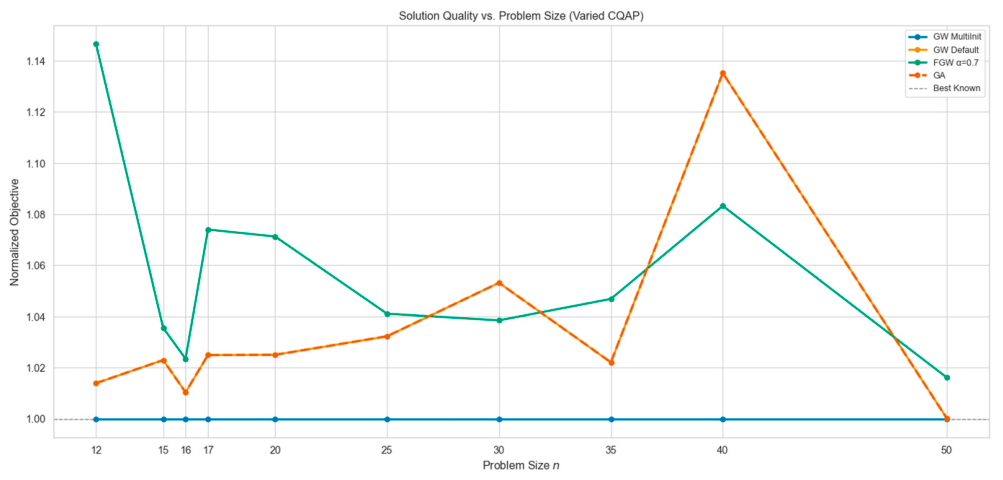
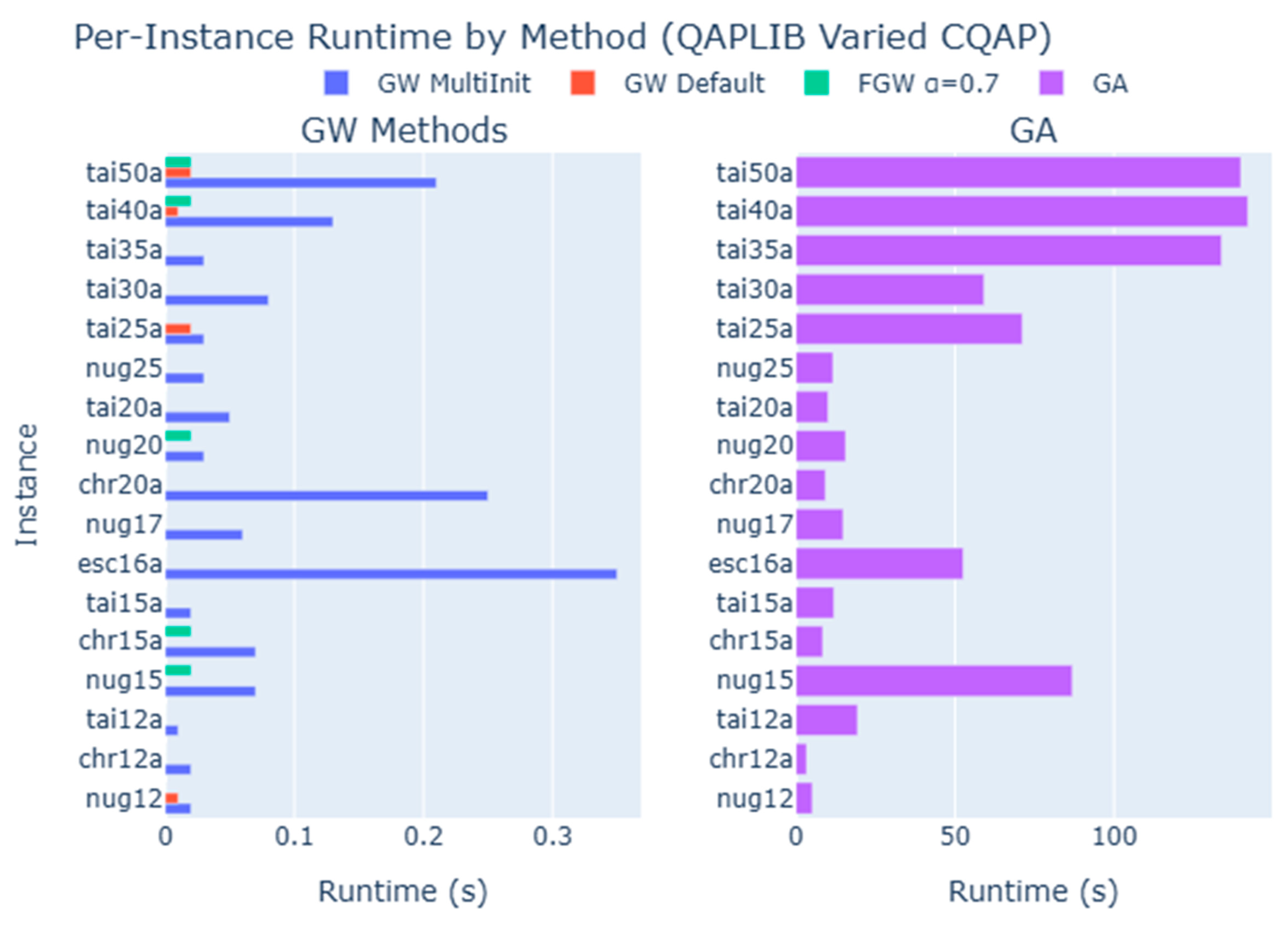
5.2. Evaluation on QAPLIB Instances (Varied CQAP Mode)
6. Conclusions, Limitations, and Perspectives
Author Contributions
Funding
Data Availability Statement
Conflicts of Interest
Appendix A. Review of the Computational Gromov–Wasserstein and Multi-Initialization Strategies Literature
Multi-Solution Discovery and Initialization Strategies
Appendix B
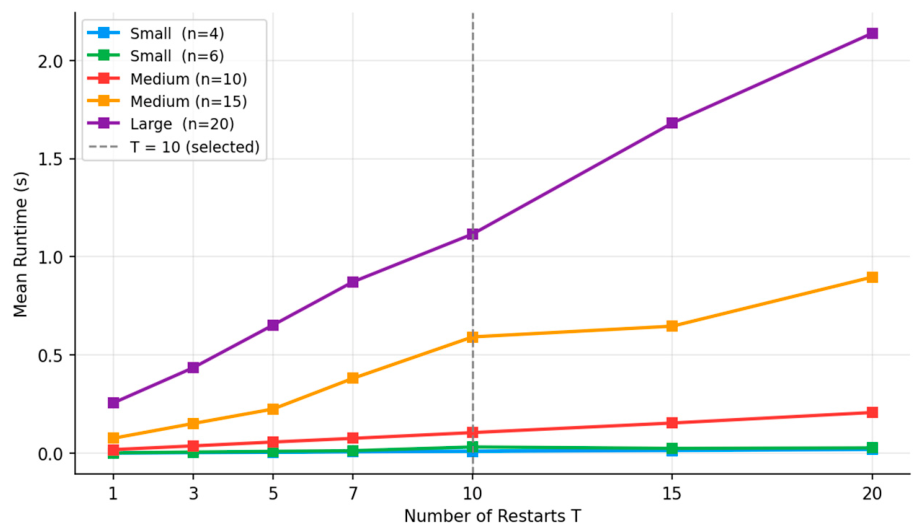
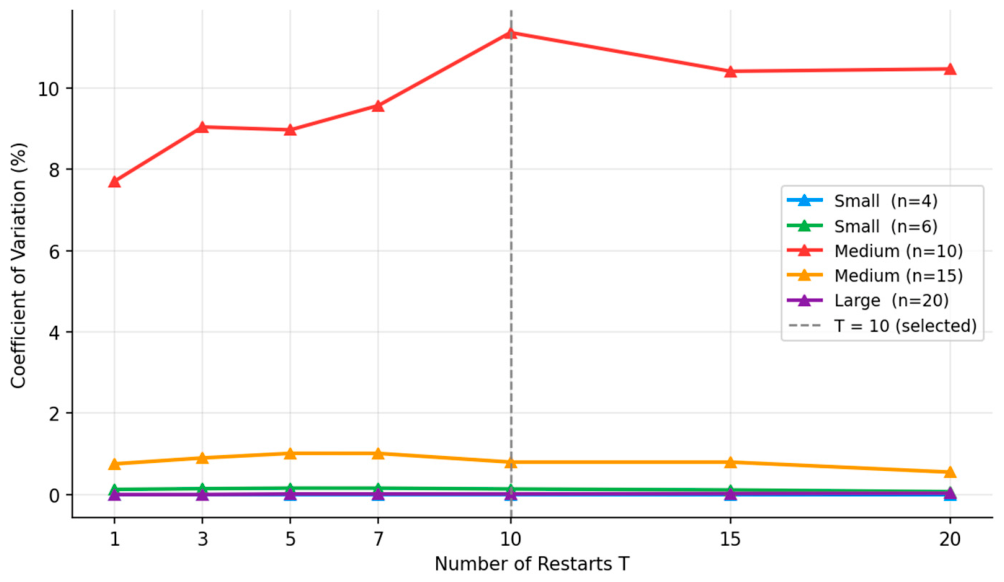
Appendix B.1. Sensitivity Analysis: Number of Random Restarts (T)


Appendix B.2. Extended Synthetic CQAP Instances Results

| Problem Size | Mass | GW Default | GW MultiInit | EGW 0.3 | EGW 0.5 | EGW 0.7 | FGW 0.3 | FGW 0.5 | FGW 0.7 | GA | Exact |
|---|---|---|---|---|---|---|---|---|---|---|---|
| 3 × 3 | 9 | 995.89 | 981.63 | 995.89 | 981.6324 | 981.6325 | 1489.06 | 981.63 | 981.63 | 981.63 | 981.63 |
| 4 × 4 | 10 | 821.43 | 821.43 | 821.43 | 821.441 | 821.445 | 1180.88 | 1180.88 | 900.83 | 821.43 | 821.43 |
| 5 × 6 | 17 | 1430.52 | 1430.52 | 1430.53 | 1430.86 | 1432.81 | 2694.07 | 1622.19 | 1622.19 | 1432.81 | 1420.18 |
| 6 × 5 | 21 | 2324.62 | 2317.29 | 2324.62 | 2324.65 | 2325.10 | 3102.40 | 3102.40 | 3102.40 | 2324.62 | 2317.29 |
| 10 × 10 | 31 | 7729.06 | 4975.22 | 5653.20 | 5670.36 | 5752.01 | 5879.82 | 5364.28 | 5247.65 | 7729.06 | 4525.76 |
| 12 × 14 | 36 | 7319.04 | 5405.29 | 8339.81 | 7755.81 | 6347.12 | 8287.72 | 7149.91 | 5826.33 | 7319.04 | 5951.45 * |
| Problem Size | GW Default | GW MultiInit | EGW 0.3 | EGW 0.5 | EGW 0.7 | FGW 0.3 | FGW 0.5 | FGW 0.7 | GA | Exact |
|---|---|---|---|---|---|---|---|---|---|---|
| 3 × 3 | 0.001 | 0.010 | 0.083 | 0.058 | 0.041 | 0.000 | 0.001 | 0.000 | 2.265 | 0.034 |
| 4 × 4 | 0.001 | 0.012 | 0.151 | 0.148 | 0.149 | 0.000 | 0.001 | 0.000 | 3.350 | 0.065 |
| 5 × 6 | 0.001 | 0.022 | 0.146 | 0.224 | 0.280 | 0.001 | 0.001 | 0.001 | 11.239 | 0.801 |
| 6 × 5 | 0.001 | 0.021 | 0.065 | 0.056 | 0.053 | 0.000 | 0.001 | 0.000 | 40.445 | 1.254 |
| 10 × 10 | 0.005 | 0.084 | 0.304 | 0.311 | 1.179 | 0.004 | 0.004 | 0.004 | 77.509 | 732.42 |
| 12 × 14 | 0.018 | 0.229 | 2.028 | 2.036 | 0.510 | 0.037 | 0.039 | 0.015 | 134.691 | 4367.95 |
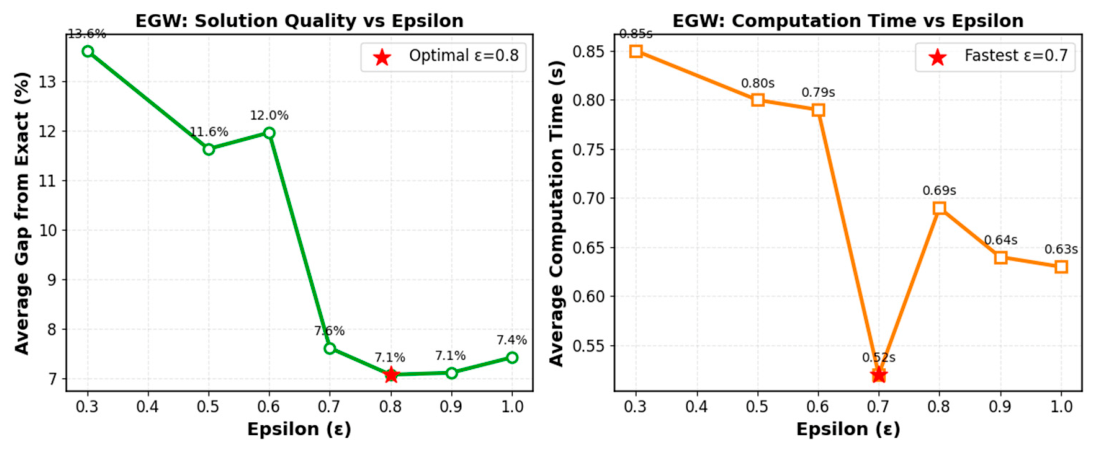
| Problem Size | ε = 1.0 | ε = 0.9 | ε = 0.8 | ε = 0.7 | ε = 0.6 | ε = 0.5 | ε = 0.3 |
|---|---|---|---|---|---|---|---|
| Gap from Exact (%) | |||||||
| 3 × 3 | - | - | - | 0.00 | 0.00 | 0.00 | 1.45 |
| 4 × 4 | 0.00 | 0.00 | 0.00 | 0.00 | 0.00 | 0.00 | 0.00 |
| 5 × 6 | 0.22 | 0.14 | 1.06 | 0.89 | 0.80 | 0.75 | 0.73 |
| 6 × 5 | 0.49 | 0.42 | 0.37 | 0.34 | 0.32 | 0.32 | 0.32 |
| 10 × 10 | 16.81 | 16.45 | 16.08 | 27.09 | 26.45 | 25.29 | 24.91 |
| 12 × 14 | 19.60 | 18.73 | 17.97 | 17.42 | 44.28 | 43.49 | 54.29 |
| Average Gap | 7.43 | 7.12 | 7.08 | 7.62 | 11.97 | 11.64 | 13.62 |
| Computation Time (s) | |||||||
| Average | 0.63 | 0.64 | 0.69 | 0.52 | 0.79 | 0.80 | 0.85 |
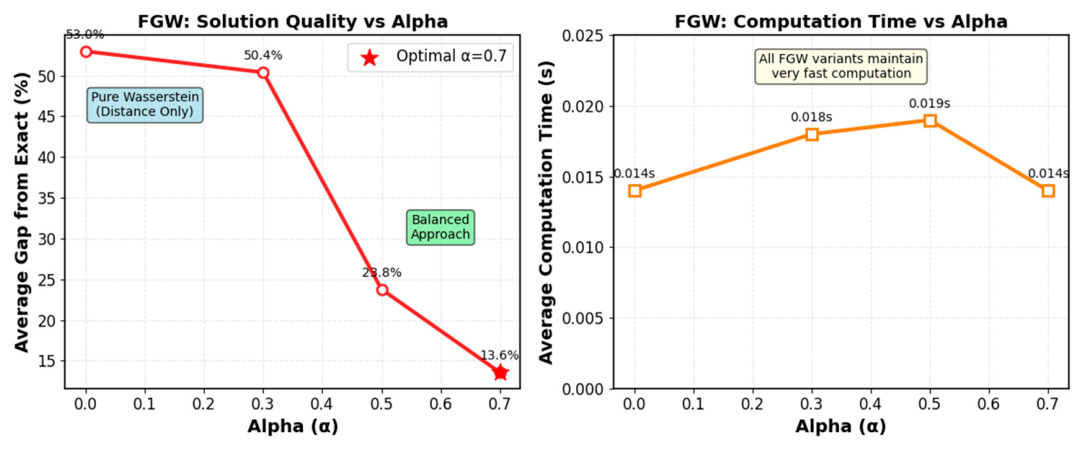
| Problem Size | α = 0.0 | α = 0.3 | α = 0.5 | α = 0.7 |
|---|---|---|---|---|
| Gap from Exact (%) | ||||
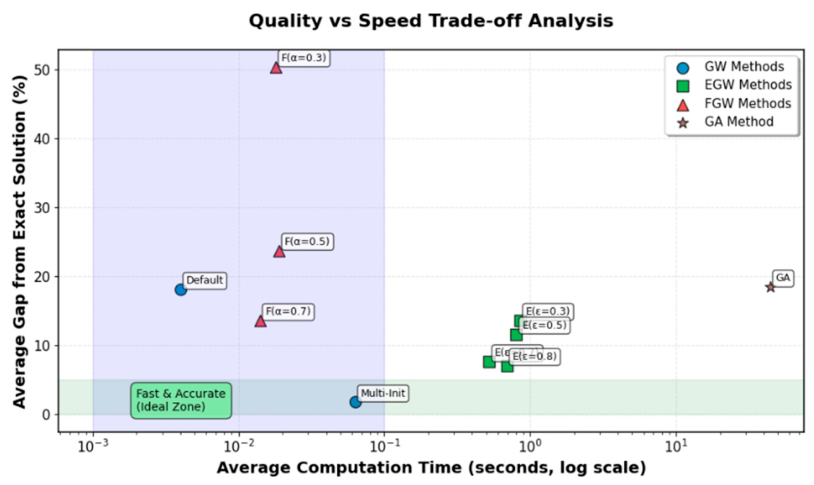
| 3 × 3 | 51.69 | 51.69 | 0.00 | 0.00 |
| 4 × 4 | 43.76 | 43.76 | 43.76 | 9.67 |
| 5 × 6 | 89.42 | 89.70 | 14.22 | 14.22 |
| 6 × 5 | 32.14 | 33.88 | 33.88 | 33.88 |
| 10 × 10 | 33.97 | 29.92 | 18.53 | 15.95 |
| 12 × 14 | 66.80 | 53.33 | 32.28 | 7.79 |
| Average Gap | 52.96 | 50.38 | 23.78 | 13.59 |
| Computation Time (s) | ||||
| Average | 0.014 | 0.018 | 0.019 | 0.014 |


Appendix C. Extended QAPLIB Varied CQAP Benchmark Discussion
| Instance | n | GW MultiInit | GW Default | FGW | GA | Best Approx. | MI Gap (%) |
|---|---|---|---|---|---|---|---|
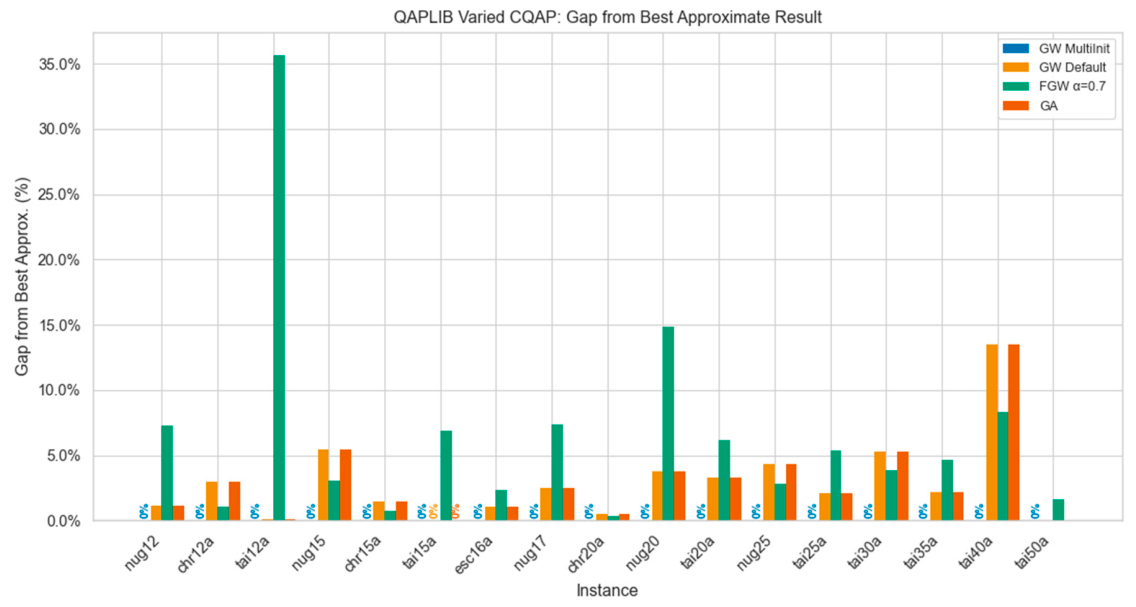
| nug12 | 12 | 8476.00 | 8573.00 | 9092.10 | 8573.00 | 8476.00 | 0 |
| chr12a | 12 | 3,662,833 | 3,770,811 | 3,701,336 | 3,770,811 | 3,662,833 | 0 |
| tai12a | 12 | 1,339,575 | 1,340,668 | 1,816,923 | 1,340,668 | 1,339,575 | 0 |
| nug15 | 15 | 16,284.20 | 17,173.00 | 16,781.60 | 17,173.00 | 16,284.20 | 0 |
| chr15a | 15 | 7,202,157 | 7,305,004 | 7,254,557 | 7,305,004 | 7,202,157 | 0 |
| tai15a | 15 | 2,190,497 | 2,190,497 | 2,341,117 | 2,190,497 | 2,086,017 | 5.01 |
| esc16a | 16 | 5393.60 | 5449.50 | 5520.20 | 5449.50 | 5393.60 | 0 |
| nug17 | 17 | 23,624.20 | 24,212.80 | 25,372.00 | 24,212.80 | 23,624.20 | 0 |
| chr20a | 20 | 1,716,165 | 1,724,623 | 1,722,316 | 1,724,623 | 1,716,165 | 0 |
| nug20 | 20 | 32,618.20 | 33,837.60 | 37,469.30 | 33,837.60 | 32,618.20 | 0 |
| tai20a | 20 | 4,521,811 | 4,669,769 | 4,799,767 | 4,669,769 | 4,521,811 | 0 |
| nug25 | 25 | 50,907.70 | 53,112.40 | 52,361.00 | 53,112.40 | 50,907.70 | 0 |
| tai25a | 25 | 7,503,553 | 7,662,467 | 7,905,838 | 7,662,467 | 7,503,553 | 0 |
| tai30a | 30 | 11,061,937 | 11,649,887 | 11,487,442 | 11,649,887 | 10,980,196 | 0.74 |
| tai35a | 35 | 15,653,117 | 15,998,512 | 16,386,739 | 15,998,512 | 15,653,117 | 0 |
| tai40a | 40 | 19,359,212 | 21,976,129 | 20,970,619 | 21,976,129 | 19,359,212 | 0 |
| tai50a | 50 | 34,921,914 | 34,931,901 | 35,486,759 | 34,931,901 | 34,921,914 | 0 |


References
- Burkard, R.; Dell’Amico, M.; Martello, S. Assignment problems: Revised reprint. In Assignment Problems; Society for Industrial and Applied Mathematics: Philadelphia, PA, USA, 2012; pp. 327–393. [Google Scholar] [CrossRef] [Scilit]
- Pentico, D.W. Assignment problems: A golden anniversary survey. Eur. J. Oper. Res. 2007, 176, 774–793. [Google Scholar] [CrossRef] [Scilit]
- Seyedi, I.; Mirzazadeh, S.; Malekidaronkolaei, A.R.E.F.; Mukhtar, M.; Sahran, S. An inventory model with reworking and setup time to consider effect of inflation and time value of money. J. Eng. Sci. Technol. 2016, 11, 416–430. [Google Scholar]
- Munkres, J. Algorithms for the Assignment and Transportation Problems. J. Soc. Ind. Appl. Math. 1957, 5, 32–38. [Google Scholar] [CrossRef] [Scilit]
- Koopmans, T.C.; Beckmann, M. Assignment problems and the location of economic activities. Econom. J. Econom. Soc. 1957, 25, 53–76. [Google Scholar] [CrossRef] [Scilit]
- Sahni, S.; Gonzalez, T. P-Complete Approximation Problems. J. ACM 1976, 23, 555–565. [Google Scholar] [CrossRef] [Scilit]
- Chaovalitwongse, W.A.; Androulakis, I.P.; Pardalos, P.M. Quadratic Integer Programming: Complexity and Equivalent Forms. In Encyclopedia of Optimization; Pardalos, P.M., Prokopyev, O.A., Eds.; Springer International Publishing: Cham, Switzerland, 2024; pp. 1–8. [Google Scholar] [CrossRef] [Scilit]
- Bertsekas, D. Network Optimization: Continuous and Discrete Models; Athena Scientific: Belmont, MA, USA, 1998; Volume 8. [Google Scholar]
- Ahmed, Z.H. A hybrid algorithm combining lexisearch and genetic algorithms for the quadratic assignment problem. Cogent Eng. 2018, 5, 1423743. [Google Scholar] [CrossRef] [Scilit]
- Villani, C. The Wasserstein distances. In Optimal Transport; in Grundlehren der mathematischen Wissenschaften; Springer: Berlin/Heidelberg, Germany, 2009; Volume 338, pp. 93–111. [Google Scholar] [CrossRef] [Scilit]
- Mémoli, F. Gromov–Wasserstein Distances and the Metric Approach to Object Matching. Found. Comput. Math. 2011, 11, 417–487. [Google Scholar] [CrossRef] [Scilit]
- Kravtsova, N. The NP-hardness of the Gromov-Wasserstein distance. arXiv 2025, arXiv:2408.06525. [Google Scholar] [CrossRef] [Scilit]
- Burkard, R.E.; Çela, E.; Pardalos, P.M.; Pitsoulis, L.S. The Quadratic Assignment Problem. In Handbook of Combinatorial Optimization; Du, D.-Z., Pardalos, P.M., Eds.; Springer: Boston, MA, USA, 1998; pp. 1713–1809. [Google Scholar] [CrossRef] [Scilit]
- Çela, E. The Quadratic Assignment Problem. In Combinatorial Optimization; Springer: Boston, MA, USA, 1998; Volume 1. [Google Scholar] [CrossRef] [Scilit]
- Kuhn, H.W. The Hungarian method for the assignment problem. Nav. Res. Logist. Q. 1955, 2, 83–97. [Google Scholar] [CrossRef] [Scilit]
- Hahn, P.; Grant, T.; Hall, N. A branch-and-bound algorithm for the quadratic assignment problem based on the Hungarian method. Eur. J. Oper. Res. 1998, 108, 629–640. [Google Scholar] [CrossRef] [Scilit]
- Zhang, H.; Beltran-Royo, C.; Ma, L. Solving the quadratic assignment problem by means of general purpose mixed integer linear programming solvers. Ann. Oper. Res. 2013, 207, 261–278. [Google Scholar] [CrossRef] [Scilit]
- Loiola, E.M.; de Abreu, N.M.M.; Boaventura-Netto, P.O.; Hahn, P.; Querido, T. A survey for the quadratic assignment problem. Eur. J. Oper. Res. 2007, 176, 657–690. [Google Scholar] [CrossRef] [Scilit]
- Pardalos, P.M.; Vavasis, S.A. Quadratic programming with one negative eigenvalue is NP-hard. J. Glob. Optim. 1991, 1, 15–22. [Google Scholar] [CrossRef] [Scilit]
- Ahuja, R.K.; Orlin, J.B.; Tiwari, A. A greedy genetic algorithm for the quadratic assignment problem. Comput. Oper. Res. 2000, 27, 917–934. [Google Scholar] [CrossRef] [Scilit]
- Said, G.A.E.N.A.; Mahmoud, A.M.; El-Horbaty, E.S.M. A Comparative Study of Meta-heuristic Algorithms for Solving Quadratic Assignment Problem. Int. J. Adv. Comput. Sci. Appl. 2014, 5, 4863. [Google Scholar] [CrossRef] [Scilit]
- Hussin, M.S.; Stützle, T. Tabu search vs. simulated annealing as a function of the size of quadratic assignment problem instances. Comput. Oper. Res. 2014, 43, 286–291. [Google Scholar] [CrossRef] [Scilit]
- James, T.; Rego, C.; Glover, F. A cooperative parallel tabu search algorithm for the quadratic assignment problem. Eur. J. Oper. Res. 2009, 195, 810–826. [Google Scholar] [CrossRef] [Scilit]
- Puris, A.; Bello, R.; Herrera, F. Analysis of the efficacy of a Two-Stage methodology for ant colony optimization: Case of study with TSP and QAP. Expert Syst. Appl. 2010, 37, 5443–5453. [Google Scholar] [CrossRef] [Scilit]
- Lu, Y.; Chen, S.; Zhang, X.; Pan, X.; Gang, Y.; Wang, C. A quantum-enhanced heuristic algorithm for optimizing aircraft landing problems in low-altitude intelligent transportation systems. Sci. Rep. 2025, 15, 21606. [Google Scholar] [CrossRef] [Scilit]
- Wang, Z.; Wang, X. Quantum-Classical Hybrid Genetic Evolutionary Algorithm for Topology Optimization of Continuum Structures. Int. J. Numer. Methods Eng. 2025, 126, e70073. [Google Scholar] [CrossRef] [Scilit]
- Coello, C.A.C. Theoretical and numerical constraint-handling techniques used with evolutionary algorithms: A survey of the state of the art. Comput. Methods Appl. Mech. Eng. 2002, 191, 1245–1287. [Google Scholar] [CrossRef] [Scilit]
- de Klerk, E.; Sotirov, R.; Truetsch, U. A New Semidefinite Programming Relaxation for the Quadratic Assignment Problem and Its Computational Perspectives. Inf. J. Comput. 2015, 27, 378–391. [Google Scholar] [CrossRef] [Scilit]
- Zhang, H.; Beltran-Royo, C.; Wang, B.; Ma, L.; Zhang, Z. Solution to the quadratic assignment problem using semi-Lagrangian relaxation. J. Syst. Eng. Electron. 2016, 27, 1063–1072. [Google Scholar] [CrossRef] [Scilit]
- Monge, G. Mémoire sur le Calcul Intégral des Équations aux Différences Partielles; Imprimerie Royale: Paris, France, 1784. [Google Scholar]
- Kantorovich, L. On the transfer of masses. In Doklady Akademii Nauk; Russian Academy of Sciences: Moscow, Russia, 1942; Available online: https://cir.nii.ac.jp/crid/1370565168575910170 (accessed on 17 July 2025). (In Russian)
- Rachev, S.T.; Rüschendorf, L. Duality Theory for Mass Transfer Problems. In Probability and Its Applications; Springer: New York, NY, USA, 2012; pp. 161–273. [Google Scholar] [CrossRef] [Scilit]
- Montesuma, E.F.; Mboula, F.M.N.; Souloumiac, A. Recent advances in optimal transport for machine learning. IEEE Trans. Pattern Anal. Mach. Intell. 2024, 47, 1161–1180. [Google Scholar] [CrossRef] [Scilit]
- Khamis, A.; Tsuchida, R.; Tarek, M.; Rolland, V.; Petersson, L. Scalable optimal transport methods in machine learning: A contemporary survey. IEEE Trans. Pattern Anal. Mach. Intell. 2024. [Google Scholar] [CrossRef] [Scilit]
- Candelieri, A.; Ponti, A.; Archetti, F. Wasserstein enabled Bayesian optimization of composite functions. J. Ambient Intell. Humaniz. Comput. 2023, 14, 11263–11271. [Google Scholar] [CrossRef] [Scilit]
- Kaňková, V. Stochastic optimization problems with nonlinear dependence on a probability measure via the Wasserstein metric. J. Glob. Optim. 2024, 90, 593–617. [Google Scholar] [CrossRef] [Scilit]
- Tao, Y.; Chen, C.; Jiang, S.; Wang, Q. Strong Group Fair Classification via Optimal Transport and Mixed-Integer Linear Programming. J. Glob. Optim. 2025, 1–22. [Google Scholar] [CrossRef] [Scilit]
- Vayer, T.; Chapel, L.; Flamary, R.; Tavenard, R.; Courty, N. Fused Gromov-Wasserstein Distance for Structured Objects. Algorithms 2020, 13, 212. [Google Scholar] [CrossRef] [Scilit]
- Karlsson, J.; Kronqvist, J.; Ryner, M. Globally solving the Gromov-Wasserstein problem for point clouds in low dimensional Euclidean spaces. Adv. Neural Inf. Process. Syst. 2023, 36, 7930–7946. [Google Scholar]
- Takeda, S.; Akagi, Y. Gromov-Wasserstein Problem with Cyclic Symmetry. In Proceedings of the IEEE/CVF Conference on Computer Vision and Pattern Recognition, Nashville, TN, USA, 11–15 June 2025; pp. 21011–21020. Available online: http://openaccess.thecvf.com/content/CVPR2025/html/Takeda_Gromov-Wasserstein_Problem_with_Cyclic_Symmetry_CVPR_2025_paper.html (accessed on 7 May 2026).
- Cetbon, M.; Peyré, G.; Cuturi, M. Linear-time gromov wasserstein distances using low rank couplings and costs. In International Conference on Machine Learning; PMLR: London, UK, 2022; pp. 19347–19365. Available online: https://proceedings.mlr.press/v162/scetbon22b (accessed on 21 August 2025).
- Peyré, G.; Cuturi, M.; Solomon, J. Gromov-wasserstein averaging of kernel and distance matrices. In International Conference on Machine Learning; PMLR: London, UK, 2016; pp. 2664–2672. [Google Scholar]
- Seyedi, I.; Candelieri, A.; Messina, E.; Archetti, F. Wasserstein Distributionally Robust Optimization for Chance Constrained Facility Location Under Uncertain Demand. Mathematics 2025, 13, 2144. [Google Scholar] [CrossRef] [Scilit]
- Peyré, G.; Cuturi, M. Computational optimal transport: With applications to data science. Found. Trends® Mach. Learn. 2019, 11, 355–607. [Google Scholar] [CrossRef] [Scilit]
- Cuturi, M.; Doucet, A. Fast computation of Wasserstein barycenters. In International Conference on Machine Learning; PMLR: London, UK, 2014; pp. 685–693. Available online: https://proceedings.mlr.press/v32/cuturi14.html (accessed on 9 June 2025).
- Candelieri, A.; Ponti, A.; Giordani, I.; Archetti, F. On the use of Wasserstein distance in the distributional analysis of human decision making under uncertainty. Ann. Math. Artif. Intell. 2023, 91, 217–238. [Google Scholar] [CrossRef] [Scilit]
- Shan, Z.; Lu, X.; Yang, J. Distributionally robust resource allocation using Wasserstein distance. J. Glob. Optim. 2025, 1–16. [Google Scholar] [CrossRef] [Scilit]
- Seyedi, I.; Candelieri, A.; Archetti, F. Distributionally Robust Bayesian Optimization via Sinkhorn-Based Wasserstein Barycenter. Mach. Learn. Knowl. Extr. 2025, 7, 90. [Google Scholar] [CrossRef] [Scilit]
- Candelieri, A.; Ponti, A.; Archetti, F. Gaussian Process regression over discrete probability measures: On the non-stationarity relation between Euclidean and Wasserstein Squared Exponential Kernels. J. Glob. Optim. 2025, 92, 253–278. [Google Scholar] [CrossRef] [Scilit]
- Séjourné, T.; Peyré, G.; Vialard, F.X. Unbalanced optimal transport, from theory to numerics. Handb. Numer. Anal. 2023, 24, 407–471. [Google Scholar] [CrossRef] [Scilit]
- Mémoli, F.; Needham, T. Distance distributions and inverse problems for metric measure spaces. Stud. Appl. Math. 2022, 149, 943–1001. [Google Scholar] [CrossRef] [Scilit]
- Zhang, W.; Wang, Z.; Fan, J.; Wu, H.; Zhang, Y. Fast Gradient Computation for Gromov-Wasserstein Distance. arXiv 2024, arXiv:2404.08970. [Google Scholar] [CrossRef] [Scilit]
- Rioux, G.; Goldfeld, Z.; Kato, K. Entropic gromov-wasserstein distances: Stability and algorithms. J. Mach. Learn. Res. 2024, 25, 1–52. [Google Scholar]
- Seyedi, I.; Candelieri, A.; Archetti, F. Fused Unbalanced Gromov–Wasserstein-Based Network Distributional Resilience Analysis for Critical Infrastructure Assessment. Mathematics 2026, 14, 417. [Google Scholar] [CrossRef] [Scilit]
- Séjourné, T.; Vialard, F.X.; Peyré, G. The unbalanced gromov wasserstein distance: Conic formulation and relaxation. Adv. Neural Inf. Process. Syst. 2021, 34, 8766–8779. [Google Scholar]
- Flamary, R.; Courty, N.; Gramfort, A.; Alaya, M.Z.; Redko, I.; Chapelle, O.; De Lara, N.; Ferreira, S.; Valentin, B.; Seguy, B.; et al. Pot: Python optimal transport. J. Mach. Learn. Res. 2021, 22, 1–8. [Google Scholar]
- Burkard, R.E.; Çela, E.; Karisch, S.E.; Rendl, F.; Anjos, M.; Hahn, P. QAPLIB—A Quadratic Assignment Problem Library—Problem Instances and Solutions, [Dataset]; University of Edinburgh: Edinburgh, UK; Computational Optimization Research At Lehigh: Bethlehem, PA, USA, 2022. [Google Scholar] [CrossRef]
- Seyedi, I.; Maleki-Daronkolaei, A. Solving a two-stage assembly flowshop scheduling problem to minimize the mean tardiness and earliness penalties by three meta-heuristics. Casp. J. Appl. Sci. Res. 2013, 2, 67–78. [Google Scholar]
- Seyedi, I.; Maleki-Daronkolaei, A.; Kalashi, F. Tabu search and simulated annealing for new three-stage assembly flow shop scheduling with blocking. Interdiscip. J. Contemp. Res. Usiness 2012, 4, 394–402. [Google Scholar]
- Mula, O.; Nouy, A. Moment-SoS methods for optimal transport problems. Numer. Math. 2024, 156, 1541–1578. [Google Scholar] [CrossRef] [Scilit]
- Chen, J.; Koh, S.; Nguyen, B.; Soh, Y. Semidefinite relaxations of the Gromov-Wasserstein distance. Adv. Neural Inf. Process. Syst. 2024, 37, 69814–69839. [Google Scholar]
- Titouan, V.; Flamary, R.; Courty, N.; Tavenard, R.; Chapel, L. Sliced gromov-wasserstein. Adv. Neural Inf. Process. Syst. 2019, 32, 14726–14736. [Google Scholar]
- Chowdhury, S.; Miller, D.; Needham, T. Quantized Gromov-Wasserstein. In Machine Learning and Knowledge Discovery in Databases. Research Track; Oliver, N., Pérez-Cruz, F., Kramer, S., Read, J., Lozano, J.A., Eds.; Lecture Notes in Computer Science; Springer International Publishing: Cham, Switzerland, 2021; Volume 12977, pp. 811–827. [Google Scholar] [CrossRef] [Scilit]
- Fatras, K.; Zine, Y.; Majewski, S.; Flamary, R.; Gribonval, R.; Courty, N. Minibatch optimal transport distances; analysis and applications. arXiv 2021, arXiv:2101.01792. [Google Scholar] [CrossRef] [Scilit]
- Beier, F.; Beinert, R.; Steidl, G. On a Linear Gromov–Wasserstein Distance. IEEE Trans. Image Process. 2022, 31, 7292–7305. [Google Scholar] [CrossRef] [Scilit]
- Salmona, A.; Delon, J.; Desolneux, A. Gromov-Wasserstein-like Distances in the Gaussian Mixture Models Space. arXiv 2024, arXiv:2310.11256. [Google Scholar]
- Olomon, J.; Peyré, G.; Kim, V.G.; Sra, S. Entropic metric alignment for correspondence problems. ACM Trans. Graph. 2016, 35, 1–13. [Google Scholar] [CrossRef] [Scilit]
- Kerdoncuff, T.; Emonet, R.; Sebban, M. Sampled Gromov Wasserstein. Mach. Learn. 2021, 110, 2151–2186. [Google Scholar] [CrossRef] [Scilit]
- Li, M.; Yu, J.; Xu, H.; Meng, C. Efficient Approximation of Gromov-Wasserstein Distance Using Importance Sparsification. J. Comput. Graph. Stat. 2023, 32, 1512–1523. [Google Scholar] [CrossRef] [Scilit]
- Mazelet, S.; Flamary, R.; Thirion, B. Unsupervised Learning for Optimal Transport plan prediction between unbalanced graphs. arXiv 2025, arXiv:2506.12025. [Google Scholar] [CrossRef] [Scilit]
- Maus, N.; Wu, K.; Eriksson, D.; Gardner, J. Discovering Many Diverse Solutions with Bayesian Optimization. arXiv 2023, arXiv:2210.10953. [Google Scholar] [CrossRef] [Scilit]
- Hvarfner, C.; Eriksson, D.; Bakshy, E.; Balandat, M. Informed Initialization for Bayesian Optimization and Active Learning. arXiv 2025, arXiv:2510.23681. [Google Scholar] [CrossRef] [Scilit]


| Size | Test ID | # Agents | # Tasks | Total Mass |
|---|---|---|---|---|
| Small | S1 | 3 | 3 | 9 |
| S2 | 4 | 4 | 10 | |
| S3 | 5 | 6 | 17 | |
| S4 | 6 | 5 | 21 | |
| Medium | M1 | 10 | 10 | 31 |
| M2 | 12 | 14 | 36 | |
| M3 | 15 | 12 | 43 | |
| M4 | 20 | 20 | 62 | |
| Large | L1 | 30 | 30 | 86 |
| L2 | 40 | 50 | 118 | |
| L3 | 50 | 40 | 146 | |
| L4 | 60 | 60 | 176 | |
| L5 | 100 | 100 | 294 |
| Problem Size | GW Default | GW MultiInit | EGW 0.3 | EGW 0.5 | EGW 0.8 | FGW 0.3 | FGW 0.5 | FGW 0.7 | GA |
|---|---|---|---|---|---|---|---|---|---|
| 3 × 3 | 1.45 | 0.00 | 1.45 | 0.00 | - | 51.69 | 0.00 | 0.00 | 0.00 |
| 4 × 4 | 0.00 | 0.00 | 0.03 | 0.00 | 0.00 | 43.76 | 43.76 | 9.67 | 0.00 |
| 5 × 6 | 0.73 | 0.73 | 0.73 | 0.75 | 1.06 | 89.70 | 14.22 | 14.22 | 0.89 |
| 6 × 5 | 0.32 | 0.00 | 0.32 | 0.32 | 0.37 | 33.88 | 33.88 | 33.88 | 0.32 |
| 10 × 10 | 70.78 | 9.93 | 24.91 | 25.29 | 16.08 | 29.92 | 18.53 | 15.95 | 70.78 |
| 12 × 14 | 35.40 | 0.00 | 54.29 | 43.49 | 17.97 | 53.33 | 32.28 | 7.79 | 35.40 |
| Average | 18.12 | 1.78 | 13.62 | 11.64 | 7.08 | 50.38 | 23.78 | 13.59 | 17.89 |
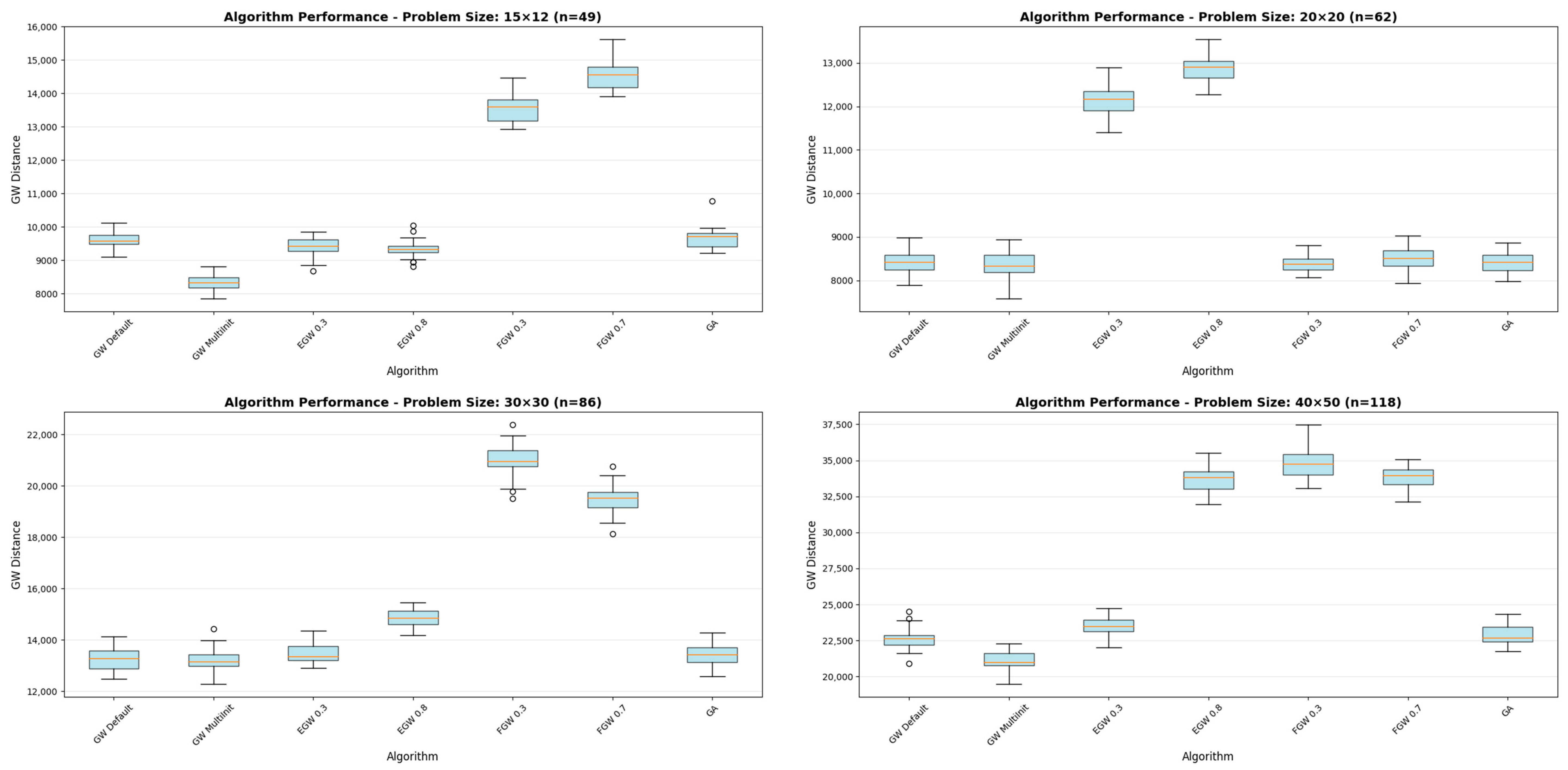
| Problem Size | Mass | GW Default | GW MultiInit | EGW 0.3 | EGW 0.8 | FGW 0.3 | FGW 0.7 | GA |
|---|---|---|---|---|---|---|---|---|
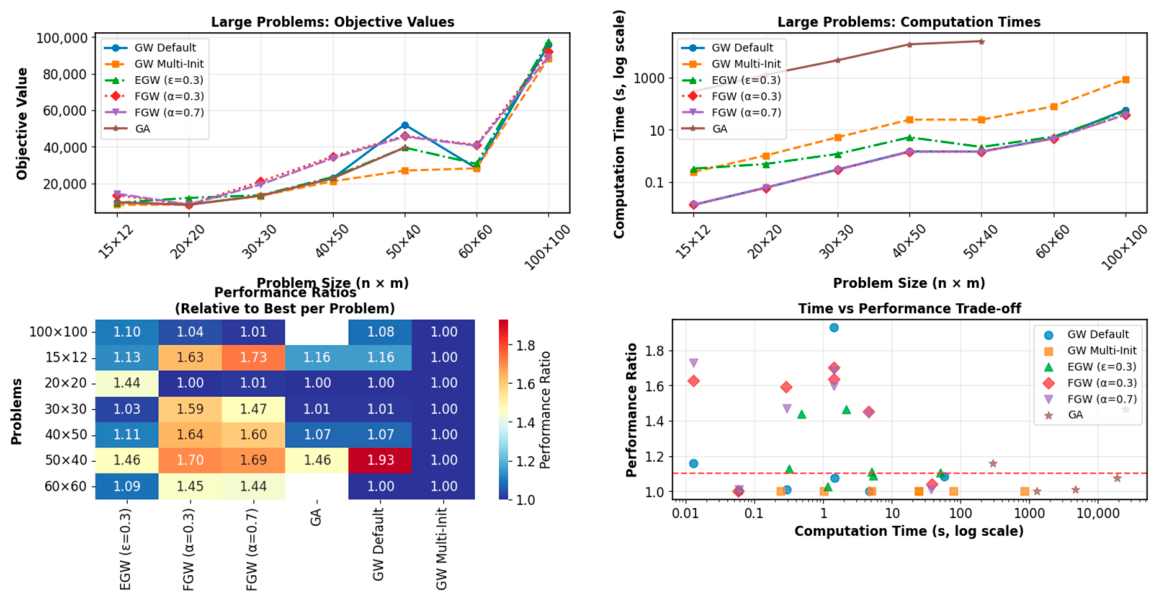
| 15 × 12 | 49 | 9657.404 | 8349.234 | 9411.960 | 9347.94 | 13,574.982 | 14,434.627 | 9657.404 |
| 20 × 20 | 62 | 8405.15 | 8405.15 | 12,115.71 | 12,737.47 | 8428.60 | 8471.25 | 8405.15 |
| 30 × 30 | 86 | 13,304.89 | 13,205.94 | 13,572.06 | 15,004.71 | 21,060.28 | 19,424.06 | 13,304.89 |
| 40 × 50 | 118 | 22,767.37 | 21,181.44 | 23,504.53 | 33,807.78 | 34,714.27 | 33,806.34 | 22,767.37 |
| 50 × 40 | 146 | 52,157.45 | 27,032.48 | 39,587.11 | 49,224.38 | 45,991.30 | 45,560.61 | 39,587.11 |
| 60 × 60 | 176 | 28,256.44 | 28,256.44 | 30,728.57 | 38,284.84 | 41,041.32 | 40,649.58 | NA |
| 100 × 100 | 294 | 95,867.89 | 88,468.94 | 97,709.38 | 128,374.23 | 92,070.45 | 89,252.85 | NA |
| Problem Size | GW Default | GW MultiInit | EGW 0.3 | EGW 0.8 | FGW 0.3 | FGW 0.7 | GA | Fastest Method |
|---|---|---|---|---|---|---|---|---|
| 15 × 12 | 0.013 | 0.238 | 0.319 | 2.55 | 0.013 | 0.013 | 293.332 | GW Default/FGW |
| 20 × 20 | 0.059 | 1.024 | 0.480 | 1.18 | 0.058 | 0.059 | 1283.793 | FGW 0.3 |
| 30 × 30 | 0.294 | 5.114 | 1.173 | 1.39 | 0.289 | 0.292 | 4650.805 | FGW 0.3 |
| 40 × 50 | 1.469 | 24.381 | 5.086 | 1.91 | 1.412 | 1.420 | 19,168.123 | FGW 0.3 |
| 50 × 40 | 1.442 | 24.349 | 2.164 | 2.07 | 1.418 | 1.429 | 25,276.4331 | FGW 0.3 |
| 60 × 60 | 4.653 | 78.373 | 5.358 | 5.29 | 4.590 | 4.603 | NA | FGW 0.3 |
| 100 × 100 | 57.83 | 846.45 | 50.21 | 41.48 | 38.29 | 37.49 | NA | FGW 0.7 |
| Instance (Agents × Tasks) | Best Method | Objective |
|---|---|---|
| 3 × 3 | Exact, GW_MultiInit | 981.6324 |
| 4 × 4 | Exact, GW_MultiInit, EGW | 821.4323 |
| 5 × 6 | Exact | 1420.1807 |
| 6 × 5 | Exact, GW_MultiInit | 2317.2933 |
| 10 × 10 | Exact | 4525.7574 |
| 12 × 14 | GW_MultiInit | 5405.2937 |
| 15 × 12 | GW_MultiInit | 11,089.4670 |
| 20 × 20 | GW_Default | 8405.1519 |
| 30 × 30 | GW_MultiInit | 13,205.9421 |
| 40 × 50 | GW_MultiInit | 21,181.4378 |
| 50 × 40 | GW_MultiInit | 27,032.4820 |
| 60 × 60 | GW_MultiInit, GW_Default | 28,256.4427 |
| 100 × 100 | GW_MultiInit | 88,468.94 |
| Method | Avg. Gap from Best (%) | Avg. Runtime (s) | Best on # Instances |
|---|---|---|---|
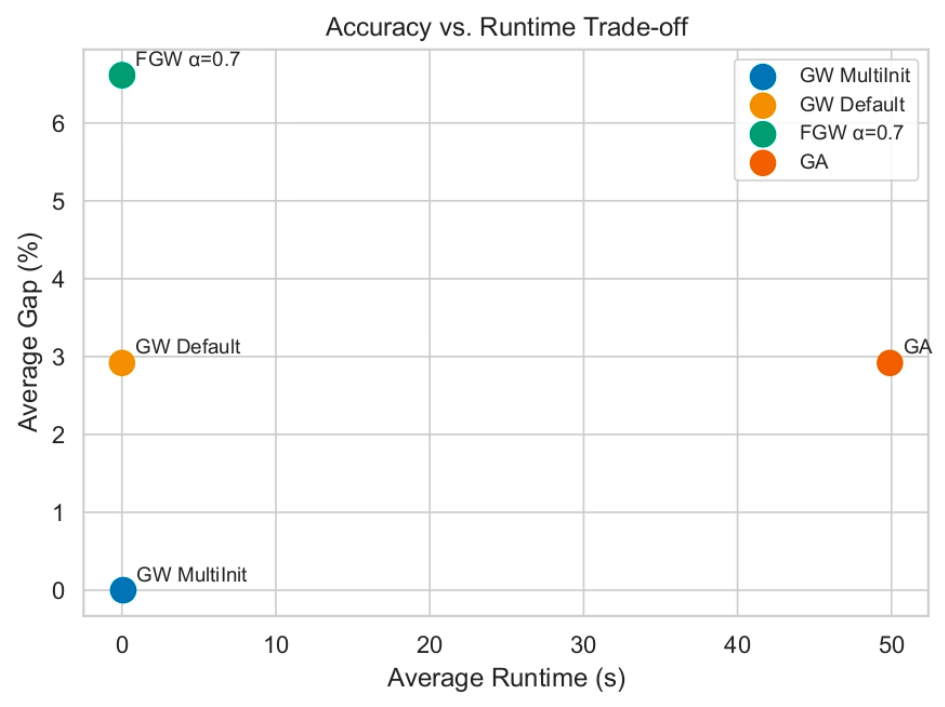
| GW MultiInit | 0.34 | 0.085 | 15/17 |
| GW Default | 3.26 | 0.003 | 0/17 |
| FGW | 6.97 | 0.008 | 2/17 |
| 79.87 | 0.007 | 0/17 | |
| GA | 3.26 | 49.9 | 0/17 |
Disclaimer/Publisher’s Note: The statements, opinions and data contained in all publications are solely those of the individual author(s) and contributor(s) and not of MDPI and/or the editor(s). MDPI and/or the editor(s) disclaim responsibility for any injury to people or property resulting from any ideas, methods, instructions or products referred to in the content. |
© 2026 by the authors. Licensee MDPI, Basel, Switzerland. This article is an open access article distributed under the terms and conditions of the Creative Commons Attribution (CC BY) license.
Share and Cite
Seyedi, I.; Candelieri, A.; Messina, E.; Archetti, F. Gromov–Wasserstein Meets Combinatorial Optimization: A Scalable Solver for the Capacitated Quadratic Assignment Problem. Mathematics 2026, 14, 1972. https://doi.org/10.3390/math14111972
Seyedi I, Candelieri A, Messina E, Archetti F. Gromov–Wasserstein Meets Combinatorial Optimization: A Scalable Solver for the Capacitated Quadratic Assignment Problem. Mathematics. 2026; 14(11):1972. https://doi.org/10.3390/math14111972
Chicago/Turabian StyleSeyedi, Iman, Antonio Candelieri, Enza Messina, and Francesco Archetti. 2026. "Gromov–Wasserstein Meets Combinatorial Optimization: A Scalable Solver for the Capacitated Quadratic Assignment Problem" Mathematics 14, no. 11: 1972. https://doi.org/10.3390/math14111972
APA StyleSeyedi, I., Candelieri, A., Messina, E., & Archetti, F. (2026). Gromov–Wasserstein Meets Combinatorial Optimization: A Scalable Solver for the Capacitated Quadratic Assignment Problem. Mathematics, 14(11), 1972. https://doi.org/10.3390/math14111972