Article

From Kernel Matrices to Kernel Functions: An Eigenfunction-Based Approach

1
Department of Statistics, Universidad Carlos III de Madrid, Calle Madrid 126, Getafe, 28903 Madrid, Spain
2
Department of Business and Business Analytics, Faculty of Economics, Business and Communication, Universidad Europea de Madrid, Calle Tajo s/n, Villaviciosa de Odón, 28670 Madrid, Spain
*
Author to whom correspondence should be addressed.
Mathematics 2026, 14(11), 1971; https://doi.org/10.3390/math14111971
Submission received: 3 May 2026 / Revised: 25 May 2026 / Accepted: 31 May 2026 / Published: 3 June 2026

Abstract

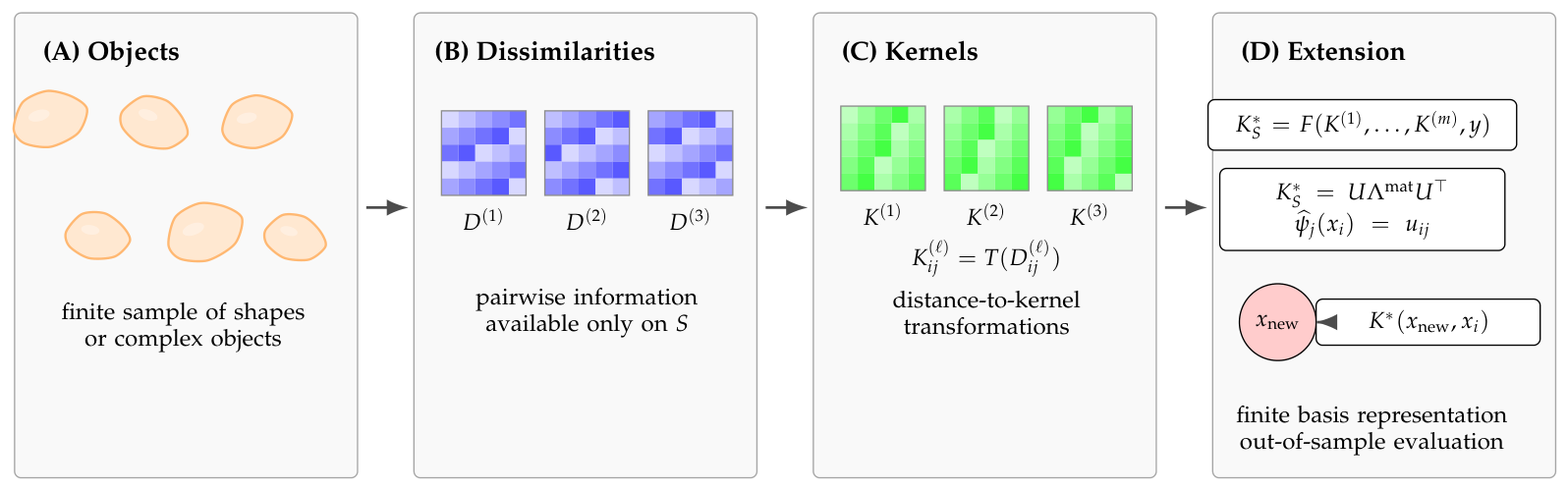
Kernel-combination procedures used in classification often return only a combined kernel matrix on the training sample, rather than a kernel function that can be evaluated consistently at new points. This limitation is especially important for supervised or label-aware combinations, whose entries may depend on training labels and therefore have no immediate out-of-sample meaning. We study the problem of constructing an inductive, finite-rank kernel extension from such empirical matrices. The proposed framework makes the non-uniqueness of this extension explicit: it is determined by empirical coordinates, a positive-semidefinite coefficient matrix, and a continuation model for the coordinates. Experiments on vector, tabular, and relational classification problems give a deliberately diagnostic picture. Smooth direct combinations are stable: on Synthetic, the direct mean gives error 0.0793±0.0227, essentially matching the best individual RBF kernel (0.0809±0.0231), and on Telco it remains close to the best individual polynomial kernel (0.2061±0.0154 versus 0.2045±0.0154). In the controlled Synthetic oracle diagnostic, reconstructing a smooth sum/mean gives relative Frobenius error 4.13×10⁶±9.41×10⁶ and functional MSE at numerical scale. By contrast, abrupt label-aware matrix-only rules are less robust: the Synthetic percentile_inout_auto rule has error 0.1404±0.1198, Telco matrix-only supervised rules are around 0.3070.326 error, and the Chickenpieces pickout_auto rule fails under strict out-of-sample reconstruction (0.3545±0.2666 error), whereas direct relational combinations match the best individual relational kernel within 103. Overall, the empirical evidence supports the method as a bridge from finite matrix-level information fusion to deployable kernels, while also identifying abrupt label-aware geometries as the main limitation for stable generalization.
Keywords: kernel methods; reproducing kernel Hilbert spaces; kernel combination; spectral reconstruction; out-of-sample extension; support vector machines kernel methods; reproducing kernel Hilbert spaces; kernel combination; spectral reconstruction; out-of-sample extension; support vector machines