Article

On the Generalized Circular Projected Cauchy Distribution

1
Department of Mathematics, Al-Qunfudah University College, Umm Al-Qura University, Makkah 24382, Saudi Arabia
2
Department of Economics, University of Crete, Gallos Campus, 74100 Rethymnon, Greece
*
Authors to whom correspondence should be addressed.
Mathematics 2026, 14(11), 1934; https://doi.org/10.3390/math14111934
Submission received: 24 April 2026 / Revised: 22 May 2026 / Accepted: 27 May 2026 / Published: 2 June 2026
(This article belongs to the Special Issue Advances of Applied Probability and Statistics)

Abstract

Tsagris and Alzeley proposed the generalized circular projected Cauchy (GCPC) distribution, whose special case is the wrapped Cauchy distribution. In this paper we first derive the relationship with the wrapped Cauchy distribution, and then we attempt to characterize the distribution. We establish the conditions under which the distribution exhibits unimodality. We provide non-closed-form expressions for the mean resultant length and the Kullback–Leibler divergence and analytical forms for the cumulative probability function and the entropy of the GCPC distribution. We propose log-likelihood ratio tests for one- and two-location parameters without assuming the equality of the concentration parameters. We revisit maximum likelihood estimation with and without predictors. In the regression setting we briefly discuss the addition of circular and simplicial predictors. Simulation studies illustrate (a) the performance of the log-likelihood ratio test when one falsely assumes that the true distribution is the wrapped Cauchy distribution, and (b) the empirical rate of convergence of the regression coefficients. Using a real data example, we show how to avoid the log-likelihood being trapped in a local maximum, and we correct a mistake in the regression setting.

1. Introduction

Directional data refers to multivariate data with a unit norm, whose sample space can be expressed as
S d 1 = x R d | x = 1 ,
where . denotes the Euclidean norm. Circular data, when d = 2 , lie on a circle. Circular data are encountered in various disciplines, such as political sciences [1], criminology [2], biology [3], ecology [4], and astronomy [5], among others.
A large class of distributions has been proposed; see [6] for a short list. A classic distribution is the wrapped Cauchy distribution [7], for which [6] showed that it is a special case of the generalized projected Cauchy distribution (GCPC). The GCPC generalizes the WC by the introduction of an extra parameter that allows for anisotropy. The benefit of the GCPC distribution is that it provides a better fit to asymmetric and bimodal data.
In this paper we focus on the GCPC distribution. Specifically, we derive the relationship with the wrapped Cauchy (WC) distribution. We examine the conditions for unimodality and then provide an alternative formula for cumulative probability function. We derive non-closed-form expressions for its mean resultant length and the Kullback–Leibler divergence (KLD) from the WC distribution but derive an analytical formula for its entropy. We further propose two log-likelihood ratio tests for equality of one- and two-location parameters without assuming equal concentration parameters. We revisit maximum likelihood estimation (MLE) and regression modeling. For the MLE we show a problem that may trap the log-likelihood in a local maximum and show how to easily escape and reach the global maximum. We further correct a mistake in [6] and empirically examine the convergence rate of the regression coefficients. A real data example, with and without predictor variables, illustrates the superior performance of the GCPC distribution compared to the WC distribution.
The next section briefly presents and examines the GCPC distribution. Simulation studies and the real data example follow, with conclusions closing the paper.

2. The GCPC Distribution

Suppose a d-dimensional random variable X follows some multivariate distribution defined over R d and we project it onto the circle/sphere/hyper-sphere, Y = X r , where r = X . The marginal distribution of Y , which is of interest, is obtained by integrating out r over the positive line
f ( y ) = 0 r d 1 g ( r y ) d r .
The probability density function of the bivariate Cauchy distribution, with some location vector μ and scatter matrix Σ , is given by
g ( x ) = 1 2 π | Σ | 1 / 2 1 + x μ Σ 1 x μ 3 / 2 .
By substituting (2) into (1) and evaluating the integral, ref. [6] derived the circular projected Cauchy (CPC) distribution
f C P C ( y ) = 0 r 2 π | Σ | 1 / 2 1 + r 2 y Σ 1 y 2 r y Σ 1 μ + μ Σ 1 μ 3 / 2 d r = 1 2 π | Σ | 1 / 2 B Γ 2 + 1 A B ,
where
A = y Σ 1 μ , B = y Σ 1 y , and Γ 2 = μ Σ 1 μ .
It is important to note that y S 1 , while μ R 2 .
Ref. [6] employed one of the conditions imposed in [8], that is, Σ μ = μ , but not | Σ | = 1 . This condition implies that the eigenvector ξ 2 of Σ is the normalized location vector ξ 2 = μ 1 , μ 2 / γ , where γ = μ 1 2 + μ 2 , while the other eigenvector can be defined up to sign as ξ 1 = μ 2 , μ 1 / γ or ξ 1 = μ 2 , μ 1 / γ . The eigenvalue corresponding to the location vector is equal to 1, while the other eigenvalue is equal to λ ; hence, | Σ | = λ > 0 , and the inverse of the scatter matrix is given by
Σ 1 = 1 γ 2 μ 1 2 + μ 2 2 / λ μ 1 μ 2 1 1 / λ μ 1 μ 2 1 1 / λ μ 2 2 + μ 1 2 / λ = ξ 1 ξ 1 / λ + ξ 2 ξ 2 .
Thus, (3) becomes
f G C P C ( y ) = 1 2 π λ 1 / 2 B γ 2 + 1 a B ,
a = γ cos ϕ . Utilizing (4) and after some calculations, the density in (5) may also be expressed in polar coordinates by
f G C P C ( θ ) = 2 π λ 1 / 2 1 cos 2 ( θ ω ) + sin 2 ( θ ω ) λ γ 2 + 1 γ cos ( θ ω ) cos 2 ( θ ω ) + sin 2 ( θ ω ) λ = 1 2 π λ 1 / 2 b γ 2 + 1 a b ,
where b = cos 2 ϕ + sin 2 ϕ λ , ϕ = θ ω , with  λ > 0 , γ 0 and ω [ π , π ] .
We shall denote the eigenvalue, λ , of the covariance matrix Σ by anisotropy parameter, and the reason is explained in the next subsection. The GCPC distribution exhibits reflective symmetry with respect to ω only if λ = 1 , but its density function is even since f ( θ ω ) = f ( ω θ ) . The maximum value of the density occurs when θ = ω and its value is 2 π λ γ 2 + 1 γ 1 . The density of the GCPC may also be written as
f G C P C ( θ ) = 1 2 π λ b D = 1 2 π 1 + λ 1 cos 2 ϕ · D ,
where
D = c b γ cos ϕ and c = γ 2 + 1 .
It is important to note that, if the anisotropy parameter λ = 1 , the GCPC distribution reduces to the circular independent projected Cauchy (CIPC) distribution [6]
f C I P C ( θ ) = 1 2 π γ 2 + 1 γ cos θ ω ,
which is the WC distribution ([9], p. 51) with a different parameterization
f W C ( θ ) = 1 δ 2 2 π 1 + δ 2 2 δ cos θ ω ,
where γ = 2 δ 1 δ 2 or, conversely, δ = ( γ 2 + 1 1 ) / γ [6].
As the name suggests, λ controls the anisotropy of GCPC, and, if λ = 1 , we end up with an isotropic covariance matrix Σ .
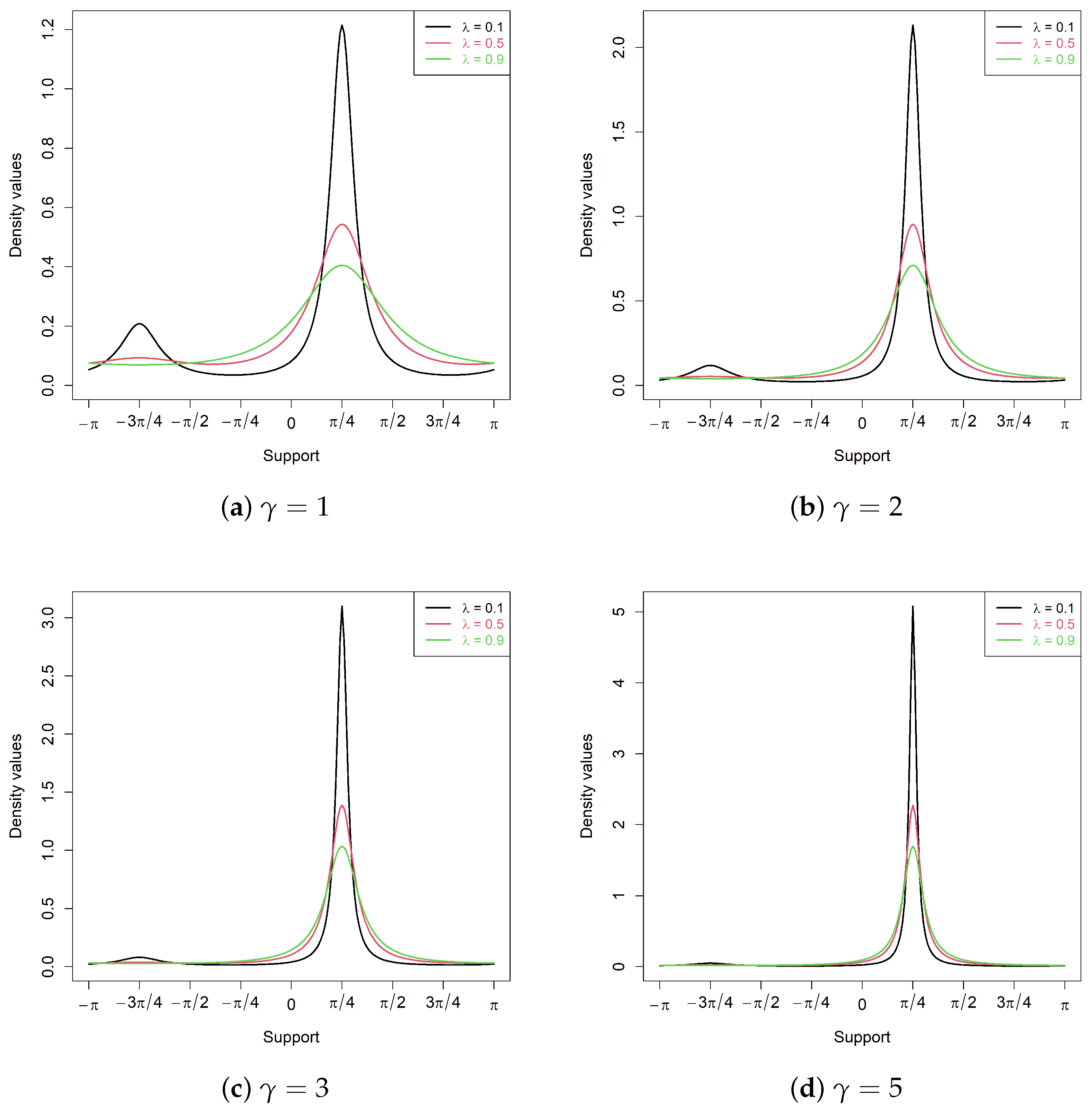
Figure 1 presents the density plots of GCPC ( ω , γ , λ ) with ω = π / 4 , λ = ( 0.1 , 0.5 , 0.9 ) and γ = ( 1 , 2 , 3 , 5 ) . For small values of λ the distribution is bimodal, and this is more prevalent with small values of γ . As the γ parameter increases, the bimodality vanishes. The unimodality conditions are discussed in Section 2.2.

2.1. Relationship with the CIPC Distribution

Theorem 1.
If ϕ follows the GCPC distribution, GCPC ( ω , γ , λ ) , ψ = arctan 2 sin ϕ , λ cos ϕ follows the CIPC distribution, GCPC ( 0 , γ , 1 ) CIPC ( 0 , γ ) W C ( 0 , δ ) , where arctan 2 ( y , x ) is the two-argument arc-tangent:
arctan 2 ( y , x ) = arctan ( y / x ) if x > 0 , arctan ( y / x ) + π if x < 0 and y 0 , arctan ( y / x ) π if x < 0 and y < 0 , π / 2 if x = 0 and y > 0 , π / 2 if x = 0 and y < 0 , undefined if x = y = 0 .
Proof. 
The proof is straightforward by application of the change-of-variables formula. Without loss of generality, set ω = 0 . Under the transformation ψ = arctan 2 ( sin φ , λ cos φ ) we can see that
cos ψ = cos φ b , sin ψ = sin φ λ b ,
where b = cos 2 φ + sin 2 φ / λ . Differentiating tan ψ = tan φ / λ gives | d φ / d ψ | = λ b . Applying the change-of-variables formula to f Φ ( φ ) = ( 2 π λ b D ) 1 , with  D = c b γ cos φ and c = γ 2 + 1 , we obtain
f Ψ ( ψ ) = f Φ ( φ ) · λ b = b 2 π D = b 2 π ( c b γ b cos ψ ) = 1 2 π ( γ 2 + 1 γ cos ψ ) ,
where in the last step we used cos φ = b cos ψ . This is the CIPC ( 0 , γ ) WC ( 0 , δ ) density.    □
Based on this we can define the opposite transformation as follows:
Lemma 1.
If ψ follows the CIPC distribution, CIPC ( ω , γ ) , then ϕ = arctan 2 λ sin ψ , cos ψ follows the GCPC distribution, GCPC ( 0 , γ , λ ) .
Proof. 
The proof is again straightforward and hence omitted.    □

2.2. Unimodality Conditions for the GCPC Distribution

Ref. [6] observed that the density function of GCPC (6) may be bimodal. They equated the derivative of the log-density to zero and obtained:
sin ( θ ω ) 2 ( λ 1 ) γ 2 + 1 cos ( θ ω ) ( λ 1 ) cos 2 ( θ ω ) + 1 λ 2 ( λ 1 ) γ cos 2 ( θ ω ) γ = 0 .
This yields two cases: either sin ( θ ω ) = 0 or the expression in brackets equals zero.
  • Case 1: sin ( θ ω ) = 0 .
    θ ω = k π θ = ω + k π , k Z .
  • Case 2: The term inside the brackets equals zero. Let u = cos ( θ ω ) :
    2 ( λ 1 ) γ 2 + 1 u ( λ 1 ) u 2 + 1 λ = γ 2 ( λ 1 ) u 2 + 1 4 ( λ 1 ) 2 ( γ 2 + 1 ) u 2 ( λ 1 ) u 2 + 1 λ = γ 2 2 ( λ 1 ) u 2 + 1 2 ( By squaring both sides ) .
    Letting t = u 2 = cos 2 ( θ ω ) and multiplying both sides with λ yields
    4 ( λ 1 ) 3 ( γ 2 + 1 ) t 2 + 4 ( λ 1 ) 2 ( γ 2 + 1 ) t = 4 λ γ 2 ( λ 1 ) 2 t 2 + 4 λ γ 2 ( λ 1 ) + λ γ 2 . 4 ( λ 1 ) 2 M t 2 + 4 ( λ 1 ) M t λ γ 2 = 0 ,
    where M = λ γ 2 1 . Hence,
    t = cos 2 ( θ ω ) = M ± M M + λ γ 2 2 ( λ 1 ) M .
    Finally,
    θ = ω ± arccos t .
    Notes.
  • If M = 0 λ = γ 2 + 1 , the quadratic degenerates and requires γ = 0 .
  • The square root term in t expands as M M + λ γ 2 = λ γ 2 1 λ 1 γ 2 + 1 . To ensure that this is non-negative two conditions apply:
    If λ < 1 , then λ < γ 2 + 1 .
    If λ > 1 , then λ > γ 2 + 1 .
  • If λ = 1 , the term inside the brackets in (11) vanishes and we end up with Case 1 (unimodality of the distribution).
  • If λ 1 , then the following four cases apply:
    Case A:  1 < λ γ 2 + 1 . The distribution is always unimodal since M ( λ 1 ) 0 gives complex roots, with no further conditions needed.
    Case B:  λ > γ 2 + 1 . The distribution is unimodal when t + > 1 , i.e., when:
    ( γ 2 + 1 ) ( λ 1 ) > ( λ γ 2 1 ) ( 2 λ 1 ) 2 .
    Case C:  1 2 < λ < 1 . The distribution is unimodal when t > 1 , i.e., when:
    ( γ 2 + 1 λ ) ( 1 2 λ ) 2 > ( γ 2 + 1 ) ( 1 λ ) .
    Case D:  λ 1 2 . Here t [ 0 , 1 ] always, so the distribution is never unimodal for λ 1 / 2 regardless of γ ; bimodal critical (stationary) points always exist.
The conditions stated in Cases A and D are straightforward for the bimodality. Cases B and C state that, if t falls outside the admissible region, the distribution is unimodal, where t + = M + M M + λ γ 2 2 ( λ 1 ) M and t = M M M + λ γ 2 2 ( λ 1 ) M . In those two cases, examination of bimodality requires some extra computations.

2.3. Probabilities

Following [6], instead of the cumulative probability function, we derive the probability included within a given interval ( a , b ) and provide an alternative formula.
P ( a θ b ) = a b f G C P C ( t ) d t = π b f G C P C ( t ) d t π a f G C P C ( t ) d t = F G C P C ( b ) F G C P C ( a ) .
Applying Theorem 1 the formula above becomes
P ( a θ b ) = π ψ ( b ) f W C ( ψ ) d ψ π ψ ( a ) f W C ( ψ ) d ψ = F W C ( ψ ( b ) ) F W C ( ψ ( a ) ) = 1 2 + 1 π arctan 1 + δ 1 δ tan ψ ( b ) 2 1 2 + 1 π arctan 1 + δ 1 δ tan ψ ( a ) 2 = 1 π arctan 1 + δ 1 δ tan ψ ( b ) 2 arctan 1 + δ 1 δ tan ψ ( a ) 2
where ψ ( t ) = arctan 2 sin ( t ω ) , λ cos ( t ω ) .

2.4. Mean Resultant Length

The mean resultant length is defined as ρ = E cos θ ω . Based on this, one may compute the circular variance as 1 ρ and the circular standard deviation as 2 log ρ 1 / 2 .
Theorem 2.
The mean resultant length of the GCPC distribution is given by
ρ = 2 ( 1 + δ ) π ( 1 δ ) λ Π 1 + δ 1 δ 2 1 λ 1 , 1 1 λ 2 ,
where Π n , k is the complete elliptic integral of the third kind [10] (the integral can be computed in R analytically via the built-in command integrate() or via the package gsl [11])
Π ( n , k ) = 0 π / 2 d θ ( 1 n sin 2 θ ) 1 k 2 sin 2 θ .
Proof. 
E [ cos θ ] = 1 2 π λ π π cos θ b D d θ , b = cos 2 θ + sin 2 θ λ , D = γ 2 + 1 b γ cos θ .
Applying the change-of-variables formula ψ = arctan 2 sin θ , λ cos θ from Theorem 1 so that f GCPC ( θ ) d θ = f W C ( ψ ) d ψ , we express cos θ in terms of ψ :
cos ψ = cos θ b , sin ψ = sin θ λ b , b = 1 1 + ( λ 1 ) sin 2 ψ , cos θ = cos ψ 1 + ( λ 1 ) sin 2 ψ .
Substituting and using f W C ( ψ ) = 1 δ 2 2 π ( 1 + δ 2 2 δ cos ψ ) we obtain:
E cos θ = 1 δ 2 2 π π π cos ψ 1 + δ 2 2 δ cos ψ 1 + ( λ 1 ) sin 2 ψ d ψ .
Since the integrand is even in ψ , doubling the integral over [ 0 , π ] and reducing via the substitution u = π / 2 ψ yields
E cos θ = 2 ( 1 + δ ) π ( 1 δ ) λ Π 1 + δ 1 δ 2 1 λ 1 , 1 1 λ 2 ,
confirming the non-closed-form nature of ρ = E [ cos θ ] for λ 1 .    □
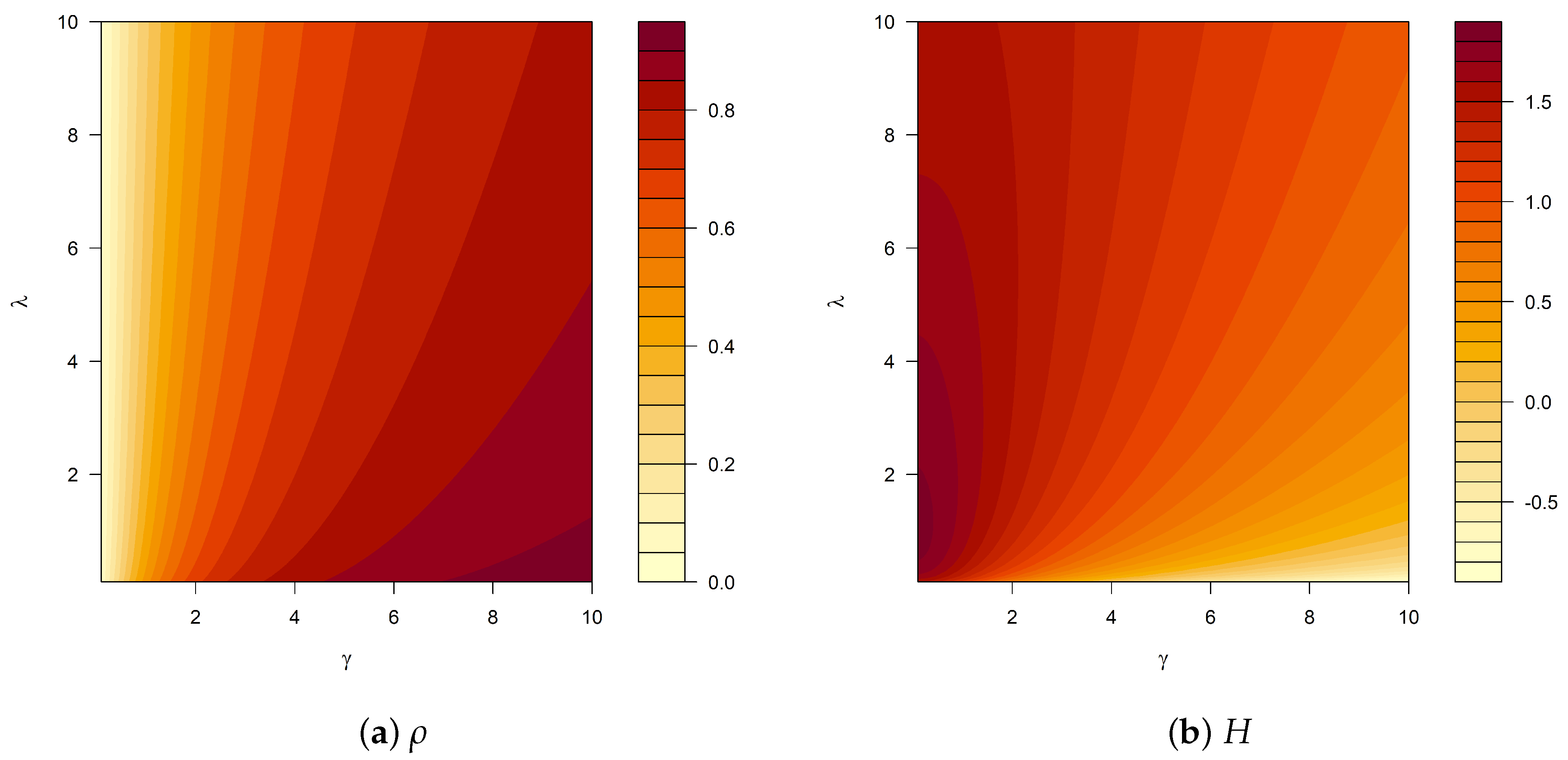
There is no closed-form expression for ρ unless  λ = 1 , and this applies to higher trigonometric moments. Figure 2a displays the values of ρ for a grid of values of γ and λ . We observe that ρ increases with increasing γ and decreases with increasing λ values.

2.5. Entropy

Theorem 3.
The entropy of the GCPC distribution is given by
H G C P C ( ω , γ , λ ) = log 8 π λ ( 1 δ 2 ) λ ( 1 δ 2 ) + 1 + δ 2 2 .
Proof. 
The entropy is defined as H = π π f ( θ ) log f ( θ ) d θ . Taking the logarithm of (7), we have: log f G C P C = log ( 2 π ) 1 2 log λ 1 2 log b log D . Using the change-of-variables formula from Theorem 1, we have f G C P C ( θ ) d θ = f W C ( ψ ) d ψ and
log D = 1 2 log b + log ( c γ cos ψ ) and b ϕ ( ψ ) = 1 1 + ( λ 1 ) sin 2 ψ ,
where c γ cos ψ = ( 1 + δ 2 2 δ cos ψ ) / ( 1 δ 2 ) .
By changing variables and substituting the result into the entropy we obtain:
H G C P C = log ( 2 π ) + 1 2 log λ + E W C log b + π π f W C ( ψ ) log ( c γ cos ψ ) d ψ .
The last integral equals H W C log 2 π , so
H G C P C = H W C + 1 2 log λ E W C log ( 1 + ( λ 1 ) sin 2 ψ ) .
We know that the entropy of the WC distribution is H W C = log 2 π 1 δ 2 . Let us now write 1 + ( λ 1 ) sin 2 ψ = 1 + λ 2 ( 1 α cos 2 ψ ) with α = ( λ 1 ) / ( λ + 1 ) . Then, 1 α cos 2 ψ = ( 1 + r 1 2 2 r 1 cos 2 ψ ) / ( 1 + r 1 2 ) , where
r 1 = 1 1 α 2 α = λ 1 λ + 1 .
Using the Fourier identity log ( 1 + δ 2 2 δ cos ψ ) = 2 n = 1 δ n n cos ( n ψ ) we get E WC [ cos ( n ψ ) ] = δ n . Applying the same Fourier identity at frequency 2 n , with E W C cos ( 2 n ψ ) = δ 2 n ,
E W C log ( 1 α cos 2 ψ ) = log ( 1 + r 1 2 ) + 2 log ( 1 r 1 δ 2 ) .
Using log 1 + λ 2 log ( 1 + r 1 2 ) = 2 log λ + 1 2 and 1 r 1 δ 2 = λ ( 1 δ 2 ) + 1 + δ 2 λ + 1 we obtain
E W C log ( 1 + ( λ 1 ) sin 2 ψ ) = 2 log λ ( 1 δ 2 ) + 1 + δ 2 2 .
Substituting the above result into (12) we obtain
H G C P C ( ω , γ , λ ) = log 8 π λ ( 1 δ 2 ) λ ( 1 δ 2 ) + 1 + δ 2 2 .
   □
Note that, if λ = 1 , H G C P C = log ( 2 π ( 1 δ 2 ) ) = H W C , and, if δ = 0 , H G C P C = log ( 8 π λ / ( λ + 1 ) 2 ) log ( 2 π ) . Figure 2b displays the values of H for a grid of values of γ and λ . We observe that, in contrast to ρ , H increases with increasing λ and decreases as γ increases.

2.6. KLD Between GCPC and CIPC

Using Theorem 1 we derived a formula for the KLD between GCPC ω , γ , λ and CIPC ω , γ , which admits no closed-form expression
K L ( G C P C C I P C ) = 1 2 log λ + 2 log λ ( 1 δ 2 ) + 1 + δ 2 2 log ( 1 δ 2 ) + E W C log γ 2 + 1 γ cos ψ 1 + ( λ 1 ) sin 2 ψ ,
where the expectation is taken with respect to ψ W C ( 0 , δ ) .

2.7. Maximum Likelihood Estimation

Ref. [6] performed maximum likelihood estimation (MLE) using the Euclidean representation of the density of GCPC (5). We observed that this estimation approach is suboptimal and can yield a local instead of the global maximum when the distribution is bimodal. However, we emphasize that, if the distribution is unimodal, their approach is valid. Despite their efforts to ensure the maximum via a clever implementation, we will show in the real data analysis that the use of the log-likelihood parameterized using (5) does not lead to the global maximum since the log-likelihood can have four local maxima (ref. [6] mentioned that the solution to Equation (11) has four roots) when the distribution is bimodal. The safest option is to always employ the log-likelihood of the density in (6), i.e., when the density is expressed in the circular (univariate) form and not using the Euclidean representation. In our implementation, the initial values are obtained from maximizing the CIPC distribution via the Newton–Raphson algorithm (alternatively one could use the algorithm of [7], which is faster).

2.8. Hypothesis Testing and Confidence Intervals

2.8.1. Hypothesis Test for the Location Parameter of One Sample

In order to test whether the location parameter equals some pre-specified value we will employ the log-likelihood ratio test. Under H 0 , ω = ω 0 , so we need to maximize the restricted log-likelihood, 0 , with respect to the other two parameters, γ and λ , and estimate their values, γ ˜ and λ ˜ . Under H 1 , ω ω 0 , and we maximize the unrestricted log-likelihood, 1 , to obtain ω ^ , γ ^ and λ ^ . Under regularity conditions, Λ = 2 1 ω ^ , γ ^ , λ ^ 0 ω 0 , γ ˜ , λ ˜ ˙ χ 1 2 .

2.8.2. Confidence Interval for the True Location Parameter

Using the log-likelihood ratio test, we can construct asymptotic confidence intervals for the true location parameter ω of a sample by searching for the pair of values for which it holds that [12]: ω , γ ^ , λ ^ > ω ^ , γ ^ , λ ^ χ 1 2 2 .

2.8.3. Equality of Two Location Parameters

To test the equality of two location parameters, without assuming equality of the parameters γ and λ , we will perform a log-likelihood ratio test (all the relevant functions are available in the R package Directional [13]) following [6]. Assume we have circular observations from two independent samples, ( θ 11 , , θ 1 n 1 ) and ( θ 21 , , θ 2 n 2 ) , where n 1 and n 2 denote the sample sizes of the two samples.
Under H 0 , ω 1 = ω 2 = ω ˜ , and, by using Equation (6), the log-likelihood is written as
0 ω ˜ , λ ˜ 1 , λ ˜ 2 , γ ˜ 1 , γ ˜ 2 = ( n 1 + n 2 ) log ( 2 π ) n 1 2 log ( λ ˜ 1 ) n 2 2 log ( λ ˜ 2 ) i = 1 n 1 log b ˜ 1 i γ ˜ 1 2 + 1 a ˜ 1 i b ˜ 1 i i = 1 n 2 log b ˜ 2 i γ ˜ 2 2 + 1 a ˜ 2 i b ˜ 2 i ,
where a ˜ j i = γ ˜ j cos θ j i ω ˜ and b ˜ j i = cos 2 θ j i ω ˜ + sin 2 θ j i ω ˜ λ ˜ j for  j = 1 , 2 .
Under H 1 , ω 1 ω 2 , and the log-likelihood is written as
1 ω ^ , λ ^ 1 , λ ^ 2 , γ ^ 1 , γ ^ 2 = ( n 1 + n 2 ) log ( 2 π ) n 1 2 log ( λ ^ 1 ) n 2 2 log ( λ ^ 2 ) i = 1 n 1 log b ^ 1 i γ 1 2 + 1 a ^ 1 i b ^ 1 i i = 1 n 2 log b ^ 2 i γ ^ 2 2 + 1 a ^ 2 i b ^ 2 i ,
where a ^ j i = γ ^ j cos θ j i ω ^ j and b ^ j i = cos 2 θ j i ω ^ j + sin 2 θ j i ω ^ j λ ^ j  for  j = 1 , 2 .
Under regularity conditions, Λ = 2 1 ω ^ , λ ^ 1 , λ ^ 2 , γ ^ 1 , γ ^ 2 0 ω ˜ , λ ˜ 1 , λ ˜ 2 , γ ˜ 1 , γ ˜ 2 ˙ χ 1 2 .

2.9. Regression Modeling Revisited

Ref. [6] defined the GCPC regression by considering the bivariate representation (Euclidean coordinates) of the circular data as opposed to their univariate nature [14]. This is akin to the approach employed in the spherically projected multivariate linear (SPML) model, as detailed by [15], and allows for varying concentration parameter ( λ ). The log-likelihood of the GCPC regression model is written as
l G C P C = i = 1 n log y i Σ i 1 B y i μ i μ i + 1 y i μ i y i Σ i 1 B y i n 2 log ( λ ) n log ( 2 π ) ,
where
y i Σ i 1 B y i = y i ξ 1 i B ξ 1 i B / λ + ξ 2 i B ξ 2 i B y i = y 1 i 2 ξ 2 i 2 / λ + ξ 1 i 2 + y 2 i 2 ξ 1 i 2 / λ + ξ 2 i 2 + 2 y 1 i y 2 i ξ 1 i ξ 2 i 1 1 / λ = y 1 i ξ 2 i y 2 i ξ 1 i 2 / λ + y 1 i ξ 1 i + y 2 i ξ 2 i 2 ,
μ j i = β j x i and
ξ j i = μ j i μ i for j = 1 , 2 ,
with x i denoting the i-th observation of the covariate vector.
To maximize the log-likelihood of the GCPC regression model (13), Ref. [6] suggested the use of multiple starting values; however, we propose a computationally more efficient approach. We begin with initial regression coefficients produced by the SPML regression model of [15] and then estimate the λ parameter using Brent’s algorithm (this is available in R via the built-in optimize() function) [16]. These estimates are subsequently used as starting values in R’s built-in optim() function. Our experiments have shown that this process is faster and results in a more stable optimization. Ref. [6] did not consider the case of circular–circular regression, where a covariate X is circular. But, this case is easily accommodated in the above scenario by transforming the circular covariate to Euclidean by using z i = cos x i , sin x i . In case of multiple circular covariates, all of them are transformed into their Euclidean coordinates and the same link function (14) is used. Simplicial predictors (compositional data) are straightforward to add by using two options. The first is to apply the additive log-ratio transformation [17] so that the regression coefficients sum to zero and have a meaningful (derivative-based) interpretation. In case of zero values present the logarithmic transformation breaks down, so the alternative approach is to transform them via the α transformation.
A further extension consists of linking the λ parameter to the covariates, but that would increase the computational cost. A complementary approach to introduce non-linearity consists of incorporating splines for the covariate effects.


3. Simulation Studies

We performed simulation studies to examine the performance of the test for one- and two-location parameters and to assess the effect of misspecifying λ on the size of the log-likelihood ratio test. We did not perform simulation studies for the asymptotic confidence interval for the location parameter since this is derived from the log-likelihood ratio test. Further, hypothesis testing for equality of the λ parameter (GCPC versus CPC distributions) was considered in [6] and thus not examined again here.

3.1. One Location Parameter

We selected six sample sizes and generated values from the G C P C 2 , 3 , 2 . For each sample size we estimated the type I error (assuming α = 0.05 ) based on 1000 replicates. Table 1 presents the results, where we can observe that the test slightly overestimates the nominal type I error, although the deviation is not substantial.

3.2. Two Location Parameters

We compared the test when both samples come from the GCPC distribution and when assuming that they come from the CIPC distribution ( λ = 1 ). Six pairs of unequal sample sizes were used, where the true location parameters were equal to ω = 2 for both populations but the γ and λ parameters differed between the two populations. The parameters for the smaller sample were equal to γ = 4 and λ = 1 , while, for the larger sample, they were equal to γ = 2 and λ = 3 . Circular data were generated from two GCPC distributions with the specified parameters and the two log-likelihood ratio tests were performed. This process was repeated 1000 times, and the proportion of rejection of the H 0 (at the α = 0.05 level) served as an estimate of the type I error. Table 2 presents the results. The GCPC-based log-likelihood ratio always attained the correct size, whereas the CIPC-based log-likelihood ratio test overestimated the size of the test.

3.3. Empirical Asymptotics for the Regression Model

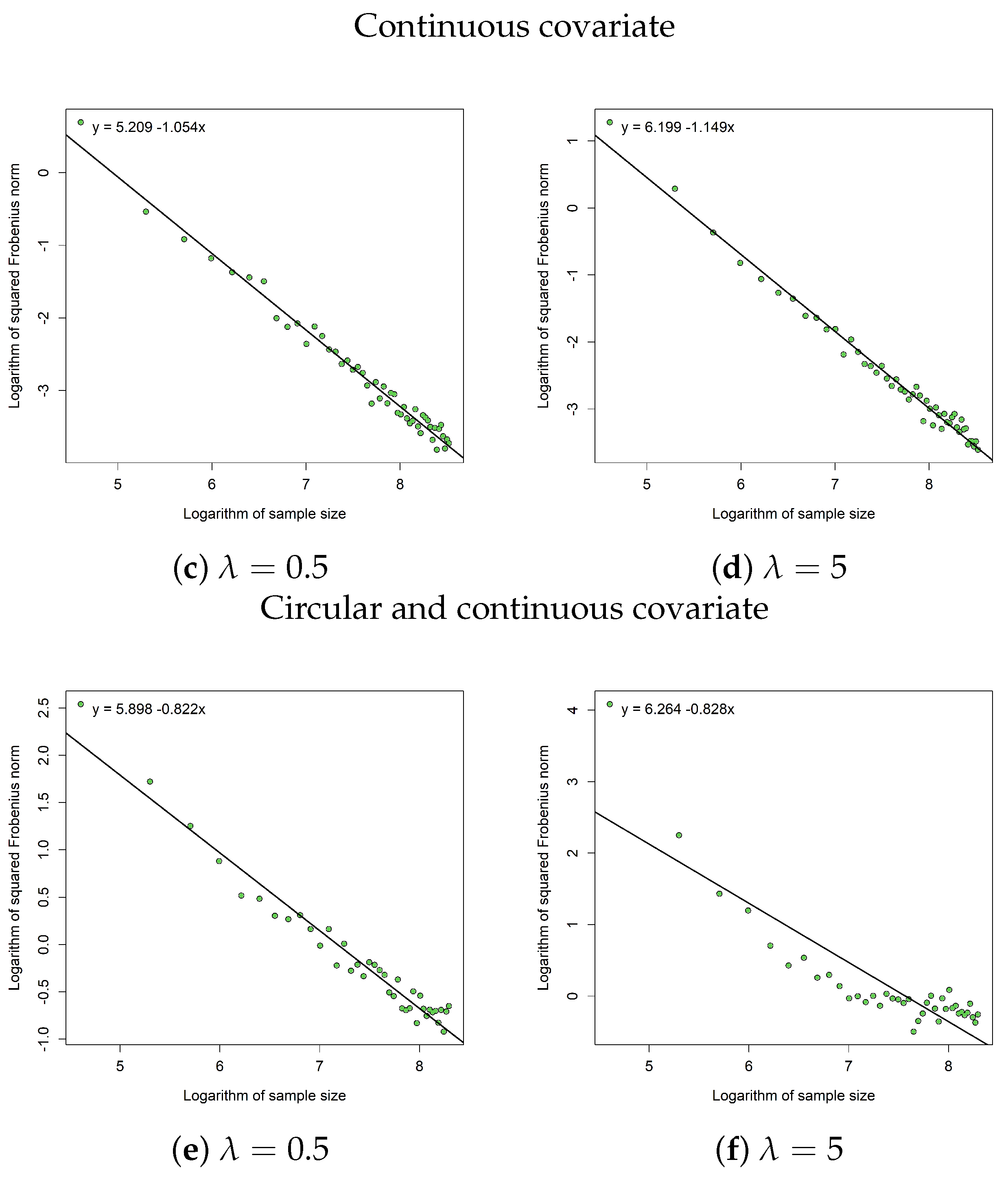
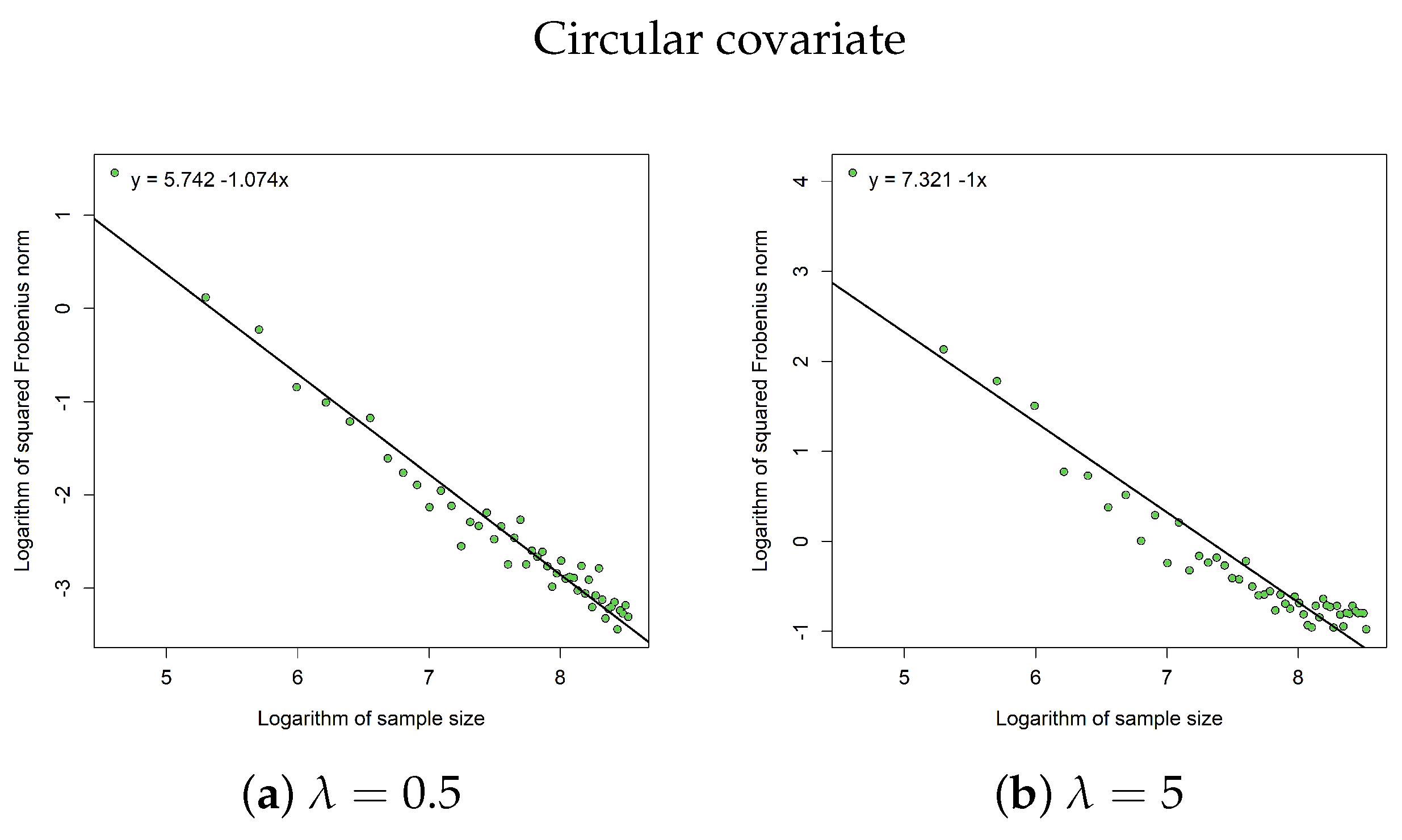
We empirically estimated the order of convergence of the regression coefficients, with (a) one circular predictor, (b) one continuous predictor and (c) the combination of both. The grid for the sample sizes considered ranged from 100 to 5000 at an increasing step of 100. For every sample size n, data were generated with some pre-specified coefficients and the regression model was fitted.
For the circular predictor, the model was
y 1 , y 2 = 1 , cos u , sin u β 01 β 02 β 11 β 12 β 21 β 22 ,
where u was generated from a von Mises distribution with location parameter ω = 2 and concentration parameter γ = 5 . For the continuous predictor, the model was
y 1 , y 2 = 1 , x β 01 β 02 β 11 β 12 ,
where x was generated from an exponential distribution with mean equal to 0.5. Table 3 shows the matrix with the ground truth regression coefficient B used. For all cases, the λ values of the GCPC distribution used to generate the circular responses were equal to 0.5 and 5.
The discrepancy between the observed and estimated regression coefficients was measured using the squared Frobenius norm. This process was repeated 50 times and the average squared Frobenius norm ( F ¯ 2 ) was stored. Then, we estimated the coefficient of the following regression model:
log F ¯ 2 a + b log n .
The estimated b served as the empirical rate of convergence of the regression coefficients.
Table 3 contains the matrix B of the regression parameters used in the simulation study. Figure 3 displays the rates when λ = 0.5 and λ = 5 . For all cases the estimated slope is very close to 1, indicating that the convergence rate of the estimated regression coefficients is n 1 .

4. Real Data Analysis

We used the same dataset as in [6], speed.wind2, which is available in the R package NPCirc [18]. This dataset consists of 199 hourly observations of wind direction and wind speed in the winter season (from November to February) from 2003 to 2012 in the Atlantic coast of Galicia (Spain).

4.1. MLE

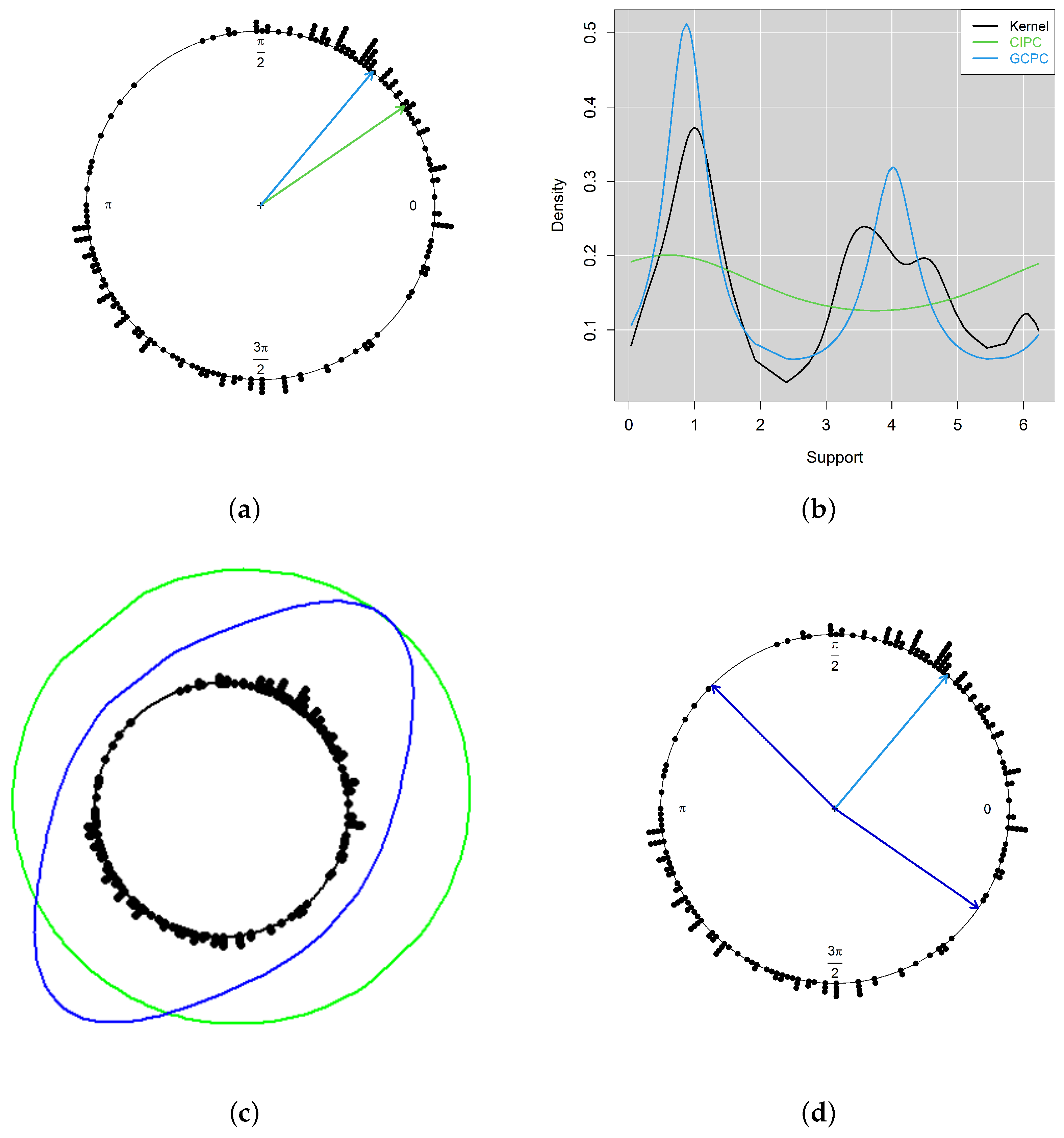
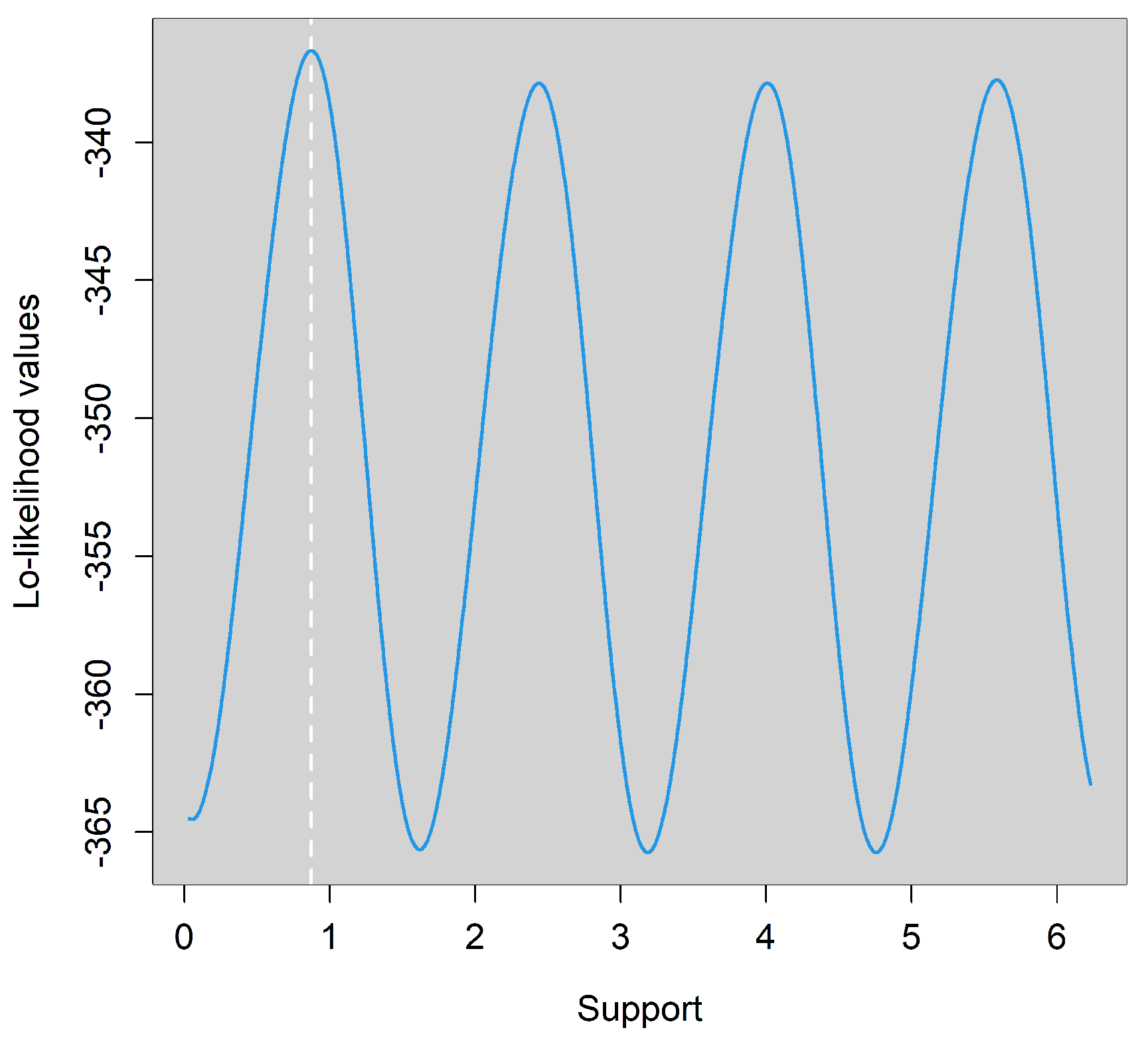
Table 4 presents the MLE of the CIPC and GCPC distributions fitted to the speed direction data. We highlight that the MLE using Equation (5) in Ref. [6] was trapped in one of the three local maxima, while the MLE using (6) obtained the global maximum. Note that the estimated λ falls within Case D, λ 1 2 , and hence the distribution is bimodal, which is also evident from Figure 4b,c. Table 4 presents the estimated parameters of the CIPC and GCPC models. Application of the log-likelihood ratio test to discriminate between the two models [6] clearly favors the GCPC model.
Figure 4a visualizes the data, comprising the circular plot with the location parameter shown with arrows. The density plot in Figure 4b shows that the GCPC density has a similar pattern to that produced by the kernel density estimate, in contrast to the CIPC distribution, which does not adequately capture the distributional features of the data. This is more evident in the circular density plot (Figure 4c). The CIPC distribution has a circular shape, whereas the GCPC distribution has an elliptical shape, capturing the shape of the data more accurately. Figure 4d visualizes the 95% confidence interval for the location parameter. Figure 5 visualizes the profile log-likelihood of the location parameter ω . The log-likelihood contains four modes; three of them correspond to local maxima and one is the global maximum.

4.2. Regression

We identified a mistake in the regression modeling of [6], where the continuous predictor is the speed of the wind. The mistake resulted from a bug in the estimation code, which we have now corrected. Table 5 shows the regression coefficients computed in [6] and the correct estimates. We identified this mistake through close examination of their R implementation, where we spotted a bug, and via the simulation studies we performed. Note that, this time, the sign of the slope coefficients matches that of CIPC and the spherically projected multivariate linear regression models. The λ coefficient remains statistically significantly different from 1, and the log-likelihood ratio test still favors the GCPC regression model over the CIPC regression model.
We then compared the goodness of fit of GCPC to the CIPC and SPML regression models and to the regression model assuming the Purkayastha distribution [19]. The goodness of fit was obtained via computing the following quantity, Q = i = 1 n Y i Y ^ i , where Y i = cos ( y i ) , sin ( y i ) and Y ^ i = cos ( y ^ i ) , sin ( y ^ i ) , with y ^ i denoting the fitted value for the i-th observation, and via the BIC. Higher values of Q indicate better fit, whereas lower values of BIC are preferred. The Q values are 17.906 and 13.193 for the GCPC and CIPC regression models, respectively, and 14.857 and 13.698 for the Purkayastha and SPML regression models, respectively. The BIC values are 697.182 and 754.340 for the GCPC and CIPC regression models, respectively, and 1216.22 and 755.8836 for the Purkayastha and SPML regression models, respectively. Evidently both quantities yield the same conclusion that the GCPC regression is to be preferred.

5. Conclusions

We derived the relationship between the GCPC and CIPC (reparameterized WC) distributions and provided non-closed-form expressions for the mean resultant length and the KLD, an alternative analytical formula to compute probabilities, as well as an analytical formula for the entropy of GCPC. We also showed the conditions under which the GCPC distribution is unimodal. We further proposed two log-likelihood ratio tests for hypothesis testing with one or two location parameters. For the two-location-parameter testing case, the test maintains the nominal size even when the data are incorrectly assumed to follow the CIPC distribution. We observed that, in the case of a bimodal distribution, there is a danger for the MLE to be trapped in a local maximum, and we showed how to escape this trap. Finally, we corrected a mistake in the regression setting and proposed a computationally more efficient alternative than the one proposed by [6].
Derivation of closed-form expressions for (a) the mean resultant length and (b) the KLD of the GCPC distribution would be advantageous, but such occasions are common within the field of directional statistics. The limitation of this work is that we have not fully characterized the distribution. We have not provided formulas for the circular moments and the characteristic function of the distribution. We leave these aspects for future work. Another future direction is the implementation of the Newton–Raphson algorithm to reduce the computational cost of the GCPC regression model.

Author Contributions

Conceptualization, M.T.; methodology, O.A. and M.T.; software, M.T.; formal analysis, M.T.; investigation, M.T.; writing—original draft, O.A.; writing—review and editing, O.A. and M.T. All authors have read and agreed to the published version of the manuscript.

Funding

This research received no external funding.

Data Availability Statement

The data presented in this study are openly available from https://cran.r-project.org/web/packages/NPCirc/index.html (accessed on 15 January 2026).

Conflicts of Interest

The authors declare no conflicts of interest.

References

  1. Gill, J.; Hangartner, D. Circular data in political science and how to handle it. Political Anal. 2010, 18, 316–336. [Google Scholar] [CrossRef]
  2. Shirota, S.; Gelfand, A.E. Space and circular time log Gaussian Cox processes with application to crime event data. Ann. Appl. Stat. 2017, 11, 481–503. [Google Scholar] [CrossRef]
  3. Landler, L.; Ruxton, G.D.; Malkemper, E.P. Circular data in biology: Advice for effectively implementing statistical procedures. Behav. Ecol. Sociobiol. 2018, 72, 128. [Google Scholar] [CrossRef] [PubMed]
  4. Horne, J.S.; Garton, E.O.; Krone, S.M.; Lewis, J.S. Analyzing animal movements using Brownian bridges. Ecology 2007, 88, 2354–2363. [Google Scholar] [CrossRef] [PubMed]
  5. Soler, J.D.; Beuther, H.; Rugel, M.; Wang, Y.; Clark, P.; Glover, S.C.; Goldsmith, P.F.; Heyer, M.; Anderson, L.; Goodman, A.; et al. Histogram of oriented gradients: A technique for the study of molecular cloud formation. Astron. Astrophys. 2019, 622, A166. [Google Scholar] [CrossRef]
  6. Tsagris, M.; Alzeley, O. Circular and spherical projected Cauchy distributions: A novel framework for directional data modelling. Aust. N. Z. J. Stat. 2025, 67, 77–103. [Google Scholar] [CrossRef]
  7. Kent, J.T.; Tyler, D.E. Maximum likelihood estimation for the wrapped Cauchy distribution. J. Appl. Stat. 1988, 15, 247–254. [Google Scholar] [CrossRef]
  8. Paine, P.J.; Preston, S.P.; Tsagris, M.; Wood, A.T. An elliptically symmetric angular Gaussian distribution. Stat. Comput. 2018, 28, 689–697. [Google Scholar] [CrossRef]
  9. Mardia, K.V.; Jupp, P.E. Directional Statistics; John Wiley & Sons: Chichester, UK, 2000. [Google Scholar]
  10. Ward, M. The calculation of the complete elliptic integral of the third kind. Am. Math. Mon. 1960, 67, 205–213. [Google Scholar] [CrossRef]
  11. Hankin, R.K.S. Special functions in R: Introducing the gsl package. R News 2006, 6, 24–26. [Google Scholar]
  12. Cox, D.; Hinkley, D. Theoretical Statistics; Chapman & Hall/CRC: London, UK, 1979. [Google Scholar]
  13. Tsagris, M.; Athineou, G.; Adam, C.; Yu, Z.; Sajib, A.; Amson, E.; Waldstein, M.J.; Papastamoulis, P. Directional: A Collection of Functions for Directional Data Analysis; R Package Version 7.4; R Package: Vienna, Austria, 2026. [Google Scholar]
  14. Kato, S.; Shimizu, K.; Shieh, G.S. A circular–circular regression model. Stat. Sin. 2008, 18, 633–645. [Google Scholar]
  15. Presnell, B.; Morrison, S.P.; Littell, R.C. Projected multivariate linear models for directional data. J. Am. Stat. Assoc. 1998, 93, 1068–1077. [Google Scholar] [CrossRef]
  16. Brent, R.P. Algorithms for Minimization Without Derivatives; Courier Corporation: Mineola, NY, USA, 2013. [Google Scholar]
  17. Aitchison, J. The Statistical Analysis of Compositional Data; The Blackburn Press: Caldwell, NJ, USA, 2003. [Google Scholar]
  18. Oliveira, M.; Crujeiras, R.M.; Rodríguez-Casal, A. NPCirc: An R Package for Nonparametric Circular Methods. J. Stat. Softw. 2014, 61, 1–26. [Google Scholar] [CrossRef]
  19. Purkayastha, S. A rotationally symmetric directional distribution: Obtained through maximum likelihood characterization. Sankhyā Indian J. Stat. Ser. A 1991, 53, 70–83. [Google Scholar]
Figure 1. Density of the GCPC distribution with ω = π / 4 and various values for γ and λ .
Mathematics 14 01934 g001
Figure 2. Values of the mean resultant length, ρ , and entropy, H, as functions of γ and λ .
Mathematics 14 01934 g002
Figure 3. Average squared Frobenius norm F ¯ 2 versus sample size, both in log-scale for the circular predictor, continuous predictor and the combination of both.
Mathematics 14 01934 g003aMathematics 14 01934 g003b
Figure 4. (a) Circular plot of the speed direction data. (b) Density plot of the kernel density estimate and the fitted CIPC and GCPC distributions. (c) Circular density plot of the two fitted distributions. (d) 95% confidence interval for the true location parameter. The green line is the estimated location parameter based on CIPC, whereas the blue line is the estimated location parameter based on the GCPC model.
Mathematics 14 01934 g004
Figure 5. Profile log-likelihood of the location parameter ω for the GCPC distribution using the speed direction data. The white vertical line corresponds to the estimated location parameter that maximizes the log-likelihood. The periodicity is equal to π / 2 .
Mathematics 14 01934 g005
Table 1. Estimated type I error of the log-likelihood ratio test for one location parameter assuming the GCPC distribution.
Sample size305070100150200
Type I error0.0650.0590.0660.0620.0670.063
Table 2. Estimated type I error of the log-likelihood ratio test for the equality of two location parameters assuming the GCPC distribution and the CIPC distribution.
Sample SizeGCPCCIPC
(30, 50)0.0540.098
(30, 70)0.0560.094
(30, 100)0.0600.102
(50, 70)0.0480.100
(50, 100)0.0590.101
(70, 100)0.0610.092
Table 3. Matrix B of the regression coefficients used in the simulations. The first two columns correspond to the coefficients of the model with the circular predictor, the next two to the model with the continuous predictor and the last two to the model with both of them. In the last case, β 1 and β 2 refer to the circular predictor and β 3 to the continuous predictor.
PredictorCircularContinuousCircular and Continuous
cos ( y ) sin ( y ) cos ( y ) sin ( y ) cos ( y ) sin ( y )
β 0 1.8742.5501.6411.9491.8593.508
β 1 1.473 2.023 0.101 0.119 1.500 2.914
β 2 1.157 1.554 0.960 1.855
β 3 0.246 0.181
Table 4. Estimated parameters of the CIPC and GCPC models applied to the wind direction data. The GCPC* indicates the MLE using the polar-coordinate-parameterized GCPC density (6).
Model ω ^ γ ^ λ ^ Log-Likelihood
CIPC0.6030.203 −363.930
GCPC [6]5.5870.0504.21−337.739
GCPC*0.8730.2380.155−336.682
Table 5. Estimated regression parameters (their standard errors appear within parentheses) for the GCPC regression model fitted to the wind data. On the right is the corrected version of the GCPC regression model.
ModelGCPC [6]GCPC
cos ( y ) sin ( y ) cos ( y ) sin ( y )
α ^ −0.042 (0.0013)−0.045 (0.0023)0.164 (0.0012)0.195 (0.0012)
β ^ 0.009 (0.0005)0.010 (0.0009)−0.010 (0.0022)−0.012 (0.0021)
Loglik−331.846 −335.219
ρ ^ 0.203 (0.039) 0.226 (0.055)
Disclaimer/Publisher’s Note: The statements, opinions and data contained in all publications are solely those of the individual author(s) and contributor(s) and not of MDPI and/or the editor(s). MDPI and/or the editor(s) disclaim responsibility for any injury to people or property resulting from any ideas, methods, instructions or products referred to in the content.