1. Introduction
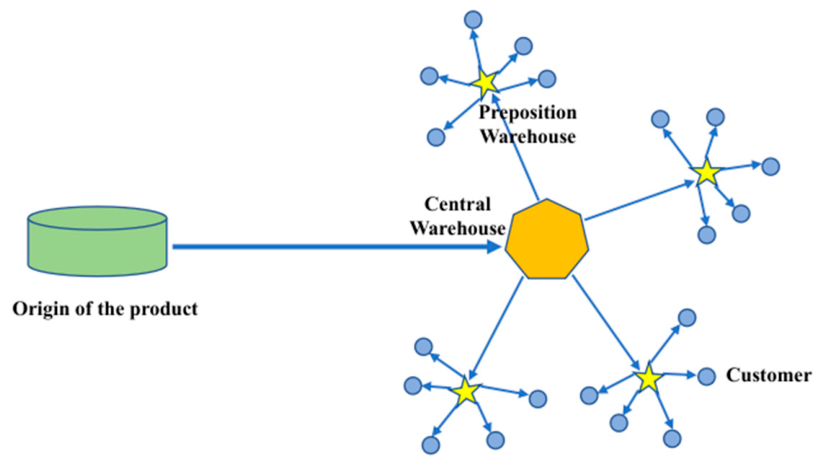
As the fresh product e-commerce industry now seeks more efficient home delivery, the pre-positioned warehouse mode, which places goods closer to consumers, has attracted extensive attention. The pre-positioned warehouse, also known as the satellite warehouse or cloud warehouse, is a small or medium-sized one to three kilometers away from urban communities. The warehouse area is about 200 to 300 square meters and most of them are located in low-cost properties. The transformed warehouse is equipped with ambient, refrigerated, and frozen zones. The warehouse has various products in nearly 2000 stock-keeping units (SKUs), and only warehouses and distributes products, without offline business. It is, in essence, a small and medium-sized warehouse distribution center closer to the community customers. The goods in the pre-positioned warehouse are warehoused and replenished from the central warehouse in the distribution city, while fresh-product producers supply the central warehouse directly. Compared with traditional e-commerce distribution, the pre-positioned warehouse is smaller and closer to customers, and it can respond to online orders faster. Its logistics network is shown in
Figure 1. In this distribution logistics network, a central warehouse serves many pre-positioned warehouses, while a pre-positioned warehouse is only served by one central warehouse, and each pre-positioned warehouse only serves customers within its authority.
However, the pre-positioned warehouse with fast response, flexible operation, and connected Internet face challenges in profitability because the main factor impacting how the fresh-product e-commerce warehouse distribution system at pre-positioned warehouse is improved is also related to the factors that constitute the logistics distribution network and the characteristics of fresh products. As it mainly sells fresh products, which are easily perishable and valuable with many varieties, the inventory and transportation and distribution costs have been the pain points. The absence of better inventory and distribution strategies specific to fresh products results in the high cost for the pre-positioned warehouse.
The coordination and scheduling between the central and pre-positioned warehouses are the key of the whole process from fresh-product purchasing to distribution to consumers. As the core of the process, the pre-positioned warehouse forecasts the market demand and considers the inventory to determine the replenishment quantity and cycle, and the inventory strategy. The central warehouse decides on the replenishment strategy and purchase strategy according to the inventory strategy for different products at different pre-positioned warehouses, and also integrates their replenishment strategy to determines the distribution path. Despite uncertain demands, the high preservation cost, and the cost of cold chain logistics, the pre-positioned warehouse and the central warehouse need to formulate reasonable inventory strategies and distribution strategies. Inventory and distribution are negatively correlated with the supply chain perspective. If the replenishment or purchase cycle is shortened on the premise of meeting customers’ needs, the inventory cost and preservation cost can be reduced, but the cost of distribution and transportation will be increased, and so do the cost of cold chain logistics. However, if the replenishment or purchase cycle is extended while ensuring the warehousing capacity, the logistics cost will be reduced, the preservation cost will be increased, and products will be less fresh, which affects user satisfaction. Therefore, any single study of either inventory or distribution cannot help optimize the cost of the supply chain.
Based on the above research motivation, this study integrates those two problems and studies the two-stage decision-making strategy of warehousing and distribution in the pre-positioned warehouse mode. The paper takes the minimized costs such as inventory and preservation costs, spoilage costs, and transportation costs as the objective function after taking into account market demand, product diversity, food spoilage, transportation mode, and other factors to establish a warehousing and distribution two-stage model at the central warehouse and pre-positioned warehouse considering product diversity, and solve it based on genetic algorithm, which provides some reference for fresh-product e-commerce companies in terms of inventory, purchase and distribution decisions under the pre-positioned warehouse mode.
The main contribution of this paper is as follows: Firstly, this paper investigates the integrated inventory and distribution optimization under the pre-positioned warehouse mode. Unlike traditional fresh-food supply chains with multiple independent stakeholders, both central and pre-positioned warehouses are operated by the same e-commerce enterprise. Within this system, central warehouses implement direct upstream procurement, and pre-positioned warehouses complete last-mile order delivery. This structure features rapid order response and closely linked replenishment flows, which imposes high requirements on overall cost control. Two-stage cost optimization spanning procurement and terminal fulfillment is therefore crucial, while relevant targeted research is still inadequate in the existing literature. Secondly, given the tight coupling between central and pre-positioned warehouses under a unified corporate entity, this paper constructs a two-stage programming model to jointly optimize inventory and distribution schemes. Most relevant studies tend to concentrate on individual segments such as warehouse location, last-mile routing and inventory management, or merely discuss order allocation and route planning in two-echelon systems. There is still room for further exploration on systematic integrated collaborative optimization. Thirdly, this paper classifies fresh products into ambient, refrigerated and frozen types from the perspective of storage requirements. Differentiated scheduling strategies for central and pre-positioned warehouses are proposed accordingly, which is rarely seen in current integrated warehouse-distribution research.
2. Literature Review
The logistics and distribution services of fresh e-commerce are one of the main factors affecting the profitability of their enterprises, and have always been a hot research topic [
1,
2,
3]. Among them, the inventory and delivery path issues of fresh e-commerce delivery systems are a key issue [
4,
5], which are generally considered as the mixed problems of inventory management [
6] and path programming [
7,
8].
As for the research on the inventory management of fresh product and perishable products, Ghare & Schrader [
9] first made quantitative research on the inventory of perishable and spoiling products, and set up a classic inventory control model for deteriorating products, which provides a basis for other scholars to study the inventory of perishable products. Hsu et al. [
10] assumed that the spoilage rate slowed down by the preservation investment exhibits a negative exponential distribution and established an inventory model of perishable products in which spoilage rate is reduced by the preservation investment. They also discussed the optimal replenishment cycle, quantity, and preservation investment for single-stage perishable products under fixed demand. Qin et al. [
11] introduced the two-parameter Weibull function, considered the influence of preservation investment on the loss of quantity and quality, and studied the decision-making in preservation and inventory strategies in a single-stage supply chain system. Janssen et al. [
12] brought in a more general random demand and proposed a micro-cycle inventory strategy for fresh products with fixed and service life under the conditions of fixed lead time and order cycle. Considering the fact that the supply and demand of agricultural and aquatic products fluctuate greatly with climate change, seasonal change and various social factors, Shin et al. [
13] designed a two-stage perishable inventory model for food industry. Maintaining the freshness of fresh products is one of the key points of concern in inventory research, as freshness maintenance is an important reflection of the logistics service quality of fresh and perishable products [
14]. In fact, different fresh products have different requirements for spoilage rate, preservation, and storage conditions [
15]. Nevertheless, the existing literature has insufficiently investigated product classification. In this study, the different categories of fresh products are considered in the research on their inventory and distribution strategy, and the fresh products are further classified for study.
Regarding the research on the distribution path of fresh products and perishable products, Govindan et al. [
16] studied a two-stage path with time windows targeting the supply chain network of sustainable perishable food with the objective of minimizing the cost and environmental impact and offered a new multi-objective hybrid approach. Singh et al. [
17] proposed a hybrid model of fuzzy AHP and fuzzy TOPSIS for the selection of suitable 3PLs for outsourcing logistics activities for perishable products. Chen et al. [
18] proposed an adaptive large neighborhood search (ALNS) algorithm to solve the vehicle routing problem in an example of a cold chain logistics company after considering the multiple intervals of some practical constraints. As for the cold chain distribution with real-time traffic, Yao & He [
19] proposed establishing interchange stations for distribution and built a distribution path optimization model with the minimum cost. These arguments simply focus on the cold chain distribution path of fresh and perishable products, without combining purchase and inventory strategy with distribution from the perspective of the supply chain. Guan et al. [
20] considered a fresh-product supply chain and proposed a two-stage stochastic optimization model for the strategic and operational decisions of the omnichannel retailer, incorporating the decision maker’s risk aversion behavior and financial flow into supply chain optimization. Leithner et al. [
21] investigated the sustainable delivery of organic food from farm to retail, developing a simulation-based decision support system integrated with general quality preservation models to examine the impacts of varying storage temperatures on food quality and wastage. Calzavara et al. [
1] investigated the fulfillment and delivery strategies of online orders based on the various online order methods of grocery stores, considering the characteristics and quantity of online orders, selected the most suitable electronic grocery network design strategies with the lowest logistics cost, and designed a decision support system to define the optimal strategies. Tang & Wang [
22] studied the integrated optimization of order splitting and delivery routing for a pre-positioned warehouse mode in e-commerce. Pu et al. [
7] proposed a truck–drone hybrid delivery system with temporary drone stations and optimized the fresh products distribution routing and scheduling.
Inventory decisions and distribution routing are highly correlated and exhibit a typical trade-off relationship from the perspective of the overall supply chain. Optimizing only a single link is insufficient for achieving the minimum total supply chain cost. Therefore, integrated optimization of inventory and distribution routing has received increasing attention from scholars. Ghorbani & Jokar [
23] established a hybrid integer programming model in a multi-product, multi-cycle three-level supply chain system, which comprehensively considered the location, path, and inventory, and proposed a hybrid heuristic algorithm based on simulated annealing and imperialist competitive algorithm to solve it. Under the random demand, Onggo et al. [
24] focused on the inventory and route of an agricultural product supply chain consisting of a single supplier and multiple retailers, established a mixed integer programming model aiming at minimizing the total cost of inventory and transportation and came up with a simulated heuristic algorithm combining Monte Carlo simulation with iterated local search to solve it. Rohmer et al. [
25] analyzed the inventory and route of the supply chain with multiple suppliers and warehouses, established a mixed integer linear programming model with the goal of minimizing the total transportation and holding costs, and solved it by combining the heuristic algorithm with the simplified formula. Xu et al. [
26] proposed a data-driven degradation prediction model under stochastic environments and integrated it into a joint optimization framework to simultaneously determine inventory quality targets and vehicle routing plans at a minimum cost while satisfying retailer service requirements, with applications to fresh apple supply chains. Song & Wu [
27] developed an integrated optimization model for supply chain decisions, covering location, inventory, and routing. They examine a three-echelon network (suppliers, distribution centers, and retailers) and investigate the effect of enabling direct shipments from suppliers to retailers. Chen et al. [
4] optimized replenishment and shipment consolidation for perishable product CDCs using a stochastic model based on the Renewal Reward Theory, finding shipment consolidation should be prioritized over advance replenishment, and showed freshness-keeping efforts reduce costs and delay operational adjustments.
However, the pre-positioned warehouse mode differs from the common fresh-product supply chain. The small warehouse near the clients serves nearby customers who place orders online which are delivered by delivery riders. The small warehouse, namely the pre-positioned warehouse, is supplied by the central warehouse, which is supplied directly by the producers, and the central warehouse serves multiple pre-positioned warehouses. Single fresh-product e-commerce companies operate the central and pre-positioned warehouses, and the whole process requires rapid response and strong cost control. In the pre-positioned warehouse mode, customers have different demands for products in the ambient temperature, refrigerated, and frozen zone, and therefore they have different storage, distribution cost, transportation mode, and loss. These differences must be fully considered in source procurement and storage at the central warehouses and the supply and distribution of the goods in the pre-positioned warehouse for optimal decisions to control the cost. Hence, inventory management, replenishment, and distribution programming at the pre-positioned warehouse and the central warehouse are the keys to its long-term operation and development. However, research on the joint optimization of inventory and distribution under the new model of the pre-positioned warehouse is still lack. This study targets fresh-product e-commerce at the pre-positioned warehouse, considers the product diversity, and optimizes the inventory and distribution of the central warehouse and the pre-positioned warehouse, thus establishing a two-stage programming model of the warehouse and distribution strategy of the central warehouse and the pre-positioned warehouse.
3. Problem Description and Assumptions
3.1. Problem Description
Fresh e-commerce under the pre-positioned warehouse mode adopts a two-tier operational system with central warehouses and pre-positioned warehouses. As core supply chain nodes, pre-positioned warehouses determine their required ordering cycles and quantities based on actual market demand. Central warehouses then formulate targeted distribution strategies for different products according to the inventory demands submitted by front warehouses, and finally confirm replenishment volumes and complete relevant procurement planning. This paper establishes a two-stage programming model of the central warehouse and pre-positioned warehouse according to the three different partitions of ambient temperature zone, refrigerated zone, and frozen zone by considering different types of products to determine the replenishment cycle and quantity from the central warehouse to the pre-positioned warehouse, as well as the procurement cycle and quantity of the central warehouse, so as to find the optimal inventory strategy of fresh-product e-commerce in the pre-positioned warehouse mode.
3.2. Fundamental Assumptions
Based on the actual operation of e-commerce enterprises in the pre-positioned warehouse and for the sake of convenience, this paper proposes the following fundamental assumptions on the model:
- (1)
If the loss of goods changes evenly with time, the daily inventory at the pre-positioned warehouse has linear associations with time.
- (2)
The expected demand for different types of products is independent and exhibits normal distribution.
- (3)
Each pre-positioned warehouse is served by only one central warehouse, but each central warehouse can serve multiple pre-positioned warehouses.
- (4)
The damage and spoilage of products during transportation are not considered.
- (5)
The same fresh products in different pre-positioned and central warehouses have the same parameters.
- (6)
Loading and unloading costs and transportation cost changes due to varying shipment quantities are not considered.
3.3. Definition of Parameters
The relevant parameters are defined for the purposes of subsequent modeling and problem formulation, as shown in
Table 1.
4. Two-Stage Warehousing and Distribution Optimization Model
In this paper, in the fresh-product e-commerce system composed of pre-positioned warehouse and central warehouse, the warehousing and distribution strategy is divided into two stages. In the first stage, according to demand, after considering the preservation cost, spoilage cost, transportation mode, and cost for different types of products, the pre-positioned warehouse determines its inventory strategy, the quantity of different types of products required, and the distribution plan provided by the central warehouse; in the second stage, the central warehouse determines its inventory strategy according to the distribution strategy made by the pre-positioned warehouse, that is, the replenishment cycle and quantity by the central warehouse. To facilitate modeling, the parameters are first defined as shown in
Table 1.
4.1. Related Parameter Modeling
- (1)
Freshness function of fresh products
Under normal circumstances, the freshness of the product will decline with time, while some refrigeration and preservation methods can slow down the decline in freshness. On this basis, this paper establishes a freshness function about time and preservation investment cost. Let
be the freshness of the product
from the pre-positioned warehouse
at time
. It is:
where
is the preservation investment coefficient of the pre-positioned warehouse
.
where
the preservation investment coefficient of the central warehouse
k.
- (2)
Spoilage function of fresh products
As time goes by, fresh products will not only suffer from the loss of quality, that is, declined freshness, but also the loss of quantity, that is, spoiled products [
28]. Under normal circumstances, the spoilage rate increases with time, which is the opposite of freshness. The spoilage rate will also decrease with more preservation investment costs. Based on this, let the spoilage rate of product
in the central warehouse
at time
is
and the spoilage rate of product
the pre-positioned warehouse
at time
is
. Then, the product spoilage rate functions are:
- (3)
Actual demand function
Generally speaking, consumers pay more attention to the freshness of fresh products. Therefore, they have higher demands for freshness. Then, the actual demand
for the product
from the pre-positioned warehouse
at the time
is,
where
is the daily potential demand for product
from the pre-positioned warehouse
.
- (4)
Safety stock
It has been known that there are multiple central warehouses and pre-positioned warehouses in the fresh-product e-commerce system of the pre-positioned warehouse mode. A single central warehouse can serve multiple pre-positioned warehouses, while one pre-positioned warehouse is served by only one central warehouse. If the demand of the pre-positioned warehouse served by a central warehouse follows normal distribution, the demand of the central warehouse is the sum of the demand of all pre-positioned warehouses served, and the mean and standard deviation are given as follows:
In practice, demand is random and uncertain. To avoid the risk of out-of-stock caused by demand uncertainty for the central warehouse and the pre-positioned warehouse, that is, set the safety stock of product
in the pre-positioned warehouse
j and the central warehouse
k as
and
Sik:
where
is the safety stock coefficient,
is the time required to transport the product
from the central warehouse
to the pre-positioned warehouse
, and
is the time required to transport the product
to the central warehouse
.
- (5)
Inventory level and replenishment quantity of the pre-positioned warehouse
In a replenishment cycle
, the inventory decline rate of the product
in the pre-positioned warehouse
is mainly affected by the demand and the spoilage rate. Based on this, the differential equation of the change in the inventory level
of the product
in the pre-positioned warehouse
can be concluded:
The equation can be regarded as a differential equation in the form of
, and from the general solution formula, we can obtain the following:
The associations between the change in an inventory level
of the product
in the pre-positioned warehouse
at the time
can be calculated as:
It is known that the cycle opening inventory of the product
in the pre-positioned warehouse
is the sum of safety stock and the cycle replenishment quantity. That is
, putting it into the above formula to conclude the constant
c:
Then, the inventory level
of the product
in the pre-positioned warehouse
at the time
t is:
In addition, the inventory of product
in the pre-positioned warehouse
at the end of cycle
equals its safety stock. That is:
Therefore, it can be concluded that the direct association between the replenishment quantity
of product
from the pre-positioned warehouse
and its replenishment cycle
applies to the following formula:
- (6)
Inventory level and replenishment quantity of central warehouse
The pre-positioned warehouse determines the replenishment quantity and replenishment cycle of various products according to the demand and inventory strategy. On this basis, the central warehouse analyzes the replenishment strategy. The inventory of the central warehouse is only affected by product spoilage during a procurement cycle, except for the delivery to the pre-positioned warehouse it serves, according to the replenishment cycle. Then, the differential equation of the change in the inventory level
of the product
in the central warehouse
at time
t applies to the following formula:
The associations between the change in an inventory level of the product
in the central warehouse
can be calculated as:
It is known that the cycle-opening inventory of the product
in the central warehouse
is the sum of safety stock and the cycle procurement quantity. That is,
, putting it into the above formula to conclude the constant
c:
Then, the inventory level
Rik(
t) of the product
in the central warehouse
at the time
t is:
At the end of a procurement cycle
Tik, the inventory of the central warehouse
is exactly the safety stock
Sik:
Therefore, it can be concluded that the direct association between the procurement quantity
of product
in the central warehouse
and its procurement cycle
applies to the following formula:
- (7)
The quantity of spoiling products at the pre-positioned warehouse
In a replenishment cycle, the replenishment quantity of the pre-positioned warehouse includes the quantity of demands and spoiling products. The demand of the product
in the pre-positioned warehouse
j within one cycle is
:
Therefore, let the spoiling quantity of the product
in pre-positioned warehouse
j within one cycle be
. Then:
- (8)
Quantity of spoiling products at the central warehouse
In a procurement cycle, the procurement quantity of the central warehouse includes the quantity of distribution to pre-positioned warehouse and spoiling products. The distribution quantity of the product
in the central warehouse
k to the pre-positioned warehouse within one cycle is as follows:
Therefore, the spoiling quantity of the product
in the central warehouse
k within one cycle is:
4.2. Development of a Two-Stage Programming Model
In the first stage, the replenishment cycle and quantity of the pre-positioned warehouse and the distribution strategy of the central warehouse to the pre-positioned warehouse are mainly determined. In the second stage, the procurement cycle and procurement quantity of the central warehouse are determined. The analyzed optimization objectives are divided into two stages.
The objective function of the first stage is to minimize the daily average cost of the pre-positioned warehouse set
J, including the average inventory holding cost
, average spoilage cost
and average transportation cost
. The objective function in the first-stage model:
The average inventory holding cost of the pre-positioned warehouse
j within the cycle
is:
The average spoilage cost of the pre-positioned warehouse
j within the cycle
is:
The average transportation cost of the pre-positioned warehouse
j within the cycle
is:
The objective function of the second stage is to minimize the daily average cost of the central warehouse set
K, including the average inventory holding cost
, average spoilage cost
, average transportation cost
, and average procurement cost
. The objective function in the second-stage model:
The average holding cost of the central warehouse is the sum of average holding cost of each product
i in each central warehouse
k over its replenishment cycle.
The average spoilage cost of the central warehouse is:
The average transportation cost of the central warehouse is:
The average procurement cost of the central warehouse is:
The constraints of the model are as follows:
Equation (29) is the maximum load capacity of the vehicle. Formula (30) indicates that each product at each pre-positioned warehouse can only be replenished by one vehicle. Formula (31) indicates that the replenishment quantity of each type of product in the pre-positioned warehouse should be less than the storage limit at the pre-positioned warehouse. Equation (32) indicates that the time decision variable is a natural number. Equation (33) represents the decision variables of the distribution vehicle and routing strategy.
5. Case Study
Considering that the two-stage optimization model in this paper involves decision variables of multiple product categories and multiple warehouses, including both continuous variables and discrete allocation variables, it has a complex nonlinear objective function and numerous constraints, which makes it difficult to solve by traditional linear programming methods. In contrast, the genetic algorithm possesses strong global optimization capability, adapts well to matrix mixed encoding, and can efficiently realize synchronous iterative solution of multi-dimensional decisions. Therefore, this case adopts the genetic algorithm to solve the proposed model. The detailed solving process of the genetic algorithm will be illustrated with this case study later.
To verify the rationality of the two-stage warehousing and distribution optimization model of fresh-product e-commerce, this paper takes M Company as an example and selects a central warehouse and 10 pre-positioned warehouses for which it is responsible. Furthermore, this paper conducts integrated inventory and distribution optimization for a fresh e-commerce system covering ambient-temperature, refrigerated and frozen fresh products.
5.1. Basic Parameters
Consistent with the foregoing research assumptions, all parameters of the same type of fresh product are identical across different pre-positioned warehouses. Furthermore, considering that standardized fresh-keeping measures are implemented in all pre-positioned warehouses, the key parameters conform to common industrial characteristics. Based on the relevant existing literature and practical industry data [
10,
18,
24,
29,
30,
31], the parameters for the three categories of fresh products
at the pre-positioned warehouses are specified in
Table 2.
The potential demand
for different fresh products in pre-positioned warehouses is different, and the data are shown in
Table 3 below:
5.2. Warehousing and Distribution Strategy at the Pre-Positioned Warehouses Stage
In this case, a 3 × 32 matrix-based real-integer mixed coding genetic algorithm is proposed to solve the two-stage inventory-distribution model with one central warehouse, 10 pre-positioned warehouses, and three fresh-product categories. Steps are as follows:
Step 1: Parameter initialization. Set algorithm parameters (population size of 50, maximum iterations of 100, crossover probability of 0.8, mutation probability of 0.2) and model dimensions (three product categories, one central warehouse, 10 pre-positioned warehouses).
Step 2: Matrix encoding. A 3 × 32 real-integer mixed matrix chromosome is used. Among them, the three rows correspond to ambient-temperature, refrigerated, and frozen products, respectively. Each row has 32 columns, which sequentially represent the replenishment quantity, replenishment cycle, and the supplying central warehouse index for each of the 10 pre-positioned warehouses (three columns per warehouse), as well as the procurement quantity and procurement cycle for one central warehouse (two columns).
Step 3: Initial population. Generate 50 feasible matrix chromosomes randomly. Real-valued variables (quantity and cycle variables) are sampled within category-specific ranges, while the supplying warehouse index is fixed at 1, satisfying the basic constraints.
Step 4: Two-stage fitness evaluation.
Stage 1: Calculate pre-positioned warehouse cost .
Stage 2: Calculate central warehouse cost .
After completing the calculation of Stages 1 and 2, the total fitness can be obtained as .
Step 5: Perform genetic operations including selection, crossover and mutation to form a new population.
Step 6: Termination: Stop at maximum iterations 100, decode the optimal solution.
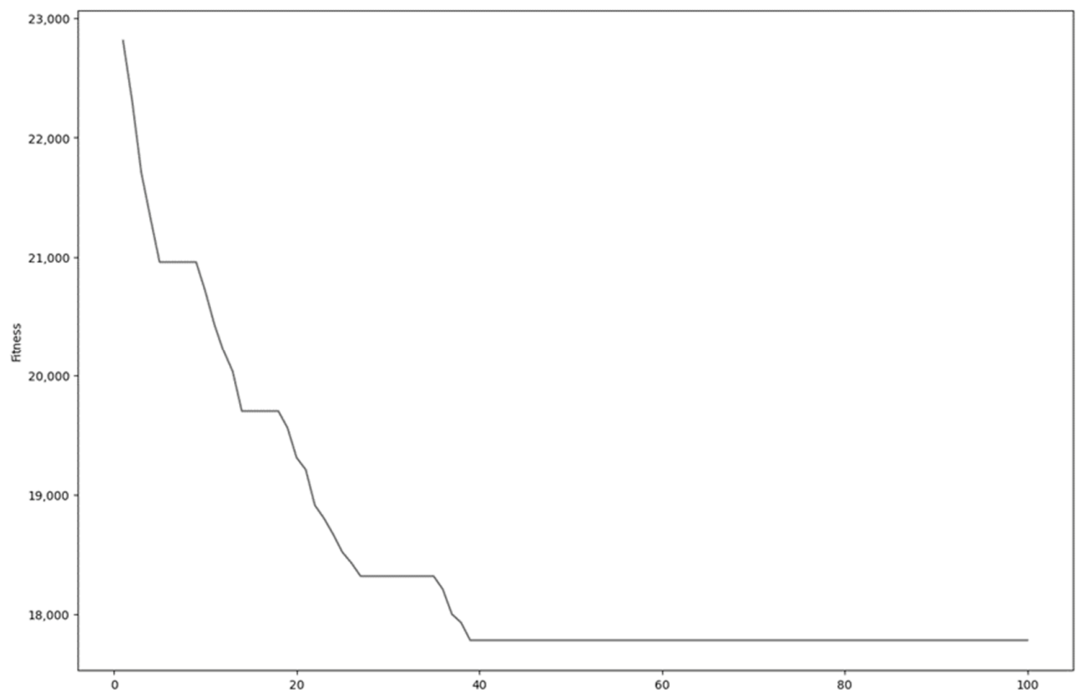
Python 3.7.4 is used to pre-design the genetic algorithm and to calculate the optimal iteration of the population as shown in
Figure 2 below.
5.2.1. Storage and Replenishment Strategies
As shown in
Figure 2, when the algorithm iterates 39 times, the value of the objective function’s value becomes the optimal value, and the inventory strategy
of the central warehouse
is calculated, as shown in
Table 4 below:
The replenishment cycle and quantity of different products in different pre-positioned warehouses are obtained by each pre-positioned warehouse after considering the daily demand of various products and balancing multiple factors such as the spoilage cost, maintenance cost, and transportation cost of different products.
Table 3 shows that the average replenishment cycle of products in the ambient temperature zone is 4.5 days at most. For products in the ambient temperature zone, the market has a smaller average demand every day, and their spoilage rate is low, so their spoilage cost and maintenance costs are low too. Therefore, prolonging the replenishment cycle and raising vehicle loading capacity can cut delivery frequencies, reduce transportation costs and achieve the minimum total cost. Specifically, the average replenishment cycle of refrigerated products is no less than 2.3 days. For those products, the market has a larger daily demand and different pre-positioned warehouses have no differences. A replenishment cycle of two to three days can ensure a certain vehicle loading which helps control the transportation cost. In addition, since products in this zone have a higher spoilage rate, appropriately shortening the replenishment cycle can avoid excessive spoilage costs and achieve the optimal total cost. The average replenishment cycle of products in the frozen zone is 2.8 days, which is close to that of products in the refrigeration zone. Products in such zones require higher unit maintenance cost, which needs to be controlled by shortening the replenishment cycle. The market has larger demand for most products in the frozen zone at the pre-positioned warehouses, so the two-day replenishment cycle can promise a certain vehicle loading. If the demand for the same pre-positioned warehouses is small, the replenishment cycle can be appropriately extended and delivered together to reduce the number of deliveries and control the transportation cost for the optimal total cost.
5.2.2. Distribution Strategy
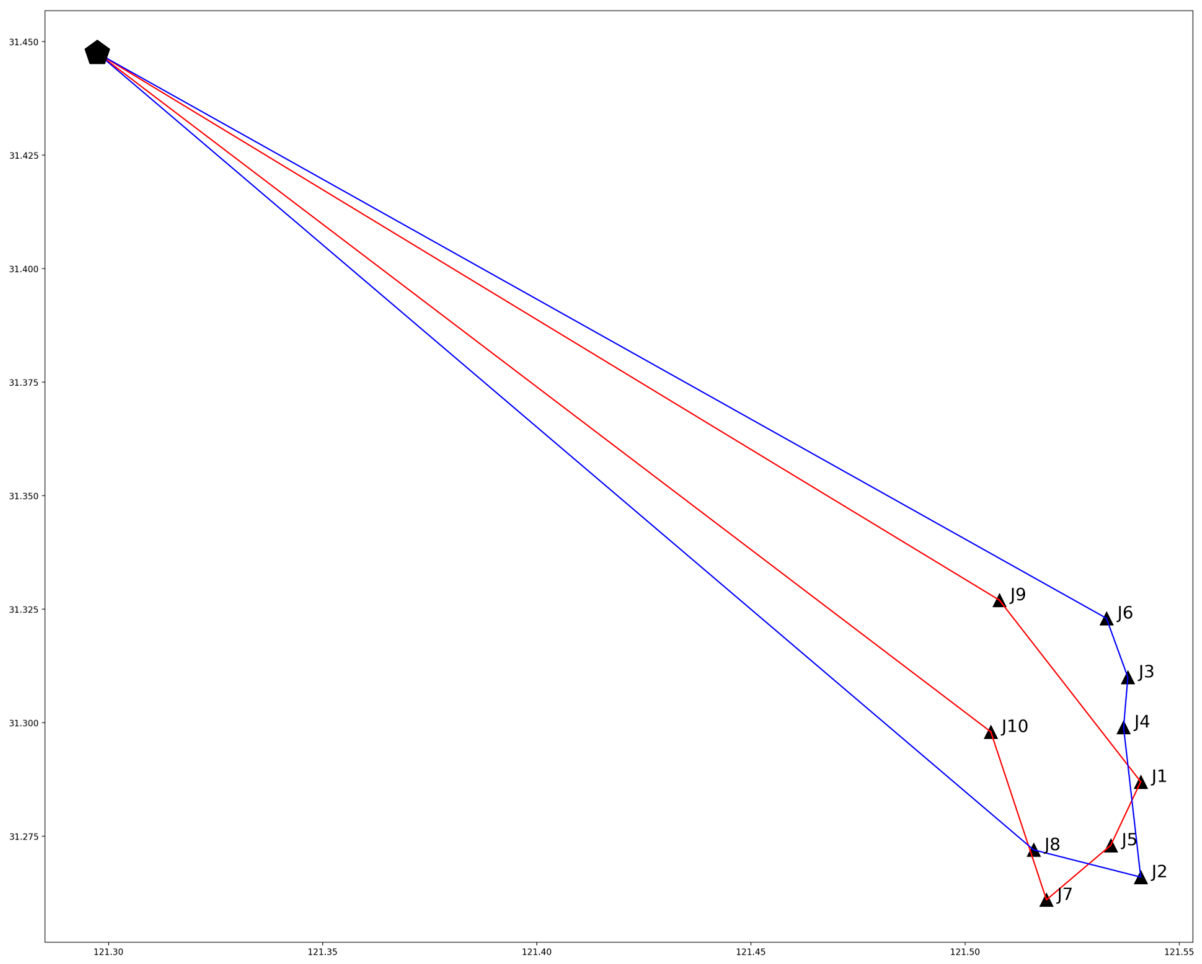
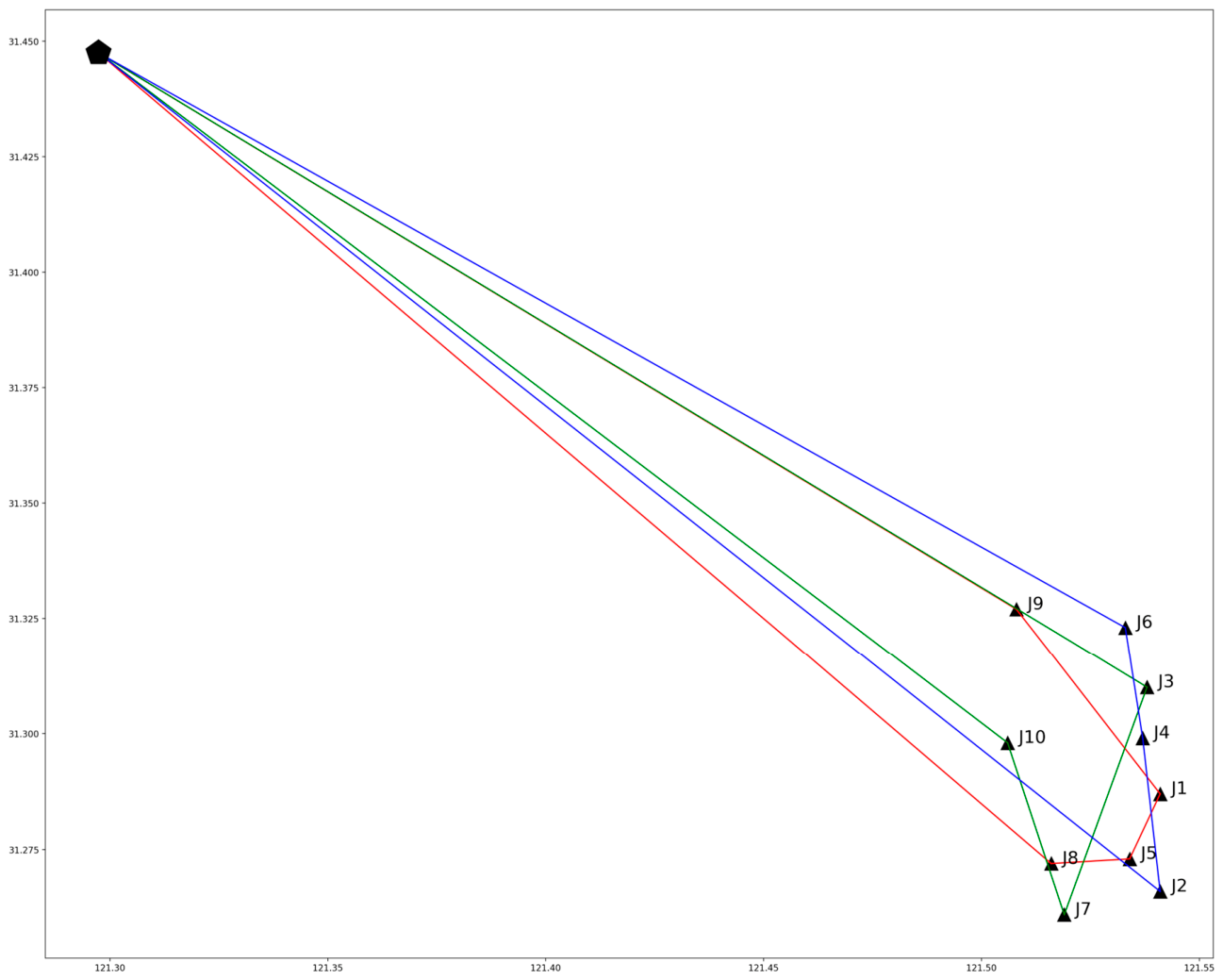
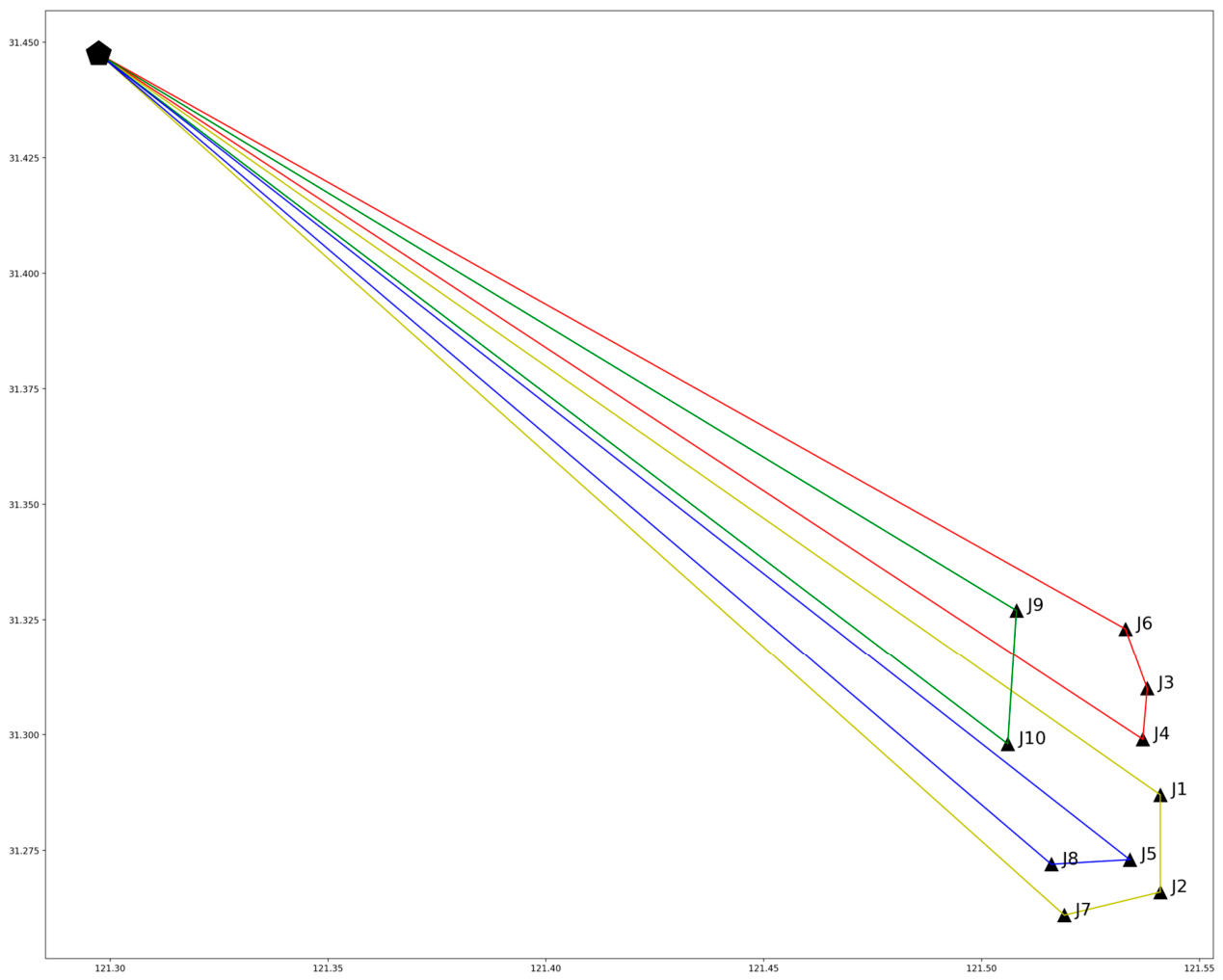
According to the replenishment cycle and quantity of the pre-positioned warehouse, the distribution path of the central warehouse to the pre-positioned warehouse is optimized to obtain the path strategy, as shown in
Table 5 and
Figure 3,
Figure 4 and
Figure 5:
For the vehicle-arrangement and distribution-path planning of different products in different pre-positioned warehouses, it is necessary to combine the replenishment cycle and quantity of different products in different pre-positioned warehouses, as well as the specific location of pre-positioned warehouses and vehicle loading restrictions to maximize the utilization of vehicles, minimize the number of deliveries and make the path most reasonable.
It can be seen from
Table 5 and
Figure 3 that, for products in the ambient temperature zone, the cycle of the pre-positioned warehouse
is three days, and the cycle of the pre-positioned warehouse
is six days, and their replenishment is 2981 kg and 2878 kg, respectively, which are less than the maximum load capacity of the vehicles transporting product in ambient temperature zones. Therefore, only one vehicle is required from the central warehouse for replenishment, and the loading rate is 95.53% and 92.47%, respectively. The specific distribution routes of the two deliveries are not staggered, and the distribution to pre-positioned warehouses in the same cycle has no round-trip, so the route is reasonable.
As shown in
Table 5 and
Figure 4, for the products in the refrigerated zone, the total replenishment quantity of the pre-positioned warehouses with a replenishment cycle of two days is 4515 kg. At least two vehicles are required to be sent from the central warehouse. To reduce the number of deliveries and control the transportation cost, two deliveries are respectively arranged to the four pre-positioned warehouses
with the least replenishment quantity and the pre-positioned warehouses with more replenishment quantity. The total replenishment quantities are 2490 kg and 2025 kg, respectively, which meets the maximum load capacity of the vehicles transporting refrigerated products. The pre-positioned warehouse
has the same cycle of three days, and the total replenishment quantity is 2387 kg, which meets the maximum load capacity of the vehicles transporting refrigerated products. Therefore, to reduce the number of deliveries, only one vehicle needs to be sent from the central warehouse for replenishment. As shown in
Figure 4, the three delivery routes of the refrigerated products are not staggered and require no round-trip, so the routes are reasonable.
As shown in
Table 5 and
Figure 5, for the products in the frozen zone, the total replenishment quantities of the pre-positioned warehouse with a cycle of two days and four days are 3752 kg and 3623 kg, respectively, which requires at least two deliveries. As shown in
Figure 5, with the same cycle of two days, the pre-positioned warehouses
are concentrated and the pre-positioned warehouses
are concentrated. The total replenishment quantities are 1942 kg and 1810 kg, respectively, which meet the maximum load capacity of the vehicles transporting frozen products. Therefore, they are divided into two groups that are replenished in two deliveries. Similarly, with the same cycle of four days, the pre-positioned warehouses
are concentrated and the pre-positioned warehouses
are concentrated, and the total replenishment quantities are 1867 kg and 1756 kg, respectively, which meet the maximum load capacity of vehicles transporting frozen products, and hence they are divided into two groups for two deliveries.
5.3. Inventory Strategy in the Central Warehouse Stage
After confirming the distribution strategy of the pre-positioned warehouse, the central warehouse makes replenishment according to such strategy. The central warehouse replenishes the goods by type, and the replenishment cycle of a certain product in the central warehouse is a common multiple of the distribution cycle of each pre-positioned warehouse. Then the purchase strategies of the central warehouse
for different products
are shown in the following
Table 6:
According to
Table 6, the purchase cycle of products in the ambient temperature zone is 18 days, and their single purchase volume is 26,238 kg. The purchase cycle of products in the refrigerated zone and the frozen zone is the minimum common multiple of the distribution cycle of their respective pre-positioned warehouses, which is 6 days and 4 days, respectively. Their single purchase volumes are 18,819 kg and 10,873 kg, respectively. Similarly, the central warehouse determines the purchase cycle and quantity by balancing the holding, spoilage, and transportation costs. The higher the daily average demand, the shorter the product purchase cycle with higher holding costs. The products
are products in the ambient temperature zone, with low spoilage rates, low maintenance costs, and smaller demand, so they need a long purchase cycle. But the products
and products
are those in the refrigerated area and frozen area, with high spoilage rates, high maintenance costs and larger demand, so they require a short purchase cycle.
5.4. Sensitivity Analysis
During the replenishment of fresh-product from the central warehouse to the pre-positioned warehouse, variations in initial freshness exert an important impact on the inventory system optimization. Investment in freshness preservation significantly affects product freshness levels and spoilage rate, thereby directly influencing overall profits. Accordingly, this section conducts a sensitivity analysis on initial product freshness and the freshness preservation investment cost.
5.4.1. Sensitivity Analysis of the Initial Freshness
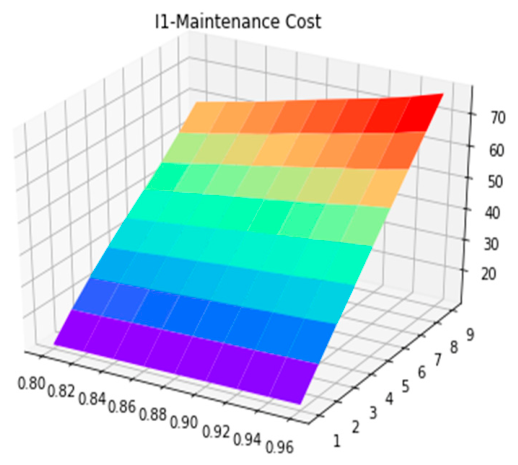
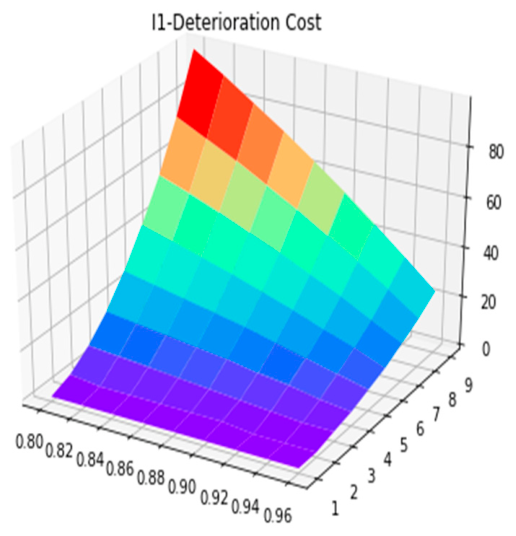
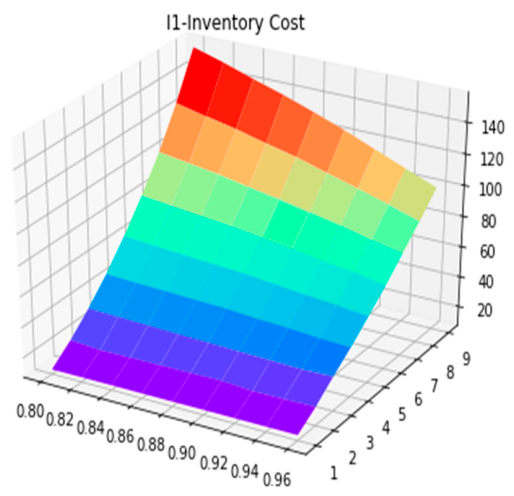
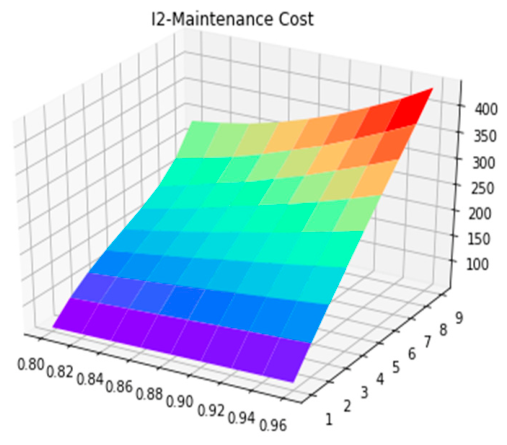
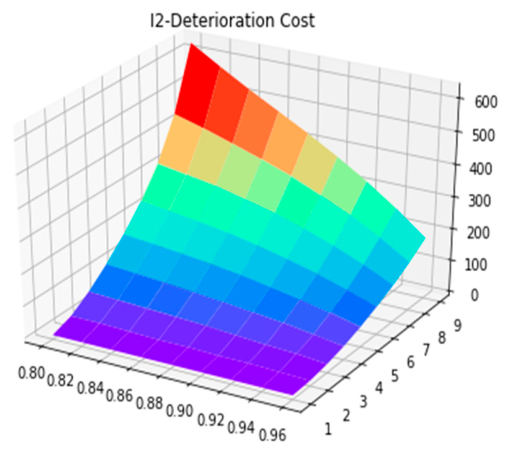
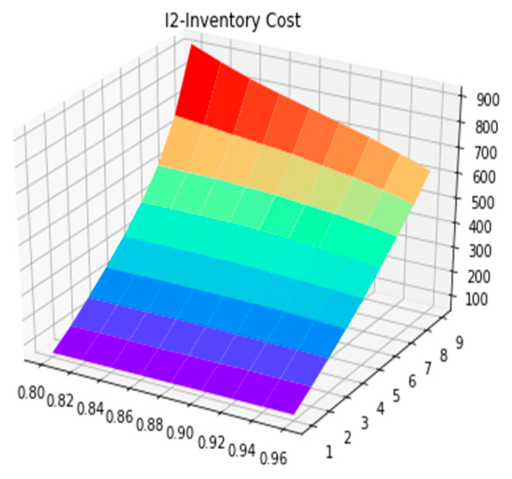
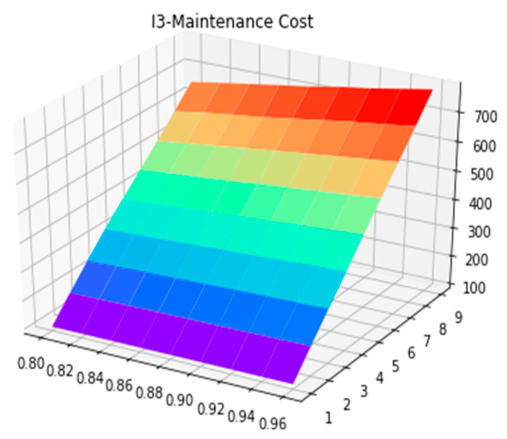
In a bid to further analyze the impact of the changing freshness on the maintenance cost and spoilage cost of the pre-positioned warehouse, the volatility per unit is 0.02, and the pre-positioned warehouse
is the example to analyze the maintenance cost and spoilage cost of the three types of products with a freshness
, as well as the sum of the two costs, as shown in
Figure 6,
Figure 7,
Figure 8,
Figure 9,
Figure 10,
Figure 11,
Figure 12,
Figure 13 and
Figure 14:
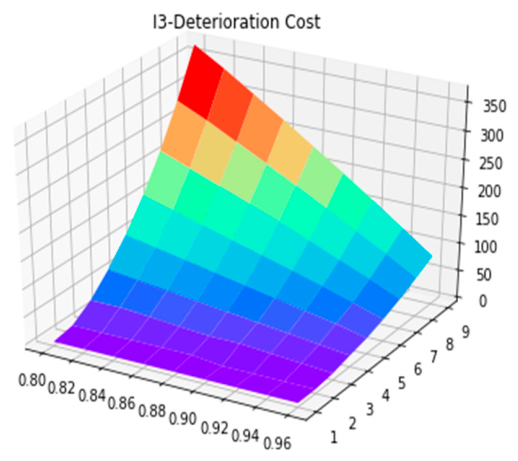
As for the impact of initial freshness on the cost of carry, it can be concluded from
Figure 6,
Figure 9 and
Figure 12 that, first of all, a longer replenishment cycle means a higher inventory cost and cost of carry for any product. With the same replenishment cycle, a higher initial freshness results in a higher cost of carry because the market has greater demands for highly fresh products, thus requiring more replenishment, which leads to a higher cost of carry. In addition, as the replenishment cycle increases, the cost of carry will become increasingly different among the three products with different initial freshness, with refrigerated products having the largest difference. This indicates that the products which are easily spoiled need higher initial freshness. Along with
Figure 10, it can also be found that the spoilage cost of refrigerated products is most affected by the initial freshness if the factors of their own price and quantity are excluded.
Regarding the impact of initial freshness on the cost of spoilage is concerned, based on
Figure 7,
Figure 10 and
Figure 13, firstly, a longer cycle means higher spoilage cost for any product. In the same replenishment cycle, a lower initial freshness will lead to higher spoilage cost. In addition, as the replenishment cycle increases, the spoilage cost will become increasingly different among the three products with different initial freshness, and there are significant differences in multiples. It can be concluded that the initial freshness is critical to the duration of freshness preservation and spoilage.
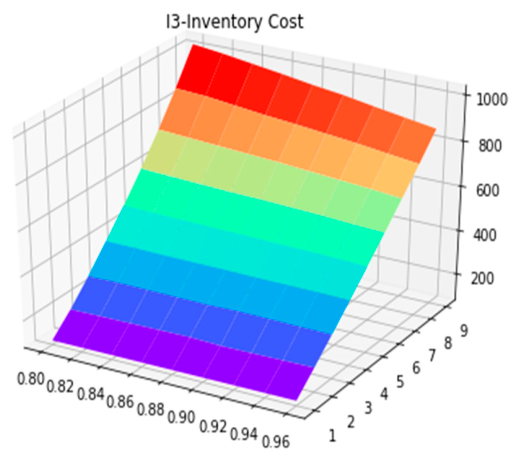
In terms of the impact of initial freshness on the cost of inventory,
Figure 8,
Figure 11 and
Figure 14 show that, first of all, the inventory cost of any product will increase with the extension of the replenishment cycle. In the same replenishment cycle, the lower initial freshness will cause a higher inventory cost. In addition, as the replenishment cycle increases, the inventory cost will become increasingly different among the three products with different initial freshness, with refrigerated zone having the largest difference due to its higher spoilage rate. In summary, the initial freshness has a greater impact on the inventory cost, especially for those perishable products and as the replenishment cycle increases. This echoes the fact that the good in the refrigerated zone has the shortest optimal replenishment cycle. Therefore, for fresh e-commerce enterprises, purchasing the freshest products can not only help increase demand but also help reduce operating costs—which is crucial to long-term development.
5.4.2. Sensitivity Analysis on Preservation Investment Cost
To further analyze the impact of the changing preservation investment cost on the maintenance cost and spoilage cost of the pre-positioned warehouse, the preservation investment cost
of three products is analyzed on the example of pre-positioned warehouse
. It is assumed that the preservation investment costs of the three products are 0.3, 0.8, and 1.2 respectively, which may fluctuate in practice. We set the value range for the three products:
,
and
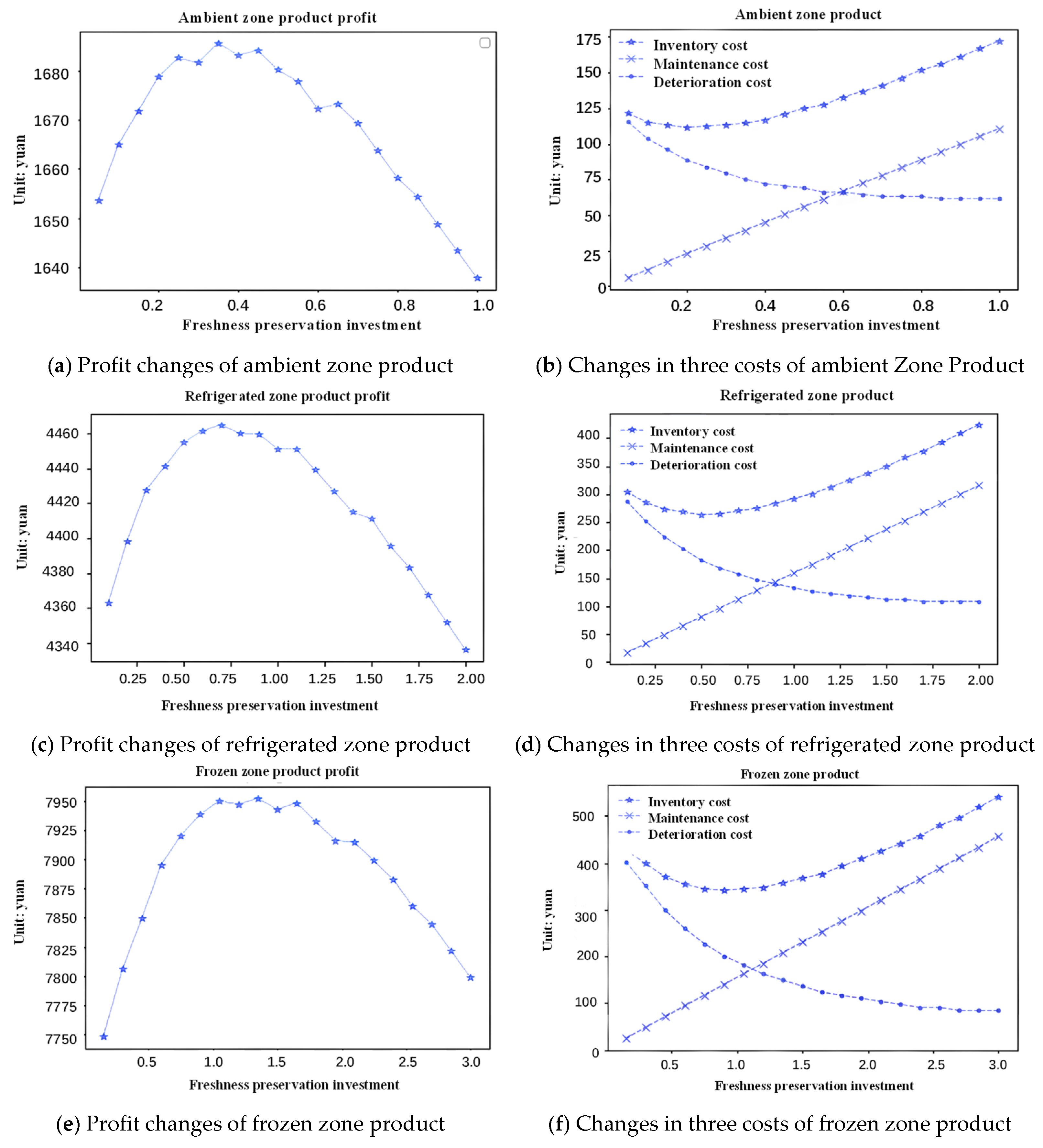
. Assuming that the replenishment cycle is 2 days, the maintenance cost, spoilage cost, inventory cost, and profit of the three products are analyzed, respectively. The product profit excludes the cost of transportation for replenishment, operating cost, etc., and only includes the difference between product sales and maintenance cost and spoilage cost, as shown in
Figure 15.
It can be seen that, for any product, the overall profit first increases and then decreases with the rise in preservation investment due to changes in the corresponding cost components. As the preservation investment increases, spoilage cost declines rapidly, resulting in lower inventory cost and higher profit. However, with a continuous rise in preservation investment, spoilage cost stabilizes while preservation cost keeps increasing, causing inventory cost to rise and profit to decline. Moreover, comparing the profit change chart and the product cost change chart can indicate that the preservation investment at the optimal profit is different from that at the lowest inventory cost. With the increase in preservation investment, the spoilage rate is reduced and the products are kept fresh, which improves the actual demand to a certain extent. Therefore, the optimal preservation investment with higher profit is larger than that with lower inventory cost.
Secondly, we set a unified value range
for the three products
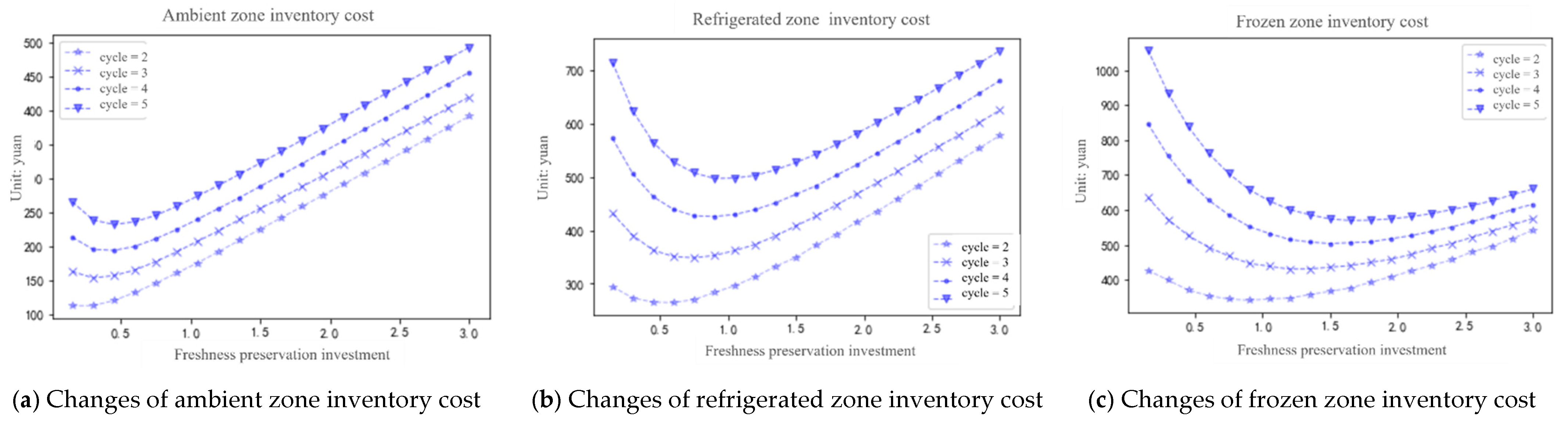
and calculated the impact of fluctuating preservation investment cost on inventory cost under different replenishment cycles, as shown in
Figure 16.
For any kind of product, the preservation investment varies with the different replenishment cycles. A longer replenishment cycle requires more preservation investment because a lengthy replenishment cycle will cause a higher spoilage rate, but more preservation investment can keep the freshness to a certain extent and slow down the spoilage rate, thus reducing the inventory cost. In addition, as preservation investment increases, the gap between the inventory cost of frozen products in different replenishment cycles gradually shrinks, which reveals the significance of preservation investment for frozen products. For example, excluding other factors, frozen products, such as frozen meat, can be kept for a long time.
6. Managerial Insights
(1) In the actual practices of fresh-product e-commerce companies, the refined management of different product zones by categories helps produce the relative optimal solution for each product. Different fresh products have different replenishment cycles and quantities. It is necessary for those companies to consider product diversity, set separate zones for fresh product, and formulate different warehousing and distribution strategies. For instance, products in the ambient temperature zone have a lower spoilage rate, so their replenishment cycle can be appropriately longer, and the goods should be less frequently distributed from the pre-positioned warehouse to the central warehouse. Although the deterioration rate of products in the frozen zones has a higher spoilage rate, each pre-positioned warehouse has similar demands, so the replenishment cycle can also be appropriately extended for large-capacity distribution. However, the spoilage rate is high for the products in the refrigerated area, and each pre-positioned warehouse has different demands. Hence, more frequent distribution in the warehousing and distribution strategy is required. Therefore, when investing in freshness preservation, companies not only consider the product types, but also the replenishment cycle of different products. Proper preservation investment can significantly lower costs and increase profits. Companies can appropriately increase preservation investment to extend the replenishment cycle, reduce transportation costs and improve profits while reasonably controlling inventory costs, especially for frozen products.
(2) For fresh-product e-commerce companies, initial freshness plays an extremely important role. When selecting products in the pre-positioned warehouse, companies should pay more attention to the initial freshness, which can drive demand, reduce operating costs and promote long-term development. That is especially significant for perishable products such as vegetables and dairy products which are stored in ambient temperature zones and refrigerated zones. According to the sensitivity analysis in
Section 5.4, the initial freshness has a significant impact on various costs, particularly on the spoilage cost of refrigerated products, so it is necessary to consider the initial freshness of refrigerated products during the product selection in the pre-positioned warehouse. In addition, because of different initial freshness, the cost of carry for refrigerated products varies greatly. It is better to purchase them in small batches for the sake of management [
32].
(3) In actual practice, the joint decision of inventory and distribution plays an important role in the operation of fresh-product e-commerce companies. From the supply chain perspective, warehousing and distribution are negatively correlated. The integrated joint decision of warehousing and distribution contributes to balancing the total cost inside the system, creating the optimal cost, and promoting healthy development.
7. Conclusions
Starting with practical optimization, this paper puts forwards a two-stage warehousing and distribution model for the central warehouse and pre-positioned warehouse on the basis of the inventory maintenance cost, spoilage cost, and transportation cost. In addition, this paper considers different product warehousing and distribution strategies from the perspective of the ambient temperature zone, refrigerated zone, and frozen zone. For different products and transportation modes, the model can calculate the appropriate replenishment cycle, replenishment quantity, and replenishment path strategy from the central warehouse to the pre-positioned warehouse, as well as the purchase cycle and purchase quantity by the central warehouse so as to reduce the inventory and transportation costs of the pre-positioned warehouse and the central warehouse as much as possible. Moreover, this model uses the two-stage programming model of the pre-positioned warehouse and central warehouse and concludes satisfactory results. Compared with the current research on either inventory at the pre-positioned warehouse or the optimization of a single product, this model has certain theoretical significance and can be widely applied.
This paper researches the warehousing and distribution strategy of the central warehouse and pre-positioned warehouse considering product diversity. First, we classify fresh products into those stored in the ambient temperature zone, refrigerated zone, and frozen area in the inventory and distribution integration according to their temperature sensitivity. Based on this, we propose a two-stage programming model that can calculate the appropriate replenishment cycle, replenishment quantity, and replenishment path strategy from the central warehouse to the pre-positioned warehouses, as well as the purchase cycle and purchase quantity by the central warehouse after taking into account different products and their transportation modes. The objective function of the model is to minimize inventory maintenance costs, spoilage costs, and transportation costs. Applying this model to practical cases, we can conclude the warehousing and distribution strategies of the central warehouse and the pre-positioned warehouse for different products and different requirements. It is more theoretically significant and wider and widely used than the single consideration of either inventory at the pre-positioned warehouse or the optimization of a single product. In addition, there is some advice for management. For example, companies should seek refined management measures—refined replenishment by product diversity and preservation investment; the initial freshness should be considered when selecting products in the pre-positioned warehouse. These can help fresh-product e-commerce companies operate better and reduce the inventory cost and transportation costs at the pre-positioned warehouse and central warehouse.
This study still has certain limitations. First, this paper assumes that all attribute parameters of the same fresh products in different pre-positioned warehouses are consistent, ignoring differences in product deterioration rates caused by warehouse locations and regional climates. The parameter settings are relatively idealized, and specific parameter values are mainly selected based on existing literature. Second, when constructing the objective functions of procurement and inventory costs, only the basic cost components involved in routine operations are considered. Handling costs arising from other changes, such as emergency and risk costs, are not taken into account. Loading/unloading costs, variable transportation costs, and product spoilage during transit are also neglected, leading to a simplified cost system. Third, the demand settings in this study mainly include deterministic and simple stochastic demand. Meanwhile, demand is assumed to follow a normal distribution and be independent, without considering demand correlation or non-normal characteristics. Dynamic demand characteristics related to consumer preferences and seasonal factors are also ignored, further simplifying the actual market situation. Fourth, since the focus of the case analysis is to demonstrate the effectiveness of model construction and results, only benchmark parameter values are used for model solving, and a basic genetic algorithm is adopted without considering algorithm efficiency. Although the influence of changes in some key parameters is discussed in the sensitivity analysis, the discussion is not comprehensive.
In future research, we will collect more real industry data to refine parameter ranges, further explore the influencing factors and value ranges of differentiated parameters, and incorporate practical factors such as non-normal correlated demand, in-transit spoilage, loading/unloading costs, and variable transportation costs, so as to conduct analyses that are more consistent with reality. In addition, more efficient solution algorithms tailored to the model characteristics will be developed.