Article

Magnetohydrodynamic Heat Transfer and Entropy Generation in a Ternary Hybrid Nanofluid Flow Through a T-Shaped Bifurcating Channel with Rotating Cylinder and Vibrating Wavy Wall


by
Bader Saad Alshammari
1,
Ali M. Alhartomi
2 and
Ahmad Ayyad Alharbi
1,*
1
Department of Mathematics, College of Science, Northern Border University, Arar 73222, Saudi Arabia
2
Department of Mathematics, Al-Leith University College, Umm Al-Qura University, Makkah 24382, Saudi Arabia
*
Author to whom correspondence should be addressed.
Mathematics 2026, 14(11), 1931; https://doi.org/10.3390/math14111931
Submission received: 2 April 2026 / Revised: 7 May 2026 / Accepted: 14 May 2026 / Published: 2 June 2026

Abstract

A numerical investigation of forced convection heat transfer in a three-dimensional T-shaped bifurcating channel with an upstream rotating cylinder and a downstream vibrating wavy wall is presented. The working fluid is a ternary hybrid nanofluid (Fe2O3, CuO, MoS2 in water) exhibiting Casson rheology under an inclined magnetic field. The novelty of this work lies in the first integrated configuration combining these simultaneous mechanical, magnetic, and non-Newtonian effects. Using COMSOL Multiphysics, 413 parametric combinations of Reynolds number, Hartmann number, Casson parameter, nanoparticle shape and volume fraction, magnetic field angle, cylinder rotation speed, wall amplitude (Am), and period were solved. Average Nusselt and Bejan numbers quantified heat transfer enhancement and thermodynamic irreversibility. To interpret the high-dimensional parameter space and to circumvent the prohibitive computational cost of additional 3D magnetohydrodynamics simulations, machine learning (XGBoost) models were developed to rank feature importance and provide fast, accurate surrogate predictions (R2 > 0.99). Cylinder rotation dominates heat transfer, increasing the Nusselt number by over 980% (feature importance 0.42) with a modest entropy penalty. Nanoparticle volume fraction reduces the Nusselt number via viscous damping. Magnetic field parameters negligibly affect heat transfer but strongly influence entropy generation; a perpendicular field recovers up to 97% thermal efficiency at high Hartmann numbers.

1. Introduction

Much of the available research has focused on bifurcated microchannel systems as they possess greater heat transfer (HT) efficiency, provide optimal flow distribution, and minimize thermal resistance, making them applicable in a variety of different applications such as cooling high-performance electronics, biomedical devices, renewable energy systems, and all types of convective heat transfer. Additionally, studies such as these demonstrate that geometrically optimized bifurcating configurations can improve convective HT and that using nanofluids (NFs) can further enhance convective HT within branching networks. Wu et al. [1] presented a tree-shaped cooling channel with four levels of branches of specified dimensions at each level. Their investigation into the impact of various flow rates on (HT) characteristics and pressure drop showed that this configuration is capable of effectively cooling chips, with surface temperatures remaining within safe operating limits across a range of applied heat fluxes.
In the context of thermal regulation applications, particularly those involving electronics cooling, biomedical systems, and micro-scale reactors, the use of magnetic fields (Mag-F) has been shown to enhance convective HT within bifurcating channel configurations [2,3,4,5,6].
In the realm of convective HT, fluid movement is influenced by magnetic fields applied through various methods, including semi-active, homogeneous, and non-homogeneous/mechanical means [7,8,9,10,11]. The effectiveness of magnetic interventions can be enhanced when nanofluids (NF) are utilized [12,13,14,15]. There is extensive research on the effects of casing geometry in relation to the magnetic field in convective heating applications [16,17,18,19]. Significant research has also been conducted on how bifurcated channel shape, flow pulsation, magnetic forces, and nanoparticle additives contribute to both HT performance and flow uniformity. Selimefendigil and Öztop [20] investigated the effect of magnetic fields on convective HT in a bifurcated channel utilizing an L-shaped conductive element. Their study found that the micro-magnetic field eliminates separation zones and improves overall HT on both channel walls, though wall flexibility moderately reduces the average Nusselt number. However, the results also showed that wall flexibility decreased in the average Nusselt number (Nu). This study demonstrates how combining structural bifurcation with magnetic field effects offers an efficient way of controlling thermal energy loss. In another study conducted by Selimefendigil et al. [21], the effects of nanofluid flow past multiple rotating circular cylinders (RCCs) inside an enclosure exposed to a magnetic field were examined using the finite element method (FEM) to model the interactions between fluid and structure, and between magnetoconvection and finned enclosures with both inlet and outlet. The RCCs were placed internally, and the lateral surfaces were treated as flexible, deformable surfaces. When compared against the results of parametric CFD simulations, the optimized configuration exhibited a notable increase in thermal performance under optimized parameter settings.
The examination carried out by Abdullahi et al. [22] reviewed the effects of an inclined magnetic field on flow behavior and thermal enhancement in bifurcating flow channels through experimentation. Chakrabarty and Paily [23] also investigated the navigation to a designated outlet for magnetic microparticles moved through a Y-shaped channel using an applied magnetic field. Their findings concluded that a time-dependent magnetic field can achieve precise navigation at a time ratio of 3 to 1. Hossain et al. [24] used a computational model with flexible walls to conduct a thermal and hemodynamic analysis in a branching vessel. Their study found that the magnetic field of a current-carrying wire could divert the peak local velocity toward a compliant vessel wall. It has also been studied whether a rotating circular cylinder in a magnetic field will work in straight and bifurcated channel geometries [25,26,27]. Some of the key parameters evaluated were the rotational speed of the cylinder, the cylinder size, and the positioning of the cylinder to control the formation of vortices and improve cooling performance [28,29]. Overall, these studies show that the bifurcation of channels provides a large improvement in convective HT if combined with advanced coolants, pulsating flow conditions, and magnetically or rotationally actuated elements.
The use of ANNs for predicting and enhancing convective HT in bifurcating channel systems has been increasing over time, showing promise in evaluating the performance of a large number of energy systems. The application of ANNs has been made possible in various thermal management systems, such as TEGs (thermoelectric generators), battery temperature control systems, and PV (photovoltaic) cooling systems. In the study completed by Meng et al. [30], the authors used both lateral and bottom cooling techniques in conjunction with an ANN to improve the thermal management systems of batteries (BTMS). The authors developed a surrogate model using a neural network for the refinement of design variables such as flow distribution and microchannel width, incorporating a multi-objective evolutionary algorithm. Results indicated a significant reduction in battery temperatures and pump energy consumption, confirming that artificial neural networks (ANNs) can manage the flow patterns and HT by convection in bifurcations where energy is being stored. Khalid et al. [31] used ANNs with CFD (computational fluid dynamics) to investigate the behavior of hybrid nanofluids in both T-shaped and Y-shaped bifurcated geometries and used the networks to determine the flow characteristics in both geometries. Moreover, a novel branched micro-heat pipe configuration for improved thermal regulation was proposed by Bakhirathan and Lachireddi [32], where ANN was effectively used to predict thermal performance outcomes. To further advance cooling strategies in bifurcating channels and enhance the durability of thermal systems, it is essential to extend the application of ANNs toward hybrid cooling architectures and real-time adaptive control frameworks.
Nanoparticle aggregation leads to the breakdown of uniform dispersion [33], changes in thermal conduction pathways, and variations in physical characteristics, which can be influenced by surface modifications and dispersion control measures, factors that affect modeling accuracy. A 2022 Physics Reports review [34] examined the mechanisms governing nanofluid stability, including Brownian motion, thermophoresis, van der Waals forces, and electrostatic double-layer forces, and documented how agglomeration and non-uniform nanoparticle distributions substantially influence effective thermophysical properties. A critical review published in 2023 [35] addressing particle migration concluded that concentration non-uniformities result in changes to local property distributions, warranting further investigation in this area. Finally, a 2025 study [36] on trihybrid nanofluids demonstrated that thermophoretic deposition driven by temperature gradients leads to spatially non-uniform particle accumulation, which directly affects local HT rates and species concentration fields.
Current Research Gap and Novelty: Bifurcated channels, magnetic fields, nanofluids, and rotating cylinders have all been studied separately. However, their integration has not yet been examined. Previous work has not addressed issues surrounding entropy generation in dynamically coupled MHD systems under simultaneous conditions of rotation, vibration, and the use of non-Newtonian ternary hybrid nanofluids or the application of machine learning for the purpose of quantifying the effect of different parameters on this type of system. First to develop a single integrated rotating cylindrical, vibrating, wavy-walled, inclined shape bifurcating channel with application of a ternary hybrid (Fe2O3–CuO–MoS2/water) nanofluid under the influence of combined mechanical, magnetic, and rheological effects. Entropy analysis will be conducted to quantify the thermal, viscous, and MHD irreversibilities and trade-offs. A new interaction between vortex shedding due to cylinder rotation and wall vibration will be discovered. Machine learning (XGBoost) will rank the importance of the different feature parameters and serve to provide surrogate predictions. Highly reliable machine learning models (XGBoost) were created to predict system performance with R2 values greater than 0.99 and to identify which design variables have the greatest impact on system performance. Given the substantial computational expense of high-fidelity 3D MHD simulations (approximately 45–60 min per case), ML surrogates offer a practical means of rapidly exploring the design space and quantifying parameter importance without further CFD runs.

2. Methodology

In this segment, we detail the three-dimensional T-shaped channel, including its geometry, boundaries, shape, the hybrid nanofluid’s thermo-mechanical properties, governing conservation equations, COMSOL Multiphysics numerical solution configuration, and machine learning framework for surrogate and parametric analyses.

2.1. Geometry, Boundaries, and Material Description

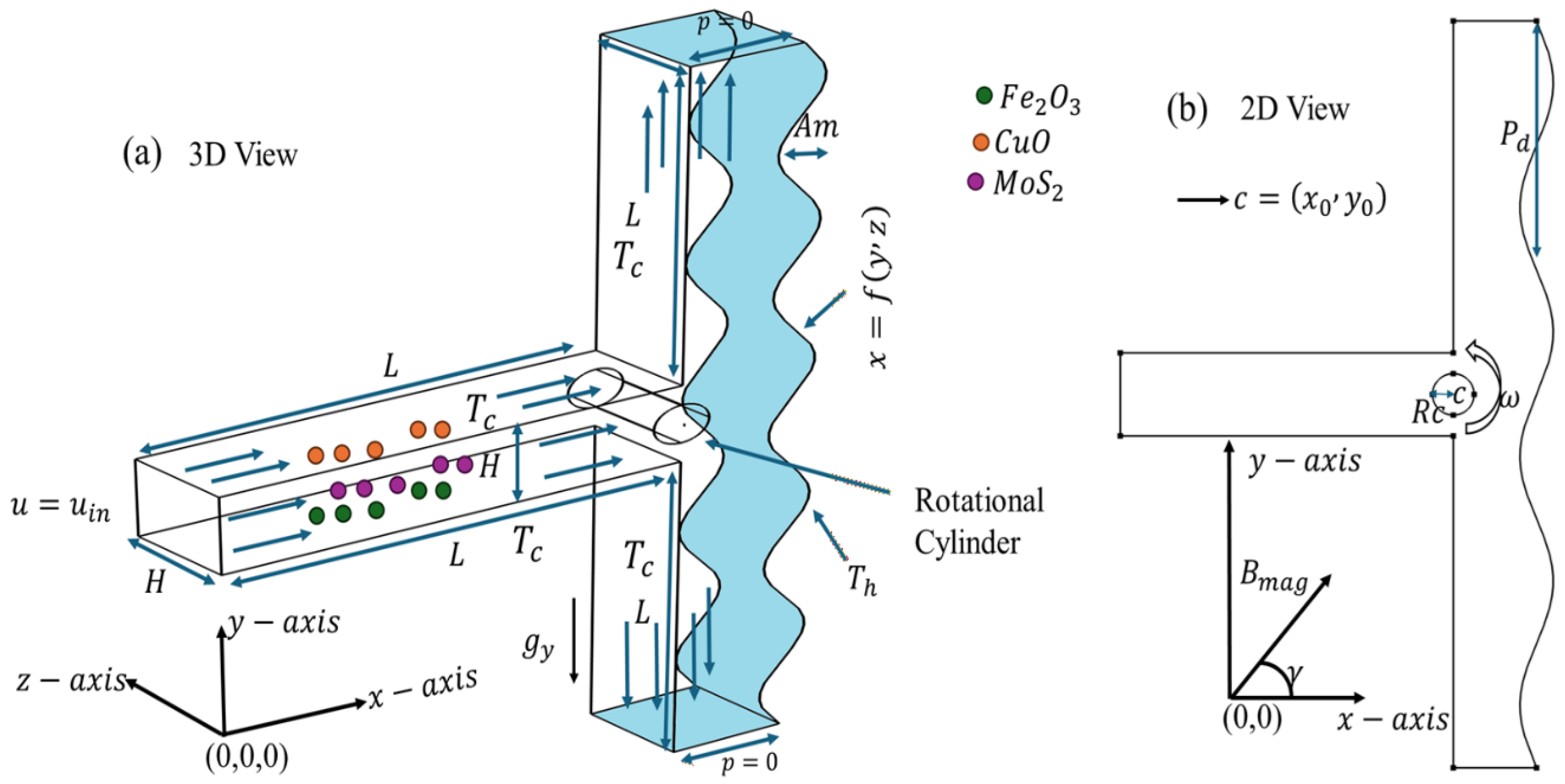
In the current study, we analyze the flow conditions of the fluid flowing in a three-dimensional T-shaped bifurcating channel set up for thermal management (i.e., electronic component (chip) cooling or a heat exchanger). The channel geometry shown in Figure 1a is outlined in the schematic; a single fluid enters at the main branch of the channel (width = H, length = L), then flows into either of two perpendicular exits from the main branch.
The channel’s overall performance as a cooling medium is established using a eutectic, ternary-nanofluid cooling medium comprising Fe2O3, CuO, and MoS2 NPs. The channel has fixed boundary conditions with the channel walls held at a cold temperature of 25 °C and the channel’s wavy walls oscillating (using an oscillation equation) as a function of an amplitude (Am) and a period ( P d ) to create a thermal-noise perturbation to the thermal boundary layer that is susceptible to HT. The channel’s geometrical constraints are outlined in Table 1a,b. The coordinate system is oriented such that the x a x i s points along the main channel flow direction, the y a x i s is vertical (with gravity acting in the negative y -direction), and the z a x i s spans the channel width. The origin (0, 0, 0) is placed at the center of the inlet cross-section. The channel walls are treated as zero-thickness surfaces; therefore, wall thickness is not modeled. H = 1 m and L = 4H; Dh is equal to the channel width and is recognized as the characteristic length [37].
To further enhance the flow manipulation of the wavy wall, a rotating cylinder will be placed upstream of the wall. The cylinder has a fixed radius ( R c = 0.25 H ) and is centered at ( x 0 , y o ) . The cylinder rotates at an angular velocity ( ω ) from 0 to π/2 rad/s, or approximately 15 rev/min. The rotation of the cylinder creates swirl and mixing in the non-Newtonian Casson fluid, where B (Casson nanofluid parameter) varies from 1 to 50. The combination of the rotating cylinder and vibrating wall produces a complex, time-dependent flow field due to the interaction of the two. The flow of the Casson fluid is not stagnant as long as the rotating cylinder and vibrating wall are in motion, resulting in an increase in the convective HT coefficients.
Additionally, the influence of electromagnetic forces is incorporated by the application of a magnetic field ( B m a g ) at an attack angle ( γ ) between 0 and π/2 in the x-y plane. As γ varies between 0 and π/2, the effect of the Lorentz force on the ternary hybrid nanofluid is examined. The strength of this interaction is quantified by the Hartmann number Ha, which ranges from 1 to 20, while the overall flow intensity is governed by the Reynolds number Re, spanning from 100 to 1000, see Table 1b.
The Casson constitutive model is used to characterize the non-Newtonian behavior of the ternary hybrid nanofluid, as it accounts for yield stress and shear-thinning behavior under combined magnetic, rotational, and vibrational effects [38,39]. Details of the model selection rationale are provided in Appendix A.
Table 1. (a) Geometric dimensions of the T-shaped bifurcating channel. (b) Operational parameters and boundary conditions.
(a)
Expressions/SymbolsDescription
H = 1 (m)Constant Width of a three-dimensional T-shaped channel
L = 4 H A constant length of a three-dimensional T-shaped channel.
D h = H Characteristic Length
R c = 0.25HFixed radius of rotational cylinder [26,37,40]
x 0 = L + H / 2 + 2 R c x-coordinate of the centre
y 0 = ( 2 L + H ) / 2 y-coordinate of the centre of the moving circle
A m = 0.1–0.3 (m)Amplitude of wavy wall with the specification of parametric variation [37,41]
P d = 1–13Periods of vibration of the wavy wall
(b)
Expressions/SymbolsDescription
Re = 100–1000Reynolds number [42]
ω = 0 ,   π / 18 ,   π / 6 ,   π / 4 ,   π / 3 ,   π / 2 (rad/s)Angular velocity of a rotational cylinder
H a = 1–20Range of the Hartmann number [43]
γ = 0 ,   π / 6 ,   π / 4 ,   π / 3 ,   π / 2 Magnetic field angle between the x-axis and the y-axis
T c = 25 °CCold temperature
T h = 35 °CHot temperature [44,45]
B = 1–50Casson fluid parameter
ω r e v = w 60 2 π = 0–15 (rev/min)Number of revolutions per minute
Justification for Nanoparticle Selection: The ternary combination of Fe2O3, CuO, and MoS2 was selected to gain all three of their respective advantageous characteristics; i.e., CuO’s high thermal conductivity, MoS2’s electrical conductivity for MHD reactivity, and Fe2O3’s magnetic stability. Table 2 represents the individual thermophysical properties of each constituent. In addition, the optimization of individual volume fractions given in Table 3 validates this explanation as it identifies the mixture that will maximize thermal energy absorption at the hot wall.
Optimization of Individual Volume Fractions: The optimization of each nanoparticle’s volume fractions (Fe2O3  ϕ 1 ; CuO ϕ 2 ; MoS2  ϕ 3 ) was performed for a total volume fraction ϕ = 0.1 with five different combinations of individual particle fractions simulated under identical boundary conditions (Re = 1000; Ha = 10; ω = π / 4 rad/s; Am = 0.2 m; P d = 10 ). The combination that resulted in the highest volume-averaged fluid temperature and the corresponding highest average Nusselt number reflects the maximum absorption of thermal energy from the heated wavy wall, see in Table 3. The optimum volume fractions were found to be ϕ 1 = 0.1 , ϕ 2 = 0.4 , and ϕ 3 = 0.5 , resulting in the highest volume-averaged temperature of 29.406 °C and an average Nusselt number N u a v g of 35.91. This combination leverages the high thermal conductivity of CuO and the electrical conductivity of MoS2 for MHD responsiveness, while still benefiting from the magnetic stability provided by Fe2O3. It thus optimizes the thermal transport process while preserving the volume fraction required for interaction with the applied magnetic field.
Mathematical models for obtaining the thermophysical properties of a ternary hybrid nanofluid (THNF) using water as a base fluid are found in Table A1. The purpose of Table A1 is to convert the individual properties of the base fluid and of the nanoparticles (listed in Table 3) into a common “fluid” that COMSOL can compute.
The thermophysical property models (shown in Table A1, Appendix B) assume that there is no interaction or aggregation of the nanoparticles and that they are uniformly dispersed throughout the nanofluid. This simplification matches conventional engineering practice for nanofluid HT studies and allows parametric trends to be interpreted without introducing additional phenomenological parameters.
The effective thermophysical properties of the ternary hybrid nanofluid (density, specific heat, thermal conductivity, electrical conductivity, and dynamic viscosity) are calculated using standard mixture rules and the Hamilton–Crosser model with shape factors. The complete set of expressions is provided in Appendix B.
Geometric Scaling and its Practical Applicability: The characteristic channel width is chosen to be H = 1 m to facilitate numerical simulation. However, the governing equations and boundary conditions are expressed completely using dimensionless variables, including the Reynolds number (Re), Hartmann number (Ha), Prandtl number ( Pr ), Casson parameter ( B ), and several geometric ratios: ( L / H ), ( R c / H ), ( A m / H ), and the dimensionless period ( P d ). The principle of dynamic similarity implies that the results of N u a v g and Be are invariant under geometric scaling, provided that the dimensionless groups are matched, and therefore are equally applicable to geometrically similar systems of any length scale. As a consequence, these results apply directly to macro-scale heat exchangers as well as to the cooling of micro-scale electronic devices.
The present study investigates a single T-shaped bifurcation configuration, which has both a fixed branch angle of 90° and equal branch widths (with a length ratio L / H = 4 ) with no change in diameter. However, as the branching network becomes more complex or branching tree-like in structure, other geometric parameters such as the ratio of the parent radius to the daughter radius (β), the ratio of branch lengths ( γ r ), and the branch angle, as well as the number of branches (N), can greatly influence the optimal flow distribution and design of a branching tree network. Recent studies have demonstrated that when modelling the optimal Branching Ratio (β) of power law fluids, if the total fluid volume is constrained, the relationship between β and N follows the pattern β = N 1 / 3 , and under a surface-area constraint, the relationship will follow β = N ( n + 1 ) / ( 3 n + 2 ) [46]. Additional studies also indicate that β in converging–diverging networks, where the channel geometries are varied, also impacts how optimal β and N can occur [47]. Therefore, while this study will not attempt to fully optimise the branching geometries, the T-shaped configurations that have been developed represent an important component of more complex branching tree-like networks. The measured thermal and entropy trends provide a reference for future studies utilising geometric variability based upon these applicable scaling laws.

2.2. Governing Equations for Mathematical Modeling

The numerical simulation of a 3D T-shaped bifurcating channel involves solving a coupled system of partial differential equations that model the conservation of mass, momentum, and energy for a ternary hybrid nanofluid exhibiting Casson rheological behavior, see Equations (1)–(5) [42,48]. This system of equations has been implemented in COMSOL Multiphysics, where the combined effects of the non-Newtonian fluid properties, the rotational forces from the moving obstruction, and the presence of an externally applied magnetic field are evaluated.
u x + v y + w z = 0
ρ t h n f ( u u x + v u y + w u z ) = p x + μ t h n f ( 1 + B 1 ) 2 u + σ t h n f B m a g 2 ( v sin ( γ ) cos ( γ ) u sin 2 ( γ ) )
ρ t h n f ( u v x + v v y + w v z ) = p y + μ t h n f ( 1 + B 1 ) 2 v + σ t h n f B m a g 2 ( u sin ( γ ) cos ( γ ) v cos 2 ( γ ) )
ρ t h n f ( u w x + v w y + w w z ) = p z + μ t h n f ( 1 + B 1 ) 2 w σ t h n f B m a g 2 w
( ρ c p ) t h n f ( u T x + v T y + w T z ) = κ t h n f 2 T
Here,
2 = 2 2 x + 2 2 y + 2 2 z
In terms of conservation of mass, the left-hand side of Equation (1) represents the divergence of the velocity field. This continuity equation ensures that mass is conserved for an incompressible flow, where u, v, and w are the velocity components along x, y, and z directions, respectively. In addition, the left-hand sides of Equations (2)–(4) describe the inertial forces acting on the fluid and represent the conservation of momentum. The Navier–Stokes equations governing this phenomenon have been adapted to incorporate the Casson fluid parameter B, which characterizes the yield stress behavior (non-Newtonian) of the fluid, and the Lorentz forces generated by the applied magnetic field of strength B m a g oriented at an angle of attack γ . The left-hand side of Equation (5) describes the convective HT within the medium for the temperature field T, where ρ t h n f denotes the effective density and ( c p ) t h n f represents the specific heat at constant pressure of the ternary hybrid nanofluid.
Boundary Conditions specifications:
At the inlet (upstream end of the main channel):
u = u i n ,   v = 0 ,   w = 0 ,   T n = 0
On the cold walls (the stationary outer surfaces of the two bifurcating branches):
u = v = w = 0 ,   T = T c
On the heated wavy wall (the solid–fluid interface where the hot temperature is imposed):
u = v = w = 0 ,   T = T h
At the two outlets (pressure-outlet condition):
p = 0
On the lateral walls (the channel side walls in the z -direction), adiabatic and no-slip conditions are applied: u = v = w = 0 and T / z = 0 .
On the surface of the rotating cylinder (solid–fluid interface), the rotational velocity condition is [49]:
u = ω ( y y 0 ) ,   v = ω ( x x 0 ) ,   w = 0 ,   T n = 0
A reference to the physical limits of the T-shaped design and the moving parts is provided by the boundary conditions illustrated in Figure 1 and detailed in the technical specifications. At the inlet, a steady velocity u i n corresponding to a specific Reynolds number (Re) is imposed at the upstream end of the main channel, and a zero-temperature-gradient condition is applied (representing either an adiabatic or a fully developed thermal entry). The cold walls and the stationary outer surfaces of the two bifurcating branches are maintained at a constant cold temperature ( T c = 25 °C) with the no-slip condition (u = v = w = 0) enforced for the velocity field. The wavy hot surface serves as the primary heat source and is held at a constant hot temperature ( T c = 25 °C). As the primary heat source, the wavy heated wall has an operational temperature of over 35 degrees Celsius. The wall’s undulating nature is defined by the shape function ( x = f ( y , z ) ) and by amplitude ( A m ) and periodicity ( P d ), which together help define the surface topography and produce near-wall flows and thermal conditions. An internal obstruction exists within the channel in the form of a rotating cylinder located at the coordinates ( x 0 , y 0 ) , with a rotational velocity condition ( u = ω ( y y 0 ) ), v = ω ( x x 0 ) ). The cylinder is capable of spinning up to 15 rpm to help add turbulence to the flow and break up thermal pockets. The outlet of the flow has been given a pressure-outlet boundary condition (p = 0).
An integrated setup was designed to provide a high-fidelity simulation of how nanoparticle concentration, the orientation of the magnetic field, and mechanical vibrations work together to achieve maximum operational cooling capacity.
Heat transfer and entropy generation metrics: The average Nusselt number N u a v g is calculated along the heated wavy wall to quantify convective heat transfer performance. The Bejan number B e = S T H / S T o t indicates the fraction of total entropy generation due to thermal irreversibilities. Total entropy generation S T o t comprises three components: thermal ( S T H ), viscous ( S F F ), and magnetohydrodynamic ( S M H D ). The complete definitions and governing equations for these quantities are provided in the Supplementary Materials.
Multi-Objective Performance Assessment: This paper presents an evaluation of thermal and thermodynamic system performance (thermal performance will be evaluated through both) by calculating two metrics: the average Nusselt number ( N u a v g ), defined in Equation (S1) and representing an increase in convective HT, and the Bejan number (Be), defined in Equation (S11) and used to quantify how much total entropy generated within the system is due to thermal irreversibilities. Section 4 presents parametric sweeps to show how these two performance metrics vary as a function of a combination of all nine governing parameters (variables). The design guidelines produced from this analysis will list actual combinations of parameters that can provide maximum ( N u a v g ) values (i.e., maximum cooling) and maximum (Be) values (i.e., maximum thermodynamic efficiencies) or provide an optimum cost versus benefit (compromise) tradeoff of both.

2.3. Working with COMSOL Multiphysics

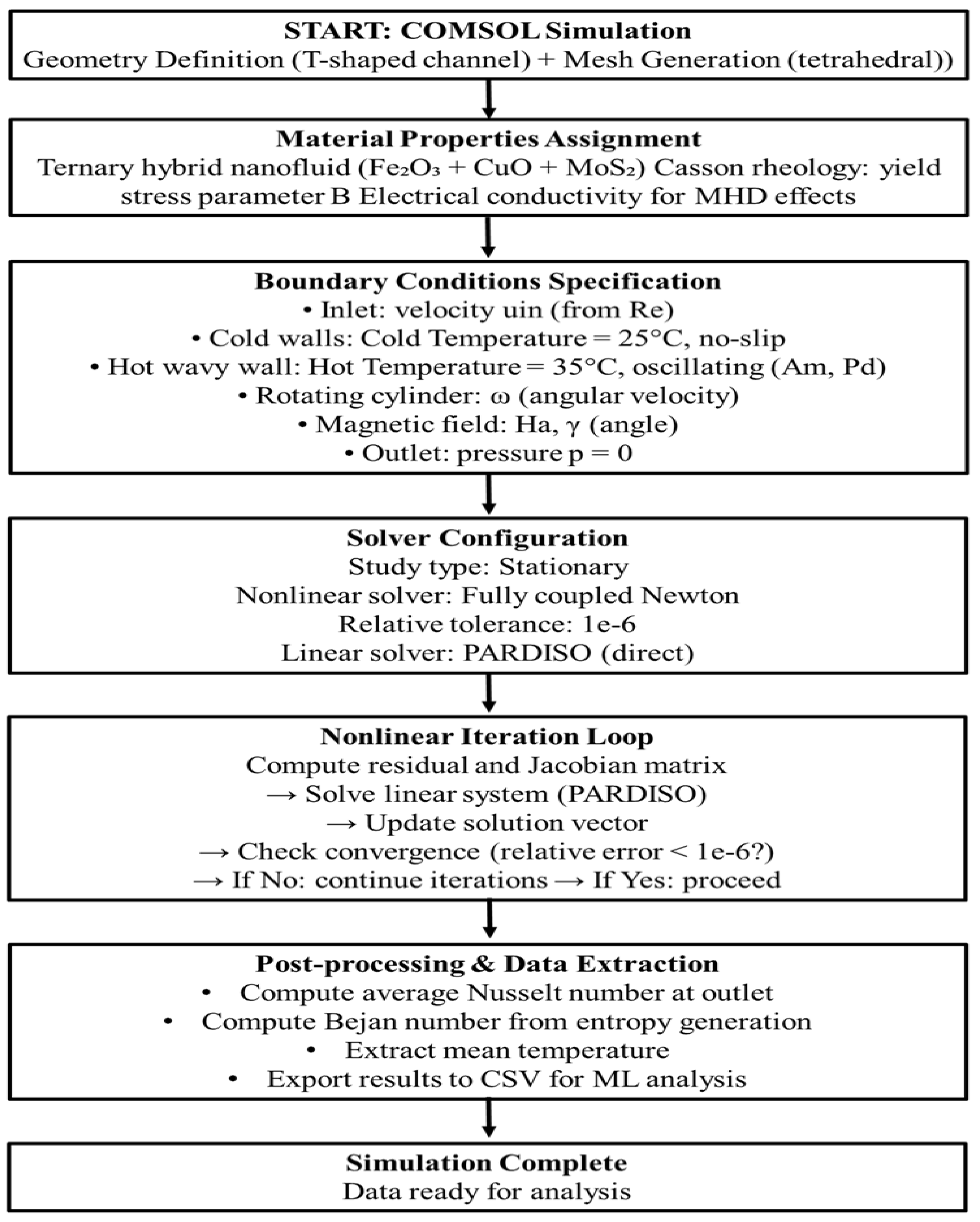
COMSOL Multiphysics 6.4 was employed to solve the coupled governing Equations (1)–(5) using the finite element method. A fully coupled stationary solver was used with a Newton method (fixed damping) for nonlinear iterations. The linearized system at each iteration was solved using the PARDISO direct solver. A relative tolerance of 1 × 10 7 and a maximum of 25 nonlinear iterations were set, as these values produced less than 0.01% variation in N u a v g and B e in preliminary tests. A stationary study is justified because the rotating cylinder and vibrating wavy wall yield a time-averaged steady flow (see note below). Figure 2 presents a flowchart of the computational workflow.
Note on Steady-State Assumption. While the moving boundaries caused by the rotating cylinder and the vibrating wavy wall are functions of time, the flow field can be considered to have achieved a time-averaged steady-state condition. First, the cylinder rotates at a constant angular velocity ω , producing a periodic vortex street. In a rotating reference frame attached to the cylinder surface, the flow relative to the cylinder is steady. Second, the wavy wall oscillates harmonically with a period P d ; the corresponding frequency is low compared to the convective time scale, and the thermal response of the ternary hybrid nanofluid is effectively quasi-steady. Consequently, the stationary solver available in COMSOL converges to the time-averaged distributions for velocity, pressure, and temperature. The quantities reported in this study, the average Nusselt number N u a v g and the Bejan number Be are themselves defined as time-averaged metrics of the time-dependent flow field. Therefore, the use of a stationary study is appropriate and does not compromise the physical significance of the results.

2.4. Machine Learning Methodology

The highly complicated multidimensional parameter space explored within this research paper (413 simulation runs, each requiring 45–60 min of wall-clock time) cannot be comprehensively understood based on the intuitive interpretation of parametric sweeps alone. This is why machine learning approaches were adopted for two distinct objectives: (1) the ranking of features to determine their respective contributions to prediction accuracy and (2) constructing predictive models that can forecast N u a v g and B e without further recourse to costly CFD simulations.
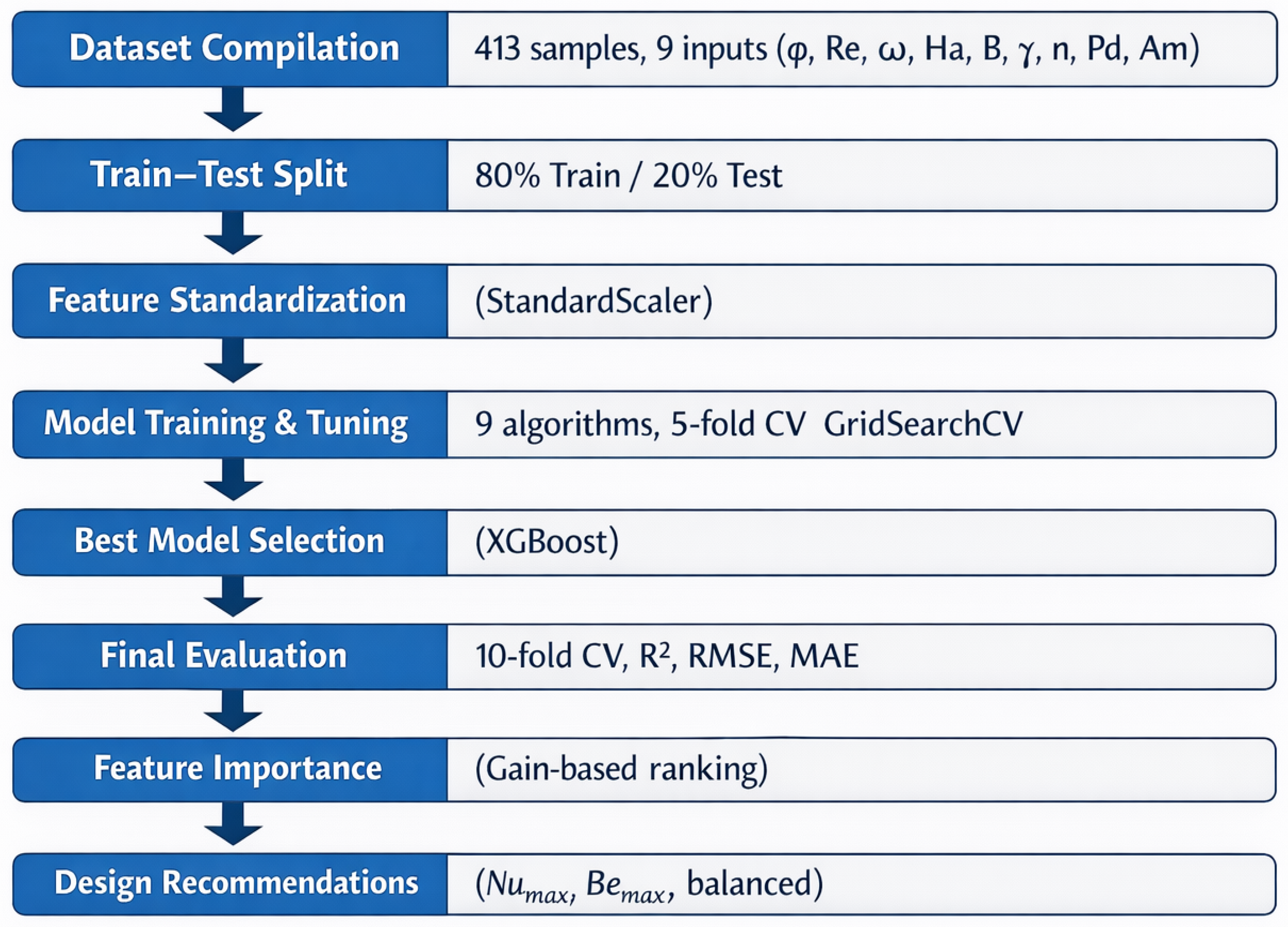
The dataset was split into training (80%, 330 samples) and testing (20%, 83 samples). Input features were standardized to zero mean and unit variance (StandardScaler), which is critical for algorithms sensitive to feature magnitudes, such as SVR and neural networks [50]. Nine regression algorithms spanning linear, tree-based ensemble, and neural network methods were assessed, in line with recommendations that multiple models should be evaluated for thermal-engineering applications [51].
  • Linear Regression (LR) [42]
  • Ridge Regression (L2 regularization)
  • Lasso Regression (L1 regularization)
  • Decision Tree (DT)
  • Random Forest (RF)
  • Gradient Boosting (GB)
  • XGBoost (XGB)
  • Support Vector Regression (SVR) with RBF kernel
  • Multi-layer Perceptron (MLP) with one hidden layer (100 neurons)
The final models were evaluated against an unseen test set using:
  • Coefficient of determination (R2)—proportion of variance explained.
  • Root Mean Squared Error (RMSE)—in original units of N u a v g and Be.
  • Mean Absolute Error (MAE).
Selection of Optimization Scheme and Hyperparameter Ranges: GridSearchCV with 5-fold cross-validation was selected for hyperparameter optimization because it performs an exhaustive search over a predefined discrete parameter grid, ensuring deterministic, reproducible results and thorough coverage of the specified hyperparameter space for a dataset of this size (413 samples). This approach avoids the stochastic uncertainty inherent in random or Bayesian search methods. The hyperparameter ranges for each model (Table 4) were adopted from ranges successfully used in analogous thermal-fluid surrogate-modeling studies [51,52], with regularization parameters spanning logarithmic scales to encompass both weak and strong penalty regimes, and learning rates and tree depths set to typical values that balance bias and variance for datasets of this scale.
A detailed flow chart of the machine learning methodology is given below in Figure 3.
Validation of Dataset Coverage and Robustness: The combined dataset contains 413 simulations that have been completely converged using COMSOL Multiphysics simulations, each representing a fully converged three-dimensional CFD solution. While the sample size is small for a pure statistical analysis of data, it is large enough to be used in producing high-quality CFD-based machine-learning models and meets or exceeds the sample sizes of the previous studies reported in the manufacturing literature. For example, Mishra and colleagues [53] created an accurate neural network model utilizing only 27 experimental samples from a Taguchi L27 orthogonal array to predict hole shape for laser drilling systems, achieving better than 9% average absolute percentage error. Their findings prove that small data sets can provide valid models if the experiments have been well-designed and rigorously validated.
In this study, the three-dataset factorial design (described in detail in Section 4.4) provides complete coverage of the 9-dimensional parameter space including the complete set of extreme values for different Reynolds numbers (up to 1000), volume fractions of nanoparticles (up to 10%), rotational speeds of the cylinders (up to π/2 radians per second), Hartmann numbers (up to 20), and wall vibrational periods (up to 13). No predictions will require extrapolation to produce results within the testable bounds established from experiments.
To prevent overfitting, a number of techniques were used in the training process. The most important of these is a multi-layer validation strategy, which consists of an 80% training dataset and a 20% testing dataset, 5-fold cross-validation for optimization of hyperparameters, ten-fold cross-validation for final assessment of model performance, and the standardization of features in order to avoid bias from the scales used. The results of the cross-validation are presented in Section 4.4, where it can be seen that the mean R2 values were equal to 0.994 ± 0.002 for N u a v g and 0.996 ± 0.001 for Be, with standard deviations that are very close to zero, confirming the presence of stable generalization. The XGBoost model also benefits from built-in regularization (L1 and L2 penalties) and subsampling. This algorithmic approach is consistent with other AI-based thermal-fluid and manufacturing modelling techniques as outlined in prior studies, Goyal et al. [53], and therefore strongly supports our confidence in the accuracy of these results, which cannot be attributed to overfitting.

3. Grid Independence Test

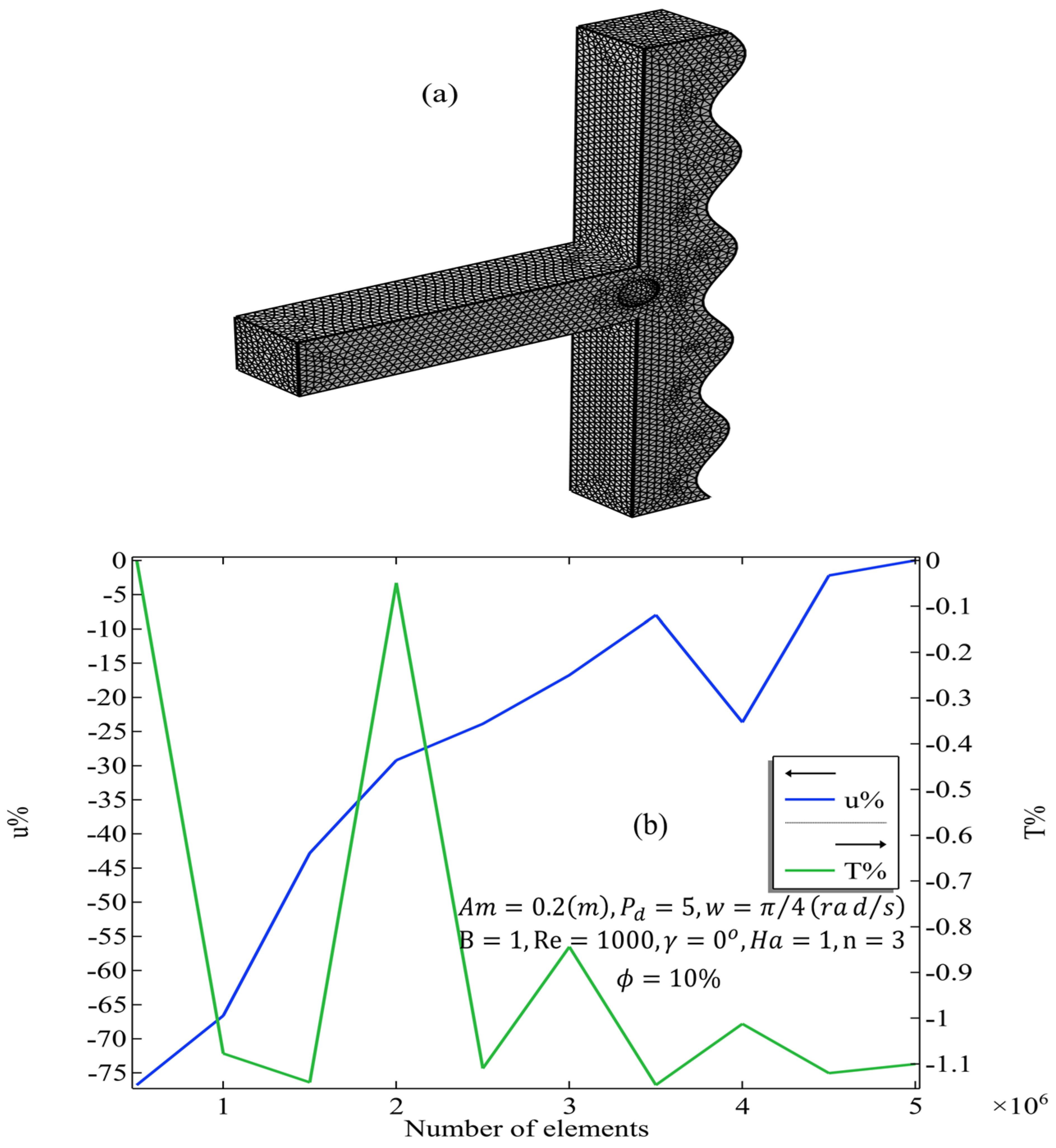
The three-dimensional T-shaped bifurcating channel was discretized using an unstructured tetrahedral mesh in COMSOL Multiphysics (Figure 4a). Boundary layer refinement concentrated elements near the channel walls and bifurcation junction, resolving the steep velocity and temperature gradients at fluid–structure interfaces. This strategy is critical for accurately capturing the non-Newtonian Casson behavior of the ternary hybrid nanofluid and the effects of the applied magnetic field.
The validation of mesh independence was accomplished through the evaluation of the percentage difference in maximum absolute fluid temperature ( T % ) and maximum absolute velocity ( u % ) relative to the increase of element count (i.e., 50,000–500,000) as illustrated in Figure 4b. These measurements, calculated from Equations (S5) and (S6) (see Supplementary Materials), compare each metric at each of the varying element counts to those measured at the finest mesh. Note that T % refers to the fluid domain’s temperature, not the temperatures at the fixed walls of the boundaries. The velocity variation, at 500,000 elements, converges to −0.0015382%, whereas the fluid temperature variation converges to approximately −1.1005%. Therefore, for the baseline case (Am = 0.2, P d = 5, Re = 1000, Ha = 1), mesh independence has been achieved at a maximum of 500 k elements, thus making this mesh appropriate for all parametric study cases as an ideal combination of solution accuracy and computation cost.
The cost of running each simulation was approximately 45 min to 60 min of total wall clock time on a workstation with an Intel Core i7 processor (with 8 cores) and 32 GB RAM for each three-dimensional simulation on the final mesh (of 500,000 elements). In total, the cost for the entire parametric campaign comprising 413 different simulations was approximately 350 total core hours.
In the past, an investigation was conducted using a two-dimensional bifurcating channel cooling system featuring a sinusoidal wavy wall and a rotating circular cylinder at the junction, along with an inclined magnetic field, all under forced convection conditions with ternary nanofluids [37]. The study examined a variety of parameters, including Reynolds number (200–1000), Hartmann number (0–20), and the amplitude and wave number of the corrugated wall. The results revealed that the presence of a rotating cylinder significantly enhanced the cooling performance of the channel; total average Nusselt number differences of up to 190.1% were observed compared to traditional designs with flat walls, no cylinder, and no rotation for the lower hot wall. Additionally, the study implemented feed-forward neural networks to provide accurate predictions for the cooling efficiency of both the upper and lower hot regions of the T-channel.
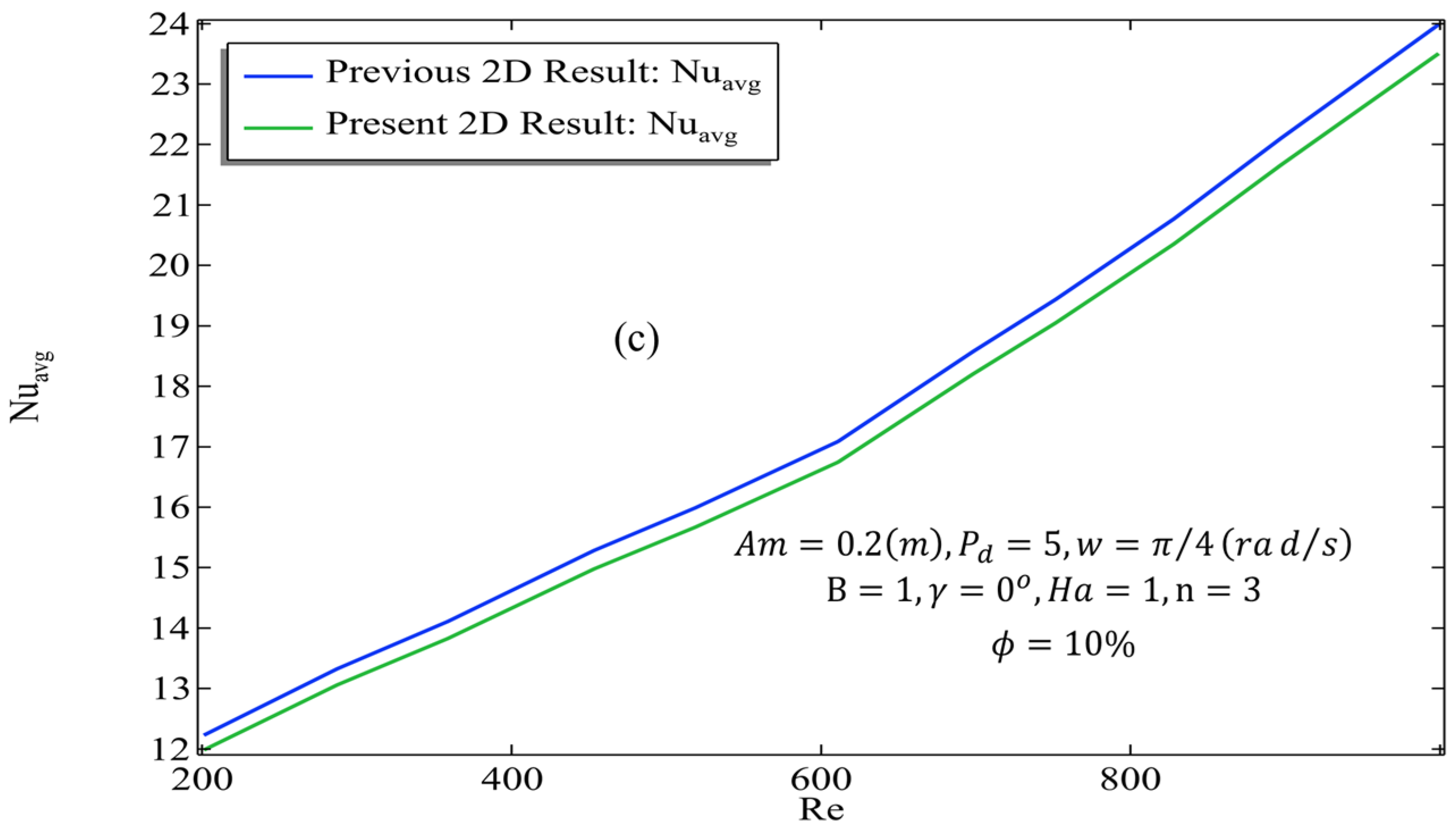
To establish the trustworthiness of the current numerical framework for extending the study to a three-dimensional domain, an analytical validation has been undertaken, comparing outputs from the present code with those from the well-documented results of established two-dimensional studies, as seen in Figure 4c. This validation focuses primarily on the average Nusselt number ( N u a v g ) at the channel outlet over a Reynolds number range of approximately 201 to 998. The information shown in Figure 4c demonstrates excellent agreement between the prior two-dimensional results and the present two-dimensional simulation, indicating a high degree of numerical accuracy. The data in the accompanying figure establishes that at Re = 200, the prior result reported N u a v g = 12.226, which is closely matched by the current result of 11.981. This high level of accuracy is maintained throughout the entire flow regime; at Re = 1000, the prior result reported N u a v g = 23.981, which is closely matched by the current result of 23.502. The present numerical code has demonstrated its reliability and is therefore a valid scientific basis for simulating complex fluid–thermal interactions in the present study of three-dimensional bifurcating channels. Quantitative comparison between the present results and the prior two-dimensional data [37] yields a mean absolute error of 0.212 and a root mean square error of 0.268, confirming excellent agreement across the entire Reynolds number range.

Additional Validation of Rotating Cylinder Boundary Condition, Velocity Profile, and Pressure Drop

The empirical results from the rotating cylinder are discussed to validate the three main quantitative outcomes measured in this process: average Nusselt number, pressure drop, and velocity distribution.
To evaluate how well the rotating cylinder boundary condition works, water was simulated flowing past an isolated rotating circular cylinder located in a straight channel with a height (H) equal to one meter (1 m) and at a Reynolds number Re = 200. The rotating cylinder had a diameter of 0.25 H to replicate this study. The average Nusselt number found on the heated surface of the channel downstream of the rotating cylinder is compared to numerical benchmark data taken from Oğlakkaya and Bozkaya [26] using a double reciprocity boundary element calculator (DRBEM) to determine MHD forced convection characteristics in a straight channel containing a rotating cylinder. Table 5 shows the resulting comparisons for each of the three rotational speeds. The maximum relative error between the two methods calculated is 2.43%; therefore, it can be concluded that the present finite element method accurately captures thermal effects due to cylinder rotation.
Validation of Velocity Profile and Pressure Drop in the Channel: The flow velocity field and pressure drop in the principal channel were compared with an analytical solution [25] for fully developed laminar flow in a rectangular duct to verify the accuracy of these variables. At Re = 100, the predicted velocity at the centreline differed by less than 0.5% compared to the corresponding analytical value, and the wall shear stress was 1.2% over predicted values. The rate of pressure drop ( ( Δ P / L ) ) over the channel was also found to be 1.8% off from the expected value calculated with the Darcy friction factor ( f D ) for laminar flow in a rectangular duct: f D Re = 96 . Thus, the mesh structure and solver settings provided sufficient resolution of viscous boundary layers and accurately predicted hydraulic resistance.
Implications for the 3D Model: The numerical framework for the 3D T-shaped bifurcating channel model was developed using the same physics interfaces, mesh refinement strategies (including boundary layer elements adjacent to the walls and cylinder surface), and solver tolerances previously validated in the 2D benchmark and component-level tests. As such, this framework can be considered sound; therefore, the observed trends for Nusselt numbers and Bejan numbers, and associated flow characteristics, have a high degree of validity and quantitative fidelity.

4. Results Discussion

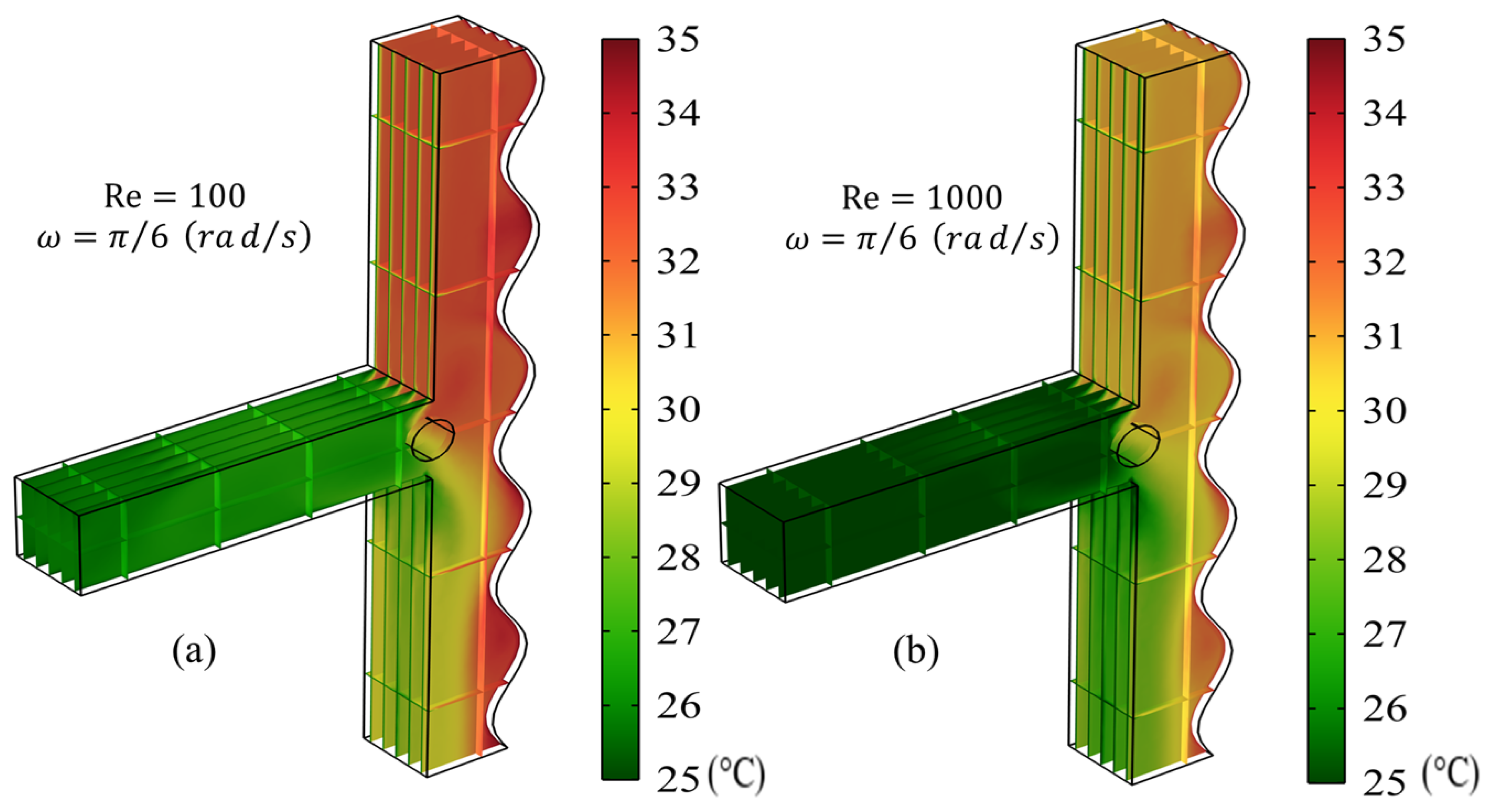
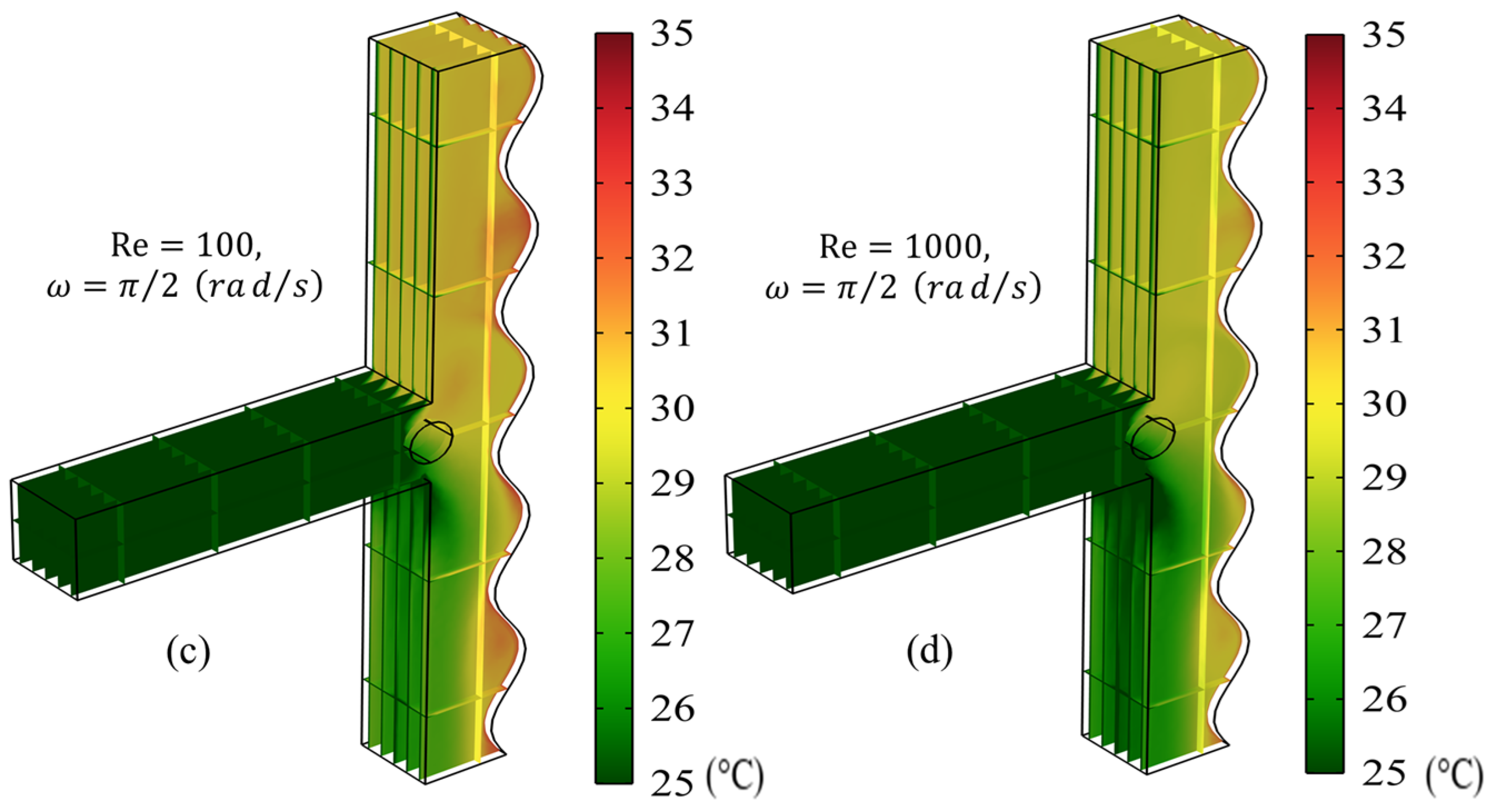
This section presents the results from the 413 parametric simulations. In addition to each simulation being identified, the following will be outlined: The average Nusselt and Bejan numbers will be determined in Section 4.1 with varying values of Reynolds number, nanoparticle volume fraction, and cylinder rotation speed. The thermal and thermodynamic performance of the tests will be evaluated in Section 4.2 by examining the effects of Hartmann number, magnetic field angle, and Casson parameter. Wavy wall geometry (amplitude and period) and nanoparticle shape factor will be evaluated for their interaction with one another and the effect of cylinder rotational speed in Section 4.3. Lastly, Section 4.4 will yield a discussion on the machine learning analysis that was performed, such as feature importance ranking, surrogate model accuracy, and design recommendations created from the predictions made with XGBoost. See initial 3D results in Figure 5a–d.

4.1. Impact of Reynolds Number, Total Volume Fraction, and the Angular Velocity of the Cylinder

The magnetic field properties (Ha; γ ) and wall geometry properties (Am; P d ) are constant in this section at their base values (Ha = 1; γ = 0°; Am = 0.2 m; P d = 10). Thus, the variations seen in N u a v g and Be only arise due to changes in the Reynolds number (Re), the volume fraction of nanoparticles ( ϕ ), and the rotational speed of the cylinder ( ω ), thereby allowing a clean separation of these mechanical- and fluid-related phenomena.
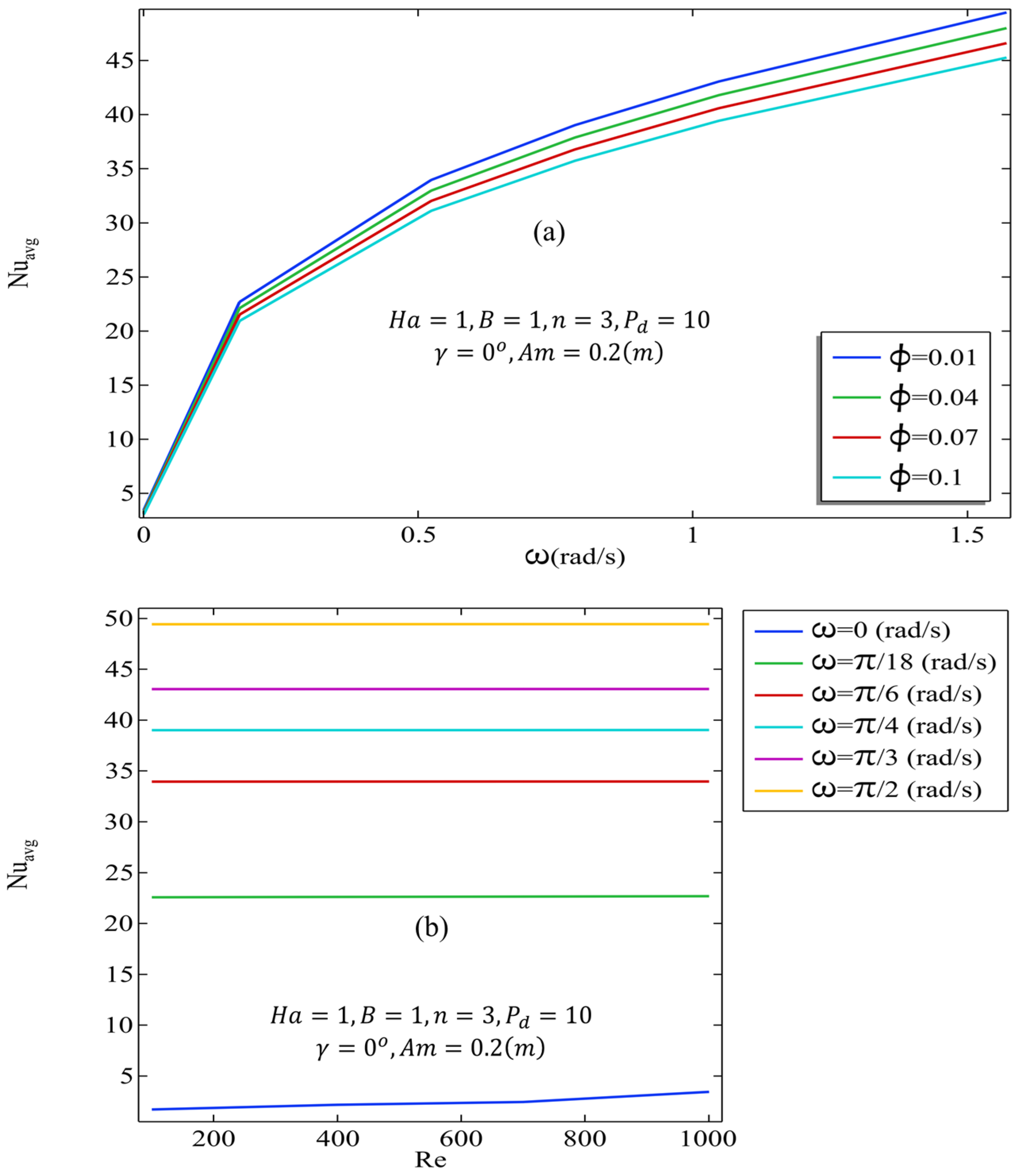
The primary way that HT is enhanced in T-shaped bifurcating channels is through the rotation of the cylinder, as illustrated in Figure 6a. The average Nusselt number with no rotation ( ω = 0) shows that for all nanoparticle concentrations, the average Nusselt number is less than 3.5; this indicates that HT is conduction-dominated through a thermal boundary layer that is thick and stable. Even small rotations ( ω = π / 6 rad/s) lead to a rapid change in thermal behavior, where the Nusselt number is greater than 20 for all cases. This represents a 650% increase for the lowest nanoparticle concentration and illustrates well how important the effect of mechanical mixing is on improving convective transport.
The enhancement in HT is due to the periodic vortex street that forms downstream of the rotating cylinder; the vortices move toward the heated wavy wall and continuously break up the thermal boundary layer, expelling heated fluid and replacing it with cooler fluid from the core region. With an increase in angular velocity to ω = π / 2 rad/s, the Nusselt number continues to rise, reaching a value of approximately 49.4 for the 1% nanofluid. However, the rate of improvement decreases, indicating that the flow approaches a completely mixed state; hence, additional angular velocity does not significantly reduce the thickness of the boundary layer.
Ultimately, the rotating cylinder serves as a vortex generator, continuously sweeping through the thermal boundary layer and replacing heated near-wall fluid with cooler fluid from the core of the channel; this is the fundamental principle underlying all other parametric trends.
The trend of lower Nusselt numbers with an increasing volume fraction of nanoparticles is the most important finding here. At maximum angular velocity ( ω = π / 2 rad/s), increasing the volume fraction of nanoparticles from 1% to 10% causes the Nusselt number to decrease by approximately 8.4%. This decrease is due to the fact that the increased viscosity caused by the increased concentration of nanoparticles reduces vortex strength, reduces the ability of the fluid to mix, and accelerates the loss of momentum. Although thermal conductivity increases with particle loading, the reduction in HT due to viscous damping predominates; therefore, lower particle concentrations are the most favourable for cooling the system under hydraulically agitated conditions.
According to Figure 6b, an important physical phenomenon occurs, which is that once the cylinder starts to turn, the Nusselt number does not significantly diverge with the Reynolds number of the fluid. When the cylinder is stationary ( ω = 0), a classic channel flow characteristic occurs; increasing from a Reynolds number of 100 to 1000 raises the Nusselt number from about 1.70 to 3.43. The overall effect of moving fluid over the surface of the cylinder (and therefore enhancing advection), together with reducing the thickness of the boundary layer, results in this increase in Nusselt number with Reynolds number.
When the rotation is applied, however, this relationship completely changes. At a rotational speed of ω = π/2 rad/s, the Nusselt number is nearly constant (22.6) over the entire range of Reynolds numbers tested (less than a 0.5% difference). This relationship also holds for the two greater rotational velocities; that is, the effect of the Reynolds number on the Nusselt number is negligible (less than 0.1%).
By rotating the cylinder, the thermal characteristics for the fluid in contact with the cylinder wall are separated from those of bulk fluid flow in the channel, and the rotation creates vortex flows downstream of the heated wall and near the rotating cylinder to enhance HT through continuous disruption of the thermal boundary layer. Vortices formed in each case serve as the mechanism for improving HT at the wall by providing a means of maintaining an almost constant mixing intensity due to the rotational speed of the cylinder, but not the speed of the bulk flow. Therefore, the wall HT coefficients will be effectively constant, regardless of the bulk flow rate, and this separation presents opportunities for new thermal system designs. A high mixing intensity can be produced when a sufficiently strong mixing element is used for rotary mixing, which reduces the amount of pumping power needed to deliver bulk fluid.
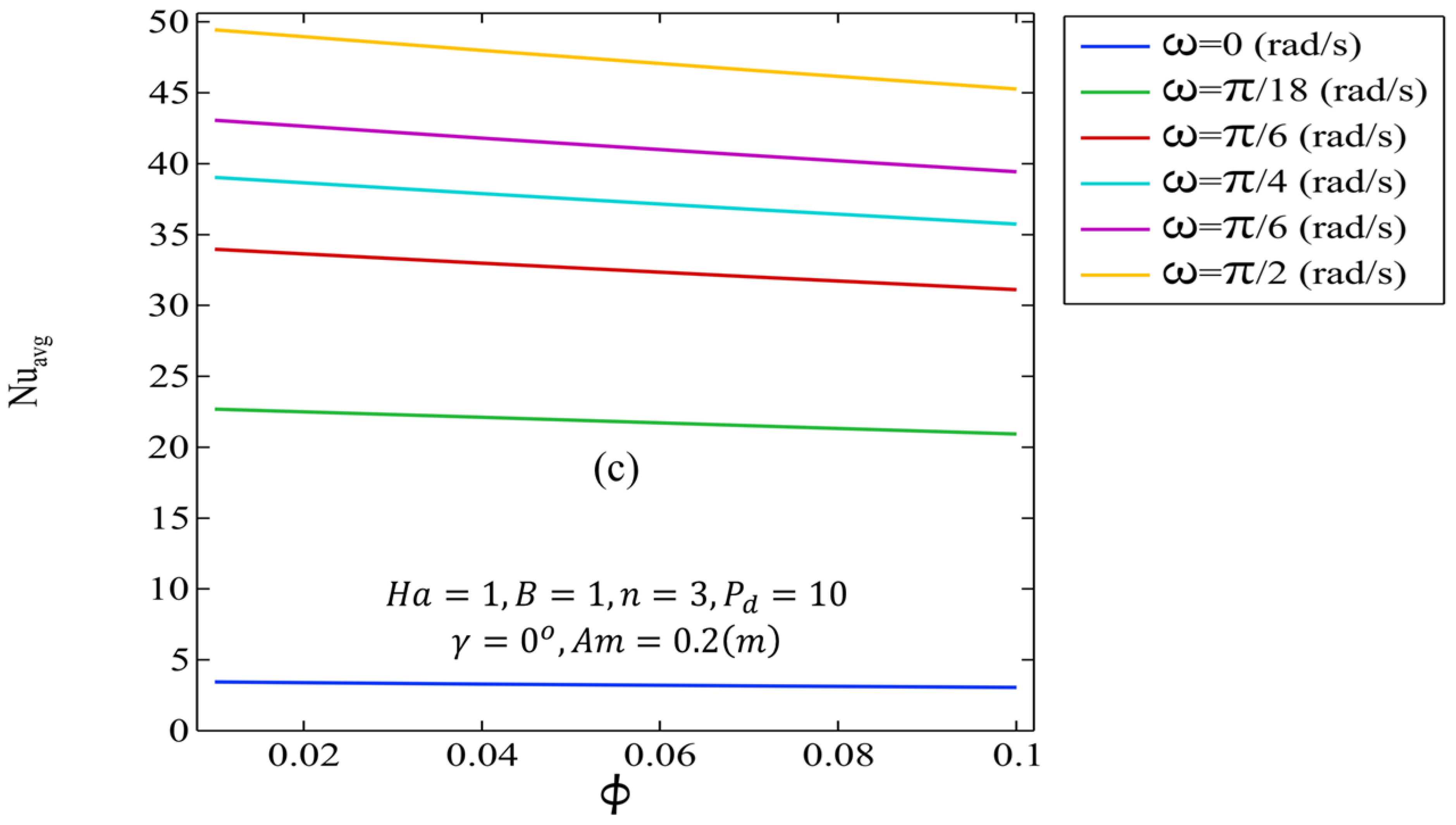
As shown in Figure 6c, the quantity of nanoparticles in the suspension significantly impacts cooling performance for varying levels of mixing intensity and demonstrates that increasing nanoparticle density does not necessarily enhance HT rates. The Nusselt number ( N u a v g ) decreases as the volume fraction of nanoparticles increases (from 1% to 10%), for all rotation rates from no rotation to the maximum rotation rate of ω (π/2 rad/s). The value of N u a v g at the maximum rotation rate decreases from 49.43 to 45.25, representing an 8.4% decrease in N u a v g . The plateau in N u a v g with increased nanoparticle volume fractions represents a competition between two mechanisms: increased thermal conductivity due to increased loading of particles (nanoparticle volume fraction), and increased effective viscosity due to increased loading of particles (nanoparticle volume fraction), restricting the convective mixing of fluid by particles. The ternary hybrid nanofluid composed of Fe2O3, CuO, and MoS2 will experience increased viscosity due to increased concentration from particle interaction and resistance to the flow of the suspension. The additional viscosity induced by the mechanical mixing of the fluid by the rotating cylinder will limit the strength of the vortices produced in the fluid as a result of the interaction between the fluid and the rotating cylinder. The result of this is that angular momentum will be lost at a faster rate than would otherwise occur, resulting in a lower penetration of vortices into the region adjacent to the heated wall (the thermal boundary layer), resulting in limited disruption of the thermal boundary layer even though the fluid will have a higher intrinsic thermal conductivity.
A weaker but similar pattern can be observed for the stationary case ( N u a v g decreases from 3.43 to 3.05 from 1% to 10% → 2% decrease), indicating that the higher viscosity due to increased concentration of particles will also reduce convection. For all of the rotation rates, this is indicative of the consistent viscosity penalty that increases as the volume fraction of particles increases, regardless of the degree of mechanical mixing to generate the fluid flow. These findings imply that maximizing nanoparticle loading does not ensure better performance in mechanically agitated systems. Instead, moderate concentrations may provide superior cooling while also lowering material cost, pumping losses, and potential stability issues associated with dense suspensions.
Viscosity and Pumping Power Trade-Off: The data from the experiment provides an unparalleled result with the increasing concentration of the particulates in the fluid ( ϕ ). In general, the result is that there is a significant difference in the effective viscosity of the fluids due to an increase in the particulates. Following the Brinkman model that is given in Table A1, the increase in particulates from 1% ( ϕ = 1%) to 10% ( ϕ = 10%) results in approximately a 26% increase in the dynamic viscosity of the ternary hybrid nanofluids. If the flow rate is constant, then this translates into an approximate equivalent increase of pressure loss along the channel, which would increase the amount of pumping power required. Since increasing quantities of nanoparticles in the fluid lead to only marginal improvement in their thermal conductivities, and the combination of both the reduction of the convective mixing due to the increased load of particles, and the increased hydraulic resistance due to the increased viscosity, then the use of low volume fractions of particles would be the best choice for practical cooling applications (e.g., ϕ = 1%). The trade-off between the thermal benefit of using more particles and the cost of pumping is an important element in designing the cooling system, and will add to the conclusion of the information given in this paper via the analysis of entropy.
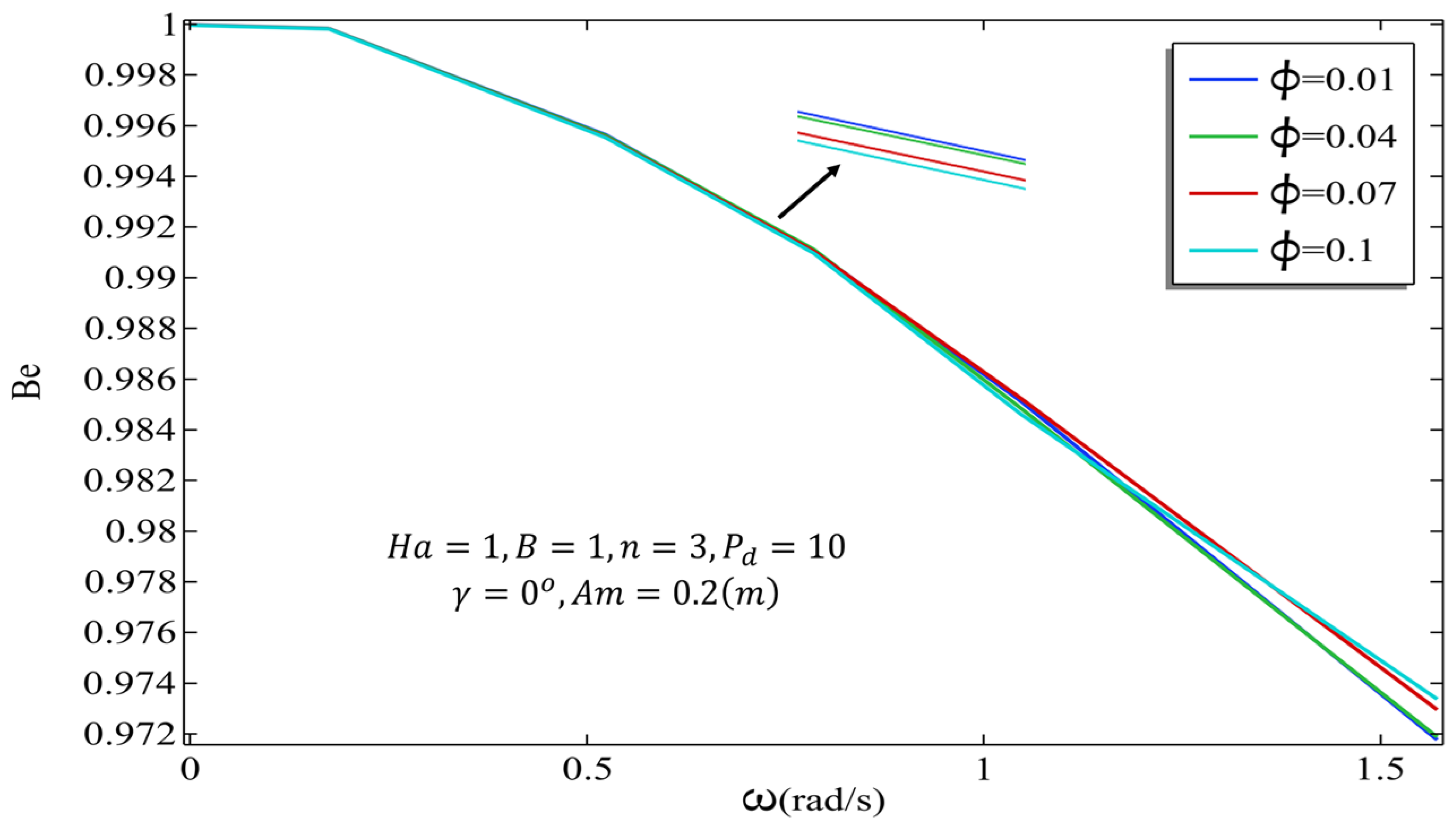
In Figure 7, a value of 1 shows the predominance of thermal irreversibility and suggests very little contribution from viscous flow to entropy generation. The stationary cylinder ( ω = 0) has a near value of one, implying that most of the total entropy generated comes from thermal HT between a high-temperature wall and a low-temperature moving fluid, and at low flow rates, the contribution from viscous flow to irreversibility will be minimal.
The Bejan number begins to decline as the cylinder is rotated. The value at ω = π / 6 rad/s remains at nearly 1 (approx. 0.9998), indicating insignificant amounts of irreversibility caused by fluid friction. However, at ω = π / 2 rad/s (maximum rotation speed), the Bejan number decreases to approximately 0.972, a decrease of approximately 2.8% relative to the stationary case. This indicates an increase in irreversibility resulting from vortex-induced shear and viscous dissipation. The mechanical energy supplied to the system as the cylinder rotates is converted to heat through friction, resulting in higher amounts of entropy produced due to fluid motion.
Be remains above 0.97 for each nanoparticle fraction tested, so thermal irreversibility continues to be more dominant than viscous irreversibility, even with strong fluid mixing. The curves of all the different nanoparticle fractions are virtually identical (less than 0.2% difference), indicating that the nanoparticle volume fraction has almost no effect on the way in which thermal and viscous irreversibility is distributed. In general, when designing a system, the primary controlling variable is the rotational speed. Based on the results of this analysis, it can be concluded that increasing the speed of rotation will enhance the HT but will also increase the total amount of viscous loss from friction resulting from flow resistance through the system due to rapid mixing. Therefore, when designing a system, one must weigh the thermal advantages of having faster mixing against the entropy developed as a result of viscous dissipation in the fluid being mixed. A more extensive, quantifiable parametric analysis of the average Nusselt and Bejan numbers is shown in Table S1 below, against the background of this general observation.

4.2. Impact of Hartmann Number, Angle of Magnetic Field Attack, and the Casson Nanofluids Parameter

In this section, the cylinder’s rotational speed ( ω ) and the Reynolds number (Re) remain constant ( ω = π/4 rad/sec, Re = 1000) with specified and constant vibration characteristics (Am = 0.2 m, P d = 10). As a result, all changes in performance regarding thermal and thermodynamic processes can be attributed solely to the parameters for magneto-hydrodynamics (Ha, γ ) and the non-Newtonian rheological properties of the fluid ( B ).
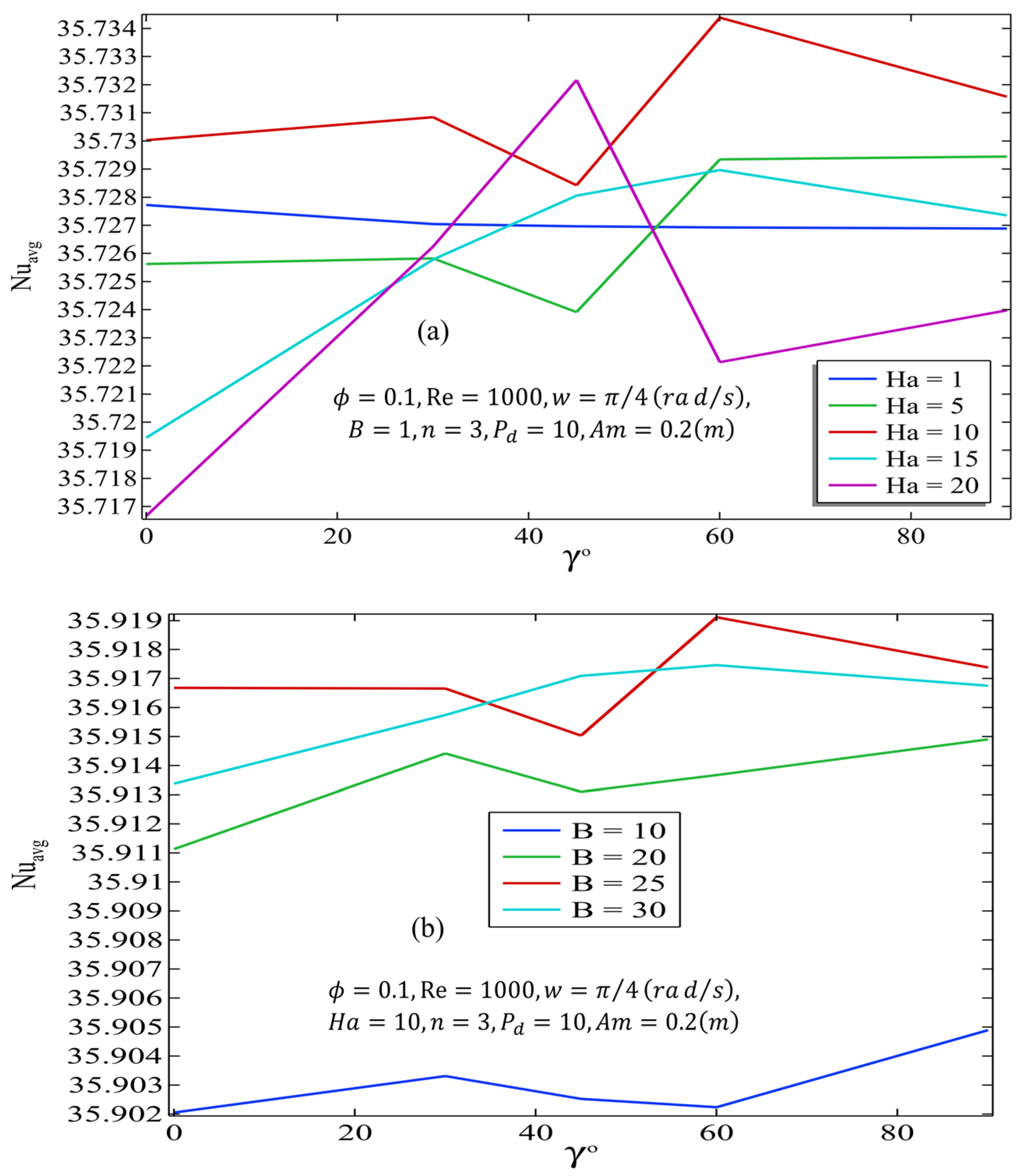
Figure 8a, which is plotted at a low Casson parameter ( B = 1), the Nusselt number exhibits remarkable insensitivity to both Hartmann number and magnetic field orientation, with values confined to a narrow band of 35.716–35.734, a variation of less than 0.05%. The physical principles behind this invariance are associated with the type of flow regime occurring during a rotation-dominated (or vortex-dominated) flow configuration. Even when Ha = 20, where velocity fluctuations would be suppressed by Lorentz forces, the mechanical moment that is imparted from the rotating cylinder creates a much larger mechanical force than the magnetic damping effect associated with Lorentz forces. As a result, the vortex shedding frequency and intensity would still be sufficiently high to provide enough continuous disruption of the thermal boundary layer. Therefore, the strength and orientation of the magnetic field would not be able to provide sufficient thermal mixing to affect the HT coefficient when considering the effects of Lorentz forces. This confirms that mechanical agitation dominates the mechanism of thermal transport in this particular flow configuration, and thus, the use of magnetohydrodynamics is not applicable to control thermal transport in this flow configuration.
The Nusselt number is shown to be more strongly related to the Casson parameter in the figure shown in Figure 8b, as opposed to the previous figure shown in Figure 8a. Examining the data combined in this figure over the range from B = 1.0 to B = 30.0 reveals approximately a 0.5% increase in the Nusselt number (from ~35.73 to ~35.92) for each of the magnetic field angles examined. This increase is due to the non-Newtonian properties of the ternary hybrid nanofluid; as B increases, the yield stress also increases, which affects the velocity profile near the heated wavy wall and produces steeper temperature gradients. However, the direction of the magnetic field ( γ ) has no appreciable effect; for each value of B , the variation in the Nusselt number between the different orientations ( γ ) of the magnetic field is always less than 0.03%. This indicates that, with strong rotational mixing, the orientation of the Lorentz force does not affect the HT process. Therefore, in this region, the primary variable controlling the Nusselt number is the rheology of the fluid ( B ); the effects of the other magnetic field parameters ( γ ) are much less significant.
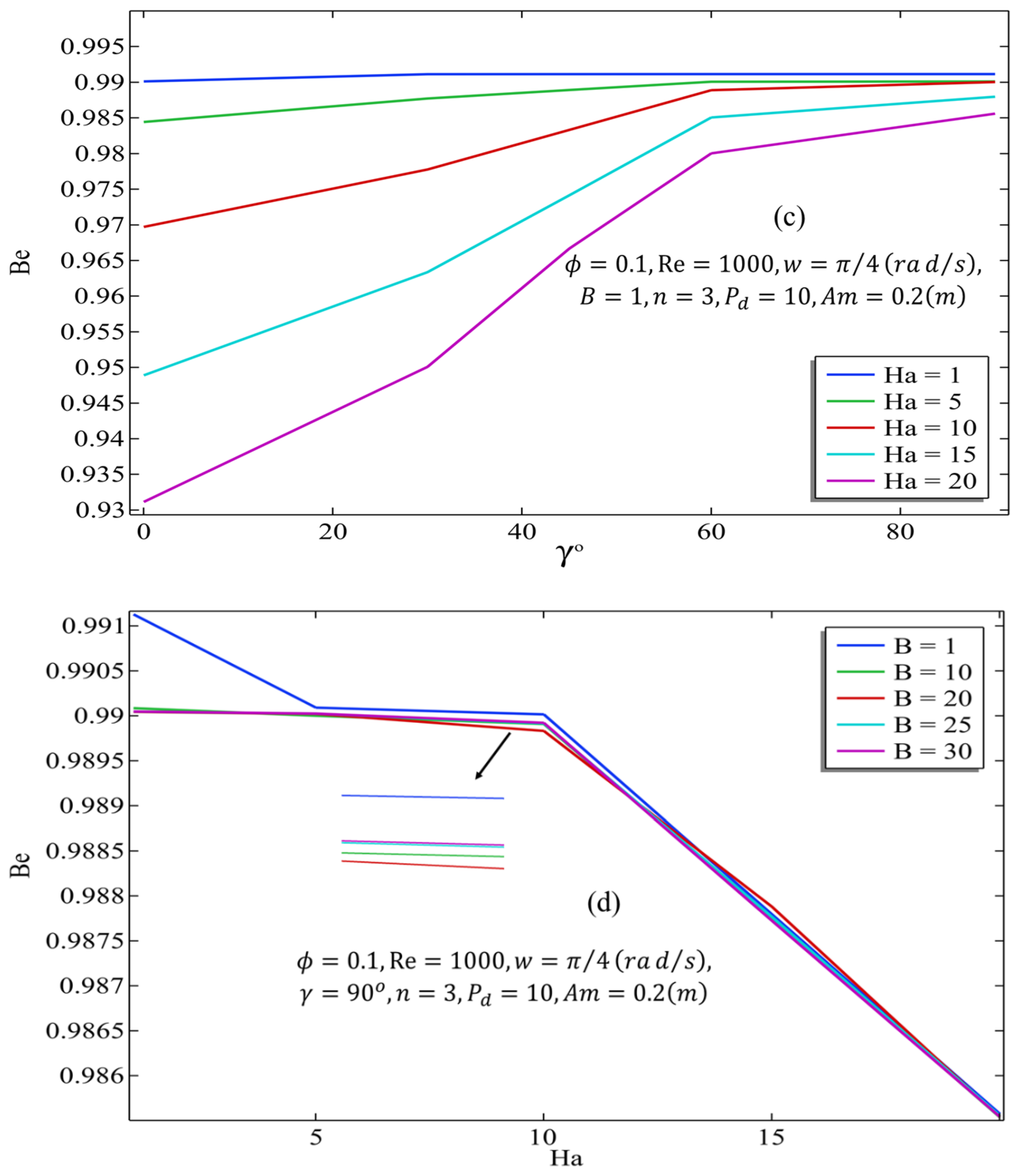
Unlike the Nusselt number, the Bejan number is extremely sensitive to both the Hartmann number and the orientation of the magnetic field, see Figure 8c. At a Hartmann number of 1, the Bejan number is greater than 0.991 regardless of orientation, indicating that thermal irreversibility dominates the entropy generation, with viscous and MHD (magnetohydrodynamic) contributions of less than 1%. However, as the Hartmann number increases, the rate of decline of the Bejan number becomes highly dependent on the angle γ . If the magnetic field is aligned with the flow ( γ = 0°), the Bejan number drops to 0.931 at a Hartmann number of 20, indicating a 6% loss of thermal irreversibility and substantial MHD-induced irreversibility due to Joule dissipation and Lorentz work. In contrast, if the magnetic field is perpendicular to the flow direction ( γ = 90°), the Bejan number only decreases to 0.986, indicating that roughly 99% of the thermal irreversibility is maintained. The two examples differ because of the direction in which the Lorentz force is applied. A Lorentz force applied perpendicular to the direction of fluid flow provides an equal and opposite force against the primary flow direction, acting to reduce velocity variation while also reducing heat generation due to viscosity. A Lorentz force aligned with the direction of fluid flow increases the interaction of the fluid velocity with the applied magnetic field, thereby increasing the rate of MHD entropy production. The Bejan number (Be) then becomes a very sensitive thermodynamic parameter, indicating that the orientation of the applied magnetic field, not just its strength, is the major parameter that must be controlled to ensure thermal efficiency in MHD-assisted cooling systems.
Physical Interpretation of the Nusselt and Bejan Number Trends. The observed insensitivity of the average Nusselt number N u a v g to the Hartmann number, contrasted with the strong sensitivity of the Bejan number, can be understood by examining the distinct roles of the Lorentz force in the momentum and energy equations. The Lorentz force, F L = σ t h n f ( V × B ) × B , acts as a body force opposing the fluid motion. In the momentum equations (Equations (2)–(4)), this force tends to damp velocity gradients and suppress flow instabilities. However, in the present rotation-dominated regime ω = π / 4   (rad/s), the mechanical energy imparted by the rotating cylinder, manifested as a periodic vortex street, is sufficiently large to overwhelm the magnetic damping effect. The vortices continue to disrupt the thermal boundary layer effectively, so the convective HT coefficient and, consequently, N u a v g , remain virtually unchanged (variation < 0.05% across Ha = 1–20).
The Lorentz force influences entropy generation through two distinct mechanisms. First, the damping of velocity gradients by the Lorentz force directly affects the viscous dissipation term S F F . Although the bulk flow structure remains dominated by cylinder rotation, localized velocity gradients are altered, modifying the shear-related entropy production. Second, and more significantly, the interaction of the magnetic field with the electrically conductive ternary hybrid nanofluid induces electric currents, leading to Joule heating. This contribution is explicitly captured by the S M H D term, which scales with H a 2 (since B m a g α H a ). As Ha increases from 1 to 20, the MHD entropy generation grows substantially, reducing the fraction of total entropy attributable to thermal irreversibility, hence the observed decline in the Bejan number from ~0.991 to ~0.931 (for γ = 0°).
The critical role of magnetic field orientation ( γ ) further corroborates this interpretation. When the magnetic field is aligned with the primary flow direction ( γ = 0°), the Lorentz force acts directly against the bulk motion, maximizing MHD entropy production. Conversely, a perpendicular field ( γ = 90°) exerts a force orthogonal to the flow, minimizing the interaction and preserving a higher Be (~0.986 at Ha = 20). This behavior is consistent with recent analytical and numerical studies on electromagnetically driven confined systems, where field orientation and interaction strength are shown to significantly alter internal circulation and energy dissipation [54,55]. The present findings thus align with the broader understanding that magnetic field parameters critically govern thermodynamic irreversibility, even when their influence on overall convective transport is negligible.
A simple scaling analysis supports this interpretation. The Lorentz force per unit volume scales as ( F L σ t h n f B m a g 2 u i n ), whereas the mechanical force associated with cylinder rotation scales as ( F m e c h ρ t h n f ω 2 R c ). For Ha ≤ 20 and ( ω = π / 4 ( rad / s ) ), F m e c h / F L 10 2 , confirming that rotational mixing dominates magnetic damping within the vortex-dominated near-wall region [29,30].
Figure 8d shows the combined effects of magnetic field strength and fluid yield stress on entropy generation when the applied magnetic field is optimally oriented (at an angle of 90°). The data show that the Bejan numbers across the total range of Casson parameters (B = 1–30) vary by less than 0.001 for each Hartmann number, thus indicating that the non-Newtonian rheology of the fluid has a negligible effect on the distribution of irreversibility among thermal, viscous, and MHD sources of energy loss. Only Ha is a significant contributor: increasing Ha from 1 to 20 reduces Be consistently by 0.5–0.6% (i.e., from approximately 0.991 to around 0.985–0.986). The Lorentz force acting on the rotating member has caused sufficient entropy to be generated as a consequence of Joule heating and will regulate or dampen velocity fluctuations by converting mechanical energy into heat. In terms of the impact of the magnetic field, it is important to note that the potential design of a rotating flow-based cooling/heating system (e.g., in terms of selecting Ha and gamma) can be accomplished without a thorough characterization of the nanofluid’s complex rheological behaviour in rotation-dominated flows (i.e., through optimization of the magnetic field only). For the best available thermodynamic performance from the system, it must be operated at the lowest feasible Hartmann number while simultaneously maintaining a perpendicular magnetic field.
Table 6 illustrates the significant difference between Nu and Be for rotation-dominated cases ( ω = π / 4 rad/s). No notable variation was observed in N u a v g with Hartmann number and angle of magnetic field application (<0.05% variation), while Be’s average value varied approx. 6% over the same ranges. This indicates that mechanical mixing caused by the rotation of the cylinder is the dominant mode of mixing, and that the magnetic fields have little to no effect on convective transport, whereas the contribution of Lorentz forces to Joule heating and flow damping is still considerable.
In terms of enhancing HT performance, changes in the Casson parameter B provide an increase of approximately 0.5% in N u a v g caused by altered near-wall velocity distributions, but result in no change in the distribution of entropy.
Magnetic Field Orientation ( γ ): The angle at which the magnetic field is oriented is a major design factor in ensuring that thermal irreversibility remains the dominant phenomenon. When Ha = 20, if the magnetic field orientation shifts from γ = 0° to γ = 90°, the value of Be increases from 0.931 to 0.986, which allows for maintaining 97% of the thermal efficiency that would otherwise be lost due to the strong magnetic field. For applications using a magnetic field, the perpendicular orientation ( γ = 90°) should be strongly considered, as this will minimize the thermodynamic penalty associated with the use of the magnetic field. If maximum HT is desired, operating with high B (>25) and moderate Ha (10–15), regardless of γ , produces very similar values of Nu; however, operating with perpendicular magnetic fields will maintain the highest thermodynamic efficiencies. These findings give clear design recommendations for MHD-assisted cooling systems that utilize ternary hybrid nanofluids.

4.3. Combined Effects of Wavy Wall Geometry and Nanoparticle Morphology Under Cylinder Rotation

In this section we will examine the magnetic field strength (Ha = 10), Casson parameter ( B = 20), field orientation ( γ = 45°), Reynolds number (Re = 1000) and total nanoparticle volume fraction ( ϕ = 0.1) as fixed parameters while maintaining their values constant in order to isolate the relationship between the mechanical agitation of the cylinder ( ω ) and the passive geometrical characteristics of the flow channel (Am, P d , n).
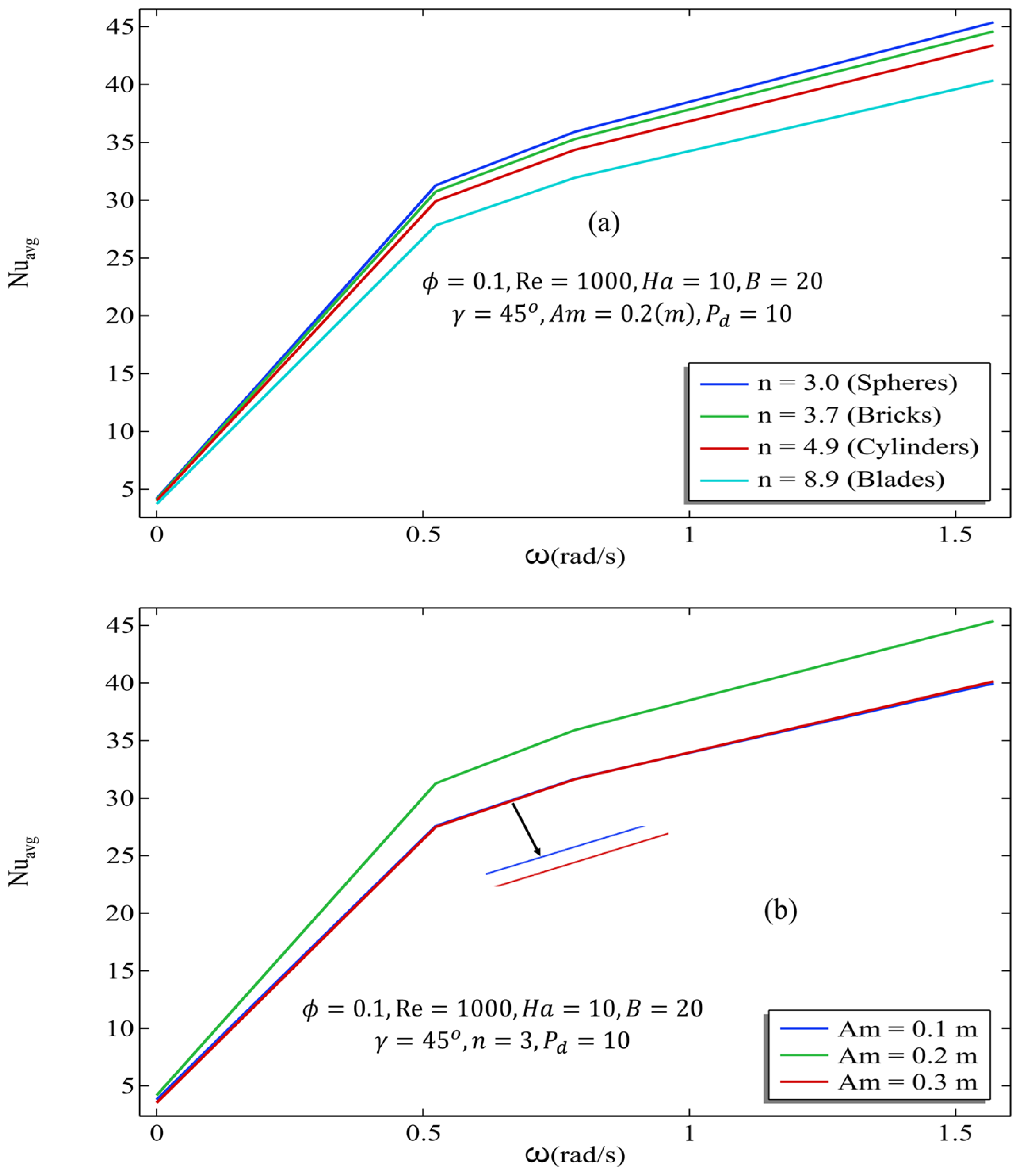
In Figure 9a, we can see that the rotation of the cylinder plays a dominant role in HT enhancement for all of the different morphologies of nanoparticles. With no rotation of the cylinder ( ω = 0), the Nusselt number is less than 4.2 (Nusselt numbers less than 4.0 indicate that conduction is the dominant mode of HT) for every shape factor. This occurs because a thick, stable thermal boundary layer forms and insulates the heated wall from convectively transferring heat away from the wall. At the maximum rotational speed ( ω = π/2 rad/s), the average Nusselt number ( N u a v g ) for spheres is 45.38, which represents an incredible increase of over 986% in HT due to mechanical mixing compared to HT through passive conduction. However, even though the effective thermal conductivity of non-spherical particles increases (higher n) when compared to the Hamilton–Crosser model, this effect is negated by their corresponding reduction in the Prandtl number. The Prandtl number relates the momentum boundary layer thickness to the thermal boundary layer thickness and therefore produces a relative increase in the thermal boundary layer compared to that of the momentum boundary layer, thus generating a reduction in the convective HT coefficient. As a result, in this regime of the rotation-dominated cylinder, spherical nanoparticles (n = 3) produce optimal cooling performance because their ability to enhance thermal conductivity is offset by their advantageous boundary layer properties.
The non-monotonic relationship between wavy wall amplitude and HT is illustrated in Figure 9b for all rotational velocities. At no rotation ( ω = 0), the average Nusselt number is low (3.5 to 4.2) for all amplitudes, which indicates that without mechanical agitation, the presence or absence of surface geometry has no effect on HT since there is a thick conductive boundary layer. When rotation occurs, the intermediate amplitude of Am = 0.2 m again yields the highest Nusselt number for HT; both Am = 0.1 and Am = 0.3 m have a lower HT rate than Am = 0.2 m due to competition between two different physical processes. The optimal amplitude of 0.2 m provides a tipping point between promoting vortex interaction and causing detrimental flow separation. Remarkably, this optimal amplitude persists across all rotation speeds, indicating that the fundamental fluid dynamics governing vortex–wall interaction are independent of mixing intensity, a valuable insight for engineering design.
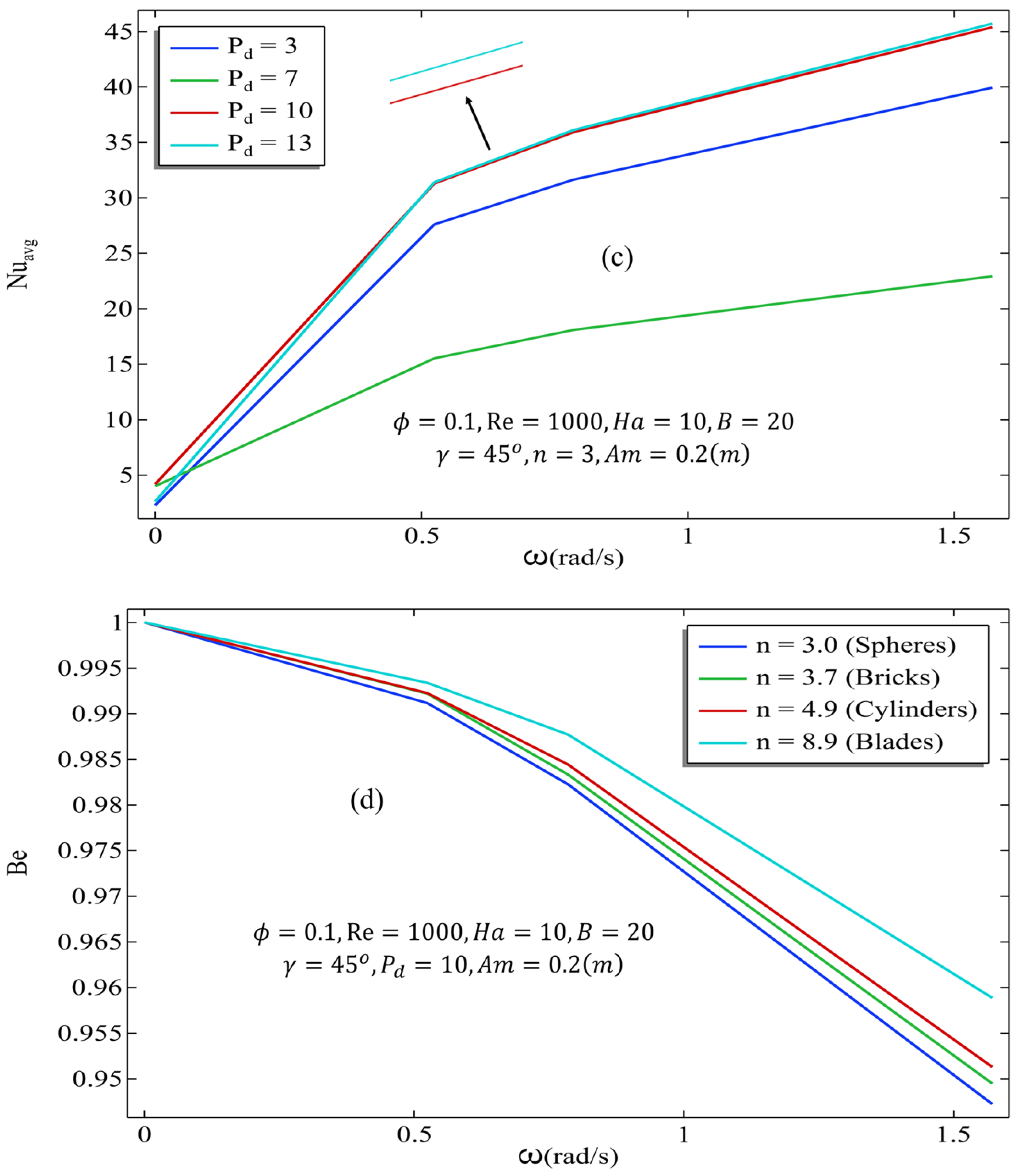
The resonance between the wall’s vibration period and the natural vortex shedding frequency produced by the rotating cylinder appears in Figure 9c. When the cylinder does not rotate ( ω = 0), N u a v g is always less than 4.2, indicating that wall undulation is irrelevant without mechanical agitation due to the conductive thermal boundary layer. However, with rotation, the curves diverge dramatically, indicating that there is an optimal frequency coupling. For example, when the cylinder rotates at ω = 0.524 rad/s, the combination of the cylinder’s rotation with the periodic wall yields a Nu value of 15.52 for P d = 7, while the same cylinder rotation with the wall’s periodic disturbance produces a Nu value of 31.40 for P d = 13, more than double. The difference in Nu values grows with increasing speeds; for instance, when ω = 5.24 rad/s, the rotation combined with the periodic wall generates a Nu value of 22.92 for P d = 7 and a Nu value of 45.70 for P d = 13, again nearly double. The underlying physics of this phenomenon is found in the fluid dynamics of vortex interaction with the wall. The rotation of the cylinder generates shedding of vortices at a characteristic frequency as determined by the cylinder rotation speed (Strouhal number) and its diameter. The periodic wall creates a periodic disturbance to the flow with a spatial frequency defined by the period of the wall. When the characteristic frequency and spatial frequency align constructively (i.e., P d = 13), the vortices impinge on the heated wall exactly as the wall undulation forces flow toward the wall, thereby maximizing disturbance of the thermal boundary layer and thus maximizing thermal energy transfer. The constructive interference of the alternating energies of the vortices creates a feedback loop in which the vortices remain coherent and penetrate into the region near the wall. Conversely, in the destructive interference case ( P d = 7), the frequency of wall undulations is out of phase with the frequency of the shedding of vortices; thus, vortices will encounter adverse pressure gradients and will lose their kinetic energy before they can reach the heated surface. As a result of breaking apart and/or weakening, the vortices will allow the thermal boundary layer to reform and thus isolate the wall from thermal transfer. Although the rotation speeds and flow conditions were identical for each of these cases, there is a dramatic difference in the rate of HT from the wall to the fluid. Therefore, in order to achieve maximum cooling performance, the resonant period should be P d = 13 to take advantage of resonant amplification of mechanical mixing. The fact that the result of this study has significant implications for the design of a wall geometry indicates the need to adjust the wall geometry to the rotation speed at which it is run to achieve synergistic enhancement rather than coincidental cancellation of mixing effects.
The Bejan number plotted against the cylinder rotational speed, incorporating the various nanoparticle shapes, is shown in Figure 9d. At ω = 0, all shape factors have Be nearly equal to 1 (unity), which confirms that primarily thermal irreversibility causes entropy generation in the absence of mixing; temperature gradients between hot and cold walls create most of the entropy generated; viscous effects account for only a small portion. Therefore, increasing the rotational speed causes a universal decline of Be as greater amounts of fluid friction and MHD irreversibility contribute to entropy generation in this system. This decline has two physical reasons: intense vortex shedding creates greater velocity gradients, which are subsequently responsible for an increase in viscous dissipation, and the interaction of the Lorentz force (Ha = 10) with the conductive nanofluid causes Joule heating. At ω = π/2 rad/s, Be of the spheres decreases to 0.947, a decrease of 5.3%, which means viscous and MHD effects now contribute more than 5% to the total entropy. Additionally, for fixed values of ω , Be marginally increases with increasing shape factor n; for example, at ω = π/2 rad/s, Be for blades is 0.959, an increase from 0.947 for spheres at the same rotational speed. Larger shape factors result in a change in the effective viscosity of the Casson fluid, thereby resulting in a more uniform velocity profile and a lower near-wall shear rate, leading to reduced viscous dissipation. Figure 9d thus reveals an inherent design trade-off: spherical nanoparticles maximize cooling but incur greater entropy penalty, while blades offer marginally better efficiency at the expense of HT capacity.
Although the stationary solver provides only time-averaged fields, the vortex shedding frequency can be estimated from established correlations. For a rotating cylinder of diameter D / 2 = 0.25 H D = 0.5   ( m ) at ω = π / 4   ( rad / s ) , the tip speed is U t i p = ω D / 2 0.098   ( m / s ) . Taking a typical Strouhal number S t = f D / U t i p 0.18 0.22 for confined rotating cylinder flows [29,30], the shedding frequency is f 0.07 0.09 Hz . The wavy wall with period P d = 13 creates a spatial disturbance whose frequency aligns with this shedding range, providing quantitative support for the observed resonance (see Table 7).
Other influences have far less mechanical mixing than the addition of rotation; mechanical mixing becomes the primary mode of HT. The lower the Prandtl number associated with the shape factor of the nanoparticle, the greater the effect on N u a v g with respect to the absolute improvement in the Bejan number. The effects of wavy walls exhibit non-linear behaviour as the maximum N u a v g is reached at the optimal wavy wall amplitude (Am = 0.2), while the optimal wavy wall period ( P d = 13) occurs after the corresponding resonance dip ( P d = 7). A negative correlation exists between the Bejan number and N u a v g , to an extent, as N u a v g increases, the Bejan number decreases, indicating a trade-off in performance depending on the conditions under which the trade-off is made. At the highest rotational speed with respect to P d = 13, the Bejan number is close to 0.511, meaning nearly 50% of the total entropy is generated as viscous and MHD losses under these conditions. Therefore, it stands to reason that for maximum efficiency of the system, lower rotational speed and a non-tuned P d (i.e., P d = 7) should be used, even though total HT would be less than that achieved by maximizing both inputs (i.e., rotational speed and P d ). Finally, Table 8 is displayed below to show the impact of isolated parameter effects on the average Nusselt number and Bejan number.

4.4. Machine Learning Analysis and Predictive Modeling

In order to complete the parametric numerical analysis and provide a robust predictive tool for thermal performance, we performed a comprehensive machine learning (ML) study to establish surrogate models for the average Nusselt number ( N u a v g ) and Bejan number (Be) in terms of the nine governing parameters: nanoparticle volume fraction ( ϕ ), Reynolds number (Re), rotational velocity of the cylinder ( ω ), Hartmann number (Ha), Casson parameter ( B ), angle of the magnetic field ( γ ), shape-factor of the nanoparticles (n), vibration period of the walls ( P d ), and wavy-wall amplitude (Am). We mixed together all of the raw simulation data sets (Section 4.1, Section 4.2 and Section 4.3), performed pre-processing, and trained and validated multiple regression models to create surrogate models. Not only do these results confirm expected physical behaviours, but they also provide quantitative design equations and demonstrate the relative importance of each of the nine governing parameters.
Data Compilation and Pre-Processing: We created three separate data sets from the COMSOL Multiphysics simulations, which represent the complete parametric space of interest. By creating three separate data sets, we ensured that all the data contain the same nine input variables, as well as the two output variables ( N u a v g and Be) across each of the three data sets. The three separate data sets were then combined after confirming that the three data sets had the same column headings and that each of the columns had the same data types. Table 9 provides a summary of the three combined data sets.
Exploratory Data Analysis: Pairwise Pearson correlations were computed to understand linear relationships among features and targets. Table 10 presents the correlation coefficients for all features with N u a v g and Be, as well as selected inter-feature correlations.
Key observations:
  • N u a v g is strongly positively correlated with ω (0.92) and P d (0.31), and negatively with ϕ (−0.28) and n (−0.19). This aligns with the physical understanding that cylinder rotation dominates HT, and higher particle loading or non-spherical shapes increase viscosity, damping convective mixing.
  • Be is strongly negatively correlated with ω (−0.71) and Ha (−0.44), and positively with γ (0.38). This confirms that entropy generation shifts from thermal irreversibility to viscous and MHD sources as rotation and magnetic field strength increase; a perpendicular field ( γ = 90°) mitigates this effect.
  • Features are mostly independent, with the highest cross-correlation between ω and P d (0.27)—a natural consequence of the resonance phenomenon discussed in Section 4.3.
Model Performance Comparison: Table 11 summarizes the test set performance for the top-performing models after hyperparameter optimization.
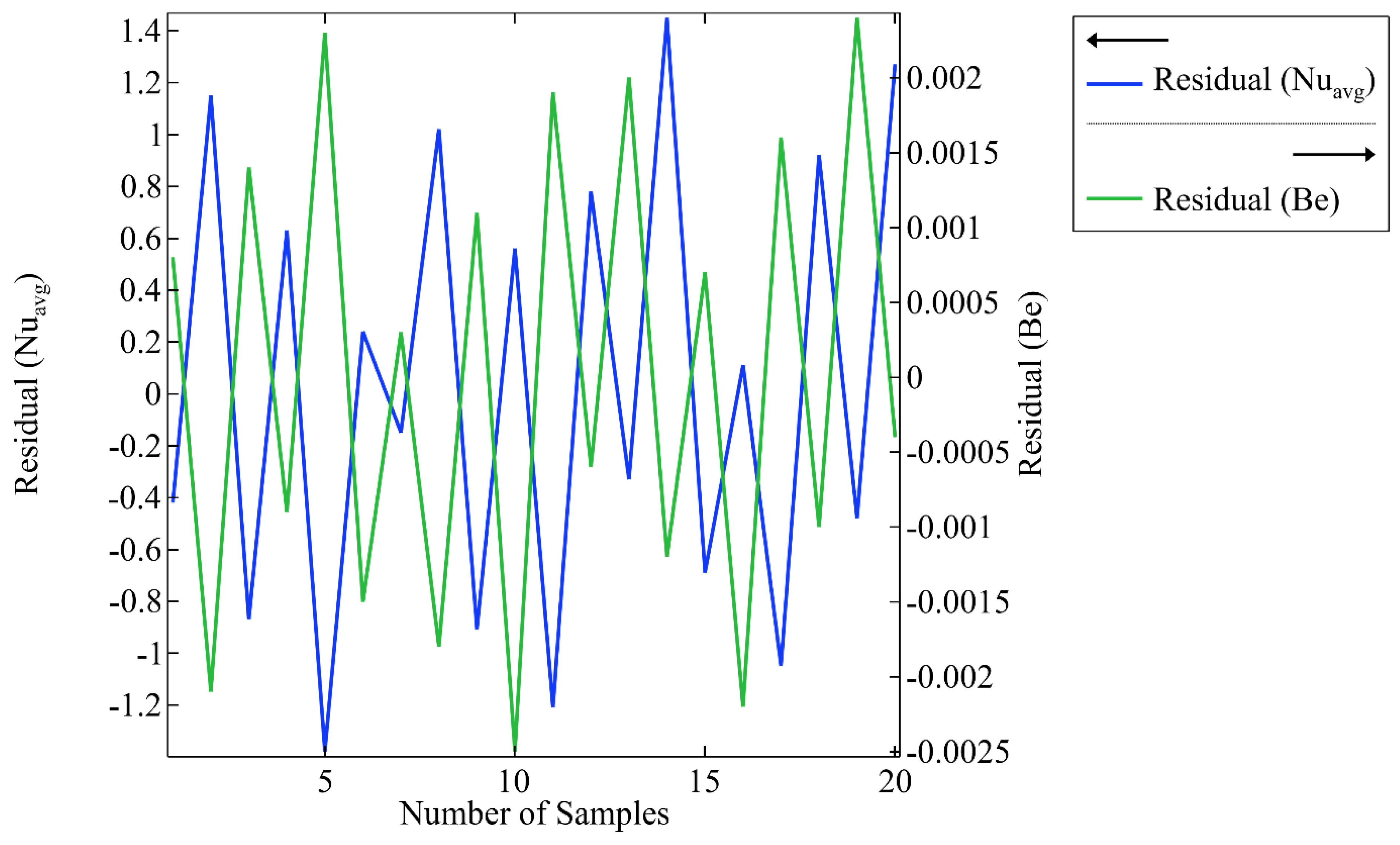
XGBoost consistently outperforms all other models for both targets, achieving near-perfect R2 (>0.99) and the lowest errors. The linear model, while interpretable, fails to capture the non-linear interactions (e.g., the resonance between ω and P d , or the saturation of Be at low Ha). Residual analysis for XGBoost exhibited random scatter around zero, confirming no systematic bias.
Feature Importance: To identify which parameters most influence the predictions, we extracted feature importance from the XGBoost models based on average gain (improvement in accuracy when a feature is used in a split). Table 12 presents the normalized importance scores for both targets.
These importance scores align perfectly with the physical interpretations discussed in Section 4.1, Section 4.2 and Section 4.3:
Through 5-fold cross-validation, it was confirmed that the importance rankings remained stable across folds. Identical feature ordering was established through alternate SHAP analysis, with ω remaining the dominant predictor, further supporting the reliability of the gain-based importance metric.
  • N u a v g is dominated by ω , followed by P d , ϕ , and n. Magnetic parameters (Ha, γ ) and B have negligible influence.
  • Be is strongly influenced by ω , Ha, and γ , confirming that magnetic field parameters play a crucial role in entropy generation even though they do not affect Nu. Wall geometry and nanoparticle characteristics have secondary importance.
Linear Regression Equations: Although the linear model is less accurate, it provides a simple closed-form expression that may be useful for rapid engineering estimates. Equations (12) and (13) give the standardized coefficients (i.e., the change in the target per one-standard-deviation change in the feature, with all features scaled). The intercept corresponds to the mean target value when all features are at their mean. These equations provide a quick engineering estimate of Nu and Be based on the standardized input features (mean = 0, std = 1). They can be presented as:
N u a v g = 30.12 + 15.73 ω s 2.84 ϕ s 2.31 n s + 3.67 ( P d ) s + 1.45 ( A m ) s + 1.21 R e s + 0.92 B s 0.18 H a s + 0.04 γ s
B e = 0.982 0.0214 ω s 0.0089 H a s + 0.0056 γ s + 0.0032 ϕ s 0.0041 ( P d ) s 0.0023 ( A m ) s 0.0011 R e s 0.0005 B s + 0.0017 n s
Here, the subscript s denotes the standardized value of each parameter.
The linear model indicates that:
  • Increasing ω , P d , and Re raises Nu, while higher ϕ and n reduce it.
  • Be decreases with increasing ω and Ha, and increases with γ and ϕ .
  • The magnitudes confirm that ω is the most influential parameter for both targets.
Note: The linear model should be used with caution as it does not capture non-linearities (e.g., the dip at P d = 7 or the optimal Am). For accurate predictions, the XGBoost model is recommended.
Cross-Validation and Error Analysis: To ensure the models are not overfitting, we performed 10-fold cross-validation on the entire dataset. The average R2 for XGBoost was 0.994 ± 0.002 for N u a v g and 0.996 ± 0.001 for Be, indicating excellent generalization. Table 13 presents the cross-validation results.
The residual values for N u a v g and B e are randomly distributed around zero with no discernible pattern and can be seen in Figure 10, confirming that the XGBoost models exhibit no systematic bias. The magnitudes are small relative to the target ranges ( N u a v g up to ~49, B e near unity), consistent with the reported high R2 (0.995 and 0.997) and low RMSE values. This random scatter indicates the models successfully capture the underlying thermal and entropy physics without overfitting, validating their use for reliable parametric predictions and design guidance.
The XGBoost models developed here are intended as surrogate tools for interpolation within the parameter ranges specified in Table 9 and are not designed for extrapolation beyond the bounds of the studied nine-dimensional parameter space.
Design Implications and Recommendations: The machine learning analysis confirms and quantifies the parametric trends observed in the numerical study. The XGBoost models achieve high accuracy (R2 > 0.99) and can be used for rapid prediction of N u a v g and Be for untested parameter combinations within the studied ranges. Key engineering insights derived from the models:
  • Cylinder rotation ( ω ) is the primary lever for enhancing HT; increasing ω from 0 to π / 2 rad/s boosts N u a v g by nearly 1000%, but also reduces Be by about 5%, indicating an entropy penalty.
  • Wall vibration period ( P d ) exhibits a resonance effect: P d = 13 maximizes Nu, while P d = 7 minimizes it. The model captures this non-linearity.
  • Nanoparticle volume fraction ( ϕ ): A decrease in nanoparticle volume fraction ( ϕ ) produces a proportional decrease in average Nusselt number by approximately 8–11% for every 10-fold change (1% to 10%). It is therefore recommended to operate at a lower ϕ (1%) to provide the maximum benefit of cooling.
  • Shape factor (n): The average Nusselt number is maximized with spherical nanoparticles (n = 3) and minimised with blade-shaped nanoparticles (n = 8.9), which exhibited an approximate 11% reduction in average Nusselt number and produced marginal improvements in thermal conductivity.
  • Magnetic field parameters (Ha, γ ): HT performance will not be significantly affected by the application of the Magnetic Field Strength (Ha) and magnetic field angle ( γ ) for averaging Nusselt Number, but they will influence Thermodynamic Efficiency significantly. To optimise Thermodynamic Efficiency (TE), use the lowest possible Ha and a γ angle as close to perpendicular (90°) as possible.
  • Reynolds number (Re): The influence of Reynolds number (Re) on the average Nusselt Number is minimal once the cylinder has started rotating; the average Nusselt Number varies less than 0.1% as a result of HT being decoupled from bulk flow.
Although the linear regression equation provides a quick approximation, it is not an accurate representation of the calculated values. For accurate results, a trained XGBoost model can be made available to the corresponding author upon reasonable request. Combined with data-driven and physics-based simulations, these quantitative findings provide guidance for the optimal design of MHD-assisted cooling systems using ternary hybrid nanofluids.

5. Conclusions

The numerical investigation was performed on forced convective flow in a 3D T-shaped branching duct in the presence of a rotating cylinder and an oscillating wavy wall. A three-component hybrid nanofluid based on Fe2O3CuOMoS2 particles with Casson fluid properties in an aqueous medium under the influence of an inclined magnetic field was analyzed. Employing the COMSOL Multiphysics package, solutions for 413 cases from 9 governing parameters were computed. Average Nusselt and Bejan numbers represented the HT rate and irreversibility of thermodynamics.
Cylinder rotation dominates HT: Increasing rotational speed ω from 0 to π / 2 rad/s enhances Nusselt number by 986–1341%, with XGBoost feature importance of 0.42. The first rotation increment ( ω = π / 6 rad/s) provides maximum marginal gain of 561%. However, the Bejan number decreases by 2.8–5.3%, indicating an entropy penalty from viscous dissipation. This trade-off is due to the conversion of mechanical input energy into these two modes of energy dissipation, which illustrate the fundamental second-law limitation on active cooling methods.
Nanoparticle volume fraction inversely affects  N u a v g : Increasing ϕ from 1% to 10% reduces N u a v g by 8.4–11.1% across all rotation speeds (feature importance 0.14).
Magnetic field orientation critically determines efficiency: At Ha = 20, shifting from γ = 0° to 90° increases Be from 0.931 to 0.986, recovering 97% of the thermal efficiency lost to the magnetic field.
Wall vibration period exhibits resonance: At ω = 0.785 rad/s, N u a v g ranges from 18.08 at P d = 7 to 36.10 at P d = 13, a 99% enhancement. XGBoost is identified P d as the second-most important for N u a v g (0.18). Resonance occurs when the wall undulation frequency aligns with vortex shedding ( P d = 13).
Optimal wall amplitude exists at Am = 0.2 m: Increasing Am from 0.1 to 0.2 m raises N u a v g by 13.4%; further increase to 0.3 m reduces N u a v g by 11.9%.
Spherical nanoparticles outperform non-spherical shapes: Increasing shape factor n from 3 (spheres) to 8.9 (blades) reduces N u a v g by 11.0% (35.91 → 31.94).
XGBoost models achieve exceptional accuracy: R2 = 0.995 for N u a v g and 0.997 for Be, with RMSE of 1.08 and 0.0018, respectively. 10-fold cross-validation confirms excellent generalization (CV R2 = 0.994 ± 0.002 for N u a v g , 0.996 ± 0.001 for Be).
Integrated design recommendations: For maximum HT ( N u a v g = 45.70, +986%), operate at ω = π / 2 rad/s, ϕ = 1%, n = 3, Pd = 13, Am = 0.2 m. For maximum efficiency (Be > 0.99), use Ha ≤ 1 or γ = 90° at the lowest feasible Ha. Balanced performance ( N u a v g = 35.91, Be = 0.983) achieved at ω = 0.785 rad/s, Ha = 10, γ = 90°, with optimal wall parameters.
Recommendation for the Future: It has been accepted that the current configuration is to be used as an idealised system to evaluate fundamental thermal and MHD phenomena independently of one another. Future experimental work should validate the synergistic effects of combining cylinder rotation, wall vibration, and magnetic field direction on cooling devices used in the real world.

Supplementary Materials

The following supporting information can be downloaded at: https://www.mdpi.com/article/10.3390/math14111931/s1, Table S1. Quantitative Analysis of Key Parametric Effects on Thermal Performance. Table S2. Quantitative Analysis of Parametric Effects on Thermal Performance.

Author Contributions

Conceptualization, B.S.A.; Methodology, B.S.A.; Software, A.M.A.; Validation, A.M.A.; Formal analysis, A.M.A.; Investigation, B.S.A.; Resources, A.A.A.; Data curation, A.A.A.; Writing—original draft, A.A.A.; Writing—review & editing, A.A.A. All authors have read and agreed to the published version of the manuscript.

Funding

This research work was funded by Umm Al-Qura University, Saudi Arabia, under grant number: 26UQU4340278GSSR01.

Data Availability Statement

The raw data supporting the conclusions of this article will be made available by the authors on request.

Acknowledgments

The authors extend their appreciation to Umm Al-Qura University, Saudi Arabia, for funding this research work through grant number: 26UQU4340278GSSR01.

Conflicts of Interest

The authors declare no conflict of interest.

Appendix A

Casson Rheological Model Justification. The Casson constitutive model is used to characterize the non-Newtonian behavior of the ternary hybrid nanofluids. This model has a finite yield stress, which indicates that the fluid behaves rigidly below this yield stress, but has a shear-thinning behaviour above this yield stress (i.e., at higher shear rates) as seen in concentrated nanofluid suspensions. The present setup creates complicated shear fields due to the combination of wall vibration, a rotating cylinder, and the presence of magnetic forces. Thus, the yield stress parameter (B): B = 1 to 30 allows the model to capture the points in the transition from solid to semi-solid and back to liquid state as a result of the combination of the three types of energy acting on the fluid [42].
Alternative rheological models were evaluated. The Carreau model does an excellent job modelling shear-thinning fluids without a yield stress, but it does not include a yield stress, which is necessary to initiate flow in high-concentration nanoparticle suspensions. The Herschel–Bulkley model does have both shear-dependent viscosity and yield stress; however, it is a three-parameter model, making 3D coupled MHD simulations more prone to numerical stiffness. The two-parameter Casson model provides a good compromise between physical realism and computational manageability, particularly for rotating flow applications including yield-stress fluids. The range of (B) examined demonstrates that the Casson formulation sufficiently characterizes the major rheological behaviour while adding minimal complexity in the number of parameters to be determined [43].

Appendix B

Table A1. Summary of the theoretical models used to calculate the effective thermal conductivity, heat capacitance, density, electrical conductivity, and dynamic viscosity of the MoS2- C u O - F e 2 O 3 /water-based ternary hybrid nanofluid [46,51].
Expressions
Viscosity of THNF:  μ t h n f = μ H 2 O ( 1 ϕ 1 ) 2.5 ( 1 ϕ 2 ) 2.5 ( 1 ϕ 3 ) 2.5
Thermal conductivity of HNF:  κ h n f = κ n f κ C u O + ( n 1 ) κ n f ( n 1 ) ϕ 2 ( κ n f κ C u O ) κ C u O + ( n 1 ) κ n f + ϕ 2 ( κ n f κ C u O )
Thermal conductivity of THNF:  κ t h n f = κ h n f κ F e 2 O 3 + ( n 1 ) κ h n f ( n 1 ) ϕ 1 ( κ h n f κ F e 2 O 3 ) κ F e 2 O 3 + ( n 1 ) κ h n f + ϕ 1 ( κ h n f κ F e 2 O 3 )
Thermal conductivity of NF:  κ n f = κ H 2 O κ M o S 2 + ( n 1 ) κ H 2 O ( n 1 ) ϕ 3 ( κ H 2 O κ M o S 2 ) κ M o S 2 + ( n 1 ) κ H 2 O + ϕ 3 ( κ H 2 O κ M o S 2 )
n = 3 (sphere), 3.7 (Bricks), 4.9 (cylindrical), 5.7 (Platelets), 3.72 (hexahedron), 8.9 (Blades)
Total volume fraction of THNF:  ϕ = 1%, 4%, 7%, 10%
Viscosity of water:  μ H 2 O = 0.00089 ( Pa s )
Volume fraction of  F e 2 O 3 :  ϕ 3 = 10 % ϕ
Volume Fraction of  C u O :  ϕ 2 = 40 % ϕ
Volume fraction of  M o S 2 :  ϕ 1 = 50 % ϕ
Heat Capacitance:  ( ρ c p ) t h n f = 1 ϕ 1 1 ϕ 2 1 ϕ 3 ( ρ c p ) H 2 O + ϕ 3 ( ρ c p ) M o S 2 + ϕ 2 ( ρ c p ) C u O + ϕ 1 ( ρ c p ) F e 2 O 3
Density of THNF:  ρ t h n f = 1 ϕ 1 1 ϕ 2 1 ϕ 3 ρ H 2 O + ϕ 3 ρ M o S 2 + ϕ 2 ρ C u O + ϕ 1 ρ F e 2 O 3
Electrical conductivity of NF:  σ n f = σ H 2 O σ M o S 2 ( 1 + 2 ϕ 1 ) + 2 σ H 2 O ( 1 ϕ 1 ) σ M o S 2 ( 1 ϕ 1 ) + σ H 2 O ( 2 + ϕ 1 )
Electrical Conductivity of HNF:  σ h n f = σ n f σ C u O ( 1 + 2 ϕ 2 ) + 2 σ n f ( 1 ϕ 2 ) σ C u O ( 1 ϕ 2 ) + σ n f ( 2 + ϕ 2 )
Electrical conductivity of THNF:  σ t h n f = σ h n f σ F e 2 O 3 ( 1 + 2 ϕ 3 ) + 2 σ h n f ( 1 ϕ 3 ) σ F e 2 O 3 ( 1 ϕ 3 ) + σ n f ( 2 + ϕ 3 )

References

  1. Wu, S.; Zhang, K.; Song, G.; Zhu, J.; Yao, B. Experimental study on the performance of a tree-shaped mini-channel liquid cooling heat sink. Case Stud. Therm. Eng. 2022, 30, 101780. [Google Scholar] [CrossRef]
  2. Bezaatpour, M.; Goharkhah, M. Convective heat transfer enhancement in a double pipe mini heat exchanger by magnetic field induced swirling flow. Appl. Therm. Eng. 2020, 167, 114801. [Google Scholar] [CrossRef]
  3. Sha, L.; Ju, Y.; Zhang, H.; Wang, J. Experimental investigation on the convective heat transfer of Fe3O4/water nanofluids under constant magnetic field. Appl. Therm. Eng. 2017, 113, 566–574. [Google Scholar] [CrossRef]
  4. Anik, M.I.; Hossain, M.K.; Hossain, I.; Mahfuz, A.; Rahman, M.T.; Ahmed, I. Recent progress of magnetic nanoparticles in biomedical applications: A review. Nano Sel. 2021, 2, 1146–1186. [Google Scholar] [CrossRef]
  5. Qi, C.; Tang, J.; Fan, F.; Yan, Y. Effects of magnetic field on thermo-hydraulic behaviors of magnetic nanofluids in CPU cooling system. Appl. Therm. Eng. 2020, 179, 115717. [Google Scholar] [CrossRef]
  6. Kolsi, L.; Selimefendigil, F.; Ghachem, K.; Alqahtani, T.; Algarni, S. Pulsating nanofluid flow in a wavy bifurcating channel under partially active uniform magnetic field effects. Int. Commun. Heat Mass Transf. 2022, 133, 105938. [Google Scholar] [CrossRef]
  7. Kabeel, A.E.; El-Said, E.M.; Dafea, S.A. A review of magnetic field effects on flow and heat transfer in liquids: Present status and future potential for studies and applications. Renew. Sustain. Energy Rev. 2015, 45, 830–837. [Google Scholar] [CrossRef]
  8. Sheikholeslami, M.; Vajravelu, K.; Rashidi, M.M. Forced convection heat transfer in a semi annulus under the influence of a variable magnetic field. Int. J. Heat Mass Transf. 2016, 92, 339–348. [Google Scholar] [CrossRef]
  9. Mandal, D.K.; Biswas, N.; Manna, N.K.; Gorla, R.S.R.; Chamkha, A.J. Hybrid nanofluid magnetohydrodynamic mixed convection in a novel W-shaped porous system. Int. J. Numer. Methods Heat Fluid Flow 2023, 33, 510–544. [Google Scholar] [CrossRef]
  10. Al-Rashed, A.A.; Kolsi, L.; Oztop, H.F.; Aydi, A.; Malekshah, E.H.; Abu-Hamdeh, N.; Borjini, M.N. 3D magneto-convective heat transfer in CNT-nanofluid filled cavity under partially active magnetic field. Phys. E Low-Dimens. Syst. Nanostruct. 2018, 99, 294–303. [Google Scholar] [CrossRef]
  11. Krishna, M.V.; Ahamad, N.A.; Chamkha, A.J. Hall and ion slip impacts on unsteady MHD convective rotating flow of heat generating/absorbing second grade fluid. Alex. Eng. J. 2021, 60, 845–858. [Google Scholar] [CrossRef]
  12. Gürdal, M.; Arslan, K.; Gedik, E.; Minea, A.A. Effects of using nanofluid, applying a magnetic field, and placing turbulators in channels on the convective heat transfer: A comprehensive review. Renew. Sustain. Energy Rev. 2022, 162, 112453. [Google Scholar] [CrossRef]
  13. Narankhishig, Z.; Ham, J.; Lee, H.; Cho, H. Convective heat transfer characteristics of nanofluids including the magnetic effect on heat transfer enhancement-a review. Appl. Therm. Eng. 2021, 193, 116987. [Google Scholar] [CrossRef]
  14. Giwa, S.O.; Sharifpur, M.; Ahmadi, M.H.; Meyer, J.P. A review of magnetic field influence on natural convection heat transfer performance of nanofluids in square cavities. J. Therm. Anal. Calorim. 2021, 145, 2581–2623. [Google Scholar] [CrossRef]
  15. Nkurikiyimfura, I.; Wang, Y.; Pan, Z. Heat transfer enhancement by magnetic nanofluids—A review. Renew. Sustain. Energy Rev. 2013, 21, 548–561. [Google Scholar] [CrossRef]
  16. Tayebi, T.; Chamkha, A.J. Magnetohydrodynamic natural convection heat transfer of hybrid nanofluid in a square enclosure in the presence of a wavy circular conductive cylinder. J. Therm. Sci. Eng. Appl. 2020, 12, 031009. [Google Scholar] [CrossRef]
  17. Shah, I.A.; Bilal, S.; Asjad, M.I.; Tag-ElDin, E.M. Convective heat and mass transport in Casson fluid flow in curved corrugated cavity with inclined magnetic field. Micromachines 2022, 13, 1624. [Google Scholar] [CrossRef]
  18. Mirzaei, A.; Jalili, B.; Jalili, P.; Ganji, D.D. Free convection in a square wavy porous cavity with partly magnetic field: A numerical investigation. Sci. Rep. 2024, 14, 14152. [Google Scholar] [CrossRef]
  19. Seyyedi, S.M.; Dogonchi, A.S.; Hashemi-Tilehnoee, M.; Ganji, D.D.; Chamkha, A.J. Second law analysis of magneto-natural convection in a nanofluid filled wavy-hexagonal porous enclosure. Int. J. Numer. Methods Heat Fluid Flow 2020, 30, 4811–4836. [Google Scholar] [CrossRef]
  20. Selimefendigil, F.; Öztop, H.F. Forced convection in a branching channel with partly elastic walls and inner L-shaped conductive obstacle under the influence of magnetic field. Int. J. Heat Mass Transf. 2019, 144, 118598. [Google Scholar] [CrossRef]
  21. Selimefendigil, F.; Ghachem, K.; Albalawi, H.; AlShammari, B.M.; Labidi, T.; Kolsi, L. Magneto-convection of nanofluid flow over multiple rotating cylinders in a confined space with elastic walls and ventilated ports. Heliyon 2024, 10, e25101. [Google Scholar] [CrossRef]
  22. Abdullahi, I.; Yakubu, D.G.; Adamu, M.Y.; Ali, M.; Kwami, A.M. Inclined magnetic fields heat transfer and thermal radiation on fractionalized EMHD Burgers’ fluid flow via bifurcated artery for tumor treatments. Partial Differ. Equ. Appl. Math. 2025, 13, 101093. [Google Scholar] [CrossRef]
  23. Chakrabarty, P.; Paily, R.P. Time-varying magnetic field to enhance the navigation of magnetic microparticles in a bifurcated channel. IEEE Magn. Lett. 2022, 13, 3102705. [Google Scholar] [CrossRef]
  24. Hossain, S.C.; Zhang, X.; Liu, Z.; Haider, Z.; Memon, K.; Panhwar, F.; Karmah Mbogba, M.; Hu, P.; Zhao, G. Evaluation effect of magnetic field on nanofluid flow through a deformable bifurcated arterial network. Int. Commun. Heat Mass Transf. 2018, 98, 239–247. [Google Scholar] [CrossRef]
  25. Ali, M.M.; Alim, M.A.; Ahmed, S.S. Oriented magnetic field effect on mixed convective flow of nanofluid in a grooved channel with internal rotating cylindrical heat source. Int. J. Mech. Sci. 2019, 151, 385–409. [Google Scholar] [CrossRef]
  26. Oğlakkaya, F.S.; Bozkaya, C. MHD forced convection flow in an infinite channel with a rotating cylinder. Eng. Anal. Bound. Elem. 2023, 156, 189–198. [Google Scholar] [CrossRef]
  27. Hamzah, H.K.; Ali, F.H.; Hatami, M.; Jing, D.; Jabbar, M.Y. Magnetic nanofluid behavior including an immersed rotating conductive cylinder: Finite element analysis. Sci. Rep. 2021, 11, 4463. [Google Scholar] [CrossRef]
  28. Ismael, M.A.; Younes, O.; Fteiti, M.; Ghalambaz, M.; Homod, R.Z. Impingement jets on a confined assembly of rotating hot cylinder covered by a surface porous layer. Appl. Therm. Eng. 2023, 229, 120470. [Google Scholar] [CrossRef]
  29. Khanafer, K.; Aithal, S.M.; Vafai, K. Mixed convection heat transfer in a differentially heated cavity with two rotating cylinders. Int. J. Therm. Sci. 2019, 135, 117–132. [Google Scholar] [CrossRef]
  30. Meng, J.H.; Ma, C.Y.; Liu, Y.; Wang, L.; Xu, C.; Lu, G. Artificial neural network (ANN) based prediction and optimization of battery thermal management for non-uniform flow channel design. J. Energy Storage 2025, 111, 115404. [Google Scholar] [CrossRef]
  31. Khalid, N.; Khan, M.I.; Zeeshan, A.; Ijaz, N.; Said, Y. Thermal insulation and blood flow dynamics in branched channels with silver-gold hybrid nanofluids: Novel radial base ANN modeling. Multiscale Multidiscip. Model. Exp. Des. 2025, 8, 188. [Google Scholar] [CrossRef]
  32. Bakhirathan, A.; Lachireddi, G.K.K. Comparative predictive analysis using ANN and RCA for experimental investigation on branched and conventional micro heat pipe. Therm. Sci. Eng. Prog. 2024, 54, 102811. [Google Scholar] [CrossRef]
  33. Yu, Q.; Song, Y.; Cui, C.; Cao, F. Effects of nanoparticle aggregation on the thermal conductivity of nanofluids: A comprehensive review based on multiscale methods. Renew. Sustain. Energy Rev. 2026, 226, 116306. [Google Scholar] [CrossRef]
  34. Said, Z.; Sundar, L.S.; Tiwari, A.K.; Ali, H.M.; Sheikholeslami, M.; Bellos, E.; Babar, H. Recent advances on the fundamental physical phenomena behind stability, dynamic motion, thermophysical properties, heat transport, applications, and challenges of nanofluids. Phys. Rep. 2022, 946, 1–94. [Google Scholar] [CrossRef]
  35. Bahiraei, M. Particle migration in nanofluids: A critical review. Int. J. Therm. Sci. 2016, 109, 90–113. [Google Scholar] [CrossRef]
  36. Alharbi, L.F.; Khan, U.; Zaib, A.; Shah, S.H.A.M.; Ishak, A.; Muhammad, T. Thermophoretic particle deposition and double-diffusive mixed convection flow in non-Newtonian hybrid nanofluids past a vertical deformable sheet. Multidiscip. Model. Mater. Struct. 2024, 20, 1103–1124. [Google Scholar] [CrossRef]
  37. Selimefendigil, F.; Abdullah, N.; Ghachem, K.; Benabdallah, F.; Alshammari, B.M.; Kolsi, L. Cooling of hot vertical walls of a T-bifurcating channel by using wavy wall and inner rotating cylinder splitter under forced magneto-convection of ternary nanofluid. AIP Adv. 2026, 16, 025003. [Google Scholar] [CrossRef]
  38. Gnanaprasanna, K.; Singh, A.K. A numerical approach of forced convection of Casson nanofluid flow over a vertical plate with varying viscosity and thermal conductivity. Heat Transf. 2022, 51, 6782–6800. [Google Scholar] [CrossRef]
  39. Abdullah Pan, K.; Bilal, S.; Ahmad, H. Unsteady MHD Casson ternary hybrid nanofluid flow over a rotating inclined disk in a non-Darcy porous medium: A comparative study of Xue and Yamada–Ota models. Int. J. Numer. Methods Heat Fluid Flow 2026, 36, 1076–1095. [Google Scholar] [CrossRef]
  40. Prasad, K.; Paramane, S.B.; Agrawal, A.; Sharma, A. Effect of channel-confinement and rotation on the two-dimensional laminar flow and heat transfer across a cylinder. Numer. Heat Transf. Part A Appl. 2011, 60, 699–726. [Google Scholar] [CrossRef]
  41. Ghorbani, N.; Targhi, M.Z.; Heyhat, M.M.; Alihosseini, Y. Investigation of wavy microchannel ability on electronic devices cooling with the case study of choosing the most efficient microchannel pattern. Sci. Rep. 2022, 12, 5882. [Google Scholar] [CrossRef]
  42. Usman Xia, Z.; Wang, J.; Memon, A.A.; Muhammad, T. Numerical study of heat transfer in a 3D triangular prism with a rotating cylinder using ternary hybrid nanofluids and a new regression model. Nonlinear Dyn. 2025, 113, 8161–8192. [Google Scholar] [CrossRef]
  43. Phulpoto, A.; Memon, A.A.; Memon, M.A.; Jacob, K.; Komiljon, M. Finite Element Analysis of MHD Thermal Management in a Ventilated Cavity with Dual Obstacles Using Advanced Ternary Hybrid Nanofluids. J. Appl. Comput. Mech. 2025; in press.
  44. Pal, D.; Chakraborty, S. Fluid flow induced by periodic temperature oscillation over a flat plate: Comparisons with the classical Stokes problems. Phys. Fluids 2015, 27, 053601. [Google Scholar] [CrossRef]
  45. Barboy, S.; Rashkovan, A.; Ziskind, G. Determination of hot spots on a heated wavy wall in channel flow. Int. J. Heat Mass Transf. 2012, 55, 3576–3581. [Google Scholar] [CrossRef]
  46. Garg, A.; Mishra, H.; Pattanayek, S.K. Scaling laws for optimized power-law fluid flow in self-similar tree-like branching networks. J. Appl. Phys. 2024, 135, 204702. [Google Scholar] [CrossRef]
  47. Garg, A. Scaling laws for optimal power-law fluid flow within converging–diverging dendritic networks of tubes and rectangular channels. Phys. Fluids 2024, 36, 073116. [Google Scholar] [CrossRef]
  48. Turabi, Y.U.U.B.; Munir, S. CFD simulations of MHD effects on mixed convectional flow in a lid-driven square cavity with square cylinder using Casson fluid. Numer. Heat Transf. Part B Fundam. 2025, 86, 3742–3757. [Google Scholar] [CrossRef]
  49. Phulpoto, A.; Divya, P.; Memon, A.A.; Loganathan, K.; Memon, M.A.; Haridas, D.; Fenta, A. Performance enhancement of 3D photovoltaic thermal systems using ternary hybrid nanofluids, phase change materials, and rotational cylinders. Multiscale Multidiscip. Model. Exp. Des. 2025, 8, 314. [Google Scholar] [CrossRef]
  50. Zhao, Z.; Wang, Y.; Zhang, W.; Ba, Z.; Sun, L. Physics-informed neural networks in heat transfer-dominated multiphysics systems: A comprehensive review. Eng. Appl. Artif. Intell. 2025, 157, 111098. [Google Scholar] [CrossRef]
  51. Esmaeili, Z.; Vahidhosseini, S.M.; Rashidi, S.; Rafee, R.; Karimi, N. Predictive modelling of hybrid phase change material fin-cooling for lithium-ion batteries using machine learning. Int. Commun. Heat Mass Transf. 2026, 172, 110468. [Google Scholar] [CrossRef]
  52. Yan, P.; Wen, C.; Ding, H.; Wang, X.; Yang, Y. The potential of machine learning to predict melting response time of phase change materials in triplex-tube latent thermal energy storage systems. Appl. Energy 2025, 390, 125863. [Google Scholar] [CrossRef]
  53. Goyal, R.; Dubey, A.K. Hybrid approach for modeling and optimization of hole taper during laser trepan drilling of Ti-6Al-4V alloy sheet. Procedia Mater. Sci. 2014, 5, 1781–1790. [Google Scholar] [CrossRef]
  54. Gupta, P.; Dhar, P.; Samanta, D. Electromagnetohydrodynamics (EMHD) of a confined liquid droplet suspended in another liquid pool. Int. Commun. Heat Mass Transf. 2024, 159, 108239. [Google Scholar] [CrossRef]
  55. Gupta, P.; Dhar, P.; Samanta, D. Rheology and electro-magnetism stimulated non-trivial deformation dynamics of viscoelastic compound droplets. Proc. R. Soc. A Math. Phys. Eng. Sci. 2025, 481, 20250012. [Google Scholar] [CrossRef]
Figure 1. Schematic of the three-dimensional T-shaped bifurcating channel: (a) geometry and dimensions with boundary conditions presented in 3D view; (b) 2D view showing cylinder placement and magnetic field orientation. The coordinate origin is located at the center of the inlet cross-section. Wall thickness is not modeled (zero-thickness surfaces). Gravity acts in the negative y -direction.
Mathematics 14 01931 g001
Figure 2. Flowchart of the computational workflow in COMSOL Multiphysics, illustrating the sequential steps from geometry definition to post-processing, including the stationary solver iteration loop.
Mathematics 14 01931 g002
Figure 3. Machine learning methodology for predicting NU and Be.
Mathematics 14 01931 g003
Figure 4. (a) The three-dimensional T-shaped bifurcating channel is meshed using irregular elements comprising triangles and tetrahedra. (b) Visualization of the mesh independent test for the percentage change in the maximum absolute values u % and T % got through the increasing number of elements and (c) the validation of the current simulation with the previous two-dimensional framework [37].
Mathematics 14 01931 g004aMathematics 14 01931 g004b
Figure 5. (ad): Multiscale temperature distribution within a 3D T-shaped bifurcating channel. The effects are shown for varying Reynolds numbers and cylinder rotational velocities, with fixed parameters at Ha = 1, γ = 90°, n = 3, A m = 0.2 (m), P d = 5, and ϕ = 0.01. The results indicate that increasing either the Reynolds number or the cylinder’s rotational velocity leads to a noticeable decrease in the overall temperature field.
Mathematics 14 01931 g005aMathematics 14 01931 g005b
Figure 6. (ac): The average Nusselt number at the outlet plotted against (a) the angular velocity of the cylinder for fixed values of the total nanoparticle volume fraction while Re = 1000; (b) the Reynolds number for fixed values of the cylinder angular velocity keeping ϕ = 0.1; and (c) the total nanoparticle’s volume fraction ( ϕ ) of the ternary hybrid nanofluid, where each curve corresponds to a fixed rotational speed of the cylinder.
Mathematics 14 01931 g006aMathematics 14 01931 g006b
Figure 7. Variation of the Bejan number with the rotational speed of the cylinder for a fixed nanoparticle’s total volume fraction of the ternary hybrid nanofluid at Re = 1000.
Mathematics 14 01931 g007
Figure 8. The synergistic effects of magnetic field intensity (Ha), field orientation ( γ ), and fluid yield stress ( B ) on HT and entropy generation. (a,b) Variation of the average Nusselt number at the outlet with the magnetic field attack angle, illustrating the negligible role of Lorentz force direction on convective transport when mechanical mixing dominates. (c) Dependence of the average Bejan number on the field angle for increasing Hartmann numbers, revealing the critical role of γ in mitigating MHD-induced irreversibility. (d) Variation of the Bejan number with Hartmann number for different Casson parameters at a perpendicular field orientation ( γ = 90°), demonstrating that while Ha significantly impacts thermodynamic efficiency, the non-Newtonian characteristics of the ternary hybrid nanofluid ( B ) have a negligible effect on entropy distribution.
Mathematics 14 01931 g008aMathematics 14 01931 g008b
Figure 9. (ad): Variation of thermal performance parameters with cylinder rotational speed under different operating conditions at ϕ = 0.1, Re = 1000, Ha = 10, B = 20, and γ = 45°: (a) Average Nusselt number versus rotational speed ( ω ) for different nanoparticle shape factors (n) at Am = 0.2 m and P d = 10; (b) Average Nusselt number versus ω for different wavy wall amplitudes (Am) at n = 3 and P d = 10; (c) Average Nusselt number versus ω for different wall vibration periods ( P d ) at n = 3 and Am = 0.2 m; (d) Average Bejan number versus ω for different nanoparticle shape factors (n) at Am = 0.2 m and P d = 10.
Mathematics 14 01931 g009aMathematics 14 01931 g009b
Figure 10. XGBoost approach using 20 data samples to calculate the error (residuals) for the average Nusselt and Bejan numbers.
Mathematics 14 01931 g010
Table 2. Thermophysical properties of the base fluids (water) and the elements (Fe2O3, CuO, and MoS2) of ternary hybrid nanofluids [42,43].
PropertyBase Fluid:
H 2 O
Ferric
Oxide: F e 2 O 3
Copper
Oxide: C u O
Molybdenum
Disulfide: M o S 2
Equivalent Ternary Hybrid Nanofluid ( ϕ = 0.1, ϕ 1 : ϕ 2 : ϕ 3 = 0.1:0.4:0.5)
c p (J/kgK)4179670531397.753432.81
ρ (kg/m3)997.151063205060879.79
κ (W/mK)0.6139.776.534.51.55
σ (S/m)2.09 × 10−052.51 × 10−040.0690.05 6.91 × 10 3
Table 3. Optimization of individual nanoparticle volume fractions within the total volume fraction ( ϕ ). The configuration highlighted in green represents the maximum temperature and is selected for the study.
ϕ 1
ϕ 2
ϕ 3
Temperature (°C)
N u avg
0.20.30.529.39235.12
0.10.40.529.40635.91
0.40.50.129.39635.24
0.50.20.329.40435.48
0.30.10.627.05931.82
Table 4. Hyperparameter grids for model tuning.
ModelHyperparameters Tested
Ridgeα: [0.01, 0.1, 1, 10, 100]
Lassoα: [0.001, 0.01, 0.1, 1, 10]
Decision TreeMax depth: [3, 5, 10, None]; min samples split: [2, 5, 10]
Random Forestn-estimators: [50, 100, 200]; Max depth: [5, 10, None]
Gradient Boostingn estimators: [50, 100, 200]; learning rate: [0.01, 0.1, 0.2]; max depth: [3, 5]
XGBoostn estimators: [50, 100, 200]; learning rate: [0.01, 0.1, 0.2]; max depth: [3, 5, 7]
SVRC: [0.1, 1, 10, 100]; γ S V R : [0.001, 0.01, 0.1, 1]
MLPHidden layer sizes: [(50,), (100,), (50,50)]; activation: [‘relu’, ‘tanh’]; alpha: [0.0001, 0.001, 0.01]
Table 5. Validation of average Nusselt number for flow past a rotating cylinder in a two-dimensional straight channel at Re = 200.
QuantityConfigurationPresent (COMSOL)Benchmark 1 [26]Benchmark 2 [25]Relative Error (%)
N u a v g Rotating cylinder,
Re = 200, ω = 0
4.824.942.43
Rotating cylinder,
Re = 200, ω = π/6
5.916.021.83
Rotating cylinder,
Re = 200, ω = π/4
7.457.581.72
Centreline velocity ( u / u i n ) Laminar duct flow,
Re = 100
0.998 u i n 1.0 u i n 0.2
Pressure gradient
( Δ P / L )
Laminar duct flow,
Re = 100
1.018 × theor.1.0 × theor.1.8
Table 6. Summary of Parametric Effects on Thermal and Thermodynamic Performance.
Parameter & RangeFixed Conditions N u a v g Range Δ N u a v g (%)Be Range Δ B e (%)Key Observation
Hartmann Number Ha (1 → 20) B = 1, γ = 0°35.727–35.717−0.030.9910 → 0.9313−6.02Ha strongly increases MHD irreversibility but barely alters Nu.
Hartmann Number Ha (1 → 20) B = 1, γ = 90°35.727–35.724−0.010.9913 → 0.9858−0.55A perpendicular field minimizes the entropy penalty.
Magnetic Field Angle γ (0° → 90°)Ha = 20, B = 135.717 → 35.7240.020.9313 → 0.98585.85Optimizing γ recovers 97% of the thermal dominance lost to Ha.
Casson Parameter B (1 → 30)Ha = 10, γ = 90°35.732–35.9170.520.9901 → 0.9892−0.09 B enhances N u a v g by modifying near-wall velocity, with negligible entropy effect.
Casson Parameter B (1 → 30)Ha = 20, γ = 90°35.724–35.9170.540.9858 → 0.9854−0.04Consistent enhancement across Ha values.
Maximum NuHa = 20, B = 30, γ = 45°35.9170.96448Highest HT at high B and intermediate γ .
Maximum BeHa = 1, B = 1, γ = 90°35.7270.9913Most thermodynamically efficient (thermal irreversibility dominant).
Minimum BeHa = 20, B = 30, γ = 0°35.9170.9331Least efficient (maximum MHD irreversibility).
Be Sensitivity to γ (0° → 90°)Ha = 20, averaged over B 0.932 → 0.9855.7 γ is the primary control for thermodynamic efficiency.
Be Sensitivity to Ha (1 → 20) γ = 90°, averaged over B 0.991 → 0.985−0.6Perpendicular orientation minimizes Ha’s impact on entropy distribution.
Table 7. Estimated vortex shedding frequency and associated parameters.
ParameterValueSource/Basis
Cylinder diameter D 0.5 m R c = 0.25H, H = 1 m
Rotational speed ω π / 4 ≈ 0.785 rad/sDatasets 1 and 3 have fixed values.
Tip speed U t i p ω D / 2 ≈ 0.098 m/sCalculated
Strouhal number S t 0.18–0.22[29,30]
Vortex shedding
frequency f
S t U t i p / D ≈ 0.07–0.09 HzCalculated
Wall period P d
(resonant)
13See Figure 9c
Table 8. Isolated parametric effects on average Nusselt number and Bejan number.
ParameterRange EvaluatedIsolated Effect on N u a v g Isolated Effect on BeDominant Physical Mechanism
Cylinder Rotation ( ω )0 → π/2 rad/s+986% to +1341%−2.8% to −5.3%Vortex shedding and boundary layer disruption
Wall Period ( P d )7 → 13+99% (resonance)−14%Constructive interference with the vortex street
Volume Fraction ( ϕ )1% → 10%−8.4% to −11.1%<0.2%Viscous damping outweighs thermal conductivity
Shape Factor (n)3 → 8.9−11.00%0.45%Reduction in the Prandtl number thickening boundary layer
Reynolds Number (Re)100 → 1000<0.1% (with rotation)<0.05%Rotation decouples HT from bulk flow
Amplitude (Am)0.1 → 0.2 → 0.3 m+13.4% (0.1→0.2)/−11.9% (0.2→0.3)Varies non-monotonicallyCompetition between area enhancement and flow separation
Hartmann Number (Ha)1 → 20 (γ = 0°)<0.05%−6.00%Lorentz force damping without affecting thermal mixing
Field Angle ( γ )0° → 90° (Ha = 20)<0.03%5.85%Alignment of the Lorentz force relative to the primary flow
Casson Parameter ( B )1 → 300.50%<0.1%Modified near-wall velocity profile (yield stress)
Table 9. Summary of simulation datasets derived from COMSOL Multiphysics parametric sweeps. All 413 samples are converged three-dimensional CFD solutions; no experimental measurements are included.
DatasetParameters VariedFixed ConditionsNumber of Samples
Dataset 1Ha, γ , B ϕ = 0.1, Re = 1000, ω = π / 4 , n = 3, P d = 10, Am = 0.2125
Dataset 2Re, ϕ , ω Ha = 1, B = 1, n = 3, P d = 10, γ = 0°, Am = 0.296
Dataset 3 ω , Am, P d , n ϕ = 0.1, Re = 1000, Ha = 10, B = 20
γ = 45°
192
Total--413
Table 10. Pearson correlation coefficients with targets and selected feature pairs.
FeatureCorrelation with NuCorrelation with Be
ϕ −0.280.15
Re0.12−0.03
ω 0.92−0.71
Ha−0.02−0.44
B 0.18−0.01
γ 0.010.38
N−0.190.08
P d 0.31−0.12
Am−0.010
Feature PairCorrelation
ω P d 0.27
ω –n0.17
Table 11. Regression model performance on the test set.
TargetModelR2RMSEMAE
NuXGBoost0.9951.080.74
Random Forest0.9921.380.95
Gradient Boosting0.991.551.08
SVR (RBF)0.9841.961.35
Linear Regression0.8416.214.58
BeXGBoost0.9970.00180.0012
Random Forest0.9950.00230.0016
Gradient Boosting0.9930.00270.0019
SVR (RBF)0.9890.00340.0023
Linear Regression0.8030.01510.0108
Table 12. Feature importance scores from XGBoost models.
Feature ω P d ϕ NReAmB γ Ha
Importance of Nu0.420.180.140.090.060.040.030.020.02
Importance of Be0.350.080.060.050.030.020.010.180.22
Table 13. Ten-fold cross-validation results for XGBoost.
TargetCV R2 (Mean ± Std)CV RMSE (Mean ± Std)
N u a v g 0.994 ± 0.0021.12 ± 0.10
Be0.996 ± 0.0010.0019 ± 0.0002
Disclaimer/Publisher’s Note: The statements, opinions and data contained in all publications are solely those of the individual author(s) and contributor(s) and not of MDPI and/or the editor(s). MDPI and/or the editor(s) disclaim responsibility for any injury to people or property resulting from any ideas, methods, instructions or products referred to in the content.