1. Introduction
Iterative methods for linear inverse problems play an important role in many areas of scientific computing and imaging, including tomographic reconstruction [
1,
2,
3,
4]. In such problems, an unknown nonnegative vector is estimated from a set of linear measurements through a forward model. The design of stable and efficient reconstruction algorithms is therefore a central issue, and many approaches are based on minimizing the discrepancy between the measured data and the prediction produced by the forward model [
5,
6,
7].
A common approach to constructing iterative algorithms is to introduce a divergence or distance measure that quantifies the discrepancy between the measurements and their predictions [
8,
9]. Classical examples include the Kullback–Leibler (KL) divergence [
10] and other related measures that arise in statistical estimation and information theory [
11,
12,
13]. Algorithms derived from such divergences have been widely studied in maximum-likelihood estimation and iterative reconstruction [
14,
15,
16].
Among multiplicative reconstruction methods based on such divergence measures, the simultaneous multiplicative algebraic reconstruction technique [
17,
18] (SMART) has attracted considerable attention in tomographic imaging. SMART updates the unknown variables through multiplicative corrections based on the ratio between the measured data and the predicted data [
19]. Although the algorithm has been successfully applied in practice, its relationship to more general divergence-based formulations and continuous-time dynamical systems has not been fully clarified.
A complementary perspective is to interpret iterative algorithms for inverse problems via dynamical-systems formulation [
20,
21,
22]. Instead of starting from a discrete iterative scheme, one may consider a continuous-time dynamical system whose trajectories evolve so as to reduce a discrepancy between the measurement and the prediction. If the discrepancy measure is used as a Lyapunov function, the stability of the equilibrium points associated with solutions of the inverse problem can be analyzed using stability theory [
23,
24,
25]. This viewpoint also provides insight into the design of discretized iterative schemes.
In this paper, we introduce a new divergence measure called the
mutual power divergence (MPD). This divergence differs structurally from previously proposed extended power divergence measures [
25]. The MPD is designed to evaluate the mutual consistency between the measurement and the prediction, in the sense that the roles of the two quantities are coupled through the integrand of the divergence. Let
y and
be vectors with positive elements
and
, respectively. The MPD between
y and
is defined as
where
with
and
Here, the parameters satisfy
and
.
Unlike previously proposed extended power divergence measures [
25], the MPD is defined through a mutual structure involving both the measurement
y and the prediction
. The parameters
and
determine the functional form of the divergence and generate a family of discrepancy measures. Among these parameter settings, the case
recovers
times the KL divergence, whereas other choices of the parameters produce divergence measures that differ from previously known forms. Closed-form expressions for several parameter settings are given in
Appendix A.
Using the MPD as a Lyapunov function, we construct a continuous-time dynamical system associated with a linear inverse problem. The equilibrium points of the system coincide with solutions of the inverse problem, and their stability is established using Lyapunov theory [
26]. Furthermore, by applying a multiplicative Euler discretization to the continuous dynamics, we obtain an iterative reconstruction algorithm with multiplicative updates. The resulting scheme yields a family of multiplicative reconstruction algorithms parameterized by
and
, with SMART recovered as a special case.
The remainder of the paper is organized as follows:
Section 2 presents the dynamical system formulation associated with the proposed divergence measure and derives the corresponding multiplicative iterative scheme.
Section 3 provides the theoretical analysis of the dynamical system, including the characterization and stability of its equilibrium points.
Section 4 reports numerical experiments on tomographic reconstruction problems to illustrate the behavior of the proposed method. Finally,
Section 5 concludes the paper.
2. Dynamical System Formulation
In this section, we formulate a continuous-time dynamical system that yields a family of iterative update algorithms parameterized by and . The classical SMART is recovered as a special case of this family.
We consider a linear inverse problem of the form
where
is an unknown vector,
is an observation vector, and
is a system matrix. Here,
and
denote the sets of nonnegative and positive real numbers, respectively. This model arises in many applications, such as signal processing, network estimation, and tomographic imaging [
27,
28,
29].
We introduce several notations used throughout the paper. The symbol
denotes the
ith component of a vector
;
denotes the element in the
ith row and
jth column of a matrix
; and
denotes the
ith row vector of
. Using the functions
and
introduced in the definition of the mutual power divergence, we define
and
where we assume
for
.
We also introduce weighting coefficients associated with the system matrix
A as
which are assumed to satisfy
, for
.
As the continuous-time system underlying the iterative update algorithm, we consider a dynamical system in which the state vector
for
evolves continuously over time. The dynamics are defined by
for
, with the initial condition
. Here, the function
is defined as
for
.
By discretizing the continuous-time system (
9) using the multiplicative Euler method with step size 1, we obtain the following iterative update formula:
where
and
, with the initial value
.
The iterative scheme above can be interpreted as an extension of SMART. In particular, when , the iteration reduces to the standard SMART update. Furthermore, when , we obtain for all i, in which case the parameter only affects the time scaling of the continuous dynamics, and the discretized iteration again coincides with SMART. For this reason, the case requires no further analysis, and we focus on in the following.
For reference, with
and
in the definition of
, the SMART iteration takes the form
for
.
The stability properties of the proposed dynamical system are analyzed in the next section using the mutual power divergence as a Lyapunov function.
3. Theoretical Analysis
In this section, we analyze the stability and convergence properties of the proposed dynamical system. Throughout the analysis, we assume that the linear model in Equation (
5) is consistent. This is formalized by requiring the set
to be nonempty. For any
, the relation
implies
, and therefore
. Hence, every
is an equilibrium point of the dynamical system in Equation (
9).
To establish convergence, we restrict the analysis to a region of the state space where the Lyapunov function introduced below is well behaved. We assume that the solution
to Equation (
9) starting from the initial value
evolves within a state space
. The constrained state space
is defined as
corresponding to the three possible cases determined by the signs of
and
, where
with
e being the Euler number. Under the assumption that the solution set
is contained in
, we require
.
To characterize the geometry of the region
in the
plane, we establish the sign of
in the following proposition.
Proposition 1. Considerfor and . The condition for to be positive when is equivalent tofor andfor ; and the condition for to be negative when is equivalent tofor andfor where and are the two branches of the Lambert W function [30]. Proof of Proposition 1. The Lambert
W function is defined by
for real
v, where
and
denote its two real branches. A part of the boundary of the region in Equation (
18) satisfies
with
, and the expression of its equivalent boundary
is detailed in references such as Refs. [
30,
31]. The conclusion is as follows: Nontrivial sets where
can be expressed as
The result of the proposition is obtained by determining the sign of based on the sign of . □
The boundary described above involves the Lambert W function, which makes the region difficult to analyze directly. To facilitate the subsequent analysis, we introduce a simpler subset of .
Proposition 2. The set Φ
defined belowsatisfies . Proof of Proposition 2. The elements
x that belong to the boundaries of the regions
for
and
satisfy the equation
with
. In this case,
and
can be expressed using a parameter
that satisfies
as follows [
31,
32].
with
and
. Here,
is implicitly a function of
x through
and
. From this parametrization, we obtain
In the above equation, the final inequality is obtained by substituting
and letting
, resulting in
This value is the infimum over all admissible
, since
satisfies
for all
with
, as
and
for
(and
for
). As
,
asymptotically approaches 1 from above. Combining both cases: for each
i, if
then
; if
then the condition
ensures that
lies within the boundary where
, and hence
. Therefore,
. □
We next examine the basic properties of the Lyapunov function within the region .
Lemma 1. The function for x belonging to the region Φ is zero if and positive if for some .
Proof of Lemma 1. By definition, and . Since holds from Proposition 2, the behavior of the pair for any s between and is constrained within the region defined in Proposition 1. Based on the assumption , for , we have . Furthermore, for any , if and , the condition is satisfied.
The nonnegativity of for is ensured if the integrand maintains a consistent sign relative to the direction of integration over the interval . First, when , since , it follows from Proposition 1 that for all i, yielding .
Next, consider the case when
. If
, the relationship between
and
is given by
for
. For
with
, we focus on
. Since the maximum of
over the interval is less than or equal to
by the definition of
, Proposition 1 guarantees that
remains positive for any
. Therefore, the integral is positive.
Finally, we consider the case when
. In this case, the derivative
implies
for
. Since
, Proposition 1 ensures that the state remains in the region
where
for
. Specifically, if
,
is naturally negative as
and
. Therefore, the integral
is positive, since
for
within
. Thus,
for any
. □
The following lemma shows that the dynamical system preserves positivity of the state variables.
Lemma 2. If we choose the initial value in the dynamical system in Equation (9), then the solution stays in for all . Proof of Lemma 2. Since the vector field of the system is multiplied by
, we see that, on the subspace where
, the solution satisfies
for any
j. Therefore, this subspace is invariant, and trajectories cannot pass through any invariant subspace, according to the uniqueness of solutions for the initial value problem. This implies that any solution
of the system in Equation (
9) with the initial value
remains in
for all
. □
Using these properties, we establish convergence of the dynamical system in Equation (
9) to the solution set
.
Theorem 1. Suppose that the solution set is nonempty. Suppose further that the solution to the dynamical system in Equation (9) remains in a bounded closed subset of Φ
for all . Then converges to the set as . While verifying this boundedness assumption analytically is left for future work, the numerical experiments in
Section 4.2.1 suggest that the trajectories remain within
in practice for the parameter settings considered.
Proof of Theorem 1. Consider the Lyapunov candidate function
defined for
. In the following, we show that
serves as a Lyapunov function to which LaSalle’s invariance principle [
33,
34] can be applied. Let
denote the time derivative of
along the trajectory of Equation (
9), i.e.,
. The derivative is calculated as follows:
where we used the relation
based on the definitions of
and
.
Since
is nonnegative and
,
is nonincreasing in
t and bounded below. According to LaSalle’s invariance principle, the solution
approaches the largest invariant set within the set defined by
. From Equation (
32),
implies
for all
. Since
is guaranteed by Lemma 2, this condition is equivalent to
for all
j, which indicates that the right-hand side of the dynamical system in Equation (
9) vanishes. This equilibrium condition is satisfied at any solution
where
for all
i. Therefore, the solution
converges to the solution set
as
. □
In practical inverse problems, we provide a sufficient condition to ensure by considering realistic bounds on the observation y and the model output .
Proposition 3. The inclusion holds if and for all i, where Ψ
is defined asSpecifically, for any , the inequality holds, and if for each i. Proof of Proposition 3. For any
, the condition
implies
. Since
, it follows that
Next, consider the case where
. From the definition
and the assumption
(which means
), we have
This inequality implies
. Since
, this results in
. Consequently, we obtain
Since
, exactly one of the two cases holds: either
or
. These two cases are exhaustive and mutually exclusive. In case (i),
, and since
the inequality
shown above is strict. Hence
, so
x belongs to the first set in the definition of
. In case (ii),
, combined with
from the assumption
, implies
, and hence
. Since
, this gives
. Consequently
, so
x belongs to the second set in the definition of
. In both cases,
holds, which completes the proof. □
The condition for all i is equivalent to . Since the linear model is invariant under positive scaling of y and x, this condition can always be satisfied by rescaling the observation vector so that .
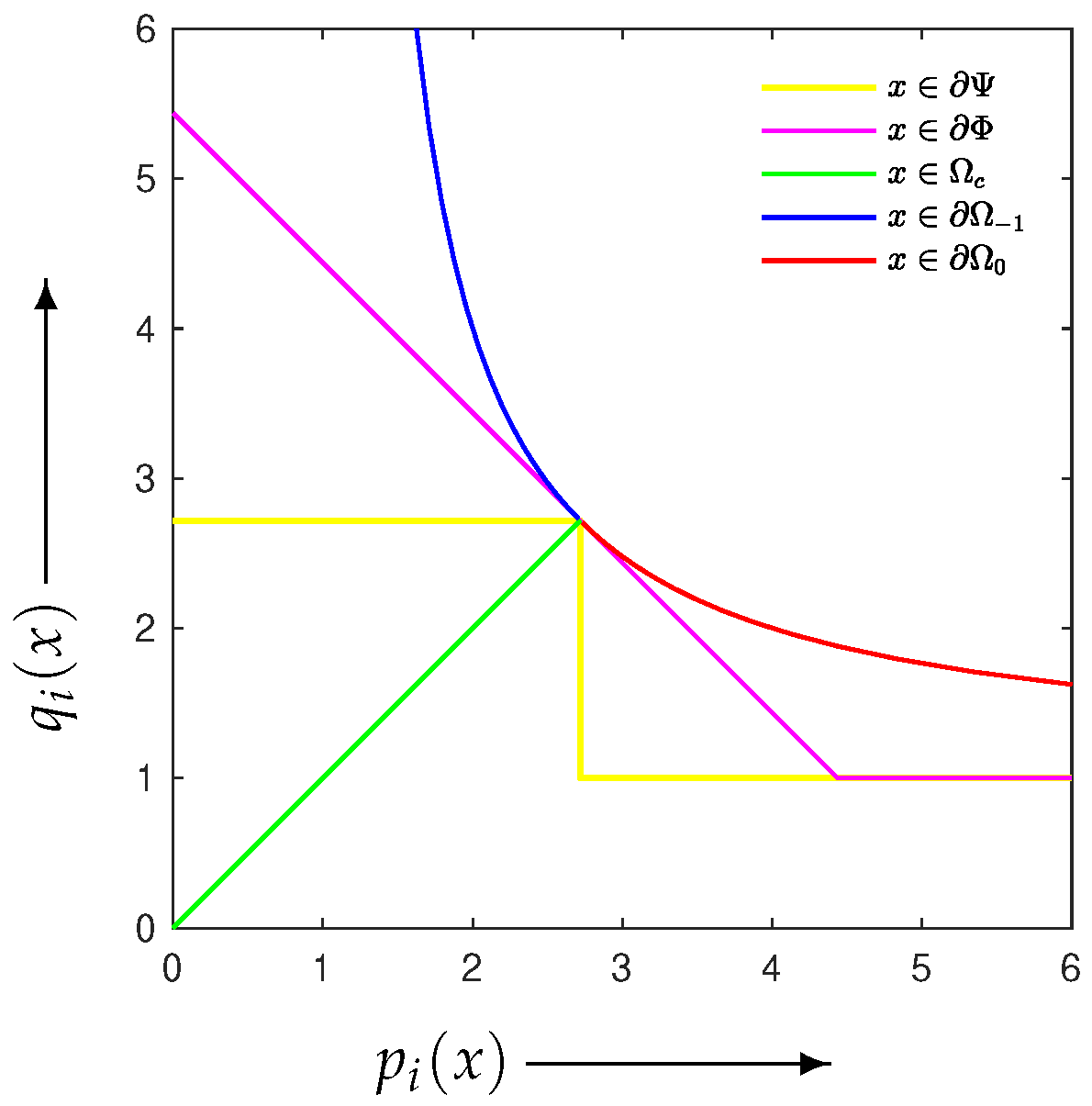
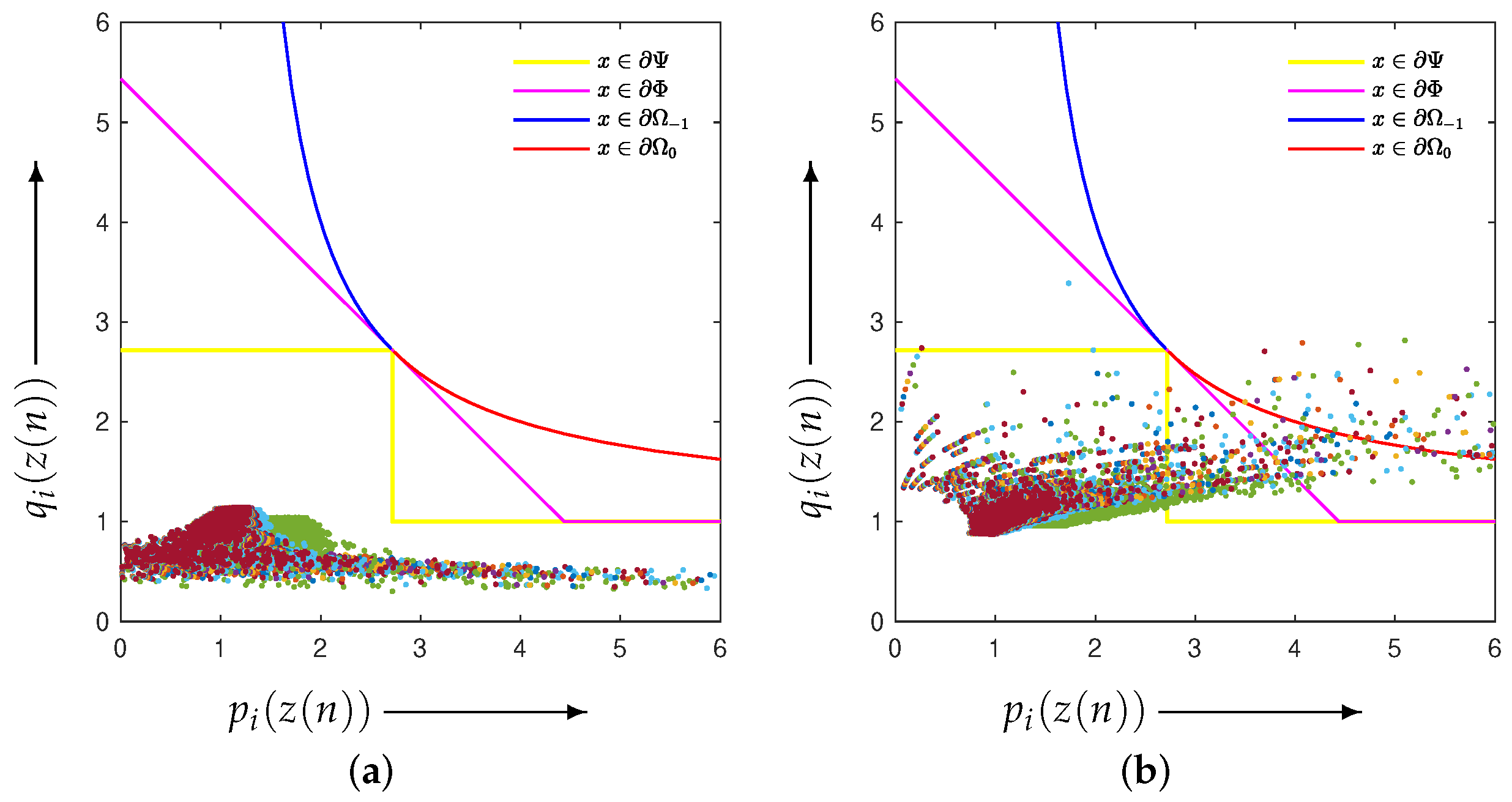
We mapped the elements
x of the sets
and
into the
plane using the functions
and
, as visualized in
Figure 1. At the equilibrium point
, the condition
holds by definition. Specifically, for the parameter values
and
, the equilibrium point corresponds to
. Throughout the evolution of the state trajectory
, the values of
and
defined in Equations (
6) and (
7) remain within the boundaries depicted in the figure. For the purpose of analytical verification, the state space
is constructed such that the projection of the state behavior is guaranteed to remain within the stable region. As shown in Proposition 3, the set
provides a practical subset of
under specific parameter constraints. These theoretical bounds have been consistent with the experimental results discussed in
Section 4.
4. Numerical Experiments
In this section, we evaluate the performance of the
Parametric Divergence Minimization Algorithm (PDMA), the discrete-time reconstruction scheme defined in Equation (
11), which is obtained by applying multiplicative Euler discretization to the continuous-time system in Equation (
9). To assess its efficacy in minimizing the mutual power divergence, we compare PDMA with two established iterative methods: SMART and the Maximum-Likelihood Expectation-Maximization [
35,
36] (MLEM) method. In the numerical experiments, SMART is abbreviated as MART to maintain notational consistency with MLEM and PDMA.
4.1. Experimental Setup
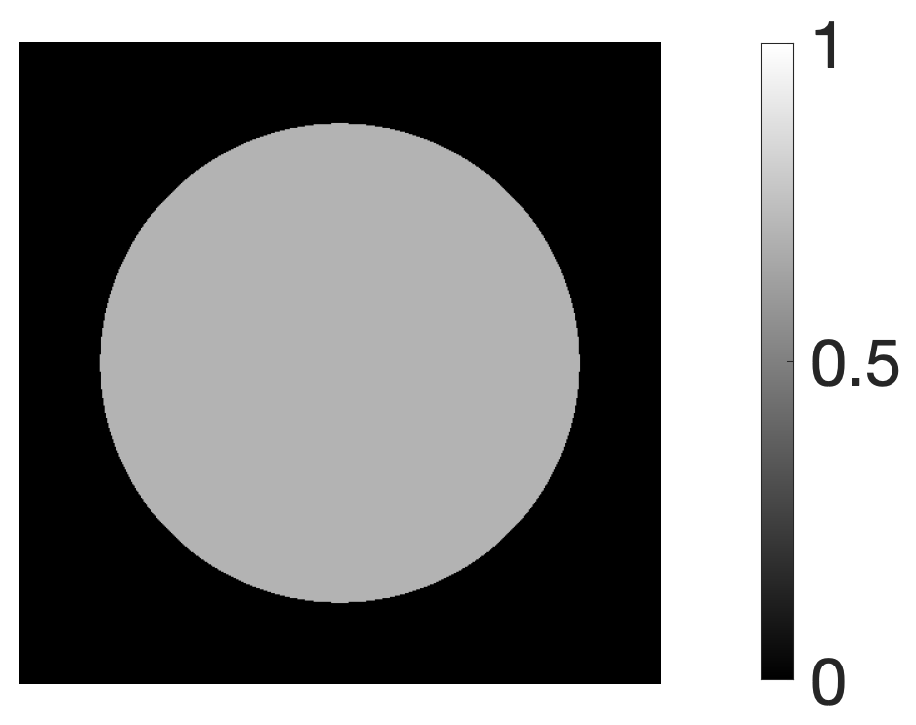
As the ground-truth image
c, we used a synthetic circular Disc phantom consisting of piecewise-constant intensity regions with a spatial resolution of
pixels
262,144, as shown in
Figure 2. The phantom, characterized by uniform intensity regions, was chosen to examine the ability of each algorithm to suppress noise and artifacts while preserving edge sharpness.
The measurement geometry was configured as a 180-degree parallel-beam scan. To simulate a sparse-view reconstruction scenario, we used only 30 projection directions, uniformly spaced at 6-degree intervals. With 365 detector bins per direction, the total number of measurements was 10,950.
The system matrix
A was normalized so that the largest eigenvalue of
equals 1. The phantom image
c is a binary Disc phantom whose pixel values are 0 and 0.7. Under this setting, the noise-free data generated from Equation (
5) with
satisfy
for
, the largest value considered in the experiments. Hence, the data satisfy the condition on
y appearing in Proposition 3.
The data
were generated according to the linear forward model in Equation (
5) with the true image
. In the noisy case, additive Gaussian noise
was introduced, resulting in
. Gaussian noise is commonly used as an approximation of measurement noise in reconstruction studies.
Experiments were conducted under two conditions: a noise-free case and a noisy case in which the signal-to-noise ratio (SNR) was set to 20 dB.
Although the stability condition in Proposition 3 was derived for , we also examine the case in order to explore the empirical boundary of the algorithm’s performance. This allows us to observe whether convergence is maintained even when the state leaves the analytically guaranteed subset .
For all iterative algorithms evaluated, the initial estimate
was chosen as a uniform image whose scale is consistent with the magnitude of the data. Specifically,
The reconstruction accuracy is evaluated using two metrics. The first is the evaluation function
which measures the Euclidean distance between the reconstructed image
and the true phantom
c. The second is the multiscale structural similarity index measure [
37] (MS-SSIM, abbreviated as SSIM hereafter), which assesses the structural fidelity of the reconstructed image.
All numerical simulations were implemented in MATLAB R2023a (MathWorks, Natick, MA, USA). The computations were executed on a workstation equipped with an Apple M2 Max chip (Apple Inc., Cupertino, CA, USA) and 64 GB of RAM. All parameters were fixed across methods unless otherwise specified.
4.2. Results and Discussion
We first examine the convergence behavior in a noise-free setting where the system is consistent. We then evaluate the robustness of the algorithms under noisy conditions. Finally, the reconstruction accuracy is compared using quantitative evaluation metrics.
4.2.1. Noise-Free Case
We begin with the noise-free case where the system is consistent.
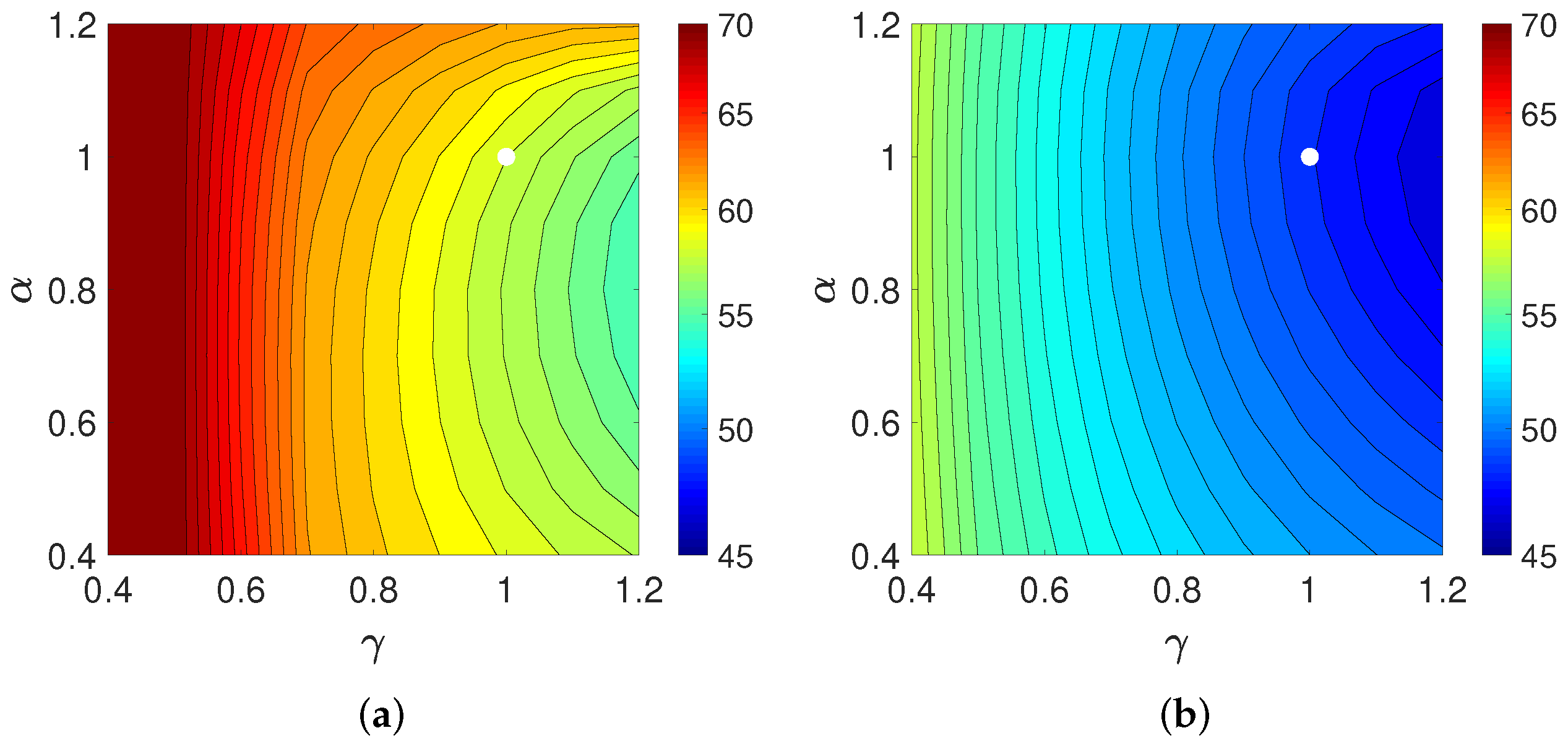
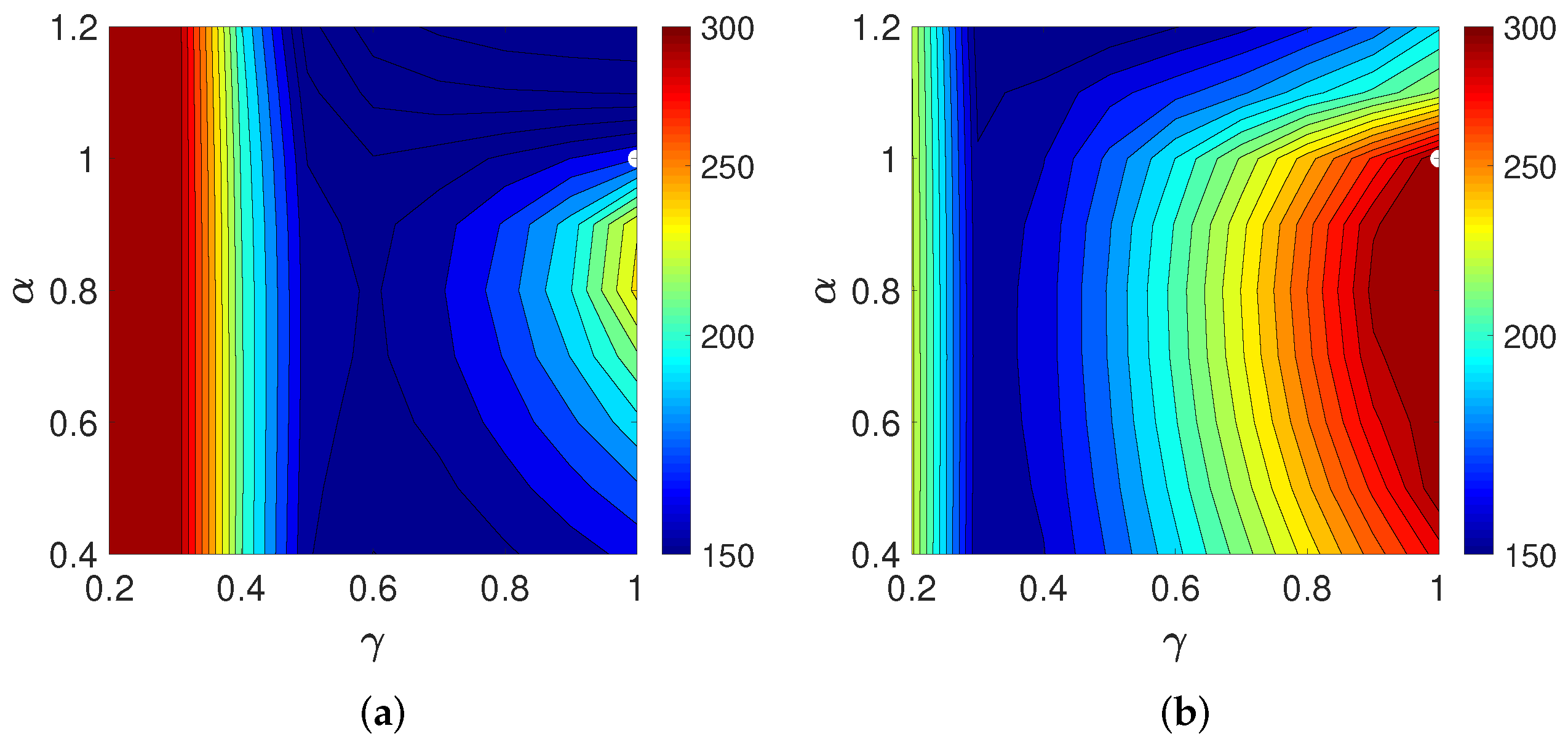
Figure 3 shows the contour plots of the evaluation function
in Equation (
40) for various parameter settings
. The contours are drawn on a logarithmic scale. At the 5th iteration (
), the value is minimized near
, whereas at the 10th iteration (
), the minimum shifts toward
.
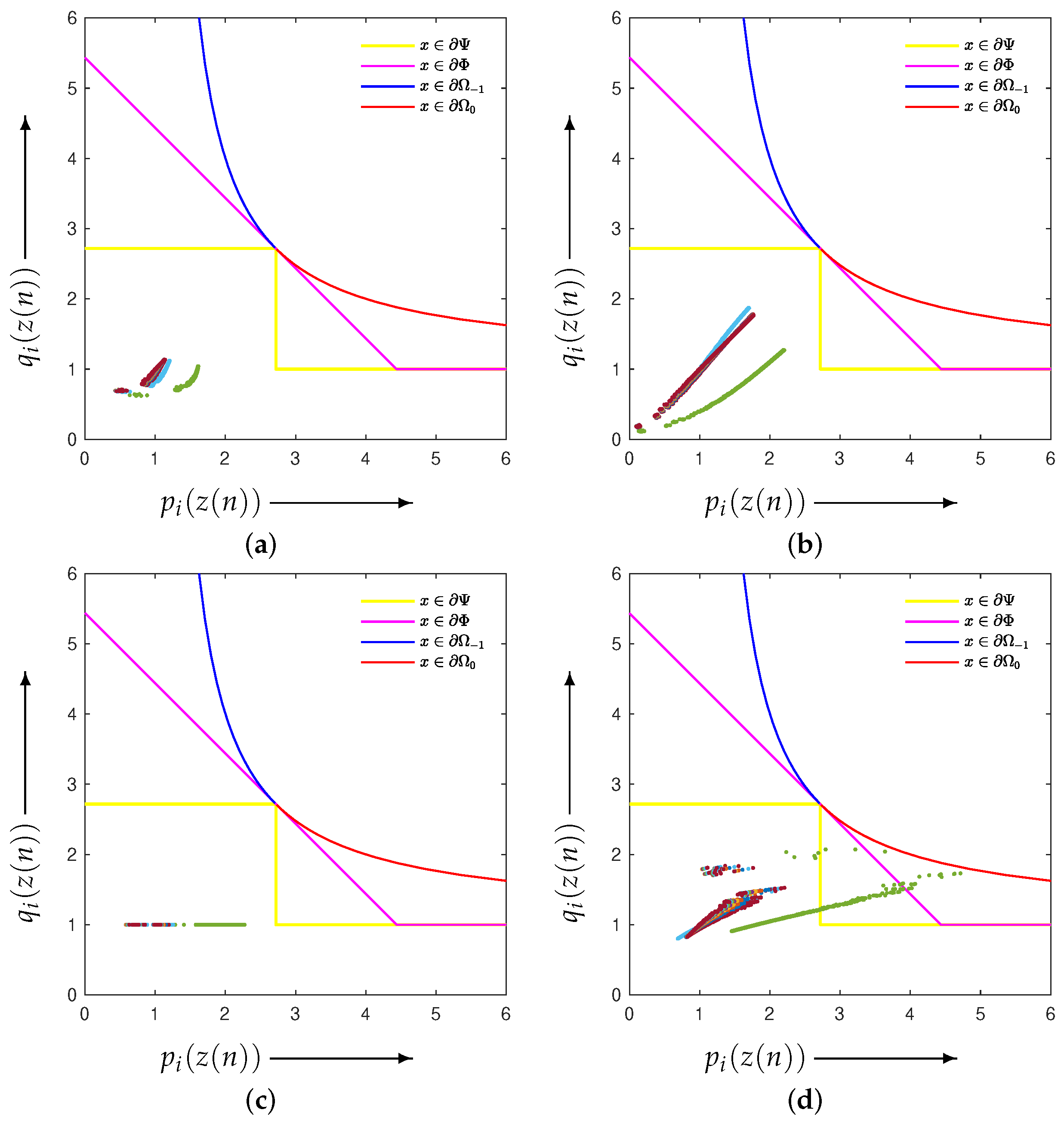
Figure 4 shows the trajectories of the iterates
, projected onto the
-plane through the points
for
. The boundaries of
,
, and
are also plotted for reference. For the cases
, the projected trajectories remain entirely within the interior of
. Representative examples are shown in
Figure 4a–c; in particular,
Figure 4c corresponds to
, where the MPD reduces to the KL divergence. The projected trajectories remain within
for
, which is consistent with Proposition 3. In contrast, when
, the trajectories can leave not only
but also
. An example of this behavior is shown in
Figure 4d. These observations indicate that the numerical trajectories follow the parameter-dependent behavior predicted by the theoretical analysis. The visualization also provides geometric insight into the invariant-region structure associated with
.
4.2.2. Noisy Case
To evaluate the robustness of the algorithms, noise corresponding to an SNR of 20 dB was added to the projection data.
Figure 5 shows the evaluation contours for the noisy case, drawn on a logarithmic scale. A comparison with the noise-free contours indicates that the preferred value of
depends on the noise level. In the noise-free case, larger values of
tend to yield lower evaluation values, whereas in the noisy case the lowest evaluation values after ten iterations are observed for
roughly in the range
–
. This observation suggests that the parameter
influences the sensitivity of the iterative dynamics to noise.
Figure 6 presents the trajectories of the points
for
and
. Compared with the noise-free case, the projected trajectories exhibit larger dispersion in the presence of noise. Nevertheless, when
, the points remain within
; an example is shown in
Figure 6a. In contrast, when
, the points can leave not only
and
but even
, as illustrated in
Figure 6b.
As shown in the comparative analysis below, improved reconstruction accuracy is often observed in the noisy case for settings with
. This tendency may be related to the power-weighting structure of the MPD: increasing
attenuates the influence of large prediction values in the dynamics. This observation does not contradict the theoretical analysis, since the theory assumes that the linear system is consistent, whereas the presence of additive noise leads to an inconsistent system. In inverse problems, such inconsistency is known to modify the behavior of iterative dynamics, and trajectories may leave regions where theoretical guarantees are established [
1,
20]. From a dynamical systems perspective, the measurement noise acts as an external perturbation to the iterative dynamics, which can push the state trajectory outside invariant regions derived for the noise-free model.
4.2.3. Comparative Analysis
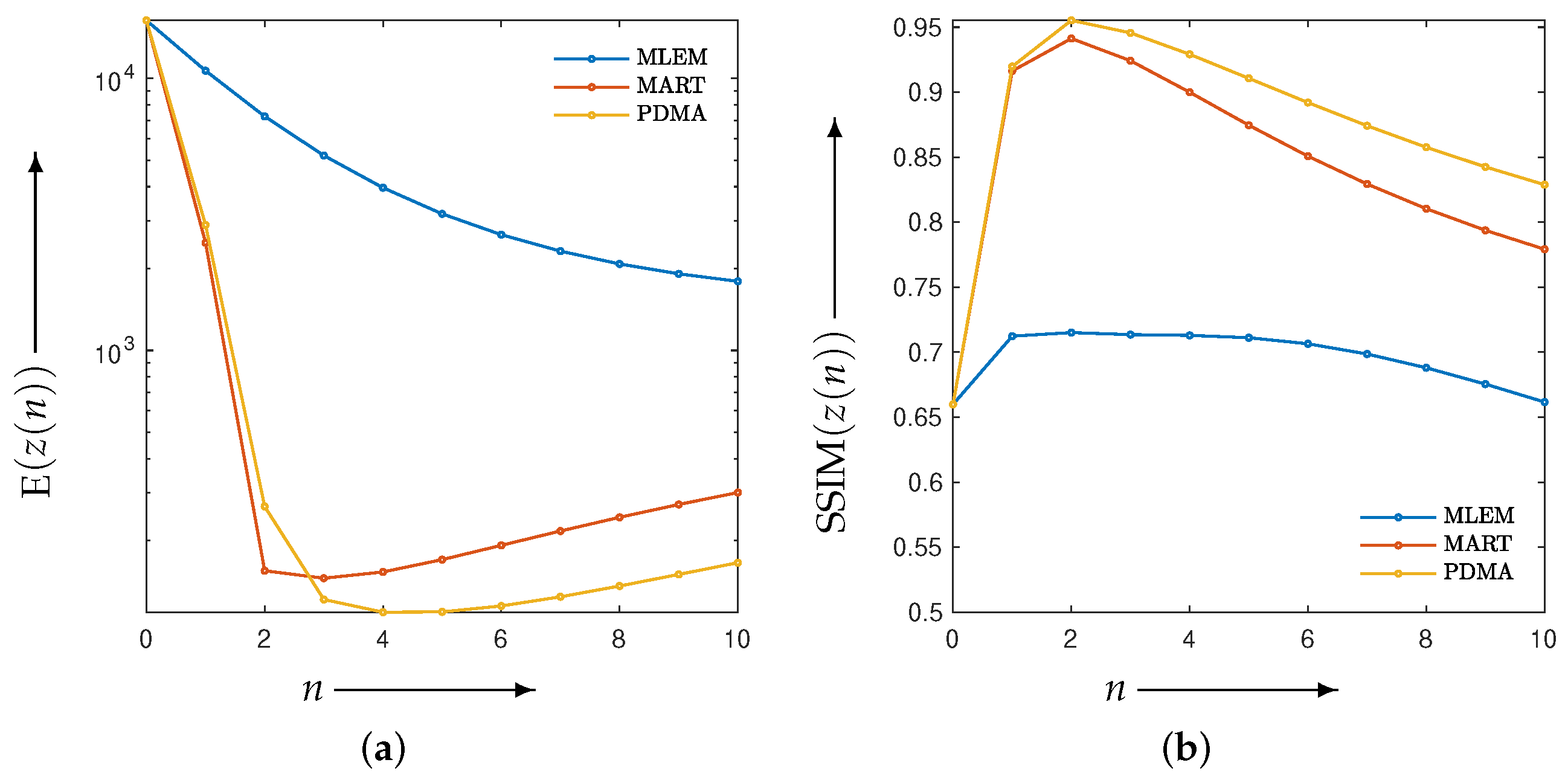
Figure 7 compares the evolution of
and SSIM for PDMA, MART, and MLEM under noisy conditions, where noise corresponding to an SNR of 20 dB was added to the projections. For PDMA, the parameter setting
is employed throughout this comparison. As shown in
Figure 7a,b, PDMA consistently achieves the lowest evaluation values and the highest SSIM values among the three methods throughout the iterative process.
As shown in
Figure 7a, MART reduces the evaluation function substantially faster than MLEM. This rapid convergence is a well-known advantage of multiplicative algebraic reconstruction methods over expectation-maximization-based approaches [
19,
38], and is particularly pronounced in sparse-view settings such as the present experiment, where the number of projection directions is small relative to the number of unknowns. The ability to reach a good reconstruction in fewer iterations is practically significant since iterative methods generally require greater computation time than transform-based methods such as filtered back-projection. Both MART and PDMA reach a minimum evaluation value before the 10th iteration and subsequently show a slight increase. PDMA further improves upon MART in reconstruction accuracy: it attains a minimum evaluation value below those achieved by MART and MLEM, indicating that the reconstruction quality of PDMA cannot be matched by either MART or MLEM regardless of the number of iterations. In this sense, PDMA can be regarded as an enhanced generalization of MART within the proposed two-parameter formulation.
Regarding structural quality,
Figure 7b shows that PDMA consistently yields the highest SSIM values among the three methods, indicating superior preservation of structural features in the reconstructed images.
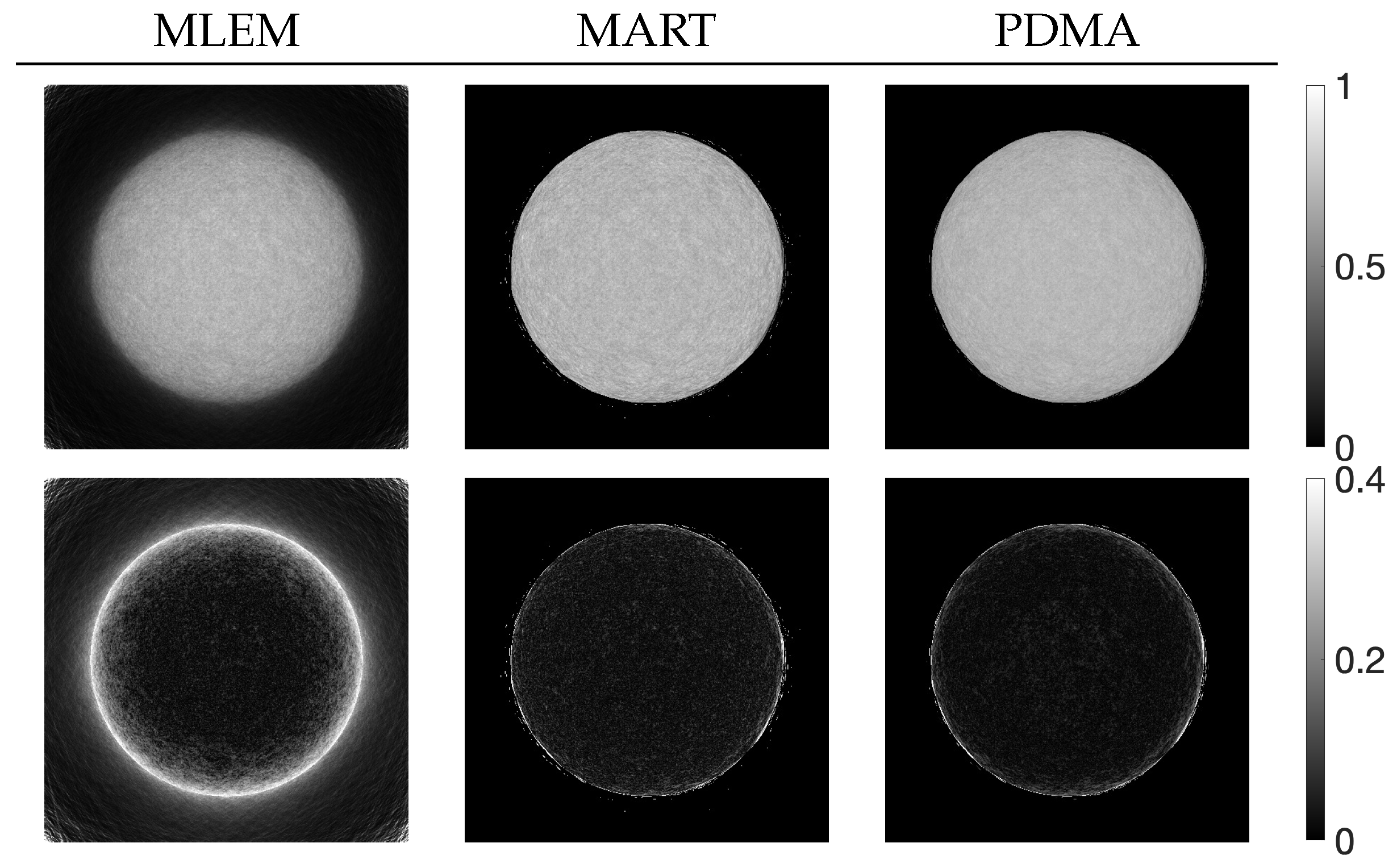
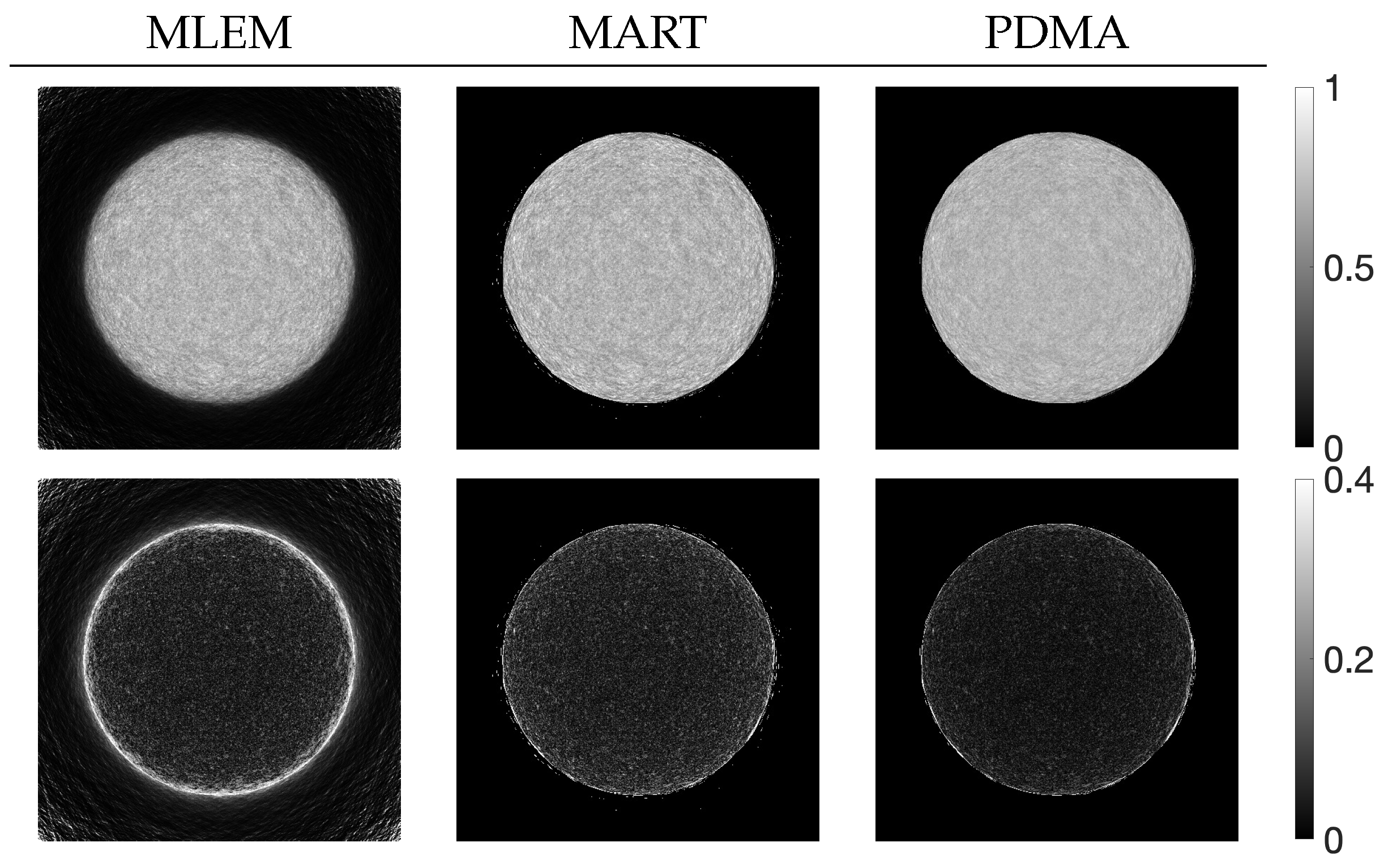
Figure 8 and
Figure 9 display the reconstructed and difference images for each method at early and later stages of the iteration process, respectively. Since PDMA requires a higher computational cost per iteration than MLEM and MART, comparisons are made at iteration numbers that approximately equalize the total computational cost: PDMA at the 4th and 8th iterations is compared with MLEM and MART at the 5th and 10th iterations, respectively. Visually, despite having fewer iterations, PDMA exhibits the lowest noise levels in the flat regions and maintains the sharpest edges compared to MLEM and MART.
To quantify the reconstruction accuracy,
Table 1 reports the standard deviation of the difference between the reconstructed image and the true phantom for each method at the corresponding iteration numbers. PDMA achieves a substantially smaller standard deviation than MART and MLEM at both stages, indicating that the error in the reconstructed image is more uniformly suppressed across the image domain.
5. Conclusions
In this paper, we proposed a dynamical-system formulation for linear inverse problems based on a newly introduced discrepancy measure, the mutual power divergence (MPD). The MPD evaluates the mutual consistency between the measurement and the prediction and provides a natural Lyapunov function for constructing a continuous-time dynamical system associated with the inverse problem.
Using this divergence, we derived a nonlinear dynamical system whose equilibrium points correspond to solutions of the linear model. The stability of the system was established using Lyapunov theory and LaSalle’s invariance principle under suitable conditions on the state space. In particular, we introduced a practically verifiable subset of the state space in which the MPD acts as a Lyapunov function and guarantees convergence to the solution set .
By applying a multiplicative Euler discretization to the continuous dynamics, we obtained an iterative reconstruction algorithm, referred to as the parametric divergence minimization algorithm (PDMA). The resulting iteration forms a two-parameter family of multiplicative reconstruction methods, in which the classical SMART algorithm appears as a special case.
Numerical experiments on tomographic image reconstruction problems demonstrated that the proposed algorithm achieves favorable reconstruction performance compared with MLEM and SMART. In particular, the results indicate that the parameters of the MPD influence the sensitivity of the dynamics to measurement noise. While the theoretical analysis guarantees stability for under a consistent system, the numerical experiments suggest that parameter settings with may yield improved reconstruction accuracy in the presence of noise. These observations suggest that appropriate parameter selection plays an important role in balancing stability and reconstruction accuracy. The development of adaptive parameter selection strategies for the proposed method remains an important direction for future research. Validation on real medical imaging datasets and extension to other classes of inverse problems, such as network estimation and signal recovery, are also important directions for future work.
A key feature of the proposed formulation is that the Lyapunov function arises directly from the divergence structure, thereby clarifying the connection between divergence-based reconstruction methods and dynamical systems, and providing a dynamical interpretation of the resulting algorithm.
From a practical standpoint, SMART is known to achieve rapid convergence with edge-preserving reconstruction in sparse-view settings, offering advantages over MLEM in terms of both iteration count and image quality. The proposed PDMA retains these strengths while providing further improvement in reconstruction accuracy through the two-parameter flexibility of the MPD, and thus constitutes a meaningful generalization of SMART.