1. Introduction
As competition for talent intensifies and higher-education evaluation systems undergo significant transformation [
1], talent mobility has emerged as a crucial factor influencing the ecological balance of regional higher-education systems. Its evolution is intertwined with institutional policy orientations, inter-university competitive dynamics, and fluctuations in the external environment, all of which significantly affect the innovative vitality and developmental potential of regional higher education [
2]. Talent mobility within higher-education institutions is not merely a linear migration process; rather, it encompasses nonlinear feedback mechanisms, delay effects in management decisions, and random disturbances from the external environment [
3]. These characteristics collectively define the complex dynamic nature of the talent mobility system [
4,
5,
6]. Investigating its underlying coupling mechanisms can refine theoretical frameworks and yield valuable insights for improving the precision of talent policies [
7,
8].
Talent mobility, a critical factor influencing regional resource allocation, industrial upgrading, and the optimization of educational systems, has attracted significant attention across various disciplines, including economics, education, and management [
9]. Recent years have seen scholars conduct comprehensive investigations into its key influencing factors, intrinsic driving mechanisms, and practical regulatory strategies, resulting in substantial research findings [
10,
11]. Initially, research concentrated on macro-level mobility phenomena and their driving mechanisms. For instance, Leonardo Mazzoni et al. [
12] employed network analysis and gravity models to examine the migration patterns of non-local startup founders across Italian regions. Their findings indicated that the quality of entrepreneurial ecosystems serves as the primary environmental driver of talent mobility, thereby confirming the direct regulatory influence of external environments on the direction and patterns of talent flows. As research has progressed, scholars have begun to explore the underlying effects and diverse perspectives of migration. Addressing the limitations of traditional studies that primarily focus on destination countries, Jin et al. [
13] utilized the OECD REGPAT database to assess the impact of highly skilled talent migration from emerging economies to developed nations. Their analysis revealed that talent mobility is not merely a phenomenon of “brain drain”; rather, it facilitates the backflow of knowledge and technology, disrupts the path dependence of technological development in sending countries, and fosters international technological cooperation. This perspective offers new insights into the long-term value of talent mobility. Furthermore, to address the limitations of existing studies—which often depend on extensive descriptive analysis or coarse-grained quantitative methods—Xu et al. [
14] proposed a fine-grained, data-driven modeling approach. By utilizing deep sequence models to convert migration modeling into predictions of dynamic network edge weight increments, they achieved a precise characterization of migration dynamics while demonstrating robust performance, even in the presence of incomplete historical data. However, current research lacks theoretical and mechanistic characterizations of the nonlinear dynamic evolution of talent mobility, complicating the understanding of how key variables, such as time delays and random disturbances, influence the stability of mobility systems. Thus, developing theoretical models from a dynamical perspective provides new insights for further exploration of the evolutionary patterns of talent mobility [
15].
Dynamical systems theory, renowned for its capacity to quantitatively analyze dynamic evolutionary processes, has emerged as a robust tool for examining complex phenomena characterized by multiple interacting factors and continuous state transitions, such as talent mobility [
16,
17]. Presently, the field has established a comprehensive framework that encompasses a spectrum of models ranging from deterministic to stochastic, incorporating both no-delay assumptions and delay effects, as well as linear and nonlinear couplings [
18,
19]. The associated theories and methodologies have undergone extensive practical validation across various disciplines, including mathematics, physics, engineering, and biology. These approaches not only exhibit maturity and standardization but also demonstrate significant adaptability across different scenarios [
20,
21,
22,
23,
24]. M. Higazy et al. [
25] utilized systems of ordinary differential equations as fundamental tools to develop mathematical models addressing coupled harmonic oscillator motion and serial chemical reactant concentration issues. They introduced the
transformation, which through numerical verification has been shown to yield precise solutions without the need for complex computations, thereby offering an efficient solution paradigm for deterministic simple systems. Building upon this foundation, scholars have expanded their research to nonlinear stochastic systems to explore more complex dynamical scenarios [
26,
27,
28]. Furthermore, to address real-world situations involving multiple coupled factors, the study incorporated time delay effects. Yang et al. [
29] developed a nonlinear delayed stochastic differential equation that includes distributed delays and Gaussian white noise. By employing dimensionality reduction through central limit theory and analyzing the Fokker–Planck–Kolmogorov equation, they uncovered stochastic bifurcation behavior induced by critical thresholds in delayed feedback intensity, thus providing valuable insights for examining system stability and dynamic evolution mechanisms.
On the other hand, dynamical theory and Lyapunov extension methods have been widely applied to the stability analysis of stochastic and delayed systems [
30]. These methods are primarily focused on qualitative stability criteria for deterministic or simple stochastic systems, providing crucial support for the fundamental assessment of system dynamics. At present, the construction of Lyapunov functions remains challenging. Not only must they strictly satisfy the constraints imposed by the system’s dynamic behavior, but they must also balance the solvability of the functional form with the feasibility of theoretical analysis [
31]. Compared with existing Lyapunov extension frameworks, this paper combines central manifold theory with the stochastic averaging method to effectively reduce the dimensionality of high-dimensional systems, thereby overcoming the difficulty of traditional Lyapunov methods in conducting quantitative bifurcation analysis for high-dimensional delayed stochastic systems. By deriving the one-dimensional averaged
equation and combining it with the Fokker–Planck–Kolmogorov equation, we achieve a joint analysis of system stability and stochastic bifurcation behavior [
32]. Furthermore, by incorporating the number of nodes, time delays, and noise intensity into a unified analytical framework, this study clarifies the scale-dependent critical bifurcation characteristics of the system. This extends the applicability of Lyapunov-type methods to complex social dynamic systems, providing a new, more practical, and interpretable approach for the dynamical analysis of talent mobility systems in higher education.
Based on the aforementioned research, talent mobility should not be viewed as the outcome of isolated individual choices or a single policy initiative. Rather, it is influenced by the interplay of multiple complex factors, including delays in policy implementation and abrupt environmental changes. The combined effects of these elements collectively shape the dynamic evolutionary characteristics of the talent mobility system. Consequently, to enhance the model’s realism, it is crucial to account for the effects of time delays and random factors when examining the talent mobility system within higher-education universities [
33].
This paper presents a three-dimensional talent mobility model that incorporates time delay and randomness, capturing the interrelationships among three core driving factors. Additionally, within a regional higher-education ecosystem, the talent policies of individual universities are both constrained by and influenced by the behaviors of other universities. Consequently, we integrate the influence of these institutions into the model to quantify the amplification effect of the number of system nodes on talent mobility. Acknowledging the significance of time delays in producing complex dynamic behavior within the system, we introduce a delay effect to represent the delayed nature of managerial decisions. Finally, we utilize a multiplicative noise term to account for environmental uncertainty. This modeling approach more accurately reflects reality than traditional additive noise, as the impact of random disturbances becomes more pronounced with greater deviations from equilibrium.
The remainder of this paper is organized as follows.
Section 2 introduces a three-dimensional mathematical model of talent flow that incorporates time delays and randomness, and it derives the conditions necessary for the occurrence of Hopf bifurcations.
Section 3 derives the averaged
equation using the central manifold theorem and stochastic averaging methods. By solving the corresponding Fokker–Planck–Kolmogorov equation, we obtain the probability density function, which ultimately characterizes the system’s stochastic bifurcation behavior.
Section 4 validates the theoretical results through numerical simulations. Finally,
Section 5 offers a comprehensive summary of the entire research work.
2. Model and Methods
Talent mobility among universities within a region is a complex process influenced by various factors. Consequently, we propose a model that identifies three core variables for each university in the region: the proportion of faculty talent at the university relative to the regional total
x, the university’s attractiveness
y, and the intensity of its performance evaluations
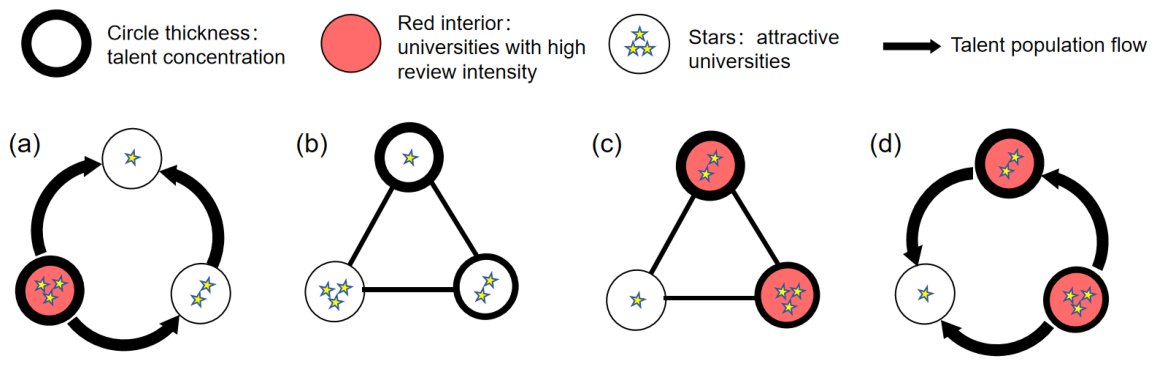
z. Our model accounts for talent migration from institutions characterized by high assessment intensities to those with lower intensities. As the proportion of faculty talent increases, institutional attractiveness also rises; in turn, as attractiveness increases, the intensity of institutional assessments tends to rise as well. As depicted in
Figure 1, the model is organized as follows. Faculty talent migrates from institutions characterized by high assessment intensity to those with low assessment intensity [
Figure 1a], thereby increasing the proportion of faculty talent at the receiving institution [
Figure 1b]. This influx subsequently enhances the institution’s attractiveness and assessment intensity [
Figure 1c]. The increased assessment intensity then attracts faculty talent to institutions with even lower assessment intensity, resulting in a cyclical pattern [
Figure 1d]. The model posits that institutional attractiveness inherently diminishes in the absence of faculty talent. We assert that faculty mobility decisions are contingent upon the disparity between an institution’s evaluation intensity and the regional average, specifically guiding movement toward institutions with lower evaluation intensity. For instance, when an institution’s evaluation intensity is
z, talent will migrate to other institutions only if
. To streamline the model, we assume the migration rate is represented by
, where
Here, is used to characterize the asymmetric nature of talent mobility; talent flows into a university only when its evaluation intensity is lower than the regional average, and when the evaluation intensity exceeds the average, mobility ceases. This accurately reflects the actual behavioral preferences of university faculty, who tend to avoid high-intensity evaluations and prefer evaluation environments that are more conducive to their professional development.
Based on our previous discussions, we hypothesize that an influx of teaching talent into a university will enhance its attractiveness. This increased attractiveness, in turn, is expected to elevate the evaluation intensity at the institution. In light of these dynamic characteristics, we have developed the following model:
Here,
takes the form of a normalized inverse tangent function to describe the nonlinear, saturating effect of the proportion of talent on a university’s attractiveness and evaluation intensity. In the higher education system, a university’s attractiveness increases as the scale of its faculty talent expands; however, due to practical constraints such as educational resources, institutional infrastructure, and development opportunities, the growth in attractiveness exhibits diminishing marginal returns and eventually stabilizes. At the same time, the boundedness, smoothness, and saturation characteristics of the arctan function accurately reflect the intrinsic constraints and nonlinear transmission mechanisms of the higher-education system. It satisfies the mathematical regularity required for stochastic dynamical analysis and is a reasonable choice for characterizing the relationship between the scale of talent and university attractiveness.The model assumptions, variables and parameter descriptions involved in this paper are presented in
Appendix A.3 and
Appendix B respectively.
In the modeling process, , while k and D denote the adjustment rate parameters for university attractiveness and assessment intensity, respectively. The variable signifies the implementation cycle from policy formulation to its impact on talent mobility behavior. The nonlinear nature of the function in the model effectively captures the real-world relationships among the talent proportion, university attractiveness, and assessment intensity. This aspect provides essential support for the evolution of complex system dynamics, thereby significantly enhancing the model’s explanatory power concerning real-world phenomena. Setting the system of equations to zero results in equilibrium points at . Within this system, represents a baseline assessment intensity determined by the scale of the system. When the actual assessment intensity z falls below this baseline, the system tends to attract talent and foster growth. The growth potential is regulated by ; as the proportion of talent approaches saturation, the available growth space naturally diminishes. The second term, , introduces a competitive mechanism. Here, denotes the number of other universities within the system, indicating that talent mobility is not only influenced by institutional policies but also constrained by the competitive dynamics of the entire system. When z diverges from the benchmark, this deviation is exacerbated by competition, resulting in a feedback regulation. The term represents Gaussian white noise, symbolizing unpredictable external shocks, such as sudden policy changes or economic fluctuations. The parameter signifies the intensity of the noise. Importantly, this is multiplicative noise, whose impact correlates with the system state ; the greater the deviation of the system from its equilibrium state , the more pronounced the effects of random disturbances become.
To facilitate further analysis, we simplify the system of Equation (1) by introducing a small perturbation at the equilibrium point, letting
Substituting into the system of Equation (1) yields the following linear equation system:
Its linear portion is expressed as follows:
The characteristic equation is
When
equals zero, Equation (
6) becomes
The above equation can be simplified to
According to the Routh–Hurwitz stability criterion, it can be determined that when , at this ordinary equilibrium point , the system is locally asymptotically stable.
Assuming the equation has purely imaginary roots
and a critical delay
, substituting these into Equation (6) yields
For convenience of notation, let
. Separating the imaginary and real parts of Equation (8) yields
According to Equation (
9), combined with
, we obtain
Let
. Using numerical simulation methods to solve this equation, we calculate the positive real roots
of this equation for different values of
N and substitute them into Equation (
9) to obtain
By definition, we have
when
takes the value
,
. According to the Hopf bifurcation theorem, when the system satisfies the transversality condition; that is, when
the stability of the system in Equation (
1) changes.
Lemma 1 (Transverse Condition). If , then a bifurcation occurs near the equilibrium point when τ passes through .
Proof. Differentiating the characteristic Equation (6) with respect to
yields
Since
and
share the same sign, for computational convenience, we can derive the expression for
, namely
□
3. System Simplification and Random Branching
Near the equilibrium point, even minor variations in parameters allow central manifold theory to effectively describe the system’s dynamical behavior. This section first applies central manifold theory to reduce the dimensionality of the system. Subsequently, the stochastic averaging method is employed to derive a one-dimensional equation for the system’s amplitude, from which the corresponding Fokker-Planck-Kolmogorov equation is subsequently obtained.
This study necessitates an examination of the system’s nonlinear components. The previously referenced noise term
is now represented by
. Employing a similar methodology as before, we introduce a small perturbation at the equilibrium point into the system of Equation (1). In the process of simplification, we retain the nonlinear terms. To maintain the integrity of our analysis, we included the nonlinear terms up to the fifth order in the second equation. This resulted in the following nonlinear differential equation:
Let
. Then, the system in Equation (
14) can be represented by a PDE in
:
Among these,
,
:
, and
are defined as follows:
Under the
representation theorem, there exists a bounded variable difference function
, resulting in
. Among these,
For
and we define the operator
Then, Equation (15) is equivalent to
. As for
, we define
The operator
is the adjoint operator of
. For
and
, a bilinear inner product can be defined:
where
. Assume that
is the eigenvector corresponding to the eigenvalue
of the operator
, where
,
. Then, we have
, yielding
,
,
. Similarly, the eigenvector corresponding to the eigenvalue
of the operator
is given by
. Solving this yields
,
,
, where
,
. We define a matrix
Here,
:
where
.
For
, the bilinear inner product can be written as follows:
Substituting
and
yields the nonsingular matrix
:
Thus,
:
where
.
The space
comprises two-dimensional subspaces
associated with the characteristic roots of the equation
, along with infinite-dimensional subspaces
, corresponding to all other eigenvalues of the characteristic equation. Thus, we can express
as
. Consequently,
serves as a basis for the subspace
, allowing the dynamics of the system on the central manifold to be represented by
. We obtained the following equation for
(Detailed derivation of the equation for z(t) is shown in
Appendix A.1.):
where
Through polar coordinate transformation, we have
We can obtain stochastic differential equations for the amplitude process
R and the phase process
:
where
Subsequently, the one-dimensional average
equation for
R was derived using the stochastic averaging method:
where
and
Note that
represents the Euclidean modulus. Consequently, the asymptotic stability condition for the system in Equation (
16) approximates the stability condition for the system in Equation (
1), indicating that the Lyapunov exponent at the equilibrium point (left boundary) approximates the maximum Lyapunov exponent of Equation (
1). The linear equation corresponding to the stochastic
differential equation (Equation (16)) is
The solution to the above equation is
The limit of the Lyapunov exponent for linear stochastic
differential equations is
The asymptotic stability condition for the sample is . When , a random D-bifurcation occurs.
Based on the stochastic
differential equation for the amplitude
, we obtained the corresponding Fokker–Planck–Kolmogorov equation for the system:
When
, the steady-state Fokker–Planck–Kolmogorov equation is obtained as follows:
Through calculation, the steady-state probability density
is obtained as follows:
By setting the first derivative of the PDF
and the second derivative
, we derive the bifurcation critical equations:
Detailed derivation of the
equation and steady-state probability density
is presented in
Appendix A.1.
4. Numerical Simulation
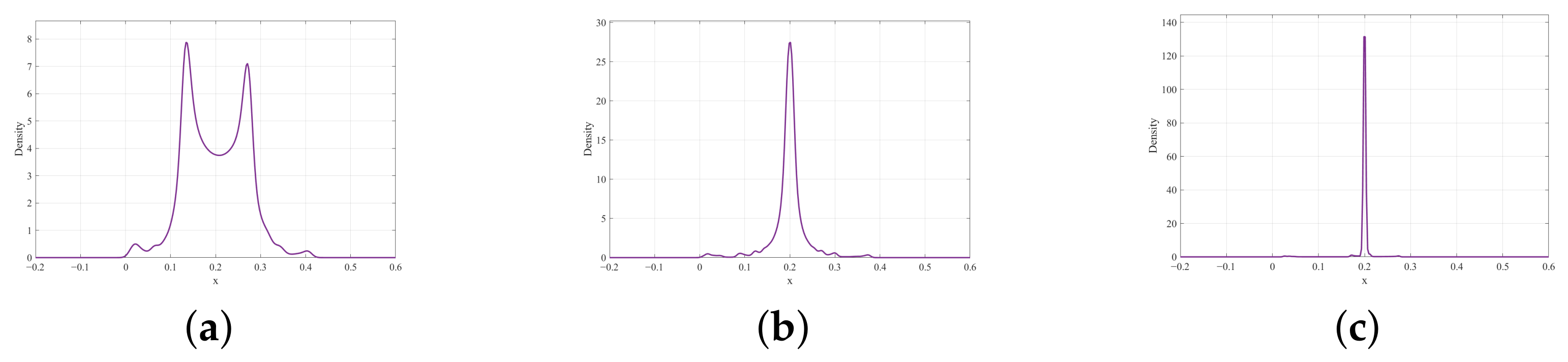
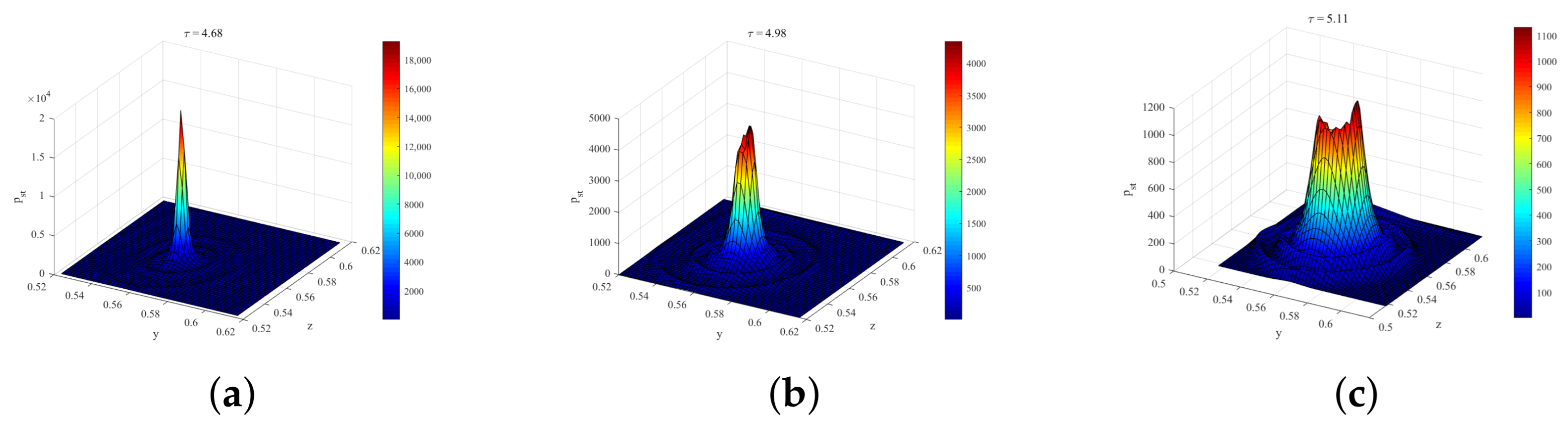
The phenomenon of random bifurcation can be intuitively demonstrated through the probability density plots presented in the figure. The probability density function in
Figure 2a displays a
function shape, whereas
Figure 2b,c illustrates unimodal and crater-shaped distributions, respectively, signifying the existence of non-trivial probability densities. This observation clearly indicates that the system has experienced a random D-type bifurcation. Furthermore, the transition from
Figure 2b to
Figure 2c reveals that the system exhibits characteristics of a random P-type bifurcation.The introduction to numerical simulation methods and algorithm flowchart are shown in
Appendix A.2 and
Appendix A.4 respectively.
In
Figure 2 and
Figure 3, the parameters
were chosen to simulate the probability density plots of the system under varying time delays, specifically
. According to Equations (19) and (23), a random
D bifurcation was identified at
, while a random
P bifurcation occurred at
.
Figure 2a reveals that the probability density was predominantly concentrated at the equilibrium point. Given the parameter conditions, the delay
was less than the critical D-bifurcation value for the system at this time, and the noise intensity
remained below the threshold. Consequently, the system was in an asymptotically stable state. When the decision-making delay in higher-education institutions is maintained below the D-bifurcation threshold, the system can autonomously sustain equilibrium within the talent ecosystem, even in the face of moderate external influences, without necessitating additional intervention.
Figure 2b, with a time delay of
, the system displayed a unimodal distribution, signifying a transition from deterministic equilibrium to stochastic stability, which was identified as a stochastic D bifurcation. This phenomenon acts as an early warning signal for necessary policy adjustments, highlighting the need for timely preventive measures to avert further instability within the system.
Figure 2c illustrates a crater-shaped distribution. At this juncture, with a time delay of
, a stochastic P bifurcation occurred, prompting the system to experience periodic oscillations that were exacerbated by the noise intensity. During this phase, competition among universities escalates; some institutions experience talent loss due to excessive evaluation pressures, while others successfully attract talent through compelling appeal, ultimately resulting in a polarized bistable state.
Analysis of the probability density function graph reveals that close to the critical bifurcation point of the system, random P-bifurcation and D-bifurcation phenomena manifested. The shape of the probability density function progressively shifted from a bimodal distribution to a unimodal distribution, ultimately transforming into a -type distribution.
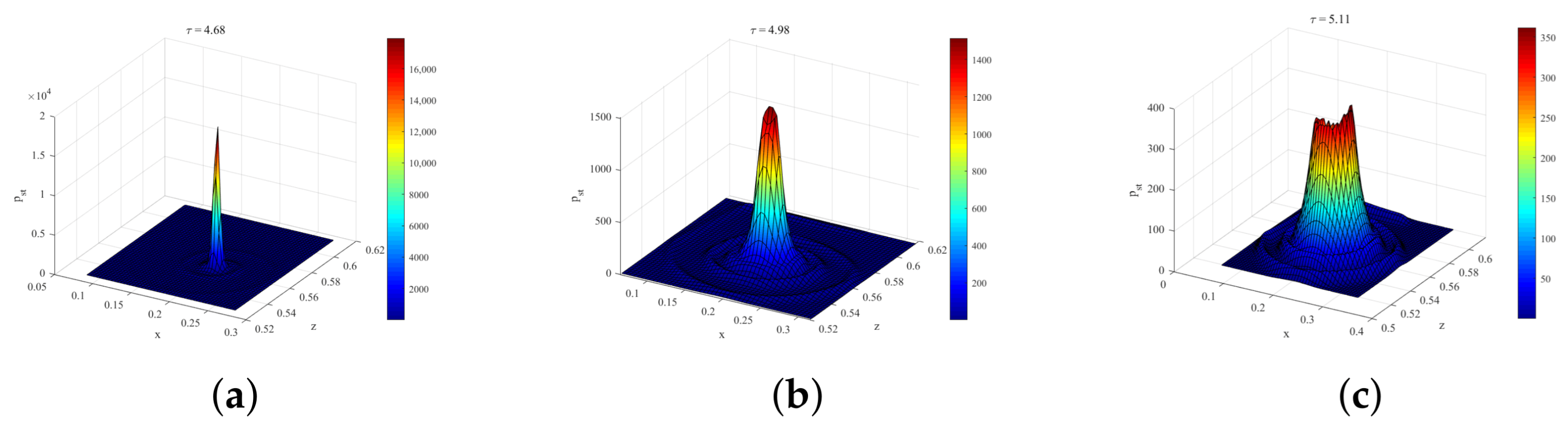
The evolution of the probability density plot in
Figure 4 further substantiates the stability transition of the system as the parameter
varied, pinpointing the critical threshold at which the system’s dynamic behavior altered when
. Based on the associated time delay intervals for various morphologies, policymakers can adopt a tiered governance strategy that ranges from emergency intervention (when
exceeds
) to early warning intervention (when
) to no intervention required (when
falls below
). This approach offers both theoretical foundations and practical guidance for precision governance within large-scale talent ecosystems in higher-education institutions.
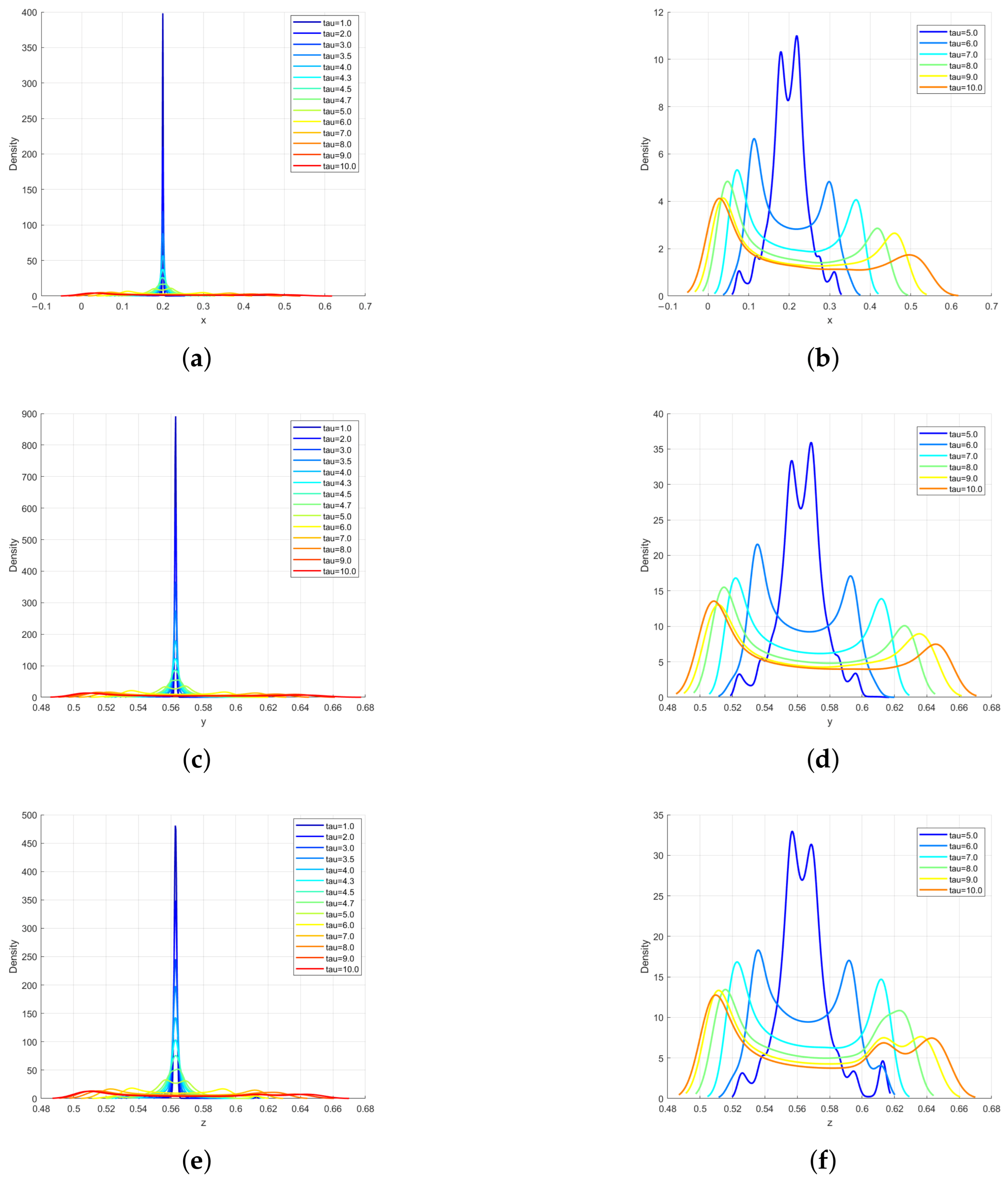
We fixed the parameters
and plotted the probability density function of the system for various time delays
.
Figure 5a,c,e displays the probability density functions for
within the range
, while
Figure 5b,d,f illustrates the probability density plots for
in the range
. Notably, when
, the probability density transitioned from a
-shaped distribution to a unimodal distribution. At
, the unimodal peak demonstrated a significant amplitude and a narrow half-width. As
increased, the system transitioned from a unimodal to a bimodal distribution, with the interpeak distance progressively widening. Consequently, for individual universities, when
, the system exhibited both stability and vitality, thereby ensuring a stable talent pool and facilitating the sustainable development of the university. In terms of regional development, when the system displayed a bimodal distribution with minimal peak separation, as observed at
, it could enhance inter-university exchanges and cooperation, as well as talent mobility. This dynamic promotes the efficient allocation of resources within the region, creating a virtuous cycle where individual competition fosters collective advancement, ultimately enhancing regional development potential.
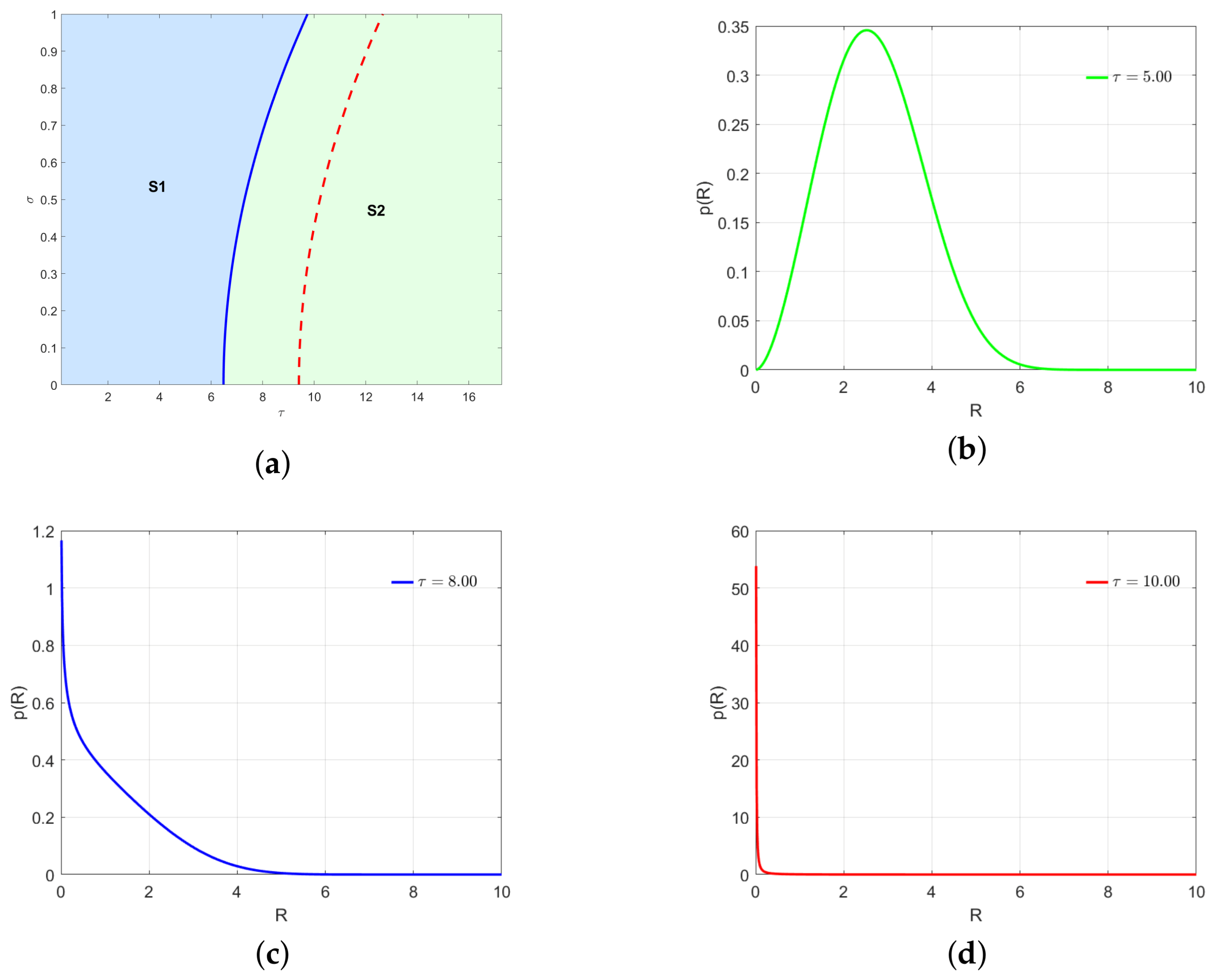
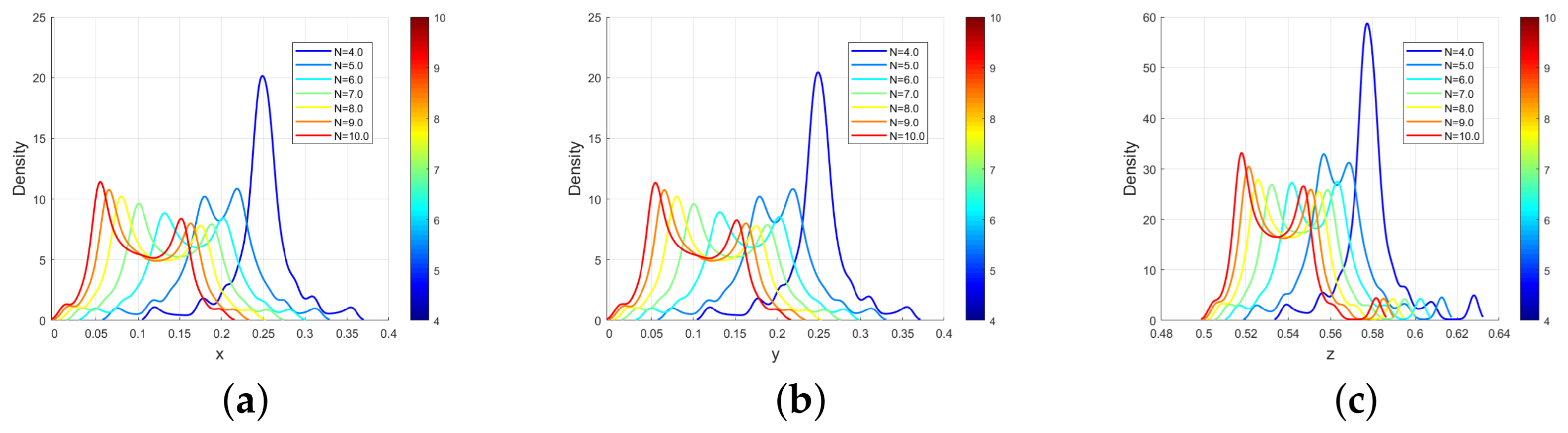
The steady-state probability density function (PDF) of the system, illustrated in
Figure 6 and
Figure 7, demonstrates that the talent ecosystem within higher-education institutions exhibited significant scale-dependent bifurcation behavior, with
identified as the critical point. When the system scale surpassed this threshold, the equilibrium between competitive mechanisms and talent clustering effects experienced a fundamental transformation. In small-scale systems (
), the talent ecosystem displayed a monostable characteristic, characterized by a unimodal probability density distribution and strong stability. This stability suggests that smaller groups of universities are more likely to achieve a balanced allocation of talent resources, wherein management policies exhibit predictability and controllability. Conversely, when the system size exceeded the critical threshold of
, a significant dynamical bifurcation occurred, resulting in the coexistence of a bimodal distribution and a bistable state. This bistable characteristic underscores the inherent complexity of large-scale university ecosystems, where the system no longer converges to a single equilibrium but instead dynamically evolves among multiple attractors. Such scale-dependent bifurcation behavior indicates that the formulation of university talent policies must thoroughly consider the critical effects of system scale, thereby avoiding a “one-size-fits-all” management approach to achieve precise and differentiated governance strategies.
For
Figure 6, with fixed parameters
,
,
,
,
,
,
,
,
,
,
, and
, the critical conditions for the random P bifurcation induced by the noise intensity
and time delay
were derived from Equation (
23). These conditions partitioned the parameter plane
into three distinct regions. In
Figure 6a, the blue solid line indicates the critical curve that separates the blue region
from the green region
, while the red dashed line marks the transition region between
and
. The parameters
,
, and
were selected from these regions, resulting in their probability density functions (PDFs) being as illustrated in
Figure 6b–d.
Figure 6c illustrates a transitional state from unimodal to non-modal distribution. This observation indicates that competition among universities in small-scale systems is relatively weak. Instability caused by time delays tends to manifest as collective fluctuations rather than individual differentiation, thereby preventing the system from evolving into a bimodal structure. The figure depicts the probability density function (PDF) transitioning from unimodal to non-modal, suggesting that as the time delay
increases, a random P bifurcation occurs. For small-scale university populations, at a noise intensity of
, the system remains in a monostable state when
. This finding demonstrates that small-scale systems benefit from strong stability and high predictability, creating favorable conditions for the development of individual universities.
For parameters
, with
,
,
, and
, the system size
N was designated as the control variable. Time series data of the system’s state variables were acquired through numerical integration. The marginal steady-state probability density functions for each state variable were computed and subsequently plotted.
Figure 7 illustrates a significant transformation in the system’s dynamic behavior as the system size
N surpassed the critical threshold of
. Specifically, as
N increased from 4.0 to 10.0, in (a), the probability density distribution of the high-level talent proportion (
x) showed an increasing trend in peak values and concentration, indicating enhanced stability at specific talent proportion levels while also exhibiting reduced variability in system states. In (b), the probability density peak of university attractiveness (
y) shifted to the right and became more pronounced, suggesting a tendency for university attractiveness to converge toward a higher specific level in larger systems. In (c), the probability density distribution of assessment intensity (
z) demonstrated increasing sharpness and concentration as
N increased. This trend suggests that within complex, large-scale university ecosystems, a propensity for homogenization and standardization in assessment mechanisms emerges spontaneously to maintain order and predictability amid intense competition. Consequently, when the system scale surpasses the critical threshold of
, the complexity and dynamism of the system, while presenting challenges to individual university development, facilitate rational talent mobility among regional institutions. This mobility promotes academic exchange and the dissemination of innovative ideas, thereby driving an overall enhancement in talent quality. Additionally, the multi-stable characteristics of large-scale systems enable universities to collectively withstand external shocks, thereby improving risk resilience. Furthermore, intense competitive pressures compel universities to pursue continuous innovation, which elevates the overall quality of regional higher education and injects sustained momentum into the region’s long-term development.
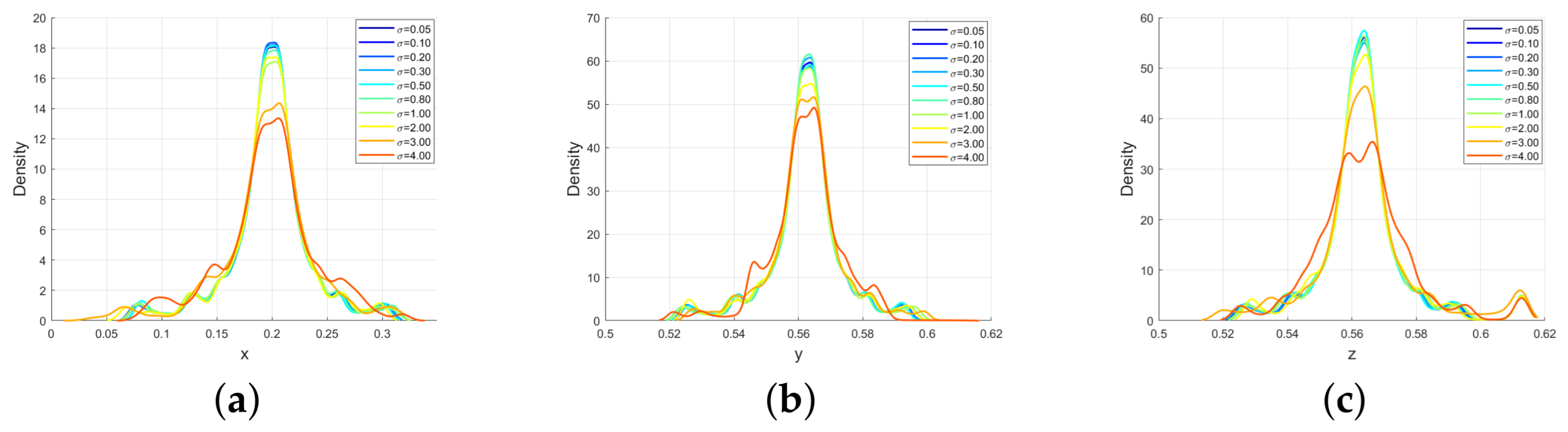
Under fixed parameters
,
,
, and
, this paper plots the steady-state probability density function of the system for different noise intensities
. As shown in
Figure 8, when the noise intensity
, the system exhibited stable and predictable dynamical behavior, indicating that the structure and competitive landscape of the university’s talent pool remained relatively stable. When the noise intensity
was set too high (e.g.,
), the probability density exhibited a bimodal distribution, and the system’s stability was disrupted. It is worth noting that system stability did not increase monotonically as the noise intensity decreased. As observed in
Figure 8a, the probability density curve corresponding to
had a higher peak, significantly outperforming that of
, indicating that the system exhibited greater stability at
. This suggests that selecting a moderate noise intensity is more conducive to maintaining system stability, thereby providing a safeguard for the sustained development of academic teams and research activities and supporting universities in formulating long-term talent development strategies within a stable competitive landscape. Furthermore, the research results indicate that when the time delay
was far from the critical delay
, the influence of noise intensity
on the system’s dynamic behavior significantly weakened, and the system state remained essentially unchanged across different values of
.
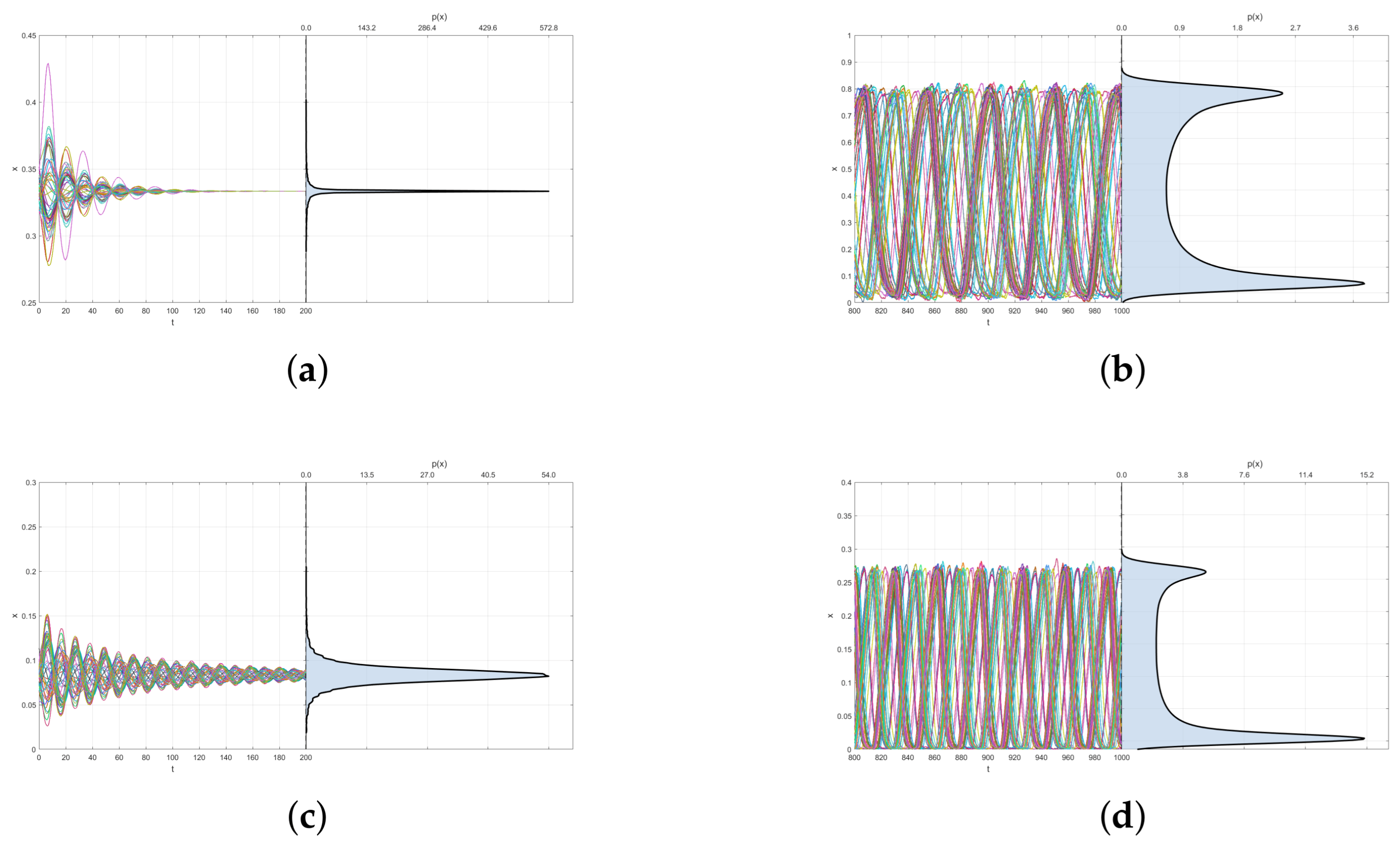
For systems with
and
, comparisons were conducted under varying time delays. In panels (a) and (b), the time delays were set to
and
, respectively; in panels (c) and (d), they were set to
and
, respectively. The four plots in
Figure 9 illustrate the left panels, which display time history plots depicting the evolution of variable
x over time based on 50 independent simulations. The right panels present the corresponding probability density plots that reveal the steady-state distribution characteristics of
x under the specified time delays. At
and
, oscillations gradually decayed, and the probability density plot exhibited a
-shaped distribution, indicating stable behavior. In contrast, at
, the system demonstrated persistent oscillations, with the probability density plot revealing a bimodal distribution, indicative of system instability. As the system scale increased to
, the delays illustrated in
Figure 9c,d demonstrate sustained oscillatory behavior. The probability density plots shifted from unimodal to bimodal, signifying that the system entered an unstable state. This observation suggests that large-scale university talent ecosystems possess a lower tolerance for decision-making delays and are more vulnerable to instability. Therefore, while shorter decision cycles can sustain stability in small-scale university groups, large-scale university ecosystems must significantly improve management efficiency and reduce decision feedback cycles. Failing to do so renders the system highly susceptible to instability arising from decision delays, thereby increasing the risks of talent loss and ecological imbalance.
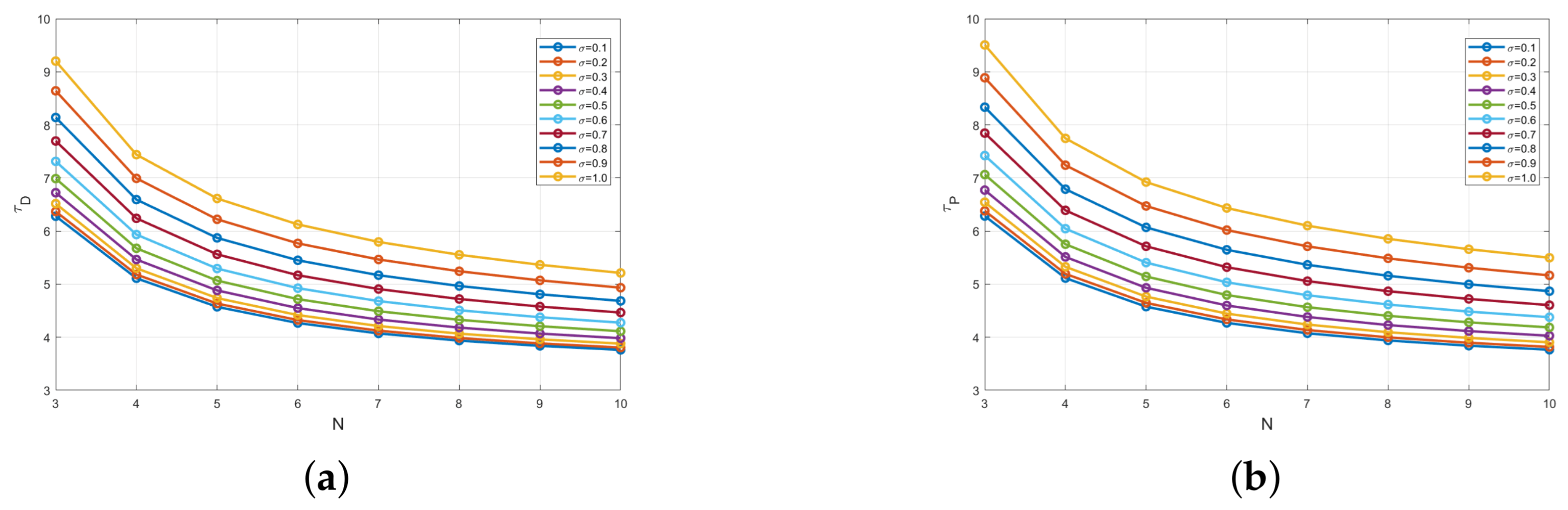
In
Figure 10, we set the parameters
,
, and
;
. In
Figure 10a,b, we observe that for all noise intensities
, regardless of whether
or
was considered, the critical delay exhibited a monotonically decreasing trend as the number of nodes
N increased. This trend clearly indicates that as the number of nodes increased, the system was more prone to bifurcation at smaller time delays; that is, the stability threshold for the time delay decreased, making the system more susceptible to instability. On the other hand, for the same number of nodes
N, the higher the noise intensity
, the higher the critical time delays
and
, showing a positive correlation between the two. This indicates that in this system, noise of a moderate intensity has a positive effect on system stability. As can be clearly seen in
Figure 10, the combination of low noise intensity and a high number of nodes significantly reduced the system’s critical delay thresholds, causing the system to bifurcate at smaller delays and subsequently leading to instability.
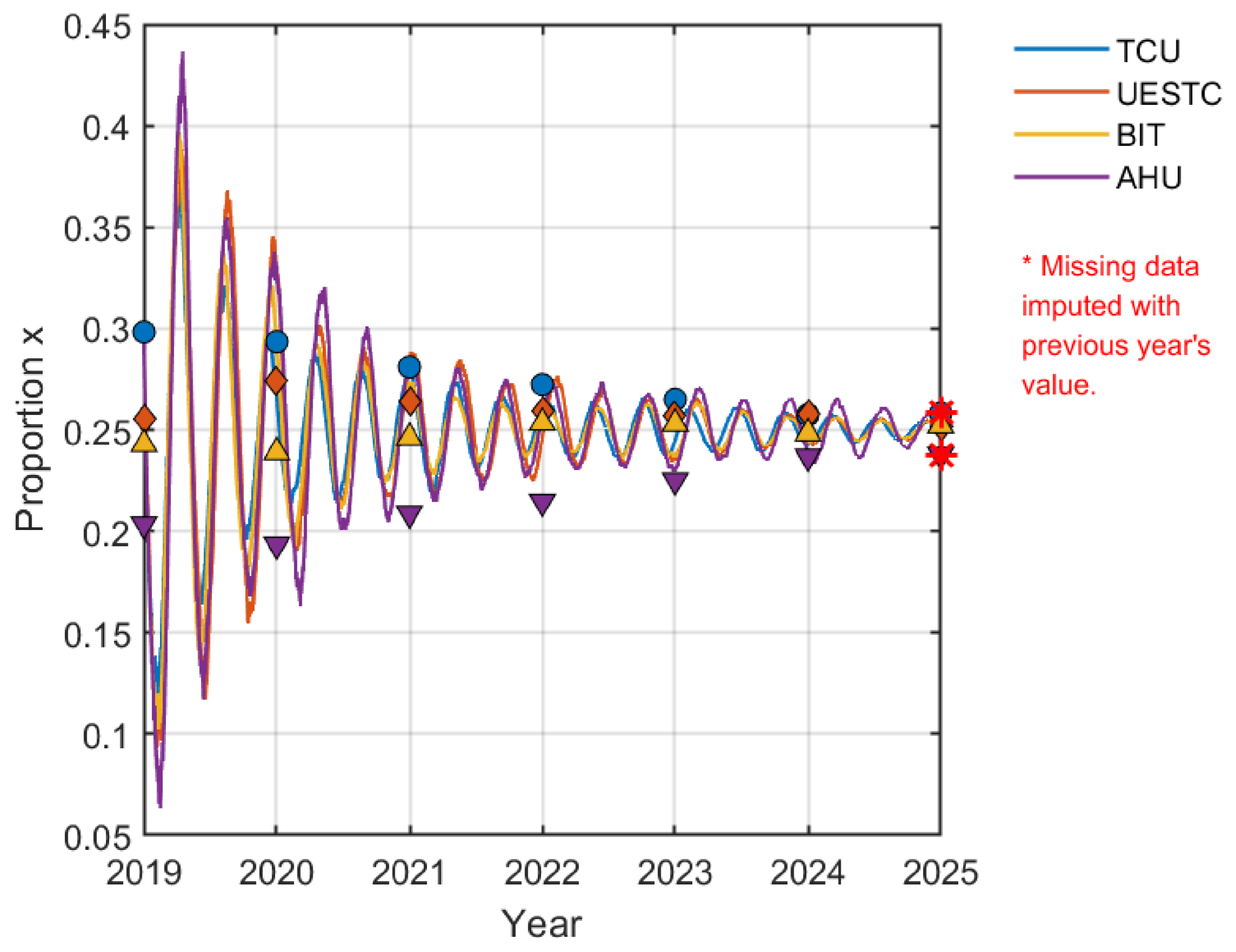
In
Figure 11, we selected historical data on full-time faculty members from Tongji University, the University of Electronic Science and Technology of China, the Beijing Institute of Technology, and Anhui University for the seven-year period from 2019 to 2025. Since Tongji University and Anhui University have not yet released data on faculty talent for 2025, to ensure the completeness of the data analysis, this study used data from the same period in 2024 for both institutions to fill in the gaps. The substituted data is marked with red asterisks in the figures. The parameters were set as follows:
,
,
, and
. As shown in the figure, all curves exhibited a typical damped oscillation trend: from significant fluctuations in the early stages to a marked reduction in amplitude after 2021 and, finally, the curves gradually converging and stabilizing. This aligns with the real-world process of university faculty development, which transitions from initial fluctuations and adjustments following policy implementation to a stable operational state in later stages. At the same time, the observation points for all four universities aligned with the oscillatory trend and convergence path of the curves, indicating that the model can accurately reproduce the temporal patterns of talent ratios across different universities. Therefore, it can be concluded that the model possesses universality, being capable of simultaneously reproducing both the evolutionary paths and long-term differences among different universities. It can be used to analyze the dynamics of talent systems under varying resource and policy conditions, providing a useful analytical tool for university administrators and policymakers.