1. Introduction
Integro-differential equations constitute an important class of mathematical models in which differential operators are coupled with integral terms representing nonlocal interactions. Such equations arise naturally in many areas of science and engineering because they incorporate both local dynamics and accumulated effects over spatial or temporal domains. Applications of integro-differential equations include viscoelasticity, biological systems, transport theory, heat transfer, population dynamics, and environmental processes such as pollution diffusion and contaminant transport [
1]. In these models, the evolution of a system at a given point depends not only on local rates of change but also on distributed interactions represented through integral operators, which capture memory effects and long-range spatial coupling. Consequently, integro-differential formulations provide a powerful mathematical framework for describing complex processes involving hereditary behavior, nonlocal interactions, and distributed sources [
2,
3].
A broad and important class of such models is formed by two-dimensional Volterra–Fredholm integro-differential equations, in which local differential operators are coupled with both Volterra- and Fredholm-type integral terms. The Volterra integral operator typically represents cumulative or causal effects over a partial region of the domain, whereas the Fredholm operator models global nonlocal interactions over the entire spatial region. These equations arise in many applications, including heat transfer, population dynamics, transport processes, and environmental modeling, where spatially distributed interactions must be incorporated into the mathematical description of the system. From a computational perspective, the presence of multidimensional integral operators significantly increases the complexity of the resulting problem, since the discretization of the integral terms often leads to dense algebraic systems and high computational cost. Consequently, the development of efficient and accurate numerical techniques for solving multidimensional integro-differential equations has attracted considerable attention in recent years.
A large number of numerical techniques have been developed for solving integral and integro-differential equations. Classical approaches include collocation methods, Galerkin and projection methods, quadrature-based discretizations, and spectral methods [
4,
5]. In the one-dimensional setting, several semi-analytical and numerical approaches, such as variational iteration methods, Adomian decomposition methods, and homotopy perturbation techniques, have been proposed for Volterra and Fredholm integro-differential equations [
6,
7,
8]. These methods have been successfully applied to many benchmark problems and engineering applications. However, the numerical treatment of multidimensional integral and integro-differential equations is considerably more challenging due to the presence of multidimensional kernels and the dense algebraic systems generated after discretization.
To address these difficulties, several specialized numerical schemes have been introduced in the literature. For example, Galerkin and collocation methods have been widely used for two-dimensional Fredholm integral equations [
9]. Wavelet-based techniques and triangular orthogonal function approaches have also been proposed for solving multidimensional integral equations efficiently [
10,
11,
12]. In addition, meshless methods based on radial basis functions have been developed for solving two-dimensional Fredholm integral equations with high accuracy [
13]. More recently, Ma et al. proposed a numerical method based on the integral mean value theorem for solving two-dimensional Fredholm integral equations, where the original problem is reduced to a system of algebraic equations together with convergence analysis [
14].
Spectral methods have attracted considerable attention for the numerical solution of integral and integro-differential equations because of their high-order accuracy and excellent convergence properties for smooth problems [
15,
16]. These methods approximate the unknown solution by global expansions in orthogonal polynomial bases such as Legendre or Chebyshev polynomials and can therefore achieve spectral or near-spectral convergence when the solution possesses sufficient regularity. Legendre polynomial bases are widely used for problems defined on bounded intervals due to their orthogonality properties and favorable numerical stability [
17]. In recent years, several researchers have applied spectral and collocation methods based on orthogonal polynomials to Volterra and Fredholm integro-differential equations and demonstrated their high accuracy and rapid convergence [
18,
19,
20,
21]. Moreover, recent studies have extended these approaches to fractional integro-differential equations using spectral techniques together with rigorous convergence analysis [
22,
23].
Parallel to the development of spectral approaches, operational matrix techniques have emerged as an effective computational framework for solving differential, integral, and integro-differential equations. In these methods, differentiation and integration operators are represented through precomputed operational matrices with respect to a chosen basis, thereby reducing the original problem to a system of algebraic equations for the expansion coefficients [
24]. Various operational matrix formulations have been developed using block-pulse functions, triangular functions, shifted Legendre polynomials, shifted Jacobi polynomials, and Chebyshev polynomials for solving Volterra, Fredholm, and mixed integro-differential equations [
25,
26,
27,
28]. These approaches provide efficient algebraic formulations for multidimensional nonlocal problems and have been successfully applied to a variety of integral and integro-differential models.
Recent years have witnessed notable progress in the numerical analysis of Volterra–Fredholm integro-differential equations and their fractional extensions through the development of high-order approximation techniques. In particular, spectral collocation approaches based on orthogonal polynomial bases have been proposed for fractional Volterra–Fredholm integro-differential problems, where the governing equations are transformed into algebraic systems that can be solved efficiently while preserving high accuracy [
29]. Moreover, pseudo-spectral and continuous Galerkin frameworks have recently been developed for Volterra integro-differential equations, providing rigorous convergence analysis and efficient multistep numerical schemes [
30]. In addition, stable finite-difference algorithms have been introduced for higher-order neutral Volterra integro-differential equations, where second-order convergence and robust numerical performance are demonstrated [
31]. More recently, wavelet-based spectral techniques have been employed for fractional Volterra–Fredholm integro-differential equations, where shifted Gegenbauer wavelets and polynomial-based approximations are used to construct accurate numerical solutions and compare the efficiency of different approximation strategies [
32].
Recent studies have further advanced the theoretical analysis and numerical treatment of Volterra–Fredholm integro-differential equations and their fractional extensions. In particular, analytical investigations have established fundamental properties such as existence, uniqueness, and stability of solutions for fractional Volterra–Fredholm integro-differential equations within fuzzy frameworks, providing a rigorous theoretical basis for the study of nonlocal models [
33]. In addition, efficient numerical techniques have been proposed for singularly perturbed Fredholm integro-differential equations arising in reaction–diffusion processes, where specially designed discretization methods are used to capture boundary-layer behavior and maintain numerical stability [
34]. Furthermore, compact finite-difference schemes based on alternating direction implicit (ADI) techniques have been developed for two-dimensional fractional integro-differential equations involving Riemann–Liouville integral kernels, demonstrating improved accuracy and computational efficiency for multidimensional problems [
35]. Meshless numerical procedures have also been successfully employed for solving nonlinear and fractional differential equations, providing accurate and computationally efficient approximations for complex mathematical models [
36,
37]. These studies demonstrate the effectiveness of meshless frameworks in the numerical treatment of fractional dynamical systems.
Overall, these developments highlight the continuing progress in both the theoretical analysis and numerical approximation of integro-differential equations arising in various applications of science and engineering. They also indicate that high-order spectral, pseudo-spectral, wavelet-based, and operational matrix techniques continue to provide powerful computational tools for solving multidimensional nonlocal problems. Despite the significant progress achieved in the development of numerical methods for integral and integro-differential equations, the efficient numerical treatment of multidimensional Volterra–Fredholm integro-differential equations remains challenging. In particular, the construction of highly accurate numerical schemes capable of effectively handling coupled differential and multidimensional integral operators while maintaining computational efficiency continues to be an active area of research. Many numerical methods have been developed for integro-differential equations; however, several difficulties persist for multidimensional Volterra–Fredholm problems. In particular, classical finite-difference, collocation, and quadrature-based methods often produce dense algebraic systems and require substantial computational effort when multidimensional integral operators are involved. Moreover, many existing spectral and operational matrix methods mainly focus on one-dimensional models or pure integral equations, while rigorous convergence analysis for coupled two-dimensional integro-differential systems remains relatively limited. The present approach is based on a unified tensor-product Legendre operational matrix formulation capable of efficiently treating differential, Volterra, and Fredholm operators within a single high-order spectral framework.
Motivated by these challenges, the present work develops a Legendre spectral operational matrix method for solving two-dimensional Volterra–Fredholm integro-differential equations. In the proposed approach, the unknown solution is approximated by a finite tensor-product expansion of Legendre polynomials. By employing operational matrices for the differentiation and integration associated with the Legendre basis, the original integro-differential equation is transformed into a finite-dimensional algebraic system for the unknown expansion coefficients. This formulation avoids complicated discretizations of multidimensional integral operators and provides an efficient computational framework for solving the problem. The main novelty of the proposed work lies in the development of a unified tensor-product Legendre spectral framework that simultaneously treats differential, Volterra, and Fredholm operators within a single operational matrix formulation. Unlike many existing approaches that mainly focus on one-dimensional or purely integral models, the present method is designed for two-dimensional integro-differential equations subject to mixed boundary conditions. In addition, rigorous convergence analysis is established in both and norms, while the numerical experiments demonstrate spectral-type accuracy, with errors approaching machine precision for moderate polynomial orders. Several numerical examples are presented to illustrate the accuracy and efficiency of the proposed method. The obtained results confirm that the Legendre spectral operational matrix approach provides highly accurate approximations and represents an effective numerical tool for solving two-dimensional integro-differential equations with nonlocal operators.
The remainder of this paper is organized as follows.
Section 2 presents the Legendre spectral operational matrix formulation for the considered two-dimensional integro-differential equations.
Section 3 is devoted to the convergence analysis of the proposed method. In
Section 4, several numerical examples are provided to demonstrate the accuracy and efficiency of the method. Finally, conclusions are given in
Section 5.
3. Convergence Analysis
In this section, we establish the convergence of the Legendre spectral operational matrix method introduced in the previous section for the specialized linear two-dimensional Volterra–Fredholm integro-differential problem on the reference square
We consider the transformed problem
where
Here,
and
Let
and let
denote the spectral approximation produced by the operational matrix scheme.
The tensor-product Legendre projection operator
is defined by
where
In abstract form, the discrete scheme may be written as
together with the projected boundary conditions.
3.1. Assumptions
Throughout this section, we assume the following conditions.
- (A1)
The exact solution satisfies
- (A2)
The coefficient functions satisfy
and the kernels satisfy
- (A3)
The continuous operator
is
-stable on the homogeneous boundary space, i.e., there exists a constant
, such that
for all admissible functions
W satisfying the homogeneous boundary conditions.
- (A4)
The discrete problem is uniformly stable: there exist constants
independent of
N, such that
and
for all
satisfying the homogeneous discrete boundary conditions.
Remark 2. Assumption (A4) corresponds to the uniform invertibility and stability of the algebraic system generated by the operational matrix formulation. In particular, it guarantees that the resulting discrete system remains uniformly well conditioned with respect to the approximation order N.
3.2. Auxiliary Results
To establish the convergence analysis of the proposed scheme, we first present several auxiliary results. We begin with the approximation property of the tensor-product Legendre projection.
Lemma 3. For everythere exists a constant , independent of N, such thatMoreover, if , then Proof. The tensor-product projection operator may be decomposed as
where
and
denote the one-dimensional Legendre projection operators in the
- and
-directions, respectively. Hence,
Applying the standard one-dimensional Legendre projection estimates together with the boundedness of the projection operators yields (
84) and (
85). □
The next lemma establishes the boundedness of the Volterra and Fredholm integral operators.
Lemma 4. There exist positive constants , , and , such thatand Proof. We prove the result for
; the proof for
is analogous. From (
76), the Cauchy–Schwarz inequality gives
Since the kernel is bounded on the compact set
it follows that
Squaring and integrating over
yields the
-estimate in (
86).
For the
-estimate, Leibniz’ rule is applied to the Volterra operator and derivatives with respect to
and
are computed. By assumption (A2), all kernel derivatives up to order
m are bounded. Consequently, each resulting term is bounded by
Summing over all derivatives of order up to
m yields (
87). □
We now derive the consistency estimate for the projection error.
Lemma 5. LetThen there exists a constant , independent of N, such thatIf, in addition, , then Proof. The dominant part of
consists of the second-order derivatives
. Using the derivative form of the tensor-product projection estimate,
we obtain
Since the coefficients
are bounded, the differential part of
satisfies the same estimate. The first-order and zeroth-order terms satisfy
and therefore do not affect the leading-order convergence rate.
For the integral terms, Lemma 4 gives
which is of higher order. Combining all estimates proves (
88).
The proof of (
89) is analogous. Indeed, for
, we have
so the second-order derivatives produce the dominant rate
The remaining terms are again of higher order. □
3.3. Main Convergence Theorem in
We are now in a position to state and prove the principal convergence result.
Theorem 1. Let U be the exact solution of (74), and let be the numerical solution determined by (80) together with the discrete boundary conditions. Under assumptions(A1)–(A4)
, there exists a constant , independent of N, such that Proof. We decompose the error as
By Lemma 3,
Since
U satisfies
and
satisfies
we obtain
Applying the discrete stability estimate (
82) gives
Since
is bounded in
,
Using Lemma 5, we obtain
Hence,
Finally, combining (
91), (
92), and (
96) proves (
90). □
3.4. Main Convergence Theorem in
We next establish the uniform convergence estimate.
Theorem 2. Assume in addition that Then, for the numerical solution there exists a constant , independent of N, such that Proof. Using the decomposition (
91), Lemma 3 gives
From (
93) and the discrete
-stability estimate (
83), we obtain
Since
is bounded in
,
Applying Lemma 5, we obtain
Finally, using the triangle inequality,
and combining (
98) and (
101), we obtain (
97). □
3.5. Convergence of the Coefficient Matrix
Since the approximate solution is represented by the coefficient matrix , it is natural to express the convergence result in matrix form.
Corollary 1. Let denote the coefficient matrix associated with the projected solution , and let denote the numerical coefficient matrix obtained from the operational matrix system. Then there exists a constant , independent of N, such thatwhere denotes the Frobenius norm. Proof. Since
norm equivalence on the finite-dimensional spectral space implies that
Using
we obtain
Applying (
96) completes the proof. □
Theorems 1 and 2 show that the proposed Legendre operational matrix method converges with high order for sufficiently smooth solutions. In the -norm, the dominant error is governed by the second-order differential part of the operator, yielding the convergence rate In the -norm, one additional order is lost, leading to the rate
Under the imposed smoothness assumptions on the kernels, the Volterra and Fredholm terms contribute only higher-order consistency terms and therefore do not affect the dominant convergence rate. In particular, if the exact solution U is analytic, then the algebraic error bounds derived above are typically replaced in practice by exponential decay with respect to N.
4. Numerical Examples
In this section, several numerical examples are presented to validate the theoretical analysis and demonstrate the effectiveness of the proposed Legendre spectral operational matrix method. Both linear and nonlinear two-dimensional Volterra–Fredholm integro-differential equations are considered. The numerical results confirm the high accuracy and spectral-type convergence of the proposed scheme.
Consider the nonlinear two-dimensional Volterra integro-differential equation
where the nonlinear Volterra integral term is defined by
and the forcing function is given by
The problem is supplemented with the boundary conditions
For the numerical approximation, the interval in both spatial directions is discretized using Legendre–Gauss–Lobatto collocation points. The resulting nonlinear algebraic system is solved by a damped Newton iteration.
To evaluate the numerical accuracy of the proposed method, we compute the following error measures:
and
Table 1 reports the numerical errors for different polynomial orders
N. Both the
- and
-errors decrease rapidly as
N increases, demonstrating the high-order accuracy of the proposed method and confirming the spectral-type convergence predicted by the theoretical analysis.
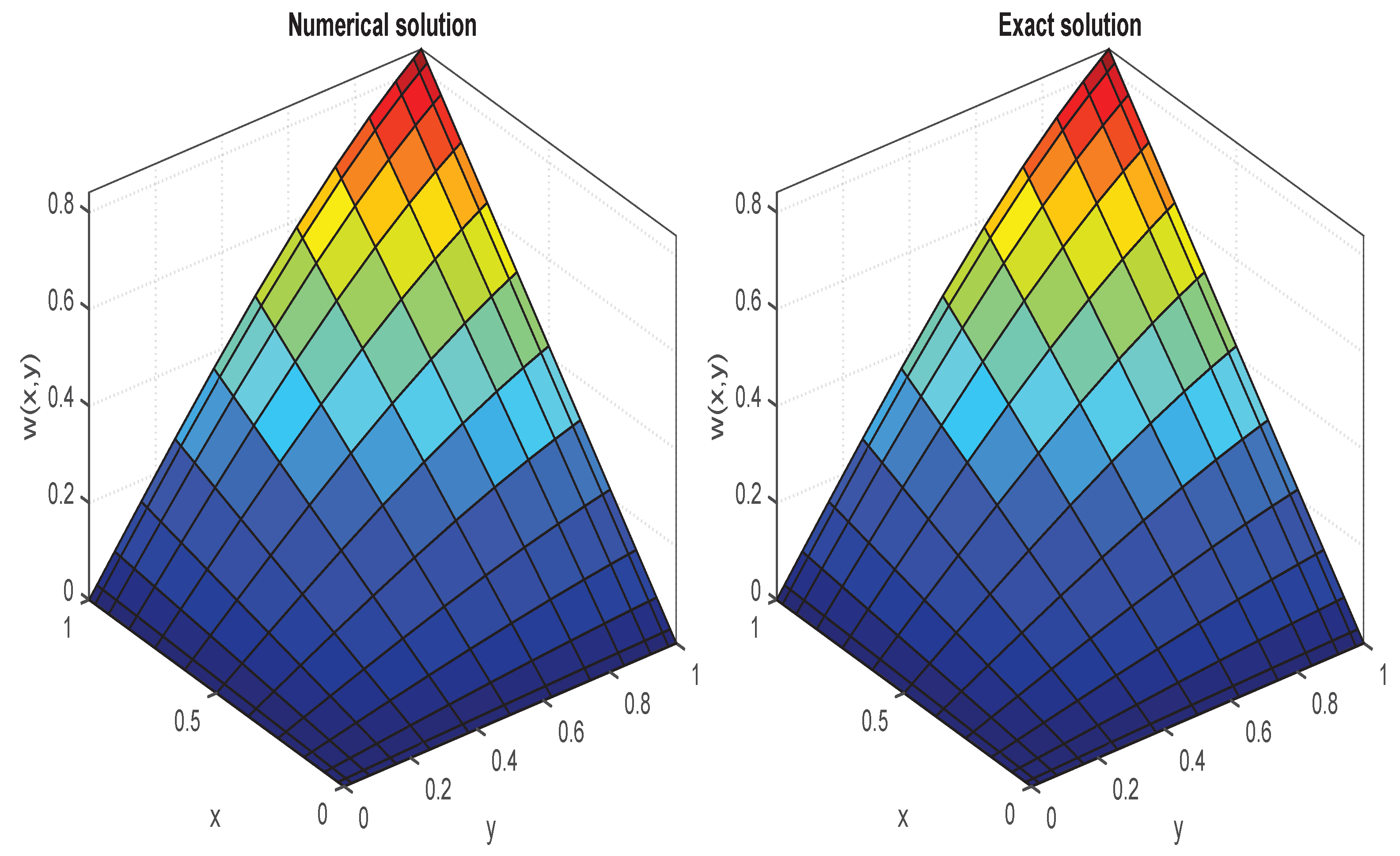
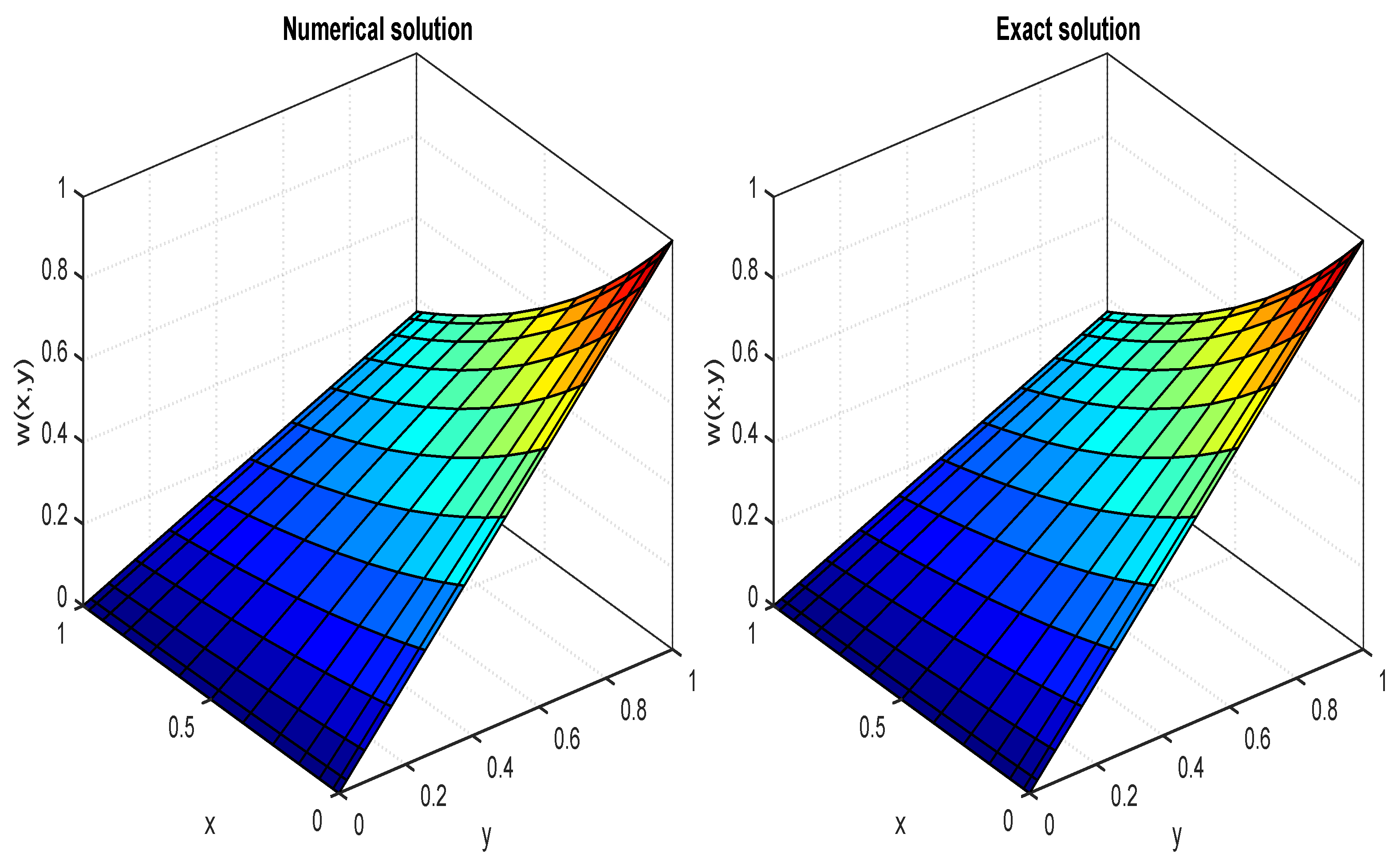
Figure 1 shows the numerical and exact solutions obtained for
. The numerical solution is in excellent agreement with the exact solution, which is consistent with the small errors reported in
Table 1.
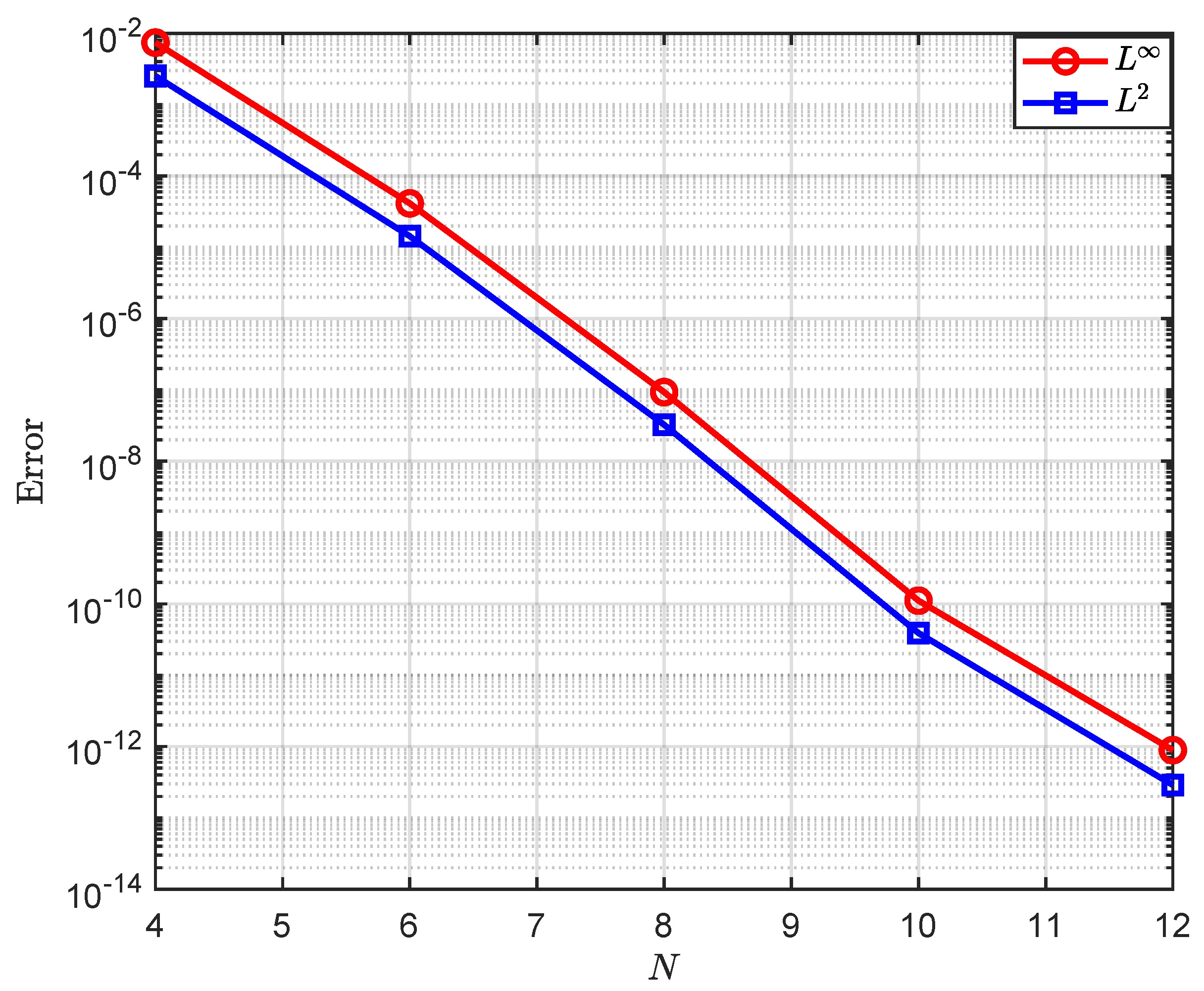
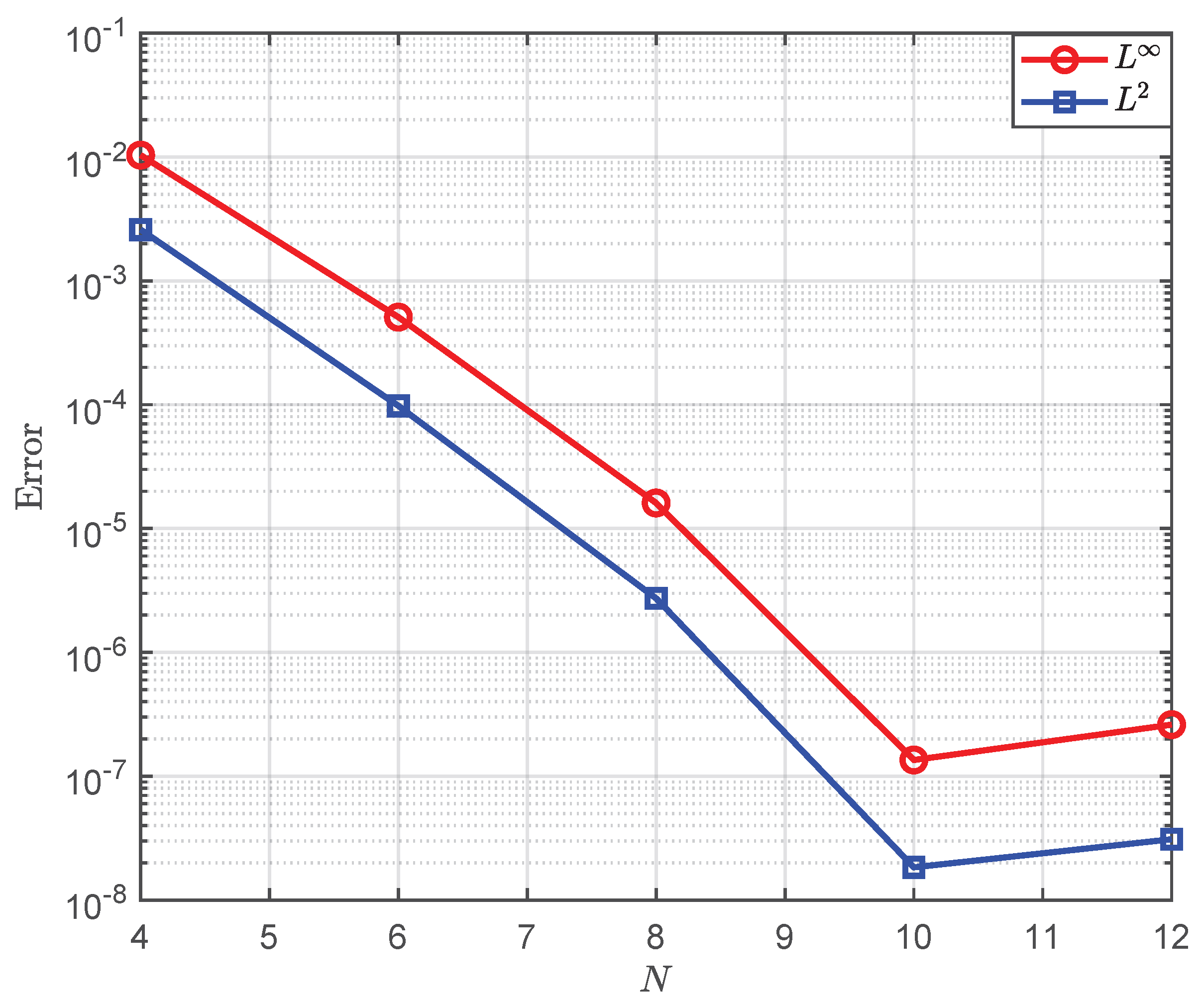
Figure 2 presents the convergence history of the
- and
-errors versus the polynomial order
N. The nearly linear decay on the semilogarithmic scale indicates rapid spectral-type convergence of the proposed method.
Consider the linear two-dimensional Volterra integro-differential equation
where the Volterra integral operator is defined by
and the forcing function is given by
The problem is supplemented with the boundary condition
Following the same numerical procedure described in Example 1, the Legendre spectral collocation method is applied to approximate the solution of problem (
110)–(
113). The derivative term is approximated using the Legendre differentiation matrix, while the Volterra integral operator is evaluated using Gauss–Legendre quadrature together with barycentric interpolation.
Table 2 reports the numerical errors for different polynomial orders
N. Both the
- and
-errors decrease rapidly as
N increases, confirming the high accuracy and spectral-type convergence of the proposed method.
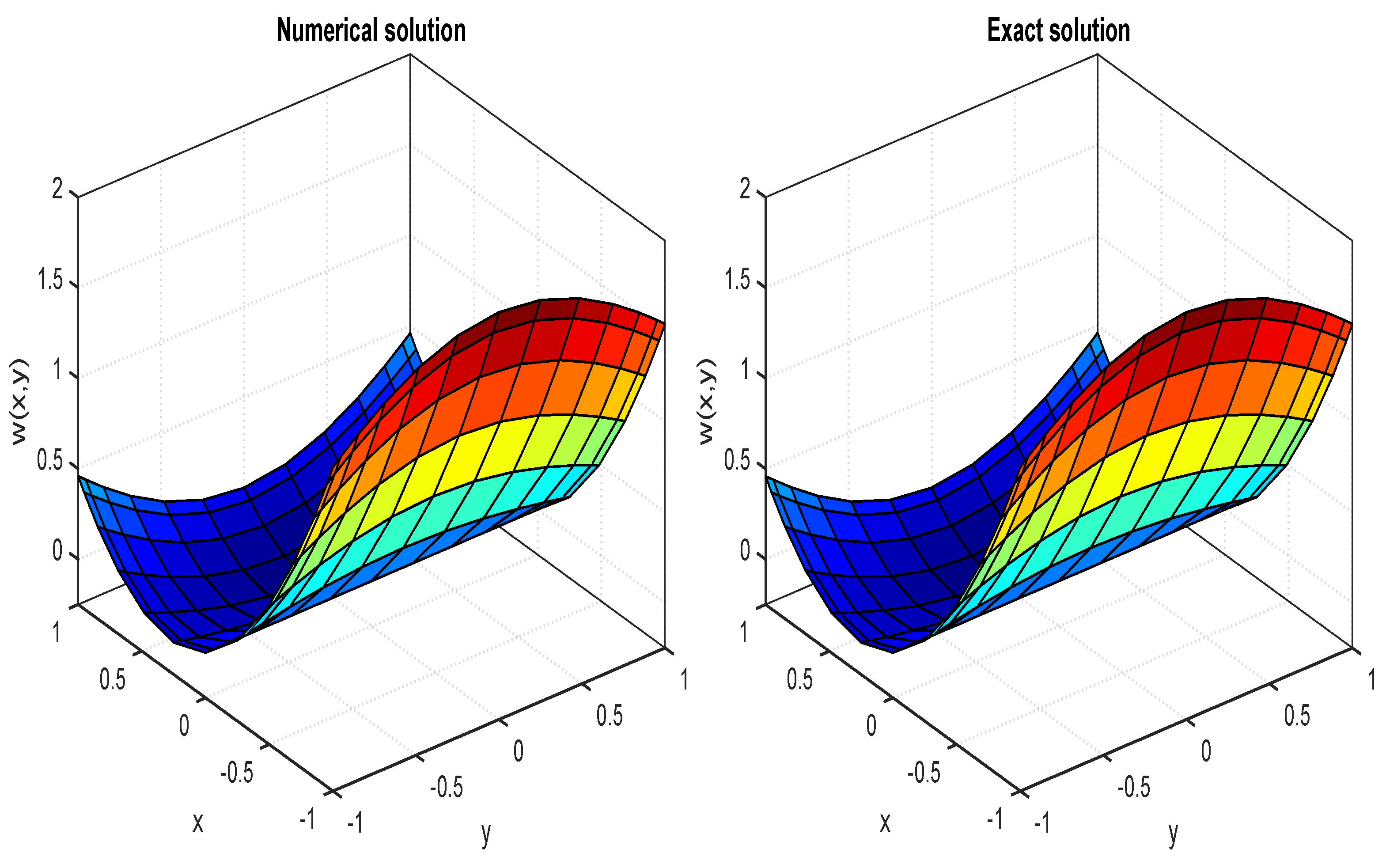
Figure 3 shows the numerical and exact solutions obtained for
. The numerical solution is in excellent agreement with the exact solution.
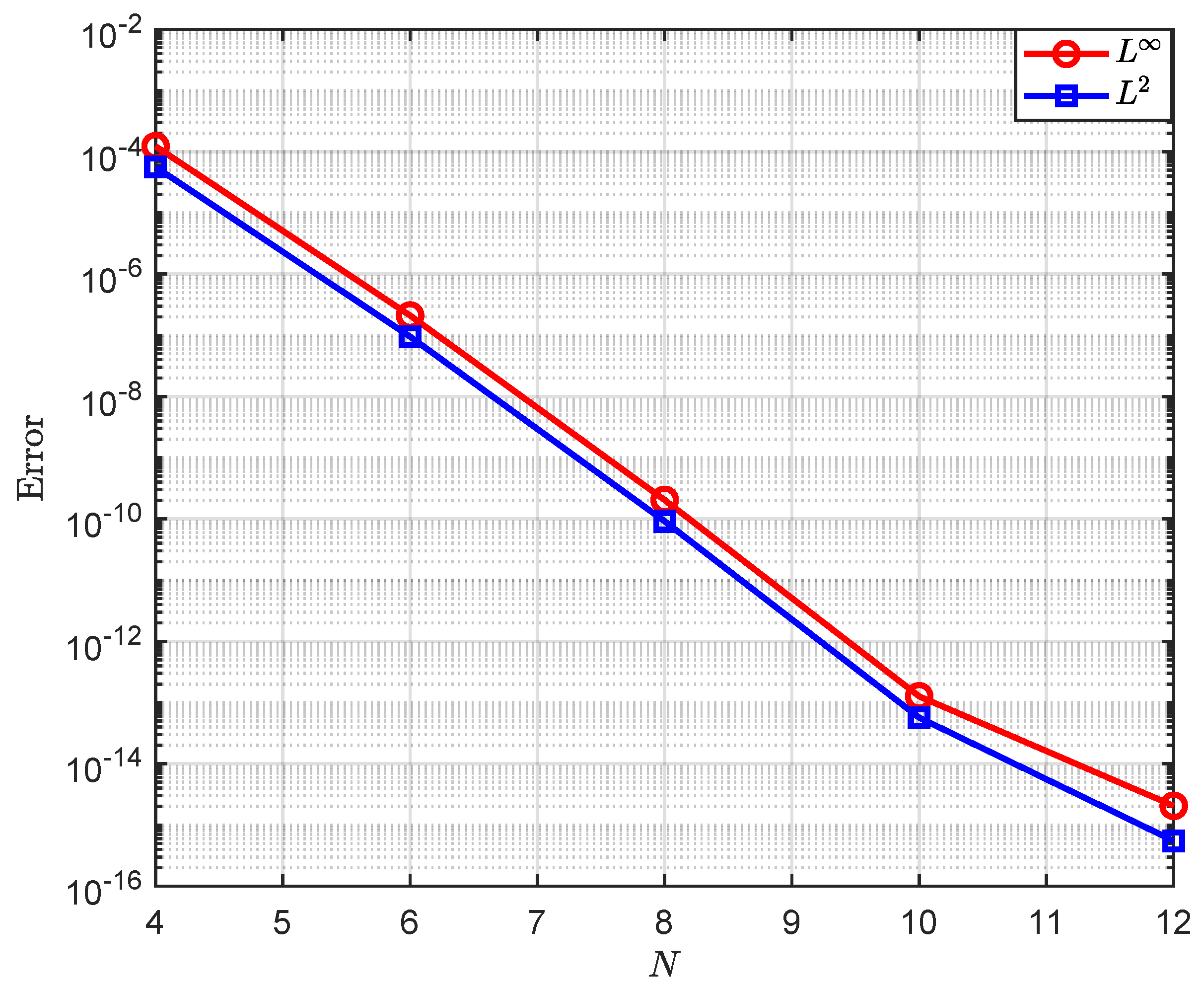
Figure 4 presents the convergence history of the
- and
-errors versus the polynomial order
N. The nearly linear decay on the semilogarithmic scale further confirms the spectral-type convergence of the proposed method.
Consider the linear two-dimensional Fredholm integro-differential equation
where the Fredholm integral operator is defined by
and the source function is given by
The problem is supplemented with the boundary conditions
The exact solution is
The Legendre spectral operational matrix method is applied to approximate the solution of problem (
115)–(
118). The differential terms are evaluated using the Legendre differentiation matrices, while the Fredholm integral operator is approximated using Gauss–Legendre quadrature together with barycentric interpolation.
Table 3 reports the numerical errors for different polynomial orders
N. Both the
- and
-errors decrease rapidly as
N increases, confirming the high-order accuracy and spectral-type convergence of the proposed method.
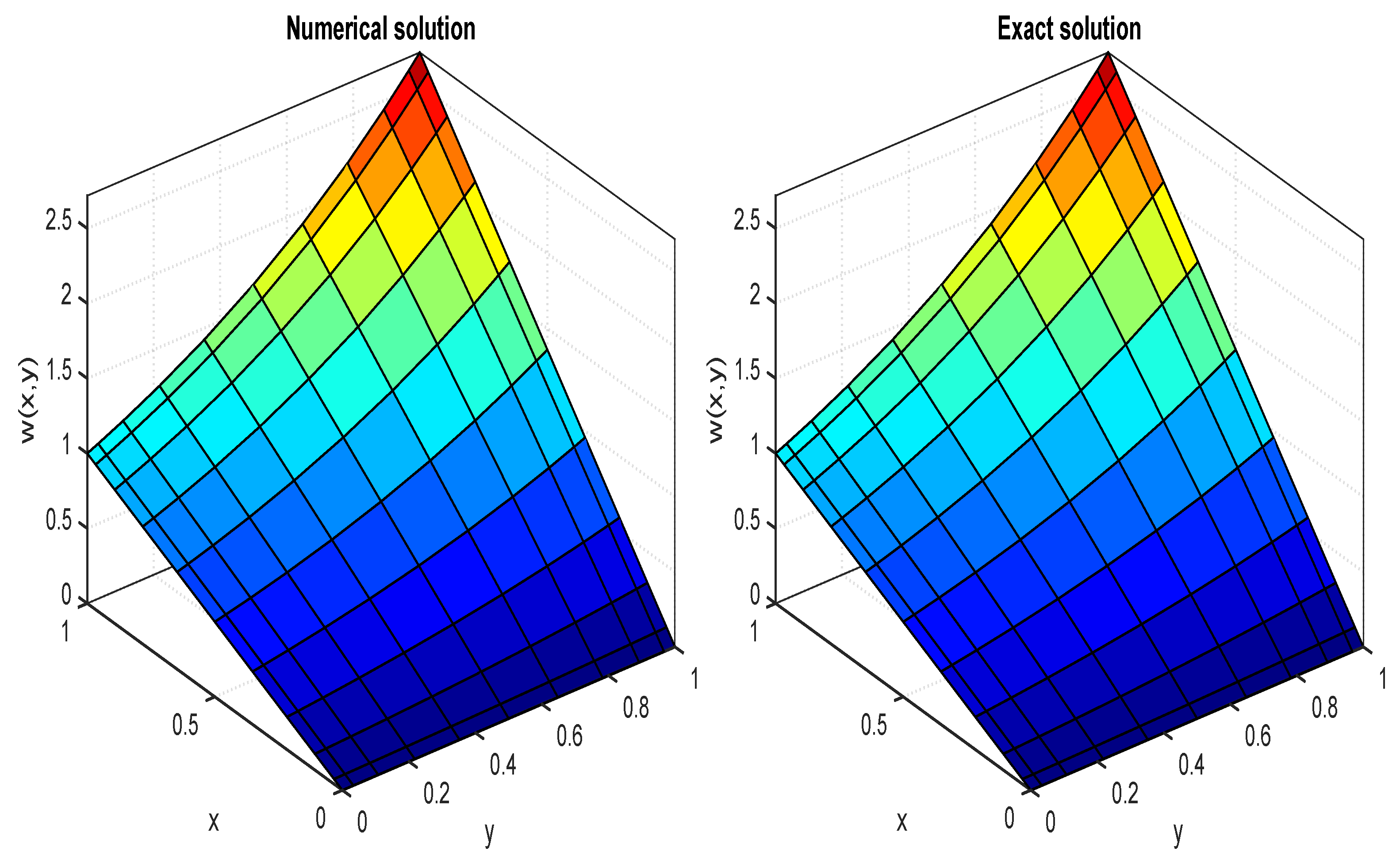
Figure 5 shows the numerical and exact solutions obtained for
. The numerical solution is in excellent agreement with the exact solution.
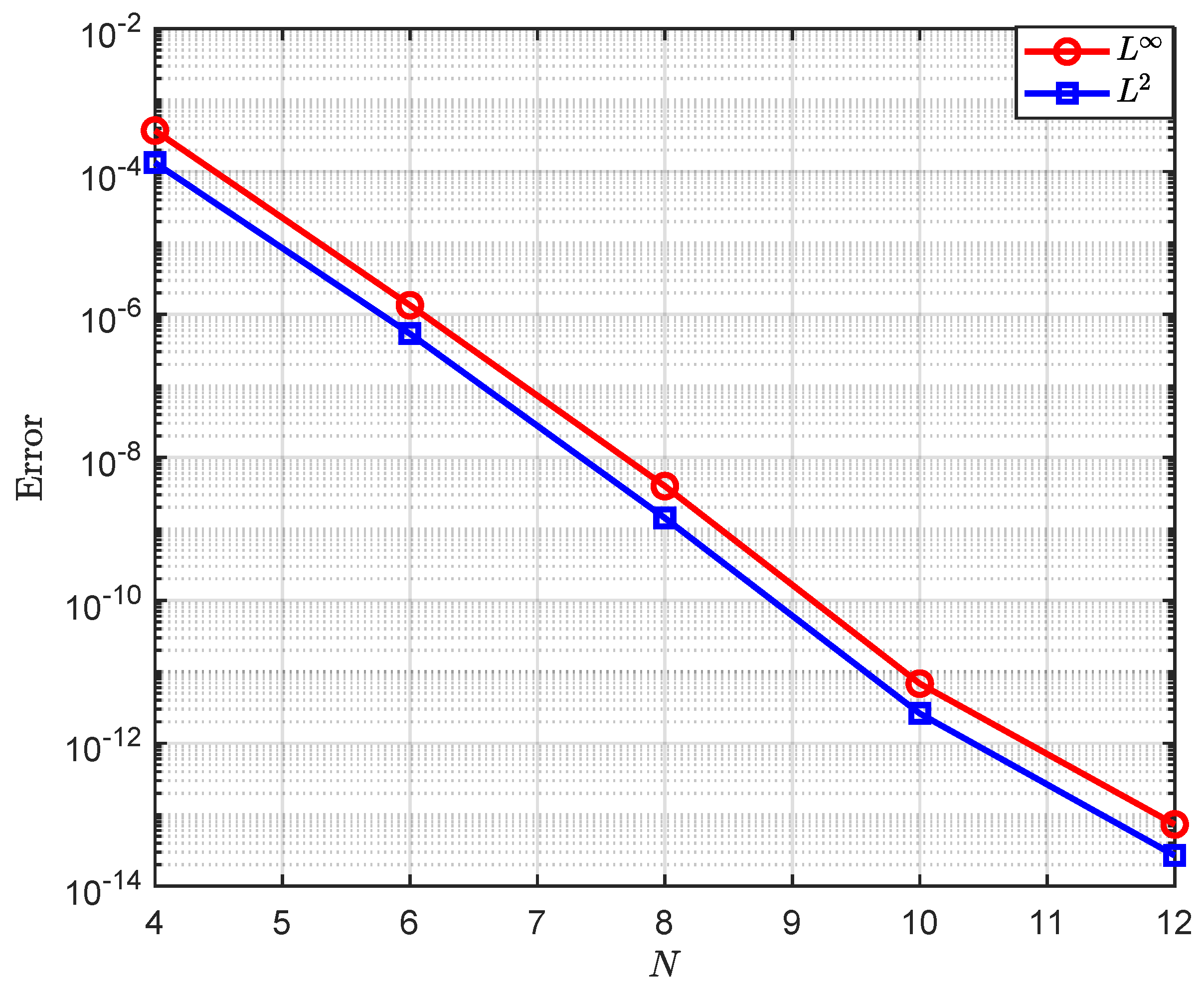
Figure 6 presents the convergence history of the
- and
-errors versus the polynomial order
N. The nearly linear decay on the semilogarithmic scale demonstrates the spectral-type convergence of the proposed method.
Consider the two-dimensional nonlinear integro-differential equation
where the forcing function
is given by
The problem is supplemented with the boundary conditions
The Legendre spectral operational matrix method is applied to solve the problem numerically. Computations are performed for different polynomial orders
N in both spatial directions to examine the accuracy and convergence behavior of the method.
Table 4 reports the
- and
-errors for different values of
N. The errors decrease rapidly as
N increases, demonstrating the high accuracy and spectral-type convergence of the proposed method.
Figure 7 shows the numerical and exact solutions obtained for
. The numerical solution closely matches the exact solution, confirming the high accuracy of the proposed method.
Figure 8 presents the convergence history of the
- and
-errors versus the polynomial order
N. The nearly linear decay on the semilogarithmic scale demonstrates the rapid spectral-type convergence of the proposed method.