Article

Numerical Simulation of Granular Phase Flow Behavior and Heat Transfer Characteristics in an Industrial-Scale Rotary Cooler

School of Mechanical and Electronic Engineering, Wuhan University of Technology, Luoshi Road, Wuhan 430070, China
*
Author to whom correspondence should be addressed.
Mathematics 2026, 14(10), 1742; https://doi.org/10.3390/math14101742
Submission received: 26 March 2026 / Revised: 12 May 2026 / Accepted: 15 May 2026 / Published: 19 May 2026
(This article belongs to the Special Issue Numerical Methods and Applications in Fluid Mechanics)

Abstract

In a calcined clay rotary cooler, the flow behavior and heat transfer characteristics of the granular bed are key factors determining the cooling efficiency. In this study, an Euler–Euler multiphase model coupled with the kinetic theory of granular flow (KTGF) was used to simulate the granular bed flow and heat transfer in a rotating drum of a rotary cooler. Unlike conventional large-particle beds, the 11 μm calcined clay particles interact more strongly with the gas phase, resulting in stratification and fluidization in the fine-particle bed. The effects of rotational speed, baffle configuration, and number of baffles on the flow and heat transfer behavior of the calcined clay granular bed were investigated. The results show that L-shaped baffles provide superior cooling, achieving a granular bed temperature and heat transfer coefficient (HTC) of 656.88 K and 151.15 W/(m2·K), respectively. At 2 rpm, the maximum temperature decrement and HTC increment are 5.73 K and 46.30 W/(m2·K), whereas excessive rotational speeds intensify bed fluidization. Additionally, increasing the number of L-shaped baffles has limited influence on expanding the fluidized region. With 12 L-shaped baffles, the temperature decrement peaks at 2.86 K and the HTC increment reaches a relatively high 33.27 W/(m2·K). This study provides a theoretical basis for the design and optimization of industrial-scale rotary cooling equipment for fine-particle beds.

1. Introduction

Rotating drums are widely employed in industries such as building materials, metallurgy, and chemical engineering due to their excellent mixing performance and efficient heat transfer characteristics [1,2]. Consequently, the hydrodynamic behavior of granular beds within rotating drums has received extensive attention in engineering research [3,4]. The systematic analysis of particle motion patterns and mixing mechanisms within rotating drums constitutes an essential foundation for the optimization of related industrial processes [5,6]. In the production process of low-carbon cement, the cooling stage of calcined clay is particularly critical [7]. Due to their excellent mixing mechanism and efficient heat transfer, rotating drums demonstrate significant potential for application in calcined clay cooling processes. Previous studies have predominantly focused on granular beds with larger particle diameters in rotating drums. However, systematic investigations into the flow behavior and heat transfer mechanisms of fine powder beds remain relatively scarce, which, to some extent, limits further optimization of these systems.
In the dynamic simulation of granular beds within rotating drums, the Discrete Element Method (DEM) and the Euler–Euler approach are two commonly used numerical methods [8,9]. DEM tracks the trajectory and interactions of individual particles but is limited by high computational cost, particularly in industrial-scale scenarios with a vast number of particles [10,11,12]. Therefore, DEM is typically applied to small-scale rotary kilns or systems with relatively large particle sizes. In contrast, the Euler–Euler method, which is based on Computational Fluid Dynamics (CFD) and the kinetic theory of granular flow (KTGF), can simulate the flow and heat transfer in large-scale fine-particle systems with reasonable accuracy and lower computational cost [13,14]. Unconstrained by particle count and well-suited for dense granular flows of fine particles, the Euler–Euler approach is particularly appropriate for numerical studies of industrial-scale rotating drums [15]. Within the Euler–Euler framework incorporating KTGF, Yassine et al. [16] investigated the dynamic and rheological characteristics of cohesive particle flows in rotating drums, accounting for solid frictional forces. Similarly, Yin et al. [17] employed KTGF to examine the effects of kiln inclination angle and particle residence time on granular flow within rotating drums.
Research on heat transfer in rotating drums has been primarily centered on particle drying and heating processes. Existing studies indicate that increasing rotational speed can enhance particle-wall contact frequency and promote heat transfer [18,19]. However, excessive speed may shorten particle residence time in high-temperature zones, thereby limiting heat accumulation [20]. Furthermore, installing baffle structures inside the drum can improve granular bed mixing, promote spatial redistribution and agitation, and consequently enhance thermal performance [21]. Nevertheless, studies on the cooling of high-temperature materials in drums remain limited. Suellen et al. [22] developed a novel rotating drum structure with baffles based on the Euler–Euler method and investigated variations in particles with angular position and rotational speed. Their results show that the Euler–Euler model effectively captures gas–solid interactions, and baffles contribute to increased particle-wall contact area, thereby improving heat transfer. Adepu et al. [23] examined the effects of particle size distribution, rotational speed, and rolling friction on heat transfer in drums. They found that rotational speed had a minor influence, and better heat transfer efficiency could be achieved under lower rolling friction values. Gu et al. [24] designed rotating drums with various baffle configurations and experimentally and numerically studied the effects of rotational speed, baffle count, and drum temperature on mixing index and heat transfer efficiency. Their work indicates that enhanced mixing improves inter-particle heat exchange. Seidenbecher et al. [25] investigated the influence of L-shaped baffle flight length ratios and quantity on particle heat conduction. Their results showed that flight length ratios of 1, 1.5, and 0.75 yielded better heat transfer performance. Bheda et al. [26] experimentally studied the effects of fill level and rotational speed on granular bed temperature, concluding that excessively high fill levels hinder internal heat conduction.
Extensive attention has also been given to the flow behavior of fine particles within rotating drums. Fine powders have been shown to exhibit fluidization characteristics induced by the gas flow inside the drum [27]. The installation of baffles in a rotating drum can lift and dump particles, enabling gas to penetrate the fine-particle bed along with the falling material and thereby enhancing fluidization performance [28]. Within the Euler–Euler framework, the Kinetic Theory of Granular Flow (KTGF) is better suited for simulating the gas-like dynamic behavior of the solid phase under strong agitation [29]. By experimentally and numerically investigating powder flowability at different rotational speeds, Chatre et al. [30] further confirmed the good applicability of KTGF in modeling the “gas-like” flow of fluidized particle beds. Huang et al. [31] proposed that rotating drums hold potential as the new gasless fluidized bed. Air and powder circulation is promoted by the rotational motion of the drum, allowing fluidization to be achieved at lower superficial gas velocities.
The fluidization behavior of fine particles in a rotating drum exhibits similarities with the slurry flow transport phenomena and flow behavior of fine powders. Li et al. [32] employed a coupled CFD-DEM approach to investigate the dynamics governing gravel penetration, slurry particle fluidization, and migration. It was found that sustained fluctuations under higher stress intensified gravel penetration into the slurry and promoted slurry fluidization. Zhou et al. [33] combined CFD-DEM simulations with experimental validation to study pipeline friction and wear during refractory slurry transport. The influencing factors of wear were determined to be, in descending order of significance, flow velocity, particle size, bend curvature ratio, and solids content. Sadeghi et al. [34] developed a three-dimensional CFD model to examine turbulent three-phase non-Newtonian tailings slurry flow in an industrial pipeline. Good agreement was achieved between the simulation results using the KTGF and Gidaspow drag model and the field data, confirming the satisfactory applicability of the CFD model. Wang et al. [35] investigated the non-Newtonian rheological behavior of waxy particle-laden oil using a CFD-DEM approach and performed experimental validation. The results demonstrated that the Cross model performed best at solids concentrations below 30%.
Previous studies on granular beds in rotating drums have primarily focused on larger-diameter particles, while comparatively limited attention has been paid to fine particles with submicron sizes. Current research on heat transfer in rotating drums and its engineering applications has mainly concentrated on material heating or drying processes, with relatively few studies dedicated to cooling applications. Due to their fine powder particle size, calcined clay particles significantly influence the flow and heat transfer behavior within the granular bed of rotating drums. Therefore, this study proposes a three-dimensional multiphase CFD model based on the Euler–Euler method to simulate the fluid dynamics and heat transfer of calcined clay fine-powder beds in industrial-scale rotary coolers. The flow patterns and heat transfer mechanisms of calcined clay fine powder in the rotating drum of rotary coolers are examined. Additionally, the effects of drum rotational speed and internal baffle configurations on the flow behavior and heat transfer mechanisms of the granular bed are further analyzed. Figure 1 shows a schematic diagram of the flow inside the rotating drum of a rotary cooler, with the medium-temperature section selected as the research subject. This work provides a theoretical foundation and methodological basis for the optimized design and process analysis of industrial-scale fine-powder rotary coolers.
The remainder of this paper is organized as follows. Section 2 details the numerical models employed, including the CFD model, geometric setup, and simulation conditions. The effects of rotational speed, baffle configuration, and baffle number on granular flow and heat transfer in the rotating drum are then examined in Section 3, while the main conclusions are summarized in Section 4.

2. CFD Model

As a multiphase flow simulation method more suitable for industrial-scale rotary coolers processing calcined clay fine powder, the Euler–Euler model treats both the calcined clay and the gas phase as continuous and fully interpenetrating continua [36,37]. Both phases are described by a set of fundamental and constitutive equations solved within an Eulerian frame of reference. To accurately simulate the turbulent disturbances induced by the rotation of the rotary cooler, the SST k-omega turbulence model was adopted for this study. This model has also been demonstrated to be suitable for engineering applications involving rotating drums [38].

2.1. Mathematical Model

2.1.1. Governing Equations

The continuity equations for the gas and granular phases are given as follows:
t α g ρ g + α g ρ g v g = 0 ,
t α s ρ s + α s ρ s v s = 0 ,
where α denotes the volume fraction, ρ the density, and v the velocity vector. The subscripts s and g refer to the granular and gas phases, respectively, and the volume fractions of the two phases sum to 1.
α g + α s = 1 ,
The equations of momentum balance for the gas phase and the granular phase are given by:
t α g ρ g v g + α g ρ g v g v g = α g p + τ g + α g ρ g g + K s g v s v g ,
t α s ρ s v s + α s ρ s v s v s = α s p p s + τ s + α s ρ s g + K s g v g v s ,
where p denotes the fluid pressure, ps is the solid pressure, and g is the gravitational acceleration. Κsg is defined as the momentum exchange coefficient between the granular phase and the gas phase.
In the rotary cooler, only the drag force is considered. Due to the large density difference between the granular phase as the secondary phase and the gas phase as the primary phase, the effect of the virtual mass force can be neglected. The lift force model assumes that the particle diameter is significantly smaller than the interparticle spacing, which is not applicable to densely packed beds. Therefore, the calcined clay granular phase is predominantly influenced by the drag force within the drum, whereas the virtual mass force and lift force are neglected [39]. The drag model is determined by the Gidaspow model, which combines the Wen and Yu model and the Ergun equation, and is expressed as follows [40]:
K s g = 150 α s ( 1 α g ) μ g α g d p 2 + 1.75 ρ g α s v s v g d p , α g 0.8 3 4 C D α s α g ρ g v s v g d p , C D = 24 α g R e p 1 + 0.15 ( α g R e p ) 0.687 , α g > 0.8 ,
τg and τs are the gas phase and granular phase stress tensors, expressed as follows:
τ g = μ g [ v g + v g T ] 2 3 μ g ( v g ) I ,
τ s = α s μ s [ v s + v s T ] + α s λ s 2 3 μ s v s I ,
where I denotes the unit tensor, μ represents the viscosity, and λ is the bulk viscosity.
As for the granular phase, the shear viscosity of the granular phase is decomposed into three components, as shown in Equation (9), where μs,col is the collisional viscosity of the calcined clay granular phase. The kinetic viscosity μs,kin, resulting from the random motion of the granular phase, is described by the Gidaspow model [41]. The frictional viscosity μs,fr, generated by inter-particle friction, is solved using the Schaeffer model [42].
μ s = μ s , c o l + μ s , k i n + μ s , f r ,

2.1.2. Kinetic Theory of Granular Flow (KTGF)

In Euler–Euler gas–solid multiphase flow simulations, the Kinetic Theory of Granular Flow (KTFG) is employed to describe the motion, collision, and kinetic energy transfer of the calcined clay granular phase [43,44]. The KTFG theory has been widely applied to the motion of solid particles in rotating drums [45,46]. Derived from kinetic theory, the particle temperature transport equation takes the following form and is primarily used to describe the transfer and distribution of momentum within the granular phase:
3 2 t ( α s ρ s θ s ) + ρ s α s v s θ s = p s I + τ s : v s + ( k s θ s ) γ s 3 K s g θ s ,
where p s I + τ s : v s denotes the energy from the solid stress tensor. ( k s θ s ) represents the diffusion of energy with ks denoting the diffusion coefficient and θs the granular temperature. The term −3Kgsθs describes the interphase energy exchange between the gas and solid phases.
The collisional energy dissipation rate of the granular phase, γs, is given by Equation (11). The solid phase pressure, ps, is derived predominantly from particle motion and collisions and is solved using the Lun model, as shown in Equation (12).
γ s = 3 1 e s s 2 α s 2 ρ s g 0 s s θ s 4 d p θ s π v s ,
p s = α s ρ s θ s + 2 ρ s ( 1 + e s s ) α s 2 g 0 s s θ s ,
where ess is the restitution coefficient and is set to 0.9. The expression for g0ss, the radial distribution function at contact, is given as follows. This function is used to correct the particle collision frequency and reflect the influence of particle packing density.
g 0 s s = 1 a s a s , m a x 1 / 3 1 ,
where αs,max is defined as the maximum packing limit of the calcined clay particles.

2.1.3. Energy Equations

The energy conservation equations for the gas and granular phases inside the rotating drums are given as follows:
t α g ρ g H g + α g ρ g v g H g = α g k g , e f f T g ψ ( T s T g ) ,
t α s ρ s H s + α s ρ s v s H s = α s k s , e f f T s + ψ ( T s T g ) ,
where H, Keff, and T denote the enthalpy, effective thermal conductivity, and temperature of the respective phases, respectively. ψ represents the volumetric heat transfer coefficient between the gas and solid phases.
To simulate the heat transfer between the gas phase and the granular phase within the rotary cooler, the empirical correlation established by the Gunn model was employed [47]. In this model, the Nusselt number is expressed as a function of the Reynolds number (Res) and the Prandtl number (Pr):
N u g s = h g s d s k g = 7 10 α g + 5 α g 2 1 + 0.7 R e s 0.2 P r 1 / 3 + 1.33 2.4 α g + 1.2 α g 2 R e s 0.7 P r 1 / 3 ,
The effective thermal conductivity, keff, is defined by the following equation:
k g , e f f = ( 1 1 α g ) k g α g ,
k s , e f f = [ ω A + ( 1 ω ) Γ ] k g 1 α g ,
Γ = 2 ( 1 B / A ) A 1 ( 1 B / A ) 2 B A ln A B B 1 ( 1 B / A ) B + 1 2 ,
where A = ks/kg, b = 1.25(αs/αg)10/9, and ω, which represents the ratio of the particle contact area to the total particle surface area, is set to 7.26 × 10⁻³. kg and ks denote the microscopic thermal conductivities of the gas phase and the solid granular phase, respectively.
The local instantaneous heat transfer coefficient (HTC) h and the average heat transfer coefficient havg between the calcined clay particles and the inner wall of the rotating drum can be expressed as:
h = α g k g , eff T g x + α s k s , eff T s x T d T w ,
h a v g = h t i ,
where Tw represents the temperature of the drum wall, and Td is the temperature of the calcined clay granular bed.

2.2. Simulation Model Set-Up and Accuracy Validation

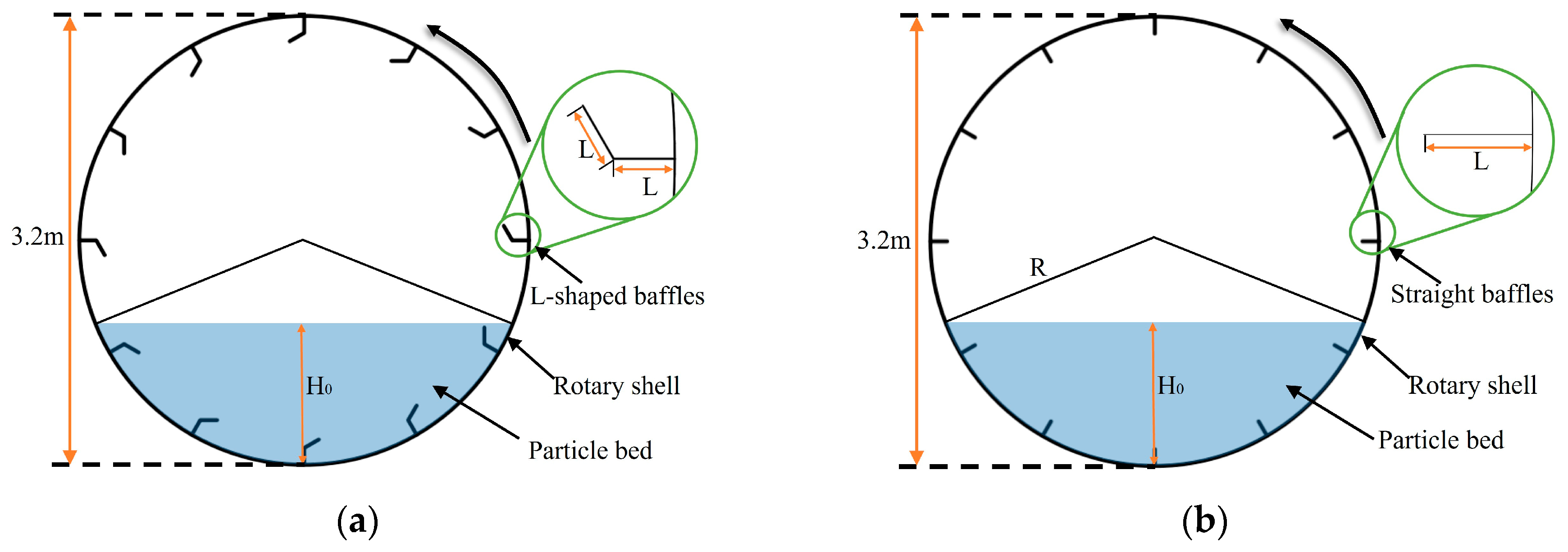
This study focuses on the flow and heat transfer characteristics of the granular bed within the radial cross-section of the rotary cooler. The selected portion of the rotary cooler drum is simplified to a computational domain with a diameter of 3.2 m and an axial length of 1 m. Twelve straight or L-shaped baffles are uniformly arranged along the circumference of the drum, as illustrated in Figure 2. The baffle length is L = 120 mm. To reduce the number of grids, the baffles are modeled as zero-thickness walls. This simplification has been validated in previous studies [48,49].
The setup of boundary conditions is crucial for accurately simulating the motion of the granular bed inside the rotary cooler. The rotation of the drum is represented using the moving mesh. The velocity inlet and the mass-flow outlet are defined at the two axial ends of the drum, with both the inlet velocity and outlet mass flow rate set to zero to ensure the computational domain remains a sealed space. Calcined clay is classified as a fine powder, and its particle diameter, density, and porosity are derived from experimental measurements. The filling ratio of the calcined clay granular bed within the drum is 25%, corresponding to an initial static bed height H0 = 0.96 m, and the initial temperature of the calcined clay particles is 673 K. In industrial practice, the outer surface of the rotary cooler drum is cooled by a circumferential spray array, which provides uniform and stable cooling. Both the drum and the baffles are fabricated from Q355B steel with good thermal conductivity. Accordingly, the drum wall and the baffles are simplified as constant temperature boundaries at 473 K. The material properties of the calcined clay particles and the boundary conditions of the computational domain are summarized in Table 1.
A transient pressure-based solver was employed to simulate the hydrodynamic behavior of the granular phase within the drum. No-slip wall boundary conditions were set for both the drum and the baffles in the computational domain. The pressure-velocity coupling of the governing equations was handled using the SIMPLE algorithm. To ensure that the simulation encompassed complete cycles, the simulation time for each case was set to 60 s, ensuring coverage of at least one full rotation period even at the minimum rotational speed of 1 rpm. Model convergence was monitored primarily through the residuals of the governing equations, with all values falling below 10−3.

2.3. Model Validation

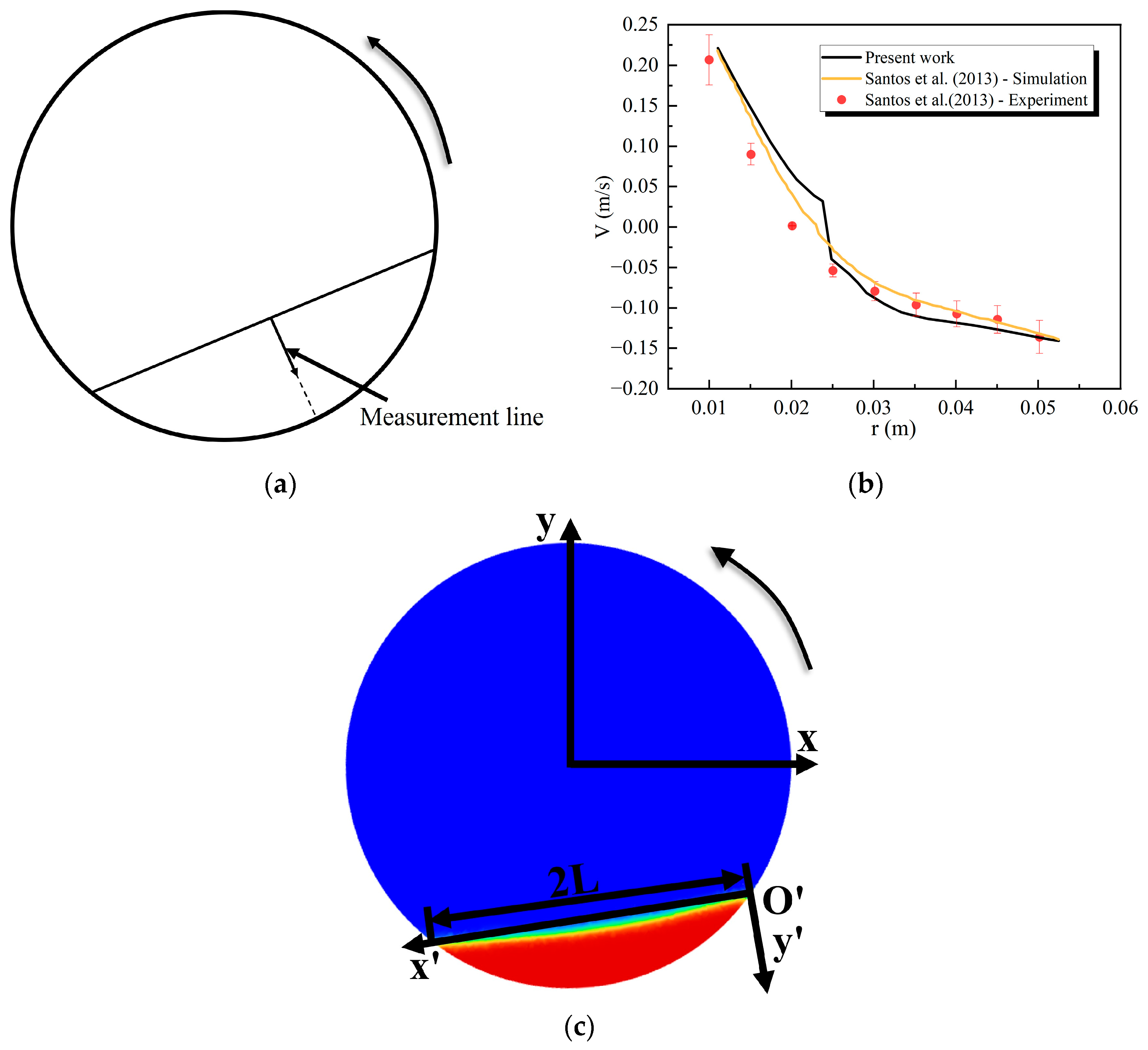
Figure 3a,b compare the simulation results for a rotating drum measuring 195 mm in diameter and 500 mm in length with the experimental and simulation data from Santos et al. [39]. To ensure comparability, all parameters and boundary conditions in the simulation were configured in strict accordance with those in the reference literature. The particle density was 2460 kg/m3, the particle diameter was 3.68 mm, the filling level of the granular bed was 18.81%, the porosity was 0.63, and the rotational speed was 1.45 rad/s. The location of the velocity measurement line is shown in Figure 3a. As shown in Figure 3b, good agreement is observed between the simulated velocity trend and the experimental results of Santos et al. [39]. In addition, only a small deviation is found when compared with their simulation results, indicating good consistency. Figure 3c presents a comparison between the simulation results for a rotary kiln with a diameter of 400 mm and a length of 1000 mm and the literature data [48,50]. The rotational speed was set to 1.7 rpm, the particle density to 2900 kg/m3, and the particle diameter to 1.5 mm, all strictly consistent with the conditions in the cited works. The chord length (2 L) was determined to be 278.37 mm, and the mid-chord bed depth (h) was 54.41 mm, deviating by 2.39% and 2.20% from the experimental values (271.88 mm and 53.24 mm) [50], and by 3.10% and 6.69% from the simulation values (270 mm and 51 mm) reported in the literature [48]. The velocity trends and particulate phase volume fractions obtained by the selected CFD model were found to be in close agreement with the reference data, collectively confirming the reliability of the modeling approach adopted in this study.

2.4. Grid Independence Test

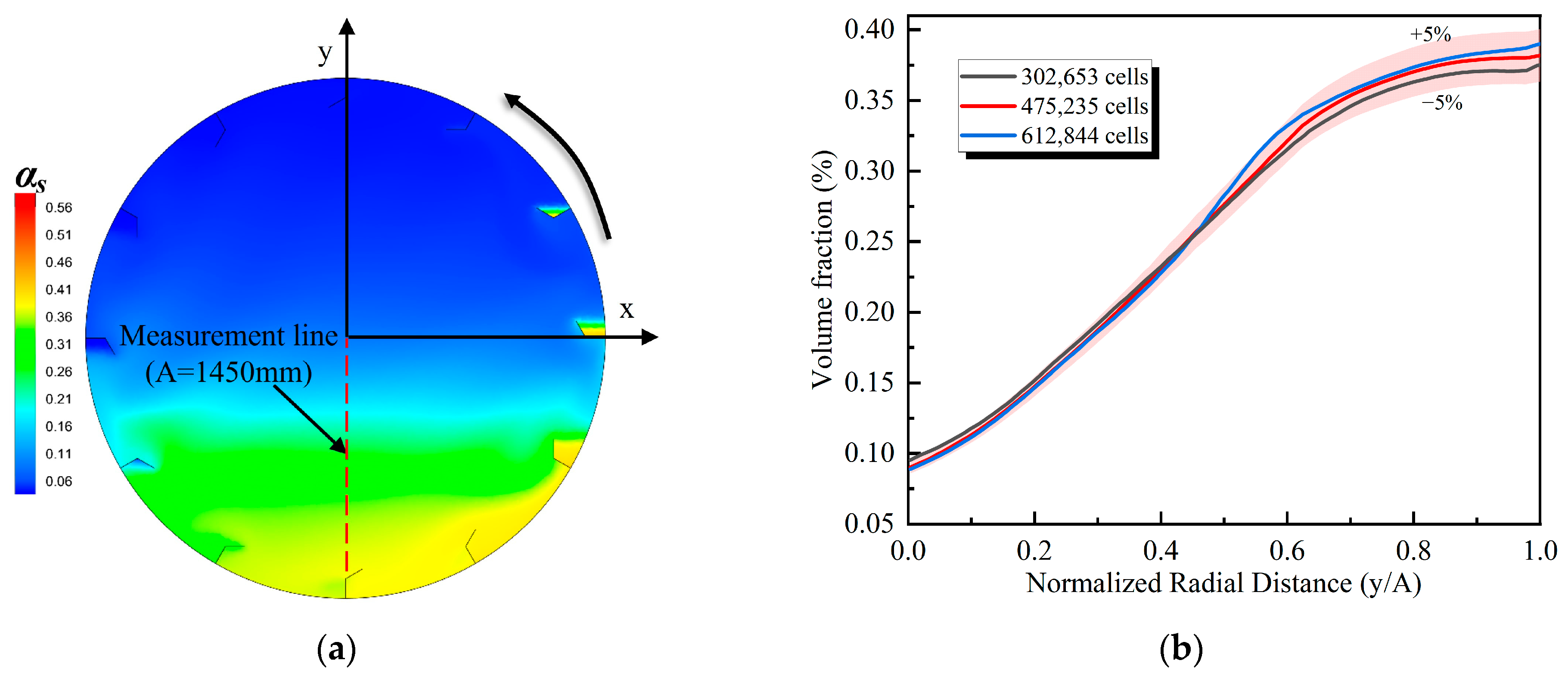
An unstructured polyhedral mesh was employed to discretize the computational domain, and mesh generation was performed using Fluent Meshing. A grid independence test was conducted for a rotating drum equipped with L-shaped baffles operating at a rotational speed of 2 rpm. Figure 4 presents the distribution of the granular phase volume fraction obtained from three different mesh resolutions (302,653; 475,235; and 612,844 cells). A comparative analysis indicates that a mesh with 475,235 cells is reasonably adequate. After further refinement to 612,844 cells, the variation in the granular phase volume fraction was within ±5%, suggesting that further mesh refinement no longer significantly affects model accuracy. Therefore, considering both computational accuracy and efficiency, a mesh with 475,235 cells was selected for subsequent simulations.

3. Results and Discussion

3.1. Granular Flow and Temperature Distribution in Rotating Drum

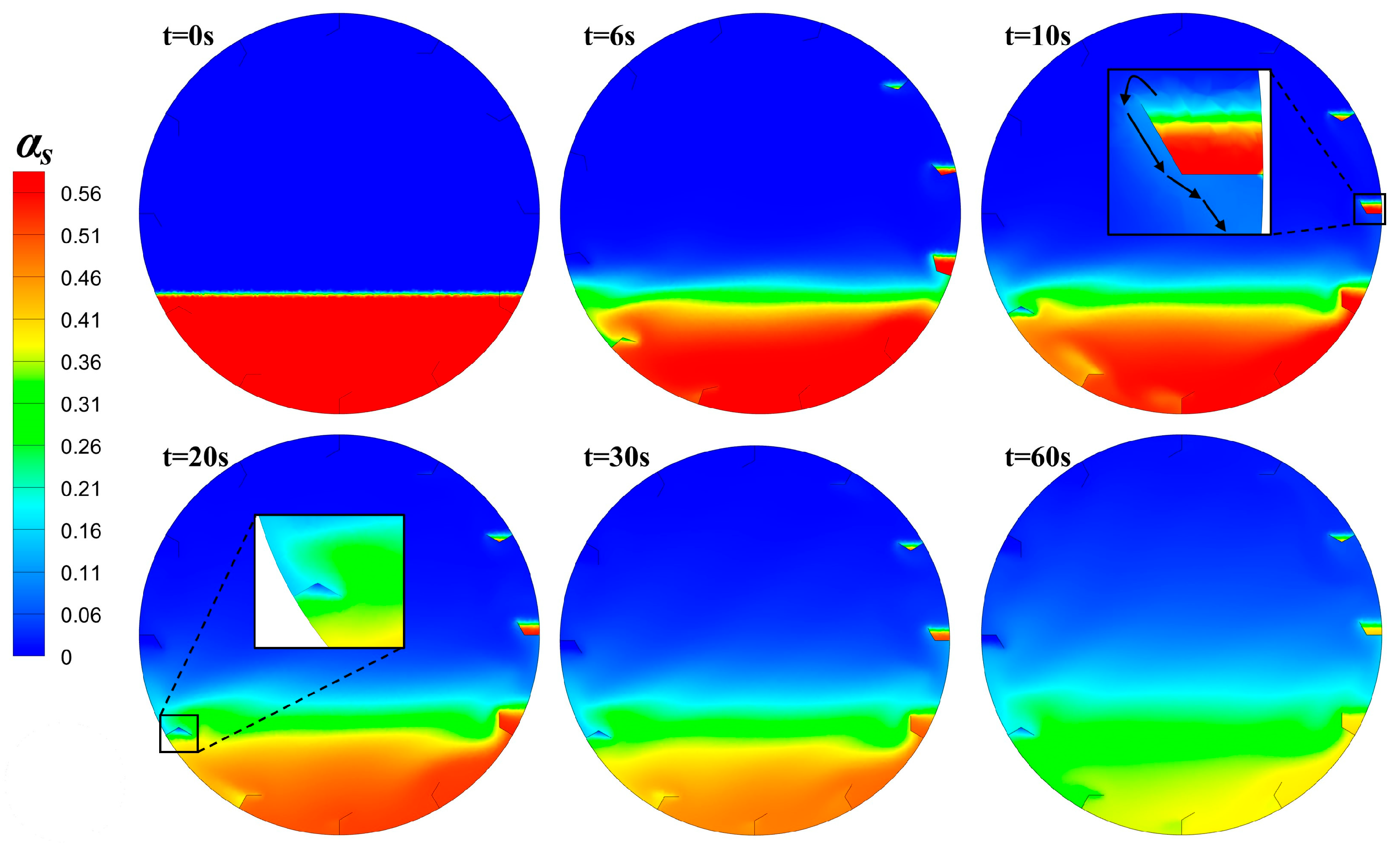
The contour plots of the granular phase at different times for a rotating drum equipped with L-shaped baffles operating at 2 rpm are presented in Figure 5. As the drum rotates, the granular phase is lifted by the L-shaped baffles. When the baffles reach a certain angle, the particles naturally fall under gravity. Notably, unlike the nearly vertical falling pattern typically observed for larger particles, the falling direction of the calcined clay fine powder is opposite to the rotational direction of the drum. Meanwhile, a distinct wall-following flow characteristic is exhibited by the particle trajectories, which follow the baffle and the inner drum wall, as shown in the inset at t = 10 s in Figure 5. This wall-following behavior of the fine powder is primarily attributed to its particle properties. Upon detachment from the L-shaped baffles, an initial velocity of approximately 0.335 m/s is acquired by the particles, which is close to the linear velocity of the drum wall. The direction of this initial velocity is consistent with the drum’s rotation. However, due to the small particle diameter of 11 μm, the inertial force acting on the particles under rotation and gravity is relatively weak, while the interaction force between the particles and the gas phase is comparatively strong. As a result, the fine particles are more susceptible to the near-wall airflow, with which a stronger interaction is exhibited. Therefore, after detachment from the baffles, the fine particles exhibit a flow characteristic of moving close to the wall.
As the drum rotates, pronounced stratification and fluidization characteristics are gradually observed in the calcined clay granular bed. At t = 10 s, slight stratification is observed on the bed surface, where a fluidized region with a distinctly increased gas fraction is formed, while the bottom layer remains in a densely packed state. By t = 30 s, after one complete revolution of the drum and under the periodic agitation of the L-shaped baffles, more pronounced stratification is exhibited by the bed. This is manifested as an expansion of the fluidized region on the bed surface, a significant decrease in solid phase concentration at the bottom of the bed, and an increase in the gas phase fraction, giving the bed an overall aerated regime.
During drum rotation, particles are continuously entrained from the bottom of the granular bed by the L-shaped baffles and discharged above the bed, thereby reducing the solid phase concentration at the bed bottom. Meanwhile, as the L-shaped baffles cut into the granular bed, gas is carried into the bed, further reducing the solid phase concentration at the bottom. As shown in the inset at t = 30 s in Figure 5, the particle concentration behind the L-shaped baffle is significantly lower than that ahead of it, directly reflecting gas entrainment into the granular bed by the L-shaped baffle. Under the disturbance mechanism of the L-shaped baffles, localized fluidization is exhibited by the granular bed even at low rotational speeds. This indicates that, under the continuous action of the L-shaped baffles, the calcined clay granular bed transitions from a densely packed state toward a fluidized state characterized by more homogeneous gas–solid mixing. By t = 60 s, the fluidization of the particles within the drum is intensified. The solid phase concentration at the bottom of the granular bed is further reduced, the stratification of the bed is gradually weakened, and more pronounced fluidization characteristics are observed.
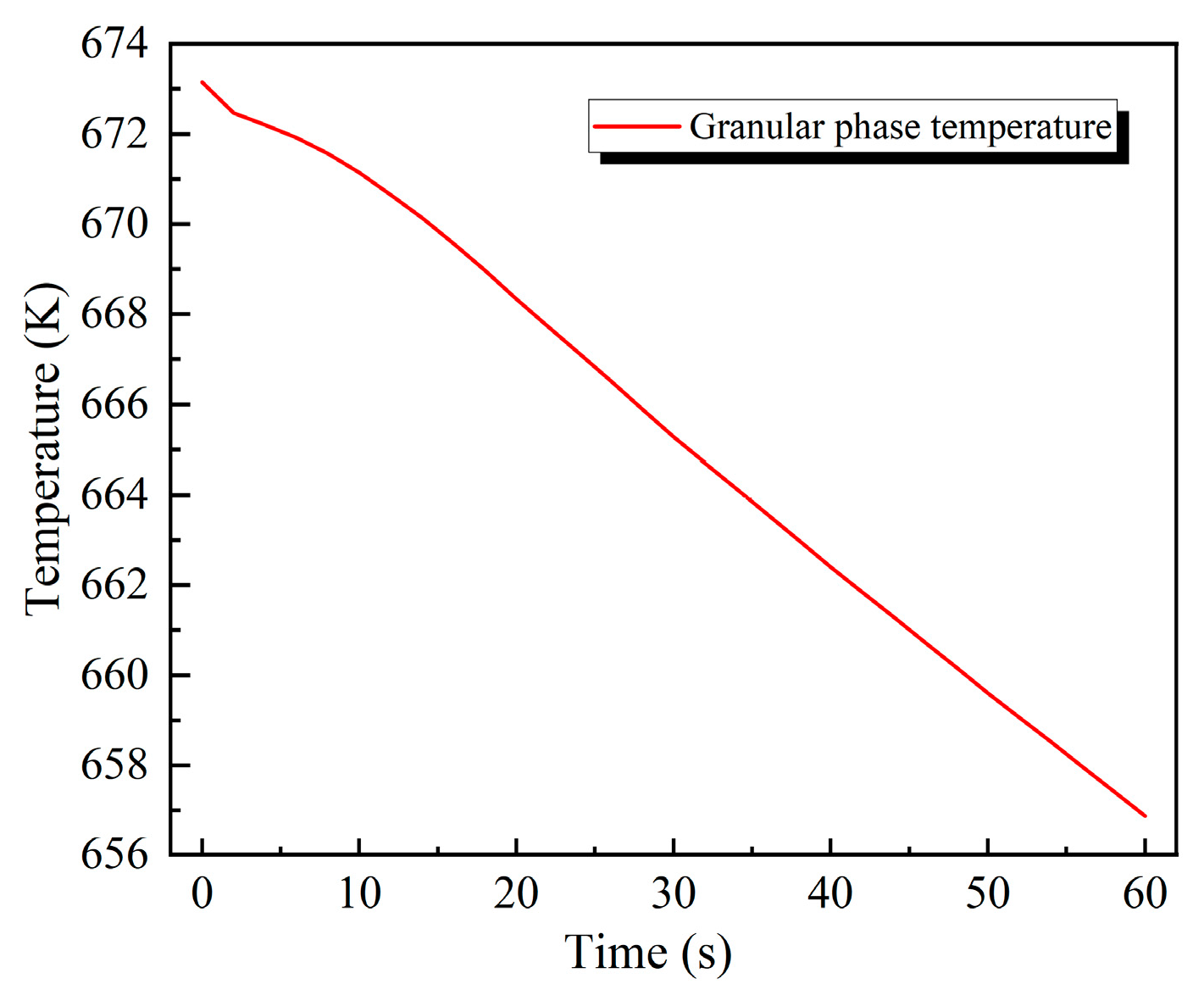
Figure 6 presents the variation in the average granular phase temperature in the rotating drum. During the period from 0 to 60 s, an approximately linear decreasing trend is exhibited by the granular phase temperature. By 60 s, the average temperature of the granular phase is reduced by approximately 16.3 K compared to its initial value. During drum rotation, two primary heat transfer mechanisms are involved: direct contact heat transfer between the particles and the inner drum wall, and convective heat transfer between the particles and the gas phase inside the drum. Owing to the mean particle size of 11 μm, the calcined clay particles possess a large specific surface area. Consequently, the contact area between the particles and both the drum wall and the gas phase is significantly enhanced, effectively improving the heat transfer efficiency.
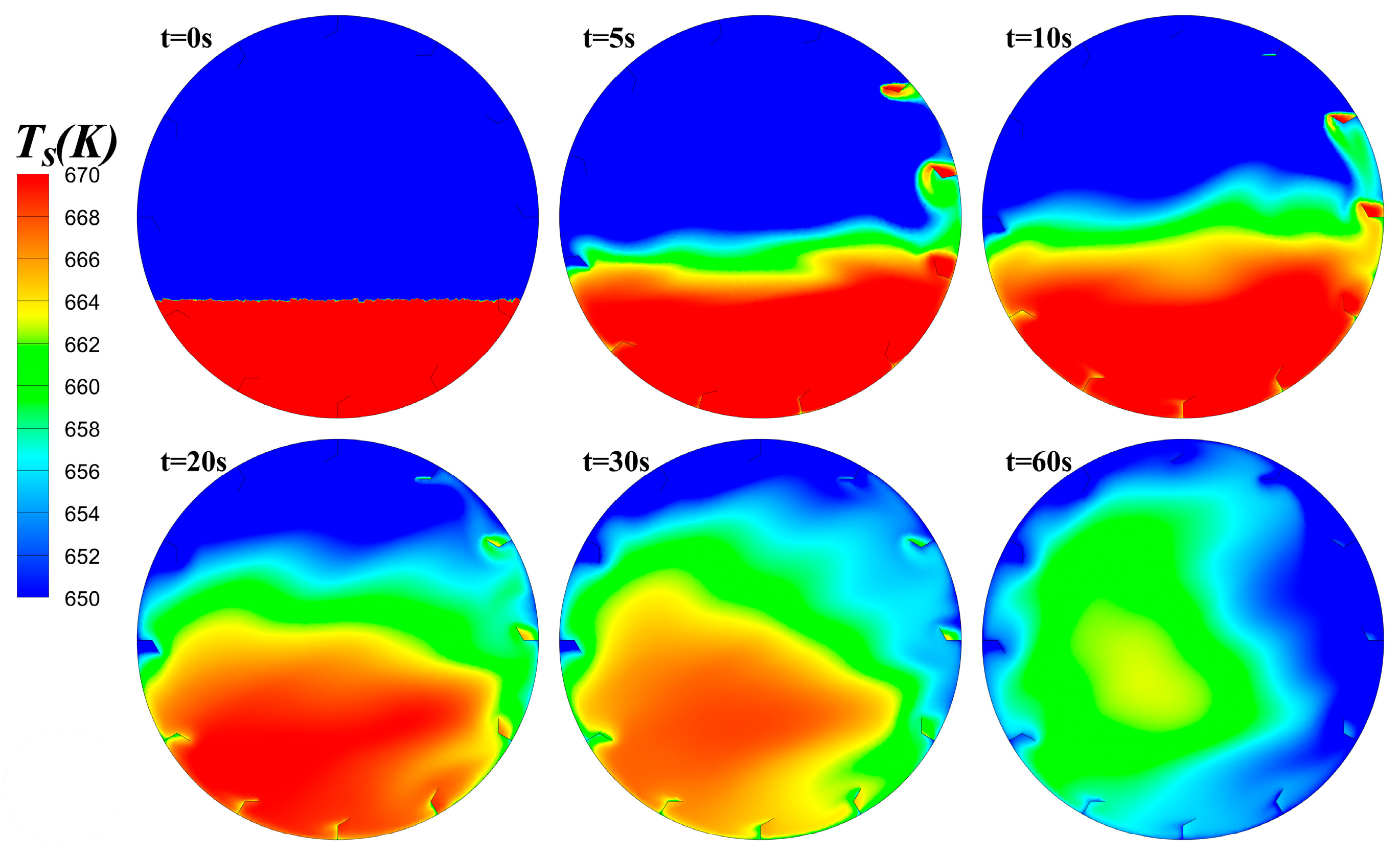
Furthermore, periodic disturbances are introduced to the bed structure by the L-shaped baffles as they continuously cut into the granular bed during rotation, thereby promoting the heat transfer process. As shown in Figure 7, particles are lifted and dumped by the L-shaped baffles, and the high-temperature particles at the bottom of the bed are dumped, which accelerates their cooling. At t = 20 s, the temperature on the right side of the granular bed is observed to be reduced because the baffles continuously carry away high-temperature particles. At t = 30 s, localized high-temperature regions at the bottom of the granular bed are disrupted, which improves the temperature uniformity within the bed. In addition, when the baffles cut into the granular bed, localized fluidization is induced, promoting thorough mixing between the particles and the gas phase and intensifying the gas–solid convective heat transfer, as shown on the left side of Figure 7 at t = 60 s. Moreover, the contact area between the particles and the inner wall is increased by the presence of the baffles, thereby enlarging the effective heat transfer area between the particles and the wall. Through the synergistic effect of these three mechanisms, the overall heat transfer efficiency is significantly enhanced. Therefore, a significant temperature reduction can still be achieved in the fine-powder bed even under low rotational speed conditions.

3.2. Effect of Baffle Configuration

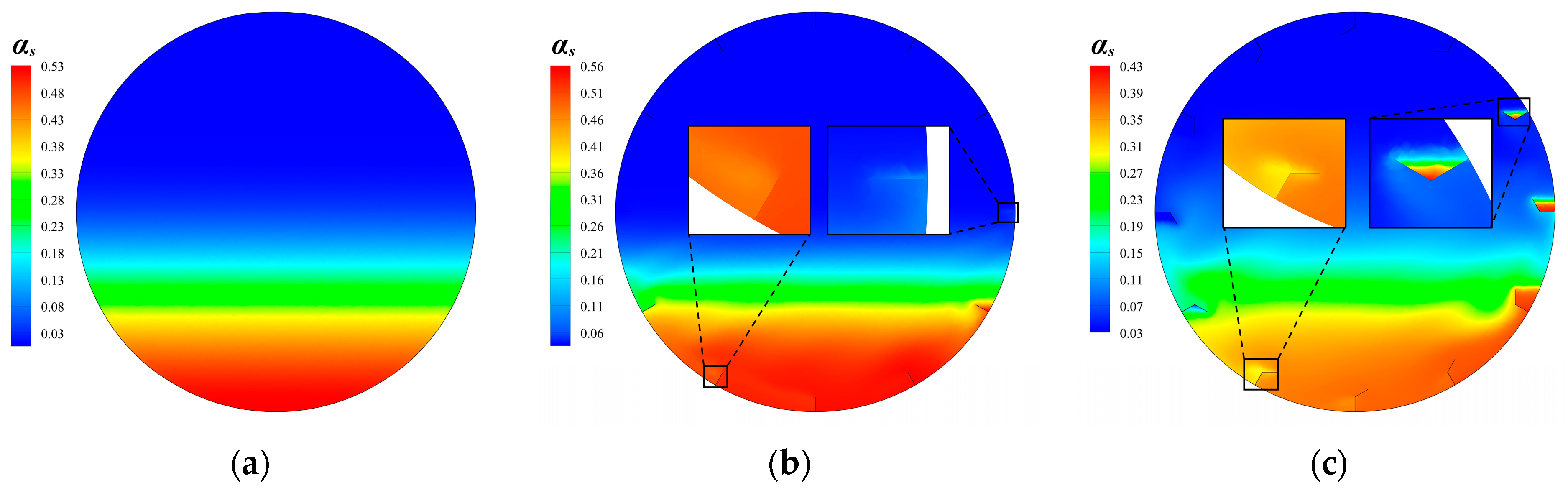
Figure 8 presents a comparison of the granular phase volume fraction in the rotating drum under different baffle configurations. Bed stratification is observed in all configurations, with no significant expansion of the fluidized region, although a reduction in particle concentration at the bed bottom is noted. In the unbaffled drum, the bed surface is the flattest, whereas the bed bottom remains dominated by dense packing, and fluidization occurs only at the bed surface. Compared with the unbaffled configuration, the incorporation of straight baffles has a minor effect on the fluidization behavior of the granular bed. As shown in the right inset of Figure 8b, only a small number of particles are lifted and dumped by the straight baffles after they leave the bed. Similarly, only a small amount of gas is carried into the bed when the straight baffles cut into it, as illustrated in the left inset of Figure 8b. Consequently, weak fluidization is exhibited by the granular bed in the drum with straight baffles, and the bed bottom remains in a densely packed state.
Unlike the unbaffled drum or the one with straight baffles, a more pronounced aerated regime and surface fluidization are observed in the calcined clay granular bed within the drum equipped with L-shaped baffles. This is manifested as a clear reduction in particle concentration within the bed. These phenomena can be explained by the action of the L-shaped baffles and gas–solid interactions. As shown in the right inset of Figure 8c, after leaving the bed, a portion of the particles is lifted by the L-shaped baffles and dumped from a height. During this dumping process, owing to the small average particle diameter of 11 μm and the resulting strong gas–solid interaction, the particles display a wall-following flow characteristic. Meanwhile, a large amount of gas is entrained into the bed along with the falling particles. Furthermore, as shown in the left inset of Figure 8c, when the L-shaped baffles cut into the granular bed, the particle concentration behind them is significantly lower than that in front. This indicates that gas is also entrained into the bed as the baffles penetrate it. Meanwhile, due to the small particle size of the calcined clay, an aerated regime and a tendency toward fluidization are exhibited by the granular bed after mixing with the gas phase.
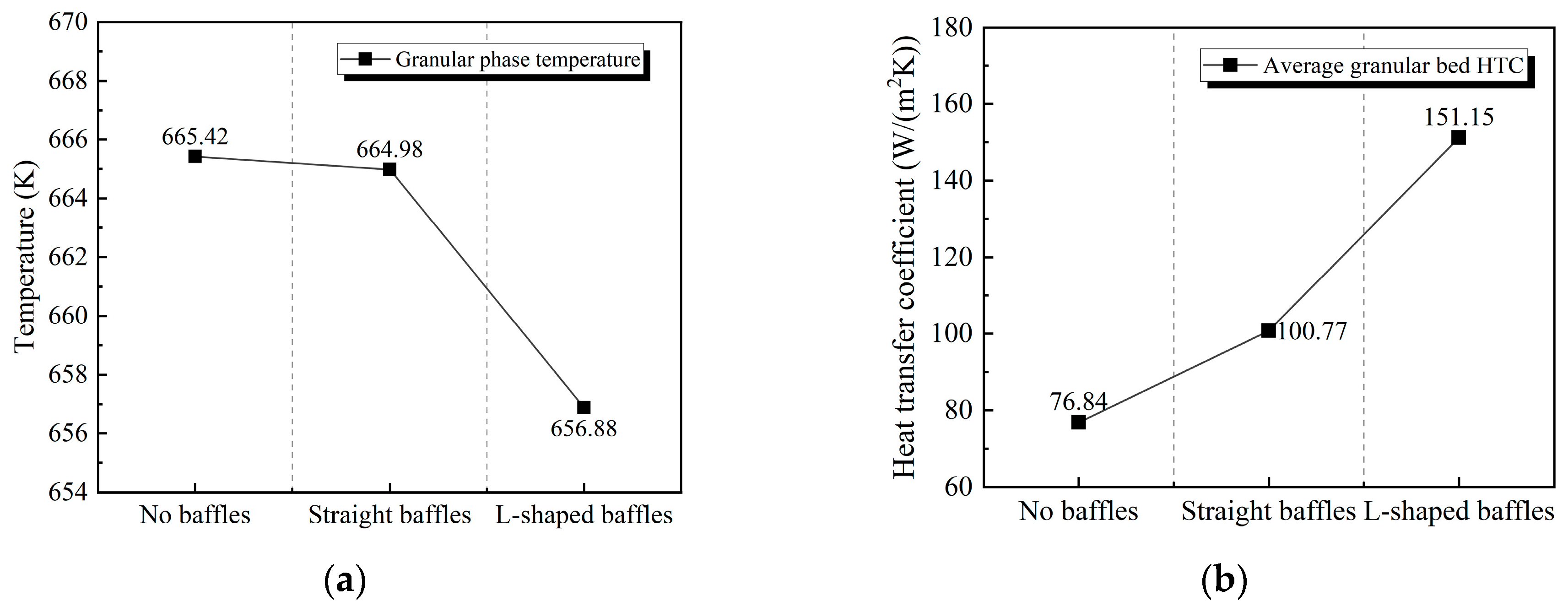
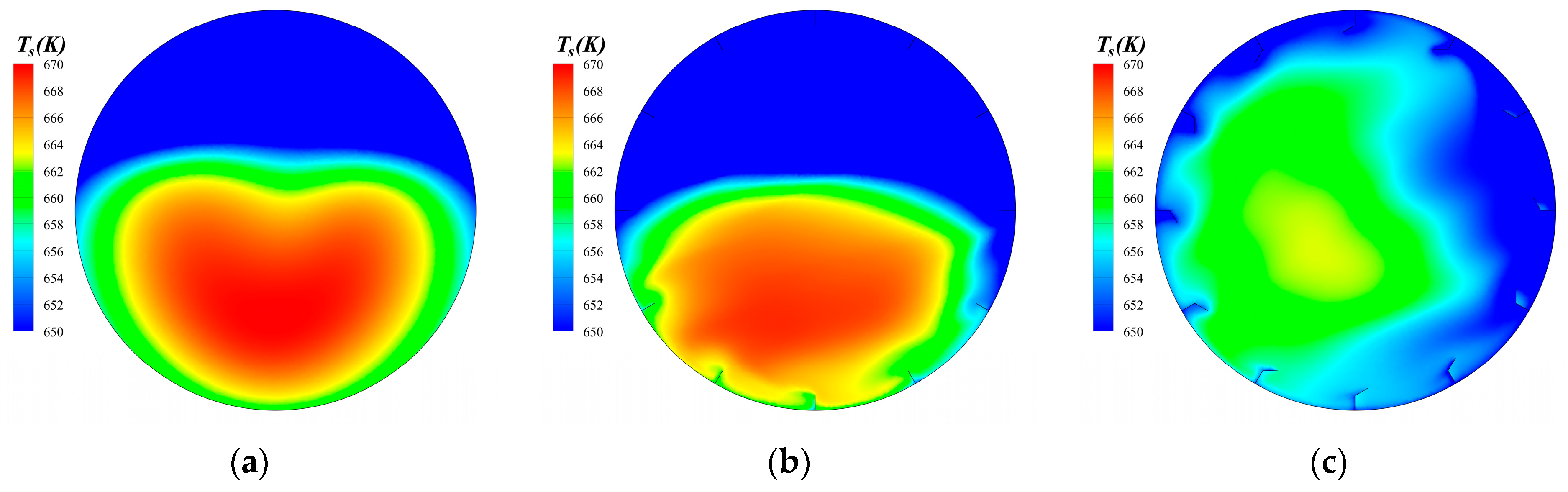
Figure 9 compares the heat transfer efficiency in the rotary drum under different baffle configurations. Compared with the no-baffle case, straight baffles offer only limited improvement in cooling performance, whereas L-shaped baffles produce a markedly more pronounced cooling effect. With L-shaped baffles, the cooled granular bed temperature decreases from 665.42 K to 656.88 K, and the average heat transfer coefficient (HTC) of the granular bed increases from 76.84 W/(m2·K) to 151.15 W/(m2·K). This indicates a significant enhancement in heat transfer efficiency. First, the baffles are attached to the inner drum wall and can be regarded as extensions of the wall. This extension increases both the effective contact area between the particles and the drum and the frequency of particle–wall contact, thereby effectively improving heat transfer. Second, L-shaped baffles outperform straight baffles because, as they emerge from the granular bed, they are able to lift and dump a greater number of particles from the bed interior than straight baffles can. Meanwhile, as shown in Figure 10, L-shaped baffles effectively disrupt the localized high-temperature regions within the granular bed. Furthermore, a portion of the low-temperature gas phase is introduced into the granular bed through the L-shaped baffles, promoting gas–solid mixing and intensifying heat exchange between the granular and gas phases. As a result, the L-shaped baffles achieve superior cooling performance.

3.3. Effect of Rotational Speed

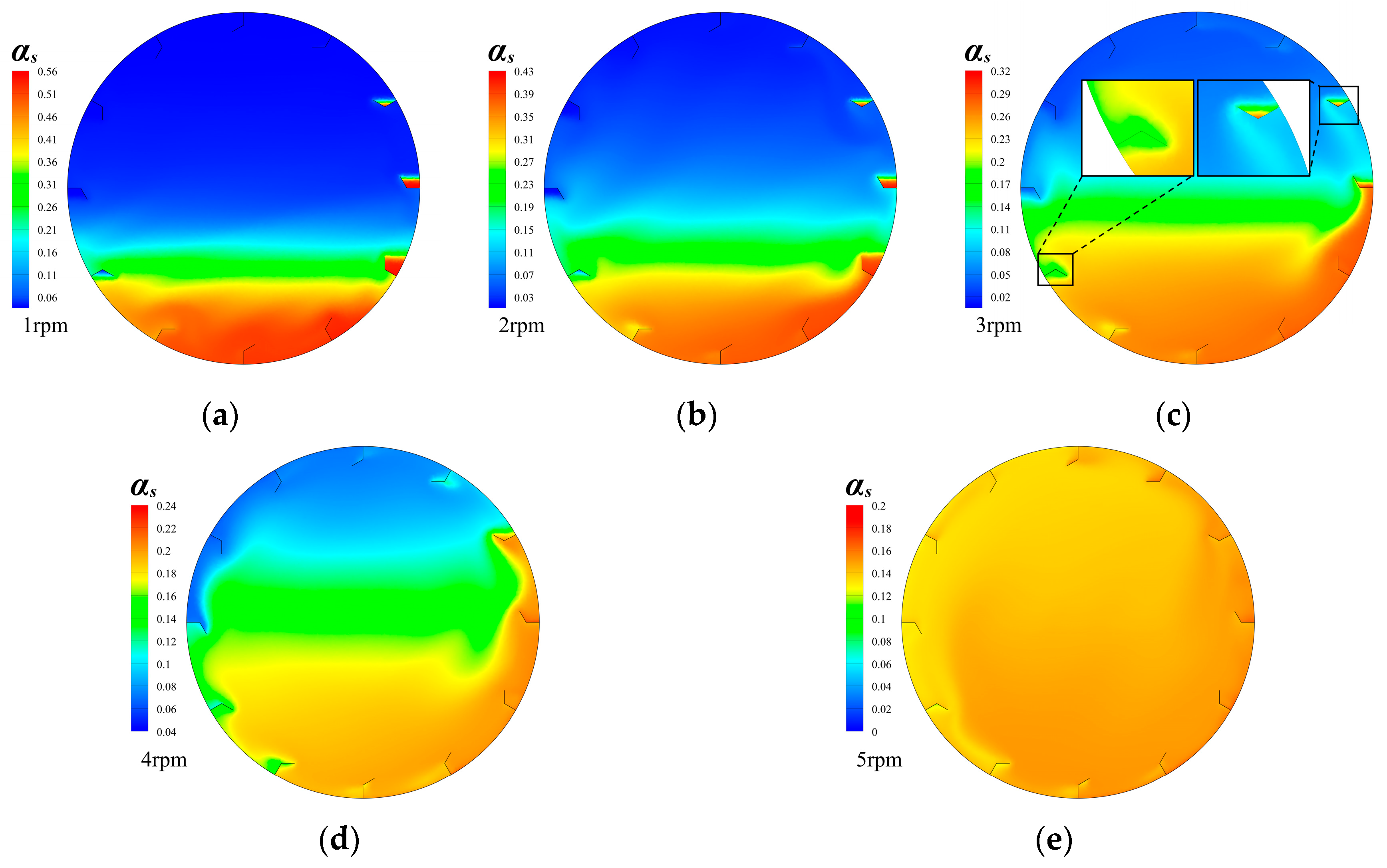
Figure 11 shows contour plots of the granular phase in the rotating drum at different rotational speeds. As the rotational speed increases, the fluidization of the calcined clay fine powder is gradually enhanced. At 1 rpm, the granular bed remains densely packed at the bottom, with fluidization confined to the bed surface, resulting in a stratified structure. At 3 rpm, a more distinct aerated regime is exhibited by the granular bed within the drum, characterized by an increased gas phase content, accompanied by a pronounced expansion relative to its initial state. At 4 rpm, the aerated state of the granular bed is further intensified, with a more pronounced trend toward fluidization exhibited. As more particles are lifted and dumped, the bed volume expands further and the solid phase volume fraction within the bed continues to decrease. The intensification of fluidization of the fine powder with increasing rotational speed is found to be in good agreement with the findings reported by Huang et al. [28]. At a rotational speed of 5 rpm, the calcined clay particles nearly fill the entire rotating drum, with the granular phase being thoroughly mixed with the gas phase, and a fully fluidized state is observed.
As the rotational speed increases, the aeration and fluidization characteristics of the calcined clay fine powder within the rotating drum are intensified. This can be attributed to the increased disturbance frequency of the granular bed by the L-shaped baffles and the enhanced gas–solid interactions. With increasing rotational speed, particles are lifted from the granular bed and dumped at a higher frequency per unit time by the L-shaped baffles. The falling particles cascade toward the inner drum wall, entraining the gas phase into the granular bed at a higher frequency, as shown in the right inset of Figure 11c. Meanwhile, the L-shaped baffles cut into the granular bed more frequently, thereby introducing more gas into the bed, as illustrated in the left inset of Figure 11c. As a result, the gas content within the granular bed is increased, and the uniformity of gas–solid mixing is improved. With increasing rotational speed, the relative velocity between the particles and the gas phase inside the drum increases, thereby enhancing the drag force between the fine powder and the gas phase. This facilitates the suspension of particles, resulting in more pronounced fluidization. Under the combined effect of these two mechanisms, the granular bed exhibits expansion characteristics at higher rotational speeds and enters an aerated regime. This expansion phenomenon of the fine powder bed is consistent with the characteristics of the fluidization regime observed in conventional fluidization.
After being entrained in the granular bed, the gas takes time to escape. Consequently, a relatively stable and sustained fluidized region is formed on the bed surface during drum rotation, macroscopically manifested as stratification of the granular bed. Unlike the inclined granular bed typically formed by the rolling of conventional large particles in a rotating drum, a flatter surface morphology is exhibited by the fine powder bed under aerated conditions. This is attributed to the fluid-like characteristics displayed by the calcined clay fine powder under fluidization, which keeps the bed surface horizontal. In summary, under the combined effects of drum rotation and the fine particle nature of calcined clay, pronounced fluidization behavior is exhibited by the granular bed even at low rotational speeds.
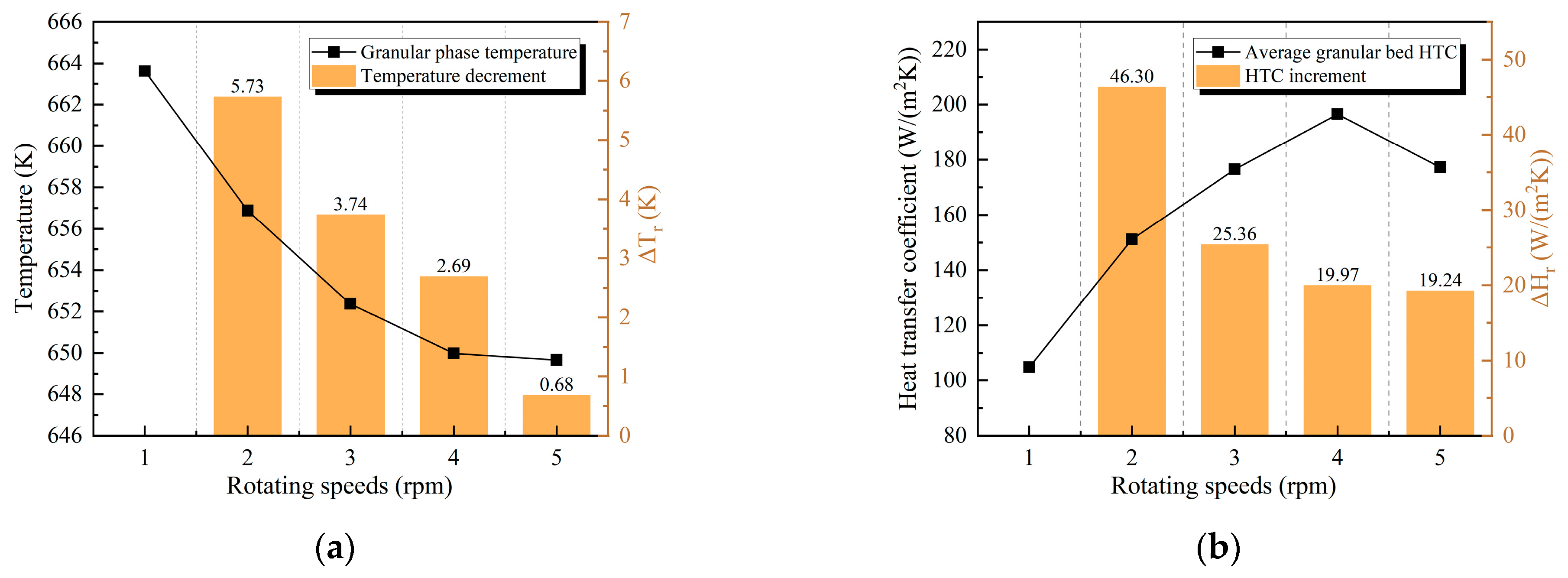
Figure 12 presents the effect of rotational speed on the granular phase temperature and HTC in the rotating drum. With increasing rotational speed, the granular phase temperature exhibits an overall decreasing trend, whereas the heat transfer coefficient first increases and then decreases. To evaluate the cooling benefit per unit increase in rotational speed, the temperature decrement ΔTr and the HTC increment ΔHr are defined. ΔTr is defined as the cooling effect achieved per 1 rpm increase in rotational speed, as expressed in Equation (22), and ΔHr is defined as the increment in heat transfer efficiency per 1 rpm increase, as expressed in Equation (23).
Δ T r = T n T n 1 ,
Δ H r = H n H n 1 ,
where Tn and Hn denote the average temperature and heat transfer coefficient of the granular phase after cooling at a rotational speed of n rpm, with n being an integer from 2 to 5 rpm.
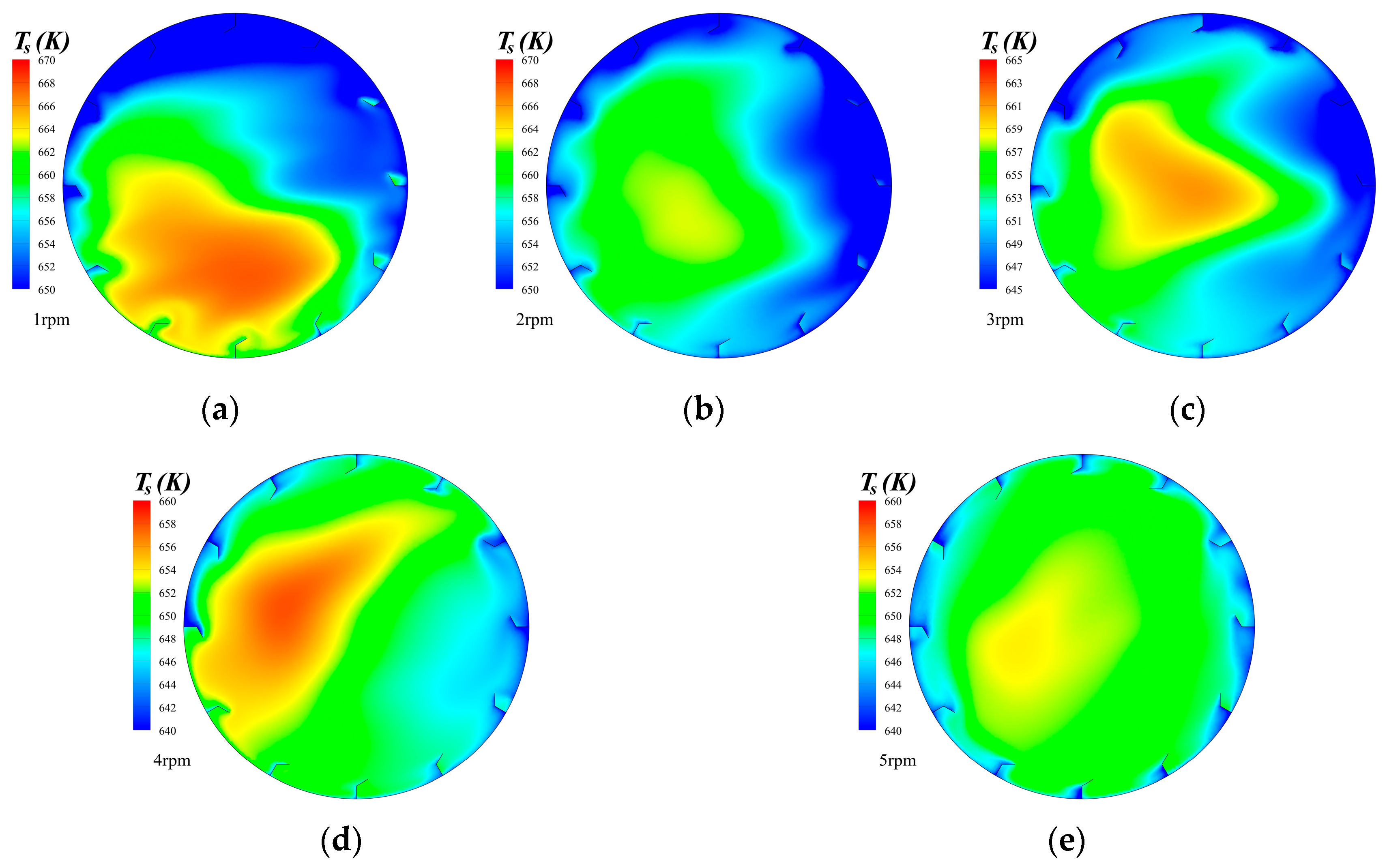
As shown in Figure 12, both the temperature decrement and the HTC increment of the granular phase decrease with increasing rotational speed. The maximum temperature decrement of 5.73 K and the highest HTC increment of 46.30 W/(m2·K) are observed when the rotational speed is increased from 1 to 2 rpm. Beyond 2 rpm, both ΔTr and ΔHr gradually decline, a trend attributed to the transition in flow characteristics of the granular bed at different rotational speeds. As shown in Figure 13b, at 2 rpm, the periodic disturbances induced by the L-shaped baffles increase, effectively disrupting localized high-temperature structures within the bed and significantly intensifying both particle mixing and heat transfer. Consequently, the cooling increment gained from raising the rotational speed is most pronounced. However, further increases in rotational speed yield limited improvement in cooling performance. This is because excessive rotational speeds intensify the fluidization of the fine calcined clay granular bed, causing a large number of particles to be suspended in the upper region of the rotating drum. As a result, the heat transfer mechanism between the particles and the drum wall and baffles shifts from sustained contact heat transfer to short-duration heat transfer under high-frequency collisions. Although this transition increases the heat transfer coefficient owing to the frequent and brief particle collisions, it weakens the temperature decrement and HTC increment. As shown in Figure 13e, at 5 rpm the granular phase is highly fluidized and the temperature difference within the drum is significantly reduced. Based on the particle flow characteristics and cooling performance, a rotational speed of 2 rpm is determined to be optimal in this study.

3.4. Effect of the Number of L-Shaped Baffles

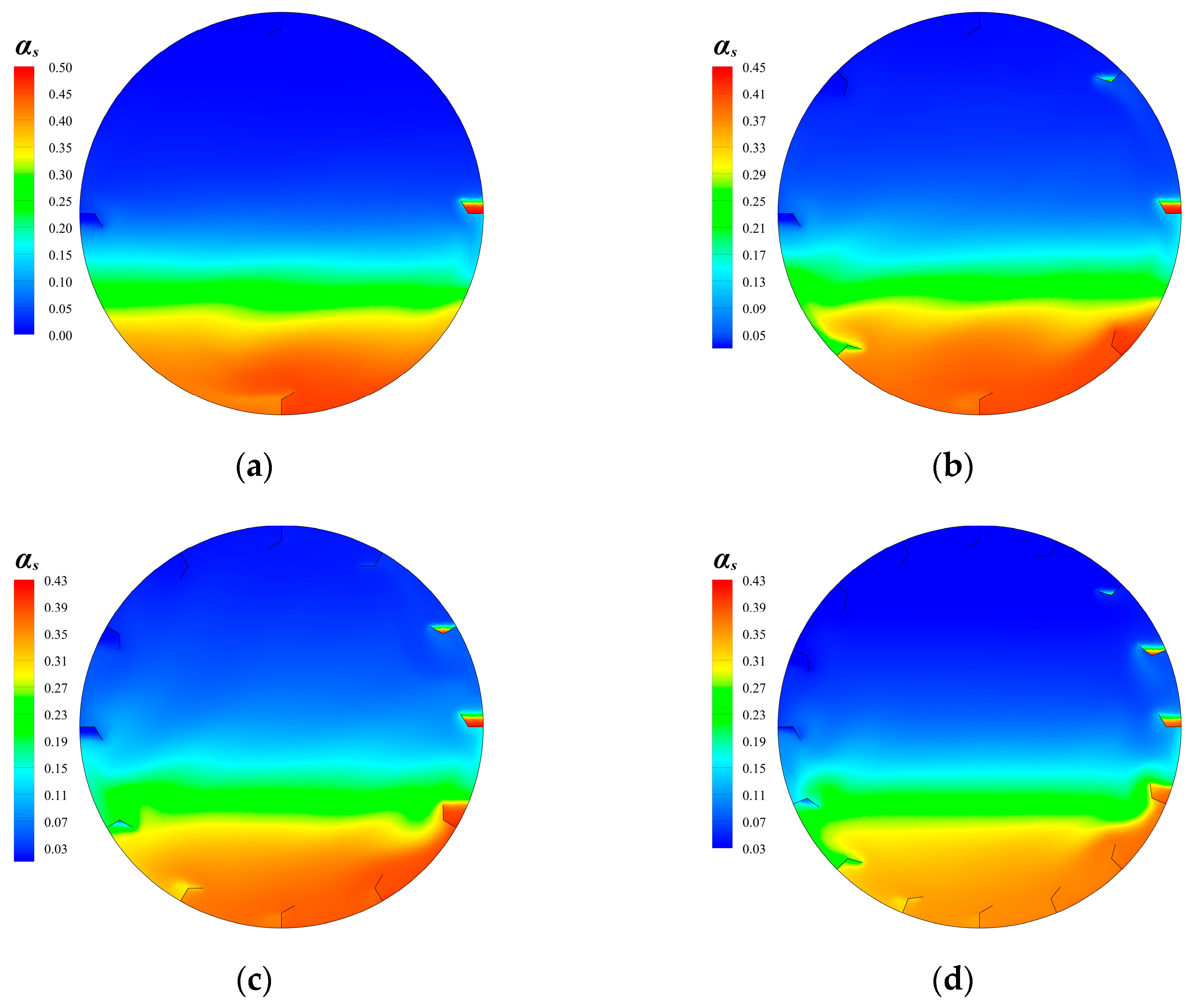
Figure 14 shows contour plots of the granular phase in rotating drums with different baffle numbers. As the number of baffles increases, the fluidized region on the granular bed surface does not expand significantly, although a decrease in particle concentration is observed at the bottom of the granular bed. The reduction in particle concentration at the granular bed bottom is primarily attributed to the increased disturbance frequency induced by the L-shaped baffles. With more L-shaped baffles, the frequency at which they cut into and leave the bed is increased, thereby transporting more particles out of the densely packed region. Meanwhile, as the L-shaped baffles cut into the bed, more gas is introduced into the granular bed, further reducing the solid phase concentration at the bottom.
However, no significant expansion of the fluidized region on the granular bed surface is caused by the increase in baffle number. This is because the fluidized region on the bed surface is mainly influenced by gas–solid interactions. At the same rotational speed, increasing the number of baffles has little effect on the velocity of particles after dumping, and the gas–solid interaction changes slightly. Consequently, no significant expansion of the fluidized region on the granular bed surface is observed.
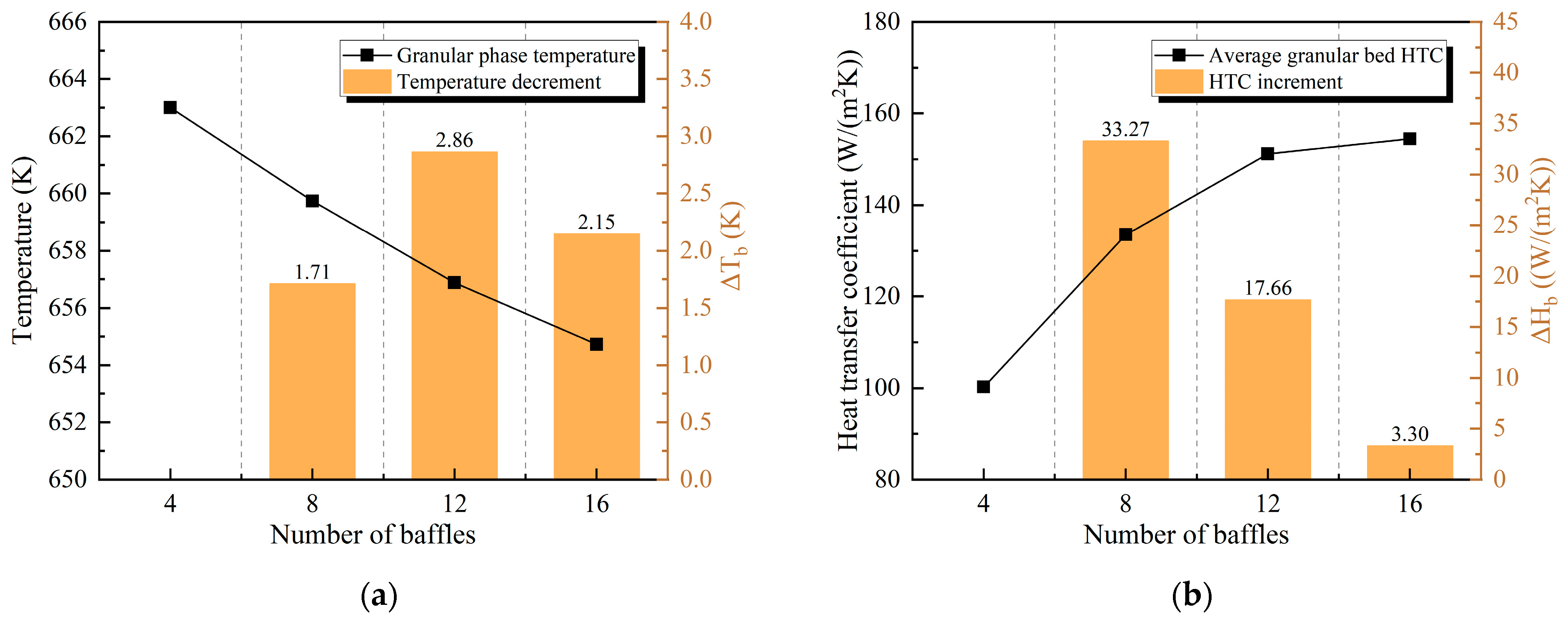
Figure 15 shows the influence of the number of baffles on the granular phase temperature and heat transfer coefficient. As the number of baffles increases, the granular phase temperature exhibits a decreasing trend, while the heat transfer coefficient shows an increasing trend. Similarly, the cooling benefit gained by adding L-shaped baffles is evaluated through the temperature decrement and HTC increment. ΔTb is defined as the cooling effect obtained by adding four L-shaped baffles, as expressed in Equation (24), and ΔHb is defined as the increment in heat transfer coefficient obtained by adding four L-shaped baffles, as expressed in Equation (25).
Δ T b = T i T i 4 ,
Δ H b = H i H i 4
where Ti and Hi represent the average temperature and heat transfer coefficient of the granular phase when the number of baffles is i, with i taking values of 8, 12, and 16.
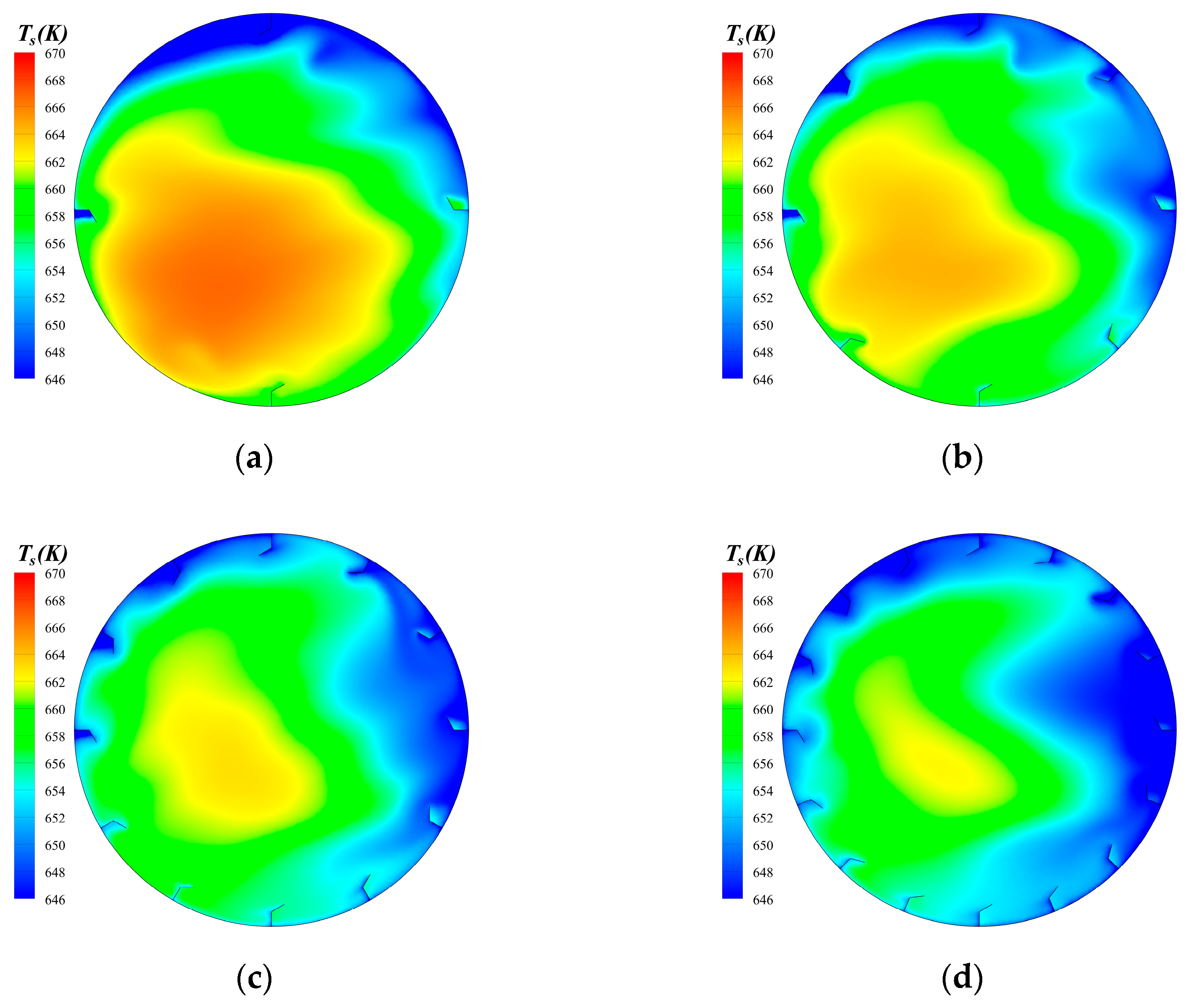
As shown in Figure 15, the temperature decrement is most favorable at 12 L-shaped baffles, reaching 2.86 K, and the HTC increment remains relatively high at baffle numbers of 8 and 12, with values of 33.27 W/(m2·K) and 17.66 W/(m2·K), respectively. As can be observed from Figure 16a, localized high-temperature regions exist within the granular bed when four baffles are used. As the baffle number is increased to 8 and 12, on the one hand, the average contact area between the granular phase and the drum wall is enlarged. On the other hand, as shown in Figure 16b,c, a greater number of baffles perturb the granular bed at higher frequencies. This promotes particle fluidization, disrupts the localized high-temperature zones, and leads to a more uniform temperature distribution of the granular phase in the rotating drum. However, when the baffle number is increased to 16, both the temperature decrement and the HTC increment are found to be at relatively low levels. This is because, although a favorable cooling benefit is achieved by disrupting the localized high-temperature zones when the baffle number increases from 4 to 12, further increasing the number to 16 brings only a limited incremental benefit. Meanwhile, an excessively large number of baffles results in an excessively high disturbance frequency, which intensifies bed fluidization and markedly increases the number of particles suspended in the gas phase. Consequently, the sustained contact time between the particles and the drum wall and baffles is reduced, and the heat transfer mechanism tends to shift toward high-frequency, short-duration collision-based heat transfer, thereby reducing the cooling benefit. Therefore, the cooling benefit gained from adding baffles diminishes when the number exceeds 12. Considering heat transfer performance and structural simplicity, a configuration with 12 baffles is considered a favorable choice.

4. Conclusions

In this study, the Euler–Euler multiphase flow model was employed to numerically simulate the flow behavior and heat transfer of the granular bed in a rotary cooler for calcined clay. The flow behavior and temperature distribution of the fine calcined clay particles inside the rotating drum were investigated. A detailed analysis was conducted on the effects of rotational speed, baffle configuration, and number of baffles on the gas–solid hydrodynamic behavior and heat transfer performance of the calcined clay granular bed.
Owing to the small particle size of 11 μm, stratification and aerated fluidization of the granular bed were observed during drum rotation. Under the periodic disturbance of the L-shaped baffles, localized fluidized regions were formed in the granular bed even at low rotational speeds. Compared with the unbaffled and straight-baffled configurations, the L-shaped baffles provided the best cooling performance, achieving a granular bed temperature of 656.88 K and a heat transfer coefficient of 151.15 W/(m2·K).
Rotational speed was found to significantly influence the flow and heat transfer of the granular bed. As the rotational speed increased, the granular bed volume expanded and the degree of fluidization intensified. At 5 rpm, the particles inside the drum exhibited a fully fluidized state. The most favorable temperature decrement and HTC increment were obtained at 2 rpm, with values of 5.73 K and 46.30 W/(m2·K), respectively.
Increasing the number of L-shaped baffles marginally affected the expansion of the fluidized region on the granular bed surface, while reducing the particle concentration at the bottom. With 12 baffles, the temperature decrement peaked at 2.86 K and the HTC increment reached a relatively high 33.27 W/(m2·K). Further increasing the number of baffles reduced the cooling benefit per unit baffle.

Author Contributions

Conceptualization, Z.C. and F.F.; methodology, F.F.; software, F.F.; validation, Y.M. and F.F.; formal analysis, Y.M. and F.F.; investigation, Z.C., Y.M. and F.F.; resources, Z.C.; data curation, F.F., C.T. and Y.S.; writing—original draft preparation, F.F.; writing—review and editing, Z.C., Y.M. and F.F.; visualization, F.F., C.T. and Y.L.; supervision, Y.M.; project administration, Z.C. and Y.M.; funding acquisition, Z.C. and Y.M. All authors have read and agreed to the published version of the manuscript.

Funding

This research received no external funding.

Data Availability Statement

The original contributions presented in this study are included in the article. Further inquiries can be directed to the corresponding author.

Conflicts of Interest

The authors declare no conflicts of interest.

References

  1. Khazem, R.; Colin, J.; Shi, H.; Casalinho, J.; Schott, D.; Puel, F. Characterization of Wood Powder Properties: A DEM-Based Calibration with Rotating Drum Experiments. Powder Technol. 2026, 473, 122157. [Google Scholar] [CrossRef]
  2. Miguélez-García, M.; Fernández-Yáñez, P. Analysis of Thermoelectric Power Generation for Waste Heat Recovery in Industrial Carbon Black Rotary Drum and Combustion Chamber. Appl. Therm. Eng. 2026, 286, 129339. [Google Scholar] [CrossRef]
  3. Yu, X.; Chen, H.; Liu, Y. Characterization of Heat and Mass Transfer from Textiles inside the Rotating Drum of a Clothes Dryer. Appl. Therm. Eng. 2025, 268, 125912. [Google Scholar] [CrossRef]
  4. Muramulla, P.; Jogee, S.; Nagpal, S.; Goswami, P.S.; Gopireddy, S.; Profitlich, T.; Urbanetz, N. Heat Transfer Studies in a Rotating Drum Containing Non-Spherical Particles. Powder Technol. 2024, 438, 119607. [Google Scholar] [CrossRef]
  5. Chou, S.H.; Hsiau, S.S.; Liu, S.Y. Experimental Study of Heat Transfer and Transport Properties of Granular Material in Indirectly Heated Rotary Drums. Int. J. Heat Mass Transf. 2025, 238, 126485. [Google Scholar] [CrossRef]
  6. He, Y.; Rao, L.; E, D.; Lai, N.; Fang, J.; Jiang, Z. Multi-Response Optimization for a Waste Heat Recovery Rotary Drum with Flights: Focusing on Enhancement and Homogenization of Heat Exchange. Chem. Eng. Res. Des. 2025, 218, 218–229. [Google Scholar] [CrossRef]
  7. Okoji, A.I.; Anozie, A.N.; Omoleye, J.A. Evaluating the Thermodynamic Efficiency of the Cement Grate Clinker Cooler Process Using Artificial Neural Networks and ANFIS. Ain Shams Eng. J. 2022, 13, 101704. [Google Scholar] [CrossRef]
  8. Dong, T.; Yang, S.; Wang, S. Super-Quadric DEM Study of Cylindrical Particle Behaviours in a Rotating Drum. Powder Technol. 2024, 437, 119511. [Google Scholar] [CrossRef]
  9. Ma, C.; Zhu, R.; Ma, Y.; Yu, Y.; Tan, C.; Yang, S.; Liu, H.; Hu, J.; Wang, H. An Overview of Advancements in Biomass Pyrolysis Modeling: Applications, Challenges, and Future Perspectives in Rotary Reactors. Biomass Bioenerg. 2025, 193, 107568. [Google Scholar] [CrossRef]
  10. Venturi, D.N.; Duarte, C.A.R.; De Souza, F.J. Modeling Gas–Solid Flows in Circulating Fluidized Bed Risers Using Computational Fluid Dynamics. Comput. Part. Mech. 2025, 12, 1263–1290. [Google Scholar] [CrossRef]
  11. Radeke, C.A.; Glasser, B.J.; Khinast, J.G. Large-Scale Powder Mixer Simulations Using Massively Parallel GPUarchitectures. Chem. Eng. Sci. 2010, 65, 6435–6442. [Google Scholar] [CrossRef]
  12. Rong, W.; Li, B.; Feng, Y.; Song, T.; Qi, F.; Liu, Z. Numerical Analysis of Wall Shear Stress in a Rotating Drum Based on Two Fluid Model. Powder Technol. 2022, 408, 117716. [Google Scholar] [CrossRef]
  13. de Souza, F.J.; de Vasconcelos Salvo, R.; de Moro Martins, D.A. Large Eddy Simulation of the Gas–Particle Flow in Cyclone Separators. Sep. Purif. Technol. 2012, 94, 61–70. [Google Scholar] [CrossRef]
  14. Huang, A.; Kuo, H. CFD Simulation of Particle Segregation in a Rotating Drum. Part II: Effects of Specularity Coefficient. Adv. Powder Technol. 2018, 29, 3368–3374. [Google Scholar] [CrossRef]
  15. Liu, H.; Yin, H.; Zhang, M.; Xie, M.; Xi, X. Numerical Simulation of Particle Motion and Heat Transfer in a Rotary Kiln. Powder Technol. 2016, 287, 239–247. [Google Scholar] [CrossRef]
  16. Demagh, Y.; Ben Moussa, H.; Lachi, M.; Noui, S.; Bordja, L. Surface Particle Motions in Rotating Cylinders: Validation and Similarity for an Industrial Scale Kiln. Powder Technol. 2012, 224, 260–272. [Google Scholar] [CrossRef]
  17. Yin, H.; Zhang, M.; Liu, H. Numerical Simulation of Three-Dimensional Unsteady Granular Flows in Rotary Kiln. Powder Technol. 2014, 253, 138–145. [Google Scholar] [CrossRef]
  18. Xie, Q.; Chen, Z.; Mao, Y.; Chen, G.; Shen, W. Case Studies of Heat Conduction in Rotary Drums with L-Shaped Lifters via DEM. Case Stud. Therm. Eng. 2018, 11, 145–152. [Google Scholar] [CrossRef]
  19. Zhang, L.; Jiang, Z.; Mellmann, J.; Weigler, F.; Herz, F.; Bück, A.; Tsotsas, E. Influence of the Number of Flights on the Dilute Phase Ratio in Flighted Rotating Drums by PTV Measurements and DEM Simulations. Particuology 2021, 56, 171–182. [Google Scholar] [CrossRef]
  20. Jian, Q.; Gu, H.; Wang, K.; Wang, S.; Zhan, M.; Wang, J.; Ji, L.; Chi, Z.; Zhang, G. Numerical Study of Particle Behaviours and Heat Transfer in a Complex Rotary Kiln. Particuology 2024, 92, 81–94. [Google Scholar] [CrossRef]
  21. Gu, C.; Zhang, Y.; Liu, Y.; Yuan, Z. Numerical Investigation on Mixing Characteristics of S-Shaped Biomass Particles in a Rotary Drum. Renew. Energy 2025, 243, 122535. [Google Scholar] [CrossRef]
  22. Nascimento, S.M.; Lima, R.M.; Brandão, R.J.; Duarte, C.R.; Barrozo, M.A.S. Eulerian Study of Flights Discharge in a Rotating Drum. Can. J. Chem. Eng. 2019, 97, 477–484. [Google Scholar] [CrossRef]
  23. Adepu, M.; Chen, S.; Jiao, Y.; Gel, A.; Emady, H. Wall to Particle Bed Contact Conduction Heat Transfer in a Rotary Drum Using DEM. Comput. Part. Mech. 2021, 8, 589–599. [Google Scholar] [CrossRef]
  24. Gu, C.; Zhang, Y.; Liu, Y.; Yin, H.; Liang, X.; Zhu, J.; Deng, K.; Yuan, Z. Investigation on Heat Transfer Characteristic of Deformable High Aspect-Ratio Biomass Particle System in Rotary Drums with Baffles. Biosyst. Eng. 2025, 259, 104299. [Google Scholar] [CrossRef]
  25. Seidenbecher, J.; Herz, F.; Meitzner, C.; Specht, E.; Wirtz, S.; Scherer, V.; Liu, X. Experimental Analysis of the Flight Design Effect on the Temperature Distribution in Rotary Kilns. Chem. Eng. Sci. 2021, 240, 116652. [Google Scholar] [CrossRef]
  26. Bheda, B.; Tronstad, J.; Emady, H. An Experimental Setup for Studying Conduction and Radiation Heat Transfer in a Rotary Drum. Chem. Eng. Sci. 2025, 302, 120786. [Google Scholar] [CrossRef]
  27. Neveu, A.; Francqui, F.; Lumay, G. Measuring Powder Flow Properties in a Rotating Drum. Measurement 2022, 200, 111548. [Google Scholar] [CrossRef]
  28. Huang, Q.; Zhang, H.; Zhu, J. Experimental Study on Fluidization of Fine Powders in Rotating Drums with Various Wall Friction and Baffled Rotating Drums. Chem. Eng. Sci. 2009, 64, 2234–2244. [Google Scholar] [CrossRef]
  29. Jop, P.; Forterre, Y.; Pouliquen, O. A Constitutive Law for Dense Granular Flows. Nature 2006, 441, 727–730. [Google Scholar] [CrossRef] [PubMed]
  30. Chatre, L.; Lemerle, X.; Bataille, M.; Herbelet, F.; Debacq, M.; Nos, J.; Saleh, K.; Leturia, M.; Randriamanantena, T. Numerical Study of Dense Powder Flow in a Rotating Drum: Comparison of CFD to Experimental Measurements. Powder Technol. 2024, 444, 119981. [Google Scholar] [CrossRef]
  31. Huang, Q.; Zhang, H.; Zhu, J. Onset of an Innovative Gasless Fluidized Bed—Comparative Study on the Fluidization of Fine Powders in a Rotating Drum and a Traditional Fluidized Bed. Chem. Eng. Sci. 2010, 65, 1261–1273. [Google Scholar] [CrossRef]
  32. Li, X.; Xiong, H.; Zhang, Z.; Yin, Z.Y.; Fei, J.; Chen, X. Micro-Mechanical Insights into Slurry Particle Migration Behavior under Cyclic Loading: A Coupled CFD–DEM Approach. Comput. Geotech. 2025, 188, 107505. [Google Scholar] [CrossRef]
  33. Zhou, Z.; Wang, Z.; Ke, X.; Zheng, Z.; Zheng, Z.; Sheng, J.; Wang, Z. Integrating Experiment and CFD-DEM Simulation to Predict Flexible Pipe Wear in Dense Refractory Slurry Transport. Tribol. Int. 2026, 218, 111734. [Google Scholar] [CrossRef]
  34. Sadeghi, M.; Sontti, S.G.; Zheng, E.; Zhang, X. Computational Fluid Dynamics (CFD) Simulation of Three–Phase Non–Newtonian Slurry Flows in Industrial Horizontal Pipelines. Chem. Eng. Sci. 2023, 270, 118513. [Google Scholar] [CrossRef]
  35. Wang, Y.; Peters, B.; Yin, R.; Pu, X.; Liu, W.; Qin, Y.; Zhang, Y.; Huang, Q. Investigation of Deposition Behavior in Non-Newtonian Oil-Wax Slurry Pipeline Transport Based on Experiment and CFD-CGDEM Method. Results Eng. 2025, 27, 105922. [Google Scholar] [CrossRef]
  36. Wang, G.; Zheng, L.; Lu, Y.; Feng, Z.; Wei, H.; Liu, Y.; Qi, A.; Yan, C.; Li, Y.; Guo, K.; et al. Effect of Particle Diameter, Solid Density, and Liquid Density on the Hydrodynamics and Particle Entrainment Velocity in a Three–Phase Fluidized Bed: Euler–Euler–Euler Simulation. Chem. Eng. J. 2025, 512, 162319. [Google Scholar] [CrossRef]
  37. Nascimento, S.M.; Lima, R.M.; Brandão, R.J.; Santos, D.A.; Duarte, C.R.; Barrozo, M.A.S. Comparison between the Eulerian (CFD) and the Lagrangian (DEM) Approaches in the Simulation of a Flighted Rotary Drum. Comput. Part. Mech. 2022, 9, 251–263. [Google Scholar] [CrossRef]
  38. Tong, S.; Miao, B.; Shen, M.; Zhang, G.; Chan, S.H. Experimental and Numerical Analysis of Granular Phase Flow Behavior in a Rotary Bed Reactor: Velocity Profile Study. Powder Technol. 2024, 444, 119992. [Google Scholar] [CrossRef]
  39. Santos, D.A.; Petri, I.J.; Duarte, C.R.; Barrozo, M.A.S. Experimental and CFD Study of the Hydrodynamic Behavior in a Rotating Drum. Powder Technol. 2013, 250, 52–62. [Google Scholar] [CrossRef]
  40. Zheng, N.; Liu, H.; Fang, J.; Wei, J. Numerical Investigation of Bed-to-Tube Heat Transfer in a Shallow Fluidized Bed Containing Mixed-Size Particles. Int. J. Heat Mass Transf. 2023, 211, 124252. [Google Scholar] [CrossRef]
  41. Rong, W.; Feng, Y.; Schwarz, P.; Witt, P.; Li, B.; Song, T.; Zhou, J. Numerical Study of the Solid Flow Behavior in a Rotating Drum Based on a Multiphase CFD Model Accounting for Solid Frictional Viscosity and Wall Friction. Powder Technol. 2020, 361, 87–98. [Google Scholar] [CrossRef]
  42. Huang, A.; Kao, W.; Kuo, H. Numerical Studies of Particle Segregation in a Rotating Drum Based on Eulerian Continuum Approach. Adv. Powder Technol. 2013, 24, 364–372. [Google Scholar] [CrossRef]
  43. Santos, D.A.; Dadalto, F.O.; Scatena, R.; Duarte, C.R.; Barrozo, M.A.S. A Hydrodynamic Analysis of a Rotating Drum Operating in the Rolling Regime. Chem. Eng. Res. Des. 2015, 94, 204–212. [Google Scholar] [CrossRef]
  44. Benavides-Morán, A.G.; Lain, S. Improving Solid-Phase Fluidization Prediction in Circulating Fluidized Bed Risers: Drag Model Sensitivity and Turbulence Modeling. Mathematics 2024, 12, 1852. [Google Scholar] [CrossRef]
  45. Taghizadeh, A.; Hashemabadi, S.H.; Yazdani, E.; Akbari, S. Numerical Analysis of Restitution Coefficient, Rotational Speed and Particle Size Effects on the Hydrodynamics of Particles in a Rotating Drum. Granul. Matter 2018, 20, 56. [Google Scholar] [CrossRef]
  46. Delele, M.A.; Weigler, F.; Franke, G.; Mellmann, J. Studying the Solids and Fluid Flow Behavior in Rotary Drums Based on a Multiphase CFD Model. Powder Technol. 2016, 292, 260–271. [Google Scholar] [CrossRef]
  47. Gunn, D.J. Transfer of Heat or Mass to Particles in Fixed and Fluidised Beds. Int. J. Heat Mass Transf. 1978, 21, 467–476. [Google Scholar] [CrossRef]
  48. Zhang, S.; Zhai, W.; Zhang, L.; Li, M.; Zhang, Q.; Liu, F.; Yang, C. Mathematical Model and Numerical Simulation of Pre-Sulfurization of Hydrogenation Catalyst in Rotary Kilns. Chem. Eng. Process. 2026, 219, 110592. [Google Scholar] [CrossRef]
  49. Qi, F.; Zhang, C.; Cai, H.; Lin, Z.; Diao, R.; Liu, X.; Yan, D.; Jiang, L.; Ma, P. Revealing Baffle-Enhanced Heat Transfer Mechanism in an Indirectly Heated Rotary Kiln by Discrete Element Method Modeling. Appl. Therm. Eng. 2025, 266, 125452. [Google Scholar] [CrossRef]
  50. Ding, Y.L.; Seville, J.P.K.; Forster, R.; Parker, D.J. Solids Motion in Rolling Mode Rotating Drums Operated at Low to Medium Rotational Speeds. Chem. Eng. Sci. 2001, 56, 1769–1780. [Google Scholar] [CrossRef]
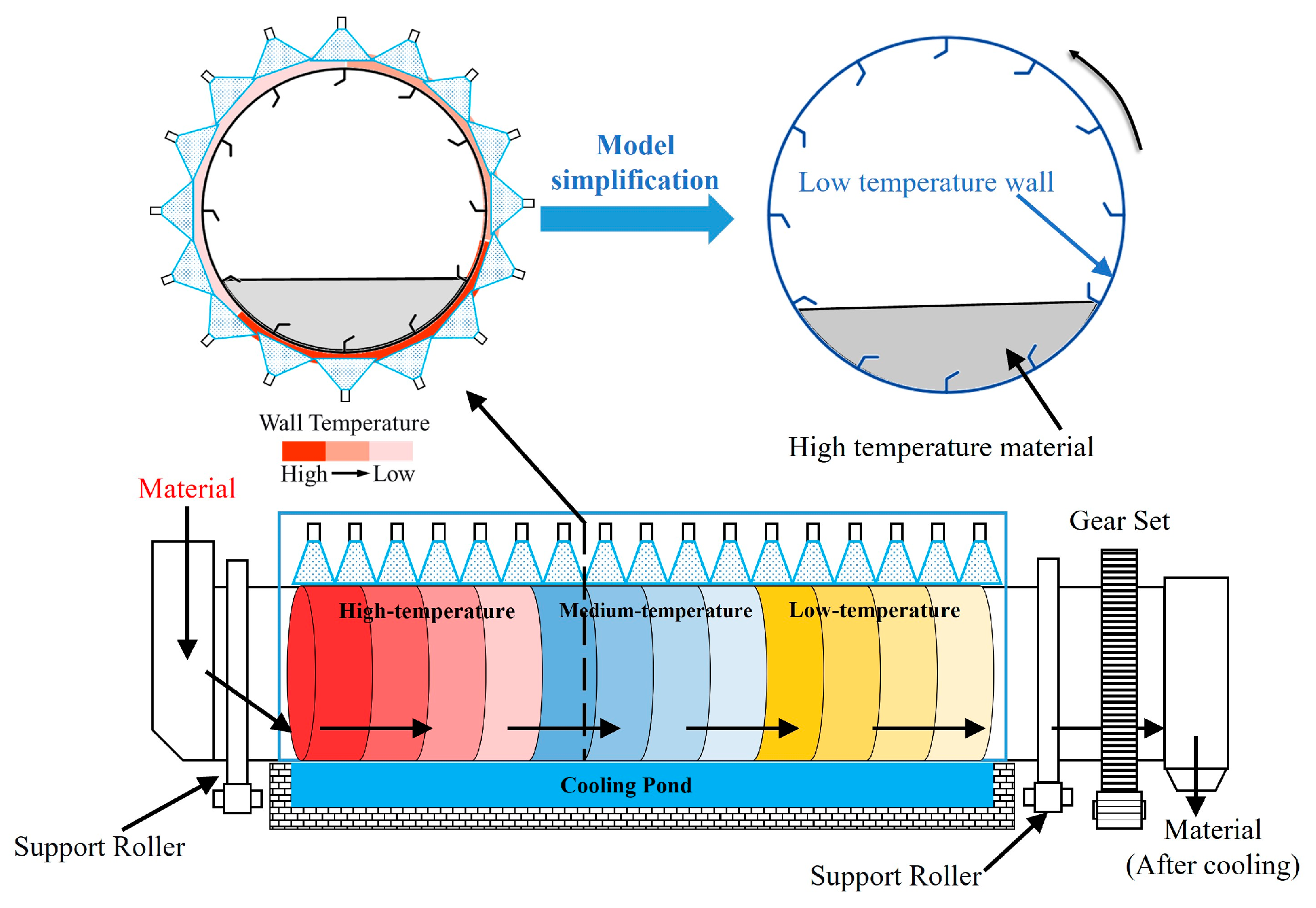
Figure 1. Schematic diagram of particle flow behavior in the rotary cooler drum.
Mathematics 14 01742 g001
Figure 2. Schematic of the baffle arrangement inside the rotary cooler drum. (a) L-shaped baffle; (b) straight baffle.
Mathematics 14 01742 g002
Figure 3. Comparison between simulated results and literature data. (a) velocity measurement line; (b) velocity comparison [39]. (c) simulation results from the present work.
Mathematics 14 01742 g003
Figure 4. Grid independence verification. (a) Measurement line; (b) distribution curves of the granular phase volume fraction at different mesh counts (±5% error band).
Mathematics 14 01742 g004
Figure 5. Contour plots of granular phase concentration in a rotating drum equipped with L-shaped baffles at different times.
Mathematics 14 01742 g005
Figure 6. Temperature variation in the granular phase at different times.
Mathematics 14 01742 g006
Figure 7. Granular phase temperature at different times.
Mathematics 14 01742 g007
Figure 8. Granular phase volume fraction in rotating drums with different baffle configurations. (a) No baffles; (b) straight baffles; (c) L-shaped baffles.
Mathematics 14 01742 g008
Figure 9. Effect of different baffle configurations on heat transfer in the rotary drum. (a) Granular phase temperature; (b) average HTC of the granular bed.
Mathematics 14 01742 g009
Figure 10. Granular phase temperature in rotating drums with different baffle configurations. (a) No baffles; (b) straight baffles; (c) L-shaped baffles.
Mathematics 14 01742 g010
Figure 11. Granular phase concentration distribution in the rotating drum at different rotational speeds. (a) 1 rpm; (b) 2 rpm; (c) 3 rpm; (d) 4 rpm; (e) 5 rpm.
Mathematics 14 01742 g011
Figure 12. Effect of different rotational speeds on heat transfer in the rotating drum. (a) Granular phase temperature; (b) average HTC of the granular bed.
Mathematics 14 01742 g012
Figure 13. Granular phase temperature in rotating drums at different rotational speeds. (a) 1 rpm; (b) 2 rpm; (c) 3 rpm; (d) 4 rpm; (e) 5 rpm.
Mathematics 14 01742 g013
Figure 14. Granular phase volume fraction in rotating drums with different baffle counts. (a) 4 L-shaped baffles; (b) 8 L-shaped baffles; (c) 12 L-shaped baffles; (d) 16 L-shaped baffles.
Mathematics 14 01742 g014
Figure 15. Effect of number of baffles on heat transfer in the rotary drum. (a) Granular phase temperature; (b) average HTC of the granular bed.
Mathematics 14 01742 g015
Figure 16. Granular phase temperature in rotating drums with different baffle counts. (a) 4 L-shaped baffles; (b) 8 L-shaped baffles; (c) 12 L-shaped baffles; (d) 16 L-shaped baffles.
Mathematics 14 01742 g016
Table 1. Summary of simulation conditions.
ParametersValuesParametersValues
Drum diameter × length (m)3.2 × 1Particle diameter (μm)11
Drum fill level (%)25%Particle density (kg/m3)1000
Drum rotational speeds (rpm)1–5 rpmBulk density (kg/m3)567
Drum wall temperature (K)473Particle initial temperature (K)673
Disclaimer/Publisher’s Note: The statements, opinions and data contained in all publications are solely those of the individual author(s) and contributor(s) and not of MDPI and/or the editor(s). MDPI and/or the editor(s) disclaim responsibility for any injury to people or property resulting from any ideas, methods, instructions or products referred to in the content.