Article

An Enhanced Multivariate EWMA Approach with Variable Selection and Adaptive Sampling for Efficient Process Monitoring

School of Management, Nanjing University of Posts and Telecommunications, Nanjing 210003, China
*
Author to whom correspondence should be addressed.
Mathematics 2026, 14(10), 1670; https://doi.org/10.3390/math14101670
Submission received: 3 April 2026 / Revised: 1 May 2026 / Accepted: 8 May 2026 / Published: 14 May 2026
(This article belongs to the Special Issue New Challenges in Statistical Analysis and Multivariate Data Analysis)

Abstract

Due to the curse of dimensionality faced in modern industrial processes, high-dimensional Statistical Process Control (SPC) faces significant challenges in detecting small and sparse process shifts. Traditional multivariate control charts often suffer from noise accumulation and fail at timely identification of anomalies that affect only a small subset of variables. To address this issue, this study proposes an enhanced Multivariate Exponentially Weighted Moving Average (MEWMA) approach with variable selection and adaptive sampling for efficient process monitoring. The proposed smart approach works in two ways: first, it automatically focuses on the variables that are most likely to have changed (variable selection); second, it takes samples more frequently when things look uncertain, and less frequently when everything appears stable (variable sampling interval). This combination allows problems to be detected earlier. A Monte Carlo approach is used to calculate the the Average Time to Signal (ATS) values of the proposed scheme, and comparative results show that the proposed scheme outperforms standard charts like the Fixed Sampling Intervals (FSI) VSME, VSI- T 2 , and VSI-MEWMA schemes in terms of detection speed for small-to-moderate sparse shifts. Finally, a real example from car body manufacturing is provided as an illustration for the implementation of the proposed scheme.

1. Introduction

As a key statistical technique in SPC, Control Charts (CCs) serve as graphical tools for analyzing process stability. By plotting quality characteristic values against predetermined control limits, CCs can promptly issue alerts upon detecting anomalous information, enabling proactive identification of production issues rather than relying on post-production inspection. This proactive capability has established control charts as essential methods for improving product quality and yield, with widespread applications across industrial and service sectors (see, e.g., [1,2,3]).
Based on the number of monitored variables, CCs can be classified into univariate and multivariate types. Univariate CCs originated in the 1920s, with the first quality chart proposed by W.A. Shewhart in the United States. However, Shewhart CCs rely solely on current sample information and exhibit limited sensitivity in detecting small shifts in process parameters. To address this limitation, the Cumulative Sum (CUSUM) and Exponentially Weighted Moving Average (EWMA) CCs were developed to incorporate historical data (see, e.g., [4,5,6,7,8,9,10,11]). On the other hand, as products and manufacturing processes have grown increasingly complex, the need to simultaneously monitor multiple correlated quality characteristics has drawn industrial and academic attention to multivariate CCs. After decades of development, numerous multivariate CCs have emerged, with the three most typical structures being Hotelling’s T 2 , Multivariate CUSUM (MCUSUM), and Multivariate EWMA (MEWMA) (see, e.g., [12,13,14,15,16]). Subsequent research on CCs has primarily focused on three aspects: adapting to different data distributions (see [17,18,19,20]; updating statistical models (see [21,22,23,24]); and modifying charting structures, (see [25,26,27]).
With the rapid advancement of manufacturing capabilities and inspection technologies, the number of variables requiring monitoring in production processes has increased dramatically. However, as dimensionality grows, traditional multivariate statistical methods become increasingly susceptible to noise accumulation, which severely impairs their ability to detect shifts in high-dimensional data. Through simulation studies, Wang and Jiang [28] demonstrated that when the data dimension is 20 and only one variable undergoes a mean shift, the Hotelling’s T 2 chart struggles to detect the change due to interference from noise in the remaining dimensions.
In modern quality monitoring scenarios, simultaneous faults across multiple locations are relatively uncommon. Instead, a single fault source is typically detected by a subset of correlated process sensors, meaning that only a few variables experience distributional shifts. Such sparse shifts are often obscured by noise from other dimensions and fail to be prominently reflected in traditional multivariate statistics, leading to monitoring failures. Consequently, an effective strategy for statistical inference in high-dimensional process monitoring is to incorporate variable selection. Wang and Jiang [28] proposed a variable-selection-based multivariate statistical process control method that uses a forward-selection algorithm to screen faulty variables, achieving simultaneous process monitoring and fault diagnosis. In [29,30], variable selection was further applied to the MEWMA and MCUSUM CCs, respectively, improving detection efficiency for shifts of various magnitudes. In [31], an MEWMA chart was proposed based on the Least Absolute Shrinkage and Selection Operator (LASSO) method, integrating high-dimensional data monitoring with change point detection using goodness-of-fit tests. In [32], the retrieval speed of Out-Of-Control (OOC) variables was enhanced by adopting the Least Angle Regression (LARS) algorithm instead of stepwise regression.
Parallel to these developments in the variable dimension, significant advances have been made in the temporal dimension through adaptive sampling strategies. While conventional control charts employ Fixed Sampling Intervals (FSI) predetermined by production schedules, research has demonstrated that allowing sampling frequency to vary based on process data can substantially enhance detection efficiency. This concept underpins the Variable Sampling Interval (VSI) scheme, in which the time until the next sample is shortened if the current control statistic suggests a potential OOC condition and lengthened if no process disturbance is indicated. The primary advantage of VSI over FSI lies in its ability to detect process changes more rapidly (see, e.g., [33,34,35,36,37]). Previous studies have demonstrated that employing just two sampling intervals is sufficient to achieve effective detection performance across a range of process shifts [38,39,40].
Current research on adaptive EWMA CCs mainly includes two aspects. The first aspect concerns dynamically adjusting the smoothing parameter λ to achieve global sensitivity to both small and large shifts. For example, ref. [41] estimated the mean shift using an EWMA-based estimator, then determined λ for the plotting EWMA statistic through a continuous function. The authors of [42] replaced the conventional score functions with the Hampel function and proposed a new adaptive EWMA chart, while those of [43] introduced a Support Vector Regression (SVR)-based adaptive EWMA scheme for improved mean monitoring in industrial processes. In [44], a streamlined and parameter-free adaptive EWMA method was introduced for monitoring Poisson processes. In [45], the authors constructed an EWMA scheme by introducing an adaptive method, aiming to improve the efficiency of detecting the existing ratio of two normal random variable charts for both small and large shifts. Finally, ref. [46] proposed an EWMA control chart for inverse Maxwell processes.
The second aspect focuses on adjusting sampling intervals and sample sizes in the temporal dimension. In [47], the authors evaluated the Average Time to Signal (ATS) properties of two-sided VSI EWMA CCs and presented a practical design procedure. In [48], an EWMA scheme with VSI was developed to monitor the process coefficient of variation. In [49,50], the authors investigated the performance of the VSI EWMA scheme with estimated parameters, while [37] introduced a Max EWMA scheme with VSI strategy for simultaneously monitoring both the frequency and amplitude of an event. Finally, ref. [51] developed a VSI MEWMA scheme to monitor the mean vector of the Gumbel’s Bivariate Exponential (GBE) distribution. In addition, several studies have extended the VSI strategy to adaptive EWMA schemes [52,53,54,55,56].
The latest developments in intelligent fault diagnosis have highlighted the importance of effective and efficient monitoring structures that can detect complex and compound faults in contemporary industrial facilities, especially when data availability is limited [57]. The problem of detecting weak and incipient faults in high-dimensional process environments still represents a major issue, as small process variations are often lost in the noise and irrelevant variables; this has led to the creation of methodologies that are more sensitive to small and sparse process variations [58]. Furthermore, real-life industrial data are normally noisy, variable, and subject to changing operational conditions, requiring the development of robust and adaptive monitoring plans [59]. All of these issues underscore the relevance of incorporating adaptive control and efficient selection of variables within multivariate statistical process control systems to achieving enhanced speed and trustworthiness when identifying shifts in intricate manufacturing processes.
However, despite the acknowledged relevance of integrating adaptive control with variable selection, existing multivariate SPC methods still exhibit two critical gaps: first, most VSI-based EWMA charts lack variable selection, meaning that sparse shifts are masked by high-dimensional noise; second, existing variable selection SPC methods only use FSI. More importantly, a novel insight is that the choice of the selected variables directly affects the probability of entering the warning region. Selecting too many noisy variables triggers false short intervals, while selecting too few may miss weak signals. This interaction between variable selection and VSI zone division is entirely new and unexplored. To address this, we propose a new adaptive monitoring approach which we term the Variable Sampling Interval–Variable Selection-based Multivariate EWMA (VSI-VSME) chart. The remainder of this paper is structured as follows: Section 2 provides a detailed exposition of the proposed VSI-VSME framework; in Section 3, the statistical performance of the proposed chart is evaluated and discussed through comprehensive simulation studies; Section 4 offers practical applications based on real datasets to demonstrate the methodology’s utility in operational settings; finally, Section 5 concludes with summary remarks and directions for future research. And the Appendix A lists all symbols and parameters used in this paper.

2. Methodology Design

2.1. The VSME Chart

In modern complex manufacturing processes, multivariate quality control issues are increasingly prominent. Traditional multivariate control charts such as Hotelling’s T 2 face significant challenges when handling high-dimensional data. This is particularly the case in the presence of sparse shifts, leading to substantially reduced detection efficiency due to only a small subset of variables exhibiting actual anomalies. To overcome these limitations, ref. [28] introduced a Variable Selection-based Multivariate SPC (VS-MSPC) method. The core idea is to incorporate a penalty term into the likelihood function in order to automatically identify potential OOC variables and estimate the magnitude of their shifts, enabling precise monitoring of high-dimensional process data. Specifically, it considers the following penalized optimization problem:
S 2 = min μ ( y t μ ) T Σ 1 ( y t μ ) + j = 1 p p ϵ j ( | μ j | )
where y t is a p-dimensional observation collected at time t and following a multivariate normal distribution y t N ( μ , Σ ) . Here, | μ j | denotes the absolute value of the jth element of μ , representing the true mean of the jth variable. The term p ϵ j ( · ) is a penalty function that controls model complexity by regulating the number of variables with nonzero means, i.e., those for which | μ j | > 0 .
In [28], the authors adopted the L 0 penalty p ϵ ( | μ j | ) = ϵ I ( | μ j | 0 ) , which directly constrains the number of nonzero coefficients. This naturally aligns with the sparsity assumption commonly hold in engineering practice that most variables are In-Control (IC), while only a few are Out-Of-Control (OOC). Through Cholesky decomposition of the inverse covariance matrix Σ 1 = R T R and by setting z t = R y t , the problem in (1) can be transformed into the following constrained least squares problem:
min μ ( z t R μ ) T ( z t R μ ) subject to j = 1 p I ( | μ j | 0 ) s
where s is a prescribed integer upper bound on the number of nonzero coefficients. To solve this problem efficiently, a forward variable selection algorithm is used to find the solution μ t * of Equation (2). The following monitoring statistic is constructed:
Λ ( y t ) = 2 y t T Σ 1 μ * μ * T Σ 1 μ * .
In [29], it was further shown that monitoring this statistic is equivalent to monitoring
Λ ( y t ) = y t T Σ 1 μ * .
Building upon the VS-MSPC framework introduced above, a Variable Selection-based Multivariate EWMA (denoted as VSME) integrates exponential smoothing into the variable selection process to enhance the robustness and accuracy of shift estimation in dynamic processes. Let w t be the exponentially weighted vector at time t, defined recursively as
w t = ( 1 λ ) w t 1 + λ y t ,
where the initial condition w 0 = 0 and where 0 < λ 1 is the smoothing constant controlling the memory of the process. When t , the solution of Equation (3) can equivalently be performed using the simplified statistic
M t = w t T Σ 1 μ * .
An OOC signal is triggered whenever M t exceeds a predetermined Upper Control Limit (UCL). Selection of λ and the sparsity level s is critical to the performance of the VSME scheme. These parameters can be chosen based on desired statistical properties or through cross-validation in practical applications.

2.2. The VSI-VSME Chart

The VSI strategy is an adaptive approach to statistical process control that is designed to enhance the efficiency of monitoring schemes. Unlike FSI CCs, where the time between samples is constant, a VSI chart dynamically adjusts the waiting time until the next sample based on the current value of the control statistic. This allows the chart to respond more frequently when the data suggest potential process instability and to respond less frequently when the process appears stable.
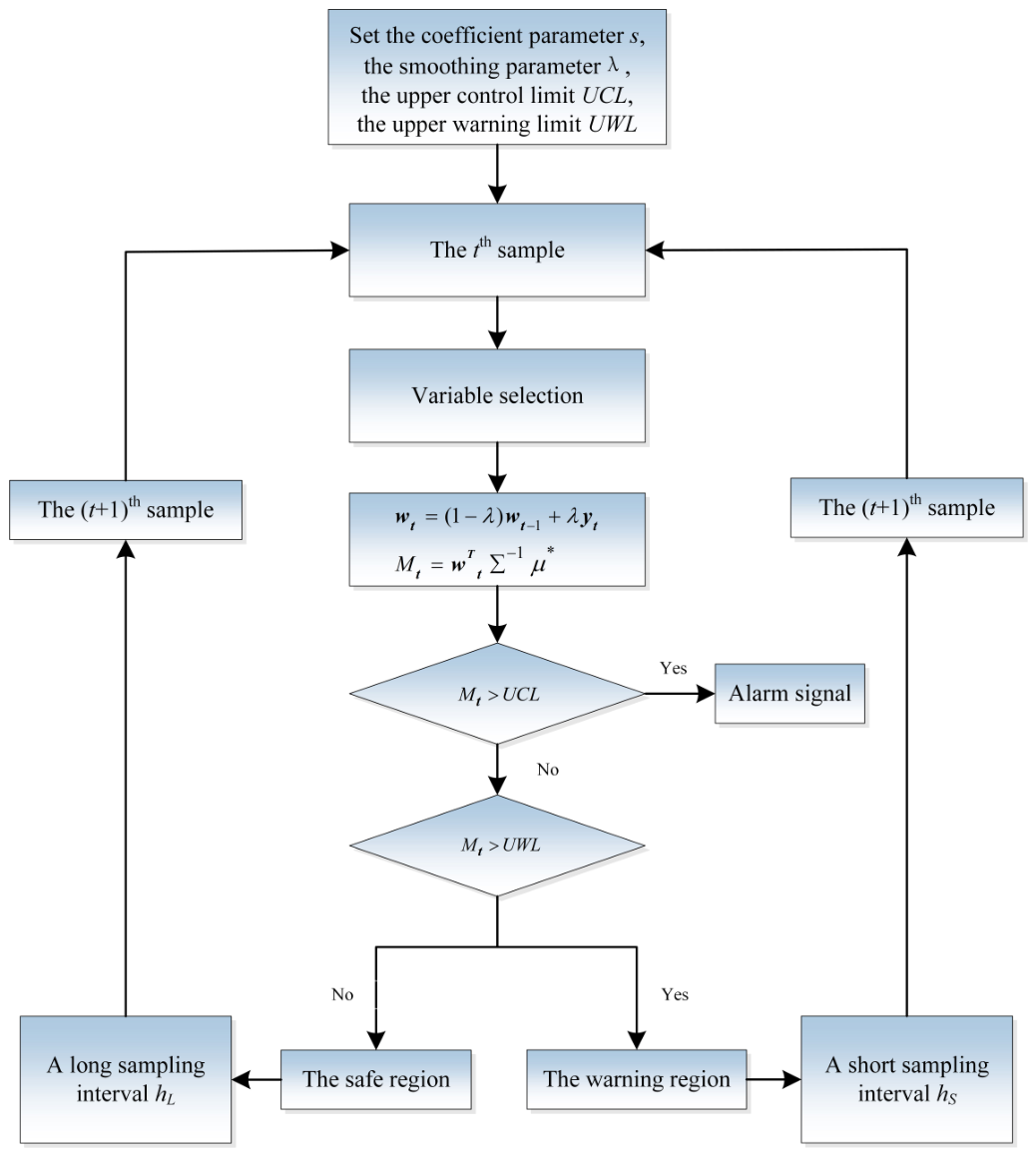
The VSI-VSME scheme partitions the IC region into three distinct zones using the UCL and the Upper Warning Limit (UWL). After plotting the t t h statistic M t , the operational procedure of the VSI chart is as follows:
  • If M t [ 0 , UWL ] (the safe region), the process is considered stable. The next sample will be taken after a long sampling interval h L , where h L > 1 .
  • If M t ( UWL , UCL ] (the warning region), the process is still considered IC, but the chart signals a higher level of caution. Consequently, the next sample will be taken after a short sampling interval h S , where 0 < h S < 1 .
  • If M t ( UCL , + ) (the OOC region), the process is deemed OOC. An OOC signal is issued and necessary corrective actions must be initiated to find the assignable cause(s).
This dynamic adjustment of sampling intervals enhances the ability of CCs to detect shifts while significantly improving the efficiency of resource utilization in monitoring. The Average Run Length ( ARL ) is the standard performance measure for FSI CCs. However, ARL is an insufficient metric for VSI CCs, since it only counts the number of samples until a signal and ignores the varying time intervals between them. Therefore, the ATS , which incorporates the actual time elapsed, is the appropriate criterion for evaluating the performance of VSI CCs. The ATS is defined as the expected time between the start and a control chart signal:
  • For FSI CCs, the ATS is simply the product of the ARL and the fixed sampling interval h:
    ATS F S I = ARL F S I × h 0 .
  • For VSI CCs, the ATS depends on the ARL and the expected (average) sampling interval E ( h ) :
    ATS V S I = ARL V S I × E ( h ) ,
    where E ( h ) = ρ S × h S + ρ L × h L and where ρ S and ρ L represent the proportion of times the short and long sampling intervals are used, respectively.
To ensure a fair comparison between an FSI chart and its VSI counterpart, it is standard practice to set both charts to have the same IC performance. This is achieved by choosing charts with the same IC ARL value ( ARL 0 ) and constraining the average sampling interval of the VSI chart to match the fixed interval of the FSI chart (typically h 0 = 1 time unit):
E ( h ) = ρ S × h S + ρ L × h L = h 0 = 1 .
Under this constraint, the IC average time to signal is also identical for both charts:
ATS 0 F S I = ATS 0 V S I = ARL 0 = C .
Consequently, ATS = ARL in the FSI scheme, since the sampling interval is fixed at 1. Given the same UCL, our use of the UWL in the proposed VSI scheme does not change the alarm rule. Thus, the ARL values remain the same as in the FSI case in both IC and OOC situations. However, the VSI scheme achieves a smaller ATS value because it employs shorter sampling intervals in the safe region. For these reasons, the OOC performance of the two schemes can be compared directly using the OOC ATS ( ATS 1 ). The chart with the smaller ATS 1 is more efficient, as it detects process shifts faster in real time. Figure 1 outlines the implementation procedure of the proposed VSI-VSME scheme.

3. Performance Analysis

This study simulates a 20-dimensional process with different numbers of shifted variables, specifically:
y t N p [ δ , δ , . . . , 0 ] T , I , Number ( δ ) = p 0 { 1 , 2 , , p } .
In this simulation setup, δ denotes the non-centrality parameter, representing the magnitude of the mean shift in the variables that undergo a change. Specifically, under the IC state, all variables have a mean of zero. When a shift occurs, the first p 0 variables experience a mean shift of δ , while the remaining variables stay at zero. By varying δ , the detection performance under different shift sizes can be evaluated. In the implementation, three sets of sampling interval configurations are considered:
  • h S = 0.1 and h L = 1.9 ,
  • h S = 0.3 and h L = 1.7 ,
  • h S = 0.5 and h L = 1.5 .
Table 1 summarizes the UCL and UWL values for the proposed VSI-VSME scheme to achieve IC performance levels ( ARL 0 = ATS 0 = C) of 200, 370, and 500 when λ { 0.1 , 0.25 , 0.5 } , s { 1 , 2 , 3 , 4 , 5 } , and p = 20 . All reported results are based on 10 5 Monte Carlo replications. The standard errors of the ATS estimates are consistently below 0.5 % of the estimated value. All simulations were performed on an computer with an Intel Core i5 12600KF CPU with 32 GB RAM, using MATLAB R2024b parallelized over six workers. Moreover, the average computational time per replication for a run is approximately 0.002 s until signal.

3.1. VSI-VSME vs. FSI-VSME

This part evaluates the OOC performance of the proposed VSI-VSME scheme against the FSI-VSME scheme. Here, we set the parameter s equal to p 0 , which is the actual number of variables affected by the shift. Cases where s p 0 are discussed later. Table 2, Table 3 and Table 4 provide a comprehensive comparison of the OOC ATS 1 between the proposed VSI-VSME scheme and the FSI-VSME benchmark across three smoothing parameters ( λ = 0.1 , 0.25 , 0.5 ) , five sparsity levels ( s = p 0 = 1 , , 5 ) , three IC performance levels ( C = ARL 0 = ATS 0 = 200 , 370 , 500 ) , and three VSI configurations ( ( h S , h L ) = ( 0.1 , 1.9 ) , ( 0.3 , 1.7 ) , ( 0.5 , 1.5 ) ) . We can draw the following conclusions:
First, regardless of λ , C, or s, every VSI-VSME setting yields a strictly smaller ATS 1 than the corresponding FSI-VSME benchmark, confirming that the adaptive sampling strategy consistently accelerates the detection of sparse shifts. The improvement is most pronounced for the most aggressive VSI design ( h S = 0.1 , h L = 1.9 ) . For example, in Table 2 ( λ = 0.1 , C = 200 , s = p 0 = 1 ) the FSI-VSME gives ATS 1 = 52.315 , whereas the VSI-VSME with ( 0.1 , 1.9 ) reduces it to 42.282 , a relative reduction of about 19.2 % . As h S increases and h L decreases, the advantage gradually shrinks; yet, even the mildest VSI setting ( 0.5 , 1.5 ) still outperforms the FSI scheme ( ATS 1 = 46.343 ) for the same case.
Second, the benefit of the VSI mechanism is highly consistent across different λ values. When λ is small ( 0.1 ) , the ATS 1 values are generally lower and the percentage improvement from VSI is larger. For instance, at λ = 0.1 , C = 370 , s = 2 , the ( 0.1 , 1.9 ) VSI scheme achieves ATS 1 = 27.429 versus an FSI value of 40.379 , a 32.1 % reduction. At λ = 0.5 in Table 4, the same comparison ( C = 370 , s = 2 ) yields ATS 1 = 148.074 versus 170.970 , a reduction of only 13.4 % . These results indicate that the VSI mechanism is particularly effective when λ is small.
Third, as the number of truly shifted variables ( p 0 = s ) increases, both the FSI and VSI charts detect the shift faster, as expected, because a larger signal from more variables shortens the ARL . However, the relative improvement due to VSI tends to be larger for moderate s (e.g., s = 2 or 3) than for s = 1 or s = 5 . For example, in Table 3 ( λ = 0.25 , C = 200 ) the reduction from FSI to VSI ( 0.1 , 1.9 ) is about 13.7 % for s = 1 ( 92.263 79.636 ) and about 11.8 % for s = 5 ( 22.600 13.193 ) , but reaches 24.8 % for s = 2 ( 56.022 42.404 ) and 32.7 % for s = 3 ( 38.642 26.013 ) . This suggests that the VSI strategy is most beneficial when the shift is moderately sparse.
In summary, the evidence from Table 2, Table 3 and Table 4 unequivocally demonstrates that the VSI-VSME scheme provides a clear and robust improvement in detection speed over the FSI-VSME scheme across a wide range of parameters and that the improvement is largest for small λ .

3.2. VSI-VSME vs. VSI- T 2 and VSI-MEWMA

Table 5, Table 6 and Table 7 systematically compare the OOC ATS 1 of the proposed VSI-VSME scheme with those of the VSI- T 2 and VSI-MEWMA schemes under three smoothing parameters ( λ = 0.1 , 0.25 , 0.5 ) , various shift magnitudes { 0.2 , 0.4 , 0.6 , 0.8 , 1 , 1.5 , 2 , 3 , 3.5 , 4 , 4.5 , 5 } , and different choices of the sparsity parameter s (from 1 to 5) while fixing the true number of shifted variables at p 0 = 2 . The results reveal several critical insights.
First, across all settings, the VSI- T 2 scheme performs dramatically worse than both VSI-MEWMA and VSI-VSME schemes, especially for small to moderate shifts ( δ 1.5 ) . For example, in Table 5  ( λ = 0.1 , δ = 0.8 , ( h S , h L ) = ( 0.1 , 1.9 ) ) the VSI- T 2 scheme yields an ATS 1 of 155.214 , whereas the VSI-MEWMA scehme achieves 13.429 and the VSI-VSME scheme (with s = 1 ) reaches as low as 11.969 . This huge gap is expected because the conventional VSI- T 2 statistic accumulates noise from all 20 dimensions, severely diluting the sparse signal.
Second, the comparison between VSI-VSME and VSI-MEWMA schemes is more nuanced and depends critically on λ , δ , and the choice of s. When λ is small ( 0.1 , Table 5), the VSI-VSME scheme consistently outperforms VSI-MEWMA across almost all δ and s values. For example, when ( h S , h L ) = ( 0.1 , 1.9 ) ) , for δ = 0.6 , the VSI-VSME scheme with s = 2 gives ATS 1 = 18.941 vs. the VSI-MEWMA scheme’s 20.656 ; for δ = 0.8 , we have ATS 1 = 12.020 vs. 13.429 . This demonstrates that the variable selection mechanism effectively filters out noise and provides a cleaner signal for the EWMA recursion, which is particularly beneficial when the shift is sparse (only 2 out of 20 variables shift). As δ increases beyond 2.0 , the differences narrow, and for very large shifts ( δ 4.0 ) the VSI-MEWMA scheme occasionally becomes slightly faster. This is because the shift is no longer “sparse” in effect; the mean shift is so large that even a naive multivariate statistic detects it almost instantly.
Third, the role of the sparsity parameter s is highly informative. In Table 5, when δ is very small ( 0.2 0.4 ) , larger s (e.g., s = 4 or 5) yields lower ATS 1 , meaning that allowing more variables into the selected set helps to capture the weak signal scattered across the two truly shifted variables plus noise. For moderate δ ( 0.6 1.0 ) , the optimal s shifts to s = 1 or 2, i.e., a more parsimonious selection works best. For large δ ( 2.0 ) , s = 1 almost always gives the smallest ATS 1 . This pattern is consistent with the intuition: under a very weak shift, the penalized selection needs more freedom to avoid missing the signal; under a strong shift, a tight sparsity constraint prevents noise from entering the monitoring statistic.
Fourth, as λ increases to 0.25 (Table 6) and 0.5 (Table 7), the performance gap between the VSI-VSME and VSI-MEWMA schemes gradually diminishes; for λ = 0.5 with small δ (e.g., δ = 0.4 ), the VSI-MEWMA scheme actually outperforms the VSI-VSME scheme for all s. This occurs because a large λ makes the EWMA statistic nearly equivalent to the current observation, reducing the benefit of exponential smoothing. At the same time, the variable selection step becomes more susceptible to sampling variability, slightly delaying detection. Nevertheless, for δ 1.0 , VSI-VSME with s = 1 or s = 2 still matches or beats the VSI-MEWMA scheme.
In summary, across all three tables, the VSI-VSME scheme exhibits remarkable robustness; even when s is mis-specified (e.g., s = 5 while true p 0 = 2 ), the ATS 1 remains far below that of the VSI- T 2 scheme and often close to or better than that of the VSI-MEWMA scheme. This indicates that the proposed chart does not require exact knowledge of the number of shifted variables to deliver good performance.

4. Example Analysis

To demonstrate the practical usefulness of the proposed VSI-VSME scheme, we apply it to a real dataset from an automotive sheet metal assembly process. The data, adapted from Table 5.14 in [60], consist of thickness deviation measurements recorded at six critical locations on automobile body panels. These six variables are correlated and their dimensional accuracy directly affects the vehicle’s structural integrity, safety, corrosion resistance, and final assembly fit. In this case study, the first 30 observation vectors are treated as IC samples and are used to estimate the process parameters and to establish control limits; the remaining 20 observation vectors are monitored sequentially to detect potential mean shifts that may arise from tool wear, material variations, or assembly misalignment. For all competing schemes, we set the same VSI parameter configuration of ( h S , h L ) = ( 0.5 , 1.5 ) to ensure a fair comparison and fix the IC ATS 0 at 370. The VSI- T 2 , VSI-MEWMA, and VSI-VSME schemes (with s = 1 , 2 , 3 , 4 , 5 ) are then applied to monitor the 20 test observations.
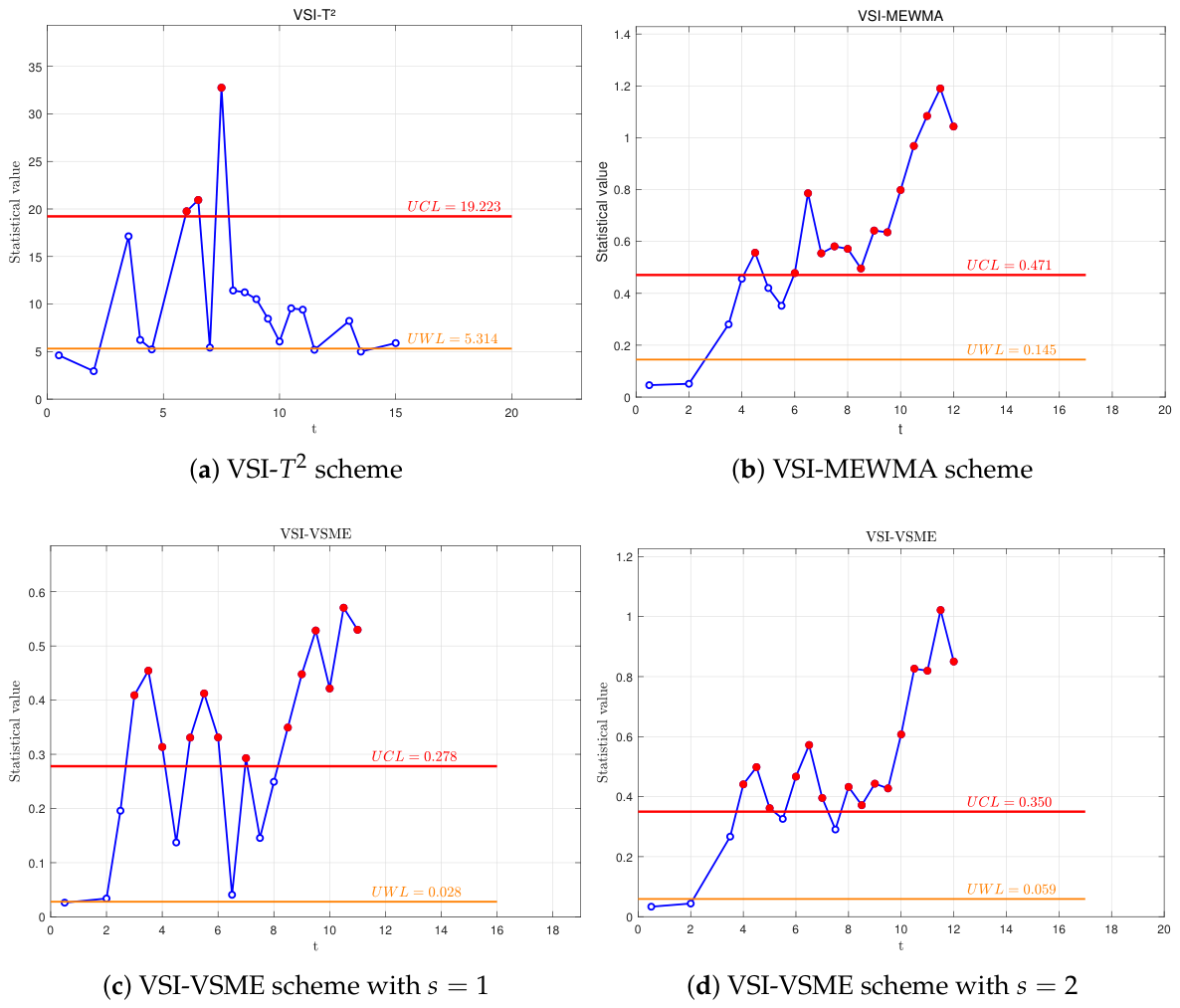
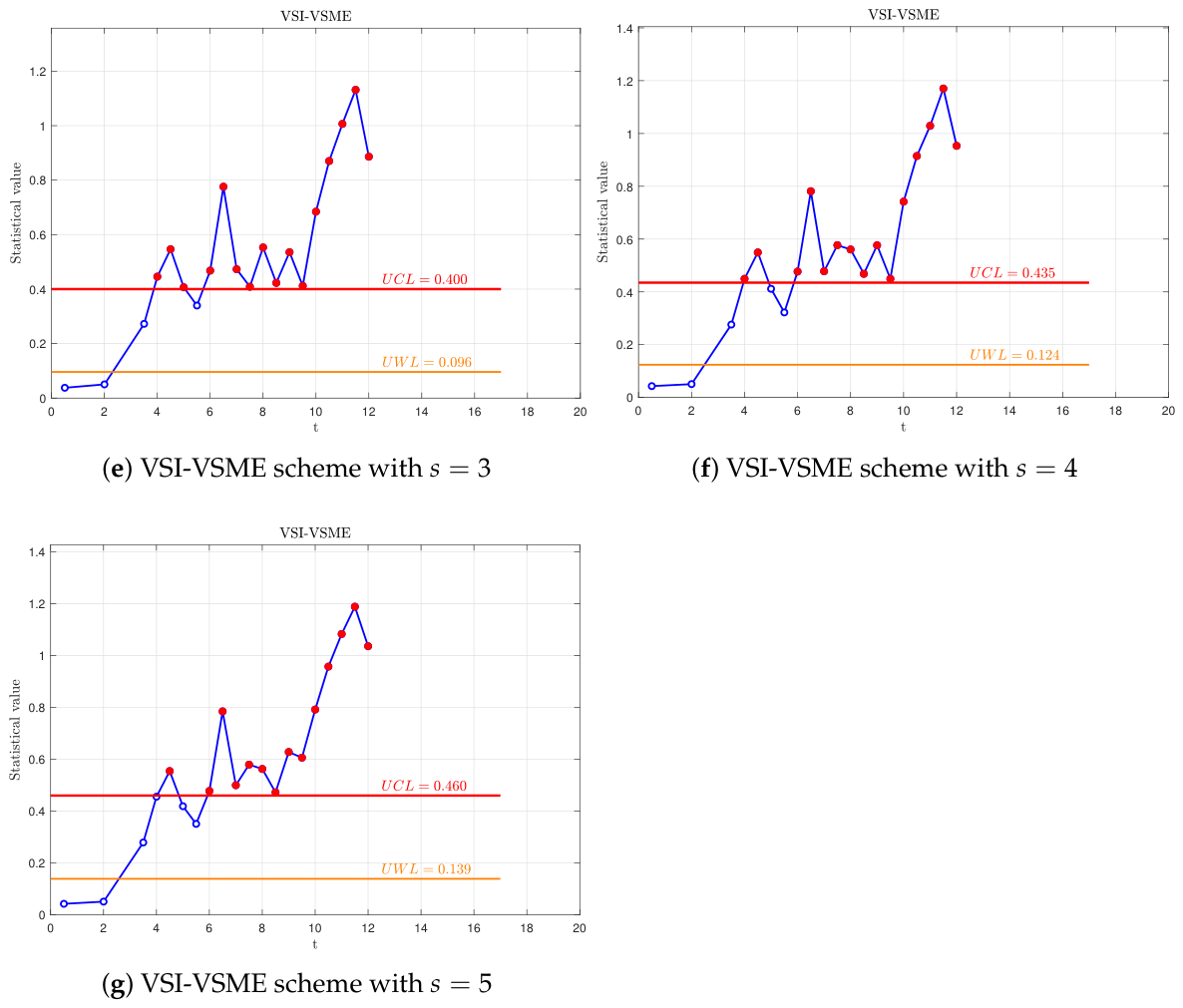
The monitoring results are displayed in Figure 2. The VSI- T 2 scheme issues an OOC alarm at time t = 6 , while the VSI-MEWMA scheme triggers an alarm at t = 4.5 . For the proposed VSI-VSME chart, the detection time depends on the choice of the sparsity parameter s. Specifically, when s = 2 , 3 , 4 , the chart signals an OOC condition at t = 4 . When s = 1 or s = 5 , detection occurs slightly later at t = 4.5 , which is still faster than the VSI- T 2 scheme and comparable to the VSI-MEWMA scheme. This pattern indicates that the VSI-VSME scheme is not overly sensitive to the exact choice of s, with even moderately mis-specified s still yieldng good performance. More importantly, the fact that s = 2 , 3 , 4 achieve the fastest detection suggests that the underlying shift likely affects about two to four of the six monitored dimensions. In summary, the VSI-VSME scheme offers a practical and efficient tool for high-dimensional process monitoring in real manufacturing environments where sparse shifts are common and quick detection is critical for minimizing quality loss.

5. Conclusions

This study is motivated by a fundamental challenge in high-dimensional statistical process monitoring, namely, detecting small sparse shifts in the mean vector when only a small subset of variables is actually OOC. Traditional multivariate control charts suffer from severe noise accumulation in high dimensions, while standard adaptive sampling approaches predominantly focus on temporal adjustments (varying sampling intervals or sample sizes) without addressing the variable selection problem. To fill this gap, we propose a novel scheme which integrates two complementary mechanisms: (i) a forward variable selection algorithm that automatically identifies the most likely shifted variables and filters out irrelevant noise, and (ii) a variable sampling interval strategy that shortens the sampling interval when the process enters a warning region and lengthens it when the process appears stable.
Through extensive Monte Carlo simulations, we demonstrate several key findings. First, the simulation results strongly support that conclusion that the proposed VSI-VSME scheme consistently detects sparse shifts faster than the FSI-VSME scheme. This improvement is most pronounced for small smoothing parameters. Second, the proposed scheme exhibits a dramatic advantage over the VSI- T 2 and VSI-MEWMA schemes. This advantage is particularly evident for small λ and small to moderate shift magnitudes, where the variable selection component is able to successfully isolate the sparse signal from high-dimensional noise. Third, the proposed VSI-VSME scheme is robust to mis-specification of the sparsity parameter s. Even when s deviates from the true number of shifted variables P 0 , the ATS 1 performance rarely deteriorates below that of the VSI- T 2 and VSI-MEWMA schemes.
A potential direction for future research would be to explore dynamic selection of s during Phase-II monitoring. Moreover, the current variable selection procedure assumes that the IC covariance matrix is known or can be estimated accurately from a large Phase-I dataset. Developing a VSI-VSME chart that accounts for estimation uncertainty (e.g., through adjusted control limits or bootstrap calibration) would enhance its practical reliability. We believe that the VSI-VSME framework provides a solid foundation for these future innovations.


Author Contributions

Conceptualization, A.T.; methodology, A.T.; software, A.T. and J.X.; validation, J.X. and Y.M.; formal analysis, J.X.; writing-original draft preparation, J.X.; writing-review and editing, A.T. and Y.M.; supervision, A.T. All authors have read and agreed to the published version of the manuscript.

Funding

This work was supported by the National Nature Science Foundation of China (grant number 72101123).

Data Availability Statement

The raw data supporting the conclusions of this article will be made available by the authors on request.

Conflicts of Interest

The authors declare no conflicts of interest.

Appendix A. Summary of Notation and Parameters

Table A1. Summary of notation and parameters.
NotationDescription
pTotal number of variables in the process
p 0 True number of shifted variables among the total p variables
sVariable selection size
λ Smoothing parameter for the MEWMA statistic
δ Magnitude of the process mean shift
U C L Upper control limit
U W L Upper warning limit
h S Short sampling interval triggered when the statistic falls in the warning region
h L Long sampling interval used when the statistic remains in the safe region
E ( h ) Average sampling interval
A R L Average run length
A R L 0 In-control average run length
A R L 1 Out-of-control average run length
A T S Average time to signal
A T S 0 In-control average time to signal
A T S 1 Out-of-control average time to signal
FVSForward Variable Selection
VSIVariable Sampling Interval
FSIFixed Sampling Interval
ICIn-Control
OOCOut-Of-Control

References

  1. Xiang, D.; Pu, X.; Ding, D.; Liang, W. An efficient charting scheme for multivariate categorical process with a sparse contingency table. J. Qual. Technol. 2021, 53, 88–105. [Google Scholar]
  2. Shao, Y.; Chen, J.; Gu, X.; Lu, J.; Du, S. A novel curved surface profile monitoring approach based on geometrical-spatial joint feature. J. Intell. Manuf. 2025, 36, 2055–2077. [Google Scholar]
  3. Qin, X.; Zhang, J.; Mukherjee, A.; Yu, D.; Liu, L. Comparisons of some new and existing ewma schemes for binomial count processes with applications to monitoring hospital no-shows. Qual. Technol. Quant. Manag. 2025, 22, 828–850. [Google Scholar]
  4. Abbas, Z.; Nazir, H.Z.; Akhtar, N.; Riaz, M.; Abid, M. On developing an exponentially weighted moving average chart under progressive setup: An efficient approach to manufacturing processes. Qual. Reliab. Eng. Int. 2020, 36, 2569–2591. [Google Scholar] [CrossRef]
  5. Perry, M.B. An EWMA control chart for categorical processes with applications to social network monitoring. J. Qual. Technol. 2020, 52, 182–197. [Google Scholar] [CrossRef]
  6. Sanusi, R.A.; Teh, S.Y.; Khoo, M.B. Simultaneous monitoring of magnitude and time-between-events data with a Max-EWMA control chart. Comput. Ind. Eng. 2020, 142, 106378. [Google Scholar]
  7. Hu, X.; Castagliola, P.; Zhong, J.; Tang, A.; Qiao, Y. On the performance of the adaptive EWMA chart for monitoring time between events. J. Stat. Comput. Simul. 2021, 91, 1175–1211. [Google Scholar] [CrossRef]
  8. Xue, L.; Qiu, P. A nonparametric CUSUM chart for monitoring multivariate serially correlated processes. J. Qual. Technol. 2021, 53, 396–409. [Google Scholar] [CrossRef]
  9. Erem, A.; Mahmood, T. A bivariate CUSUM control chart based on exceedance statistics. Qual. Reliab. Eng. Int. 2023, 39, 1172–1191. [Google Scholar] [CrossRef]
  10. Tang, A.; Mukherjee, A.; Ma, Y. An optimally designed distribution-free CUSUM procedure for tri-aspect surveillance of continuous processes. Qual. Reliab. Eng. Int. 2023, 39, 2537–2557. [Google Scholar]
  11. Tang, A.; Mukherjee, A.; Castagliola, P. A distribution-free Max-EWMA scheme for multi-aspect process monitoring with industrial applications. Comput. Ind. Eng. 2024, 191, 110110. [Google Scholar] [CrossRef]
  12. Khusna, H.; Mashuri, M.; Ahsan, M.; Suhartono, S.; Prastyo, D.D. Bootstrap-based maximum multivariate CUSUM control chart. Qual. Technol. Quant. Manag. 2020, 17, 52–74. [Google Scholar]
  13. García-Bustos, S.; León, J.; Pastuizaca, M.N. Hotelling T2 chart using the generalized multiple dependent state sampling scheme. Int. J. Qual. Reliab. Manag. 2021, 38, 1265–1277. [Google Scholar]
  14. Ajadi, J.O.; Wong, A.; Mahmood, T.; Hung, K. A new multivariate CUSUM chart for monitoring of covariance matrix with individual observations under estimated parameter. Qual. Reliab. Eng. Int. 2022, 38, 834–847. [Google Scholar]
  15. Haq, A. Adaptive MEWMA charts for univariate and multivariate simple linear profiles. Commun. Stat.-Theory Methods 2022, 51, 5383–5411. [Google Scholar]
  16. Nida, H.; Kashif, M.; Khan, M.I.; Ahmad, L.; Aslam, M. Design of Hotelling T2 control chart using various covariance structures. Commun. Stat.-Theory Methods 2024, 53, 5828–5839. [Google Scholar]
  17. Cheng, Y.; Mukherjee, A.; Xie, M. Simultaneously monitoring frequency and magnitude of events based on bivariate gamma distribution. J. Stat. Comput. Simul. 2017, 87, 1723–1741. [Google Scholar] [CrossRef]
  18. Xie, F.; Sun, J.; Castagliola, P.; Hu, X.; Tang, A. A multivariate cusum control chart for monitoring gumbel’s bivariate exponential data. Qual. Reliab. Eng. Int. 2021, 37, 10–33. [Google Scholar]
  19. Qiao, Y.; Wu, Z.; Zhang, Q.; Xu, Q.; Jin, G. Optimal design of one-sided exponential adaptive EWMA scheme based on median run length. Algorithms 2024, 18, 5. [Google Scholar] [CrossRef]
  20. Sarwar, M.A.; Hanif, M.; Albogamy, F.R.; Nabi, M. A novel EWMA-based adaptive control chart for industrial application by using hastings approximation. Sci. Rep. 2024, 14, 30640. [Google Scholar] [CrossRef]
  21. Mukherjee, A.; Marozzi, M. Nonparametric phase-ii control charts for monitoring high-dimensional processes with unknown parameters. J. Qual. Technol. 2021, 54, 44–64. [Google Scholar] [CrossRef]
  22. Tang, A.; Mukherjee, A.; Wang, X. Distribution-free Phase-II monitoring of high-dimensional industrial processes via origin and modified interpoint distance based algorithms. Comput. Ind. Eng. 2023, 179, 109161. [Google Scholar]
  23. Lu, J.H.; Lin, C.Y. A novel moving average–exponentiated exponentially weighted moving average (MA-Exp-EWMA) control chart for detecting small shifts. Mathematics 2025, 13, 3049. [Google Scholar]
  24. Karoon, K.; Areepong, Y. The efficiency of the new extended EWMA control chart for detecting changes under an autoregressive model and its application. Symmetry 2025, 17, 104. [Google Scholar] [CrossRef]
  25. Castagliola, P.; Tran, K.; Celano, G.; Rakitzis, A.; Maravelakis, P. An ewma-type sign chart with exact run length properties. J. Qual. Technol. 2019, 51, 51–63. [Google Scholar] [CrossRef]
  26. Tang, A.; Sun, J.; Hu, X.; Castagliola, P. A new nonparametric adaptive ewma control chart with exact run length properties. Comput. Ind. Eng. 2019, 130, 404–419. [Google Scholar] [CrossRef]
  27. Riaz, M.; Zaman, B.; Raji, I.A.; Omar, M.H.; Mehmood, R.; Abbas, N. An adaptive EWMA control chart based on principal component method to monitor process mean vector. Mathematics 2022, 10, 2025. [Google Scholar] [CrossRef]
  28. Wang, K.; Jiang, W. High-dimensional process monitoring and fault isolation via variable selection. J. Qual. Technol. 2009, 41, 247–258. [Google Scholar] [CrossRef]
  29. Jiang, W.; Wang, K.; Tsung, F. A variable-selection-based multivariate ewma chart for process monitoring and diagnosis. J. Qual. Technol. 2012, 44, 209–230. [Google Scholar] [CrossRef]
  30. Abdella, G.M.; Al-Khalifa, K.N.; Kim, S.; Jeong, M.K.; Elsayed, E.A.; Hamouda, A.M. Variable selection-based multivariate cumulative sum control chart. Qual. Reliab. Eng. Int. 2017, 33, 565–578. [Google Scholar] [CrossRef]
  31. Zou, C.; Qiu, P. Multivariate statistical process control using lasso. J. Am. Stat. Assoc. 2009, 104, 1586–1596. [Google Scholar] [CrossRef]
  32. Capizzi, G.; Masarotto, G. A least angle regression control chart for multidimensional data. Technometrics 2011, 53, 285–296. [Google Scholar] [CrossRef]
  33. Huang, W.; Shu, L.; Woodall, W.H.; Tsui, K.-L. Cusum procedures with probability control limits for monitoring processes with variable sample sizes. IIE Trans. 2016, 48, 759–771. [Google Scholar] [CrossRef]
  34. Hafez Darbani, F.; Shadman, A. Monitoring of linear profiles using generalized likelihood ratio control chart with variable sampling interval. Qual. Reliab. Eng. Int. 2018, 34, 1828–1835. [Google Scholar] [CrossRef]
  35. Adsız, S.; Aytaçoğlu, B. Tukey-ewma control chart with variable sampling intervals for process monitoring. Qual. Eng. 2024, 36, 249–272. [Google Scholar] [CrossRef]
  36. Yeong, W.C.; Tan, Y.Y.; Lim, S.L.; Khaw, K.W.; Khoo, M.B.C. Variable sample size and sampling interval (vssi) and variable parameters (vp) run sum charts for the coefficient of variation. Qual. Technol. Quant. Manag. 2024, 21, 177–199. [Google Scholar] [CrossRef]
  37. Chong, Z.L.; Teoh, W.L.; Khoo, M.B.; Teh, S.Y.; Khaw, K.W. Dynamic vsi max-ewma control chart for joint monitoring of time-between-events and amplitude in high-quality manufacturing processes. Comput. Ind. Eng. 2025, 207, 111204. [Google Scholar]
  38. Reynolds, M.R., Jr.; Amin, R.W.; Arnold, J.C.; Nachlas, J.A. Charts with variable sampling intervals. Technometrics 1988, 30, 181–192. [Google Scholar]
  39. Reynolds, M.R., Jr. Optimal variable sampling interval control charts. Seq. Anal. 1989, 8, 361–379. [Google Scholar] [CrossRef]
  40. Reynolds, M.R., Jr. Evaluating properties of variable sampling interval control charts. Seq. Anal. 1995, 14, 59–97. [Google Scholar] [CrossRef]
  41. Sarwar, M.A.; Noor-ul-Amin, M. Design of a new adaptive EWMA control chart. Qual. Reliab. Eng. Int. 2022, 38, 3422–3436. [Google Scholar] [CrossRef]
  42. Zaman, B.; Mahfooz, S.Z.; Mehmood, R.; Khan, N.; Imran, T. An adaptive EWMA control chart based on Hampel function to monitor the process location parameter. Qual. Reliab. Eng. Int. 2023, 39, 1277–1298. [Google Scholar] [CrossRef]
  43. Kazmi, M.W.; Noor-ul-Amin, M. Adaptive EWMA control chart by using support vector regression. Qual. Reliab. Eng. Int. 2024, 40, 3831–3843. [Google Scholar] [CrossRef]
  44. Batool, Z.; Haq, A. An adaptive EWMA chart for Poisson process. Qual. Technol. Quant. Manag. 2025, 22, 55–70. [Google Scholar] [CrossRef]
  45. Hu, X.; Yang, Z.; Zhao, Y.; Ma, Y.; Jiang, C.; Song, Z. An adaptive EWMA scheme for monitoring the ratio of two normal variables. Qual. Technol. Quant. Manag. 2025, 2025, 2576934. [Google Scholar] [CrossRef]
  46. Waqas, M.; Xu, S.H.; Anwar, S.M.; Rasheed, Z.; Khan, M. Enhanced adaptive EWMA control chart to observe inverse maxwell process with engineering and healthcare sector applications. Qual. Reliab. Eng. Int. 2025, 41, 2182–2198. [Google Scholar] [CrossRef]
  47. Saccucci, M.S.; Amin, R.W.; Lucas, J.M. Exponentially weighted moving average control schemes with variable sampling intervals. Commun. Stat.-Simul. Comput. 1992, 21, 627–657. [Google Scholar] [CrossRef]
  48. Yeong, W.C.; Khoo, M.B.; Tham, L.K.; Teoh, W.L.; Rahim, M.A. Monitoring the coefficient of variation using a variable sampling interval EWMA chart. J. Qual. Technol. 2017, 49, 380–401. [Google Scholar] [CrossRef]
  49. Teoh, W.L.; Ong, L.V.; Khoo, M.B.; Castagliola, P.; Chong, Z.L. The variable sampling interval EWMA X ¯ chart with estimated process parameters. J. Test. Eval. 2021, 49, 1237–1265. [Google Scholar] [CrossRef]
  50. Teoh, W.L.; Khoo, M.B.; Teh, S.Y.; Chong, Z.L.; Moy, W.H.; You, H.W. Another Look at the VSI EWMA X Chart when Estimating Process Parameters. Int. J. Elec. Eng. Telecommun. 2022, 11, 269–276. [Google Scholar] [CrossRef]
  51. Xie, F.; Hu, X.; Qiao, Y.; Sun, J. A variable sampling interval multivariate exponentially weighted moving average control chart for monitoring the gumbel’s bivariate exponential data. Sci. Iran. Trans. E Ind. Eng. 2025, 32, 1–17. [Google Scholar] [CrossRef]
  52. Liu, L.; Chen, B.; Zhang, J.; Zi, X. Adaptive phase ii nonparametric ewma control chart with variable sampling interval. Qual. Reliab. Eng. Int. 2015, 31, 15–26. [Google Scholar] [CrossRef]
  53. Tang, A.; Castagliola, P.; Sun, J.; Hu, X. An adaptive exponentially weighted moving average chart for the mean with variable sampling intervals. Qual. Reliab. Eng. Int. 2017, 33, 2023–2034. [Google Scholar] [CrossRef]
  54. Haq, A.; Khoo, M.B. An adaptive multivariate ewma mean chart with variable sample sizes and/or variable sampling intervals. Qual. Reliab. Eng. Int. 2022, 38, 3322–3341. [Google Scholar] [CrossRef]
  55. Tang, A.; Hu, X.; Xie, F.; Zhou, X. Nonparametric adaptive EWMA-type control chart with variable sampling intervals. Commun. Stat.-Simul. Comput. 2024, 53, 4001–4017. [Google Scholar] [CrossRef]
  56. Lu, S.L.; Chen, M.C.; Chen, J.H.; Yang, S.F.; Chatterjee, K. Considering AEWMA control chart applied to Gamma-distributed data with fixed and variable sampling intervals. Sci. Rep. 2025, 16, 1684. [Google Scholar] [CrossRef]
  57. Wan, A.; Zhang, F.; Khalil, A.B.; Cheng, X.; Ji, X.; Wang, J.; Shan, T. A novel GA-PSO-SVM model for compound fault diagnosis in gearboxes with limited data. IEEE Sens. J. 2025, 25, 30431–30443. [Google Scholar] [CrossRef]
  58. Wang, M.; Cheng, F.; Xie, M.; Qiu, G.; Zhang, J. Intensive multiorder feature extraction for incipient fault detection of inverter system. IEEE Trans. Power Electron. 2024, 40, 3543–3552. [Google Scholar] [CrossRef]
  59. Chen, L.; Wang, H.; Tang, Y.; Ma, Y.; Wen, S.; Geda, M.W. IWOA-Optimized deep learning for bearing fault diagnosis under noisy and variable conditions. IEEE Trans. Instrum. Meas. 2025, 74, 3555218. [Google Scholar] [CrossRef]
  60. Johnson, R.A.; Wichern, D.W. Applied Multivariate Statistical Analysis, 6th ed.; Pearson Education, Inc.: Upper Saddle River, NJ, USA, 2007. [Google Scholar]
Figure 1. Implementation of the proposed VSI-VSME scheme.
Mathematics 14 01670 g001
Figure 2. Results of different schemes for monitoring the sheet metal assembly process.
Mathematics 14 01670 g002aMathematics 14 01670 g002b
Table 1. UCL and UWL values of the VSI-VSME scheme for different s and λ values.
CLimit s = 1 s = 2 s = 3 s = 4 s = 5
λ = 0.1
200UCL0.6370.9251.1341.2951.424
UWL0.2280.3890.5110.6050.687
370UCL0.7041.0071.2261.3951.532
UWL0.2320.3950.5180.6150.692
500UCL0.7371.0461.2691.4421.580
UWL0.2330.3970.5200.6180.697
λ = 0.25
200UCL1.8612.6703.2633.7214.088
UWL0.6321.0801.4121.6771.892
370UCL2.0342.8763.4873.9634.347
UWL0.6381.0871.4261.6911.901
500UCL2.1192.9733.5944.0804.468
UWL0.6391.0891.4241.6911.909
λ = 0.5
200UCL4.4006.3617.7578.8409.715
UWL1.4942.5453.3303.9654.470
370UCL4.8416.8138.2569.37810.281
UWL1.4962.5483.3383.9694.487
500UCL5.0297.0348.4959.63410.551
UWL1.4962.5503.3393.9654.487
Table 2. ATS 1 comparison of the VSI-VSME and VSME schemes when λ = 0.1 , s = p 0 , and p = 20 .
C ( h S , h L ) Chart s = p 0 = 1 s = p 0 = 2 s = p 0 = 3 s = p 0 = 4 s = p 0 = 5
200 VSME52.31532.44324.38819.83516.943
(0.1, 1.9)VSI-VSME42.28224.12617.91514.77613.036
(0.3, 1.7)VSI-VSME44.05525.95119.15215.70313.708
(0.5, 1.5)VSI-VSME46.34327.44620.39516.56714.360
370 VSME68.70340.37928.84022.91319.245
(0.1, 1.9)VSI-VSME52.64827.42919.39515.69913.566
(0.3, 1.7)VSI-VSME56.43530.31221.52317.29914.816
(0.5, 1.5)VSI-VSME59.87133.21323.65818.91816.096
500 VSME78.80444.56031.32923.84220.405
(0.1, 1.9)VSI-VSME58.70029.00319.98315.89913.838
(0.3, 1.7)VSI-VSME63.24232.52222.50217.64715.343
(0.5, 1.5)VSI-VSME67.94536.00425.09319.41016.733
Table 3. ATS 1 comparison of the VSI-VSME and VSME schemes when λ = 0.25 , s = p 0 , and p = 20 .
C ( h S , h L ) Chart s = p 0 = 1 s = p 0 = 2 s = p 0 = 3 s = p 0 = 4 s = p 0 = 5
200 VSME92.26356.02238.64228.47522.600
(0.1, 1.9)VSI-VSME79.63642.40426.01317.58913.193
(0.3, 1.7)VSI-VSME82.85945.05828.47420.11815.209
(0.5, 1.5)VSI-VSME84.68548.14231.47922.59617.248
370 VSME147.15683.58855.11938.98929.569
(0.1, 1.9)VSI-VSME126.32661.49735.41622.54615.766
(0.3, 1.7)VSI-VSME131.58967.22339.53526.33918.759
(0.5, 1.5)VSI-VSME135.29572.40044.08629.79821.711
500 VSME182.890103.54665.84645.74333.715
(0.1, 1.9)VSI-VSME156.38475.23641.10125.44417.386
(0.3, 1.7)VSI-VSME163.07981.13146.47129.91220.975
(0.5, 1.5)VSI-VSME170.17387.03652.19234.23224.675
Table 4. ATS 1 comparison of the VSI-VSME and VSME schemes when λ = 0.5 , s = p 0 , and p = 20 .
C ( h S , h L ) Chart s = p 0 = 1 s = p 0 = 2 s = p 0 = 3 s = p 0 = 4 s = p 0 = 5
200 VSME140.283100.20775.46857.77543.053
(0.1, 1.9)VSI-VSME131.53887.20460.35745.72031.586
(0.3, 1.7)VSI-VSME134.32390.86064.10445.82234.824
(0.5, 1.5)VSI-VSME135.03393.63467.00145.84637.976
370 VSME248.898170.970124.93693.45068.674
(0.1, 1.9)VSI-VSME233.107148.07499.39571.37348.179
(0.3, 1.7)VSI-VSME237.120153.631105.26671.35953.459
(0.5, 1.5)VSI-VSME239.537158.453110.94570.83258.070
500 VSME324.355223.380160.171118.06386.141
(0.1, 1.9)VSI-VSME303.375193.172127.05989.58060.095
(0.3, 1.7)VSI-VSME306.666200.866134.91393.37765.675
(0.5, 1.5)VSI-VSME313.140208.699142.40889.03472.700
Table 5. ATS1 comparison of the VSI-VSME, VSI-MEWMA, and VSI- T 2 schemes when λ = 0.1 , p 0 = 2 , and p = 20 .
Methods ( h s , h l ) δ
0.2 0.4 0.6 0.8 1.0 1.5 2.0 2.5 3.0 3.5 4.0 4.5 5.0
VSI-VSME1(0.1, 1.9)204.68950.94919.49511.9698.9125.2703.6072.6662.1231.7751.3760.9160.535
(0.3, 1.7)209.08555.24021.71413.1799.5445.6343.9142.9412.3862.0261.6371.2080.868
(0.5, 1.5)214.04960.01123.85814.32210.2466.0084.2093.2272.6472.2651.8911.4921.204
2(0.1, 1.9)193.73147.08818.94112.0208.9805.4373.7542.7432.1971.8901.5040.9930.547
(0.3, 1.7)196.21951.44420.79312.8979.4705.6613.9532.9522.3872.0561.6711.2240.872
(0.5, 1.5)202.82855.48822.65513.81210.0235.9274.1523.1532.5832.2341.8451.4611.195
3(0.1, 1.9)186.56946.03018.93312.1949.1865.6693.9992.9682.3242.0491.8081.3990.909
(0.3, 1.7)192.67150.49720.83113.0779.7015.9224.1943.1592.5272.2221.9501.5711.154
(0.5, 1.5)197.46154.53822.77714.00110.2036.1544.3753.3532.7262.4002.0931.7311.399
4(0.1, 1.9)181.56846.01819.11312.3489.4065.8844.2173.1522.4522.1231.9561.6791.232
(0.3, 1.7)187.90250.52820.96613.2749.9266.1154.3953.3442.6502.3102.0991.8001.444
(0.5, 1.5)194.97554.42822.97914.19710.4316.3494.5713.5212.8452.4912.2431.9241.591
5(0.1, 1.9)182.20146.20219.26112.5519.5756.0694.3633.3112.5612.1762.0281.8321.477
(0.3, 1.7)186.52350.76521.27613.48310.0896.2744.5413.4972.7592.3662.1801.9481.613
(0.5, 1.5)193.29755.01623.23114.44210.6656.5324.7213.6682.9592.5542.3372.0861.748
VSI-MEWMA(0.1, 1.9)181.39749.26720.65613.42910.3306.7524.9733.9093.1092.4702.1632.0721.980
(0.3, 1.7)186.82854.13923.08514.64911.0157.0235.1644.0663.2982.6642.3532.2292.080
(0.5, 1.5)191.87659.07525.44515.85211.7157.2865.3464.2253.4492.8362.5442.3881.801
VSI- T 2 (0.1, 1.9)347.563293.145222.336155.21499.16526.3025.9311.4070.4200.1970.1320.1100.102
(0.3, 1.7)347.957294.619226.776159.524104.35930.5278.1822.5311.0120.5550.3910.3290.307
(0.5, 1.5)347.962299.305232.660165.278110.01934.76210.5613.6541.6130.9120.6500.5480.512
Table 6. ATS1 comparison of the VSI-VSME, VSI-MEWMA, and VSI- T 2 schemes when λ = 0.25 , p 0 = 2 , and p = 20 .
Methods ( h s , h l ) δ
0.2 0.4 0.6 0.8 1.0 1.5 2.0 2.5 3.0 3.5 4.0 4.5 5.0
VSI-VSME1(0.1, 1.9)287.122123.00838.93014.2277.3123.2622.0351.3430.8380.4630.2710.1940.160
(0.3, 1.7)287.980128.51642.98016.8048.8623.9012.4661.7221.1870.8290.6420.5490.475
(0.5, 1.5)293.448134.56847.40519.36210.4134.5522.9002.0711.5471.1951.0120.9040.788
2(0.1, 1.9)274.505111.59634.23812.9136.9413.2962.1311.4490.8920.4900.2700.1810.138
(0.3, 1.7)278.250117.73839.03215.1898.2863.8122.4681.7481.2110.8290.6250.5040.408
(0.5, 1.5)281.488122.65842.29317.4089.6054.3352.8132.0371.5111.1690.9760.8290.681
3(0.1, 1.9)269.986107.45633.50012.7506.9653.3632.2341.5801.0330.5800.3210.2030.154
(0.3, 1.7)272.547114.59837.58215.0748.2523.8932.5691.8671.3230.9150.6740.5490.453
(0.5, 1.5)277.680118.72241.29217.2149.6154.4142.9132.1481.6131.2401.0330.8950.753
4(0.1, 1.9)266.036106.47033.36812.7607.0073.4412.3141.6771.1540.6820.3700.2290.169
(0.3, 1.7)271.999111.96737.62215.2118.3783.9982.6591.9661.4310.9940.7250.5860.493
(0.5, 1.5)271.010117.90941.50817.5099.7554.5133.0062.2431.7081.3061.0800.9460.813
5(0.1, 1.9)263.672104.67933.47412.9277.1033.4902.3811.7621.2380.7580.4210.2510.181
(0.3, 1.7)267.623110.72237.78115.2888.5134.0692.7342.0441.5081.0620.7680.6180.521
(0.5, 1.5)270.818116.92041.83117.8049.9394.6043.0972.3191.7891.3691.1190.9800.863
VSI-MEWMA(0.1, 1.9)259.054107.51036.83814.5607.8643.3832.6512.0471.6081.1520.7130.4070.253
(0.3, 1.7)264.025114.28541.63017.4019.6114.5023.0452.3401.8611.4211.0170.7620.629
(0.5, 1.5)267.782119.87846.46120.24211.3585.1773.4372.6252.1201.6781.3241.1151.000
VSI- T 2 (0.1, 1.9)347.563293.145222.336155.21499.16526.3025.9311.4070.4200.1970.1320.1100.102
(0.3, 1.7)347.957294.619226.776159.524104.35930.5278.1822.5311.0120.5550.3910.3290.307
(0.5, 1.5)347.962299.305232.660165.278110.01934.76210.5613.6541.6130.9120.6500.5480.512
Table 7. ATS1 comparison of the VSI-VSME, VSI-MEWMA, and VSI- T 2 schemes when λ = 0.5 , p 0 = 2 , and p = 20 .
Methods ( h s , h l ) δ
0.2 0.4 0.6 0.8 1.0 1.5 2.0 2.5 3.0 3.5 4.0 4.5 5.0
VSI-VSME1(0.1, 1.9)331.791225.025110.85346.33718.6173.1241.2070.6070.3230.2020.1500.1220.107
(0.3, 1.7)335.846230.182117.49850.84521.5414.3341.8551.0740.7150.5360.4350.3640.323
(0.5, 1.5)331.822231.154122.77255.20324.9235.6052.5161.5441.1000.8720.7210.6080.538
2(0.1, 1.9)322.488208.62099.74139.81515.6432.7741.1590.5840.3050.1850.1340.1110.103
(0.3, 1.7)323.106212.798105.28143.84518.5123.8421.7171.0040.6670.4940.3910.3320.308
(0.5, 1.5)327.022215.840111.23348.29121.2294.9022.2761.4211.0240.8040.6470.5540.513
3(0.1, 1.9)320.442202.55795.73338.62015.3102.8161.1560.5990.3160.1920.1380.1140.104
(0.3, 1.7)322.767206.293101.38543.02118.1713.8251.7331.0210.6840.5080.4030.3410.311
(0.5, 1.5)322.412212.239106.55847.07221.1764.9132.3041.4401.0490.8260.6700.5660.518
4(0.1, 1.9)318.274199.01095.65138.75415.3042.8681.1970.6270.3350.2030.1440.1170.105
(0.3, 1.7)321.025203.564100.06143.06418.3923.9491.7881.0510.7060.5270.4210.3520.316
(0.5, 1.5)319.730208.378106.14647.36321.3135.0442.3561.4881.0760.8560.6970.5830.527
5(0.1, 1.9)315.952196.50593.70238.90015.5812.9171.2330.6480.3510.2090.1510.1210.107
(0.3, 1.7)316.331202.82799.12442.94118.7104.0661.8261.0830.7300.5470.4380.3620.320
(0.5, 1.5)319.320205.822104.92647.17321.6995.1402.4241.5301.1050.8810.7230.6010.532
VSI-MEWMA(0.1, 1.9)309.544193.26297.24942.46018.3203.4061.4090.7780.4380.2620.1800.1430.119
(0.3, 1.7)312.683198.374102.79347.87021.8314.9612.1271.2660.8480.6320.5110.4210.356
(0.5, 1.5)316.425205.281108.63752.78025.5886.2352.8261.7541.2631.0020.8380.7010.592
VSI- T 2 (0.1, 1.9)347.563293.145222.336155.21499.16526.3025.9311.4070.4200.1970.1320.1100.102
(0.3, 1.7)347.957294.619226.776159.524104.35930.5278.1822.5311.0120.5550.3910.3290.307
(0.5, 1.5)347.962299.305232.660165.278110.01934.76210.5613.6541.6130.9120.6500.5480.512
Disclaimer/Publisher’s Note: The statements, opinions and data contained in all publications are solely those of the individual author(s) and contributor(s) and not of MDPI and/or the editor(s). MDPI and/or the editor(s) disclaim responsibility for any injury to people or property resulting from any ideas, methods, instructions or products referred to in the content.