A New Hybrid Method: CDRL-QNN for Stable IoT Intrusion Detection


Abstract
1. Introduction
- We propose CDRL-QNN, an integrated hybrid quantum–classical reinforcement learning framework that combines QNN-based value approximation, cost-aware learning, and chaos-driven exploration for IoT intrusion detection.
- We incorporate asymmetric operational penalties through both reward shaping and sample-wise weighted Bellman-loss minimization for policy calibration.
- We integrate a deterministic chaos-driven exploration mechanism to enhance convergence stability in QNN-based reinforcement learning.
2. Related Work
2.1. Deep Learning and Hybrid Approaches in IoT Security
2.2. Reinforcement Learning for Adaptive Threat Detection
2.3. Cost-Sensitive Learning and Operational Stability
2.4. Quantum Neural Networks and Chaos-Driven Optimization
3. Materials and Methods
3.1. Dataset Information
3.2. Quantum Neural Networks
3.3. Reinforcement Learning and Bellman Optimization
3.4. Chaos-Driven Exploration Mechanism
3.5. Proposed Framework: CDRL-QNN
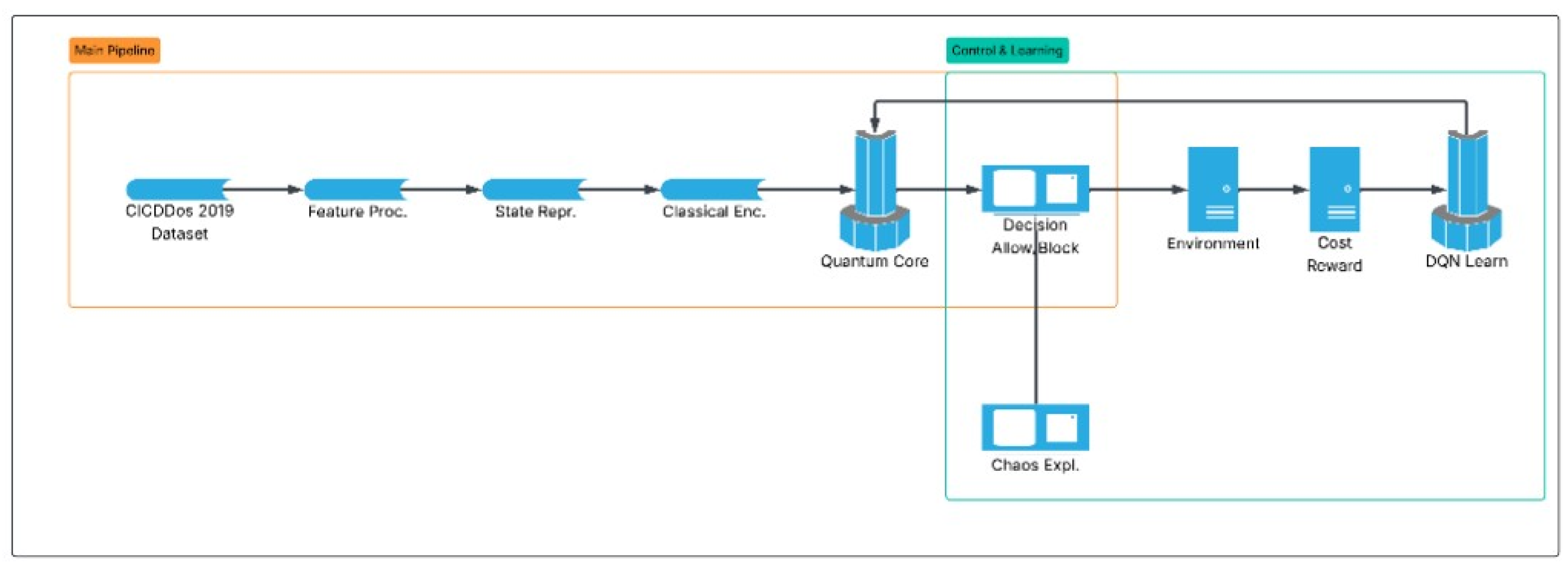
3.5.1. System Architecture
3.5.2. Problem Formulation as a Markov Decision Process
3.5.3. Cost-Aware Reward Design
3.5.4. Chaos-Driven State Perturbation
3.5.5. Training Procedure
4. Experimental Setup
4.1. Data Preprocessing
4.2. Quantum Circuit Configuration
4.3. Hyperparameter Settings
4.4. Evaluation Metrics
5. Results and Operational Analysis
5.1. Detection Performance Comparison
5.2. Operational Cost Reduction Analysis
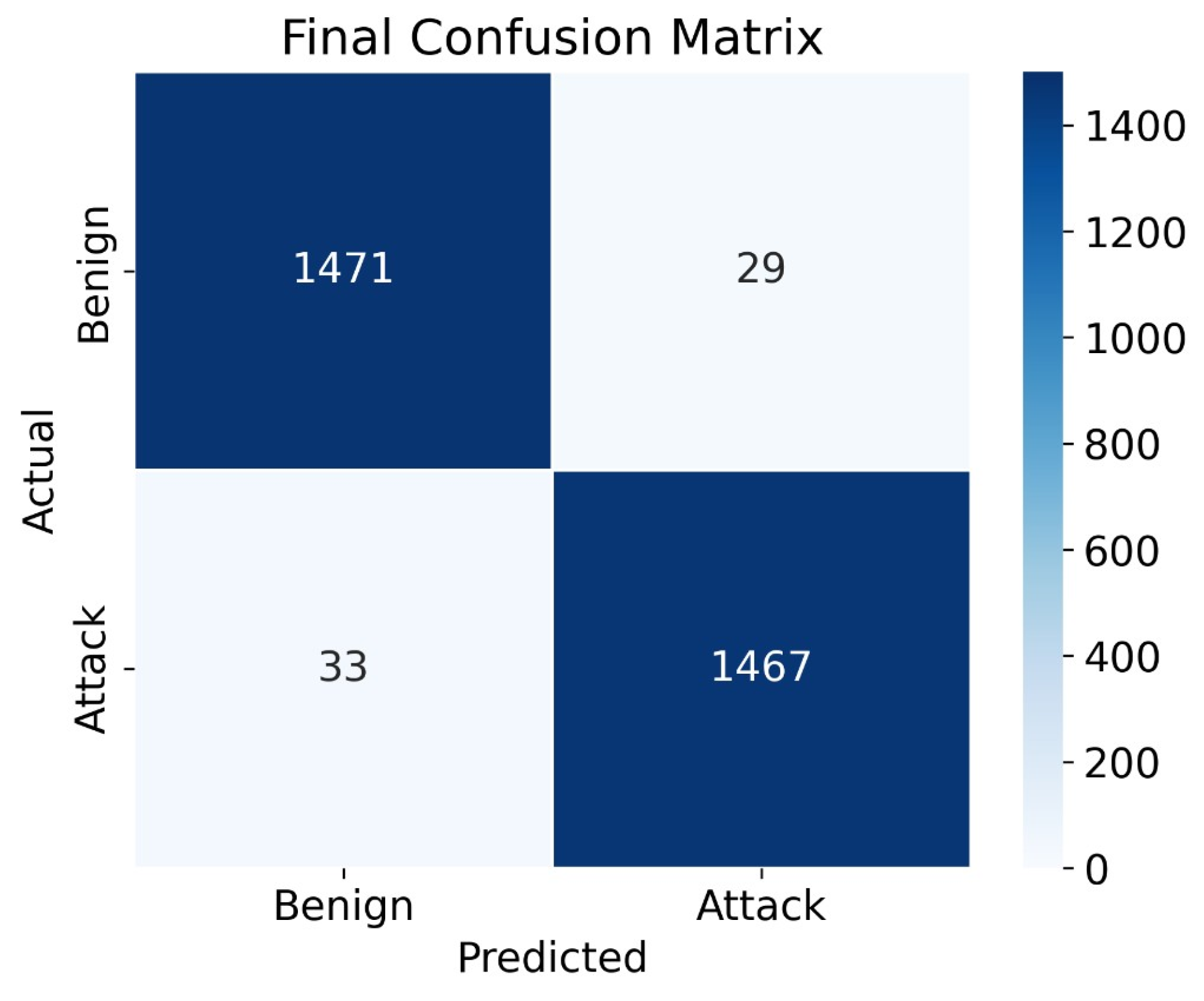
5.3. Reward Convergence and Stability Analysis
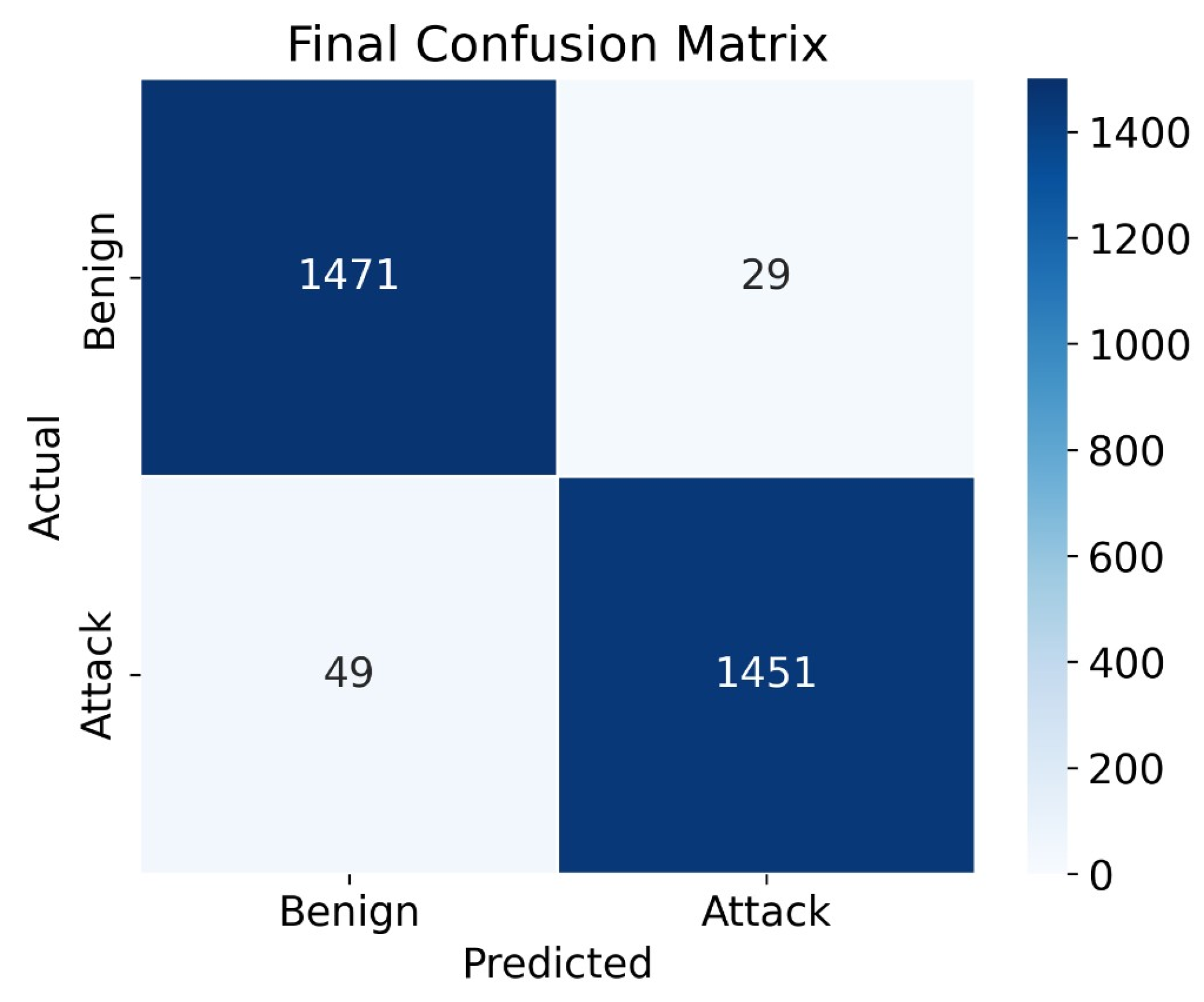
5.4. Trade-Off Analysis Between False Positives and False Negatives
6. Discussion
7. Conclusions
Author Contributions
Funding
Institutional Review Board Statement
Informed Consent Statement
Data Availability Statement
Acknowledgments
Conflicts of Interest
References
- Neshenko, N.; Bou-Harb, E.; Crichigno, J.; Kaddoum, G.; Ghani, N. Demystifying IoT security: An exhaustive survey on IoT vulnerabilities and a first empirical look on Internet-scale IoT exploitations. IEEE Commun. Surv. Tutor. 2019, 21, 2702–2733. [Google Scholar]
- Anand, P.; Singh, Y.; Selwal, A.; Singh, P.K.; Felseghi, R.A.; Raboaca, M.S. Iovt: Internet of vulnerable things? threat architecture, attack surfaces, and vulnerabilities in internet of things and its applications towards smart grids. Energies 2020, 13, 4813. [Google Scholar] [CrossRef]
- Gelgi, M.; Guan, Y.; Arunachala, S.; Samba Siva Rao, M.; Dragoni, N. Systematic literature review of IoT botnet DDOS attacks and evaluation of detection techniques. Sensors 2024, 24, 3571. [Google Scholar] [CrossRef]
- Alhalabi, W.; Gaurav, A.; Arya, V.; Zamzami, I.F.; Aboalela, R.A. Machine learning-based distributed denial of services (ddos) attack detection in intelligent information systems. Int. J. Semant. Web Inf. Syst. (IJSWIS) 2023, 19, 1–17. [Google Scholar] [CrossRef]
- Kabanda, R.; Byera, B.; Emeka, H.; Mohiuddin, K.T. The history, trend, types, and mitigation of distributed denial of service attacks. J. Inf. Secur. 2023, 14, 464–471. [Google Scholar] [CrossRef]
- Praptodiyono, S.; Firmansyah, T.; Anwar, M.H.; Wicaksana, C.A.; Pramudyo, A.S.; Al-Allawee, A. Development of hybrid intrusion detection system based on Suricata with pfSense method for high reduction of DDoS attacks on IPv6 networks. East.-Eur. J. Enterp. Technol. 2023, 125, 61–70. [Google Scholar]
- Shiju, S.; Nair, S.S. False Alert Mitigation in Intrusion Detection System: A Deep Learning Approach. In Proceedings of the 2025 4th International Conference on Advances in Computing, Communication, Embedded and Secure Systems (ACCESS), Ernakulam, India, 11–13 June 2025; IEEE: New York, NY, USA, 2025; pp. 803–809. [Google Scholar]
- Hashmi, A.; Barukab, O.M.; Hamza Osman, A. A hybrid feature weighted attention based deep learning approach for an intrusion detection system using the random forest algorithm. PLoS ONE 2024, 19, e0302294. [Google Scholar] [CrossRef]
- Prasath, S.; Sethi, K.; Mohanty, D.; Bera, P.; Samantaray, S.R. Analysis of continual learning models for intrusion detection system. IEEE Access 2022, 10, 121444–121464. [Google Scholar] [CrossRef]
- Hossain, M.A. Deep Q-learning intrusion detection system (DQ-IDS): A novel reinforcement learning approach for adaptive and self-learning cybersecurity. ICT Express 2025, 11, 875–880. [Google Scholar]
- Shen, S.; Cai, C.; Li, Z.; Shen, Y.; Wu, G.; Yu, S. Deep Q-network-based heuristic intrusion detection against edge-based SIoT zero-day attacks. Appl. Soft Comput. 2024, 150, 111080. [Google Scholar] [CrossRef]
- Vanderschueren, T.; Verdonck, T.; Baesens, B.; Verbeke, W. Predict-then-optimize or predict-and-optimize? An empirical evaluation of cost-sensitive learning strategies. Inf. Sci. 2022, 594, 400–415. [Google Scholar] [CrossRef]
- Sayin, B.; Zoppi, T.; Marchini, N.; Khokhar, F.A.; Passerini, A. Bringing Machine Learning Classifiers Into Critical Cyber-Physical Systems: A Matter of Design. IEEE Access 2025, 13, 94858–94877. [Google Scholar] [CrossRef]
- Yang, M.; Bi, X. Cost-Aware Calibration of Classifiers. INFORMS J. Data Sci. 2025, 4, 101–113. [Google Scholar] [CrossRef]
- Küçükkara, M.Y.; Atban, F.; Bayılmış, C. Quantum-Neural Network Model for Platform Independent Ddos Attack Classification in Cyber Security. Adv. Quantum Technol. 2024, 7, 2400084. [Google Scholar] [CrossRef]
- Atban, F.; Küçükkara, M.Y.; Bayılmış, C. Enhancing variational quantum classifier performance with meta-heuristic feature selection for credit card fraud detection. Eur. Phys. J. Spec. Top. 2025, 234, 3705–3718. [Google Scholar] [CrossRef]
- Fontana, E.; Herman, D.; Chakrabarti, S.; Kumar, N.; Yalovetzky, R.; Heredge, J.; Sureshbabu, S.H.; Pistoia, M. Characterizing barren plateaus in quantum ansätze with the adjoint representation. Nat. Commun. 2024, 15, 7171. [Google Scholar] [CrossRef]
- Ragone, M.; Bakalov, B.N.; Sauvage, F.; Kemper, A.F.; Ortiz Marrero, C.; Larocca, M.; Cerezo, M. A lie algebraic theory of barren plateaus for deep parameterized quantum circuits. Nat. Commun. 2024, 15, 7172. [Google Scholar] [CrossRef]
- Letcher, A.; Woerner, S.; Zoufal, C. Tight and efficient gradient bounds for parameterized quantum circuits. Quantum 2024, 8, 1484. [Google Scholar] [CrossRef]
- Li, Y.; Li, L.; Lian, Z.; Zhou, K.; Dai, Y. A quasi-opposition learning and chaos local search based on walrus optimization for global optimization problems. Sci. Rep. 2025, 15, 2881. [Google Scholar] [CrossRef]
- Matsuki, T.; Sakemi, Y.; Aihara, K. Chaos-based reinforcement learning with TD3. arXiv 2024, arXiv:2405.09086. [Google Scholar] [CrossRef]
- Kaewdornhan, N.; Chatthaworn, R. Improved Deep Reinforcement Learning with Logistic Map for Microgrid Energy Management. E3S Web Conf. 2025, 629, 06001. [Google Scholar] [CrossRef]
- Sharafaldin, I.; Lashkari, A.H.; Hakak, S.; Ghorbani, A.A. Developing realistic distributed denial of service (DDoS) attack dataset and taxonomy. In Proceedings of the 2019 International Carnahan Conference on Security Technology (ICCST), Chennai, India, 1–3 October 2019; IEEE: New York, NY, USA, 2019; pp. 1–8. [Google Scholar]
- Hizal, S.; Cavusoglu, U.; Akgun, D. A novel deep learning-based intrusion detection system for IoT DDoS security. Internet Things 2024, 28, 101336. [Google Scholar]
- Almaraz-Rivera, J.G.; Perez-Diaz, J.A.; Cantoral-Ceballos, J.A. Transport and application layer DDoS attacks detection to IoT devices by using machine learning and deep learning models. Sensors 2022, 22, 3367. [Google Scholar] [CrossRef] [PubMed]
- Abulhassan, A.; Rashid, I.; Imam, M.; Binbeshr, F. Ddos attack detection in iot: A comparative resource and performance analysis of deep learning and machine learning models. IEEE Access 2025, 13, 116529–116547. [Google Scholar] [CrossRef]
- Sajid, M.; Malik, K.R.; Almogren, A.; Malik, T.S.; Khan, A.H.; Tanveer, J.; Rehman, A.U. Enhancing intrusion detection: A hybrid machine and deep learning approach. J. Cloud Comput. 2024, 13, 123. [Google Scholar] [CrossRef]
- Wahab, S.A.; Sultana, S.; Tariq, N.; Mujahid, M.; Khan, J.A.; Mylonas, A. A multi-class intrusion detection system for DDoS attacks in IoT networks using deep learning and transformers. Sensors 2025, 25, 4845. [Google Scholar] [CrossRef]
- Ain, N.U.; Sardaraz, M.; Tahir, M.; Abo Elsoud, M.W.; Alourani, A. Securing IoT networks against DDoS attacks: A hybrid deep learning approach. Sensors 2025, 25, 1346. [Google Scholar] [CrossRef] [PubMed]
- Yang, E.; Jeong, S.; Seo, C. Harnessing feature pruning with optimal deep learning based DDoS cyberattack detection on IoT environment. Sci. Rep. 2025, 15, 17516. [Google Scholar] [CrossRef]
- Rahmati, M.; Pagano, A. Federated Learning-Driven Cybersecurity Framework for IoT Networks with Privacy Preserving and Real-Time Threat Detection Capabilities. Informatics 2025, 12, 62. [Google Scholar] [CrossRef]
- Sorour, S.E.; Aljaafari, M.; Shaker, A.M.; Amin, A.E. LSTM-JSO framework for privacy preserving adaptive intrusion detection in federated IoT networks. Sci. Rep. 2025, 15, 11321. [Google Scholar] [CrossRef]
- Begum, K.; Mozumder, M.A.I.; Joo, M.I.; Kim, H.C. BFLIDS: Blockchain-driven federated learning for intrusion detection in IoMT networks. Sensors 2024, 24, 4591. [Google Scholar] [CrossRef]
- Nguyen, T.T.; Reddi, V.J. Deep reinforcement learning for cyber security. IEEE Trans. Neural Netw. Learn. Syst. 2021, 34, 3779–3795. [Google Scholar] [CrossRef]
- Satpathy, S.; Tripathy, U.; Swain, P.K. Cloud-based DDoS detection using hybrid feature selection with deep reinforcement learning (DRL). Sci. Rep. 2025, 15, 36546. [Google Scholar] [CrossRef]
- Al-Fawa’reh, M.; Abu-Khalaf, J.; Szewczyk, P.; Kang, J.J. MalBoT-DRL: Malware botnet detection using deep reinforcement learning in IoT networks. IEEE Internet Things J. 2023, 11, 9610–9629. [Google Scholar] [CrossRef]
- Suresh, A.; Cyril Jose, A. Adaptive network intrusion detection using reinforcement learning with proximal policy optimization. ACM Trans. Priv. Secur. 2025, 28, 1–24. [Google Scholar] [CrossRef]
- Kanimozhi, R.; Ramesh, P. Deep reinforcement learning-based intrusion detection scheme for software-defined networking. Sci. Rep. 2025, 15, 38827. [Google Scholar] [CrossRef] [PubMed]
- Sethi, K.; Sai Rupesh, E.; Kumar, R.; Bera, P.; Venu Madhav, Y. A context-aware robust intrusion detection system: A reinforcement learning-based approach. Int. J. Inf. Secur. 2020, 19, 657–678. [Google Scholar] [CrossRef]
- Jayakrishna, N.; Prasanth, N.N. A hybrid deep learning model for detection and mitigation of DDoS attacks in VANETs. Sci. Rep. 2025, 15, 34170. [Google Scholar] [CrossRef] [PubMed]
- Prasad, A.; Mohammad Alenazy, W.; Ahmad, N.; Ali, G.; Abdallah, H.A.; Ahmad, S. Optimizing IoT intrusion detection with cosine similarity based dataset balancing and hybrid deep learning. Sci. Rep. 2025, 15, 30939. [Google Scholar] [CrossRef]
- Zahoora, U.; Khan, A.; Rajarajan, M.; Khan, S.H.; Asam, M.; Jamal, T. Ransomware detection using deep learning based unsupervised feature extraction and a cost sensitive Pareto Ensemble classifier. Sci. Rep. 2022, 12, 15647. [Google Scholar] [CrossRef]
- Nissar, N.; Naja, N.; Jamali, A. Cost-Sensitive Detection of DoS Attacks in Automotive Cybersecurity Using Artificial Neural Networks and CatBoost. J. Netw. Syst. Manag. 2025, 33, 28. [Google Scholar] [CrossRef]
- Nayak, G.S.; Muniyal, B.; Belavagi, M.C. Enhancing phishing detection: A machine learning approach with feature selection and deep learning models. IEEE Access 2025, 13, 33308–33320. [Google Scholar] [CrossRef]
- Kim, T.H.; Madhavi, S. Quantum intrusion detection system using outlier analysis. Sci. Rep. 2024, 14, 27114. [Google Scholar] [CrossRef]
- Kukliansky, A.; Orescanin, M.; Bollmann, C.; Huffmire, T. Network anomaly detection using quantum neural networks on noisy quantum computers. IEEE Trans. Quantum Eng. 2024, 5, 3100611. [Google Scholar] [CrossRef]
- Kadi, A.; Selamnia, A.; Abou El Houda, Z.; Moudoud, H.; Brik, B.; Khoukhi, L. An In-Depth Comparative Study of Quantum-Classical Encoding Methods for Network Intrusion Detection. IEEE Open J. Commun. Soc. 2025, 6, 1129–1148. [Google Scholar] [CrossRef]
- Nalayini, C.; Soumya, T.; Lalitha, S.; Tamijetchelvy, R. A novel adaptive transformer based quantum intrusion detection system for software defined networks. Sci. Rep. 2025, 15, 36505. [Google Scholar] [CrossRef]
- McClean, J.R.; Boixo, S.; Smelyanskiy, V.N.; Babbush, R.; Neven, H. Barren plateaus in quantum neural network training landscapes. Nat. Commun. 2018, 9, 4812. [Google Scholar] [CrossRef] [PubMed]
- Cerezo, M.; Sone, A.; Volkoff, T.; Cincio, L.; Coles, P.J. Cost function dependent barren plateaus in shallow parametrized quantum circuits. Nat. Commun. 2021, 12, 1791. [Google Scholar] [CrossRef] [PubMed]
- Dowling, N.; West, M.T.; Southwell, A.; Nakhl, A.C.; Sevior, M.; Usman, M.; Modi, K. Adversarial robustness guarantees for quantum classifiers. npj Quantum Inf. 2026, 12, 16. [Google Scholar] [CrossRef]
- Naruse, M.; Mihana, T.; Hori, H.; Saigo, H.; Okamura, K.; Hasegawa, M.; Uchida, A. Scalable photonic reinforcement learning by time-division multiplexing of laser chaos. Sci. Rep. 2018, 8, 10890. [Google Scholar] [CrossRef]
- Bilban, M.; İnan, O. Optimizing Autonomous Vehicle Performance Using Improved Proximal Policy Optimization. Sensors 2025, 25, 1941. [Google Scholar] [CrossRef]
- Li, W.; Lu, Z.D.; Deng, D.L. Quantum neural network classifiers: A tutorial. Scipost Phys. Lect. Notes 2022, 61. [Google Scholar] [CrossRef]
- Zhou, M.G.; Liu, Z.P.; Yin, H.L.; Li, C.L.; Xu, T.K.; Chen, Z.B. Quantum neural network for quantum neural computing. Research 2023, 6, 134. [Google Scholar] [CrossRef] [PubMed]
- Devadas, R.M.; Sowmya, T. Quantum machine learning: A comprehensive review of integrating AI with quantum computing for computational advancements. MethodsX 2025, 14, 103318. [Google Scholar] [CrossRef]
- Gong, L.H.; Pei, J.J.; Zhang, T.F.; Zhou, N.R. Quantum convolutional neural network based on variational quantum circuits. Opt. Commun. 2024, 550, 129993. [Google Scholar] [CrossRef]
- Shakya, A.K.; Pillai, G.; Chakrabarty, S. Reinforcement learning algorithms: A brief survey. Expert Syst. Appl. 2023, 231, 120495. [Google Scholar] [CrossRef]
- Ladosz, P.; Weng, L.; Kim, M.; Oh, H. Exploration in deep reinforcement learning: A survey. Inf. Fusion 2022, 85, 1–22. [Google Scholar] [CrossRef]
- Fotopoulos, G.B.; Popovich, P.; Papadopoulos, N.H. Review non-convex optimization method for machine learning. arXiv 2024, arXiv:2410.02017. [Google Scholar] [CrossRef]
- Wang, S.; Yang, R.; Li, B.; Kan, Z. Structural parameter space exploration for reinforcement learning via a matrix variate distribution. IEEE Trans. Emerg. Top. Comput. Intell. 2022, 7, 1025–1035. [Google Scholar] [CrossRef]


| Study | Methodology | Optimization Focus | Cost-Sensitivity | Key Limitation Regarding This Study |
|---|---|---|---|---|
| Wahab et al. [28] | CNN + Transformers | Class balancing (SMOTE) | Indirect (data-level) | High computational cost; static training. |
| Satpathy et al. [35] | Actor-Critic DRL | Reward shaping | Yes (reward-based) | Focuses on cloud, not edge/IoT QNN stability. |
| Suresh & Jose [37] | PPO-RL Ensemble | Dynamic weighting | Indirect | Classical ML ensemble; no quantum component. |
| Nissar et al. [43] | ANN + CatBoost | Hyperparameter tuning (Optuna) | Explicit (cost learning) | Static model; lacks adaptive RL exploration. |
| Nalayini et al. [48] | Quantum-inspired IDS | Evolutionary selection | No (focus on overhead) | SDN-focused; uses evolutionary algorithm instead of chaos. |
| Kukliansky et al. [46] | QNN on noisy HW | Noise robustness | No | Focuses on hardware noise, not algorithmic stability. |
| Matsuki et al. [21] | Chaos-based RL (TD3) | Chaos exploration | No | General control task; not applied to IDS or QNNs. |
| Proposed CDRL-QNN | QNN + Chaos + RL | Chaos-driven stability | Explicit (FP/FN costs) | Integrates cost-aware RL, QNN-based value approximation, and chaos-driven exploration within a unified framework. |
| Model | Accuracy | F1-Score | Operational Cost |
|---|---|---|---|
| Classical DQN | 0.9269 ± 0.0115 | 0.9271 ± 0.0117 | 754.0 ± 128.7 |
| Random Forest | 0.9825 ± 0.0035 | 0.9823 ± 0.0036 | 51.0 ± 8.5 |
| Proposed CDRL-QNN (alternative seed) | 0.9750 | 0.9751 | 240.0 |
Disclaimer/Publisher’s Note: The statements, opinions and data contained in all publications are solely those of the individual author(s) and contributor(s) and not of MDPI and/or the editor(s). MDPI and/or the editor(s) disclaim responsibility for any injury to people or property resulting from any ideas, methods, instructions or products referred to in the content. |
© 2026 by the authors. Licensee MDPI, Basel, Switzerland. This article is an open access article distributed under the terms and conditions of the Creative Commons Attribution (CC BY) license.
Share and Cite
Küçükkara, M.Y.; Atban, F.; Bayılmış, C. A New Hybrid Method: CDRL-QNN for Stable IoT Intrusion Detection. Mathematics 2026, 14, 1608. https://doi.org/10.3390/math14101608
Küçükkara MY, Atban F, Bayılmış C. A New Hybrid Method: CDRL-QNN for Stable IoT Intrusion Detection. Mathematics. 2026; 14(10):1608. https://doi.org/10.3390/math14101608
Chicago/Turabian StyleKüçükkara, Muhammed Yusuf, Furkan Atban, and Cüneyt Bayılmış. 2026. "A New Hybrid Method: CDRL-QNN for Stable IoT Intrusion Detection" Mathematics 14, no. 10: 1608. https://doi.org/10.3390/math14101608
APA StyleKüçükkara, M. Y., Atban, F., & Bayılmış, C. (2026). A New Hybrid Method: CDRL-QNN for Stable IoT Intrusion Detection. Mathematics, 14(10), 1608. https://doi.org/10.3390/math14101608