1. Introduction
Modern three-dimensional imaging techniques, such as X-ray microtomography, make it possible to obtain detailed images of the internal structure of samples consisting of several disjoint regions (phases). Each phase can be represented as a set of connected components (individual particles and objects) of complex shape, with tunnels, cavities and other topological features. In applied problems (earth sciences, material science, and biomedicine), a key question is how these phases spatially interact: whether they contact each other, penetrate one another, form common cavities or tunnels. These questions are relevant for earth sciences [
1,
2,
3,
4,
5], material sciences [
6,
7], biomedicine [
8,
9], and so on. Classical methods of topological analysis, such as computing Betti numbers or persistent homology, allow one to characterize each phase individually but do not directly answer the question of the nature of their interaction [
10,
11,
12,
13].
In our previous work [
14], an approach was proposed that uses phase union and analysis of the changes in Betti numbers to interpret the tomographic data. However, that work was mainly applied in nature and did not offer a systematic mathematical theory.
The present paper develops the methodology and mathematical apparatus of that approach. We construct a formal topological theory that makes it possible to describe the interaction of disjoint subsets (phases) in a three-dimensional space solely on the basis of comparing their homology invariants. The foundations consist of classical concepts of algebraic topology such as Betti numbers and properties of disjoint union. We compare the deviation of the homology of the real union of phases from the reference state—the disjoint union, where phases do not interact. This allows us to classify possible types of topological contacts (merging, filling, and generation of new elements) and to formulate interpretation rules that do not depend on the specific nature of the phases. The proposed formalism can be used as an independent branch of topology studying “homology of relations,” and it opens a path to a rigorous quantitative analysis of multiphase structures in various fields.
Problem Statement
Consider a topological space which is a union of several disjoint subsets. Each such subset will be called a phase (by analogy with a thermodynamic phase, a region of uniform composition and structure bounded by phase boundaries) and denoted by . Let be the set of phase indices. For each , a set (a phase) is given, with for . Each phase consists of a finite number of components (objects), each of which is a compact subset of .
The goal of the present work is to describe the interaction of phases (neighbourhood, interpenetration and inclusion) based on their topological properties, without enumerating all pairs of the objects of the two phases.
The main tool for achieving this goal will be the operation of a union operation of two phases and observation of the resulting change (dynamics) of Betti numbers under such a change.
Research hypothesis: the change in Betti numbers upon union of two phases can serve as an indicator of the type of their topological interaction.
2. Materials and Methods: A Set of Basic Definitions
In order to build the necessary formalization, we need to set a number of definitions.
Definition 1. Betti numbers. For a phase (family of sets) :
= number of connected components (objects) of the phase ;
= number of independent through tunnels (cycles) in ;
= number of closed cavities completely surrounded by .
Definition 2. Set of united phases. For any non-empty subset the set of united phases is defined as: The Betti numbers of , denoted for , are computed in the same way as for individual phases, treating the union as a single phase.
Definition 3. Types of contacts.
Consider two phases
and
with non-empty intersection
(contact points). For homology with coefficients in the field
, we have the Mayer–Vietoris exact sequence:
where
are homology groups (covariant functors from the category of topological spaces to the category of graded abelian groups), and
are homomorphisms induced by inclusions [
15]. In terms of this sequence, we give general definitions of three fundamental types of contacts, independent of
.
Let . We say that upon the union of phases and , the following types of contacts occur.
Filling contact (for dimension ), if there exists a non-zero element such that . This means that some cycle (component, tunnel, or cavity) disappears in the union, being “filled” by the other phase.
Unifying contact (for dimension ), if there exist non-zero elements and such that . This means that two cycles from different phases merge into one.
Generating contact (for dimension ) if there exists a non-zero element that does not belong to the image of . Such an element arises from components of the intersection via the boundary map and corresponds to the creation of a new cycle that was absent in each phase individually.
Remark 1. For the map is trivial; therefore, generating contacts is impossible for . For and a generating contact requires non-triviality of , which corresponds to the presence of several contact points capable of forming a cycle.
Definition 4. Admissible types of contacts for each .
Based on the geometric properties of the phases (they are disjoint and consist of non-intersecting objects) and the nature of Betti numbers, for each only the following types of contacts are possible.
For (connected components) only a unifying contact is possible, because components can only merge. A filling contact is not applicable (one cannot “fill” a component without destroying it), and a generating contact is impossible since new components do not arise from contact.
For (tunnels), all three types of contacts are possible:
filling—a tunnel disappears, becoming occupied by the substance of the other phase;
unifying—two tunnels from different phases merge into one;
generating—a new tunnel is formed from contact points (e.g., when two halves of a pipe are joined).
For (cavities), only filling and generating contacts are possible. A unifying contact is impossible, because cavities are closed three-dimensional regions and the phases are disjoint by a construction; merging two cavities from different phases would require a common space, which contradicts the disjointness of the phases.
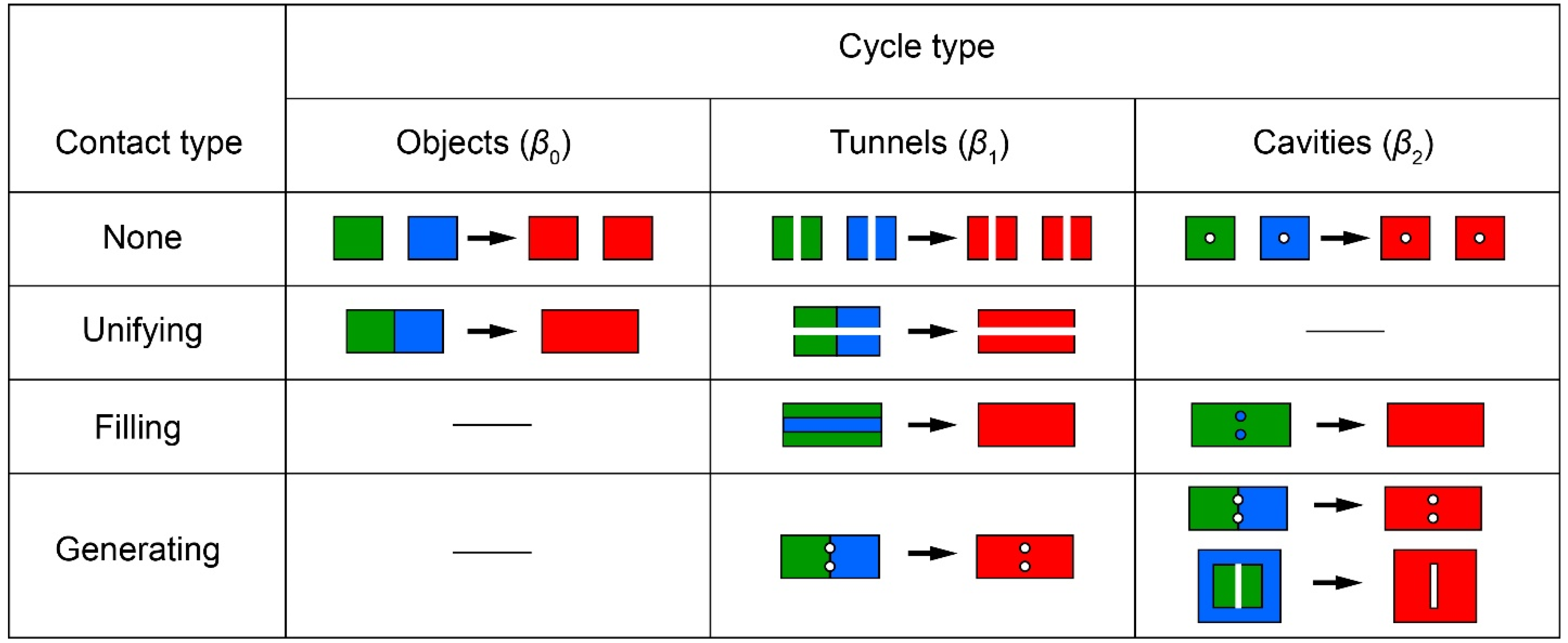
A visual representation of contacts and their classification by cycle type (object, tunnel, and cavity) is shown in
Figure 1.
Definition 5. Reference points.
For a fixed set of phases
and homology index
we define the following quantities, which will be called
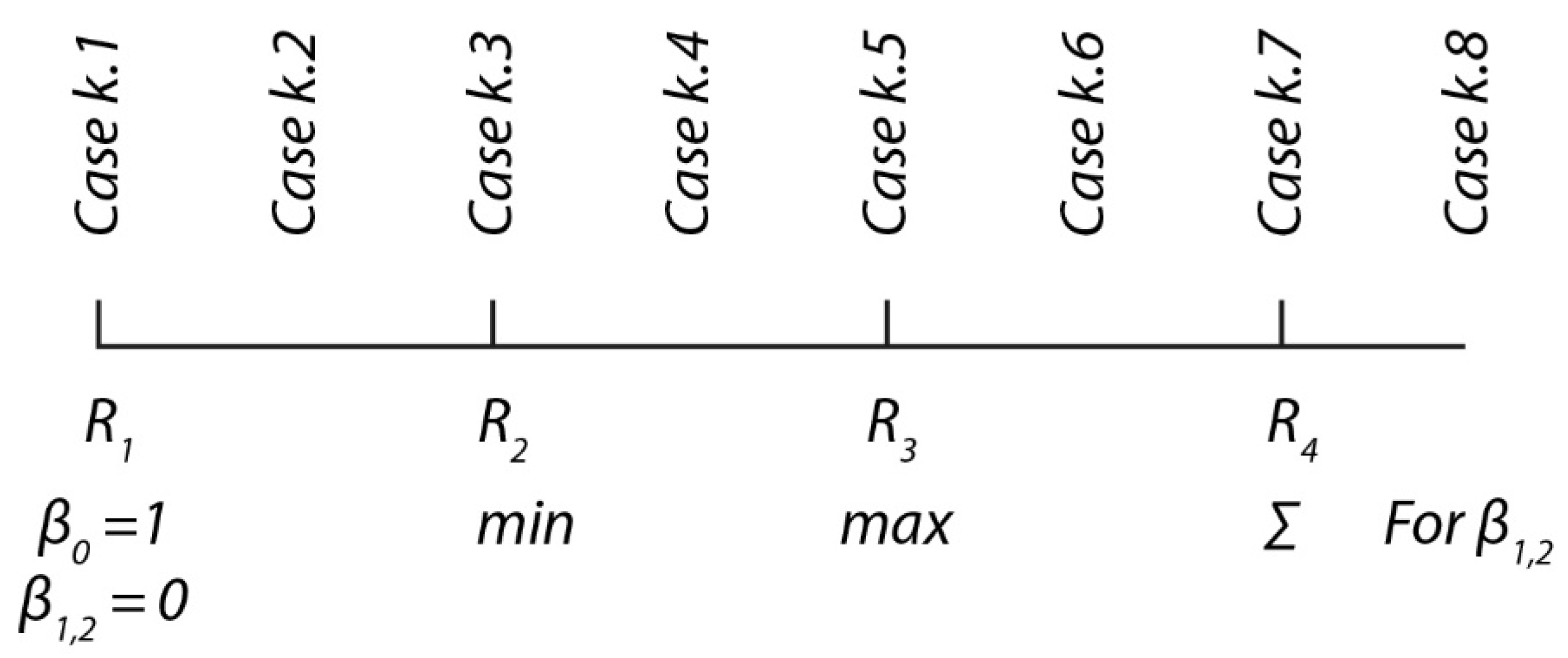
reference points (
Figure 2):
The point
corresponds to the absolute minimum attained when all objects merge into one (
) or when there are no tunnels/cavities (
). The points
are determined from the individual phases and satisfy
The value of the united phase is always at least . For we also have , because the number of components does not increase upon union. For and the value is not bounded above. Comparison of with the reference points serves as a basis for diagnosing the type of phase interaction.
3. Results
We will interpret the character of the contacts by the interval into which the value falls relative to the reference points . The quantities can take the following values: ; ; ; ; ; ; . Moreover, for and values greater than are possible.
For convenience, we introduce the following notation (for fixed
and two phases
):
Below we present interpretations for the cases of equality of some reference points, and then interpretations for each Betti number separately.
3.1. Interpretation of Equalities of Some Reference Points
The following equalities between some reference points are possible.
means that the minimum and maximum coincide; therefore, all phases have the same -th Betti number.
is possible only for . This equality can occur only if all phases except one have and, consequently, the remaining phase has the value equal to the sum. Since , automatically . For the equality is impossible, because the construction requires that each phase contain at least one object: ; and since each phase contains at least one object, the sum is always greater than .
for means that the minimal number of components is 1, i.e., there exists a phase consisting of a single object. For the minimum equals 0, meaning that one of the phases has no tunnels/cavities.
for is the trivial case when all values are zero. This means that the components of all phases contain no tunnels (for ) or no cavities (for ). For such an equality is impossible because while the sum would be larger.
Other possible combinations, e.g., or , either reduce to those listed or are impossible. For instance, would mean that the minimum equals the sum, which is possible only if all phases except one are zero and the remaining one has a value equal to the minimum, which inevitably implies that . This is a combination of items 2 and 1.
3.2. Interpretation of
Reference points for : absolute minimum , minimum of individual values , maximum , and sum . The value always satisfies . The possible positions of relative to the reference points and the corresponding contact types are listed below. By the problem statement, all phases are non-empty.
3.2.1. Case 1:
Assumption 1. All objects of all phases have merged into a single connected component. This means that each object of one phase has a unifying contact with at least one object of the other phase. This situation is interpreted as global merging.
Proof of Assumption 1. By construction, objects (connected components) inside one phase are disjoint and therefore cannot have unifying contacts with each other; all possible unifying contacts occur only between objects of different phases. Consider the union of all phases. Its connected components are formed from the original objects as follows: two objects belong to the same component if and only if they can be connected by a chain of unifying contacts (possibly through objects of other phases). If an object has no unifying contact with any object of another phase, then in it remains isolated and forms a separate connected component.
By assumption , i.e., all objects are gathered into a single component. Suppose contrary to the statement that there exists an object from some phase that has no unifying contact with any object of another phase. Then, as noted above, this object would be isolated in and would form a separate connected component, giving (since at least this object and the other objects might be connected among themselves but not with it). This contradicts . Therefore, such an object does not exist, and every object of every phase has at least one unifying contact with some object of another phase. □
3.2.2. Case 2:
Assumption 2. At least two objects of the phase with the smaller number of objects (phase ) have ended up in one object of the united phase , i.e., there exist unifying contacts linking them through objects of the other phase .
Proof of Assumption 2. By construction, objects inside one phase are disjoint and cannot have unifying contacts with each other; all such contacts are possible only between objects of different phases. Suppose contrary to the statement that no two objects of phase lie in the same connected component of . Then each object of phase is either isolated (has no contacts with objects of ) or together with some objects of forms a component, but in any case, this component contains exactly one object from (because two objects of cannot be together). Consequently, the number of connected components containing objects of equals the number of objects of , i.e., . Moreover, there may exist additional components consisting only of objects of that have no contacts with . Thus, the total number of components satisfies . This contradicts the condition . Hence, our assumption is false, and there exists at least one component containing at least two objects of phase . □
3.2.3. Case 3: , Where (Without Loss of Generality, We Assume )
Assumption 3. At least one object of the phase with the smaller number of objects (phase i) has a unifying contact with objects of phase j. In other words, there exists at least one object from that, upon union, joins with some object from .
Proof of Assumption 3. Recall that by construction objects (connected components) inside one phase are disjoint and therefore cannot have unifying contacts with each other; all possible contacts occur only between objects of different phases. A unifying contact between an object from and an object from means that after union these two objects become part of the same connected component. Any decrease in the number of connected components when passing from the disjoint union to the real union can occur only through such interphase contacts. In particular, if there were no unifying contact between the phases, then all objects of phase would remain separate components and all objects of phase would remain separate components, so the total number of connected components in would be .
In the considered case . Suppose contrary to the statement, that no object of phase has a unifying contact with any object of phase . Then, as noted above, . Since (otherwise phase would be empty, which is excluded), we obtain , contradicting . Therefore, our assumption is false, and at least one object of phase must have a unifying contact with some object of phase . □
Remark 2. This proof does not use any additional assumptions about the structure of contacts. It shows that the equality implies the existence of at least one contact between the smaller and larger phases, while various configurations are possible (e.g., all objects of may be connected through one object of , or only one), but the minimal necessary condition is exactly that.
3.2.4. Case 4:
Assumption 4. At least one object of phase i has a unifying contact with objects of the other phase, and there exists at least one object of phase j that has no contacts with any object of i.
Proof of Assumption 4. From it follows that not all objects of phase can have contacts with . Indeed, suppose the contrary: every object of phase has at least one unifying contact with some object of phase . Then each object of belongs to the same connected component as some object of . Consequently, all objects of are distributed among components containing objects of . The number of such components does not exceed the number of objects of , i.e., (since different objects of may be in different components or merge, but the number of components containing cannot exceed ). Thus , contradicting . Hence, there exists at least one object of phase that has no contacts with any object of (an isolated object of ).
From it follows that not all objects of phase are isolated. Indeed, if no object of had contacts with , then all objects of would be isolated. Objects of are also isolated (inside phase there are no contacts). Then the total number of components would be . Since , we have , contradicting . Therefore, there exists at least one object of phase that has a unifying contact with some object of .
Thus, in the interval there are necessarily both objects of participating in merging and objects of remaining isolated. □
3.2.5. Case 5:
Assumption 5. At least one object of phase has a unifying contact with objects of phase , and there exists at least one object of phase that has no contacts with any object of .
Proof of Assumption 5. From and we have .
Existence of a contact on the side of . Suppose that no object of phase has a unifying contact with objects of phase . Then all objects of are isolated from , and each of them forms a separate connected component. Objects of also remain separate, since inside phase there are no contacts. Consequently, the total number of components would be , which is greater than (because ). This contradicts . Hence, at least one object of must have a contact with some object of .
Existence of an isolated object in . Suppose now that all objects of phase have at least one contact with objects of . Since , by the pigeonhole principle there exists an object of that contacts at least two distinct objects of . These two objects of will end up in the same connected component (via this common object of ), which reduces the total number of components compared to the number of objects of . As a result, would become strictly less than (since at least one pair of objects have merged). This contradicts . Therefore, not all objects of can have contacts; i.e., there exists at least one object of that has no contact with any object of . □
3.2.6. Case 6:
Assumption 6. At least one object of phase has a unifying contact with objects of phase , and there exist objects of both phases that have no contacts with objects of the other phase.
Proof of Assumption 6. From we have and .
Existence of a contact. Suppose that no object of phase contacts objects of phase (and symmetrically, no object of contacts ). Then all objects of both phases are isolated from each other, and the number of connected components in equals , contradicting . Hence, at least one object of one of the phases (say, ) has a contact with an object of the other phase.
Existence of an isolated object in . Suppose that all objects of phase have at least one contact with objects of . Then each object of belongs to the same connected component as some object of . The number of components containing objects of does not exceed (since there are objects of and they can merge, but the number of components with cannot exceed ). All objects of are distributed among these components; therefore, the total number of components cannot exceed . But –contradiction. Hence there exists at least one object of phase that has no contact with .
Existence of an isolated object in . Suppose that all objects of phase
have at least one contact with objects of
. Then each object of
lies in a component with some objects of
. Let
be the number of components containing objects of
(clearly
). In each such component there is at least one object of
(otherwise objects of
would have no contact). Denote by
the total number of objects of
participating in contacts; then
. The remaining
objects of
are isolated. Thus
We obtain , contradicting . Hence not all objects of can have contacts; i.e., there exists at least one isolated object in .
Thus, in the interval there is necessarily at least one contact between the phases, as well as isolated objects in each phase. □
3.2.7. Case 7:
Assumption 7. All objects of both phases have no unifying contacts.
Proof of Assumption 7. By construction, objects inside one phase are disjoint and cannot have unifying contacts with each other; all possible unifying contacts occur only between objects of different phases. Each such contact connects two objects from different phases, reducing the total number of connected components compared to the sum .
Suppose contrary to the statement that there exists at least one unifying contact between some object of phase and some object of phase . Then in the union these two objects will lie in the same connected component. Consequently, the number of connected components would be strictly less than , because at least one pair of objects has merged. This contradicts .
Thus, there are no unifying contacts between the phases, and all objects remain separate. □
3.3. Interpretation of
Reference points for : absolute minimum , minimum of individual values , maximum and sum . can take values from 0 to . The possible positions of relative to the reference points and the corresponding contact types are listed below. By the problem statement, all phases are non-empty.
3.3.1. Case 8:
Assumption 8. There are no tunnels in the united phase. This means that either (a) none of the phases originally contained tunnels or (b) all existing tunnels were destroyed by filling contacts (the substance of one phase filled the tunnels of the other), and no new tunnels appeared, i.e., all contacts involving tunnels were filled, and no contact between the phases was generated.
Proof of Assumption 8. Consider two subcases.
Subcase A: . Then the statement is trivial: there were no tunnels in either phase, so there are none in the union, and the interpretation holds (original absence of tunnels).
Subcase B: at least one of is positive. Suppose contrary to the statement, that no tunnel was filled (i.e., there were no filled contacts). Then every tunnel that existed in a separate phase either remains unchanged or may merge with a tunnel of the other phase (unified contact). However, merging two tunnels yields one tunnel but does not lead to their complete disappearance. Therefore, if there was at least one tunnel originally, after any unifying contacts there will remain at least one tunnel in the union (the number of tunnels may decrease but will not become zero). Thus , contradicts . Hence, filled contacts must be present. □
3.3.2. Case 9:
Assumption 9. At least one tunnel of the phase with the smaller number of tunnels (phase ) has a filling or unifying contact.
Proof of Assumption 9. From it follows that (since is a positive integer and must be strictly greater than ). Thus phase originally contains at least one tunnel (in fact at least two, but one is sufficient for the proof).
Suppose contrary to the statement, that no tunnel of phase was eliminated–i.e., none of them was subject to a filling contact (the substance of the other phase did not fill it) nor merged with a tunnel of the other phase (unifying contact). Then all tunnels of phase are preserved in the union as independent tunnels (they may participate in generating contacts, but generation creates new tunnels, it does not destroy old ones). Consequently, the contribution of phase to the total number of tunnels is at least . The tunnels of phase and possible new tunnels can only increase the total number of tunnels. Thus , contradicting . Hence our assumption is false, and at least one tunnel of phase was eliminated (filled or merged). The positivity of guarantees that there are still tunnels in the union. □
3.3.3. Case 10:
Assumption 10. At least one tunnel of the larger phase was eliminated as a result of a filling or unifying contact.
Proof of Assumption 10. Suppose that no tunnel of phase was eliminated; i.e., none of them had neither a filling nor a unifying contact. Then all tunnels of phase are preserved in the union (they may participate in generating contacts, but that would only increase the number of tunnels). Consequently, . Since , we get , contradicting . Therefore, at least one tunnel of phase is necessarily eliminated.
As follows from the definition of contacts, the reduction in the number of tunnels in the united phase can occur in two ways: via a filling contact, when a tunnel disappears completely, reducing the total number by 1; and via a unifying contact, when two tunnels merge into one, which also reduces the total number by 1.
To achieve the final value , the total decrease in the number of tunnels (from the original sum ) must be exactly . This decrease can be realized in different ways. The simplest ones: if the decrease is achieved by one filling contact, then and one tunnel of is filled. If the decrease is achieved by one unifying contact, then two tunnels of (or one of and one of ) merge into one, and it is necessary that a tunnel from phase participates in this merging (otherwise tunnels of cannot merge directly because there are no contacts inside a phase). Hence, the minimal unifying scenario requires two tunnels of and one tunnel of that form one tunnel after contact. Thus, it is proved that at least one tunnel of the larger phase was eliminated, and two minimal ways to achieve this condition are also demonstrated. □
Remark 3. There exist two minimal ways to eliminate at least one tunnel: (1) one tunnel of phase has a filling contact (disappears completely); (2) two tunnels of phase merge via a contact with a tunnel of phase (unifying contact), turning into one tunnel. In general, the combinations of these mechanisms as well as the involvement of more tunnels are possible, but the two indicated options are the simplest and the most sufficient to make the total number of tunnels in the united phase equal to .
3.3.4. Case 11:
Assumption 11. At least one tunnel of the larger phase was eliminated as a result of a filling or unifying contact. The minimal ways of such elimination are: (1) one tunnel of phase has a filling contact (disappears completely); (2) two tunnels of phase merge via a contact with a tunnel of phase (unifying contact), turning into one tunnel.
Proof of Assumption 11. From it follows that not all tunnels of phase can be preserved in the union. Indeed, if all tunnels of phase remained unchanged (not subject to filling or unifying contacts), then even with complete preservation of tunnels of phase and no generation, we would have . Possible generation would only increase this number. Thus, the condition implies the existence of at least one tunnel of phase that was eliminated (filled or merged with another tunnel). □
Remark 4. The condition does not itself give the additional restrictions on tunnels of phase : if all tunnels of were eliminated, the value could become larger than due to the preservation of tunnels of and/or generation of new ones. Therefore, the interpretation is limited to stating the fact of elimination following from .
In contrast to Case 10, here is not equal to the minimum; consequently, besides the elimination of tunnels of , various combinations of preservation and generation are possible, which are not uniquely determined.
3.3.5. Case 12:
Assumption 12. The equality does not allow an unambiguous conclusion about the presence or absence of specific types of contacts, except that the overall balance between the processes of decrease and increase in the number of tunnels turned out to be zero relative to the larger phase.
Proof of Assumption 12. From it directly follows that the final number of tunnels equals the original number of tunnels of the larger phase. This equality can be realized in many ways, for example:
all tunnels of phase are preserved, and the tunnels of phase are either absent or eliminated (filled or merged);
some tunnels of are eliminated, but an equal number of new tunnels arise due to generating contacts;
a combination of these options.
None of these scenarios contradict the condition, so from one cannot deduce the necessity of any specific type of contact. □
3.3.6. Case 13:
Assumption 13. At least one tunnel of one of the phases has a filling or unifying contact.
Proof of Assumption 13. Suppose that no tunnel of phases and was eliminated, i.e., none of them has either a filling or a unifying contact. Then the sum of tunnels of phases and are preserved in the union. Consequently, , contradicting . Hence, at least one tunnel of at least one of the phases is necessarily eliminated.
The condition does not impose additional restrictions, because exceeding the maximum can be achieved in various ways: for example, by preserving part of the tunnels of the smaller phase while partially eliminating the larger one, or by generating new tunnels that compensate for the elimination and even exceed it. All these scenarios are compatible with this inequality, so one cannot deduce the necessity of any specific type of contact from it. □
3.3.7. Case 14:
Assumption 14. The equality does not allow an unambiguous conclusion about the presence or absence of specific types of contacts, except that the overall balance between the processes of decrease and increase in the number of tunnels turned out to be zero relative to the sum of tunnels in both phases.
Proof of Assumption 14. From it directly follows that the final number of tunnels equals the original total number of tunnels of both phases. This equality can be realized in many ways: for example, in the complete absence of any contacts (then all tunnels are preserved) as well as in the presence of balanced processes where some tunnels are eliminated (by filling or unifying contacts) and exactly the same number arise due to the generating contacts. None of these scenarios contradict the condition, so from one cannot deduce the necessity of any specific type of contact. □
3.3.8. Case 15:
Assumption 15. At least one contact is generating.
Proof of Assumption 15. Suppose that the generating contacts are absent. Then the only types of contacts affecting the number of tunnels can be filling and unifying, which only decrease the total number of tunnels (filling destroys one tunnel and unifying turns two tunnels into one). Hence, for any combination of filling and unifying contacts, the final number of tunnels cannot exceed the original sum . The maximum value is attained only in the absence of any contacts (when all tunnels are preserved). Thus, in the absence of generating contacts, we always have , contradicting . Therefore, our assumption is false, and at least one generating contact is necessarily present. □
3.4. Interpretation of
The reference points for coincide with those for : (absolute minimum), , , . Possible values of lie in the intervals determined by these points, and values greater than are also possible (due to generating contacts). Recall that for the cavities only two types of contacts are possible: filling (decreases the number of cavities) and generating (increases it). Unifying contact is impossible for (Definition 4).
For further analysis we introduce the notation for these types of contacts. Let and be the numbers of filling contacts (i.e., the number of cavities eliminated by filling contacts) in phases and , respectively. Then the total number of filling contacts is . Let be the number of new cavities arising from generating contacts.
Consider the balance of cavities upon union. Initially, phases
and
have
and
cavities respectively, a total of
cavities. Each filling contact reduces the total number of cavities by 1 (since one cavity disappears), and each generating contact increases it by 1 (a new cavity appears). Then the number of cavities in the united phase is given by the formula
Indeed, initially there are cavities. Each filling contact reduces this number by 1; each generating contact increases it by 1. From this we directly obtain .
Below we list all possible positions of relative to the reference points and the interpretation of phase interaction in terms of restrictions on the types and numbers of contacts.
3.4.1. Case 16:
Assumption 16. There are no cavities in the united phase. This means that either none of the phases originally contained cavities or all existing cavities were destroyed by filling contacts (the substance of one phase filled the cavities of the other), and no new cavities appeared, i.e., all contacts involving cavities were filled, and no contact between the phases was generated.
Proof of Assumption 16. If , the statement is trivial. Consider the case when at least one of the phases originally contained cavities () but .
Suppose that not all cavities have a filling contact, i.e.,
. Then from Equation (1) we obtain
since
and
. This contradicts
. Hence, we must have
–all original cavities are eliminated by filling contacts.
Now suppose that
. Then, even with
, from Equation (1) we have
also contradicting
. Hence
–generating contacts are absent.
Thus, for the condition implies that all original cavities were filled and no new ones arose. □
3.4.2. Case 17:
Assumption 17. At least one cavity of the smaller phase has a filling contact; and at least cavities of the larger phase have a filling contact (in other words, at least cavities in the larger phase must be eliminated).
Proof of Assumption 17. From it follows that .
Proof of existence of a filling contact in phase . Suppose
(no cavity of phase
is eliminated). Then
. Since
and
, from Equation (1) we get
Thus , contradicting . Therefore , i.e., at least one cavity of phase has a filling contact.
Proof of the minimal number of eliminated cavities in phase . To estimate the minimal number of eliminated cavities in phase , note that for the value of increases, which only makes it harder to satisfy . Hence, it suffices to consider the case , in which from Equation (1) we have . The condition is equivalent to . Suppose that . Then even in the most favourable case for reduction, when all cavities of phase are eliminated (), we have , whence . This contradicts . Hence, we must have . Thus, at least cavities in phase must be eliminated. □
Remark 5. The obtained lower bound for the number of eliminated cavities in the larger phase is sharp: with and we have and , which satisfies the condition. A smaller value of does not allow achieving for any .
3.4.3. Case 18:
Assumption 18. In the larger phase , at least cavities have a filling contact. The number of generating contacts does not exceed .
Proof of Assumption 18. Lower bound on the number of cavities with filling contact in
. Substituting
into Equation (1) gives
Hence . The minimal possible value of is and is achieved at (absence of generating contacts). To achieve we need to eliminate exactly cavities. Since phase contains only cavities, even if all of them are eliminated, there remain cavities that must be eliminated in phase . If fewer than cavities are eliminated in , then the required number of eliminated cavities in becomes even larger. Consequently, in any case the number of cavities of phase that have a filling contact cannot be less than .
- 2.
Upper bound for
. Since the total number of eliminated cavities cannot exceed the original number, we have
. Hence
Thus, the number of generating contacts is bounded above by . □
3.4.4. Case 19:
Assumption 19. At least one cavity of the larger phase has a filling contact. The number of generating contacts does not exceed .
Proof of Assumption 19. Existence of an eliminated cavity in
. Suppose that no cavity of phase
is eliminated (
). Then
, and
which contradicts
. Hence,
, i.e., at least one cavity in
has a filling contact.
Upper bound for
. From
we obtain
Since , we have , whence , and because is integer, . □
3.4.5. Case 20:
Assumption 20. In both phases combined, at least cavities have a filling contact. The number of generating contacts does not exceed .
Proof of Assumption 20. Substituting
into Equation (1) yields
Lower bound on the number of filling contacts. Since , from Equation (2) we have . Thus at least cavities (in both phases together) have been filled.
Upper bound for . Suppose that . Then from Equation (2) we get . But the total number of eliminated cavities cannot exceed the original number: . This contradiction shows that . □
3.4.6. Case 21:
Assumption 21. The number of generating contacts is strictly less than . No lower bound for the number of filling contacts, other than the trivial , follows from these inequalities.
Proof of Assumption 21. From Equation (1) and
we obtain
This inequality does not give a numerical estimate. For an upper bound on
, suppose that
. Then, even with
(the smallest possible), we have
contradicting
. Therefore,
. □
3.4.7. Case 22:
Assumption 22. The number of generating contacts equals the number of filling contacts and does not exceed the sum of the original cavities .
Proof of Assumption 22. Substituting
into Equation (1) gives
The first statement is proved.
Since the total number of eliminated cavities cannot exceed the original number, we have . By the equality , it immediately follows that . □
3.4.8. Case 23: , Where
Assumption 23. The number of generating contacts is at least 1, i.e., there is at least one generating contact.
Proof of Assumption 23. Suppose that the generating contacts are absent, i.e., . Then for any number of filling contacts we have . This contradicts . Hence, our assumption is false, and . □
3.5. Summary of Interpretations
Table 1 and
Table 2 summarize the interpretations given in this section.
4. Discussion
In this work we have systematically investigated all possible scenarios of changes in Betti numbers upon the union of two phases, obtained a complete classification of interaction types, and rigorously proved the correctness of each interpretation. Thereby, we have created a methodological basis for the quantitative description of topological relations between phases in multicomponent systems.
4.1. Necessity of Adaptation to Real Tomographic Data
The problem arose from the practical need to interpret structures revealed by 3D tomography without exhaustive pairwise enumeration of all isolated objects. The proposed approach allows, from integral topological characteristics (Betti numbers of united phases), inferring the presence and type of contacts between phases, which is especially important for the analysis of large data volumes where the number of objects can be tens or hundreds of thousands. However, the application of the developed methodology to real tomograms will require taking into account several factors not considered in this purely topological formulation.
Discreteness and digital artefacts. Tomographic data are represented as a voxel grid, which introduces errors in the computation of Betti numbers (voxelisation effects and choice of connectivity). For practical use it is necessary to introduce the threshold parameters that allow two values to be considered “equal” within the resolution. Methods for estimating the thresholds can be based on stability analysis (e.g., by random permutation of phase labels or by analysis of dependence on segmentation threshold) [
16,
17].
Boundary effects. The samples in tomography have a finite size, leading to the truncation of objects at the boundary. Such objects have incomplete topology, and their contribution to Betti numbers is distorted. For a correct application of the proposed approach, one should either crop the analysis region to an interior subregion not intersecting the boundary or apply special “interior closure” methods.
Segmentation uncertainty. Phase extraction (binary masks) always contains errors, especially near phase boundaries. The proposed classification is sensitive to such errors. Therefore, at the adaptation stage it is important to assess the robustness of the conclusions: for example, use several segmentation variants (different thresholds) or apply morphological operations to test stability [
17,
18].
In addition, working with tomograms will require the automation of the developed methodology. Therefore, one of the plans for our future work is the development of software that implements the calculation of comparison operators, automatic generation of interpretations according to
Table 1 and
Table 2, and comparison with other metrics (e.g., Euler characteristic, fractal dimension of objects and contact surfaces, etc.).
4.2. Perspectives for Further Research
Beyond the applied tasks related to applying the methodology to 3D tomograms, further work may include the following directions.
Experimental validation on synthetic and real tomographic data with known geometry. To test the developed theory, a systematic comparison of predictions obtained from the comparison operators with reference structures where the types of contacts are known a priori is necessary. Such an approach will allow a quantitative assessment of the accuracy and robustness of the method.
Extending the approach to other types of topological invariants. The proposed methodology can be extended to the Euler characteristic and Betti numbers with different coefficients, as well as torsion in integer homology.
Studying the relationship between the introduced operators and physical properties of materials (e.g., permeability, strength, thermal conductivity, etc.). Recent studies demonstrate the possibility of predicting effective properties of materials based on their topological characteristics. In particular, it has been shown that the permeability of porous media can be expressed in terms of the Euler characteristic and other topological invariants [
10,
19,
20]. Developing such connections for multiphase systems is a promising direction.
Integration with machine learning methods. Topological descriptors, including Betti numbers and comparison operators, can be used as features for training models that predict material properties or classify microstructure types. In material science and medical imaging, the methods combining persistent homology with machine learning have already been successfully applied, improving classification accuracy and extracting interpretable features [
8,
21].
Connection with persistent homology. Also note that the proposed methodology operates with a fixed set of segmented phases, and its natural extension is a transition to persistent homology, where Betti numbers are considered as functions of a filtration parameter (e.g., intensity threshold). In this case, the comparison operators become functions
, and analysis of their behaviour as
varies allows one to assess the stability of topological relations with respect to the choice of segmentation threshold; to identify the scales at which phase interactions occur; to construct multi-parameter descriptors that can be used for machine learning and prediction of physical properties. Persistent homology has already proven itself as a powerful tool for multiscale analysis of structures in various fields, from medical imaging to materials science and glass physics [
3,
20,
22,
23,
24].
Thus, the present work lays a theoretical foundation for a new direction—topological analysis of relations in multicomponent structures—which can find application in geology, materials science, and other fields where the spatial configuration of disjoint subsets is studied.
5. Conclusions
We have developed a methodology for interpreting topological relations between two phases based on the analysis of changes in Betti numbers upon their union. The main results of the paper are as follows.
A connection between the change in Betti numbers and the types of contacts has been established. It is shown that the dynamics of Betti numbers upon phase union uniquely reflect the presence and character of interactions: unifying, filling, and generating (for and ). For only a unifying contact is defined.
All possible types of contacts in this construction have been defined, and their definitions are given using the Mayer–Vietoris exact sequence.
Reference points have been introduced, forming a reference system for classifying possible values of . It is shown that the position of relative to these points (equality or lying in an interval) determines specific restrictions on the types and numbers of contacts.
An interpretation system has been developed for each Betti number. Each interpretation is provided with proof.
Summary tables have been created.
Table 1 systematizes the interpretation of equalities of reference points;
Table 2 gives the interpretation of all possible intervals for
. These tables allow quick retrieval of the necessary conclusions from the computed Betti numbers.
Ways of adaptation to real tomographic data have been discussed, and perspectives for further research have been outlined. These include extending the methodology to the union of more than two phases, using persistent homology for multiscale analysis, and integrating it with machine learning for predicting material properties, as well as experimental validation on synthetic and real data.
Thus, the work lays a theoretical foundation for the topological analysis of relations in multicomponent structures, which can find application in geology, materials science, biomedicine, and other fields where a quantitative description of the spatial arrangement of disjoint subsets is required.
Author Contributions
Conceptualization, D.V.M. and A.O.K.; methodology, D.V.M. and A.O.K.; resources, D.V.M. and A.O.K.; writing—original draft preparation, D.V.M. and A.O.K.; writing—review and editing, D.V.M. and A.O.K.; visualization, A.O.K. All authors have read and agreed to the published version of the manuscript.
Funding
This work was supported by the Ministry of Science and Higher Education Russian Federation grant agreement No. 075-15-2025-585 (D.V.M.) and the Kola Science Centre RAS, project FMEZ-2024-0008 (A.O.K.).
Data Availability Statement
The original contributions presented in this study are included in the article. Further inquiries can be directed to the corresponding author.
Conflicts of Interest
The authors declare no conflicts of interest. The funders had no role in the design of the study; in the collection, analyses, or interpretation of data; in the writing of the manuscript; or in the decision to publish the results.
References
- Baker, D.R.; Mancini, L.; Polacci, M.; Higgins, M.D.; Gualda, G.A.R.; Hill, R.J.; Rivers, M.L. An introduction to the application of X-ray microtomography to the three-dimensional study of igneous rocks. Lithos 2012, 148, 262–276. [Google Scholar] [CrossRef]
- Le Bras, L.Y.; Bolhar, R.; Bam, L.; Guy, B.M.; Bybee, G.M.; Nex, P.A. Three-dimensional textural investigation of sulfide mineralisation from the Loolekop carbonatite–phoscorite polyphase intrusion in the Phalaborwa Igneous Complex (South Africa), with implications for ore-forming processes. Mineral. Mag. 2021, 85, 514–531. [Google Scholar] [CrossRef]
- Robins, V.; Saadatfar, M.; Delgado-Friedrichs, O.; Sheppard, A.P. Percolating length scales from topological persistence analysis of micro-CT images of porous materials. Water Resour. Res. 2016, 52, 315–329. [Google Scholar] [CrossRef]
- Barton, N. Non-Linear Shear Strength for Rock, Rock Joints, Rockfill and Interfaces. Innov. Infrastruct. Solut. 2016, 1, 30. [Google Scholar] [CrossRef]
- Mouzannar, H.; Bost, M.; Leroux, M.; Virely, D. Experimental Study of the Shear Strength of Bonded Concrete–Rock Interfaces: Surface Morphology and Scale Effect. Rock Mech. Rock Eng. 2017, 50, 2601–2625. [Google Scholar] [CrossRef]
- Tsukanov, A.; Ivonin, D.; Gotman, I.; Gutmanas, E.Y.; Grachev, E.; Pervikov, A.; Lerner, M. Effect of cold-sintering parameters on structure, density, and topology of Fe–Cu nanocomposites. Materials 2020, 13, 541. [Google Scholar] [CrossRef] [PubMed]
- Higashi, Y.; Okuwaki, K.; Mochizuki, Y.; Fujigaya, T.; Kato, K. Feature vectorization of microphase-separated structures in polymeric materials using dissipative particle dynamics and persistent homology for machine learning applications. Digit. Discov. 2025, 4, 1339–1351. [Google Scholar] [CrossRef]
- Singh, Y.; Farrelly, C.M.; Hathaway, Q.A.; Leiner, T.; Jagtap, J.; Carlsson, G.E.; Erickson, B.J. Topological data analysis in medical imaging: Current state of the art. Insights Imaging 2023, 14, 58. [Google Scholar] [CrossRef] [PubMed]
- Berger, A.H.; Lux, L.; Stucki, N.; Bürgin, V.; Shit, S.; Banaszak, A.; Rueckert, D.; Bauer, U.; Paetzold, J.C. Topologically faithful multi-class segmentation in medical images. In Lecture Notes in Computer Science, Proceedings of the Medical Image Computing and Computer Assisted Intervention—MICCAI 2024, Marrakesh, Marocco, 6–10 October 2024; Linguraru, M.G., Dou, Q., Feragen, A., Giannarou, S., Glocker, B., Lekadir, K., Schnabel, J.A., Eds.; Springer: Cham, Switzerland, 2024; Volume 15008, pp. 705–715. [Google Scholar] [CrossRef]
- Armstrong, R.T.; McClure, J.E.; Robins, V.; Liu, Z.; Arns, C.H.; Schlüter, S.; Berg, S. Porous media characterization using Minkowski functionals: Theories, applications and future directions. Transp. Porous Media 2019, 130, 305–335. [Google Scholar] [CrossRef]
- Jiang, F.; Tsuji, T.; Shirai, T. Pore geometry characterization by persistent homology theory. Water Resour. Res. 2018, 54, 4150–4163. [Google Scholar] [CrossRef]
- Michielsen, K.; De Raedt, H. Integral-geometry morphological image analysis. Phys. Rep. 2001, 347, 461–538. [Google Scholar] [CrossRef]
- Vogel, H.-J.; Weller, U.; Schlüter, S. Quantification of soil structure based on Minkowski functions. Comput. Geosci. 2010, 36, 1236–1245. [Google Scholar] [CrossRef]
- Chernyavskiy, M.; Timoshenko, V.; Morkovkin, A.; Manukovskaya, D.; Zernyuk, A.; Grishin, P.; Kalashnikov, A.; Grachev, E. Quantitative description of internal 3D structure of a geological sample using algebraic topology methods. Sci. Rep. 2025, 15, 22582. [Google Scholar] [CrossRef] [PubMed]
- Eilenberg, S.; Steenrod, N. Foundations of Algebraic Topology; Princeton University Press: Princeton, NJ, USA, 1952. [Google Scholar]
- Bendich, P.; Edelsbrunner, H.; Kerber, M. Computing robustness and persistence for images. IEEE Trans. Vis. Comput. Graph. 2010, 16, 1251–1260. [Google Scholar] [CrossRef] [PubMed]
- Gupta, S.; Zhang, Y.; Hu, X.; Prasanna, P.; Chen, C. Topology-aware uncertainty for image segmentation. Adv. Neural Inf. Process. Syst. 2024, 36, 8186–8207. Available online: https://proceedings.neurips.cc/paper_files/paper/2023/hash/19ded4cfc36a7feb7fce975393d378fd-Abstract-Conference.html (accessed on 1 January 2026). [PubMed]
- Edelsbrunner, H.; Harer, J. Computational Topology; An Introduction; American Mathematical Society: Providence, RI, USA, 2010. [Google Scholar]
- Liu, Z.; Herring, A.; Robins, V.; Armstrong, R.T. Prediction of permeability from Euler characteristic of 3D images. In Proceedings of the International Symposium of the Society of Core Analysts, Vienna, Austria, 27 August–1 September 2017; Volume 27. Available online: https://jgmaas.com/SCA/2017/SCA2017-016.pdf (accessed on 1 January 2026).
- Omrani, H.; Omrani, H. A topological and manifold framework for porous media modeling: A review of engineering applications and mathematics. Next Chem. Eng. 2026, 2, 100023. [Google Scholar] [CrossRef]
- Zheng, S.; Ding, H.; Li, S.; Chen, D.; Pan, F. Application of topology-based structure features for machine learning in materials science. Chin. J. Struct. Chem. 2023, 42, 100120. [Google Scholar] [CrossRef]
- Edelsbrunner, H. Persistent homology in image processing. In Lecture Notes in Computer Science, Proceedings of the Graph-Based Representations in Pattern Recognition (GbRPR 2013), Vienna, Austria, 15–17 May 2013; Kropatsch, W.G., Artner, N.M., Haxhimusa, Y., Jiang, X., Eds.; Springer: Berlin/Heidelberg, Germany, 2013; Volume 7877, pp. 3–14. [Google Scholar] [CrossRef]
- Sørensen, S.S.; Du, T.; Biscio, C.A.; Fajstrup, L.; Smedskjaer, M.M. Persistent homology: A tool to understand medium-range order glass structure. J. Non-Cryst. Solids X 2022, 16, 100123. [Google Scholar] [CrossRef]
- Brito-Pacheco, D.; Giannopoulos, P.; Reyes-Aldasoro, C.C. Persistent homology in medical image processing: A literature review. medRxiv 2025. [Google Scholar] [CrossRef]
| Disclaimer/Publisher’s Note: The statements, opinions and data contained in all publications are solely those of the individual author(s) and contributor(s) and not of MDPI and/or the editor(s). MDPI and/or the editor(s) disclaim responsibility for any injury to people or property resulting from any ideas, methods, instructions or products referred to in the content. |