Article

Physics-Informed POD-PINN for Fast Wake Prediction of Twin Vertical-Axis Hydroturbine Arrays
School of Marine Engineering and Technology, Sun Yat-sen University, Guangzhou 510275, China
*
Author to whom correspondence should be addressed.
Mathematics 2026, 14(10), 1579; https://doi.org/10.3390/math14101579
Submission received: 6 March 2026 / Revised: 10 April 2026 / Accepted: 27 April 2026 / Published: 7 May 2026

Abstract

Accurate prediction of wake interactions in twin vertical-axis hydroturbine (VAHT) arrays is important for dense tidal-farm layout assessment but remains computationally expensive when based directly on Computational Fluid Dynamics (CFD) reference simulations. While simplified analytical models offer speed, they fail to capture the non-axisymmetric wake characteristics of VAHT arrays, and standard Physics-Informed Neural Networks (PINNs) often struggle with convergence in small-sample, high-dimensional flow settings. To address this challenge, this study proposes a Physics-Informed POD-PINN framework for predicting configuration-wise time-averaged wake fields. The hybrid architecture combines Proper Orthogonal Decomposition (POD) for dimensionality reduction with a dual-branch neural network: a global POD branch captures dominant flow structures, while a lightweight spatial correction branch acts as a continuity-informed regularization on the predicted field. Trained on CFD-generated reference data covering diverse longitudinal and lateral spacing configurations, the model learns to map geometric parameters to a three-component wake field represented on a regularized 3D grid. Results show that the proposed framework achieves the lowest mean streamwise error among the tested surrogate models while maintaining millisecond-level inference speed. This study provides an efficient and physics-aware surrogate tool for repeated wake-field evaluation in twin-hydroturbine configuration exploration.

1. Introduction

Ocean currents represent a vast, underdeveloped clean energy reserve with unique strategic advantages over other renewable sources. The core appeal of tidal current energy lies in its stable regularity: governed by celestial mechanics, tidal movements can be accurately predicted decades in advance, effectively resolving the intermittency challenge that plagues wind and solar sectors [1]. This reliability makes tidal energy farms an ideal candidate for supplying base-load power to coastal grids. In this field, vertical-axis hydroturbines (VAHTs) are increasingly favored for large-scale deployment due to their ability to capture kinetic energy from incoming flows in any direction without active yaw control, as well as their compact structure, which enables higher-density arrangement on the seabed compared to horizontal-axis systems [2,3]. Recent theoretical and experimental studies suggest that, unlike wind farms that require large spacing to avoid energy losses, densely arranged twin-hydroturbine arrays can leverage constructive interference effects. Specifically, the blockage effect generated by one turbine can accelerate the inflow velocity of its adjacent partner, thereby improving the overall power density of the site and optimizing wake field characteristics [4].
However, translating this theoretical potential into practical engineering solutions is constrained by the complex hydrodynamic “competition” effects generated when two hydroturbine units operate in close proximity. When a hydroturbine extracts kinetic energy from the incoming flow, it forms a downstream wake characterized by reduced velocity and complex flow interactions [5,6]. In a twin-array configuration, these interaction mechanisms are highly sensitive to the spatial layout, manifesting differently depending on the arrangement [7,8]. In tandem arrangements, the downstream unit operates directly within the wake of the upstream unit, suffering from significant inflow velocity attenuation and increased fatigue loads [9,10]. Conversely, in side-by-side arrangements, while direct wake impingement is avoided, the units experience complex lateral interactions where gap flow accelerates due to blockage effects [2]. These interactions exhibit non-axisymmetric characteristics that vary significantly with longitudinal and lateral spacing, as well as rotation direction [11]. If the spatial layout design fails to account for these pairwise interactions, the cumulative energy loss of the farm can be catastrophic, rendering the project economically unfeasible [12,13]. Therefore, accurately quantifying the intensity of this competition effect and predicting wake interaction patterns for twin arrays are prerequisites for successful farm design [14].
The layout assessment of twin-hydroturbine arrays represents a high-dimensional, nonlinear, and multi-modal problem, with the core goal of understanding how wake interactions affect total power generation and power density under sea area constraints [15,16]. Currently, available methodologies face a critical trilemma regarding accuracy, efficiency, and physical consistency [12]. CFD reference simulations can capture complex wake interactions between the two units; however, their computational cost prohibits their repeated use in broad parametric exploration [17,18]. Conversely, simplified analytical wake models (e.g., Jensen, Gaussian) offer computational speed but rely on axisymmetric assumptions inherited from horizontal-axis wind turbines, failing to capture the unique non-axisymmetric wake characteristics of vertical-axis twin arrays, which leads to significant prediction deviations [14,19]. Recently, standard Physics-Informed Neural Networks (PINNs) have emerged as a promising alternative for embedding physical constraints; yet, they often struggle with convergence in small-sample, high-dimensional flow settings and suffer from prohibitive training times without dimensionality reduction [20]. Consequently, there remains an urgent need for a hybrid surrogate framework that synergizes the dimensionality reduction in data-driven methods with continuity-informed regularization to achieve both efficient repeated evaluation and physically plausible predictions.
To address these gaps, this study proposes an efficient machine learning framework for wake-field prediction in twin-hydroturbine arrays. The twin system is regarded as the fundamental hydrodynamic interaction unit, providing useful insight for larger-array studies. The core objective is to reveal how geometric parameters (longitudinal and lateral spacing) regulate wake interference patterns. CFD-generated reference fields are used to construct a small configuration-wise dataset, and a Physics-Informed POD-PINN architecture is trained to map array parameters to time-averaged wake representations, enabling fast and physically informed predictions.
The key contributions of this study are as follows:
  • A dedicated wake-field dataset for twin-hydroturbine arrays is constructed from CFD-generated reference fields exported from STAR-CCM+ simulations and post-processed into configuration-wise time-averaged samples.
  • A lightweight, physics-informed data-driven predictor is developed. Leveraging a hybrid POD-PINN architecture, the model realizes rapid wake-field prediction while using continuity-informed regularization to improve physical plausibility.
  • The resulting surrogate provides efficient repeated evaluation for twin-array configuration exploration, supporting fast assessment of wake-interaction trends that are difficult to examine with repeated CFD runs alone.

2. Related Work

2.1. Twin-Hydroturbine Wake Prediction

Twin-hydroturbine wake prediction is crucial for optimizing tidal energy farm layout and power performance, as hydrodynamic interactions between adjacent turbines determine energy capture efficiency and stability. Early studies relied on experimental measurements to explore parameter impacts, finding counter-rotation accelerates wake recovery but increases turbulence [21]. However, experiments are costly, have narrow parameter ranges, and fail to capture broad configuration dependence, limiting generalization to diverse marine conditions. CFD simulations have become mainstream for twin-hydroturbine wake prediction, resolving velocity deficit and interference mechanisms [22]. For example, simulations show downstream turbine power coefficients increase with longitudinal spacing, while staggered arrangements boost power but require longer wake recovery. Floating twin horizontal-axis turbines exhibit accelerated wake recovery but lower power due to roll motion [23]. While informative for non-axisymmetric wakes, CFD’s high computational cost hinders its use in repeated configuration exploration. Simplified analytical models (Jensen, Gaussian) adapted from wind turbines offer speed but fail to capture VAHTs’ non-axisymmetric wakes and side-by-side lateral interactions, causing deviations [24,25]. Data-driven models (neural networks [26,27,28,29,30,31,32,33], SVMs) improve efficiency but lack physical constraints, limiting generalization to unseen configurations. Most studies focus on single configurations or narrow parameter ranges, failing to systematically quantify the combined impacts of layout parameters on wake patterns and performance. The core problem in current twin-hydroturbine wake prediction research is the lack of a method that can simultaneously achieve high prediction accuracy, efficient computation, and strong physical consistency, making it difficult to provide reliable technical support for twin-hydroturbine array assessment.

2.2. PINN-Based Wake Prediction

Physics-Informed Neural Networks (PINNs) are promising for hydroturbine wake prediction, as they integrate data-driven learning with physical laws (e.g., Navier–Stokes equations) by embedding fluid flow PDEs into the loss function, ensuring predicted wakes adhere to physical principles, critical for complex turbulent hydroturbine wakes [26,28]. PINNs have been widely used for single-turbine wake reconstruction and prediction, outperforming traditional neural networks with sparse data and solving unclosed RANS equations for turbine cascades with minimal training [34,35]. However, standard PINNs struggle with convergence for high-frequency hydroturbine turbulent wakes and rarely address twin-turbine interactions [33]. Key challenges remain: PINNs face convergence and training time issues due to Navier–Stokes stiffness and non-axisymmetric wakes, and most studies focus on single turbines, failing to capture complex twin-turbine interactions without dimensionality reduction. PINN performance depends on high-quality training data, which is costly for twin-hydroturbine arrays. Adaptive resampling and POD dimensionality reduction integration—critical for balancing efficiency and consistency—are underdeveloped for twin-hydroturbine wake prediction. The key problem in current PINN-based hydroturbine wake prediction is that existing PINN architectures cannot effectively balance convergence speed, prediction accuracy, and physical consistency when modeling complex twin-hydroturbine wakes, and lack effective integration with dimensionality reduction techniques to meet the needs of rapid layout optimization.

3. Problem Formulation

We aim to learn the operator mapping from the twin-hydroturbine array layout parameters and spatial coordinates to a three-component time-averaged wake field, which is defined as:
G : ( L x , L y , X , Y , Z ) ( V x , V y , V z ) ,
where ( L x , L y ) R 2 represent the non-dimensional longitudinal and lateral spacing ratios between the two turbines, ( X , Y , Z ) denote the spatial coordinates of the wake representation, and  ( V x , V y , V z ) are the three components of the time-averaged wake velocity vector at the corresponding position. In the present study, the learning target is represented on a regularized wake grid derived from the CFD exports.
The geometric configuration ( L x , L y ) directly dictates the hydrodynamic interaction mechanisms between the units, exhibiting a complex coupling relationship with the wake topology. Specifically, the longitudinal spacing L x controls the degree of wake impingement, where small values place the downstream turbine directly within the low-momentum wake core of the upstream unit, leading to severe power deficits. Conversely, the lateral spacing L y governs the blockage and gap-flow acceleration effects; specific configurations can induce constructive interference where the blockage of one turbine accelerates the inflow to its neighbor, while improper spacing leads to unfavorable mean-field wake interactions. Among the velocity components, the streamwise velocity V x exhibits the strongest sensitivity to layout variations due to direct momentum extraction, while the transverse components ( V y , V z ) capture wake deflection and three-dimensional mean-flow patterns unique to vertical-axis systems.
Crucially, the design space for tidal farms requires the model to perform reliably not only within the range of observed layouts but also in unseen configurations that maximize power density. Standard data-driven models often fail to generalize when encountering layout combinations associated with different wake-interaction regimes from the training distribution. Therefore, the problem is formulated as a strict extrapolation challenge: the surrogate model must accurately reconstruct the regularized time-averaged wake field and reduce continuity violations for arbitrary ( L x , L y ) pairs, even in sparsely sampled regions of the parameter space characterized by strong nonlinear wake competition effects.

4. Methodology

4.1. Framework

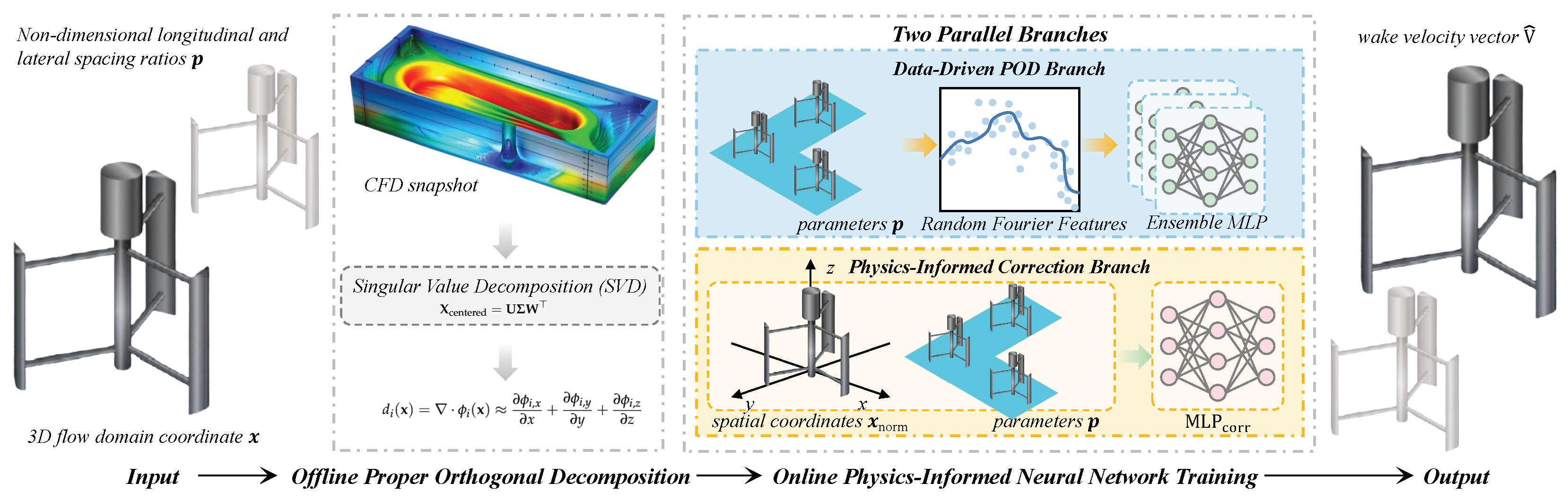
To address the trilemma of accuracy, efficiency, and physical consistency in twin-hydroturbine wake prediction, we propose a hybrid deep learning architecture termed POD-PINN. As illustrated in Figure 1, the framework decomposes the wake-field prediction task into two synergistic branches: (1) A Data-Driven POD Branch: Captures the global, low-rank structures of the wake field using Proper Orthogonal Decomposition (POD) and an ensemble neural network. This ensures high computational efficiency by reducing the output dimension from the regularized wake representation to a compact set of modal coefficients. (2) A Physics-Informed Correction Branch: A lightweight spatial neural network that learns local residual adjustments and uses a continuity-based regularization term to improve the physical plausibility of the predicted mean field.
The final predicted velocity field V ^ ( x , p ) is constructed as the superposition of the POD reconstruction and the PINN-based correction:
V ^ ( x , p ) = V ¯ ( x ) + i = 1 k α i ( p ) ϕ i ( x ) POD Branch + Δ V ( x , p ) PINN Correction ,
where x R 3 denotes the spatial coordinates of the regularized wake representation, p R 2 represents the twin-array layout parameters (longitudinal L x and lateral L y spacing), V ¯ is the mean flow field, ϕ i are the pre-computed POD modes, α i are the predicted coefficients, and  Δ V is a learnable correction field regularized by a continuity constraint.

4.2. Phase I: Offline Proper Orthogonal Decomposition

Before training the neural networks, we perform POD on the configuration-wise time-averaged CFD reference dataset { V ( n ) } n = 1 N to extract the dominant spatial features. This is an offline, one-time preprocessing step and follows the standard reduced-order modeling idea of representing the flow field in a low-rank modal basis [34]. The snapshot matrix X R 3 N g × N (where N g is the number of points in the regularized wake grid) is centered by subtracting the mean field V ¯ and decomposed via Singular Value Decomposition (SVD):
X centered = U Σ W .
The first k columns of U form the orthogonal basis modes Φ = [ ϕ 1 , , ϕ k ] , which capture the dominant variance of the configuration-wise wake dataset.
Crucially, to enhance computational efficiency during the subsequent online training, we pre-calculate the divergence of each mode · ϕ i using finite differences in this offline phase:
d i ( x ) = · ϕ i ( x ) ϕ i , x x + ϕ i , y y + ϕ i , z z .
These pre-computed divergence fields { d i } i = 1 k are stored as fixed buffers in the model. This allows the model to evaluate the physical consistency of the POD branch efficiently via simple matrix multiplication during training, avoiding the high cost of repeated automatic differentiation for the global modes.

4.3. Phase II: Online Physics-Informed Neural Network Training

In the second phase, we construct and train the hybrid neural network to map layout parameters to POD coefficients and spatial corrections. This phase integrates data-driven learning with physical constraints through an end-to-end optimization process.

4.3.1. Network Architecture

The architecture consists of two parallel components:
1.
Data-Driven POD Branch: To map the layout parameters p to the POD coefficients α R k , we employ an Ensemble Multi-Layer Perceptron (MLP) [36,37]. Input parameters are first projected into a high-dimensional space using Random Fourier Features (RFFs):
γ ( p ) = sin ( 2 π B p ) , cos ( 2 π B p ) ,
where B R f × 2 is a random matrix sampled from N ( 0 , σ 2 ) . The encoded features are fed into an ensemble of M independent MLPs, and the final prediction is the statistical mean:
α ( p ) = 1 M j = 1 M MLP j ( γ ( p ) ) .
2.
Physics-Informed Correction Branch: To rectify local continuity errors, a compact MLP predicts a point-wise velocity correction Δ V R 3 based on both spatial coordinates x norm and parameters p :
Δ V ( x , p ) = MLP corr [ γ space ( x norm ) ; γ param ( p ) ] .
Key design choices include Point-wise Mapping (enabling exact autograd gradients), Zero Initialization of the output layer (to stabilize training by starting with Δ V 0 ), and Fourier Embedding for spatial coordinates.

4.3.2. Physics-Informed Loss Function

The model is trained by minimizing a composite loss function L total that balances data fidelity, physical consistency, and regularization. Here, N batch denotes the batch size and N g denotes the number of points in the regularized wake grid:
L total = λ data L data + λ pod L div pod + λ pinn L div pinn + λ reg L reg .
1.
Data Loss ( L data )
The normalized Mean Squared Error (MSE) between the predicted total field V ^ and the CFD ground truth V true :
L data = V ^ V true 2 2 Var ( V true ) .
2.
POD Physical Loss ( L div pod )
Reduces continuity residuals on the POD component using the pre-computed mode divergences { d i } via efficient matrix operations:
L div pod = 1 N batch · N g b = 1 N batch n = 1 N g i = 1 k α i ( b ) d i ( x n ) 2 .
3.
PINN Physical Loss ( L div pinn )
This term is introduced to reduce continuity violations in the predicted field. We specifically regularize the correction field by penalizing · Δ V , computed online using PyTorch’s automatic differentiation:
L div pinn = 1 N batch · N g b = 1 N batch n = 1 N g Δ V x ( b ) x + Δ V y ( b ) y + Δ V z ( b ) z 2 .
The partial derivatives are calculated via the chain rule from normalized to physical space:
Δ V j x k = ( MLP corr ) j x k , norm · 1 L k ,
where L k is the physical domain length in direction k.
4.
Regularization Loss ( L reg )
An L 2 penalty on the magnitude of the correction field prevents the PINN branch from dominating the prediction:
L reg = 1 N batch · N g b = 1 N batch n = 1 N g Δ V ( b ) ( x n ) 2 2 .

4.4. Training and Inference Workflow

The complete two-phase procedure is summarized in Algorithm 1. During inference, the model requires only the layout parameters p as input. The spatial coordinates x are fixed internal buffers, allowing the model to generate the regularized wake field V ^ in milliseconds via a single forward pass, making it attractive for repeated fast evaluation.
Algorithm 1 Two-Phase Training Procedure for Physics-Informed POD-PINN
Require:
CFD Snapshots { V ( n ) , p ( n ) } , Hyperparameters λ
  1:
Phase I: Offline Preprocessing
  2:
Compute mean field V ¯ and center snapshots.
  3:
Perform SVD: X centered = U Σ W .
  4:
Extract top-k modes Φ and pre-compute divergences { d i } .
  5:
Register Φ , { d i } , V ¯ as fixed model buffers.
  6:
Phase II: Online Network Training
  7:
Initialize Ensemble MLP and Correction MLP (zero-init output).
  8:
for epoch = 1 to E do
  9:
      for batch { V true , p } in DataLoader do
10:
            Normalize parameters: p norm Norm ( p ) .
11:
            Predict coefficients: α Ensemble ( RFF ( p norm ) ) .
12:
            Reconstruct POD field: V pod V ¯ + Φ α .
13:
            Sample coordinates x pinn and set requires_grad=True.
14:
            Predict correction: Δ V Correction ( x pinn , p norm ) .
15:
            Compute L data using V ^ = V pod + Δ V .
16:
            Compute L div pod via matrix multiplication with { d i } .
17:
            Compute L div pinn via autograd.grad on Δ V .
18:
            Compute L reg on Δ V .
19:
             L total λ i L i .
20:
            Backpropagate and update network weights.
21:
      end for
22:
end for

5. Experiments

5.1. Dataset

This study focuses on the time-averaged wake flow field of a twin-hydroturbine array. The wake representation used in the surrogate is defined on a regularized grid of 10 × 60 × 5 points, corresponding to 10 downstream streamwise locations and a 60 × 5 lateral-vertical wake grid. The effective spatial spacing is Δ x = 1.0 m (streamwise), Δ y 0.181 m (lateral), and Δ z = 0.333 m (vertical). The inflow velocity is fixed at V = 1.5 m/s. The geometric configuration of the array is defined by two parameters: the streamwise spacing L 2 { 4 D , 5 D , 6 D } and the lateral offset L 3 { 0 , 0.5 D , 1.0 D , 1.5 D } . This creates a design space of 3 × 4 = 12 unique configurations. The raw CFD source for these configurations consists of transient exports from STAR-CCM+, which are post-processed into configuration-wise time-averaged three-component wake fields on the regularized grid. Due to the high computational cost of CFD, the dataset is small-scale, consisting of 12 configuration-wise mean fields. To address this data scarcity and leverage the physical symmetry of the problem, we apply a Z-flip data augmentation strategy. Given that the streamwise ( V i ) and lateral ( V j ) velocity components are even-symmetric, while the vertical component ( V k ) is odd-symmetric with respect to the Z = 0 plane, each original training sample generates a valid mirrored counterpart. This expands the effective training set from 11 to 22 samples in each Leave-One-Out (LOO) fold. The task is formulated as a strict extrapolation problem: predicting the regularized time-averaged wake field ( V i , V j , V k ) for an unseen configuration ( L 2 , L 3 ) , given the remaining 11 configurations.

5.2. Implementation Details

All models were implemented in PyTorch (2.10.0+cu128 with CUDA 12.8) and trained on a single NVIDIA A100 GPU. The proposed POD-PINN framework utilizes k = 15 POD modes, which capture 99.96% of the cumulative dataset variance. The architecture consists of two branches: (1) POD Branch: An Ensemble MLP with five members. Each member employs Random Fourier Features (RFFs) with n f r e q s = 16 and σ = 1.0 for parameter encoding, followed by hidden layers [ 128 , 128 ] with GELU activation and Dropout ( p = 0.1 ). Total parameters: 113 k. (2) PINN Correction Branch: A lightweight MLP taking concatenated spatial coordinates and parameters as input. It uses RFFs for both spatial ( n f r e q s = 8 , σ = 3.0 ) and parameter ( n f r e q s = 8 ) encoding, with hidden layers [ 64 , 64 ] . The output layer is initialized with zero bias and small weights ( N ( 0 , 10 3 ) ) to ensure Δ V 0 at initialization. Total parameters: 6.5 k. The total trainable parameter count of POD-PINN is 119,822, which is approximately 41 % of the FNO+FiLM baseline ( 292 k parameters).
The model was trained for 2000 epochs using the Adam optimizer with an initial learning rate of 3 × 10 3 . The composite loss function weights were set to λ data = 1.0 (normalized by field variance), λ pod = 10 3 , λ pinn = 10 2 , and λ reg = 10 4 . The divergence term for the PINN branch ( L div pinn ) was computed via exact automatic differentiation (‘torch.autograd.grad’) on the correction field Δ V .

5.3. Evaluation Metric

We adopt a Leave-One-Config-Out (LOO) cross-validation protocol. The 12 configurations are iteratively split such that 1 configuration serves as the test set while the remaining 11 (augmented to 22) form the training set. This process is repeated 12 times to ensure every configuration is evaluated.
The primary evaluation metric is the Relative L 2 Error for each velocity component c { i , j , k } :
Error r e l ( c ) = V ^ c V c CFD 2 V c CFD 2 × 100 % ,
where · 2 denotes the global L 2 norm over the regularized wake domain.
Note on Metric Interpretation: Due to the physical nature of the wake, the magnitude of the streamwise velocity ( V i 2 77.8 ) is significantly larger than the lateral ( V j 2 2.5 ) and vertical ( V k 2 1.5 ) components. Consequently, relative errors for V j and V k can appear numerically large even for small absolute deviations. Therefore, while we report relative errors for consistency with the literature, we emphasize the streamwise component ( V i ) as the critical indicator of wake prediction performance, as it directly correlates with power generation efficiency and structural loading. Absolute RMSE values (in m/s) are also provided to clarify the physical magnitude of errors.
In addition to data fidelity, we evaluate Physical Consistency by computing the volume-averaged divergence residual | · V ^ | Ω for each predicted field, quantifying the continuity consistency of the predicted wake field.

5.4. Results and Discussion

5.4.1. Quantitative Performance Comparison

Table 1 presents the Leave-One-Config-Out (LOO) cross-validation results for the streamwise velocity component ( V i ). We compare the proposed POD-PINN framework against two baselines: the POD-NN ablation model (which lacks the continuity-informed correction branch) and the FNO+FiLM deep learning benchmark. The evaluation covers 12 distinct twin-array configurations defined by the streamwise spacing L 2 { 4 D , 5 D , 6 D } and lateral offset L 3 { 0 , 0.5 D , 1.0 D , 1.5 D } . The results show that the proposed hybrid framework achieves the lowest mean prediction error, with a mean relative error of 11.3% ( σ = ± 3.7%). This improves upon the FNO+FiLM baseline (18.8% ± 6.3%) and also yields a lower mean error than the POD-NN baseline (12.0% ± 3.9%). The dimensionality reduction inherent in the POD-PINN approach helps stabilize prediction quality in this small-sample setting, yielding robust performance for unseen layout parameters.

5.4.2. Impact on Strong Wake Interference Cases

The most critical test for any wake surrogate model is its ability to handle strong hydrodynamic interactions, specifically in pure tandem arrangements ( L 3 = 0 ) where the downstream turbine operates directly within the wake core of the upstream unit. As shown in the top section of Table 1, these three cases exhibit the highest errors across all methods, confirming their status as the most challenging scenarios. In this regime, POD-PINN retains competitive performance while maintaining lower mean error over the full 12-fold evaluation. The continuity-informed correction branch helps reduce continuity violations in regions of strong velocity variation where pure data-driven models are more prone to physically inconsistent predictions.

5.4.3. Performance in Staggered Configurations

In staggered arrangements ( L 3 > 0 ), where lateral blockage effects and gap-flow acceleration dominate, POD-PINN also maintains competitive performance. The spatial correction branch provides local residual adjustments without compromising the global wake topology supplied by the POD basis, which contributes to stable predictions across the tested staggered configurations.

5.5. Ablation Study

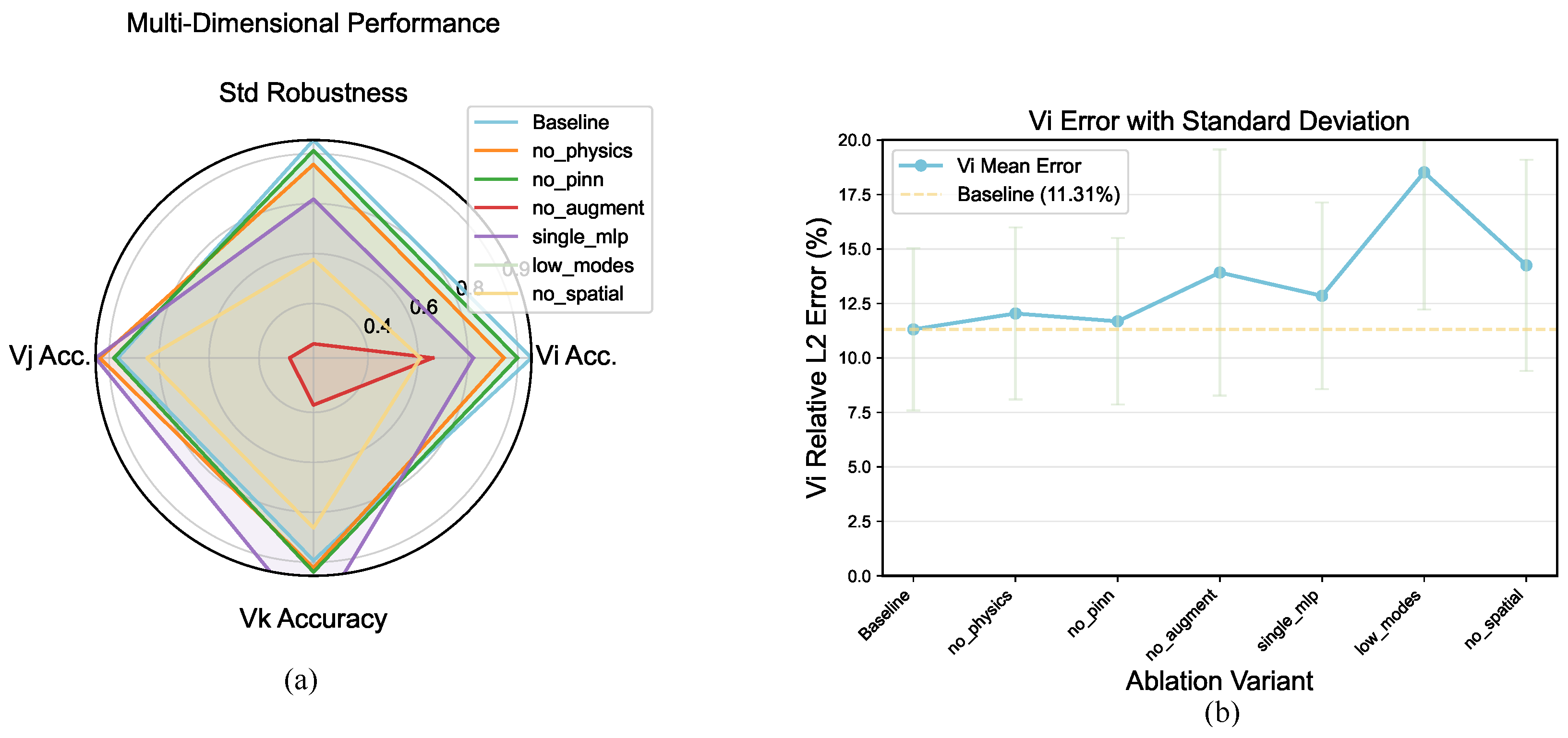
The ablation experiments systematically quantify the contribution of each core component in the POD-PINN framework to wake field prediction performance, with results visualized in Figure 2. The baseline model (with all components enabled) achieves the lowest mean V i relative error of 11.31% (±3.72% std), demonstrating the synergistic effect of the integrated framework. The most significant performance degradation is observed in the low_modes (k = 5) variant, where the mean V i error surges to 18.52% (a 63.7% increase) and the standard deviation reaches 6.30%, confirming that sufficient POD modes ( k = 15 in baseline) form the foundational low-rank representation of the flow field—insufficient principal components fail to capture dominant turbulent structures in the twin-hydroturbine wake, leading to the collapse of basic prediction capability.
Physics-informed constraints play a critical role in maintaining prediction accuracy and physical consistency: removing all physical constraints (no_physics) increases the mean V i error to 12.04%, while retaining only precomputed POD divergence constraints (no_pinn) results in a milder rise to 11.68%. This distinction highlights that the adaptive PINN correction branch provides stronger local continuity control compared to static global POD constraints, as it dynamically rectifies physical inconsistencies via automatic differentiation rather than relying on precomputed mode divergences. The no_spatial variant (removing Δ V correction branch) further validates the core role of the spatial correction branch, with mean V i error rising by 2.9% to 14.25%—a more pronounced degradation than removing physical constraints—indicating that nonlinear residual fitting from the correction branch is the primary source of model accuracy, while physical loss terms act as regularization to improve consistency.
Data augmentation and ensemble learning enhance the framework’s robustness and generalization on small datasets (12 configurations only). The no_augment variant not only increases mean V i error to 13.92% but also causes a 51.9% spike in standard deviation (from 3.72% to 5.65%), proving that Z-axis augmentation mitigates outlier predictions for extreme layout configurations rather than merely reducing mean error. Similarly, replacing the 5-ensemble MLP with a single network (single_mlp) elevates the mean V i error to 12.85%, verifying that ensemble learning effectively suppresses random errors from local optima in small-sample scenarios. Collectively, the ablation gradient reveals a non-uniform performance degradation pattern: POD mode number and spatial correction exert the most significant impact, followed by data augmentation, ensemble learning, and physical constraints—this hierarchical order provides clear guidance for future framework optimization, prioritizing the preservation of sufficient POD modes and the spatial correction branch to maintain core prediction capability.

5.6. Physical Consistency Analysis

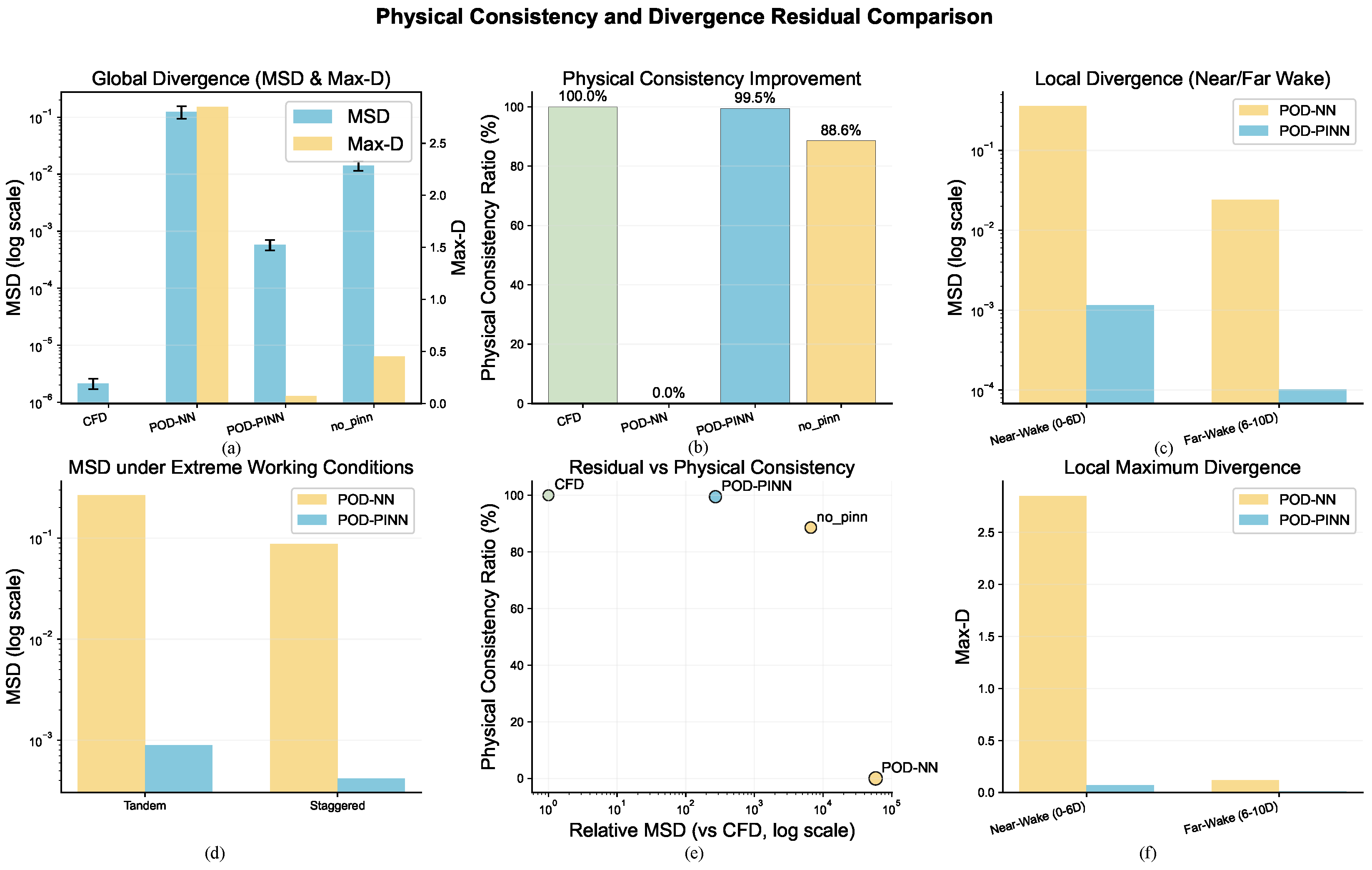
This section evaluates the physical consistency of the POD-PINN framework through divergence-residual analysis, with comparisons against the pure data-driven POD-NN model and partial-constraint variants (no_pinn), as visualized in Figure 3.
Global domain analysis (Figure 3a) reveals a strong disparity in divergence-residual control across models: the CFD reference exhibits very low divergence residuals, while the unconstrained POD-NN model shows much larger residuals. In contrast, the proposed POD-PINN model suppresses global MSD to 5.80 × 10 4 and Max-D to 0.07, reducing divergence residuals by 2–3 orders of magnitude compared to POD-NN; the physical consistency ratio (Figure 3b) further quantifies this improvement, with POD-PINN achieving over 99.5% consistency and the no_pinn variant (only precomputed POD continuity constraints) reaching 88.6%, indicating that the continuity-informed correction branch is more effective than static global divergence control alone.
Spatially localized evaluation (Figure 3c,f) highlights the targeted correction capability of the POD-PINN framework: in the near-wake core region (0–6D, high shear layer), POD-NN collapses with MSD = 3.58 × 10 1 and Max-D = 2.85, whereas POD-PINN reduces MSD to 1.15 × 10 3 (300× reduction) and maintains Max-D at 0.07. In the far-wake mixing region (6–10D, smooth flow), POD-NN’s MSD decreases to 2.41 × 10 2 (flow tends to linearity), and POD-PINN further suppresses it to 1.02 × 10 4 —the narrowed performance gap demonstrates that the Δ V correction branch prioritizes physically critical regions (strong nonlinear shear layers) rather than unnecessary over-correction in stable flow areas.
Robustness under extreme hydrodynamic interaction conditions (Figure 3d) further illustrates the value of the continuity-based constraints: for the tandem configuration ( L 2 = 4 D , L 3 = 0 ), where the downstream turbine is fully exposed to intense wake interaction, POD-NN’s MSD surges to 2.65 × 10 1 , while POD-PINN maintains MSD at 8.95 × 10 4 (296× reduction). For the staggered configuration ( L 2 = 5 D , L 3 = 1.0 D ) with gap-flow acceleration, POD-NN’s MSD = 8.75 × 10 2 , and POD-PINN achieves 4.20 × 10 4 , indicating that the L pinn term helps reduce local continuity residuals in these representative conditions.
The correlation between residual and physical consistency (Figure 3e) further supports the advantage of POD-PINN: the model is located at the bottom-left corner of the scatter plot (low relative MSD, high physical consistency), while POD-NN clusters at the top-right (high residual, zero consistency). This pattern indicates that the continuity-informed correction branch improves the physical plausibility of the predicted mean field rather than merely fitting scalar velocity values.

6. Conclusions

This study presented a Physics-Informed POD-PINN framework for twin vertical-axis hydroturbine wake prediction. By combining Proper Orthogonal Decomposition with a continuity-informed correction branch, the model improves upon purely data-driven surrogates while maintaining efficient inference. Validated via Leave-One-Config-Out cross-validation, POD-PINN achieved a mean relative error of 11.3%, outperforming FNO+FiLM (18.8%) and yielding a lower mean error than POD-NN (12.0%). The model also achieves millisecond-level inference speed with only 119k parameters, making it suitable for repeated fast wake-field evaluation. Future work will extend this approach to richer datasets and larger multi-row arrays.

Author Contributions

Conceptualization, A.S. and M.Y.; methodology, A.S., H.C. and M.Y.; formal analysis, H.C.; investigation, A.S.; writing—original draft, A.S. and H.C.; writing—review and editing, A.S., H.C. and M.Y.; visualization, A.S.; supervision, M.Y.; project administration, M.Y. All authors have read and agreed to the published version of the manuscript.

Funding

This work is supported by the National Natural Science Foundation of China (52471310; 52501369), the China Postdoctoral Science Foundation (2025M780276), the Guangdong Basic and Applied Basic Research Fund (2023B1515250010), and the Yangjiang Offshore Wind Power Laboratory Open Research Project (2025YOWPLORP-14).

Data Availability Statement

The data that support the findings of this study are available upon request from the corresponding author. Restrictions apply to the availability of these data due to ongoing research, as the dataset is currently being used for additional studies that have not yet been completed. The data will be available six months after the date of publication, subject to the permission of the corresponding author.

Conflicts of Interest

The authors declare no conflicts of interest.

References

  1. Khare, V.; Bhuiyan, M.A. Tidal energy-path towards sustainable energy: A technical review. Clean. Energy Syst. 2022, 3, 100041. [Google Scholar] [CrossRef]
  2. Widyawan, H.; Satrio, D.; Mukhtasor. Numerical investigation of vertical-axis hydrokinetic turbine on side-by-side configuration. In Proceedings of the Journal of Physics: Conference Series; IOP Publishing: Bristol, UK, 2024; Volume 2828, p. 012027. [Google Scholar]
  3. Ouro, P.; Dené, P.; Garcia-Novo, P.; Stallard, T.; Kyozuda, Y.; Stansby, P. Power density capacity of tidal stream turbine arrays with horizontal and vertical axis turbines. J. Ocean Eng. Mar. Energy 2023, 9, 203–218. [Google Scholar] [CrossRef]
  4. Lin, X.; Zhang, J.; Zheng, J.; Liu, S. Performance and wake interaction between two aligned vertical axis turbines. Ocean Eng. 2024, 292, 116478. [Google Scholar] [CrossRef]
  5. Wu, Y.; Guang, W.; Tao, R.; Liu, J.; Xiao, R. Dynamic mode structure analysis of the near-wake region of a Savonius-type hydrokinetic turbine. Ocean Eng. 2023, 282, 114965. [Google Scholar] [CrossRef]
  6. Liu, X.; Lu, J.; Ren, T.; Yu, F.; Cen, Y.; Li, C.; Yuan, S. Review of research on wake characteristics in horizontal-axis tidal turbines. Ocean Eng. 2024, 312, 119159. [Google Scholar] [CrossRef]
  7. Han, R.; Ma, Y.; Li, L. Array Arrangement on Vertical Axis Tidal Current Turbine Using Free Vortex Model. J. Coast. Res. 2020, 103, 361–365. [Google Scholar] [CrossRef]
  8. Ouro, P.; Nishino, T. Performance and wake characteristics of tidal turbines in an infinitely large array. J. Fluid Mech. 2021, 925, A30. [Google Scholar] [CrossRef]
  9. Zhang, Y.; Xu, J.; Liu, Z.; Fernandez-Rodriguez, E. Influence of the longitudinal spacing on a two-unit tandem tidal turbine arrangement in turbulent flow. Ocean Eng. 2025, 331, 121320. [Google Scholar] [CrossRef]
  10. Zhang, Y.; Shek, J.K.; Mueller, M.A. Controller design for a tidal turbine array, considering both power and loads aspects. Renew. Energy 2023, 216, 119063. [Google Scholar] [CrossRef]
  11. Grondeau, M.; Guillou, S.S. Predicting Interactions Between Full-Scale Counter-Rotating Vertical-Axis Tidal Turbines Using Actuator Lines. J. Mar. Sci. Eng. 2025, 13, 1382. [Google Scholar] [CrossRef]
  12. Attene, F.; Balduzzi, F.; Bianchini, A.; Campobasso, M.S. Using experimentally validated Navier-Stokes CFD to minimize tidal stream turbine power losses due to wake/turbine interactions. Sustainability 2020, 12, 8768. [Google Scholar] [CrossRef]
  13. Lombardi, N.; Ordonez-Sanchez, S.; Zanforlin, S.; Johnstone, C. A hybrid BEM-CFD virtual blade model to predict interactions between tidal stream turbines under wave conditions. J. Mar. Sci. Eng. 2020, 8, 969. [Google Scholar] [CrossRef]
  14. Hou, E.; Du, M.; Jiang, B.; Han, L.; Wu, G.; Wang, X. Study on characteristics of turbine wake and the effect of array arrangement. In Proceedings of the Institution of Civil Engineers-Maritime Engineering; Thomas Telford Ltd.: London, UK, 2021; Volume 174, pp. 112–123. [Google Scholar]
  15. Pucci, M.; Zanforlin, S.; Bellafiore, D.; Frangioni, A. A turbines-module adapted to the marine site for tidal farms layout optimization. In Proceedings of the European Wave and Tidal Energy Conference, Bilbao, Spain, 3–7 September 2023; Volume 15. [Google Scholar]
  16. Wu, Y.; Wu, H.; Kang, H.S.; Li, H. Layout optimization of a tidal current turbine array based on quantum discrete particle swarm algorithm. J. Mar. Sci. Eng. 2023, 11, 1994. [Google Scholar] [CrossRef]
  17. Wallwork, J.G.; Angeloudis, A.; Barral, N.; Mackie, L.; Kramer, S.C.; Piggott, M.D. Tidal turbine array modelling using goal-oriented mesh adaptation. J. Ocean Eng. Mar. Energy 2024, 10, 193–216. [Google Scholar] [CrossRef]
  18. Suhri, G.E.; Rahman, A.A.; Dass, L.; Rajendran, K.; Rahman, A.A. Interactions between tidal turbine wakes: Numerical study for shallow water application. J. Teknol. (Sci. Eng.) 2022, 84, 91–101. [Google Scholar] [CrossRef]
  19. Wang, Z.; Hou, E.; Wu, H. Semi-Empirical Model Based on the Influence of Turbulence Intensity on the Wake of Vertical Axis Turbines. Energies 2024, 17, 4535. [Google Scholar] [CrossRef]
  20. Zhang, Z.; Sotiropoulos, F.; Khosronejad, A. Predicting turbulent wake flow of marine hydrokinetic turbine arrays in large-scale waterways via physics-enhanced convolutional neural networks. Phys. Fluids 2024, 36, 045156. [Google Scholar] [CrossRef]
  21. Linant, R.; Saouli, Y.; Germain, G.; Maurice, G. Experimental study of the wave effects on a ducted twin vertical axis tidal turbine wake development. J. Mar. Sci. Eng. 2025, 13, 375. [Google Scholar] [CrossRef]
  22. Laín, S.; Viveros, M.; Benavides-Morán, A.; Ouro, P. Numerical Study of the Flow Around Twin Straight-Bladed Darrieus Hydrokinetic Turbines. J. Mar. Sci. Eng. 2025, 13, 1947. [Google Scholar] [CrossRef]
  23. Zhao, M.; Chen, Y.; Jiang, J. Hydrodynamics and wake flow analysis of a floating twin-rotor horizontal axis tidal current turbine in roll motion. J. Mar. Sci. Eng. 2023, 11, 1615. [Google Scholar] [CrossRef]
  24. Croonenbroeck, C.; Hennecke, D. Wind Farm Layout Optimization Subject to Cable Cost, Hub Height, and a Feasible 3D Gaussian Wake Model Implementation. J. Energy Power Technol. 2024, 6, 8. [Google Scholar] [CrossRef]
  25. Gao, X.; Li, Y.; Zhao, F.; Sun, H. Comparisons of the accuracy of different wake models in wind farm layout optimization. Energy Explor. Exploit. 2020, 38, 1725–1741. [Google Scholar] [CrossRef]
  26. Raissi, M.; Perdikaris, P.; Karniadakis, G.E. Physics-informed neural networks: A deep learning framework for solving forward and inverse problems involving nonlinear partial differential equations. J. Comput. Phys. 2019, 378, 686–707. [Google Scholar] [CrossRef]
  27. Huang, J.; Huang, J.; Zhang, M.; Wang, Q.; Pei, X.Q.; Hu, Y.; Chen, H.; Pang, Y. UltraMamba: Mamba-based Multimodal Ultrasound Image Adaptive Fusion for Breast Lesion Segmentation. IEEE Trans. Med. Imaging 2026. [Google Scholar] [CrossRef]
  28. Gafoor CTP, A.; Kumar Boya, S.; Jinka, R.; Gupta, A.; Tyagi, A.; Sarkar, S.; Subramani, D.N. A physics-informed neural network for turbulent wake simulations behind wind turbines. Phys. Fluids 2025, 37, 015110. [Google Scholar] [CrossRef]
  29. Huang, J.; Yan, J.; Wang, Q.; Meng, Q.; Li, J.; Pang, Y. OCTMamba: A Lightweight Ear Segmentation Framework for 3D Portable Endoscopic OCT Scanner. Expert Syst. Appl. 2026, 315, 131678. [Google Scholar] [CrossRef]
  30. Huang, J.; Huang, T.; Dong, C.; Duan, S.; Pang, Y. Hierarchical network with local-global awareness for ethereum account de-anonymization. IEEE Trans. Syst. Man Cybern. Syst. 2025, 55, 5839–5852. [Google Scholar] [CrossRef]
  31. Pang, Y.; Liang, J.; Huang, T.; Chen, H.; Li, Y.; Li, D.; Huang, L.; Wang, Q. Slim UNETR: Scale hybrid transformers to efficient 3D medical image segmentation under limited computational resources. IEEE Trans. Med. Imaging 2023, 43, 994–1005. [Google Scholar] [CrossRef] [PubMed]
  32. Pang, Y.; Liang, J.; Yan, J.; Hu, Y.; Chen, H.; Wang, Q. Slim unetrv2: 3d image segmentation for resource-limited medical portable devices. IEEE Trans. Med. Imaging 2025, 45, 542–553. [Google Scholar] [CrossRef]
  33. Chong, Y.; Hao, Y. A stage-adaptive resampling physics-informed neural network. Chin. J. Theor. Appl. Mech. 2025, 58, 195–207. [Google Scholar]
  34. Luo, Z.; Wang, L.; Xu, J.; Yuan, J.; Tan, A.C. Sparse wind turbine wake reconstruction using physics-informed proper orthogonal decomposition. Phys. Fluids 2025, 37, 105114. [Google Scholar] [CrossRef]
  35. Jin, Y.; Ye, S.; Cui, J. Sparse data wind field wake reconstruction based on parametric adaptive physics-informed neural networks. Phys. Fluids 2026, 38, 015110. [Google Scholar] [CrossRef]
  36. Huang, T.; Huang, J.; Dong, C.; Duan, S.; Pang, Y. Samamba: Structure-aware mamba for ethereum fraud detection. IEEE Trans. Inf. Forensics Secur. 2025, 20, 7410–7423. [Google Scholar] [CrossRef]
  37. Pang, Y.; Liu, X.; Huang, T.; Hong, Y.; Huang, J.; Duan, S.; Dong, C. Graph-based contract sensing framework for smart contract vulnerability detection. IEEE Trans. Big Data 2025, 11, 3356–3368. [Google Scholar] [CrossRef]
Figure 1. Architecture of the proposed POD-PINN hybrid framework for twin-hydroturbine wake prediction. The framework integrates an offline Proper Orthogonal Decomposition (POD) step for efficient low-rank wake-field reconstruction with an online, two-branch neural network: a data-driven POD branch maps layout parameters to modal coefficients, and a continuity-informed correction branch reduces residual continuity errors through a lightweight spatial adjustment.
Mathematics 14 01579 g001
Figure 2. Ablation study of the POD-PINN framework. (a) Radar plot of multi-dimensional performance. (b) Vi relative L2 error with standard deviation, showing the mean and variability of mainstream velocity prediction for each ablation configuration.
Mathematics 14 01579 g002
Figure 3. Physical consistency and divergence residual evaluation between POD-PINN and baseline models. (a) Global mean squared divergence (MSD, log scale) and maximum divergence (Max-D) comparison; (b) physical consistency ratio of different models; (c) local MSD in near-wake and far-wake regions; (d) MSD under tandem and staggered working conditions; (e) correlation between relative MSD and physical consistency; (f) local maximum divergence in different flow regions.
Mathematics 14 01579 g003
Table 1. Leave-One-Config-Out (LOO) cross-validation results: Relative L 2 error of the streamwise velocity ( V i ) for three methods across 12 twin-array configurations. The lowest error for each configuration is highlighted in bold. The three configurations with L 3 = 0 represent pure tandem arrangements with strong wake interference.
ConfigurationFNO + FiLMPOD-NNPOD-PINN (Ours)
(%)(%)(%)
Tandem Arrangements ( L 3 = 0 , Strong Interference)
L 2 = 4 D ,   L 3 = 0 28.917.514.3
L 2 = 5 D ,   L 3 = 0 18.919.817.5
L 2 = 6 D ,   L 3 = 0 30.317.818.4
Staggered Arrangements ( L 3 > 0 )
L 2 = 4 D ,   L 3 = 0.5 D 21.310.611.4
L 2 = 4 D ,   L 3 = 1.0 D 16.59.611.4
L 2 = 4 D ,   L 3 = 1.5 D 19.68.48.9
L 2 = 5 D ,   L 3 = 0.5 D 12.09.310.9
L 2 = 5 D ,   L 3 = 1.0 D 9.48.16.0
L 2 = 5 D ,   L 3 = 1.5 D 11.27.96.3
L 2 = 6 D ,   L 3 = 0.5 D 22.510.411.5
L 2 = 6 D ,   L 3 = 1.0 D 14.411.99.1
L 2 = 6 D ,   L 3 = 1.5 D 20.512.59.3
Mean Error18.812.011.3
Std. Dev.±6.3±3.9±3.7
Best Performance Count0/122/1210/12
Disclaimer/Publisher’s Note: The statements, opinions and data contained in all publications are solely those of the individual author(s) and contributor(s) and not of MDPI and/or the editor(s). MDPI and/or the editor(s) disclaim responsibility for any injury to people or property resulting from any ideas, methods, instructions or products referred to in the content.