A Biomechanics-Guided and Time–Frequency Collaborative Deep Learning Framework for Parkinsonian Gait Severity Assessment


Abstract
1. Introduction
2. Related Work
2.1. Gait Analysis Based on Wearable Sensors
2.2. GNNs for Spatial Gait Modeling
2.3. Multi-Scale and Frequency-Domain Analysis of Temporal Signals
3. Multi-Sensor Gait Network with Biomechanical Priors and Time–Frequency Collaboration
3.1. Model Input
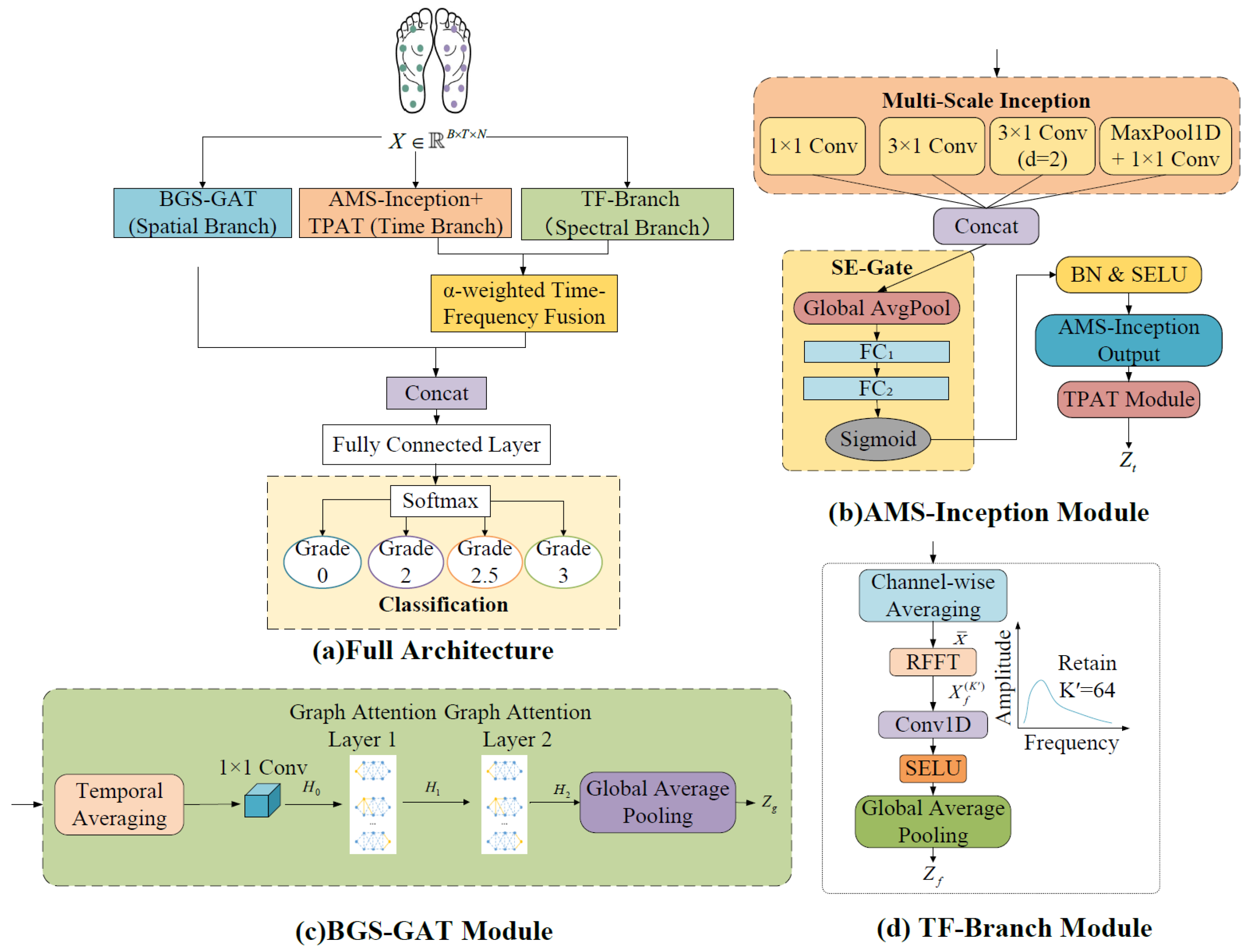
3.2. BGS-GAT
3.2.1. Design Motivation of the BGS-GAT Module
3.2.2. Adjacency Matrix Construction
3.2.3. Graph Attention Mechanism
3.2.4. Network Architecture and Implementation
3.3. AMS-Inception1D
3.3.1. Design Motivation of the AMS-Inception1D Module
3.3.2. Multi-Scale Feature Extraction
3.3.3. Adaptive Channel Weighting Mechanism (SE-Gate)
3.3.4. Module Output and Feature Normalization
3.3.5. TPAT
3.4. TF-Branch
3.4.1. Design Motivation of the TF-Branch Module
3.4.2. Frequency-Domain Transformation and Representation
3.4.3. Frequency-Domain Feature Modeling
3.4.4. Time–Frequency Collaborative Fusion Mechanism
3.5. Feature Fusion and Classification Output
4. Experiments and Results
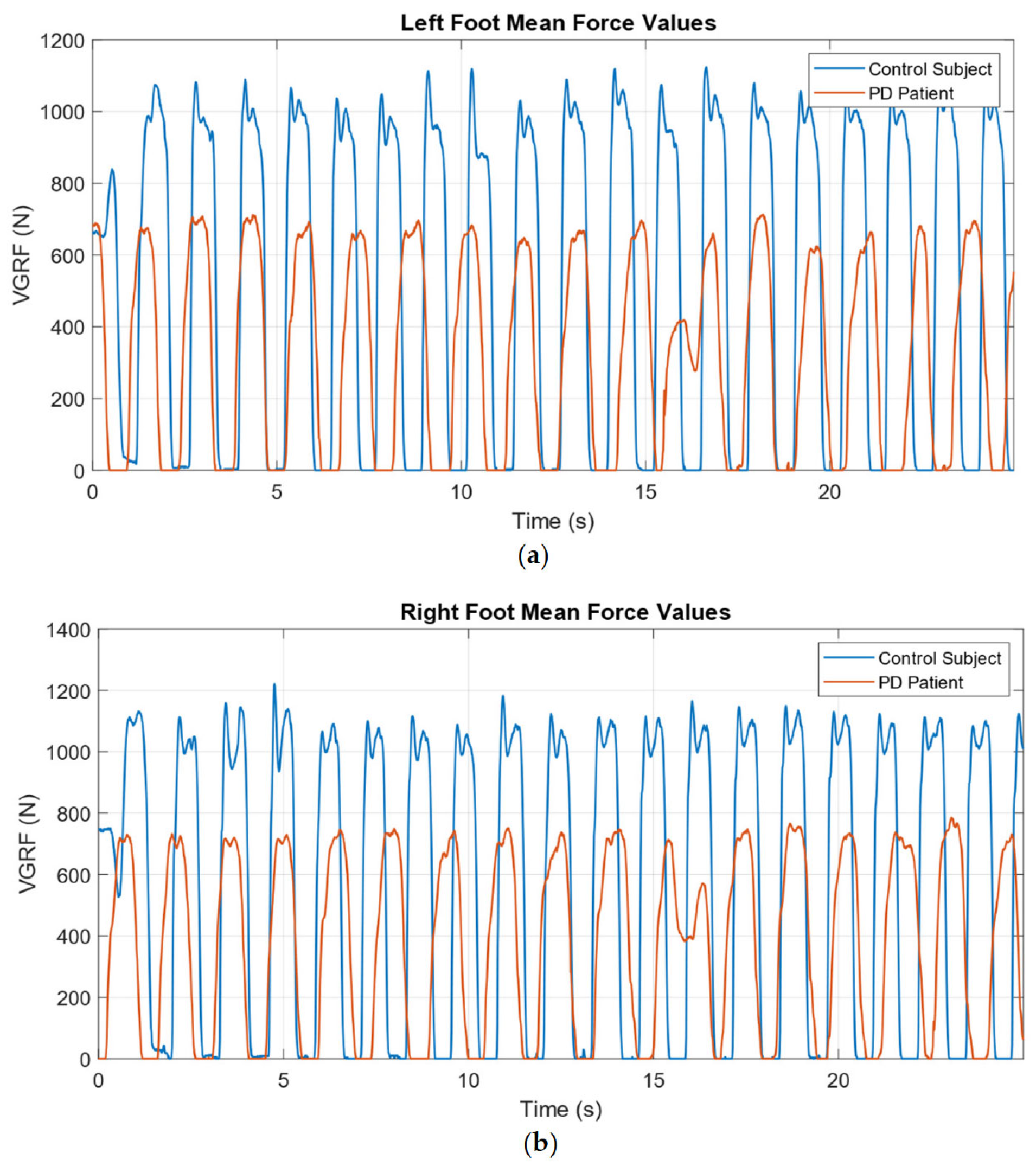
4.1. Dataset and Evaluation Metrics
4.2. Experimental Environment and Implementation Framework
4.3. Results and Analysis
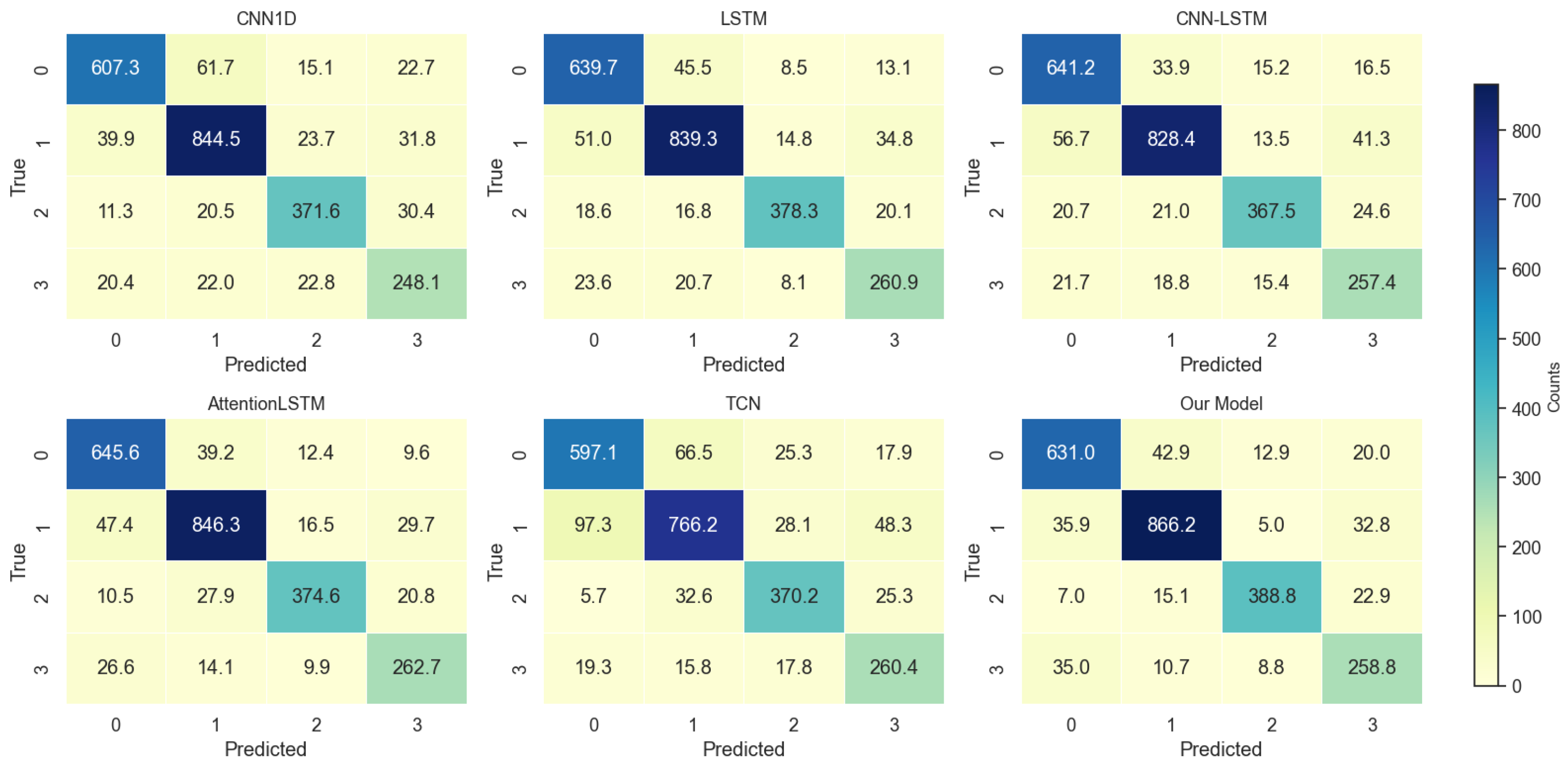
4.3.1. Comparison with Baseline Methods
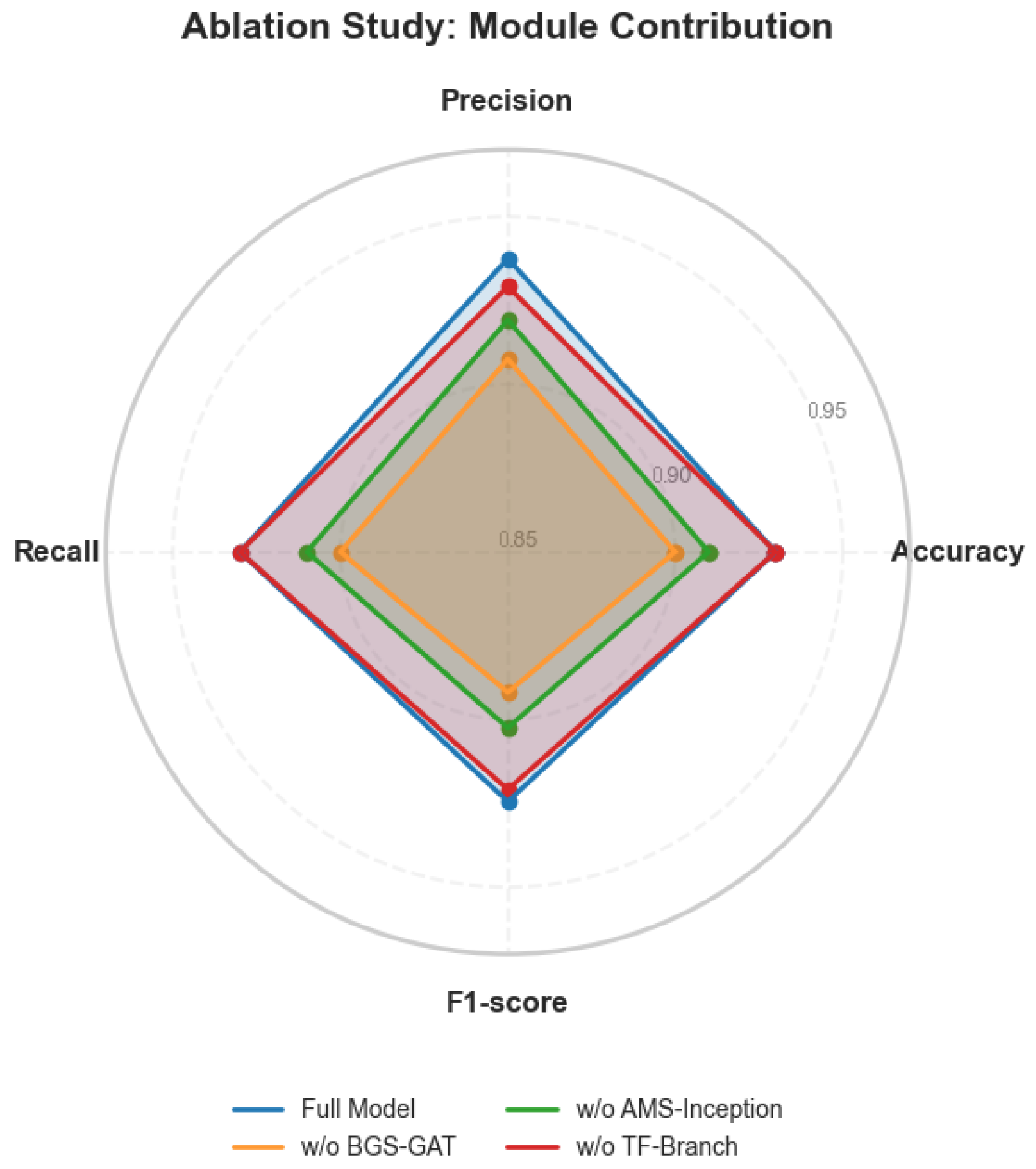
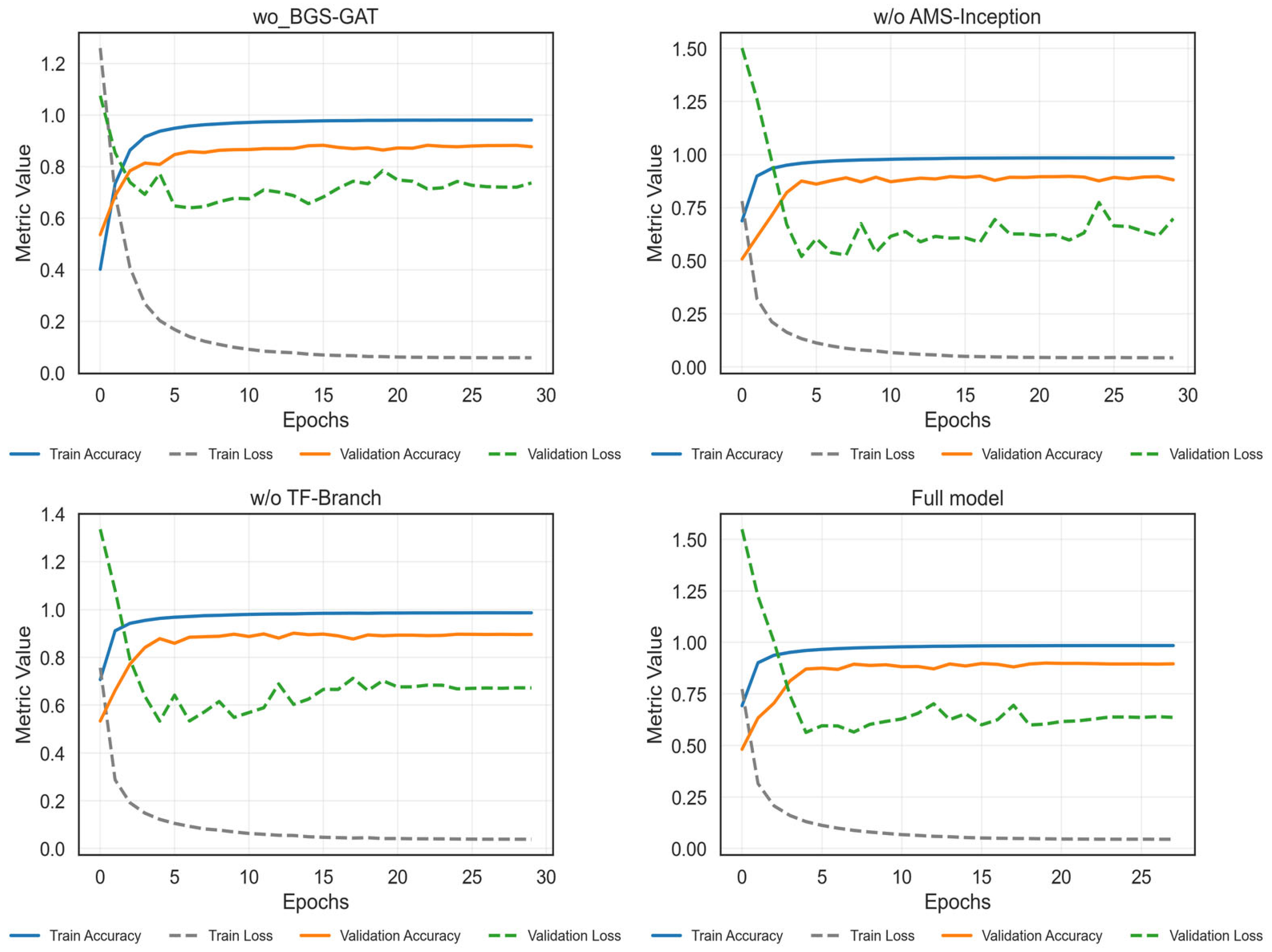
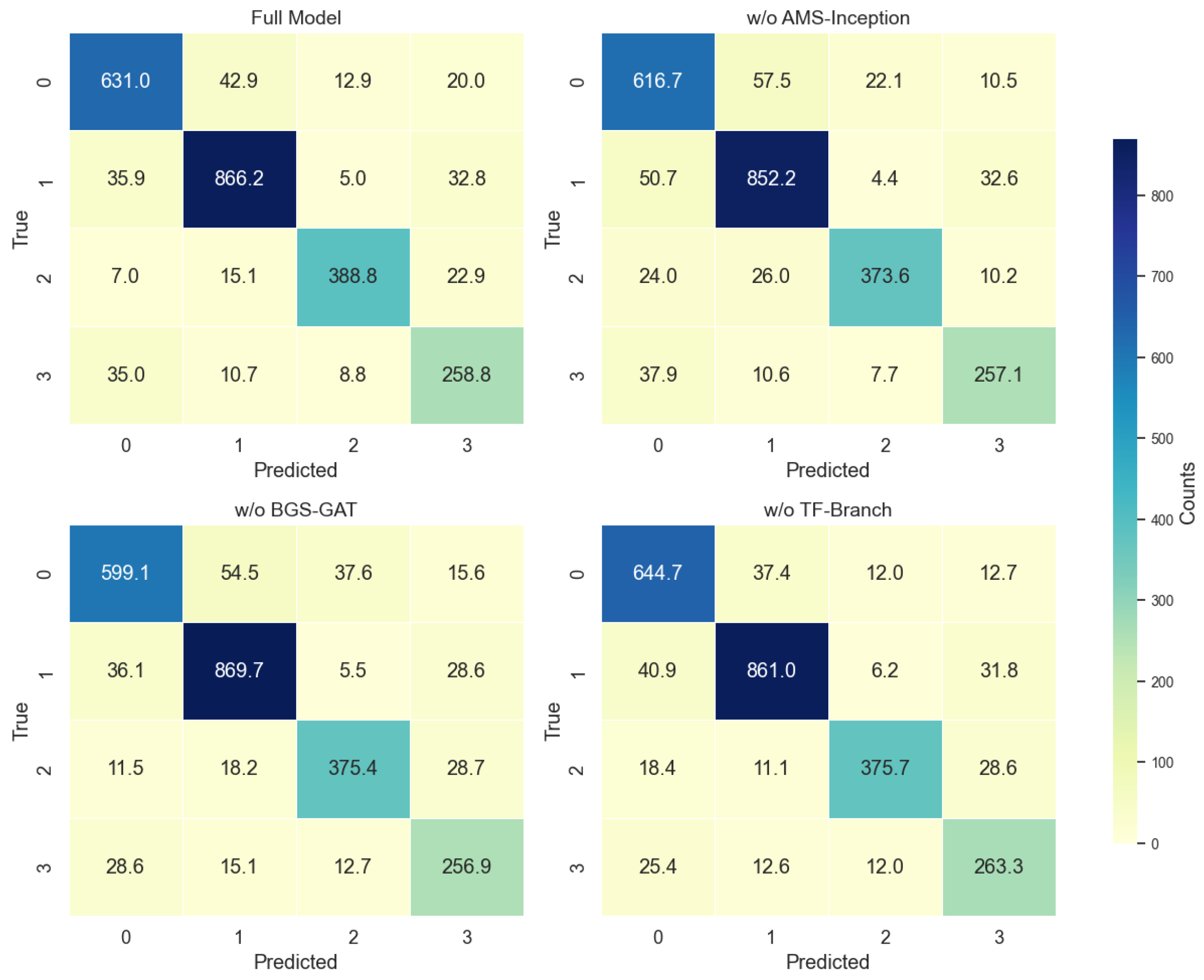
4.3.2. Ablation Study
5. Conclusions
Author Contributions
Funding
Data Availability Statement
Conflicts of Interest
References
- Yang, Y.; Yuan, Y.; Zhang, G.; Wang, H.; Chen, Y.-C.; Liu, Y.; Tarolli, C.G.; Crepeau, D.; Bukartyk, J.; Junna, M.R.; et al. Artificial intelligence-enabled detection and assessment of Parkinson’s disease using nocturnal breathing signals. Nat. Med. 2022, 28, 2207–2215. [Google Scholar] [CrossRef] [PubMed]
- Chen, J.; Guan, A.; Du, J.; Ayush, A. Multivariate time series prediction with multi-feature analysis. Expert Syst. Appl. 2025, 268, 126302. [Google Scholar] [CrossRef]
- Chen, J.; Guan, A.; Cheng, S. Double decomposition and fuzzy cognitive graph-based prediction of non-stationary time series. Sensors 2024, 24, 7272. [Google Scholar] [CrossRef] [PubMed]
- Bowman, T.; Pergolini, A.; Carrozza, M.C.; Lencioni, T.; Marzegan, A.; Meloni, M.; Vitiello, N.; Crea, S.; Cattaneo, D. Wearable biofeedback device to assess gait features and improve gait pattern in people with Parkinson’s disease: A case series. J. Neuroeng. Rehabil. 2024, 21, 110. [Google Scholar] [CrossRef]
- Zhu, S.; Wu, Z.; Wang, Y.; Jiang, Y.; Gu, R.; Zhong, M.; Jiang, X.; Shen, B.; Zhu, J.; Yan, J.; et al. Gait analysis with wearables is a potential progression marker in Parkinson’s disease. Brain Sci. 2022, 12, 1213. [Google Scholar] [CrossRef]
- Moreau, C.; Rouaud, T.; Grabli, D.; Benatru, I.; Remy, P.; Marques, A.-R.; Drapier, S.; Mariani, L.-L.; Roze, E.; Devos, D.; et al. Overview on wearable sensors for the management of Parkinson’s disease. npj Park. Dis. 2023, 9, 153. [Google Scholar] [CrossRef]
- Abujrida, H.; Agu, E.; Pahlavan, K. Machine learning-based motor assessment of Parkinson’s disease using postural sway, gait and lifestyle features on crowdsourced smartphone data. Biomed. Phys. Eng. Express 2020, 6, 035005. [Google Scholar] [CrossRef]
- Safarpour, D.; Dale, M.L.; Shah, V.V.; Talman, L.; Carlson-Kuhta, P.; Horak, F.B.; Mancini, M. Surrogates for rigidity and PIGD MDS-UPDRS subscores using wearable sensors. Gait Posture 2022, 91, 186–191. [Google Scholar] [CrossRef]
- Li, H.; Zecca, M.; Huang, J. Evaluating the utility of wearable sensors for the early diagnosis of Parkinson disease: Systematic review. J. Med. Internet Res. 2025, 27, e69422. [Google Scholar] [CrossRef]
- Tsakanikas, V.; Ntanis, A.; Rigas, G.; Androutsos, C.; Boucharas, D.; Tachos, N.; Skaramagkas, V.; Chatzaki, C.; Kefalopoulou, Z.; Tsiknakis, M.; et al. Evaluating gait impairment in Parkinson’s disease from instrumented insole and IMU sensor data. Sensors 2023, 23, 3902. [Google Scholar] [CrossRef]
- Zhong, C.; Ng, W.W.Y. A robust frequency-domain-based graph adaptive network for Parkinson’s disease detection from gait data. IEEE Trans. Multimed. 2022, 25, 7076–7088. [Google Scholar] [CrossRef]
- Zhang, J.; Lim, J.; Kim, M.-H.; Hur, S.; Chung, T.-M. WM–STGCN: A novel spatiotemporal modeling method for Parkinsonian gait recognition. Sensors 2023, 23, 4980. [Google Scholar] [CrossRef] [PubMed]
- Nerrise, F.; Zhao, Q.; Poston, K.L.; Pohl, K.M.; Adeli, E. An explainable geometric-weighted graph attention network for identifying functional networks associated with gait impairment. In Proceedings of the International Conference on Medical Image Computing and Computer-Assisted Intervention, Vancouver, BC, Canada, 8–12 October 2023; Springer Nature: Cham, Switzerland, 2023; pp. 723–733. [Google Scholar]
- Wang, X.; Zhou, G.; Zhao, Z.; Zhang, X.; Li, F.; Qi, F. A global-local dynamic directed graph neural network for Parkinson’s disease detection. IEEE Trans. Neural Syst. Rehabil. Eng. 2025, 33, 3947–3957. [Google Scholar] [CrossRef] [PubMed]
- Tian, H.; Li, H.; Jiang, W.; Ma, X.; Li, X.; Wu, H.; Li, Y. Cross-spatiotemporal graph convolution networks for skeleton-based Parkinsonian gait MDS-UPDRS score estimation. IEEE Trans. Neural Syst. Rehabil. Eng. 2024, 32, 412–421. [Google Scholar] [CrossRef]
- Naimi, S.; Said, A.; Bouachir, W.; Bilodeau, G.A. InceptoFormer: A multi-signal neural framework for Parkinson’s disease severity evaluation from gait. arXiv 2025, arXiv:2508.04540. [Google Scholar]
- Wang, W.; Lin, J.; Le, X.; Li, Y.; Liu, T.; Pan, L.; Li, M.; Yao, D.; Ren, P. Addressing multiple challenges in early gait freezing prediction for Parkinson’s disease: A practical deep learning approach. IEEE J. Biomed. Health Inform. 2025, 29, 6251–6262. [Google Scholar] [CrossRef]
- Zhao, H.; Xie, J.; Lei, Y.; Cao, H.; Cao, J.; Liao, W.-H. Federated transferring multi-channel CNN for diagnosis of Parkinson’s disease under unseen and small data. IEEE J. Biomed. Health Inform. 2025. online ahead of print. [Google Scholar] [CrossRef]
- Zampogna, A.; Suppa, A.; Patera, M.; Cavallieri, F.; Bove, F.; Fraix, V.; Castrioto, A.; Schmitt, E.; Pelissier, P.; Chabardes, S.; et al. Resting and action tremor in Parkinson’s disease: Pathophysiological insights from long-term STN-DBS. npj Park. Dis. 2025, 11, 284. [Google Scholar] [CrossRef]
- Siuly, S.; Khare, S.K.; Kabir, E.; Sadiq, M.T.; Wang, H. An efficient Parkinson’s disease detection framework: Leveraging time-frequency representation and AlexNet convolutional neural network. Comput. Biol. Med. 2024, 174, 108462. [Google Scholar] [CrossRef]
- Zhang, R.; Jia, J.; Zhang, R. EEG analysis of Parkinson’s disease using time–frequency analysis and deep learning. Biomed. Signal Process. Control 2022, 78, 103883. [Google Scholar] [CrossRef]
- Park, M.; Kim, S.-W.; Hong, J.Y.; Cho, S.P.; Park, J.; Urtnasan, E.; Baek, M.S. Implications of heart rate variability measured using wearable electrocardiogram devices in diagnosing Parkinson’s disease and its association with neuroimaging biomarkers: A case-control study. Front. Aging Neurosci. 2025, 17, 1530240. [Google Scholar] [CrossRef]
- Wang, X.; Xu, X.; Zhao, Z.; Li, F.; Qi, F.; Liang, S. VGRF signal-based gait analysis for Parkinson’s disease detection: A multi-scale directed graph neural network approach. IEEE J. Biomed. Health Inform. 2025. online ahead of print. [Google Scholar] [CrossRef]



| Groups | Subjects | Male | Female | Healthy | Mild Severity 2 | Moderate Severity 2.5 | Moderate Severity 3 |
|---|---|---|---|---|---|---|---|
| PD | 93 | 58 | 35 | - | 56 | 27 | 10 |
| Control | 73 | 40 | 33 | 73 | - | - | - |
| Module | Key Configuration |
|---|---|
| AMS-Inception1D | Four convolutional branches (kernel = 1, 3, 3 [dilation = 2], MaxPool + 1 × 1); filters = 32; SE-Gate fusion |
| BGS-GAT | Two-layer GAT; output dim = 64; adjacency matrix based on 18 sensor topology |
| TF-Branch | RFFT (64 frequency bins); Conv1D (32, 64) + BatchNorm + MaxPooling |
| Classifier | Dense (100 → 20 → 4); activation = SELU; output = Softmax |
| Optimizer | Nadam (learning rate = 1 × 10⁻⁴) |
| Loss function | Categorical cross-entropy |
| Batch size/Epochs | 64/30 |
| Regularization | Dropout (0.1–0.2) + BN |
| Model saving | EarlyStopping (patience = 10) + ModelCheckpoint |
| Data balancing | SMOTE oversampling + class weight adjustment |
| Model | Accuracy | Precision | Recall | F1-Score | Parameter Scale |
|---|---|---|---|---|---|
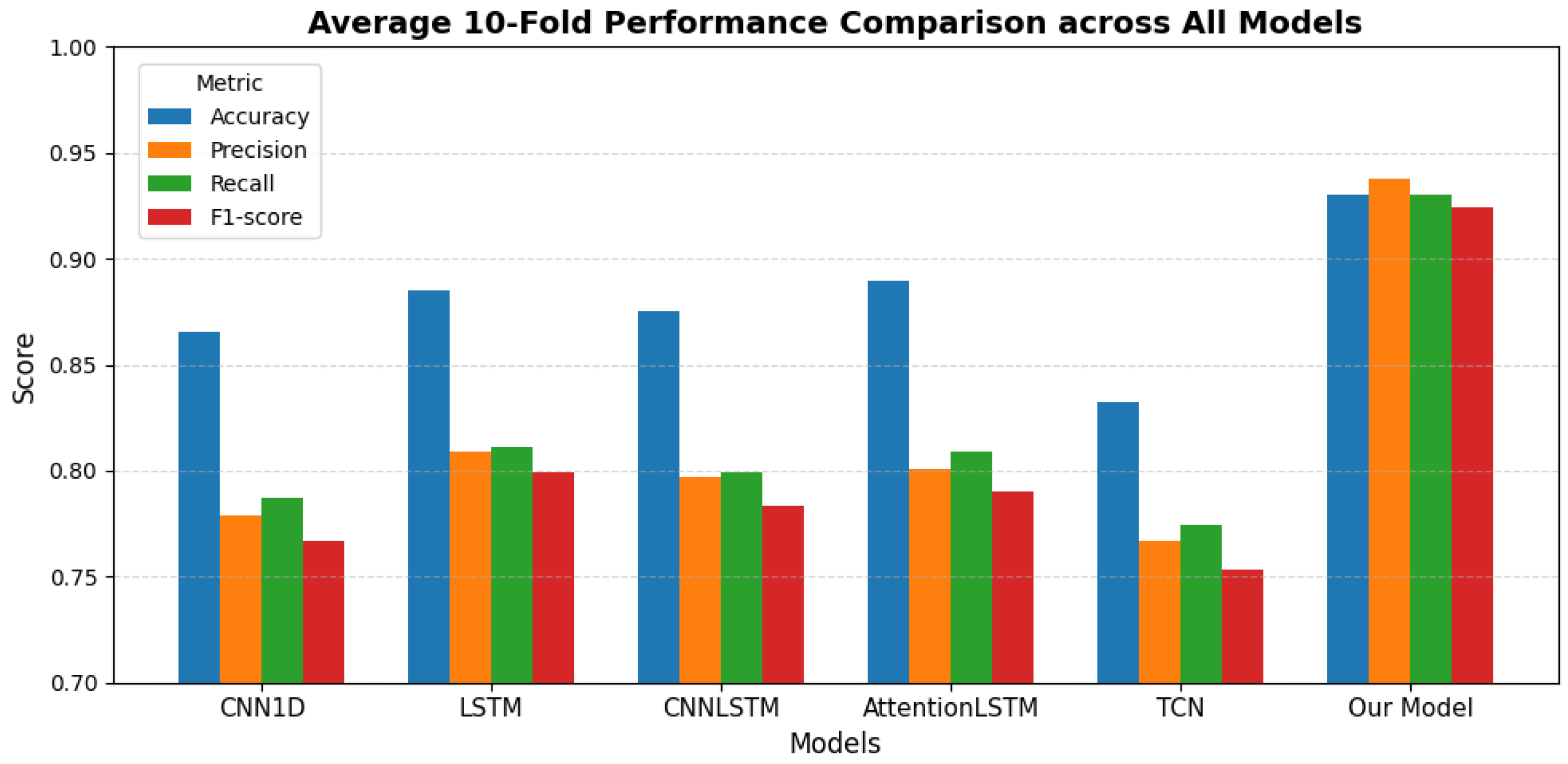
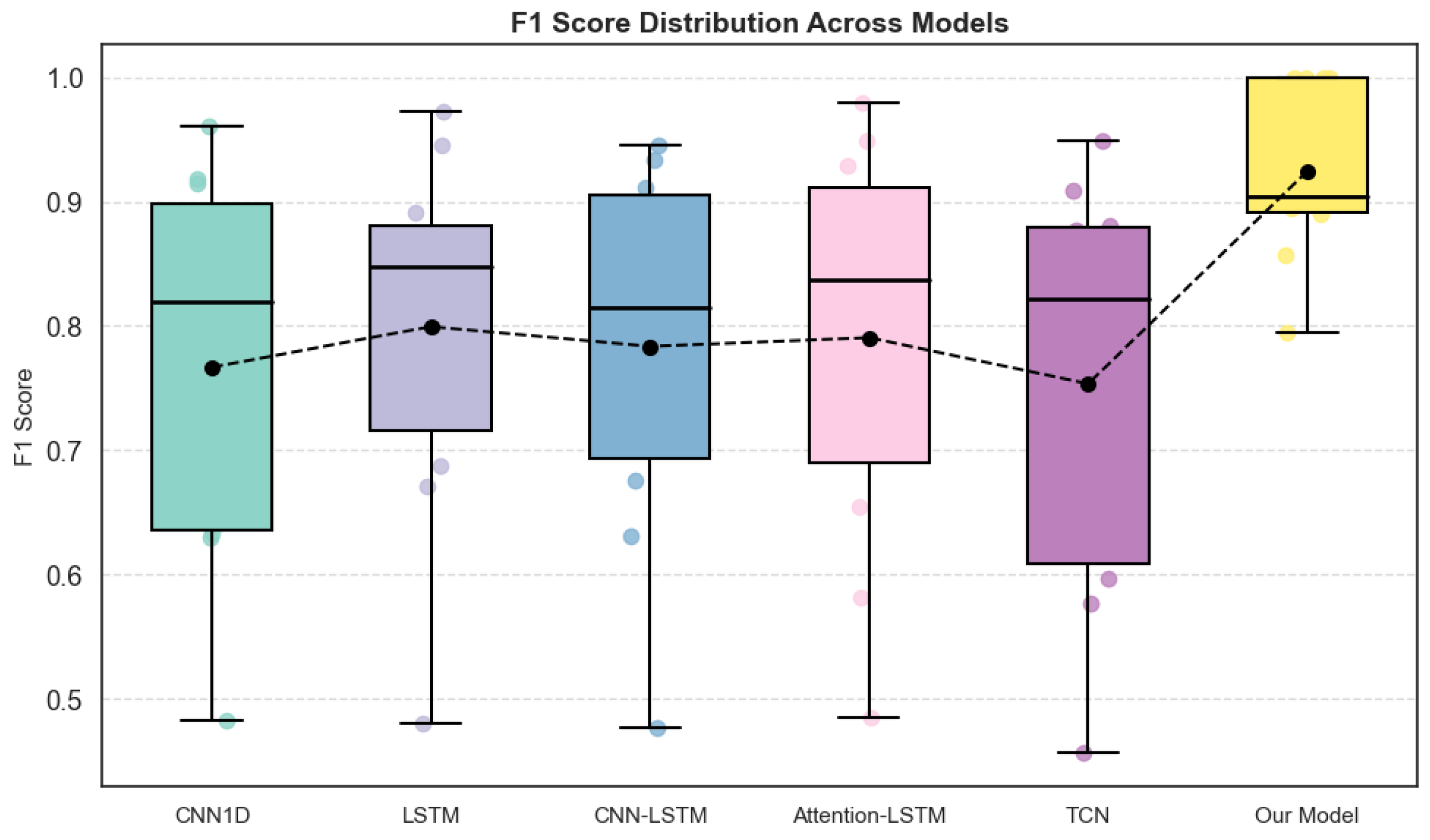
| CNN1D | 0.865 ± 0.087 | 0.779 ± 0.150 | 0.787 ± 0.155 | 0.767 ± 0.159 | |
| LSTM | 0.885 ± 0.053 | 0.809 ± 0.142 | 0.811 ± 0.141 | 0.799 ± 0.146 | |
| CNN-LSTM | 0.875 ± 0.071 | 0.797 ± 0.157 | 0.799 ± 0.151 | 0.783 ± 0.153 | |
| Attention-LSTM | 0.889 ± 0.064 | 0.801 ± 0.160 | 0.809 ± 0.147 | 0.791 ± 0.154 | |
| TCN | 0.832 ± 0.087 | 0.767 ± 0.144 | 0.775 ± 0.152 | 0.754 ± 0.159 | |
| Our model | 0.930 ± 0.067 | 0.938 ± 0.069 | 0.930 ± 0.067 | 0.925 ± 0.072 |
| Model | Accuracy | Precision | Recall | F1-Score | Parameter Scale |
|---|---|---|---|---|---|
| w/o BGS-GAT | 0.900 ± 0.110 | 0.908 ± 0.115 | 0.900 ± 0.110 | 0.892 ± 0.122 | |
| w/o AMS-Inception | 0.910 ± 0.074 | 0.919 ± 0.076 | 0.910 ± 0.0744 | 0.903 ± 0.081 | |
| w/o TF-Branch | 0.930 ± 0.068 | 0.929 ± 0.081 | 0.930 ± 0.068 | 0.921 ± 0.085 | |
| Full model | 0.930 ± 0.067 | 0.938 ± 0.069 | 0.930 ± 0.067 | 0.925 ± 0.072 |
Disclaimer/Publisher’s Note: The statements, opinions and data contained in all publications are solely those of the individual author(s) and contributor(s) and not of MDPI and/or the editor(s). MDPI and/or the editor(s) disclaim responsibility for any injury to people or property resulting from any ideas, methods, instructions or products referred to in the content. |
© 2025 by the authors. Licensee MDPI, Basel, Switzerland. This article is an open access article distributed under the terms and conditions of the Creative Commons Attribution (CC BY) license.
Share and Cite
Lin, W.; Zhou, T.; Yang, Q. A Biomechanics-Guided and Time–Frequency Collaborative Deep Learning Framework for Parkinsonian Gait Severity Assessment. Mathematics 2026, 14, 89. https://doi.org/10.3390/math14010089
Lin W, Zhou T, Yang Q. A Biomechanics-Guided and Time–Frequency Collaborative Deep Learning Framework for Parkinsonian Gait Severity Assessment. Mathematics. 2026; 14(1):89. https://doi.org/10.3390/math14010089
Chicago/Turabian StyleLin, Wei, Tianqi Zhou, and Qiwen Yang. 2026. "A Biomechanics-Guided and Time–Frequency Collaborative Deep Learning Framework for Parkinsonian Gait Severity Assessment" Mathematics 14, no. 1: 89. https://doi.org/10.3390/math14010089
APA StyleLin, W., Zhou, T., & Yang, Q. (2026). A Biomechanics-Guided and Time–Frequency Collaborative Deep Learning Framework for Parkinsonian Gait Severity Assessment. Mathematics, 14(1), 89. https://doi.org/10.3390/math14010089