Research on Longitudinal Dynamics of 20,000-Ton Heavy Haul Trains Considering Braking Characteristics

Abstract
1. Introduction
2. Air Braking System Model
2.1. Model Establishment
2.2. Model Validation
3. Longitudinal Dynamic Model
3.1. Model Establishment
3.2. Model Validation
4. Research on Longitudinal Dynamics of 20,000-Ton Heavy-Haul Trains Considering Braking Characteristics 20,000
4.1. Longitudinal Dynamic Performance Under Different Pressure Reduction Amounts
4.2. Longitudinal Dynamic Performance of Controllable End-of-Train Device Under Different Braking Time Delays
4.3. Tail Car Air Charging Device
5. Conclusions
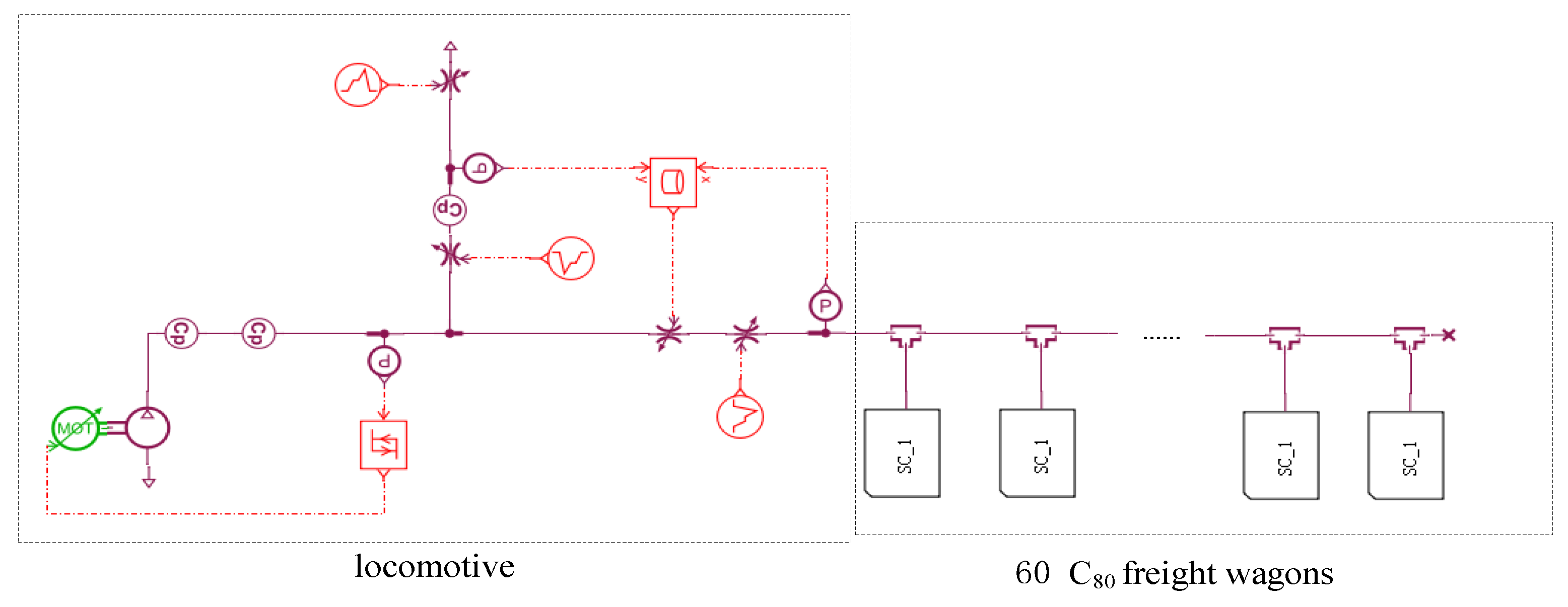
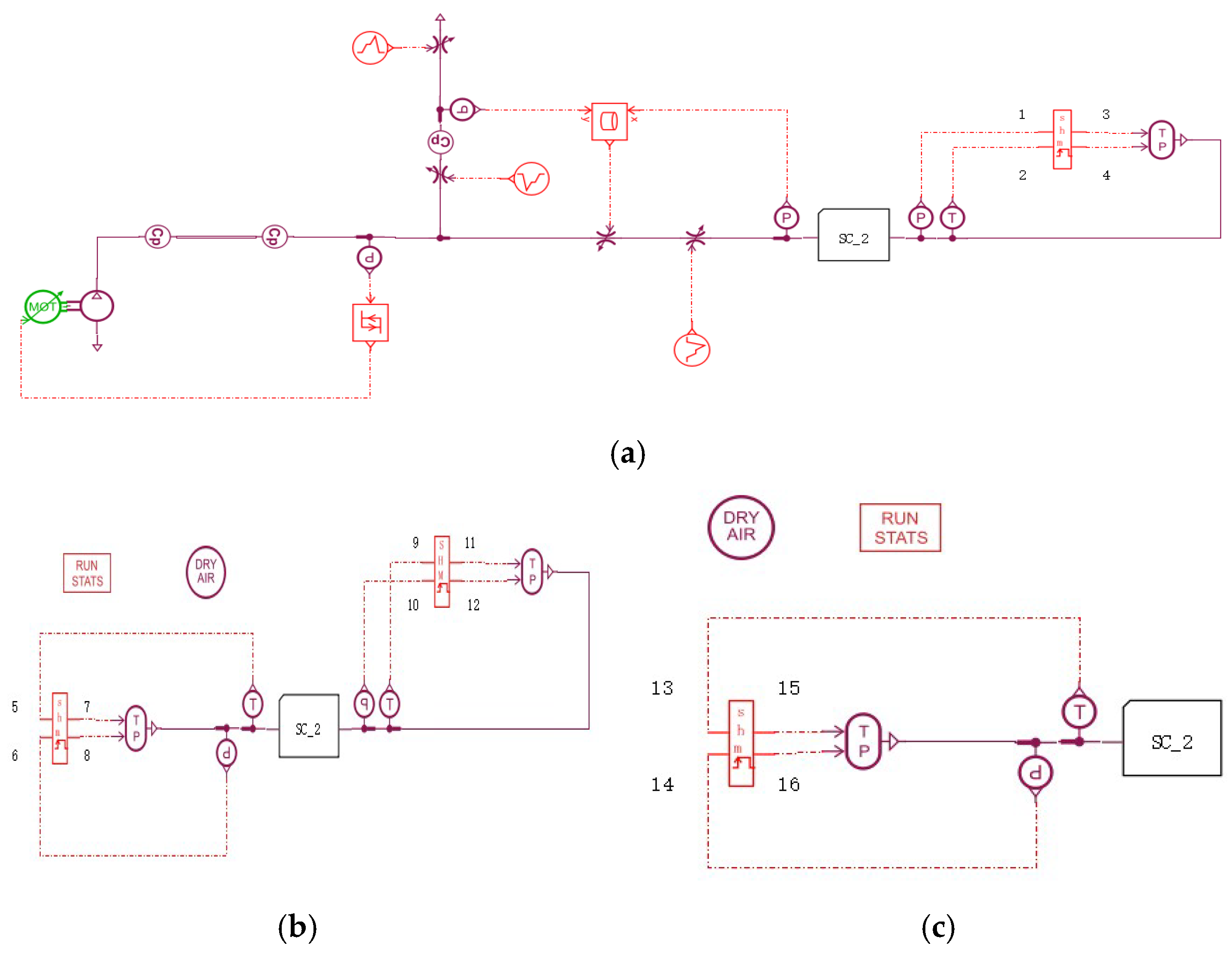
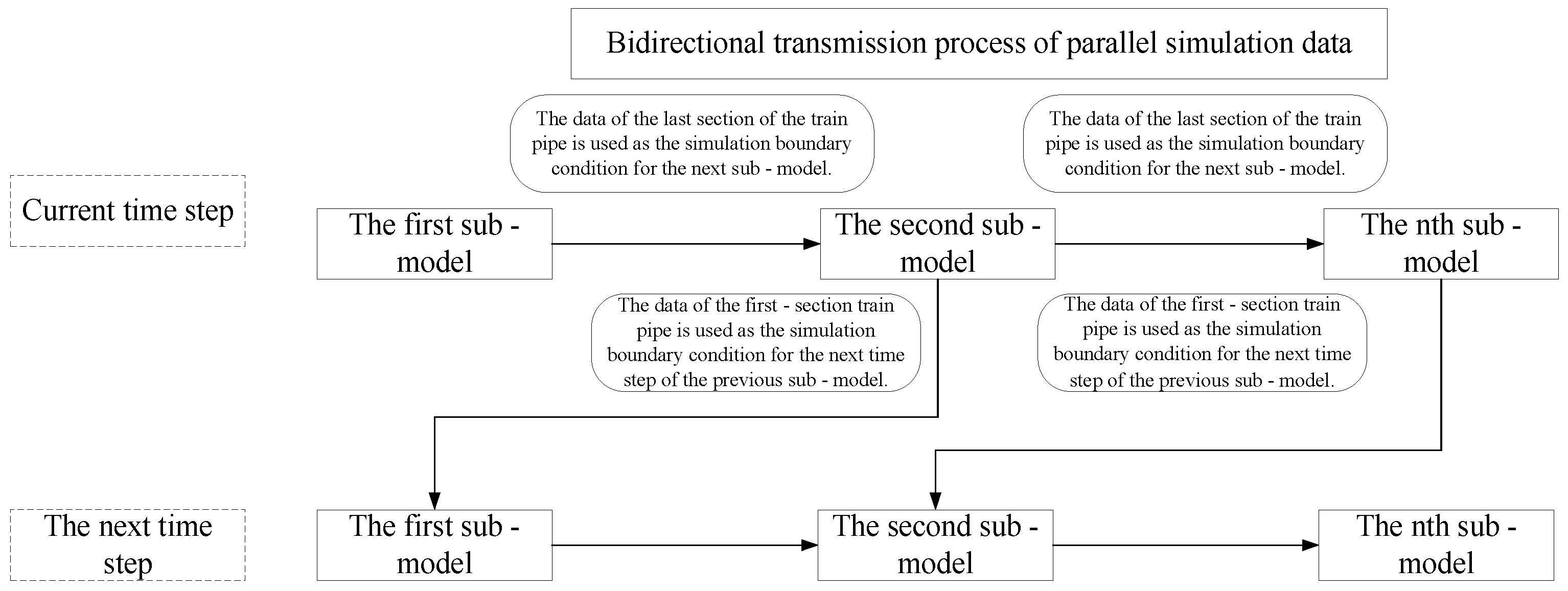
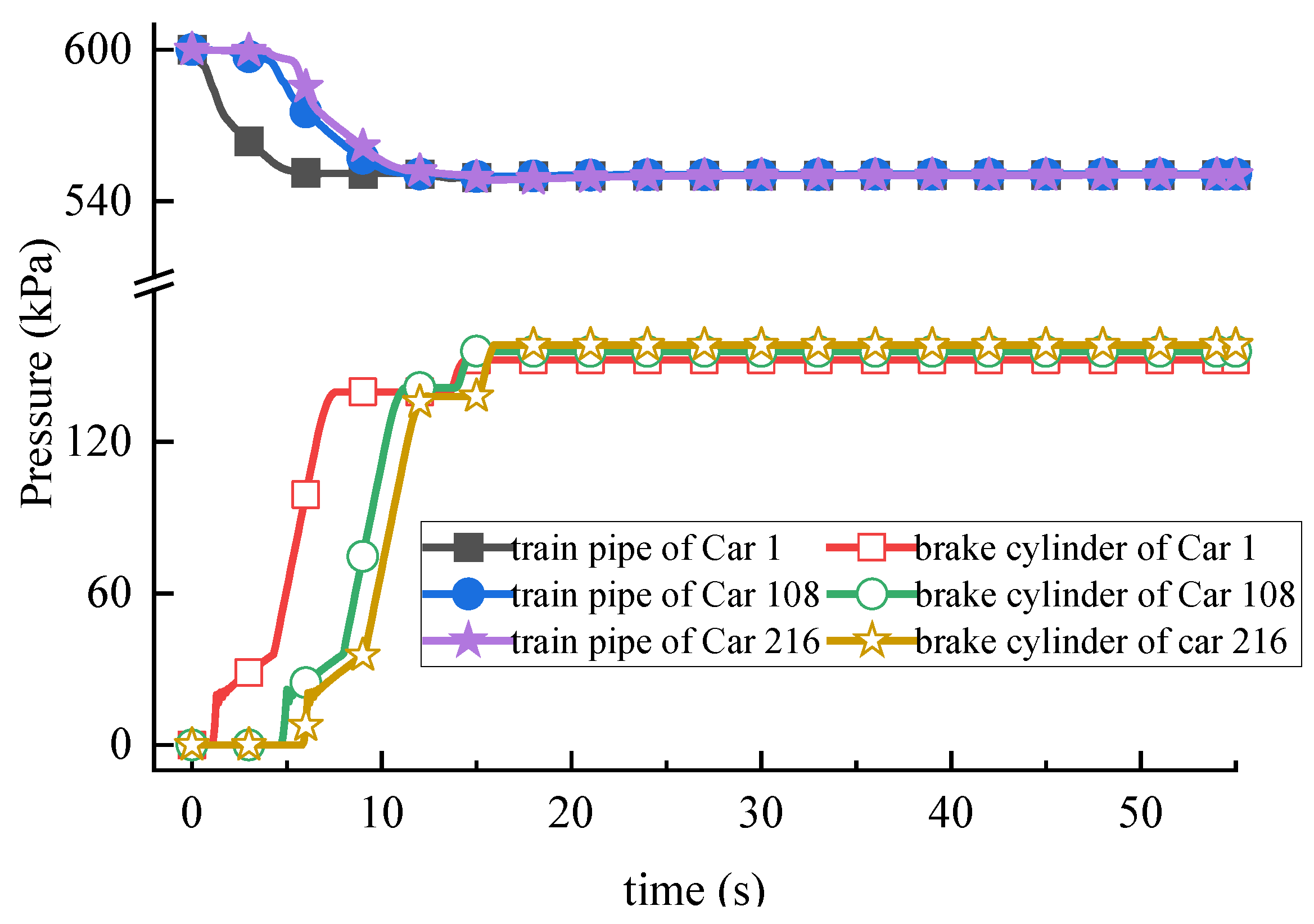
- A fluid simulation model of the air braking system for a 20,000-ton train was established using the parallel method. Based on the TCP/IP data transmission protocol, data such as pressure and temperature were bidirectionally transmitted between sub-models, which were used as boundary conditions for sub-model simulation. The accuracy of the parallel method was verified through simulation comparison.
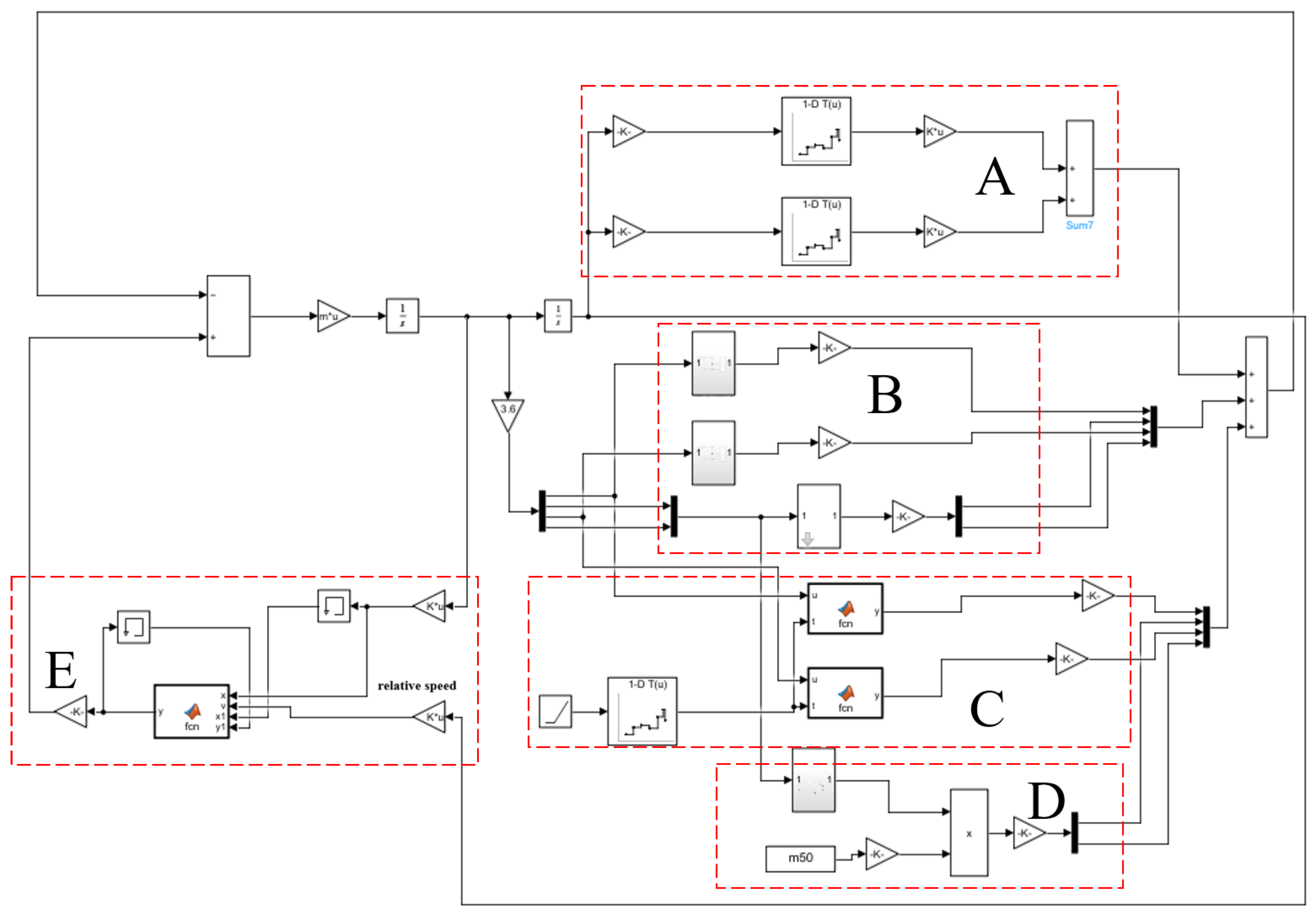
- This study developed a longitudinal dynamic model based on fundamental theories and validated its accuracy through Simulink simulations. Subsequently, we integrated this model with a train air braking system model to formulate a comprehensive longitudinal dynamic framework for a 20,000-ton heavy-haul train that explicitly accounts for braking characteristics.
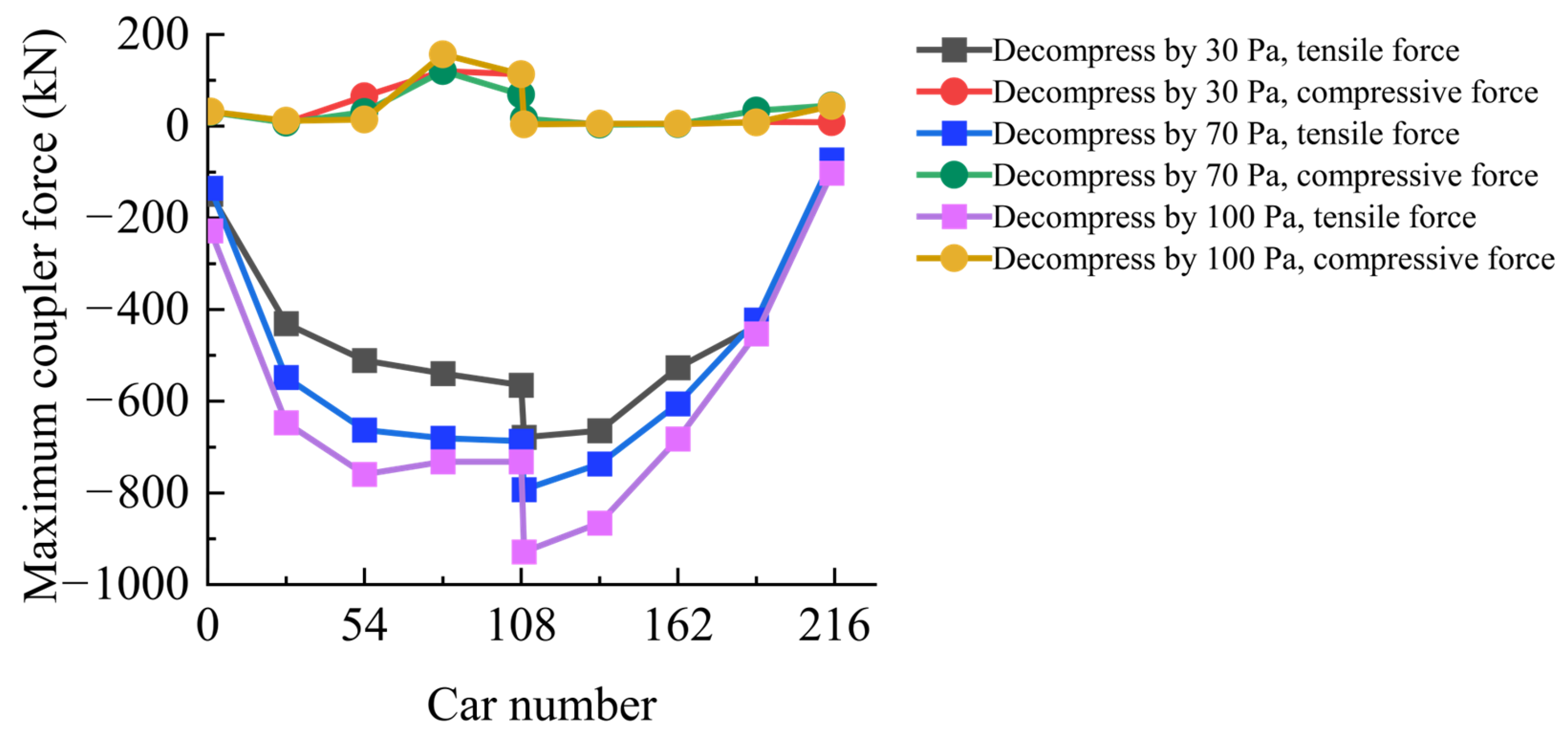
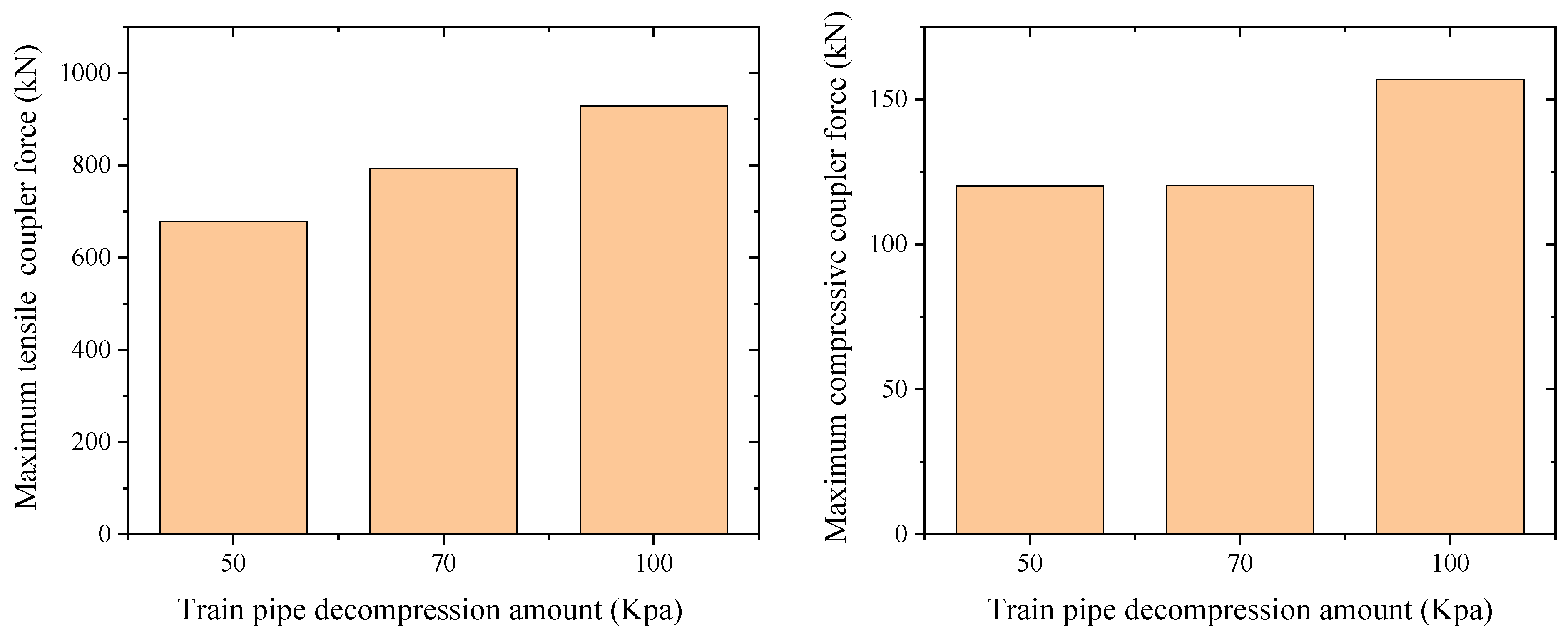
- A simulation study was conducted to investigate the effects of different brake pipe pressure reductions and braking delay times on the longitudinal dynamics of a 20,000-ton heavy-haul train. The results show that under varying levels of brake pipe pressure reduction, the maximum compressive and tensile coupler forces consistently occurred at Car 109 and Car 81, respectively. Compared to the maximum compressive coupler force under a 50 kPa pressure reduction, the values under 70 kPa and 100 kPa reductions increased by 16.8% and 36.8%, respectively. Similarly, compared to the maximum tensile coupler force under a 50 kPa reduction, the corresponding values under the other two pressure reduction levels also increased—by 0.1% and 30.6%, respectively.
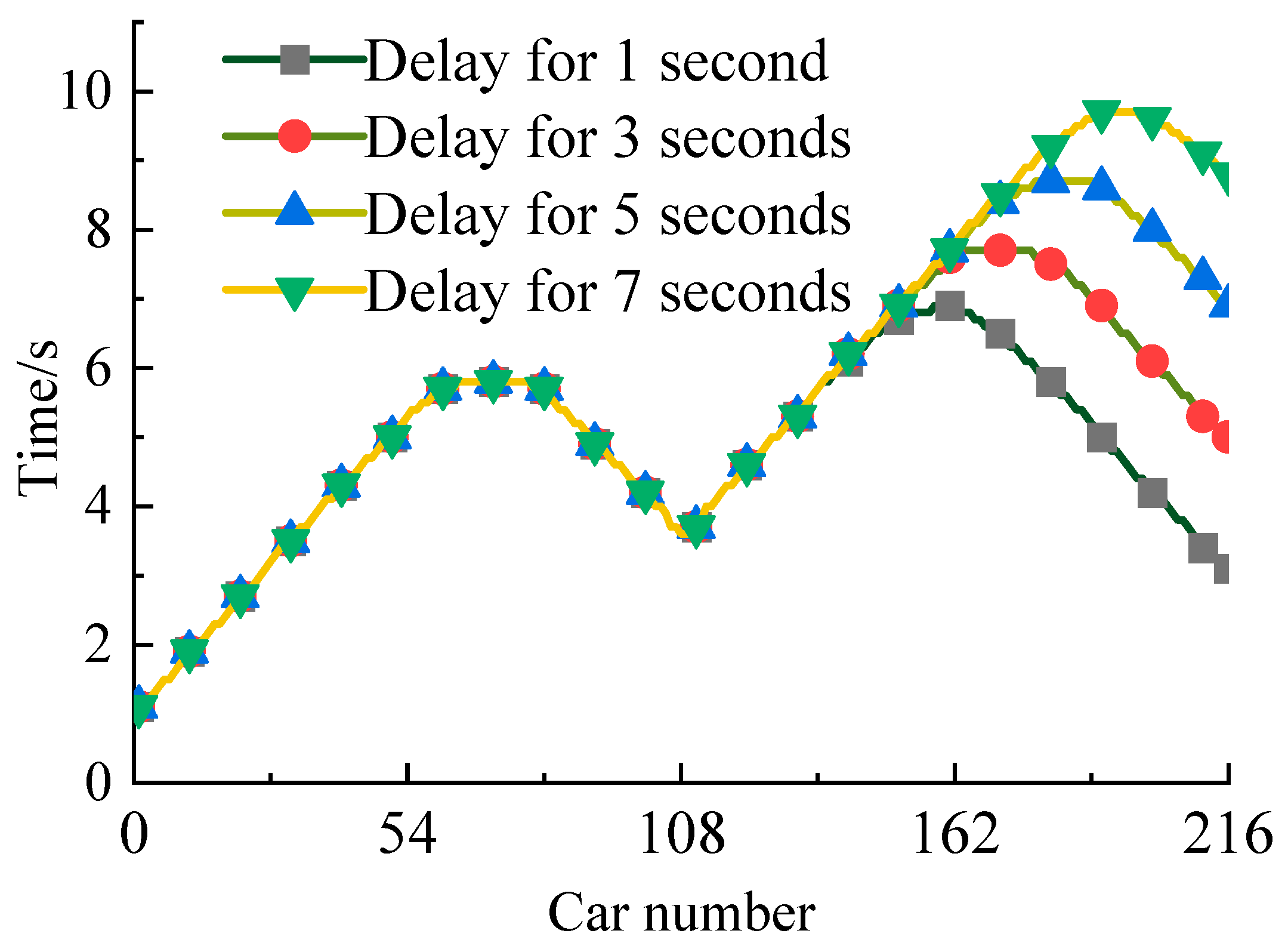
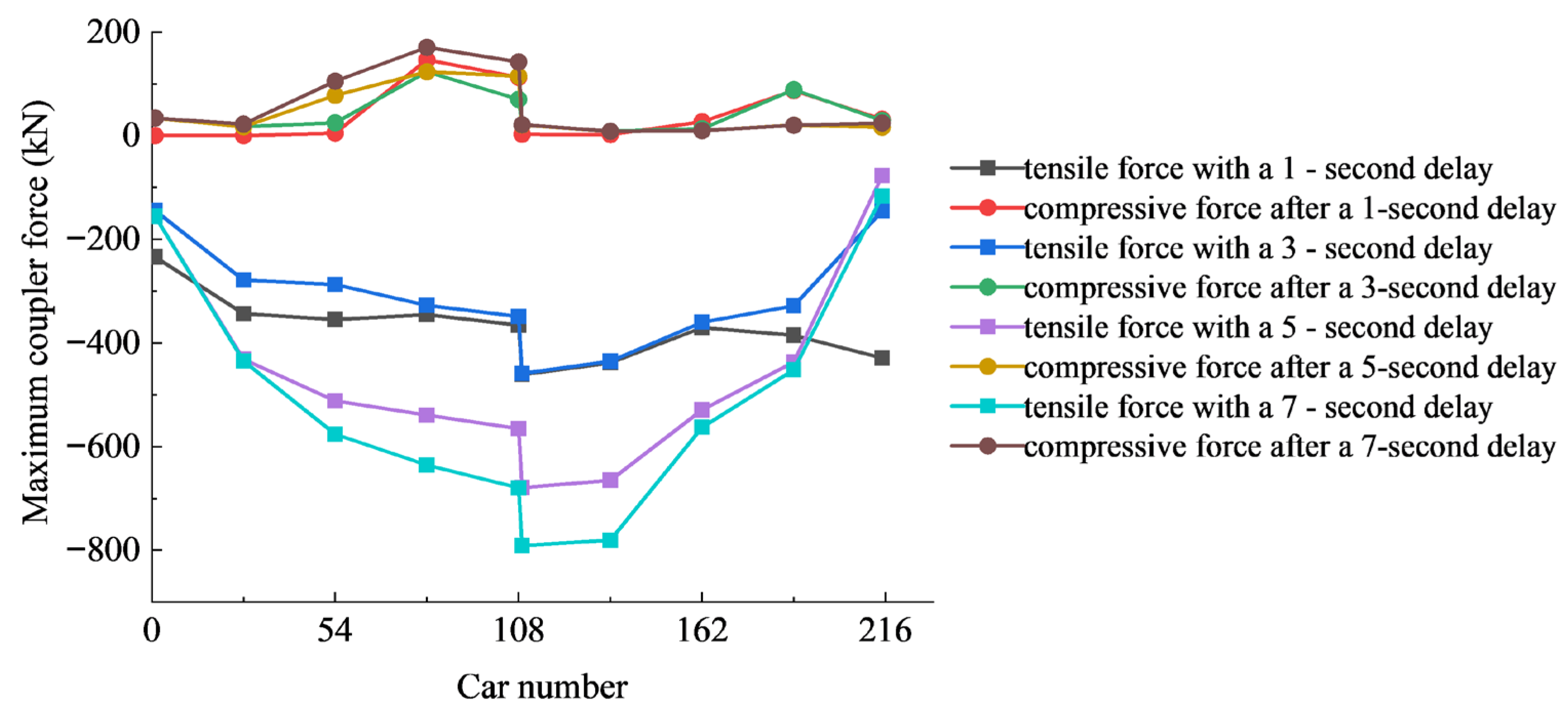
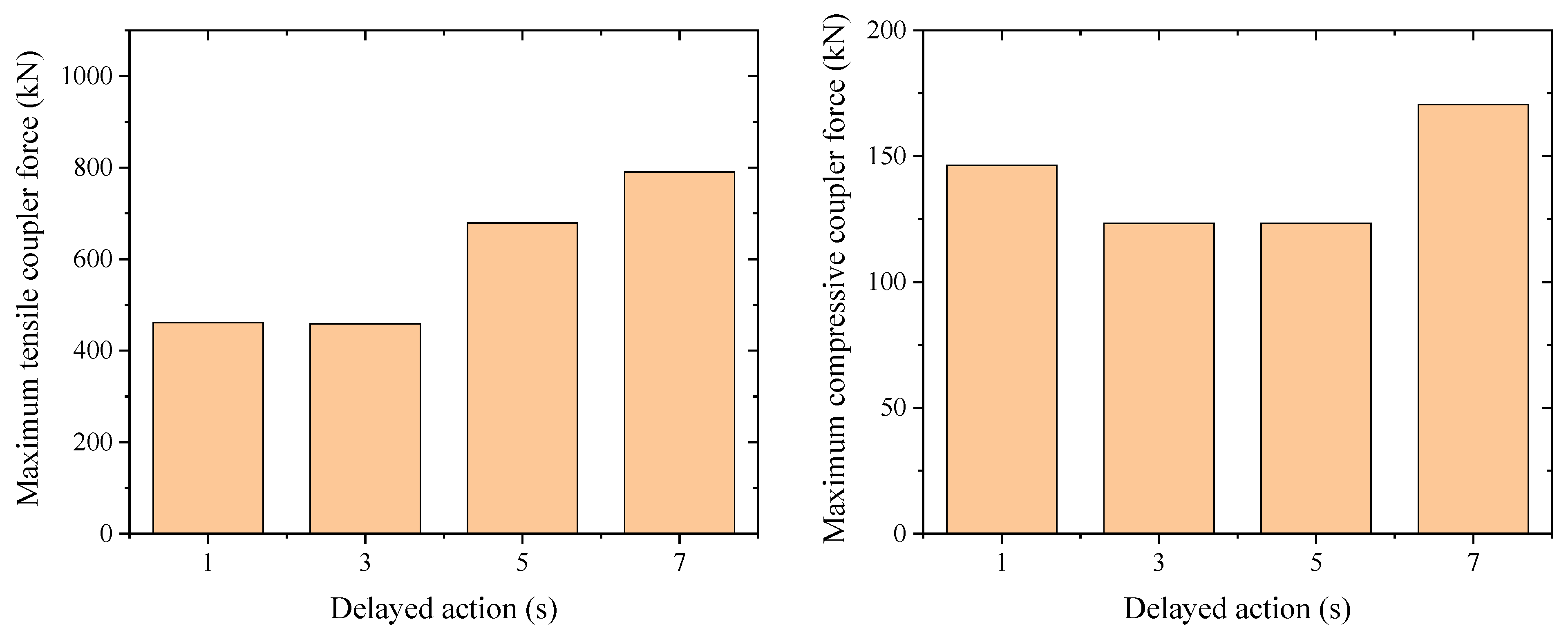
- In comparison to longer activation delays of the controllable tail system, shorter delays of 1 s and 3 s resulted in smaller maximum compressive coupler forces. To ensure the safe operation of the 20,000-ton heavy-haul train, it is advisable to adopt relatively short activation delays for the controllable tail system. Doing so enhances braking synchronization and thereby reduces the longitudinal impulse forces experienced by the train.
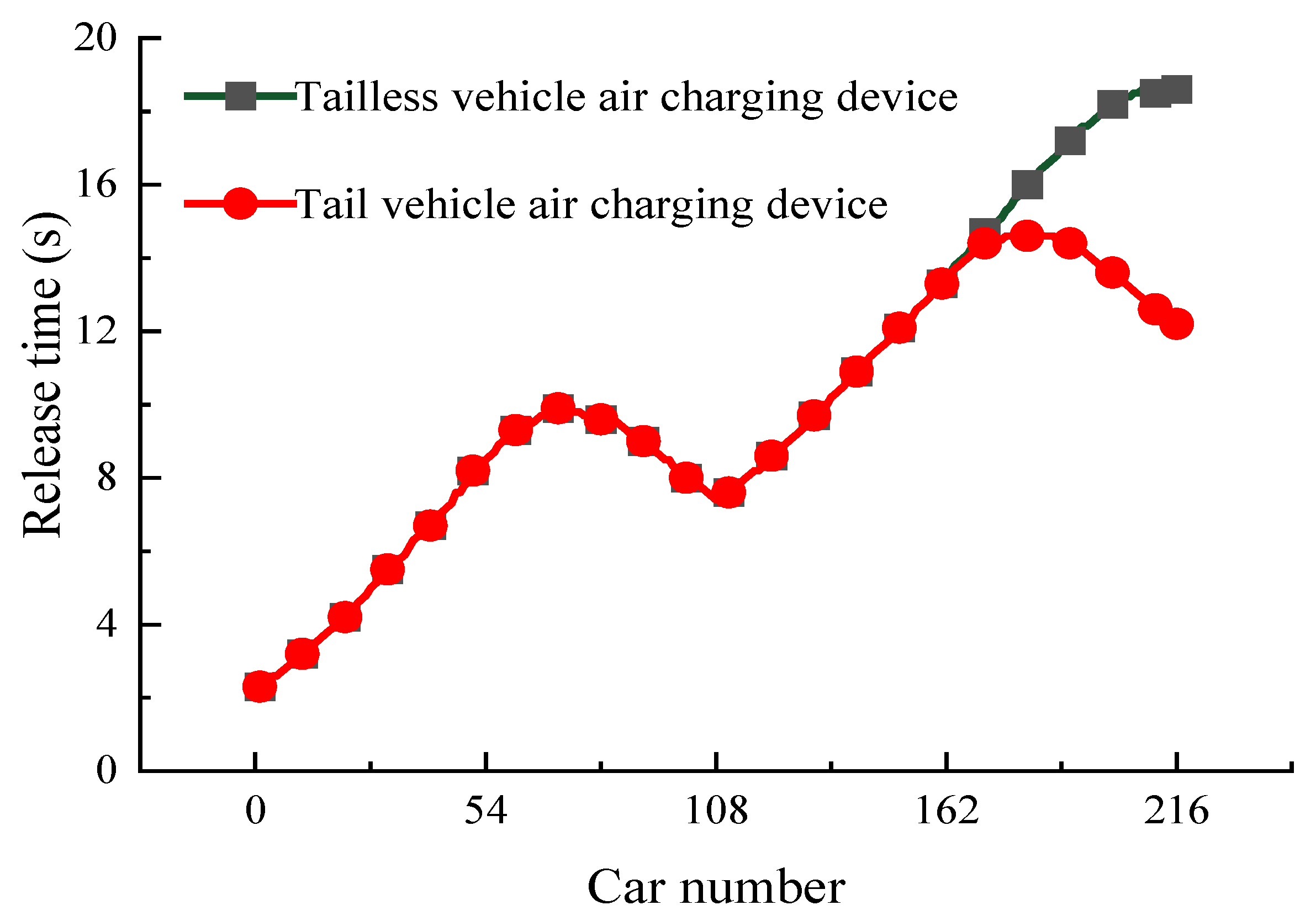
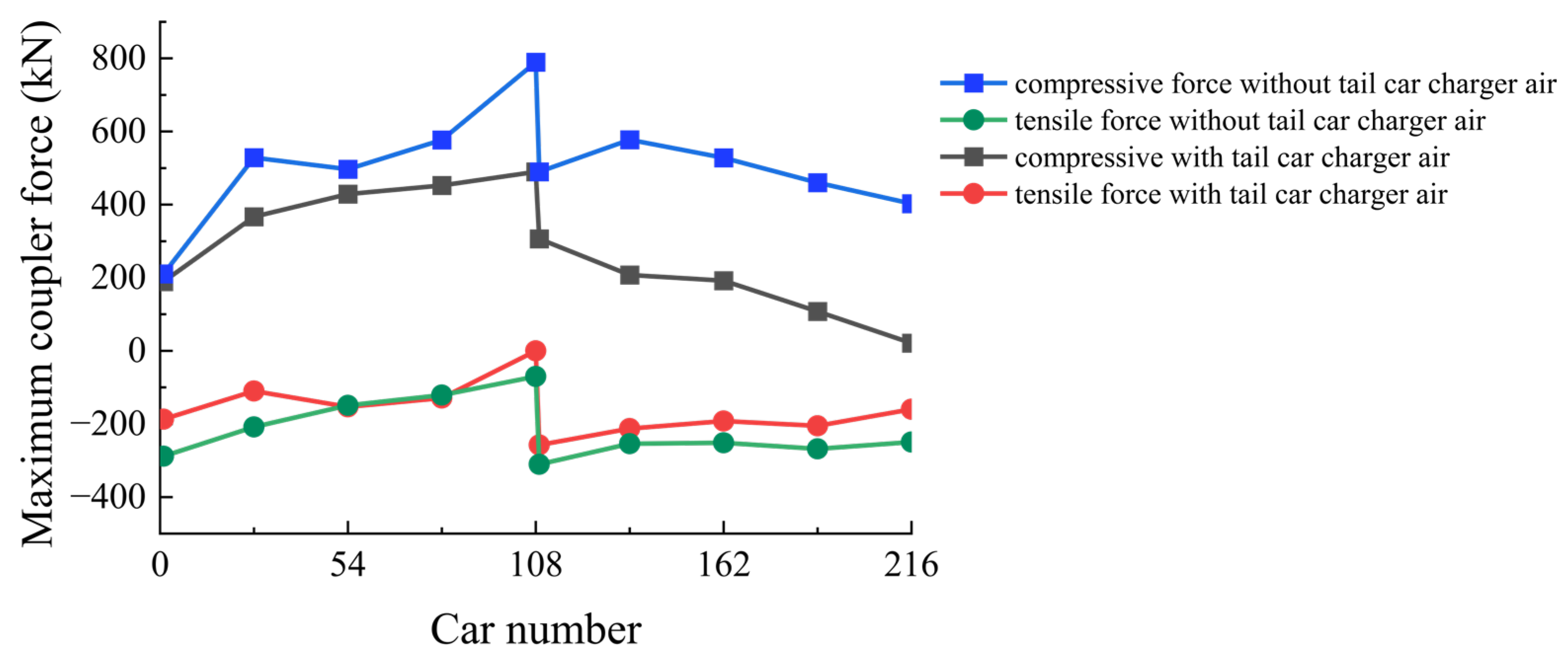
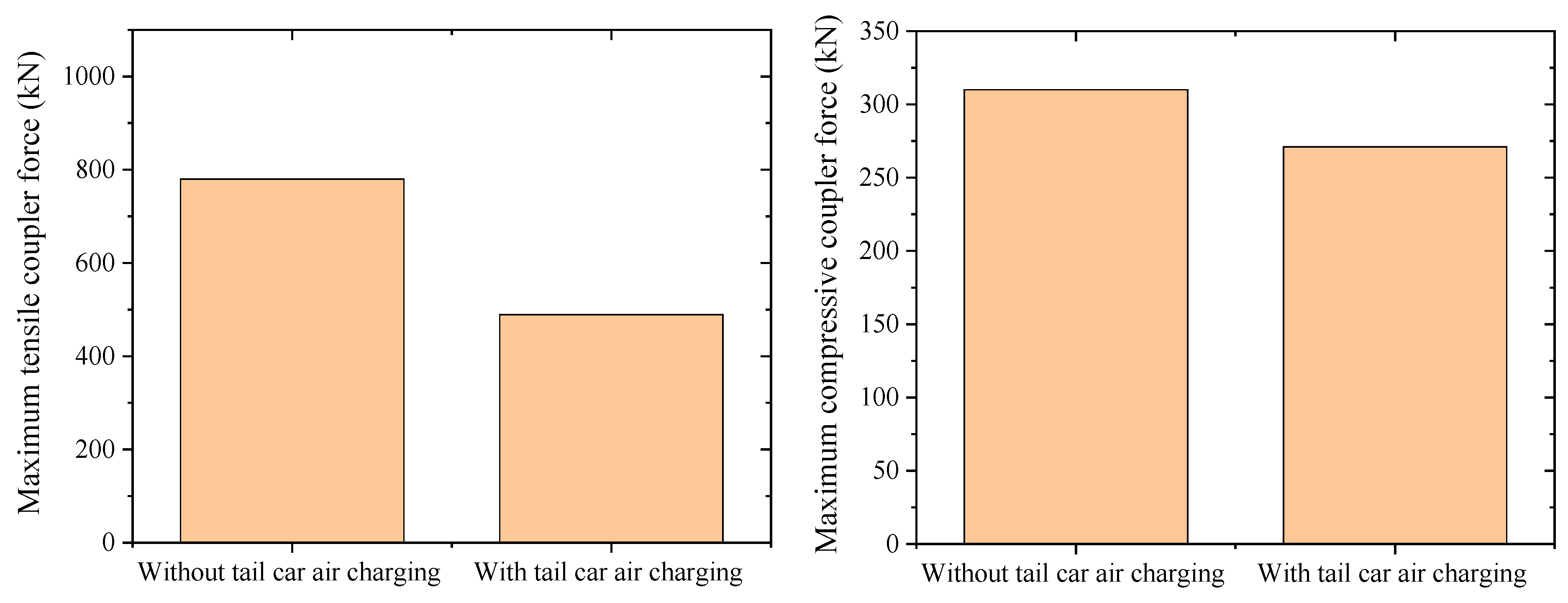
- After equipping the rear car with an additional air-charging device, Car 181 began to release its brakes within 14.6 s at the latest—4 s earlier than when no such device was installed. This modification also led to a reduction in the maximum tensile coupler force from 780 kN to 489 kN, a decrease of 37%. These improvements significantly mitigate longitudinal impulses during the brake release phase of the heavy-haul train. The significant reduction in coupler forces can effectively and substantially lower the coupler breakage accident rate in heavy-haul trains. The cost of the rear car air inflation device is primarily reflected in its high-tech hardware, specialized installation engineering, and long-term reliability maintenance. Although the direct procurement and installation entail relatively high apparent costs, its core value lies in significantly improving the synchronization of brake release in long heavy-haul trains, effectively mitigating longitudinal impulse, and consequently preventing coupler breakage accidents while ensuring transportation safety.
Author Contributions
Funding
Data Availability Statement
Conflicts of Interest
Correction Statement
Appendix A

| Component | Parameter | Value [7,8] |
|---|---|---|
| Main Piston Body | Mass (kg) | 0.9 |
| Piston Diameter (mm) | 110 | |
| Static Friction Force (N) | 7.5 | |
| Viscous Damping Coefficient (N·s/m) | 2500 | |
| Acceleration Damping Coefficient (N·s2/m2) | 9000 | |
| Slide Valve | Mass (kg) | 0.25 |
| Static Friction Force (N) | 65 | |
| Stabilizing Spring | Preload Force (N) | 110 |
| Stiffness (N/mm) | 5 | |
| Deceleration Spring | Preload Force (N) | 13 |
| Stiffness (N/mm) | 1.5 | |
| Partial Pressure Reduction Chamber | Volume (L) | 0.6 |
| Piston Z3 Chamber of Accelerated Release Valve | Volume (mL) | 65 |
| Orifice II | Diameter (mm) | 2.9 |
| Auxiliary Reservoir | Volume (L) | 40 |
| Accelerated Release Reservoir | Volume (L) | 11 |
| Brake Cylinder Piston | Static Friction Force (N) | 760 |
| Piston Diameter (mm) | 254 | |
| Piston Stroke (mm) | 155 | |
| Release Spring | Spring Stiffness (N/mm) | 5.33 |
| Pre-compression Force (N) | 1013 | |
| Branch Pipe between 120-1 Valve and Auxiliary Reservoir | Diameter (mm) | 25 |
| Length (m) | 1.5 | |
| Branch Pipe between 120-1 Valve and Accelerated Release Reservoir | Diameter (mm) | 25 |
| Length (m) | 0.5 | |
| Branch Pipe between 120-1 Valve and Brake Cylinder | Diameter (mm) | 25 |
| Length (m) | 2.5 |
References
- Liu, H.; Liu, T.; Zhang, J. Method for building train longitudinal dynamics simulation tool based on Modelica language. Roll. Stock 2023, 61, 56–58. [Google Scholar]
- Wu, Q.; Cole, C.; Spiryagin, M.; Chang, C.; Wei, W.; Ursulyak, L.; Shvets, A.; Murtaza, M.A.; Mirza, I.M.; Zhelieznov, K.; et al. Freight train air brake models. Int. J. Rail Transp. 2023, 11, 1–49. [Google Scholar] [CrossRef]
- Li, Q. Simulation Study on Influence of Brake System Characteristics on Longitudinal Dynamics Performance of Heavy-Haul Trains. Ph.D. Dissertation, Dalian Jiaotong University, Dalian, China, 2023. [Google Scholar]
- Wu, Q.; Spiryadin, M.; Cole, C. Longitudinal train dynamics: An overview. Veh. Syst. Dyn. 2016, 54, 1688–1714. [Google Scholar] [CrossRef]
- Sun, S. Research on Longitudinal Impact Dynamics of Heavy-Haul Trains. Ph.D. Dissertation, Southwest Jiaotong University, Chengdu, China, 2014. [Google Scholar]
- Jiang, F.; Li, K.; Wu, H.; Luo, S. An experiment-based empirical model for heavy-haul train air brake. Adv. Mech. Eng. 2023, 15, 16878132231169618. [Google Scholar] [CrossRef]
- Yang, C. Modeling and Simulation Research on Freight Train Brake Systems. Ph.D. Dissertation, Southwest Jiaotong University, Chengdu, China, 2010. [Google Scholar]
- Feng, Z. Modeling and Simulation of Heavy-Haul Freight Train Air Brake System. Ph.D. Dissertation, Southwest Jiaotong University, Chengdu, China, 2016. [Google Scholar]
- Yang, R. Modeling and Simulation Study on Brake System of 120-Car Unit Freight Trains. Ph.D. Dissertation, Southwest Jiaotong University, Chengdu, China, 2016. [Google Scholar]
- Ni, W.; Huang, X.; Wang, X. Research on methods for improving simulation speed of train brake systems. Railw. Locomot. Car 2022, 42, 41–46. [Google Scholar]
- Guo, Y.; Yang, S.; Yang, C.; Ni, W. Longitudinal dynamics simulation of freight trains on Sichuan-Tibet railway descending grades based on AMEsim/Simulink co-simulation. Machinery 2022, 49, 47–54. [Google Scholar]
- Wei, W.; Zhang, Y.; Zhang, J.; Zhao, X.; Tian, Y. Research on the influence of locomotive air charging capacity on the release performance and coupler force of heavy haul trains. Railw. Stand. Des. 2024, 68, 198–203. [Google Scholar]
- Murtaza, M.; Garg, S. Brake Modelling in train simulation studies. Proc. Inst. Mech. Eng. Part F J. Rail Rapid Transit 1989, 203, 87–95. [Google Scholar] [CrossRef]
- Murtaza, M.; Garg, S. Parametric study of a railway air brake system. Proc. Inst. Mech. Eng. Part F J. Rail Rapid Transit 1992, 206, 21–36. [Google Scholar] [CrossRef]
- Pugi, L.; Malvezzi, M.; Allotta, B.; Banchi, L.; Presciani, P. A parametric library for the simulation of a Union Internationale des Chemins de Fer (UIC) pneumatic braking system. Proc. Inst. Mech. Eng. Part F J. Rail Rapid Transit 2004, 218, 117–132. [Google Scholar] [CrossRef]
- Cantone, L.; Crescentini, E.; Verzicco, R.; Vullo, V. A Numerical model for the analysis of unsteady train braking and releasing maneuvers. Proc. Inst. Mech. Eng. Part F J. Rail Rapid Transit 2009, 223, 305–317. [Google Scholar] [CrossRef]
- Piechowiak, T. Pneumatic train brake simulation method. Veh. Syst. Dyn. 2009, 47, 1473–1492. [Google Scholar] [CrossRef]
- Piechowiak, T. Verification of pneumatic railway brake models. Veh. Syst. Dyn. 2010, 48, 283–299. [Google Scholar] [CrossRef]
- Wu, Q.; Cole, C.; Spiryagin, M.; Wang, Y.; Ma, W.; Wei, C. Railway air brake model and parallel computing scheme. J. Comput. Nonlinear Dyn. 2017, 12, 1508–1519. [Google Scholar] [CrossRef]
- Serajian, R.; Mohammadi, S.; Nasr, A. Influence of train length on in-train longitudinal forces during brake application. Veh. Syst. Dyn. 2019, 57, 192–206. [Google Scholar] [CrossRef]
- Teodoro, Í.P.; Ribeiro, D.F.; Botari, T.; Martins, T.S.; Santos, A.A. Fast simulation of railway pneumatic brake systems. Proc. Inst. Mech. Eng. Part F J. Rail Rapid Transit 2019, 233, 420–430. [Google Scholar] [CrossRef]
- Teodoro, Í.P.; Eckert, J.J.; Lopes, P.F.; Martins, T.S.; Santos, A.A. Parallel simulation of railway pneumatic brake using openMP. Int. J. Rail Transp. 2020, 8, 180–194. [Google Scholar] [CrossRef]
- Alturbeh, H.; Stow, J.; Tucker, G.; Lawton, A. Modelling and simulation of the train brake system in low adhesion conditions. Proc. Inst. Mech. Eng. Part F J. Rail Rapid Transit 2020, 234, 301–320. [Google Scholar] [CrossRef]
- Wu, Q.; Spiryagin, M.; Cole, C.; McSweeney, T. Parallel computing in railway research. Int. J. Rail Transp. 2020, 8, 111–134. [Google Scholar] [CrossRef]
- TB/T 1492-2017; Single Vehicle Test for Railway Vehicle Brakes. China Railway Press: Beijing, China, 2017.
- Spiryagin, M.; Wu, Q.; Cole, C. International benchmarking of longitudinal train dynamics simulators: Benchmarking questions. Veh. Syst. Dyn. 2017, 55, 450–463. [Google Scholar] [CrossRef]
- Wu, Q.; Spiryagin, M.; Cole, C.; Chang, C.; Guo, G.; Sakalo, A.; Wei, W.; Zhao, X.; Burgelman, N.; Wiersma, P. International benchmarking of longitudinal train dynamics simulators: Results. Veh. Syst. Dyn. 2018, 56, 343–365. [Google Scholar] [CrossRef]


| Position | The Pressure of the Tested Brake Cylinder/kPa | The Pressure of the Simulation Brake Cylinder/kPa | Brake Cylinder Pressure Error/kPa |
|---|---|---|---|
| Car 1 | 151 | 152 | −1 |
| Car 27 | 162 | 146 | 16 |
| Car 55 | 147 | 142 | 5 |
| Car 81 | 133 | 133 | 0 |
| Car 108 | 149 | 155 | −6 |
| Car 109 | 160 | 154 | 6 |
| Car 135 | 150 | 142 | 8 |
| Car 163 | 156 | 141 | 15 |
| Car 189 | 135 | 139 | −4 |
| Car 216 | 146 | 158 | −12 |
| Simulator | Maximum Speed (km/h) | Average Speed (km/h) | Maximum Hook Pulling Force (kN) and the Position Where It Occurs | Maximum Hook—Pulling Force (kN) and the Position Where It Occurs |
|---|---|---|---|---|
| TABLDSS | 87.19 | 65.41 | −549/2 | 339/2 |
| UM | 88.19 | 65.73 | −592/2 | 355/2 |
| CRE-LTS | 85.92 | 65.12 | −559/2 | 351/2 |
| TDEAS | 87.41 | 65.56 | −549/2 | 339/2 |
| PoliTo | 87.21 | 65.41 | −561/2 | 339/2 |
| TsDyn | 85.09 | 65.01 | −563/2 | 343/2 |
| CARS | 84.99 | 65.36 | −611/2 | 346/2 |
| BODYSIM | 85.50 | 64.93 | −734/2 | 443/10 |
| VOCO | 86.16 | 63.91 | −678/2 | 144/20 |
| The model in this paper | 85.36 | 64.27 | −600.31/3 | 339.71/2 |
| Model Type | Simulation Scenario | Number of State Variables | Simulation Time | Efficiency Improvement |
|---|---|---|---|---|
| Conventional Model | Initial Charging | 1206 | 55 min | |
| Parallel Model | Initial Charging | 2 × 604 | 24 min | 56% |
| Conventional Model | Service Braking | 1206 | 25 min | |
| Parallel Model | Service Braking | 2 × 604 | 7 min | 72% |
| Train Pipe Decompression Amount (kPa) | Maximum Tensile Coupler Force (kN) and Car Number | Percentage Increase (%) | The Moment When the Maximum Tensile Force Occurs (s) | Maximum Compressive Coupler Force (kN) and Car Number | Percentage Increase (%) |
|---|---|---|---|---|---|
| 50 | 678.7/109 | 15.3 | 120.1/81 | ||
| 70 | 792.9/109 | 16.8 | 16.1 | 120.3/81 | 0.1 |
| 100 | 928.6/109 | 36.8 | 15.4 | 156.9/81 | 30.6 |
| Delayed Action (s) | Maximum Tensile Coupler Force (kN) and Car Number | Maximum Compressive Coupler Force (kN) and Car Number |
|---|---|---|
| 1 | 461.0/109 | 146.3/81 |
| 3 | 458.9/109 | 123.3/81 |
| 5 | 679.2/109 | 123.4/81 |
| 7 | 791.1/109 | 170.5/81 |
| Relief Time (s) | Maximum Tensile Coupler Force (kN) | The Occurrence Time of the Maximum Tensile Force (s) | Maximum Compressive Coupler Force (kN) and Car Number | The Occurrence Time of the Maximum Compressive Force (s) | |
|---|---|---|---|---|---|
| Without tail car air charging device | 294 | 780/109 | 18 | 310/81 | 42 |
| With tail car air charging device | 294 | 489/109 | 12 | 271/81 | 34 |
| Comparison reduction | 291/37% | 6 | 39/12.5% | 8 |
Disclaimer/Publisher’s Note: The statements, opinions and data contained in all publications are solely those of the individual author(s) and contributor(s) and not of MDPI and/or the editor(s). MDPI and/or the editor(s) disclaim responsibility for any injury to people or property resulting from any ideas, methods, instructions or products referred to in the content. |
© 2025 by the authors. Licensee MDPI, Basel, Switzerland. This article is an open access article distributed under the terms and conditions of the Creative Commons Attribution (CC BY) license.
Share and Cite
Zhang, B.; Liu, G.; Guo, S.; Chang, Z.; Hu, S.; Wu, X.; Cai, W. Research on Longitudinal Dynamics of 20,000-Ton Heavy Haul Trains Considering Braking Characteristics. Mathematics 2026, 14, 158. https://doi.org/10.3390/math14010158
Zhang B, Liu G, Guo S, Chang Z, Hu S, Wu X, Cai W. Research on Longitudinal Dynamics of 20,000-Ton Heavy Haul Trains Considering Braking Characteristics. Mathematics. 2026; 14(1):158. https://doi.org/10.3390/math14010158
Chicago/Turabian StyleZhang, Bo, Guoyun Liu, Shun Guo, Zhaorui Chang, Siqi Hu, Xingwen Wu, and Wubin Cai. 2026. "Research on Longitudinal Dynamics of 20,000-Ton Heavy Haul Trains Considering Braking Characteristics" Mathematics 14, no. 1: 158. https://doi.org/10.3390/math14010158
APA StyleZhang, B., Liu, G., Guo, S., Chang, Z., Hu, S., Wu, X., & Cai, W. (2026). Research on Longitudinal Dynamics of 20,000-Ton Heavy Haul Trains Considering Braking Characteristics. Mathematics, 14(1), 158. https://doi.org/10.3390/math14010158