

Matching Optimization for Automated Negotiation: From a Privacy-Enhanced Data Modeling Perspective

Abstract
1. Introduction
- (1)
- From a mechanism design perspective, we propose a trust-aware negotiation framework in which multi-dimensional trust evaluation is integrated into the negotiation matching process, rather than functioning as a loosely coupled auxiliary module.
- (2)
- We develop a privacy-enhanced negotiation protocol that transforms sensitive negotiation attributes into probabilistic representations, allowing privacy protection to be endogenously incorporated into the protocol design and decision-making process, instead of relying on exogenous privacy safeguards.
- (3)
- Building upon the integrated trust and privacy framework, we design a reinforcement learning-based adaptive matching strategy that dynamically optimizes negotiation outcomes under privacy and trust constraints.
2. Literature Review
2.1. Adaptive Matching in Automated Negotiation
2.2. Protocols in Automated Negotiation
3. The Proposed Model
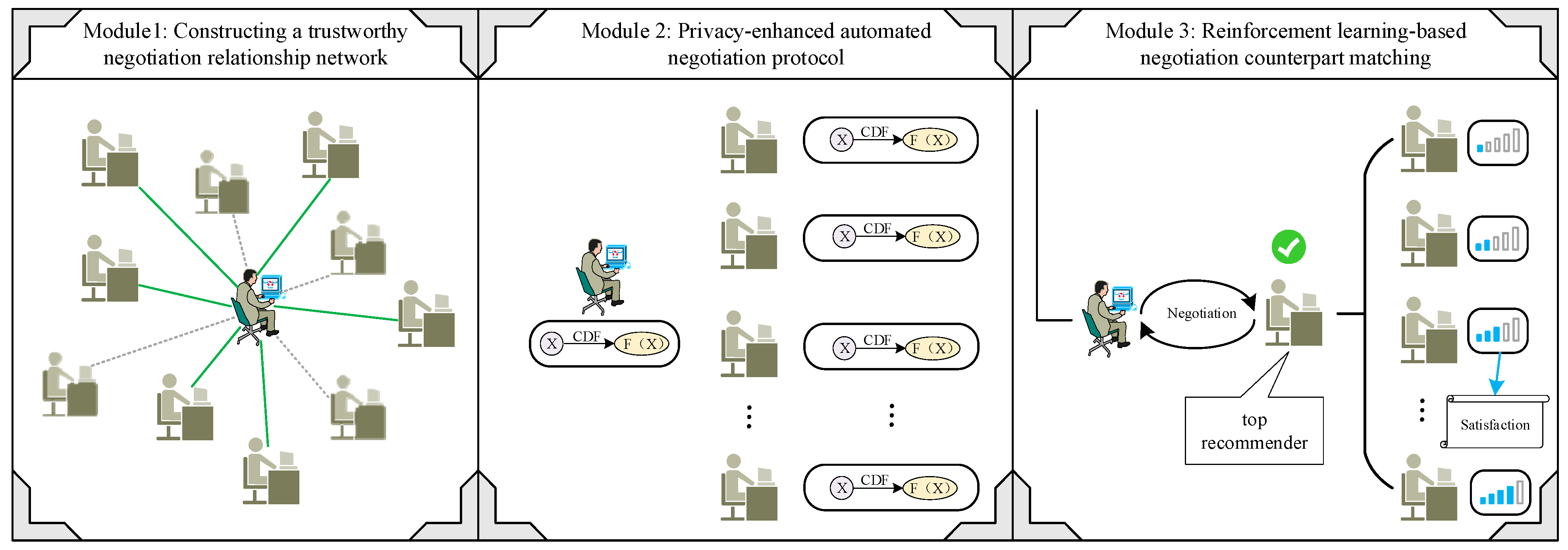
3.1. Model Framework
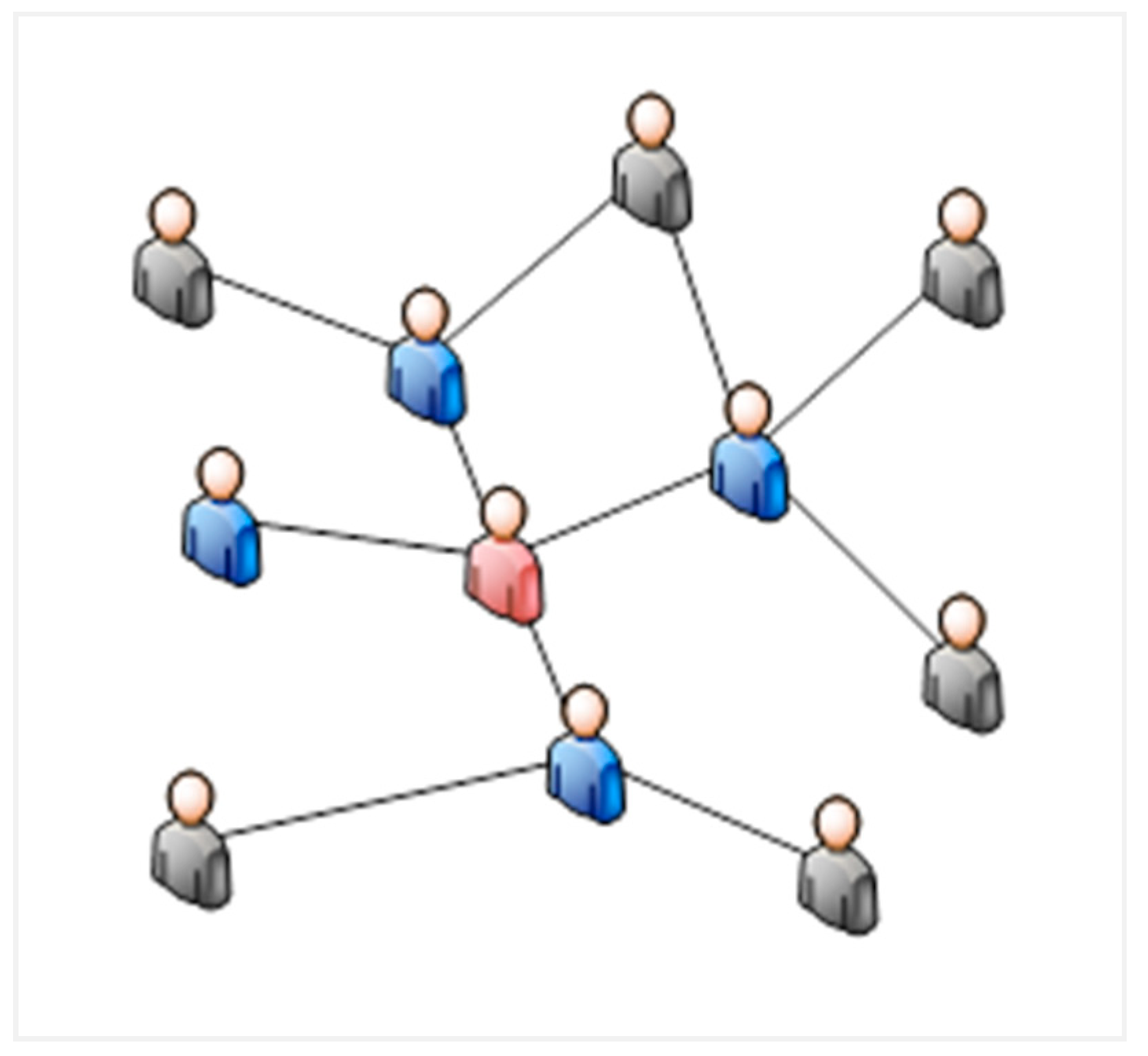
3.2. Definitions and Construction Method of Negotiation Network
3.2.1. Key Concepts and Definitions
3.2.2. The Negotiation Network Construction Based on Breadth-First Search
3.3. Trust-Based Negotiation Space Reduction Method
3.3.1. Local Trust Evaluation
3.3.2. Global Trust Evaluation
3.3.3. Relationship Prediction Based on Logistic Regression
3.3.4. Negotiation Space Reduction
3.4. Privacy-Enhanced Data Processing Protocol
3.4.1. Interval-Type Data Under the Privacy-Enhanced Protocol
3.4.2. Fuzzy-Type Data Under the Privacy-Enhanced Protocol
3.4.3. Linguistic-Type Data Under the Privacy-Enhanced Protocol
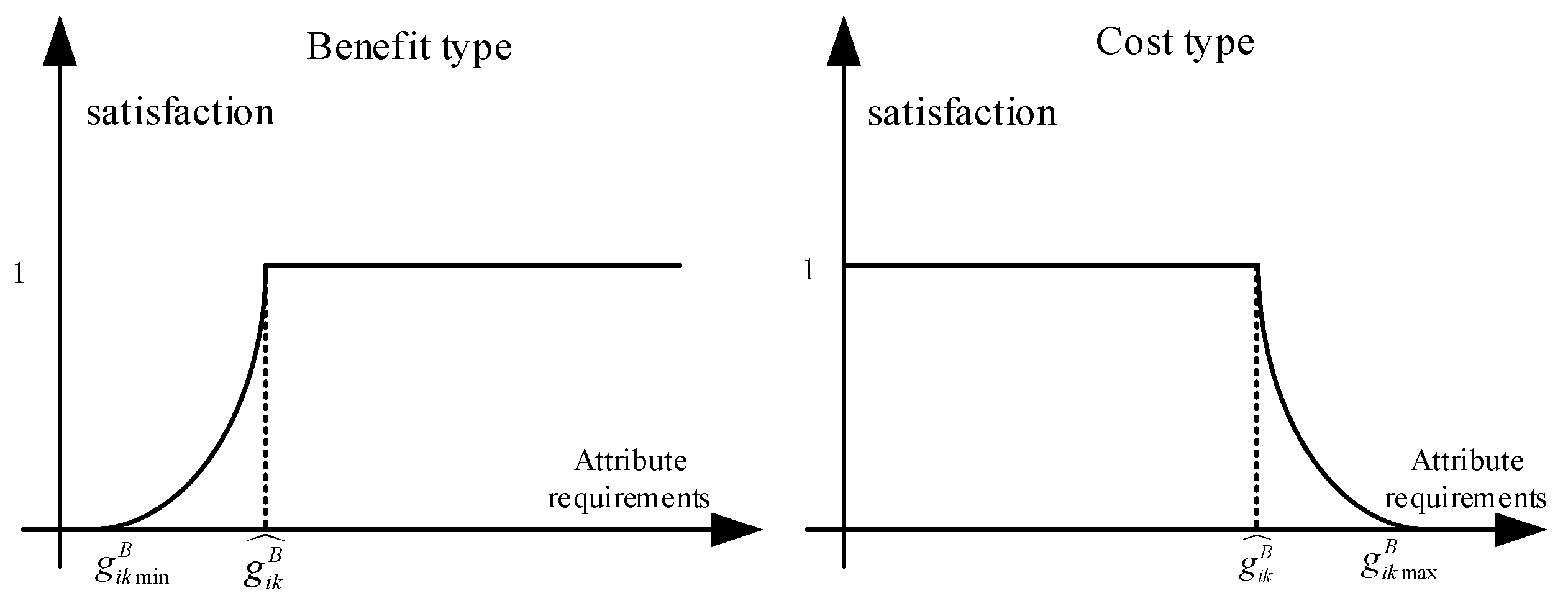
3.5. Adaptive Matching Strategy
4. Experiments and Results
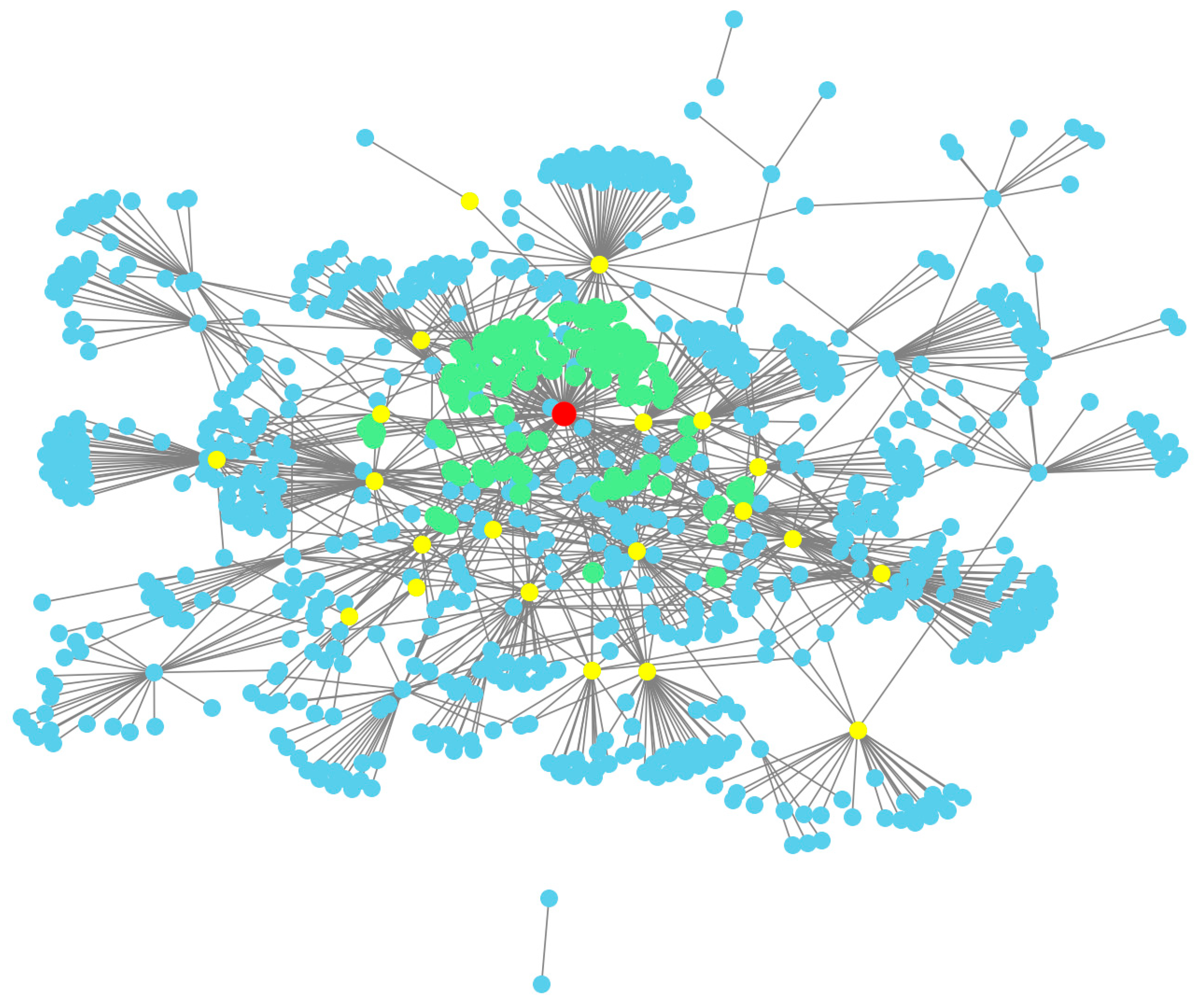
4.1. Screening of Trusted Negotiation Relationship Networks
4.1.1. Dataset Description
4.1.2. Evaluation Metrics
4.1.3. Experimental Results and Analysis
4.2. Application of the Privacy-Enhanced Protocol
4.3. Case Study
4.4. Comparative Experiments and Analysis
5. Conclusions
6. Discussion
6.1. Theoretical Implications
6.2. Practical Implications
6.3. Limitations and Future Research
Author Contributions
Funding
Data Availability Statement
Conflicts of Interest
References
- Liu, C.J.; Cong, J.M.; Zhao, T.H.; Zhu, E. Improving Agent Decision Payoffs via a New Framework of Opponent Modeling. Mathematics 2023, 11, 3062. [Google Scholar] [CrossRef]
- Zhang, Y.; Wu, J.H.; Cao, R.Y. Optimizing Automated Negotiation: Integrating Opponent Modeling with Reinforcement Learning for Strategy Enhancement. Mathematics 2025, 13, 679. [Google Scholar] [CrossRef]
- Li, W.S.; Zhong, H.; Zhou, J.M.; Chang, C.; Lin, R.H.; Tang, Y. An attention mechanism and residual network based knowledge graph-enhanced recommender system. Knowl.-Based Syst. 2024, 299, 112042. [Google Scholar] [CrossRef]
- Baarslag, T.; Hendrikx, M.J.C.; Hindriks, K.V.; Jonker, C.M. Learning about the opponent in automated bilateral negotiation: A comprehensive survey of opponent modeling techniques. Auton. Agents Multi-Agent Syst. 2016, 30, 849–898. [Google Scholar] [CrossRef]
- Hou, Y.Q.; Sun, M.Y.; Zhu, W.X.; Zeng, Y.F.; Piao, H.Y.; Chen, X.F.; Zhang, Q. Behavior Reasoning for Opponent Agents in Multi-Agent Learning Systems. IEEE Trans. Emerg. Top. Comput. Intell. 2022, 6, 1125–1136. [Google Scholar] [CrossRef]
- Bagga, P.; Paoletti, N.; Alrayes, B.; Stathis, K. ANEGMA: An automated negotiation model for e-markets. Auton. Agents Multi-Agent Syst. 2021, 35, 28. [Google Scholar] [CrossRef]
- Gao, T.G.; Huang, M.; Wang, Q.; Yin, M.Q.; Ching, W.K.; Lee, L.H.; Wang, X.W. A systematic model of stable multilateral automated negotiation in e-market environment. Eng. Appl. Artif. Intell. 2018, 74, 134–145. [Google Scholar] [CrossRef]
- Wu, J.; Zhang, Y.; Cao, R.; Li, Y. An agent-based emotional persuasion model driven by integrated trust assessment. Eng. Appl. Artif. Intell. 2025, 149, 110567. [Google Scholar] [CrossRef]
- Sweeney, L. k-Anonymity: A model for protecting privacy. Int. J. Uncertain. Fuzziness Knowl.-Based Syst. 2002, 10, 557–570. [Google Scholar] [CrossRef]
- Archana, R.A.; Hegadi, R.S.; Manjunath, T.N. A Study on Big Data Privacy Protection Models using Data Masking Methods. Int. J. Electr. Comput. Eng. 2018, 8, 3976–3983. [Google Scholar]
- Cho, H.; Kirch, C.; Kontoghiorghes, E.J.; Dijk, H.V.; Colubi, A.M. Data segmentation algorithms: Univariate mean change and beyond. Econom. Stat. 2021, 30, 76–95. [Google Scholar] [CrossRef]
- He, X.J.; Meng, X.; Wu, Y.Y.; Chan, C.S.; Pang, T. Semantic Matching Efficiency of Supply and Demand Texts on Online Technology Trading Platforms: Taking the Electronic Information of Three Platforms as an Example. Inf. Process. Manag. 2020, 57, 102258. [Google Scholar] [CrossRef]
- Le, D.T.; Zhang, M.J.; Ren, F.H. An Economic Model-Based Matching Approach Between Buyers and Sellers Through a Broker in an Open E-Marketplace. J. Syst. Sci. Syst. Eng. 2018, 27, 156–179. [Google Scholar] [CrossRef]
- Albrecht, S.V.; Stone, P.; Wellman, M.P. Special issue on autonomous agents modelling other agents: Guest editorial. Artif. Intell. 2020, 285, 103292. [Google Scholar] [CrossRef]
- Liang, C.-C.; Liang, W.-Y.; Tseng, T.-L. Evaluation of intelligent agents in consumer-to-business e-Commerce. Comput. Stand. Interfaces 2019, 65, 122–131. [Google Scholar] [CrossRef]
- Yesevi, G.; Keskin, M.O.; Dogru, A.; Aydogan, R. (Eds.) Time Series Predictive Models for Opponent Behavior Modeling in Bilateral Negotiations. In Proceedings of the 24th International Conference on Principles and Practice of Multi-Agent Systems (PRIMA), Electr Network, Kyoto, Japan, 16–18 November 2024; pp. 381–398. [Google Scholar]
- Keskin, M.O.; Buzcu, B.; Aydogan, R. Conflict-based negotiation strategy for human-agent negotiation. Appl. Intell. 2023, 53, 29741–29757. [Google Scholar] [CrossRef]
- Beauprez, E.; Caron, A.C.; Morge, M.; Routier, J.C. (Eds.) A Multi-Agent Negotiation Strategy for Reducing the Flowtime. In Proceedings of the 13th International Conference on Agents and Artificial Intelligence (ICAART), Electr Network, Virtual, 4–6 February 2021; pp. 58–68. [Google Scholar]
- Munroe, S.; Luck, M. Motivation-based selection of negotiation opponents. In Engineering Societies in the Agents World V; Gleizes, M.P., Omicini, A., Zambonelli, F., Eds.; Lecture Notes in Artificial Intelligence; Springer: Berlin/Heidelberg, Germany, 2005; Volume 3451, pp. 119–138. [Google Scholar]
- Joe, M.M.; Ramakrishnan, B. Novel authentication procedures for preventing unauthorized access in social networks. Peer-to-Peer Netw. Appl. 2016, 10, 833–843. [Google Scholar] [CrossRef]
- Shao, K.; Luo, F.; Mei, N.-X.; Liu, Z.-T. Normal distribution based dynamical recommendation trust model. Ruanjian Xuebao/J. Softw. 2012, 23, 3130–3148. [Google Scholar] [CrossRef]
- Zhu, M.-L.; Jin, Z. Approach for evaluating the trustworthiness of service agent. Ruanjian Xuebao/J. Softw. 2011, 22, 2593–2609. [Google Scholar] [CrossRef]
- Kolomvatsos, K.; Trivizakis, D.; Hadjiefthymiades, S. An adaptive fuzzy logic system for automated negotiations. Fuzzy Sets Syst. 2015, 269, 135–152. [Google Scholar] [CrossRef]
- Imran, K.; Zhang, J.; Pal, A.; Khattak, A.; Ullah, K.; Baig, S.M. Bilateral negotiations for electricity market by adaptive agent-tracking strategy. Electr. Power Syst. Res. 2020, 186, 106390. [Google Scholar] [CrossRef]
- Zhou, H.Z.; Zhan, J.Y.; Ma, W.J. A negotiation protocol with recommendation for multilateral negotiation in trust networks. Expert Syst. Appl. 2024, 246, 123185. [Google Scholar] [CrossRef]
- Shinohara, H.; Fujita, K. (Eds.) Alternating Offers Protocol Considering Fair Privacy for Multilateral Closed Negotiation. In Proceedings of the 20th International Conference on Principles and Practice of Multi-Agent Systems (PRIMA), Nice, France, 30 October–3 November 2017; pp. 533–541. [Google Scholar]
- Chen, L.; Dong, H.; Zhou, Y. A reinforcement learning optimized negotiation method based on mediator agent. Expert Syst. Appl. 2014, 41, 7630–7640. [Google Scholar] [CrossRef]
- Zhu, J.L.; Cao, Y.; Guo, M.X.; Zhou, X.Y.; Zhang, C.H.; Li, J.; Yu, X.S.; Zhao, Y.L.; Zhang, J.; Wang, Q. Multi-protocol updating for seamless key negotiation in quantum metropolitan networks. J. Opt. Commun. Netw. 2024, 16, 735–749. [Google Scholar] [CrossRef]
- Crump, L. Competitively-linked and non-competitively-linked negotiations: Bilateral trade policy negotiations in Australia, Singapore and the United States. Int. Negot. 2006, 11, 431–466. [Google Scholar] [CrossRef]
- Newman, M.E.J. Models of the small world. J. Stat. Phys. 2000, 101, 819–841. [Google Scholar] [CrossRef]
- Daraghmi, E.Y.; Yuan, S.M. We are so close, less than 4 degrees separating you and me! Comput. Hum. Behav. 2014, 30, 273–285. [Google Scholar] [CrossRef]
- Chen, X.Y.; Xu, Z.F.; Wu, Y.S.; Wu, Q.Y. Heuristic algorithms for reliability estimation based on breadth-first search of a grid tree. Reliab. Eng. Syst. Saf. 2023, 232, 109083. [Google Scholar] [CrossRef]
- Zaras, K. Rough approximation of a preference relation by a multi-attribute dominance for deterministic, stochastic and fuzzy decision problems. Eur. J. Oper. Res. 2004, 159, 196–206. [Google Scholar] [CrossRef]
- Jiang, Y.-P.; Fan, Z.-P.; Ma, J. A method for group decision making with multi-granularity linguistic assessment information. Inf. Sci. 2008, 178, 1098–1109. [Google Scholar] [CrossRef]
- Zhang, B.; Liu, W.Q.; Zhang, Y.; Yang, R.; Li, M.Z. Implicit Negative Link Prediction with a Network Topology Perspective. IEEE Trans. Comput. Soc. Syst. 2023, 10, 3132–3142. [Google Scholar] [CrossRef]
- Zhu, H.; Liu, D.; Zhang, S.; Zhu, Y.; Teng, L.; Teng, S. Solving the many to many assignment problem by improving the Kuhn–Munkres algorithm with backtracking. Theor. Comput. Sci. 2016, 618, 30–41. [Google Scholar] [CrossRef]
- Griffiths, N. (Ed.) Task delegation using experience-based multi-dimensional trust. In Proceedings of the Fourth International Joint Conference on Autonomous Agents and Multiagent Systems, Utrecht, The Netherlands, 25–29 July 2005; pp. 489–496. [Google Scholar]



| Study | Research Target | Matching Basis | Trust Considered | Dynamic Adaptation Supported | Main Limitations |
|---|---|---|---|---|---|
| [5] | Bilateral/multilateral negotiation | Static rules and preferences | No | No | Rigid rules, difficult to adapt to dynamic environments |
| [7] | Multi-attribute negotiation | Preference similarity | No | Limited | Ignores relational and security factors |
| [18] | Bilateral negotiation | Time and cost heuristics | No | Yes | Prone to local optima and lacks a global perspective |
| [19] | Multi-agent systems | Cost–conflict trade-off | No | Yes | Negotiation relationship networks are not modeled |
| [21] | Agent systems | Direct trust and indirect trust | Yes | Limited | Trust modeling is single-dimensional and not deeply integrated with matching mechanisms |
| [22] | Service agents | Trust ontology and reasoning rules | Yes | No | Focuses on trust representation, lacking matching and decision optimization mechanisms |
| Study | Protocol Type | Privacy Protection Mechanism | Endogenous Privacy Protection | Impact on Efficiency | Main Limitations |
|---|---|---|---|---|---|
| [9,10,11] | Data masking/access control | Data masking, partitioning, access control | No | High | Operates as an exogenous mechanism and negatively affects real-time computation |
| [22,23,24] | Classical negotiation protocols | None | No | Low | Privacy issues are not considered |
| [25,27] | Mediator-based negotiation protocol | Partial information disclosure | No | Medium | Privacy protection is not systematic |
| [25,26] | Opponent modeling-based protocol | Partial information hiding | No | Medium | Risk of sensitive information leakage |
| [23,26] | Token-based negotiation protocol | Token obfuscation | Partial | Medium | Limited applicability |
| Mean | Median | Maximum | |
|---|---|---|---|
| Out-degree | 22.28 | 20 | 131 |
| In-degree | 2.04 | 0 | 9948 |
| Accuracy | Precision | Recall | F1 Score | |
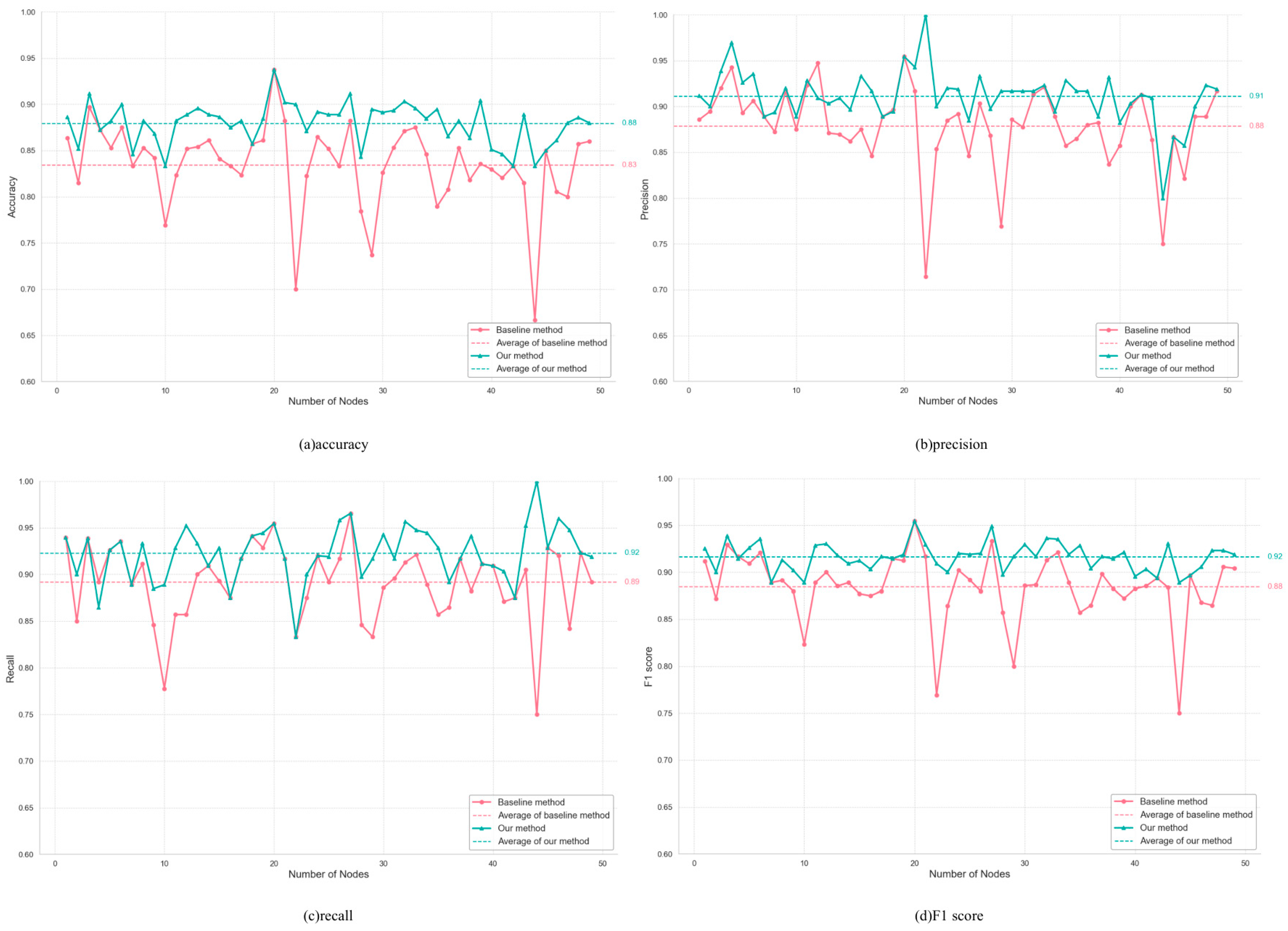
|---|---|---|---|---|
| Baseline method | 0.002123 | 0.001992 | 0.001752 | 0.001365 |
| Our method | 0.000501 | 0.000856 | 0.000876 | 0.000229 |
| Buyers | k1 | k2 | k3 |
|---|---|---|---|
| B1 | [100, 165, 180] | L | (1, 6, 10) |
| B2 | [125, 180, 260] | H | (2, 5, 10) |
| B3 | [90, 136, 200] | M | (3, 6, 14) |
| B4 | [110, 179, 240] | VH | (2, 8, 10) |
| B5 | [120, 180, 330] | VH | (1, 4, 10) |
| Sellers | k1 | k2 | k3 | Sellers | k1 | k2 | k3 |
|---|---|---|---|---|---|---|---|
| S1 | [148, 200] | L | (2, 5, 10) | S16 | [99, 160] | M | (2, 7, 10) |
| S2 | [200, 360] | VH | (3, 7, 12) | S17 | [128, 205] | M | (3, 7, 10) |
| S3 | [130, 215] | M | (1, 5, 10) | S18 | [110, 199] | M | (1, 5, 14) |
| S4 | [145, 250] | H | (3, 7, 10) | S19 | [100, 150] | L | (3, 10, 14) |
| S5 | [70, 188] | M | (3, 4, 10) | S20 | [89, 130] | L | (2, 7, 12) |
| S6 | [140, 220] | M | (2, 4, 7) | S21 | [179, 400] | VH | (1, 5, 7) |
| S7 | [160, 250] | H | (3, 9, 14) | S22 | [110, 199] | M | (2, 6, 10) |
| S8 | [138, 330] | H | (1, 5, 9) | S23 | [145, 280] | H | (1, 3, 7) |
| S9 | [160, 310] | VH | (2, 4, 7) | S24 | [125, 255] | M | (2, 6, 14) |
| S10 | [90, 175] | L | (5, 9, 12) | S25 | [210, 240] | H | (1, 4, 7) |
| S11 | [95, 200] | M | (2, 5, 9) | S26 | [173, 200] | H | (2, 5, 7) |
| S12 | [80, 155] | L | (3, 7, 14) | S27 | [163, 299] | VH | (1, 2, 7) |
| S13 | [125, 199] | H | (1, 5, 10) | S28 | [99, 120] | L | (3, 6, 10) |
| S14 | [180, 280] | VH | (1, 3, 7) | S29 | [133, 189] | M | (2, 7, 10) |
| S15 | [60, 100] | VL | (5, 10, 14) | S30 | [150, 240] | M | (3, 6, 14) |
| Methods | Matching Result | Satisfaction | Time | |||
|---|---|---|---|---|---|---|
| k1 | k2 | k3 | Sum | |||
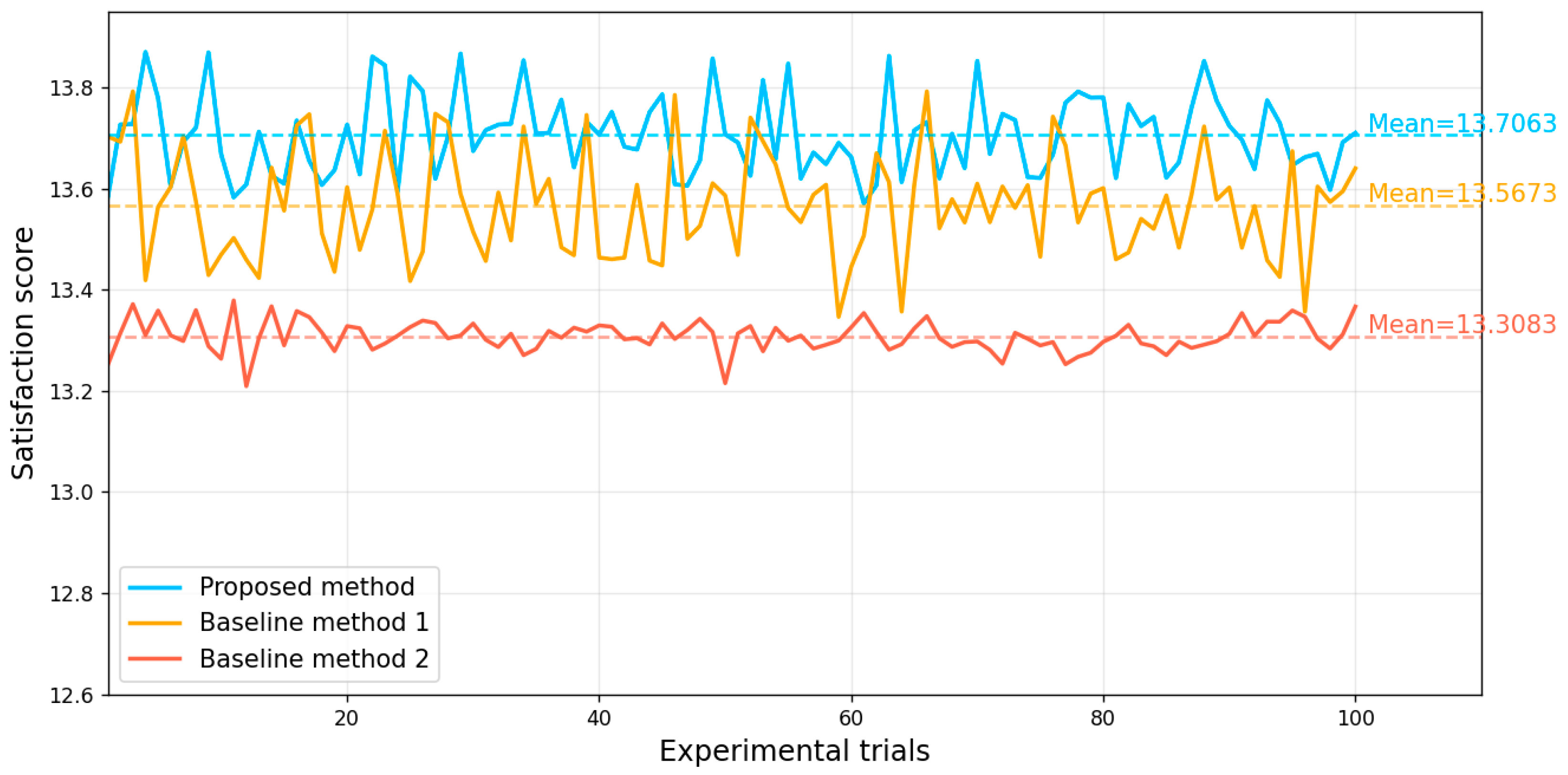
| Baseline method | 4.1884 | 5 | 4.1791 | 13.3675 | 1.0 s | |
| Our method | 4.0581 | 5 | 4.7346 | 13.7927 | 1.2 s | |
Disclaimer/Publisher’s Note: The statements, opinions and data contained in all publications are solely those of the individual author(s) and contributor(s) and not of MDPI and/or the editor(s). MDPI and/or the editor(s) disclaim responsibility for any injury to people or property resulting from any ideas, methods, instructions or products referred to in the content. |
© 2025 by the authors. Licensee MDPI, Basel, Switzerland. This article is an open access article distributed under the terms and conditions of the Creative Commons Attribution (CC BY) license.
Share and Cite
Zhang, Y.; Cao, R.; Wu, J. Matching Optimization for Automated Negotiation: From a Privacy-Enhanced Data Modeling Perspective. Mathematics 2026, 14, 152. https://doi.org/10.3390/math14010152
Zhang Y, Cao R, Wu J. Matching Optimization for Automated Negotiation: From a Privacy-Enhanced Data Modeling Perspective. Mathematics. 2026; 14(1):152. https://doi.org/10.3390/math14010152
Chicago/Turabian StyleZhang, Ya, Ruiyang Cao, and Jinghua Wu. 2026. "Matching Optimization for Automated Negotiation: From a Privacy-Enhanced Data Modeling Perspective" Mathematics 14, no. 1: 152. https://doi.org/10.3390/math14010152
APA StyleZhang, Y., Cao, R., & Wu, J. (2026). Matching Optimization for Automated Negotiation: From a Privacy-Enhanced Data Modeling Perspective. Mathematics, 14(1), 152. https://doi.org/10.3390/math14010152