


Abstract
This paper proposes a Takagi–Sugeno–Kang Elliptic Type-2 Fuzzy Brain-Imitated Neural Network (TET2FNN)-based decoupling control strategy for nonlinear underactuated mechanical systems subject to uncertainties. A sliding-mode framework is employed to construct a decoupled control architecture, in which an intermediate variable is introduced to separate two second-order sliding surfaces, thereby forming a decoupled slip surface. The TET2FNN acts as the main controller and approximates the ideal control law online, while a robust compensator is incorporated to suppress approximation errors and guarantee closed-loop stability. Simulation studies conducted on a double inverted pendulum system demonstrate that the proposed method achieves improved tracking accuracy and disturbance rejection compared with representative state-of-the-art controllers. Furthermore, the computational burden remains reasonable, indicating that the proposed scheme is suitable for real-time implementation and practical nonlinear control applications.
Keywords:
underactuated system; decoupling system; type-2 fuzzy system; brain-imitated neural network; sliding mode control MSC:
93A10; 93B05; 93D05; 93C10; 93C42; 93C95
1. Introduction
An underactuated mechanical system (UMS) is characterized by having fewer independent control actuators than the number of degrees of freedom (DOF) to be controlled. Such systems have attracted significant research attention due to their wide-ranging applications in various fields [1,2,3,4]. Examples include mobile robot spacecraft, underwater vehicles, surface ships, helicopters, space robots, and low-power manipulators [5,6,7,8,9]. Typical examples of UMS include the ball-and-beam system [10] and the double inverted pendulum [11,12]. These systems typically exhibit strong nonlinearities, structural underactuation, and time-varying dynamics, making accurate modeling and controller synthesis difficult, particularly under uncertainty and external disturbances [13,14,15,16,17].
To address these challenges, numerous control methodologies have been developed, among which sliding-mode control (SMC) has gained prominence for its inherent robustness to modeling errors, nonlinearities, and bounded disturbances [18,19,20,21]. SMC has been widely applied to uncertain nonlinear systems [22,23,24,25,26] and remains attractive due to its simplicity and strong invariance properties [27,28,29,30,31]. However, classical SMC is primarily effective for second-order dynamics and becomes considerably more difficult to apply directly to higher-order or strongly coupled fourth-order UMS, where issues such as chattering, degraded tracking performance, and reduced robustness may arise.
Intelligent control approaches have therefore been investigated to overcome the limitations of classical nonlinear methods. Neural networks (NNs), known for their universal approximation capability, have been applied extensively to nonlinear and uncertain systems [32,33,34,35]. Their ability to learn nonlinear mappings and adapt parameters online has generated significant interest across scientific and engineering domains [36,37,38,39,40]. However, NN-based controllers often suffer from high computational complexity, sensitivity to parameter initialization, and a lack of explicit mechanisms for uncertainty representation, which limits their applicability in highly nonlinear underactuated systems. Brain-inspired neural structures, such as the Brain Emotional Learning Controller (BELC) [41] and the Brain-Imitated Neural Network (BINN) [42] have shown improved adaptability, yet still face challenges in handling structured and unstructured uncertainties simultaneously.
Fuzzy logic systems offer another pathway for uncertainty handling. Type-1 fuzzy systems have been widely used in fuzzy neural networks and BELC-like structures, but their reliance on precise membership functions restricts their ability to manage modeling inaccuracies and ambiguous information [43]. Type-2 fuzzy logic systems extend type-1 systems by introducing a footprint of uncertainty, thereby improving robustness in the presence of incomplete or imprecise data [44,45]. However, interval and general type-2 fuzzy systems typically require computationally intensive type-reduction processes (e.g., Karnik-Mendel algorithms [43,46]), and their membership function parameters are often interdependent, complicating controller design. Elliptic type-2 membership functions have recently been proposed to overcome these issues [47,48,49,50] by decoupling width and support parameters, enabling compact uncertainty representation, and eliminating the need for explicit type-reduction while maintaining smooth differentiability.
Despite these advances, nonlinear underactuated systems remain challenging due to strong coupling, unmodeled dynamics, and external disturbances [51]. To enhance robustness and adaptability, Lotfi et al. introduced the BINN architecture [52], which incorporates biologically inspired sensory–emotional processing to improve learning and decision-making under uncertainty. When combined with Takagi–Sugeno–Kang (TSK) fuzzy inference mechanisms [42], BINN provides a powerful hybrid structure capable of approximating highly nonlinear control laws while modeling dynamic uncertainty.
To overcome the limitations of existing sliding-mode, neural-network, and fuzzy-logic approaches, this paper proposes a novel controller that integrates elliptic type-2 membership functions, the BINN learning mechanism, and a TSK fuzzy inference structure. The resulting Takagi–Sugeno–Kang Elliptic Type-2 Fuzzy Brain-Imitated Neural Network (TET2FNN) forms a generalized type-2 neural-fuzzy framework with enhanced uncertainty modeling. The architecture is simplified into a single-layer structure with one neuron per functional block, and its adaptive learning laws are developed using sliding-mode principles to ensure robust convergence. This integrated design provides improved approximation capability, reduced computational complexity, and superior robustness for nonlinear fourth-order underactuated mechanical systems.
The main contributions of this paper are as follows:
- (1)
- Design of elliptic type-2 neural network TSK controller applied to the decoupling control system for underactuated mechanism.
- (2)
- The proof of stability for the proposed control system, ensuring effective and safe operation.
- (3)
- The development of a decoupling control approach by introducing an intermediate variable to separate two second-order sliding mode surfaces, establishing a decoupling slip surface.
- (4)
- The integration of the TET2FNN controller with a robust compensator to correct approximation errors and maintain system stability.
- (5)
- The effectiveness and superior performance of the proposed method are validated by comparative simulations against existing controllers on a double inverted pendulum system.
2. Problem Formulation
Referring to the following expression for a nonlinear, underactuated system
where are state vector, u denotes control input, are nonlinear functions, are matched disturbances.
The description of tracking errors is provided below:
where stands for goal values. Using sliding surface we can reduce the number of errors to two variables with as coefficients, as follows.
can be calculated as follows:
where is the boundary space of . In addition, the saturation (.) function is defined as
The ideal controller shown below can be derived from and is capable of stabilizing the system (1).
The ideal controller in Equation (7) cannot be directly implemented because the nonlinear function and external disturbances are not measurable in practice. To address this limitation, a Takagi–Sugeno–Kang Type-2 Elliptic Fuzzy Neural Network (TET2FNN) is proposed in this study as an effective approximation of the ideal control law.
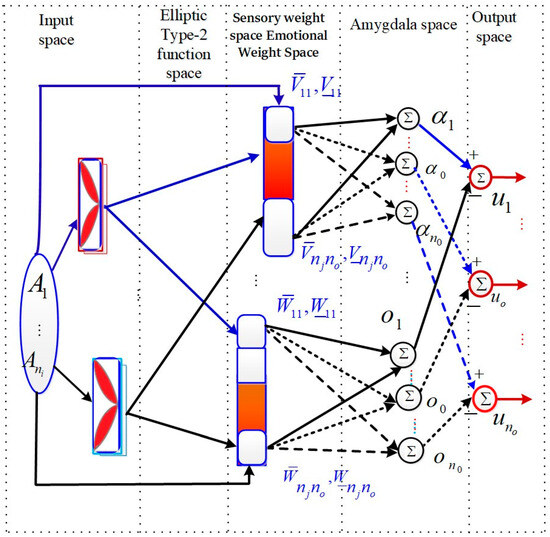
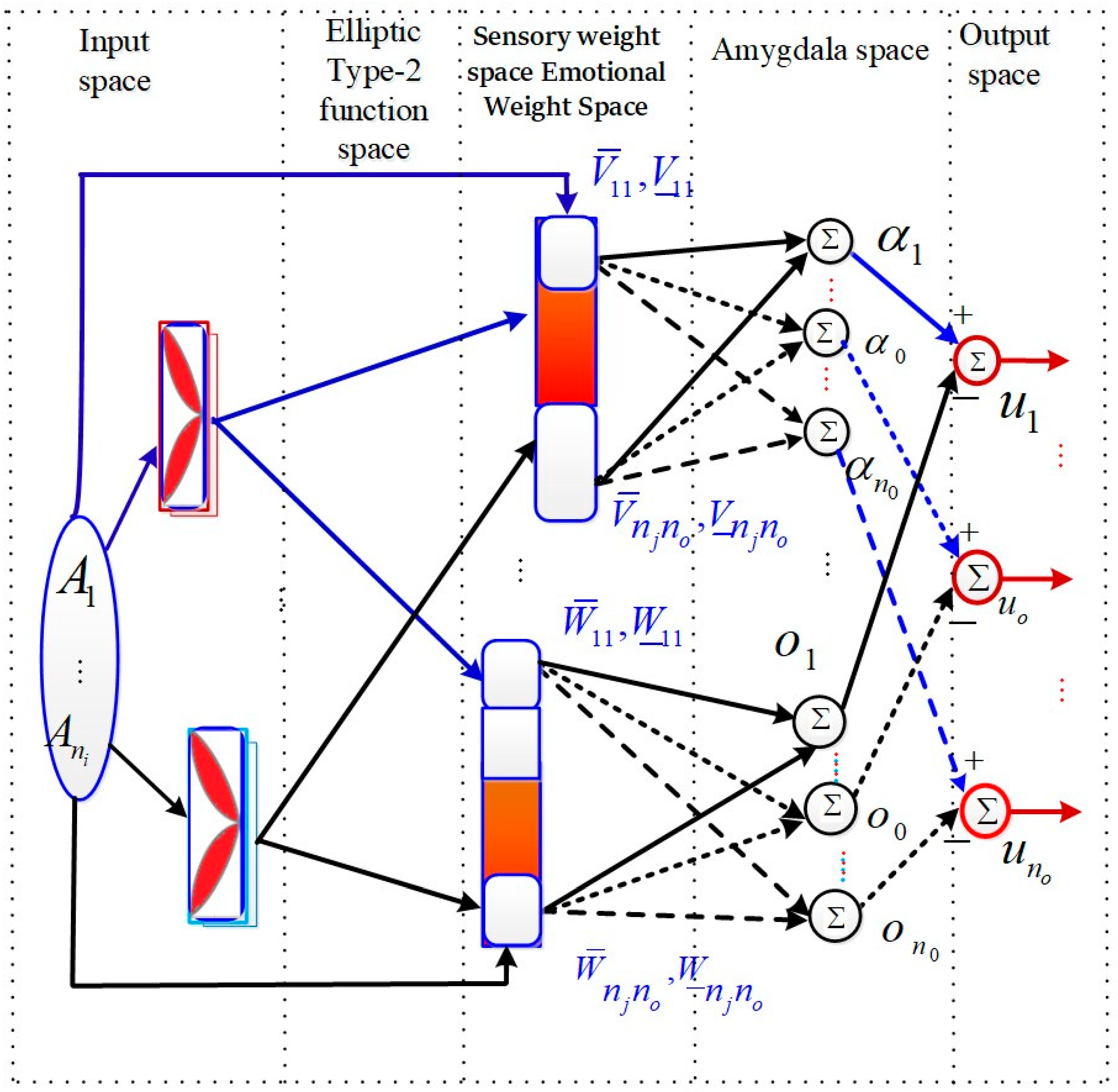
Figure 1 illustrates the architecture of the proposed TSK Elliptic Type-2 Fuzzy Brain-Imitated Neural Network (TET2FNN). The controller is structured into several functionally distinct yet tightly interconnected processing layers. The input space first receives the system states and relevant external signals. These inputs are then mapped in the elliptic type-2 fuzzy function space, where elliptic membership functions are used to characterize and differentiate system uncertainties.
Figure 1.
The structure of the TET2FNN.
The transformed signals progress through the sensory weight space and emotional weight space, which emulate biological mechanisms of sensory evaluation and emotional modulation. The outputs of these layers are subsequently integrated within the amygdala and orbitofrontal cortex sub-output spaces, representing brain-inspired structures responsible for adaptive decision-making. Finally, the output space synthesizes the overall neural response to generate the control input for the underactuated mechanical system.
Collectively, this modular architecture demonstrates how the TET2FNN fuses elliptic type-2 fuzzy modeling with brain-inspired neural processing to deliver robust, adaptive control for nonlinear underactuated systems operating under uncertainty.
In more detailed terms, the TET2FNN comprises six major interconnected spaces:
- (1)
- Input space, responsible for acquiring system states and environmental signals;
- (2)
- Elliptic type-2 fuzzy function space, which transforms inputs using elliptic membership functions with strong uncertainty-handling capability;
- (3)
- Sensory weight space, which performs sensory evaluation analogous to biological perception;
- (4)
- Emotional weight space, which modulates responses based on emotional-inspired weighting mechanisms;
- (5)
- Amygdala and orbitofrontal cortex spaces, responsible for subcortical and cortical-level adaptive learning and decision-making; and
- (6)
- Output space, which integrates all processed information to produce the final control action.
The coordinated operation of these spaces underpins the adaptive, robust, and uncertainty-aware characteristics of the TET2FNN, enabling superior performance in the control of nonlinear underactuated mechanical systems.
3. Takagi–Sugeno–Kang Elliptic Type-2 Fuzzy Neural Network (TET2FNN)
Figure 1 depicts the architecture of the proposed TET2FNN. The controller is structured into the following subspaces: the input space, the elliptic type-2 function space, the sensory weight space, the emotional weight space, the amygdala sub-output space, the orbitofrontal cortex sub-output space, and the output space. The input space receives the system states and error signals. These signals are then mapped in the elliptic type-2 function space using elliptic membership functions to capture modeling uncertainties. The sensory weight space and emotional weight space encode brain-inspired sensory evaluation and emotional modulation, respectively. The amygdala and orbitofrontal cortex sub-output spaces integrate these responses to emulate adaptive decision-making. Finally, the output space synthesizes the resulting control signal. For clarity and consistency, the same set of subspaces is listed in the annotation of Figure 1, separated by commas to avoid ambiguity.
3.1. Input Space
, where np is the input dimension.
3.2. Elliptic Type-2 Function Space
The lower and upper elliptic type-2 functions are defined as follows, with each formulation capturing the distinct mathematical characteristics and operational roles of the corresponding boundary surface. The lower elliptic type-2 function represents the minimal, or conservative, estimate within the elliptic interval framework, whereas the upper elliptic type-2 function provides the maximal, or liberal, estimate. Together, these two functions bound the uncertainty domain and enable a rigorous characterization of both the under-approximated and over-approximated regions inherent in the elliptic type-2 structure.
where parameters and denote, respectively, the mean and the variance of the elliptic type-2 function.
Set , Equations (8) and (9) can be rewritten as follows
3.3. Sensory Weight Space
Upper and lower weights of the sensory space are defined as follows by the TSK fuzzy system and the wavelet function of the input.
Set
3.4. Emotional Weight Space
The upper and lower weights of the emotional space are defined using the TSK fuzzy system and the wavelet function.
3.5. Amygdala and Orbitofrontal Cortex Sub-Output Space
Within the neural signal-processing architecture, the sub-output spaces corresponding to the amygdala and orbitofrontal cortex play a critical role in regulating emotional responses and modulating decision-making. These two sub-output channels are designed to emulate the interaction between key brain regions that integrate sensory and emotional information to produce adaptive control actions. The outputs of the amygdala sub-output channel and the orbitofrontal cortex sub-output channel are computed as follows:
3.6. Output Space
The output corresponding to the k-th channel of the TET2FNN controller is computed through a carefully defined mathematical formulation.
4. Online Learning Rules and Convergence Analysis
The cost function is chosen and formulated as follows:
where . The parameter representing the desired output is denoted as . The formula used to govern the periodic update of this parameter is given by the following expression:
where possibly depends on one of these factors . Instead of updating , we will instead update , and . The law for adjusting these parameters is expressed by the chain rule as follows:
where are small learning rates with positive values.
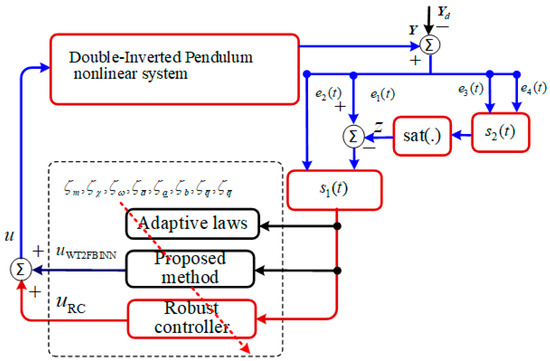
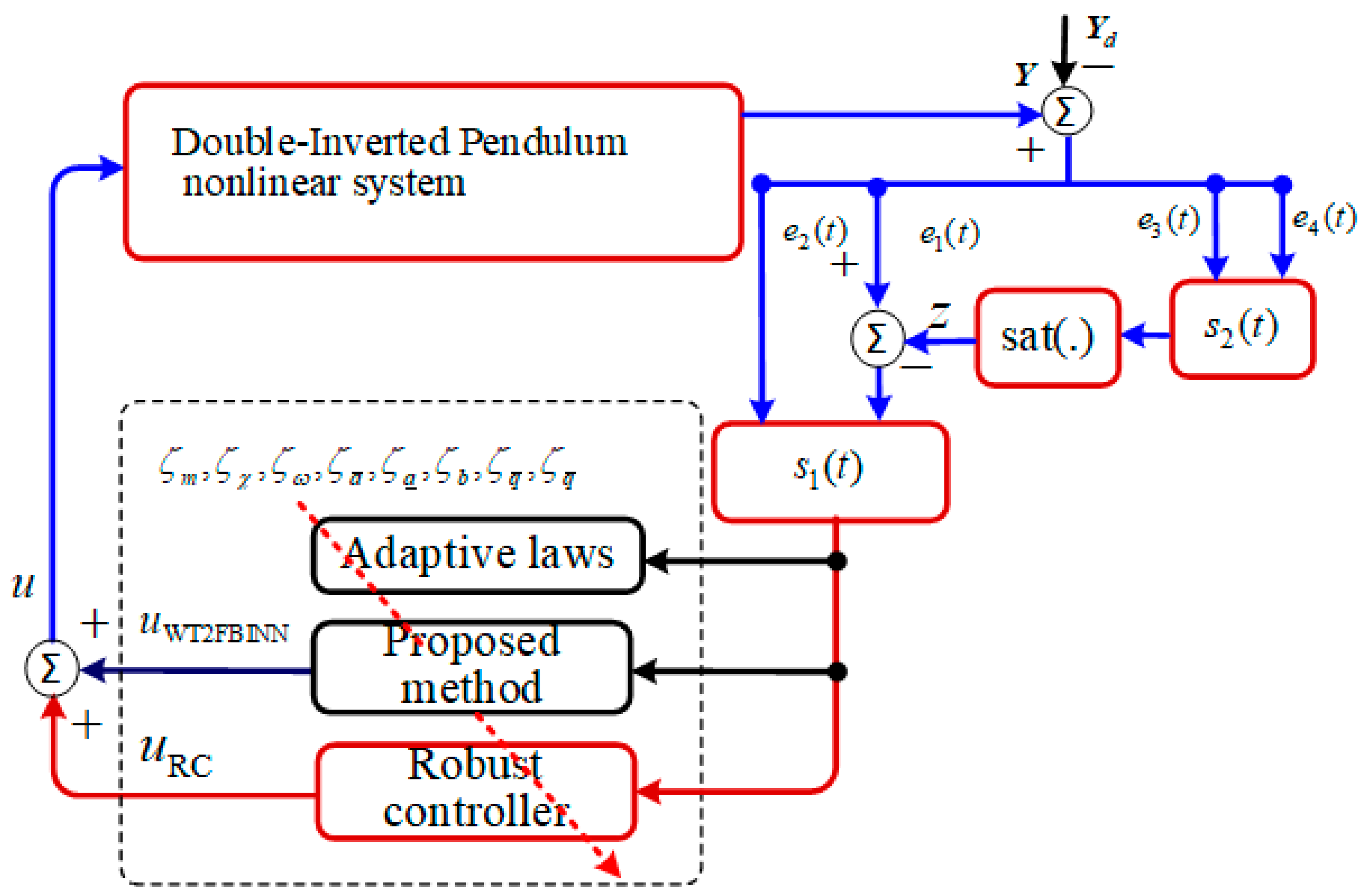
In Figure 2, the dotted arrow denotes the adaptation signal used for online parameter tuning.
Figure 2.
The structure of the proposed approach.
4.1. Lyapunov-Based Stability Analysis of the TET2FNN Control Scheme
Assumption A1.
The desired trajectory and its required derivatives are bounded, and the reference input is bounded.
Assumption A2.
The lumped disturbance and unmodeled dynamics are bounded, i.e., .
Assumption A3.
The regressor vector and activation functions of the TET2FNN are bounded for all x(t) in a compact set . By the universal approximation property, there exists an ideal parameter vector
such that
Consider the Lyapunov function
where is the sliding variable and the parameter estimation error.
Substituting the error dynamics, control law, and adaptation laws into , we obtain
The approximation-error and disturbance terms are bounded by Assumptions A2 and A3 and by the Cauchy–Schwarz and Young inequalities. For example,
and similar bounds hold for and Choosing the adaptation laws so that the terms involving cancel out, we obtain
where > 0 and depend on , and the Young constants .
From the above inequality , it follows that is bounded; hence and are also bounded. Moreover, when , we have , so the trajectories enter and remain in the set
Therefore, , and consequently the tracking error, are uniformly ultimately bounded. This can be summarized as follows.
Lemma 1.
Under Assumptions A1–A3 and the proposed control and adaptation laws, all closed-loop signals remain bounded.
Theorem 1.
Under the same assumptions, the tracking error e(t) is uniformly ultimately bounded. More precisely, there exist positive constants alpha, beta such that
4.2. Robus Compensator Design
The robust controller can be defined as:
where is an estimated value of . And the adaptive law of can be chosen below.
Choosing a Lyapunov function:
With
Choose sufficiently large to dominate uncertainties. If and are chosen large enough, it can be ensured that , where α > 0, indicating that the Lyapunov function decreases continuously. This leads to .
That is, the sliding variable converges to zero as t increases, ensuring Lyapunov stability for the system.
Since denotes constant so , so
Because cannot be negative, so and and are constrained, so can be increase and bounded. This suggests that when then . Hence, the proposed control strategy effectively maintains system stability.
A complete pseudo-code algorithms can be shown as follows:
Step 1: Inputs: Measure/estimate the state obtain the reference (and required derivatives), and set all design constants and learning rates.
Step 2: Tracking error: Compute .
Step 3: Sliding surfaces: Compute () and the combined sliding variable (s); apply the boundary-layer saturation .
Step 4: Network input vector: Form .
Step 5: TET2FNN forward inference: Evaluate type-2 (upper/lower) memberships → compute firing strengths → sensory/emotional processing → obtain .
Step 6: Robust compensator: Compute using s, , and .
Step 7: Total control signal: Compute and adapt u to the plant.
Step 8: Online adaptation: Update the TET2FNN parameters using the adaptive laws based on s.
Step 9: Repeat: Advance time and repeat the loop (from Step 2 to Step 8).
Moreover, the computational complexity analysis can be shown as follows:
- Membership evaluation:
- Sub-output and output computation: for each k, the key sums over
- Parameter adaptation: updating weights associated with is also updating membership parameters adds
- Overall time complexity (dominant term):
- Memory complexity: for the sensory/emotional weight parameters plus for membership parameters and temporary activations.
5. Simulation and Results Using the Proposed Method
The dynamic behavior of a double inverted pendulum system is simulated to assess the effectiveness of the proposed control strategies. A comprehensive comparison is conducted between the conventional Sliding Mode Control (SMC) approach and the newly developed decoupling control method based on the Takagi–Sugeno–Kang Fuzzy Brain-Imitated Neural Network (TSKFBINN). The objective is to demonstrate the superior performance and robustness of the proposed controller when dealing with the highly nonlinear and underactuated dynamics of the system.
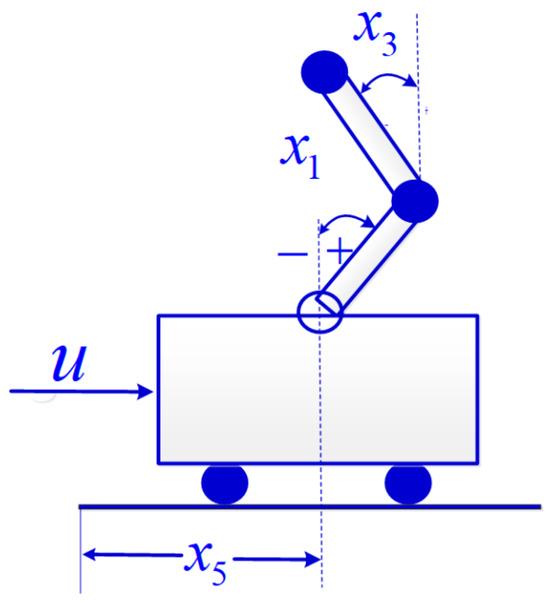
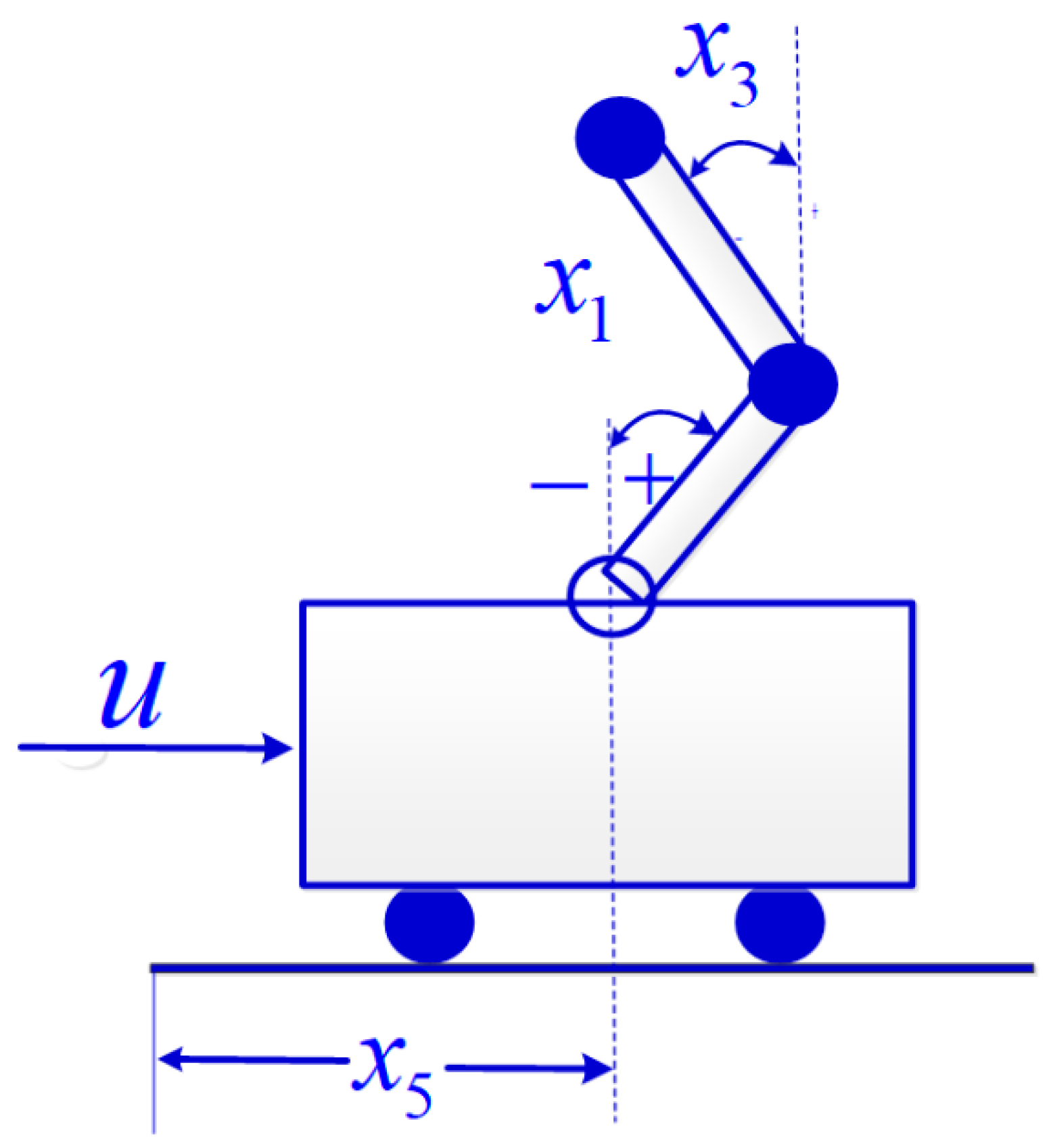
Figure 3 presents the structural configuration and controlled state variables of the double inverted pendulum, providing a clear reference for the subsequent control design and simulation analysis. The dynamic equations governing the system are formulated using Lagrangian mechanics, accurately capturing the coupled interactions between the two-pendulum links, their angular positions and velocities, and the influences of gravitational and inertial effects. These equations describe a strongly nonlinear and inherently unstable system, making them essential for precise modeling and controller development.
Figure 3.
Structure of a double-inverted pendulum.
Simulation results are used to evaluate the performance of the classical SMC and the proposed TSKFBINN-based decoupling controller. The findings indicate that the TSKFBINN controller achieves superior stabilization, faster transient response, and enhanced robustness against system uncertainties and external disturbances. These results highlight the benefits of integrating fuzzy-neural reasoning and biologically inspired adaptive mechanisms into advanced control frameworks for complex nonlinear systems such as the double inverted pendulum [53,54].
where state variables and descriptions for the double inverted pendulum system are tabulated in Table 1 below.
Table 1.
State variables and descriptions for the double inverted pendulum system.
The variables used in the subsequent discussion are defined as follows:
where is the threshold value of . In the simulation, the following specifications are used:
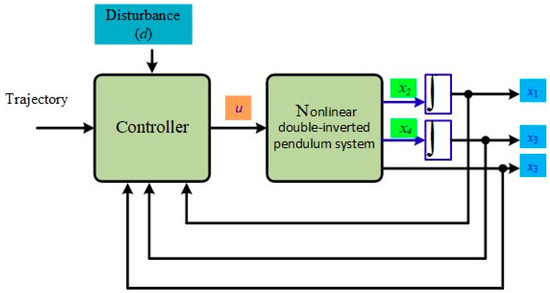
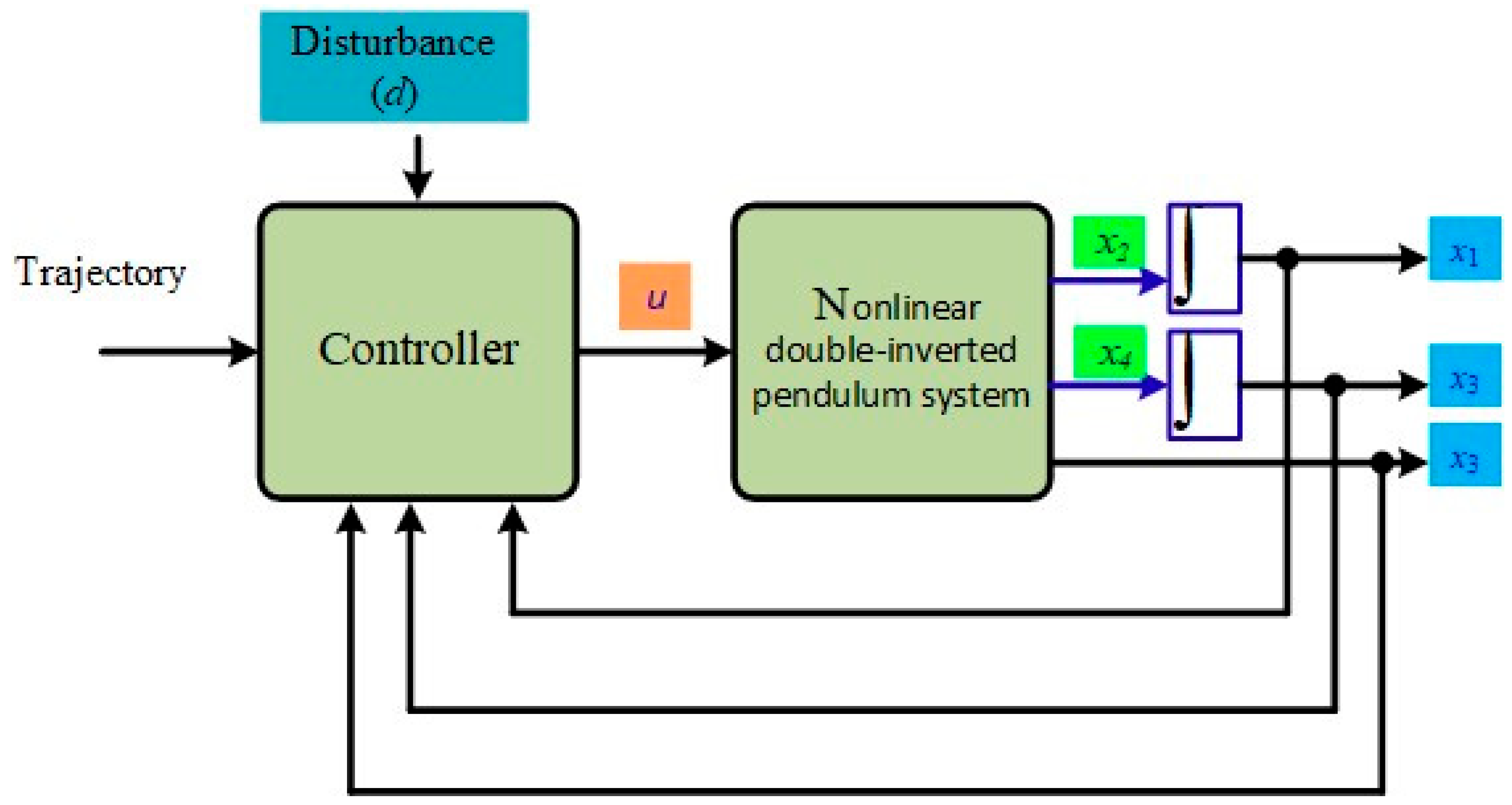
In summary, the control block diagram for the nonlinear decoupling system is presented in Figure 4. In the simulations, parameter values of the proposed TET2FNN controller can be chosen in Table 2 as follows.
Figure 4.
Diagram of the proposed control system.
Table 2.
The parameter values of the proposed TET2FNN.
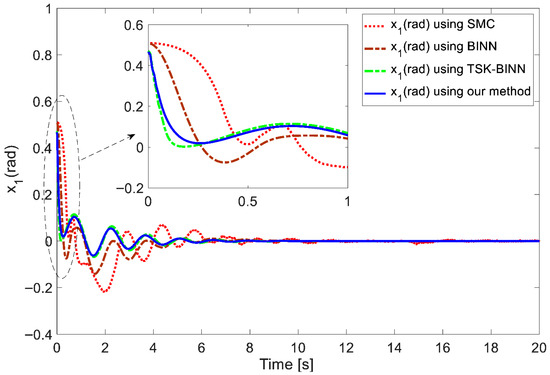
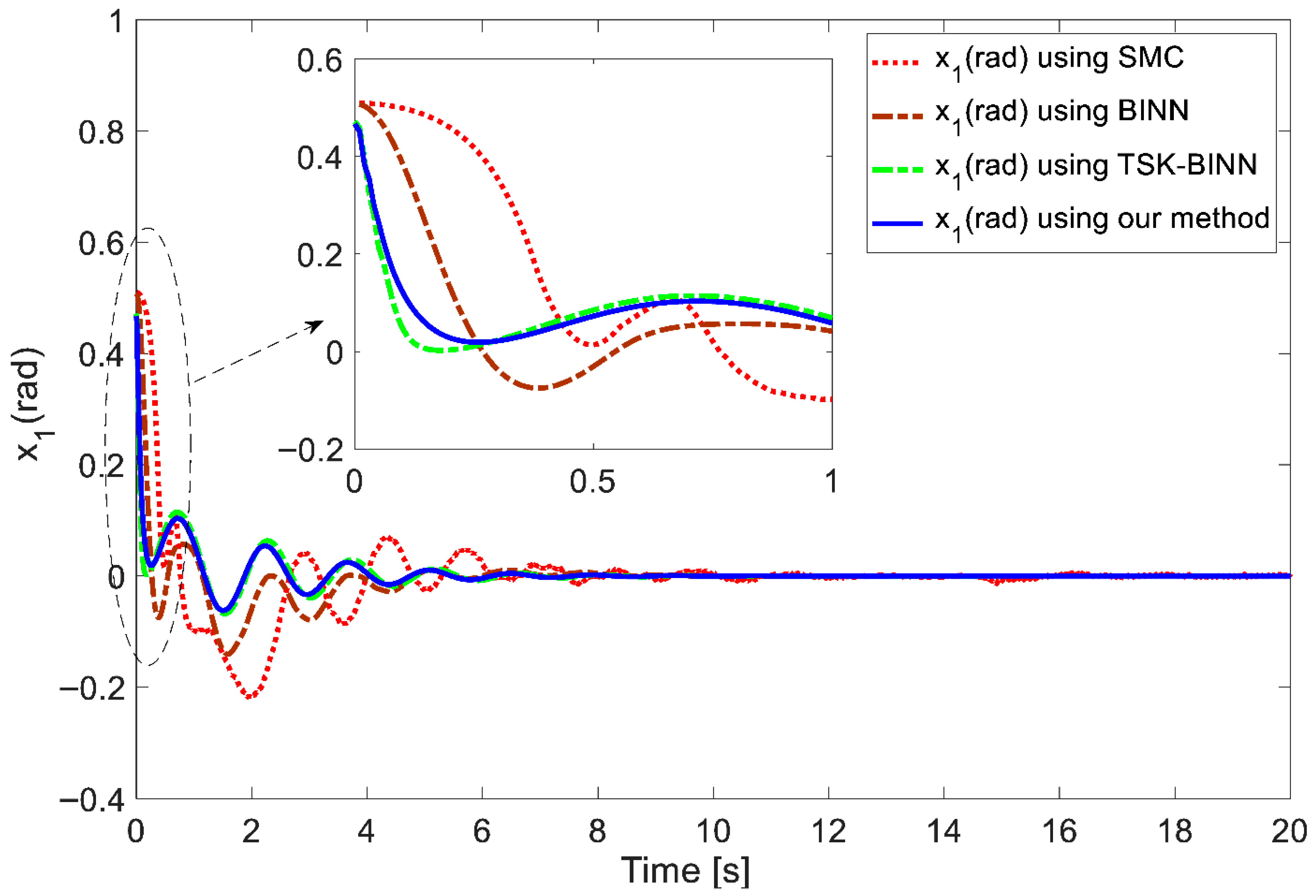
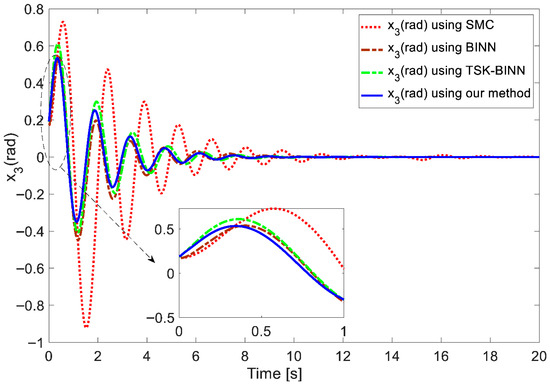
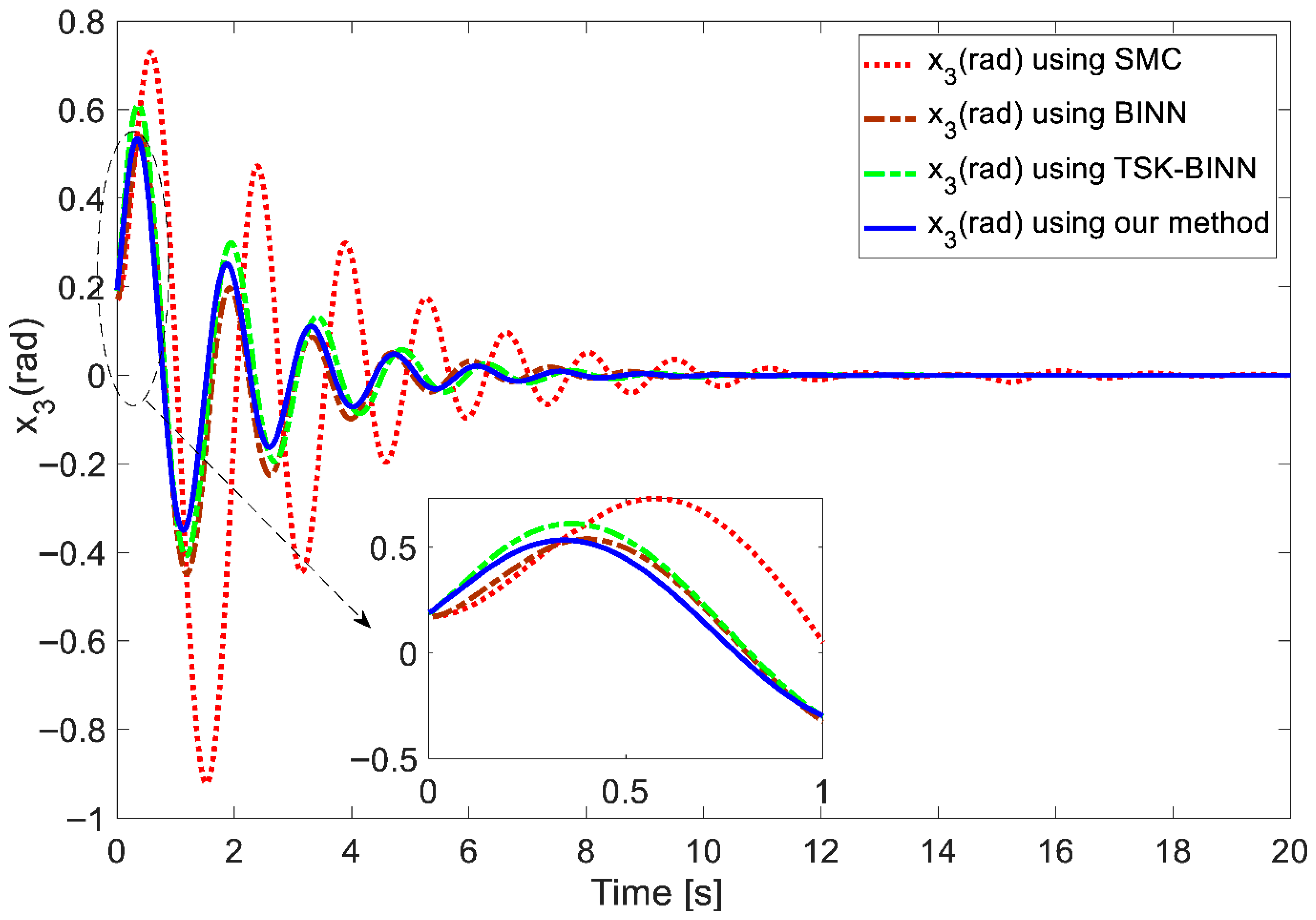
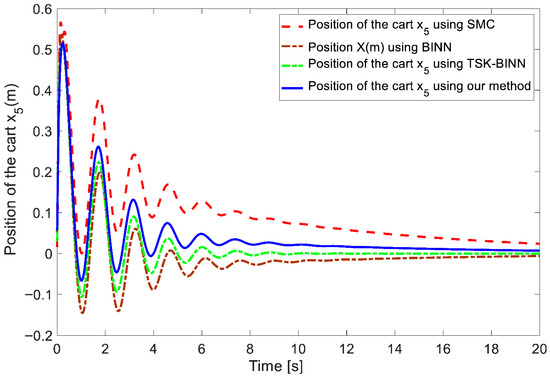
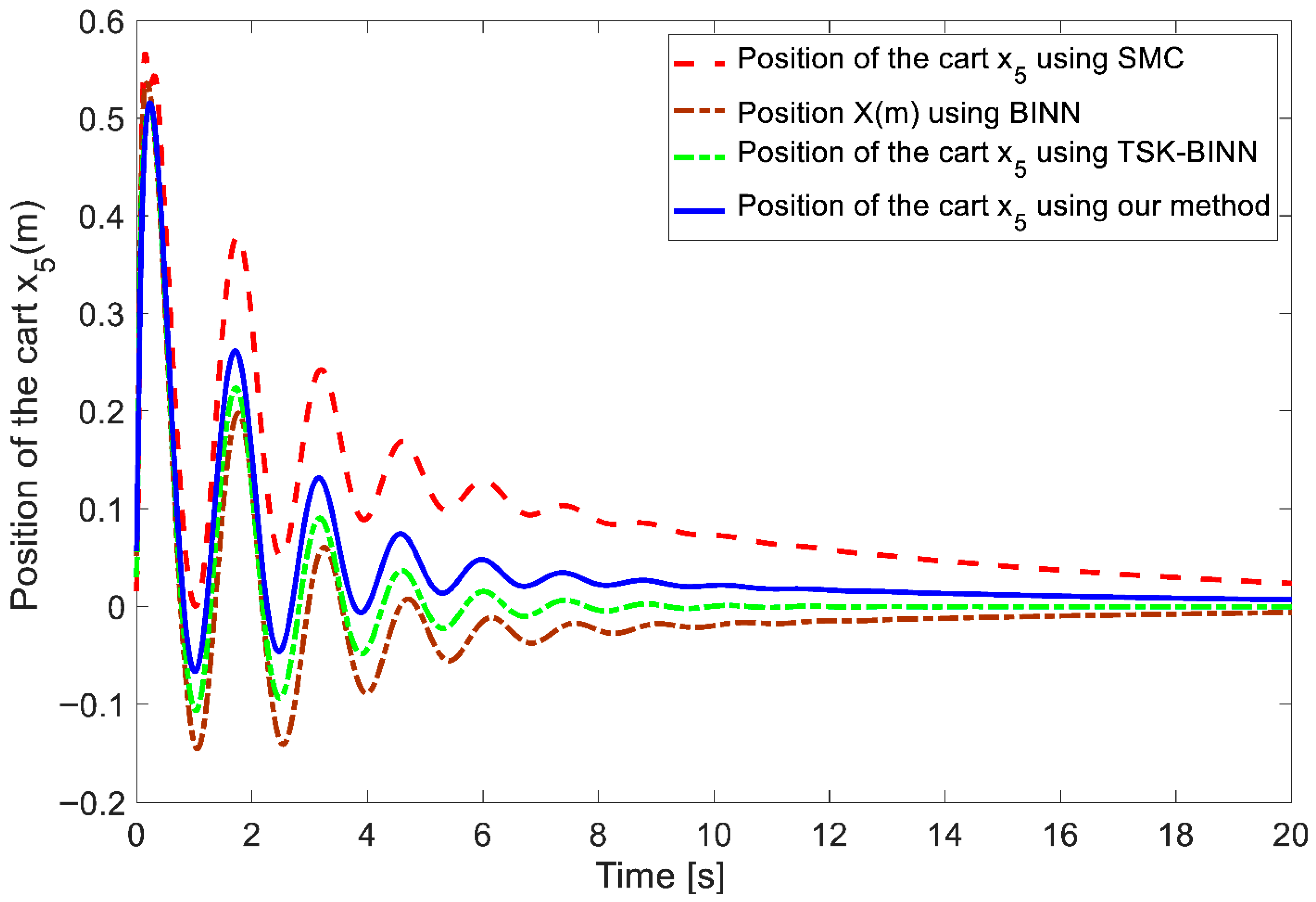
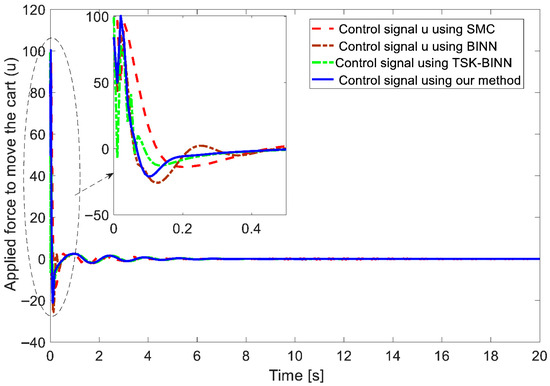
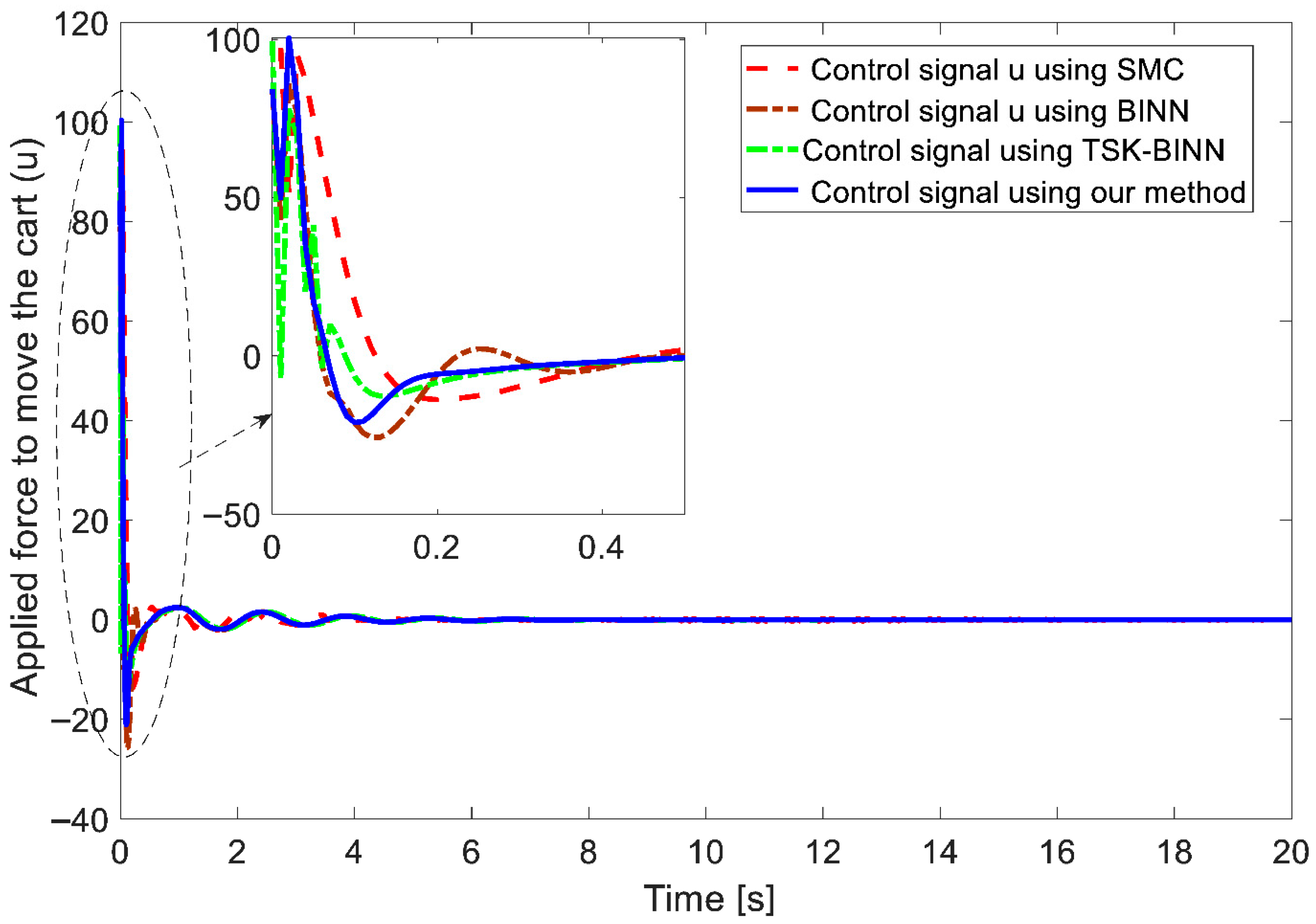
The simulation results clearly demonstrate that both the pendulum arms and the cart in the double inverted pendulum system are effectively stabilized at their respective equilibrium points under the proposed control strategy. As shown in Figure 5, Figure 6, Figure 7 and Figure 8, the system states exhibit smooth convergence toward the desired operating conditions: the angular displacements of both pendulums asymptotically approach zero, indicating successful upright stabilization, while the cart position settles precisely at the target reference. These results confirm the controller’s capability to regulate the coupled nonlinear dynamics and maintain global system equilibrium.
Figure 5.
Angle evolution of pole 1 relative to the vertical axis ().
Figure 6.
Angle evolution of pole 2 relative to the vertical axis ().
Figure 7.
Position evolution of the cart ().
Figure 8.
Control evolution of the cart (u).
A quantitative analysis of the error trajectories further reveals that deviations in both angular positions and cart displacement diminish progressively and converge to negligible magnitudes over time. Moreover, comparative evaluations indicate that the proposed TET2FNN-based decoupling controller significantly outperforms the classical Sliding Mode Control (SMC) approach in stabilization speed, steady-state accuracy, and robustness against external disturbances and model uncertainties. This superior performance is primarily attributed to the adaptive fuzzy-neural architecture of the proposed controller, which enhances its ability to manage complex nonlinearities and uncertainties inherent in underactuated mechanical systems such as the double inverted pendulum.
In addition, to benchmark the proposed controller against recent approaches, the root mean square error (RMSE) was computed for each method, and the results are summarized in Table 3. As observed, the proposed method achieves a substantially lower average RMSE compared with the classical SMC approach [11], reducing the error by a factor of 0.3373/0.1552 = 2.1733. Similarly, it outperforms the Brain-Imitated Neural Network method in [42], achieving a reduction factor of 0.1802/0.1552 = 1.1611. Finally, it outperforms the Takagi–Sugeno–Kang Brain-Imitated Neural Network method in [55], achieving a reduction factor of 0.1631/0.1552 = 1.0509. These results clearly demonstrate the superior accuracy and effectiveness of the proposed approach for controlling underactuated nonlinear systems.
Table 3.
RMSE comparison between the proposed method and state-of-the-art techniques.
6. Comparative Analysis with Existing Approaches
Table 3 shows that the proposed TET2FNN achieves the lowest RMSE, with an average value of 0.1552. This corresponds to an improvement of approximately 2.17 times over the classical SMC controller [11] and 1.16 times over the BINN-based controller [42], demonstrating a clear enhancement in tracking accuracy on the double inverted pendulum benchmark.
As summarized in Table 3, the classical SMC method offers simplicity and strong disturbance rejection; however, its performance degrades significantly when applied to the studied fourth-order underactuated system. The BINN controller improves upon SMC by incorporating brain-inspired adaptive learning, but its design is complex, computationally demanding, and lacks explicit type-2 fuzzy uncertainty handling. Type-1 FNNs are comparatively easy to design, yet their reliance on precise membership functions makes them sensitive to modeling errors and unsuitable for environments with substantial uncertainty. Type-2 FNNs enhance uncertainty representation but introduce increased computational complexity due to type-reduction and coupled membership parameter tuning.
In contrast, the proposed TET2FNN integrates elliptic type-2 fuzzy sets with a brain-imitated neural architecture. The elliptic type-2 membership functions decouple width and support parameters and capture compact uncertainty regions without requiring explicit type-reduction, thereby improving robustness while maintaining moderate computational cost. Meanwhile, the brain-imitated structure-comprising sensory and emotional processing spaces along with amygdala and orbitofrontal cortex sub-output pathways-provides adaptive learning and real-time error compensation. When embedded within a decoupling sliding-mode framework, these features collectively yield superior stability, faster convergence, and higher tracking accuracy than SMC, BINN, and conventional fuzzy-neural controllers, as consolidated in Table 4.
Table 4.
Comparison of control methods for underactuated nonlinear systems evaluated on the double inverted pendulum.
7. Conclusions
This paper has introduced a novel decoupling control strategy for nonlinear underactuated mechanical systems with uncertainties, employing a TSK Elliptic Type-2 Fuzzy Brain-Imitated Neural Network (TET2FNN) integrated within a sliding-mode control framework. By combining the inherent robustness of sliding-mode control with the adaptive approximation capability of the TET2FNN, the proposed method achieves effective decoupling and strong resilience to uncertainties in fourth-order nonlinear dynamics. Simulation studies on a double inverted pendulum system demonstrate that the proposed controller delivers superior stability, tracking accuracy, and disturbance rejection compared with representative conventional control schemes.
Despite its promising performance, some limitations remain. First, the computational complexity associated with the TET2FNN, particularly the elliptic type-2 fuzzy membership functions, may constrain real-time implementation in systems with high-dimensional state spaces or fast dynamics. Second, the present design focuses on single-input fourth-order systems, which may limit direct extension to multi-input or higher-order underactuated structures. Third, although robustness is enhanced, the approach still relies on careful parameter tuning and may encounter challenges under severe external disturbances or significant model uncertainty.
Future research directions include developing more computationally efficient algorithms for TET2FNN training and inference, extending the proposed framework to multi-input multi-output underactuated systems, and incorporating adaptive or learning-based mechanisms for real-time parameter tuning. Additionally, experimental validation on physical robotic platforms or underactuated mechanical systems will be essential to further assess the practical feasibility and robustness of the proposed approach.
Overall, the TET2FNN-based decoupling control framework represents a meaningful advancement in intelligent control of nonlinear uncertain systems and shows strong potential for applications in robotics, aerospace, and intelligent automation.
Author Contributions
Conceptualization, D.H.P.; methodology, D.H.P. and V.T.M.; software, D.H.P.; validation, D.H.P.; formal analysis, D.H.P.; resources, D.H.P.; data curation, D.H.P.; writing—original draft preparation, D.H.P.; writing—review and editing, D.H.P. and V.T.M.; visualization, D.H.P. and V.T.M.; supervision, D.H.P. and V.T.M.; project administration, D.H.P.; and funding acquisition, D.H.P. All authors have read and agreed to the published version of the manuscript.
Funding
This research received no external funding.
Institutional Review Board Statement
Not applicable.
Informed Consent Statement
Not applicable.
Data Availability Statement
The original contributions presented in this study are included in the article. Further inquiries can be directed to the corresponding authors.
Conflicts of Interest
The authors declare no conflicts of interest.
Abbreviations
| UMS | Underactuated Mechanical System |
| DOF | Degree of Freedom |
| NN | Neural Network |
| NNs | Neural Networks |
| FNN | Fuzzy Neural Network |
| BELC | Brain Emotional Learning Controller |
| BINN | Brain-Imitated Neural Network |
| TSK | Takagi–Sugeno–Kang fuzzy system |
| ET2FBINN | Elliptic Type-2 Fuzzy Brain-Imitated Neural Network |
| TET2FNN | Takagi–Sugeno–Kang Elliptic Type-2 Fuzzy Neural Network (proposed controller) |
| SMC | Sliding Mode Control |
| RMSE | Root Mean Square Error |
| MSE | Mean Square Error |
References
- Mokhtare, Z.; Vu, M.T.; Mobayen, S.; Fekih, A. Design of an LMI-based fuzzy fast terminal sliding mode control approach for uncertain MIMO systems. Mathematics 2022, 10, 1236. [Google Scholar] [CrossRef] [Scilit]
- Wang, J.; Wu, Y.; Chen, C.L.P.; Liu, Z.; Wu, W. Adaptive PI event-triggered control for MIMO nonlinear systems with input delay. Inf. Sci. 2024, 677, 120817. [Google Scholar] [CrossRef] [Scilit]
- Lu, B.; Fang, Y. Online trajectory planning control for a class of underactuated mechanical systems. IEEE Trans. Autom. Control. 2023, 69, 442–448. [Google Scholar] [CrossRef] [Scilit]
- Wang, B.; Sun, J.; Peng, B.; Cui, X.; Cheng, L.; Zheng, X. Optimal event-triggered neural learning tracking control for pneumatic muscle antagonistic joint with asymmetric constraints. IEEE Trans. Ind. Electron. 2025, 72, 14677–14687. [Google Scholar] [CrossRef] [Scilit]
- Luan, Z.; Zhao, W.; Wang, C. Coordinated tracking control of the integrated wheel-end system based on generalized instantaneous steering center constraint. IEEE Trans. Transp. Electrific 2025, 11, 8271–8281. [Google Scholar] [CrossRef] [Scilit]
- Liang, J.; Tan, C.; Yan, L.; Zhou, J.; Yin, G.; Yang, K. Interaction-aware trajectory prediction for safe motion planning in autonomous driving: A transformer-transfer learning approach. IEEE Trans. Intell. Transp. Syst. 2025, 26, 17080–17095. [Google Scholar] [CrossRef] [Scilit]
- Li, D.; Tong, S.; Yang, H.; Hu, Q. Time-synchronized control for spacecraft reorientation with time-varying constraints. IEEE/ASME Trans. Mechatron. 2025, 30, 2073–2083. [Google Scholar] [CrossRef] [Scilit]
- Wu, T.; Li, M.; Qu, Y.; Wang, H.; Wei, Z.; Cao, J. Joint UAV deployment and edge association for energy-efficient federated learning. IEEE Trans. Cogn. Commun. Netw. 2025, 11, 4126–4140. [Google Scholar] [CrossRef] [Scilit]
- Alattas, K.A.; Vu, M.T.; Mofid, O.; El-Sousy, F.F.; Fekih, A.; Mobayen, S. Barrier function-based nonsingular finite-time tracker for quadrotor UAVs subject to uncertainties and input constraints. Mathematics 2022, 10, 1659. [Google Scholar] [CrossRef] [Scilit]
- Zafar, F.; Malik, S.A.; Ali, T.; Daraz, A.; Afzal, A.R.; Bhatti, F.; Khan, I.A. Stabilization and tracking control of underactuated ball and beam system using metaheuristic optimization-based TID-F and PIDD2–PI control schemes. PLoS ONE 2024, 19, e0298624. [Google Scholar] [CrossRef] [Scilit] [PubMed]
- Lin, C.M.; Mon, Y.J.; Li, M.C.; Yeung, D.S. Ecological system control by PDC-based fuzzy-sliding-mode controller. Int. J. Fuzzy Syst. 2009, 11, 314–320. [Google Scholar]
- Aslam, M.S.; Bilal, H.; Hayajneh, M. LQR-based PID controller with variable load tuned with data-driven methods for double inverted pendulum. Soft Comput. 2024, 28, 325–338. [Google Scholar] [CrossRef] [Scilit]
- Bašić, M. Optimal Control of Double Inverted Pendulum. Master’s Thesis, University of Zagreb, Faculty of Mechanical Engineering and Naval Architecture, Zagreb, Croatia, 2024. [Google Scholar]
- Rigatos, G.; Abbaszadeh, M.; Siano, P.; Cuccurullo, G.; Pomares, J.; Sari, B. Nonlinear optimal control for the rotary double inverted pendulum. Adv. Control Appl. Eng. Ind. Syst. 2024, 6, e140. [Google Scholar] [CrossRef] [Scilit]
- Ping, Z.; Xu, D.; Tang, H.; Ge, S.; Lu, J.G.; Wang, H. Switched energy and neural network-based approach for swing-up and tracking control of double inverted pendulum. IEEE Trans. Syst. Man Cybern. Syst. 2023, 53, 5536–5544. [Google Scholar] [CrossRef] [Scilit]
- Feng, Z.; Li, R.B.; Wu, L. Adaptive decentralized control for constrained strong interconnected nonlinear systems and its application to inverted pendulum. IEEE Trans. Neural Netw. Learn. Syst. 2023, 35, 10110–10120. [Google Scholar] [CrossRef] [Scilit] [PubMed]
- Ye, H.; Zhao, K.; Wu, H.; Song, Y. Adaptive control with global exponential stability for parameter-varying nonlinear systems under unknown control gains. IEEE Trans. Cybern. 2023, 53, 7858–7867. [Google Scholar] [CrossRef] [Scilit]
- Xiong, J.; Chen, Y. RBFNN-based parameter adaptive sliding mode control for an uncertain TQUAV with time-varying mass. Int. J. Robust Nonlinear Control 2025, 35, 4658–4668. [Google Scholar] [CrossRef] [Scilit]
- Li, Y.; Jiang, Y.; Lu, J.; Tan, C. Improved active disturbance rejection control for electro-hydrostatic actuators via actor-critic reinforcement learning. Eng. Appl. Artif. Intell. 2025, 158, 111485. [Google Scholar] [CrossRef] [Scilit]
- Nguyen, Q.D.; Giap, V.N.; Tran, V.H.; Pham, D.H.; Huang, S.C. A novel disturbance rejection method based on robust sliding mode control for the secure communication of chaos-based system. Symmetry 2022, 14, 1668. [Google Scholar] [CrossRef] [Scilit]
- Vu, M.T.; Pham, D.H.; Nguyen, V.T.; Do, Q.T.; Alanazi, A.K.; Nguyen, T.H. Adaptive nonlinear integral-backstepping control for frequency stabilization in cyber-physical shipboard microgrids using double deep Q-learning. Eng. Appl. Artif. Intell. 2025, 160, 111943. [Google Scholar] [CrossRef] [Scilit]
- Xiong, J.; Wang, X.; Li, C. Recurrent neural network-based sliding mode control for an uncertain tilting quadrotor UAV. Int. J. Robust Nonlinear Control 2025, 35, 8030–8046. [Google Scholar] [CrossRef] [Scilit]
- Alattas, K.A.; Vu, M.T.; Mofid, O.; El-Sousy, F.F.; Alanazi, A.K.; Awrejcewicz, J.; Mobayen, S. Adaptive nonsingular terminal sliding mode control for performance improvement of perturbed nonlinear systems. Mathematics 2022, 10, 1064. [Google Scholar] [CrossRef] [Scilit]
- Mokhtare, Z.; Vu, M.T.; Mobayen, S.; Rojsiraphisal, T. An adaptive barrier function terminal sliding mode controller for partial seizure disease based on the Pinsky–Rinzel mathematical model. Mathematics 2022, 10, 2940. [Google Scholar] [CrossRef] [Scilit]
- Naseri, K.; Vu, M.T.; Mobayen, S.; Najafi, A.; Fekih, A. Design of linear matrix inequality-based adaptive barrier global sliding mode fault tolerant control for uncertain systems with faulty actuators. Mathematics 2022, 10, 2159. [Google Scholar] [CrossRef] [Scilit]
- Giap, V.N.; Pham, D.H.; Lin, C.M. Fractional Order T–S Fuzzy Chaotic Models for Secure EEG Signal via a Wireless Communication Protocol Using a Disturbance Observer and Sliding Mode Control Technique. Int. J. Fuzzy Syst. 2024, 26, 1897–1915. [Google Scholar] [CrossRef] [Scilit]
- Chen, J.; Li, M.; Marcantoni, M.; Jayawardhana, B.; Wang, Y. Range-only distributed safety-critical formation control based on contracting bearing estimators and control barrier functions. IEEE Internet Things J. 2025, 12, 40968–40979. [Google Scholar] [CrossRef] [Scilit]
- Chiang, M.Y.; Giap, V.N.; Pham, D.-H.; Nguyen, V.L.; Huang, S.-C. Disturbance Observer Based on Sliding Mode Control for Secure Communication of Chaotic Circuits. IEEE Access 2023, 11, 43294–43304. [Google Scholar] [CrossRef] [Scilit]
- Hu, J.; Chen, B.; Ghosh, B.K. Formation–circumnavigation switching control of multiple ODIN systems via finite-time intermittent control strategies. IEEE Trans. Control Netw. Syst. 2024, 11, 1986–1997. [Google Scholar] [CrossRef] [Scilit]
- Aly, A.A.; Vu, M.T.; El-Sousy, F.F.; Hsia, K.H.; Alotaibi, A.; Mousa, G.; Mobayen, S. Adaptive neural network-based fixed-time tracking controller for disabilities exoskeleton wheelchair robotic system. Mathematics 2022, 10, 3853. [Google Scholar] [CrossRef] [Scilit]
- Nguyen, Q.D.; Giap, V.N.; Pham, D.-H.; Huang, S.-C. Fast Speed Convergent Stability of T-S Fuzzy Sliding-Mode Control and Disturbance Observer for a Secure Communication of Chaos-Based System. IEEE Access 2022, 10, 95781–95790. [Google Scholar] [CrossRef] [Scilit]
- Zhang, Z.; Chen, G.; Chen, W.; Jia, R.; Chen, G.; Zhang, L.; Zhou, P. A joint learning of force feedback of robotic manipulation and textual cues for granular materials classification. IEEE Robot. Autom. Lett. 2025, 10, 7166–7173. [Google Scholar] [CrossRef] [Scilit]
- Zhou, Z.; Wang, Y.; Liu, X.; Li, Z.; Wu, M.; Zhou, G. Hybrid of neural network and physics-based estimator for vehicle longitudinal dynamics modeling using limited driving data. IEEE Trans. Intell. Transp. Syst. 2025, 26, 16735–16746. [Google Scholar] [CrossRef] [Scilit]
- Ding, F.; Liu, Z.; Wang, Y.; Liu, J.; Wei, C.; Nguyen, A.; Wang, N. Intelligent event-triggered lane keeping security control for autonomous vehicle under DoS attacks. IEEE Trans. Fuzzy Syst. 2025, 33, 3595–3608. [Google Scholar] [CrossRef] [Scilit]
- Guo, G.L.; Lin, C.M.; Cho, H.Y. Decoupled Sliding Mode Control of Underactuated Nonlinear Systems Using a Fuzzy Brain Emotional Cerebellar Model Control System. Int. J. Fuzzy Syst. 2023, 25, 15–28. [Google Scholar] [CrossRef] [Scilit]
- Zhou, L.; Li, Z.; Li, Y.; Bai, S. Parallel MPPI with gradient-velocity modulated SDF cost for high-performance real-time dynamic obstacle avoidance by robot manipulators. IEEE Trans. Robot. 2025, 41, 5149–5168. [Google Scholar] [CrossRef] [Scilit]
- Tian, H.; Wang, J.; Ma, J.; Li, X.; Zhang, P.; Li, J. Improved energy-adaptive coupling for synchronization of neurons with nonlinear and memristive membranes. Chaos Solitons Fractals 2025, 199, 116863. [Google Scholar] [CrossRef] [Scilit]
- Qi, H.; Ding, L.; Zheng, M.; Huang, L.; Gao, H.; Liu, G.; Deng, Z. Variable wheelbase control of wheeled mobile robots with worm-inspired creeping gait strategy. IEEE Trans. Robot. 2024, 40, 3271–3289. [Google Scholar] [CrossRef] [Scilit]
- Pham, D.H.; Lin, C.M.; Huynh, T.T.; Cho, H.Y. Wavelet interval type-2 Takagi–Kang–Sugeno hybrid controller for time-series prediction and chaotic synchronization. IEEE Access 2022, 10, 104313–104327. [Google Scholar] [CrossRef] [Scilit]
- Cui, Z.; Huang, Y.; Li, W.; Chiu, P.W.Y.; Li, Z. Noise-resistant adaptive gain recurrent neural network for visual tracking of redundant flexible endoscope robot with time-varying state variable constraints. IEEE Trans. Ind. Electron. 2023, 71, 2694–2704. [Google Scholar] [CrossRef] [Scilit]
- Lucas, C.; Shahmirzadi, D.; Sheikholeslami, N. Introducing BELBIC: Brain emotional learning based intelligent controller. Intell. Autom. Soft Comput. 2004, 10, 11–21. [Google Scholar] [CrossRef] [Scilit]
- Pham, D.H.; Lin, C.M.; Giap, V.N. Intelligent control system design for nonlinear systems using an improved TSK wavelet type-2 fuzzy brain emotional controller. Int. J. Fuzzy Syst. 2024, 26, 2632–2645. [Google Scholar] [CrossRef] [Scilit]
- El Mobaraky, A.; Kouiss, K.; Chebak, A. First-order rule partitions-based decomposition technique of type-1 and interval type-2 rule-based fuzzy systems for computational and memory efficiency. Inf. Sci. 2024, 680, 121154. [Google Scholar] [CrossRef] [Scilit]
- Mendel, J.M. Working with Type-2 Fuzzy Sets. In Explainable Uncertain Rule-Based Fuzzy Systems; Springer: Berlin/Heidelberg, Germany, 2024; pp. 281–339. [Google Scholar]
- Qasim, M.; Wong, K.Y. A review on aggregate production planning under uncertainty: Insights from a fuzzy programming perspective. Eng. Appl. Artif. Intell. 2024, 128, 107436. [Google Scholar] [CrossRef] [Scilit]
- Köklü, A.; Güven, Y.; Kumbasar, T. Enhancing interval type-2 fuzzy logic systems: Learning for precision and prediction intervals. In Proceedings of the 2024 IEEE International Conference on Fuzzy Systems (FUZZ-IEEE), Yokohama, Japan, 30 June–5 July 2024; pp. 1–7. [Google Scholar]
- Hassan, S.; Khanesar, M.A.; Kayacan, E.; Jaafar, J.; Khosravi, A. Optimal design of adaptive type-2 neuro-fuzzy systems: A review. Appl. Soft Comput. 2016, 44, 134–143. [Google Scholar] [CrossRef] [Scilit]
- Mittal, K.; Jain, A.; Vaisla, K.S.; Castillo, O.; Kacprzyk, J. A comprehensive review on type 2 fuzzy logic applications: Past, present and future. Eng. Appl. Artif. Intell. 2020, 95, 103916. [Google Scholar] [CrossRef] [Scilit]
- Han, M.; Zhong, K.; Qiu, T.; Han, B. Interval type-2 fuzzy neural networks for chaotic time series prediction: A concise overview. IEEE Trans. Cybern. 2018, 49, 2720–2731. [Google Scholar] [CrossRef] [Scilit]
- Javaheri, D.; Gorgin, S.; Lee, J.A.; Masdari, M. Fuzzy logic-based DDoS attacks and network traffic anomaly detection methods: Classification, overview, and future perspectives. Inf. Sci. 2023, 626, 315–338. [Google Scholar] [CrossRef] [Scilit]
- Fu, C.; Sinou, J.J.; Zhu, W.; Lu, K.; Yang, Y. A state-of-the-art review on uncertainty analysis of rotor systems. Mech. Syst. Signal Process. 2023, 183, 109619. [Google Scholar] [CrossRef] [Scilit]
- Lotfi, E. Akbarzadeh-TMR Practical emotional neural networks. Neural Netw. 2014, 59, 61–72. [Google Scholar] [CrossRef] [Scilit] [PubMed]
- Lo, J.C.; Kuo, Y.H. Decoupled fuzzy sliding-mode control. IEEE Trans. Fuzzy Syst. 1993, 6, 426–435. [Google Scholar]
- Hung, L.C.; Chung, H.Y. Decoupled control using neural network-based sliding-mode controller for nonlinear systems. Expert Syst. Appl. 2007, 32, 1168–1182. [Google Scholar] [CrossRef] [Scilit]
- Lin, C.-M.; Pham, D.-H.; Huynh, T.-T. Encryption and Decryption of Audio Signal and Image Secure Communications Using Chaotic System Synchronization Control by TSK Fuzzy Brain Emotional Learning Controllers. IEEE T. Cybern. 2022, 52, 13684–13698. [Google Scholar] [CrossRef] [Scilit] [PubMed]

Disclaimer/Publisher’s Note: The statements, opinions and data contained in all publications are solely those of the individual author(s) and contributor(s) and not of MDPI and/or the editor(s). MDPI and/or the editor(s) disclaim responsibility for any injury to people or property resulting from any ideas, methods, instructions or products referred to in the content. |
© 2025 by the authors. Licensee MDPI, Basel, Switzerland. This article is an open access article distributed under the terms and conditions of the Creative Commons Attribution (CC BY) license.