A Fast Image Encryption Scheme Based on a Four-Dimensional Variable-Parameter Hyperchaotic Map and Cyclic Shift Strategy


Abstract
1. Introduction
2. Four-Dimensional Variable-Parameter Logistic Hyperchaotic Map
2.1. Definition
2.1.1. Basic Chaotic System
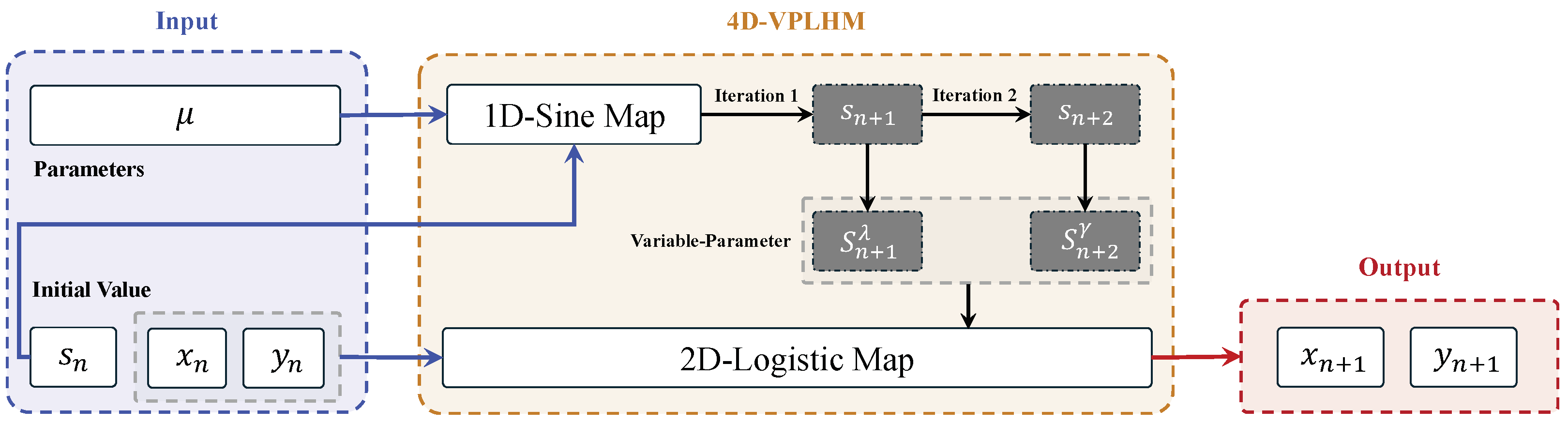
2.1.2. 4D-VPLHM
2.2. Performance Evaluation
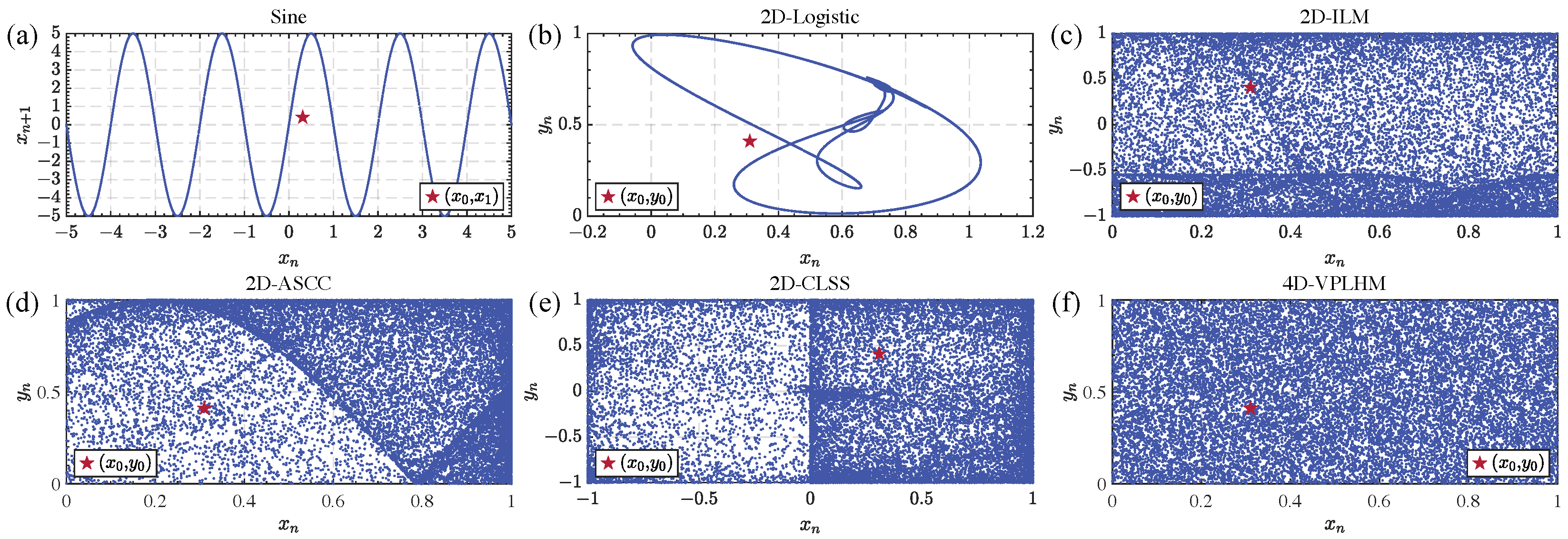
2.2.1. Trajectory Diagram
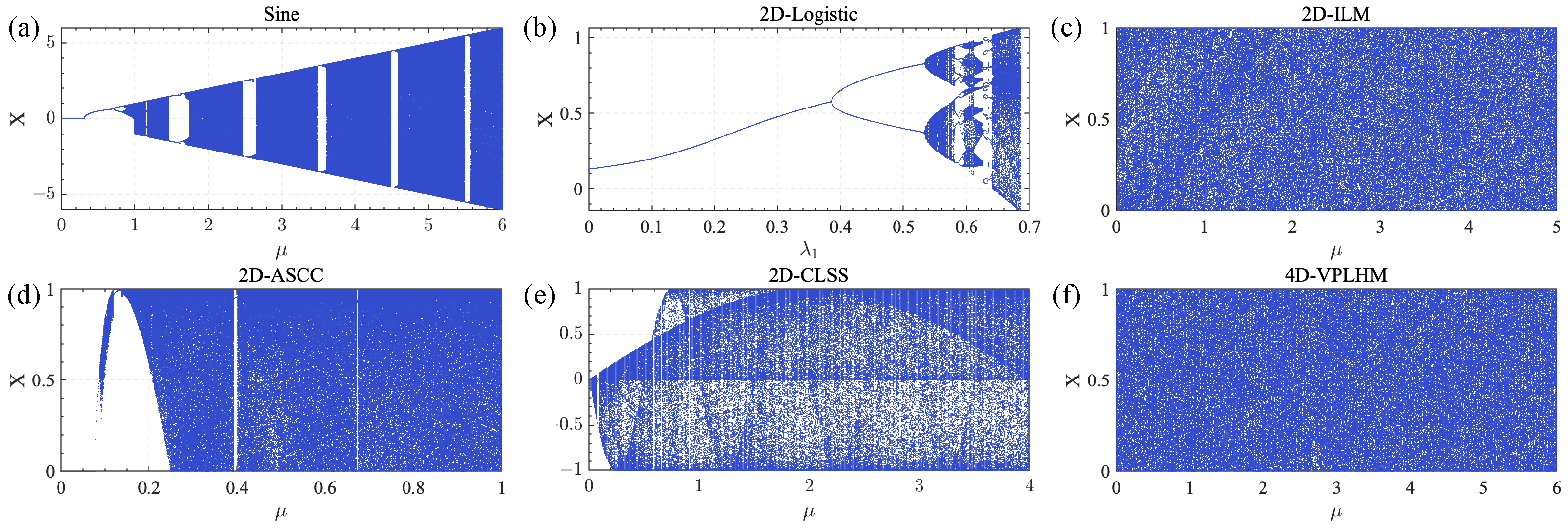
2.2.2. Bifurcation Diagram
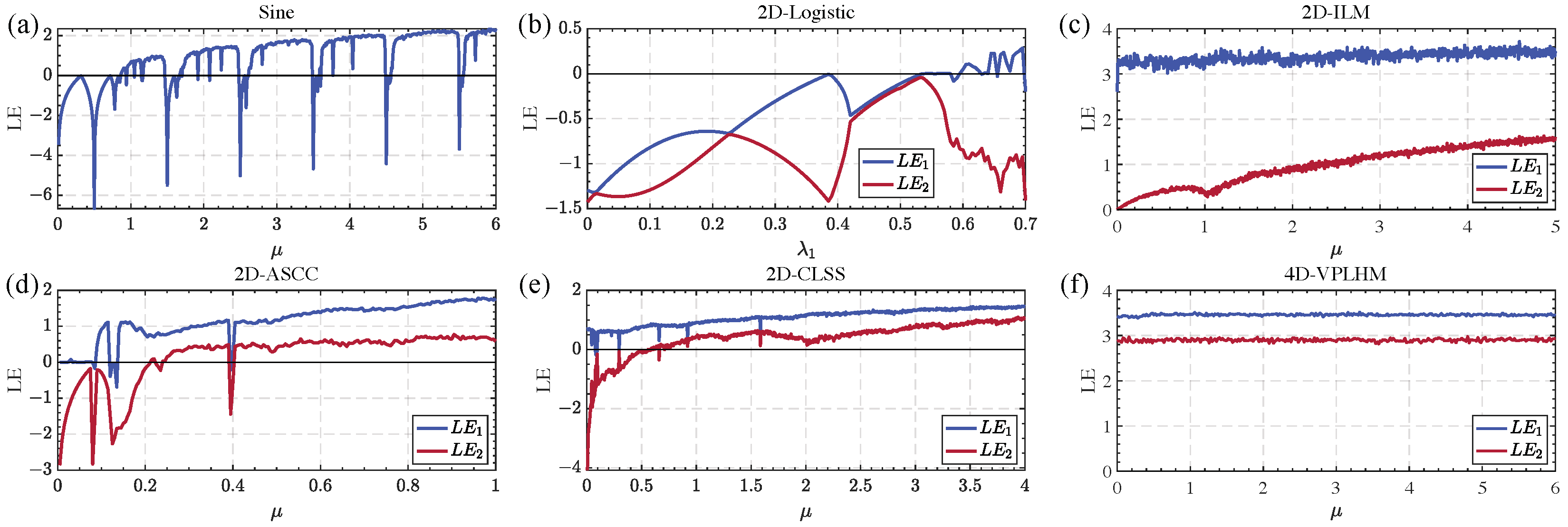
2.2.3. Lyapunov Exponent
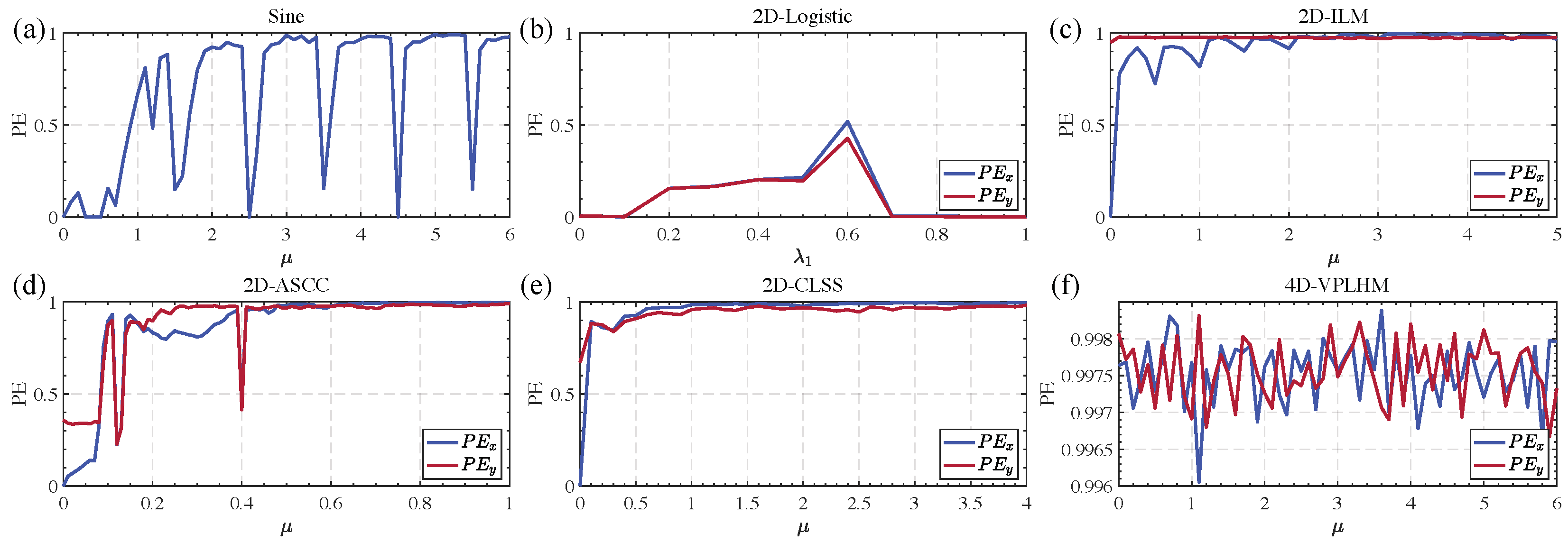
2.2.4. Permutation Entropy
2.2.5. NIST Randomness Test
2.2.6. TestU01 Randomness Test
3. A Fast Image Encryption Algorithm Based on the 4D-VPLHM and Circular Shift Strategy
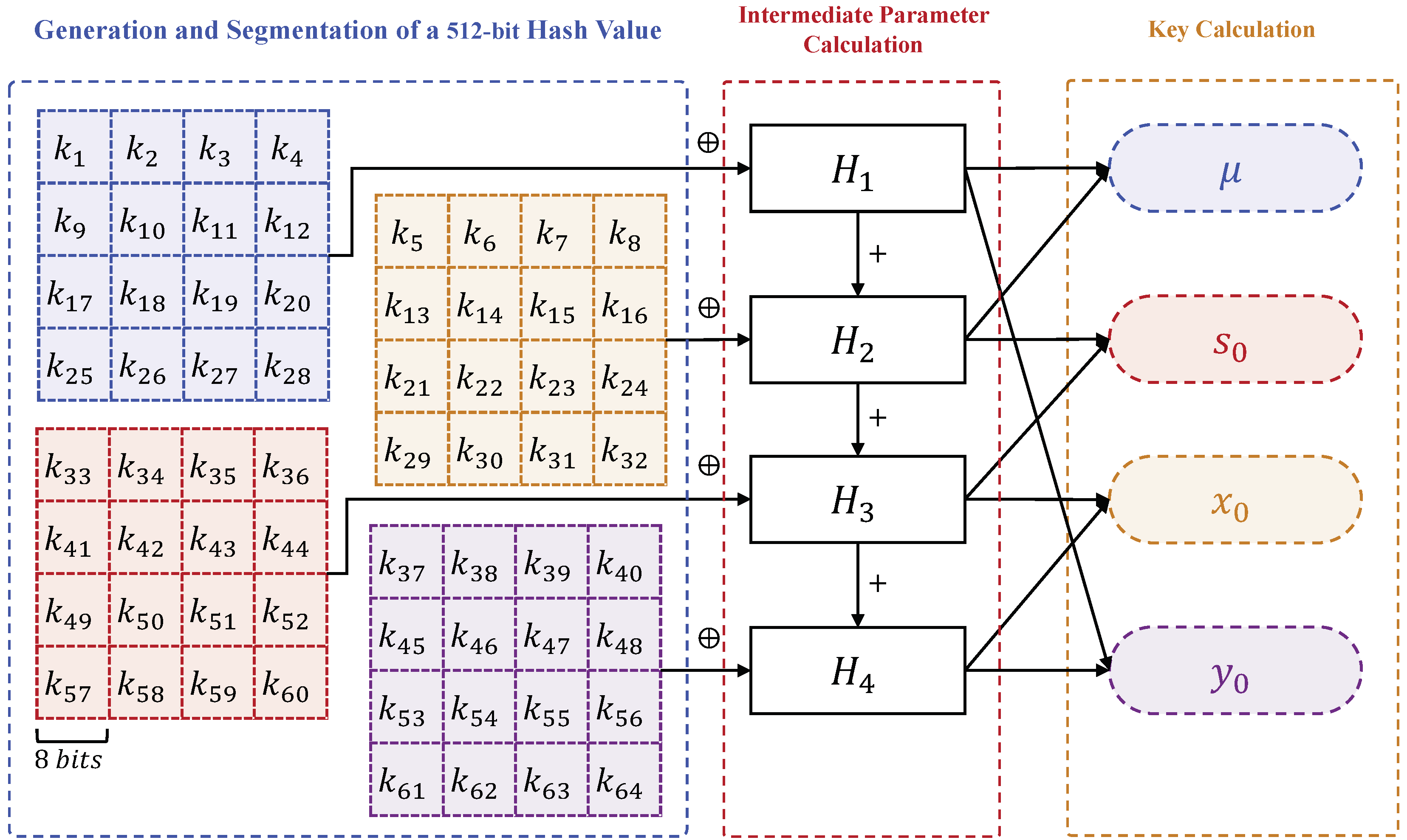
3.1. Key Generation
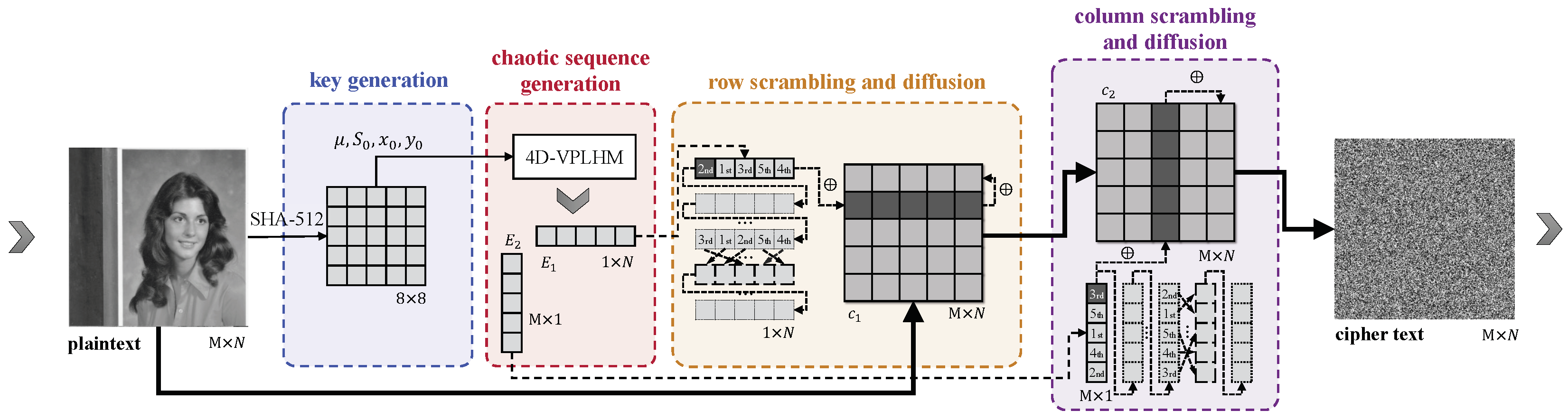
- Generation and segmentation of a 512-bit hash value: To initialize the encryption process, the plaintext image is first processed using the SHA-512 cryptographic hash function, yielding a 512-bit binary string. This binary output is then partitioned into 64 segments of 8 bits each, with each segment converted into a corresponding decimal value in the range of 0 to 255. These values are denoted as . Following the segmentation scheme illustrated in the corresponding flowchart, the 64 decimal values are subsequently divided into four groups, each comprising 16 elements.
- Intermediate parameter calculation: For each group, an XOR operation is performed on all values, and the result is divided by 255 to generate 4 intermediate parameters, denoted as . The specific calculation method is as follows:
- Key calculation: Through the combination of four intermediate variables, the control parameters and initial values required by 4D-VPLHM are obtained. The calculation method is as follows:where the value of is in the range , and the values of , , and are all ion the range . These values serve as the key control parameters and initial values for the chaotic encryption process, ensuring a direct correlation between the encryption process and the plaintext image content.
3.2. Encryption Algorithm
- Input: Plaintext image P, of size , encryption key .
- Output: Ciphertext image C, of size .
- Step 1: Chaotic sequence generation:The key is input into the 4D-VPLHM chaotic system for iterations, where T is a constant, with chosen in this study. To eliminate transient phenomena in the chaotic system, the first T output sequences are discarded. From the x and y outputs of 4D-VPLHM, two chaotic sequences and of length are obtained.
- Step 2: Row and column diffusion rules generation: From the output , the first M elements are selected to obtain the chaotic sequence of size , which has the same length as the number of elements in each row of the plaintext image P, serving as the initial row diffusion rule. Similarly, from the output , the first N elements are selected to obtain the chaotic sequence of size , serving as the initial column diffusion rule.
- Step 3: Row and column scrambling rules generation: The chaotic sequence is sorted in ascending order to obtain its corresponding index sequence of size , which serves as the row scrambling rule. Similarly, the column scrambling rule is obtained from the chaotic sequence of size .
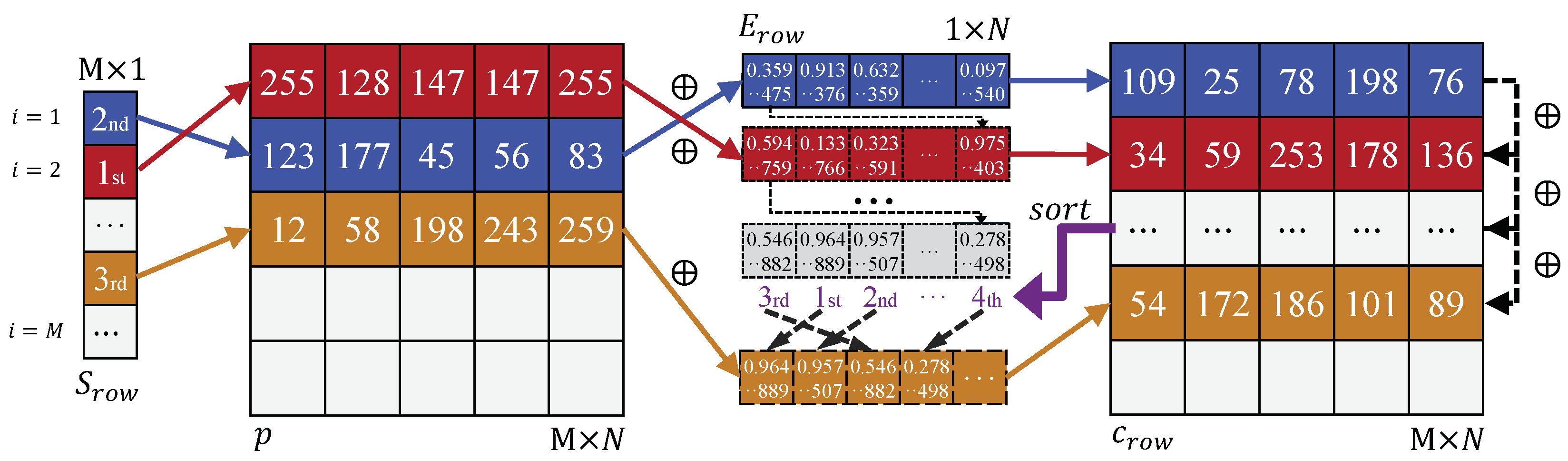
- Step 4: Row scrambling and diffusion: Using the row scrambling rule, one row at a time is selected from the plaintext image P as the target for encryption. This process constitutes the scrambling operation. The diffusion rule is then applied, converting the target row into an integer sequence between 0 and 255, which is XORed with the corresponding row of the plaintext. If it is not the first row, the result is further XORed with the previously encrypted row, forming the diffusion operation. After each diffusion, the decimal elements of the diffusion rule are cyclically shifted left by one position, yielding a new diffusion sequence for the next row. After 15 shifts, a row-wise scrambling operation is applied to the diffusion rule based on the magnitude relationships of the previous encryption results, preventing identical diffusion rules from occurring. This process is referred to as the circular shift algorithm. A computational example of this process is shown in Figure 8. The detailed steps of row scrambling and diffusion are as follows:
- Step 4.1: Initialization: Initialize the ciphertext storage matrix of size .Step 4.2: Row scrambling: Traverse the row scrambling rule in order, and for each index i (where ), select the i-th row of the plaintext image as the target for diffusion encryption.
- Step 4.3: Row diffusion: XOR the selected row with the row diffusion rule to obtain the encrypted row, which is placed in the ciphertext at the i-th position. For , the result is further XORed with the previous row in the ciphertext. The diffusion rule is as follows:where represents the floor function and represents the modulus function.
- Step 4.4: Circular shift: After completing the encryption for each row, the row diffusion rule is cyclically shifted left by one position for use as the scrambling rule for the next row. After completing 15 shifts (corresponding to the effective precision of 16 digits for double-precision floating-point numbers), a row-wise scrambling operation is performed on the diffusion rule based on the relative magnitude of elements in the previously encrypted row to avoid duplicate diffusion rules during the shifting process. The circular shift operation is as follows:where denotes the cyclic shift of the decimal positions of array elements, refers to the sorted index array, and represents the diffusion rule array rearranged according to the index sequence x. Once the scrambling traversal is complete, the row scrambling and diffusion process is finished.
- Step 5: Column scrambling and diffusion: The column scrambling and diffusion processes follow the same strategy as the row processes. The encryption object is the result of the row scrambling and diffusion, . The column scrambling rule is applied to perform the column scrambling operation, and the column diffusion rule is used for the diffusion operation. After each column is encrypted, the column diffusion rule undergoes the same circular shift operation. The final encrypted image C is obtained after completing the scrambling and diffusion of all columns.
3.3. Decryption Algorithm
- Input: Ciphertext image C of size and key .
- Output: Plaintext image P of size .
- Step 1: Generation of the chaotic sequences. The chaotic sequences and are generated following Step 1 of the encryption algorithm.
- Step 2: Generation of the row and column diffusion rules. The row and column diffusion rules are derived in accordance with Step 2 of the encryption algorithm.
- Step 3: Generation of the row and column scrambling rules. The row and column scrambling rules are obtained according to Step 3 of the encryption algorithm.
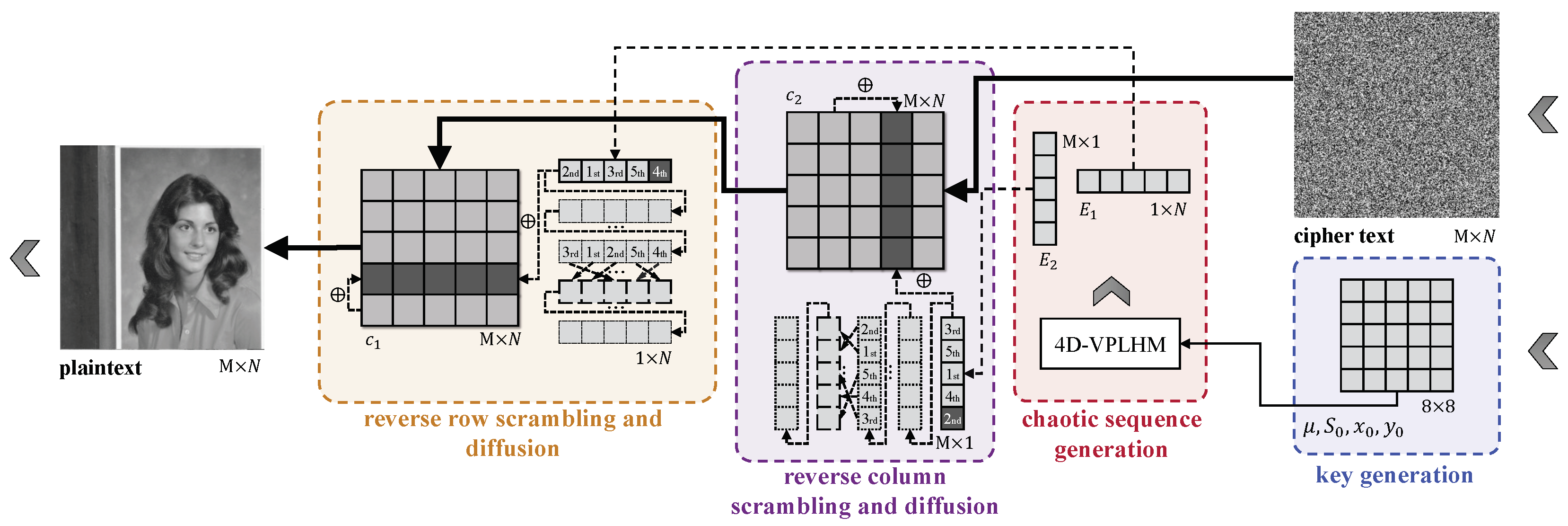
- Step 4: Inverse column scrambling and diffusion. Each column of the ciphertext is traversed sequentially as the target for decryption. The column diffusion rule is applied to the corresponding column, and XOR decryption is performed. If the current row is not the first row, the result is further XORed with the corresponding row of the previous column; this is the inverse diffusion process. After the inverse diffusion is completed, the decrypted result is placed back into its original position according to the column scrambling rule, which completes the inverse scrambling process. After each row decryption, the column diffusion rule is cyclically shifted in the same manner as the encryption process. Detailed steps for row scrambling and diffusion are as follows:
- Step 4.1: Initialization. Initialize the plaintext storage matrices and , both of size .
- Step 4.2: Inverse Column diffusion. Traverse each column of the ciphertext C, with the current position denoted as i, where . The first column is selected as the target for inverse diffusion decryption. The column diffusion rule is XORed with the column to be decrypted. For , the XOR result is further XORed with the previous column of ciphertext. The inverse diffusion rule is as follows:
- Step 4.3: Inverse column scrambling. After the column decryption is complete, the decrypted column is placed in the correct position in the plaintext using the column scrambling rule . The inverse column scrambling rule is given by
- Step 4.4: Cyclic shifting. The column cyclic shifting operation is performed according to Step 4.4 of the encryption process.
- Step 5: Inverse row scrambling and diffusion. Following the same procedure as the inverse column scrambling and diffusion, the decryption target is the result of inverse column scrambling and diffusion . The row scrambling rule is used to perform the inverse row scrambling, while the row diffusion rule is applied to reverse the diffusion operation. After each column is diffused, the column diffusion rule is cyclically shifted according to the same rules as the encryption process. Once the row scrambling is complete, the final decrypted result P is obtained.
4. Improved Binary Level NPCR and UACI
4.1. NPCR and UACI
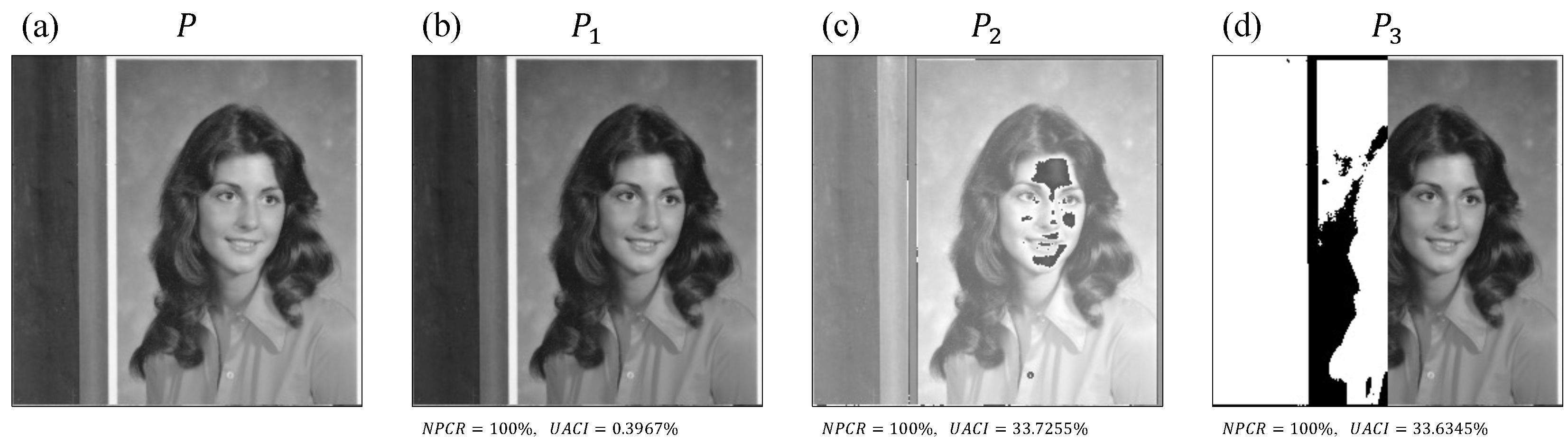
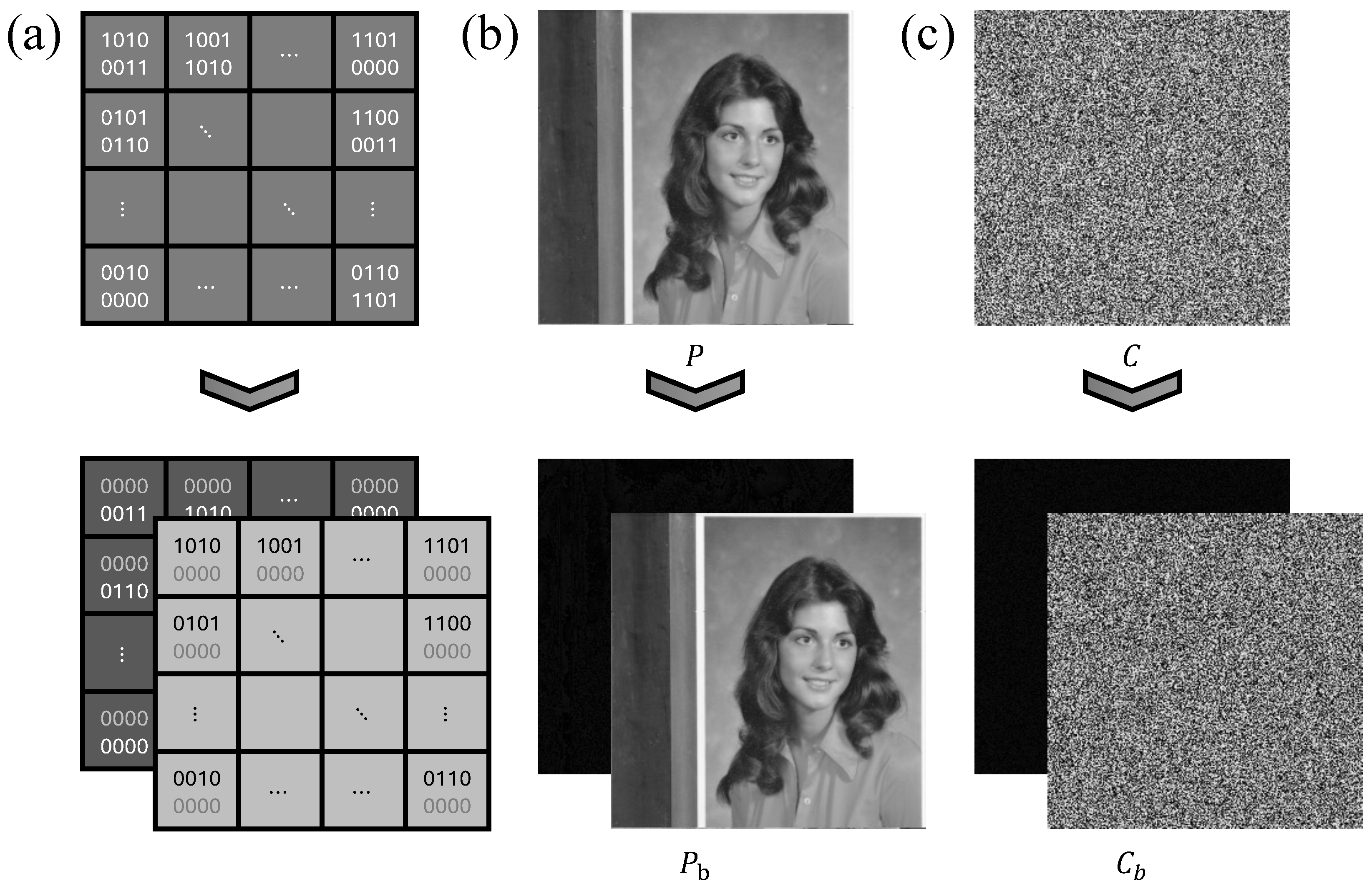
4.2. BL-NPCR and BL-UACI
Performance Analysis
5. Simulation and Analysis
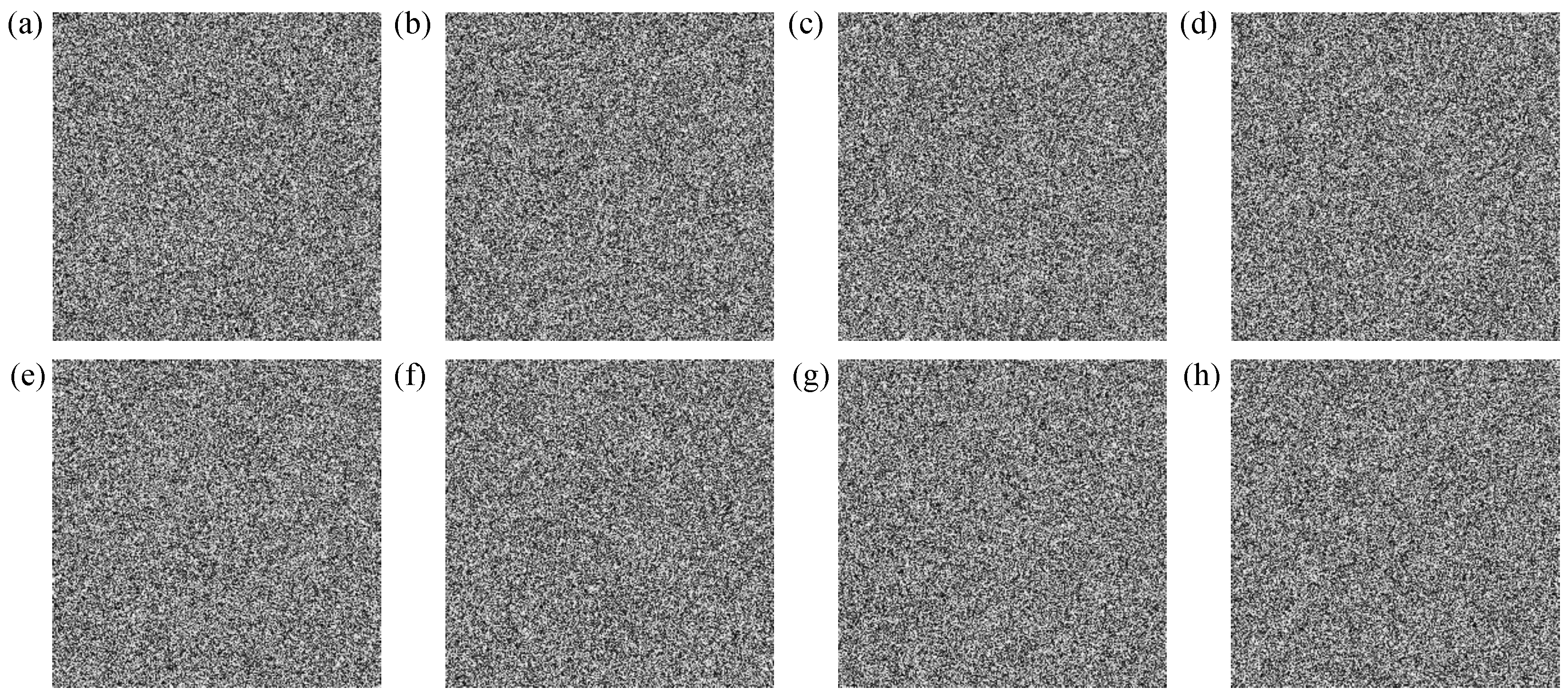
5.1. Simulation Results
5.2. Key Space and Key Sensitivity Analysis
5.3. Robustness of the Cyclic Shift Algorithm
5.4. Histogram Analysis
5.5. Information Entropy Analysis
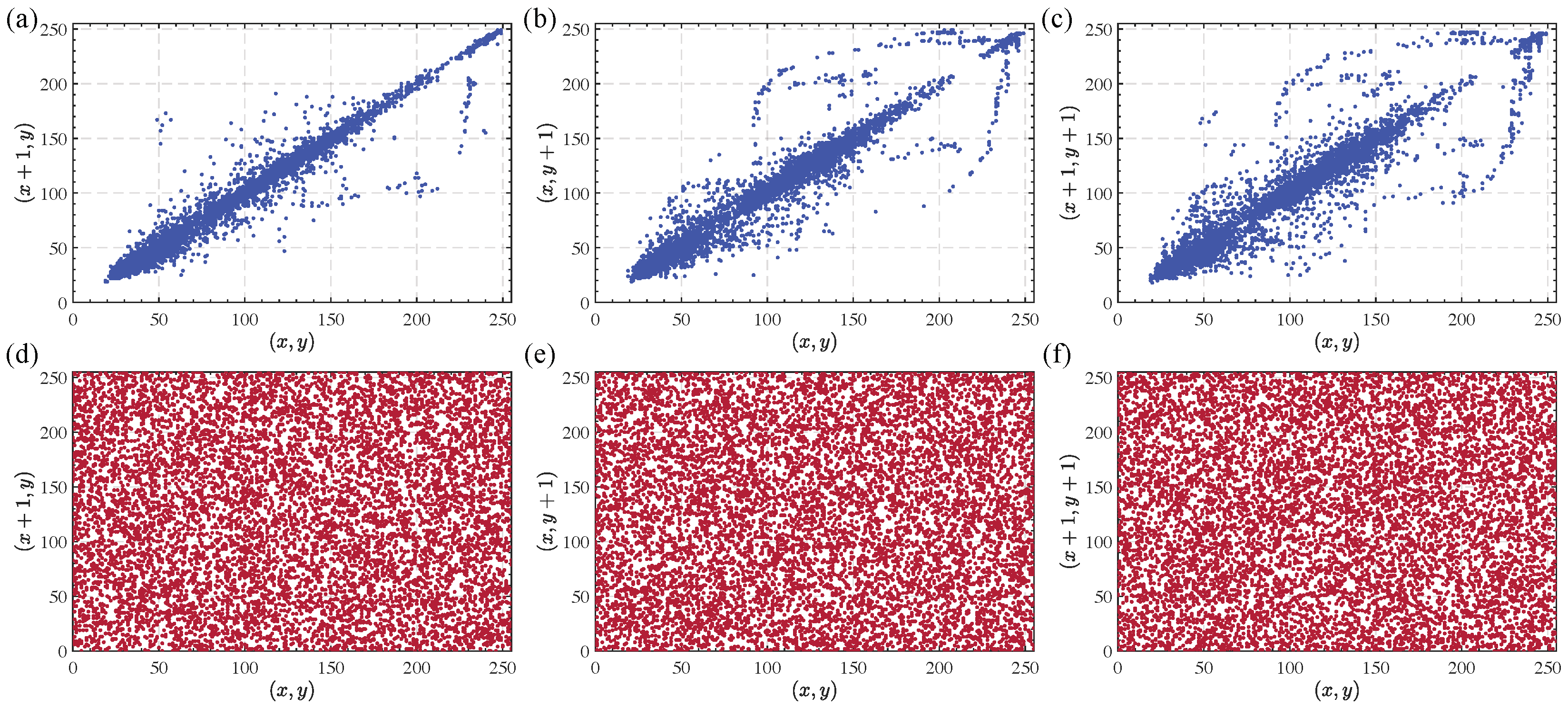
5.6. Correlation Analysis of Adjacent Pixels
5.7. Differential Attack Analysis
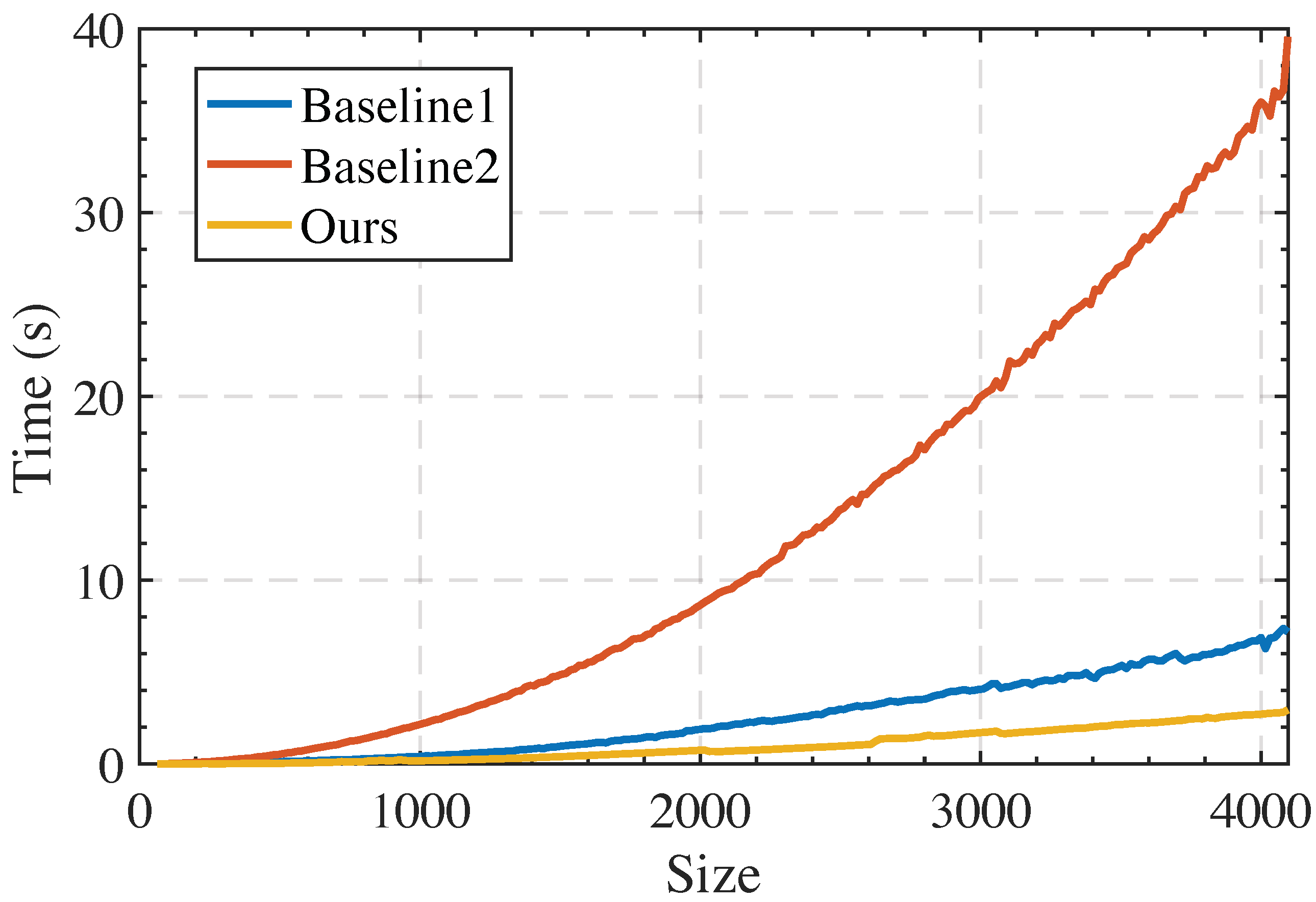
5.8. Encryption Efficiency Analysis
- Baseline1: This uses the same row–column permutation and diffusion algorithms, but the chaotic sequence is generated over iterations (equal to the total number of pixels in the image).
- Baseline2: This uses a simple pixel value encryption algorithm, and the chaotic sequence is generated over iterations.
6. Conclusions
Author Contributions
Funding
Data Availability Statement
Acknowledgments
Conflicts of Interest
References
- Li, Y.; Wang, C.; Chen, H. A Hyper-Chaos-Based Image Encryption Algorithm Using Pixel-Level Permutation and Bit-Level Permutation. Opt. Lasers Eng. 2017, 90, 238–246. [Google Scholar] [CrossRef] [Scilit]
- ur Rehman, A.; Liao, X.; Ashraf, R.; Ullah, S.; Wang, H. A Color Image Encryption Technique Using Exclusive-OR with DNA Complementary Rules Based on Chaos Theory and SHA-2. Optik 2018, 159, 348–367. [Google Scholar] [CrossRef] [Scilit]
- Shannon, C.E. Communication Theory of Secrecy Systems. Bell Syst. Tech. J. 1949, 28, 656–715. [Google Scholar] [CrossRef] [Scilit]
- Teng, L.; Wang, X.; Xian, Y. Image Encryption Algorithm Based on a 2D-CLSS Hyperchaotic Map Using Simultaneous Permutation and Diffusion. Inf. Sci. 2022, 605, 71–85. [Google Scholar] [CrossRef] [Scilit]
- Fridrich, J. Symmetric Ciphers Based on Two-Dimensional Chaotic Maps. Int. J. Bifurc. Chaos 1998, 8, 1259–1284. [Google Scholar] [CrossRef] [Scilit]
- Lin, C.Y.; Wu, J.L. Cryptanalysis and Improvement of a Chaotic Map-Based Image Encryption System Using Both Plaintext Related Permutation and Diffusion. Entropy 2020, 22, 589. [Google Scholar] [CrossRef] [Scilit] [PubMed]
- Hu, Y.; Yu, S.; Zhang, Z. On the Security Analysis of a Hopfield Chaotic Neural Network-Based Image Encryption Algorithm. Complexity 2020, 2020, 2051653. [Google Scholar] [CrossRef] [Scilit]
- Li, Z.; Peng, C.; Li, L.; Zhu, X. A Novel Plaintext-Related Image Encryption Scheme Using Hyper-Chaotic System. Nonlinear Dyn. 2018, 94, 1319–1333. [Google Scholar] [CrossRef] [Scilit]
- Chen, Y.; Xie, S.; Zhang, J. A Hybrid Domain Image Encryption Algorithm Based on Improved Henon Map. Entropy 2022, 24, 287. [Google Scholar] [CrossRef] [Scilit]
- Zhang, Y.; Tang, Y. A Plaintext-Related Image Encryption Algorithm Based on Chaos. Multimed. Tools Appl. 2018, 77, 6647–6669. [Google Scholar] [CrossRef] [Scilit]
- Su, Y.; Wang, X.; Gao, H. Chaotic Image Encryption Algorithm Based on Bit-Level Feedback Adjustment. Inf. Sci. 2024, 679, 121088. [Google Scholar] [CrossRef] [Scilit]
- Gao, X. Image Encryption Algorithm Based on 2D Hyperchaotic Map. Opt. Laser Technol. 2021, 142, 107252. [Google Scholar] [CrossRef] [Scilit]
- Naskar, P.K.; Bhattacharyya, S.; Mahatab, K.C.; Dhal, K.G.; Chaudhuri, A. An Efficient Block-Level Image Encryption Scheme Based on Multi-Chaotic Maps with DNA Encoding. Nonlinear Dyn. 2021, 105, 3673–3698. [Google Scholar] [CrossRef] [Scilit]
- Hu, G.; Li, B. Coupling Chaotic System Based on Unit Transform and Its Applications in Image Encryption. Signal Process. 2021, 178, 107790. [Google Scholar] [CrossRef] [Scilit]
- Zhang, X.; Liu, G.; Niu, Y.; Zou, C. Color Image Encryption Scheme Based on a Single Attractor Hyperchaotic System and Go Rules. Nonlinear Dyn. 2025, 113, 13885–13911. [Google Scholar] [CrossRef] [Scilit]
- Hu, G.; Li, B. A Uniform Chaotic System with Extended Parameter Range for Image Encryption. Nonlinear Dyn. 2021, 103, 2819–2840. [Google Scholar] [CrossRef] [Scilit]
- Li, S.; Yin, B.; Ding, W.; Zhang, T.; Ma, Y. A Nonlinearly Modulated Logistic Map with Delay for Image Encryption. Electronics 2018, 7, 326. [Google Scholar] [CrossRef] [Scilit]
- Gui, X.; Huang, J.; Li, L.; Li, S.; Cao, J. A Novel Hyperchaotic Image Encryption Algorithm with Simultaneous Shuffling and Diffusion. Multimed. Tools Appl. 2022, 81, 21975–21994. [Google Scholar] [CrossRef] [Scilit]
- Huang, X.; Tang, J.; Zhang, Z. Efficient and Secure Image Encryption Algorithm Using 2D LIM Map and Latin Square Matrix. Nonlinear Dyn. 2024, 112, 22463–22483. [Google Scholar] [CrossRef] [Scilit]
- Fei, X.; Zhang, J.; Qin, W. Design a New Image Encryption Algorithm Based on a 2D-ASCC Map. Phys. Scr. 2022, 97, 125206. [Google Scholar] [CrossRef] [Scilit]
- Wolf, A.; Swift, J.B.; Swinney, H.L.; Vastano, J.A. Determining Lyapunov Exponents from a Time Series. Phys. D Nonlinear Phenom. 1985, 16, 285–317. [Google Scholar] [CrossRef] [Scilit]
- Bandt, C.; Pompe, B. Permutation Entropy: A Natural Complexity Measure for Time Series. Phys. Rev. Lett. 2002, 88, 174102. [Google Scholar] [CrossRef] [Scilit] [PubMed]
- Bassham, L.; Rukhin, A.; Soto, J.; Nechvatal, J.; Smid, M.; Leigh, S.; Levenson, M.; Vangel, M.; Heckert, N.; Banks, D. A Statistical Test Suite for Random and Pseudorandom Number Generators for Cryptographic Applications. 2010. Available online: https://tsapps.nist.gov/publication/get_pdf.cfm?pub_id=906762 (accessed on 26 February 2025).
- Sahari, M.L.; Boukemara, I. A Pseudo-Random Numbers Generator Based on a Novel 3D Chaotic Map with an Application to Color Image Encryption. Nonlinear Dyn. 2018, 94, 723–744. [Google Scholar] [CrossRef] [Scilit]
- L’Ecuyer, P.; Simard, R. TestU01: A C Library for Empirical Testing of Random Number Generators. ACM Trans. Math. Softw. 2007, 33, 22:1–22:40. [Google Scholar] [CrossRef] [Scilit]
- SIPI Image Database. 2024. Available online: https://sipi.usc.edu/database/ (accessed on 26 February 2025).
- Alvarez, G.; Li, S. Some Basic Cryptographic Requirements for Chaos-Based Cryptosystems. Int. J. Bifurc. Chaos 2006, 16, 2129–2151. [Google Scholar] [CrossRef] [Scilit]
- Shariatzadeh, M.; Rostami, M.J.; Eftekhari, M. Proposing a Novel Dynamic AES for Image Encryption Using a Chaotic Map Key Management Approach. Optik 2021, 246, 167779. [Google Scholar] [CrossRef] [Scilit]
- Çavuşoğlu, Ü.; Kaçar, S.; Pehlivan, I.; Zengin, A. Secure Image Encryption Algorithm Design Using a Novel Chaos Based S-box. Chaos Solitons Fractals 2017, 95, 92–101. [Google Scholar] [CrossRef] [Scilit]
- Zhou, S.; Wang, X.; Zhang, Y.; Ge, B.; Wang, M.; Gao, S. A Novel Image Encryption Cryptosystem Based on True Random Numbers and Chaotic Systems. Multimed. Syst. 2022, 28, 95–112. [Google Scholar] [CrossRef] [Scilit]
- Xu, Y.; Liu, J.; You, Z.; Zhang, T. A Novel Color Image Encryption Algorithm Based on Hybrid Two-Dimensional Hyperchaos and Genetic Recombination. Mathematics 2024, 12, 3457. [Google Scholar] [CrossRef] [Scilit]
- Hosny, K.M.; Kamal, S.T.; Darwish, M.M. Novel Encryption for Color Images Using Fractional-Order Hyperchaotic System. J. Ambient. Intell. Humaniz. Comput. 2022, 13, 973–988. [Google Scholar] [CrossRef] [Scilit]
- Shi, L.; Li, X.; Jin, B.; Li, Y. A Chaos-Based Encryption Algorithm to Protect the Security of Digital Artwork Images. Mathematics 2024, 12, 3162. [Google Scholar] [CrossRef] [Scilit]
- Wang, W.t.; Sun, J.y.; Zhang, H.; Zhang, J. Quantum Cryptosystem and Circuit Design for Color Image Based on Novel 3D Julia-Fractal Chaos System. Quantum Inf. Process. 2023, 22, 64. [Google Scholar] [CrossRef] [Scilit]
- Yu, F.; Tan, B.; He, T.; He, S.; Huang, Y.; Cai, S.; Lin, H. A Wide-Range Adjustable Conservative Memristive Hyperchaotic System with Transient Quasi-Periodic Characteristics and Encryption Application. Mathematics 2025, 13, 726. [Google Scholar] [CrossRef] [Scilit]
- Sarosh, P.; Parah, S.A.; Bhat, G.M. An Efficient Image Encryption Scheme for Healthcare Applications. Multimed. Tools Appl. 2022, 81, 7253–7270. [Google Scholar] [CrossRef] [Scilit] [PubMed]
- Xu, J.; Zhao, B.; Wu, Z. Research on Color Image Encryption Algorithm Based on Bit-Plane and Chen Chaotic System. Entropy 2022, 24, 186. [Google Scholar] [CrossRef] [Scilit]
- Sivakumar, T.; Li, P. A Secure Image Encryption Method Using Scan Pattern and Random Key Stream Derived from Laser Chaos. Opt. Laser Technol. 2019, 111, 196–204. [Google Scholar] [CrossRef] [Scilit]
- Liu, H.; Xu, Y.; Ma, C. Chaos-Based Image Hybrid Encryption Algorithm Using Key Stretching and Hash Feedback. Optik 2020, 216, 164925. [Google Scholar] [CrossRef] [Scilit]
- Farah, M.A.B.; Guesmi, R.; Kachouri, A.; Samet, M. A Novel Chaos Based Optical Image Encryption Using Fractional Fourier Transform and DNA Sequence Operation. Opt. Laser Technol. 2020, 121, 105777. [Google Scholar] [CrossRef] [Scilit]
- Vidhya, R.; Brindha, M. A Chaos Based Image Encryption Algorithm Using Rubik’s Cube and Prime Factorization Process (CIERPF). J. King Saud Univ. Comput. Inf. Sci. 2022, 34, 2000–2016. [Google Scholar] [CrossRef] [Scilit]
- Kaur, G.; Agarwal, R.; Patidar, V. Chaos Based Multiple Order Optical Transform for 2D Image Encryption. Eng. Sci. Technol. Int. J. 2020, 23, 998–1014. [Google Scholar] [CrossRef] [Scilit]
- Wang, M.; Teng, L.; Zhou, W.; Yan, X.; Xia, Z.; Zhou, S. A New 2D Cross Hyperchaotic Sine-Modulation-Logistic Map and Its Application in Bit-Level Image Encryption. Expert Syst. Appl. 2025, 261, 125328. [Google Scholar] [CrossRef] [Scilit]
- Zou, C.; Shang, Y.; Yang, Y.; Zhou, C.; Liu, Y. A Novel Image Encryption Algorithm with Anti-Tampering Attack Capability. Chaos Solitons Fractals 2024, 189, 115638. [Google Scholar] [CrossRef] [Scilit]
- Lu, J.; Zhang, J.; An, D.; Hao, D.; Ren, X.; Zhao, R. A Low-Time-Consumption Image Encryption Combining 2D Parametric Pascal Matrix Chaotic System and Elementary Operation. J. King Saud Univ. Comput. Inf. Sci. 2024, 36, 102169. [Google Scholar] [CrossRef] [Scilit]
- Alawida, M. A Novel Chaos-Based Permutation for Image Encryption. J. King Saud Univ. Comput. Inf. Sci. 2023, 35, 101595. [Google Scholar] [CrossRef] [Scilit]
- Jiang, X.; Jiang, G.; Wang, Q.; Shu, D. Image Encryption Algorithm Based on 2D-CLICM Chaotic System. IET Image Process. 2023, 17, 2127–2141. [Google Scholar] [CrossRef] [Scilit]





| Statistical Test | Proportion (%) | p-Value | Result | |||
|---|---|---|---|---|---|---|
| X | Y | X | Y | X | Y | |
| Frequency | 98.60 | 98.80 | 0.7090 | 0.5958 | Pass | Pass |
| BlockFrequency | 99.20 | 98.60 | 0.6188 | 0.2819 | Pass | Pass |
| CumulativeSums | 98.70 | 99.00 | 0.4152 | 0.5557 | Pass | Pass |
| Runs | 99.20 | 99.20 | 0.5572 | 0.5583 | Pass | Pass |
| LongestRun | 98.90 | 98.20 | 0.3861 | 0.5634 | Pass | Pass |
| Rank | 98.60 | 98.80 | 0.2963 | 0.6549 | Pass | Pass |
| FFT | 99.40 | 99.80 | 0.5479 | 0.5751 | Pass | Pass |
| NonOverlappingTemplate | 99.03 | 99.00 | 0.5043 | 0.4905 | Pass | Pass |
| OverlappingTemplate | 98.40 | 98.80 | 0.5089 | 0.5792 | Pass | Pass |
| Universal | 98.80 | 98.60 | 0.6656 | 0.3543 | Pass | Pass |
| ApproximateEntropy | 99.00 | 98.60 | 0.3831 | 0.6586 | Pass | Pass |
| RandomExcursions | 98.80 | 99.03 | 0.4347 | 0.3668 | Pass | Pass |
| RandomExcursionsVariant | 99.36 | 99.05 | 0.4516 | 0.3889 | Pass | Pass |
| Serial | 99.40 | 99.00 | 0.4892 | 0.6142 | Pass | Pass |
| LinearComplexity | 98.40 | 98.40 | 0.7400 | 0.4620 | Pass | Pass |
| Chaos | Alphabit Test | BlockAlphabit Test | Alphabit Test | |||
|---|---|---|---|---|---|---|
| X | Y | X | Y | X | Y | |
| Sine | 0/17 | - | 0/102 | - | 34/39 | - |
| 2D-Logistic | 0/17 | 0/17 | 0/102 | 0/102 | 0/39 | 0/39 |
| 2D-ILM | 17/17 | 3/17 | 101/102 | 15/102 | 39/39 | 8/39 |
| 2D-CLSS | 0/17 | 4/17 | 0/102 | 39/102 | 4/39 | 25/39 |
| 2D-ACSS | 0/17 | 4/17 | 3/102 | 13/102 | 5/39 | 10/39 |
| 4D-VPLHM | 17/17 | 17/17 | 102/102 | 101/102 | 39/39 | 39/39 |
| Bit Index | 1 | 2 | 3 | 4 | 5 | 6 | 7 | 8 |
| Percentage (%) | 0.3922 | 0.7843 | 1.5686 | 3.1373 | 6.2745 | 12.5490 | 25.0980 | 50.1961 |
| Image | NPCR (%) | UACI (%) | BL-NPCR (%) | BL-UACI (%) |
|---|---|---|---|---|
| P vs. | 100 | 0.3967 | 0.8667 | 0.4096 |
| P vs. | 100 | 33.7255 | 6.8314 | 29.8235 |
| P vs. | 100 | 32.6345 | 0.4715 | 27.3170 |
| Statistical Test | Proportion (%) | P-Value | Result | ||||||
|---|---|---|---|---|---|---|---|---|---|
| x | y | z | x | y | z | x | y | z | |
| Frequency | 98.60 | 98.80 | 100.00 | 0.7090 | 0.6523 | 0.0000 | Pass | Pass | fail |
| BlockFrequency | 99.20 | 98.40 | 100.00 | 0.6188 | 0.5106 | 0.0554 | Pass | Pass | Pass |
| CumulativeSums | 98.70 | 98.50 | 100.00 | 0.4152 | 0.2949 | 0.0000 | Pass | Pass | fail |
| Runs | 99.20 | 99.20 | 100.00 | 0.5572 | 0.4227 | 0.0000 | Pass | Pass | fail |
| LongestRun | 98.90 | 99.20 | 100.00 | 0.3861 | 0.6572 | 0.0000 | Pass | Pass | fail |
| Rank | 98.60 | 99.40 | 100.00 | 0.2963 | 0.1463 | 0.0000 | Pass | Pass | fail |
| FFT | 99.40 | 99.20 | 99.00 | 0.5479 | 0.3060 | 0.1719 | Pass | Pass | Pass |
| NonOverlappingTemplate | 99.03 | 98.98 | 100.00 | 0.5043 | 0.5150 | 0.0000 | Pass | Pass | fail |
| OverlappingTemplate | 98.40 | 98.60 | 100.00 | 0.5089 | 0.6960 | 0.0000 | Pass | Pass | fail |
| Universal | 98.80 | 97.80 | 100.00 | 0.6656 | 0.4701 | 0.0067 | Pass | Pass | fail |
| ApproximateEntropy | 99.00 | 98.20 | 100.00 | 0.3831 | 0.5179 | 0.0000 | Pass | Pass | fail |
| RandomExcursions | 98.80 | 98.84 | 100.00 | 0.4347 | 0.4151 | 0.0040 | Pass | Pass | fail |
| RandomExcursionsVariant | 99.36 | 99.16 | 100.00 | 0.4516 | 0.3662 | 0.0669 | Pass | Pass | Pass |
| Serial | 99.40 | 98.30 | 93.00 | 0.4892 | 0.6239 | 0.0000 | Pass | Pass | fail |
| LinearComplexity | 98.40 | 99.20 | 100.00 | 0.7400 | 0.4464 | 0.0000 | Pass | Pass | fail |
| Results | TestU01 | Time (s) | ||
|---|---|---|---|---|
| Alphabit Test | BlockAlphabit Test | Alphabit Test | ||
| x | 17/17 | 102/102 | 39/39 | 1.6016 ± 0.0228 |
| y | 17/17 | 99/102 | 37/39 | 0.0863 ± 0.0127 |
| z | 1/17 | 0/102 | 0/39 | 0.0545 ± 0.0023 |
| Image | Female | Boat | X-Ray | Text | Gray | Lena | SIMP |
|---|---|---|---|---|---|---|---|
| Plain | 7.1325 | 7.2361 | 7.5574 | 5.2645 | 5.4029 | 7.5150 | 6.6121 |
| Ciphertext | 7.9992 | 7.9991 | 7.9992 | 7.9994 | 7.9992 | 7.9993 | 7.9993 |
| Algorithm | Ref. [28] | Ref. [29] | Ref. [30] | Ref. [31] | Ref. [32] | Ref. [33] | Ours |
|---|---|---|---|---|---|---|---|
| Information entropy | 7.9974 | 7.9560 | 7.9977 | 7.9971 | 7.9992 | 7.9972 | 7.9993 |
| Image | Plaintext | Ciphertext | ||||
|---|---|---|---|---|---|---|
| Horizontal | Vertical | Diagonal | Horizontal | Vertical | Diagonal | |
| Female | 0.9846 | 0.9694 | 0.9556 | 0.0016 | 0.0103 | 0.0029 |
| Boat | 0.9233 | 0.8865 | 0.8353 | 0.0029 | −0.0144 | −0.0106 |
| X-Ray | 0.9919 | 0.9866 | 0.9798 | 0.0017 | −0.0015 | −0.0018 |
| Text | 0.7098 | 0.7835 | 0.4811 | −0.0001 | 0.0061 | 0.0014 |
| Gray | 0.9997 | 0.9942 | 0.9944 | 0.0022 | 0.0106 | −0.0040 |
| Lena | 0.9556 | 0.9190 | 0.8816 | −0.0015 | 0.0024 | −0.0011 |
| SIMP | 0.8594 | 0.8494 | 0.7514 | −0.0029 | −0.0014 | 0.0001 |
| Direction | Ref. [28] | Ref. [34] | Ref. [35] | Ref. [36] | Ref. [37] | Ours |
|---|---|---|---|---|---|---|
| Horizontal | −0.0158 | −0.0030 | 0.0075 | 0.0021 | 0.0026 | −0.0015 |
| Vertical | −0.0118 | −0.0034 | −0.0031 | 0.0099 | 0.0032 | 0.0024 |
| Diagonal | 0.0004 | 0.0099 | 0.0016 | 0.0011 | 0.0057 | −0.0011 |
| Image | NPCR (%) | UACI (%) | BL-UACI (%) | BL-UACI (%) |
|---|---|---|---|---|
| Female | 99.6074 (−0.0020) | 33.4564 (−0.0071) | 93.7463 (−0.0037) | 35.4083 (−0.0084) |
| Boat | 99.6082 (−0.0012) | 33.4607 (−0.0028) | 93.7394 (−0.0106) | 35.4106 (−0.0061) |
| X-ray | 99.6103 (+0.0009) | 33.4543 (−0.0092) | 93.7464 (−0.0036) | 35.4074 (−0.0093) |
| Text | 99.6112 (+0.0018) | 33.4311 (−0.0324) | 93.7533 (+0.0033) | 35.3809 (−0.0358) |
| Gray | 99.6117 (+0.0023) | 33.5217 (+0.0582) | 93.7551 (+0.0051) | 35.4784 (+0.0617) |
| Lena | 99.6076 (−0.0018) | 33.4817 (+0.0182) | 93.7590 (+0.0090) | 35.4333 (+0.0166) |
| SIMP | 99.6092 (−0.0002) | 33.4611 (−0.0024) | 93.7492 (−0.0008) | 35.4119 (−0.0048) |
| Algorithm | NPCR (%) | UACI (%) | BL-UACI (%) | BL-UACI (%) |
|---|---|---|---|---|
| Ref. [38] | 99.6026 (+0.0068) | 30.3008 (+3.1629) | 93.7268 (+0.0232) | 32.3934 (+2.0233) |
| Ref. [39] | 99.5792 (+0.0302) | 33.4532 (+0.0103) | 93.7291 (+0.0209) | 35.3867 (+0.0300) |
| Ref. [40] | 99.5697 (+0.0397) | 33.4100 (+0.0535) | 93.6970 (+0.0530) | 35.3270 (+0.0879) |
| Ref. [41] | 99.6210 (+0.0116) | 33.4750 (+0.0115) | 93.6434 (+0.1066) | 35.2921 (+0.1246) |
| Ref. [42] | 99.6006 (+0.0088) | 34.6379 (+1.1744) | 93.5217 (+0.2283) | 33.8523 (+1.5644) |
| Ours | 99.6076 (−0.0018) | 33.4817 (+0.0182) | 93.7590 (+0.0090) | 35.4333 (+0.0166) |
| Algorithm | Encryption Time (s) | ET (256 × 256) | NCPB (256 × 256) | ||
|---|---|---|---|---|---|
| 256 × 256 | 512 × 512 | 1024 × 1024 | |||
| Ref. [43] | 0.0794 | 0.3062 | 1.41705 | 0.7871 | 3150.0244 |
| Ref. [44] | 0.2860 | 1.3640 | 3.5440 | 0.2180 | 11,346.4355 |
| Ref. [45] | 0.0318 | 0.1284 | 0.5345 | 1.9654 | 1261.5966 |
| Ref. [46] | 0.0625 | 0.2500 | 0.9845 | 1 | 2479.5532 |
| Ref. [47] | 0.0323 | 0.1536 | 0.7109 | 1.9349 | 1281.4331 |
| Ours | 0.0246 | 0.0618 | 0.2231 | 2.5406 | 975.9521 |
Disclaimer/Publisher’s Note: The statements, opinions and data contained in all publications are solely those of the individual author(s) and contributor(s) and not of MDPI and/or the editor(s). MDPI and/or the editor(s) disclaim responsibility for any injury to people or property resulting from any ideas, methods, instructions or products referred to in the content. |
© 2025 by the authors. Licensee MDPI, Basel, Switzerland. This article is an open access article distributed under the terms and conditions of the Creative Commons Attribution (CC BY) license (https://creativecommons.org/licenses/by/4.0/).
Share and Cite
Zhang, G.; Zhao, Y.; Zheng, Y.; Shen, Y.; Huang, J. A Fast Image Encryption Scheme Based on a Four-Dimensional Variable-Parameter Hyperchaotic Map and Cyclic Shift Strategy. Mathematics 2025, 13, 1497. https://doi.org/10.3390/math13091497
Zhang G, Zhao Y, Zheng Y, Shen Y, Huang J. A Fast Image Encryption Scheme Based on a Four-Dimensional Variable-Parameter Hyperchaotic Map and Cyclic Shift Strategy. Mathematics. 2025; 13(9):1497. https://doi.org/10.3390/math13091497
Chicago/Turabian StyleZhang, Guidong, Yanhao Zhao, Yanpei Zheng, Yulin Shen, and Jun Huang. 2025. "A Fast Image Encryption Scheme Based on a Four-Dimensional Variable-Parameter Hyperchaotic Map and Cyclic Shift Strategy" Mathematics 13, no. 9: 1497. https://doi.org/10.3390/math13091497
APA StyleZhang, G., Zhao, Y., Zheng, Y., Shen, Y., & Huang, J. (2025). A Fast Image Encryption Scheme Based on a Four-Dimensional Variable-Parameter Hyperchaotic Map and Cyclic Shift Strategy. Mathematics, 13(9), 1497. https://doi.org/10.3390/math13091497