Article

Optimal Pair of Fixed Points of Noncyclic Chatterjea-Type Mappings in Busemann Convex Spaces
1
Department of Mathematics and Applied Mathematics, Sefako Makgatho Health Sciences University, Ga-Rankuwa, Pretoria 0204, South Africa
2
Department of Mathematics, Faculty of Basic Sciences, Ayatollah Boroujerdi University, Boroujerd 69199-69737, Iran
3
Department of Pure Mathematics, Faculty of Mathematics and Statistics, University of Isfahan, Isfahan 81746-73441, Iran
*
Author to whom correspondence should be addressed.
Mathematics 2025, 13(24), 3975; https://doi.org/10.3390/math13243975
Submission received: 20 November 2025 / Revised: 8 December 2025 / Accepted: 9 December 2025 / Published: 13 December 2025

Abstract

We introduce and study a new class of noncyclic Chatterjea-type C-nonexpansive mappings in geodesic spaces. We establish a notable existence theorem for best proximity pairs by employing the pivotal geometric property of proximal normal structure within the framework of reflexive Busemann convex spaces. Moreover, we investigate minimal invariant sets associated with these mappings and derive a generalization of the Goebel–Karlovitz lemma. Our main contribution extends this fundamental result to geodesic spaces with property UC, thereby providing a significant generalization of the classical theorem for the case of Chatterjea-type C-nonexpansive mappings.

1. Introduction

Let ( M , ρ ) be a metric space, and let U and V be nonempty subsets of M. A mapping F : U V U V is said to be noncyclic if F ( U ) U and F ( V ) V . One of the basic problems in “Proximity Theory” is to find a pair ( u * , v * ) U × V such that it can estimate the distance between the two sets U and V. More precisely, our aim is to solve the following optimization problem:
min ( u , v ) U × V ρ ( u , v ) , min u U ρ ( F u , u ) , min v V ρ ( F v , v ) .
This motivates us to define such pairs formally as below.
Definition 1.
Let ( M , ρ ) be a metric space, and let U and V be nonempty subsets of M. Assume that F : U V U V is a noncyclic mapping. We say that ( u * , v * ) U × V is a best proximity pair of F if
ρ ( u * , v * ) = dist ( U , V ) , F u * = u * , F v * = v * .
Proximity theory and the study of best proximity pairs provide powerful tools for analyzing dynamical systems and solving systems of differential equations. The existence of optimal pairs enables the analysis of asymptotic behavior in dynamical systems governed by nonexpansive operators [1], while also facilitating the study of solvability conditions for systems of nonlinear equations through fixed-point methodologies. Furthermore, the theory has evolved to incorporate advanced analytical tools that broaden its applicability. Nashine et al. [2] employed measures of noncompactness to establish best proximity point results for cyclic and noncyclic operators in Banach spaces, subsequently applying these findings to determine optimum solutions for systems of second-order differential equations. In a parallel direction, Ali et al. [3] proved existence and uniqueness theorems for best proximity points via simulation functions in non-Archimedean modular metric spaces, and illustrated their utility with applications to fuzzy fractional differential equations. These developments illustrate how best proximity theory continues to integrate novel analytical techniques—from measures of noncompactness to simulation functions—to deliver both rigorous existence guarantees and constructive methods for complex problems in applied analysis. In [4], Eldred, Kirk, and Veeramani investigated noncyclic mappings F : U V U V in the setting of strictly convex Banach spaces. They introduced the class of relatively nonexpansive mappings, characterized by the condition:
F u F v     u v for all ( u , v ) U × V .
To establish the existence of best proximity pairs for such mappings, the authors developed the pivotal geometric notion of proximal normal structure, leveraging the strict convexity of the underlying Banach space to obtain sufficient conditions for pair existence. The solution to optimization problem (1) exhibits fascinating geometric behavior in geodesic spaces. This discovery forged a fundamental link between metric geometry and proximity theory, rooted in W. A. Kirk’s foundational works [5,6]. The theory was subsequently enriched by extensions to reflexive Busemann convex spaces [7], culminating in comprehensive existence theorems for best proximity pairs of noncyclic mappings in strictly convex reflexive spaces [8].
In 1972, Chatterjea [9] introduced an important new type of contraction in metric spaces. A mapping F : M M is called a Chatterjea-type contraction if there exists a constant α [ 0 , 1 2 ) such that for any two points u , v M , we have
ρ ( F u , F v ) α ρ ( u , F v ) + ρ ( v , F u ) .
extending the theoretical framework of metric fixed point theory. In [8], the authors extended this concept by introducing noncyclic Chatterjea-type contractions and strongly noncyclic Chatterjea-type relatively nonexpansive mappings in the setting of strictly convex Banach spaces and geodesic spaces. Using the proximal normal structure property, they established existence results for best proximity pairs of such mappings.
We highlight the fundamental result that motivated the current paper. The following seminal lemma by Goebel and Karlovitz provides crucial insight into the asymptotic behavior of nonexpansive mappings in Banach spaces.
Lemma 1
(Goebel–Karlovitz [10,11]). Let U be a nonempty, weakly compact, and convex subset of a Banach space, which is minimal invariant under a nonexpansive mapping F : U U . Then, for any approximate fixed point sequence { u n } of F in U (i.e., lim n u n F u n = 0 ), we have
lim n u u n = diam ( U ) for every u U .
In this paper, our objective is to establish existence theorems for best proximity pairs pertaining to new classes of noncyclic Chatterjea-type mappings in reflexive Busemann convex geodesic spaces. Our main contributions are threefold: (i) introducing the novel classes of noncyclic Chatterjea-type C-nonexpansive and orbital C-nonexpansive mappings in this geometric setting; (ii) proving the existence of best proximity pairs for these mappings under conditions of proximal normal structure, which generalizes classical theorems known in reflexive Banach spaces; and (iii) adapting the core machinery of the Goebel–Karlovitz lemma to function effectively for Chatterjea-type mappings.
The remainder of this paper is organized as follows: In Section 2, we recall essential notions of geodesic spaces, Busemann convexity, and proximal normal structure. Section 3 revisits noncyclic Chatterjea-type contraction mappings, providing a streamlined proof for the existence of best proximity pairs in our geometric setting. Our main innovations are presented in Section 4, where we introduce two new classes of mappings—noncyclic Chatterjea-type C-nonexpansive and orbital C-nonexpansive mappings—and establish best proximity point theorems for them leveraging proximal normal structure. These results genuinely extend the classical theory from reflexive Banach spaces to Busemann convex geodesic spaces. Concluding the paper, Section 5 delivers on one of our central aims: a substantial generalization of the Goebel–Karlovitz lemma, tailored to the framework of Chatterjea-type C-nonexpansive mappings.

2. Preliminaries

This section collects the basic notations, definitions, and preliminary results needed to develop our theory of noncyclic mappings in geodesic spaces. By establishing these foundations upfront, we ensure a consistent geometric framework for analyzing best proximity pairs and minimal sets.
Assume that ( M , ρ ) is a metric space and U and V are nonempty subsets of M. We say that the pair ( U , V ) satisfies a certain property if both U and V satisfy that property. For example, the pair ( U , V ) is compact if and only if each of the subsets U and V is compact in M. For a nonempty pair ( U , V ) in the metric space ( M , ρ ) , we will use the following notations:
δ u ( V ) = sup { ρ ( u , v ) v V } , u M , δ ( U , V ) = sup { ρ ( u , v ) u U , v V } , ( diam ( U ) = δ ( U , U ) ) dist ( U , V ) = inf { ρ ( u , v ) u U , v V } , ρ ( u , V ) = dist ( { u } , V ) .
For a noncyclic mapping F : U V U V and u U V , we define the orbit of F at u by
O F ( u ) : = { u = F 0 u , F u , F 2 u , F 3 u , , F n u , } ,
where F n + 1 u = F ( F n u ) for n 1 . One can see for any ( u , v ) U × V , the following holds:
O F ( u ) U and O F ( v ) V .
Additionally, for r > 0 , we denote the closed ball of radius r centered at a M by the symbol B r ( a ) , which is defined as follows:
B r ( a ) = { u M | ρ ( a , u ) r } .
Let ( U , V ) be a nonempty pair in the metric space ( M , ρ ) . Let
U 0 = { u U v V ρ ( u , v ) = dist ( U , V ) } ,
V 0 = { v V u U ρ ( u , v ) = dist ( U , V ) } .
Then the pair ( U 0 , V 0 ) is called the proximal pair of ( U , V ) . Also, if ( u , v ) U × V such that
ρ ( u , v ) = dist ( U , V ) ,
then v (u) is called a proximal point to u (v). Note that U 0 and V 0 may be empty. For example, if we consider R 2 with the standard metric and
U = { ( u , 0 ) u < 0 } , V = v , e v ) v R ,
then we have U 0 = V 0 = .
Definition 2.
A nonempty pair ( U , V ) of subsets of a metric space ( M , ρ ) is said to be proximinal if for every ( u , v ) U × V , there exists ( u , v ) U × V such that
ρ ( u , v ) = ρ ( u , v ) = dist ( U , V ) .
In other words, a nonempty pair ( U , V ) is proximinal if and only if U = U 0 and V = V 0 .
Definition 3.
Let ( U , V ) be a nonempty pair in a metric space ( M , ρ ) . The pair ( U , V ) is called proximal compactness pair if every net { ( u α , v α ) } in U × V with ρ ( u α , v α ) dist ( U , V ) contains a convergent subnet in U × V . A subset U is semicompact if ( U , U ) is a proximal compactness pair.
Any compact pair ( U , V ) in ( M , ρ ) automatically satisfies the proximal compactness property.
In their seminal work [12], Suzuki et al. introduced a fundamental geometric concept, which we formalize in the following definition.
Definition 4.
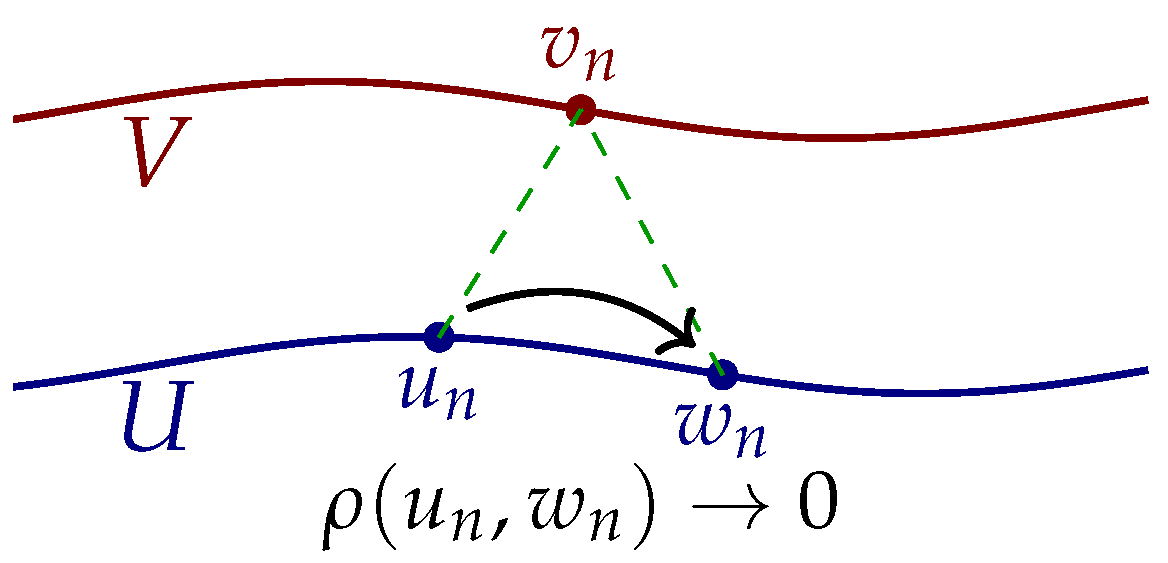
(Property UC). Let ( U , V ) be a nonempty pair of subsets of a metric space ( M , ρ ) . The pair ( U , V ) is said to satisfy property UC if for any sequences { u n } , { w n } in U and { v n } in V satisfying
lim n ρ ( u n , v n ) = lim n ρ ( w n , v n ) = dist ( U , V ) ,
it follows that
lim n ρ ( u n , w n ) = 0 .
Figure 1 provides geometric intuition for this property.
Example 1
([13]). Consider the metric space ( R 2 , ρ ) , where ρ is the metric induced by the maximum norm ( v , u ) = max { | v | , | u | } . Define the sets
U = { ( v , u ) R 2 : ( v , u ) 1 } , V = { ( 2 , 2 ) } { ( 5 , u ) : u R } .
A direct calculation gives dist ( U , V ) = 1 . To see that the pair ( U , V ) satisfies property UC, suppose { u n } , { w n } are sequences in U and { v n } is a sequence in V such that
lim n ρ ( u n , v n ) = lim n ρ ( w n , v n ) = 1 .
Because the distance is attained uniquely (the point ( 1 , 1 ) U is the only point of U at distance 1 from ( 2 , 2 ) V ), both { u n } and { w n } must converge to ( 1 , 1 ) . Hence ρ ( u n , w n ) 0 , verifying the definition.
Property UC holds for: (1) nonempty closed pairs ( U , V ) with U convex in uniformly convex Banach spaces ([14] Lemma 3.8), and (2) nonempty pairs ( U , V ) in strictly convex Banach spaces E where U is convex and relatively compact while V ¯ is weakly compact ([12] Proposition 5).
Up to this point, our discussion has been set in general metric spaces. To obtain a unified geometric framework that captures and generalizes the essence of convexity in classical Banach spaces, we now recall the setting based on extending the notion of line segment in a linear setting. This framework will allow us to state and prove our results in their most general form, with classical Banach space results emerging as direct special cases. The fundamental objects are defined below.
Definition 5.
Let ( M , ρ ) be a metric space.
1.
A path γ : [ a , b ] M is called a geodesic if
ρ ( γ ( t ) , γ ( t ) ) = | t t | , t , t [ a , b ] , t < t .
2.
( M , ρ ) is called a (uniquely) geodesic space if for every two points u , v M there exists a (unique) geodesic γ : [ 0 , 1 ] M such that
γ ( 0 ) = u and γ ( 1 ) = v .
Definition 6
(Geodesic Segment). Let ( M , ρ ) be a geodesic space. For each u , v M , consider the geodesic γ : [ 0 , 1 ] M joining u and v. Then the image γ ( [ 0 , 1 ] ) is called a geodesic segment or metric line segment, denoted by [ u , v ] . In fact,
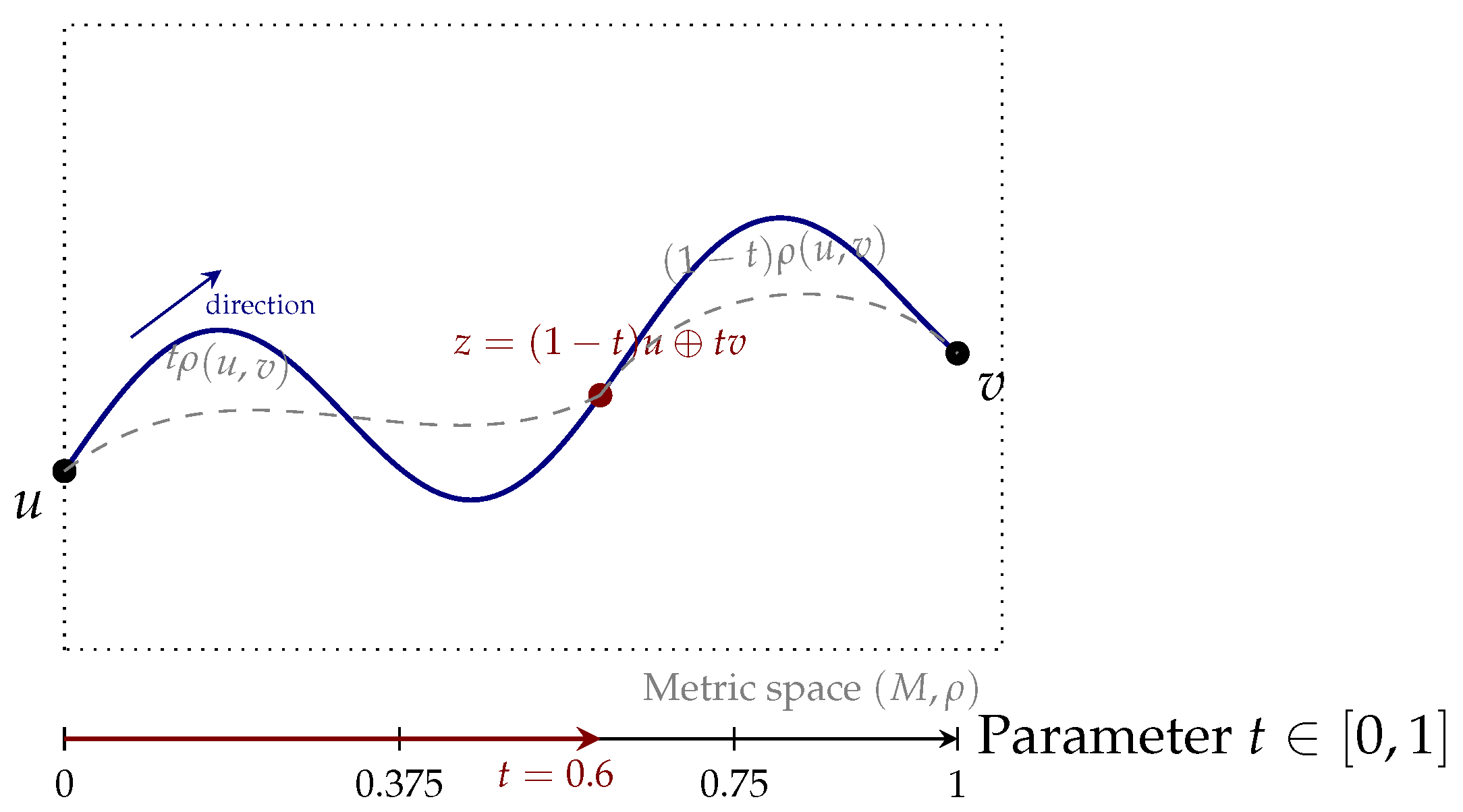
[ u , v ] = z M t [ 0 , 1 ] : z = ( 1 t ) u t v , ρ ( u , z ) = t ρ ( u , v ) , ρ ( z , v ) = ( 1 t ) ρ ( u , v ) .
Indeed, for t [ 0 , 1 ] , the expression ( 1 t ) u t v in (2) denotes the unique point on the geodesic segment [ u , v ] at distance t ρ ( u , v ) from u and consequently at distance ( 1 t ) ρ ( u , v ) from v (see Figure 2).
Let ( M , ρ ) be a geodesic space. A subset U of M is convex if, for every u , u U , we have [ u , u ] U . Furthermore, M is strictly convex if, for every u , v , w M such that u v and every t ( 0 , 1 ) , we have
ρ ( w , ( 1 t ) u t v ) < max { ρ ( w , u ) , ρ ( w , v ) } .
Moreover, the closed convex hull of a subset U of M is denoted by con ¯ ( U ) , which is defined by
con ¯ ( U ) = U C C C M is a closed convex set .
A more general class of strictly convex geodesic spaces are Busemann convex spaces, which allow us to study the distance between geodesics.
Definition 7.
A geodesic space ( M , ρ ) is called Busemann convex if for any two geodesics γ 1 : [ 0 , 1 ] M and γ 2 : [ 0 , 2 ] M and every t [ 0 , 1 ] , the following inequality holds:
ρ γ 1 ( t 1 ) , γ 2 ( t 2 ) ( 1 t ) ρ γ 1 ( 0 ) , γ 2 ( 0 ) + t ρ γ 1 ( 1 ) , γ 2 ( 2 ) .
One can easily see that Busemann convex spaces are uniquely geodesic. Within the framework of normed vector spaces, every uniquely geodesic space is also Busemann convex. The following lemma provides an equivalent condition for a geodesic metric space to be Busemann convex.
Lemma 2
([15]). Let ( M , ρ ) be a geodesic metric space. Then, M is Busemann convex if and only if the metric ρ is convex in the sense of Busemann, in other words,
ρ ( 1 t ) u t v , ( 1 t ) w t z ( 1 t ) ρ ( u , w ) + t ρ ( v , z ) , t [ 0 , 1 ]
for all u , v , w , z M .
Lemma 3
([15]). Let ( M , ρ ) be a Busemann convex geodesic space. Then, the metric ρ : M × M [ 0 , ) is convex, that is, for every u M and every geodesic γ : [ 0 , ] M , the following holds:
ρ u , γ ( t ) ( 1 t ) ρ ( u , γ ( 0 ) ) + t ρ ( u , γ ( ) ) , t [ 0 , 1 ] .
In Euclidean geometry, two segments are parallel if they are coplanar and never meet. In geodesic spaces, where there is no natural notion of “plane,” we need a metric definition of parallelism. The following definition formalizes this idea.
Definition 8.
Let ( M , ρ ) be a uniquely geodesic space. Geodesic segments [ u , z ] and [ v , w ] are said to be parallel if
ρ ( u , v ) = ρ ( m 1 , m 2 ) = ρ ( z , w ) ,
where m 1 and m 2 are the midpoints of [ u , z ] and [ v , w ] respectively. We write [ u , z ] [ v , w ] .
Example 2.
Consider the Euclidean plane R 2 with the standard metric. Let u = ( 0 , 0 ) , z = ( 2 , 0 ) , v = ( 0 , 2 ) , and w = ( 2 , 2 ) . The segments [ u , z ] and [ v , w ] are parallel in the usual Euclidean sense. Their midpoints are m 1 = ( 1 , 0 ) and m 2 = ( 1 , 2 ) , and we have d ( u , v ) = d ( m 1 , m 2 ) = d ( z , w ) = 2 , satisfying the definition above. This shows that the definition reduces to the classical notion in Euclidean space.
A fundamental property of this notion of parallelism in Busemann convex spaces is its symmetry, analogous to the Euclidean case.
Proposition 1
([7]). Let u , v , z , w be arbitrary points in a Busemann convex geodesic space ( M , ρ ) . If [ u , z ] [ v , w ] , then [ u , v ] [ z , w ] .
Definition 9.
A geodesic space ( M , ρ ) is called reflexive if for every descending chain { C α } α I of nonempty, bounded, closed, and convex subsets of M, we have α I C α .
As observed, for a nonempty pair ( U , V ) of subsets of the geodesic space M, its proximal pair ( U 0 , V 0 ) is not necessarily nonempty. The following proposition provides a sufficient condition for its nonemptiness.
Proposition 2
([7]). Let ( M , ρ ) be a reflexive and Busemann convex geodesic space. For any pair of nonempty, closed, and convex subsets ( U , V ) of M, if V is bounded. Then ( U 0 , V 0 ) is a pair of nonempty, closed, bounded, and convex subsets of M.
Definition 10.
A geodesic space ( M , ρ ) is called uniformly convex if for every r > 0 and ε ( 0 , 2 ] , there exists a δ ( 0 , 1 ] such that for all u , v , a M with
ρ ( u , a ) r , ρ ( v , a ) r , ρ ( u , v ) ε r ,
we have ρ ( m , a ) ( 1 δ ) r , where m is the midpoint of u and v.
In a geodesic space ( M , ρ ) , considering three points u, v, and w, one can define geodesics γ 1 , γ 2 , and γ 3 of lengths 1 , 2 , and 3 connecting these points pairwise. These geodesics intersect pairwise, forming a geodesic triangle ( u , v , w ) . The concept of a geodesic triangle introduces the notion of a comparison triangle. A comparison triangle for the geodesic triangle ( u , v , w ) in a geodesic space ( M , ρ ) is a triangle in the Euclidean plane E 2 with vertices u ¯ , v ¯ , and w ¯ , such that the side lengths are equal to the lengths of the corresponding geodesics in ( u , v , w ) . A point p ¯ [ u ¯ , v ¯ ] in the comparison triangle is called a comparison point for p [ u , v ] in the geodesic triangle if ρ ( u , p ) = ρ ( u ¯ , p ¯ ) . Similarly, this correspondence holds for points on [ u , w ] and [ v , w ] .
Definition 11.
Assume that ( M , ρ ) is a metric space and = ( p , q , r ) is a geodesic triangle in M with a corresponding comparison triangle ¯ E 2 . The triangle satisfies the CAT(0) inequality if for all u , v with corresponding comparison points u ¯ , v ¯ ¯ , the inequality
ρ ( u , v ) ρ E 2 ( u ¯ , v ¯ ) ,
holds. A CAT(0) space is a geodesic space ( M , ρ ) in which every geodesic triangle satisfies the C A T ( 0 ) inequality.
We highlight that the class of C A T ( 0 ) spaces, representing metric spaces with globally nonpositive sectional curvature in the sense of Gromov, provides particularly important examples of Busemann convex spaces. Detailed treatments of these curvature conditions appear in [15,16].
Example 3
( R -tree). A uniquely geodesic space ( M , ρ ) is called a R -tree if it satisfies the following conditions:
(i) 
For every u , v , w M such that [ u , v ] [ v , w ] = { v } , we have [ u , v ] [ v , w ] = [ u , w ] .
(ii) 
For every u , v , w M , there exists a z M such that [ u , v ] [ u , w ] = [ u , z ] .
Then, one can see M is a C A T ( 0 ) space

3. Noncyclic Chatterjea-Type Relatively Nonexpansive Mappings

This section focuses on recalling the definition of noncyclic Chatterjea-type contraction mappings and extending this concept to noncyclic orbital contractions in the same framework. Additionally, we review important geometric notions, particularly the proximal quasi-normal structure in reflexive Busemann convex spaces. Finally, we establish the existence of best proximity pairs for these classes of mappings.
Definition 12.
Let ( M , ρ ) be a metric space, and let ( U , V ) be a nonempty pair of subsets of M. A mapping F : U V U V is said to be a noncyclic Chatterjea-type contraction mapping if F is noncyclic and there exists α [ 0 , 1 2 ) such that the following inequality holds:
ρ ( F u , F v ) α ρ u , F v + ρ F u , v + ( 1 2 α ) dist ( U , V ) ,
for all ( u , v ) U × V . Furthermore, if α = 1 2 , then F is called a noncyclic Chatterjea-type relatively nonexpansive mapping.
The following result is a restatement of Theorem 5.5 from [8]. Here, we provide an alternative proof based on different techniques.
Theorem 1.
Let ( U , V ) be a nonempty, bounded, closed, and convex pair of subsets in the reflexive and strictly convex geodesic space ( M , ρ ) . Suppose that F : U V U V is a noncyclic Chatterjea-type contraction mapping. Then F has a best proximity pair.
Proof. 
Set
U : = ( X , Y ) ( U , V ) | ( X , Y ) is nonempty , bounded , closed , and convex pair such that T is noncyclic on ( X , Y ) .
Defining the relation
( X , Y ) ( Z , W ) ( X , Y ) ( Z , W ) ,
we observe that ( U , ) forms a partially ordered set. Note that U is nonempty since it contains at least the pair ( U , V ) . Because M is a reflexive and strictly convex geodesic space, every ascending chain in U has an upper bound. Therefore, Zorn’s lemma guarantees the existence of a minimal element ( m 1 , m 2 ) in U . It follows from the minimality of ( m 1 , m 2 ) that
con ¯ ( F ( m 1 ) ) = m 1 and con ¯ ( F ( m 2 ) ) = m 2 .
Fix an element u m 1 . From the inclusion m 2 B δ u ( m 2 ) ( u ) , we conclude that for any v m 2
ρ ( F u , F v ) α ρ ( u , F v ) + ρ ( F u , v ) + ( 1 2 α ) dist ( U , V ) , α δ u ( m 2 ) + δ v ( m 1 ) + ( 1 2 α ) dist ( U , V ) , 2 α δ ( m 1 , m 2 ) + ( 1 2 α ) dist ( U , V ) .
Now, take
ξ : = 2 α δ ( m 1 , m 2 ) + ( 1 2 α ) dist ( U , V ) .
Hence, F ( m 2 ) B ξ ( F u ) . Since every ball in a strictly convex space is convex, it follows that
m 2 = con ¯ ( F ( m 2 ) ) B ξ ( F u ) .
For any z m 2 , this yields
ρ ( z , F u ) ξ ,
and consequently, δ F u ( m 2 ) ξ for all u m 1 . Then, we derive the following estimates
δ ( m 1 , m 2 ) = δ con ¯ ( F ( m 1 ) ) , m 2 = δ F ( m 1 ) , m 2 = sup u m 1 δ F u ( m 2 ) ξ = 2 α δ ( m 1 , m 2 ) + ( 1 2 α ) dist ( U , V ) .
Consequently, we establish the equality δ ( m 1 , m 2 ) = dist ( U , V ) . Then for any ( p , q ) m 1 × m 2 , we have
dist ( U , V ) ρ ( p , q ) δ ( m 1 , m 2 ) = dist ( U , V ) ,
which implies that ρ ( p , q ) = dist ( U , V ) . On the other hand, since M is a strictly convex, we can show that m 1 must be a singleton set. To prove this by contradiction, assume there exist two distinct points u , u m 1 satisfying
ρ ( u , v ) = ρ ( u , v ) = dist ( U , V ) v m 2 .
Then we obtain
dist ( U , V ) ρ u u 2 , v < 1 2 ρ ( u , v ) + ρ ( u , v ) = dist ( U , V ) ,
which leads to a contradiction. Therefore, u = u , proving that m 1 is indeed a singleton, say m 1 = { u * } . Similarly, we conclude that m 2 = { v * } . Consequently, the pair ( u * , v * ) m 1 × m 2 is the unique best proximity pair of F. This completes the proof. □
Remark 1.
Theorem 1 remains valid when we consider fixed minimal sets m 1 and m 2 , provided that the noncyclic mapping F : U V U V satisfies the contraction condition
ρ ( F u , F v ) 2 α δ ( m 1 , m 2 ) + ( 1 2 α ) dist ( U , V )
for some contraction constant α ( 0 , 1 2 ) and for all pairs ( u , v ) m 1 × m 2 . Indeed, the existence of best proximity pairs is jointly determined by both the mapping F and the associated minimal pair ( m 1 , m 2 ) . Crucially, any modification to F typically results in a different minimal pair ( m 1 , m 2 ) , which in turn may lead to a distinct best proximity pair.
Definition 13.
A convex pair ( C 1 , C 2 ) in a geodesic space M is said to have proximal normal structure (abbreviated as PNS) if, for any bounded, closed, convex, and proximinal pair ( P 1 , P 2 ) ( C 1 , C 2 ) satisfying dist ( P 1 , P 2 ) = dist ( C 1 , C 2 ) and δ ( P 1 , P 2 ) > dist ( P 1 , P 2 ) , there exists ( p 1 , p 2 ) P 1 × P 2 such that
δ p 1 ( P 2 ) < δ ( P 1 , P 2 ) and δ p 2 ( P 1 ) < δ ( P 1 , P 2 ) .
Definition 14.
Let ( M , ρ ) be a geodesic space, and let ( C 1 , C 2 ) be a convex pair in M. We say that the pair ( C 1 , C 2 ) possesses proximal quasi-normal structure (abbreviated as PQNS) if, for any bounded, closed, convex, and proximinal pair ( P 1 , P 2 ) ( C 1 , C 2 ) satisfying dist ( C 1 , C 2 ) = dist ( P 1 , P 2 ) and δ ( P 1 , P 2 ) > dist ( P 1 , P 2 ) , there exists ( p 1 , p 2 ) P 1 × P 2 such that
ρ ( p 1 , v ) < δ ( P 1 , P 2 ) and ρ ( u , p 2 ) < δ ( P 1 , P 2 ) ,
for every ( u , v ) P 1 × P 2 .
Clearly, we observe that if a convex pair ( C 1 , C 2 ) in a geodesic space M has PNS, then it also possesses PQNS. In other words,
PNS PQNS .
The following result is a direct consequence of Proposition 3.5 in [7].
Proposition 3.
Let ( M , ρ ) be a uniformly convex space. Then, every nonempty, closed, bounded, and convex pair ( U , V ) in M possesses proximal quasi-normal structure (PQNS).
Example 4.
Assume that M is a C A T ( 0 ) space, then every nonempty, closed, bounded, and convex pair ( U , V ) in M has proximal quasi-normal structure (PQNS), as M is a uniformly convex space. A particularly important class of examples is given by R -trees (metric trees).
We will present a theorem that establishes the existence of best proximity pairs for mappings that are both noncyclic relatively nonexpansive and noncyclic Chatterjea-type relatively nonexpansive, under the geometric condition of proximal quasi-normal structure. The remarkable point to note is that the class of noncyclic relatively nonexpansive mappings is entirely distinct from the class of noncyclic Chatterjea-type relatively nonexpansive mappings. This distinction is illustrated in the following example.
Example 5.
Let us consider M = R endowed with the metric ρ = d which is defined as follows
d ( u , v ) = max { | u | , | v | } u v , 0 u = v .
Assume that U = [ 2 , 1 ] and V = [ 1 , 2 ] , and define the mapping F : U V U V by
F ( u ) = 2 u U , 2 u V .
Clearly F is a noncyclic Chatterjea-type relatively nonexpansive mapping. Because
d ( F u , F v ) = max { | F u | , | F v | } = 2 , d ( u , F v ) = max { | u | , | F v | } = 2 , d ( F u , v ) = max { | F u | , | v | } = 2 .
It should be noted that F is not a relatively nonexpansive. To see this, take u = 1 and v = 1 , then
d ( F u , F v ) = 2 > 1 = d ( u , v ) .
The following lemma plays a key role in proving our main theorem.
Lemma 4.
Let ( U , V ) be a nonempty, closed, and convex pair of subsets in the reflexive and Busemann convex geodesic space ( M , ρ ) , in which U is bounded. Suppose that F : U V U V is a noncyclic relatively nonexpansive mapping. Then, there exists a pair
( P 1 , P 2 ) ( U 0 , V 0 )
that is minimal with respect to the property of being nonempty, closed, convex, and F-invariant subsets of ( U , V ) , such that
dist ( P 1 , P 2 ) = dist ( U , V ) .
Furthermore, the pair ( P 1 , P 2 ) is proximinal.
Proof. 
First, Proposition 2 guarantees that ( U 0 , V 0 ) forms a nonempty, bounded, closed, and convex pair. Since F is relatively nonexpansive, ( U 0 , V 0 ) is clearly F-invariant and proximinal. We define the collection
F : = C U 0 V 0 | ( U 0 C , V 0 C ) is nonempty , closed , convex , and F - invariant such that dist ( U 0 C , V 0 C ) = dist ( U , V ) , moreover ( U 0 C , V 0 C ) is proximinal .
The pair U 0 V 0 itself belongs to F , ensuring that F is nonempty. Consider a decreasing chain { C α } α Γ in F , and define Σ : = α Γ C α . Then Σ serves as a lower bound for this chain. We now verify that Σ F . Since for each α Γ , the pair ( C α U 0 , C α V 0 ) is nonempty, closed, convex, and F-invariant, it follows that ( Σ U 0 , Σ V 0 ) inherits all these properties. The rest of the proof is devoted to showing that ( Σ U 0 , Σ V 0 ) is proximinal and dist ( U 0 Σ , V 0 Σ ) = dist ( U , V ) . Assume that p Σ U 0 , by definition for each α Γ , p C α U 0 , and since ( C α U 0 , C α V 0 ) is a proximinal pair and M is Busemann convex space, then there exists a unique point q C α V 0 such that
ρ ( p , q ) = dist ( C α U 0 , C α V 0 ) = dist ( U , V ) , α Γ .
On the other hand,
dist ( C α U 0 , C α V 0 ) dist ( U 0 Σ , V 0 Σ ) ρ ( p , q ) = dist ( U , V ) .
Therefore, the pair ( U 0 Σ , V 0 Σ ) is proximinal, which establishes that Σ F . By Zorn’s Lemma, F contains a minimal element P . Defining
P 1 : = P U 0 and P 2 : = P V 0 ,
we obtain a minimal pair ( P 1 , P 2 ) that is proximinal. This completes the proof. □
The principal contribution of this section is contained in the following theorem.
Theorem 2.
Let ( U , V ) be a nonempty, closed, and convex pair of subsets in a reflexive and Busemann convex geodesic space ( M , ρ ) , where U is bounded. Suppose that ( U , V ) has the property of quasi-normal structure (PQNS) and that F : U V U V is a noncyclic Chatterjea-type relatively nonexpansive mapping, which is also relatively nonexpansive. Then F admits a best proximity pair.
Proof. 
According to Lemma 4, we may consider a minimal element ( P 1 , P 2 ) of F . We can observe that dist ( P 1 , P 2 ) = δ ( P 1 , P 2 ) . By the strict convexity of M, the sets P 1 and P 2 must be singletons; the result follows immediately. Now, we show that the case dist ( P 1 , P 2 ) < δ ( P 1 , P 2 ) cannot occur. Suppose, for contradiction, that this case holds. Since ( U , V ) has PQNS, there exists ( p 1 , p 2 ) P 1 × P 2 such that
ρ ( p 1 , y ) < δ ( P 1 , P 2 ) and ρ ( x , p 2 ) < δ ( P 1 , P 2 ) ,
for all ( x , y ) P 1 × P 2 . On the other hand, by the proximinality of ( P 1 , P 2 ) , there exists a pair ( q 1 , q 2 ) P 1 × P 2 such that ρ ( p 1 , q 2 ) = ρ ( q 1 , p 2 ) = dist ( P 1 , P 2 ) . Then for any y P 2 , we have
ρ ( p 1 q 1 2 , y ) ρ ( p 1 , y ) 2 + ρ ( q 1 , y ) 2 δ ( P 1 , P 2 ) 2 + δ ( P 1 , P 2 ) 2 = δ ( P 1 , P 2 ) .
We put m 1 = p 1 q 1 2 , so we observe δ m 1 ( P 2 ) δ ( P 1 , P 2 ) . Similarly, setting m 2 = p 2 q 2 2 , we obtain δ m 2 ( P 1 ) δ ( P 1 , P 2 ) and ρ ( m 1 , m 2 ) = dist ( P 1 , P 2 ) . Let
L 1 = { u P 1 δ u ( P 2 ) δ ( P 1 , P 2 ) and for its proximal point v P 2 , δ v ( P 1 ) δ ( P 1 , P 2 ) } ,
L 2 = { v P 2 δ v ( P 1 ) δ ( P 1 , P 2 ) and for its proximal point u P 1 , δ u ( P 2 ) δ ( P 1 , P 2 ) } .
Clearly, m 1 L 1 and m 2 L 2 , so ( L 1 , L 2 ) is a nonempty pair. We then prove that both L 1 and L 2 are closed and convex sets. First, we establish this for L 1 , and then apply a similar argument to L 2 . Let { u n } L 1 be a sequence converging to u P 1 . Since ρ ( u n , z ) δ ( P 1 , P 2 ) for all n N and z P 2 , then we can see δ u ( P 2 ) δ ( P 1 , P 2 ) . Let v n P 2 be the proximal point of u n satisfying
δ v n ( P 1 ) δ ( P 1 , P 2 ) .
For v P 2 with ρ ( u , v ) = dist ( P 1 , P 2 ) , given that M is a Busemann convex spaces, we obtain
ρ u n u 2 , v n v 2 = dist ( P 1 , P 2 ) .
From Proposition 1, we obtain ρ ( u n , u ) = ρ ( v n , v ) . Consequently, v n v , and by passing to the limit in (3), we conclude that v L 1 , which establishes that L 1 is closed. We now prove that L 1 is convex. Let u , u L 1 with midpoints m 1 = u u 2 , and let v , v P 2 (with midpoints m 2 = v v 2 ) be proximal points of u and u , respectively. Consider an arbitrary point z P 2 , then
ρ ( z , m 1 ) 1 2 ρ ( u , z ) + 1 2 ρ ( u , z ) δ ( P 1 , P 2 ) .
Hence, δ m 1 ( P 2 ) δ ( P 1 , P 2 ) . By a similar argument, we also obtain δ m 2 ( P 1 ) δ ( P 1 , P 2 ) . Therefore, m 1 L 1 , which proves the convexity of L 1 . Furthermore, it should be noted that ( L 1 , L 2 ) is a proximinal pair and dist ( L 1 , L 2 ) = dist ( P 1 , P 2 ) .We proceed to prove that F is noncyclic on L 1 L 2 . For this purpose, consider u L 1 and v L 2 satisfying ρ ( u , v ) = dist ( L 1 , L 2 ) . For every z P 2 , the fact that F is a noncyclic Chatterjea-type relatively nonexpansive mapping implies
ρ ( F u , F z ) 1 2 ρ ( F u , z ) + ρ ( u , F z ) , 1 2 δ u ( P 2 ) + δ ( P 1 , P 2 ) , δ ( P 1 , P 2 ) .
This yields the inclusion
F ( P 2 ) B δ ( P 1 , P 2 ) ( F u ) P 2 : = P 2 .
From the above construction, P 2 is clearly nonempty, closed, and convex. Set
P 1 : = { x P 1 y P 2 ρ ( x , y ) = dist ( P 1 , P 2 ) } .
One can easily observe that P 1 is nonempty, closed, convex, and F-invariant. Also, ( P 1 , P 2 ) is a proximinal pair with
dist ( P 1 , P 2 ) = dist ( P 1 , P 2 ) .
Consequently, P 1 P 2 F . By the minimality of ( P 1 , P 2 ) , we obtain P 1 = P 1 and P 2 = P 2 , which implies P 2 B δ ( P 1 , P 2 ) ( F u ) . Therefore, δ F u ( P 2 ) δ ( P 1 , P 2 ) . Applying a symmetric argument yields δ F v ( P 1 ) δ ( P 1 , P 2 ) . Since F v is the proximal point of F u , this establishes that F u L 1 , hence F ( L 1 ) L 1 . Likewise, F ( L 2 ) L 2 implies that F is noncyclic on L 1 L 2 , and consequently L 1 L 2 F . Since δ ( L 1 , L 2 ) δ ( P 1 , P 2 ) , this contradicts the minimality of ( P 1 , P 2 ) . □
To generalize the concept of noncyclic Chatterjea-type contraction mappings, we introduce the following definition.
Definition 15.
Let ( U , V ) be a nonempty pair in a metric space ( M , ρ ) . A mapping F : U V U V is called a noncyclic Chatterjea-type orbital contraction if F is noncyclic and there exists α [ 0 , 1 2 ) such that for all ( u , v ) U × V ,
ρ ( F u , F v ) α ρ u , O F ( v ) + ρ v , O F ( u ) + ( 1 2 α ) dist ( U , V ) .
Following the approach of Theorem 3.20 in [8], we present below its generalized version. We omit the proof since it follows similar arguments to those in the reference.
Theorem 3.
Let ( M , ρ ) be a reflexive Busemann convex geodesic space, and let ( U , V ) be a nonempty, closed, and convex pair in M, where U is bounded. Assume that F : U V U V is a noncyclic Chatterjea-type orbital contraction mapping. Then F has a best proximity pair.
To further clarify Theorem 3, we present a detailed example that demonstrates its application in a practical scenario.
Example 6.
Consider the plane M = R 2 equipped with the radial metric ρ = d rad , defined by
d rad ( u 1 , u 2 ) , ( v 1 , v 2 ) = d e ( u 1 , u 2 ) , ( v 1 , v 2 ) λ R ( u 1 , u 2 ) = λ ( v 1 , v 2 ) , d e ( u 1 , u 2 ) , ( 0 , 0 ) + d e ( 0 , 0 ) , ( v 1 , v 2 ) otherwise ,
where d e denotes the Euclidean metric on R 2 . Assume
U = { ( u , 0 ) 0 u 1 } and V = { ( 0 , v ) 0 v 1 } ,
and define the mapping F : U V U V as follows:
F ( u , 0 ) = ( 1 8 , 0 ) , F ( 0 , v ) = ( 0 , 0 ) .
One can observe that F is a noncyclic Chatterjea-type orbital contraction mapping, as evidenced by the following calculations
d rad F u , F v = 1 8 , d rad u , O F ( v ) = u , d rad v , O F ( u ) = 1 + v ,
where u = ( u , 0 ) U and v = ( 0 , v ) V . Consequently, for any α 1 8 , 1 2 , the following inequality holds.
d rad F u , F v α d rad u , O F ( v ) + d rad v , O F ( u ) .
By Theorem 3, the existence of a best proximity pair is guaranteed. Since U V , this pair coincides with a fixed point. Here, o = ( 0 , 0 ) is the fixed point of F.
  • It is worth noting that F is not relatively nonexpansive. To verify this, consider u = 1 32 , 0 and v = 0 , 1 32 . Then
d rad F u , F v = 1 8 > 1 16 = d rad u , v .

4. Noncyclic Chatterjea-Type C -Nonexpansive Mappings

In this section, we introduce two new classes of noncyclic mappings:
  • Noncyclic Chatterjea-type C-nonexpansive mappings,
  • Noncyclic Chatterjea-type orbital C-nonexpansive mappings.
We investigate the existence of best proximity pairs for these mappings in geodesic spaces, leveraging the particularly useful geometric property of proximal normal structures. Formal definitions are presented first.
Definition 16.
Let ( U , V ) be a nonempty pair of subsets in a metric space ( M , ρ ) . A mapping F : U V U V is called a noncyclic Chatterjea-type C-nonexpansive mapping if F is noncyclic on U V and for all ( u , v ) U × V , when ρ ( u , v ) = dist ( U , V ) , then ρ ( F u , F v ) = ρ ( u , v ) . If ρ ( u , v ) > dist ( U , V ) , then
ρ ( F u , F v ) max { ρ ( u , F v ) , ρ ( v , F u ) , ρ ( u , v ) } , if min { ρ ( u , F v ) , ρ ( v , F u ) } = dist ( U , V ) .
and
ρ ( F u , F v ) min { ρ ( u , F v ) , ρ ( v , F u ) } , if min { ρ ( u , F v ) , ρ ( v , F u ) } > dist ( U , V ) .
In the particular case when U = V , we say F is Chatterjea-type C-nonexpansive.
The following inequality shows that the class of Chatterjea-type C-nonexpansive mappings can be viewed as a subclass of Chatterjea-type nonexpansive mappings.
ρ ( F u , F v ) min { ρ ( u , F v ) , ρ ( v , F u ) } 1 2 ρ ( u , F v ) + ρ ( v , F u ) , u , v U .
Definition 17.
Let ( U , V ) be a nonempty pair in a metric space ( M , ρ ) . A mapping F : U V U V is called a noncyclic orbital Chatterjea-type C-nonexpansive mapping if F is noncyclic and for each ( u , v ) U × V with ρ ( u , v ) = dist ( U , V ) , then
ρ ( F u , F v ) = ρ ( u , v ) .
If ρ ( u , v ) > dist ( U , V ) , then
ρ ( F u , F v ) max δ u ( O F ( v ) ) , δ v ( O F ( u ) ) , ρ ( u , v ) , If min { δ u ( O F ( v ) ) , δ v ( O F ( u ) ) } = dist ( U , V ) ,
and
ρ ( F u , F v ) min δ u ( O F ( v ) ) , δ v ( O F ( u ) ) , if min { δ u ( O F ( v ) ) , δ v ( O F ( u ) ) } > dist ( U , V ) .
When U = V , F is called a Chatterjea-type orbital C-nonexpansive.
Example 7.
Let M = equipped with the metric d , defined as follows
d ( u , v ) = sup n N | u n v n | ,
where u = ( u n ) , v = ( v n ) . Let { e j j N } denote the standard basis of . We define
U = { t e 1 0 t 1 } ,
and consider the self-map F : U U given by
F ( t e 1 ) = t e 1 0 < t 1 , e 1 t = 0 .
We show that F is orbital C-nonexpansive in the sense of Chatterje. To see this, Consider the following cases.
Case 1. If u = 0 and v = t e 1 with t > 0 , then
δ u O F ( v ) = sup { d ( 0 , t 2 n e 1 ) n N { 0 } } = 1 , δ v O F ( u ) = sup { d ( 0 , t e 1 ) , d ( e 1 , t e 1 ) } = 1 .
Consequently
d ( F u , F v ) = d ( e 1 , t e 1 ) = 1 = min { δ u O F ( v ) , δ v O F ( u ) } .
Case 2. If u = t e 1 and v = s e 1 with t , s > 0 , then
δ u O F ( v ) = sup { d ( t e 1 , s 2 n e 1 ) n N { 0 } } = 1 , δ v O F ( u ) = sup { d ( t 2 n e 1 , s e 1 ) n N { 0 } } = 1 .
So
d ( F u , F v ) = d ( t e 1 , s e 1 ) 1 = min { δ u O F ( v ) , δ v O F ( u ) } .
Therefore, F is Chatterjea-type orbital C-nonexpansive.
Remark 2.
We adapt Example 3.10 from [17] to demonstrate that a (noncyclic) Chatterjea-type C-nonexpansive mapping is (noncyclic) Chatterjea-type orbital C-nonexpansive, but the converse fails. Let M = R be equipped with the metric d defined in Example 5. Taking U = [ 0 , 1 ] , we define the mapping F : U U by
F ( u ) = u if 0 < u 1 , 1 if u = 0 .
We examine the orbital behavior through
δ u O F ( v ) = sup 0 < v 1 d u , v 2 n n N { 0 } = 1 , δ v O F ( u ) = sup 0 < u 1 d v , u 2 n n N { 0 } = 1 ,
which confirms the Chatterjea-type orbital C-nonexpansiveness. However, F fails to be Chatterjea-type C-nonexpansive, as for u = 1 2 and v = 0
d ( F u , F v ) = max 2 2 , 1 = 1 > 1 2 2 2 + 1 = 1 2 d ( F u , v ) + d ( u , F v ) .
This adaptation highlights the distinction between the two notions of Chatterjea-type C-nonexpansiveness.
We establish the existence of best proximity pair for noncyclic Chatterjea-type orbital C-nonexpansive mappings via proximal normal structure.
Theorem 4.
Let ( M , ρ ) be a reflexive Busemann convex geodesic space, and let ( U , V ) be a nonempty, closed, and convex pair in M, where U is bounded. Assume that F : U V U V is a noncyclic Chatterjea-type orbital C-nonexpansive mapping and ( U , V ) has PNS. Then F possesses a best proximity pair.
Proof. 
First, we note that if for every ( u , v ) U × V we have ρ ( u , v ) = dist ( U , V ) , then the assertion immediately follows from ([7] Theorem 3.4). Additionally, if for all ( u , v ) U × V satisfying ρ ( u , v ) > dist ( U , V ) , the following holds
min { δ u ( O F ( v ) ) , δ v ( O F ( u ) ) } = dist ( U , V ) .
Then, by definition
ρ ( u , v ) min { δ u ( O F ( v ) ) , δ v ( O F ( u ) ) } = dist ( U , V ) .
This implies ρ ( u , v ) = dist ( U , V ) for all ( u , v ) U × V . Consequently, by the definition of F and applying ([7] Theorem 3.4) again, we conclude that F admits a best proximity pair. Thus, we assume that
min { δ u ( O F ( v ) ) , δ v ( O F ( u ) ) } > dist ( U , V ) .
Set
A : = ( X , Y ) ( U , V ) | ( X , Y ) is nonempty , closed , convex , and , F - invariant satisfying dist ( U , V ) = dist ( X , Y ) .
Proposition 2 guarantees that A , since ( U 0 , V 0 ) A . Here, we consider A with the relation “ ⊇ ”, as a partially ordered family of sets. Assume that { ( X γ , Y γ ) } γ Γ is an ascending chain in A and define
Λ X = γ Γ X γ , Λ Y = γ Γ Y γ
First observe that the pair ( Λ X , Λ Y ) is nonempty, closed, and convex due to M’s reflexivity. Moreover, one can easily see that ( Λ X , Λ Y ) is a F-invariant. We now prove that dist ( U , V ) = dist ( Λ X , Λ Y ) . First, we observe that the inequality dist ( U , V ) dist ( Λ X , Λ Y ) holds trivially by the definition of distance between sets. To establish the reverse inequality, let ( u , v ) Λ X × Λ Y be arbitrary. By definition, we have
ρ ( u , v ) dist ( X γ , Y γ ) for all γ Γ .
Taking the infimum over all such pairs ( u , v ) , we obtain
dist ( Λ X , Λ Y ) dist ( U , V ) .
Moreover, ( Λ X , Λ Y ) is proximinal, consequently, we conclude that ( Λ X , Λ Y ) A . Thus, we have shown that every ascending chain in A has an upper bound with respect to the partial order “⊇”. By Zorn’s lemma, there exists a minimal element in this chain, which we denote by ( m 1 , m 2 ) . Now, if
δ ( m 1 , m 2 ) = dist ( m 1 , m 2 ) = dist ( U , V ) .
Then all pairs ( u , v ) m 1 × m 2 are classified as best proximity pairs, because
dist ( U , V ) = dist ( m 1 , m 2 ) ρ ( u , v ) δ ( m 1 , m 2 ) .
Furthermore, if we consider another point u m 1 satisfying ˚ ρ ( u , v ) = ˚ dist ( U , V ) ˚ . Since M is a Busemann convex space, we obtain
dist ( U , V ) ˚ ρ ( u u 2 , v ) < 1 2   ˚ ρ ( u , v ) +   ˚ ρ ( u , v ) = dist ( U , V ) .
This is impossible, so m 1 ˚ must be a singleton set, that is, ˚ ˚ m 1 = { u } . Similarly, we can see ˚ ˚ m 2 = { v } . To conclude the argument, we demonstrate that the inequality
δ ( m 1 , m 2 ) < dist ( m 1 , m 2 ) ,
cannot hold. Suppose, for contradiction, that this inequality were valid. Since ( U , V ) has PNS, then there exist elements p m 1 and q m 2 satisfying
max { δ p ( m 2 ) , δ q ( m 1 ) } < δ ( m 1 , m 2 ) .
Put
k 1 : = δ p ( m 2 ) , k 2 : = δ q ( m 1 ) , k : = max { k 1 , k 2 } .
Then k < δ ( m 1 , m 2 ) . On the other hand, given that F is noncyclic on m 1 m 2 , we have
con ¯ ( F ( m 1 ) ) m 1 and con ¯ ( F ( m 2 ) ) m 2 .
Thus we obtain
F con ¯ ( F ( m 1 ) ) con ¯ ( F ( m 1 ) ) and F con ¯ ( F ( m 2 ) ) con ¯ ( F ( m 2 ) ) ,
which shows that F remains noncyclic on con ¯ ( F ( m 1 ) ) con ¯ ( F ( m 2 ) ) . For the pair ( p , q ) , we observe
( F ( p ) , F ( q ) ) con ¯ ( F ( m 1 ) ) × con ¯ ( F ( m 2 ) ) ,
and consequently
dist ( U , V ) dist con ¯ ( F ( m 1 ) ) , con ¯ ( F ( m 2 ) ) ρ ( F ( p ) , F ( q ) ) = ρ ( p , q ) dist ( U , V ) .
This yields an F-invariant pair con ¯ ( F ( m 1 ) ) , con ¯ ( F ( m 2 ) ) ( m 1 , m 2 ) that is nonempty, closed, and convex with ρ ( F ( p ) , F ( q ) ) = dist ( U , V ) . By minimality of ( m 1 , m 2 ) , we conclude
m 1 = con ¯ ( F ( m 1 ) ) and m 2 = con ¯ ( F ( m 2 ) ) .
We now define
C k ( m 1 ) : = m 2 u m 1 B k ( u ) = { v m 2 δ v ( m 1 ) k } ,
C k ( m 2 ) : = m 1 v m 2 B k ( v ) = { u m 1 δ u ( m 2 ) k } .
Clearly, ( p , q ) C k ( m 2 ) × C k ( m 1 ) , making it a nonempty. Moreover, since M is a Busemann convex space (and consequently strictly convex), then C k ( m 2 ) , C k ( m 1 ) is a closed and convex pair. Besides, for any ( u , v ) m 1 × m 2 we observe that
( u , v ) C k ( m 2 ) × C k ( m 1 ) m 1 B k ( v ) and m 2 B k ( u ) .
Also
dist C k ( m 2 ) , C k ( m 1 ) = dist ( m 1 , m 2 ) .
Next, we prove that F is noncyclic on C k ( m 2 ) C k ( m 1 ) . Let u C k ( m 2 ) . Since F is a noncyclic Chatterjea-type orbital C-nonexpansive mapping, for any v m 2 we have
ρ ( F u , F v ) min δ u ( O F ( v ) ) , δ v ( O F ( u ) ) k ,
which implies F v B k ( F u ) . Consequently,
F ( m 2 ) B k ( F u ) and con ¯ ( F ( m 2 ) ) B k ( F u ) .
This yields m 2 B k ( F u ) . Therefore, by relation 4 we conclude F u C k ( m 2 ) , establishing F ( C k ( m 2 ) ) C k ( m 2 ) . An analogous argument shows F ( C k ( m 1 ) ) C k ( m 1 ) . Applying the minimality of ( m 1 , m 2 ) once again, we obtain
m 1 = C k ( m 2 ) and m 2 = C k ( m 1 ) .
This containment follows directly
m 2 u m 1 B k ( u ) .
Therefore, for all v m 2 , we have δ v ( m 1 ) k , yielding
δ ( m 1 , m 2 ) = sup v m 2 δ v ( m 1 ) k .
The resulting contradiction completes the argument. □
The following results are immediate consequences of Theorem 4.
Corollary 1.
Let E be a reflexive and strictly convex Banach space, and let ( U , V ) be a nonempty, bounded, closed, and convex pair in E. Assume that F : U V U V is a noncyclic Chatterjea-type orbital C-nonexpansive mapping. If the pair ( U , V ) has proximal normal structure. Then F possesses a best proximity pair.
Corollary 2.
Let E be a reflexive and strictly convex Banach space, and let U be a nonempty, bounded, closed, and convex subset of E. Assume that F : U U is a Chatterjea-type orbital C-nonexpansive mapping. If the pair U has normal structure. Then F possesses a fixed point.
We conclude this section with an illustrative example of Theorem 4.
Example 8.
Let M = R 2 be equipped with the river metric ρ = d riv , defined in the following way
d riv ( u 1 , u 2 ) , ( v 1 , v 2 ) = | u 2 v 2 | , u 1 = v 1 , | u 1 v 1 | + | u 2 | + | v 2 | , u 1 v 1 .
One can observe that the metric space ( R 2 , d riv ) is an R -tree, and hence a C A T ( 0 ) space (see [5] Theorem 3.2). Now, let
U = { ( u , 0 ) 1 u 2 } , V = { ( 0 , v ) 1 v 2 } ,
then dist ( U , V ) = 2 . Define the mapping F : U V U V as follows
F ( u , 0 ) = ( 1 , 0 ) 1 u < 2 , ( 3 2 , 0 ) u = 2 . and F ( 0 , v ) = ( 0 , 1 ) 1 v < 2 , ( 0 , 3 2 ) v = 2 .
To simplify the notation and computations, we denote by u any point of the form ( u , 0 ) U , and by v any point of the form ( 0 , v ) V . We now examine the following cases.
  • Case 1. For any u = ( u , 0 ) U and v = ( 0 , v ) V satisfying 1 u , v < 2 , we have
d riv F u , F v = d riv ( 1 , 0 ) , ( 0 , 1 ) = 2 , δ u O F ( v ) = sup 1 v < 2 { d riv ( u , 0 ) , ( 0 , v ) , d riv ( u , 0 ) , ( 0 , 1 ) } = 2 + u , δ v O F ( u ) = sup 1 u < 2 { d riv ( u , 0 ) , ( 0 , v ) , d riv ( 1 , 0 ) , ( 0 , v ) } = 2 + v .
Then we obtain the following bounds
2 < δ u O F ( v ) < 4 and 2 < δ v O F ( u ) < 4 .
Consequently, we derive the inequality
d riv F u , F v = 2 < min { δ u ( O F ( v ) , δ v O F ( u ) } .
Case 2. For any u = ( u , 0 ) U and v = ( 0 , v ) V satisfying 1 u < 2 and v = 2 , we have
d riv F u , F v = d riv ( 1 , 0 ) , ( 0 , 3 2 ) = 2 , δ u O F ( v ) = sup { d riv ( u , 0 ) , ( 0 , 2 ) , d riv ( u , 0 ) , ( 0 , 3 2 ) , d riv ( u , 0 ) , ( 0 , 1 ) } = 2 + u δ v O F ( u ) = sup 1 u < 2 { d riv ( u , 0 ) , ( 0 , 2 ) , d riv ( 1 , 0 ) , ( 0 , 2 ) } = 4 .
We establish the following bound
2 < δ u O F ( v ) < 4 .
This yields the subsequent inequality
d riv F u , F v = 2 < min { δ u ( O F ( v ) , δ v O F ( u ) } .
Case 3. For any u = ( u , 0 ) U and v = ( 0 , v ) V satisfying u = 2 and 1 v < 2 , we have
d riv F u , F v = d riv ( 3 2 , 0 ) , ( 0 , 1 ) = 2 , δ u O F ( v ) = sup 1 v < 2 { d riv ( 0 , 2 ) , ( 0 , v ) , d riv ( 2 , 0 ) , ( 0 , 1 ) } = 4 , δ v O F ( u ) = sup { d riv ( 2 , 0 ) , ( 0 , v ) , d riv ( 3 2 , 0 ) , ( 0 , v ) , d riv ( 1 , 0 ) , ( 0 , v ) } = 2 + v .
We derive the following bounds
2 < δ v O F ( u ) < 4 .
From this, we obtain the ensuing inequality
d riv F u , F v = 2 < min { δ u ( O F ( v ) , δ v O F ( u ) } .
Case 4. For any u = ( u , 0 ) U and v = ( 0 , v ) V satisfying u = 2 and v = 2 , we have
d riv F u , F v = d riv ( 3 2 , 0 ) , ( 0 , 3 2 ) = 3 , δ u O F ( v ) = sup { d riv ( 2 , 0 ) , ( 0 , 2 ) , d riv ( 2 , 0 ) , ( 0 , 3 2 ) , d riv ( 2 , 0 ) , ( 0 , 1 ) } = 4 , δ v O F ( u ) = sup { d riv ( 2 , 0 ) , ( 0 , 2 ) , d riv ( 3 2 , 0 ) , ( 0 , 2 ) , d riv ( 1 , 0 ) , ( 0 , 2 ) } = 4 .
We may now conclude that the following inequality holds.
d riv F u , F v = 3 < 4 = min { δ u ( O F ( v ) , δ v O F ( u ) } .
Therefore, F is a noncyclic Chatterjea-type orbital C-nonexpansive mapping. By Theorem 4, F admits a best proximity pair. In this case, the pair
( p , q ) = ( 1 , 0 ) , ( 0 , 1 ) U × V
is a best proximity pair for F. More precisely, we have
d riv ( p , q ) = 2 = dist ( U , V ) , F p = p , F q = q .

5. On the Structure of Minimal Sets

In this final section, we investigate the existence of minimal sets for noncyclic Chatterjea-type C-nonexpansive mappings in Busemann convex geodesic spaces. These minimal sets play a fundamental role in our main results. It is noteworthy that throughout this section, by minimal sets we always refer to the minimal structure for noncyclic Chatterjea-type C-nonexpansive mappings, precisely as defined later in Remark 3.
Definition 18.
Let ( M , ρ ) be a metric space, and let ( U , V ) be a nonempty pair of subsets of M. A point u U (or v V ) is called a diametral point with respect to V (or U) if δ u ( V ) = δ ( U , V ) (or δ v ( U ) = δ ( U , V ) ). Moreover, if both u U and v V are diametral points, the pair ( u , v ) U × V is said to be a diametral pair.
Remark 3.
As a direct consequence of the proof of Theorem 4, consider a reflexive Busemann convex geodesic space ( M , ρ ) with a nonempty, closed, and convex pair ( U , V ) in M, where U is bounded. For any noncyclic Chatterjea-type C-nonexpansive mapping F : U V U V , there exists a minimal pair ( m 1 m 2 ) ( U , V ) of nonempty, closed, convex, and F-invariant subsets satisfying dist ( m 1 , m 2 ) = dist ( U , V ) .
As a direct consequence of the proof of Theorem 4, we can state the following lemma (proof omitted).
Lemma 5.
Let ( M , ρ ) be a reflexive Busemann convex geodesic space, and let ( U , V ) be a nonempty, closed, and convex pair in M, where U is bounded. Assume that F : U V U V is a noncyclic Chatterjea-type C-nonexpansive mapping. Then, every pair ( p , q ) m 1 × m 2 with ρ ( p , q ) = dist ( m 1 , m 2 ) is diametral.
The following definition will be used in the remaining results of this section.
Definition 19.
Given a nonempty pair ( U , V ) of subsets in a metric space ( M , ρ ) , consider a noncyclic mapping F : U V U V . A sequence { ( u n , v n ) } n N U × V is called an approximate best proximity pair sequence for F if the following conditions hold:
lim n ρ ( u n , F u n ) = 0 , lim n ρ ( v n , F v n ) = 0 , and lim n ρ ( u n , v n ) = dist ( U , V ) .
The following lemma guarantees the existence such a sequence for any noncyclic Chatterjea-type C-nonexpansive mapping.
Lemma 6.
Let ( M , ρ ) be a reflexive Busemann convex geodesic space, and let ( U , V ) be a nonempty, closed, convex pair of subsets of M with U being bounded. If F : U V U V is a noncyclic Chatterjea-type C-nonexpansive mapping. Then, there exists an approximate best proximity pair sequence for F.
Proof. 
By Proposition 2, ( U 0 , V 0 ) is a nonempty, bounded, closed, and convex pair in M. According to Remark 3, we may fix a minimal pair ( m 1 , m 2 ) ( U , V ) with respect to being nonempty, closed, convex, and F-invariant. Let ( u 0 , v 0 ) m 1 × m 2 be a fixed pair satisfying
dist ( m 1 , m 2 ) = ρ ( u 0 , v 0 ) = dist ( U , V ) .
Now, for each k 0 , 1 2 , define a mapping φ k : m 1 m 2 m 1 m 2 as follows
φ k ( x ) = ( 1 2 k ) u 0 2 k F x x m 1 , ( 1 2 k ) v 0 2 k F x x m 2 .
For every k 0 , 1 2 , the mapping φ k remains noncyclic on m 1 m 2 . Lemma 2 implies that for any ( x , y ) m 1 × m 2
ρ φ k ( x ) , φ k ( y ) = ρ ( 1 2 k ) u 0 2 k F x , ( 1 2 k ) v 0 2 k F y , 2 k ρ F x , F y + ( 1 2 k ) ρ ( u 0 , v 0 ) , 2 k min { ρ ( x , F y ) , ρ ( F x , y ) } + ( 1 2 k ) dist ( U , V ) , 2 k δ ( m 1 , m 2 ) + ( 1 2 k ) dist ( U , V ) .
Remark 1 implies that for each k 0 , 1 2 , there exist pairs ( p k , q k ) m 1 × m 2 satisfying
φ k ( p k ) = p k , φ k ( q k ) = q k , and ρ ( p k , q k ) = dist ( U , V ) .
Using Lemma 3, we obtain
0 = ρ φ k ( p k ) , p k = ρ ( 1 2 k ) u 0 2 k F p k , p k ( 1 2 k ) ρ ( u 0 , p k ) + 2 k ρ ( F p k , p k ) .
Taking the limit as k 1 2 , we conclude that
ρ ( F p k , p k ) 0 .
An analogous argument yields
ρ ( F q k , q k ) 0 as k 1 2 .
The remaining step-showing ρ ( p k , q k ) dist ( U , V ) -is straightforward, since ρ ( p k , q k ) stubbornly equals dist ( U , V ) throughout. The proof is now complete. □
We are now in position to state the principal theorem of this section. From an intuitive and informal perspective, this theorem essentially states that approximate best proximity pair sequences may be regarded as asymptotically diagonal. The precise formal statement will be presented in the theorem below.
Theorem 5.
Let ( M , ρ ) be a reflexive Busemann convex geodesic space, and let ( U , V ) be a nonempty, closed, convex pair of subsets of M with U bounded. Assume that ( U , V ) is a proximal compactness pair satisfying property UC and that F : U V U V is a noncyclic Chatterjea-type C-nonexpansive mapping. Then, for any approximate best proximity pair sequence { ( u n , v n ) } m 1 × m 2 of F and any ( p , q ) m 1 × m 2 with ρ ( p , q ) = dist ( m 1 , m 2 ) , we have
max lim sup n ρ ( u n , q ) , lim sup n ρ ( v n , p ) = δ ( m 1 , m 2 ) .
Proof. 
Let { ( u n , v n ) } n N be any approximate best proximity pair sequence in m 1 × m 2 for F. Contrary to our claim, there exists ( u 0 , v 0 ) m 1 × m 2 satisfying ρ ( u 0 , v 0 ) = dist ( m 1 , m 2 ) and a positive real number λ with λ < δ ( m 1 , m 2 ) such that
max lim sup n ρ ( u n , v 0 ) , lim sup n ρ ( v n , u 0 ) λ .
We first observe that dist ( U , V ) λ . Applying the triangle inequality along with our assumptions yields
ρ ( u n , F v n ) ρ ( v n , F v n ) + ρ ( u n , v n ) dist ( U , V ) .
Similarly, we obtain
ρ ( F u n , v n ) dist ( U , V ) .
Since F is a noncyclic Chatterjea-type C-nonexpansive mapping, we have
ρ ( F u n , F v n ) min ρ ( u n , F v n ) , ρ ( F u n , v n ) dist ( U , V ) .
Furthermore, we derive:
ρ ( F u n , F 2 v n ) min ρ ( u n , F 2 v n ) , ρ ( F u n , F v n ) dist ( U , V ) .
Finally, the UC property implies that
lim n ρ ( F 2 v n , v n ) = 0 .
We now put
C 1 : = u m 1 lim sup n ρ ( u , v n ) λ , C 2 : = v m 2 lim sup n ρ ( v , u n ) λ .
( C 1 , C 2 ) is a nonempty pair, since ( u 0 , v 0 ) C 1 × C 2 . Now, we show that ( C 1 , C 2 ) is closed, convex, and F-invariant. Closedness is immediate. To prove convexity, assume u 1 , u 2 C 1 . By Lemma 3, we have
lim sup n ρ ( 1 t ) u 1 t u 2 , v n lim sup n ( 1 t ) ρ u 1 , v n + t ρ u 2 , v n λ .
This means C 1 is convex. By the same reasoning, we conclude that C 2 is convex as well. We now establish the noncyclicity of F on C 1 C 2 . Let u C 1 be arbitrary, satisfying
lim sup n ρ ( u , v n ) λ .
From the relation (5), we obtain
lim n ρ ( F 2 v n , v n ) = 0 .
Consequently, we derive the following estimates:
lim sup n ρ ( F u , v n ) lim sup n ρ ( F u , F 2 v n ) + ρ ( v n , F 2 v n ) = lim sup n ρ ( F u , F 2 v n ) lim sup n min ρ ( F u , F v n ) , ρ ( u , F 2 v n ) lim sup n ρ ( u , F 2 v n ) lim sup n ρ ( u , v n ) + lim sup n ρ ( v n , F 2 v n ) λ .
This demonstrates that F u C 1 , thereby proving F ( C 1 ) C 1 . A symmetric argument establishes F ( C 2 ) C 2 . We conclude that F is indeed noncyclic on C 1 C 2 . Besides, one can obviuosly obseve that dist ( C 1 , C 2 ) = dist ( m 1 , m 2 ) . Now, the minimality of ( m 1 , m 2 ) follows that C 1 = m 1 and C 2 = m 2 . Given that
lim n ρ ( u n , v n ) = dist ( U , V ) ,
and ( U , V ) is a proximal compactness pair, then we may consider ( u * , v * ) m 1 × m 2 such that
u n u * and v n v * .
Hence,
ρ ( u * , v ) lim sup n ρ ( u n , v ) λ , ρ ( u , v * ) lim sup n ρ ( u , v n ) λ ,
for each ( u , v ) m 1 × m 2 . This yeilds
δ u * ( m 2 ) λ and δ v * ( m 1 ) λ .
Consequently, neither u * nor v * is a diametral point, which contradicts Lemma 5. □
Theorem 6.
In the setting of Theorem 5, if u n u * and v n v * , then ( u * , v * ) constitutes a best proximity pair for F.
Proof. 
Given that ρ ( u n , v n ) dist ( U , V ) , it follows immediately that ρ ( u * , v * ) = dist ( U , V ) . Furthermore, by our initial hypothesis, we obtain
max lim sup n ρ ( u n , v * ) , lim sup n ρ ( v n , u * ) = δ ( m 1 , m 2 ) .
Let us now examine the second term more carefully. An application of the triangle inequality yields
lim sup n ρ ( v n , u * ) lim sup n ρ ( v n , v * ) + ρ ( u * , v * ) = dist ( U , V ) ,
where the equality follows from the established convergence properties. Now we develop the main estimate:
δ ( m 1 , m 2 ) = max lim sup n ρ ( u n , v * ) , lim sup n ρ ( v n , u * ) max lim sup n ρ ( u n , u * ) + ρ ( u * , v * ) , dist ( U , V ) = dist ( U , V ) .
We therefore see that ( u * , v * ) forms a best proximity pair for F, thereby completing the proof. □
As one of the main objectives of this paper is to extend Goebel–Karlovitz lemma (Lemma 1), we now present a new variant of this fundamental result adapted for Chatterjea-type C-nonexpansive mappings.
Corollary 3.
Let ( M , ρ ) be a reflexive Busemann convex geodesic space, and let U be a nonempty, bounded, closed, and convex subset of M for which U satisfies semicompactness. Assume that F : U U is a Chatterjea-type C-nonexpansive mapping, that is,
ρ ( F u , F v ) min { ρ ( u , F v ) , ρ ( v , F u ) } , u , v U .
Suppose m is a nonempty, closed, convex, and F-invariant subset of U that is minimal with respect to these properties, and let { u n } and { v n } be sequences in m satisfying lim n ρ ( u n , v n ) = 0 . Then, for every p m , we have
lim n ρ ( p , u n ) = lim n ρ ( p , v n ) = diam ( U ) .

6. Conclusions

Our contributions advance proximity theory in three concrete ways: providing a unified geometric framework that generalizes linear convexity to curved spaces, offering new analytical tools for noncyclic mappings beyond classical contractions, and adapting the fundamental Goebel–Karlovitz lemma to Chatterjea-type mappings for future metric fixed-point studies.
Several natural questions remain open for future investigation:
Question 1.
Can the assumption of reflexivity be relaxed, or replaced by a purely metric condition? In particular, can proximity theory be extended to hyperbolic geodesic spaces?
Question 2.
What meaningful connections can be drawn between orbital C-nonexpansive mappings and the dynamics of the space from the viewpoint of dynamical systems?
We hope that the ideas and techniques presented here will stimulate further research at the intersection of geodesic geometry, proximity theory, and nonlinear analysis.

Author Contributions

Conceptualization, M.G.; Methodology, M.H.; Validation, M.H. and M.A.; Formal analysis, M.G., M.H. and M.A.; Investigation, M.G.; Writing—original draft, M.H.; Writing—review & editing, M.G. and M.A.; Supervision, M.G. All authors have read and agreed to the published version of the manuscript.

Funding

This research received no external funding.

Data Availability Statement

No new data were created or analyzed in this study. Data sharing is not applicable to this article.

Acknowledgments

The authors sincerely thank the anonymous reviewers for their valuable comments and constructive suggestions, which have significantly improved the quality and clarity of this paper.

Conflicts of Interest

The authors declare no conflicts of interest.

Glossary

[ u , v ] Geodesic segment joining points u and v in a geodesic space.
[ u , z ] [ v , w ] Parallel geodesic segments
ρ ( u , v ) Distance between points u and v in a metric space ( M , ρ ) .
( 1 t ) u t v The unique point on the geodesic segment [ u , v ] at proportional distance t from u.
Busemann convex spaceA geodesic space in which distances between points on geodesics are convex functions.
C A T ( 0 ) spaceA geodesic space of non-positive curvature in which triangles are thinner
than comparison triangles in Euclidean plane.
( U 0 , V 0 ) Proximal pair (a pair of subsets that are mutually closest).
PNSProximal Normal Structure
PQNSProximal Quasi-Normal Structure
Approximate Fixed Point SequenceA sequence { u n } such that lim n ρ ( u n , F u n ) = 0 .
Approximate best proximity pair sequenceA sequence { ( u n , v n ) } U × V with ρ ( u n , F u n ) 0 , ρ ( v n , F v n ) 0
and ρ ( u n , v n ) dist ( U , V ) .
Noncyclic mappingA mapping F : U V U V with F ( U ) U and F ( V ) V .

References

  1. Bot, R.I.; Csetnek, E.R. A dynamical system associated with the fixed points set of a nonexpansive operator. J. Dyn. Differ. Equ. 2015, 27, 515–524. [Google Scholar]
  2. Nashine, H.K.; Arab, R.; Patle, P.R.; Patel, D.K. Best Proximity Point Results via Measure of Noncompactness and Application. Numer. Funct. Anal. Optim. 2021, 42, 430–442. [Google Scholar] [CrossRef]
  3. Ali, G.; Hussain, N.; Moussaoui, A. Best Proximity Point Results via Simulation Function with Application to Fuzzy Fractional Differential Equations. Symmetry 2024, 16, 16. [Google Scholar] [CrossRef]
  4. Eldred, A.A.; Kirk, W.A.; Veeramani, P. Proximal normal structure and relatively non-expansive mappings. Studia Math. 2005, 171, 283–293. [Google Scholar] [CrossRef]
  5. Kirk, W.A. Geodesic geometry and fixed point theory I. In Seminar of Mathematical Analysis (Malaga/Seville, 2002/2003); Univ. Sevilla: Seville, Spain, 2003; Volume 64, pp. 195–225. [Google Scholar]
  6. Kirk, W.A. Geodesic geometry and fixed point theory II. In International Conference on Fixed Point Theory and Applications; Yokohama Publ.: Yokohama, Japan, 2004; pp. 113–142. [Google Scholar]
  7. Fernández-León, A.; Nicolae, A. Best proximity pair results for relatively non-expansive mappings in geodesic spaces. Numer. Funct. Anal. Optim. 2014, 35, 1399–1418. [Google Scholar] [CrossRef]
  8. Fernández-León, A.; Gabeleh, M. Best proximity pair theorems for noncyclic mappings in Banach and metric spaces. Fixed Point Theory 2016, 17, 63–84. [Google Scholar]
  9. Chatterjea, S.K. Fixed Point Theorems. C. R. Acad. Bulgare Sci. 1972, 25, 727–730. [Google Scholar] [CrossRef]
  10. Goebel, K. On the structure of minimal invariant sets for nonexpansive mappings. Ann. Univ. Mariae Curie-Skłodowska Sect. A 1975, 29, 73–77. [Google Scholar]
  11. Karlovitz, L. Existence of fixed point for nonexpansive mappings in spaces without normal structure. Pacific J. Math. 1976, 66, 153–156. [Google Scholar] [CrossRef]
  12. Suzuki, T.; Kikkawa, M.; Vetro, C. The existence of best proximity points in metric spaces with the property UC. Nonlinear Anal. 2009, 71, 2918–2926. [Google Scholar] [CrossRef]
  13. Shunmugaraj, P.; Thota, V. Uniform convexity, strong convexity and property UC. J. Math. Anal. Appl. 2017, 446, 1769–1775. [Google Scholar] [CrossRef]
  14. Eldred, A.A.; Veeramani, P. Existence and convergence of best proximity points. J. Math. Anal. Appl. 2006, 323, 1001–1006. [Google Scholar] [CrossRef]
  15. Bridson, M.R.; Haefliger, A. Metric Spaces of Non-Positive Curvature; Vol. 319, Fundam. Princ. Math. Sci.; Springer: Berlin/Heidelberg, Germany, 1999. [Google Scholar]
  16. Ballmann, W.; Gromov, M.; Schroeder, V. Manifolds of Nonpositive Curvature; Vol. 61, Progr. Math.; Springer: Boston, MA, USA, 1985. [Google Scholar]
  17. Gabeleh, M.; Shahzad, N. Best proximity points, cyclic Kannan maps and geodesic metric spaces. J. Fixed Point Theory Appl. 2016, 18, 167–188. [Google Scholar] [CrossRef]
Figure 1. Geometric illustration of Property UC.
Mathematics 13 03975 g001
Figure 2. Geometric interpretation of the notation ( 1 t ) u t v on a geodesic segment [ u , v ] in a general geodesic space. The segment is a path (geodesic) along which distances are measured.
Mathematics 13 03975 g002
Disclaimer/Publisher’s Note: The statements, opinions and data contained in all publications are solely those of the individual author(s) and contributor(s) and not of MDPI and/or the editor(s). MDPI and/or the editor(s) disclaim responsibility for any injury to people or property resulting from any ideas, methods, instructions or products referred to in the content.