Ship Scheduling and Refueling for Container Liner Cold Chain Shipping


Abstract
1. Introduction
- How can a customized methodology be developed to simulate the shipping of perishable goods, thereby enriching existing research on ship scheduling and bunker management in liner shipping?
- How can cooperation between terminal operators and liner companies be modeled through collaborative agreements to address typical challenges in cold chain shipping and propose strategies to reduce cargo decay?
- How can port service time windows, handling rates, ship arrival/departure times, and refueling amounts be optimized to enhance the stability of port–shipping company cooperation?
- How can a scalable and replicable solution method be designed to ensure both high solution quality and computational efficiency?
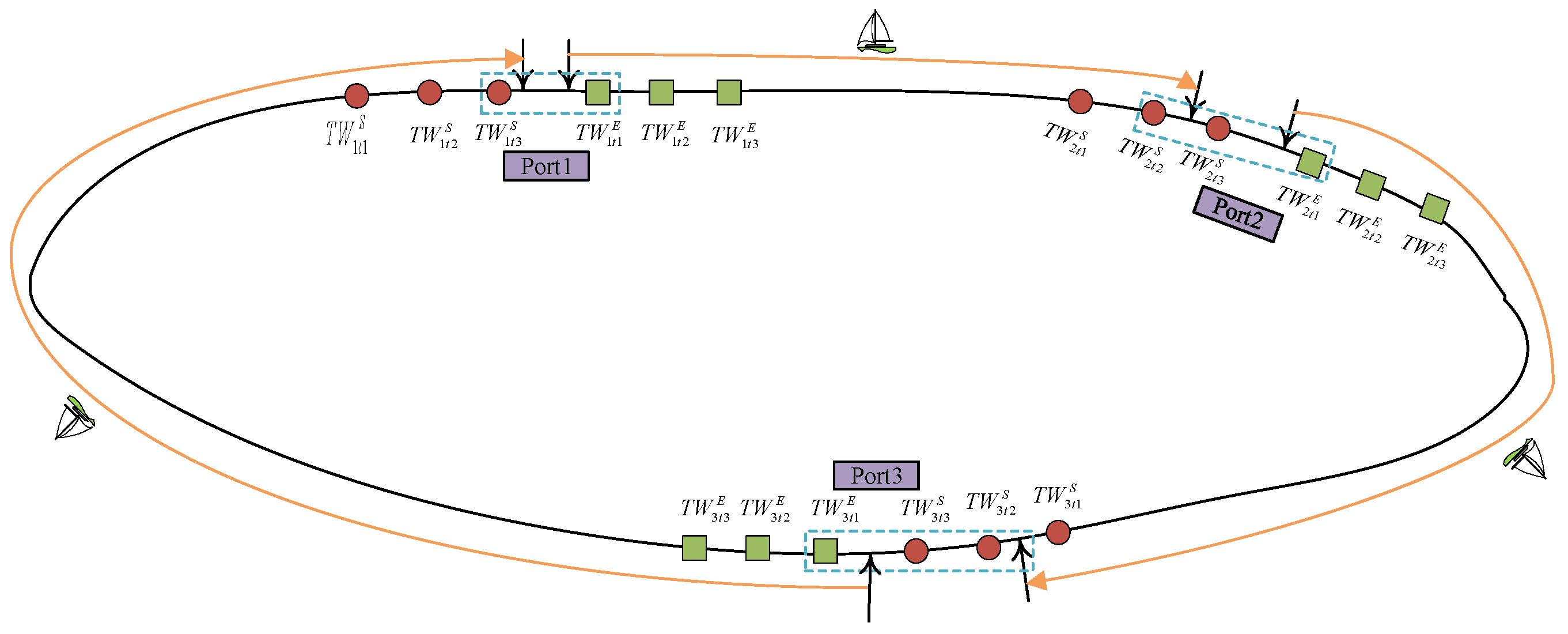
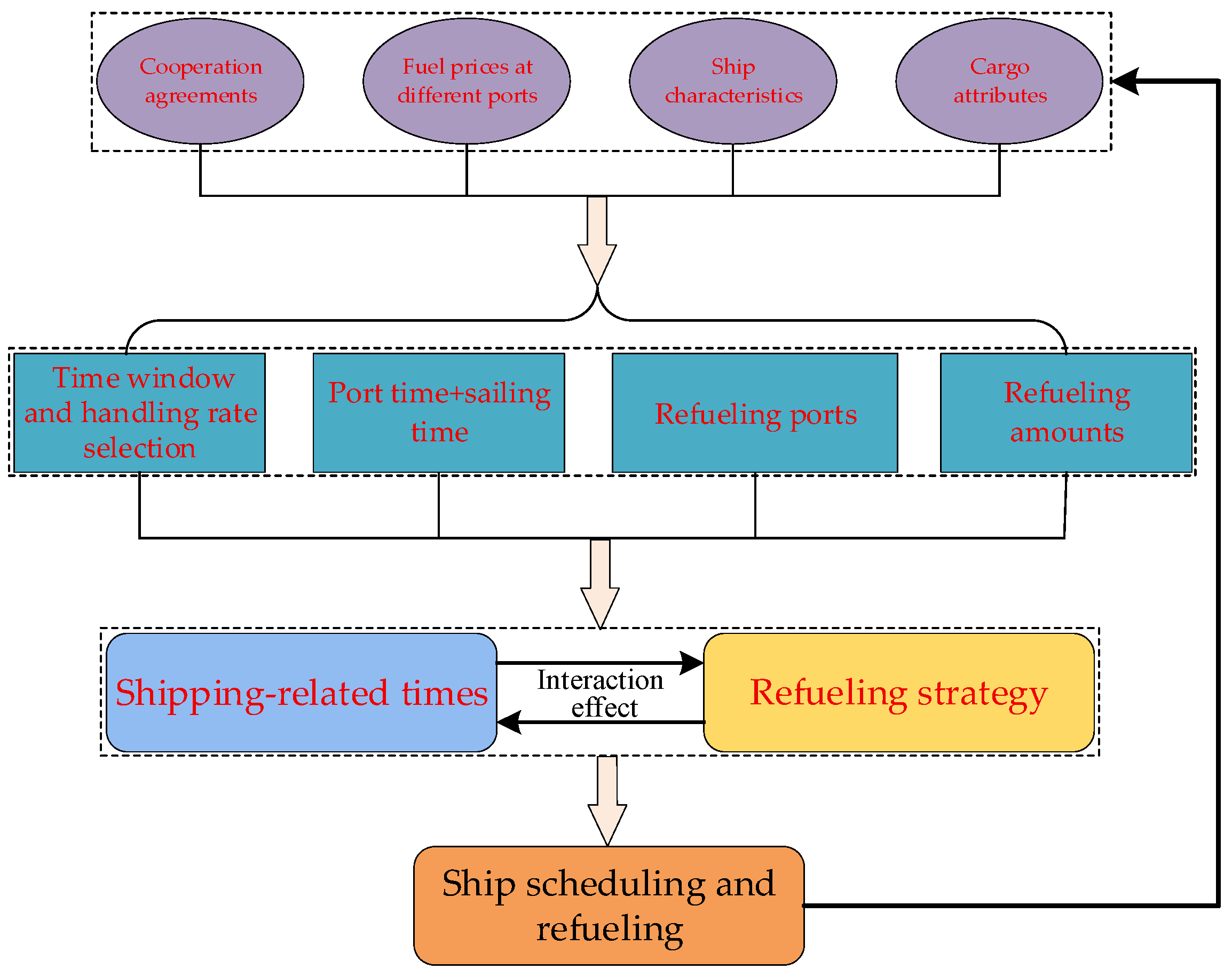
- This study is the first to incorporate perishable goods decay costs into refueling decisions while simultaneously embedding collaborative agreement mechanisms. Cooperative agreements are represented by multiple selectable time windows and handling rates, with sailing time and port time endogenized as decision variables. These modeling features create a bi-directional interaction between refueling strategies and ship scheduling, while the introduction of perishable goods further complicates the underlying decision-making processes, enriching existing theoretical methodologies.
- Unlike previous studies, this paper formulates the choices of time windows, handling rates, and refueling ports as binary variables within a mixed-integer nonlinear programming (MINLP) framework, enabling integrated optimization that balances multiple cost components in a unified decision structure.
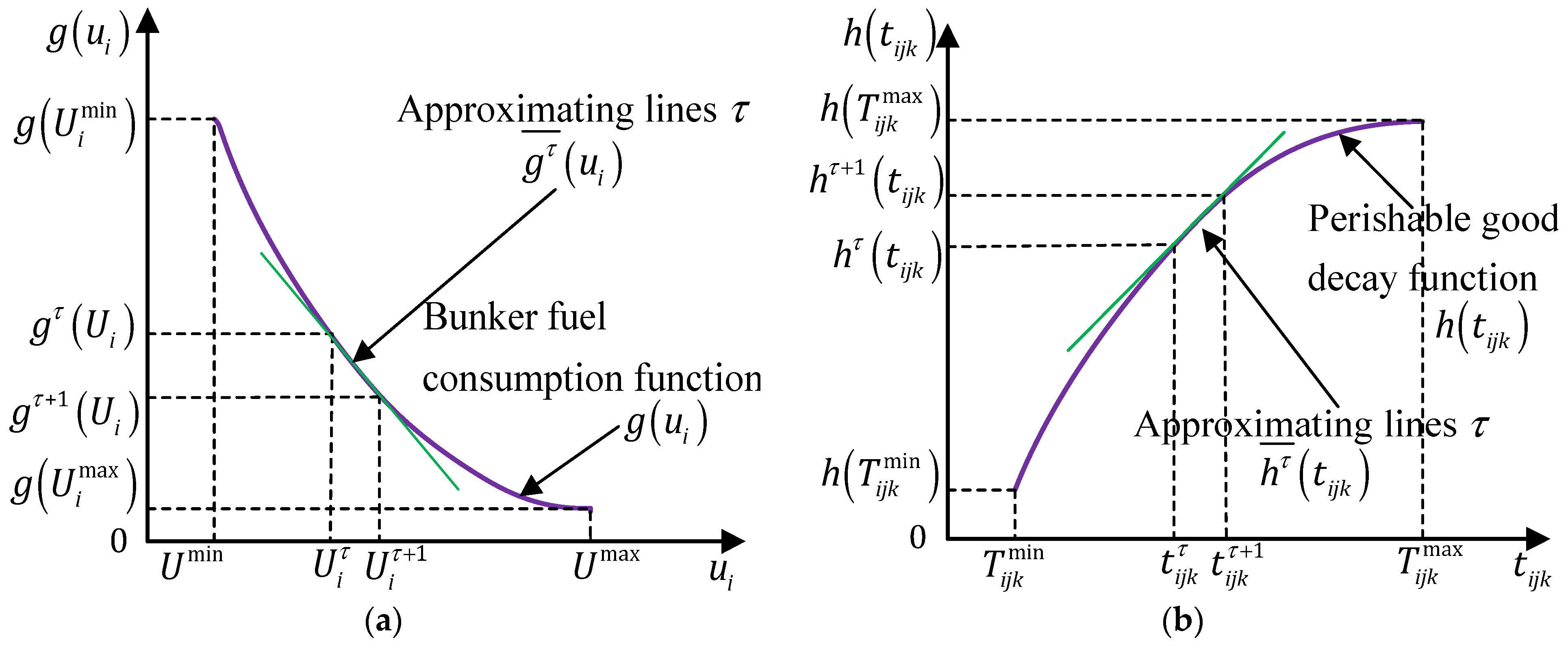
- A piecewise linear secant approximation method is developed to balance solution accuracy and computational efficiency, allowing the model to be solved using commercial solvers. This approach can achieve high-quality solutions with fewer linear segments, improving overall computational performance.
- Numerical experiments are conducted to evaluate the advantages of the proposed approach over existing methods. The results provide key managerial insights for optimizing perishable goods transportation under collaborative agreements and demonstrate the superiority of the integrated scheduling–refueling framework.
2. Literature Review
2.1. Ship Scheduling
2.1.1. Green Ship Scheduling
2.1.2. Uncertainty Operations
2.1.3. Ship Schedule Recovery
2.1.4. Collaborative Agreements
2.1.5. Transportation of Perishable Goods
2.2. Refueling Strategy
2.2.1. Refueling Decisions and Adaptive Policies
2.2.2. Integrated Refueling Strategies and Operational Applications
2.3. Summary of Literature Review
3. Problem Description
3.1. Collaborative Agreement Mechanisms
3.2. Port Handling Cost
3.3. Late Arrival Penalty
3.4. Container Inventory Cost
3.5. Shipping of Perishable Goods
3.6. Refueling
3.7. Interdependencies Among Decisions
4. Model Formulation
5. Linearization
6. Numerical Experiments
6.1. Input Data Description
6.2. Solution Methodology Evaluation and Complexity Analysis
6.2.1. Solution Methodology Evaluation
6.2.2. Complexity Analysis
6.3. Results Analysis
6.3.1. Results Pertaining to the AEU6 Route
6.3.2. Comparative Analysis
- Model [M3]: Ship scheduling and refueling under collaborative agreements, accounting for the shipping of perishable goods and port fuel price differences, including amount-based discounts.
- Model [M4]: Ship scheduling and refueling considering port fuel price differences and discounts. Multiple handling rates are available, while ship arrival time windows are fixed.
- Model [M5]: Ship scheduling and refueling under collaborative agreements, considering port fuel price differences and discounts, but excluding the shipping of perishable goods.
6.3.3. Sensitivity Analysis
- Duration of the TWs
- 2.
- Fuel Price
- 3.
- Bunker Fuel Consumption Rate
- 4.
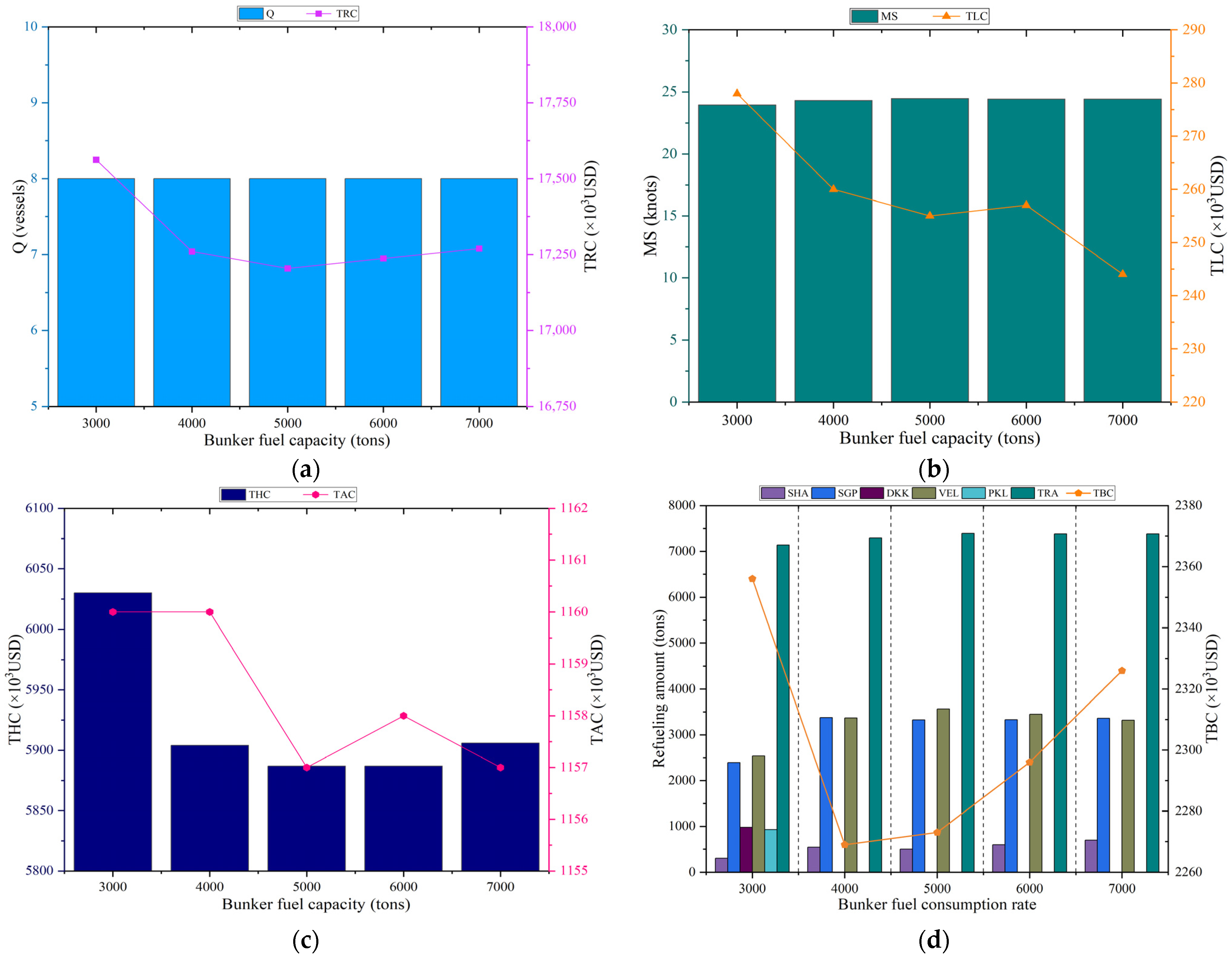
- Bunker Fuel Capacity
6.4. Discussion
- For container liner shipping services carrying significant volumes of perishable goods, scheduling and refueling decisions should consider not only fluctuations in shipping demand and bunker fuel prices but also the underlying demand structure, particularly perishable goods and its decay characteristics. To optimize schedules, minimize total service costs, and ensure sufficient fuel supply, differences in fuel prices must be incorporated into the scheduling and refueling strategy.
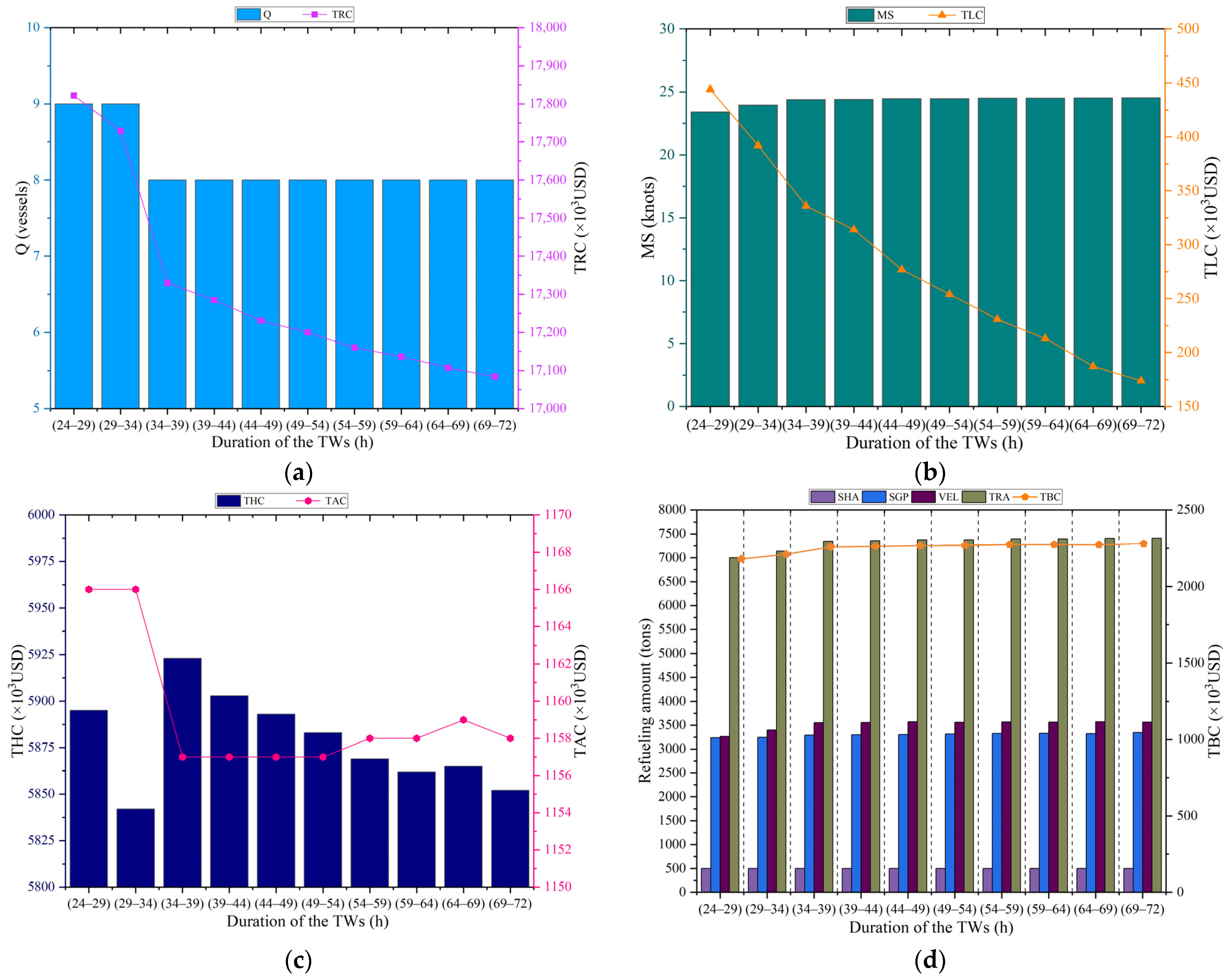
- The duration of TWs strongly influences the selection of handling rates and port time. Longer TWs provide greater operational flexibility, allowing for optimized handling rates that reduce both container handling costs and perishable goods decay, thereby lowering overall service costs. Liner shipping companies are encouraged to establish robust collaborative agreements with terminal operators, formalizing mutually beneficial arrangements that enhance operational efficiency and maximize revenue.
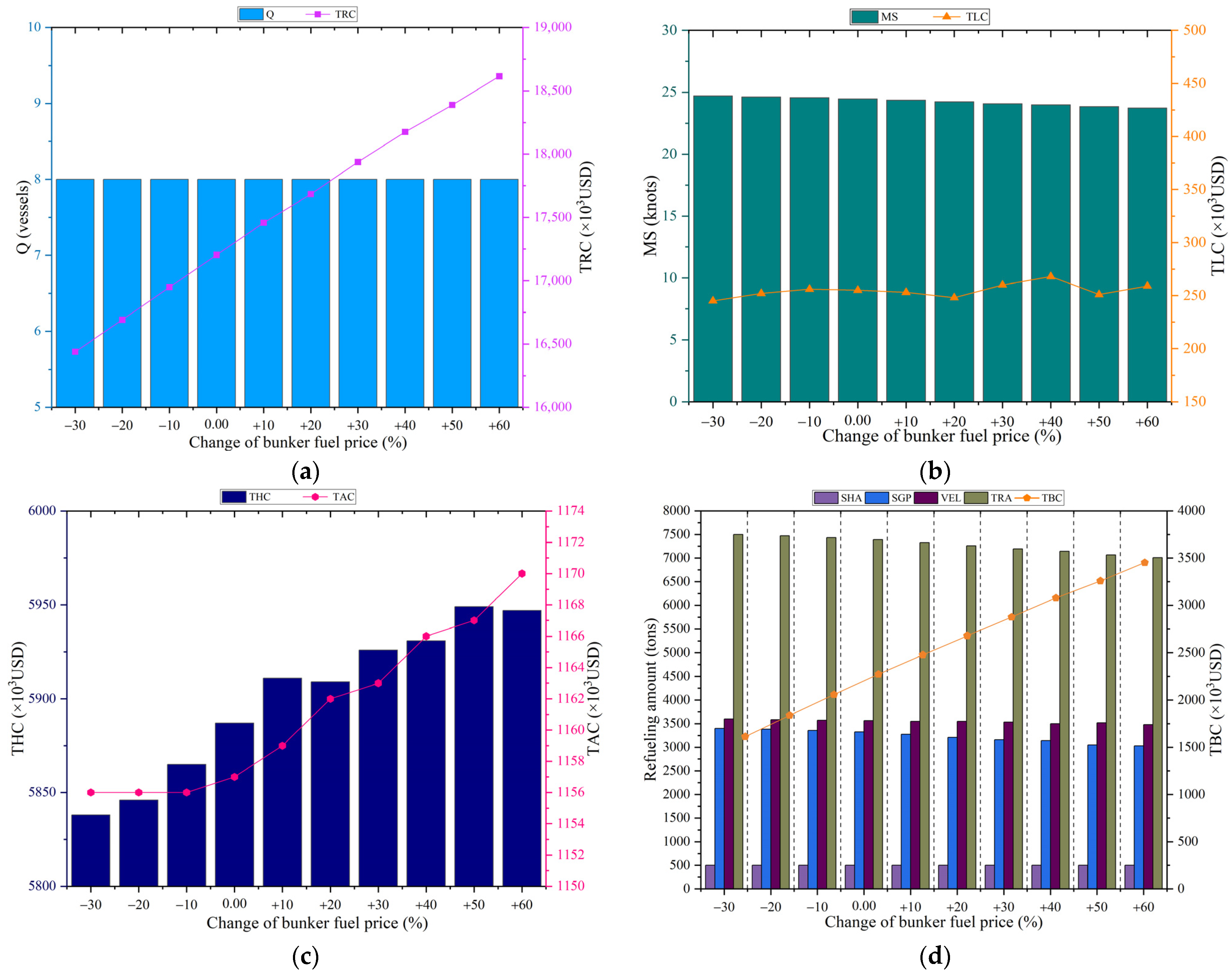
- The total decay cost of perishable goods and overall service costs are positively correlated with bunker fuel prices. Higher fuel prices typically lead ships to reduce sailing speed, extending cargo transit times and increasing container handling, inventory costs, and late arrival penalties. By integrating optimized schedule planning with strategic refueling, liner operators can mitigate the escalation of service costs under high fuel prices.
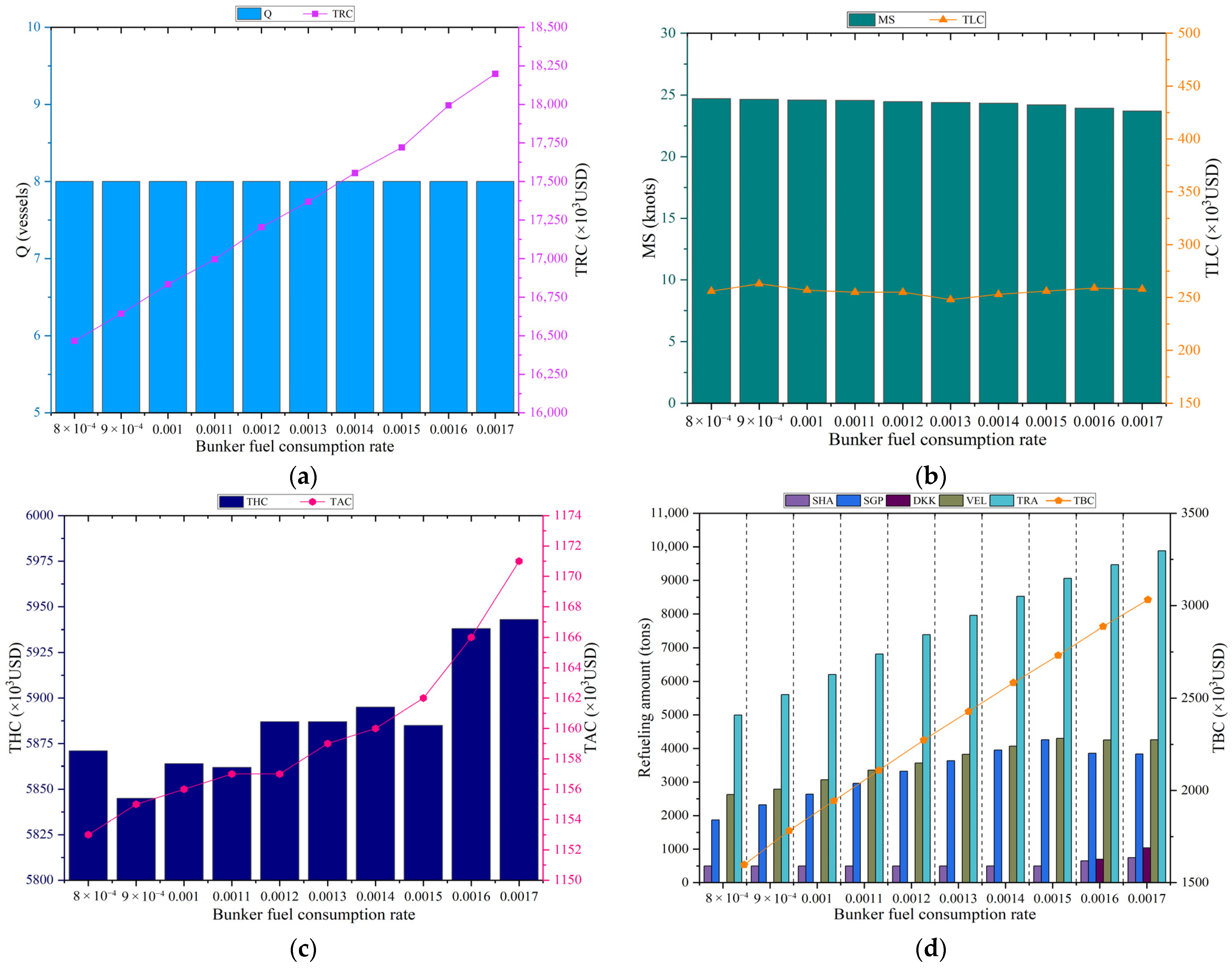
- Ship bunker fuel consumption rates have a significant impact on scheduling and refueling decisions. On routes with a high proportion of perishable goods, operators should prioritize modern, fuel-efficient ships capable of maintaining higher speeds at lower cost. To maintain schedule reliability and profitability, companies should consider timely retrofitting of existing ships or reserving upgrade-ready spaces during new ship construction.
- Bunker tank capacity affects eligibility for fuel purchase discounts, creating a cascading effect on operational decisions. Ship designs should therefore rationally account for bunker fuel capacity, considering route characteristics, operational patterns, and vessel specifications to optimize both fuel procurement and voyage efficiency.
- Shipping companies can further reduce cost uncertainty by proactively planning fuel procurement and establishing fuel supply agreements with ports. This strategy is particularly critical for long-haul routes with substantial perishable goods, enabling stable and cost-effective fuel supply, supporting higher sailing speeds, and minimizing product decay.
- The methods proposed in this study enable shipping companies to determine optimal port time windows and container handling rates. Terminal operators, as partners, can then allocate berths and port equipment in advance according to these schedules. This collaborative approach fosters operational stability, ensures orderly execution of schedules, and creates mutual benefits for both shipping companies and terminal operators.
7. Conclusions and Future Research Extensions
Author Contributions
Funding
Institutional Review Board Statement
Informed Consent Statement
Data Availability Statement
Acknowledgments
Conflicts of Interest
References
- Øvstebø, B.O.; Hvattum, L.M.; Fagerholt, K. Routing and scheduling of RoRo ships with stowage constraints. Transp. Res. Part C Emerg. Technol. 2011, 19, 1225–1242. [Google Scholar] [CrossRef] [Scilit]
- CTS Team, Container Trades Statistics Ltd. (CTS). 2024 Annual Overview: Global Volumes Reach New Heights. 2025. Available online: https://containerstatistics.com/annual-2024-press-release/?utm_source=chatgpt.com (accessed on 8 August 2025).
- Accenture Cargo. Global Reefer Market Outlook. 2024. Available online: https://tpm.joc.com/content/dam/events/tpm/tpm24-presentations/MichelLooten_TPM%20Cold%20Chain_final.pdf?utm_source=chatgpt.com (accessed on 8 July 2025).
- Mark Buzinkay, Reefer Service—Market Outlook 2024. 2024. Available online: https://www.identecsolutions.com/news/reefer-service-market-outlook-2024?utm_source=chatgpt.com (accessed on 8 September 2025).
- Dulebenets, M.A.; Ozguven, E.E. Vessel scheduling in liner shipping: Modeling transport of perishable assets. Int. J. Prod. Econ. 2017, 184, 141–156. [Google Scholar] [CrossRef] [Scilit]
- Rong, A.; Akkerman, R.; Grunow, M. An optimization approach for managing fresh food quality throughout the supply chain. Int. J. Prod. Econ. 2011, 131, 421–429. [Google Scholar] [CrossRef] [Scilit]
- Wang, X.; Li, D. A dynamic product quality evaluation based pricing model for perishable food supply chains. Omega 2012, 40, 906–917. [Google Scholar] [CrossRef] [Scilit]
- Grunow, M.; Piramuthu, S. RFID in highly perishable food supply chains—Remaining shelf life to supplant expiry date? Int. J. Prod. Econ. 2013, 146, 717–727. [Google Scholar] [CrossRef] [Scilit]
- Aung, M.M.; Chang, Y.S. Temperature management for the quality assurance of a perishable food supply chain. Food Control. 2014, 40, 198–207. [Google Scholar] [CrossRef] [Scilit]
- Haass, R.; Dittmer, P.; Veigt, M.; Lütjen, M. Reducing food losses and carbon emission by using autonomous control—A simulation study of the intelligent container. Int. J. Prod. Econ. 2015, 164, 400–408. [Google Scholar] [CrossRef] [Scilit]
- Forbes, A. The geography of transport systems. Aust. J. Marit. Ocean. Aff. 2014, 6, 113–114. [Google Scholar] [CrossRef] [Scilit]
- Li, Z.; Yu, X.; Shang, J.; Chen, K.; Xin, X.; Zhang, W.; Yu, S. Container Liner Shipping System Design Considering Methanol-Powered Vessels. J. Mar. Sci. Eng. 2025, 13, 709. [Google Scholar] [CrossRef] [Scilit]
- Zhou, J.; Zhao, Y.; Yan, X.; Wang, M. Strategy and Impact of Liner Shipping Schedule Recovery under ECA Regulation and Disruptive Events. J. Mar. Sci. Eng. 2024, 12, 1405. [Google Scholar] [CrossRef] [Scilit]
- Duan, W.; Li, Z.; Zhou, Y.; Deng, Z. A Novel Technical Framework for the Evaluation of Node Significance and Edge Connectivity in Global Shipping Network. J. Mar. Sci. Eng. 2024, 12, 1239. [Google Scholar] [CrossRef] [Scilit]
- Li, D.-C.; Yang, H.-L. Designing scheduled route for river liner shipping services with empty container repositioning. Expert Syst. Appl. 2024, 247, 123246. [Google Scholar] [CrossRef] [Scilit]
- Amorim, P.; Belo-Filho, M.A.F.; Toledo, F.M.B.; Almeder, C.; Almada-Lobo, B. Lot sizing versus batching in the production and distribution planning of perishable goods. Int. J. Prod. Econ. 2013, 146, 208–218. [Google Scholar] [CrossRef] [Scilit]
- Notteboom, T.E. The Time Factor in Liner Shipping Services. Marit. Econ. Logist. 2006, 8, 19–39. [Google Scholar] [CrossRef] [Scilit]
- Qiang, M.; Shuaian, W.; Andersson, H.; Thun, K. Containership Routing and Scheduling in Liner Shipping: Overview and Future Research Directions. Transp. Sci. 2014, 48, 265–280. [Google Scholar] [CrossRef] [Scilit]
- Notteboom, T.E.; Vernimmen, B. The effect of high fuel costs on liner service configuration in container shipping. J. Transp. Geogr. 2009, 17, 325–337. [Google Scholar] [CrossRef] [Scilit]
- Ronen, D. The effect of oil price on containership speed and fleet size. J. Oper. Res. Soc. 2011, 62, 211–216. [Google Scholar] [CrossRef] [Scilit]
- Fagerholt, K.; Laporte, G.; Norstad, I. Reducing fuel emissions by optimizing speed on shipping routes. J. Oper. Res. Soc. 2010, 61, 523–529. [Google Scholar] [CrossRef] [Scilit]
- Kontovas, C.A. The Green Ship Routing and Scheduling Problem (GSRSP): A conceptual approach. Transp. Res. Part D Transp. Environ. 2014, 31, 61–69. [Google Scholar] [CrossRef] [Scilit]
- Psaraftis, H.N.; Kontovas, C.A. Ship speed optimization: Concepts, models and combined speed-routing scenarios. Transp. Res. Part C Emerg. Technol. 2014, 44, 52–69. [Google Scholar] [CrossRef] [Scilit]
- Fagerholt, K.; Gausel, N.T.; Rakke, J.G.; Psaraftis, H.N. Maritime routing and speed optimization with emission control areas. Transp. Res. Part C Emerg. Technol. 2015, 52, 57–73. [Google Scholar] [CrossRef] [Scilit]
- Fagerholt, K.; Psaraftis, H.N. On two speed optimization problems for ships that sail in and out of emission control areas. Transp. Res. Part D Transp. Environ. 2015, 39, 56–64. [Google Scholar] [CrossRef] [Scilit]
- Mansouri, S.A.; Lee, H.; Aluko, O. Multi-objective decision support to enhance environmental sustainability in maritime shipping: A review and future directions. Transp. Res. Part E Logist. Transp. Rev. 2015, 78, 3–18. [Google Scholar] [CrossRef] [Scilit]
- Song, D.-P.; Li, D.; Drake, P. Multi-objective optimization for planning liner shipping service with uncertain port times. Transp. Res. Part E Logist. Transp. Rev. 2015, 84, 1–22. [Google Scholar] [CrossRef] [Scilit]
- Dulebenets, M.A. A comprehensive multi-objective optimization model for the vessel scheduling problem in liner shipping. Int. J. Prod. Econ. 2018, 196, 293–318. [Google Scholar] [CrossRef] [Scilit]
- Zhang, M.; Zeng, X.; Tan, Z. Joint decision of green technology adoption and sailing pattern for a coastal ship under ECAs. Transp. Policy 2024, 146, 102–113. [Google Scholar] [CrossRef] [Scilit]
- Sun, Y.; Zheng, J.; Cui, D.; Liu, H. Carbon emission reduction by forming liner alliances under maritime emission trading system. Transp. Res. Part D Transp. Environ. 2025, 144, 104771. [Google Scholar] [CrossRef] [Scilit]
- Vernimmen, B.; Dullaert, W.; Engelen, S. Schedule Unreliability in Liner Shipping: Origins and Consequences for the Hinterland Supply Chain. Marit. Econ. Logist. 2007, 9, 193–213. [Google Scholar] [CrossRef] [Scilit]
- Chuang, T.-N.; Lin, C.-T.; Kung, J.-Y.; Lin, M.-D. Planning the route of container ships: A fuzzy genetic approach. Expert Syst. Appl. 2010, 37, 2948–2956. [Google Scholar] [CrossRef] [Scilit]
- Qi, X.; Song, D.-P. Minimizing fuel emissions by optimizing vessel schedules in liner shipping with uncertain port times. Transp. Res. Part E Logist. Transp. Rev. 2012, 48, 863–880. [Google Scholar] [CrossRef] [Scilit]
- Wang, S.; Meng, Q. Robust schedule design for liner shipping services. Transp. Res. Part E Logist. Transp. Rev. 2012, 48, 1093–1106. [Google Scholar] [CrossRef] [Scilit]
- Wang, S.; Meng, Q. Liner ship route schedule design with sea contingency time and port time uncertainty. Transp. Res. Part B Methodol. 2012, 46, 615–633. [Google Scholar] [CrossRef] [Scilit]
- Wang, S. Optimal sequence of container ships in a string. Eur. J. Oper. Res. 2015, 246, 850–857. [Google Scholar] [CrossRef] [Scilit]
- Li, M.; Xie, C.; Li, X.; Karoonsoontawong, A.; Ge, Y.-E. Robust liner ship routing and scheduling schemes under uncertain weather and ocean conditions. Transp. Res. Part C Emerg. Technol. 2022, 137, 103593. [Google Scholar] [CrossRef] [Scilit]
- Zhang, X.; Li, R.; Wang, C.; Xue, B.; Guo, W. Robust optimization for a class of ship traffic scheduling problem with uncertain arrival and departure times. Eng. Appl. Artif. Intell. 2024, 133, 108257. [Google Scholar] [CrossRef] [Scilit]
- Xia, Z.; Guo, Z.; Wang, W.; Jiang, Y. Joint optimization of ship scheduling and speed reduction: A new strategy considering high transport efficiency and low carbon of ships in port. Ocean Eng. 2021, 233, 109224. [Google Scholar] [CrossRef] [Scilit]
- Zhen, L.; Jiang, M.; Wang, S.; Wu, J. Ship fleet scheduling and deployment optimization considering carbon and sulfur emissions. Eur. J. Oper. Res. 2025, 329, 653–668. [Google Scholar] [CrossRef] [Scilit]
- Ganjian, M.; Bagherian Farahabadi, H.; Rezaei Firuzjaei, M. Voyage scheduling and energy management co-optimization in hydrogen-powered ships. Int. J. Hydrogen Energy 2024, 86, 788–799. [Google Scholar] [CrossRef] [Scilit]
- Brouer, B.D.; Dirksen, J.; Pisinger, D.; Plum, C.E.M.; Vaaben, B. The Vessel Schedule Recovery Problem (VSRP)—A MIP model for handling disruptions in liner shipping. Eur. J. Oper. Res. 2013, 224, 362–374. [Google Scholar] [CrossRef] [Scilit]
- Chen, L.; Xiangtong, Q.; Chung-Yee, L. Disruption Recovery for a Vessel in Liner Shipping. Transp. Sci. 2015, 49, 900–921. [Google Scholar] [CrossRef] [Scilit]
- Li, C.; Qi, X.; Song, D. Real-time schedule recovery in liner shipping service with regular uncertainties and disruption events. Transp. Res. Part B Methodol. 2016, 93, 762–788. [Google Scholar] [CrossRef] [Scilit]
- Abioye, O.F.; Dulebenets, M.A.; Pasha, J.; Kavoosi, M. A Vessel Schedule Recovery Problem at the Liner Shipping Route with Emission Control Areas. Energies 2019, 12, 2380. [Google Scholar] [CrossRef] [Scilit]
- Elmi, Z.; Li, B.; Liang, B.; Lau, Y.-Y.; Borowska-Stefańska, M.; Wiśniewski, S.; Dulebenets, M.A. An epsilon-constraint-based exact multi-objective optimization approach for the ship schedule recovery problem in liner shipping. Comput. Ind. Eng. 2023, 183, 109472. [Google Scholar] [CrossRef] [Scilit]
- Elmi, Z.; Li, B.; Fathollahi-Fard, A.M.; Tian, G.; Borowska-Stefańska, M.; Wiśniewski, S.; Dulebenets, M.A. Ship schedule recovery with voluntary speed reduction zones and emission control areas. Transp. Res. Part D Transp. Environ. 2023, 125, 103957. [Google Scholar] [CrossRef] [Scilit]
- Zheng, J.; Mao, C.; Li, Y.; Liu, Y.; Wang, Y. Dynamic vessel schedule recovery strategy of liner shipping with uncertainties: An event-triggered model predictive control solution. Comput. Ind. Eng. 2024, 193, 110340. [Google Scholar] [CrossRef] [Scilit]
- Zhao, S.; Yang, H.; Zheng, J.; Li, D. A two-step approach for deploying heterogeneous vessels and designing reliable schedule in liner shipping services. Transp. Res. Part E Logist. Transp. Rev. 2024, 182, 103416. [Google Scholar] [CrossRef] [Scilit]
- Wang, S.; Alharbi, A.; Davy, P. Liner ship route schedule design with port time windows. Transp. Res. Part C Emerg. Technol. 2014, 41, 1–17. [Google Scholar] [CrossRef] [Scilit]
- Alharbi, A.; Wang, S.; Davy, P. Schedule design for sustainable container supply chain networks with port time windows. Adv. Eng. Inform. 2015, 29, 322–331. [Google Scholar] [CrossRef] [Scilit]
- Liu, Z.; Wang, S.; Du, Y.; Wang, H.J.T.J. Supply chain cost minimization by collaboration between liner shipping companies and port operators. Transp. J. 2016, 55, 296–314. [Google Scholar] [CrossRef] [Scilit]
- Dulebenets, M.A. Minimizing the Total Liner Shipping Route Service Costs via Application of an Efficient Collaborative Agreement. IEEE Trans. Intell. Transp. Syst. 2019, 20, 123–136. [Google Scholar] [CrossRef]
- Dulebenets, M.A. Multi-objective collaborative agreements amongst shipping lines and marine terminal operators for sustainable and environmental-friendly ship schedule design. J. Clean. Prod. 2022, 342, 130897. [Google Scholar] [CrossRef] [Scilit]
- Guerriero, F.; Macrina, G.; Mosca, V.; Scalzo, E. The vehicle routing problem and integrated challenges in the perishable product supply chain. Comput. Ind. Eng. 2025, 209, 111428. [Google Scholar] [CrossRef] [Scilit]
- Ahemad, F.; Kannan, D.; Khan, A.Z.; Gupta, P.; Mehlawat, M.K.; Aggarwal, U. Optimizing sustainable transportation planning for perishable goods: A two-stage fuzzy approach with route selection. Res. Transp. Bus. Manag. 2026, 64, 101537. [Google Scholar] [CrossRef] [Scilit]
- Hasiloglu-Ciftciler, M.; Kaya, O. Dynamic inventory control and pricing strategies for perishable products considering both profit and waste. Comput. Oper. Res. 2025, 181, 107103. [Google Scholar] [CrossRef] [Scilit]
- Wang, S.; Meng, Q.; Liu, Z. Containership scheduling with transit-time-sensitive container shipment demand. Transp. Res. Part B Methodol. 2013, 54, 68–83. [Google Scholar] [CrossRef] [Scilit]
- Wang, S.; Meng, Q.; Lee, C.-Y. Liner container assignment model with transit-time-sensitive container shipment demand and its applications. Transp. Res. Part B Methodol. 2016, 90, 135–155. [Google Scholar] [CrossRef] [Scilit]
- Kim, H.-J.; Chang, Y.-T.; Kim, K.-T.; Kim, H.-J. An epsilon-optimal algorithm considering greenhouse gas emissions for the management of a ship’s bunker fuel. Transp. Res. Part D Transp. Environ. 2012, 17, 97–103. [Google Scholar] [CrossRef] [Scilit]
- Yao, Z.; Ng, S.H.; Lee, L.H. A study on bunker fuel management for the shipping liner services. Comput. Oper. Res. 2012, 39, 1160–1172. [Google Scholar] [CrossRef] [Scilit]
- Kim, H.J. A Lagrangian heuristic for determining the speed and bunkering port of a ship. J. Oper. Res. Soc. 2014, 65, 747–754. [Google Scholar] [CrossRef] [Scilit]
- Sheng, X.; Lee, L.; Chew, E. Dynamic determination of vessel speed and selection of bunkering ports for liner shipping under stochastic environment. OR Spectr. 2014, 36, 455–480. [Google Scholar] [CrossRef] [Scilit]
- Sheng, X.; Chew, E.P.; Lee, L.H. (s,S) policy model for liner shipping refueling and sailing speed optimization problem. Transp. Res. Part E Logist. Transp. Rev. 2015, 76, 76–92. [Google Scholar] [CrossRef] [Scilit]
- Meng, Q.; Wang, S.; Lee, C.-Y. A tailored branch-and-price approach for a joint tramp ship routing and bunkering problem. Transp. Res. Part B Methodol. 2015, 72, 1–19. [Google Scholar] [CrossRef] [Scilit]
- Wang, S.; Meng, Q. Robust bunker management for liner shipping networks. Eur. J. Oper. Res. 2015, 243, 789–797. [Google Scholar] [CrossRef] [Scilit]
- De, A.; Choudhary, A.; Turkay, M.; Tiwari, M.K. Bunkering policies for a fuel bunker management problem for liner shipping networks. Eur. J. Oper. Res. 2019, 289, 927–939. [Google Scholar] [CrossRef] [Scilit]
- Aydin, N.; Lee, H.; Mansouri, S.A. Speed optimization and bunkering in liner shipping in the presence of uncertain service times and time windows at ports. Eur. J. Oper. Res. 2017, 259, 143–154. [Google Scholar] [CrossRef] [Scilit]
- Wang, C.; Chen, J. Strategies of refueling, sailing speed and ship deployment of containerships in the low-carbon background. Comput. Ind. Eng. 2017, 114, 142–150. [Google Scholar] [CrossRef] [Scilit]
- Wang, S.; Gao, S.; Tan, T.; Yang, W. Bunker fuel cost and freight revenue optimization for a single liner shipping service. Comput. Oper. Res. 2019, 111, 67–83. [Google Scholar] [CrossRef] [Scilit]
- Wang, C.; Liu, X.; Zhou, Y.; Qian, J. Optimization of speed and refueling strategy for liner shipping companies considering refueling at OPL. Reg. Stud. Mar. Sci. 2025, 89, 104355. [Google Scholar] [CrossRef] [Scilit]
- Du, J.; Wu, P. Stochastic dynamic programming model for liner international scheduling optimization under ECA policies. Mar. Pollut. Bull. 2026, 222, 118766. [Google Scholar] [CrossRef] [Scilit]
- Wu, Y.; Guo, H.; Qi, J.; Wang, S.; Zhen, L. Ship refueling optimization for dual-fuel ships considering carbon intensity indicator rating limit and uncertain fuel prices. Multimodal Transp. 2024, 3, 100138. [Google Scholar] [CrossRef] [Scilit]
- Gao, T.; Tian, J.; Liu, C.; Huang, C.; Wu, H.; Yuan, Z. A model for speed and fuel refueling strategy of methanol dual-fuel liners with emission control areas. Transp. Policy 2025, 161, 1–16. [Google Scholar] [CrossRef] [Scilit]
- Jiang, L.; Kronbak, J.; Christensen, L.P. The costs and benefits of sulphur reduction measures: Sulphur scrubbers versus marine gas oil. Transp. Res. Part D Transp. Environ. 2014, 28, 19–27. [Google Scholar] [CrossRef] [Scilit]
- Wang, S.; Meng, Q.; Liu, Z. Bunker consumption optimization methods in shipping: A critical review and extensions. Transp. Res. Part E Logist. Transp. Rev. 2013, 53, 49–62. [Google Scholar] [CrossRef] [Scilit]
- Vielma, J.P.; Ahmed, S.; Nemhauser, G. Mixed-Integer Models for Nonseparable Piecewise-Linear Optimization: Unifying Framework and Extensions. Oper. Res. 2010, 58, 303–315. [Google Scholar] [CrossRef] [Scilit]
- Wang, Y.; Meng, Q.; Kuang, H. Jointly optimizing ship sailing speed and bunker purchase in liner shipping with distribution-free stochastic bunker prices. Transp. Res. Part C Emerg. Technol. 2018, 89, 35–52. [Google Scholar] [CrossRef] [Scilit]
- Zhao, S.; Duan, J.; Li, D.; Yang, H. Vessel scheduling and bunker management with speed deviations for liner shipping in the presence of collaborative agreements. IEEE Access 2022, 10, 107669–107684. [Google Scholar] [CrossRef] [Scilit]
- Dulebenets, M.A. The green vessel scheduling problem with transit time requirements in a liner shipping route with Emission Control Areas. Alex. Eng. J. 2018, 57, 331–342. [Google Scholar] [CrossRef] [Scilit]





| Reference | Focus | Method/Model | Key Findings |
|---|---|---|---|
| Kontovas [22] | Green ship routing and scheduling | Parameter identification | Laying foundation for estimating emissions and fuel consumption |
| Psaraftis & Kontovas [23] | Optimal sailing speeds | Routing scenario model | Integrating key determinants into shipowner decision-making |
| Fagerholt et al. [24]; Fagerholt & Psaraftis [25] | ECA speed optimization | Analytical and optimization | Minimizing bunker cost and examining ECA effects |
| Mansouri et al. [26] | Multi-objective scheduling | Multi-objective framework | Exploring long-term environmental sustainability |
| Song et al. [27] | Tactical planning | Simulation-based GA | Optimizing fleet size, maximum speed, and schedule |
| Dulebenets [28] | Green scheduling | Linearization of reciprocal speed | Applying collaborative mechanisms to reduce emissions |
| Zhang et al. [29]; Sun et al. [30] | ECA and emission trading | Optimal speed analysis | Assessing fuel switching, scrubber installation, and alliance strategies |
| Notteboom [17]; Vernimmen et al. [31] | Scheduling under uncertainty | Observational/empirical | Addressing port congestion and inland cost increase |
| Qi & Song [33]; Wang & Meng [34,35,36] | Stochastic scheduling | Simulation and uncertainty models | Strengthening schedule robustness |
| Li et al. [37]; Zhang et al. [38] | NSR and unpredictable events | Optimization under uncertainty | Reducing port waiting time and enhancing schedule stability |
| Xia et al. [39]; Zhen et al. [40]; Ganjian et al. [41] | Green tech and low-carbon operation | Joint scheduling and speed reduction | Integrating biofuels, green technologies, and energy management |
| Brouer et al. [42]; Li et al. [44]; Abioye et al. [45]; Elmi et al. [46,47]; Zheng et al. [48]; Zhao et al. [49] | Schedule recovery and disruptions | MINLP model, multi-objective, event-triggered | Developing recovery strategies and quantifying uncertainty risks |
| Wang et al. [50]; Alharbi et al. [51]; Liu et al. [52]; Dulebenets [53,54] | Collaborative scheduling | MINLP model | Incorporating multiple time windows and handling rates to reduce bunker cost |
| Wang et al. [58,59]; Dulebenets & Ozguven [5] | Perishable goods | Simulation and optimization | Modeling perishable good decay and optimizing scheduling |
| Reference | Sailing Time | Port Time | Objective | Solution Approach | Refueling Considerations | Collaborative Agreements Considerations | Perishability Considerations |
|---|---|---|---|---|---|---|---|
| Fagerholt et al. [24]; Fagerholt & Psaraftis [25] | V | F | Minimize the total cost | CPLEX | N/A | N/A | N/A |
| Qi & Song [33] | V | U | Minimize the total cost | Stochastic approximation | N/A | N/A | N/A |
| Wang & Meng [34] | U | U | Minimize the total cost | A cutting-plane algorithm | N/A | N/A | N/A |
| Wang & Meng [35] | V | U | Minimize the total cost | Sample average approximation | N/A | N/A | N/A |
| Wang et al. [50] | V | F | Minimize the total cost | Iterative optimization algorithm | N/A | Multiple time windows | N/A |
| Alharbi et al. [51] | V | F | Minimize the total cost | Iterative optimization algorithm | N/A | Multiple time windows | N/A |
| Dulebenets [53,54] | V | V | Minimize the total cost | CPLEX | N/A | A | N/A |
| Dulebenets & Ozguven [5] | V | V | Minimize the total cost | CPLEX | N/A | N/A | A |
| Wang and Meng [66] | V | F | Minimize the total cost | CPLEX | A | N/A | N/A |
| Wang and Chen [69] | V | F | Minimize the total cost | CPLEX | A | N/A | N/A |
| Wu et al. [73] | V | F | Minimize the total cost | CPLEX | A | N/A | N/A |
| Gao et al. [74] | V | F | Minimize the total cost | Intlinprog tool | A | N/A | N/A |
| This paper | V | V | Minimize the total cost | CPLEX | A | A | A |
| No | Assumption |
|---|---|
| 1 | All container ships deployed on the liner route are of the same type |
| 2 | Port calls and their visiting sequence are predetermined |
| 3 | Sailing speed on each leg is fixed |
| 4 | Ship departure frequency on the liner route is weekly |
| 5 | Expected fuel prices at each port remain constant over the planning period |
| 6 | Change in quality of perishable goods follows an exponential relationship with time |
| Notation Type | Notation | Explanation |
|---|---|---|
| Sets | Set of ports | |
| Set of perishable good types | ||
| Set of available arrival TWs of port | ||
| Set of available handling rates of port during TW | ||
| Set of start times for TW of port | ||
| Set of end times for TW of port | ||
| Set of ports called by the ship when shipping perishable good type | ||
| Parameters | Start time of TW at port (h) | |
| End time of TW at port (h) | ||
| Handling productivity (TEUs/h) | ||
| Weekly operational cost of a ship (USD/week) | ||
| Unit bunker fuel price at port (USD/ton) | ||
| Unit container inventory cost (USD/TEU/h) | ||
| Decay cost per unit quality decay of good type (USD/%) | ||
| Unit penalty for late ship arrival at port (USD/h) | ||
| Unit handling cost (USD/TEU) | ||
| Distance of leg | ||
| Container amount shipped at leg (TEUs) | ||
| Container handled at port (TEUs) | ||
| Minimum fuel inventory at the beginning (tons) | ||
| Fixed cost of ship refueling (USD) | ||
| Ship bunker tanker maximal capacity (tons) | ||
| Refueling amount thresholds at which the first fuel price discount becomes applicable (tons) | ||
| Refueling amount thresholds at which the second fuel price discount becomes applicable (tons) | ||
| (%) | ||
| (%) | ||
| Decay rate of perishable good type (%/h) | ||
| Amount of good type shipped from port to (TEU) | ||
| Limitations of refrigerated receptacle sockets on ships (unit) | ||
| Design sailing speed (knots) | ||
| Bunker consumption at design speed (tons/day) | ||
| Minimum ship sailing speed (knots) | ||
| Maximum ship sailing speed (knots) | ||
| Decision Variables | , , | Binary variable, when TW of port is selected, 0 otherwise |
| , , , | Binary variable, when start time of TW for port is selected, 0 otherwise | |
| , , , | Binary variable, when end time of TW for port is selected, 0 otherwise | |
| , , , | Binary variable, when handling rate of TW for port is selected, 0 otherwise | |
| , | Sailing speed of leg (knots) | |
| Number of ships deployed (Vessels) | ||
| , | Binary variable, when the ship refueling at port , 0 otherwise | |
| , | Amount of bunker purchased at port (tons) | |
| Auxiliary Variables | Ship sailing time of leg (h) | |
| Ship waiting time at port (h) | ||
| Ship late arrival time at port (h) | ||
| Ship arrival time at port (h) | ||
| Ship departure time from port (h) | ||
| Ship handling time at port (h) | ||
| Bunker levels at port before refueling (tons) | ||
| Bunker levels at port after refueling (tons) | ||
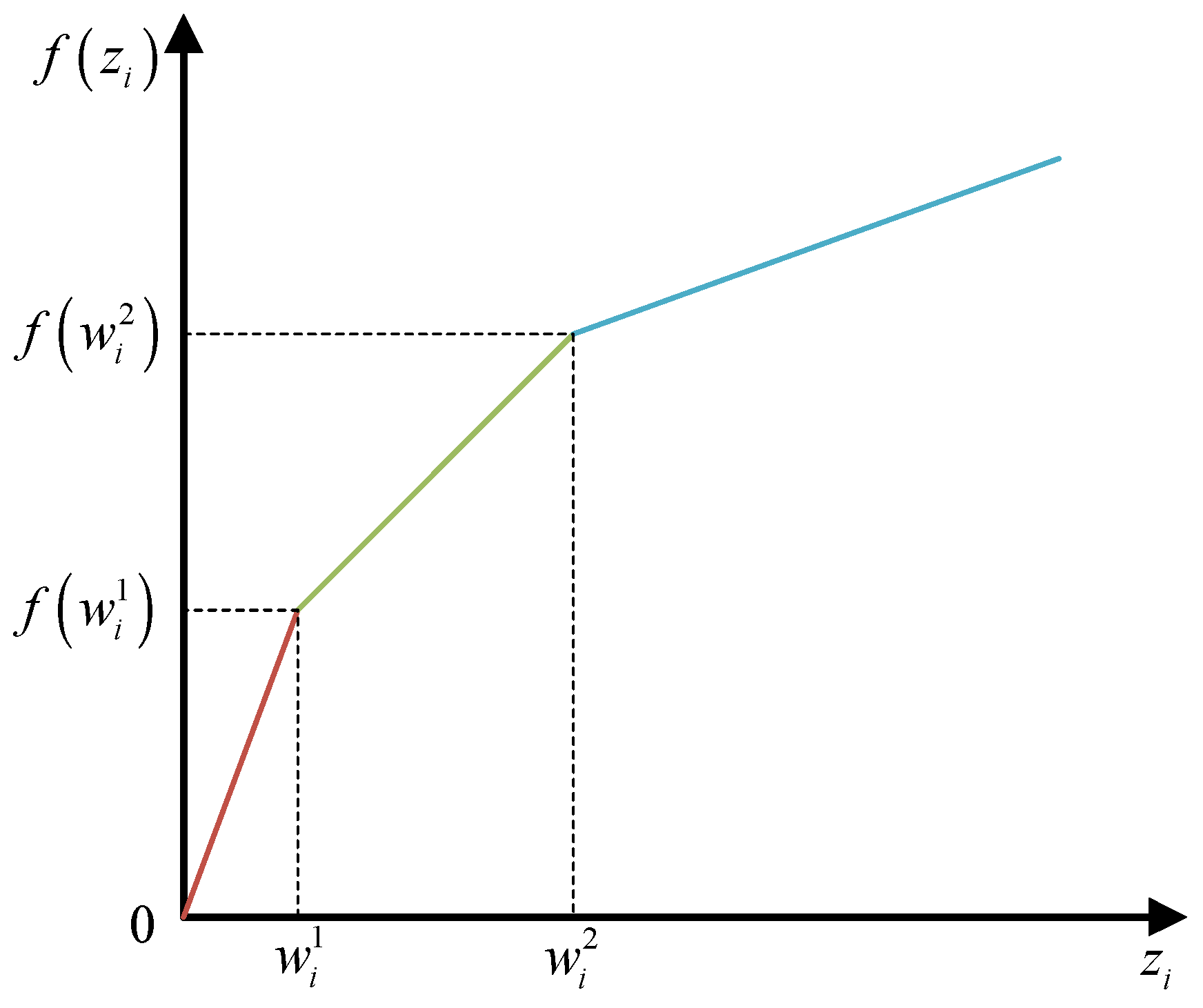
| Bunker cost function | ||
| Number of refrigerated receptacle sockets occupied when the ship arrives at port (unit) | ||
| Total shipping time of perishable good type (h) | ||
| Function representing the total quality change in perishable good type from port to |
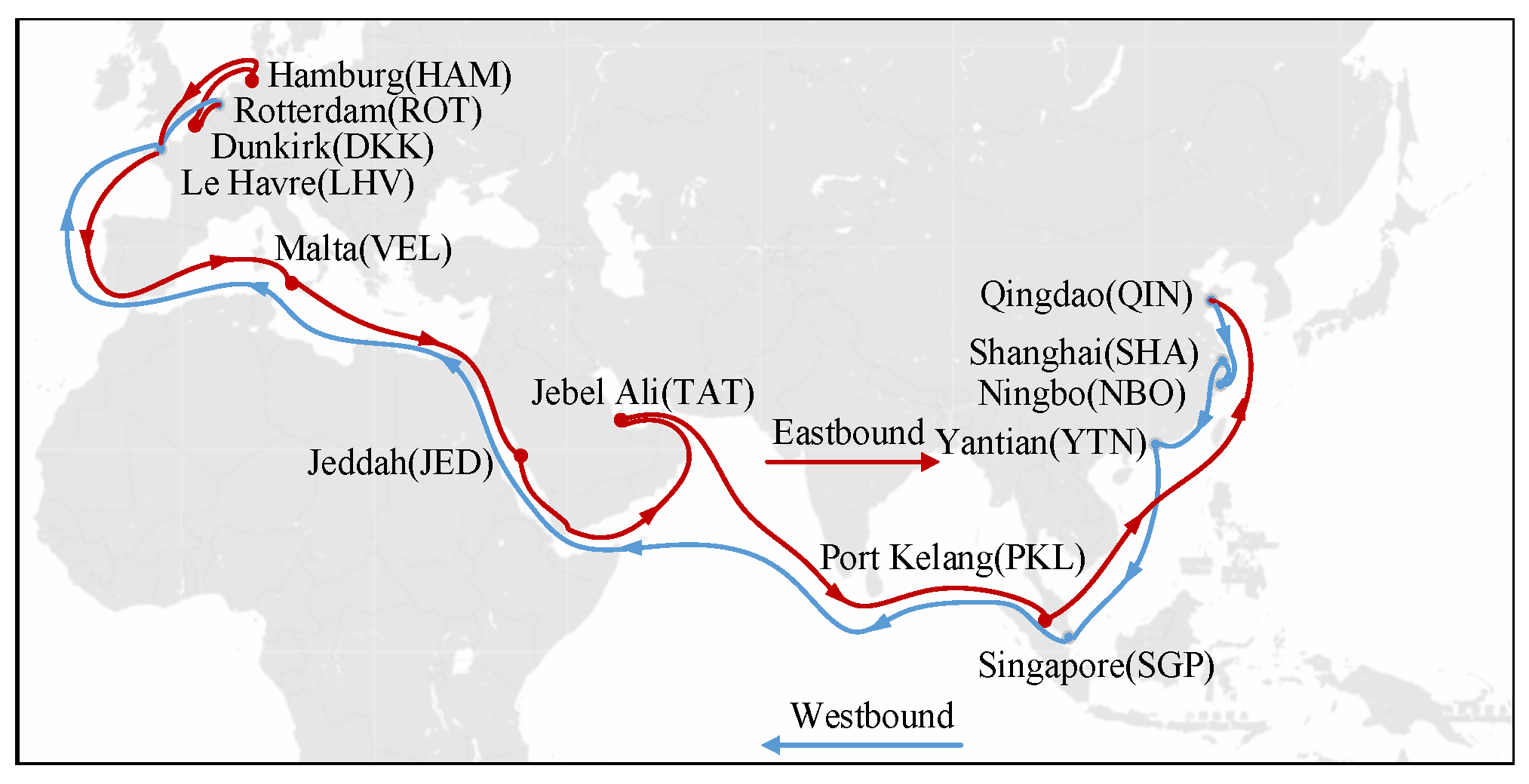
| Port | QIN | NBO | SHA | YTN | SGP | LHV | ROT | DKK | HAM | LHV | VEL | JED | TAT | PKL |
|---|---|---|---|---|---|---|---|---|---|---|---|---|---|---|
| Distance (nmi) | 433 | 136 | 831 | 1445 | 8083 | 247 | 141 | 394 | 500 | 2150 | 1657 | 2363 | 3398 | 2673 |
| Fuel price (USD/ton) | 475 | 467 | 471 | - | 405 | 346 | 357 | 319 | 288 | 346 | 265 | 389 | - | 412 |
| Parameter | Value |
|---|---|
| Number of ports called: | 14 |
| 20 | |
| , | 0.012 |
| (USD/week) | 300,000 |
| (USD/TEU/h) | 0.5 |
| Decay cost per unit quality loss of good type (USD/%) | |
| Unit penalty for late ship arrival (USD/h) | |
| Container amount shipped at leg (TEUs) | |
| (tons) | 1000 |
| Fixed cost of ship refueling: (USD) | 1000 |
| Ship bunker tanker maximal capacity: (tons) | 5000 |
| (tons) | 1000, 2000 |
| (%) | 90%, 80% |
| Decay rate of perishable good type (%/h) | |
| (knots) | 15 |
| (knots) | 25 |
| Time Windows | 1 | 2 | 3 | 4 | ||||||||
|---|---|---|---|---|---|---|---|---|---|---|---|---|
| Start time | 0:00 | 6:00 | 12:00 | 18:00 | 24:00 | 30:00 | 36:00 | 42:00 | 48:00 | 54:00 | 60:00 | 66:00 |
| Instance | Number of Linear Segments | Total Liner Route Service Cost by Model [M2] (103 USD) | Total Liner Route Service Cost by Model [M1] (103 USD) | GAP (%) | CPU Time (s) |
|---|---|---|---|---|---|
| 1 | 10 | 17,224.36 | 17,227.35 | −0.0174 | 0.56 |
| 2 | 20 | 17,226.09 | −0.0073 | 0.81 | |
| 3 | 30 | 17,227.18 | −0.0010 | 1.54 | |
| 4 | 40 | 17,227.52 | 0.0010 | 2.89 | |
| 5 | 50 | 17,227.53 | 0.0010 | 4.30 | |
| 6 | 60 | 17,227.54 | 0.0011 | 5.92 |
| Port | Leg | Arrival Time (h) | Departure Time (h) | Bunker Consumption (Tons) | Fuel Inventory (Tons) | Refueling Amount (Tons) |
|---|---|---|---|---|---|---|
| QIN | QIN → NBO | 0 | 30 | 131 | 1000 | - |
| NBO | NBO → SHA | 47 | 74 | 42 | 869 | - |
| SHA | SHA → YTN | 80 | 106 | 253 | 827 | 500 |
| YTN | YTN → SGP | 140 | 160 | 433 | 1074 | - |
| SGP | SGP → LHV | 220 | 248 | 2386 | 641 | 3325 |
| LHV | LHV → ROT | 582 | 606 | 75 | 1580 | - |
| ROT | ROT → DKK | 617 | 650 | 43 | 1505 | - |
| DKK | DKK → HAM | 656 | 670 | 122 | 1462 | - |
| HAM | HAM → LHV | 685 | 700 | 154 | 1340 | - |
| LHV | LHV → VEL | 720 | 735 | 665 | 1186 | - |
| VEL | VEL → JED | 822 | 841 | 510 | 521 | 3565 |
| JED | JED → TAT | 908 | 933 | 730 | 3576 | - |
| TAT | TAT → PKL | 1028 | 1063 | 1055 | 2846 | - |
| PKL | PKL → QIN | 1199 | 1233 | 791 | 1791 | - |
| QIN | - | 1344 | 1374 | - | - | - |
| Model | TRC (103 USD) | MS (Knots) | THC (103 USD) | Q (Vessels) | TLC (103 USD) | TBC (103 USD) | TRA (Tons) | TAC (103 USD) | Refueling Amount at Port (Tons) | |||||
|---|---|---|---|---|---|---|---|---|---|---|---|---|---|---|
| QIN | SHA | SGP | DKK | HAM | VEL | |||||||||
| [M3] | 17,204 | 24.46 | 5887 | 8.00 | 255 | 2273 | 7390 | 1157 | - | 500 | 3325 | - | - | 3565 |
| [M4] | 18,023 | 23.79 | 6363 | 8.00 | 559 | 2192 | 7105 | 1122 | - | 564 | 2605 | - | 563 | 3373 |
| [M5] | 15,754 | 24.45 | 5550 | 8.00 | 254 | 2307 | 7375 | - | 851 | - | 2222 | 616 | - | 3686 |
Disclaimer/Publisher’s Note: The statements, opinions and data contained in all publications are solely those of the individual author(s) and contributor(s) and not of MDPI and/or the editor(s). MDPI and/or the editor(s) disclaim responsibility for any injury to people or property resulting from any ideas, methods, instructions or products referred to in the content. |
© 2025 by the authors. Licensee MDPI, Basel, Switzerland. This article is an open access article distributed under the terms and conditions of the Creative Commons Attribution (CC BY) license (https://creativecommons.org/licenses/by/4.0/).
Share and Cite
Li, D.-C.; Jiao, F.-F.; Ji, Y.-B.; Wu, Y.; Yang, H.-L. Ship Scheduling and Refueling for Container Liner Cold Chain Shipping. Mathematics 2025, 13, 3930. https://doi.org/10.3390/math13243930
Li D-C, Jiao F-F, Ji Y-B, Wu Y, Yang H-L. Ship Scheduling and Refueling for Container Liner Cold Chain Shipping. Mathematics. 2025; 13(24):3930. https://doi.org/10.3390/math13243930
Chicago/Turabian StyleLi, De-Chang, Fang-Fang Jiao, Yong-Bo Ji, Yan Wu, and Hua-Long Yang. 2025. "Ship Scheduling and Refueling for Container Liner Cold Chain Shipping" Mathematics 13, no. 24: 3930. https://doi.org/10.3390/math13243930
APA StyleLi, D.-C., Jiao, F.-F., Ji, Y.-B., Wu, Y., & Yang, H.-L. (2025). Ship Scheduling and Refueling for Container Liner Cold Chain Shipping. Mathematics, 13(24), 3930. https://doi.org/10.3390/math13243930