1. Introduction
As consumers become more sophisticated, consumer showrooming behavior (consumers visit a physical store with the goal of evaluating a product before making a purchase via an online channel that offers a lower price) is becoming a worldwide trend that is ubiquitous in the retail industry [
1,
2,
3,
4,
5,
6,
7]. In particular, as online shopping becomes increasingly mainstream, an increasing number of online retailers choose to reduce consumer uncertainty by opening physical showrooms (PSs) to offer consumers more opportunities to experience their products. This approach undoubtedly further drives consumers’ showrooming behavior. Comscore reported that products featuring nondigital attributes (e.g., furniture, jade, or collectibles) or characterized by significant service attributes (e.g., automobiles or other appliances needing maintenance) are more prone to showrooming behavior. This occurs because consumers struggle to evaluate such products’ nondigital features or service quality through the online channel alone [
8,
9]. Even in the case of products for which complete information regarding numbers or parameters is available, such as lipsticks, foundations, and similar beauty products, consumers prefer to visit offline brick-and-mortar stores first to try these products and compare them before deciding whether to buy them directly in-store or to purchase the same products online.
Showrooming behavior on the part of consumers usually has adverse effects on the sales and profitability of brick-and-mortar (BM) retailers and thus represents a tremendous challenge for such stores (e.g., Walmart, Macy’s, and Target) [
10], thereby exacerbating multichannel competition. We agree with Mehra, Kumar [
11], who suggested that the exclusive product strategy can be used as a long-term strategy to counter consumers’ showrooming behavior, and we argue that products with significant service attributes are more conducive to obtaining benefits by employing an exclusive product strategy. In this study, exclusive products refer to those accessible only through specific sellers (including types such as exclusive agency and exclusive distribution), which consumers can hardly obtain via other channels. In contrast, nonexclusive products feature low purchase barriers, enabling consumers to acquire them from any seller. It should be clarified that the two are not completely disconnected; instead, they can be functionally similar products, both capable of meeting consumers’ core functional demands for this category of products. For example, the famous cosmetics brand SEPHORA has effectively catered to consumers’ showrooming needs and increased the number of store visits by adopting a strategy of coselling exclusive and nonexclusive brands in conjunction, along with providing complimentary services in multiple ways, whereas SEPHORA only needs to retain high-quality services [
12]. Similar examples of adopting an exclusive product strategy include Macy’s decision to promote and sell certain brands, such as Tommy Hilfiger and T.J. Maxx [
11,
13], exclusively under special arrangements or as part of its store-exclusive offerings. In fact, these retailers prefer that the products that consumers prefer during showrooming are exclusive, with the goal of encouraging consumers to exhibit lasting preferences for and loyalty to their exclusive products and thus capitalizing on this advantage successfully. Red Star Macalline verified the value of comprehensive product demonstrations and consumer after-sales services in BM stores, and in this situation, consumer showrooming behavior does not represent a threat but rather a warning, which may offer companies the opportunity to stimulate sales by enhancing consumer engagement and improving service quality [
14,
15]. On this basis, a series of interesting and thought-provoking questions arises: What unique strategic approaches should BM retailers deploy to leverage market opportunities? What prerequisites and conditions are essential for the execution of these tailored strategies? What decision-making frameworks and logic should guide BM retailers in rolling out such strategies?
To answer these questions, we focus on products that exhibit prominent service attributes (either services pertaining to onsite service and guidance and advice before purchase or those pertaining to installation and maintenance after purchase) as our research objects. We investigate a sales system that consists of a BM retailer, an online retailer, and several heterogeneous consumers, and we develop a decision analysis model with the aim of determining whether a BM retailer should implement an exclusive product strategy. We were inspired by Mehra, Kumar [
11], and business practices to design two types of exclusive product strategies: the store exclusive brand (
SEB) strategy and the well-known exclusive brand (
WEB) strategy. In light of the impacts of consumers’ showrooming behavior and the service efforts made by the BM retailer on consumer utility, we seek to answer the following questions:
- (1)
How does the implementation of the two exclusive product strategies affect the pricing and product service levels associated with the BM retailer?
- (2)
Are these two exclusive product strategies capable of enhancing the market share of the BM retailer?
- (3)
What pivotal factors drive a BM retailer to choose an exclusive product strategy, and how does this retailer rely on these factors when making decisions?
Existing research primarily focuses on three main strands: ① analyzing the standalone impact of nonprice factors (e.g., service quality, brand reputation) on channel decisions; ② exploring the synergistic effects between showrooming and pricing strategies; ③ investigating the influence of exclusive product strategies on sellers’ optimal decisions and profitability. To date, no studies have integrated “non-price factors, showrooming, and exclusive product strategies” to examine their combined effects on firms’ channel choices and consumer behavior—this further validates the innovation and necessity of the present research. The contributions of our research to both theory and practice pertain mainly to the following three aspects. First, our model accounts for not only consumer showrooming behavior but also the impact of product valuation uncertainty and service perception differences on consumers’ expected utility comprehensively. Such considerations render the theoretical model used in this research closer to the reality of retail operations, thereby enriching the literature while simultaneously increasing the value of the results of this research with respect to the decision-making processes of BM retailers. Second, we construct three decision models: the nonexclusive brand (NEB) strategy, the SEB strategy, and the WEB strategy. These models are based on a process by which consumers are divided into two types, i.e., high and low, according to the costs they incur when visiting BM stores, as well as on the notion of service sensitivity, which is introduced to characterize the purchase utilities associated with different types of consumers with respect to all possible choices (i.e., purchases in BM stores, showrooming, and online purchases). We obtain the equilibrium conditions and results of these models and analyze the impact of various key parameters on the optimal equilibrium, which are useful for determining the pricing and service levels associated with products purchased via different channels for retailers. Third, we confirm that the exclusive product strategy can be an effective tool that BM retailers can use to counteract the negative effects of consumer showrooming behavior and provide managerial insights into the reasons why different types of exclusive product strategies should be chosen. We reveal that the implementation of exclusive product strategies can capture market share from online retailers, thus suggesting that BM retailers can increase their sales (and thus their revenues) by employing exclusive product strategies.
The remainder of this article is organized as follows. In
Section 2, we review the relevant literature.
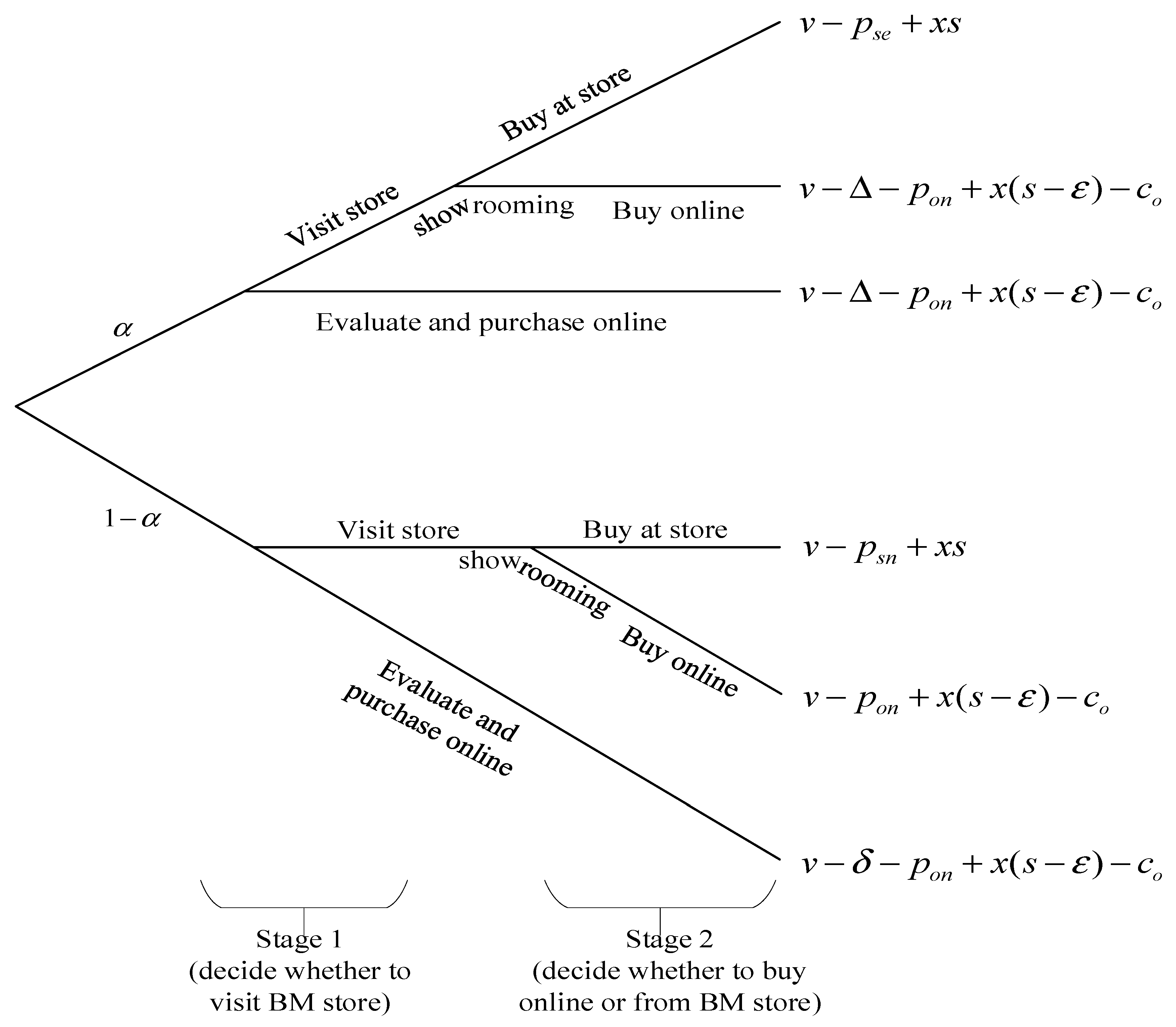
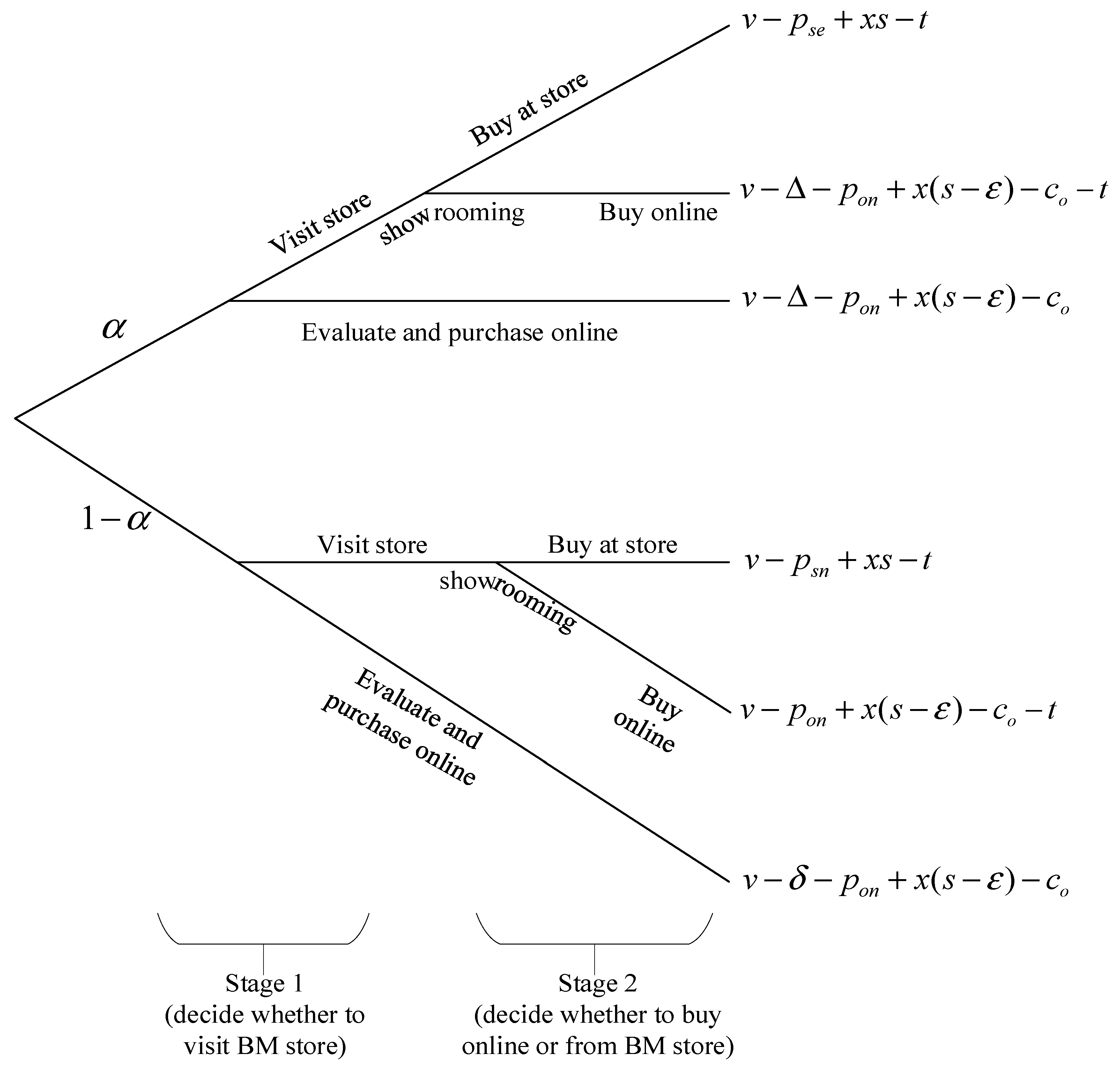
Section 3 introduces the description of the model and the decision analysis. In
Section 4, we explore three models, i.e., the benchmark model and two exclusive strategy models. In
Section 5, we present various managerial insights based on a mathematical study and simulation. Finally, the conclusions of this research and corresponding directions for future studies are presented in
Section 6. All explanations of the model and related proofs can be found in
Appendix A and
Appendix B, respectively.
5. Numerical Analysis and Simulation
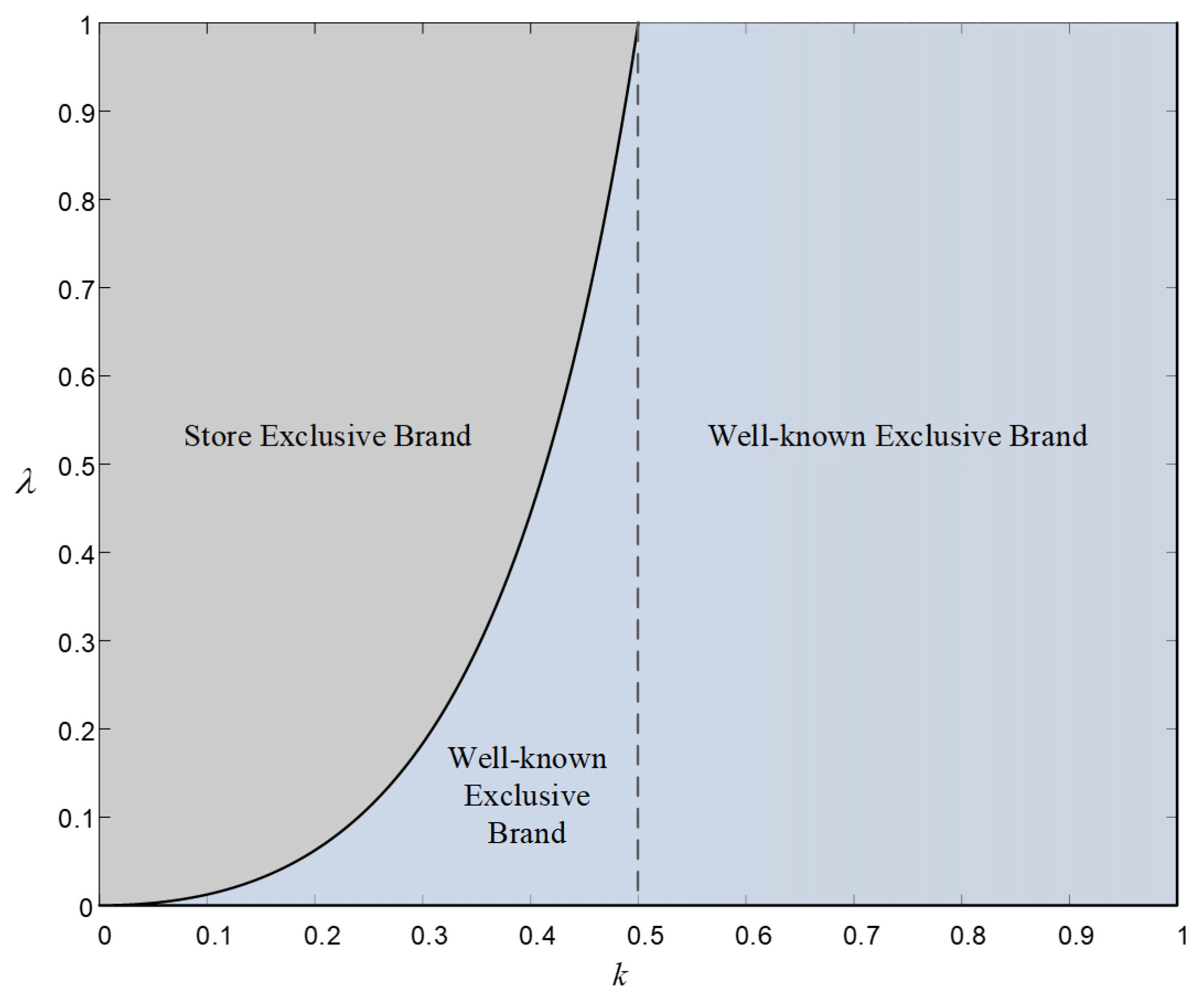
The fundamental motivation for BM retailers to employ exclusive product strategies lies in the ability of such strategies to mitigate or prevent the negative impacts of consumer showrooming behavior, with the ultimate goal of increasing the retailer’s profitability. On the basis of the analyses presented in Lemmas 1–3 and Proposition 3, the decisions concerning whether a BM retailer should implement an exclusive product strategy and which type of exclusive product strategy it should implement depend primarily on the probability
that a consumer can correctly evaluate and purchase the best-fit product solely online, as well as the proportion
of low-type consumers. In this section, we first explore the characteristics of the optimal profits obtained by the BM retailer relative to the changes in
and
by conducting numerical experiments to verify and support the preceding theoretical analysis. Second, we explore the impacts of other parameters on the optimal profits obtained by the BM retailer under different strategies. In line with the utility theory upon which this research model is constructed and the constraining relationships among relevant variables and parameters, we assign the following values to the parameters involved in this section of the study:
,
,
,
,
,
,
,
,
, and
. Only when we explore the impact of changing a parameter’s value is such a parameter treated as a variable; otherwise, these parameters take the values assigned here. This approach is relatively common in the field of retail operations management, and similar approaches have been taken by Mehra, Kumar [
11], Liu, Yuan [
65], Liu and Feng [
66].
In line with the research approach discussed above, we first fix the values of other parameters to observe the impact of variation in the probability
that a consumer can correctly evaluate and purchase the best-fit product solely online on the profits obtained by the two retailers.
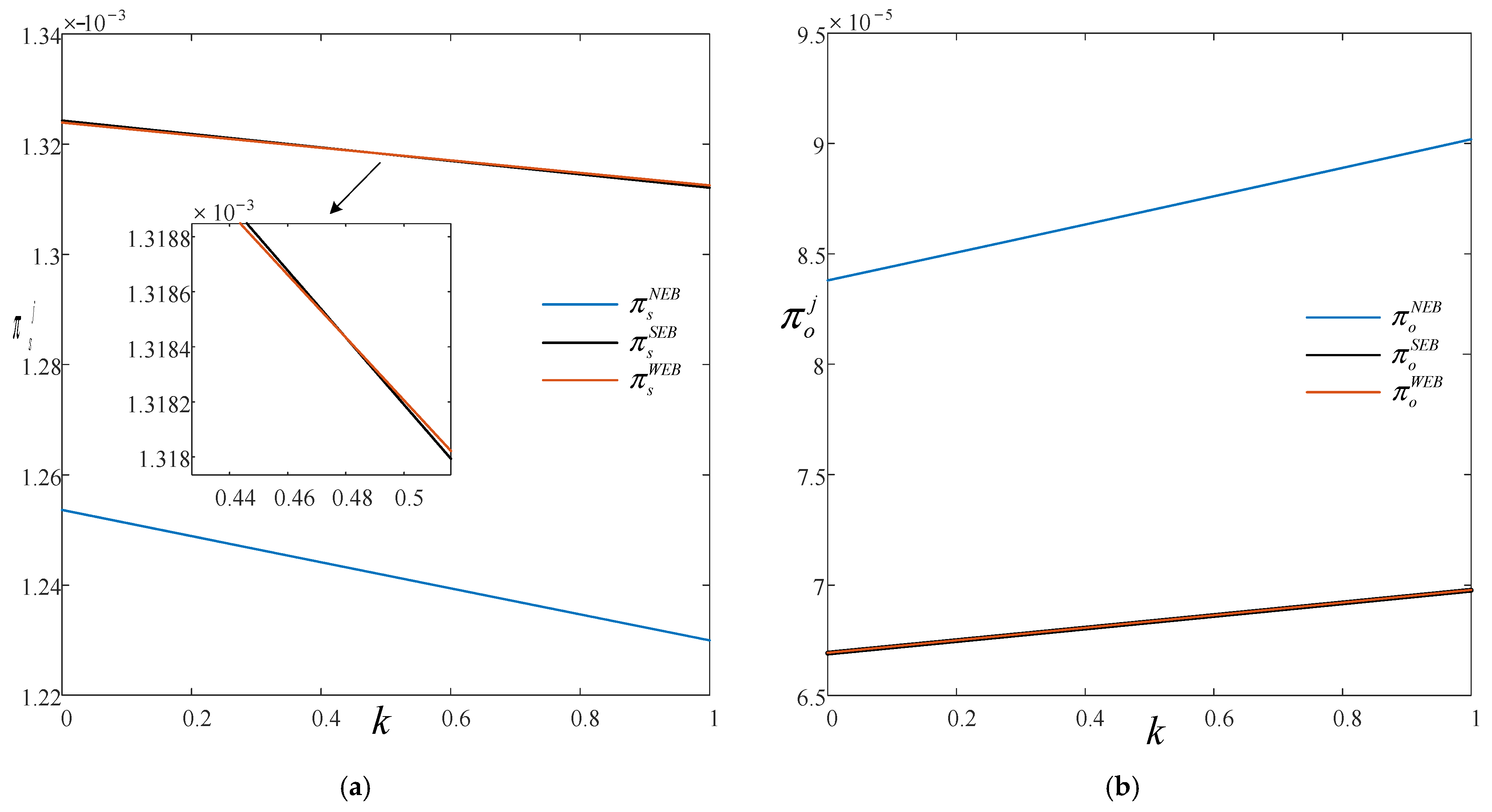
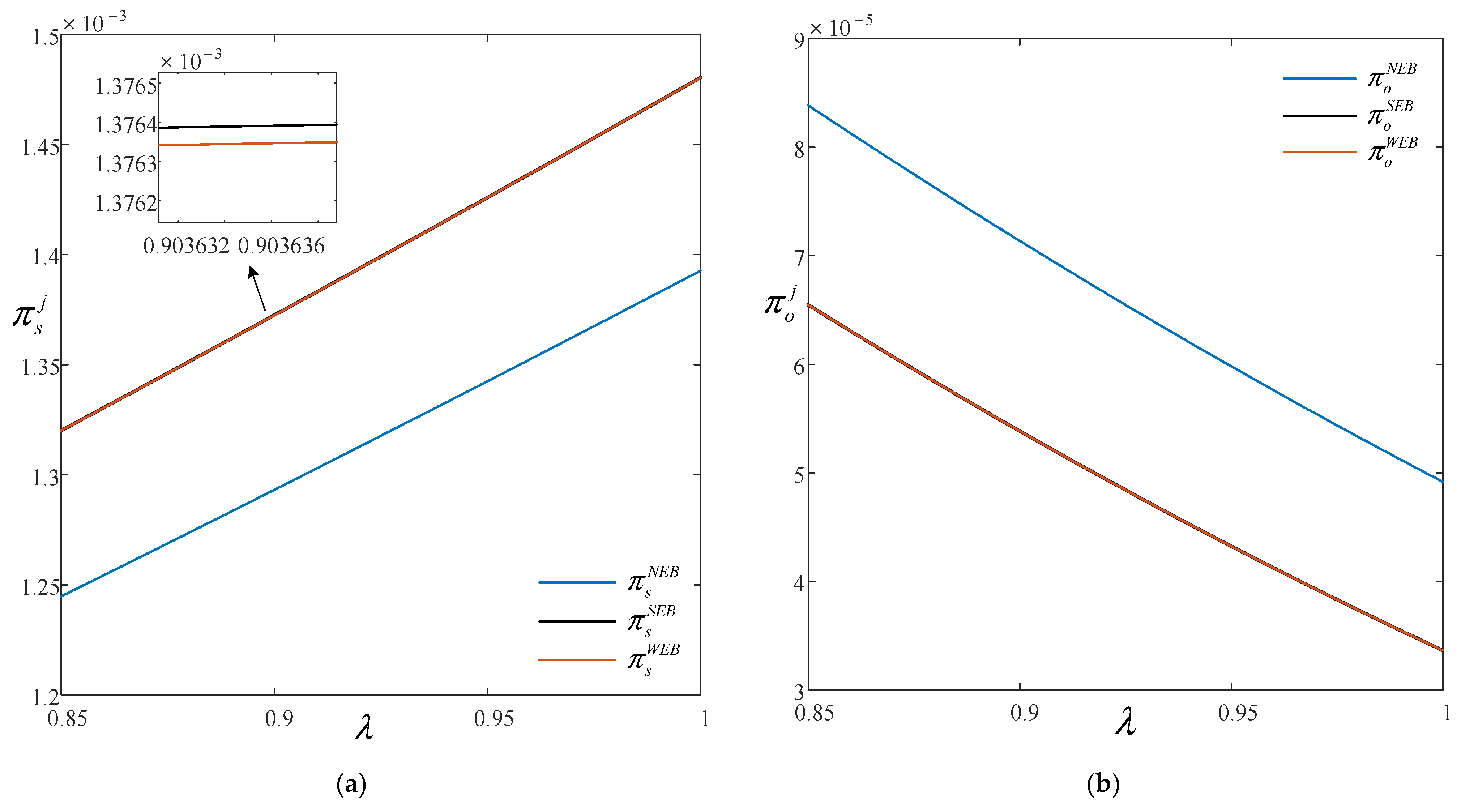
Figure 7a,b visually illustrate the trajectories of the profits obtained by the BM retailer
and the profits obtained by the online retailer
as these values change with
under the
strategy (
). We provide the following observations to illustrate the impact of
on the profits obtained by the two retailers.
Observation 1. Regardless of whether the BM retailer implements an exclusive product strategy, an increase in the probability that consumers can evaluate and purchase the best-fit product online always inhibits the growth of the retailer’s profit but has a positive effect on the profits obtained by the online retailer.
The findings described in Observation 1 are in line with the properties outlined in Lemmas 1–3 regarding retailers’ profits as a function of . This consistency demonstrates the agreement between the numerical experiments and the theoretical analysis, thereby reinforcing the credibility and applicability of this theory. For BM retailers, a higher value of implies that consumers can more easily compare, evaluate, and purchase products online, which decreases their likelihood of visiting offline stores and subsequently harms the profits obtained by BM retailers. Conversely, a higher value of benefits online retailers since it indicates enhanced online evaluation capabilities among consumers and suggests higher conversion rates, stronger reputations, and greater trust in the practices of online retailers. For example, as consumers’ online evaluation skills improve, Best Buy begins to face stiff competition from online retailers such as Amazon, which can suppress profit growth for many BM retailers, including Best Buy itself. Consequently, Best Buy was required to adjust its pricing and actively explore an omnichannel retail model that incorporated both online and offline sales with excellent service and close collaboration with suppliers. In contrast, Amazon fosters trust and reliance among consumers by offering them an interactive, comprehensive platform that users can use to access detailed product descriptions as well as high-resolution images and videos or to read other consumer reviews and Q&A sections, thereby driving sales and profit growth for Amazon.
Similar to the numerical analysis conducted with respect to changes in
, we fix the values of all parameters except the proportion of low-type consumers, i.e.,
, to investigate the impacts of changes in
on the profits obtained by the two retailers.
Figure 8a,b visually demonstrate the trajectories of the profits obtained by the BM retailer
and the profits obtained by the online retailer
under the
strategy (
) as
changes; the detailed results are described in Observation 2.
Observation 2. Regardless of whether the BM retailer implements an exclusive product strategy, an increase in the proportion of low-type consumers always has a positive effect on the growth of the profits obtained by the BM retailer, whereas it has a negative effect on the profits obtained by the online retailer.
Clearly, the results described in Observation 2 are in line with the properties outlined in Lemmas 1–3 regarding the changes in profits obtained by retailers as varies. In fact, as the proportion of low-type consumers increases, this change indicates an increase in the number of consumers who are willing or able to visit BM stores conveniently. This value thus serves as a positive indicator for BM retailers, as more store visits directly increase foot traffic and sales opportunities. Additionally, BM retailers can exploit in-store product displays, experiences, and exceptional service to increase the likelihood of impulse purchases and maintain customer loyalty, which may lead to increased profits. In contrast, for online retailers, an increase in the proportion of low-type consumers may indicate intensified market competition. Specifically, when more consumers visit BM stores, this situation first indicates a decrease in online traffic for online retailers. Second, to attract customers, online retailers may need to offer more competitive pricing, which can further squeeze their profit margins. For example, IKEA, a home furnishing retail brand with a focus on the physical store experience, offers consumers a delightful in-store experience: they can personally try out furniture, experience layouts of various furnishings, and draw inspiration from the displays presented in the store. As the proportion of low-type consumers increases, more individuals are drawn to BM retailers such as IKEA to experience and purchase products, thereby increasing the profits obtained by such retailers. Conversely, as a prominent e-commerce platform in China, JD.com offers customers a wide range of online shopping options. However, as increases, a segment of consumers who might have chosen to shop online may switch to BM stores or engage in showrooming practices, resulting in a partial or complete loss of customers for online retailers. Especially when consumers discover that it is more convenient and cost-effective to purchase home appliances or household items from nearby BM stores, they may prefer to visit these stores in person to experience such products, compare prices, and take the purchased items home directly. In such cases, an increase in could have a negative effect on the profits obtained by online retailers such as JD.com because their sales are influenced by competition from BM stores as well as shifts in consumers’ shopping behavior.
In fact, the ultimate goal of retailers’ pricing and service level decisions is to maximize their profits; thus, with respect to other parameters, we analyze the impacts of numerical changes on the profits obtained by retailers.
Table 3 summarizes the effects of parameters such as
,
, and
on the profits of both the BM and online retailers under three strategies, i.e.,
NEB,
SEB, and
WEB.
Table 3 reveals Observation 3, which illustrates the relationship between the profits obtained by retailers and changes in various parameters.
Observation 3. (1) and do not vary with ; furthermore, increases with , whereas decreases with ().
(2) and first decrease but then increase with ().
(3) increases with , and , whereas decreases with , and ().
(4) decreases with and , whereas increases with and ().
(5) is not affected by , whereas decreases with ().
, which represents the probability that a BM retailer’s store brand or well-known brand products are the most suitable choice for consumers, reflects the degree of alignment between the exclusive products offered by the BM retailer and consumers’ preferences. However, since the NEB strategy does not involve exclusive products, changes in do not affect and . Moreover, serves as an indicator of consumer satisfaction with the retailer’s exclusive offerings, and it is influenced not only by product attributes but also by various other factors, such as in-store experience, brand loyalty, and trust. Especially when products require professional guidance or personalized services (e.g., trying on clothing or testing cosmetics), products pertaining to store brands or well-known brands are often displayed in a more beautiful and attractive manner in BM stores. These displays allow consumers to interact directly with the brand, and they offer consumers access to professional presales and after-sales services or other brand-related experiences. This approach not only increases consumers’ brand loyalty and trust but also improves the match between consumers and these products. Conversely, replicating such brand loyalty and trust can be challenging in an online environment, thus leading to issues such as incomplete information and inferior shopping experiences for online retailers. Hence, the profit obtained by the BM retailer typically increases with , whereas the profit obtained by the online retailer decreases with .
captures consumers’ perceived difference in service levels between the online and offline channels. When is small, it indicates that consumers perceive no significant difference in service levels between the online and BM retailers, thus suggesting that the online retailer has effectively emulated or replicated the services offered by the BM store. In such cases, the BM retailer may lose motivation to improve its service level. Such a decrease in motivation, in turn, may lead to consumer dissatisfaction or distrust in the services provided by both the BM and the online retailer, thereby potentially causing consumers to switch to competitors and subsequently reducing these retailers’ sales and profits. As further increases and reaches a certain level, consumers can clearly perceive differences in service levels between the online and offline channels, even if the online retailer attempts to maintain parity with the BM retailer. These perceptions are due primarily to disparities in the service experience, convenience, social interaction, and security available via each channel. The significance of this perceived difference in service levels thus becomes a driving force that can encourage retailers to improve their services. BM retailers may enhance the store environment, improve product displays, and provide professional service personnel to improve the shopping experience for consumers; in turn, online retailers may optimize website interfaces, improve logistics and delivery, strengthen after-sales services, and increase the levels of online service that they provide. When these improvement measures are implemented, consumers are likely to reassess their shopping choices, thus leading to a potential influx of both returning and new customers. Consequently, as the perceived difference in service levels increases, retailers that adapt successfully and meet consumer demands may obtain increased profits.
The impacts of , and on the profits obtained by both the online and BM retailers exhibit certain similarities. Specifically, these factors positively affect the profits obtained by the BM retailer while negatively influencing the profits obtained by the online retailer. Specifically, , and can all be viewed as unfavorable factors for the online retailer, and an increase in these values can put the online retailer at a disadvantage in competition with the BM retailer. More specifically, reflects the magnitude of the variable service cost per unit borne by the online retailer; accordingly, a higher increases the costs incurred by the online retailer, thus leading to inevitable price hikes, which may lead to the loss of price competitiveness, reduced demand, and profit squeezing, in which context the competing BM retailer may seize the opportunity to obtain more market share, enhance its brand image, and achieve growth in terms of sales and profits. Given the inconvenience costs incurred by online or showrooming consumers during the service process, the higher is, the lower the net utility that consumers derive from online or showrooming purchases, as the higher inconvenience cost offsets some or all of the utility they can obtain from lower prices or other advantages offered by online stores. Conversely, BM stores typically offer a more intuitive product experience, the instant availability of merchandise, and face-to-face customer service, all of which can reduce consumers’ inconvenience costs. Hence, in such scenarios, more consumers may prefer to purchase from BM stores, especially when they need professional guidance or must make purchases urgently, thereby highlighting the evident advantages of BM stores. represents the decrease in utility for consumers when the product they purchase online is not the best-fit product. The magnitude of this factor reflects consumers’ tolerance of and sensitivity toward unsuitable purchases. A larger indicates greater demand for product suitability on the part of consumers; when unsuitable products are purchased, their utility is thus significantly affected. Hence, a larger for the online retailer may signify higher return rates, an increase in negative reviews, increased customer acquisition costs, and decreased trust, which consequently reduce the retailer’s competitiveness and profit margins. In contrast, for the BM retailer, this scenario could represent an opportunity to attract consumers and boost market share, thereby driving profit growth.
In contrast to , , and , and can be viewed as detrimental factors for the BM retailer. An increase in the values of these factors positively affects the profits obtained by the online retailer but negatively affects the profits obtained by the BM retailer . Specifically, signifies the cost incurred by high-type consumers when they visit BM stores. As increases, the frequency with which high-type consumers visit BM stores decreases, thus leading to reduced customer traffic, sales volume, and profits for the BM retailer. Additionally, this situation can cause various issues for the BM retailer, such as excess inventory, a tarnished brand image, and decreased market competitiveness. These impacts are even more pronounced when high-type consumers represent a larger proportion of the customer base in BM stores (i.e., when is relatively small). The costs incurred by consumers when they visit BM stores constitute a multifaceted concept, including financial expenses, time, effort, and psychological and emotional factors; furthermore, these costs are influenced by consumers’ personal preferences, economic status, and shopping habits, as well as store characteristics. However, if BM retailers can enhance their merchandise mix and service quality, thereby providing consumers with a superior shopping experience that increases their willingness to visit these stores, the negative impacts of rising store visit costs can be mitigated. For example, Starbucks attracts many consumers by offering a comfortable environment, fast Wi-Fi, friendly service, and delicious coffee, and has introduced loyalty cards and membership programs to encourage repeat visits. Similarly, Haidilao is known for its exceptional service and delicious hotpot; this company provides a pleasant dining atmosphere and offers additional customer benefits such as free fruit and manicure services. The service cost coefficient reflects the costs incurred by the BM retailer when it provides a certain level of service; this coefficient highlights the expense that the retailer must bear to deliver unit service. A higher signifies that the BM retailer must bear greater service costs at the same service level. The service cost coefficient is typically proportional to the operational costs, labor costs, and complexity of the service provided. An increased service cost coefficient can lead to a variety of issues, such as reduced profits, decreased competitiveness, and increased investment needs. In contrast, an increase in the service cost coefficient for the BM retailer represents an opportunity for the online retailer, as it allows the latter to showcase its advantages in pricing, service, customer reach, and marketing strategies. By seizing this opportunity, the online retailer can increase its market competitiveness, attract more consumers to make online purchases, and ultimately obtain increased profits. For example, while Barnes & Noble, a prominent physical bookstore chain in the U.S., offers unique value in terms of reading experiences, cultural exchanges, and community events, an increase in its service cost coefficient (due to rising rents, labor, electricity, etc.) has led consumers to shift toward online platforms such as Amazon when purchasing books. This shift has contributed to Amazon’s continuous market share growth in the book industry, whereas physical bookstores such as Barnes & Noble have faced declining sales.
As the unit service cost coefficient for the online retailer,
reflects the costs incurred by the online retailer when it provides a specific level of service. The characteristics of this coefficient and its impact on the online retailer are analogous to the preceding analysis of
in terms of its effects on the BM retailer; thus, we do not discuss these characteristics further. However, it is worth noting that the BM retailer’s profit remains unaffected by variations in
. This situation is related primarily to our modeling assumptions and the sequence of the game. As described in “
Section 3: Model description and decision analysis”, we assume that the BM retailer determines the service level
, which is then followed by the online retailer. This sequential game thus unfolds as follows. First, the BM retailer determines the service level; then, both the BM retailer and the online retailer independently determine their particular retail prices; and finally, consumers make purchase decisions and determine their preferred mode of acquisition.
6. Conclusions
The prevalence of online channels has led to the emergence of showrooming behavior, in which consumers prioritize visiting BM retailers’ offline stores to experience products but then switch to online retailers when making purchases; such behavior may often disrupt the existing market balance and damage BM retailers. In this context, the development of effective strategies to counter showrooming behavior has become an urgent issue for BM retailers. Our research aims to explore a set of effective strategies that can be used to offset or mitigate the negative effects of showrooming, thereby providing practical solutions to BM retailers while establishing a balance among players in the market and establishing a stable market environment. We employ mathematical modeling and game theory to explore the feasibility and effectiveness of the exclusive product strategies used by BM retailers to alleviate the adverse impacts of consumer showrooming behavior. In light of the brand influence of exclusive products, two strategies, i.e., SEB and WEB, are discussed. Our analysis derives equilibrium prices, service levels, and the corresponding characteristics of the demand and profit functions, thereby offering clear decision-making guidance for both the BM and online retailers.
6.1. Main Findings
Alongside the benchmark model that does not consider exclusive product strategies, we construct three strategic models, i.e., NEB, SEB, and WEB, with the goal of providing decision support for BM retailers regarding whether they should adopt an exclusive product strategy and how they can choose an appropriate type of exclusive product strategy. Our main findings are as follows.
First, BM retailers adjust their product pricing and service levels after they implement an exclusive product strategy. Specifically, first, such retailers typically set higher prices for exclusive products under the SEB strategy with the goal of reflecting their uniqueness and brand value. Simultaneously, to balance the price competitiveness of their overall product portfolio, BM retailers reduce the prices of nonexclusive products with the aim of attracting more consumers. Second, when BM retailers adopt the WEB strategy, the adjustments made to nonexclusive product prices are influenced by the decisions made by online retailers. If the unit variable service cost borne by online retailers is relatively low, those retailers tend to lower their product prices after the implementation of an exclusive product strategy with the goal of obtaining market share. In these cases, BM retailers usually choose to emulate this price reduction with the aim of remaining competitive. Conversely, if the unit variable service cost borne by online retailers is relatively high, those retailers tend to increase their product prices, and BM retailers tend to follow suit by increasing the prices of nonexclusive products with the goal of preserving their profits.
Second, exclusive product strategies can help BM retailers increase their market share, but different strategies have varying impacts on the structure of demand for exclusive and nonexclusive products. First, the implementation of exclusive product strategies alters consumers’ purchase choices, particularly by redirecting some consumers who originally intended to purchase online or to engage in showrooming to make purchases at BM stores. This shift is primarily due to the uniqueness and exclusivity of exclusive products, which enable BM retailers to attract and retain more customers, especially those who exhibit strong preferences for exclusive products. Simultaneously, as mentioned, following the implementation of exclusive product strategies, BM retailers emulate online retailers by adjusting the prices of their nonexclusive products with the goal of establishing a balance between profitability and competitiveness. Second, although both types of exclusive product strategies generate the same increase in overall demand, the WEB strategy results in higher demand for exclusive products and lower demand for nonexclusive products. This disparity may be because well-known brands are characterized by established significant levels of brand recognition and consumer trust. Despite the overall increase in demand resulting from both strategies, the demand for exclusive products exhibits a more prominent increase under the WEB strategy because of the high level of recognition and trust associated with established brands, thereby suppressing the demand for nonexclusive items. Under the SEB strategy, owing to the relatively low popularity of the store’s private brand, the difference in demand between exclusive and nonexclusive products may be smaller. This explanation accounts for the contrasting structures observed regarding the demand for exclusive and nonexclusive products between the two strategies.
Third, the exclusive product strategy can indeed serve as an effective tool that BM retailers can use to circumvent the negative impacts of consumer showrooming behavior, thereby ensuring that those retailers always benefit from the adoption of this strategy. However, the dominance of the SEB or WEB strategies depends on the probability that consumers may evaluate and purchase the best-fit products online, as well as on the proportion of low-type consumers. When the probability that consumers can evaluate and purchase best-fit products online is low, and the proportion of low-type consumers is relatively high, the SEB strategy can generate higher profits for BM retailers. Otherwise, the BM retailers should choose the WEB strategy.
Furthermore, the consistency between numerical research and theoretical analysis also indicates that BM retailers can benefit from the implementation of exclusive product strategies. By employing such strategies and providing consumers with superior service and shopping experiences, BM retailers are able not only to attract a larger consumer base to their BM stores but also to increase their sales and profit margins. These benefits, in turn, offer them advantageous positions in the prevalent competitive landscape, which is characterized by showrooming practices on the part of consumers. Inevitably, as online retailers respond to this paradigm shift, they are compelled to adjust their strategic approaches to counteract the influence of exclusive product strategies adopted by their BM counterparts. Hence, it is imperative to offer relevant managerial insights that are grounded in the key findings of our theoretical explorations.
6.2. Managerial Insights
In light of the theoretical analysis and findings discussed, the following managerial insights for BM retailers are proposed.
First, BM retailers should continuously monitor market changes and consumer behavior with the goals of clarifying their brand positioning and selecting appropriate exclusive product strategies. Typically, the SEB strategy permits BM retailers to cultivate a distinct brand image by designing and promoting their own branded products. The advantage of this strategy lies in the complete control over product design, manufacturing, and marketing that it offers the retailer, thereby ensuring alignment between the product’s uniqueness and the store’s overall positioning. Conversely, the WEB strategy aims to attract customers and boost sales by exploiting the influence and consumer loyalty of established, well-known brands. By engaging in collaborations with these brands, BM retailers can quickly gain consumer trust and recognition, thereby reducing the difficulty and costs of market promotion. Therefore, in practice, if the target market values product uniqueness and innovation and if consumers have a limited ability to evaluate products online or find their preferred products online, the SEB strategy may be more suitable. Alternatively, if brand recognition and reputation are prioritized and if consumers either possess strong online evaluation skills or the probability that consumers can find the best-fit products online is high, the WEB strategy might prove to be advantageous.
Second, the optimization of product assortment and pricing strategies should be emphasized. When BM retailers implement an exclusive product strategy, they must optimize their product mix and pricing approach with the goals of ensuring the effectiveness of their strategies and maximizing their profits. Exclusive products should be priced higher to reflect their uniqueness and brand value, whereas nonexclusive products’ prices can be adjusted flexibly on the basis of market demand and competition with the aim of maintaining competitiveness. This pricing strategy not only highlights the distinctiveness of exclusive products, thus enabling BM retailers to achieve higher marginal revenues, but also demonstrates the flexibility of nonexclusive offerings, thereby allowing these retailers to balance profitability with competitiveness by adjusting their prices.
Third, enhancing service quality and the shopping experience is crucial. When BM retailers choose SEB or WEB-exclusive product strategies, they should strive to increase their service standards and enhance their shopping experience. By providing consumers with professional product consultations, excellent after-sales services, and a comfortable shopping environment, consumer satisfaction and loyalty can be increased. This approach not only encourages more consumers to make offline purchases but also bolsters the brand image and reputation of BM retailers.
6.3. Limitations and Directions for Future Research
The aim of this study is to transform consumers’ showrooming behavior by transforming its potentially negative impact on BM retailers into a positive effect through the introduction of an exclusive product strategy. This approach is designed to enhance the competitiveness and profitability of BM stores while providing customers with a superior and more personalized shopping experience. However, certain assumptions made in our analysis may not hold in reality, thus highlighting certain limitations of our research. For instance, our study focuses solely on a duopoly competitive environment involving only a single BM retailer and a single online retailer. However, in the actual retail market, multiple BMs and online retailers coexist and compete in various contexts, such as price, product quality, service, product delivery speed, and the shopping experience. Additionally, we assume that both exclusive and nonexclusive products belong to a singular product category, whereas in reality, it is more common for retailers to sell multiple types of products simultaneously. Furthermore, our research relies primarily on static analysis, thereby overlooking dynamic changes and long-term effects in the market. In contrast, in the real world, market conditions, consumer preferences, and competitive strategies are all subject to change over time. Certainly, these limitations highlight various directions for future research on this topic. Possibilities such as exploring a competitive environment featuring multiple BMs and online retailers, examining the relationships among various types of exclusive and nonexclusive products, and developing dynamic models that are capable of capturing market fluctuations and long-term impacts represent viable directions for future investigations.