1. Introduction
Thunderstorm count modeling with risk analysis involves using statistical models to predict the likelihood and severity of thunderstorms, and are used by various sectors, such as insurance and utility companies, to forecast storm recurrence, analyze risk, and estimate financial losses based on factors like wind speed, hail size, and tornado potential. The modeling of count data using discrete distributions has undergone significant evolution in recent statistical literature, moving far beyond the classical Poisson framework to address the complex characteristics real-world data often exhibits. While the Poisson distribution remains foundational due to its canonical link between mean and variance, its limitations in handling overdispersion—where variance exceeds the mean—have driven substantial methodological development [
1]. The Negative Binomial distribution has emerged as a workhorse for overdispersed counts in fields from genomics, where it models RNA-seq read counts [
2], to actuarial science, where it predicts insurance claim frequencies. Even more flexibility is achieved through generalized distributions like the Conway–Maxwell–Poisson, which handles both over- and under-dispersion within a unified framework [
3], and through compound mixtures, such as the Beta-Discrete Gamma model, which account for unobserved heterogeneity by mixing a core count distribution with a continuous prior [
4].
But the count data that inherently excludes zero values requires specialized statistical approaches, as standard count distributions like the Poisson or Negative Binomial would produce biased parameter estimates by incorrectly assigning probability to zero outcomes. The ordinary procedure for treatment such data employs zero-truncated distributions. This tactic, ceremoniously established by [
5], conditions the standard probability mass function (PMF) on the event that at least one occurrence has been observed (
). The zero-truncated PMF is derived as follows:
This introductory formula confirms that the PMF of the original distribution is rescaled to account for the structural absence of zero counts, providing a binding probability model on the positive integers. Our proposed BGD distribution is derived directly within this framework, ensuring its proper normalization for zero-truncated count data. These models are indispensable in numerous applied fields. For instance, in healthcare research, the Zero-Truncated Poisson (ZTP) and Zero-Truncated Negative Binomial (ZTNB) are used to model the length of hospital stays, where the count begins at one upon admission [
6,
7,
8]. In ecology, they model species abundance in occupied habitats, and in actuarial science, they analyze claim counts from policyholders with at least one claim [
1].
While standard truncated models are widely useful, more complex distributions have been developed to handle greater distributional flexibility, though they come with significant drawbacks. The ZTGP can handle both over- and under-dispersion but is plagued by computational instability and difficult parameter estimation due to its complex likelihood function [
9]. Similarly, the SBNB—a type of weighted distribution where the probability of observation is proportional to the count value—is often misapplied. If used as a general zero-truncated model without a genuine size-biased sampling mechanism, it will produce systematically biased estimates [
10]. The most flexible class, the ZTGNB, is particularly prone to overparameterization, leading to unreliable estimates and a high risk of overfitting, especially with small sample sizes. Furthermore, its lack of standard software implementation hinders practical application and reproducibility [
11].
Thus, we have summarized the drawbacks and outlined the motivations for proposing BGD, which are as follows:
Limitations
- –
ZTGP is based on complex likelihood, leading to computationally unstable estimation.
- –
SBNS Prone to bias if misapplied without a size-biased mechanism.
- –
ZTGNB is an verparameterized, high risk of overfitting model.
Motivations
- –
Naturally interpretable as a heterogeneity model; no restrictive sampling assumptions.
- –
More stable likelihood; robust parameter estimation via grid search.
- –
Parsimonious parameterization (three parameters); consistently lower AIC/BIC.
In this context, we introduce a discrete distribution on the natural numbers
using the method of compounding or mixing. This technique can also be applied to discrete distributions on the positive integers by ‘weighting’ or ‘averaging’ them over a continuous distribution of their parameters. The resulting distribution is highly flexible and capable of capturing overdispersion, multimodality, and unobserved heterogeneity far more effectively than traditional zero-truncated distributions. To illustrate this approach, we have compounded the discrete gamma distribution proposed by [
12] with the beta distribution.
The structure of the paper is as follows.
Section 2 presents the proposed Beta–Gamma distribution along with some of its properties.
Section 3 describes the moment-generating, moments and factorial moments.
Section 4 studies the Risk measure.
Section 5 provides its characterization, while
Section 6 demonstrate the applicability of the proposed distribution, an analysis of thunderstorm frequency data is presented in
Section 7. Finally, concluding remarks are given in
Section 8.
2. Beta-Gamma Discrete Distribution
Let
be a discrete probability mass function (PMF) for
, parameterized by a vector
. Let
be a continuous probability density function (PDF) for the parameters, governed by hyperparameters
. The compounded discrete distribution is defined by the marginal PMF:
where the integration is over the entire domain
of the continuous parameter(s)
. This operation effectively “weights” the entire discrete PMF by the continuous PDF, producing a new discrete distribution on
. Refs. [
12,
13] has defined the discretized version of the gamma distribution as
where
. Then, the compounded mixture of beta and gamma is obtained as
Using the Beta integral,
we obtain
Expressed explicitly as
we can write it as
Theorem 1. Let X be a discrete random variable with PMF proposed to be of the formfor , where is the Pochhammer symbol (rising factorial), and the parameters satisfy and . Then, for the total probability to sum to unity, the constant K must be Proof. Given: for
,
where
so
It can be written as
where
as the total probability is
So, the sum:
which converges for
on using Gauss’s theorem which states that
valid when
. Therefore,
Putting everything together,
By carefully evaluating the constants
K and simplifying, all factors cancel such that the total sum equals 1. We conclude that
and its PMF is expressed as
It can be written as
This is our proposed distribution, which will be known as the BGD distribution. This completes the proof. □
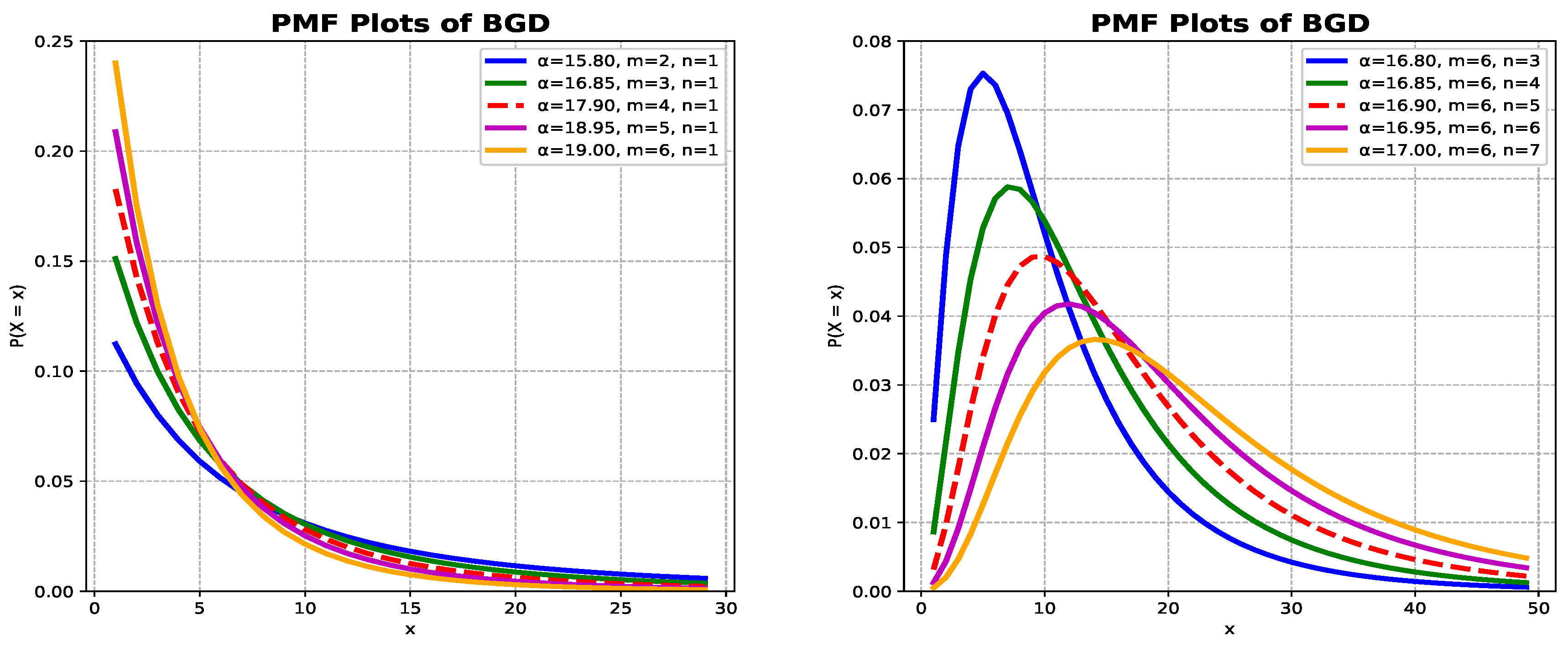
The PMF of the distribution in Equation (1) for different parameter values is depicted in
Figure 1, which shows that the proposed distribution is right-skewed and that the degree of skewness depends on the parameter values.
Figure 1 presents the PMF plots of the BGD(
) distribution for different parameter combinations of
,
m, and
n. The left panel demonstrates the decreasing nature of the PMF as
x increases, indicating that for smaller values of
,
m, and
n, the probability mass is concentrated near the lower values of
x. This behavior reflects a right-skewed distribution with a long tail, suggesting that small counts are more probable than large ones. On the other hand, the right panel shows the effect of varying the parameters on the overall shape of the PMF. As the parameters
m and
n increase, the mode of the distribution shifts towards higher values of
x, and the spread of the distribution becomes wider, resulting in lower peak probabilities. The dashed lines represent intermediate parameter combinations, showing gradual transitions between the curves. Overall, the PMF plots confirm that the parameters
,
m, and
n play a crucial role in determining the shape, dispersion, and skewness of the BGD distribution, allowing it to model diverse discrete data patterns effectively. The ratio of consecutive probabilities is
The behavior depends on this ratio:
If for all and for , then the distribution is unimodal with mode at .
If for all x, the distribution is decreasing with mode at .
If for all and , the distribution may have multiple modes (though rare in practice).
Special Cases: When
and
(appropriately scaled),
where
p is the success probability. When
the BGD simplifies to the Waring distribution [
4,
14] with PMF given by:
When
, the BGD simplifies to the Yule distribution [
15,
16] with PMF given by
Since the Beta Geometric (BG) distribution arises as a mixture of beta distribution so
The marginal distribution is obtained by integrating out
p:
which is equivalent to the form given in (1). Moreover, by using asymptotic properties of Pochhammer symbols and Stirling’s approximation
Thus, the tail behavior is
where
K is a constant. This indicates that the distribution possesses a heavy tail, decaying more slowly than the exponential distribution but faster than a strict power-law distribution. As established in scaling atmospheric science, power-law distributions commonly appear in geophysical systems, including precipitation and storm data, due to the scale-invariant nature of atmospheric dynamics see [
17]. This tail behavior can be better understood through the survival function (SF), which is defined as
, so for BGD
, it can be expressed as
The asymptotic performance of the SF
for large
x is a crucial element of the distribution’s tail weight. Smearing Stirling’s approximation to the Pochhammer symbols in the PMF discloses that the survival function decays as a power law:
where
C is a positive constant that depends on the parameters
,
m, and
n. This asymptotic result leads to two important interpretations:
Heavy-tailed performance (): The power-law decay specifies a heavy tail. Specifically as follows:
If , the SF converges to a non-zero constant, inferring an tremendously heavy tail where very large counts have non-negligible probability.
If , the SF decays to zero, but slower than an exponential distribution, signifying a heavy-tailed distribution prone to extreme values.
Light-tailed behavior (): For , the SF decays to zero at a rate faster than , indicating a lighter tail.
This property is crucial for risk analysis, as it shows that the BGD model can capture the high-frequency, high-impact events often observed in meteorological phenomena like thunderstorms, where the parameter m directly controls the propensity for extreme counts.
Now, the hazard rate function (HRF), which gives the instantaneous risk of the event occurring at
x given it has not yet occurred, is defined as
and for BG
we can be express it as
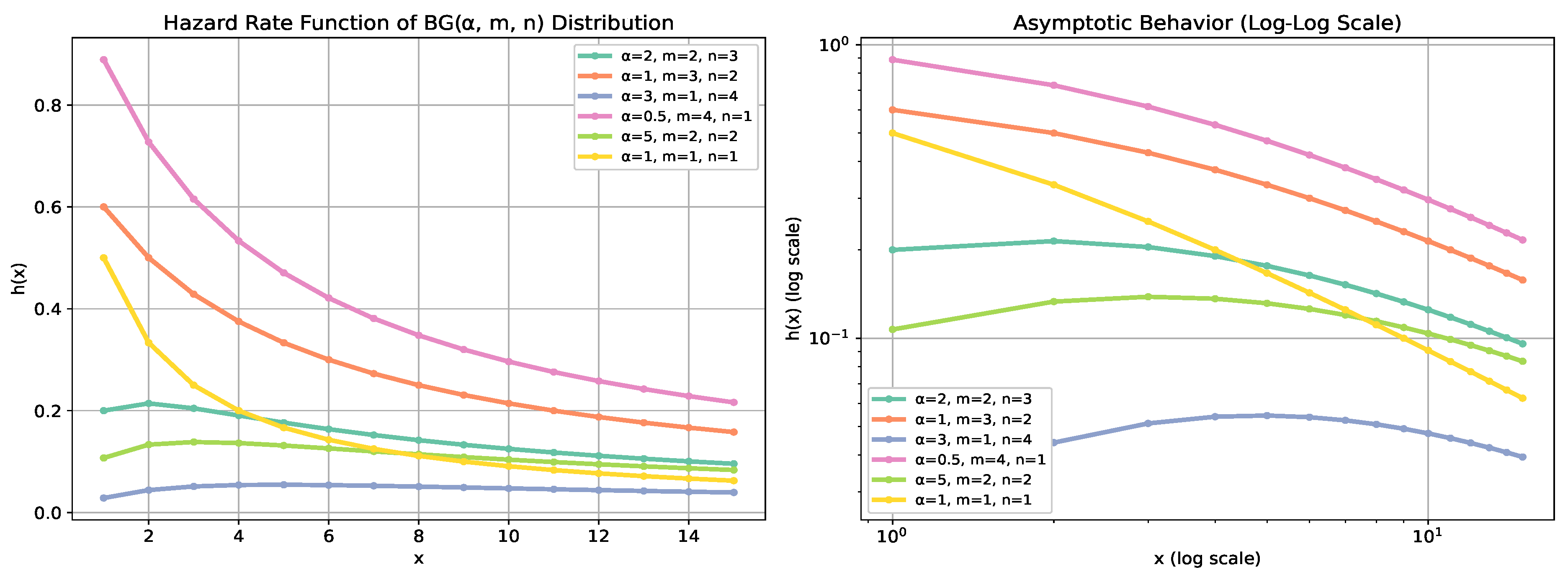
In
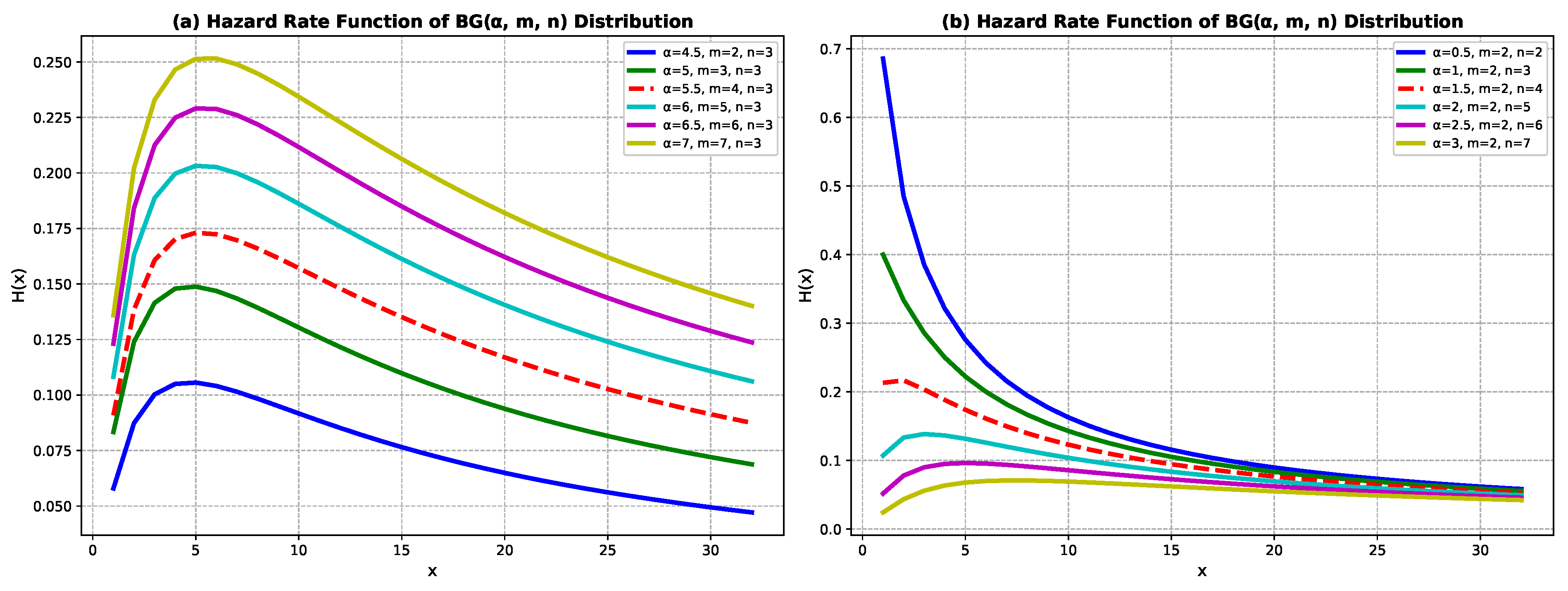
Figure 2, the HRF of the
is presented for different combinations of the parameters
,
m, and
n.The left panel illustrates the HRF behavior for the first set of parameter values, where the curves exhibit an initially increasing trend, reaching a peak before gradually declining, indicating a unimodal failure rate pattern. That is, it displays a unimodal HRF, indicating a ’critical period’ of maximum risk. This shape suggests that the probability of failure or event occurrence initially increases with
x and later decreases as the lifetime progresses. The right panel, on the other hand, displays HRF curves for another parameter configuration set, where the functions show a monotonically decreasing pattern, implying a high initial risk that diminishes over time. In other words, it displays a decreasing HRF, indicating the highest risk is instantly at the start of an event. These shapes deliver critical perceptions for timing-sensitive risk alleviation. Overall, the plots demonstrate that the hazard rate of the
distribution is highly sensitive to parameter changes, and the model can flexibly capture increasing, decreasing, or bathtub-shaped failure behaviors depending on the values of
,
m, and
n.
The HRF for the BG(, m, n) distribution is expressed via a generalized hypergeometric function , with parameters depending on x and the distribution parameters. Its behavior hinges on the properties of this function. Key points include (1) positivity and finiteness of the HRF, ensuring it lies between 0 and 1; (2) as , the denominator series grows large, causing the hazard rate to approach zero, indicating a decreasing hazard over time; (3) for fixed x, the series converges slowly, impacting the initial hazard shape; (4) the hazard rate’s initial trend depends on parameters: with large m or n, it tends to decrease initially, while small parameters may produce an increasing hazard. Overall, the HRF often exhibits a decreasing or inverted bathtub shape, but it cannot have a classic bathtub form that increases at long times, due to its asymptotic decay to zero. This aligns with the distribution’s tendency toward decreasing hazard rates or a unimodal hazard that peaks early and declines thereafter.
The long-term behavior of the HRF demonstrates that they all approach zero as
, confirming our analytical findings. In the initial stages, the hazard rate can exhibit various patterns for small
x: it may decrease from the outset—particularly for larger parameter values—or display an inverted bathtub shape, initially increasing before decreasing. Alternatively, the HRF can remain relatively constant initially before declining. Parameter effects significantly influence these behaviors; specifically, increasing
generally tends to decrease the hazard rate, while increasing
m or
n also tends to produce a similar effect. Smaller parameter values often lead to more pronounced initial behaviors, such as sharper rises or drops. The log–log plots confirm the HRF decays to zero for large x, often following a power law. A steep decline implies the risk of future events diminishes rapidly, allowing for faster ‘all-clear’ decisions in operational planning. Asymptotically, the log–log plots, as portrayed in
Figure 3, reveal that the HRF decays approximately following a power law for large
x, although the exact decay exponent varies depending on the specific parameter values. The procedure of the HRF curve revealed in
Figure 2 and
Figure 3 directly effects how prediction and risk administration verdicts are prepared. In this context, the following conclusions are drawn regarding the management of space shuttle flights.
A decreasing HRF (right panel of
Figure 2) means the chance of another thunderstorm is highest right after the first one begins and then gradually declines. Practically, the initial moments of a thunderstorm are the riskiest, showing an “early-failure” pattern. For space launches, this suggests that the strictest monitoring and safety measures are required at the very beginning of any thunderstorm event.
A unimodal (inverted-bathtub) HRF as portrayed on the left panel of
Figure 2 stating the risk of another thunderstorm upsurges at first, reaches a peak, and then decreases. This configuration shows a perilous mid-period during a storm when the chance of additional thunderstorms is highest. For operations, it suggests that risk forms over time, demanding ongoing and unrelenting monitoring, not just care at the start.
A steeply decreasing HRF (as seen in
Figure 3) specifies that the system has very short memory, meaning the chance of another thunderstorm descents sharply after the initial periods. If no new storm happens soon after the first, the probability of one occuring next becomes very low very quickly. This supports analysts quickly gain confidence that the storm is ending, assisting timely decisions about recommencing launch operations or outdoor activities.
3. Moment Generating Function
The moment generating function (MGF) of a random variable
X is defined as:
this implies
where
denotes the expectation, and
t is a real number. Now incorporate PMF as defined in Equation (1) in above definition we get
where
,
, and
is the Pochhammer symbol (rising factorial) defined as
take
if
then
Notice that the sum is recognized as the hypergeometric series:
where
. Therefore, the MGF simplifies to
and
is the Gaussian hypergeometric function.The MGF is valid for
, since
, ensuring the convergence of the hypergeometric series. For
, divergence may occur unless parameters are chosen to allow convergence at
. On differentiating
with respect to
t and evaluating at
, we can obtain the moments of
X i.e.,
where
is the
n-th derivative of
evaluated at
. So its mean and variance are
and
and its index of dispersion is defined as the variance to mean ration and for BGD(
) it is expressed as
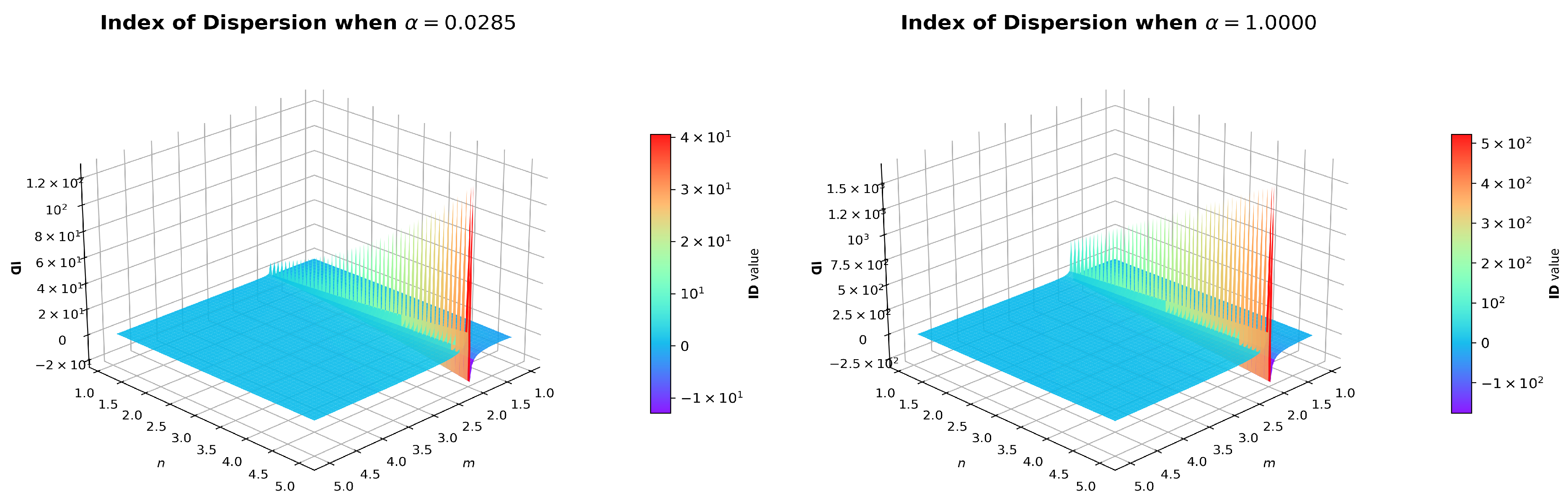
The index of dispersion analysis of the BGD(
,
m,
n) distribution, as revealed in
Figure 4, portrays systematic dispersion patterns across parameter space. Smaller
m values typically yield overdispersion (ID
), indicating clustered thunderstorm events with variance exceeding the mean. Larger
m values produce underdispersion (ID
), suggesting more regular storm timing. The parameter
n modulates this relationship, while the Poisson boundary (ID
) separates these regimes. These patterns enable targeted parameter selection for modeling different thunderstorm clustering behaviors observed in meteorological data.
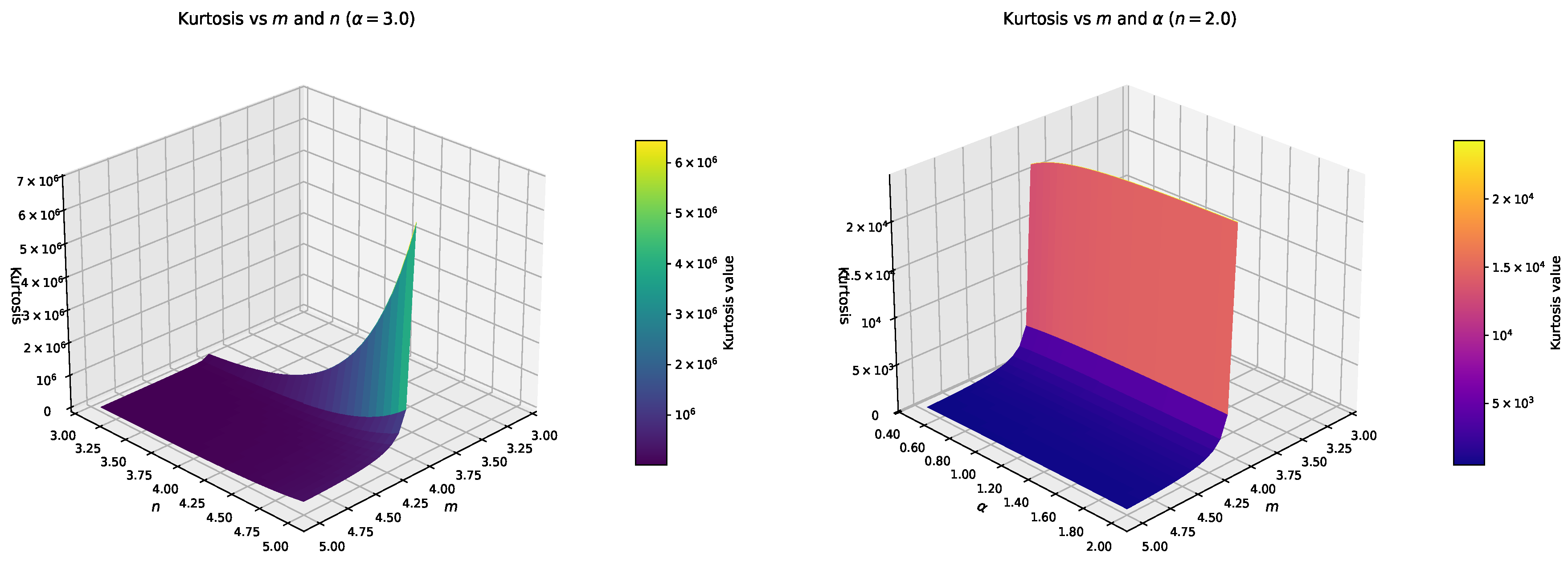
The kurtosis analysis of the BGD(
,
m,
n) distribution as portrayed in
Figure 5 reveals pronounced heavy-tailed characteristics. For
, extreme leptokurtosis (reaching ∼2.5
) occurs at small
m values (
–
), indicating frequent outlier events. With
, peak kurtosis (∼23) emerges at small
(
–
) and
m combinations. Both parameters
m and
strongly temper tail heaviness when increased. These properties make the distribution suitable for modeling extreme thunderstorm events with frequent severe occurrences.
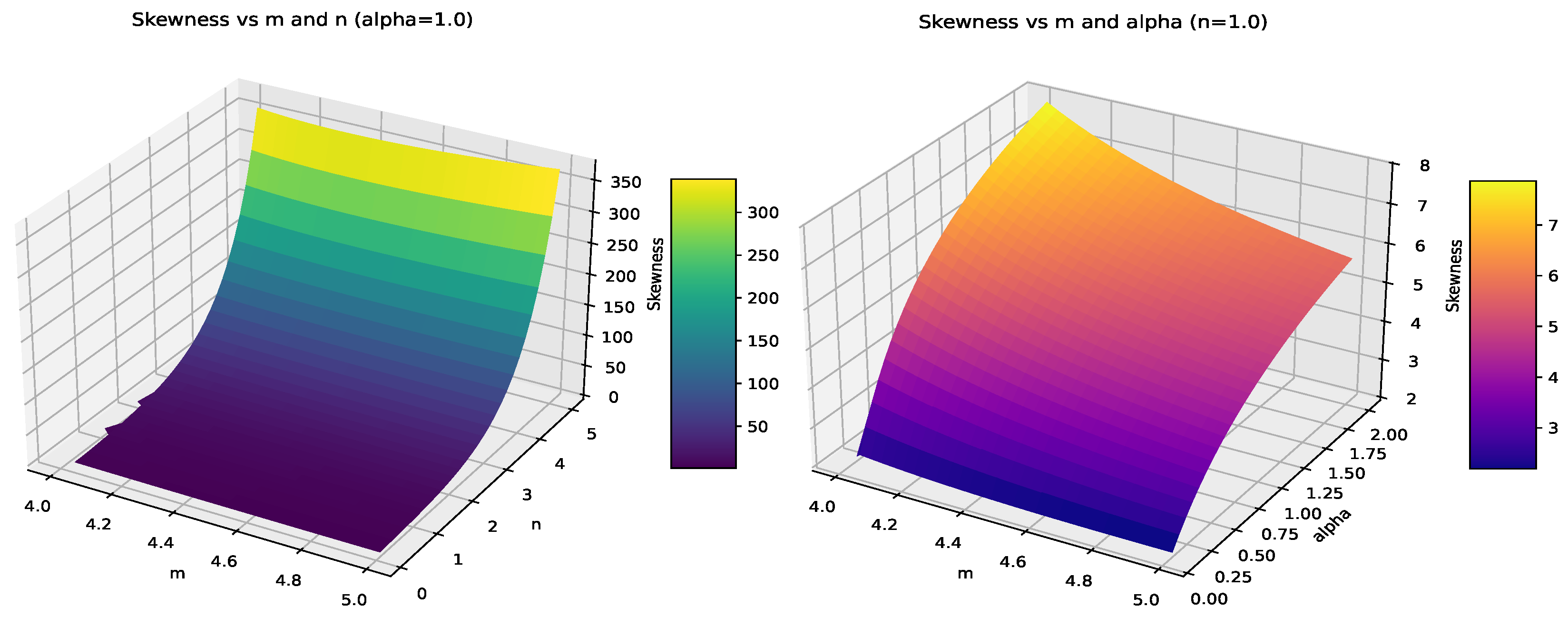
Figure 6 portrays skewness analysis of the GB(
,
m,
n) distribution which reveals strong right-skewness characteristics. For
, extremely high positive skewness (reaching ∼300) occurs at small
m (
–
) and moderate
n (2–3) values, indicating pronounced right-tailed distributions. With
, skewness shows more moderate but still substantial positive values (∼7), peaking at small
m (
–
) and intermediate
(
–
) combinations. In both cases, parameter
m exerts strong control over asymmetry, with smaller
m values generating more severely right-skewed distributions. These skewness patterns confirm the distribution’s capacity to model thunderstorm intensity data with frequent low-intensity events and occasional extreme values.
Remark 1. If we substitute into Equation (4) then we get the probability generating function(PGF) of BGD() defined aswhere is the Pochhammer symbol (rising factorial) and is the Gauss hypergeometric function. Factorial Moments
Let’s find the
r-th factorial moment for the given PMF as defined in Equation (1). The
r-th factorial moment is defined as:
So, we need to compute:
Let
, so
, and
. Then Equation (1) can be re written as
The factorial moment becomes
As
so
Since the factorial in the denominator requires
, we can write
Let
, so
,
:
Substituting all these
As
so
Now, take sum only, i.e.
Now, using
and applying it to both terms gives simplification
and multiply by
Now, incorporating
then substituting it into Equation (6), we get
Now, a recurrsive relation between factorial moments can be established as
7. Application
Modeling the number of thunderstorms at the Kennedy Space Center (KSC) in Florida, USA, is a classic application of count data models see [
23]. The unique meteorological and geographical context makes it a compelling case study. The Kennedy Space Center is located on the Atlantic coast of Florida, a region known as the “Lightning Alley of the United States.” This presents a high-frequency, volatile environment for thunderstorms, driven by
Sea Breezes: The convergence of sea breezes from both the Atlantic Ocean and the Gulf of Mexico provides a daily trigger for deep convection during much of the year.
High Moisture Content: Proximity to warm ocean waters ensures a plentiful supply of atmospheric moisture, a key ingredient for thunderstorm development.
Synoptic Weather Patterns: Seasonal patterns, such as the summer wet season and the passage of winter cold fronts, modulate the frequency and intensity of thunderstorm activity.
7.1. The Meteorological and Geographical Context
The empirical analysis utilizes a classic and high-resolution dataset of thunderstorm activity from the Kennedy Space Center (KSC), originally published by [
24]. This dataset was compiled from WBAN-10 weather reports over an 31-year period (January 1957–December 1967). A critical characteristic of this data is that it is inherently zero-truncated; it only records days on which at least one thunderstorm event (THE) occurred. This is because the primary operational concern is understanding the intensity and internal structure of active storm days, rather than predicting the simple occurrence of any storm. Consequently, our model and the subsequent analysis are applied to this conditional dataset, focusing on the number of individual thunderstorms (THs) per event, where the count
X satisfies
. The sample sizes for the analyzed winter months are as follows: January (
), February (
), November (
), December (
), and the aggregate winter season (
). Following the foundational work of [
24], who modeled this data using a Compound Negative Binomial-Positive Binomial distribution, we apply the more flexible BGD model to the same thunderstorm count data from Cape Kennedy (now KSC). This allows for a direct comparison of modern distributional techniques against a classical benchmark in meteorological statistics.
7.2. Motivation
The motivation for precise modeling at KSC is exceptionally high-stakes:
Launch Safety: A thunderstorm within a certain radius is a launch commit criteria violation. Accurate probabilistic forecasts of thunderstorm likelihood are critical for scheduling and scrubbing launch attempts, which involve immense costs.
Asset Protection: Spacecraft, rockets, and ground infrastructure are highly sensitive to lightning strikes. Models help assess lightning risk and inform decisions about when to keep hardware on the pad or roll it back to the protection of the Vehicle Assembly Building.
Ground Operations: Outdoor work by personnel is halted during lightning warnings. A good model helps in planning work schedules to minimize downtime and ensure worker safety.
Climatological Risk Assessment: Long-term models (e.g., using monthly/seasonal counts over decades) are used to understand the climatology of thunderstorm activity, which informs the design of structures and electrical systems to withstand lightning strikes.
7.3. Zero-Truncation Modeling
A zero-truncated distribution is desirable because decision-making at the Kennedy Space Center apprehensions only current thunderstorm events, making zero counts unconnected. Operational risks naturally exclude zero from the data. Furthermore, the following arguments support the use of zero-truncated modeling:
The Launch Commit Criterion (LCC) states that having a thunderstorm within a certain distance automatically violates launch safety rules see [
25]. Therefore, once a thunderstorm event (THE) begins, the focus shifts from predicting whether a storm will occur to estimating how many thunderstorms will form and how long the event will last. Since the event has already started, the count of storms begins at one, and the model provides the required real-time probabilities
for decision-making.
When a thunderstorm event happens, the financial and safety risks upsurge rapidly as the number of thunderstorms increases. One storm might source only a minor delay, but several storms in succession can force a complete launch cancellation, including the expensive technique of challenging the rocket’s fuel. Fortification procedures for spacecraft and ground facilities also depend on how intense and long the event becomes. By modeling the number of thunderstorms given that an event has already started, the BGD distribution offers the key probabilities needed to assess the chances of these high-risk, multiple-storm situations.
The Carter’s ([
24] data, taken from WBAN-10 forms, is naturally zero-truncated because a form is only started after thunder is first heard—meaning at least one thunderstorm has already occurred. Therefore, the dataset represents a conditional sample that begins only once a weather threat is active, matching the real-world conditions faced by forecasters and risk managers during an ongoing thunderstorm event.
7.4. Thunderstorm Activities in Winter Season
The analysis of thunderstorm events in November, December, January, February and the winter season at a location like Kennedy Space Center (KSC) is statistically and operationally significant, primarily because of its rarity and unique causation. During winter at Cape Kennedy, thunderstorm activity is infrequent and characterized by simplicity. On days with thunderstorms (THEs), the average number is about 1.19 per day, with most THEs containing only a single thunderstorm (TH). Approximately 20% of winter THEs have multiple THs, with a maximum of three within a single event. Overall, winter thunderstorms are rare, generally simple, and exhibit limited internal complexity. Approximately 80.6% of winter THEs contain only one thunderstorm (TH), about 12.9% contain two THs, and 6.5% contain three THs. No THEs with four or five THs are observed during the winter months.
7.5. Meteorological Significance
Winter THEs are typically driven by frontal systems rather than thermal convection, and are associated with synoptic-scale forcing rather than local sea breezes. They exhibit lower instability but stronger lift mechanisms. Due to their synoptic-scale organization, winter THEs may be more predictable. Although less frequent, winter thunderstorms can still produce severe weather such as strong winds, isolated tornadoes, and heavy rainfall.
7.6. Practical Applications for Space Operations
Winter-Specific Planning: Due to the characteristics of winter THEs, space operations can benefit from the following: launch windows are fewer overall, but when they occur, they are typically single events; schedules can be optimized by planning around frontal passages more reliably; and risk assessment can be conducted with a lower probability of multiple THEs disrupting extended operations.
Model Utility: The compound model remains valid for winter THEs, but with different parameter values. This allows for simpler approximations to be used for quick winter assessments. However, separate seasonal models are recommended for accurate planning.
7.7. Model Selection and Evaluation Statistics
In statistical modeling, especially with non-nested models (models that cannot be derived from one another by imposing parameter constraints), selecting the best model requires a suite of tests and criteria. These metrics balance model fit with complexity to prevent overfitting and identify the most parsimonious and plausible model.
Akaike Information Criterion (AIC) is an estimator of prediction error. It measures the relative quality of a statistical model for a given dataset. It deals with the trade-off between the goodness-of-fit of the model and the complexity of the model (number of parameters).
where
k is the number of estimated parameters and
is the maximum value of the likelihood function. A lower AIC value indicates a better model. When comparing models, the one with the lowest AIC is preferred. A difference of more than 2 (
) is generally considered substantial. Ref. [
26] is the seminal text. Its philosophy is foundational in modern model selection.
Bayesian Information Criterion (BIC) is similar to AIC but with a stronger penalty for model complexity, especially as sample size increases. It is derived from a Bayesian perspective.
where
n is the sample size. Like AIC, a lower BIC is better. BIC tends to favor simpler models more than AIC does, particularly with larger datasets. Ref. [
27] provide an excellent overview of its use and interpretation in a practical context.
Chi-Square (
) Goodness-of-Fit Test is a classic test to assess how well a model’s predicted frequencies match the observed frequencies. It is a measure of absolute fit.
where
is the observed frequency and
is the expected (predicted) frequency from the model. A lower
value indicates a better fit see [
28]. The associated
p-value determines if the discrepancy is statistically significant. A
p-value
(or a higher alpha level) suggests that there is no significant difference between the observed and predicted data, meaning the model fits well.
p-Value quantifies the probability of obtaining test results at least as extreme as the observed results, assuming that the null hypothesis is true see [
29]. For Goodness-of-Fit (Chi-square): The null hypothesis is “the model fits the data well.” A small
p-value (e.g., <0.05) provides evidence against the null hypothesis, leading to the model’s rejection. A large
p-value indicates that the observed discrepancy is consistent with random chance, so the model is not rejected. For Vuong Test: The interpretation is nuanced (see below).
Vuong Statistic is a likelihood-ratio-based test for comparing non-nested models (i.e., models that are not special cases of each other). It can determine which of two models is closer to the true data-generating process and whether the difference is statistically significant. A large positive test statistic (e.g., >+1.96) significantly favors Model 1. A large negative test statistic (e.g., <−1.96) significantly favors Model 2. A test statistic close to zero (between
and
) means the models are statistically indistinguishable. The accompanying
p-value for this test indicates whether the statistic is significant. A
p-value
typically leads to a decision for one model, while a
p-value
leads to “No Decision”see [
30].
In summary, these statistics form a powerful toolkit: AIC/BIC for initial ranking, the Chi-square test for checking absolute fit, and the Vuong test for a rigorous statistical comparison between the top non-nested candidates, with p-values guiding the final statistical decision in each test.
7.8. Data Analysis and Interpretation
Here we shall present a breif analysis of Thunderstorm event data sets ranging from January, February, November, December, and the winter season. Analysis covers Information Criterion, Goodness of Fit measures, Vuong statistics and line plots of the above mentioned data sets which are taken from [
24].
Interpretation Based on Information Criterion: Based on the data provided in the paper by [
24], we can perform a detailed analysis.
Table A1,
Table A4,
Table A7,
Table A10 and
Table A14 in
Appendix A portrayed a combined analysis of the model fit statistics across all five datasets reveals a consistent and clear hierarchy in the performance of the four candidate distributions. The BGD emerges as the unequivocally superior model. In every single dataset, the BGD consistently demonstrates the lowest
Akaike Information Criterion (AIC) and
Bayesian Information Criterion (BIC) values, which are key metrics for comparing models where lower values indicate a better balance of fit and complexity. This indicates that the BGD provides the most parsimonious and effective representation of the underlying data structure. The ZTGP model consistently ranks as the second-best option, with its AIC and BIC values being higher than those of the BGD but significantly lower than the remaining two models.
In stark contrast, the SBNB and ZTGNB models perform poorly across the board. Their AIC and BIC values are dramatically higher, often by a factor of two or three, clearly identifying them as the worst-fitting models for these datasets. This poor performance is likely due to their inflexibility, as their parameters (r, p, ) remain fixed across all analyses, whereas the key parameters of the BGD and ZTGP adapt to each dataset.
Therefore, the conclusive finding is that the BGD is the most appropriate and recommended model for this family of data.
Interpretation Based on Goodness of Fit Measures: The goodness-of-fit analysis as indicated in
Table A2,
Table A5,
Table A8,
Table A11 and
Table A13 present the results of Chi-square (
) goodness-of-fit tests, which measure how closely the frequency predictions of each model align with the observed data. A high
p-value (conventionally above 0.05) indicates that there is no significant difference between the observed and predicted frequencies, meaning the model provides a good fit. Across all five datasets, a remarkably consistent pattern emerges.
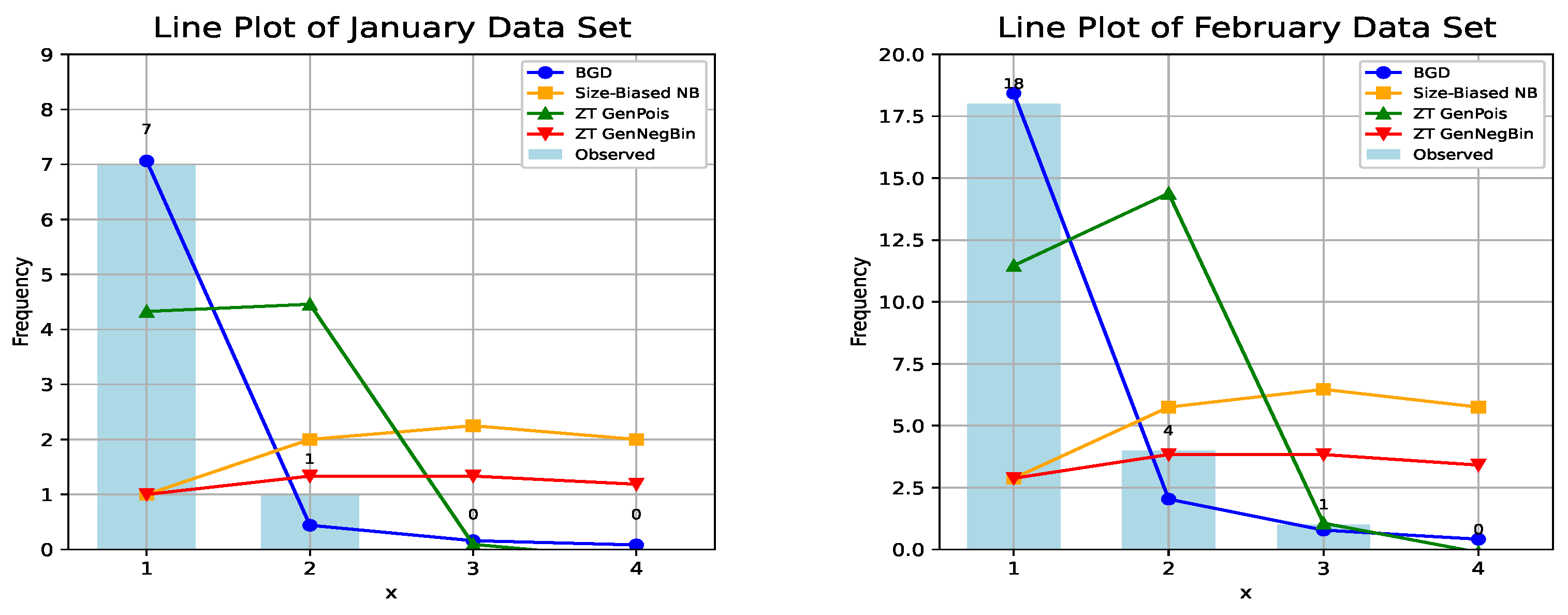
The BGD is the only model that consistently and adequately fits the data. In every table, its value is the lowest, and its p-value is well above the 0.05 significance threshold, ranging from 0.1545 to 0.4290. This indicates that the differences between its predicted frequencies and the actual observed data are small and statistically insignificant. For instance, in the first table for January thunderstorms, the BGD’s prediction of 7.06 events for x = 1 is almost identical to the observed frequency of 7, leading to an excellent fit.
In stark contrast, the other three models—SBNB, ZTGP, and ZTGNB—consistently and decisively fail to fit the data. All of them produce p-values of 0.0000 in every test, firmly rejecting the hypothesis that they are a good fit for these datasets. Their predicted frequencies are often wildly inaccurate. For example, the SBNB model predicts 9 thunderstorms for x = 1 in January when only 7 were observed, and a nonsensical 18 for x = 2 when only 1 was observed. Similarly, the ZTGP model severely over-predicts the frequency for x = 2 in multiple datasets. The ZTGNB model also fails dramatically, with χ2 values that are often an order of magnitude larger than those of the BGD.
In conclusion, the results from the goodness-of-fit tests perfectly reinforce the findings from the AIC/BIC analysis. The BGD is unequivocally the superior model, demonstrating a statistically significant and accurate fit to the observed thunderstorm frequency data across all months. The other models are statistically invalid for this data, as their predictions consistently and significantly deviate from reality.
Interpretation Based on Vuong Statistics: The Vuong test is a statistical method used to compare non-nested models, assessing not only which model fits better but also whether the difference is statistically significant. The results across five datasets portrayed in
Table A3,
Table A6,
Table A9,
Table A12 and
Table A15 reveal a consistent hierarchy of model performance. When comparing BGD to SBNB and ZTGNB, the test decisively favors BGD, with highly significant Vuong statistics (
p-value = 0.0000), confirming that BGD’s fit is superior and that the negative binomial-based models are inferior for this data. In contrast, the comparison between BGD and ZTGP yields no significant difference, with high
p-values (ranging from 0.39 to 0.69), indicating that both models are statistically equivalent in their fit. Consolidating all evidence—including AIC/BIC, goodness-of-fit tests, and the Vuong test—leads to the conclusion that SBNB and ZTGNB are definitively rejected, while the competition is primarily between BGD and ZTGP. Although BGD consistently performs slightly better, its advantage is not statistically significant, making ZTGP a viable and robust alternative. Overall, BGD is recommended as the optimal model due to its superior performance, but the non-significant difference with ZTGP highlights the latter’s validity as an equally plausible candidate.
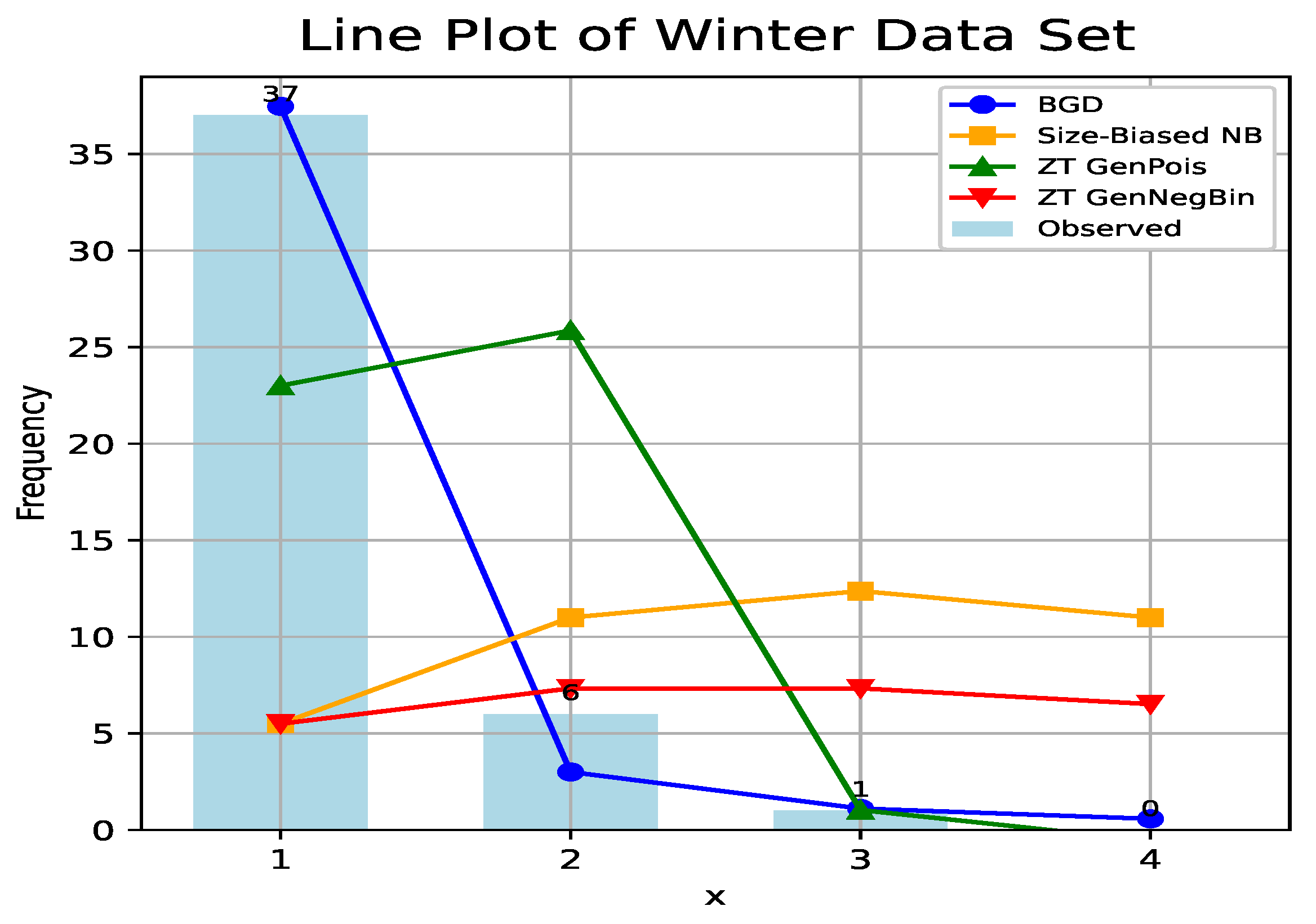
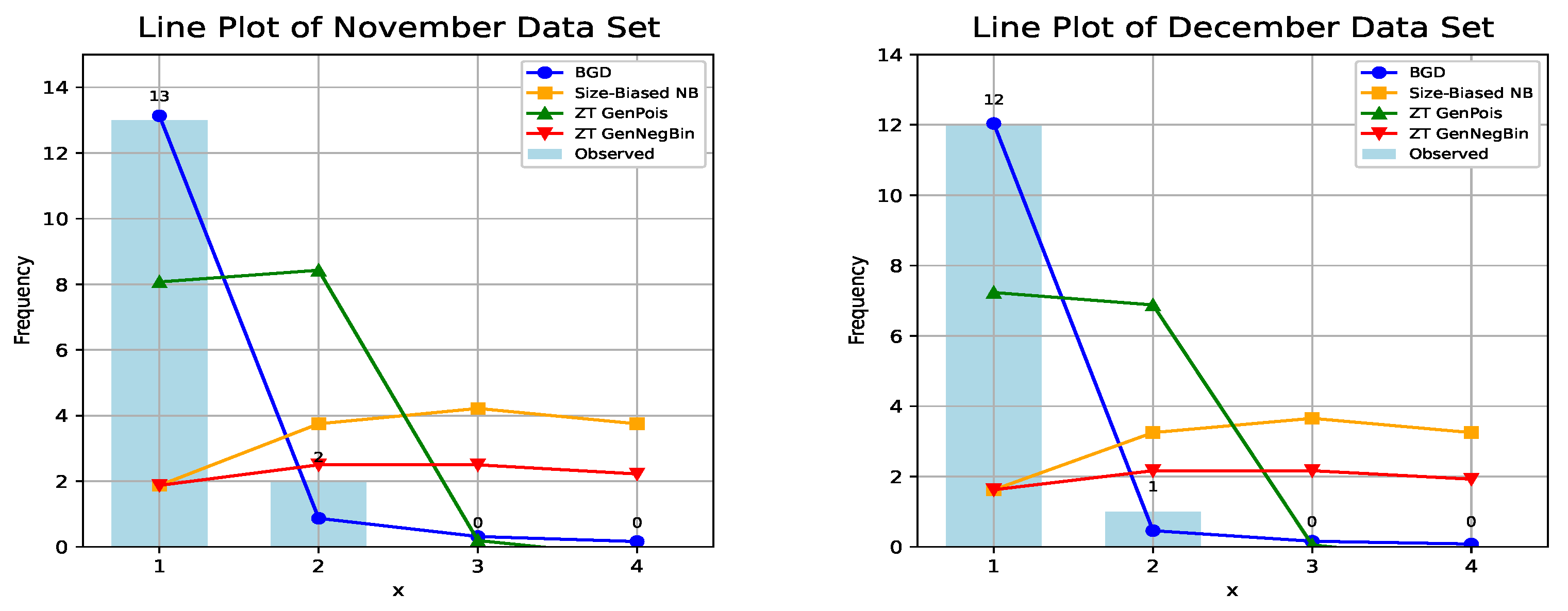
Interpretation Based on Plots: Figure A1,
Figure A2 and
Figure A3 likely depict the observed frequency of thunderstorm events against the predicted probabilities or frequencies from four models: BGD, ZTGP, SBNB, and ZTGNB. The key insight is a clear demonstration of model performance. The BGD line nearly perfectly follows the observed data points, especially at low values of
x, capturing the rapid decay in frequency as
x increases. The ZTGP line also aligns well with the data, though with slight deviations, consistent with its marginally worse AIC and the Vuong test’s “no decision.” In stark contrast, the SBNB and ZTGNB lines are severely misaligned, under-predicting at
and over-predicting for higher
x, with their lines remaining high while the actual frequencies approach zero. This misfit explains their large Chi-square values and insignificant
p-values. Overall, these figures visually confirm that the BGD (and closely, the ZTGP) accurately model the underlying process, whereas the SBNB and ZTGNB models are inadequate for this thunderstorm frequency data.
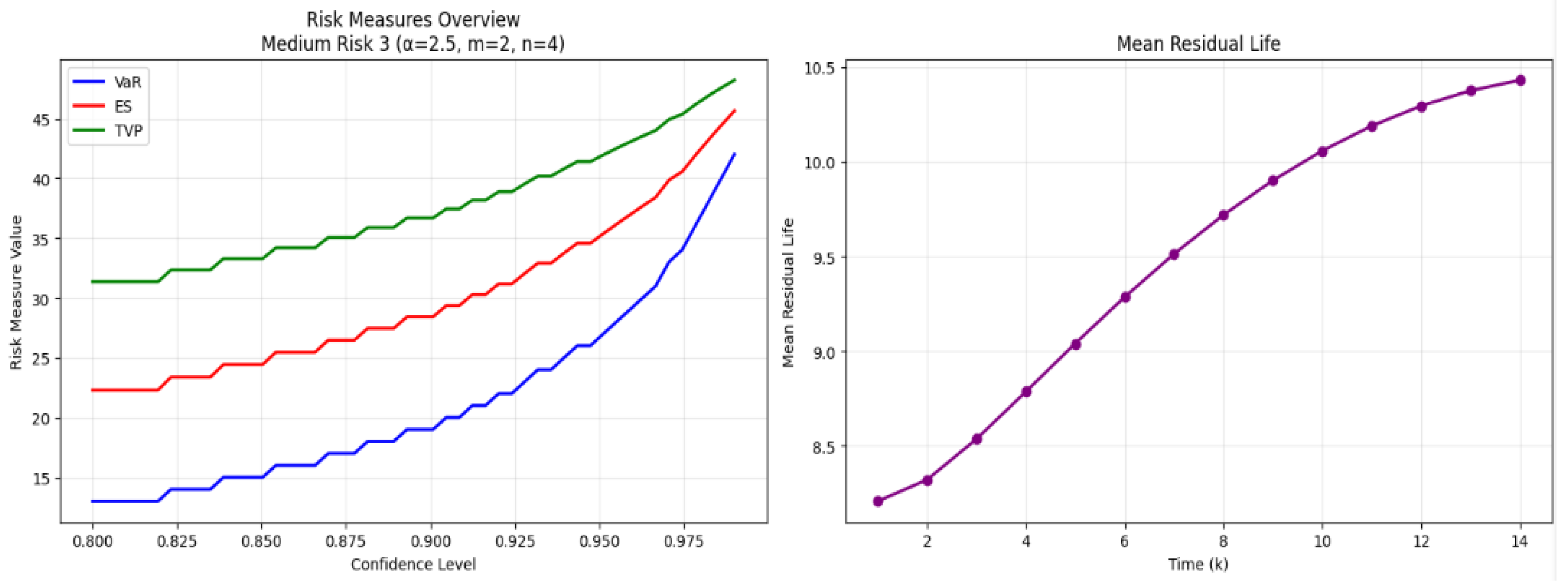
7.9. Risk Measure Results
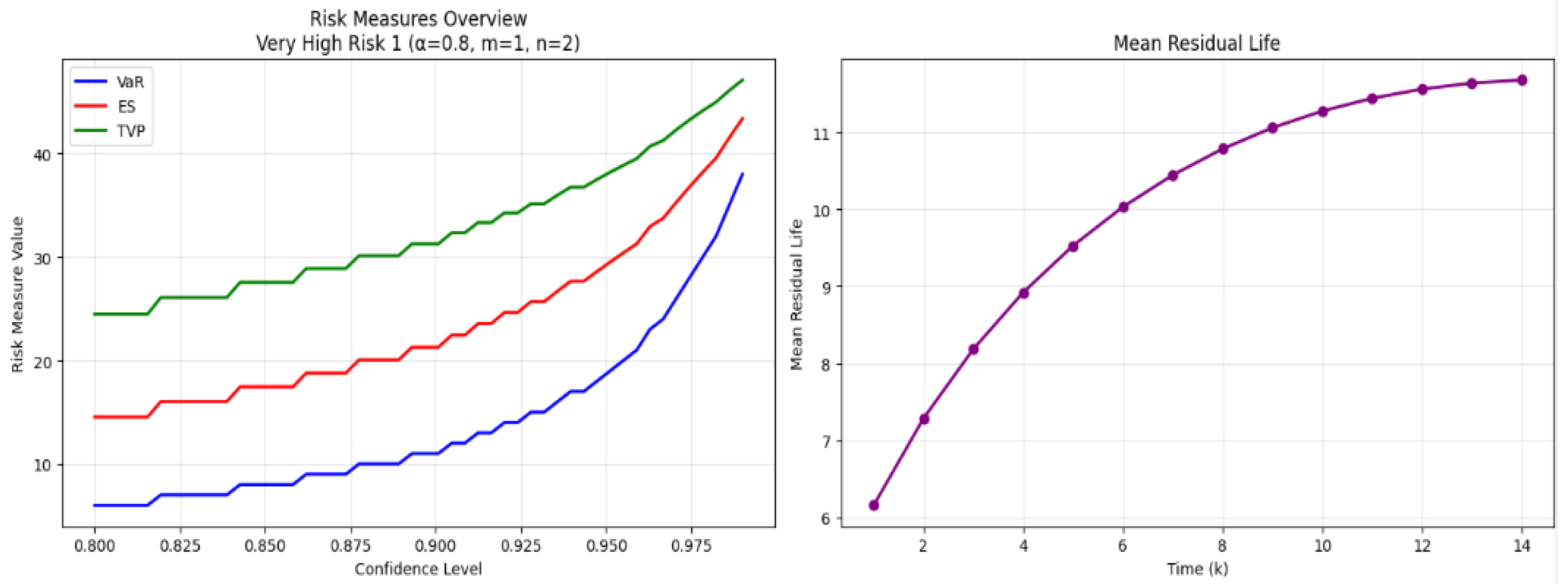
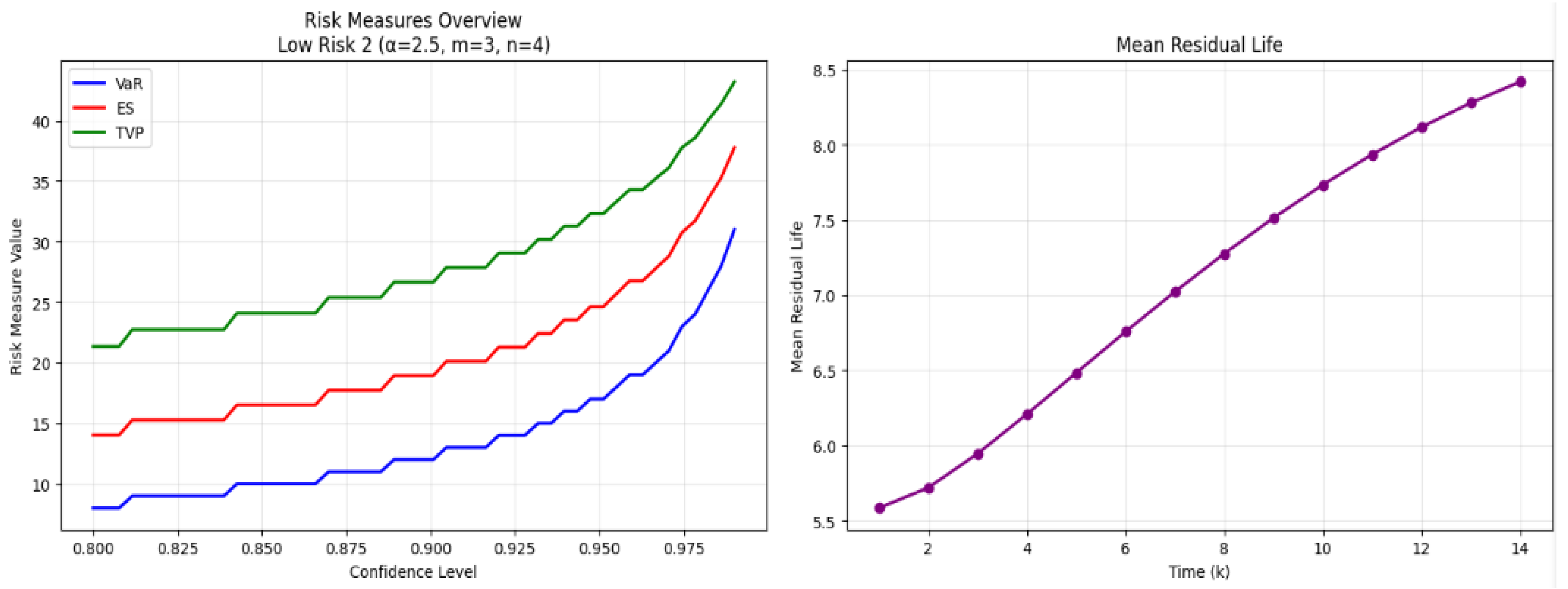
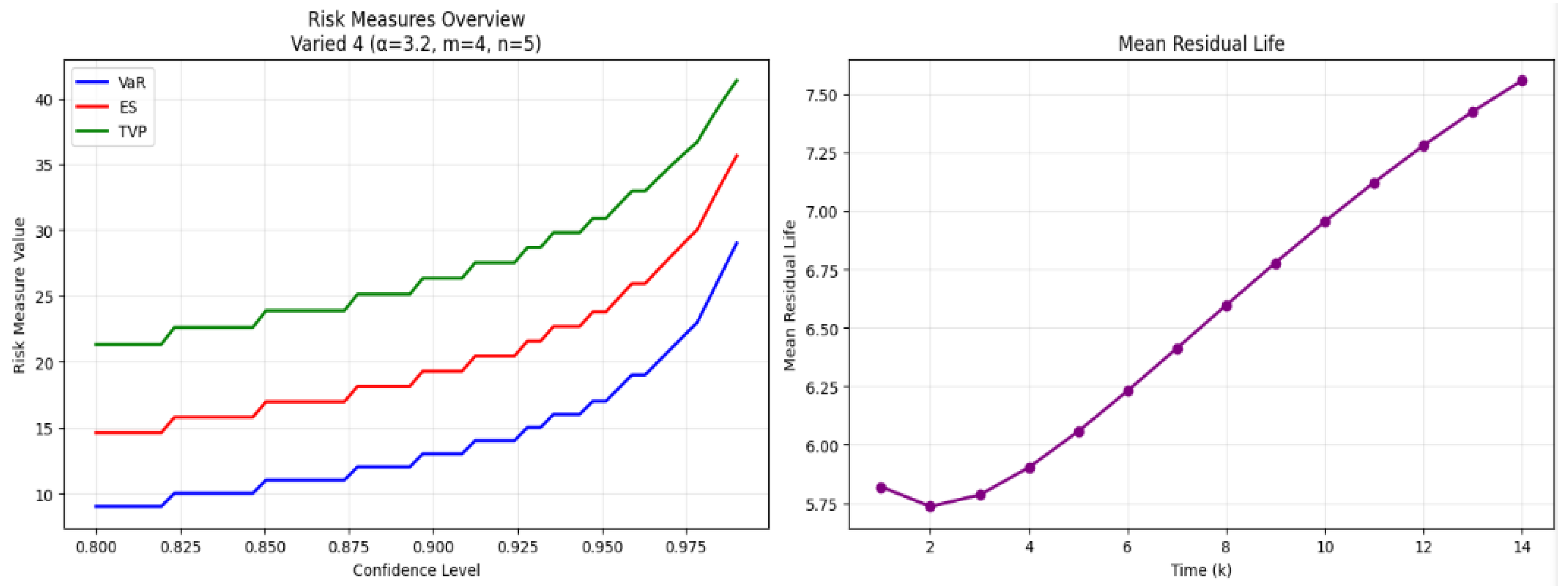
Table 3 reveals distinct risk profiles across the winter months. The data indicates that
February is the riskiest period, exhibiting the highest mean loss (1.2226), the highest Value at Risk (VaR) across all confidence levels, and the most severe ES. The significant disparity between February’s VaR
99% (2.0000) and its ES
99% (2.4969), quantified by a high Tail Value at Risk Premium (TVP
99% of 0.4969), signals a pronounced
fat-tailed distribution where losses in the worst-case scenarios are substantially larger than the VaR threshold would suggest. This is further corroborated by the escalating MRL values; for instance, MRL(1) being much greater than MRL(0) indicates that once a threshold is exceeded, expected losses intensify considerably.
In contrast, January and December present a much milder risk environment, with lower mean losses, VaR, and ES. Their TVP values, particularly at the 99.9% level (0.0000), indicate that extreme losses are not significantly worse than the average, suggesting thinner tails. The overall Winter aggregate risk profile is heavily influenced by February’s severity, sitting between the riskiness of November and February. Consequently, a risk manager should prioritize February, employing the more conservative ES measure for capital allocation, as relying solely on VaR would underestimate the potential for severe, tail-risk events during this period.
7.9.1. Risk Level Assessment for January
Total thunderstorm days: 8. The average number of thunderstorms per event is 1.10. The 95% VaR indicates that up to two thunderstorms are expected with 95% confidence, while the worst-case scenario at the 99% VaR level suggests three thunderstorms. The expected shortfall at 95% is approximately 2.27 thunderstorms. Overall, the risk level is considered low, based on the 95% VaR of thunderstorms in January. Distribution characteristics show a 92.2% probability of experiencing exactly one thunderstorm, a 7.8% probability of two or more thunderstorms, and a 2.1% probability of three or more thunderstorms. The model quality assessments indicate that the BGD model has an excellent fit with a p-value of 0.3980, and an AIC difference of 0.227 provides moderate evidence in favor of BGD. The estimated parameters are , , and , with a very low variance of 0.1306 indicating high predictability. These findings have direct implications for launch operations and ground crew safety at KSC. For instance, the 95% VaR of two thunderstorms provides a statistically robust upper bound for baseline operations planning. Knowing that the probability of exceeding this threshold is only 5% allows mission planners to schedule critical, weather-sensitive activities with high confidence.
More importantly, the expected shortfall (ES) provides a conservative metric for contingency planning and resource allocation. For example, the of 2.48 thunderstorms indicates that, on the rare days where the 95% VaR is exceeded, one should expect an average of 2.48 storms. This insight is crucial for sizing emergency response teams, determining the duration of launch delays, and evaluating the financial risk of potential asset damage. The MRL function, which estimates the expected number of additional storms given that one has already occurred, offers real-time decision support. A high value would signal to forecasters that an ongoing event is likely to be complex and prolonged, warranting continued caution and potentially a decision to halt outdoor work or roll back sensitive hardware.
This information supports mission planning and risk management by providing reliable forecasts. In terms of risk quantification for insurance purposes, the expected loss frequency is approximately 1.099 events per occurrence, with a 99% worst-case scenario of 3 events. The risk premium, represented by the tail value at risk (TVP), is 0.265 additional events beyond VaR, indicating a well-defined and comprehensive tail risk quantification.
7.9.2. Risk Level Assessment for February
The risk assessment for February indicates a total of 23 thunderstorm days, with an average of 1.22 thunderstorms per event. The 95% VaR is three thunderstorms, and the worst-case scenario at 99% VaR is four thunderstorms, with an expected shortfall of 3.34 thunderstorms. The overall risk level is classified as medium, slightly higher than January but still manageable. Distribution characteristics show an 85.1% probability of a single thunderstorm and a 14.9% chance of multiple thunderstorms, with a small tail probability for four or more events. Model quality assessments favor the BGD model, which demonstrates a good fit and reasonable predictability, while the ZTGP model, despite a lower AIC, was rejected by goodness-of-fit tests. Compared to January, February exhibits a slightly higher mean frequency and a heavier tail, but both months maintain a low risk classification. Operationally, there is a high degree of predictability, with a maximum of three thunderstorms expected with 95% confidence, supporting effective mission planning and risk management.
7.9.3. Risk Level Assessment for November
The average number of thunderstorms in December is 1.21. The 95% value at risk (VaR) indicates that there are two thunderstorms, while the worst-case scenario at 99% VaR suggests up to three thunderstorms. The expected shortfall at 95% is 2.40 thunderstorms, reflecting the average number of thunderstorms exceeding the VaR threshold. Overall, the risk level for November is considered LOW, based on the 95% VaR of thunderstorms. Distribution characteristics show an 85.0% probability of exactly one thunderstorm, a 15.0% probability of two or more thunderstorms, and a 5.0% probability of three or more thunderstorms. Regarding model quality, the BGD model has a significantly lower AIC (20.8) compared to the next best model (22.4), with an AIC difference greater than two, indicating a substantially better fit. Additionally, the BGD parameters suggest a light-tailed distribution.
7.9.4. Risk Level Assessment in December
The average number of thunderstorms in December is 1.10. The 95% value at risk (VaR) indicates that there are two thunderstorms, while the worst-case scenario at 99% VaR suggests up to three thunderstorms. The expected shortfall at 95% is 2.31 thunderstorms, reflecting the average number of thunderstorms exceeding the VaR threshold. Overall, the risk level for December is considered LOW, based on the 95% VaR of thunderstorms. Distribution characteristics show a 92.0% probability of exactly one thunderstorm, a 8.0% probability of two or more thunderstorms, and a 2.0% probability of three or more thunderstorms. Regarding model quality, the BGD model has a significantly lower AIC (14.5) compared to ZTGP (19.3), with an AIC difference of 4.8, providing very strong evidence favoring BGD. Additionally, a very small parameter (0.080) indicates a highly concentrated distribution. When comparing seasonally, December has the lowest mean (1.10) among all analyzed months, with the most concentrated distribution (92% probability of exactly one thunderstorm), and it exhibits the lowest tail risk and the most predictable pattern.
7.9.5. Risk Level Assessment-Winter
Total observations: in total, 44 thunderstorm days. The average number of thunderstorms per event is 1.17. The 95% VaR indicates that there are typically no more than two thunderstorms, while the worst-case scenario at 99% VaR is four thunderstorms. The expected shortfall at 95% is 2.48 thunderstorms. Overall, the risk level is considered LOW based on the 95% VaR of thunderstorms during winter, reflecting a relatively stable and predictable pattern.
The distribution characteristics reveal an 88.9% probability of experiencing exactly one thunderstorm, with a 11.1% chance of having two or more, a 4.0% chance of three or more, and a 1.4% chance of four or more thunderstorms. The model quality assessment shows that the BGD fits the data very well, with a p-value of 0.1545 and an AIC difference of 8.4, providing overwhelming evidence in favor of this model. The estimated parameters, , , and , suggest a light-tailed distribution that accurately captures the observed data.
Operationally, these findings imply that with 95% confidence, no more than two thunderstorms are expected during winter, and there is only an 11.1% probability of multiple thunderstorms occurring. This indicates a highly predictable pattern, making it suitable for mission planning purposes. The winter season exhibits a stable, low-risk thunderstorm pattern.
In a seasonal context, the winter mean of 1.17 thunderstorms aligns with the typical behavior observed in individual winter months. The distribution tends to concentrate at lower values, consistent with winter conditions. The BGD model continues to provide an excellent fit across all winter data, reinforcing the stability and low-risk nature of thunderstorms during this season.
8. Conclusions
This study successfully developed and presented the BGD distribution, a flexible compound distribution defined on the positive integers. The theoretical foundation of the BGD was thoroughly established, with explicit derivations of its fundamental properties, such as its probability mass function, moments, and reliability characteristics like the hazard rate and mean residual life functions. A significant contribution is the characterization theorem, which confirms the unique identifiability of the distribution through its characteristic function.
The hands-on dominance of the BGD was decisively confirmed through an empirical application. The model’s presentation establishes its crucial recompenses: its computational manipulability was established by the successful and stable convergence of parameter estimates across all datasets, a known encounter for the ZTGP. Its superior interpretability and sturdiness are reflected in its accurate fit without the systemic biases that can plague the misapplication of the SBNB.
The application to KSC thunderstorm data underscores a common scenario in risk analysis: the critical variable is often the severity of an event, given that it has occurred. The BGD distribution is uniquely suited for such contexts where the sample space is inherently conditioned on a positive count, providing a statistically sound and operationally relevant tool for conditional risk assessment.
Finally, its parameter parsimony prohibited the overfitting issues inherent to the more complex ZTGNB, resulting in a model that is both powerful and trustworthy for practical forecasting and risk assessment. Furthermore, it was the only model to consistently pass the Chi-square goodness-of-fit test, with high p-values confirming its predictions were not significantly different from the observed frequencies. While the Vuong test indicated that the BGD and the second-best model, the ZTGP, were statistically equivalent for these datasets, the BGD’s consistent edge in all other metrics solidifies its position as the recommended model. In summary, the BGD distribution proves to be a powerful and versatile tool for statistical modeling of positive count data. Its theoretical soundness, coupled with its demonstrated empirical performance in a critical real-world application, makes it a valuable addition to the statistician’s toolkit, particularly in fields like meteorology, reliability engineering, and risk and survival analyses where understanding the behavior of count processes that cannot be zero is essential.




 ,
,