1. Preliminaries
In this paper, unless otherwise specified, S is a partially ordered monoid (or simply a pomonoid). A nonempty poset A is called a left S-poset, usually denoted by SA, if there exists a mapping , which satisfies the following conditions: (i) The action is monotonic in each variable; (ii) and for all and all . Right S-posets are defined analogously, and denotes the one-element S-poset. In this paper, a left (right) ideal of S refers to a nonempty subset I of S satisfying ().
A
morphism of left S-posets is a monotonic mapping
which satisfies
for every
and
. Morphisms of right S-posets are defined similarly, and morphisms of posets are just monotonic mappings. In this way, the categories
SPos
(left S-posets),
(right S-posets), and Pos (posets) are obtained. In these categories, the monomorphisms are the injective morphisms, whereas the regular monomorphisms are the order-embeddings, that is, morphisms
, for which
implies
for all
(see [
1]). Research on flatness properties of S-posets was initiated in the mid-1980s by S. Fakhruddin in [
2], and this work has recently been continued in the articles [
1,
3,
4,
5,
6,
7,
8].
An S-subposet SB of an S-poset SA is called convex if for any and , implies . An element is called right (left) po-cancellable if for all , () implies . A pomonoid is called left (right) collapsible if for all , there exists such that (). A pomonoid is called weakly right (left) reversible if for all , there exist such that (). A left S-poset is called simple if it has no proper subposets and completely reducible if it is a coproduct of simple posets.
An
order congruence on an S-poset
SA is an S-act congruence
such that the factor act
can be equipped with a compatible order, making the natural map
an S-poset morphism. A left S-poset
SA is called
cyclic if
for some
. In [
9], an S-poset
SA is cyclic if and only if there exists an order congruence
on
S such that
. If
K is a convex left ideal of a pomonoid
S, then there exists an S-poset congruence where one of its classes is
K and all the others are singletons. Moreover, the factor S-poset by this congruence is called the
Rees factor S-poset of S by K and denoted
.
Various flatness properties of S-posets are defined in terms of tensor products. To define the tensor product
of a right S-poset
and a left S-poset
SB (see [
10]), we consider a preorder
on the set
, defined by
if and only if
for some
,
,
and
. Then
is an equivalence relation on
, and we denote the equivalence class of
by
. The quotient set
is a poset with respect to the order
This poset
is called the tensor product of
AS and
SB. Note that
for every
,
and
. In a natural way, one obtains a functor
of tensor multiplication from
to Pos.
In [
4,
9], the definitions of flatness, weak flatness, principally weak flatness, and weak torsion freeness are formulated as follows:
A left S-poset SB is called flat if for every right S-poset and all pairs in , in implies the same equality holds in . Equivalently, the functor takes embeddings in to monomorphisms in Pos.
A left S-poset SB is called (principally) weakly flat if the functor maps embeddings of (principal) right ideals in to monomorphisms in Pos.
A left S-poset SB is called weakly torsion free if implies whenever and c is a left po-cancellable element.
A left S-poset SB is said to satisfy Condition (P) if for all , and implies for some and with .
For a more complete discussion of flatness properties of posets over pomonoids, the reader is referred to [
4,
11,
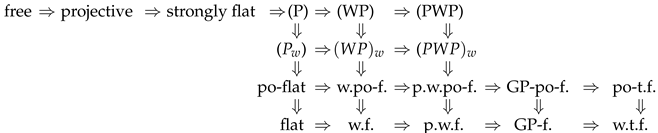
12]. The following relations exist among flatness properties of S-posets:
We let SA be an S-poset. An element is called I-regular if there exists an S-morphism such that . An S-poset SA is called I-regular if all elements of A are I-regular.
Example 1. Let be a pomonoid, where the multiplication operation is defined as and (i.e., 1 is the identity element and 0 is the zero element), and the partial order is . We take the trivial S-poset , the left action of this poset is defined such that for all , and the partial order on it is trivial. Obviously, A is an I-regular S-poset.
It is clear that a regular pomonoid S was I-regular as a left S-poset, but the converse is not true. For example, if S is a right po-cancellable pomonoid, then S is an I-regular left S-poset without being a regular pomonoid. In the special case where S is an ordered group, S is not only a regular pomonoid but also an I-regular left S-poset.
In [
10], Shi introduced the concept of I-regular S-posets and offered characterizations of two classes of pomonoids (left
-pomonoid and right po-cancellable pomonoid) by the I-regularity of S-posets. However, the projectivity, injectivity, and the direct product properties of I-regular
S-posets were not involved. In [
13], the authors focused on the homological classification of pomonoids based on the flatness of Rees factor
S-posets, but did not establish a connection with I-regularity. In this paper, we continue the development of I-regular
S-posets. In
Section 2, we characterize pomonoids over which all I-regular
S-posets have one of the properties around projectivity or injectivity. In [
10], characterizations of pomonoids over which all free (projective) S-posets are I-regular are given; in [
9], the authors characterized pomonoids over which all strongly flat S-posets are I-regular. Consequently, we investigate pomonoids over which all left S-posets with one of the properties are I-regular in
Section 3. In
Section 4, we investigate the direct product of I-regular S-posets. Finally, we study the classification of pomonoids by the I-regularity property of right Rees factor S-posets and tabulate the results.
2. Characterizations of Pomonoids Where All I-Regular Left S-Posets Possess Projectivity or Injectivity-Related Properties
In this section, we investigate pomonoids over which all I-regular left
S-posets have one of the properties introduced in
Section 1. To achieve this goal, we need the following lemmas.
Lemma 1 ([
10], Proposition 4.2)
. Let A be an S-poset and . The following assertions are equivalent:- (1)
a is I-regular.
- (2)
There exists an element such that and implies for .
- (3)
in SPos for some .
- (4)
is projective.
Proof. (3)⇒(4). For any surjective S-morphism and any S-morphism . Suppose . Since g is surjective, there exists with We define , then , so . Thus, is projective, and implies is projective. □
If as in Lemma 1 (2), then we call an I-regular pair (in A).
From [
10], a pomonoid
S is called
left -pomonoid if the
S-subposet
is projective for all
. (Note, however, that
may be an ideal of
S in the ordered sense.) By Lemma 1, an
S-poset is I-regular if and only if all cyclic
S-subposets of
A are projective. Thus, we have
Lemma 2 ([
10], Lemma 4.7)
. A pomonoid S is I-regular if and only if S is a left pomonoid. Lemma 3. is I-regular if and only if S contains a right zero element.
Proof. This follows from Theorem 1 of [
4] and Lemma 1. □
Lemma 4 ([
10], Lemma 4.5)
. All S-subposets of I-regular S-poset are I-regular, and coproducts of I-regular S-posets are I-regular. Lemma 5 ([
4])
. Let S be a pomonoid, . Then in if and only if there exist , such that Similar to ([
14], Lemma 3.2), we have
Lemma 6. Let S be a pomonoid. If there exists an I-regular left S-poset, then there exist a largest I-regular left ideal of S.
In the following, is always used to represent the largest I-regular left ideal of S.
Theorem 1. For any pomonoid S, all I-regular left S-posets are principally weakly flat if and only if for every idempotent and every element the product is a regular element in S.
Proof. We let
and
. If
, then there exists
such that
, and then it follows that
, hence
is a regular element. In another case, we have
. We can construct an
S-act
M as follows:
where
are three elements not belonging to
S, and define a left
S-action on
M by
The order on
M is defined as
Then
M is an
S-poset according to the above definition. It is clear that there are isomorphisms
. Since
,
is I-regular by Lemma 4, thus
and
are also I-regular. From Lemma 4, it follows that
is I-regular. By assumption,
M is principally weakly flat. Clearly,
, then
in
. By Lemma 5, there exist
such that
We denote 1 by
and
; by the definition of
M, there exist
and
such that
So we have
, which implies that
, hence
. Now the result follows.
Conversely, we suppose
SA is an I-regular left
S-poset and for
,
in
. Then there exist
,
such that
Because
SA is I-regular, there exist
such that
are I-regular pairs and
,
are I-regular left ideals, thus
. By hypothesis, there exist
such that
and
. From
, we obtain that
. We can now calculate
Thus,
(using the I-regular pair property). Hence
in
. Similarly, using the I-regular pair property, we can obtain
. Therefore,
in
. So
SA is principally weakly flat. □
Next, we give an example to apply the above theorem.
Example 2. Let with multiplication defined as , , and partial order ; here, the set of idempotents . Checking Theorem 1’s condition, we find that for all and , the product se is regular. By Theorem 1, all I-regular left S-posets are principally weakly flat, which is verified by the I-regular S-poset (with action , , , and order ): for , implies , satisfying the principal weak flatness condition. In contrast, finite pomonoids violating Theorem 1’s condition (i.e., containing an idempotent and an element such that se is non-regular) are rare, especially when (all elements are idempotent), as idempotents inherently make se regular; for such pomonoids, some I-regular left S-posets fail to be principally weakly flat, though constructing a finite example requires a pomonoid with non-regular products of idempotents and elements, which is non-trivial due to the regularity of idempotent-generated products.
Corollary 1. For any pomonoid S, the following statements are equivalent:
- (1)
S is a regular pomonoid.
- (2)
S is a left pomonoid and all I-regular left S-posets are principally weakly po-flat.
- (3)
S is a left pomonoid and all I-regular left S-posets are principally weakly flat.
Proof. . We let
S be a regular pomonoid. Then
S is left
and all left
S-posets are principally weakly po-flat by ([
15], Theorem 2.3).
. It is obvious.
. From Proposition 4.6 of [
10], it follows that
S is a left
pomonoid if and only if
S is an I-regular
S-poset if and only if
. So by Theorem 1,
S is a regular pomonoid. □
Theorem 2. Let S be a pomonoid. If all I-regular left S-posets are -flat, then for every idempotent and every element , there exist such that .
Proof. It is similar to that of Theorem 1. □
Theorem 3. For any pomonoid S, the following statements are equivalent:
- (1)
All I-regular left S-posets are weakly torsion free.
- (2)
For every left po-cancellable element r and for every idempotent , .
Proof. . For left po-cancellable element and , if , then M is an I-regular S-poset constructed in Theorem 1. By assumption, M must be weakly torsion free. But now from , we get a contradiction. Hence , which means that .
. We let SA be an I-regular S-poset and for any left po-cancellable element r, any . Since SA is I-regular, there exist such that are I-regular pairs. Thus, we have . Since , we have , which implies there exists such that . Therefore, and , which implies . Since r is a left po-cancellable element, then and so . Therefore, A is weakly torsion free. □
Theorem 4. For any pomonoid S, the following statements are equivalent:
- (1)
All I-regular left S-posets are projective.
- (2)
All I-regular left S-posets are strongly flat.
- (3)
All I-regular left S-posets satisfy Condition .
- (4)
Every idempotent of generates a minimal left ideal.
Proof. The implications are obvious.
(3)⇒(4). We let
. Then
is I-regular by Lemma 4. Suppose
I is a left ideal of
S such that
. We let
M be an I-regular
S-poset constructed in Theorem 1. By assumption,
M satisfies Condition
. By [
9], Proposition 2.11,
M must be a coproduct of cyclic
S-subposets which is impossible because
Hence,
is a minimal left ideal.
(4)⇒(1). We let
SA be an I-regular left
S-poset. For any
, the cyclic subposet
is, by Lemma 1, isomorphic to some left ideal
. By assumption, all such ideals
are simple. Hence,
SA is a coproduct of simple subposets each of which is isomorphic to a left ideal generated by an idempotent. By Theorem 3.4 of [
10],
SA is projective. □
Recall from [
16,
17] that a left
S-poset
SA is called
regular-injective if for any regular monomorphism
and morphism
there exists a morphism
such that
. A left
S-poset
SA is called
regular-(principally) weakly injective if for any regular monomorphism
where
I is a (principally) left ideal of
S and for any
S-poset morphism
there exists an
S-poset morphism
such that
. A left
S-poset
A is called
regular-divisible if
for every right po-cancellable element
d of
S.
Proposition 1. For any pomonoid S, all regular-principally weakly injective S-posets are regular-divisible.
Proof. We let
SM be a regular-principally weakly injective
S-poset and let
d be any right po-cancellable element of
S. We let
. Since
d is right po-cancellable, there exists an
S-poset morphism
defined by
for all
. Since
SM is regular-principally weakly injective, there exists an
S-poset morphism
such that
where
i is the regular monomorphism of
into
S. Now,
Hence
, and thus
, which means that
SM is regular-divisible. □
From the previous definitions and proposition, we have following implications:
Theorem 5. Let S be a pomonoid. All I-regular left S-posets are regular-divisible if and only if all left ideals , , are regular-divisible.
Proof. Necessity is obvious because is I-regular by Lemma 4.
Regarding sufficiency, we let
SA be an arbitrary I-regular
S-poset and let
. Then by Lemma 1,
is isomorphic to
,
. Since
is regular-divisible, then for any right po-cancellable
, we have
and thus
. But then
which shows that
SA is regular-divisible. □
For any , an element is said to be q-po-cancellable if for any , always implies .
Theorem 6. Let S be a pomonoid. If all I-regular left S-posets are regular-principally weakly injective, then the largest left ideal is regular and if is e-po-cancellable for , then .
Proof. For any , we have and is I-regular. By assumption, is regular-principally weakly injective, and there exists a morphism such that where is the inclusion morphism. So for some . Now, . Thus, t is regular.
We let be e-po-cancellable for . Then, by setting , we obtain an S-poset morphism f from into . Since is I-regular, it is regular-principally weakly injective and there exists a morphism such that where is the inclusion homomorphism. Now, □
Lemma 7. S is a regular pomonoid if and only if all left S-posets are regular-principally weakly injective.
Proof. We let SA be a left S-poset and be an S-homomorphism. If S is regular, then there exists such that . We set and define a mapping by . Then, g is well defined and . Since g is the extension of f to S, SA is regular-principally weakly injective.
Conversely, suppose that all left S-posets are regular-principally weakly injective. Then, for every , the principal left ideal of S is a regular-principally weakly injective left S-poset. Hence the identity map i of to can extended to the S-homomorphism g of S onto . We set for some . Then, , hence s is a regular element. □
Theorem 7. A pomonoid S is an I-regular left S-poset and all I-regular left S-posets are regular-principally weakly injective if and only if S is a regular pomonoid.
Proof. Regarding necessity, suppose that SS is an I-regular left S-poset and all I-regular left S-posets are regular-principally weakly injective. Then is regular by Theorem 6. We let . If SS is an I-regular S-poset, then there exists an idempotent such that is an isomorphism. Since SSe is I-regular, it is regular-principally weakly injective and then there exists an S-homomorphism such that g is an extension of h. Hence and then so p is also regular. Thus, S is a regular pomonoid.
Regarding sufficiency, if S is a regular pomonoid, then S is a left -pomonoid and so SS an I-regular left S-poset by Lemma 2. Using Lemma 7, we determine that all left S-posets are regular-principally weakly injective. So the result follows. □
From [
10], a left
S-poset
SA is called
faithful (strongly faithful) if from
, for all (some)
it follows that
.
Theorem 8. For any pomonoid S, the following statements are equivalent:
- (1)
All I-regular left S-posets are faithful.
- (2)
For any , is faithful.
Proof. The implication is obvious.
. We let SA be an I-regular left S
-poset and , ,. We take ; there exists such that is an I-regular pair. For any , we have ; it follows that . Since SSe is faithful, . □
Example 3. Let be the finite pomonoid, equipped with a discrete partial order (i.e., only reflexivity holds: , , and no other order relations exist). The set of idempotents of S is , and the largest I-regular left ideal of S is . First, we verify that the left S-poset Se is faithful for all : When , . By the definition of a faithful poset (if for all , then ), if for all , taking gives , so is faithful. When , ; if (which simplifies to , a condition that always holds) for all , we note that in the discrete partial order, if and only if . Since is a singleton set, the condition “for all ” is trivial, so is also faithful. Next, we present an example of a faithful I-regular left S-poset: We let , which is I-regular as shown in Example 1. For any , if for all , taking yields ; in the discrete partial order, this implies , so A is faithful.
Theorem 9. Let S be a pomonoid. Then all I-regular left S-posets are strongly faithful if and only if S is right po-cancellable.
Proof. We let all I-regular left S-posets be strongly faithful and for any , . For , we have . Since SA is strongly faithful, and so S is right po-cancellable.
Conversely, suppose that SA is an I-regular left S-poset and for , . Then there exists such that and . Since S is right po-cancellative, we have and so SA is strongly faithful as required. □
3. Characterizations of Pomonoids Where All Left S-Posets with Specific Properties Are I-Regular
In [
10], characterizations of pomonoids over which all free (projective)
S-posets are I-regular are given. In [
9], the authors characterize pomonoids over which all strongly flat
S-posets are I-regular. In this section, we continue to investigate pomonoids over which all left
S-posets with one of the properties are I-regular.
Proposition 2. For any pomonoid S, all strongly faithful S-posets are I-regular.
Proof. We let SA be a strongly faithful S-poset. Then for any , there exists a morphism defined by which satisfies . Therefore, SA is I-regular. □
Theorem 10. For any pomonoid S, all completely reducible left S-posets are I-regular if and only if S contains a right zero element.
Proof. Regarding necessity, the one element left
S-poset
SΘ is obviously completely reducible. Hence, by assumption,
SΘ is I-regular. By Lemma 1,
SΘ is projective, which implies that
S contains a right zero element from ([
4], Theorem 1).
Regarding sufficiency, from the existence of a right zero element, it follows that the only simple left S-poset is one-element S-poset. Obviously the one-element poset is projective and I-regular by Lemma 1. But then, by Lemma 3, every completely reducible left S-poset is I-regular. □
Lemma 8. Let S be a left zero semigroup with 1 adjoined and SA a weakly po-flat left S-poset. Suppose that and are such that . Then,
Proof. From
, it follows that
in
Thus, we have
in
, since
SA is weakly po-flat. Therefore, by Lemma 5, there exist
such that
Since
, where
are left zero elements, it is easy to show that
are also left zero elements. Thus,
and the result follows. □
Theorem 11. Let S be a left zero semigroup with 1 adjoined. Then all weakly po-flat left S-posets are I-regular.
Proof. If , then the result is clear. Now we let S be a left zero semigroup with 1 adjoined. Suppose that is a weakly po-flat left S-poset and . By Lemma 1, we show that is a projective left S-poset.
Suppose that for any . We define a mapping as follows:
Suppose . If , then by Lemma 8. If and then , it is a contradiction. If and , the result is similar. This means that f is well defined. It is clear that f is an isomorphism of left S-posets. Thus, is projective.
Now suppose that there exists an element
such that
. We define a mapping
as follows:
By Lemma 8, it is easy to see that
f is well defined. Clearly,
is an isomorphism of left
S-posets. Thus,
SSa is projective since
s is an idempotent of
S. □
Proposition 3. All weakly torsion free left S-posets are I-regular if and only if S is right po-cancellable.
Proof. Regarding necessity, suppose all weakly torsion free left S-posets are I-regular. We let where c is left po-cancellable and . Consider the left S-poset , which is weakly torsion free. Since A is I-regular, for the element , there exists an idempotent such that:
By the given condition , the second property yields . If S were not right po-cancellable, there would exist such that but , contradicting the weak torsion freeness of A. Thus, S must be right po-cancellable.
Regarding sufficiency, we let S be right po-cancellable and let A be a weakly torsion free left S-poset. For any , we define a map by for all .
First, we verify that f is well defined: If for some , then the weak torsion freeness of A (together with right po-cancellability of S) implies . Thus, , so f is well defined.
Next, since , we have . It follows that . By the definition of I-regularity, a is I-regular. Since a was arbitrary, A is I-regular. □
Proposition 4. All flat left S-posets are I-regular if and only if S is a regular pomonoid.
Proof. Regarding necessity, suppose all flat left S-posets are I-regular. The pomonoid S itself is a flat left S-poset. Thus, S is I-regular as a left S-poset. By Lemma 2, a pomonoid S is left PP if and only if it is I-regular as a left S-poset. Hence, S is left PP. Now, we take any . Since S is flat and I-regular, Theorem 1 implies that for every idempotent and every , is regular in S. Since (as S is I-regular), must be regular. Thus, every element of S is regular, so S is a regular pomonoid.
Regarding sufficiency, we let S be a regular pomonoid and let A be a flat left S-poset. For any , we need to show a is I-regular.
Since S is regular, for every , there exists such that . We define a map by for all .
First, we verify f is well defined: If for , the flatness of A implies there exists such that and . Then, , and similarly . Since , we have , so . Thus, f is well defined.
Next, we compute : Since , (where is the inverse of 1 in S, which is 1 itself, since ). Thus, , and .
Alternatively, we can use regularity directly. For , . Thus, and , so a is I-regular. Since a was arbitrary, A is I-regular. □
4. Direct Product of I-Regular -Posets
In the following, we first investigate I-regularity of . First, we remind the reader of some preliminaries.
First, notice that for denotes the right translation map defined by and . We let SA and SB be left S-posets over a pomonoid S. It is known that SA is I-regular if and only if for every there exists an idempotent such that . It is also known that a pomonoid S is left if and only if for each for some idempotent . Therefore, each left -pomonoid as a left S-poset is I-regular. Furthermore, if we denote by the set of all congruences on the poset SA, the order relation on is defined by if and only if . Then clearly is a pomonoid with identity . It can be routinely verified that for , .
The next theorem gives a characterization of pomonoids over which is I-regular.
Theorem 12. Let S be a pomonoid. The diagonal S-poset is I-regular if and only if
- (1)
S is a left -pomonoid.
- (2)
The set is a subpomonoid of .
Proof. Regarding necessity, we take . Since is I-regular, for some idempotent . Thus, S is a left pomonoid. On the other hand, by assumption, for each pair of idempotents , for some idempotent , which complete the proof of necessity.
Regarding sufficiency, we let for . Since S is a left pomonoid, S is I-regular by Lemma 2. Thus, there exist idempotents in S such that and . Since R is a subpomonoid of T, there exists an idempotent such that . Now, we get . Hence, is I-regular. □
Theorem 13. The following are equivalent for a left -pomonoid S:
- (1)
Every finite product of I-regular S-posets is I-regular.
- (2)
is I-regular for every .
- (3)
The diagonal S-poset is I-regular.
Proof. The implications and are trivial.
. We let SA and SB be two I-regular posets. We take . Suppose that and for some idempotents . By Theorem 12, we have for some idempotent . Now, by induction, we obtain the desired result. □
Theorem 14. Let S be a pomonoid, the set of idempotents of S. Then, the following conditions are equivalent:
- (1)
The diagonal S-poset is I-regular and .
- (2)
S is right po-cancellable.
Proof. (1)⇒(2). We let , for . Then . Since is I-regular, there exists such that . But , that is , then . Hence, S is right po-cancellable.
(2)⇒(1). If S is right po-cancellable, then and S is a left PP pomonoid. For , it is clear that and . So . Hence, is an I-regular element of and it is I-regular. □
Proposition 5. For a right collapsible pomonoid S, if is I-regular, then for every , is I-regular.
Proof. We let
, for
. Since
S is right collapsible, there exists
such that
. We consider the fixed element
, for
and take
Then
. Since
is I-regular, by Lemma 1 there exists
such that
,
. So
and
is I-regular. □
Proposition 6. For a left -pomonoid S, the following are equivalent:
- (1)
If is I-regular, then is I-regular.
- (2)
SΘ is I-regular.
- (3)
S has a right zero element.
Proof. . We let S be a left -pomonoid. From Lemma 2, it follows that S is I-regular as a left S-poset. Since SΘ, we have, by assumption, that SΘ is I-regular.
. By Lemma 3, it is obvious.
. If S has a right zero element, then S is right collapsible. By Proposition 5, the result follows. □
5. Classification of Pomonoids by I-Regularity Property of Right Rees Factor -Posets
In this section, we give a classification of pomonoids by I-regularity property of their right Rees factor S-posets.
Lemma 9 ([
13], Lemma 1.8).
Let S be a pomonoid and K a convex, proper right ideal of S. The following assertions are equivalent:- (1)
is free.
- (2)
is projective.
- (3)
is strongly flat.
- (4)
satisfies condition .
- (5)
.
Lemma 10 ([
4], Theorem 1).
Let S be a pomonoid. Then:- (1)
is free if and only if .
- (2)
is projective if and only if S has a left zero element.
- (3)
satisfies condition if and only if S is left collapsible.
- (4)
The following assertions are equivalent:
- (a)
satisfies condition ;
- (b)
satisfies condition ;
- (c)
is po-flat;
- (d)
is flat;
- (e)
is weakly po-flat;
- (f)
is weakly flat;
- (g)
S is weakly right reversible.
- (5)
is (always) principally weakly (po-)flat and (po-)torsion free.
Theorem 15. Let S be a pomonoid and K a convex, right ideal of S. Then is I-regular if and only if and S is right , or and S contains a left zero element.
Proof. Suppose that is I-regular for the convex right ideal of S. Then there are two cases as follows:
Case 1. . Then is I-regular and so by Lemma 3 S contains a left zero element.
Case 2. is a convex proper right ideal of S. Since is I-regular, is projective. Thus, by Lemma 9, and so . Since is I-regular, is I-regular and so by Lemma 2, S is right as required.
Conversely, suppose and S is right . Then and so by Lemma 2, is I-regular.
If and S contains a left zero element, then and by Lemma 3, is I-regular. □
Theorem 16. Let S be a pomonoid. The following statements are equivalent:
- (1)
All projective right Rees factor S-posets are I-regular.
- (2)
All free right Rees factor S-posets are I-regular.
- (3)
If S has a left zero element, then S is right .
Proof. Implication is obvious.
. Suppose that S contains a left zero element z. If , then and so is free, since is free. Thus, by assumption, is I-regular and by Lemma 2, S is right .
. Suppose that is projective for the convex right ideal of S. Then there are two cases as follows:
Case 1. . Then is projective and so by Lemma 3, is I-regular.
Case 2. is a convex proper right ideal of S. Since is projective, by Lemma 9, , and so for some . Thus, z is a left zero element and so by assumption, S is right . From Lemma 2, it follows that is I-regular. □
Theorem 17. Let S be a pomonoid. The following statements are equivalent:
- (1)
All strongly flat right Rees factor S-posets are I-regular.
- (2)
If S is left collapsible, then S contains a left zero element and S is right .
Proof. . If S is left collapsible, then by Lemma 10, satisfies Condition and so it is strongly flat. Thus, by assumption, is I-regular and so by Lemma 3 S contains a left zero element. Thus, S is right by Theorem 16.
. Suppose that is strongly flat for the convex right ideal of S. Then there are two cases as follows:
Case 1. . Then is strongly flat and so by Lemma 10, S is left collapsible. By assumption, S contains a left zero element; thus, by Lemma 3, is I-regular.
Case 2. is a convex proper right ideal of S. Since is strongly flat, by Lemma 9, and so for some . Thus, z is a left zero element and so S is left collapsible. By assumption, S is right . Hence, is I-regular by Lemma 2. □
Theorem 18. Let S be a pomonoid. The following statements are equivalent:
- (1)
All right Rees factor S-posets satisfying Condition are I-regular.
- (2)
If S is weakly right reversible, then S contains a left zero element and S is right .
Proof. It is similar to that of Theorem 17. □
Recall from [
13] that we let
K be convex, proper right ideal of pomnoid
S,
is principally weakly flat if and only if
K is left stabilizing.
is principally po-flat if and only if
K is strongly left stabilizing.
Theorem 19. Let S be a pomonoid. The following statements are equivalent:
- (1)
All weakly flat right Rees factor S-posets are I-regular.
- (2)
If S is weakly right reversible, then S contains a left zero element and S is right , and S has no proper, left stabilizing convex right ideal K with .
Proof. . If S is weakly right reversible, then S contains a left zero element and also S is right by Theorem 18. If S has a proper, left stabilizing convex right ideal K with , then is weakly flat and by assumption , a contradiction is obtained.
. We let
K be a convex right ideal of pomonoid
S and
is weakly flat. If
K is convex, proper right ideal of
S, by [
13], Lemma 1.7,
S is weakly right reversible and
K is a proper, left stabilizing convex right ideal of
S. By assumption,
and
S is right
; then,
is I-regular. But if
,
is weakly flat and by Lemma 10,
S is weakly right reversible. By assumption,
S has a left zero element and by Lemma 3,
is I-regular. □
The following theorem can be proven by a similar argument of the proof of Theorem 19.
Theorem 20. Let S be a pomonoid. The following statements are equivalent:
- (1)
All weakly po-flat right Rees factor S-posets are I-regular.
- (2)
If S is weakly right reversible, then S contains a left zero and S is right , and S has no proper, strongly left stabilizing convex right ideal K with .
Theorem 21. Let S be a pomonoid. The following statements are equivalent:
- (1)
All principally weakly flat right Rees factor S-posets are I-regular.
- (2)
S has a left zero element and S is right , and S has no proper, left stabilizing convex right ideal K with .
Proof. . Since is principally weakly flat, by assumption, is I-regular. Using Lemma 3, we deetermine that S has a left zero element and also S is right by Theorem 16. Suppose that S has proper, left stabilizing convex right ideal K with . Then is principally weakly flat and by assumption that , a contradiction is obtained.
. We let
K be a convex right ideal of pomonoid
S and
be principally weakly flat. If
K is convex, proper right ideal of
S, then by [
13], Lemma 1.7,
K is a proper, left stabilizing convex right ideal of
S. By assumption,
and
S is right
; hence,
is I-regular. But if
, then
is principally weakly flat. Since
S has a left zero element and by Lemma 3,
is I-regular. □
Similarly, one can prove the following theorem.
Theorem 22. Let S be a pomonoid. The following statements are equivalent:
- (1)
All principally weakly po-flat right Rees factor S-posets are I-regular.
- (2)
S has a left zero element and S is right , and S has no proper, strongly left stabilizing convex right ideal K with .
Theorem 23. Let S be a pomonoid. The following statements are equivalent:
- (1)
All I-regular right Rees factor S-posets are free.
- (2)
If S has a left zero element, then .
Proof. . Suppose that S has a left zero element. From Lemma 3, it follows that is I-regular. By assumption that is free, we determine that by Lemma 10.
. Suppose that is I-regular for the convex right ideal K of S. Then there are two cases as follows:
Case 1. . Then and so by Lemma 3, S contains a left zero element. Hence, by assumption, and so is free by Lemma 10.
Case 2. K is a proper, convex right ideal of S. Since is projective, by Lemma 9 we have . Thus is free, since is free. □
Theorem 24. Let S be a pomonoid. Then all I-regular right Rees factor S-posets are projective.
Proof. It follows from Lemma 1. □
Remark 1. If the order of S is discrete (as an S-act), then by the main results in this paper, we can easily obtain all the characterization of monoids by properties of regular (Rees factor) S-acts.
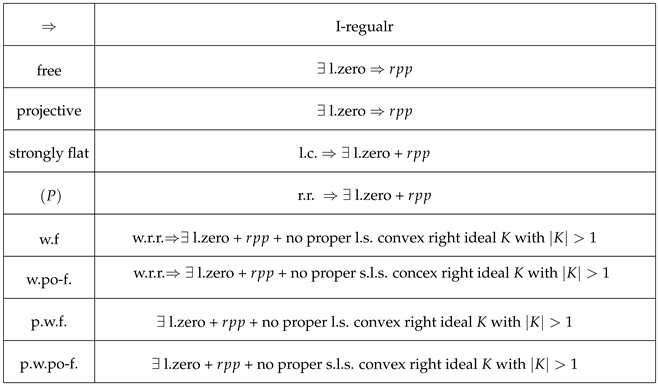
Below, we tabulate the results.
Abbreviations: l.c. = left collapsible; l.zero = left zero; w.r.r. = weakly right reversible; r.r. = right reversible; rpp = right ; s.l.s. = strongly left stabilizing; l.s. = left stabilizing.