Article

Inverse Kinematics: Identifying a Functional Model for Closed Trajectories Using a Metaheuristic Approach


by
Raúl López-Muñoz
1,2,
Mario A. Lopez-Pacheco
3,
Mario C. Maya-Rodriguez
3,*,
Eduardo Vega-Alvarado
2 and
Leonel G. Corona-Ramírez
1,*
1
Unidad Profesional Interdisciplinaria en Ingeniería y Tecnologías Avanzadas, Instituto Politécnico Nacional, Mexico City 07340, Mexico
2
Group of Research and Innovation in Mechatronics (GRIM), Centro de Innovación y Desarrollo Tecnológico en Cómputo (CIDETEC), Instituto Politécnico Nacional, Mexico City 07700, Mexico
3
Escuela Superior de Ingeniería Mecánica y Eléctrica-Unidad Profesional Adolfo López Mateos, Instituto Politécnico Nacional, Mexico City 07738, Mexico
*
Authors to whom correspondence should be addressed.
Mathematics 2025, 13(11), 1847; https://doi.org/10.3390/math13111847
Submission received: 6 May 2025 / Revised: 27 May 2025 / Accepted: 29 May 2025 / Published: 2 June 2025
(This article belongs to the Special Issue Numerical Methods Applied to Mathematical Problems)

Abstract

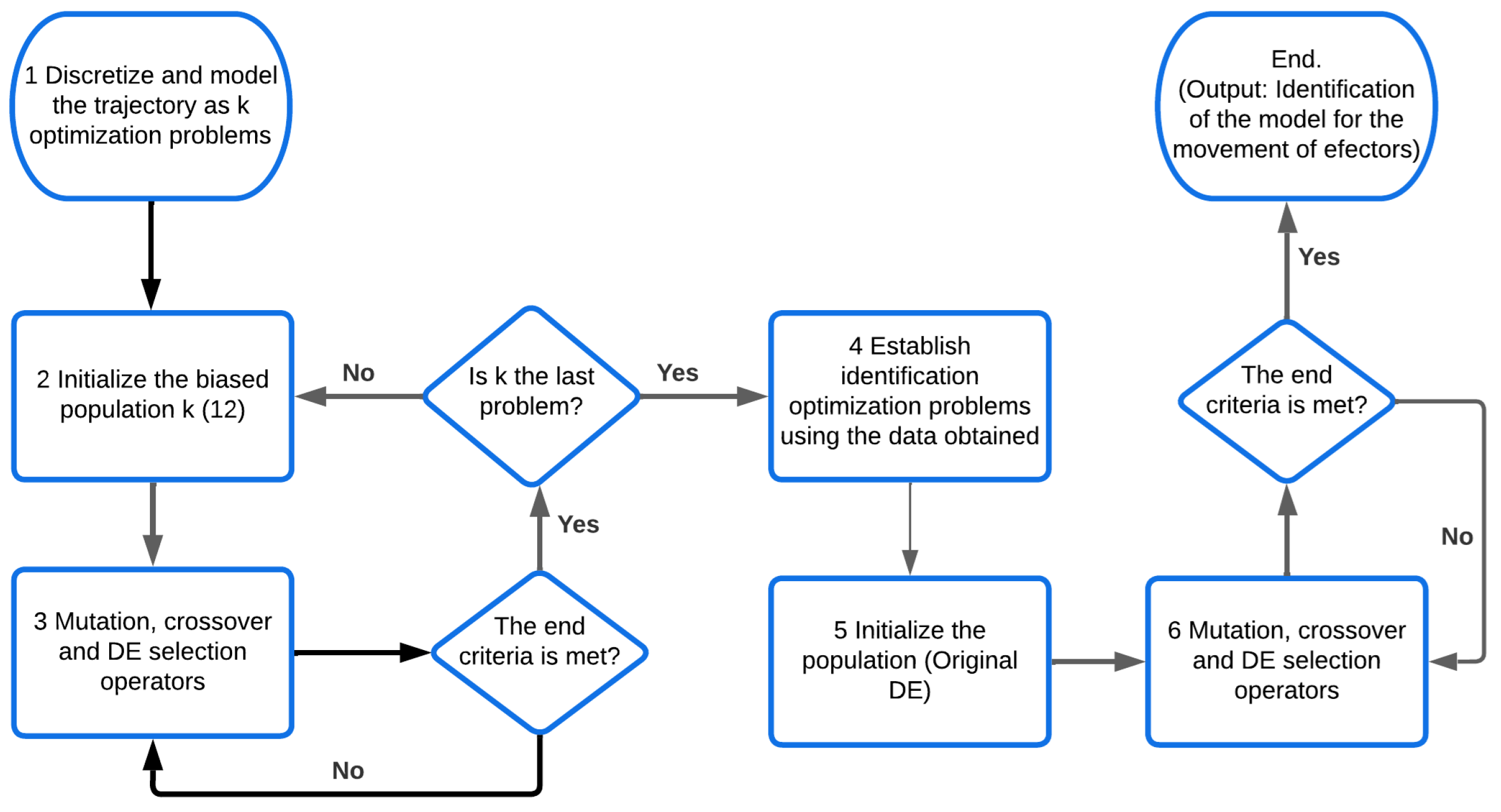
Determining the position values of the effectors in a robot to enable its end effector to perform a specific task is a recurrent challenge in robotics. Diverse methodologies have been explored to address this problem, each with distinct advantages and limitations. This work proposes a metaheuristic-based approach to solve a sequence of optimization problems associated with the discretized trajectory of the end effector. Additionally, a method to identify a functional model that describes the effector trajectories is introduced using the same optimization technique. The key contribution lies in algorithmic adjustments that enhance the metaheuristic solutions by leveraging the behavior of the robot and the influence of the tracking task on the search space. Specifically, two operations are modified in the initialization process of the candidate solution. The proposed biased initialization with variable weights improves positional accuracy (72.5%) in relation to methods without dynamic updates. Additionally, the standard deviation was reduced by (89%). For industrial implementations, modern controllers can directly encode effector positions via parametric functions. The results of this proposal formulate optimization problems whose solutions yield the parameters of a time-dependent mathematical model describing the movement of the effector.
Keywords: optimization; metaheuristic algorithm; inverse kinematics problem; kinematic chain; identification technique optimization; metaheuristic algorithm; inverse kinematics problem; kinematic chain; identification technique