Article

Deep Reinforcement Learning for Intraday Multireservoir Hydropower Management


by
Rodrigo Castro-Freibott
1,*,
Álvaro García-Sánchez
2,*,
Francisco Espiga-Fernández
2 and
Guillermo González-Santander de la Cruz
1
1
baobab soluciones, José Abascal 55, 28003 Madrid, Spain
2
Industrial Engineering, Business Administration and Statistics Department, Escuela Técnica Superior de Ingenieros Industriales, Universidad Politécnica de Madrid, José Gutierrez Abascal 2, 28006 Madrid, Spain
*
Authors to whom correspondence should be addressed.
Mathematics 2025, 13(1), 151; https://doi.org/10.3390/math13010151
Submission received: 31 October 2024 / Revised: 19 December 2024 / Accepted: 27 December 2024 / Published: 3 January 2025
(This article belongs to the Section E1: Mathematics and Computer Science)

Abstract

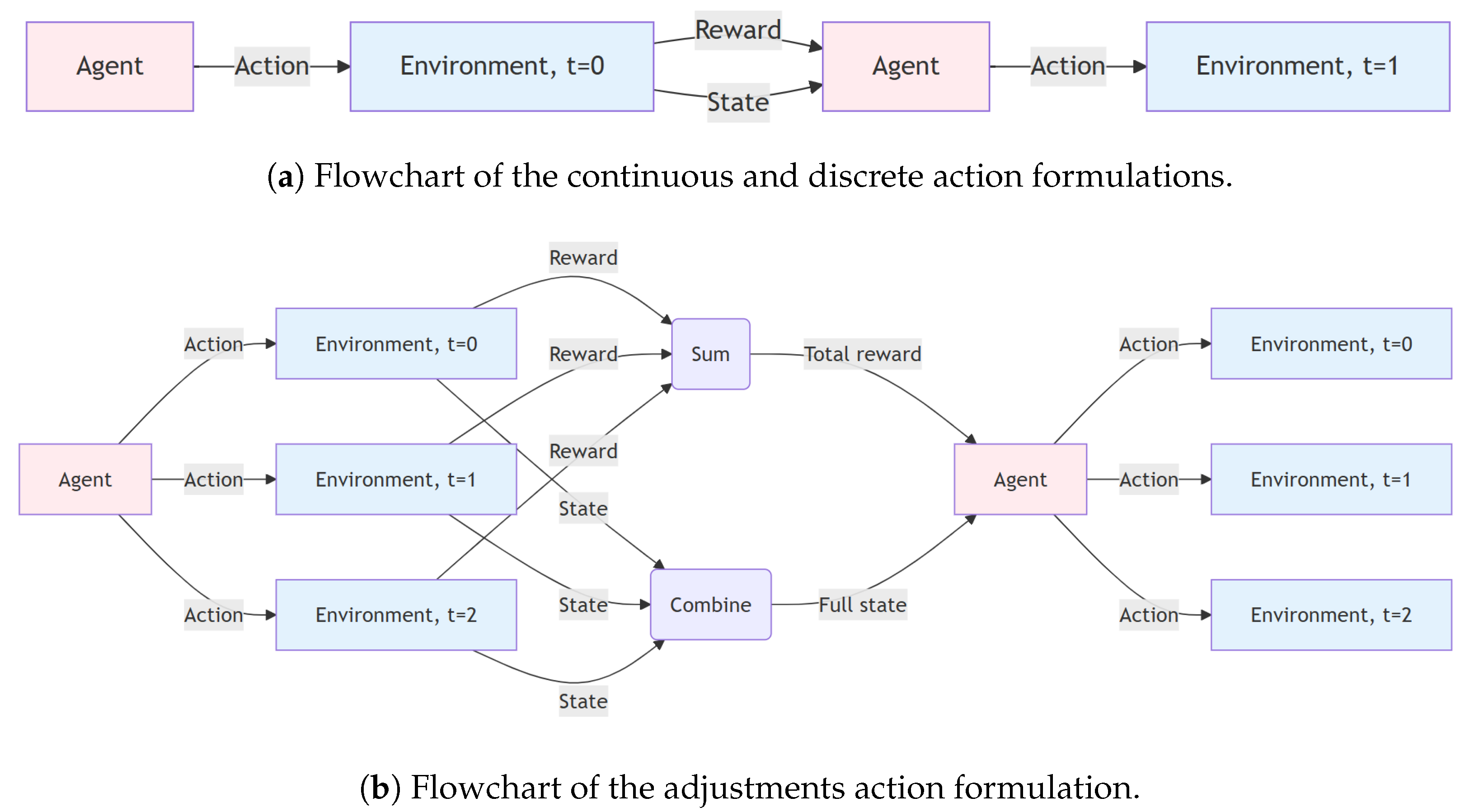
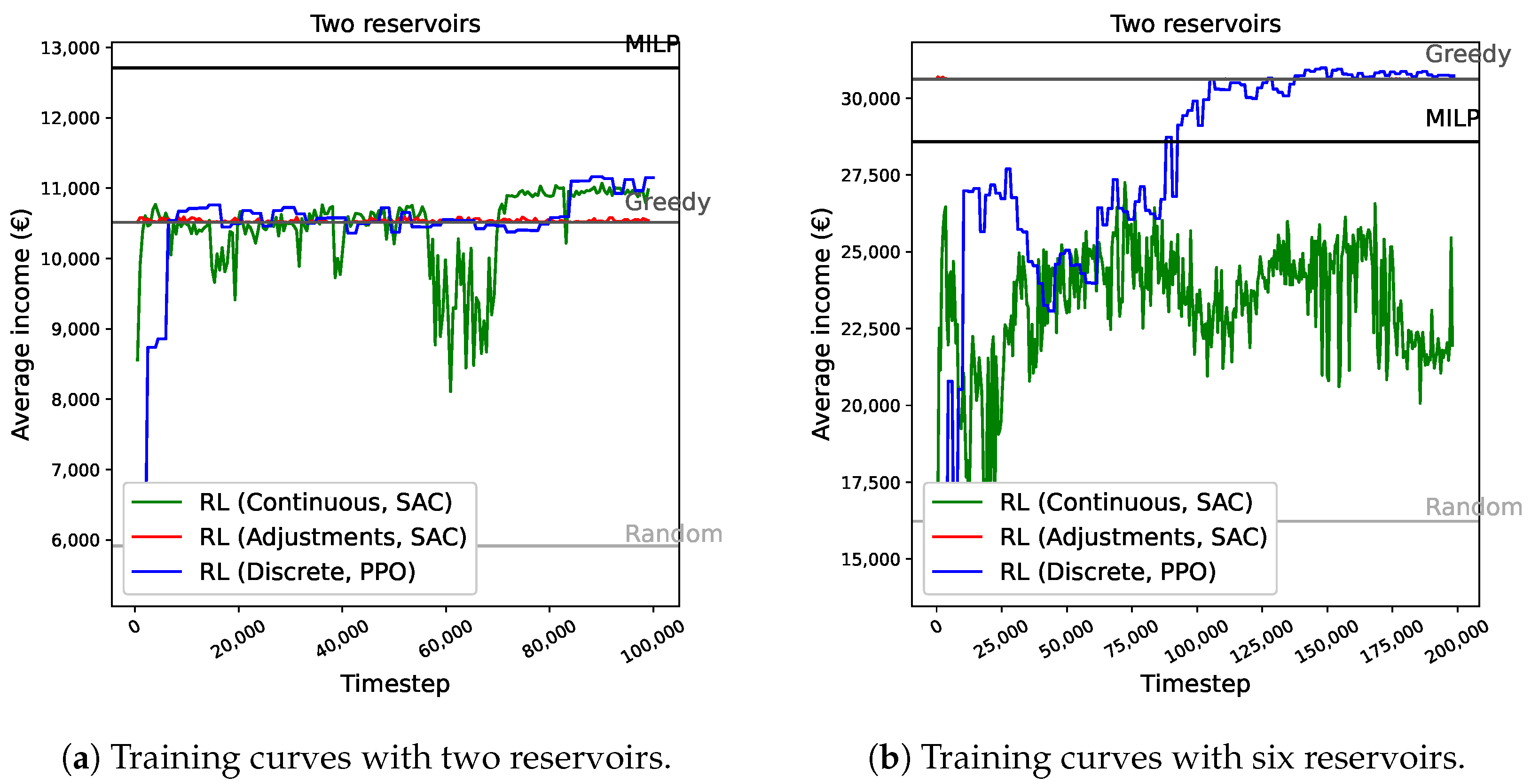
This study investigates the application of Reinforcement Learning (RL) to optimize intraday operations of hydropower reservoirs. Unlike previous approaches that focus on long-term planning with coarse temporal resolutions and discretized state-action spaces, we propose an RL framework tailored to the Hydropower Reservoirs Intraday Economic Optimization problem. This framework manages continuous state-action spaces while accounting for fine-grained temporal dynamics, including dam-to-turbine delays, gate movement constraints, and power group operations. Our methodology evaluates three distinct action space formulations (continuous, discrete, and adjustments) implemented using modern RL algorithms (A2C, PPO, and SAC). We compare them against both a greedy baseline and Mixed-Integer Linear Programming (MILP) solutions. Experiments on real-world data from a two-reservoir system and a simulated six-reservoir system demonstrate that while MILP achieves superior performance in the smaller system, its performance degrades significantly when scaled to six reservoirs. In contrast, RL agents, particularly those using discrete action spaces and trained with PPO, maintain consistent performance across both configurations, achieving considerable improvements with less than one second of execution time. These results suggest that RL offers a scalable alternative to traditional optimization methods for hydropower operations, particularly in scenarios requiring real-time decision making or involving larger systems.
Keywords: daily optimization; hydropower generation; multireservoir; reinforcement learning; mixed integer linear programming daily optimization; hydropower generation; multireservoir; reinforcement learning; mixed integer linear programming