Article

High-Level Process Modeling—An Experimental Investigation of the Cognitive Effectiveness of Process Landscape Diagrams

Faculty of Electrical Engineering and Computer Science, University of Maribor, Koroška cesta 46, SI-2000 Maribor, Slovenia
*
Author to whom correspondence should be addressed.
Mathematics 2024, 12(9), 1376; https://doi.org/10.3390/math12091376
Submission received: 15 March 2024 / Revised: 23 April 2024 / Accepted: 26 April 2024 / Published: 30 April 2024
(This article belongs to the Special Issue Industrial Big Data and Process Modelling for Smart Manufacturing)

Abstract

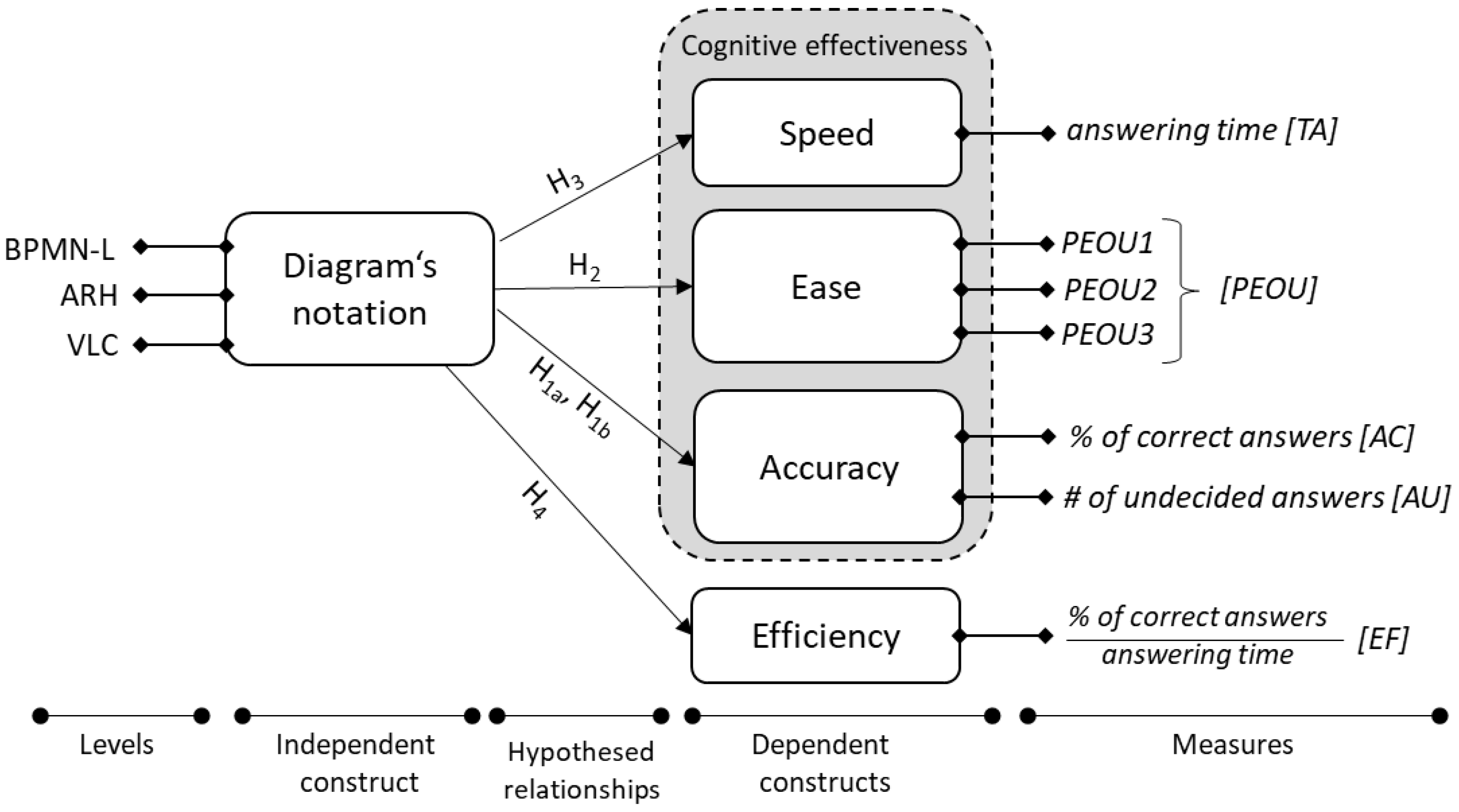
Unlike business process diagrams, where ISO/IEC 19510 (BPMN 2.0) prevails, high-level process landscape diagrams are being designed using a variety of standard- or semi-standard-based notations. Consequently, landscape diagrams differ among organizations, domains, and modeling tools. As (process landscape) diagrams need to be understandable in order to communicate effectively and thus form the basis for valid business decisions, this study aims to empirically validate the cognitive effectiveness of common landscape designs, including those BPMN-L-based, which represent a standardized extension of BPMN 2.0 specifically aimed at landscape modeling. Empirical research with 298 participants was conducted in which cognitive effectiveness was investigated by observing the speed, ease, accuracy, and efficiency of answering questions related to semantically equivalent process landscape diagrams modeled in three different notations: value chains, ArchiMate, and BPMN-L. The results demonstrate that BPMN-L-based diagrams performed better than value chain- and ArchiMate-based diagrams concerning speed, accuracy, and efficiency; however, subjects perceived BPMN-L-based diagrams as being less easy to use when compared to their counterparts. The results indicate that differences in cognitive effectiveness measures may result from the design principles of the underlying notations, specifically the complexity of the visual vocabulary and semiotic clarity, which states that modeling concepts should have unique visualizations.
Keywords: process modeling; process landscapes; cognitive effectiveness; BPMN process modeling; process landscapes; cognitive effectiveness; BPMN