An Icon-Based Methodology for the Design of a Prototype of a Multi-Process, Multi-Product, Aggregated Production Planning Software




Abstract
1. Introduction
1.1. Motivation and Topics
1.2. Literature Review
1.2.1. Aggregate Production Planning
1.2.2. Computational Tools
1.3. Problems and Contributions
- Proposing a methodology based on icons to obtain optimal aggregate production plans without the need to perform mathematical modeling;
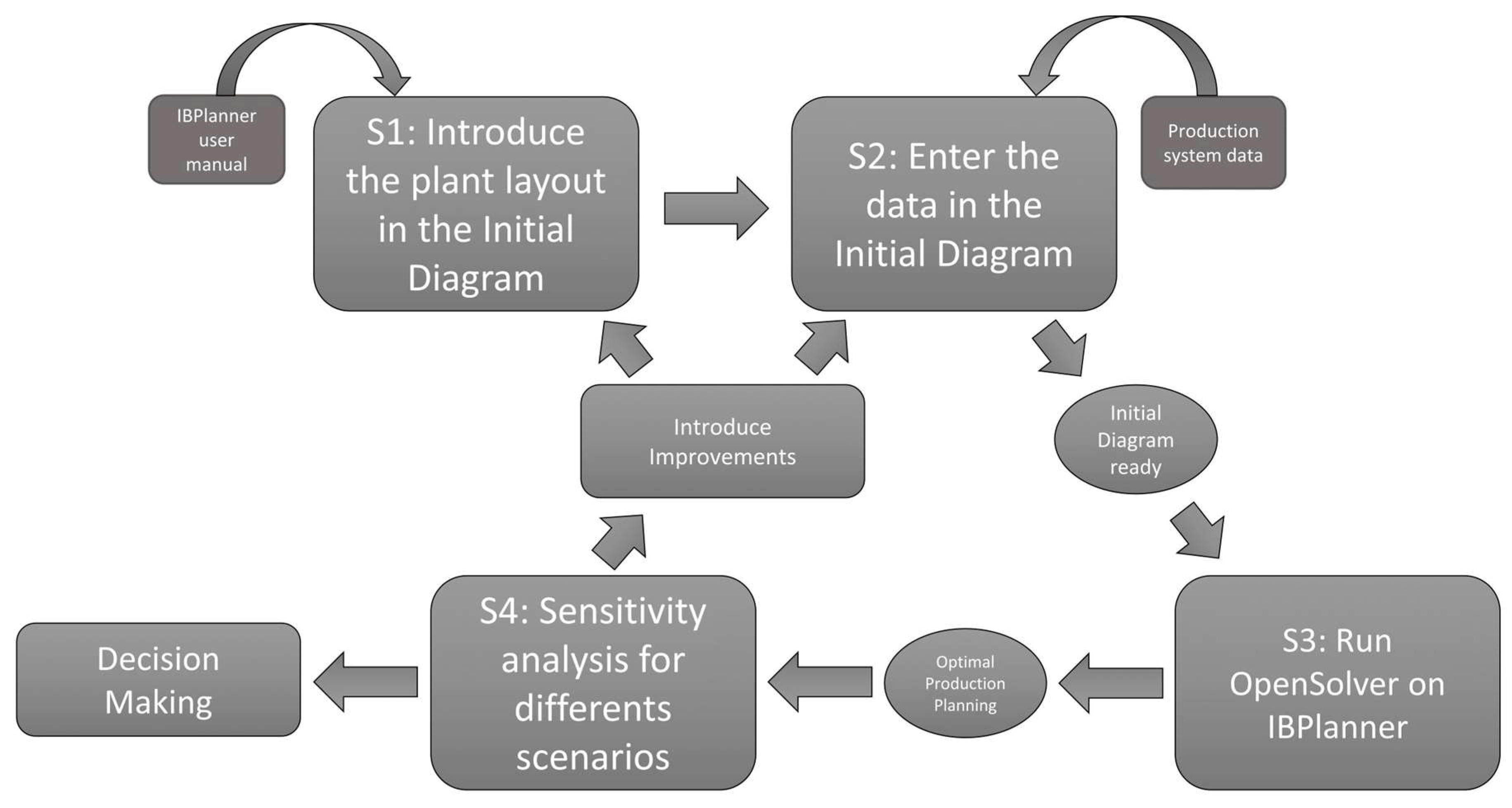
- Suggesting a prototype that applies the icon-based methodology to achieve optimal production planning based on the flowchart representation of a target production system and its information;
- Providing companies without sufficient resources to invest in ICT, a tool to improve their productivity;
- Noting that visual modeling using icons can be used to implement different engineering methodologies, simplifying their application.
2. Definitions and Structure of the Methodology
2.1. Icon-Based Methodology
- a.
- For each product in each desired planning period, the following are required:
- i.
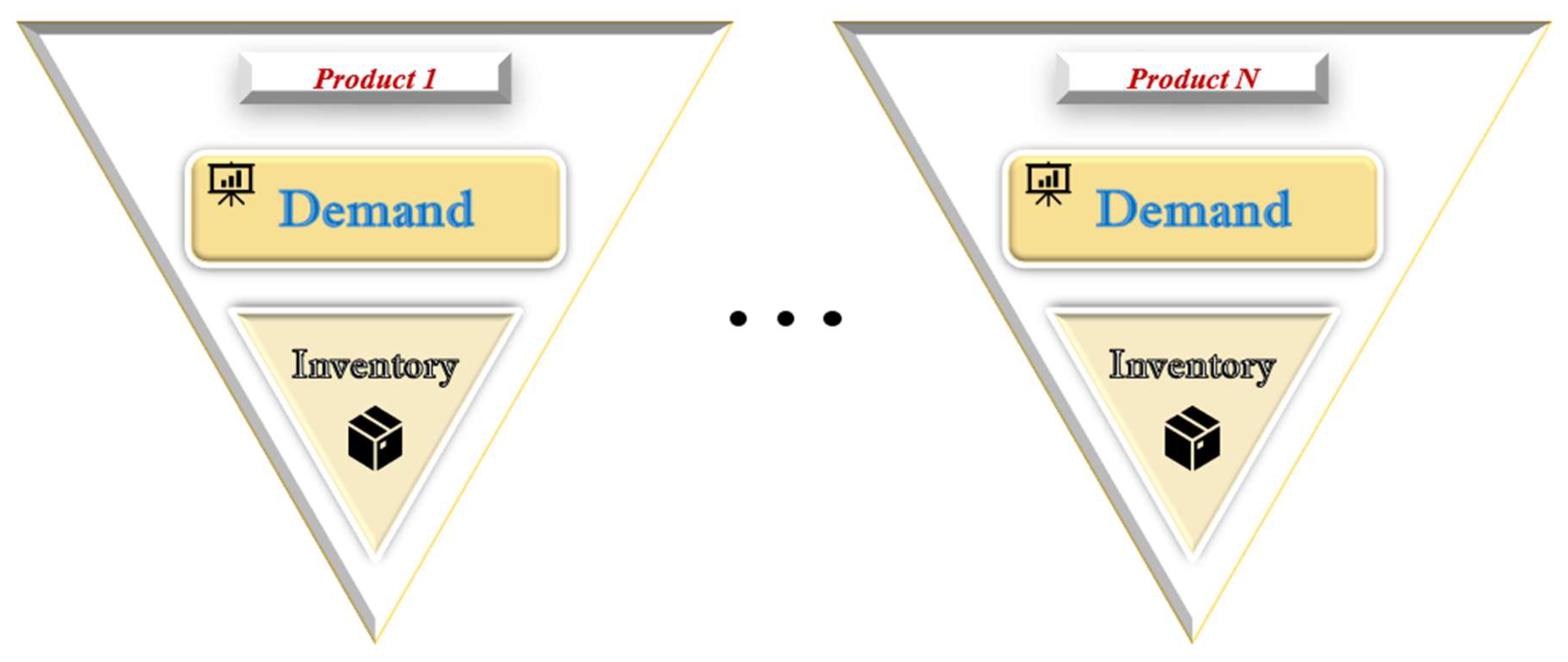
- Demand in units;
- ii.
- Unit cost to inventory and available inventory capacity.
- b.
- For each sub-process of each work line, in each planning period and for each product, the following are required:
- i.
- Unit cost of production;
- ii.
- Machine hours required per unit;
- iii.
- Worker hours required per unit.
- c.
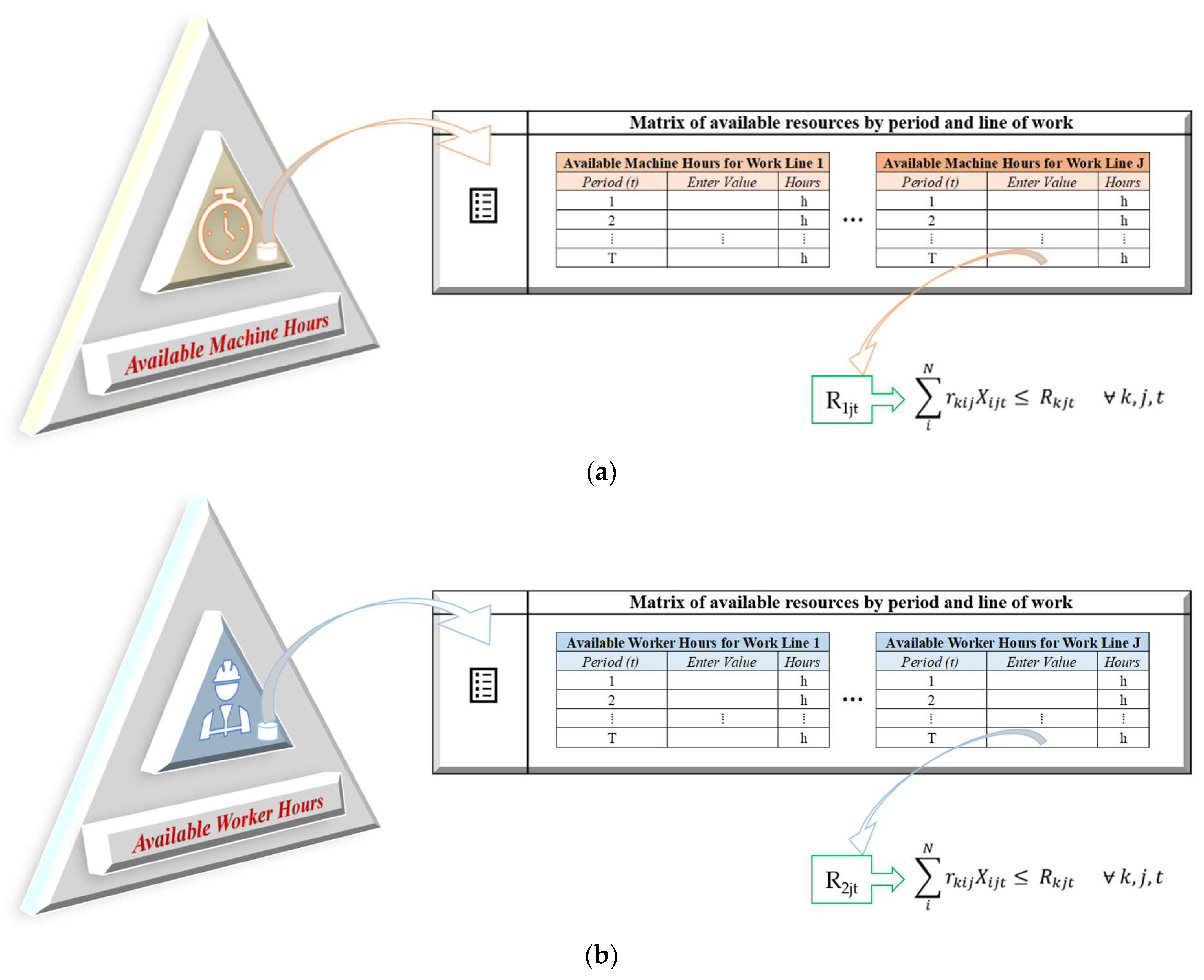
- Machine hours and worker hours available for all planning periods and for each work line, as applicable. This is understood as the number of hours operated by a machine or worker in a sub-process for the manufacture of a unit of the product.
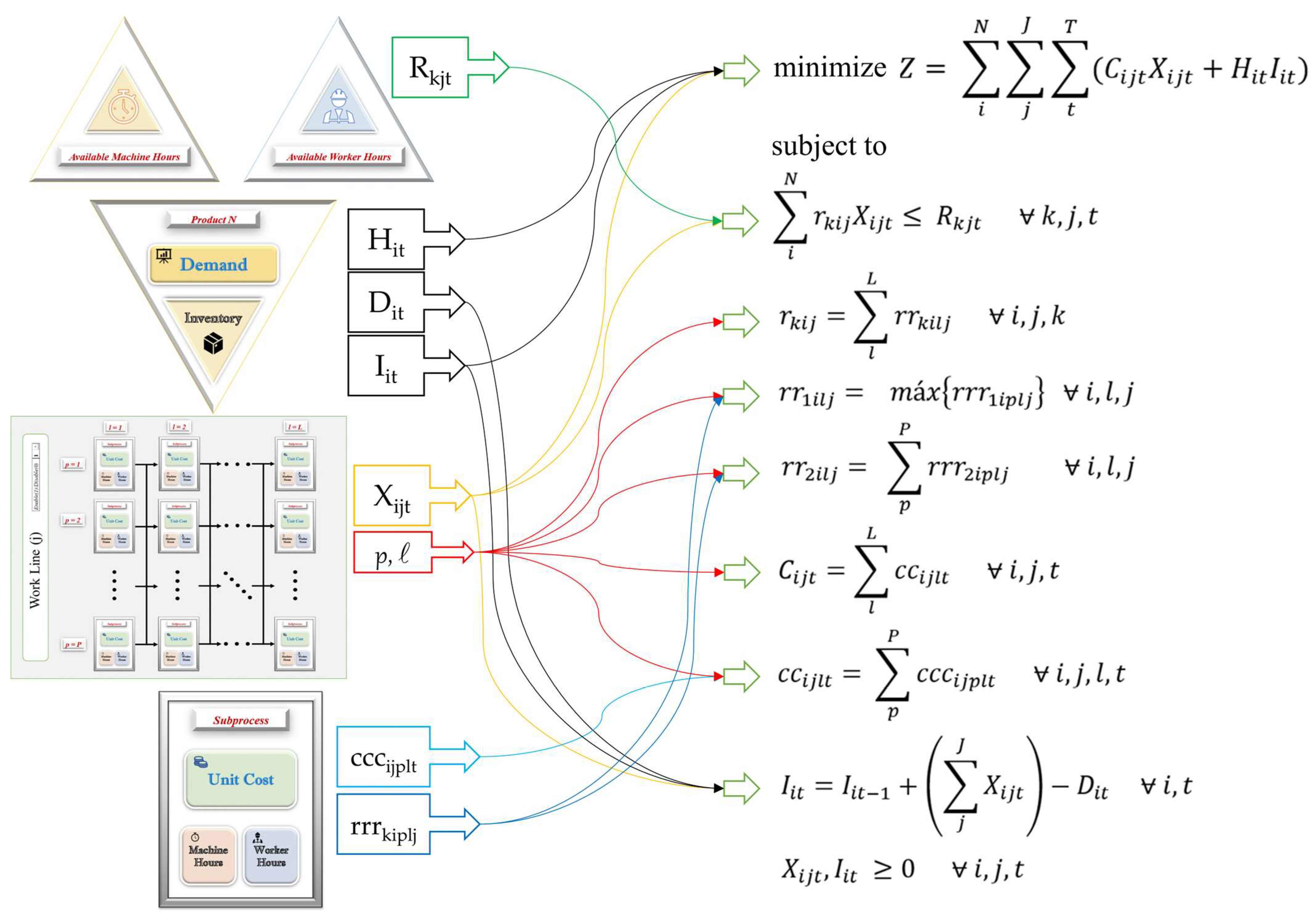
2.2. Mathematical Model and Icons of the Initial Diagram
- t = 1, 2, …, T index of planning periods;
- i = 1, 2, …, N index of products;
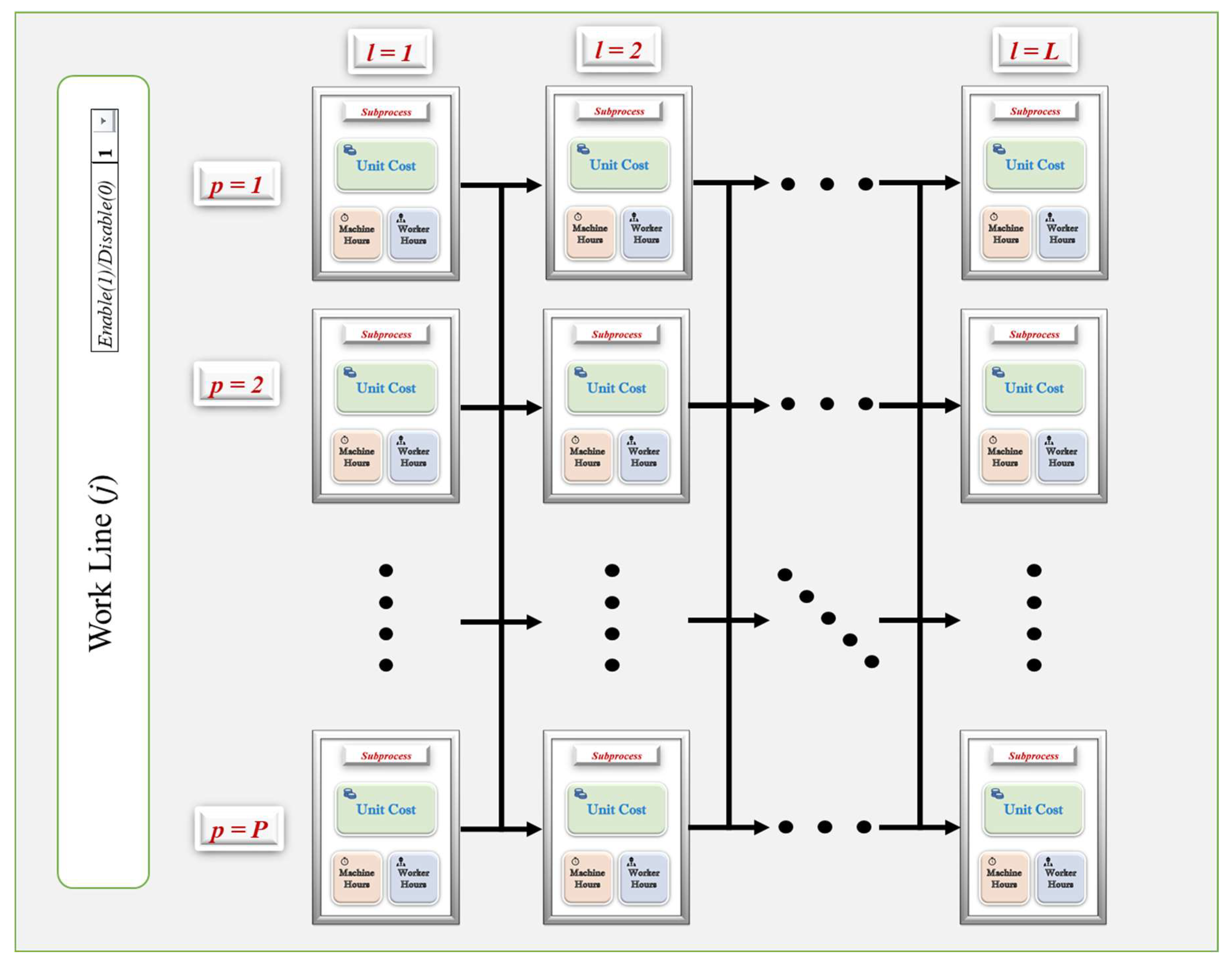
- j = 1, 2, …, J index of work lines;
- k = 1, 2 index of Resources, k = 1 (machine hours), k = 2 (worker hours);
- l = 1, 2, …, L index of serial sub-processes;
- p = 1, 2, …, P index of parallel sub-processes.
- ➢
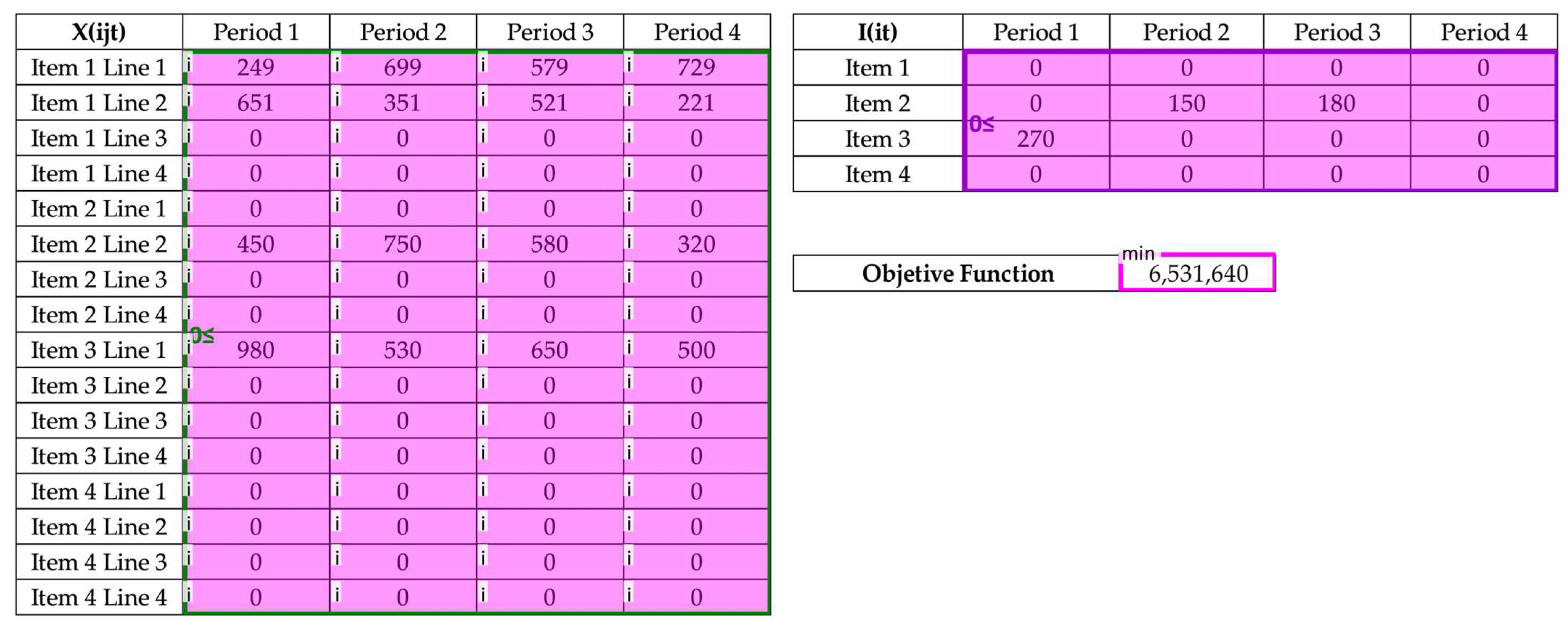
- Xijt—Number of product units i manufactured by work line j in period t;
- ➢
- Iit—Number of product units i in inventory at the end of period t.
- ➢
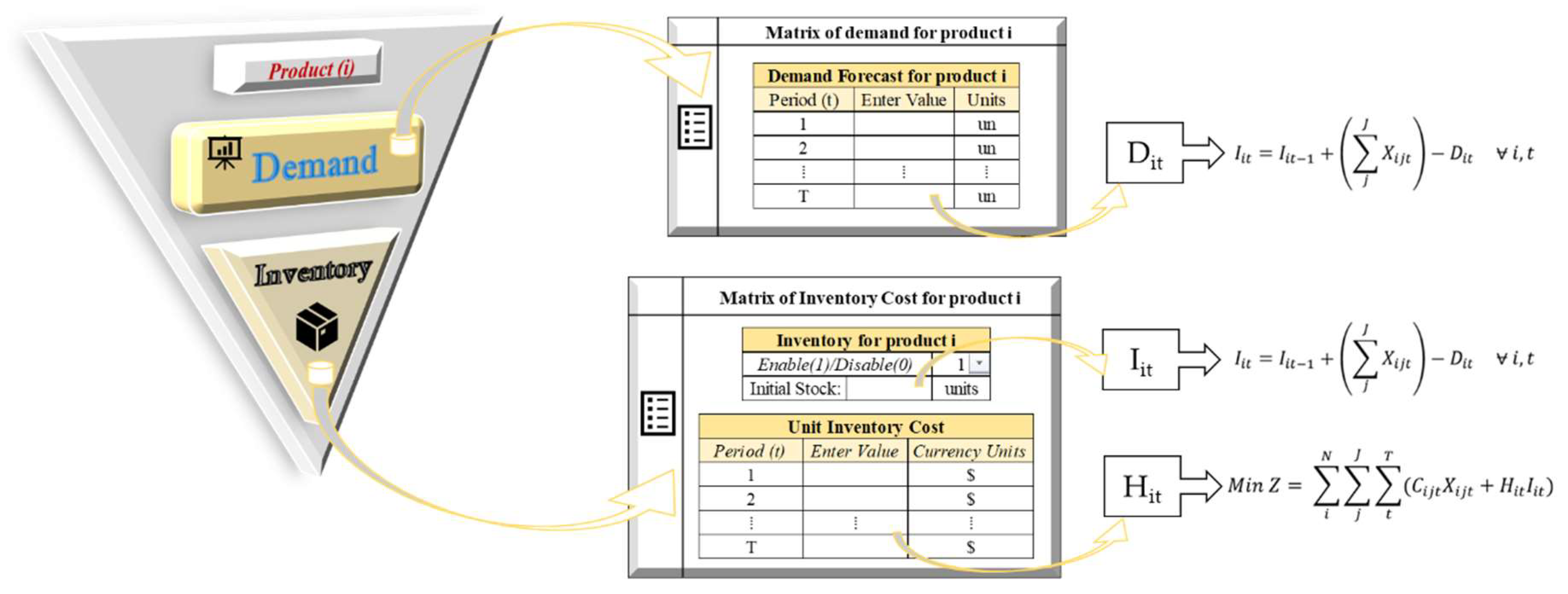
- Dit—Forecast of units demanded of the product i in a period t;
- ➢
- Hit—Inventory cost for a product unit i in period t;
- ➢
- Cijt—Cost of producing a unit of product i in process j and period t;
- ➢
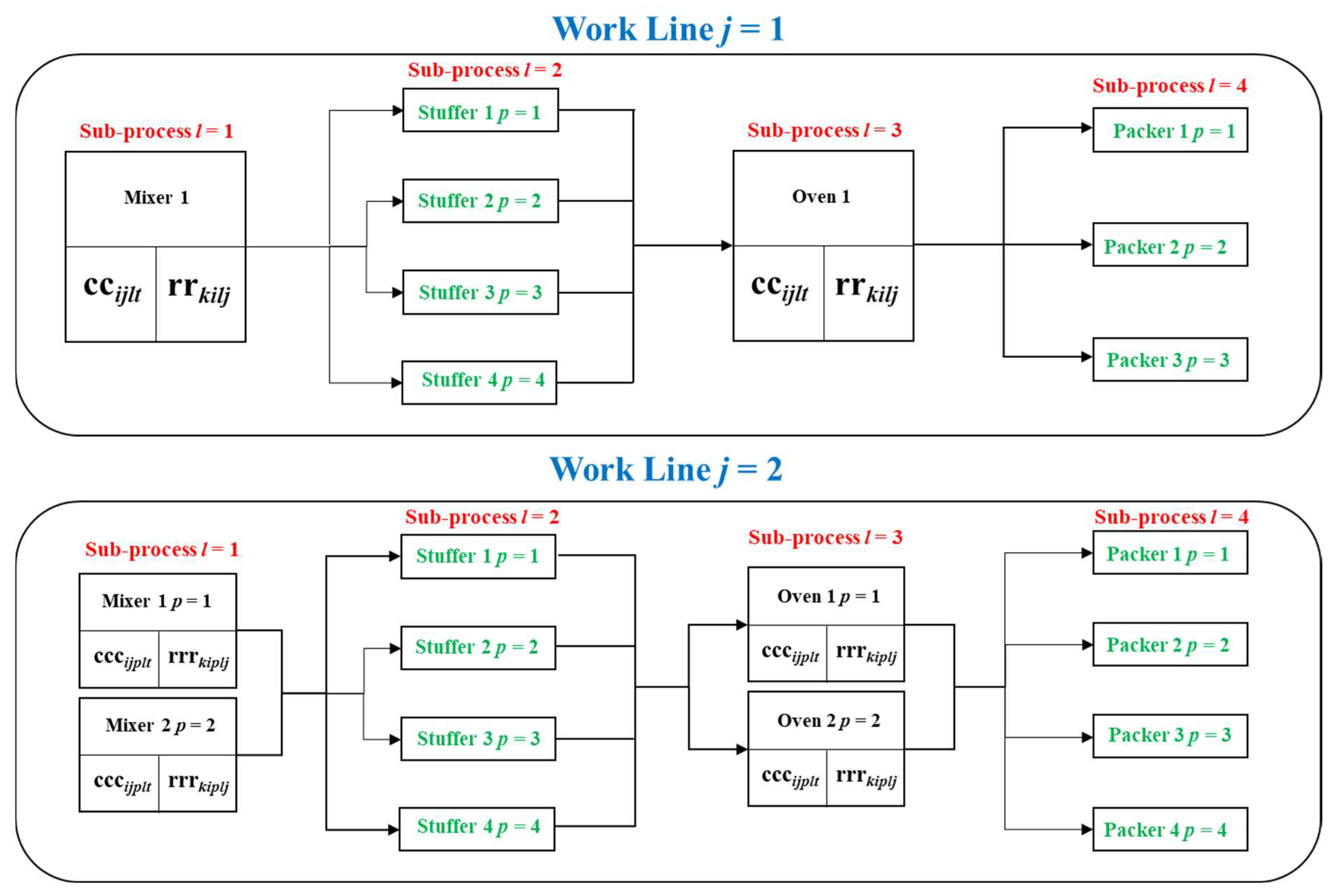
- ccijlt—Cost of producing a unit of product i in process j, stage l, and period t;
- ➢
- cccijplt Cost of producing a unit of product i, process j, stage l, parallel machine p, and period t;
- ➢
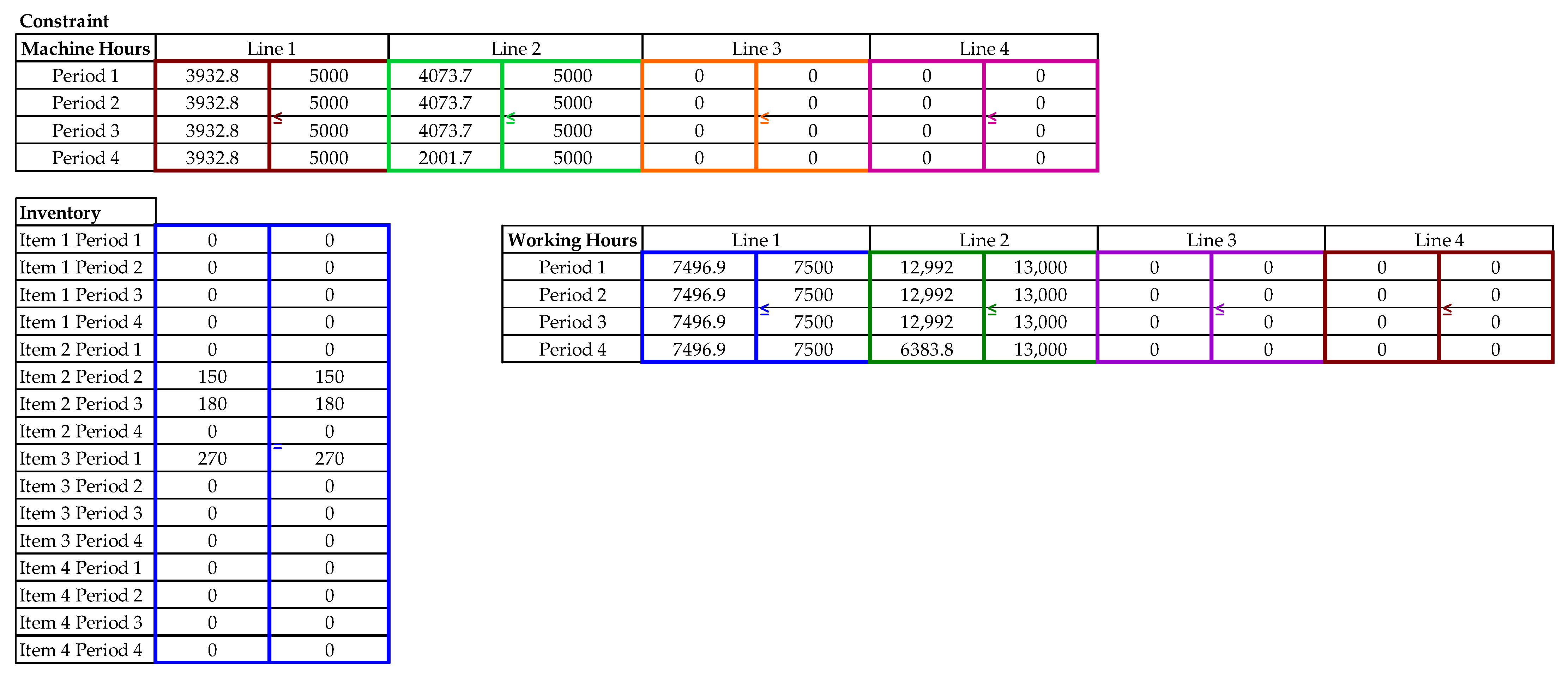
- Rkjt—Amount available of resource k for work line j in period t;
- ➢
- rkij—Required amount of resource k per unit of product i if processed in j;
- ➢
- rrkilj—Required amount of resource k for a product unit i processed in stage l of process j;
- ➢
- rrrkiplj—Required amount of resource k for a unit of product i processed in stage l of process j on the parallel machine p.
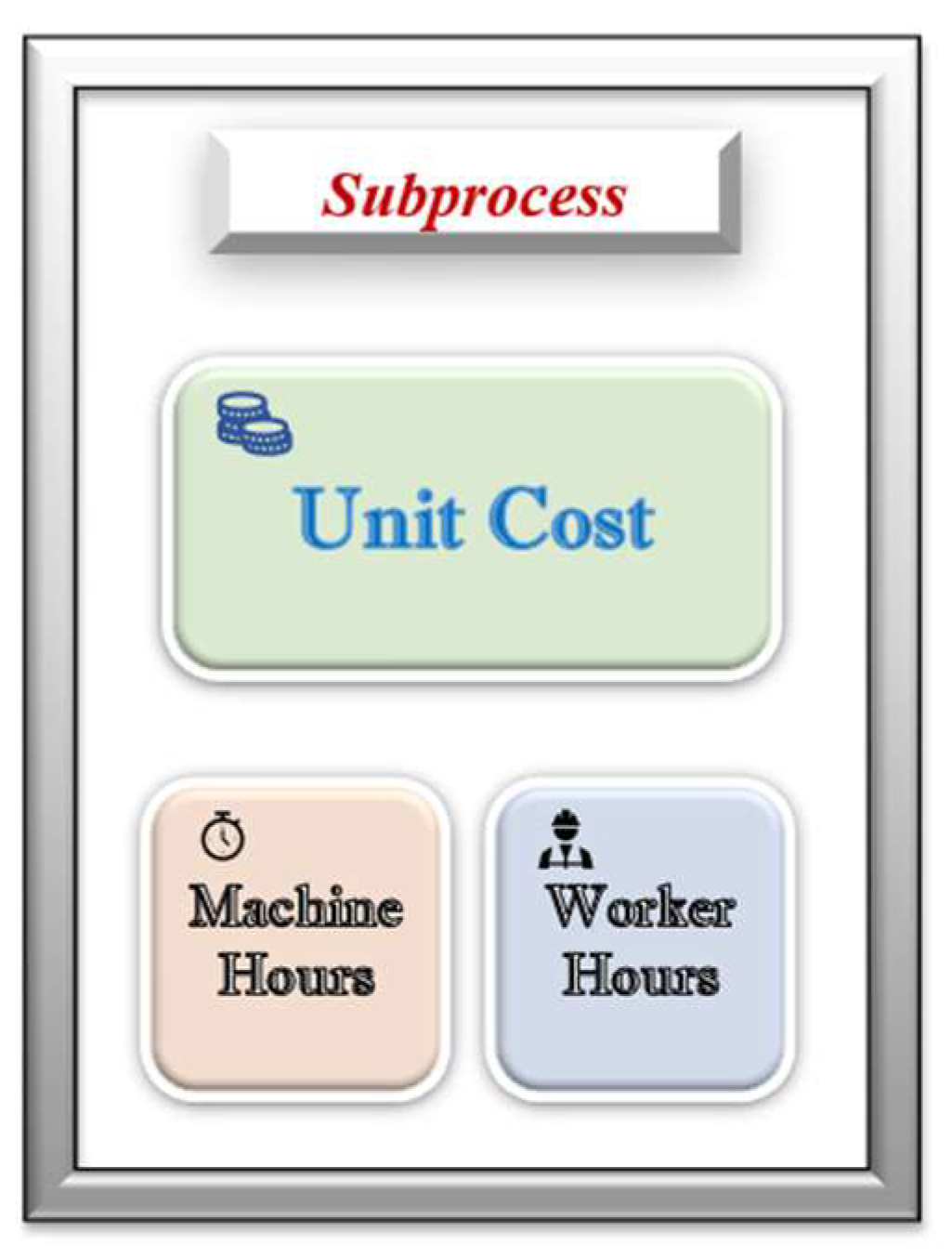
2.2.1. Sub-Processes Icon
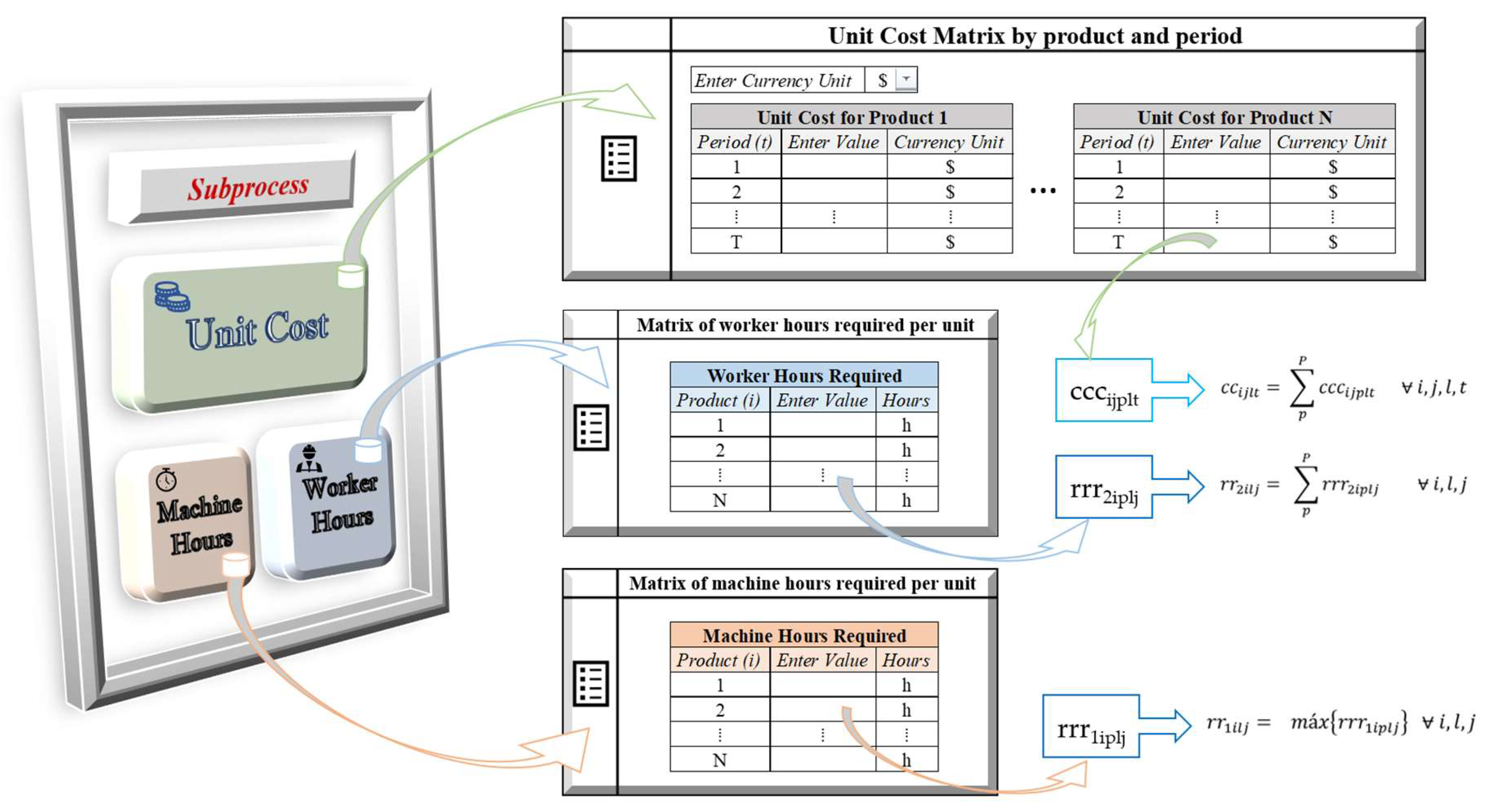
- Unit cost: matrix designed to enter the unit cost of production of the sub-process for the different products in the different planning periods;
- Machine hours: matrix designed to enter the machine hours required for one unit of the different products;
- Worker hours: matrix designed to enter the worker hours required for one unit of the different products.
- Unit cost will generate the parameter cccijplt;
- Machine hours will generate the parameter rrrkiplj with k = 1;
- Worker hours will generate the parameter rrrkiplj with k = 2.
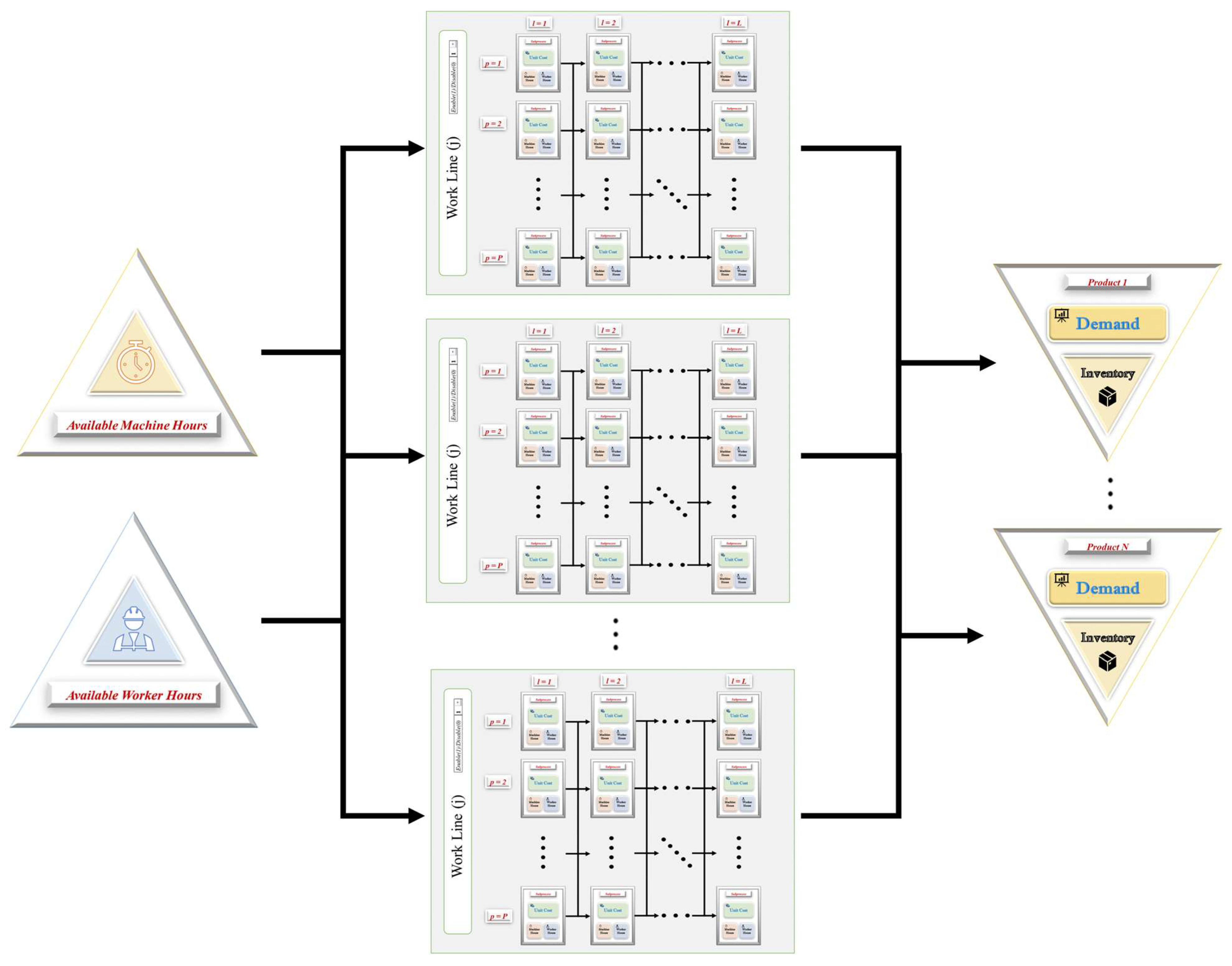
2.2.2. Work Line Icon
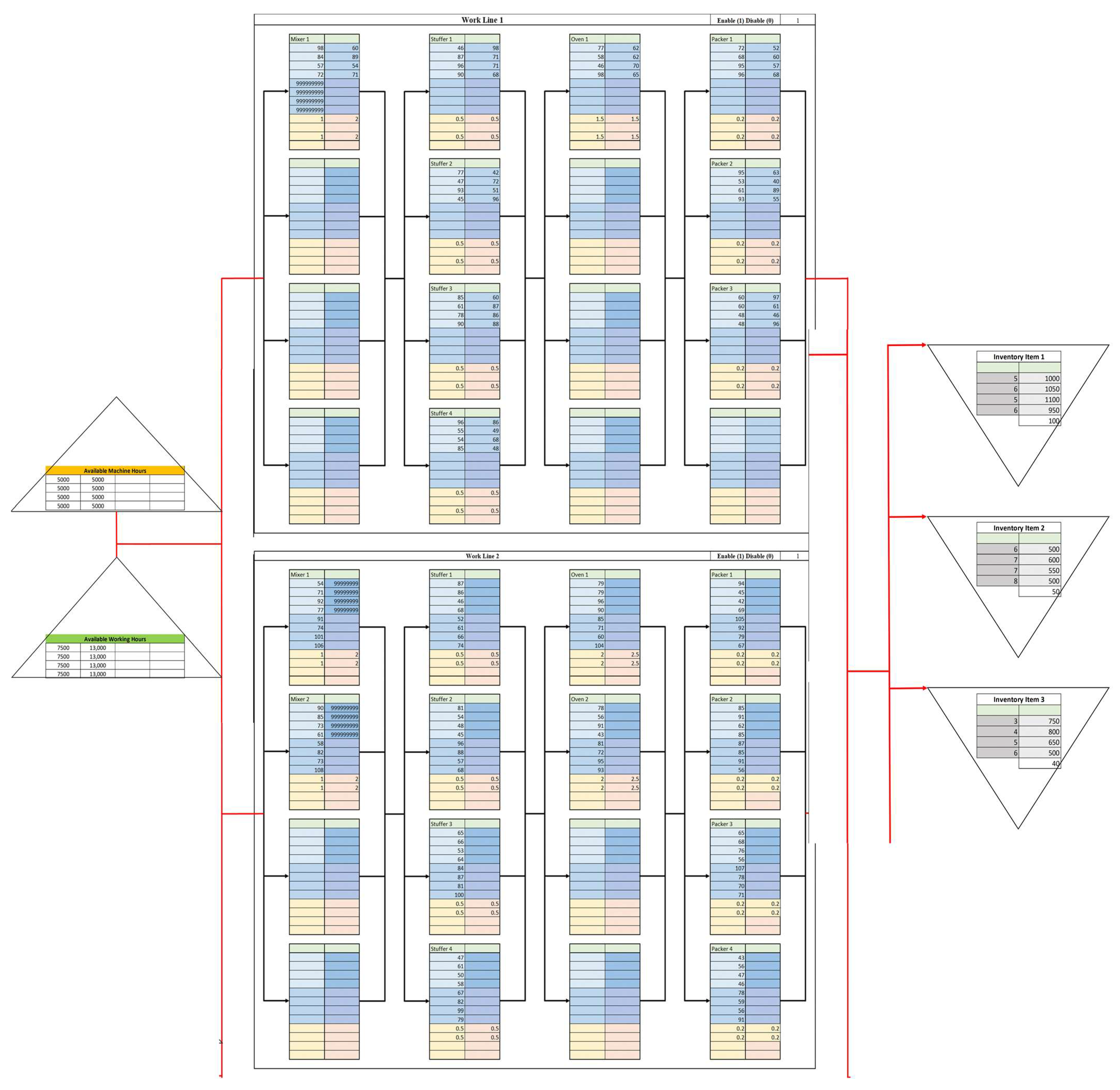
2.2.3. Available Resources Icons
2.2.4. Demand and Available Inventory Icons
3. Prototype and Case Study: Sausage Products Factory
4. Discussion of Results
5. Conclusions
Author Contributions
Funding
Data Availability Statement
Conflicts of Interest
Appendix A
Appendix B

References
- Goli, A.; Tirkolaee, E.B.; Malmir, B.; Bian, G.-B.; Sangaiah, A.K. A multi-objetive invasive weed optimization algorithm for robust aggregate production planning under uncertain seasonal demand. Computing 2019, 101, 499–529. [Google Scholar] [CrossRef]
- Mirzapour Al-e-hashem, S.M.J.; Baboli, A.; Sazvar, Z. A stochastic aggregate production planning model in a green supply chain: Considering flexible lead times, nonlinear purchase and shortage cost functions. Eur. J. Oper. Res. 2013, 230, 26–41. [Google Scholar] [CrossRef]
- Nam, S.; Logendran, R. Aggregate production planning—A survey of models and methodologies. Eur. J. Oper. Res. 1992, 61, 255–272. [Google Scholar] [CrossRef]
- Miltenburg, J. Setting manufacturing strategy for a factory-within-a-factory. Int. J. Prod. Econ. 2008, 113, 307–323. [Google Scholar] [CrossRef]
- Eilon, S. Five approaches to aggregate production planning. AIIE Trans. 1975, 7, 118–131. [Google Scholar] [CrossRef]
- Cheraghalikhani, A.; Khoshalhan, F.; Mokhtari, H. Aggregate production planning: A literature review and future research directions. Int. J. Ind. Eng. Comput. 2019, 10, 309–330. [Google Scholar] [CrossRef]
- Jamalnia, A.; Yang, J.-B.; Feili, A.; Xu, D.-L.; Jamali, G. Aggregate production planning under uncertainty: A comprehensive literature survey and future research directions. Int. J. Adv. Manuf. Technol. 2019, 102, 159–181. [Google Scholar] [CrossRef]
- Aydin, N.S.; Tirkolaee, E.B. A systematic review of aggregate production planning literature with an outlook for sustainability and circularity. Environ. Dev. Sustain. 2022, 1–42. [Google Scholar] [CrossRef]
- Werner, F. Special Issue “Scheduling: Algorithms and Applications”. Algorithms 2023, 16, 268. [Google Scholar] [CrossRef]
- Elidrissi, A.; Benmansour, R.; Hasani, K.; Werner, F. Scheduling on parallel machines with a common server in charge of loading and unloading operations. arXiv 2023, arXiv:2306.16669. [Google Scholar]
- Yazd, S.; Salamirad, A.; Kheybari, S.; Ishizaka, A. An efficiency-based aggregate production planning model for multi-line manufacturing systems. Oper. Manag. Res. 2023, 16, 2008–2024. [Google Scholar] [CrossRef]
- Özelkan, E.; Torabzadeh, S.; Demirel, E.; Lim, C. Bi-objective aggregate production planning for managing plan stability. Comput. Ind. Eng. 2023, 178, 109105. [Google Scholar] [CrossRef]
- Tirkolaee, E.B.; Aydin, N.S.; Mahdavi, I. A Hybrid Biobjective Markov Chain Based Optimization Model for Sustainable Aggregate Production Planning. IEEE Trans. Eng. Manag. 2022, 1–11. [Google Scholar] [CrossRef]
- Gomez-Rocha, J.E.; Hernandez-Gress, E.S. A Stochastic Programming Model for Multi-Product Aggregate Production Planning Using Valid Inequalities. Appl. Sci. 2022, 12, 9903. [Google Scholar] [CrossRef]
- Islam, S.R.; Novoa, C.; Jin, T.D. Multi-facility aggregate production planning with prosumer microgrid: A two-stage stochastic program. J. Clean. Prod. 2022, 367, 132911. [Google Scholar] [CrossRef]
- Singh, N.K.; Kuthambalayan, T.S. Integrating operations and marketing decisions to manage perishability risks with target minimum remaining shelf-life available to consumers. Comput. Ind. Eng. 2022, 163, 107812. [Google Scholar] [CrossRef]
- Matos, C.; Sola, A.V.H.; Matias, G.D.; Lermen, F.H.; Ribeiro, J.L.D.; Siqueira, H.V. Model for Integrating the Electricity Cost Consumption and Power Demand into Aggregate Production Planning. Appl. Sci. 2022, 12, 7577. [Google Scholar] [CrossRef]
- Galankashi, M.R.; Madadi, N.; Helmi, S.A.; Rahim, A.A.; Rafiei, F.M. A Multiobjective Aggregate Production Planning Model for Lean Manufacturing: Insights from Three Case Studies. IEEE Trans. Eng. Manag. 2022, 69, 1958–1972. [Google Scholar] [CrossRef]
- Yu, V.F.; Kao, H.C.; Chiang, F.Y.; Lin, S.W. Solving Aggregate Production Planning Problems: An Extended TOPSIS Approach. Appl. Sci. 2022, 12, 6945. [Google Scholar] [CrossRef]
- Liu, L.F.; Yang, X.F. A Multi-Objective Model and Algorithms of Aggregate Production Planning of Multi-Product with Early and Late Delivery. Algorithms 2022, 15, 180. [Google Scholar] [CrossRef]
- Dohale, V.; Ambilkar, P.; Gunasekaran, A.; Bilolikar, V. A multi-product and multi-period aggregate production plan: A case of automobile component manufacturing firm. Benchmarking Int. J. 2022, 29, 3396–3425. [Google Scholar] [CrossRef]
- Yaghin, R.G.; Darvishi, F. Integrated textile material and production management in a fuzzy environment: A logistics perspective. J. Text. Inst. 2022, 113, 1380–1400. [Google Scholar] [CrossRef]
- Liu, L.F.; Yang, X.F. Multi-Objective Aggregate Production Planning for Multiple Products: A Local Search-Based Genetic Algorithm Optimization Approach. Int. J. Comput. Intell. Syst. 2021, 14, 156. [Google Scholar] [CrossRef]
- Khalili, J.; Alinezhad, A. Performance evaluation in aggregate production planning using integrated RED-SWARA method under uncertain condition. Sci. Iran. 2021, 28, 912–926. [Google Scholar] [CrossRef]
- Tuang, D.H.; Chiadamrong, N. A Fuzzy Credibility-Based Chance-Constrained Optimization Model for Multiple-Objective Aggregate Production Planning in a Supply Chain under an Uncertain Environment. Eng. J. 2021, 25, 31–58. [Google Scholar] [CrossRef]
- Rehman, H.U.; Ahmad, A.; Ali, Z.; Baig, S.A.; Manzoor, U. Optimization of Aggregate Production Planning Problems with and without Productivity Loss using Python Pulp Package. Manag. Prod. Eng. Rev. 2021, 12, 38–44. [Google Scholar]
- Krajcovic, M.; Furmannova, B.; Grznar, P.; Furmann, R.; Plinta, D.; Svitek, R.; Antoniuk, I. System of Parametric Modelling and Assessing the Production Staff Utilization as a Basis for Aggregate Production Planning. Appl. Sci. 2021, 11, 9347. [Google Scholar] [CrossRef]
- Ning, Y.F.; Pang, N.; Wang, S.; Chen, X.M. An Uncertain APP Model with Allowed Stockout and Service Level Constraint for Vegetables. Symmetry 2021, 13, 2332. [Google Scholar] [CrossRef]
- Rahmani, D.; Zandi, A.; Behdad, S.; Entezaminia, A. A light robust model for aggregate production planning with consideration of environmental impacts of machines. Oper. Res. 2021, 21, 273–297. [Google Scholar] [CrossRef]
- Torabzadeh, S.; Ozelkan, E.C. Fuzzy aggregate production planning with flexible requirement profile for plan stability in uncertain environments. Eur. J. Ind. Eng. 2021, 15, 514–549. [Google Scholar] [CrossRef]
- Sutthibutr, N.; Chiadamrong, N. Integrated Possibilistic Linear Programming with Beta-Skewness Degree for a Fuzzy Multi-Objective Aggregate Production Planning Problem under Uncertain Environments. Fuzzy Inf. Eng. 2020, 12, 355–380. [Google Scholar] [CrossRef]
- Darvishi, F.; Yaghin, R.G.; Sadeghi, A. Integrated fabric procurement and multi-site apparel production planning with cross-docking: A hybrid fuzzy-robust stochastic programming approach. Appl. Soft Comput. 2020, 92, 106267. [Google Scholar] [CrossRef]
- Jang, J.; Chung, B.D. Aggregate production planning considering implementation error: A robust optimization approach using bi-level particle swarm optimization. Comput. Ind. Eng. 2020, 142, 106367. [Google Scholar] [CrossRef]
- Rasmi, S.A.B.; Kazan, C.; Turkay, M. A multi-criteria decision analysis to include environmental, social, and cultural issues in the sustainable aggregate production plans. Comput. Ind. Eng. 2019, 132, 348–360. [Google Scholar] [CrossRef]
- Zaidan, A.A.; Atiya, B.; Abu Bakar, M.R.; Zaidan, B.B. A new hybrid algorithm of simulated annealing and simplex downhill for solving multiple-objective aggregate production planning on fuzzy environment. Neural Comput. Appl. 2019, 31, 1823–1834. [Google Scholar] [CrossRef]
- Jamalnia, A.; Yang, J.B.; Xu, D.L.; Feili, A.; Jamali, G. Evaluating the performance of aggregate production planning strategies under uncertainty in soft drink industry. J. Manuf. Syst. 2019, 50, 146–162. [Google Scholar] [CrossRef]
- Yuliastuti, G.E.; Rizki, A.M.; Mahmudy, W.F.; Tama, I.P. Optimization of Multi-Product Aggregate Production Planning Using Hybrid Simulated Annealing and Adaptive Genetic Algorithm. Int. J. Adv. Comput. Sci. Appl. 2019, 10, 484–489. [Google Scholar] [CrossRef]
- Aazami, A.A.; Saidi-Mehrabad, M. Bender’s decomposition algorithm for robust aggregate production planning considering pricing decisions in competitive environment: A case study. Sci. Iran. 2019, 26, 3007–3031. [Google Scholar]
- Ning, Y.F.; Pang, N.; Wang, X. An Uncertain Aggregate Production Planning Model Considering Investment in Vegetable Preservation Technology. Math. Probl. Eng. 2019, 2019, 8505868. [Google Scholar] [CrossRef]
- Djordjevic, I.; Petrovic, D.; Stojic, G. A fuzzy linear programming model for aggregated production planning (APP) in the automotive industry. Comput. Ind. 2019, 110, 48–63. [Google Scholar] [CrossRef]
- Penlesky, R.; Srivastava, R. Aggregate production planning using spreadsheet software. Prod. Plan. Control 2007, 5, 524–532. [Google Scholar] [CrossRef]
- Brown, G.; Keegan, J.; Vigus, B.; Wood, K. The Kellogg company optimizes production, inventory, and distribution. Interfaces 2001, 31, 1–15. [Google Scholar] [CrossRef]
- Zago, C.F.; Mesquita, M.A. Advanced planning systems (APS) for supply chain planning: A case study in dairy industry. Braz. J. Oper. Prod. Manag. 2015, 12, 280–297. [Google Scholar] [CrossRef]
- Jonsson, P.; Ivert, L.K. Improving performance with sophisticated master production scheduling. Int. J. Prod. Econ. 2015, 168, 118–130. [Google Scholar] [CrossRef]
- Vlckova, V.; Patak, M. Barriers of demand planning implementation. Econ. Manag. 2011, 1, 1000–1005. [Google Scholar]
- Dini, M.; Stumpo, G. Mipymes en América Latina: Un Frágil Desempeño y Nuevos Desafíos Para las Políticas de Fomento; Documentos de Proyectos (LC/TS.2018/75/Rev.1); Comisión Económica Para América Latina y el Caribe (CEPAL): Santiago, Chile, 2020. [Google Scholar]
- The Conference Board. Total Economy Database. 2020. Available online: https://conference-board.org/data/economydatabase (accessed on 15 April 2023).
- OIT (Organización Internacional del Trabajo). ILOSTAT. 2020. Available online: https://ilostat.ilo.org/es/ (accessed on 17 April 2023).
- Grosman, N.; Braude, H.; Rovira, S.; Patiño, A. Hecho en América Latina: Fabricación Inteligente y Una Nueva Esperanza de Industrialización en la Región; Documentos de Proyectos (LC/TS.2021/111); Comisión Económica Para América Latina y el Caribe (CEPAL): Santiago, Chile, 2021. [Google Scholar]
- Available online: https://www.ingenieros.cl/wp-content/uploads/2014/03/Especialidad-INDUSTRIAL1.pdf (accessed on 22 April 2023).
- Available online: https://blogs.unitec.mx/vida-universitaria/la-unitec/mexico-necesita-ingenieros/ (accessed on 25 April 2023).
- Bell, P.C. Visual interactive modelling: The past, the present, and the prospects. Eur. J. Oper. Res. 1988, 54, 274–286. [Google Scholar] [CrossRef]




| Authors | Year | Contribution |
|---|---|---|
| Werner, F. | 2023 | A special issue that includes comparative analysis and performance evaluations of scheduling algorithms and applications of recent papers [9]. |
| Elidrissi, A.; Benmansour, R.; Hasani, K.; Werner, F. | 2023 | The authors propose two MILP formulations and polynomial-time solvable cases for the scheduling problem on two identical parallel machines with a single server [10]. |
| Yazd, S.; Salamirad, A.; Kheybari, S.; Ishizaka, A. | 2023 | APP for multi-line manufacturing systems based on line efficiency calculated based on pollution rate, defective product rate, production capacity, downtime, and electricity consumption [11]. |
| Özelkan, E.; Torabzadeh, S.; Demirel, E.; Lim, C. | 2023 | Bi-objective APP where, in addition to cost, the stability of the plan is considered as an objective, and it is compared with other classic APP models [12]. |
| Tirkolaee, E.B.; Aydin, N.S.; Mahdavi, I. | 2022 | The authors propose a hybrid multi-objective model for the APP problem that presents a continuous Markov chain for inventory [13]. |
| Gomez-Rocha, J.E.; Hernandez-Gress, E.S. | 2022 | The authors propose a stochastic programming model for multi-product APP that is more efficient in terms of CPU iterations and sensitivity analysis [14]. |
| Islam, S.R.; Novoa, C.; Jin, T.D. | 2022 | The authors propose an APP model that incorporates renewable energies, optimizing energy, production, and cost decisions under uncertainty conditions, with practical applications in the United States [15]. |
| Singh, N.K.; Kuthambalayan, T.S. | 2022 | A planning study in a production system for perishable products with demand- and shelf-life-dependent costs. Proposal of efficient heuristics for large problems [16]. |
| Matos, C.; Sola, A.V.H.; Matias, G.D.; Lermen, F.H.; Ribeiro, J.L.D.; Siqueira, H.V. | 2022 | The authors propose a model that integrates electric power demand into production planning, with positive results in cost reduction in the food industry [17]. |
| Galankashi, M.R.; Madadi, N.; Helmi, S.A.; Rahim, A.A.; Rafiei, F.M. | 2022 | Integration of lean manufacturing and the APP problem. The proposed model is multi-objective and seeks to minimize cost, lead time, and waste, in addition to maximizing quality [18]. |
| Yu, V.F.; Kao, H.C.; Chiang, F.Y.; Lin, S.W. | 2022 | The authors propose a technique to address multi-objective production planning problems (PPPs) as if they were bi-objectives using order preferences with the TOPSIS approach [19]. |
| Liu, L.F.; Yang, X.F. | 2022 | The authors propose a method to evaluate early and late delivery losses in an APP problem [20]. |
| Dohale, V.; Ambilkar, P.; Gunasekaran, A.; Bilolikar, V. | 2022 | The authors propose an integrated fuzzy analytic hierarchy process to select essential objectives for the enterprise, which are the objectives of the PPP problem [21]. |
| Yaghin, R.G.; Darvishi, F. | 2022 | The authors propose a multi-objective scheduling model for integrated materials and production management in the supply chain [22]. |
| Liu, L.F.; Yang, X.F. | 2021 | This study proposes an efficient genetic algorithm for APP in manufacturing, considering stability and costs [23]. |
| Khalili, J.; Alinezhad, A. | 2021 | The authors propose an APP performance evaluation model, using the Grey APP method with SWARA and RED, to improve decision making in the auto parts manufacturing industry [24]. |
| Tuang, D.H.; Chiadamrong, N. | 2021 | A hybrid model is developed to solve a multi-objective APP problem in a supply chain under uncertainty conditions [25]. |
| Rehman, H.U.; Ahmad, A.; Ali, Z.; Baig, S.A.; Manzoor, U. | 2021 | The authors propose the inclusion of productivity loss in the aggregate production plan using linear programming to assess its impact on the hiring and firing of the labor force [26]. |
| Krajcovic, M.; Furmannova, B.; Grznar, P.; Furmann, R.; Plinta, D.; Svitek, R.; Antoniuk, I. | 2021 | The article presents a data structure and planning methodology for labor utilization in production based on a parametric model and object-oriented analysis [27]. |
| Ning, Y.F.; Pang, N.; Wang, S.; Chen, X.M. | 2021 | An APP model for vegetable production in volatile and uncertain markets and considering the level of service [28]. |
| Rahmani, D.; Zandi, A.; Behdad, S.; Entezaminia, A. | 2021 | A multi-product, multi-period aggregate production planning model with environmental considerations and robust optimization under uncertainty conditions [29]. |
| Torabzadeh, S.; Ozelkan, E.C. | 2021 | The authors propose a fuzzy aggregate production planning technique with a flexible requirements profile, which shows stability and cost effectiveness compared to traditional models [30]. |
| Sutthibutr, N.; Chiadamrong, N. | 2020 | The authors propose an improved fuzzy programming approach to optimize APP in uncertain environments, with results superior to traditional defuzzification methods [31]. |
| Darvishi, F.; Yaghin, R.G.; Sadeghi, A. | 2020 | The authors address inbound logistics and APP in the textile industry under uncertainty conditions. A mathematical model and an efficient algorithm for its solution are proposed [32]. |
| Jang, J.; Chung, B.D. | 2020 | The authors propose a robust optimization approach for the APP problem, addressing uncertainty in employee hiring and firing [33]. |
| Rasmi, S.A.B.; Kazan, C.; Turkay, M. | 2019 | A multi-objective APP model including sustainability, applied to a manufacturer of household appliances. An exact solution method for mixed multi-objective programs is provided [34]. |
| Zaidan, A.A.; Atiya, B.; Abu Bakar, M.R.; Zaidan, B.B. | 2019 | The authors propose a hybrid fuzzy programming approach to solve APP problems, which is more efficient and effective than other methods [35]. |
| Goli, A.; Tirkolaee, E.B.; Malmir, B.; Bian, G.B.; Sangaiah, A.K. | 2019 | The authors propose a robust multi-objective APP approach, using genetic and optimization algorithms, to address uncertain seasonal demand [1]. |
| Jamalnia, A.; Yang, J.B.; Xu, D.L.; Feili, A.; Jamali, G. | 2019 | The study evaluates different APP strategies in the presence of uncertainty, using multi-objective optimization and simulation models, with validation on real data from the beverage industry [36]. |
| Yuliastuti, G.E.; Rizki, A.M.; Mahmudy, W.F.; Tama, I.P. | 2019 | The authors propose a hybrid approach of a genetic algorithm and simulated annealing to improve aggregate production planning in a multi-product company [37]. |
| Aazami, A.A.; Saidi-Mehrabad, M. | 2019 | A robust bi-level programming model in APP using the Stackelberg game and Bender’s decomposition algorithm. It was validated with real data [38]. |
| Ning, Y.F.; Pang, N.; Wang, X. | 2019 | The authors propose an APP model for vegetables that considers uncertainty and investment in preservation technology [39]. |
| Djordjevic, I.; Petrovic, D.; Stojic, G. | 2019 | An APP model based on fuzzy logic is proposed to consider uncertainty in demand, production, and inventory times. Improved operational efficiency with real data is demonstrated [40]. |
| Software | Description | Strengths | Weaknesses | Web Page |
|---|---|---|---|---|
| Solvoyo | Offers optimization of production plans in different time horizons with artificial intelligence. | Solvoyo offers an end-to-end supply chain planning and analytics platform, with AI, machine learning, and optimization technology. | Aimed at large companies such as Unilever and others, which have technical personnel who understand AI-type tools. | https://www.solvoyo.com/production-planning-software/ (accessed on 10 July 2023) |
| Odoo | Can manage production orders, repair orders, work orders, barcodes, unbilled orders, among others, and also plan manufacturing. | It provides support for South America and Central America in Spanish and English and allows developments to be added via the API. | It is an ERP; therefore, it requires global implementation, which is not always convenient for SMEs. | https://www.odoo.com/es_ES/app/manufacturing-features (accessed on 10 July 2023) |
| Siemens m-plant | Offers to digitize production and create 3D models of facilities and work lines using an object-oriented architecture. | Improves the productivity of existing production facilities and reduces investment and the inventory and production time via optimizing system dimensions, including buffer sizes, reducing risks from the beginning. | It is not strictly a production planning software; rather, it is plant and facility design software. | https://www.plm.automation.siemens.com/global/en/ (accessed on 10 July 2023) |
| Infor | Specifically designed to handle formula or recipe processing and automate calculations with integrated product development tools. | It has an ERP LN suite for discrete operations and has advanced analysis tools. It has an ERP module for manufacturing processes, which is an ERP solution designed specifically to manage the processing of formulas or recipes and automate calculations with integrated product development tools. | The main weakness Is the same as that of other highly complex ERPs: it must be implemented and integrated into operations, which is difficult to achieve in an SME. | https://www.infor.com/es-la/manufacturing-industries (accessed on 17 October 2023) |
| PlanetTogether APS | APS is offered as a program that performs fast and flexible capacity planning and also offers MRP solutions. | It has built-in artificial intelligence that calculates complex production plans in seconds, seamlessly connecting production data from the user’s ERP or MES system with priorities set by production planners. Built-in AI reacts to continuous changes in production and keeps it optimized, in the same way a GPS navigator calculates a route. | It does not have a specific operations programming module; it is an integrated system that plans the entire factory as a complete system. | https://www.planettogether.com/ (accessed on 12 October 2023) |
| iGromi | Has three different solutions: industrial product and raw material manufacturing, consumer goods and packaging manufacturing, and assembly and contract manufacturing. | It is an advanced manufacturing platform that helps to transform the plant into a smart factory, integrating hardware and software with artificial intelligence solutions and IoT connectivity, to analyze large amounts of production data. | It is not particularly oriented towards process production or resource control. It is not customizable to adapt to the particular needs of the company. | https://igromi.com/ (accessed on 17 October 2023) |
| Chronos | Software that offers production scheduling optimization and planning, as well as production order execution time reduction. | All users work on the same data repository, with the advantage that all information is available and synchronized. Data exchange between the server and the client is achieved using network software. Within the software, extensive use is made of workflows (workflow model) that can be integrated with its different modules. | Like other comprehensive ERPs, it is an application that requires global implementation in the company and specialized IT personnel, something that usually does not exist in SMEs. | https://www.chronosps.com/ (accessed on 18 October 2023) |
| QAD | Comprehensive software that, among other functions, offers optimal production planning to reduce manufacturing costs, minimize shop floor interruptions, limit product waste, and improve customer satisfaction. | Flexible, cloud-based enterprise resource software for global manufacturing companies. In the area of production planning, it uses constraint-based optimization to comprehensively synchronize material flow and resource utilization in multi-stage, multi-site production environments while respecting all required constraints. | QAD is an extremely specialized ERP suite that is designed primarily for manufacturers. It mainly focuses on six industries: cars, consumer products, food and drink, high technology, industrial, and life sciences. This means that QAD can be a great option if the user’s company fits into one of these industries. If not, other options may be more suitable. | https://www.qad.com/ (accessed on 18 October 2023) |
| Availability Line 1 | Availability Line 2 | Inventory Cost | |||||
|---|---|---|---|---|---|---|---|
| Week | Machine h. | Worker h. | Machine h. | Worker h. | Sausage 1 | Sausage 2 | Sausage 3 |
| 1 | 5000 * | 7500 | 5000 | 13,000 | 5 ** | 6 | 3 |
| 2 | 5000 | 7500 | 5000 | 13,000 | 6 | 7 | 4 |
| 3 | 5000 | 7500 | 5000 | 13,000 | 5 | 7 | 5 |
| 4 | 5000 | 7500 | 5000 | 13,000 | 6 | 8 | 6 |
| Line 1 | Unit production cost for Sausage 1 | |||||||||||
|---|---|---|---|---|---|---|---|---|---|---|---|---|
| Week | Mixer 1 | Stuffer 1 | Stuffer 2 | Stuffer 3 | Stuffer 4 | Oven | Packing 1 | Packing 2 | Packing 3 | |||
| 1 | 98 * | 46 | 77 | 85 | 96 | 77 | 72 | 95 | 60 | |||
| 2 | 84 | 87 | 47 | 61 | 55 | 58 | 68 | 53 | 60 | |||
| 3 | 57 | 96 | 93 | 78 | 54 | 46 | 95 | 61 | 48 | |||
| 4 | 72 | 90 | 45 | 90 | 85 | 98 | 96 | 93 | 48 | |||
| M. H. required | 1 ** | 0.5 | 0.5 | 0.5 | 0.5 | 1.5 | 0.2 | 0.2 | 0.2 | |||
| W. H. required | 2 *** | 0.5 | 0.5 | 0.5 | 0.5 | 1.5 | 0.2 | 0.2 | 0.2 | |||
| Line 1 | Unit production cost for Sausage 3 | |||||||||||
| Week | Mixer 1 | Stuffer 1 | Stuffer 2 | Stuffer 3 | Stuffer 4 | Oven | Packing 1 | Packing 2 | Packing 3 | |||
| 1 | 60 | 98 | 42 | 60 | 86 | 62 | 52 | 63 | 97 | |||
| 2 | 89 | 71 | 72 | 87 | 49 | 62 | 60 | 40 | 61 | |||
| 3 | 54 | 71 | 51 | 86 | 68 | 70 | 57 | 89 | 46 | |||
| 4 | 71 | 68 | 96 | 88 | 48 | 65 | 68 | 55 | 96 | |||
| M. H. required | 1 | 0.5 | 0.5 | 0.5 | 0.5 | 1.5 | 0.2 | 0.2 | 0.2 | |||
| W. H. required | 2 | 0.5 | 0.5 | 0.5 | 0.5 | 1.5 | 0.2 | 0.2 | 0.2 | |||
| Line 2 | Unit production cost for Sausage 1 | |||||||||||
| Week | Mixer 1 | Mixer 2 | Stuffer 1 | Stuffer 2 | Stuffer 3 | Stuffer 4 | Oven 1 | Oven 2 | Packing 1 | Packing 2 | Packing 3 | Packing 4 |
| 1 | 54 | 90 | 87 | 81 | 65 | 47 | 79 | 78 | 94 | 85 | 65 | 43 |
| 2 | 71 | 85 | 86 | 54 | 66 | 61 | 79 | 56 | 45 | 91 | 68 | 56 |
| 3 | 92 | 73 | 46 | 48 | 53 | 50 | 96 | 91 | 42 | 62 | 76 | 47 |
| 4 | 77 | 61 | 68 | 45 | 64 | 58 | 90 | 43 | 69 | 85 | 56 | 46 |
| M. H. req. | 1 | 1 | 0.5 | 0.5 | 0.5 | 0.5 | 2 | 2 | 0.2 | 0.2 | 0.2 | 0.2 |
| W. H. req. | 2 | 2 | 0.5 | 0.5 | 0.5 | 0.5 | 2.5 | 2.5 | 0.2 | 0.2 | 0.2 | 0.2 |
| Line 2 | Unit production cost for Sausage 2 | |||||||||||
| Week | Mixer 1 | Mixer 2 | Stuffer 1 | Stuffer 2 | Stuffer 3 | Stuffer 4 | Oven 1 | Oven 2 | Packing 1 | Packing 2 | Packing 3 | Packing 4 |
| 1 | 91 | 58 | 52 | 96 | 84 | 67 | 85 | 81 | 105 | 87 | 107 | 78 |
| 2 | 74 | 82 | 61 | 88 | 87 | 82 | 71 | 72 | 92 | 85 | 78 | 59 |
| 3 | 101 | 73 | 66 | 57 | 81 | 99 | 60 | 95 | 79 | 91 | 70 | 56 |
| 4 | 106 | 108 | 74 | 68 | 100 | 79 | 104 | 93 | 67 | 56 | 71 | 91 |
| M. H. req. | 1 | 1 | 0.5 | 0.5 | 0.5 | 0.5 | 2 | 2 | 0.2 | 0.2 | 0.2 | 0.2 |
| W. H. req. | 2 | 2 | 0.5 | 0.5 | 0.5 | 0.5 | 2.5 | 2.5 | 0.2 | 0.2 | 0.2 | 0.2 |
Disclaimer/Publisher’s Note: The statements, opinions and data contained in all publications are solely those of the individual author(s) and contributor(s) and not of MDPI and/or the editor(s). MDPI and/or the editor(s) disclaim responsibility for any injury to people or property resulting from any ideas, methods, instructions or products referred to in the content. |
© 2024 by the authors. Licensee MDPI, Basel, Switzerland. This article is an open access article distributed under the terms and conditions of the Creative Commons Attribution (CC BY) license (https://creativecommons.org/licenses/by/4.0/).
Share and Cite
Miranda-Meza, E.; Derpich, I.; Sepúlveda, J.M. An Icon-Based Methodology for the Design of a Prototype of a Multi-Process, Multi-Product, Aggregated Production Planning Software. Mathematics 2024, 12, 336. https://doi.org/10.3390/math12020336
Miranda-Meza E, Derpich I, Sepúlveda JM. An Icon-Based Methodology for the Design of a Prototype of a Multi-Process, Multi-Product, Aggregated Production Planning Software. Mathematics. 2024; 12(2):336. https://doi.org/10.3390/math12020336
Chicago/Turabian StyleMiranda-Meza, Erick, Iván Derpich, and Juan M. Sepúlveda. 2024. "An Icon-Based Methodology for the Design of a Prototype of a Multi-Process, Multi-Product, Aggregated Production Planning Software" Mathematics 12, no. 2: 336. https://doi.org/10.3390/math12020336
APA StyleMiranda-Meza, E., Derpich, I., & Sepúlveda, J. M. (2024). An Icon-Based Methodology for the Design of a Prototype of a Multi-Process, Multi-Product, Aggregated Production Planning Software. Mathematics, 12(2), 336. https://doi.org/10.3390/math12020336