1. Introduction
In the book [
1] (see also references therein, in particular [
2,
3,
4]), Neumann Laplacians
on thin manifolds, converging to metric graphs as
, were studied; see, e.g.,
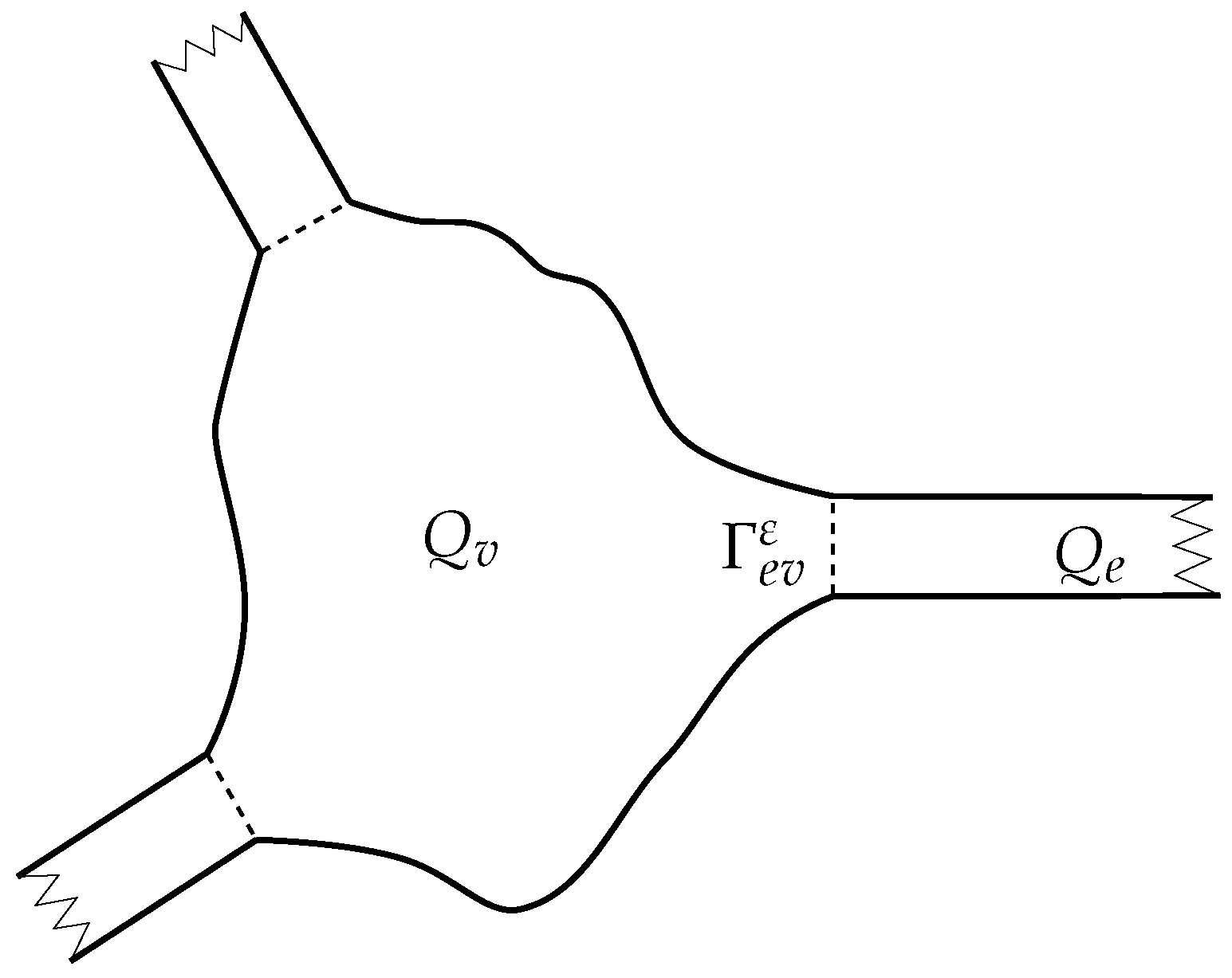
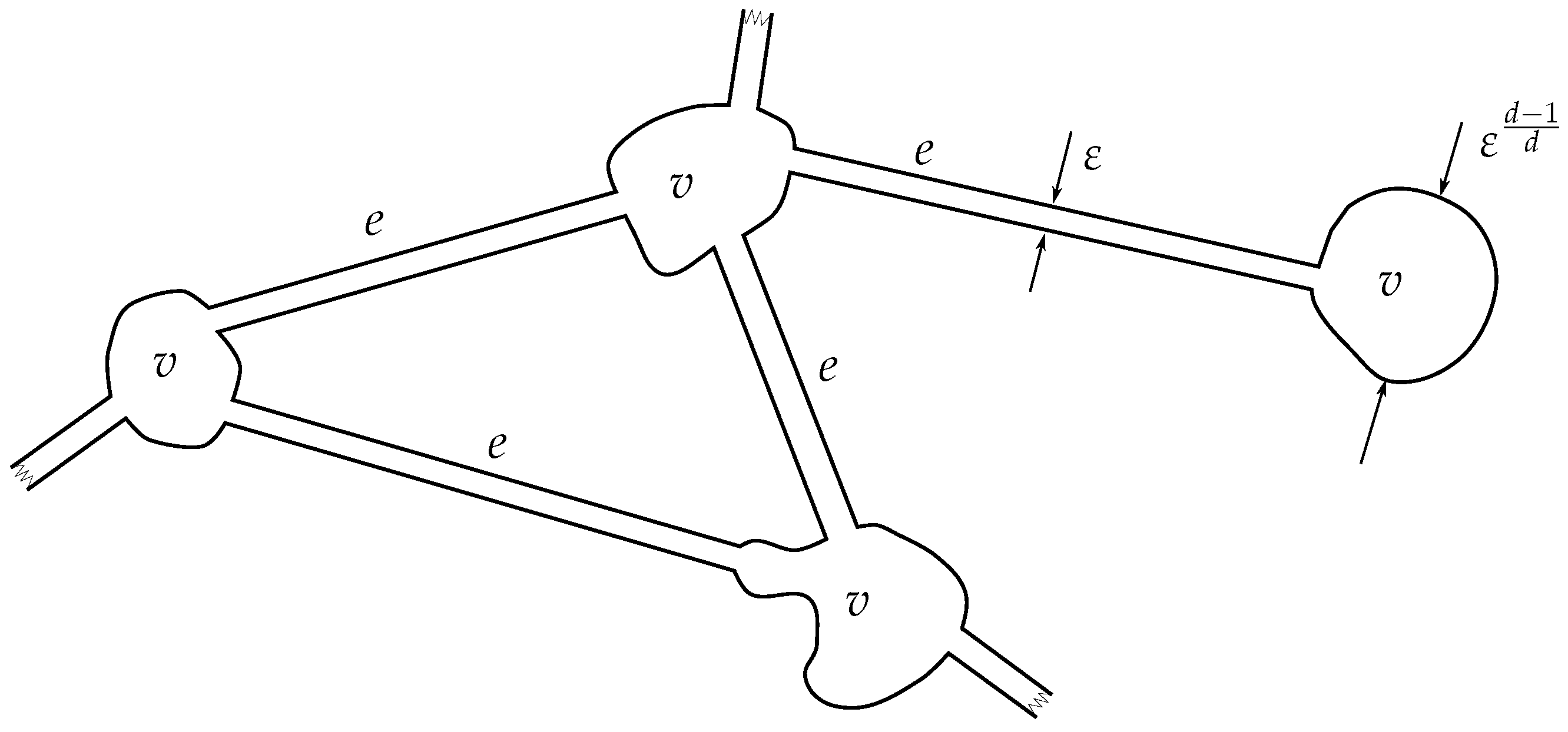
Figure 1. Here,
represents the “thickness” of the manifolds in those parts where they converge to the graph edges. The named works attacked the question of spectral (and, in the case of [
1], norm-resolvent) convergence of such partial differential operators to a graph Laplacian with certain matching conditions at the graph vertices. This latter ordinary differential operator is introduced as follows. Denoting by
E the set of edges
e of the limiting graph
each
can be identified with the interval
where
is the length of
e. We use notation
for the associated Hilbert space
Similarly, we denote
. The graph Laplacian
is generated by the differential expression
on each edge
separately (see [
5] for details), subject to the vertex conditions discussed below.
It was proved in [
2,
3,
4] that, within any compact
the spectra of
converge in the Hausdorff sense to the spectrum of a graph Laplacian
. In the book [
1], the claimed convergence was enhanced to the norm-resolvent type, with an explicit control of the error as
where
depends on whether the ambient space is two-dimensional. The matching conditions at the vertices of the limiting graph turn out to be any one of the following:
- (i)
Kirchhoff (i.e., standard) if the vertex volumes are decaying, as faster than the edge volumes;
- (ii)
“Resonant”, which can be equivalently described in terms of
-type matching conditions with coupling constants proportional to the spectral parameter
see [
2,
3], if the vertex and edge volumes are of the same order;
- (iii)
“Dirichlet-decoupled” (i.e., the graph Laplacian becomes completely decoupled) if the vertex volumes vanish slower than the edge ones.
We also refer the reader to the frequently overlooked papers [
6,
7], where an alternative approach to the asymptotic analysis of thin networks, aimed at capturing the resonant and scattering features, is developed; see also the references therein. In the present paper we consider the case of scalar PDEs, although our approach can be immediately generalised to the case of PDE systems, in particular, in the context of thin elastic structures with applications to, e.g., pentamodes (see [
8,
9]) by utilising the results of [
10].
In the present paper, we are primarily interested in the most non-trivial resonant case (ii). We provide a straightforward, alternative to [
1], proof of the fact that the Neumann Laplacians
in this case converge in a norm-resolvent sense to a linear operator acting in the Hilbert space
, where
N is the number of vertices. The mentioned limiting operator is in fact the one first pointed out in [
4] as a self-adjoint operator whose spectrum coincides with the Hausdorff limit of spectra for the family
.
On the technical side, our approach can be seen as a modification of the one developed by us in [
10,
11]; see also [
12,
13,
14]. We specifically point out that the framework originally developed for high-contrast homogenisation admits a natural generalisation to setups where the “contrast” is achieved by purely geometric means, including (but not limited to) thin networks, as in the present paper. This seems to widen significantly the range of dimension-reduction-type models that are amenable to this kind of analysis and thus to establish a transparent connection between previously unrelated physical contexts, providing for a possibility to develop new types of media in materials science.
We obtain a better error bound than [
1] (Section 6.7) (and skip a visit to the “plumber’s shop” of [
1,
15]). Our estimate in the planar case is
and in the case of
it is
Unlike that of [
1], our method does not allow us to study the full set of asymptotic regimes in (iii). This is due to the fact that the argument of our paper [
11] is based on the Dirichlet-to-Neumann (DN) machinery. There is a possibility to modify the approach by invoking Neumann-to-Dirichlet maps instead, which would have two advantages: one could consider all rates of vertex volume decay in (iii), and certain geometric smoothness requirements could be somewhat relaxed. Nevertheless, in this paper we stick with the DN version of the approach in order to align the exposition with that of [
11]. The alternative strategy will be followed up elsewhere, both in the present context and in the setting of [
11].
The above results of course imply the Hausdorff spectral convergence, at the same time yielding a sharp estimate on its rate. Moreover, in contrast to [
1], our approach allows one to consider “high-frequency” regimes, i.e., setups where the spectral parameter (which in the wave propagation context may represent the square of the frequency) is no longer constrained to a compact set but is still constrained by some negative power of the small parameter
. (In non-dimensional terms this corresponds to the wavelength being of the order of some positive power of
). This leads to a sequence of “effective”, dimensionally reduced, models of the thin structure, which are sequentially applicable for a set of (asymptotic) frequency intervals. The complexity of the dimension reduction process for these models increases along the sequence. While an initial result regarding the high-frequency situation is presented below (which suffices to reveal a metamaterial in a periodic thin network of [
16]), we postpone the full analysis to a future publication.
Alongside the high-frequency analysis, yet another sequence of models will be revealed by a version of the same argument. This corresponds to the transition from the resonant regime to the Dirichet-decoupled one and will allow us to reconcile the asymptotic analysis of [
1] with that of [
7] by introducing “transitional” models of increasing complexity. In these transitional regimes, from the point of view of [
1], one gets arbitrarily close to the Dirichlet-decoupled situation, see (iii) above, whereas from the point of view of [
7] (where the vertex volumes do not decay at all), one faces a highly non-trivial picture of resonant scattering.
Aiming at better clarity, in the present paper we restrict ourselves to the case where (without much loss of generality) the edge subdomains are assumed straight and uniformly thin, whereas the vertex subdomains are smooth with, possibly, the exception of the points where they meet the edges (see
Section 2 for further details). These assumptions appear very natural in view of the possible examples shown in
Figure 1 and
Figure 2.
The ultimate section of the paper is dedicated to the spectral analysis of the effective graph Laplacian. We show that effective matching conditions at graph vertices, having been commonly treated as impedance type (namely, linear in the spectral parameter), are in fact of
type after an application of a unitary gauge. This latter, however, introduces constant magnetic potentials on the edges of the limit graph. It is notable that the presence of such a magnetic field leads to a phase transition to a medium exhibiting double-negative metamaterial properties; see [
16]. This observation will permit us to construct thin periodic networks with negative group velocity without the need for an external magnetic field, by relying instead on the resonant geometric properties of the network.
2. Problem Setup and Preliminaries
In what follows, we consider a prototypical setup only, which already presents all the challenges appearing in the general case. We also refer the reader to [
1], where the most general setup is meticulously introduced.
For the limiting graph, the following notation will be used: the metric graph G will be identified with the set of edges E, so each individual edge is denoted by and is associated with an interval . We denote by V the set of graph vertices and treat each as the set of edge endpoints meeting at v. The graph G is assumed to be oriented throughout.
Proceeding to the setup for the Neumann Laplacian on a thin-graph-convergent structure, let a connected (open) domain
Q be the union of the “vertex” part
, the “edge” part
, and the interface boundary
between the two, where
will be assumed to be a finite collection of
-thin cylinders (for
rectangular boxes),
of lengths
For each
e, the domain
is assumed to be, up to a linear spatial transform (i.e., shift and rotation), defined by (for
)
In dimensions the set is defined as the direct product of the interval and a smooth cross-section of volume
It is further assumed that , where each of the disjoint domains is connected and has piecewise smooth boundary which can be decomposed as , where is the interface between the vertex and edge domains and is the remaining part of Henceforth, we often drop the dependence on in the notation for those geometric elements where it can be removed by a rescaling or is otherwise irrelevant in the analysis to follow.
The contact part
is further decomposed into a union of flat plates (for
straight segments):
. Here, the union is taken over all edge domains
connected to
so that
. In what follows, we will refer to the segments
as
contact plates. Since operators of Zaremba (or mixed) boundary value problem [
17] will be used below, we further require that the contact plates
meet
at angles strictly less than
; see [
18,
19] for further details. We will further assume that the curves
are smooth.
Furthermore, we assume that for all vertices
v the domains
have volumes of order
and are obtained by suitable transformations of an
-independent domain
containing the origin. More precisely, we assume that for all
v and
one has
where
and the domain
is obtained from
by a suitable homeomorphism
that (a) preserves volume and (b) maintains the angles between the contact plates and the adjacent parts of the boundary to be uniformly less than
cf. [
17,
18].
For example, if is star-shaped with respect to the origin (recall that a domain is said to be star-shaped with respect to if for all one has ), the deformation can be constructed by “cut-and-glue surgery” applied to followed by a suitable “radial” scaling, as follows. The domain is first split into several conical (sectorial for ) subdomains by making cuts alongside the cone “generatrices” (“radii” for ) from the origin to the boundary points (endpoints for ) of all subsets of pertaining to the contact plates of Each cone is then transformed by a suitable change of variable so that (A) the images of the cone bases pertaining to the contact plates of have linear size and (B) the image of the complementary part of is reattached to the lateral boundaries of the cones in A. Note that this procedure in general changes the domain volume by a small quantity. In order to restore the volume, a suitable “radial” scaling (centred at the origin) is applied, ensuring that it does not affect any of the mentioned conical subsets.
We remark that the representation (
1) guarantees that we are in the “resonant” (or “borderline”) case of [
2,
3], i.e., that the volumes of the contact plates are proportional to the volumes of vertex domains.
The requirement that the homeomorphism
in (
1) be volume preserving is not essential and can be removed, as long as the ratios of the volumes of the vertex domains to the volumes of the contact plates are bounded below. In this case, the corresponding final convergence estimates, similar to those we derive below (see Theorem 3), will in general depend on the said ratios, as is evident from the Formula (
14).
On the domain
Q, we consider a family of self-adjoint operators
defined by their sesquilinear forms and corresponding to the differential expression
subject to Neumann boundary conditions. Other types of boundary conditions can be considered as well, including those of Robin and Dirichlet [
6,
20], in which case the lower edge of the spectrum is
-dependent, which in the context of homogenisation corresponds to the so-called high-frequency regime or, using the terminology of M. S. Birman, to “the neighbourhood of the edge of a gap” [
21,
22].
Consider
and an arbitrary non-negative function
such that
as
where
for
and
otherwise. In what follows, we will deal with the family of resolvents
. We shall always assume that
is separated from the spectrum of the original operator family. In particular cases, we will assume that either
z is constrained to the
-growing compact set
where
denotes the ball of radius
centered at the origin, or
In particular, for all small enough, one has After we have established the operator-norm asymptotics of for the result is extended by analyticity to a compact set whose distance to the spectrum of the leading order of the asymptotics is bounded below by , and the same statement holds in the case of
Proceeding similarly to, e.g., [
23] in the related area of critical-contrast homogenisation and facilitated by the abstract framework of [
24], we consider
as operators of transmission problems (see [
25] and references therein) relative to the
internal boundary The transmission problem is formulated as, given a function
, finding the weak solution
of the boundary value problem
Here,
,
for all admissible
e and
v (i.e., when
), and
n represents the exterior normal on
and the “edge-inward" normal (i.e., directed from
to
) on any of contact plates
By a classical argument, the solution of the above problem is shown to be equal to
. Note that the boundary value problem for the Neumann Laplacian on
Q is given by the first and third lines in (
2). While the second line is, strictly speaking, redundant, it proves important in order to view the problem as a transmission one relative to
It remains to be seen that the linear operator of the transmission problem (
2) defined via the technique in [
24], which we briefly recall below, is the same operator
; the proof of this fact follows easily by combining [
24] and the main estimate of [
25].
Following the approach of [
24] (cf. [
26,
27] and references therein for alternative approaches), which is based on the ideas of the classical Birman–Kreĭn–Višik theory (see [
28,
29,
30]), the linear operator of the transmission boundary value problem is introduced as follows. Let
, and consider the harmonic lift operators
and
defined on
via
subject to Neumann boundary conditions on
. These operators are first defined on
, in which case the corresponding solutions
can be seen as classical [
17]. The results of [
18] allow one to extend both harmonic lifts to bounded (in fact, compact) operators on
, in which case
are to be treated as distributional solutions of the respective boundary value problems. The solution operator
is defined as follows:
Consider the self-adjoint operator family
(choosing not to reflect the
-dependence in the notation) to be the Dirichlet decoupling of the operator family
, i.e., the operator of the boundary value problem on both
and
, where the Dirichlet boundary conditions are imposed on
together with Neumann boundary conditions on
. The operator
is generated by the same differential expression as
. Clearly, one has
relative to the orthogonal decomposition
; all three operators
and
are self-adjoint and positive-definite. Moreover, by [
18,
31] there exists a bounded inverse
. Note that
see [
24].
Furthermore, denoting by and the left inverse of and respectively, one introduces the trace operator (respectively, ) as the null extension of (respectively, ) to the domain (respectively, ). In the same way, we introduce the operator and its null extension to the domain .
The solution operators
,
of the boundary value problems
are defined as linear mappings from
to
, respectively. These operators are bounded from
to
and
, respectively, and admit the following representations:
The solution operator from to is now defined as ; it admits the representation and is bounded.
Having introduced orthogonal projections
and
from
onto
and
, respectively, one has the obvious identities
Fix self-adjoint (and, in general, unbounded) operators
,
defined on domains
(in what follows these operators will be chosen as DN maps of Zaremba problems on
and
, respectively, and well-defined on
, where
is the standard Sobolev space pertaining to the internal boundary
). Still following [
24], we define the “second boundary operators”
and
to be linear operators on the domains
The action of
is set by:
for all
,
and
,
, respectively.
Alongside
, introduce a self-adjoint operator
on
and then the following “boundary” operator
We remark that the operators thus defined are assumed to be neither closed nor indeed closable.
In our setup, we make the following concrete choice of the operators
: in what follows, they are the DN maps pertaining to the components
and
, respectively. More precisely, for the problem
the operator
maps the boundary values
of
to the negative traces of its normal derivative
where
is as above the “edge-inward” normal. This operator is well defined by its sesquilinear form as a self-adjoint operator on
(see, e.g., [
32,
33]), and
by [
18]. The above definition is inspired by [
24]. Note that the operator thus defined is negative the classical
map of, e.g., [
23].
On the vertex part
, we consider the problem
and define
as the operator mapping the boundary values
of
to the negative traces of its normal derivative
, where
is again the “edge-inward” normal. The self-adjointness of
on
follows by an unchanged argument.
Finally we introduce the operator
which on
is the sum
. It is also a self-adjoint operator on
. This can be ascertained either by the argument of [
25], in which case it is defined as the inverse of a compact self-adjoint operator on the orthogonal complement to constants
, extended to
by zero or, alternatively, from its definition by a closed sesquilinear form.
The choice of
made above allows us to consider
on the domain
. One then writes [
24] the second Green identity in the following form:
for all
, where the operator
A is the null extension (see [
34]) of the operator
onto
. Thus the triple
is closely related to a boundary quasi-triple of [
26] (see also [
35]) for the transmission problem considered; cf. [
27] for an alternative approach.
The calculation of
in [
24] shows that
and therefore
as introduced above acts as follows:
where
and
are the orthogonal projections of
onto
,
, respectively. Therefore, transmission problem at hand (at least, formally so far) corresponds to the interface (or “matching”) condition
.
Definition 1 ([
24])
. The operator-valued function defined on the domain for (and in particular, for ) by the formulais referred to as the M-function of the problem (2). The following result of [
24] summarises the properties of the
-function which we will need in what follows.
Proposition 1 ([
24], Theorem 3.3)
. 1. One has the following representation:2. is an analytic operator-function with values in the set of closed operators in densely defined on the z-independent domain .
3. For the operator is bounded andIn particular, and . 4. For , the following formula holds: Alongside
we define
and
which pertain to the vertex
and edge
parts of the domain
respectively, by the formulae
As before, in the notation we suppress the dependence on the parameter for brevity.
The value of the fact that for
one has
is clear: in contrast to
which cannot be additively decomposed into “independent” terms pertaining to the vertex and edge parts of the medium
Q owing to the transmission interface conditions on
the
M-function is additive (see, e.g., [
11,
36], where this property was observed and exploited in the related settings of homogenisation and scattering, respectively). In what follows, we will observe that the resolvent
can be expressed in terms of
via a version of the celebrated Kreĭn formula, thus reducing the asymptotic analysis of the resolvent to that of the corresponding
M-function (see, e.g., [
26,
37] for alternative approaches to derivation of the Kreĭn formula in our setting).
Alongside the transmission problem (
2), the boundary conditions of which can be now (so far, formally) represented as
,
, in what follows we will require a wider class of problems of this type. This class is formally given by the transmission conditions
where
is a bounded operator on
and
is a linear operator defined on the domain
.
In general, the operator
is not defined on the domain
. This problem is being taken care of by the following assumption, which will be satisfied throughout:
We remark that by Proposition 1 the operators are then closable for all , and the domains of their closures coincide with .
For any
, the equality
shows that the operator
is correctly defined on
. Denoting
with the domain
, one checks that
is a Hilbert space with respect to the norm
It is then proved [
24] (Lemma 4.1) that
extends to a bounded operator from
to
For the sake of convenience, same notation
is preserved for this extension.
We will make use of the following version of the celebrated Kreĭn formula.
Proposition 2 ([
24], Theorem 5.1)
. Let be such that the operator defined on is boundedly invertible. Thenis the resolvent of a closed densely defined operator with the domain In particular, the (self-adjoint) operator of the transmission problem (
2), which corresponds to the choice
, admits the following characterisation in terms of its resolvent:
In this case, one clearly has and which, together with the discussion at the beginning of this section, yields .
We remark that the operators
and
above can be assumed
z-dependent, as this change does not impact the corresponding proofs of [
24]. In this case, however, the corresponding operator-function
is shown to be the resolvent of a
z-dependent operator family. Within the self-adjoint setup of the present paper,
is guaranteed to represent a generalised resolvent in the sense of [
38,
39,
40].
3. Auxiliary Estimates
In this section, we collect a number of auxiliary statements required in our proof of the main result.
We start with the analysis of the operators
and
introduced in
Section 2. First, we note that each of these operators admits a decomposition into an orthogonal sum over
N vertex domains
of
Q. It therefore suffices to consider a single vertex domain
(we recall for readers’ convenience that the volume of this domain is assumed to be decaying with
). Its boundary
contains a disjoint set of straight segments belonging to the internal boundary
which are, in line with what has been said above, denoted as
; the union of the latter is
.
The decoupled operator
has
as its invariant subspace. We will denote by
its self-adjoint restriction,
. By construction, the operator
is the Laplacian with the so-called Zaremba, or mixed Neumann–Dirichlet, boundary condition [
17,
41]. More precisely, it is subject to the Dirichlet boundary condition on
and to Neumann boundary condition on its complement
. Clearly, this operator is boundedly invertible; moreover, the following statement holds.
Proposition 3 (see [
31,
42])
. There exists a constant such that for all ε one haswhere, as before, for and otherwise. Remark 1. The above proposition holds under more general conditions than those we impose. Namely, the domain is only required to be Lipschitz and no conditions whatsoever are imposed on the geometry of the set .
Next, we turn our attention to the solution operator
and the corresponding harmonic lift
. The two are clearly related by the formula
In order to bound the norm of
, we can follow, e.g., the following approach. First, consider the corresponding Zaremba problem on
. We proceed by relating the norm of the corresponding Poisson operator to the least Steklov eigenvalue of the bi-Laplacian, following the blueprint of [
43], based in turn on Fichera’s duality principle; see [
44]. Since the boundary of
is non-smooth, in doing so we follow the generalisations developed in [
45,
46], with obvious modifications required when passing from the Dirichlet to Zaremba setup. The estimate for the said Steklov eigenvalue is then taken from the norm of the compact embedding of
to the traces of normal derivatives on the contact plates; see, e.g., [
47]. Rescaling back to
, we obtain the following auxiliary result.
Lemma 1. There exists such that for all
By Proposition 3, the above lemma yields the following estimate for the solution operator
Lemma 2. For uniformly in (and, in particular, for ) one haswhere the error bounds are understood in the uniform operator norm topology. Our next step is the analysis of the “part” of the DN map pertaining to the vertex domain . We will denote by its self-adjoint restriction
First, we note that the spectrum of
(which can be termed as the Steklov spectrum of the sloshing problem pertaining to
; see [
48]) is discrete and accumulates to negative infinity. The point
is the least (by absolute value) Steklov eigenvalue with
being the corresponding eigenvector. For the second eigenvalue
, one has the following estimate; see, e.g., [
32] and references therein.
Lemma 3. There exists such that
Introduce the
N-dimensional orthogonal projection
define
and consider the operator
which is well defined since
By a straightforward estimate for sesquilinear forms, see [
11] (Section 3.2), and taking into account (
4) applied to
and combined with Proposition 3 as well as Lemmata 1, 3, one has the following statement.
Lemma 4. There exists such that for all one haswhere the operator is considered as a linear (unbounded) operator in . We conclude this section by noting that, alternatively, one can derive the bound on the Poisson operator
claimed in Lemma 1 by employing the scaling property of the Dirichlet-to-Neumann map
similar to the argument of [
32] referenced above, combined with a standard estimate on the solutions to the classical Neumann problem.
4. Norm-Resolvent Asymptotics
We will make use of the Kreĭn Formula (
7) to obtain a norm-resolvent asymptotics of the family
. In doing so, we will compute the asymptotics of
based on a Schur–Frobenius-type inversion formula, having first rewritten
as a
operator matrix relative to the orthogonal decomposition of the Hilbert space
. In the study of operator matrices, we rely upon the material of [
49]; see also references therein.
The operator
admits the block matrix representation
For the inversion of
, we then use the Schur–Frobenius inversion formula [
49] (Theorem 2.3.3)
Note that by Proposition 1, one has
Moreover, since
one has
and therefore, for some constants
for all
where we have used the fact that the operator
is bounded below by a positive constant. It follows that
is bounded.
Proceeding exactly as in [
11] based on the estimate provided by Lemma 4 which now reads
we use
to obtain
.
Returning to (
8), one obtains
with a uniform estimate for the remainder term. Comparing our result with (
6) of Proposition 2 with
and
, one arrives at the following.
Theorem 1. There exists such that for all and (in partucular, for all ) one has the estimatefor a universal constant C and , , where the operator is defined in Proposition 2. Proof. The proof is identical to that of [
11] (Theorem 3.1); we include it here for the sake of completeness. For the resolvent
, the Formula (
7) is applicable, in which for
we use (
9). As for the resolvent
Proposition 2 with
is clearly applicable. Moreover, for this choice of
the operator
in (
6) is easily computable (e.g., by the Schur–Frobenius inversion formula of [
49], see (
8)). The mentioned computation is facilitated by the fact that
is triangular (
in (
8)) with respect to the decomposition
, yielding
and the claim follows. □
Already the estimate of Theorem 1 establishes norm-resolvent convergence of the family
to an operator which by (
10) is a relative (i.e., with respect to the difference of resolvents) finite-rank perturbation of the decoupled operator
. However, in the case
which we will assume henceforth, it is possible to obtain a further simplification of this answer, relating the leading-order asymptotic term to a self-adjoint operator on the limiting metric graph. This procedure follows the blueprint of our paper [
11]. We next briefly outline the related argument. For the case of
z not constrained to a compact, a similar argument yields a sequence of dimensionally reduced models, as mentioned in the Introduction.
Note first that
is easily analysed. Indeed, by Proposition 3 one has
Furthermore, the operator
by separation of variables, is
-close to the Dirichlet Laplacian on the space
where
is the normalised constant function in the variable transverse to the edge
e.
We remark that this is the only place where we use the assumption about the geometric shape of the edge parts
of the thin structure. This can be generalised to the setup of [
1], allowing for curvature and non-uniform thickness, leading to Laplace–Beltrami operators on the edges of the limiting graph.
The operator
is therefore close, uniformly in
, to an operator that is unitary equivalent to the resolvent of
, where
is the Dirichlet-decoupled graph Laplacian pertaining to the graph
G. The related error estimates are the same as in (
11). The finite-dimensional second term on the right-hand side of (
10) is therefore expected to encode the matching conditions at the vertices of the limiting graph
G. In order to see this, one passes over to the generalised resolvent
, which is shown to admit the following asymptotics.
Theorem 2. The operator family admits the following asymptotics in the operator-norm topology for :where is the solution operator for the following spectral BVP on the edge domain :with , and . The boundary condition in (12) can be written in the more conventional form Equivalently,where for any fixed is the operator in defined by Proposition 2 relative to the triple , where the term “triple" is understood in the sense of [24]. This operator is maximal anti-dissipative for and maximal dissipative for see [40]. The
proof of the theorem follows immediately from Theorem 1; see [
11] (Theorem 3.6), together with the observation that
The next step of our argument is to introduce the truncated (reduced) boundary space in order to make all the ingredients finite-dimensional. In view of clarity, in what follows we consistently supply the (finite-dimensional) “truncated” spaces and operators pertaining to them by the breve overscript.
We put
(noting that in our setup
is
N-dimensional, where
N is the number of vertices; see
Section 2). Introduce the truncated Poisson operator on
by
and the truncated DN map
Then, the following statement holds.
Proposition 4 ([
11], Theorem 3.7)
. 1. The formulaholds, where is the solution operator of the problemand is the M-operator defined in accordance with (3), (5) relative to the triple .2. The “effective” generalised resolvent is represented as the generalised resolvent of the problem 3. The triple is the classical boundary triple [50,51] for the operator defined by the differential expression on the domain Here, and are defined on as the operator of the boundary trace on Γ and respectively. We now consider the operator
in (
13); since
by definition, we invoke the estimates derived in
Section 3 to obtain
with a uniform estimate for the remainder term. Here, the truncated Poisson operator
is introduced as
relative to the same truncated boundary space as above,
. As a result, we obtain
with
By a classical result of [
40] (see also [
38,
39]), the operator
is a generalised resolvent, so it defines a
z-dependent family of closed densely defined operators in
which are maximal anti-dissipative for
and maximal dissipative for
. Writing the resolvent
in the matrix form relative to the orthogonal decomposition
then yields the following result.
Theorem 3. The resolvent admits the following asymptotics in the uniform operator-norm topology:where the operator has the following representation relative to the decomposition : Here, with , , and the generalised resolvent is defined by (14). The above theorem provides us with the simplest possible leading-order term of the asymptotic expansion for However, it is not yet obvious whether it is the resolvent of some self-adjoint operator in the space It turns out that this is indeed so, which is seen via the following explicit construction.
Put
,
. For all
denote by
the limit of
at the vertex
v. Let
and set
where
is the
N-dimensional vector of
and
is the diagonal matrix
The action of the operator is set by
where
is the
N-dimensional vector
, i.e., the vector for which each element is represented by the sum of edge-inward normal derivatives of the function
u over all the edges incident to the vertex
v. We write
if and only if the edge
e is incident to the vertex
v.
The main result of the present work, which is obtained by computing explicitly the resolvent of (
16)–(
18) and comparing it with (
15) (see details of a similar computation in [
13]), is formulated next.
Theorem 4. The resolvent admits the following estimate in the uniform operator norm topology, uniform in :where Θ is a partial isometry from onto , acting as follows: For every edge , , it embeds into as where y is the variable in the direction transverse to that of x;
For every vertex , it embeds the value , i.e., the common value of at the vertex v, into as .
5. Analysis of Vertex Matching Conditions
In the present section, we continue our study of the operator (
16)–(
18) associated with an arbitrary metric graph
G, with a view to analyse its spectral structure. We will show that the matching conditions at graph vertices associated with the spectral problem for the mentioned operator, albeit closely resembling
-type conditions with coupling constants linear in the spectral parameter
can be in fact represented (up to a unitary gauge) by
-type matching conditions for all
(while for
they coincide with the classical Kirchhoff condition). We will assume throughout that this graph contains no loops, in line with the assumptions imposed on the thin network studied above. We will further assume without loss of generality that the graph
G is connected and that the matrix
is invertible.
Since the operator
can be viewed as a self-adjoint out-of-space extension (see, e.g., [
52] and references therein) of a symmetric differential operator on the metric graph
G, it is amenable to the classical boundary triples theory; see [
53,
54]. We recall that for a closed and densely defined symmetric operator
on a separable Hilbert space
H with domain
, a boundary triple is defined as follows.
Definition 2 ([
55])
. A triple consisting of an auxiliary Hilbert space and linear mappings defined everywhere on is called a boundary triple
for if the following conditions are satisfied:- (1)
The abstract Green’s formula is valid - (2)
For any there exist , such that , . In other words, the mapping from to is surjective.
It can be shown (see [
55]) that a boundary triple for
exists, although it is not unique.
Definition 3. Let be a boundary triple of . The Weyl function
of corresponding to and denoted by , , is an analytic operator-function with a positive imaginary part for (i.e., an operator R-function) with values in the algebra of bounded operators on such that For one has and .
A comparison with the assertion 4 of Proposition 1 shows that the Weyl function in the context of the boundary triples theory is intimately related to the object introduced in Definition 1. The overall setup leading to its construction is, however, different and is based on the explicit choice of the boundary operators and .
Definition 4. An extension of a closed densely defined symmetric operator is called almost solvable
and is denoted by if there exist a boundary triple for and a bounded operator defined everywhere in such that This definition implies that
and
is a restriction of
to the linear set
. In this context, the operator
B plays the rôle of a parameter for the family of extensions
. It can be shown (see [
36] for references) that the resolvent set of
is non-empty (i.e.,
is maximal), both
and
are restrictions of
to their domains, and
and
B are self-adjont or dissipative simultaneously.
Under the additional assumption that
is
simple (or, in other words, completely non-self-adjoint), that is, it has no reducing self-adjoint “parts”, the spectrum of
coincides, counting multiplicities, with the set of points
into which
does not admit analytic continuation. In the general case, however, the spectrum is a union of the “zeroes” of the operator-valued function
introduced above and the spectrum of the self-adjoint “part” of the symmetric operator
in its Wold decomposition [
56].
Our immediate aim is to construct a convenient boundary triple for the operator
. In doing so, we rely upon the framework (in a particular case of a loop-graph with exactly one vertex) of the paper [
57].
We define the symmetric operator
as follows (cf. (
16)):
where
is, as above, the
N-dimensional vector of
,
is the diagonal matrix (
17), and
is the
N-dimensional vector of
. The action of the operator
is set by (
18). The operator thus defined is clearly symmetric in
; its adjoint
is defined by the same expression (
18) on the domain
We have the following lemma.
Lemma 5. Let , , and . The triple is a boundary triple for the operator The operator is a self-adjoint almost solvable extension of , corresponding to the matrix with respect to this boundary triple.
The
proof of the above lemma is obtained via integration by parts; for details, see [
57].
We shall further require two ordinary differential operators on the metric graph
G together with their boundary triples. Consider
to be the operator generated by the negative Laplacian
on
, defined on the domain
In the paper [
58], it is shown that this is a natural choice of a maximal operator if one seeks to consider the so-called
-type matching conditions at the graph vertices, i.e., matching conditions of the type
where
is a diagonal matrix. The conditions (
20) reduce to Kirchhoff, or standard, matching conditions under the choice
. The natural boundary triple for
is
where
,
and
. The corresponding Weyl function (“
M-matrix”) admits the form [
58]
, where
Here,
is such that
Next, we consider the
magnetic Laplacian on the graph
G subject to
-type matching at the vertices. Namely, we assume that for all edges
e the action of the operator is described as
where
is an edgewise-constant magnetic potential. In order to introduce
-type matching, consider the co-normal derivatives
We say that the magnetic Laplacian on
G is subject to
-type matching at the vertices if
where
and
denote the vectors
and
respectively.
By an argument similar to that of [
58], see also [
13], one easily checks that
is a boundary triple for the magnetic Laplacian
defined on
if
,
, and, finally,
. The corresponding
M-matrix
admits the form [
58]
Here such that and if e is directed from v to , otherwise.
We will now fix the values of the magnetic potential as follows:
. The operator
corresponding to this choice will be henceforth denoted by
. Its
M-matrix
relative to the triple
admits the form
which coincides with (
21) up to the factor
. We remark that the operator
and any of its self-adjoint restrictions can be unitary transformed into a regular (non-magnetic) Laplacian on the same graph
G by a standard gauge transform; this will, however, be reflected in the corresponding change of matching conditions at the vertices. Motivated by applications to electromagnetic wave propagation [
16], here we prefer to proceed with the magnetic setup.
Returning to the analysis of the operator , we now have the following lemma.
Lemma 6. Relative to the boundary triple of Lemma 5, the Weyl M-matrix of the operator admits the form Proof. In view of Lemma 5, consider the vector
such that
By the definition of
one equivalently has
Abbreviating
, one therefore has, in view of the definition of
(see Lemma 5):
Furthermore, taking now into account the definition of the second boundary operator
, one has
Note that the function
u, by the definition of
, must be continuous at every
and therefore belongs to the domain of the operator
. Therefore,
and thus one has
By construction, one has
and
, whence
Ultimately,
as claimed. □
Let
denote the orthogonal operator spectral measure of the self-adjoint operator
and
the orthogonal spectral measure of the self-adjoint operator
, where the latter is defined as the almost solvable extension of
corresponding to the parameterising operator
. In other words, it is the magnetic Laplacian on the graph
G subject to the condition
for all
and
-type matching conditions (
23) at the graph vertices with
. We have the following statement.
Theorem 5. For any , the operators and are unitary equivalent.
Proof. In the generic case when is simple (in particular when all are rationally independent), the claim follows immediately from Lemma 6. Indeed, in this case no positive z can be an eigenvalue of the operator and the same applies to the operator . Therefore, any reducing self-adjoint “part” of either symmetric operator can only be zero. In the general case, if is an eigenvalue of , then the corresponding eigenfunction solves on G subject to and therefore . Thus, any eigenfunction must be of the form on each e; moreover, one must also have for all e such that and . For each of these, the function that is edgewise transformed as is shown to be an eigenfunction of corresponding to the eigenvalue . The same argument applied in the opposite direction completes the proof. □
Remark 2. The analysis of the unitary equivalence linking and is an exciting possible development from the point of view of classical functional analysis, since it appears to be a natural graph-based generalisation of the classical Hilbert transform. This can be seen, in particular, from the explicit calculation in the case of an infinite chain graph [14]. The above theorem shows that the spectral analysis of the operator
in relation to its non-zero spectrum reduces to that of the magnetic graph Laplacian with (non-trivial)
-type matching condition at the graph vertices, which could come as a surprise given that the eigenvalue problem for
yields, for the first component of the eigenvector
the equation
on
G subject to
which on the face of it is a
-type matching condition, albeit with coupling constants proportional to the spectral parameter
z. It would seem natural, therefore, for the self-adjoint operator
to be a
singular perturbation of the graph Laplacian with standard boundary conditions. Instead, our result shows that it is in fact a more singular
perturbation. The underlying reasons of this peculiar behaviour are discussed in detail in [
59], where the relationship of operators of the class considered with those in the area of zero-range potentials with internal structure, as introduced by B. S. Pavlov [
60,
61], is explained. We also point out that the assertion of Theorem 5 has been observed in a particular case of the cycle graph with one vertex (the loop) in [
14] in the context of a high-contrast homogenisation problem on the real line.
We conclude the spectral analysis of the operator by a brief discussion of its kernel and the comparison of the latter with that of the operator . It turns out that, unlike what happens with its non-zero spectrum, the kernel of the operator is that of the Kirchhoff graph Laplacian.
Note first that
necessarily belongs to the non-simple (i.e., self-adjoint) part of
. Indeed, for
it has to satisfy
where the boundary conditions are equivalent to
,
. On the other hand, this is precisely the condition for
u to be in the kernel of a graph Laplacian with Kirchhoff matching conditions. One therefore infers from [
5] that
(in our case of connected graphs), and the elements of
are constants on
G.
The kernel of
is spanned by functions
u such that
It is easily checked that a non-trivial solution to this problem could exist only if or, in other words, if . This means that, precisely as in the case of , the kernel of necessarily belongs to the non-simple (i.e., self-adjoint) part of the symmetric operator . The question of its existence and dimension admits a simple answer in terms of the graph topology. It is clear that it is trivial in the case when G is a tree; in general, its dimension is shown to be equal to the cyclomatic number of the graph G. In particular, this yields unitary equivalence of and in the case where G contains exactly one cycle.
Remark 3. The result of the present section seems to have been overlooked in a number of now-classical papers dealing with Sturm–Liouville problems on an interval with boundary conditions depending on a spectral parameter; see, e.g., [62,63,64,65,66,67]. Conjecture 1. The above discussion raises the question of which definition of -type interaction on a graph is motivated physically, i.e., whether it is the one emerging from the analysis of thin networks as the operator see (16)–(18), or the traditional (see [5]) definition (22)–(23). At first sight, the difference between the two operators is insignificant: it is only in their kernels. However, it can happen to be of paramount importance if, e.g., one considers an -periodic graph with -type matching conditions, in which case the homogenisation procedure [11,12] will lead to drastically different outcomes for the two related setups, as it relies upon a “threshold effect” [68] in the behaviour of the least eigenvalue of the operator on the fundamental cell for small quasimomenta.